研究论文

γ-氨基丁酸对热应激黄羽肉鸡生长性能、器官指数、血清生化指标及肠道形态的影响

  • 郭长征 , 1 ,
  • 陈静龙 1 ,
  • 雷闯闯 1 ,
  • 胡艳 1 ,
  • 朱沛霁 2 ,
  • 施寿荣 , 1, *
展开
  • 1 江苏省家禽科学研究所,扬州 225125
  • 2 江苏立华牧业股份有限公司,常州 213168
* 施寿荣,研究员,博士生导师,E-mail:

郭长征(1992—),男,河南濮阳人,助理研究员,博士,研究方向为动物营养与饲料科学。E-mail:

Office editor: 武海龙

收稿日期: 2023-11-09

  网络出版日期: 2024-05-15

基金资助

江苏省自然科学基金青年基金项目(BK20220706)

江苏省自然科学基金青年基金项目(BK20230728)

Effects of γ-Aminobutyric Acid on Growth Performance, Organ Indexes, Serum Biochemical Indicators and Intestinal Morphology of Yellow-Feathered Broiler Chickens under Heat Stress

  • GUO Changzheng , 1 ,
  • CHEN Jinglong 1 ,
  • LEI Chuangchuang 1 ,
  • HU Yan 1 ,
  • ZHU Peiji 2 ,
  • SHI Shourong , 1, *
Expand
  • 1 Jiangsu Institute of Poultry Sciences, Yangzhou 225125, China
  • 2 Jiangsu Lihua Animal Husbandry Co., Ltd., Changzhou 213168, China
* professor, E-mail:

Received date: 2023-11-09

  Online published: 2024-05-15

摘要

本试验旨在探究γ-氨基丁酸对热应激黄羽肉鸡生长性能、器官指数、血清生化指标及肠道形态的影响。选取体重相近的144只35日龄雄性青脚麻鸡,随机分为3组,每组6个重复,每个重复8只。3组分别为常温对照组(CON组)、热应激处理组(HS组)和热应激处理+γ-氨基丁酸组(GABA组)。CON和HS组饲喂基础饲粮,GABA组在基础饲粮中添加100 mg/kg的γ-氨基丁酸。预试期1周,正试期2周。结果表明:1)与CON组相比,HS组的56日龄体重、平均日增重和平均日采食量极显著降低(P<0.01),料重比显著升高(P<0.05);与HS组相比,GABA组的56日龄体重、平均日增重和平均日采食量显著升高(P<0.05)。2)与CON组相比,HS组的肝脏、脾脏、胸肌和胸腺指数显著降低(P<0.05);与HS组相比,GABA组的肝脏和脾脏指数显著升高(P<0.05)。3)与CON组相比,HS组的第3天、第7天、第10天和第14天直肠温度极显著升高(P<0.01);与HS组相比,GABA组的第7天、第10天和14天直肠温度极显著降低(P<0.01)。4)与CON组相比,HS组的血清甘油三酯和钾含量显著降低(P<0.05),血清白蛋白含量极显著降低(P<0.01),血清钠、皮质酮含量和谷草转氨酶活性极显著升高(P<0.01);与HS组相比,GABA组的血清皮质酮含量显著降低(P<0.05),血清谷草转氨酶活性极显著降低(P<0.01)。5)与CON组相比,HS组的空肠绒毛高度显著降低(P<0.05);与HS组相比,GABA组的空肠绒毛高度和绒毛高度/隐窝深度显著升高(P<0.05)。综上所述,热应激处理导致黄羽肉鸡生长性能下降、器官发育受损、体温升高和营养物质吸收利用能力降低;饲粮中添加γ-氨基丁酸具有缓解黄羽肉鸡热应激、改善生长性能的作用。

本文引用格式

郭长征 , 陈静龙 , 雷闯闯 , 胡艳 , 朱沛霁 , 施寿荣 . γ-氨基丁酸对热应激黄羽肉鸡生长性能、器官指数、血清生化指标及肠道形态的影响[J]. 动物营养学报, 2024 , 36(5) : 2938 -2947 . DOI: 10.12418/CJAN2024.252

Abstract

The present study aimed to explore the effects of γ-aminobutyric acid on growth performance, organ indexes, serum biochemical indicators and intestinal morphology of yellow-feathered broiler chickens under heat stress. A total of 144 thirty-five-day-old male green-footed hemp chickens with similar body weights were randomly divided into 3 groups with 6 replicates in each group and 8 birds in each replicate. The 3 groups were the ordinary temperature control group (CON group), heat stress treatment group (HS group) and heat stress treatment+γ-aminobutyric acid group (GABA group). The CON and HS groups were fed a basal diet, and the GABA group was fed the basal diet supplemented with 100 mg/kg γ-aminobutyric acid. The results showed as follows: 1) compared with the CON group, the body weight at 56 days of age, average daily weight gain and average daily feed intake of HS group were significantly decreased (P<0.01), and the feed to gain ratio was significantly increased (P<0.05); compared with the HS group, the body weight at 56 days of age, average daily weight gain and average daily feed intake of GABA group were significantly increased (P<0.05). 2) Compared with the CON group, the liver, spleen, breast muscle and thymus indexes of HS group were significantly decreased (P<0.05); compared with the HS group, the liver and spleen indexes of GABA group were significantly increased (P<0.05). 3) Compared with the CON group, the rectal temperature on day 3, day 7, day 10 and day 14 of HS group was significantly increased (P<0.01); compared with the HS group, the rectal temperature on day 7, day 10 and day 14 of GABA group was significantly decreased (P<0.01). 4) Compared with the CON group, the contents of triglycerides and potassium in serum of HS group were significantly decreased (P<0.05), the serum albumin content was significantly decreased (P<0.01), and the serum sodium, cortisol contents and aspartate aminotransferase activity were significantly increased (P<0.01); compared with the HS group, the serum corticosterone content of GABA group was significantly decreased (P<0.05), and the serum aspartate aminotransferase activity was significantly decreased (P<0.01). 5) Compared with the CON group, the jejunal villus height of HS group was significantly decreased (P<0.05); compared with the HS group, the jejunal villus height and villus height/crypt depth of GABA group was significantly increased (P<0.05). In summary, heat stress treatment leads to the growth performance decrease, organ development damage, body temperature increase and nutrient absorption and utilization capacity reduce of yellow-feathered broiler chickens; dietary γ-aminobutyric acid has the effect of alleviating heat stress and improving growth performance of yellow-feathered broiler chickens.

热应激是严重影响家禽业的环境因素之一,当环境温度超过家禽的等热范围(16~26 ℃)[1-2]或当个体产生的热量超过其散热能力时[3],就会发生热应激。热应激引起动物呼吸频率加快、食欲降低、生长性能下降,甚至死亡,给家禽业造成重大经济损失。黄羽肉鸡是我国家禽业中的特色产业,2022年黄羽肉鸡出栏量占我国肉鸡出栏量的38%,在我国家禽业中具有举足轻重的地位。但是,黄羽肉鸡主要以农户地面散养为主,环境控制差,且养殖区域主要集中在我国南方地区,因此,黄羽肉鸡在夏季更易发生热应激[4]。目前家禽热应激的研究主要以白羽肉鸡为主,在黄羽肉鸡方面的研究较少。此外,现有研究多采用单一高温诱导持续热应激,与实际生产中的温度变化情况不符,可能导致研究结果缺乏一定的参考价值。因此,通过环境控制仓模拟夏季的环境温度变化,探究循环热应激条件下黄羽肉鸡的营养调控措施十分必要。
γ-氨基丁酸是一种重要的神经递质,广泛存在于动物的神经系统中。它参与调节机体多种功能,包括镇静、记忆和睡眠,具有抗惊厥、降低血压、调节呼吸和食欲以及抗应激等功能[5]。γ-氨基丁酸已初步应用于动物生产中,对于提高动物的采食量、生长性能、抗氧化能力和抗应激能力具有良好的效果[6]。研究表明,热应激会降低爱拔益加(AA)肉鸡血清γ-氨基丁酸含量以及采食量和体重,而饲粮中添加γ-氨基丁酸可改善热应激AA肉鸡的血清γ-氨基丁酸含量和体重[7],提示热应激条件下γ-氨基丁酸含量降低可能是导致肉鸡采食量下降的因素之一。在黄羽肉鸡上,γ-氨基丁酸可以缓解热应激对雏鸡胰腺的损伤,提高雏鸡胰腺组织中消化酶活性,增强抗氧化能力,减少细胞凋亡[8]。γ-氨基丁酸也可降低夏季热应激淮南麻黄鸡的直肠温度,抑制下丘脑-垂体-肾上腺轴激素分泌,缓解热应激[9]。此外,视前区-下丘脑前部被认为是整合源自身体不同部位的热信号进而参与体温调节的主要场所[10]。在大鼠上的研究表明,γ-氨基丁酸作为下丘脑中主要的抑制性神经递质,在寒冷环境温度下解除抑制产热和抑制热损失,在炎热环境温度下抑制产热[11]。因此,γ-氨基丁酸在热应激条件下可能同时具有提高采食量和缓解体温升高的作用。基于此,本研究旨在探究热应激处理对黄羽肉鸡生长性能、体温、器官指数、血清生化指标和肠道形态的影响,以及γ-氨基丁酸的缓解作用,为γ-氨基丁酸在肉鸡生产中的应用提供理论依据。

1 材料与方法

1.1 试验设计

选择体重相近的144只35日龄雄性青脚麻鸡(购自江苏立华牧业股份有限公司),随机分为3组,每组6个重复,每重复8只。3组分别为常温对照组(CON组),热应激处理组(HS组)和热应激处理+γ-氨基丁酸组(GABA组)。CON和HS组饲喂基础饲粮,GABA组在基础饲粮中添加100 mg/kg的γ-氨基丁酸(纯度≥98%)。试验在江苏省家禽科学研究所仪征基地进行,预试期1周,正试期2周。在正试期,对照组维持常温[(26±1) ℃],HS组和GABA组进行循环热应激处理,设置程序为:00:00—06:00和20:00—00:00,(31±1) ℃,共10 h;06:00—10:00和16:00—20:00,(33±1) ℃,共8 h;10:00—16:00,(34±1) ℃,共6 h。基础饲粮组成及营养水平见表1
表1 基础饲粮组成及营养水平(风干基础)

Table 1 Composition and nutrient levels of the basal diet (air-dry basis) %

项目Items 含量Content
原料Ingredients
玉米Corn 69.37
豆粕Soybean meal 20.00
玉米蛋白粉Corn gluten meal 5.00
大豆油Soybean oil 3.03
石粉Limestone 0.96
磷酸氢钙CaHPO4 0.52
蛋氨酸Met 0.15
赖氨酸Lys 0.29
苏氨酸Thr 0.02
精氨酸Arg 0.01
植酸酶Phytase 0.02
氯化胆碱Choline chloride 0.10
微量元素预混料Trace mineral premix1) 0.20
维生素预混料Vitamin premix2) 0.03
氯化钠NaCl 0.30
合计Total 100.00
营养水平Nutrient levels3)
代谢能ME/(MJ/kg) 13.18
粗蛋白质CP 17.00
钙Ca 0.55
总磷TP 0.42
有效磷AP 0.22
赖氨酸Lys 0.87
蛋氨酸Met 0.48

1)微量元素预混料为每千克饲粮提供 Trace mineral premix provided the following per kg of diet:Mn 60 mg,I 0.35 mg,Fe 25 mg,Cu 8 mg,Zn 50 mg。

2)维生素预混料为每千克饲粮提供 Vitamin premix provided the following per kg of diet:VA 4 000 IU,VD3 1 600 IU,VK3 1.5 mg,VB1 1.0 mg,VB2 3.0 mg,VB6 3.0 mg,VB12 0.005 mg,泛酸 pantothenic acid 8.0 mg,烟酸 nicotinic acid 20 mg,叶酸 folic acid 20 mg。

3)代谢能和有效磷为计算值,粗蛋白质、钙、总磷、氨基酸(赖氨酸和蛋氨酸)为实测值。ME and AP were calculated values, while CP, Ca, TP and amino acids (Lys and Met) were measured values.

1.2 饲养管理

试验在动物营养代谢环控仓(北京库蓝科技有限公司)进行,采用3层笼养,鸡笼规格为100 cm×80 cm×45 cm,试验期间自由采食和饮水,相对湿度维持在(60±5)%,定期清理粪便,24 h光照。试验期间记录采食量、体重和肛温等。

1.3 样品采集

试验结束称重后,每个重复挑选1只接近平均体重的试验鸡,用促凝管采集翅下静脉血液,3 000 r/min离心10 min收集血清,用于血清生化指标和皮质酮含量检测。
试验鸡处死后,采集肝脏、脾脏、胸腺、法氏囊等称重,用于计算器官指数(器官指数=100×器官重/活重);采集中间部位的空肠组织,剪取一小段在冰的磷酸盐缓冲液(PBS)中刷洗3次后,固定在4%多聚甲醛溶液中,用于组织形态学分析。

1.4 指标测定与方法

饲粮中粗蛋白质、钙、总磷、氨基酸(赖氨酸和蛋氨酸)含量测定分别依据GB/T 6432—2018、GB/T 6436—2018、GB/T 6437—2018、GB/T 18246—2019。代谢能参照《中国饲料成分及营养价值表》(2022年第33版)计算。
试验开始和结束时称量试验鸡的体重,每日记录采食量,并计算试验期的平均日增重、平均日采食量和料重比。
在正试期第1、3、7、10和14天14:00,从每个重复中随机选取1只试验鸡,测定直肠温度。
使用全自动血液生化分析仪测定血清谷丙转氨酶、谷草转氨酶、乳酸脱氢酶活性及白蛋白、葡萄糖、尿酸、总胆固醇、甘油三酯、低密度脂蛋白、钾、钠、氯、钙含量。
使用酶联免疫吸附试验(ELISA)试剂盒测定血清皮质酮含量,试剂盒购自武汉伊莱瑞特生物科技股份有限公司。
取固定在4%多聚甲醛溶液中的空肠组织,制作石蜡切片,测量绒毛高度和隐窝深度,测量方法参照孙大明等[12]的报道。

1.5 数据处理与统计分析

试验数据经Excel 2010初步整理后,应用SPSS 25.0统计软件进行t检验(CON组vs HS组和HS组 vs GABA组),结果以平均值±标准误表示,P<0.05为差异显著,P<0.01为差异极显著。

2 结果

2.1 γ-氨基丁酸对热应激黄羽肉鸡生长性能的影响

图1可见,在试验开始时,3组黄羽肉鸡的42日龄体重无显著差异(P>0.05)。试验结束时,与CON组相比,HS组黄羽肉鸡的56日龄体重、平均日增重和平均日采食量极显著降低(P<0.01),料重比显著升高(P<0.05);与HS组相比,GABA组黄羽肉鸡的56日龄体重、平均日增重和平均日采食量显著升高(P<0.05),料重比无显著差异(P>0.05)。
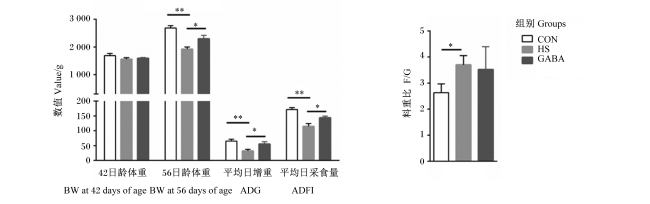
图1 γ-氨基丁酸对热应激黄羽肉鸡生长性能的影响

*表示差异显著(P<0.05),**表示差异极显著(P<0.01)。下图同。

Fig.1 Effects of GABA on growth performance of yellow-feathered broiler chickens under heat stress

* mean significant difference (P<0.05), and ** mean extremely significant difference (P<0.01). The same as below.

2.2 γ-氨基丁酸对热应激黄羽肉鸡器官指数的影响

图2可见,与CON组相比,HS组黄羽肉鸡的肝脏、脾脏、胸肌和胸腺指数显著降低(P<0.05),腹脂和法氏囊指数无显著差异(P>0.05);与HS组相比,GABA组黄羽肉鸡的肝脏和脾脏指数显著升高(P<0.05),腹脂、胸肌、法氏囊和胸腺指数无显著差异(P>0.05)。
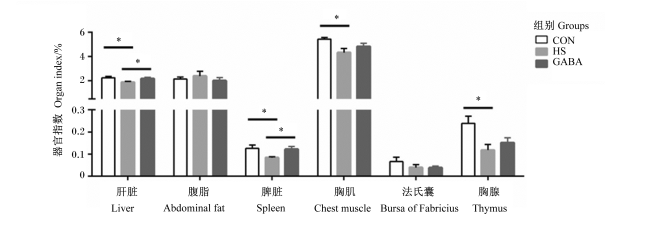
图2 γ-氨基丁酸对热应激黄羽肉鸡器官指数的影响

Fig.2 Effects of GABA on organ indexes of yellow-feathered broiler chickens under heat stress

2.3 γ-氨基丁酸对热应激黄羽肉鸡直肠温度的影响

图3可见,与CON组相比,HS组黄羽肉鸡的第3天、第7天、第10天和第14天直肠温度极显著升高(P<0.01),第1天直肠温度无显著差异(P>0.05);与HS组相比,GABA组黄羽肉鸡的第7天、第10天和14天直肠温度极显著降低(P<0.01),第1天和第3天直肠温度无显著差异(P>0.05)。
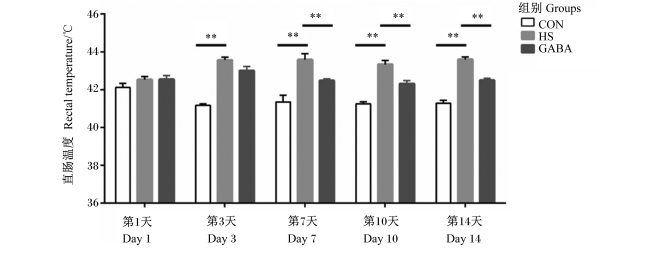
图3 γ-氨基丁酸对热应激黄羽肉鸡直肠温度的影响

Fig.3 Effects of GABA on rectal temperature of yellow-feathered broiler chickens under heat stress

2.4 γ-氨基丁酸对热应激黄羽肉鸡血清生化指标、肝功能指标和皮质酮含量的影响

图4可见,与CON组相比,HS组黄羽肉鸡的血清甘油三酯和钾含量显著降低(P<0.05),血清白蛋白含量极显著降低(P<0.01),血清钠含量极显著升高(P<0.01),血清葡萄糖、尿酸、总胆固醇、高密度脂蛋白、低密度脂蛋白、氯和钙含量均无显著差异(P>0.05);与HS组相比,GABA组黄羽肉鸡的血清生化指标均无显著差异(P>0.05)。
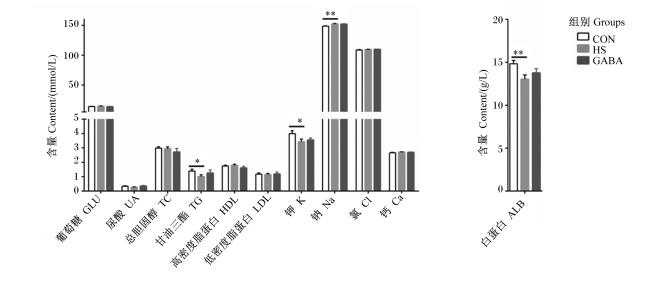
图4 γ-氨基丁酸对热应激黄羽肉鸡血清生化指标的影响

Fig.4 Effects of GABA on serum biochemical indicators of yellow-feathered broiler chickens under heat stress

图5可见,与CON组相比,HS组黄羽肉鸡的血清谷草转氨酶活性极显著升高(P<0.01),血清谷丙转氨酶和乳酸脱氢酶活性无显著差异(P>0.05);与HS组相比,GABA组黄羽肉鸡的血清谷草转氨酶活性极显著降低(P<0.01),血清谷丙转氨酶和乳酸脱氢酶活性无显著差异(P>0.05)。
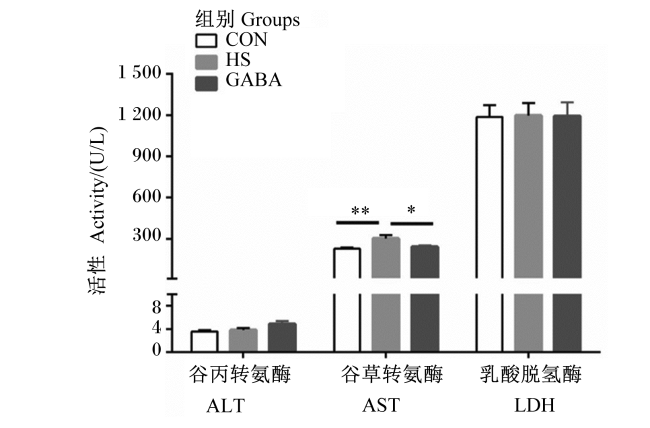
图5 γ-氨基丁酸对热应激黄羽肉鸡血清肝功能指标的影响

Fig.5 Effects of GABA on serum liver function indicators of yellow-feathered broiler chickens under heat stress

图6可见,与CON组相比,HS组黄羽肉鸡的血清皮质酮含量极显著升高(P<0.01);与HS组相比,GABA组黄羽肉鸡的血清皮质酮含量显著降低(P<0.05)。
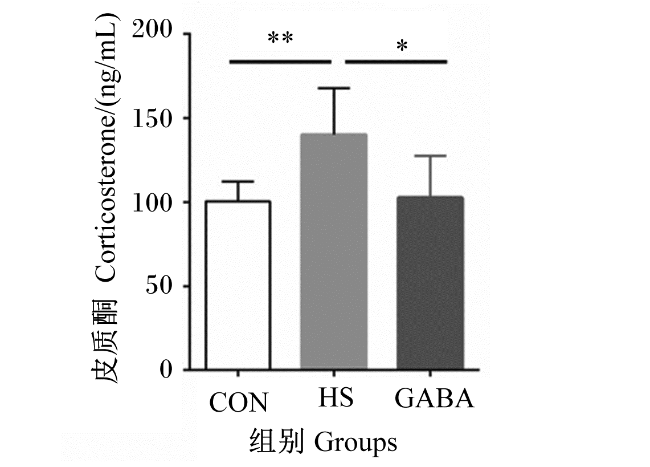
图6 γ-氨基丁酸对热应激黄羽肉鸡血清皮质酮含量的影响

Fig.6 Effects of GABA on serum corticosterone content of yellow-feathered broiler chickens under heat stress

2.5 γ-氨基丁酸对热应激黄羽肉鸡空肠上皮形态的影响

表2可见,与CON组相比,HS组黄羽肉鸡的空肠绒毛高度显著降低(P<0.05),空肠隐窝深度和绒毛高度/隐窝深度无显著差异(P>0.05);与HS组相比,GABA组黄羽肉鸡的空肠绒毛高度和绒毛高度/隐窝深度显著升高(P<0.05),空肠隐窝深度无显著差异(P>0.05)。
表2 γ-氨基丁酸对热应激黄羽肉鸡空肠上皮形态的影响

Table 2 Effects of GABA on jejunal epithelial morphology of yellow-feathered broiler chickens under heat stress

项目
Items
组别groups PP-value
CON HS GABA CON组vs HS组
CON group vs
HS group
HS组vs GABA组
HS group vs
GABA group
绒毛高度
Villus height/μm
1 630.70±56.14 1 314.08±99.69 1 661.18±58.12 0.028 0.013
隐窝深度
Crypt depth/μm
222.86±55.50 175.20±22.42 167.85±19.56 0.416 0.810
绒毛高度/隐窝深度
Villus height/crypt depth
9.11±1.32 8.51±0.51 11.01±0.95 0.661 0.042

3 讨论

3.1 γ-氨基丁酸对热应激黄羽肉鸡生长性能的影响

热应激是严重影响家禽业的环境因素之一,可导致肉鸡采食量和体重减少,料重比增加[13]。本试验研究发现,热应激处理降低了黄羽肉鸡的体重、平均日增重和平均日采食量,提高了料重比。这与以往研究结果一致,肉鸡在面临高温时适应性地通过减少采食量进而减少代谢所产生的热量,以缓解体温升高[14]。虽然减少采食量有助于适应高温环境,但也造成了生长性能下降等不利影响。同时,本试验研究显示,饲粮中添加γ-氨基丁酸逆转了热应激处理导致的采食量和体重下降,但对料重比无显著影响。这说明GABA是通过改善高温引起的食欲降低,进而提高体重,而不是通过提高饲料转化效率。Chand等[15]在饲粮中添加γ-氨基丁酸提高了罗斯308肉鸡的采食量和体重;Hu等[7]研究显示,饲粮中添加γ-氨基丁酸提高了AA肉鸡的体重。有研究指出,γ-氨基丁酸能够逆转热应激导致的采食量降低,其原因在于它可以抑制厌食神经肽的表达并上调促食欲神经肽的表达[16]

3.2 γ-氨基丁酸对热应激黄羽肉鸡器官指数的影响

器官指数是反映器官发育状况的重要参数。本试验研究发现,热应激处理降低了黄羽肉鸡的肝脏、脾脏、胸肌和胸腺指数。肉鸡的肝脏作为最大的代谢和解毒器官,非常容易受到应激源的影响,从而破坏肝脏和整个系统的代谢稳态[17]。本试验血清肝功能指标结果也发现,热应激提高了血清谷草转氨酶活性。Ding等[18]研究也显示,热应激处理降低了肝脏重量并引起肝脏炎症。脾脏和胸腺是肉鸡重要的免疫器官,其器官指数降低表明热应激损害了黄羽肉鸡的免疫器官发育,这可能与生产上热应激导致肉鸡死亡率增加有关。这与Tang等[19]的研究结果一致,即热应激处理导致文昌鸡的免疫器官指数降低。本研究同时发现,热应激处理降低了黄羽肉鸡的胸肌指数,这可能与热应激导致的采食量下降,进而发生蛋白质动员有关[20]。此外,本试验研究发现,γ-氨基丁酸提高了热应激处理导致的部分器官(肝脏和脾脏)指数降低和血清谷草转氨酶活性升高,表明γ-氨基丁酸能在一定程度上逆转热应激对肉鸡器官发育的损害[19]。研究表明,虽然γ-氨基丁酸是中枢神经系统中的抑制性神经递质,但是γ-氨基丁酸也可与其受体结合,通过信号传导机制直接作用于中枢神经系统之外的组织,如保护肝脏[21],这可能是本研究中γ-氨基丁酸能逆转热应激导致的血清谷草转氨酶含量升高的原因。

3.3 γ-氨基丁酸对热应激黄羽肉鸡直肠温度的影响

直肠温度通常被用作反映肉鸡热应激状况的标志[17,22-23]。本试验中,热应激处理提高了试验期第3天至第14天黄羽肉鸡的直肠温度,表明本试验较好地模拟了夏季高温情况,建立了黄羽肉鸡热应激模型。此外,本试验发现,γ-氨基丁酸能改善热应激导致的直肠温度升高,与前人研究报道[17,24]一致,这可能与γ-氨基丁酸对体温具有调控作用[11],并在炎热环境中具有降低热量产生的作用有关[25]

3.4 γ-氨基丁酸对热应激黄羽肉鸡血清生化指标和皮质酮含量的影响

血清生化指标能反映机体的生理状态和健康状况等信息[26]。本试验研究发现,热应激处理降低了血清甘油三酯、白蛋白和钾含量,提高了血清钠含量。前人研究表明,热应激条件下,采食量下降会进一步影响肉鸡的蛋白质代谢和脂质代谢。例如,甘油三酯是通过饲粮或通过肝脏内源合成获得的,热应激会导致肉鸡血清甘油三酯含量降低[27]。Huang等[28]研究也发现,热应激处理降低了肉鸡血清白蛋白含量。此外,热应激还会引起酸碱平衡发生变化,导致呼吸性碱中毒的发生[29]。本试验中,热应激处理降低了血清钾含量,提高了血清钠含量,表明热应激损害了黄羽肉鸡的酸碱平衡。
家禽的应激反应主要是由下丘脑-垂体-肾上腺轴和正交感神经系统的激活引起的。此前报道表明,热应激会激活肉鸡下丘脑-垂体-肾上腺轴而导致血清皮质酮含量升高[30]。本试验研究发现,热应激提高了血清皮质酮含量,而γ-氨基丁酸缓解了热应激引起的血清皮质酮含量升高。

3.5 γ-氨基丁酸对热应激黄羽肉鸡空肠上皮形态的影响

肠道损伤是热应激的重要表现之一,绒毛高度、隐窝深度和绒毛高度/隐窝深度是评估肠道健康和营养物质吸收状况的关键指标[31]。绒毛高度越高,肠道黏膜表面积越大,与营养物质接触越充分,利于营养物质的吸收[32]。隐窝深度越浅,肠上皮细胞成熟率越高,吸收功能越强[31]。本试验研究发现,热应激处理降低了黄羽肉鸡空肠的绒毛高度,而γ-氨基丁酸能缓解热应激导致的黄羽肉鸡空肠绒毛高度降低。Song等[33]研究也显示,热应激处理导致肉鸡空肠绒毛高度降低,隐窝深度变浅,绒毛高度/隐窝深度降低,原因可能是肉鸡在高温环境下会产生过量的氧自由基,对肠黏膜造成严重损害[34]。此外,以往研究表明,γ-氨基丁酸可能通过保护肉鸡的绒毛高度和隐窝深度来减轻高温环境对肉鸡肠道的损伤,从而起到改善营养物质吸收的作用[6,16,35]。有学者指出,γ-氨基丁酸的这些作用可能与谷胱甘肽过氧化物酶活性的增加有关,进而减少热应激条件下肉鸡体内氧自由基的形成[36]

4 结论

热应激处理导致黄羽肉鸡生长性能下降、器官发育受损、直肠温度升高和营养物质吸收利用能力降低;饲粮中添加γ-氨基丁酸可降低黄羽肉鸡的直肠温度和应激反应,改善肝脏功能和肠道上皮形态,缓解黄羽肉鸡热应激,并且具有提高生长性能的作用。
[1]
陆壮. 慢性热应激对肉鸡糖脂代谢的影响及牛磺酸的缓解作用研究[D]. 博士学位论文. 南京: 南京农业大学, 2019.

LU Z. Effects of chronic heat stress on the glucose and lipid metabolism in broilers and the alleviative effects of taurine[D]. Ph.D.Thesis. Nanjing: Nanjing Agricultural University, 2019. (in Chinese)

[2]
DIARRA S S, TABUACIRI P. Feeding management of poultry in high environmental temperatures[J]. International Journal of Poultry Science, 2014, 13(11):657-661.

[3]
AKBARIAN A, MICHIELS J, DEGROOTE J, et al. Association between heat stress and oxidative stress in poultry;mitochondrial dysfunction and dietary interventions with phytochemicals[J]. Journal of Animal Science and Biotechnology, 2016, 7:37.

[4]
钟光, 邵丹, 施寿荣, 等. 循环热应激对黄羽肉鸡呼吸机能、生长性能和肝脏抗氧化功能的影响[J]. 动物营养学报, 2018, 30(3):947-952.

ZHONG G, SHAO D, SHI S R, et al. Effects of cyclic heat stress on breathing function,growth performance and liver antioxidant function of yellow-feathered broilers[J]. Chinese Journal of Animal Nutrition, 2018, 30(3):947-952. (in Chinese)

[5]
BONGIANNI F, MUTOLO D, NARDONE F, et al. GABAergic and glycinergic inhibitory mechanisms in the lamprey respiratory control[J]. Brain Research, 2006, 1090(1):134-145.

PMID

[6]
CHEN Z, XIE J, HU M Y, et al. Protective effects of γ-aminobutyric acid (GABA) on the small intestinal mucosa in heat-stressed Wenchang chicken[J]. The Journal of Animal & Plant Sciences, 2015, 25(1):78-87.

[7]
HU H, BAI X, SHAH A A, et al. Dietary supplementation with glutamine and γ-aminobutyric acid improves growth performance and serum parameters in 22- to 35-day-old broilers exposed to hot environment[J]. Journal of Animal Physiology and Animal Nutrition, 2016, 100(2):361-370.

DOI PMID

[8]
温静, 余哲琪, 田佳迎, 等. γ-氨基丁酸对热应激雏鸡胰腺组织结构、抗氧化能力、消化酶活性及细胞凋亡的影响[J]. 动物营养学报, 2021, 33(5):2927-2938.

DOI

WEN J, YU Z Q, TIAN J Y, et al. Effects of γ-aminobutyric acid on pancreatic tissue structure,antioxidant capacity,digestive enzyme activities and cell apoptosis of heat-stressed chicks[J]. Chinese Journal of Animal Nutrition, 2021, 33(5):2927-2938. (in Chinese)

[9]
骞守法, 姜丹, 马玉莹, 等. γ-氨基丁酸对夏季热应激鸡下丘脑-垂体-肾上腺轴的调控作用[J]. 动物营养学报, 2019, 31(6):2625-2633.

QIAN S F, JIANG D, MA Y Y, et al. Regulation of γ-aminobutyric acid on hypothalamic-pituitary-adrenal axis of heat-stressed chickens in summer[J]. Chinese Journal of Animal Nutrition, 2019, 31(6):2625-2633. (in Chinese)

[10]
NAKAYAMA T. Thermosensitive neurons in the brain[J]. The Japanese Journal of Physiology, 1985, 35(3):375-389.

[11]
ISHIWATA T, SAITO T, HASEGAWA H, et al. Changes of body temperature and thermoregulatory responses of freely moving rats during GABAergic pharmacological stimulation to the preoptic area and anterior hypothalamus in several ambient temperatures[J]. Brain Research, 2005, 1048(1/2):32-40.

[12]
孙大明, 殷雨洋, 吴建良, 等. 早期补饲粉状精料和颗粒料对羔羊生长性能及胃肠道发育的影响[J]. 草业学报, 2020, 29(7):184-192.

DOI

SUN D M, YIN Y Y, WU J L, et al. Effect of early mashed and pelleted concentrate starter supplementation on animal performance and development of the gastrointestinal tract in lambs[J]. Acta Prataculturae Sinica, 2020, 29(7):184-192. (in Chinese)

[13]
SOHAIL M U, HUME M, BYRD J A, et al. Effect of supplementation of prebiotic mannan-oligosaccharides and probiotic mixture on growth performance of broilers subjected to chronic heat stress[J]. Poultry Science, 2012, 91(9):2235-2240.

DOI PMID

[14]
NILSSON J Å, MOLOKWU M N, OLSSON O. Body temperature regulation in hot environments[J]. PLoS One, 2016, 11(8):e0161481.

[15]
CHAND N, MUHAMMAD S, KHAN R U, et al. Ameliorative effect of synthetic γ-aminobutyric acid (GABA) on performance traits,antioxidant status and immune response in broiler exposed to cyclic heat stress[J]. Environmental Science and Pollution Research International, 2016, 23(23):23930-23935.

[16]
AL WAKEEL R A, SHUKRY M, ABDEL AZEEZ A, et al. Alleviation by gamma amino butyric acid supplementation of chronic heat stress-induced degenerative changes in jejunum in commercial broiler chickens[J]. Stress, 2017, 20(6):562-572.

DOI PMID

[17]
CHEN Z, TIAN R F, SHE Z G, et al. Role of oxidative stress in the pathogenesis of nonalcoholic fatty liver disease[J]. Free Radical Biology & Medicine, 2020, 152:116-141.

[18]
DING K N, LU M H, GUO Y N, et al. Resveratrol relieves chronic heat stress-induced liver oxidative damage in broilers by activating the Nrf2-Keap1 signaling pathway[J]. Ecotoxicology and Environmental Safety, 2023, 249:114411.

[19]
TANG J, CHEN Z. The protective effect of γ-aminobutyric acid on the development of immune function in chickens under heat stress[J]. Journal of Animal Physiology and Animal Nutrition, 2016, 100(4):768-777.

DOI PMID

[20]
MA B B, HE X F, LU Z, et al. Chronic heat stress affects muscle hypertrophy,muscle protein synthesis and uptake of amino acid in broilers via insulin like growth factor-mammalian target of rapamycin signal pathway[J]. Poultry Science, 2018, 97(12):4150-4158.

[21]
WANG S L, SUI S F, LIU Z Y, et al. Protective roles of hepatic gamma-aminobutyric acid signaling in acute ethanol exposure-induced liver injury[J]. Journal of Applied Toxicology, 2018, 38(3):341-350.

DOI PMID

[22]
HE S P, LI S, AROWOLO M A, et al. Effect of resveratrol on growth performance,rectal temperature and serum parameters of yellow-feather broilers under heat stress[J]. Animal Science Journal, 2019, 90(3):401-411.

[23]
EL-NAGGAR K, EL-KASSAS S, ABDO S E, et al. Role of gamma-aminobutyric acid in regulating feed intake in commercial broilers reared under normal and heat stress conditions[J]. Journal of Thermal Biology, 2019, 84:164-175.

DOI PMID

[24]
NCHO C M, GOEL A, GUPTA V, et al. Embryonic manipulations modulate differential expressions of heat shock protein,fatty acid metabolism,and antioxidant-related genes in the liver of heat-stressed broilers[J]. PLoS One, 2022, 17(7):e0269748.

[25]
MIYAZAWA T, KAWABATA T, OKAZAKI K, et al. Oral administration of γ-aminobutyric acid affects heat production in a hot environment in resting humans[J]. Journal of Physiological Anthropology, 2012, 31(1):3.

[26]
KHAN R U, NAZ S, ULLAH H, et al. Physiological dynamics in broiler chickens under heat stress and possible mitigation strategies[J]. Animal Biotechnology, 2023, 34(2):438-447.

[27]
MORAES V M B, MALHEIROS R D, BRUGGEMAN V, et al. Effect of thermal conditioning during embryonic development on aspects of physiological responses of broilers to heat stress[J]. Journal of Thermal Biology, 2003, 28(2):133-140.

[28]
HUANG S C, YANG H P, REHMAN M U, et al. Acute heat stress in broiler chickens and its impact on serum biochemical and electrolyte parameters[J]. Indian Journal of Animal Research, 2018, 52(5):683-686.

[29]
AHMAD T, SARWAR M. Dietary electrolyte balance:implications in heat stressed broilers[J]. World’s Poultry Science Journal, 2006, 62(4):638-653.

[30]
HANAFI S A, ZULKIFLI I, RAMIAH S K, et al. Prenatal thermal stress affects acute-phase proteins,heat shock protein 70,and circulating corticosterone in developing broiler embryos and neonates[J]. Journal of Thermal Biology, 2022, 109:103328.

[31]
DUCATELLE R, GOOSSENS E, DE MEYER F, et al. Biomarkers for monitoring intestinal health in poultry:present status and future perspectives[J]. Veterinary Research, 2018, 49(1):43.

[32]
CASPARY W F. Physiology and pathophysiology of intestinal absorption[J]. The American Journal of Clinical Nutrition, 1992,55 (Suppl.1):299S-308 S.

[33]
SONG J, XIAO K, KE Y L, et al. Effect of a probiotic mixture on intestinal microflora,morphology,and barrier integrity of broilers subjected to heat stress[J]. Poultry Science, 2014, 93(3):581-588.

[34]
TAN G Y, YANG L, FU Y Q, et al. Effects of different acute high ambient temperatures on function of hepatic mitochondrial respiration,antioxidative enzymes,and oxidative injury in broiler chickens[J]. Poultry Science, 2010, 89(1):115-122.

DOI PMID

[35]
MUJAHID A, YOSHIKI Y, AKIBA Y, et al. Superoxide radical production in chicken skeletal muscle induced by acute heat stress[J]. Poultry Science, 2005, 84(2):307-314.

PMID

[36]
CHEN Z, TANG J, SUN Y Q, et al. Protective effect of γ-aminobutyric acid on antioxidation function in intestinal mucosa of Wenchang chicken induced by heat stress[J]. The Journal of Animal & Plant Sciences, 2013, 23(6):1634-1641.

文章导航

/