研究论文

大蒜素对热应激干奶牛被动免疫转移及犊牛血清指标的影响

  • 李志杰 , 1, 2 ,
  • 徐宏建 1, 2, 3 ,
  • 赵志飞 1, 2 ,
  • 朱宽 1, 2 ,
  • 沈宜钊 4 ,
  • 王猛 1, 2 ,
  • 李妍 2, 5 ,
  • 孙凤莉 6 ,
  • 张秀江 7 ,
  • 剧勍 7 ,
  • 王美美 8 ,
  • 马峰涛 1, 2 ,
  • 高艳霞 , 1, 2, 3, 9, * ,
  • 李建国 , 1, 2, 3, 9, *
展开
  • 1 河北农业大学动物科技学院,保定 071001
  • 2 农业农村部奶牛健康养殖重点实验室(部省共建),保定 071001
  • 3 河北省牛羊胚胎技术创新中心,保定 071001
  • 4 山东农业大学动物科技学院,泰安 271000
  • 5 河北农业大学动物医学院,保定 071001
  • 6 河北省畜牧兽医研究所,保定 071000
  • 7 保定市畜牧工作站,保定 071000
  • 8 沧州师范学院生命科学学院,沧州 061001
  • 9 河北省乳制品产业技术研究院,石家庄 050000
*高艳霞,研究员,硕士生导师,E-mail: ;
李建国,教授,博士生导师,E-mail:

李志杰(2000—),男,河北邯郸人,硕士研究生,从事奶牛营养学研究。E-mail:

Copy editor: 田艳明

收稿日期: 2025-04-11

  网络出版日期: 2025-11-14

基金资助

生物农业联合基金重点项目(C2022204248)

国家奶牛产业技术体系(CARS-36-20)

河北省现代农业产业技术体系奶牛创新团队(HBCT2023180207)

河北省高端人才项目(6012018)

Effects of Allicin on Passive Immune Transfer of Dry Dairy Cows under Heat Stress and Serum Indices of Calves

  • LI Zhijie , 1, 2 ,
  • XU Hongjian 1, 2, 3 ,
  • ZHAO Zhifei 1, 2 ,
  • ZHU Kuan 1, 2 ,
  • SHEN Yizhao 4 ,
  • WANG Meng 1, 2 ,
  • LI Yan 2, 5 ,
  • SUN Fengli 6 ,
  • ZHANG Xiujiang 7 ,
  • JU Qing 7 ,
  • WANG Meimei 8 ,
  • MA Fengtao 1, 2 ,
  • GAO Yanxia , 1, 2, 3, 9, * ,
  • LI Jianguo , 1, 2, 3, 9, *
Expand
  • 1 College of Animal Science and Technology, Hebei Agricultural University, Baoding 071001, China
  • 2 Key Laboratory of Healthy Breeding in Dairy Cattle (Co-Construction by Ministry and Province), Ministry of Agriculture and Rural Affairs, Baoding 071001, China
  • 3 Hebei Technology Innovation Center of Cattle and Sheep Embryo, Baoding 071001, China
  • 4 College of Animal Science and Technology, Shandong Agricultural University, Tai'an 271000, China
  • 5 College of Veterinary Medicine, Hebei Agricultural University, Baoding 071001, China
  • 6 Hebei Institute of Animal Husbandry and Veterinary Medicine, Baoding 071000, China
  • 7 Baoding Animal Husbandry Station, Baoding 071000, China
  • 8 College of Life Science, Cangzhou Normal University, Cangzhou 061001, China
  • 9 Hebei Provincial Dairy Industry Technology Research Institute, Shijiazhuang 050000, China
*GAO Yanxia, professor, E-mail: ;
LI Jianguo, professor, E-mail:

Received date: 2025-04-11

  Online published: 2025-11-14

摘要

本试验旨在研究饲粮添加大蒜素对热应激干奶牛被动免疫转移及犊牛血清指标的影响,为缓解干奶期奶牛热应激及改善犊牛健康提供依据。选取60头经产荷斯坦干奶牛[胎次(2.25±0.43),体重(650±43) kg],随机分为4组,每组15个重复,每个重复1头。对照组(CON组)饲喂基础饲粮,试验组分别在基础饲粮的基础上添加3(ALL3组)、6(ALL6组)和9 g/d(ALL9组)大蒜素。预试期14 d,正试期60 d(从产前60 d至分娩当天)。结果表明:1)试验期间,牛舍温湿度指数(THI)平均值为78.1,高于奶牛的耐热阈值;同时,饲粮添加大蒜素对奶牛直肠温度无显著影响(P>0.05),表明奶牛处于热应激状态。2)与CON组相比,ALL3组初乳免疫球蛋白M含量显著提高(P<0.05);随着饲粮中大蒜素添加量的提高,犊牛血清免疫球蛋白G含量呈先升高后降低的二次变化(P<0.05);饲粮添加大蒜素对犊牛初生重和断奶重无显著影响(P>0.05)。3)与CON组相比,ALL3组犊牛血清超氧化物歧化酶和谷胱甘肽过氧化物酶活性显著提高(P<0.05);随着饲粮中大蒜素添加量的提高,犊牛血清白细胞介素-6含量、谷丙转氨酶活性和非酯化脂肪酸含量呈先降低后升高的二次变化(P<0.05)。4)血清代谢组分析表明,大蒜素显著上调了母牛血清胆汁酸相关代谢物(如3-氧代胆酸、熊去氧胆酸)含量(P<0.05),并使代谢物显著富集在胆汁分泌、酪氨酸代谢以及炎症相关通路上(P<0.05)。综上所述,在热应激状态下,干奶牛饲粮添加3 g/d大蒜素虽未缓解热应激状态,但可通过影响母牛血液代谢通路提高初乳免疫球蛋白含量,增强犊牛抗氧化和抗炎能力,改善被动免疫转移。

本文引用格式

李志杰 , 徐宏建 , 赵志飞 , 朱宽 , 沈宜钊 , 王猛 , 李妍 , 孙凤莉 , 张秀江 , 剧勍 , 王美美 , 马峰涛 , 高艳霞 , 李建国 . 大蒜素对热应激干奶牛被动免疫转移及犊牛血清指标的影响[J]. 动物营养学报, 2025 , 37(11) : 7617 -7630 . DOI: 10.12418/CJAN2025.619

Abstract

This experiment aimed to investigate the effects of dietary allicin on passive immune transfer in heat-stressed dry dairy cows and serum indices of calves, providing a basis for alleviating heat stress in dry dairy cows and improving the health of calves. Sixty multiparous Holstein cows with parities of (2.25±0.43) and body weight of (650±43) kg were selected and randomly divided into 4 groups, with 15 replicates in each group and 1 cow in each replicate. Cows in the control group (CON group) were fed a basal diet, while those in the experimental groups were fed the basal diets supplemented with 3 (ALL3 group), 6 (ALL6 group), and 9 g/d (ALL9 group) of allicin, respectively. The pre-trial period was 14 days, and the formal trial period was 60 days (from 60 days before delivery to the day of delivery). The results showed as follows: 1) during the experiment, the average value of temperature-humidity index (THI) in the cowshed was 78.1, which was higher than the heat tolerance threshold of dairy cows; meanwhile, dietary allicin had no significant effect on the rectal temperature of dairy cows (P>0.05), indicating that the dairy cows were in a state of heat stress. 2) Compared with CON group, the immunoglobulin M content in colostrum in ALL3 group were significantly increased (P<0.05); with the increase of allicin addition in the diet, the immunoglobulin G content in serum of calves showed a quadratic change of first increasing and then decreasing (P<0.05); dietary allicin had no significant effect on the birth weight and weaning weight of calves (P>0.05). 3) Compared with CON group, the activities of superoxide dismutase and glutathione peroxidase in serum of calves in ALL3 group were significantly increased (P<0.05); with the increase of allicin addition in the diet, the interleukin-6 content, alanine aminotransferase activity and non-esterified fatty acid content in serum of calves showed a quadratic change of first decreasing and then increasing (P<0.05). 4) The serum metabolome analysis indicated that allicin significantly upregulated the contents of bile acid-related metabolites (such as 3-oxycholic acid and ursodeoxycholic acid) in serum of cows (P<0.05), and significantly enriched the metabolites in bile secretion, tyrosine metabolism, and inflammation-related pathways (P<0.05). In conclusion, under the condition of heat stress, although adding 3 g/d allicin to the diet for dry dairy cows does not alleviate the heat stress state, it can increase the colostrum immunoglobulin content by influencing the blood metabolic pathways of cows, enhance the antioxidant and anti-inflammatory capabilities of calves, and improve passive immune transfer.

奶牛在遭遇温湿度指数(temperature-humidity index,THI)突破其热耐受阈值时,会产生热应激;同时,奶牛会出现一系列非特异性应答反应[1]。干奶期是奶牛乳腺恢复的关键阶段[2],此时若经历热应激,不仅会影响其产后生产力[3],还会对其子代出生后的存活率和生产性能产生不利影响[4]。因此,研究缓解干奶牛热应激的关键技术对奶牛健康和牧场经济的可持续发展至关重要。
在热应激状态下,奶牛会出现采食量下降[5]、体脂动员增加[6]、氧化应激水平升高[7]以及机体免疫下降等情况,进而导致产后能量负平衡;而新生犊牛则表现出初生体重低[8]、死亡率升高[9]以及被动免疫获取能力降低[10]等问题。大蒜素是大蒜中的一种含硫化合物[11],自然条件下容易降解为烯丙基多硫化物,并含有黄酮类等多酚物质[12]。大蒜素已经大量试验得出具有抗菌、抗炎、抗氧化以及调节脂质代谢等功能[13-15]。已有研究表明,大蒜素可通过调节代谢来改善奶牛生理状态[16-17]。大蒜素可增强海参体腔液中的过氧化氢酶和总超氧化物歧化酶活性,提高兔子血液中的免疫球蛋白G(IgG)和免疫球蛋白M(IgM)含量,减轻奶牛乳腺上皮细胞被脂多糖(LPS)诱导的炎症反应,并改善产蛋鸡的盲肠健康[18-21]。值得注意的是,作为饲料添加剂,大蒜素已被证明能够改善肉鸡和蛋鸡热应激参数[22-23];此外,付红蕾等[24]研究发现,饲粮添加大蒜素能够提高奶牛免疫和抗氧化水平,这为缓解奶牛热应激提供了理论支撑。在犊牛方面,Gholipour等[25]发现,直接将大蒜粉饲喂给犊牛能降低血清中低密度脂蛋白和非酯化脂肪酸(NEFA)含量,进而调节犊牛脂质代谢。Assar等[26]发现,在母羊饲粮中添加大蒜素能够改善其羔羊的初生重和断奶重。然而,目前关于大蒜素改善奶牛热应激反应及其对产后犊牛影响的研究较少。因此,本试验旨在探究饲粮添加大蒜素对干奶期奶牛热应激、新生犊牛被动免疫获取和犊牛健康的影响,为大蒜素作为干奶期饲料添加剂应用提供参考。

1 材料与方法

1.1 试验材料和动物伦理声明

本试验所用大蒜素为市售产品(大蒜素含量为25%,辅料为沸石粉),添加剂量是根据厂家推荐使用的标准进行上下调整。试验于2024年7月1日至11月10日(母牛干奶期至犊牛断奶)在保定弘达牧业股份有限公司开展,试验方案所有程序均经河北农业大学动物伦理委员会批准(批准编号:GYX 1006)。

1.2 试验设计和饲养管理

试验采用完全随机设计,选取60头经产荷斯坦干奶牛[(2.25±0.43)胎次,体重(650±43) kg],随机分为4组,每组15个重复,每个重复1头。对照组(CON组)饲喂基础饲粮,试验组分别在基础饲粮的基础上添加3(ALL3组)、6(ALL6组)和9 g/d(ALL9组)大蒜素。预试期14 d,正试期60 d(从产前60 d至分娩当天)。
试验期间,每天饲喂2次全混合日粮(06:00和14:00各1次),基础饲粮参照NRC(2001)标准配制,其组成及营养水平见表1。记录每头犊牛出生时的体重,并在断奶(60日龄)当天进行称重。在整个试验期间,奶牛可以自由活动并自由饮水。试验期间圈舍平均温度为28.8 ℃,平均相对湿度为59%。牛舍每2周消毒1次,每天17:00清理粪便。
表1 基础饲粮组成及营养水平(干物质基础)

Table 1 Composition and nutrient levels of basal diets (DM basis)%

项目
Items
干奶前期
Early dry
period
干奶后期
Late dry
period
原料Ingredients
燕麦干草Oat hay 24.82 25.82
玉米青贮Corn silage 15.56 15.56
羊草Chinese wildrye 28.75 28.75
干酒糟及其可溶物DDGS 3.06 4.06
预混料Premix1) 1.57 1.57
麦麸Wheat bran 3.56 2.56
玉米粉Corn flour 5.00 3.50
甜菜颗粒Beet pellets 6.38 6.58
豆粕Soybean meal 4.48 5.78
蒸汽压片玉米Steam-flaked corn 3.30 2.30
棉籽粕Cottonseed meal 3.52 3.52
合计Total 100.00 100.00
营养水平Nutrient levels2)
粗蛋白质CP 12.07 13.41
粗脂肪EE 3.16 3.92
中性洗涤纤维NDF 45.97 46.40
酸性洗涤纤维ADF 25.90 26.32
钙Ca 0.45 0.55
磷P 0.22 0.27
泌乳净能NEL/(MJ/kg) 5.61 5.59

1)每千克预混料含有 One kg of the premix contained the following:Cu 600 mg,Fe 1 000 mg,Mn 1 800 mg,Co 20 mg,Se 30 mg,I 39 mg,生物素 biotin 45 mg,β-胡萝卜素 β-carotene 300 mg,VA 800 000 IU,VD3 180 000 IU,VE 7 000 mg。

2)泌乳净能依据NRC(2001)计算,其他为实测值。NEL was calculated according to NRC (2001), while the others were measured values.

1.3 样品采集及指标测定

1.3.1 饲粮营养成分测定

收集试验期2个阶段(干奶前期和干奶后期)新鲜的饲粮和剩料样品,经65 ℃烘干72 h后回潮24 h,再经105 ℃干燥4 h得到干物质含量,采用粉碎机(FOSS,丹麦)粉碎干燥样品,并过1 mm筛,于-20 ℃保存待测。
在实验室对饲粮营养成分含量进行测定,主要采用对应标准的常规分析法。其中,粗蛋白质含量采用全自动凯氏定氮仪(Kjeltec 8400,FOSS,丹麦)进行测定(GB/T 6432—2018),粗脂肪含量采用索氏提取法(GB/T 6433—2006)进行测定,中性洗涤纤维(GB/T 20806—2022)和酸性洗涤纤维(NY/T 1459—2022)含量采用全自动纤维仪(A2000i,ANKOM,美国)遵循范氏法进行测定,钙含量采用高锰酸钾法(GB/T 6436—2018)进行测定,磷含量采用分光光度法(GB/T 6437—2018)进行测定。

1.3.2 牛舍THI和奶牛直肠温度测定

试验期间,在牛舍距离地面1.5 m处固定专业温湿度指示计(四川东华计量检测技术有限公司),每天07:00、14:00和21:00记录牛舍内温度和相对湿度,并计算THI,计算公式如下[27]:
THI=(1.8×T+32)-(0.55-0.55×R/100)×(1.8×T-26)。
式中:T为平均温度(℃);R为平均相对湿度(%)。
分别于预产期前60、40和20 d(09:00—15:00)使用专业兽用直肠温度计测定奶牛直肠温度。

1.3.3 初乳采集和免疫球蛋白含量测定

奶牛分娩后,立即将其赶至挤奶厅,使用真空移动脉冲式挤奶机(淄博钰鑫畜牧机械有限公司)采集初乳;在现场使用MC2-1数显折光仪[哈罗德(北京)科技有限公司]对初乳进行白利度测量,白利度在15%~25%的初乳视为合格,可用于饲喂给试验犊牛。随后,使用50 mL离心管收集每头牛的初乳,于-20 ℃保存。采用酶联免疫吸附测定(ELISA)试剂盒(江苏酶免实业有限公司)测定初乳中免疫球蛋白A(IgA,MM-33432O1)、IgM(MM-0974O2)和IgG(MM-0694O1)含量。

1.3.4 血液样品采集及血清指标测定

在产犊后第1天晨饲前采用促凝采血管于每组8头奶牛的尾根静脉收集血液样本。血液样本在常温下静置30 min后,进行离心处理(3 000×g离心15 min),吸取上清装于1.8 mL冻存管内,液氮保存并送至实验室,-80 ℃保存。后将样品送至上海派森诺生物科技股份有限公司进行检测。血清代谢组分析采用超高效液相色谱-质谱(UPLC-MS)平台(Vanquish Flex,Thermo Fisher Scientific,美国)进行,将50 μL样品转移到2 mL离心管中,加入200 μL预冷的甲醇-乙腈混合液(体积比1∶1),随后进行30 s的涡旋混合;混合物被移入-20 ℃的冰箱内冷藏;冷藏后,在4 ℃条件下,以10 000×g离心10 min;随后取上清液200 μL进行真空浓缩干燥;将残余物在100 μL 50%甲醇(含2-氯苯丙氨酸)中重组并涡旋30 s;在4 ℃条件下,以10 000×g离心10 min;离心后的上清液经过0.22 μm的滤膜处理;过滤完毕的滤液转移小瓶中。使用的色谱柱为ACQUITY UPLC HSS T3,具备1.8 μm的颗粒大小和2.1 mm×100 mm的尺寸;色谱柱的流速设定为0.4 mL/min,柱温维持在40 ℃;自动进样器的工作温度设定为8 ℃,每次进样的量为2 μL;正相和负相分别使用流动相A和流动相B,其中流动相A为0.1%甲酸水溶液,流动相B为乙腈与0.1%甲酸水溶液的混合溶剂。采用质谱仪(Orbitrap Exploris 120,Thermo Fisher Scientific,美国)在正离子和负离子模式下获取质谱数据,由Xcalibur 4.7软件控制。基于自建文库、人类代谢组数据库(HMDB)和京都基因与基因组百科全书(KEGG)进行代谢物鉴定和筛选。通过派森诺云平台(https://www.genescloud.cn)进行偏最小二乘判别分析(PLS-DA)、正交偏最小二乘判别分析(OPLS-DA)和差异代谢物功能分析。
犊牛在出生后2 h内饲喂2 L初乳,出生后24 h从颈静脉采集血液并收集血清样本,保存于-20 ℃待测。采用ELISA试剂盒(北京华悦昌生物科技有限公司)测定血清总抗氧化能力(T-AOC,DRE98021)以及超氧化物歧化酶(SOD,DRE98268)、谷胱甘肽过氧化物酶(GSH-Px,DRE98266)、丙二醛(MDA,DRE98173)、NEFA(DRE98327)、IgA(DRE98024)、IgG(DRE98027)、IgM(DRE98310)、LPS(DRE98563)、肿瘤坏死因子-α(TNF-α,DRE98009)、白细胞介素-1β(IL-1β,DRE98167)和白细胞介素-6(IL-6,DRE98010)活性或含量,利用Rayto RT-6100型酶标仪[瑞莱生物工程(深圳)有限公司]获取结果。采用BK-280型全自动生化分析仪(山东博科生物产业有限公司)测定血清谷草转氨酶(AST)、谷丙转氨酶(ALT)、葡萄糖(GLU)、总蛋白(TP)、尿素氮(UN)和β-羟基丁酸(BHBA)活性或含量。批内和批间变异系数分别小于10%和15%。

1.4 数据统计分析

试验数据采用SAS 9.4软件的PROC MIXED模型进行单因素方差分析,采用Tukey法进行多重比较,结果数据采用最小二乘平均值和均值标准误(SEM)表示;采用正交多项式对比分析大蒜素的线性和二次效应,统计显著性定义为P<0.05,而0.05≤P<0.10则视为有显著性趋势;根据P<0.05、差异倍数(fold change,FC)>2.00或<0.75以及变量投影重要性(VIP)>1的阈值筛选血清差异代谢物。

2 结果与分析

2.1 大蒜素对奶牛热应激和直肠温度的影响

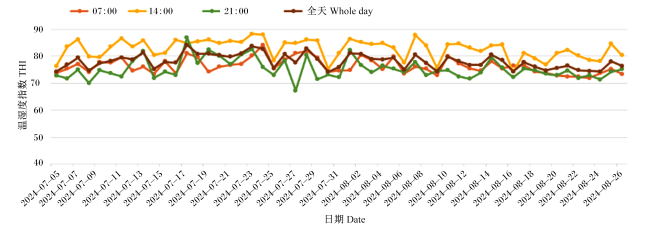
图1所示,牛舍每天07:00的THI平均值为76.4,14:00的THI平均值为82.8,21:00的THI平均值为75.3,全天的THI平均值为78.1,均高于THI阈值68.0。
图1 试验期间牛舍THI

Fig.1 THI in cowshed during the trial

表2可知,饲粮添加大蒜素对产前60、40和20 d于09:00和15:00测得的奶牛直肠温度无显著影响(P>0.05),且全期也无显著影响(P>0.05)。结合THI和直肠温度,表明试验期奶牛处于热应激状态。
表2 大蒜素对奶牛直肠温度的影响

Table 2 Effects of allicin on rectal temperature of dairy cows℃

项目
Items
组别Groups 均值
标准误
SEM
PP-value
CON ALL3 ALL6 ALL9 处理
Treatment
线性
Linear
二次
Quadratic
09:00直肠温度Rectal temperature at 09:00
产前60 d 60 days before delivery 39.11 39.11 39.23 39.09 0.066 0.433 0.841 0.297
产前40 d 40 days before delivery 39.06 39.04 39.09 39.11 0.065 0.884 0.511 0.800
产前20 d 20 days before delivery 39.09 39.05 39.04 39.07 0.037 0.779 0.565 0.403
全期Whole period 39.08 39.05 39.07 39.09 0.038 0.871 0.722 0.488
15:00直肠温度Rectal temperature at 15:00
产前60 d 60 days before delivery 39.04 39.07 39.15 39.05 0.049 0.337 0.533 0.317
产前40 d 40 days before delivery 39.10 39.04 39.10 39.09 0.059 0.874 0.982 0.563
产前20 d 20 days before delivery 39.09 39.05 39.15 39.04 0.054 0.451 0.864 0.702
全期Whole period 39.09 39.05 39.13 39.07 0.030 0.522 1.000 0.931

同行数据肩标相同字母或无字母表示差异不显著(P>0.05),不同字母表示差异显著(P<0.05)。表3表5同。

In the same row, values with the same letter or no letter superscripts mean no insignificant difference (P>0.05), while with different letter superscripts mean significant differences (P<0.05). The same as Table 3 to Table 5.

2.2 大蒜素对奶牛被动免疫转移的影响

表3可知,与CON组相比,ALL3组初乳IgM含量显著提高(P<0.05)。随着饲粮中大蒜素添加量的提高,母牛初乳IgG和IgM含量呈二次变化(P<0.05),初乳IgA含量有线性升高的趋势(P=0.059);犊牛血清IgG含量呈二次变化(P<0.05)。
表3 大蒜素对母牛初乳及其犊牛血清免疫球蛋白含量的影响

Table 3 Effects of allicin on immunoglobulin contents in colostrum of cows and in serum of their calves

项目
Items
组别Groups 均值
标准误
SEM
PP-value
CON ALL3 ALL6 ALL9 处理
Treatment
线性
Linear
二次
Quadratic
母牛初乳Cow colostrum/(mg/mL)
免疫球蛋白G IgG 63.5 67.7 66.3 63.6 0.88 0.051 0.774 <0.001
免疫球蛋白A IgA 12.6 15.2 16.9 13.7 1.43 0.191 0.059 0.344
免疫球蛋白M IgM 20.4b 23.8a 22.2ab 21.8ab 0.82 0.030 0.484 0.020
犊牛血清Calf serum/(μg/mL)
免疫球蛋白G IgG 25.7 30.1 29.0 28.1 1.24 0.091 0.298 0.047
免疫球蛋白A IgA 166 168 181 186 13.5 0.666 0.232 0.884
免疫球蛋白M IgM 96.8 89.8 92.2 87.8 5.91 0.729 0.365 0.833
表4可知,母牛饲粮添加大蒜素对其犊牛初生重和断奶重均无显著影响(P>0.05)。
表4 母牛饲粮添加大蒜素对其犊牛体重的影响

Table 4 Effects of allicin supplementation in cow diets on body weight of their calveskg

项目
Items
组别Groups 均值
标准误
SEM
PP-value
CON ALL3 ALL6 ALL9 处理
Treatment
线性
Linear
二次
Quadratic
初生重Birth weight 35.2 35.9 36.5 34.7 1.02 0.625 0.789 0.230
断奶重Weaning weight 86.9 87.9 87.4 86.1 1.09 0.675 0.540 0.278

2.3 母牛饲粮添加大蒜素对其犊牛血清指标的影响

表5可知,与其他3组相比,ALL3组犊牛血清SOD活性显著提高(P<0.05);与CON组相比,ALL3组血清GSH-Px活性显著提高(P<0.05)。随着母牛饲粮中大蒜素添加量的提高,犊牛血清SOD和GSH-Px活性呈二次变化(P<0.05),血清LPS含量有二次变化趋势(P=0.063),血清IL-6含量、ALT活性和NEFA含量呈二次变化(P<0.05),血清TP含量有二次变化趋势(P=0.088)。
表5 母牛饲粮添加大蒜素对其犊牛血清指标的影响

Table 5 Effects of allicin supplementation in cow diets on serum indices of their calves

项目
Items
组别Groups 均值
标准误
SEM
PP-value
CON ALL3 ALL6 ALL9 处理
Treatment
线性
Linear
二次
Quadratic
总抗氧化能力T-AOC/(U/mL) 5.94 6.39 5.98 6.47 0.245 0.333 0.264 0.983
丙二醛MDA/(nmol/mL) 5.34 5.41 5.21 5.07 0.254 0.672 0.355 0.455
超氧化物歧化酶SOD/(U/mL) 117b 159a 133b 118b 6.2 0.001 0.384 <0.001
谷胱甘肽过氧化物酶GSH-Px/(U/mL) 564b 619a 603ab 582ab 13.8 0.045 0.530 0.011
脂多糖LPS/(EU/L) 0.96 0.86 0.91 0.95 0.038 0.215 0.841 0.063
肿瘤坏死因子-α TNF-α/(ng/L) 150 148 173 164 15.5 0.611 0.361 0.900
白细胞介素-1β IL-1β/(pg/mL) 266 218 230 255 22.9 0.434 0.612 0.123
白细胞介素-6 IL-6/(pg/mL) 55.1 42.2 49.3 55.2 3.68 0.061 0.654 0.021
谷草转氨酶AST/(U/mL) 28.2 27.2 30.6 26.4 1.19 0.106 0.762 0.242
谷丙转氨酶ALT/(U/mL) 26.5 21.1 19.6 23.9 1.86 0.066 0.282 0.030
葡萄糖GLU/(mmol/L) 1.12 1.21 1.08 1.17 0.038 0.115 0.800 0.679
总蛋白TP/(g/L) 38.3 41.1 41.0 39.4 1.21 0.310 0.541 0.088
白蛋白ALB/(g/L) 19.0 18.9 19.3 19.7 0.55 0.616 0.270 0.479
尿素氮UN/(mmol/L) 1.60 1.59 1.63 1.62 0.056 0.933 0.663 0.925
β-羟基丁酸BHBA/(mmol/L) 359 349 359 361 33.4 0.994 0.943 0.831
非酯化脂肪酸NEFA/(mmol/L) 469 437 454 474 10.9 0.088 0.517 0.020

2.4 大蒜素对奶牛血清代谢物的影响

基于表型数据,将展示CON组和ALL3组奶牛的血清代谢组分析结果。

2.4.1 变量统计分析

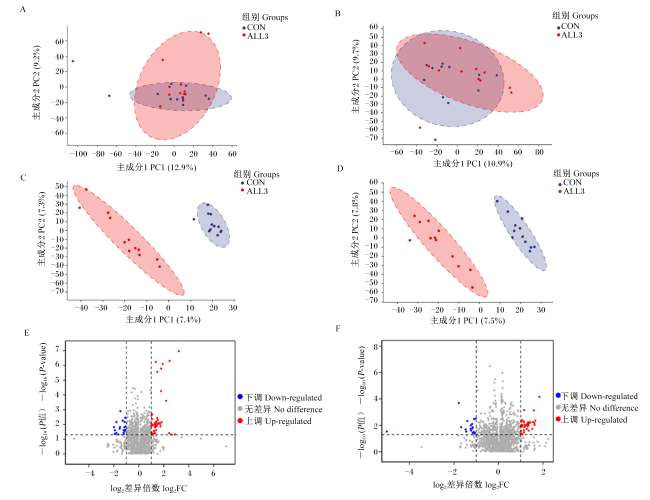
基于无监督的主成分分析(PCA)表明,CON组和ALL3组奶牛血清代谢物并未显示出明显的分离(图2-A图2-B);然而,采用PLS-DA观察到CON组和ALL3组血清代谢物明显分离(图2-C图2-D)。通过应用单元统计分析,本研究对在正离子和负离子模式下所检测到的所有血清代谢物(包括那些尚未被确定的物质)进行了差异性分析,将|FC|>2和P<0.05的差异代谢物采用火山图的形式进行可视化展示(图2-E图2-F)。
图2 奶牛血清代谢物的变量统计分析

A、C和E分别为正离子模式下的主成分分析、偏最小二乘判别分析和可视化分析火山图,B、D和F分别为负离子模式下的主成分分析、偏最小二乘判别分析和可视化分析火山图。

Fig.2 Variable statistical analysis of serum metabolites of dairy cows

A, C and E were principal component analysis, partial least squares discriminant analysis, and volcano plot of visual analysis in positive ion mode, and B, D and F were principal component analysis, partial least squares discriminant analysis, and volcano plot of visual analysis in negative ion mode, respectively.

2.4.2 血清差异代谢物筛选

表6可知,CON组和ALL3组奶牛血清共鉴定出17种差异代谢物;其中,与CON组相比,ALL3组血清3-氧代胆酸、α-鼠胆酸、(5β)-3-氧代胆甾-8(14),11-二烯-24-酸、熊去氧胆酸、7-酮脱氧胆酸和淫羊藿苷E4含量显著上调(P<0.05),血清氧化磷脂酰胆碱、L-α-甘油磷脂酰胆碱、硬脂酰-L-肉碱、7-十二碳烯酰肉碱、钝孢酸D、2-(丙-2-炔基氨基)乙酸、4-庚烯酰甘氨酸、DL-2-氨基辛酸、酪醇、肾上腺素和L-3-苯基乳酸含量显著下调(P<0.05)。
表6 大蒜素对奶牛血清差异代谢物组成的影响

Table 6 Effects of allicin on serum differential metabolite composition of dairy cows

化学分类Chemical taxonomy 化合物
Compounds
变量投影
重要性
VIP
log2差异
倍数
log2FC
超类Super class 亚类Sub class
上调代谢物Up-regulated metabolites


脂质或类脂分子
Lipid or lipoid molecules


胆汁酸、醇及其衍生物
Bile acids, alcohols and
derivatives
3-氧代胆酸 2.09 1.30
α-鼠胆酸 2.11 1.50
(5β)-3-氧代胆甾-8(14),
11-二烯-24-酸
1.78 1.00
熊去氧胆酸 2.02 1.30
7-酮脱氧胆酸 2.06 1.06
木脂素、新木脂素及相关化合物
Lignans, neolignans and related
compounds
木脂素苷
Lignan glycoside
淫羊藿苷E4 2.23 1.54
下调代谢物Down-regulated metabolites


脂质或类脂分子
Lipid or lipoid molecules


甘油磷脂酰胆碱
Glycerol phosphatidylcholine
氧化磷脂酰胆碱 2.05 -0.81
L-α-甘油磷脂酰胆碱 2.46 -0.55

脂肪酸酯
Fatty acid esters
硬脂酰-L-肉碱 2.21 -0.76
7-十二碳烯酰肉碱 2.36 -0.53


有机酸及其衍生物
Organic acids and derivatives
中链羟基酸及其衍生物
Medium-chain hydroxy acids and
derivatives
钝孢酸D 1.98 -1.22


氨基酸、多肽和类似物
Amino acids, polypeptides
and analogues
2-(丙-2-炔基
氨基)乙酸
1.86 -0.70
4-庚烯酰甘氨酸 2.34 -0.60
DL-2-氨基辛酸 2.13 -0.44


苯环类物质
Benzene-ring substances
酪醇及其衍生物
Tyrosol and derivatives
酪醇 2.17 -0.60
苯二酚
Benzenediol
肾上腺素 2.02 -0.42
苯丙素类和聚酮类化合物
Phenylpropanoid and polyketide
compounds
苯丙酸及其衍生物
Phenylpropionic acid and
derivatives
L-3-苯基乳酸 2.15 -0.54

2.4.3 KEGG通路富集分析

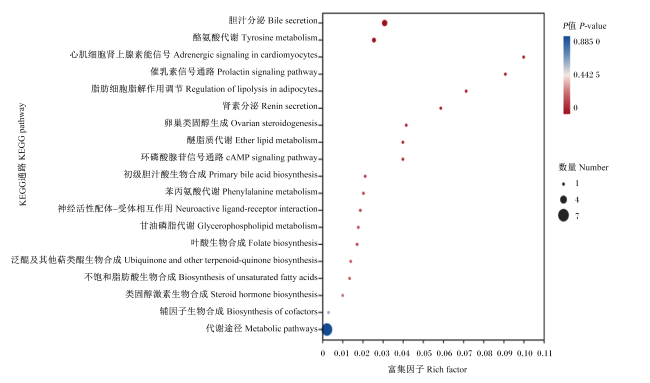
图3所示,对奶牛血清差异代谢物进行KEGG通路富集分析发现,代谢物显著富集在胆汁分泌、酪氨酸代谢、心肌细胞肾上腺素能信号、催乳素信号通路、脂肪细胞脂解作用调节和肾素分泌通路中(P<0.05)。
图3 奶牛血清代谢物KEGG通路富集分析

Fig.3 KEGG pathway enrichment analysis of serum metabolites of dairy cows

3 讨论

3.1 大蒜素对奶牛热应激的影响

研究表明,处于热应激下的干奶牛采食量显著降低[28],由于营养摄入难以满足乳腺恢复和胎儿生长的能量需求[29],奶牛出现能量负平衡的风险会相应增加。这不仅会削弱奶牛自身的健康储备,还会对下一次泌乳期的产奶量产生负面影响[30]。此外,热应激还会干扰干奶期奶牛子宫内胎儿的正常发育,导致新生犊牛出现出生体重减轻、被动免疫转移效果不佳等问题[31]。大蒜素已被证明具有抗炎、抗氧化、增强免疫功能和调节脂质代谢等功能[32]。因此,为了改善热应激期间干奶牛的生理状态以及促进其后代的健康发展,补饲大蒜素可能是一种有效的策略。
在评估奶牛是否遭遇热应激的方面,直肠温度被认为是一种“黄金标准”[33],相较于呼吸频率,它能更精准地反映奶牛的生理状况[1]。当奶牛体温超过38.5 ℃时,表明奶牛正遭受热应激[34]。这也意味着直肠温度的变化与本试验所测量的热应激指数THI相吻合,表示奶牛正遭受热应激。本试验中,饲粮添加大蒜素并未显著改善热应激状态下干奶牛的直肠温度,这一结果与大量相关研究结论相一致。例如,先前有研究表明,饲粮添加万寿菊黄酮对肉牛直肠温度无显著影响[35];类似的,竹叶提取物对热应激状态下奶牛直肠温度也无显著效果[36]。这可能是因为热应激对奶牛的影响是多方面的[37],仅靠植物提取物难以全面缓解其对奶牛造成的热应激影响。

3.2 大蒜素对热应激奶牛被动免疫转移的影响

在奶牛的繁殖过程中,由于胎盘结构的独特性,母体在妊娠期间无法通过胎盘将免疫球蛋白传递给犊牛[38],这意味着初乳成为犊牛获取免疫球蛋白的唯一途径。然而,热应激会降低奶牛初乳中免疫球蛋白的含量[39],从而影响犊牛被动免疫的获取。本研究发现,饲粮添加大蒜素能够提高奶牛初乳IgG和IgM含量,这与El Shereef[40]的研究结果一致,表明大蒜素能够增强肠道屏障功能或刺激免疫器官分泌免疫球蛋白来发挥作用。研究表明,及时供应优质初乳对被动免疫的成功至关重要[41],本试验确保了每组犊牛获得的初乳质量合格,而由于大蒜素提高了试验组初乳中的免疫球蛋白含量,使得试验组犊牛的被动免疫效果更佳。Assar等[26]在母羊饲粮中添加大蒜素的研究发现,产羔7 d后羔羊血清IgG含量显著升高,这表明大蒜素可以提高初乳中的免疫球蛋白含量,并通过被动免疫转移给子代,与本试验结果相符。此外,本研究中初乳IgA含量未显著变化可能与其合成和转运机制的特性有关,研究表明,相较于血液来源的IgG,IgA主要由乳腺组织局部合成,其分泌依赖于多聚免疫球蛋白受体(pIgR)介导的跨膜转运,而常规营养干预若未直接刺激乳腺局部免疫应答(如触发pIgR表达或激活相关信号通路),则难以改变IgA含量[42]。本试验中,饲粮添加大蒜素并没有改变犊牛初生重和断奶重,这与Assar等[26]的研究结果相反,可能的原因是其研究中采用的大蒜素添加量梯度(0.4、0.8和1.2 g/kg,干物质基础)高于本试验添加量梯度(3、6和9 g/d),剂量效应可能导致生物活性物质的作用效果产生显著差异。

3.3 大蒜素对热应激下新生犊牛血清指标的影响

病原体感染常引发氧化应激和炎症反应[43],在此过程中,免疫球蛋白在机体的免疫防御中扮演了核心角色,能预防机体受到病原体的侵害[44],因此,被动免疫的成功转移,对于降低氧化应激和炎症反应的发生概率有着积极的意义。本研究发现,受大蒜素的影响,犊牛血清中重要的抗氧化酶如SOD、GSH-Px活性显著升高。Assar等[26]研究结果显示,饲喂初乳7 d后,羔羊血清中的抗氧化酶活性显著提高,表明受大蒜素影响的后代获得了更多的被动免疫,并因此产生了更高的抗氧化酶活性。新生犊牛在刚出生时会经历第1个氧化应激期,此时其承受的氧化应激增加,促氧化剂与抗氧化剂之间存在严重的不平衡[45]。笔者猜测,由于这段时间氧化应激的不断积累,抗氧化剂无法清除过多的促氧化剂,所以出生后24 h血清MDA含量可能无法代表此阶段的氧化应激水平。LPS作为内毒素,能刺激宿主免疫系统,其通过与宿主细胞的Toll样受体(TLR)4结合,引发一系列免疫反应,包括炎症细胞因子(如IL-6)的释放[46]。氧化应激是引发炎症反应的重要因素之一,因此抗氧化酶活性的提升有助于降低炎症指标[47]。同时,被动免疫转移的成功意味着犊牛获得了更多的免疫球蛋白,这些免疫球蛋白可以增强机体的免疫防御能力,帮助清除病原体[48]。本研究中,试验组犊牛血清ALT活性降低,表明肝细胞得到了更好的保护,因为ALT主要存在于肝细胞中,其在血液中的活性升高通常意味着肝脏受损[49]。高含量的NEFA可能影响犊牛的代谢平衡,减缓生长速度[50],并激活中性粒细胞的TLR2/4介导的炎症信号通路,增加炎性细胞因子的合成和释放[51]。本研究发现,饲喂初乳24 h后,ALL3组所产犊牛血清NEFA含量降低,这有利于犊牛的增重和免疫功能的改善。

3.4 大蒜素对热应激奶牛血清代谢物的影响

通过揭示奶牛血清代谢组的变化,有助于探索大蒜素对初乳和产后犊牛影响的作用机制。本研究分析了CON组和ALL3组奶牛血清代谢物的差异,在ALL3组上调的代谢物中,3-氧代胆酸、α-鼠胆酸、(5β)-3-氧代胆甾-8(14),11-二烯-24-酸、熊去氧胆酸和7-酮脱氧胆酸属于初级胆汁酸或胆汁酸中间体,在胆汁分泌通路中显著富集。胆汁是消化液,其能够乳化膳食脂肪以促进脂肪吸收和代谢[52],还显著影响黏膜免疫和炎症[53]。胆汁酸是胆汁的主要成分,它们能够与特定受体[如法尼醇X受体(FXR)和Takeda G蛋白偶联受体5(TGR5)]相互作用,这种相互作用抑制了核因子-κB(NF-κB)信号通路和NOD样受体蛋白3(NLRP3)炎症小体的激活[54]。由此表明,大蒜素能通过增加胆汁酸的生成发挥抗炎作用[55]。氧化磷脂酰胆碱是磷脂酰胆碱在体内发生氧化反应后形成的一类化合物。在氧化应激的环境中,活性氧(ROS)分子倾向于侵害磷脂酰胆碱分子内富含的不饱和脂肪酸链,这种攻击可触发脂质过氧化反应的启动,最终导致氧化磷脂酰胆碱的形成[56]。本试验中,ALL3组血清氧化磷脂酰胆碱含量的下调表示奶牛氧化应激水平降低。在酪氨酸代谢过程中,如多巴胺的合成和代谢,会涉及到一些酶促反应,这些反应可能会产生ROS,从而导致机体的氧化应激[57]。本研究发现,ALL3组血清中下调的代谢物富集在酪氨酸代谢通路,表示大蒜素可能减轻了氧化应激对细胞的损伤。研究还发现,肾上腺素在心肌细胞肾上腺素能信号通路中显著富集,笔者推测,大蒜素通过减少机体炎症、提高抗氧化水平来减少内源性应激和热应激,从而降低了肾上腺皮质的肾上腺素分泌[58-59]。血清代谢组分析观察到母牛氧化应激和炎症的改善从侧面反映出大蒜素可能影响到了奶牛的被动免疫转移和犊牛的健康。Abuelo等[60]报道,母体的营养和代谢状态会影响下一代的健康和疾病状况。研究表明,妊娠晚期母体代谢或氧化应激已被证明可能会影响后代的疾病易感性[61],这与本研究结果相似。

4 结论

干奶期饲粮添加适量(3 g/d)大蒜素虽未缓解奶牛热应激状态,但可通过调节母牛胆汁分泌、酪氨酸代谢等代谢通路提高初乳免疫球蛋白含量,增强犊牛抗氧化和抗炎能力,改善被动免疫转移,这为缓解热应激对奶牛健康及犊牛生长发育的负面影响提供了理论依据。
[1]
户林其, 王海慧, 赵晓静, 等. 脂肪粉和诱食剂对热应激环境下干奶牛生理状态、血清生化指标及产后产奶量的影响[J]. 动物营养学报, 2022, 34(12):7844-7857.

HU L Q, WANG H H, ZHAO X J, et al. Effects of fat powder and attractant on physiological status,serum biochemical indices and postpartum milk yield of dry dairy cows under heat stress[J]. Chinese Journal of Animal Nutrition, 2022, 34(12):7844-7857. (in Chinese)

[2]
GAO J, MARINS T N, CALIX J O S, et al. Systemic and mammary inflammation and mammary gland development of Holstein dairy cows around dry-off and calving[J]. Journal of Dairy Science, 2025, 108(2):2090-2110.

[3]
FABRIS T F, LAPORTA J, SKIBIEL A L, et al. Effect of heat stress during early,late,and entire dry period on dairy cattle[J]. Journal of Dairy Science, 2019, 102(6):5647-5656.

[4]
CATTANEO L, LAPORTA J, DAHL G E. Programming effects of late gestation heat stress in dairy cattle[J]. Reproduction,Fertility,and Development, 2022, 35(2):106-117.

[5]
SPIERS D E, SPAIN J N, SAMPSON J D, et al. Use of physiological parameters to predict milk yield and feed intake in heat-stressed dairy cows[J]. Journal of Thermal Biology, 2004, 29(7/8):759-764.

[6]
SAMMAD A, WANG Y J, UMER S, et al. Nutritional physiology and biochemistry of dairy cattle under the influence of heat stress:consequences and opportunities[J]. Animals, 2020, 10(5):793.

[7]
ZACHUT M, KRA G, LIVSHITZ L, et al. Seasonal heat stress affects adipose tissue proteome toward enrichment of the Nrf2-mediated oxidative stress response in late-pregnant dairy cows[J]. Journal of Proteomics, 2017,158:52-61.

[8]
COLLIER R J, DOELGER S G, HEAD H H, et al. Effects of heat stress during pregnancy on maternal hormone concentrations,calf birth weight and postpartum milk yield of Holstein cows[J]. Journal of Animal Science, 1982, 54(2):309-319.

[9]
MELLADO M, LOPEZ E, VELIZ F G, et al. Factors associated with neonatal dairy calf mortality in a hot-arid environment[J]. Livestock Science, 2014,159:149-155.

[10]
MONTEIRO A P A, TAO S, THOMPSON I M, et al. Effect of heat stress during late gestation on immune function and growth performance of calves:isolation of altered colostral and calf factors[J]. Journal of Dairy Science, 2014, 97(10):6426-6439.

[11]
DIRETTO G, RUBIO-MORAGA A, ARGANDOÑA J, et al. Tissue-specific accumulation of sulfur compounds and saponins in different parts of garlic cloves from purple and white ecotypes[J]. Molecules, 2017, 22(8):1359.

[12]
BAR M, BINDUGA U E, SZYCHOWSKI K A. Methods of isolation of active substances from garlic (Allium sativum L.) and its impact on the composition and biological properties of garlic extracts[J]. Antioxidants, 2022, 11(7):1345.

[13]
AHMED E, FUKUMA N, HANADA M, et al. The efficacy of plant-based bioactives supplementation to different proportion of concentrate diets on methane production and rumen fermentation characteristics in vitro[J]. Animals, 2021, 11(4):1029.

[14]
KIM Y S, KIM K S, HAN I, et al. Quantitative and qualitative analysis of the antifungal activity of allicin alone and in combination with antifungal drugs[J]. PLoS One, 2012, 7(6):e38242.

[15]
LIU T W, PANG R, HUANG L, et al. Effects of allicin addition on growth performance,rumen microbiome,and ruminal epithelial proteome of high-grain-fed goats[J]. Animal Feed Science and Technology, 2024,310:115944.

[16]
COLEMAN D N, VAILATI-RIBONI M, ELOLIMY A A, et al. Hepatic betaine homocysteine methyltransferase and methionine synthase activity and intermediates of the methionine cycle are altered by choline supply during negative energy balance in Holstein cows[J]. Journal of Dairy Science, 2019, 102(9):8305-8318.

[17]
LOPREIATO V, MEZZETTI M, CATTANEO L, et al. Role of nutraceuticals during the transition period of dairy cows:a review[J]. Journal of Animal Science and Biotechnology, 2020,11:96.

[18]
ADJEI-MENSAH B, HAMIDU J A, KONFE H, et al. Evaluating the effects of dietary allicin-rich extract on the production performance,egg quality,caecal bacterial population and lipid profile of laying hens[J]. European Poultry Science, 2023,87:1-16.

[19]
CHE H Y, ZHOU C H, LYU C C, et al. Allicin alleviated LPS-induced mastitis via the TLR4/NF-κB signaling pathway in bovine mammary epithelial cells[J]. International Journal of Molecular Sciences, 2023, 24(4):3805.

[20]
EL-RATEL I T, ABDEL-KHALEK A E, GABR S A, et al. Influence of allicin administration on reproductive efficiency,immunity and lipid peroxidation of rabbit does under high ambient temperature[J]. Journal of Animal Physiology and Animal Nutrition, 2020, 104(2):539-548.

[21]
HUANG X Y, ZHAO Z H, YANG Y J, et al. Dietary allicin improves behavior,physiology,growth,and disease resistance in the sea cucumber Apostichopus japonicus[J]. Aquaculture, 2024,593:741321.

[22]
贺驭, 党萌, 王阳, 等. 大蒜素对热应激肉仔鸡生长性能、血液生化指标和肠道形态的影响[J]. 中国动物保健, 2024, 26(5):106-108,127.

HE Y, DANG M, WANG Y, et al. Effects of allicin on growth performance,blood biochemical indices and intestinal morphology of broilers under heat stress[J]. China Animal Health, 2024, 26(5):106-108,127. (in Chinese)

[23]
邱梅平, 王恬. 大蒜素对蛋鸡热应激的缓解作用及其在家禽生产中的应用研究[J]. 饲料博览, 2009(11):30-33.

QIU M P, WANG T. Mitigative effect of allicin on heat stress in layers and application research in poultry production[J]. Feed Review, 2009(11):30-33. (in Chinese)

[24]
付红蕾, 张朋朋, 于新海. 大蒜素对奶牛泌乳性能、乳品质及抗氧化功能的影响[J]. 饲料研究, 2024, 47(3):14-18.

FU H L, ZHANG P P, YU X H. Effects of allicin on milk performance,milk quality,and antioxidant function of dairy cows[J]. Feed Research, 2024, 47(3):14-18. (in Chinese)

[25]
GHOLIPOUR A, FOROOZANDEH SHAHRAKI A D, TABEIDIAN S A, et al. The effects of increasing garlic powder and monensin supplementation on feed intake,nutrient digestibility,growth performance and blood parameters of growing calves[J]. Journal of Animal Physiology and Animal Nutrition, 2016, 100(4):623-628.

[26]
ASSAR D H, AL WAKEEL R A, EL-MAGHRABY M M, et al. Modulatory effect of dietary allicin supplementation on productivity,health,and antioxidant status of ewes and their offspring during may breeding season in Egypt[J]. Advances in Animal and Veterinary Sciences, 2023, 11(1):83-93.

[27]
MA F T, SHAN Q, JIN Y H, et al. Effect of Lonicera japonica extract on lactation performance,antioxidant status,and endocrine and immune function in heat-stressed mid-lactation dairy cows[J]. Journal of Dairy Science, 2020, 103(11):10074-10082.

[28]
谢景龙, 李晨杨, 赵燕慧, 等. 不同真菌培养物对热应激期间泌乳奶牛生产性能的影响[J]. 饲料研究, 2023, 46(16):18-21.

XIE J L, LI C Y, ZHAO Y H, et al. Effects of different fungal cultures on performance of lactating cows during heat stress[J]. Feed Research, 2023, 46(16):18-21. (in Chinese)

[29]
PASCOTTINI O B, LEROY J L M R, OPSOMER G. Metabolic stress in the transition period of dairy cows:focusing on the prepartum period[J]. Animals, 2020, 10(8):1419.

[30]
韩佳良, 刘建新, 刘红云. 热应激对奶牛泌乳性能的影响及其机制[J]. 中国农业科学, 2018, 51(16):3162-3170.

HAN J L, LIU J X, LIU H Y. Effect of heat stress on lactation performance in dairy cows[J]. Scientia Agriculture Sinica, 2018, 51(16):3162-3170. (in Chinese)

[31]
张航, 杨柏高, 徐茜, 等. 热应激影响奶牛胚胎发育作用机制的研究进展[J]. 畜牧兽医学报, 2023, 54(7):2692-2700.

ZHANG H, YANG B G, XU Q, et al. Research progress on the mechanism of heat stress affecting the development of dairy cow embryos[J]. Acta Veterinaria et Zootechnica Sinica, 2023, 54(7):2692-2700. (in Chinese)

[32]
XU S Y, LIAO Y X, WANG Q, et al. Current studies and potential future research directions on biological effects and related mechanisms of allicin[J]. Critical Reviews in Food Science and Nutrition, 2023, 63(25):7722-7748.

[33]
LI G, CHEN S Y, CHEN J, et al. Predicting rectal temperature and respiration rate responses in lactating dairy cows exposed to heat stress[J]. Journal of Dairy Science, 2020, 103(6):5466-5484.

[34]
COLLIER R J, RENQUIST B J, XIAO Y. A 100-year review:stress physiology including heat stress[J]. Journal of Dairy Science, 2017, 100(12):10367-10380.

[35]
于晓梦, 田雨晴, 林笑乾, 等. 万寿菊黄酮对热应激肉牛生长性能、营养物质表观消化率及血清抗氧化和免疫指标的影响[J]. 动物营养学报, 2024, 36(9):5736-5747.

YU X M, TIAN Y Q, LIN X Q, et al. Effects of marigold flavonoids on growth performance,nutrient apparent digestibility,serum antioxidant and immune indices of heat stressed beef cattle[J]. Chinese Journal of Animal Nutrition, 2024, 36(9):5736-5747. (in Chinese)

[36]
李义, 童津津, 栗明月, 等. 竹叶提取物对热应激奶牛泌乳性能及血清生化、抗氧化和免疫指标的影响[J]. 动物营养学报, 2021, 33(2):900-912.

LI Y, TONG J J, LI M Y, et al. Effects of bamboo leaf extract on lactation performance and indexes of biochemical,antioxidant and immune in serum of dairy cows during heat stress[J]. Chinese Journal of Animal Nutrition, 2021, 33(2):900-912. (in Chinese)

[37]
SAMMAD A, UMER S, SHI R, et al. Dairy cow reproduction under the influence of heat stress[J]. Journal of Animal Physiology and Animal Nutrition, 2020, 104(4):978-986.

[38]
SANGILD P T. Uptake of colostral immunoglobulins by the compromised newborn farm animal[J]. Acta Veterinaria Scandinavica, 2003, 44(S1):S105.

[39]
TAO S, MONTEIRO A P A, THOMPSON I M, et al. Effect of late-gestation maternal heat stress on growth and immune function of dairy calves[J]. Journal of Dairy Science, 2012, 95(12):7128-7136.

[40]
EL SHEREEF A A. Blood serum biochemical changes and milk fatty acids profile due to using garlic plant as feed additives for sheep[J]. Asian Journal of Research in Animal and Veterinary Sciences, 2019, 2(4):365-372.

[41]
IMMLER M, BÜTTNER K, GÄRTNER T, et al. Maternal impact on serum immunoglobulin and total protein concentration in dairy calves[J]. Animals, 2022, 12(6):755.

[42]
张春刚. 乳中IgA和IgM含量的变化及其影响因素的机理研究[D]. 硕士学位论文. 扬州: 扬州大学, 2008.

ZHANG C G. Study on the variation of IgA and IgM concentration in milk and the mechanisms of the affecting factors[D]. Master's Thesis. Yangzhou: Yangzhou University, 2008. (in Chinese)

[43]
LETAFATI A, TAGHIABADI Z, ZAFARIAN N, et al. Emerging paradigms:unmasking the role of oxidative stress in HPV-induced carcinogenesis[J]. Infectious Agents and Cancer, 2024, 19(1):30.

[44]
SCHROEDER H W Jr, CAVACINI L. Structure and function of immunoglobulins[J]. The Journal of Allergy and Clinical Immunology, 2010, 125( 2 Suppl.2):S41-S52.

[45]
GAÁL T, RIBICZEYNÉ-SZABÓ P, STADLER K, et al. Free radicals,lipid peroxidation and the antioxidant system in the blood of cows and newborn calves around calving[J]. Comparative Biochemistry and Physiology B:Biochemistry and Molecular Biology, 2006, 143(4):391-396.

[46]
MCALEER J P, VELLA A T. Understanding how lipopolysaccharide impacts CD4 T-cell immunity[J]. Critical Reviews in Immunology, 2008, 28(4):281-299.

[47]
WANG T, BAO M Y, XIAO G X, et al. The defatted black soldier fly meal (Hermetia illucens) improved the pathogen resistance and gut health of Nile Tilapia (Oreochromis niloticus)[J]. Fish & Shellfish Immunology, 2025,161:110242.

[48]
MARTIN C C, DE OLIVEIRA S M F N, COSTA J F D R, et al. Influence of feeding fresh colostrum from the dam or frozen colostrum from a pool on indicator gut microbes and the inflammatory response in neonatal calves[J]. Research in Veterinary Science, 2021,135:355-365.

[49]
郭庆, 吕继明, 孟祥俊. 中药微生态制剂对奶牛子宫内膜炎临床疗效和血液指标的影响[J]. 中国乳业, 2023(2):74-78.

GUO Q, LV J M, MENG X J. Effects of traditional Chinese medicine probiotics on clinical efficiency and blood indexes of cow endometritis[J]. China Dairy, 2023(2):74-78. (in Chinese)

[50]
GROSS J J. Dairy cow physiology and production limits[J]. Animal Frontiers, 2023, 13(3):44-50.

[51]
AZHAR J, NADEEM A, JAVED M, et al. Evaluation of phytochemicals from Thymus serpyllum as potential drug candidates to manage oxidative stress in transition dairy cows[J]. Journal of Biomolecular Structure and Dynamics, 2024, 42(6):2897-2912.

[52]
LV W W, SONG J Y, NOWSHIN RAKA R, et al. Effects of food emulsifiers on high fat-diet-induced obesity,intestinal inflammation,changes in bile acid profile,and liver dysfunction[J]. Food Research International, 2023, 173(Pt 1):113302.

[53]
CHEN M L, TAKEDA K, SUNDRUD M S. Emerging roles of bile acids in mucosal immunity and inflammation[J]. Mucosal Immunology, 2019, 12(4):851-861.

[54]
GUO C S, XIE S J, CHI Z X, et al. Bile acids control inflammation and metabolic disorder through inhibition of NLRP3 inflammasome[J]. Immunity, 2016, 45(4):802-816.

[55]
FLEISHMAN J S, KUMAR S. Bile acid metabolism and signaling in health and disease:molecular mechanisms and therapeutic targets[J]. Signal Transduction and Targeted Therapy, 2024, 9(1):97.

[56]
姜月华, 陈健乔, 李晓, 等. 磷脂酰胆碱的生物学功能及其在心血管疾病中的作用[J]. 生命的化学, 2022, 42(3):412-423.

JIANG Y H, CHEN J Q, LI X, et al. Biological function of phosphatidylcholine and its role in cardiovascular diseases[J]. Chemistry of Life, 2022, 42(3):412-423. (in Chinese)

[57]
CHANDIMALI N, BAK S G, PARK E H, et al. Free radicals and their impact on health and antioxidant defenses:a review[J]. Cell Death Discovery, 2025, 11(1):19.

[58]
MORIMOTO K, ITOH H, WATANABE M. Developments in understanding bile acid metabolism[J]. Expert Review of Endocrinology & Metabolism, 2013, 8(1):59-69.

[59]
GAO Y J, WANG B F, QIN G F, et al. Therapeutic potentials of allicin in cardiovascular disease:advances and future directions[J]. Chinese Medicine, 2024, 19(1):93.

[60]
ABUELO A, HERNÁNDEZ J, BENEDITO J L, et al. Redox biology in transition periods of dairy cattle:role in the health of periparturient and neonatal animals[J]. Antioxidants, 2019, 8(1):20.

[61]
LING T, HERNANDEZ-JOVER M, SORDILLO L M, et al. Maternal late-gestation metabolic stress is associated with changes in immune and metabolic responses of dairy calves[J]. Journal of Dairy Science, 2018, 101(7):6568-6580.

文章导航

/