研究论文

基于网络药理学和分子对接探究槲皮素调控肉鸡肠道炎症的机制

  • 孔令联 , 1, 2 ,
  • 杨聪 1 ,
  • 马帅 1 ,
  • 宋志刚 , 3, *
展开
  • 1 济宁职业技术学院,济宁 272037
  • 2 山东科技大学测绘与空间信息学院,青岛 266590
  • 3 山东农业大学动物科技学院,泰安 271018
*宋志刚,教授,博士生导师,E-mail:

孔令联(1990—),男,山东济宁人,讲师,博士,研究方向为家禽营养与肠道健康。E-mail:

Copy editor: 菅景颖

收稿日期: 2025-04-03

  网络出版日期: 2025-11-14

基金资助

山东省家禽产业技术体系(SDAIT-011-08)

To Explore Mechanism of Quercetin Against Intestinal Inflammation in Broilers Based on Network Pharmacology and Molecular Docking

  • KONG Linglian , 1, 2 ,
  • YANG Cong 1 ,
  • MA Shuai 1 ,
  • SONG Zhigang , 3, *
Expand
  • 1 Jining Polytechnic College, Jining 272037, China
  • 2 College of Geodesy and Geomatics, Shandong University of Science and Technology, Qingdao 266590, China
  • 3 College of Animal Science and Technology, Shandong Agricultural University, Tai'an 271018, China
*professor, E-mail:

Received date: 2025-04-03

  Online published: 2025-11-14

摘要

本研究旨在利用网络药理学和分子对接探究槲皮素调控肉鸡肠道炎症的机制。在TCMSP数据库中检索槲皮素的潜在作用靶点,并利用Uniprot数据库对所得靶点进行校验;分别在GeneCards和OMIM数据库中检索肉鸡肠道炎症相关靶点,对获得的靶点数据进行整合和去重处理;对槲皮素潜在作用靶点和肠道炎症相关靶点进行交集分析,对获得的共有靶点进行蛋白质互作网络分析、GO功能富集分析和KEGG通路富集分析,筛选核心靶点并利用分子对接验证。结果显示:1)共获得48个槲皮素潜在作用靶点和1 261个肠道炎症相关靶点,其中核心靶点9个,分别为白细胞介素6(IL6)、转化生长因子β1(TGFB1)、骨髓细胞瘤病毒癌基因同源物(MYC)、Ⅲ型胶原蛋白α1链(COL3A1)、B淋巴细胞瘤2(BCL2)、表皮生长因子受体(EGFR)、血红素加氧酶1(HMOX1)、缺氧诱导因子1α(HIF1A)和细胞周期蛋白D1(CCND1)。2)分子对接显示槲皮素与核心靶点间具有高度结合亲和力(结合能均小于-25 kJ/mol)。3)GO功能注释分析鉴定出涉及的生物学过程条目有69个、细胞组分条目有8个、分子功能条目有16个。4)KEGG通路富集分析揭示了24条信号通路,包括焦点黏附、丝裂原活化蛋白激酶和C型凝集素受体信号通路等。由此可见,槲皮素可能通过多靶点、多途径缓解肉鸡肠道炎症,该结果可为其在肉鸡生产中的应用提供理论参考。

本文引用格式

孔令联 , 杨聪 , 马帅 , 宋志刚 . 基于网络药理学和分子对接探究槲皮素调控肉鸡肠道炎症的机制[J]. 动物营养学报, 2025 , 37(11) : 7900 -7909 . DOI: 10.12418/CJAN2025.642

Abstract

This study aimed to investigate the mechanism by which quercetin modulates intestinal inflammation in broilers using network pharmacology and molecular docking. The potential targets of quercetin were searched in the TCMSP database, and verify the obtained targets using the UniProt database. The targets related to intestinal inflammation in broilers were acquired from the GeneCards and OMIM databases, respectively, and the acquired target data were integrated and de-duplicated. Intersection analysis was conducted on potential targets of quercetin and those targets related to intestinal inflammation. Protein-protein interaction (PPI) network analysis, GO functional enrichment analysis and KEGG pathway enrichment analysis were carried out on the common targets obtained. Finally, core targets were screened and verified by molecular docking. The results showed as follows: 1) a total of 48 quercetin-potential targets and 1 261 intestinal inflammation-related targets were obtained, including 9 core targets, they were interleukin 6 (IL6), transforming growth factor β1 (TGFB1), myelocytomatosis viral oncogene homolog (MYC), collagen type Ⅲ α1 chain (COL3A1), B-cell lymphoma 2 (BCL2), epidermal growth factor receptor (EGFR), heme oxygenase 1 (HMOX1), hypoxia inducible factor 1α (HIF1A), and cyclin D1 (CCND1). 2) Molecular docking showed that quercetin had strong binding affinity for the core targets (all binding energies <-25 kJ/mol). 3) GO functional annotation analysis identified 69 items in biological process (BP), 8 items in cellular component (CC), and 16 items in molecular function (MF). 4) KEGG pathway enrichment analysis revealed 24 signaling pathways, including focal adhesion, mitogen-activated protein kinase (MAPK), and C-type lectin receptor signaling pathways. It is concluded that quercetin may alleviate intestinal inflammation in broilers by acting on multiple targets and pathways. This provides a theoretical basis for its use in broiler production.

肠道健康对肉鸡生长性能、免疫功能及整体健康状况至关重要。作为营养物质吸收的主要场所,其不仅承担维持免疫稳态的重要功能,更是抵御病原体侵袭的第1道防线[1]。然而,肠道炎症已成为制约肉鸡产业发展的关键瓶颈问题,其导致的生产性能下降显著降低养殖经济效益[2]。肠道炎症的成因复杂多样:肠道菌群失调可启动级联炎症反应,破坏肠道屏障功能并增加通透性,促使病原体及其代谢产物易位至循环系统,进而诱发系统性炎症;此外,饲料中的某些成分(如非淀粉多糖)可能会在肉鸡早期发育阶段诱发肠道炎症,最终导致机体健康状态与生产性能的全面受损[3]。在当前禁抗政策背景下,开发新型安全营养调控策略已成为缓解肉鸡肠道炎症、保障产业可持续发展的重要研究方向。
槲皮素(quercetin)作为天然黄酮类化合物,广泛分布于果蔬及药用植物资源中[4]。Abdel-Latif等[5]研究发现,饲粮添加槲皮素可提高肉鸡的生长性能,促进肠道发育并改善肠道菌群结构。Xie等[6]研究发现,槲皮素通过调节Toll样受体4(TLR4)/髓分化因子88(MyD88)/核因子-κB(NF-κB)信号通路,减轻肉鸡十二指肠细胞焦亡和程序性坏死。与传统的单一靶点研究方法相比,网络药理学和分子对接技术能够从系统层面全面揭示化合物与疾病相关靶点的相互作用关系,更高效地筛选核心靶点和关键通路,从而更深入地探究作用机制。本研究旨在利用网络药理学方法结合分子对接技术,系统探究槲皮素调控肉鸡肠道炎症的核心靶点及机制,为槲皮素在肉鸡养殖中的应用提供科学依据。

1 材料与方法

1.1 槲皮素潜在作用靶点的获取

在TCMSP数据库(https://old.tcmsp-e.com/tcmsp.php)中检索关键词“Quercetin”,获取槲皮素的潜在作用靶点。将所得靶点逐一导入Uniport数据库(https://www.uniprot.org),设置物种为“Gallus gallus”,选择经Swiss-Prot数据库验证的蛋白,导出Uniport ID并标准化为基因名,去除未通过验证的靶点,得到槲皮素在肉鸡中的潜在作用靶点。

1.2 肠道炎症相关靶点的收集

在GeneCards数据库(https://www.genecards.org)搜索关键词“Intestinal Inflammation”,获得肠道炎症相关的基因靶点,并根据相关性得分(relevance score)>10进行筛选。同时,在OMIM数据库(https://www.omim.org)中进行检索,并与GeneCards数据库中获得的靶点数据进行整合和去重处理,得到肠道炎症相关靶点集合。

1.3 槲皮素潜在作用靶点与肠道炎症相关靶点交集的确定

利用微生信在线生物信息学分析平台(https://www.bioinformatics.com.cn)对槲皮素潜在作用靶点和肠道炎症相关靶点进行交集分析。利用韦恩图直观展示出两者之间的重叠部分,并导出槲皮素缓解肉鸡肠道炎症的候选靶点集合。

1.4 蛋白质互作(PPI)网络及核心靶点分析

将候选靶点导入STRING数据库(https://cn.string-db.org),指定物种为“Gallus gallus”,进行PPI网络分析,设置互作分数(confidence score)阈值为0.4,得到PPI网络。利用Cytoscape 3.10.2软件构建PPI网络可视化图谱,并运用CentiScaPe 2.2插件对网络的拓扑特性进行深入分析,以识别网络中的核心靶点。

1.5 GO功能富集分析与KEGG通路富集分析

在David数据库(https://david.ncifcrf.gov)中输入候选靶点基因集,指定物种为“Gallus gallus”,以P<0.01为阈值进行筛选,以识别显著富集的GO条目和相关信号通路,并利用微生信在线生物信息学分析平台进行可视化。

1.6 分子对接验证

通过分子对接技术预测槲皮素与核心靶点之间的结合模式和结合能力。在PubChem数据库(https://pubchem.ncbi.nlm.nih.gov)查找并下载槲皮素的3D结构。同时,从RCSB PDB数据库(https://www.rcsb.org)或AlphaFold蛋白结构数据库(https://alphafold.com)检索核心靶点蛋白的3D结构,采用AutoDock Tools 1.5.6软件对核心靶点蛋白进行加氢处理,并将槲皮素设置为对接配体。设置对接盒子覆盖受体蛋白的结构域,采用AutoDock Vina 1.2.5软件进行对接计算,根据结合能和氢键数量选择最佳结合构象,利用PyMOL 3.1.0软件进行分析和可视化处理。

2 结果与分析

2.1 槲皮素潜在作用靶点和肠道炎症相关靶点及共有靶点分析

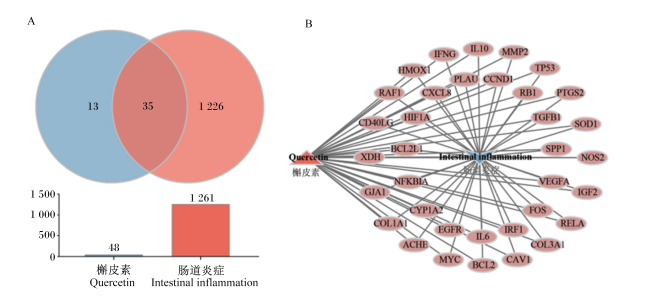
综合TCMSP和Uniprot数据库中的检索结果,共获得48个槲皮素在肉鸡中的潜在作用靶点(图1-A);通过GeneCards和OMIM数据库,共获得肠道炎症相关靶点1 261个(图1-A);通过将肠道炎症相关靶点与槲皮素潜在作用靶点进行交集分析,确定了35个共有靶点,即槲皮素缓解肉鸡肠道炎症的候选靶点(图1-B)。
图1 槲皮素潜在作用靶点和肠道炎症相关靶点以及共用靶点分析

A:槲皮素潜在作用靶点和肠道炎症相关靶点韦恩图 Venn diagram of quercetin potential targets and intestinal inflammation-related targets;B:槲皮素缓解肉鸡肠道炎症的候选靶点 candidate targets for quercetin alleviating intestinal inflammation in broilers。

ACHE:乙酰胆碱酯酶 acetylcholinesterase;BCL2:B细胞淋巴瘤2 B-cell lymphoma 2;BCL2L1:BCL2样蛋白1 BCL2 like protein 1;CAV1:小窝蛋白1 caveolin 1;CCND1:细胞周期蛋白D1 cyclin D1;CD40LG:CD40配体 CD40 ligand;COL1A1:Ⅰ型胶原蛋白α1链 collagen type Ⅰ alpha 1 chain;COL3A1:Ⅲ型胶原蛋白α1链 collagen type Ⅲ alpha 1 chain;CXCL8:C-X-C模式趋化因子配体8 C-X-C motif chemokine ligand 8;CYP1A2:细胞色素P450家族1亚家族A成员2 cytochrome P450 family 1 subfamily A member 2;EGFR:表皮生长因子受体 epidermal growth factor receptor;FOS:FOS原癌基因 Fos proto-oncogene;GJA1:间隙连接蛋白α1 Gap junction protein alpha 1;HIF1A:缺氧诱导因子1α hypoxia-inducible factor 1 alpha;HMOX1:血红素加氧酶1 heme oxygenase 1;IFNG:干扰素γ interferon gamma;IGF2:胰岛素样生长因子2 insulin like growth factor 2;IL10:白细胞介素10 interleukin 10;IL6:白细胞介素6 interleukin 6;IRF1:干扰素调节因子1 interferon regulatory factor 1;MMP2:基质金属蛋白酶2 matrix metalloproteinase 2;MYC:骨髓细胞瘤病毒癌基因同源物 myelocytomatosis viral oncogene homolog;NFKBIA:NF-κB抑制蛋白α NF-kappa-B inhibitor alpha;NOS2:一氧化氮合酶2 nitric oxide synthase 2;PLAU:尿激酶型纤溶酶原激活物 plasminogen activator, urokinase;PTGS2:前列腺素内过氧化物合酶2 prostaglandin-endoperoxide synthase 2;RAF1:Raf-1原癌基因 Raf-1 proto-oncogene;RB1:RB转录辅阻遏蛋白1 RB transcriptional corepressor 1;RELA:RELA原癌基因 RELA proto-oncogene;SOD1:超氧化物歧化酶1 superoxide dismutase 1;SPP1:分泌性磷蛋白1 secreted phosphoprotein 1;TGFB1:转化生长因子β1 transforming growth factor beta 1;TP53:肿瘤蛋白P53 tumor protein P53;VEGFA:血管内皮生长因子A vascular endothelial growth factor A;XDH:黄嘌呤脱氢酶 xanthine dehydrogenase。下图同 the same as below。

Fig.1 Analysis of potential targets of quercetin, targets related to intestinal inflammation and shared targets

2.2 槲皮素-肠道炎症靶点PPI网络的构建及核心靶点分析

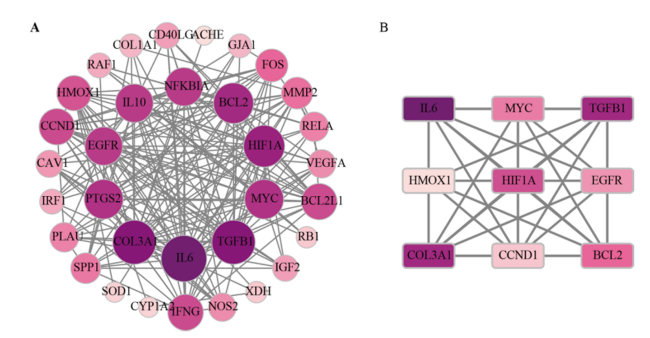
PPI网络显示,槲皮素和肠道炎症的共有靶点之间存在相互作用,网络中节点数为33个,边数为198条(图2-A)。网络拓扑分析结果表明,白细胞介素6(IL6)、转化生长因子β1(TGFB1)、骨髓细胞瘤病毒癌基因同源物(MYC)、Ⅲ型胶原蛋白α1链(COL3A1)、B淋巴细胞瘤2(BCL2)、表皮生长因子受体(EGFR)、血红素加氧酶1(HMOX1)、缺氧诱导因子1α(HIF1A)和细胞周期蛋白D1(CCND1)为槲皮素缓解肉鸡肠道炎症的核心靶点(图2-B)。
图2 槲皮素-肠道炎症靶点蛋白质互作网络及核心靶点

A:槲皮素-肠道炎症靶点PPI网络图 PPI network diagram of quercetin-intestinal inflammatory targets;B:核心靶点 core targets。

Fig.2 Quercetin-intestinal inflammatory target PPI network and core targets

2.3 GO功能富集分析和KEGG通路富集分析

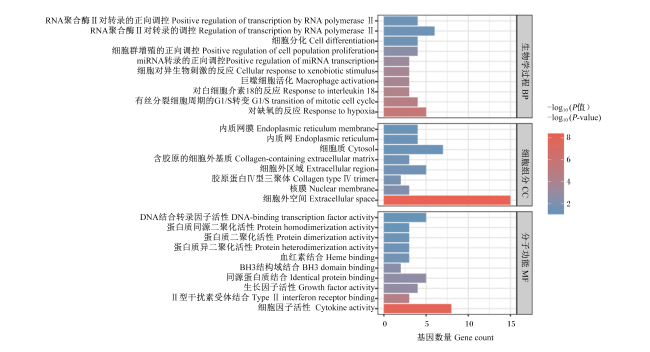
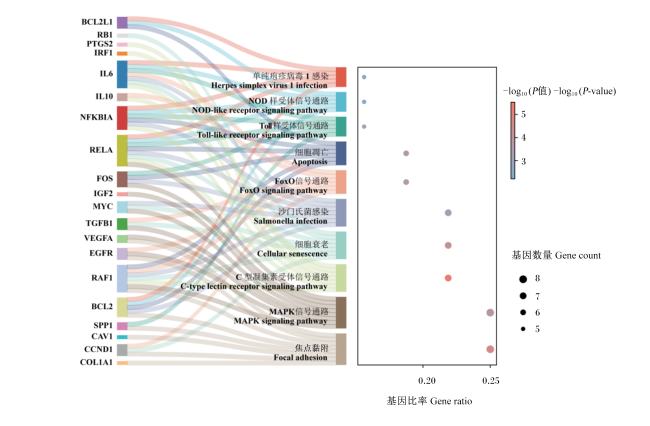
通过GO功能注释分析,本研究共获得69个生物学过程(biological processes,BP)、8个细胞组分(cellular components,CC)和16个分子功能(molecular functions,MF)条目,分别按富集度大小进行排序,选择前10个条目进行可视化。由图3可知,BP主要涉及对缺氧的反应(response to hypoxia)、有丝分裂细胞周期的G1/S转变(G1/S transition of mitotic cell cycle)、对白细胞介素18的反应(response to interleukin 18)、巨噬细胞活化(macrophage activation)和细胞对异生物刺激的反应(cellular response to xenobiotic stimulus)等过程;CC主要与细胞外空间(extracellular space)和细胞质(cytosol)等过程有关;MF主要与细胞因子活性(cytokine activity)、生长因子活性(growth factor activity)和Ⅱ型干扰素受体结合(type Ⅱ interferon receptor binding)等过程有关。通过KEGG通路富集分析,本研究共获得24条相关信号通路,根据基因比率进行排序,选择前10条进行可视化。由图4可知,槲皮素缓解肉鸡肠道炎症的信号通路主要涉及焦点黏附(focal adhesion)、丝裂原活化蛋白激酶(MAPK)信号通路(MAPK signaling pathway)、C型凝集素受体信号通路(C-type lectin receptor signaling pathway)、细胞衰老(cellular senescence)、FoxO信号通路(FoxO signaling pathway)、细胞凋亡(apoptosis)、Toll样受体信号通路(Toll-like receptor signaling pathway)和NOD样受体信号通路(NOD-like receptor signaling pathway)等。
图3 GO功能富集分析

Fig.3 GO function enrichment analysis

图4 KEGG通路富集分析

Fig.4 KEGG pathway enrichment analysis

2.4 槲皮素调控肠道炎症的核心基因簇分析

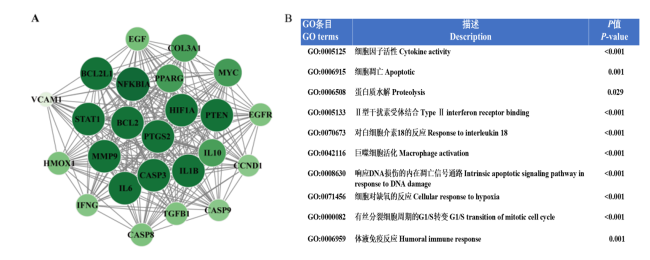
基于MCODE分析得到评分最高的集群互作网络(图5-A);GO功能分析结果表明,该基因簇主要参与细胞因子活性、细胞凋亡、Ⅱ型干扰素受体结合、对白细胞介素18的反应、巨噬细胞活化和体液免疫反应等过程(图5-B)。
图5 槲皮素调控肉鸡肠道炎症的核心基因簇分析

A:核心基因簇 core gene cluster;B:核心基因簇GO功能分析结果 GO functional analysis result of core gene cluster。

Fig.5 Analysis of core gene cluster involved in regulation of intestinal inflammation by quercetin in broilers

2.5 槲皮素与核心靶点的分子对接

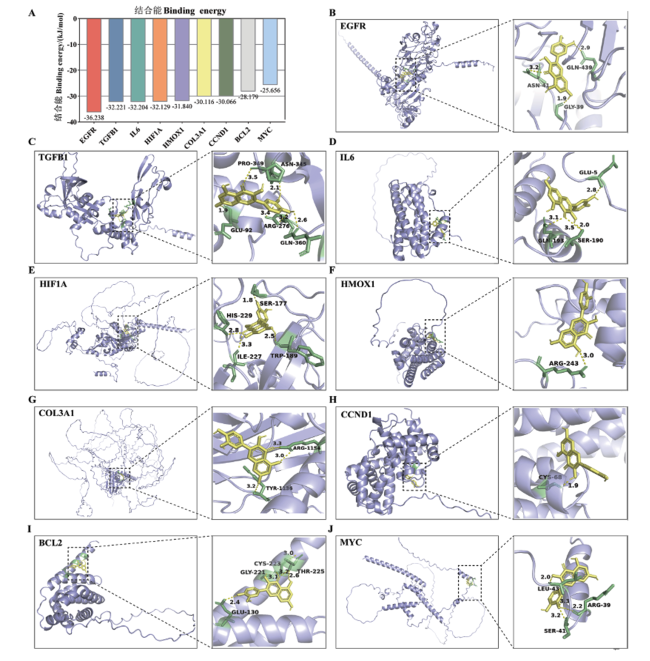
槲皮素与靶点蛋白EGFR、TGFB1、IL6、HIF1A、HMOX1、COL3A1、CCND1、BCL2和MYC的结合能分别为-36.238、-32.221、-32.204、-32.129、-31.840、-30.116、-30.066、-28.179和-25.656 kJ/mol(图6-A),表明槲皮素与核心靶点之间具有高度结合亲和力。槲皮素通过6条氢键与TGFB1蛋白的氨基酸残基PRO-349、ASN-345、GLU-92、ARG-276和GNL-360结合,通过5条氢键与BCL2蛋白的氨基酸残基CYS-223、GLY-221、THR-225和GLU-130结合,通过4条氢键与IL6蛋白的氨基酸残基GLU-5、GLN-193和SER-190结合,以及通过3条氢键与EGFR蛋白的氨基酸残基GLN-439、ASN-41和GLY-39结合,槲皮素与核心靶点之间形成的氢键长度均<3.5 Å(图6-B图6-J)。
图6 槲皮素与核心靶点的分子对接

A:槲皮素与核心靶点的结合能 binding energy of core targets and quercetin;B:槲皮素-EGFR quercetin-EGFR;C:槲皮素-TGFB1 quercetin-TGFB1;D:槲皮素-IL6 quercetin-IL6;E:槲皮素-HIF1A quercetin-HIF1A;F:槲皮素-HMOX1 quercetin-HMOX1;G:槲皮素-COL3A1 quercetin-COL3A1;H:槲皮素-CCND1 quercetin-CCND1;I:槲皮素-BCL2 quercetin-BCL2;J:槲皮素-MYC quercetin-MYC。

Fig.6 Molecular docking between core targets and quercetin

3 讨论

肠道炎症导致肉鸡生产性能显著下降,严重制约肉鸡产业的可持续发展与市场竞争力。在此背景下,天然植物提取物凭借其绿色安全属性与不易诱发耐药性的特点,已成为新型饲料添加剂研发的重要方向[7]。本研究发现,槲皮素可能通过作用于IL6、TGFB1、COL3A1、HIF1A、BCL2、EGFR、MYC、HMOX1和CCND1等靶点,调控焦点黏附、细胞衰老、MAPK、C型凝集素受体、FoxO、Toll样受体和NOD样受体等信号通路,进而干预细胞因子活性、细胞凋亡、细胞周期、巨噬细胞活化以及细胞对缺氧的反应等过程,从而缓解肉鸡肠道炎症。
研究表明,槲皮素可通过抑制IL6和TLR4等炎症基因的表达,减轻肉鸡空肠炎症反应[8]。Toll样受体是先天免疫系统的重要组成部分,可识别病原体相关分子模式并启动免疫反应[9]。另有研究证明,槲皮素通过抑制TLR4/NF-κB信号通路减轻脱氧雪腐镰刀菌烯醇诱导的小鼠肠道炎症损伤[10];并通过抑制蛋鸡肠道IL1βTLR4的表达,缓解脂多糖(LPS)诱导的肠道炎症反应[11]。此外,槲皮素是有效的EGFR磷酸化抑制剂,可通过抑制该通路减轻铁死亡和炎症反应,从而缓解大鼠胎盘内皮功能障碍[12]。GO功能富集分析结果表明,槲皮素主要作用于细胞外空间、细胞质和细胞外区域,这些位置是许多炎症因子和信号分子发挥作用的场所,证实了槲皮素在抗炎和免疫调节中的潜在作用[13]。值得注意的是,针对白细胞介素18应答及巨噬细胞活化等免疫相关BP的富集特征,提示槲皮素通过调节免疫细胞活化表型及炎症介质分泌实现对肠道炎症的调控。Wang等[14]研究发现,槲皮素可有效抑制HD11鸡巨噬细胞的M1极化并促进其M2极化,进而缓解鸡败血支原体感染引起的雏鸡呼吸道黏膜屏障功能障碍。Dong等[15]同样证实,槲皮素通过增强M2巨噬细胞的免疫调节功能,减轻小鼠气道炎症。NOD样受体是先天免疫系统的另一重要组成部分,可检测病原体和危险相关分子模式,其通过激活炎症途径在先天免疫反应中发挥关键作用[16]。槲皮素可通过作用于小胶质细胞NOD样受体蛋白3(NLRP3)炎症小体信号通路抑制神经炎症,进而消除LPS诱导的小鼠抑郁样症状[17]
BCL2是细胞凋亡的关键调节因子[18]。研究表明,槲皮素可显著下调鸡胚肝脏自噬相关基因[自噬相关基因5(ATG5)、自噬相关基因7(ATG7)]及坏死性凋亡基因[BCL2、Fas细胞表面死亡受体(FAS)、动力相关蛋白1(DRP1)、受体相互作用丝氨酸/苏氨酸蛋白激酶1(RIPK1)]的表达,进而缓解LPS诱导的肝脏炎症损伤[19]。槲皮素通过抑制细胞凋亡和炎症相关分子的表达,缓解蛋鸡产蛋后期卵巢铁死亡,进而提高产蛋量[20]。Yang等[21]进行的转录组学分析表明,槲皮素主要影响细胞凋亡、抗氧化和免疫相关基因的表达,并通过调节缺氧诱导因子1、C型凝集素受体、Toll样受体和FoxO信号通路,改善南美白对虾(Penaeus vannamei)的生长性能和免疫功能。TGFB1在炎症微环境中具有促炎与组织修复的双向调节特性,槲皮素通过动态平衡其表达水平,维持肠黏膜损伤修复与炎症消退的生理平衡,从而保障肠道屏障的结构完整性[22]。研究表明,槲皮素对小鼠子宫内膜异位症模型具有调节细胞增殖和抗炎作用,且与载体处理的小鼠相比,槲皮素腹腔注射后CCND1的表达显著降低[23]。HMOX1通过催化血红素降解反应,在氧化应激防御系统中发挥核心保护作用[24]。槲皮素通过激活HMOX1信号通路,显著增强肠道抗氧化能力,从而有效缓解氧化损伤[25]。在肉鸡中,槲皮素可上调Nrf2和HMOX1的表达,改善氧化大豆油引起的氧化应激,并增强肠道屏障功能[26]。此外,GO功能富集分析结果表明,槲皮素参与对缺氧的反应,提示其可能通过促进细胞低氧适应性、优化能量代谢模式及增强抗氧化防御功能发挥生理效应[27]。此外,槲皮素还可通过抑制MYC的表达来抑制自发性大鼠心肌炎氧化应激[28]。MAPK信号通路是包括炎症反应、细胞凋亡和氧化应激在内的多种细胞过程的关键调节因子[29-31]。Atta等[32]发现,槲皮素通过调节MAPK/NF-κB/NLRP3信号通路,减轻炎症反应、细胞凋亡和氧化应激,进而缓解丙烯酰胺诱导的大鼠肝脏炎症损伤。Zhang等[33]研究证实,槲皮素通过c-Jun氨基末端激酶(JNK)/p38 MAPK通路抑制氧化应激、细胞凋亡和炎症反应,从而减轻酒精诱导的神经元损伤,突出了其对酒精性脑损伤的治疗潜力。以上结果表明,槲皮素可通过多靶点、多途径发挥其抗炎、抗凋亡和抗氧化应激作用。
本研究基于网络药理学和分子对接技术,系统预测了槲皮素缓解肉鸡肠道炎症的潜在核心靶点和关键信号通路,为其在肉鸡健康养殖中的应用提供了理论依据,但需后续试验验证靶点蛋白的表达水平及通路活性。后续研究建议首先通过体外细胞试验和肉鸡体内模型,验证槲皮素对预测关键靶点及信号通路的调控作用;其次,建立剂量效应关系模型,阐明不同剂量槲皮素缓解肉鸡肠道炎症的效果差异;此外,可探索槲皮素与益生元、植物多糖或其他天然产物的协同作用,系统评估此类复合制剂对肉鸡肠道健康的改善效果,为开发基于槲皮素的新型高效饲料添加剂提供科学依据。

4 结论

综上所述,槲皮素可能通过多靶点、多途径缓解肉鸡肠道炎症,其缓解肉鸡肠道炎症的潜在核心靶点为IL6、TGFB1、COL3A1、HIF1A、BCL2、EGFR、MYC、HMOX1和CCND1,关键信号通路为焦点黏附、MAPK、C型凝集素受体、FoxO、Toll样受体和NOD样受体信号通路。
[1]
ZHANG B B, GAN L P, SHAHID M S, et al. In vivo and in vitro protective effect of arginine against intestinal inflammatory response induced by Clostridium perfringens in broiler chickens[J]. Journal of Animal Science and Biotechnology, 2019,10:73.

[2]
TANG Y, ZHANG X Y, WANG Y N, et al. Dietary ellagic acid ameliorated Clostridium perfringens-induced subclinical necrotic enteritis in broilers via regulating inflammation and cecal microbiota[J]. Journal of Animal Science and Biotechnology, 2022, 13(1):47.

[3]
DUCATELLE R, GOOSSENS E, EECKHAUT V, et al. Poultry gut health and beyond[J]. Animal Nutrition, 2023,13:240-248.

[4]
CHAI G R, LIU S, YANG H W, et al. Quercetin protects against diabetic retinopathy in rats by inducing heme oxygenase-1 expression[J]. Neural Regeneration Research, 2021, 16(7):1344-1350.

[5]
ABDEL-LATIF M A, ELBESTAWY A R, EL-FAR A H, et al. Quercetin dietary supplementation advances growth performance,gut microbiota,and intestinal mRNA expression genes in broiler chickens[J]. Animals, 2021, 11(8):2302.

[6]
XIE R R, XU T, YIN Y L, et al. Quercetin attenuates DEHP-induced pyroptosis and programmed necrosis in chicken duodenum through regulation of the TLR4/MYD88/NF-κB pathway[J]. Environmental Pollution, 2025,372:126016.

[7]
KUMAR A, SHARMA N K, KHERAVII S K, et al. Potential of a mixture of eugenol and garlic tincture to improve performance and intestinal health in broilers under necrotic enteritis challenge[J]. Animal Nutrition, 2022,8:26-37.

[8]
SUN L, GUO L W, XU G Q, et al. Quercetin reduces inflammation and protects gut microbiota in broilers[J]. Molecules, 2022, 27(10):3269.

[9]
李倩, 宁楠, 谌梦, 等. 复合植物精油对产气荚膜梭菌感染肉鸡生长性能和免疫功能的影响[J]. 饲料工业, 2023, 44(13):57-65.

LI Q, NING N, SHEN M, et al. Effects of compound plant essential oil on growth performance and immune function of broilers challenged by Clostridium perfringens[J]. Feed Industry, 2023, 44(13):57-65. (in Chinese)

[10]
YE Y R, JIANG M Z, HONG X Y, et al. Quercetin alleviates deoxynivalenol-induced intestinal damage by suppressing inflammation and ferroptosis in mice[J]. Journal of Agricultural and Food Chemistry, 2023, 71(28):10761-10772.

[11]
FENG J, LI Z R, MA H, et al. Quercetin alleviates intestinal inflammation and improves intestinal functions via modulating gut microbiota composition in LPS-challenged laying hens[J]. Poultry Science, 2023, 102(3):102433.

[12]
SHI M T, SUN L, WEI J C, et al. Quercetin alleviates endothelial dysfunction in preeclampsia by inhibiting ferroptosis and inflammation through EGFR binding[J]. Communications Biology, 2025, 8(1):90.

[13]
ZHANG J, WU J M, LU D Q, et al. Retinal proteomic analysis in a mouse model of endotoxin-induced uveitis using data-independent acquisition-based mass spectrometry[J]. International Journal of Molecular Sciences, 2022, 23(12):6464.

[14]
WANG S, GUO L Y, GU F H, et al. Quercetin restores respiratory mucosal barrier dysfunction in Mycoplasma gallisepticum-infected chicks by enhancing Th2 immune response[J]. Phytomedicine, 2024,133:155953.

[15]
DONG Y X, LIU L, ZHANG X W, et al. Quercetin improves macrophage immune regulatory functions to alleviate airway Th2 polarization[J]. Immunology Letters, 2025,275:107030.

[16]
LI X Y, HE C, LI N A, et al. The interplay between the gut microbiota and NLRP3 activation affects the severity of acute pancreatitis in mice[J]. Gut Microbes, 2020, 11(6):1774-1789.

[17]
ADEOLUWA O A, OLAYINKA J N, ADEOLUWA G O, et al. Quercetin abrogates lipopolysaccharide-induced depressive-like symptoms by inhibiting neuroinflammation via microglial NLRP3/NFκB/iNOS signaling pathway[J]. Behavioural Brain Research, 2023,450:114503.

[18]
YOON S, CHANDRA A, VAHEDI G. Stripenn detects architectural stripes from chromatin conformation data using computer vision[J]. Nature Communication, 2022, 13(1):1602.

[19]
YU J H, FU R, BUHE A, et al. Quercetin attenuates lipopolysaccharide-induced hepatic inflammation by modulating autophagy and necroptosis[J]. Poultry Science, 2024, 103(6):103719.

[20]
WEI S, AMEVOR F K, DU X X, et al. Quercetin mitigates iron-induced cell death in chicken granulosa cell[J]. Journal of Animal Science and Biotechnology, 2024, 15(1):168.

[21]
YANG X Y, WANG B J, JIANG K Y, et al. The combined analysis of transcriptomics and metabolomics reveals the mechanisms by which dietary quercetin regulates growth and immunity in Penaeus vannamei[J]. Fish & Shellfish Immunology, 2024,149:109579.

[22]
LIU W F, TASO O, WANG R, et al. TREM2 promotes anti-inflammatory responses in microglia and is suppressed under pro-inflammatory conditions[J]. Human Molecular Genetics, 2020, 29(19):3224-3248.

[23]
PARK S, LIM W, BAZER F W, et al. Quercetin inhibits proliferation of endometriosis regulating cyclin D1 and its target microRNAs in vitro and in vivo[J]. The Journal of Nutritional Biochemistry, 2019,63:87-100.

[24]
赵连文, 李文立, 王合亮, 等. 精氨酸对地塞米松刺激下肉鸡免疫功能、抗氧化功能和Nrf2/HO-1信号通路的影响[J]. 中国畜牧杂志, 2024, 60(10):274-279.

ZHAO L W, LI W L, WANG H L, et al. Effect of arginine on immune function,antioxidant function and Nrf2/HO-1 signaling pathway in dexamethasone-stimulated broiler chickens[J]. Chinese Journal of Animal Science, 2024, 60(10):274-279. (in Chinese)

[25]
SUN L, XU G Q, DONG Y Y I, et al. Quercetin protects against lipopolysaccharide-induced intestinal oxidative stress in broiler chickens through activation of Nrf2 pathway[J]. Molecules, 2020, 25(5):1053.

[26]
DONG Y Y, LEI J Q, ZHANG B K. Effects of dietary quercetin on the antioxidative status and cecal microbiota in broiler chickens fed with oxidized oil[J]. Poultry Science, 2020, 99(10):4892-4903.

[27]
郝铁兵, 项东, 项颖, 等. 槲皮素在畜牧养殖中应用研究进展[J]. 吉林畜牧兽医, 2023, 44(10):167-168.

HAO T B, XIANG D, XIANG Y, et al. Research progress on the application of quercetin in livestock breeding[J]. Jilin Animal Husbandry and Veterinary Medicine, 2023, 44(10):167-168. (in Chinese)

[28]
MAKSYMCHUK O, SHYSH A, KOTLIAROVA A. Quercetin inhibits the expression of MYC and CYP2E1 and reduces oxidative stress in the myocardium of spontaneously hypertensive rats[J]. Acta Biochimica Polonica, 2023, 70(1):199-204.

[29]
LI H, ZHU J, XU Y W, et al. Notoginsenoside R1-loaded mesoporous silica nanoparticles targeting the site of injury through inflammatory cells improves heart repair after myocardial infarction[J]. Redox Biology, 2022,54:102384.

[30]
WANG S F, GUO H J, ZHU-SALZMAN K, et al. PEBP balances apoptosis and autophagy in whitefly upon arbovirus infection[J]. Nature Communications, 2022, 13(1):846.

[31]
ZENG X K, LIU G G, PENG W W, et al. Combined deficiency of SLAMF8 and SLAMF9 prevents endotoxin-induced liver inflammation by downregulating TLR4 expression on macrophages[J]. Cellular & Molecular Immunology, 2020, 17(2):153-162.

[32]
ATTA R, ARAFAT H E K, KHALIL I A, et al. Enhanced hepatoprotective efficacy of quercetin nanoparticles versus free quercetin against acrylamide-induced hepatotoxicity through modulation of MAPK/NF-κB/NLRP3 signaling pathways and molecular docking validation[J]. Tissue and Cell, 2025,95:102936.

[33]
ZHANG Y, WANG B C, LIU L S, et al. The mechanistic study of quercetin in the treatment of alcoholic brain injury via the JNK/P38 MAPK signaling pathway[J]. Apoptosis, 2025, 30(7/8):1875-1892.

文章导航

/