综述

植酸磷的抗营养机制及其利用途径研究进展

  • 杨子中 , 1, 2 ,
  • 王路遥 1, 2 ,
  • 马晓康 1 ,
  • 万丹 , 2, *
展开
  • 1 湖南农业大学动物科学技术学院,长沙 410128
  • 2 中国科学院亚热带农业生态研究所,畜禽养殖污染控制与资源化技术国家工程实验室,动物营养代谢过程与生理调控实验室,长沙 410125
* 万丹,副研究员,硕士生导师,E-mail:

杨子中(2002—),男,安徽宣城人,硕士研究生,从事动物营养与饲料科学方向研究。E-mail:

收稿日期: 2025-06-08

  网络出版日期: 2026-01-13

基金资助

湖南省重大科技攻关项目(揭榜挂帅)(2024QK3001)

Research Progress on Antitrophic Mechanism and Its Utilization Pathways of Phosphorus Phytate

  • YANG Zizhong , 1, 2 ,
  • WANG Luyao 1, 2 ,
  • MA Xiaokang 1 ,
  • WAN Dan , 2, *
Expand
  • 1 College of Animal Science and Technology, Hunan Agricultural University, Changsha 410128, China
  • 2 National Engineering Laboratory of Livestock and Poultry Breeding Pollution Control and Resource Utilization Technology, Laboratory of Animal Nutrition Metabolism and Physiological Regulation, Institute of Subtropical Agroecology, Chinese Academy of Sciences, Changsha 410125, China
* associate professor, E-mail:

Received date: 2025-06-08

  Online published: 2026-01-13

摘要

磷作为动物必需的常量矿物质元素,广泛参与能量代谢、骨骼发育及DNA等物质合成的生理过程。植物性饲料中的磷主要以植酸磷形式存在,占总磷的60%~90%,在单胃动物体内利用率较低。植酸磷易与矿物质(如钙、铁、锌)及蛋白质结合,形成难吸收的复合物,影响营养物质的吸收利用效率。此外,未被利用的植酸磷随畜禽的粪便排放,可能引发水体富营养化等环境问题。因此,本文综述了近些年关于植酸磷抗营养机制以及提高植酸磷利用率的主要途径和研究现状,旨在为畜禽在饲养过程中提高饲料中植酸磷的利用率提供参考。

本文引用格式

杨子中 , 王路遥 , 马晓康 , 万丹 . 植酸磷的抗营养机制及其利用途径研究进展[J]. 动物营养学报, 2026 , 38(1) : 132 -143 . DOI: 10.12418/CJAN2026.012

Abstract

As an essential macromineral element in animals, phosphorus is widely involved in the physiological processes of energy metabolism, bone development, and DNA synthesis. Phosphorus in plant feed mainly exists in the form of phytic phosphorus, accounting for 60% to 90% of the total phosphorus, and the utilization rate in monogastric animals is low. Phosphorus phytate easily binds to minerals (such as Ca, Fe and Zn) and proteins to form difficult complexes and affect the absorption and utilization efficiency of nutrients. In addition, unused phosphorus phytate is discharged with the feces of livestock and poultry, which may cause environmental problems such as eutrophication of water bodies. Therefore, this paper reviews the main ways and research status of the antitrophic mechanism of phytate and the improvement of phytate phosphorus utilization in recent years, aiming to provide a reference for improving the utilization rate of phytate phosphorus in feed in livestock and poultry during feeding.

磷是动物必需的常量矿物质元素之一,参与动物机体遗传物质DNA和RNA的结构成分,并且通过磷脂形成细胞膜,广泛参与机体的物质代谢,在能量、氨基酸和脂肪代谢等方面发挥着至关重要的作用[1]。钙和磷是动物骨骼和肌肉发育所必需的矿物质元素,早期由于新生仔畜骨骼发育迅速,缺乏钙、磷等矿物质元素可能会降低仔畜骨密度和强度,并影响其生长发育和饲料转化率[2]。在常见的几种磷源中,无机源磷的溶解度高于动物磷源和植物磷源,可溶性越高的磷源,磷的消化率越高[3]。畜禽生产中常用的磷源主要是无机磷,据统计,2019年我国磷矿资源总量为259.1亿t,截止到2023年我国磷矿矿石储量仅为34.4亿t,磷酸盐属于不可再生资源,因此探索植物来源磷,尤其是植酸磷的高效利用技术至关重要[4]
植酸磷主要存在于谷物、谷物副产品和豆科种子中,占总磷的60%~90%,是植物种子中磷存在的主要形式[5]。在植物性饲料中,尤其是在谷实副产品和油籽类中,如麦麸、米糠的植酸磷含量显著高于谷实类;且总磷与植酸磷的含量呈显著正相关,植物总磷含量越高,植酸磷含量也会越高[6]。单胃动物(如猪和家禽)自身肠道分泌的植酸酶较少且活性较低,饲粮中的植酸(PA)会导致禽类出现唾液酸、氨基酸和矿物质的内源性损失增加[7];PA还可以通过降低仔猪回肠钠离子(Na+)的吸收转运能力,从而降低其生长性能[8]。反刍动物由于瘤胃微生物的植酸酶活性高,能有效水解饲料中的植酸磷,但是当饲粮中包含大豆粕(RSM)或油菜籽粕(SBM)时,植酸磷的有效降解性呈现显著下降,这表明反刍动物瘤胃中的活性植酸酶可能受到饲粮组成的差异影响[9-10]
2023年中国生态环境统计年报显示,全国总磷排放量为40.84万t,农业源总磷排放量为28.8万t,其中过量施用磷肥和畜禽粪便是水体磷污染的重要来源,占比高达70.6%[11]。近年来,政府有关粪便管理政策的主要目标已从单纯关注污染控制转向将污染控制与促进提高资源利用效率相结合[12-13]。很多研究成果提出了多种高效利用饲料中植酸磷的方法,包括使用外源性植酸酶[14]、膨化[15]、加热[16]以及开发低植酸(LPA)作物[17]等方式。因此,本文综述了近年来关于植酸磷抗营养机制以及提高植酸磷利用率的主要途径,旨在为提高饲料中植酸磷的利用率提供参考。

1 植酸磷的抗营养机制

1.1 PA与矿物质的螯合作用
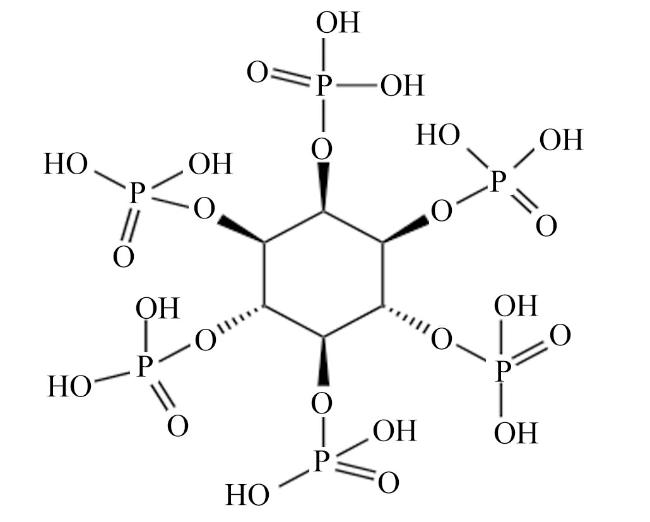
PA(图1)作为金属阳离子的强螯合剂,通过形成生物可利用性较低、稳定的PA-矿物质复合物影响动物对矿物质吸收[18]。PA-矿物质复合物的形成过程取决于pH、PA与矿物质的摩尔比和不同矿物质之间的互作[19]。PA与不同的矿物质形成复合物,其强度按降序排列,即中性pH时,锌离子(Zn2+)>亚铁离子(Fe2+)>锰离子(Mn2+)>铁离子(Fe3+)>钙离子(Ca2+)>镁离子(Mg2+)[20]。Nolan等[21]提出了PA与二价阳离子结合的几种可能机制,即:1)单个磷酸基团释放出2个氢离子与单个二价阳离子的2个正电荷结合;2)单个二价阳离子与2个不同的带负电荷的磷酸基团的结合;3)2种不同PA分子的2个磷酸基团也可以与2个带正电荷的金属阳离子结合;4)单个磷酸基团可以与2个不同的二价阳离子结合;5)如果多个磷酸基团与金属阳离子结合,还可以形成聚合物结构。
图1 植酸的化学结构式

Fig.1 Chemical structure of phytic acid[18]

PA与矿物质的摩尔比是影响其吸收的重要因素,有研究者测定了体外Caco-2细胞模型中抗坏血酸(AA)对PA络合铁影响Fe2+吸收的作用,当PA∶铁摩尔比为1∶1、3∶1、5∶1和10∶1时,铁吸收量分别降低了55.80%、72.33%、73.32%和73.26%;结果表明,PA会降低Fe2+的吸收效率,而AA可以抵消PA对Fe2+吸收的抑制作用[22]。不仅是铁,PA和锌的摩尔比过高或过低也会影响锌的吸收,当PA与锌的摩尔比为1∶20和1∶10时,锌的吸收率分别为22%~34%和20%~40%[23]
不同矿物质之间的互作效应同样也会降低矿物质的生物利用度,钙可能通过与PA作用形成复合物,从而降低锌的生物利用度,在钙含量为2 g/kg的饮食中,PA就能够降低锌的生物利用率,当钙含量达到5和15 g/kg时,其对锌生物利用度的负面影响更大[24]。在植酸盐存在的情况下,钙可以增加或减少锌的溶解度,这取决于溶质负荷和植酸盐、锌和钙的摩尔比[25]。例如,将氯化钙以摩尔过量的植酸盐添加到比例为6∶1的植酸盐和锌结合的溶液中时,能够从植酸盐中释放35%~40%的锌[26]。PA是锌和铁等矿物质吸收的主要抑制剂,因此对谷物副产品和豆类等进行脱PA处理,可以有效改善铁和锌的吸收[27-28]

1.2 PA与蛋白质的结合效应

蛋白质与PA是否能形成沉淀,强烈依赖于溶液本身的pH[29]。不同植物蛋白质的等电点(PL)在决定其分子的生化功能中起着重要作用,PA在pH低于或高于PL时,会与蛋白质形成二元复合物和三元复合物,这种复合物难以被胃蛋白酶消化,在小肠中持续存在,从而降低小肠蛋白质的消化率[30-31]
在10 mmol/L乙酸铵缓冲液(pH 4.0)条件下,加入PA到溶菌酶溶液中,先出现放热结合,随后在更高比例下发生吸热交联,这说明PA能够通过静电作用与蛋白质进行结合[32]。Nolan等[21]揭示了PA与蛋白质结合的2种机制:1)单个磷酸基团与蛋白质的带电基团相互作用,并随着pH的降低,结合能力增加;2)磷酸基团还可以通过金属离子介导与蛋白质结合,形成PA-蛋白质-金属络合物。在不添加植酸酶的情况下,肉鸡随着饲粮中PA含量从0.24%增加到0.34%和0.45%,半胱氨酸、丝氨酸和蛋氨酸+半胱氨酸的表观消化率以非线性方式分别降低了9.5%~14.1%、5.3%~5.9%和6.6%~8.7%,精氨酸和甘氨酸表观消化率仅降低了3.5%~4.0%和7.2%~8.5%,反应幅度因氨基酸而异[33]。综上所述,PA与蛋白质的结合效力随pH降低而增强,并通过持续的静电反应生成难溶性的PA-蛋白质复合物,从而影响动物肠道正常消化功能。

2 提高植酸磷利用率的主要途径

2.1 植物育种与动物基因改良

LPA作物的开发可以加强农业生产中磷的管理,以及矿物质的可持续利用,LPA的多效性归因于肌醇代谢产物作为信号分子在关键细胞通路中的作用,如细胞感知、信号传导、基因调控与磷储存等[34-35]。基因编辑技术已广泛用于植物育种,通过对PA合成关键基因进行定向突变或敲除,可使植株及种子中的PA含量显著降低,且未对植株的生长发育进程产生显著不良影响[36-37],具体见表1。但基因编辑带来的副作用也不可忽视,如幼苗出苗率低、整体作物产量降低[38]、植株高度和发芽率降低[39]等。尽管LPA品种可以有效降低植株中的PA含量,但由于缺乏种质资源,开发高产LPA品种仍然具有挑战性,未来使用如碱基编辑等精确编辑工具,可以更准确地调整作物PA相关基因,改善作物的农艺价值[40]
表1 植物育种与动物基因改良处理效果

Table 1 Plant breeding and animal genetic improvement effects

种类
Species
关键技术
Key technology
处理效果
Processing effects
参考文献
References
大豆Soybean GMIPK1基因定向突变 PA含量降低约25% [36]
油菜Rapeseed BnITPK基因敲除 PA含量降低约35%,游离磷含量增加 [37]
仔猪Piglets 植酸酶抗裂解转基因 磷消化率可达59.2%,粪磷排放降低25.4% [43]
生长育肥猪
Growing fattening pigs
β-葡萄糖苷酶、木聚糖酶和
植酸酶相关基因表达
粪便氮和磷排放量分别降低了
24.9%和45.8%,粪便和尿液中的钙和
磷含量也显著降低
[44]
仔猪
Piglets
β-葡萄糖苷酶、木聚糖酶和植酸酶
相关基因表达
粪磷排出量约降低50%,磷、钙和
氮的保留率显著提高
[45]

GmIPK1:大豆肌醇六磷酸2-激酶 glycine max inositol 1,3,4,5,6-pentakisphosphate 2-kinase 1;BnITPK:油菜肌醇三磷酸激酶 brassica napus inositol trisphosphate kinase;PA:植酸 phytic acid。

基因编辑技术也被用于转基因动物的开发,具体见表1。例如,成簇规律间隔短回文重复序列(CRISPR)/CRISPR相关蛋白9(Cas9)系统,常在猪中引入靶向遗传变异[41-42]。通过基因编辑与克隆技术培育转基因猪,使其能自身表达高活性的微生物酶(如β-葡聚糖酶、植酸酶和木聚糖酶等),这些酶在胃肠道环境中表现出优异的胃肠道环境适应性,显著提高了磷、氮等的矿物质的消化率,从而减少粪便排放[43-45]

2.2 物理和化学处理

饲料常见的物理加工方法,如高压灭菌、膨化、蒸煮和挤压等,这些方法可以有效去除抗性淀粉和PA等抗营养因子[46-47],详见表2。高温已经被证实对PA降解有显著效果,高温挤压过程降低了胰蛋白酶抑制剂、植酸磷和抗性淀粉[48]、β-大豆球蛋白和水溶性阿拉伯木聚糖含量[49]。此外,经过处理后饲粮的总酚含量、抗氧化性[50]及矿物质利用率[51]也会有所增加。
表2 不同加工方式对饲粮中植酸的降解效果

Table 2 Effects of different processing methods on phytate degradation in diets

处理方式
Processing
methods
原料
Materials
处理条件
Processing
conditions
处理效果
Processing
effects
参考文献
References
高温挤压
High temperature extrusion
蚕豆 110~115 ℃ 胰蛋白酶抑制剂和PA含量分别
降低25%和8%,IPS含量增加
[48]
高温高压灭菌
High-temperature-pressure
sterilization
燕麦麸 121 ℃,pH 4.0,
灭菌1.5 h
PA含量降低95.2%,TP和AA
含量分别提高了39%和15%
[50]
酸热处理
Acid heat treatment
小麦 45~60 ℃,pH
4.0~6.0,8~24 h
PA含量降低1.4~2.8倍,铁和锌的
利用度分别提高6和8倍
[51]
蒸汽爆破
Steam explosion
大豆粕 0.7 MPa,8 min PA含量降低12.95%~24.69%,
WSA含量可达17.59 mg/100 g
[49]
浸泡-挤压-发芽
Soak-squeeze-
germinating
大米 45 ℃浸泡24 h,
160~190 ℃挤压
PA含量降低77%,蛋白质
消化率降低7.3%
[52-53]
浸泡-发芽
Soak-germinating
大米 50 ℃浸泡36 h PA含量降低70.3%,
PHY活性显著提高
[57]
浸泡-发芽
Soak-germinating
大米 20~24 ℃,
萌发4~5 d
PA含量降低50%~80%,并且矿物质和
蛋白质的消化率可提高200%
[58]
脱脂-浸泡-发芽
Degreasing-soaking-
germinating
藜麦 室温浸泡6 h,
20 ℃、
湿度100%,
发芽4~7 d
经过处理后,WQ、BQ和RQ 3种藜麦的
PA含量分别降低了32.7%、73.7%和67.9%,
WQ和BQ的蛋白质含量分别增加了1.29和
1.23倍;钙含量在3个品种的增幅在25%~
27%;在发芽7 d后,WQ、BQ和RQ的锌浓度
分别比原料提高15%、13%和43%
[59]

PA:植酸 phytic acid;IPS:肌醇多磷酸 inositol polyphosphates;PHY:植酸酶 phytase;ACPH:酸性磷酸酶 acid phosphatase;TP:总酚 total phenols ;AA:氨基酸amino acids;WSA:水溶性阿拉伯木聚糖 water-soluble arabinoxylan;WQ:白色藜麦 white quinoa;BQ:黑色藜麦black quinoa;RQ:红色藜麦 red quinoa。

然而,在热处理过程中也可能发生某些不利影响,即蛋白质变性、可溶性纤维减少[52-53]等。这些不利影响可能是由于高温处理所导致的,所以人们探索了一些非热的加工方法,即浸泡和发芽等[54-56]。不同作物在进行浸泡-发芽处理后,作物PA含量显著降低,这可能是由于在发芽过程中植酸酶活性增加所导致的[57]。此外,作物的矿物质消化率和蛋白质消化率也显著提高[58-59]。以上结果表明,无论是热处理还是非热处理都降低了植物中的PA的含量,其中浸泡和发芽效果较显著,并且营养物质损失较少。

3 外源酶制剂的应用

3.1 植酸酶的来源与分类

植酸酶降解PA或植酸盐是逐步进行的,从完全磷酸化的肌醇六磷酸(IP6)开始,其次是肌醇五磷酸(IP5)、肌醇四磷酸(IP4)、肌醇三磷酸(IP3)、肌醇二磷酸(IP2)和肌醇单磷酸(IP1)[60]。在动物饲料中添加外源性酶制剂,如碳水化合物酶、淀粉酶和植酸酶,能够有效降低饲料中的抗营养因子,并提高动物的生长性能[61]。自然界中存在的植酸酶的来源主要分为3种:1)植物性植酸酶,广泛存在于各种植物性饲料原料中,并且根据不同植物、不同部位和不同时期,植酸酶活性有显著差异[62];2)动物性植酸酶,主要分布于单胃动物的肠道黏膜中,由于植酸酶活性低和工业化程度低等问题研究较少[63];3)微生物性植酸酶,因其来源广泛、酶活性高、易于工业化生产等特点,成为研究和应用的重点[64]。植酸酶不仅在动物饲料工业中作为一种商业酶发挥重要作用,其在生物燃料工业中的应用亦显示出巨大的潜力,相较于其他传统的酶促方法,植酸酶能够显著提升淀粉及木质纤维素转化为生物乙醇的产量[65]

3.2 植物性植酸酶

有研究者测定了植物谷物和油籽及其副产品的内源性植酸酶活性,其中最高的是小麦,植酸酶活性为1 565 U/kg[66]。Viveros等[6]的报道结果与此相似,所有籽实中黑麦植酸酶活性最高,酶活性超过5 000 U/kg;黑小麦次之,酶活性为2 030 U/kg;小麦酶活性为1 500 U/kg;玉米胚、燕麦和高梁籽实中几乎检测不到植酸酶活性。
当磷到达储存组织细胞时,经过细胞质中运作的2种生物合成途径之一转化为PA,然后再通过一种特定的多药耐药相关转运蛋白(MRP-ABC)被运输到蛋白质储存液泡(PSV),一些水解酶也被合成并储存在PSV中[67]。当种子吸水时,成熟的种子组织激活一系列预先形成的水解酶,这些酶降解了大量的内部IP6储存库,同时也降解了储存化合物如脂质、碳水化合物和蛋白质,植物种子在萌发过程中,植酸酶活性也会迅速增加[68]。不同的2种植物植酸酶活性之间还可能存在某种协同作用,通过使用去壳小麦粉作为植酸酶来源,与豌豆子叶粉混合水解PA,在相对较短的时间内可以将PA含量降低70%~95%[69]
通过对植物植酸酶基因序列的编辑,也能够提高植物植酸酶活性。从烟曲霉中克隆出来的植酸酶A2基因(PhyA2),使转基因玉米的植酸酶活性比正常组高10.9倍,转基因玉米植株能够吸收更多磷,并有效降解植酸盐[70]。通过紫色酸性磷酸酶类植酸酶基因插入,成熟谷物植酸酶活性稳定性增加,来自3种不同大麦植株的植酸酶基因通过水平叠加产生了基因剂量反应[71]

3.3 微生物性植酸酶

微生物来源的植酸酶是一种能够分解PA的蛋白酶,这些从细菌和真菌中提取的酶能够在不同的pH和温度条件下发挥作用[72]。能够产生植酸酶的常见微生物主要包括细菌(乳杆菌和芽孢杆菌)[73]和真菌(黑曲霉和米曲霉)[74]以及酵母(酿酒酵母菌和毕赤酵母)[75]等。
真菌被认为是单聚蛋白,在食品生产和饲料行业中因其能提高营养价值和减少磷污染水平而受到越来越多的关注[76]。黑曲霉相较于其他霉类有一定优势,如成本低、易于培养和工业化程度高的特性,是植酸酶生产中常用的一类真菌[77]。通过合理设计和定点突变,黑曲霉植酸酶A的活性和热稳定性显著提高,酶活性在pH 2.5和5.5时分别提高了1.6和1.7倍,酶的热稳定性在90 ℃时提高了1.4倍[78]。温度是影响米曲霉生长和活性的最重要环境因素,直接影响底物消化酶的活性,从而控制化合物产量和发酵速率[79]。采用硫酸铵级联沉淀法和阴离子交换色谱法可以有效地纯化植酸酶,使米曲酶在30 ℃和pH 5.5条件下的最大稳定性为6 h,且酶活性在60 ℃下保持稳定[80]
细菌与真菌的不同之处在于,pH最适范围从弱酸性到碱性,底物特异性高,如pH和温度最适值以及稳定性和对蛋白酶作用的抗性[73]。来自枯草芽孢杆菌P6纯化的植酸酶在40 ℃和pH 6.0时表现出最佳活性,并且对其天然底物PA表现出最高的底物特异性,不会水解具有磷酸键的其他底物[81]。由发酵乳杆菌NKN51中克隆并表达了一种新型蛋白酪氨酸磷酸酶植酸酶(PhyLf),最适温度为60 ℃,最适pH为5.0;PhyLf表现出对底物的高特异性以及对活性氧(ROS)的抗氧化性,并且在胃部酸性环境下仍保持高效的脱PA化能力[82]
酵母已被报道为生产PA的有效微生物[83]。黑曲霉AS3.350蛋白酶基因(pepD)成功克隆并在毕赤酵母KM71中表达,最适温度和pH分别为45 ℃和8.0~9.0[84]。通过CRISPR/Cas9技术将酸性和碱性植酸酶融合体展示在酿酒酵母细胞表面,使其表达一种结合了酸性和碱性植酸酶的融合植酸酶,其植酸酶的活性比单一酸植酸酶高3.5~4.0倍,且具有双重最适pH,分别在2.0和5.0~6.0[85]

3.4 其他酶制剂

植酸酶是饲料中的常用酶,能有效改善动物生产性能[86]。在育肥猪饲粮中分别添加不同形态和比例的植酸酶,平均日增重、采食量和营养物质消化率等方面均显著提高[87-88]
除了植酸酶外,畜禽生产中常用的酶制剂还包括果胶酶、淀粉酶和蛋白酶等。果胶酶是催化植物和微生物产生的含果胶物质的酶的总称,主要来源是细菌、真菌和酵母等,目前果胶酶在不同产业的需求正在不断增加[89]。淀粉酶水解淀粉生成多种产物,包括糊精和葡萄糖单元聚合物,根据作用方式分为α、β和γ[90]。蛋白酶的来源广泛,包括植物、动物以及微生物,近年来,鉴于微生物能够产生多种酶类,其在蛋白酶生产领域的产量显著提升[91]
在畜牧生产中,单一酶制剂的作用是有限的,由几种酶制剂组合的复合酶制剂效果往往更好,具体见表3。通过调整复合酶制剂的种类、比例和添加量,无论在禽类(肉鸡)[92]、猪(仔猪)[93]还是反刍动物(肉羊)[94],补充适宜的复合酶制剂均能观察到动物的生长性能、免疫功能和健康状况得到有效改善。对于泌乳奶牛,通过补充纤维酶-淀粉酶混合制剂能增加瘤胃液中的酶活性和氨氮含量,并且显著提高产奶量,从而改善奶牛的饲料转化率[95]
表3 不同酶制剂在畜禽生产中应用效果

Table 3 Application effects of different enzyme preparations in livestock and poultry production

种类
Species
组合
Combination
效果
Effects
参考文献
References
育肥猪
Fattening pigs
植酸酶 添加1 000 U/kg包衣植酸酶、粉状植酸酶、
微颗粒植酸酶,钙、磷的消化率分别提高
2.07%、1.03%、3.31%和0.50%、0.33%、2.68%
在植酸酶添加剂量为0~6 000 FTU/kg的各组中,
随着植酸酶添加水平的提高,磷、干物质、
总能及粗脂肪表观回肠消化率均呈线性
上升趋势,具体范围分别为78.1%~86.1%、
53.0%~79.4%、50.3%~78.6%和59.8%~79.5%
[87-88]
黄羽肉鸡
Yellow feathered
broilers
枯草芽孢杆菌、乳酸杆菌、
产朊假丝酵母菌、木聚糖酶、
纤维素酶和蛋白酶
在1~50 d,200和300 mg/kg添加组
肉鸡血清中GlOB含量、ALP活性、
T-AOC显著升高
[92]
肉羊
Meat sheep
木聚糖酶、植酸酶、
纤维素酶、淀粉酶和
脂肪酶
0.6和1.2 g/kg添加组肉羊血清
GLU、TP、ALB含量及瘤胃微生物
蛋白、乙酸和丁酸含量均有显著提高
[93]
断奶仔猪
Weaned piglets
木聚糖酶、甘露聚糖酶、
纤维素酶、蛋白酶、
淀粉酶和脂肪酶
2%的复合酶制剂添加组仔猪
生长性能和养分消化率提高,3%复合酶
制剂添加组血清IgG、TNF-α和IL-2
含量显著提高
[94]
泌乳母牛
Lactating cows
纤维素酶、淀粉酶 复合酶添加量为70 g/d,泌乳母牛瘤
胃中α-淀粉酶和木聚糖酶活性以及
氨氮浓度增加,牛奶产量、3.5%脂肪校
正乳和能量校正乳的产量均分别显著
提高了2.76、3.10和4.60 kg/d
[95]

GLOB:球蛋白 globulins ;ALP:碱性磷酸酶 alkaline phosphatase ;T-AOC:总抗氧化能力 total antioxidant capacity;IgG:免疫球蛋白G immuneglobulin G;TNF-α:肿瘤坏死因子-α tumor necrosis factor-α;IL-2:白细胞介素-2 interleukin-2;GLU:葡萄糖 glucose ;TP:总蛋白 total protein;ALB:白蛋白 albumin。

4 小结

近年来,随着畜牧业快速发展,饲料资源的需求持续攀升,养殖源污染的形势日益严峻,促使饲粮配方技术向节粮、绿色、高效方向发展。植酸磷是植物性饲料中磷的主要存在形式,但其在单胃动物胃肠道难以被有效消化,且会与矿物质和蛋白质结合,降低营养物质的生物利用度。本文综述了PA与矿物质和蛋白质的螯合机制以及从不同方面提高植酸磷利用率的方法,主要包括LPA作物育种与改良,β-葡聚糖酶、木聚糖酶和植酸酶转基因猪培育,蒸煮、高温高压和浸泡发芽等物理、化学方式对原料预处理,饲料外源添加酶制剂等方式。目前,LPA作物和转基因动物品种尚未广泛推广,蒸煮、高温高压和浸泡发芽等方式受传统的加工设备限制尚未产业化应用,主要依赖于植酸酶等酶制剂和多种复合酶制剂组合使用提升动物生产性能。尽管以植酸酶为代表的酶制剂研发与应用已有大量报道,但现有技术对PA的降解效率仍有待进一步提高。如何结合原料的预处理工艺、菌酶协同发酵、饲用复合酶制剂添加等方式,最大限度提高饲料中植物来源磷的利用效率,这对养殖源磷污染排放控制十分重要。
[1]
BIRD R P, ESKIN N A M. The emerging role of phosphorus in human health[J]. Advances in Food and Nutrition Research, 2021, 96:27-88.

DOI PMID

[2]
ZHANG W, KROSCHER K A, MURRAY R L, et al. Dietary calcium and phosphorus amounts affect development and tissue-specific stem cell characteristics in neonatal pigs[J]. The Journal of Nutrition, 2020, 150(5):1086-1092.

DOI

[3]
LINEVA A, KIRCHNER R, KIENZLE E, et al. A pilot study on in vitro solubility of phosphorus from mineral sources,feed ingredients and compound feed for pigs,poultry,dogs and cats[J]. Journal of Animal Physiology and Animal Nutrition, 2019, 103(1):317-323.

DOI

[4]
国家统计局. 中国统计年鉴2023[M]. 北京: 中国统计出版社, 2023.

National Bureau of Statistics. China Statistical Yearbook 2023[M]. Beijing: China Statistics Press, 2023. (in Chinese)

[5]
KUMAR A, DASH G K, SAHOO S K, et al. Phytic acid:a reservoir of phosphorus in seeds plays a dynamic role in plant and animal metabolism[J]. Phytochemistry Reviews, 2023, 22(5):1281-1304.

DOI

[6]
VIVEROS A, CENTENO C, BRENES A, et al. Phytase and acid phosphatase activities in plant feedstuffs[J]. Journal of Agricultural and Food Chemistry, 2000, 48(9):4009-4013.

PMID

[7]
COWIESON A J, ACAMOVIC T, BEDFORD M R. The effects of phytase and phytic acid on the loss of endogenous amino acids and minerals from broiler chickens[J]. British Poultry Science, 2004, 45(1):101-108.

DOI PMID

[8]
WOYENGO T A, WEIHRAUCH D, NYACHOTI C M. Effect of dietary phytic acid on performance and nutrient uptake in the small intestine of piglets[J]. Journal of Animal Science, 2012, 90(2):543-549.

DOI PMID

[9]
CHI Y P, HAESE E, RODEHUTSCORD M. Ruminal and post-ruminal phytate degradation of diets containing rapeseed meal or soybean meal[J]. Archives of Animal Nutrition, 2022, 76(3/4/5/6):233-247.

DOI

[10]
HAESE E, MÖHRING J, STEINGASS H, et al. Effect of dietary mineral phosphorus and phytate on in situ ruminal phytate disappearance from different concentrates in dairy cows[J]. Journal of Dairy Science, 2017, 100(5):3672-3684.

DOI

[11]
生态环境部. 2023年中国生态环境统计年报[R/OL].(2024-12-31)[2025-02-02]https://www.mee.gov.cn/hjzl/sthjzk/sthjtjnb/202412/t20241231_1099687.shtml.

Ministry of Ecology and Environment. 2023 China Ecological Environment Statistics Annual Report[R/OL].(2024-12-31)[2025-02-02]https://www.mee.gov.cn/hjzl/sthjzk/sthjtjnb/202412/t20241231_1099687.shtml. (in Chinese)

[12]
WEI S, ZHU Z P, ZHAO J, et al. Policies and regulations for promoting manure management for sustainable livestock production in China:a review[J]. Frontiers of Agricultural Science and Engineering, 2021, 8(1):45-57.

DOI

[13]
中华人民共和国农业农村部. 农业农村部办公厅生态环境部办公厅关于加强畜禽粪污资源化利用计划和台账管理的通知[EB/OL].(2021-12-27)[2025-02-02]. http://www.moa.gov.cn/govpublic/xmsyj/202112/t20211227_6385510.htm.

Ministry of Agriculture and Rural Affairs of the People’s Republic of China. Notice of the general office of the ministry of agriculture and rural affairs of the ministry of ecology and environment on strengthening the management of livestock and poultry manure resource utilization plan and ledger[EB/OL].(2021-12-27)[2025-02-02]. http://www.moa.gov.cn/govpublic/xmsyj/202112/t20211227_6385510.htm. (in Chinese)

[14]
KIM J W, NDOU S P, MEJICANOS G A, et al. Standardized total tract digestibility of phosphorus in flaxseed meal fed to growing and finishing pigs without or with phytase supplementation[J]. Journal of Animal Science, 2017, 95(2):799-805.

DOI PMID

[15]
ROYE C, HENRION M, CHANVRIER H, et al. Extrusion-cooking modifies physicochemical and nutrition-related properties of wheat bran[J]. Foods, 2020, 9(6):738.

DOI

[16]
LEE J, NYACHOTI C M. Heat processing increased the digestibility of phosphorus in soybean expeller,canola meal,and canola expeller fed to growing pigs[J]. Journal of Animal Science, 2021, 99(10):skab276.

[17]
REN Y Y, JIANG M D, ZHU J K, et al. Simultaneous mutations in ITPK4 and MRP5 genes result in a low phytic acid level without compromising salt tolerance in Arabidopsis[J]. Journal of Integrative Plant Biology, 2024, 66(10):2109-2125.

DOI

[18]
OATWAY L, VASANTHAN T, HELM J H. Phytic acid[J]. Food Reviews International, 2001, 17(4):419-431.

DOI

[19]
MAROLT G, GRIČAR E, PIHLAR B, et al. Complex formation of phytic acid with selected monovalent and divalent metals[J]. Frontiers in Chemistry, 2020, 8:582746.

[20]
MAENZ D D, ENGELE-SCHAAN C M, NEWKIRK R W, et al. The effect of minerals and mineral chelators on the formation of phytase-resistant and phytase-susceptible forms of phytic acid in solution and in a slurry of canola meal[J]. Animal Feed Science and Technology, 1999, 81(3/4):177-192.

DOI

[21]
NOLAN K B, DUFFIN P A, MCWEENY D J. Effects of phytate on mineral bioavailability.In vitro studies on Mg2+,Ca2+,Fe3+,Cu2+ and Zn2+ (also Cd2+) solubilities in the presence of phytate[J]. Journal of the Science of Food and Agriculture, 1987, 40(1):79-85.

DOI

[22]
HE W L, LI X L, DING K, et al. Ascorbic acid can reverse the inhibition of phytic acid,sodium oxalate and sodium silicate on iron absorption in Caco-2 cells[J]. International Journal for Vitamin and Nutrition Research, 2018, 88(1/2):65-72.

DOI

[23]
HAMBIDGE K M, MILLER L V, MAZARIEGOS M, et al. Upregulation of zinc absorption matches increases in physiologic requirements for zinc in women consuming high- or moderate-phytate diets during late pregnancy and early lactation[J]. The Journal of Nutrition, 2017, 147(6):1079-1085.

DOI

[24]
BERTINATO J, GRIFFIN P, HULIGANGA E, et al. Calcium exacerbates the inhibitory effects of phytic acid on zinc bioavailability in rats[J]. Journal of Trace Elements in Medicine and Biology, 2020, 62:126643.

[25]
ZHANG Y Y, STOCKMANN R, NG K, et al. Revisiting phytate-element interactions:implications for iron,zinc and calcium bioavailability,with emphasis on legumes[J]. Critical Reviews in Food Science and Nutrition, 2022, 62(6):1696-1712.

DOI

[26]
HALL A G, KING J C. The molecular basis for zinc bioavailability[J]. International Journal of Molecular Sciences, 2023, 24(7):6561.

DOI

[27]
GUPTA R K, GANGOLIYA S S, SINGH N K. Reduction of phytic acid and enhancement of bioavailable micronutrients in food grains[J]. Journal of Food Science and Technology, 2015, 52(2):676-684.

DOI PMID

[28]
ELLIOTT H, WOODS P, GREEN B D, et al. Can sprouting reduce phytate and improve the nutritional composition and nutrient bioaccessibility in cereals and legumes?[J]. Nutrition Bulletin, 2022, 47(2):138-156.

DOI PMID

[29]
PEI Y Q, WAN J W, YOU M, et al. Impact of whey protein complexation with phytic acid on its emulsification and stabilization properties[J]. Food Hydrocolloids, 2019, 87:90-96.

DOI

[30]
MOHANTA T K, KHAN A, HASHEM A, et al. The molecular mass and isoelectric point of plant proteomes[J]. BMC Genomics, 2019, 20(1):631.

DOI PMID

[31]
KASPCHAK E, IGARASHI-MAFRA L, MAFRA M R. Influence of ternary complexation between bovine serum albumin,sodium phytate,and divalent salts on turbidity and in vitro digestibility of protein[J]. Journal of Agricultural and Food Chemistry, 2018, 66(40):10543-10551.

DOI

[32]
DARBY S J, PLATTS L, DANIEL M S, et al. An isothermal titration calorimetry study of phytate binding to lysozyme:a multisite electrostatic binding reaction[J]. Journal of Thermal Analysis and Calorimetry, 2017, 127:1201-1208.

DOI

[33]
WALK C L, RAMA RAO S V. Increasing dietary phytate has a significant anti-nutrient effect on apparent ileal amino acid digestibility and digestible amino acid intake requiring increasing doses of phytase as evidenced by prediction equations in broilers[J]. Poultry Science, 2020, 99(1):290-300.

DOI PMID

[34]
RABOY V. Low phytic acid crops:observations based on four decades of research[J]. Plants, 2020, 9(2):140.

DOI

[35]
SPARVOLI F, COMINELLI E. Seed biofortification and phytic acid reduction:a conflict of interest for the plant?[J]. Plants, 2015, 4(4):728-755.

DOI

[36]
SONG J H, SHIN G, KIM H J, et al. Mutation of GmIPK1 gene using CRISPR/Cas9 reduced phytic acid content in soybean seeds[J]. International Journal of Molecular Sciences, 2022, 23(18):10583.

DOI

[37]
SASHIDHAR N, HARLOFF H J, POTGIETER L, et al. Gene editing of three BnITPK genes in tetraploid oilseed rape leads to significant reduction of phytic acid in seeds[J]. Plant Biotechnology Journal, 2020, 18(11):2241-2250.

DOI

[38]
REDEKAR N R, BIYASHEV R M, JENSEN R V, et al. Genome-wide transcriptome analyses of developing seeds from low and normal phytic acid soybean lines[J]. BMC Genomics, 2015, 16:1074.

[39]
LIN W X, BAI M Y, PENG C Y, et al. Genome editing toward biofortified soybean with minimal trade-off between low phytic acid and yield[J]. aBIOTECH, 2024, 5(2):196-201.

DOI PMID

[40]
BAI M Y, HU X C, LIN W X, et al. Development of PmCDA1-based high-efficiency cytidine base editors (ChyCBEs) incorporating a GmRad 51 DNA-binding domain in soybean[J]. New Crops, 2024, 1:100001.

[41]
WHITWORTH K M, GREEN J A, REDEL B K, et al. Improvements in pig agriculture through gene editing[J]. CABI Agriculture and Bioscience, 2022, 3(1):41.

DOI

[42]
KIM S, NO J G, LEE S, et al. In vitro gene editing using primary cells derived from Cas9-expressing pigs[J]. Journal of Animal Science and Technology, 2025, 67(1):179-192.

DOI

[43]
ZHANG M Y, ZHANG J, YANG H W, et al. Production of cleavage-resistant phytase transgenic pigs by handmade cloning[J]. Theriogenology, 2024, 224:68-73.

DOI PMID

[44]
ZHANG X W, LI Z C, YANG H Q, et al. Novel transgenic pigs with enhanced growth and reduced environmental impact[J]. eLife, 2018, 7:e34286.

[45]
YANG S X, LIU T T, MO J X, et al. Digestion and utilization of plant-based diets by transgenic pigs secreting β-glucanase,xylanase,and phytase in their salivary glands[J]. Transgenic Research, 2023, 32(1/2):109-119.

DOI

[46]
WU T, LI Z, LIU R, et al. Effect of extrusion,steam explosion and enzymatic hydrolysis on functional properties of wheat bran[J]. Food Science and Technology Research, 2018, 24(4):591-598.

DOI

[47]
BAI B C, GE G T, WANG Z J, et al. Extrusion puffing and enzymes improve silage performance and in vitro digestibility of sorghum straw by altering microbial composition,volatiles and anti-nutritional factors[J]. Industrial Crops and Products, 2025, 227:120837.

[48]
HEJDYSZ M, KACZMAREK S A, BEDFORD M R. The effect of different temperatures applied during extrusion on the nutritional value of faba bean and degradation of phytic P isomers[J]. Animal Feed Science and Technology, 2022, 285:115221.

[49]
KONG F, ZENG Q H, LI Y, et al. Effect of steam explosion on structural characteristics of β-conglycinin and morphology,chemical compositions of soybean meal[J]. Frontiers in Nutrition, 2022, 9:896664.

[50]
ÖZKAYA H, ÖZKAYA B, DUMAN B, et al. Effect of dephytinization by fermentation and hydrothermal autoclaving treatments on the antioxidant activity,dietary fiber,and phenolic content of oat bran[J]. Journal of Agricultural and Food Chemistry, 2017, 65(28):5713-5719.

DOI

[51]
HUYSKENS M, LEMMENS E, GROOTAERT C, et al. Acidic hydrothermal processing of wheat using citrate buffer largely enhances iron and zinc bioaccessibility and bioavailability to Caco-2 cells[J]. Food Chemistry, 2025, 467:142340.

[52]
ALBARRACÍN M, JOSÉ GONZÁLEZ R, DRAGO S R. Soaking and extrusion effects on physicochemical parameters,phytic acid,nutrient content and mineral bio-accessibility of whole rice grain[J]. International Journal of Food Sciences and Nutrition, 2015, 66(2):210-215.

DOI

[53]
ALBARRACÍN M, DYNER L, GIACOMINO M S, et al. Modification of nutritional properties of whole rice flours (Oryza sativa L.) by soaking,germination,and extrusion[J]. Journal of Food Biochemistry, 2019, 43(7):e12854.

[54]
MEHANNI A E, SOROUR M A, EL-GALEL H A, et al. Impact of soaking and germination procedures on polyphenols,tannins,and phytate contents in some Egyptian pulses[J]. SVU-International Journal of Agricultural Sciences, 2021, 3(4):63-72.

DOI

[55]
MAZI B G, ÇAĞLAYAN K. Ultrasound‐assisted soaking and solution effects on the anti‐nutritional quality and physical properties of legume seeds[J]. Food Science & Nutrition, 2025, 13(4):e70152.

[56]
RIZVI Q U E H, KUMAR K, AHMED N, et al. Influence of soaking and germination treatments on the nutritional,anti-nutritional,and bioactive composition of pigeon pea (Cajanus cajan L.)[J]. Journal of Applied Biology & Biotechnology, 2022, 10(3):127-134.

[57]
FUKUSHIMA A, UCHINO G, AKABANE T, et al. Phytic acid in brown rice can be reduced by increasing soaking temperature[J]. Foods, 2020, 10(1):23.

DOI

[58]
BEKTAŞ M, ERTOP M H. Phytic acid content and in-vitro digestibility of several cereal and legume types treated with different processes[J]. Ukrainian Food Journal, 2021, 10(3):507-523.

DOI

[59]
MALDONADO-ALVARADO P, PAVÓN-VARGAS D J, ABARCA-ROBLES J, et al. Effect of germination on the nutritional properties,phytic acid content,and phytase activity of quinoa (Chenopodium quinoa willd)[J]. Foods, 2023, 12(2):389.

DOI

[60]
RIVIERE A, NOTHOF T, GREINER R, et al. In vitro assessment of enzymatic phytate dephosphorylation during digestive process of different feeds and feed ingredients[J]. Animal Feed Science and Technology, 2021, 281:115096.

[61]
OJHA B K, SINGH P K, SHRIVASTAVA N. Chapter 7-enzymes in the animal feed industry[M]//KUDDUS M. Enzymes in Food Biotechnology. Cambridge: Academic Press, 2019:93-109.

[62]
CANGUSSU A S R, AIRES ALMEIDA D, DE SOUZA AGUIAR R W, et al. Characterization of the catalytic structure of plant phytase,protein tyrosine phosphatase-like phytase,and histidine acid phytases and their biotechnological applications[J]. Enzyme Research, 2018, 2018:8240698.

[63]
SANNI D M, JIMOH M B, LAWAL O T, et al. Purification and biochemical characterization of phytase from Bacillus cereus isolated from gastrointestinal tract of African giant snail (Achatina fulica)[J]. International Microbiology, 2023, 26(4):961-972.

DOI

[64]
RIZWANUDDIN S, KUMAR V, NAIK B, et al. Microbial phytase:their sources,production,and role in the enhancement of nutritional aspects of food and feed additives[J]. Journal of Agriculture and Food Research, 2023, 12:100559.

[65]
MAKOLOMAKWA M, PURI A K, PERMAUL K, et al. Thermo-acid-stable phytase-mediated enhancement of bioethanol production using Colocasia esculenta[J]. Bioresource Technology, 2017, 235:396-404.

DOI

[66]
GODOY S, CHICCO C, MESCHY F, et al. Phytic phosphorus and phytase activity of animal feed ingredients[J]. Interciencia, 2005, 30(1):24-28.

[67]
MADSEN C K, BRINCH-PEDERSEN H. Globoids and phytase:the mineral storage and release system in seeds[J]. International Journal of Molecular Sciences, 2020, 21(20):7519.

DOI

[68]
BETHKE P C, SWANSON S J, HILLMER S, et al. From storage compartment to lytic organelle:the metamorphosis of the aleurone protein storage vacuole[J]. Annals of Botany, 1998, 82(4):399-412.

DOI

[69]
CHOUCHENE A, MICARD V, LULLIEN-PELLERIN V. Evidence of a synergistic effect between pea seed and wheat grain endogenous phytase activities[J]. Journal of Agricultural and Food Chemistry, 2018, 66(45):12034-12041.

DOI PMID

[70]
JIAO P, YUAN W Y, ZHAO H D, et al. Construction of a new plant expression vector and the development of maize germplasm expressing the Aspergillus ficuum phytase gene PhyA2[J]. Genetic Resources and Crop Evolution, 2021, 68(3):1103-1115.

DOI

[71]
HOLME I B, MADSEN C K, WENDT T, et al. Horizontal stacking of PAPhy_a cisgenes in barley is a potent strategy for increasing mature grain phytase activity[J]. Frontiers in Plant Science, 2020, 11:592139.

DOI

[72]
JOUDAKI H, ARIA N, MORAVEJ R, et al. Microbial phytases:properties and applications in the food industry[J]. Current Microbiology, 2023, 80(12):374.

DOI

[73]
JAIN J, SAPNA, SINGH B. Characteristics and biotechnological applications of bacterial phytases[J]. Process Biochemistry, 2016, 51(2):159-169.

DOI

[74]
SINGH B, PRAGYA, TIWARI S K, et al. Production of fungal phytases in solid state fermentation and potential biotechnological applications[J]. World Journal of Microbiology and Biotechnology, 2024, 40(1):22.

DOI

[75]
GEORGIEV D, KOSTOVA M, DE OLIVEIRA A C, et al. Investigation of the potential of yeast strains for phytase biosynthesis in a two-step screening procedure[J]. Journal of Microbiological Methods, 2024, 217/218:106890.

[76]
JATUWONG K, SUWANNARACH N, KUMLA J, et al. Bioprocess for production,characteristics,and biotechnological applications of fungal phytases[J]. Frontiers in Microbiology, 2020, 11:188.

[77]
ISIK B, BILGI M. Investigation of physicochemical characteristics of Aspergillus niger biomass and examination of its ability to separate butyl acetate isomers[J]. Applied Biochemistry and Biotechnology, 2024, 196(10):6817-6835.

DOI

[78]
DOTSENKO A, ROZHKOVA A, ZOROV I, et al. Increased activity under acidic conditions and improved thermostability of Aspergillus niger phytase A[J]. Bioresource Technology Reports, 2025, 30:102161.

DOI

[79]
JIANG C M, GE J X, HE B, et al. Transcriptomic analysis reveals Aspergillus oryzae responds to temperature stress by regulating sugar metabolism and lipid metabolism[J]. PLoS One, 2022, 17(9):e0274394.

DOI

[80]
HAQ I U, JAVED M U, NAWAZ A, et al. Biosynthesis,purification,kinetic and thermodynamic analysis of phytase from Aspergillus oryzae[J]. Revista Mexicana de Ingeniería Química, 2020, 19(S1):227-242.

[81]
TRIVEDI S, HUSAIN I, SHARMA A. Purification and characterization of phytase from Bacillus subtilis P6:evaluation for probiotic potential for possible application in animal feed[J]. Food Frontiers, 2022, 3(1):194-205.

DOI

[82]
SHARMA R, KUMAR P, KAUSHAL V, et al. A novel protein tyrosine phosphatase like phytase from Lactobacillus fermentum NKN51:cloning,characterization and application in mineral release for food technology applications[J]. Bioresource Technology, 2018, 249:1000-1008.

DOI

[83]
SURYANI A E, ANGGRAENI A S, ISTIQOMAH L, et al. Isolation and identification of phytate-degrading yeast from traditional fermented food[J]. Biodiversitas Journal of Biological Diversity, 2021, 22(2):866-873.

[84]
KE Y, WEI M Y, FU Y T, et al. Enzymatic characteristics of a recombinant protease (rPepD) from Aspergillus niger expressed in Pichia pastoris[J]. Protein Expression and Purification, 2019, 162:67-71.

DOI

[85]
THANH L M, LAN V T H, CUONG C Q, et al. Development of CRISPR/Cas9-mediated Saccharomyces cerevisiae strains for the cell-surface display of a novel fusion acid-alkaline phytase[J]. Journal of Agricultural and Food Chemistry, 2025, 73(14):8458-8468.

DOI

[86]
DERSJANT-LI Y, AWATI A, SCHULZE H, et al. Phytase in non-ruminant animal nutrition:a critical review on phytase activities in the gastrointestinal tract and influencing factors[J]. Journal of the Science of Food and Agriculture, 2015, 95(5):878-896.

DOI

[87]
肖金华, 戴振宇, 刘道杨, 等. 不同形态植酸酶对育肥猪生长性能的影响[J]. 江西畜牧兽医杂志, 2024,(5):27-29.

XIAO J H, DAI Z Y, LIU D Y, et al. Effects of different forms of phytase on growth performance of fattening pigs[J]. Jiangxi Journal of Animal Husbandry and Veterinary Medicine, 2024,(5):27-29. (in Chinese)

[88]
LEE J K, DUARTE M E, KIM S W. Super dosing effects of corn-expressed phytase on growth performance,bone characteristics,and nutrient digestibility in nursery pigs fed diets deficient in phosphorus and calcium[J]. Journal of Animal Science, 2017, 95(S2):144.

[89]
HAILE S, AYELE A. Pectinase from microorganisms and its industrial applications[J]. The Scientific World Journal, 2022, 2022:1881305.

[90]
KIKANI B A, SINGH S P. Amylases from thermophilic bacteria:structure and function relationship[J]. Critical Reviews in Biotechnology, 2022, 42(3):325-341.

DOI

[91]
BEZERRA V H S, CARDOSO S L, FONSECA-BAZZO Y, et al. Protease produced by endophytic fungi:a systematic review[J]. Molecules, 2021, 26(22):7062.

DOI

[92]
王明涛, 郝慎文. 日粮添加复合酶菌制剂对肉鸡生长性能、血清生化指标和免疫功能的影响[J]. 中国饲料, 2025(6):21-24.

WANG M T, HAO S W. The effects of adding bacterial enzyme compound preparation to the diet on growth performance,serum biochemical indicators,and immune function of broiler chickens[J]. China Feed, 2025(6):21-24. (in Chinese)

[93]
宋建华, 马荣德, 赵立娜, 等. 玉米-豆粕型日粮添加复合酶制剂对育肥羊生长性能、瘤胃发酵参数和血清生化指标的影响[J]. 中国饲料, 2024(14):46-49.

SONG J H, MA R D, ZHAO L N, et al. The effects of adding complex enzyme preparations to corn and soybean meal based diets on the growth performance,rumen fermentation parameters,and serum biochemical indicators of fattening sheep[J]. China Feed, 2024(14):46-49. (in Chinese)

[94]
王文兵, 张钰爽, 余倩云, 等. 日粮添加复合酶制剂对断奶仔猪生长性能、免疫功能及养分消化率的影响[J]. 中国饲料, 2023(12):44-47.

WANG W B, ZHANG Y S, YU Q Y, et al. Effects of adding complex enzyme preparations to the diet on growth performance,immune function,and nutrient digestibility of weaned piglets[J]. China Feed, 2023(12):44-47. (in Chinese)

[95]
LIU Z K, LI Y, ZHAO C C, et al. Effects of a combination of fibrolytic and amylolytic enzymes on ruminal enzyme activities,bacterial diversity,blood profile and milk production in dairy cows[J]. Animal, 2022, 16(8):100595.

DOI

文章导航

/