综述

热应激相关肠道损伤及肠道菌群调控作用的研究进展

  • 唐宗源 ,
  • 孟薇 ,
  • 吴奇谓 ,
  • 魏艳玲 , *
展开
  • 陆军军医大学陆军特色医学中心(大坪医院)消化内科,重庆 400042
* 魏艳玲,副教授,博士生导师,E-mail:

唐宗源(1994—),男,重庆人,主治医师,硕士,主要从事消化内科及肠道菌群研究。E-mail:

收稿日期: 2025-07-04

  网络出版日期: 2026-01-13

基金资助

国家自然科学基金面上项目(82370539)

重庆英才创新创业领军人才项目(CQYC20220303576)

陆军军医大学科技创新能力提升专项项目(2022XJS32)

Research Progress on Heat Stress-Induced Intestinal Injury and Regulatory Role of Gut Microbiota

  • TANG Zongyuan ,
  • MENG Wei ,
  • WU Qiwei ,
  • WEI Yanling , *
Expand
  • Department of Gastroenterology, Daping Hospital, Army Medical University (Third Military Medical University), Chongqing 400042, China
* associate professor, E-mail:

Received date: 2025-07-04

  Online published: 2026-01-13

摘要

热应激是全球最常见的环境挑战之一,对人与动物机体存在多种负面影响,尤其是引发胃肠道症状。现有研究表明,热应激对肠道组织以及肠道菌群的影响是复杂而广泛的,调控肠道菌群可减轻热应激反应,有望成为改善热应激相关损伤的重要干预方式。本文综述了热应激与肠道关系的相关研究,包括热应激下机体肠道屏障、免疫反应、代谢及肠道菌群等方面的变化,以及肠道菌群调控机体热适应能力方面的研究进展。

本文引用格式

唐宗源 , 孟薇 , 吴奇谓 , 魏艳玲 . 热应激相关肠道损伤及肠道菌群调控作用的研究进展[J]. 动物营养学报, 2026 , 38(1) : 163 -171 . DOI: 10.12418/CJAN2026.014

Abstract

Heat stress is one of the most common environmental challenges worldwide, exerting various negative effects on the body of both humans and animals, particularly by inducing gastrointestinal symptoms. Existing research indicates that heat stress has complex and extensive impacts on intestinal tissue and gut microbiota, and modulating the gut microbiota may help alleviate heat stress responses. Gut microbiota modulation is expected to become a key intervention strategy for mitigating heat stress-related damage. This review summarized scientific evidence on the relationship between heat stress and the gut, including changes in intestinal barrier function, immune responses, metabolism, and gut microbiota under heat stress, as well as research progress on how gut microbiota regulates the body’s heat adaptation capacity.

应激(stress)是机体对干扰其正常生理状态的真实刺激或感知刺激的反应,其主要表现是机体为恢复体内平衡的生物适应性反应,但也影响着机体的正常功能。热应激(heat stress)既可以是生物体对热这一感知觉的应对反应,也可以指代导致机体产生热应激的刺激源,其广泛存在于多种环境中,是全世界最常见的环境挑战之一。热相关疾病的死亡率逐年升高[1],热应激对机体的肠道功能影响显著,消化道症状是热应激状态下的机体出现的最主要症状之一,包括腹痛、腹泻、肠道菌群紊乱,甚至严重的肠道损伤[2]。调节肠道菌群可减轻机体的热应激反应,有望成为改善热应激机体损伤的有效治疗手段。

1 热应激与肠道相关概念

通常情况下,35 ℃以上的生活环境或32 ℃以上的生产环境称为高温环境,60%以上的相对湿度环境视为高湿环境[3]。高温环境是重要的热应激源,在水资源相对丰富的地区,高温环境也伴随着高湿环境。随着全球温室效应的增加,近些年来极端天气发生更加频繁,一年中全球高温高湿天气的时空范围都相对扩大。我国大部分地区地处亚热带及热带边缘,受热带季风气候影响,尤其是沿海地区,具有夏季长、湿度大、气温高、日照强烈等气象特点,属于高温高湿环境,因此热应激、热射病等是作业生产、体能训练中常见的不良事件之一。研究报道,随着气温的升高,1991—2018年期间,全球热相关疾病的死亡风险平均增加了37%(范围为20.5%~76.3%)[1],热射病作为最严重的热应激反应,主要表现为核心体温的升高(≥40 ℃)及中枢神经系统的异常,可伴有多器官功能障碍。基于发病原因和易感人群,热射病可分为经典型热射病(classic heatstroke,CHS)与劳力性热射病(exertional heatstroke,EHS)。CHS在夏季热浪期间人群发病率为0.18‰~0.27‰,住院病死率为14%~65%,重症加强护理病房(ICU)病死率>60%;EHS在军事训练中的发病率为0.2‰~10.5‰,合并低血压时病死率>30%[4]。减轻热应激反应对高温高湿环境中的生产、生活具有重要意义。
热应激可诱发多种机体不适症状,胃肠道症状尤为突出。既往研究报道,气候相关因素显著影响易感人群的季节性腹泻。据观察,平均环境温度每升高5 ℃,每日因腹泻住院的人数就会增加2倍[5]。研究证实,腹泻症状与中暑患者生存预后存在显著相关性[6]。通过使用米索前列醇等药物减轻胃肠道损伤,可明显改善热应激导致的多器官功能障碍[7]。相关研究证明,胃肠道反应是机体的热应激全身反应的重要环节。
虽然高温高湿环境对机体具有负面影响,但是通过人工热室等方式进行适应性训练,也能够使机体在一定范围内适应,这一过程被称为热习服训练或干预,相对适应热环境的这一状态被称为热习服[8]。多项研究证明,热习服与肠道菌群之间存在密切联系,肠道菌群的组成可直接影响果蝇等生物的耐热性[9],而肠道菌群变化可通过调节免疫减轻热应激时的器官损伤[10]。这些研究报告提示,肠道菌群可通过多种方式调控热应激相关肠道损伤。
肠道是指从胃幽门至肛门的消化道,是消化系统的重要组成部分,肠道的主要功能包括消化吸收、排泄废物、免疫防御、内分泌调节以及菌群平衡。研究表明,在肠道功能的正常运转中,肠道菌群扮演着重要角色,发挥着重要作用[11]。人体肠道存在100~1 500种微生物、近100万亿个细菌,构成肠道菌群。肠道菌群是宿主肠道内的重要角色,肠道菌群及其代谢产物是维持机体内稳态的重要因素,包括神经、内分泌、营养物质代谢等生理过程[11]。肠道菌群有助于肠道黏膜免疫屏障的稳定,由机械屏障、化学屏障、生物屏障、免疫屏障组成的肠道黏膜屏障可有效阻挡人体受到病原体的侵袭。正常情况下肠道菌群间维持着共生或拮抗的关系,当人体处于健康状态时,肠道中拟杆菌门(Bacteroidetes)和厚壁菌门(Firmicutes)为优势菌门,占比超90%;然而,在内源性或外源性的不良刺激下,肠道菌群结构紊乱可成为促进病理过程发生发展的催化因素[12]
来自大脑的信号可以改变肠道的运动、感觉、分泌和免疫功能,与之相对,来自肠道的内脏信息可以通过神经递质、代谢产物等多种方式影响大脑功能,肠道菌群在这种被称为“肠-脑轴”的双向网络中扮演着重要的角色[13]。肠道作为一个半开放的器官,能直接感受外界温度的变化;温度刺激由皮肤感受传递相关信号至大脑这一神经中枢调控,通过“肠-脑轴”的交互作用,肠道也对温度刺激高度敏感[14]。所以,热应激对肠道及肠道菌群的影响是多重的、复杂的。

2 热应激相关肠道损伤

2.1 热应激与肠道屏障

热应激通常会引起肠道的不适,甚至损伤[15]。热应激条件下,机体通过适应性反应调节心血管系统,增加机体浅表部分的血流量以促进散热,同时代偿性减少内脏血流量以维持血压稳定[14],导致肠道黏膜的相对缺氧,诱发肠道的氧化和亚硝化反应,破坏肠上皮紧密连接结构,增加其通透性,引起“肠漏”,由于血供减少带来的维持细胞活力和功能的营养物质和能量减少,还会损害沿血管分布的肠道各类细胞的正常功能[16]。热应激可能与核因子-κB(NF-κB)相关信号通路的表达上调有关。在肉鸡研究中发现,慢性热应激激活黏膜相关淋巴组织淋巴瘤易位蛋白1(MALT1)/NF-κB信号通路抑制MALT1蛋白酶活性,可通过促进紧密连接蛋白生成并抑制NF-κB介导的炎症反应来保护肠道完整性[17];补充二甲基甘氨酸(DMG)可减轻炎症、下调NF-κB信号通路,同时增加粪杆菌属(Faecalibacterium)丰度及增强色氨酸代谢[18]。此外,热应激会导致自愿进食量减少。研究证实,慢性热应激可上调小鼠脂肪因子瘦素(leptin)和脂联素(adiponectin)及其受体的分泌与表达[19]。增加的脂肪因子可负调节机体的进食行为,通过减少进食达成的热量限制可帮助动物减少代谢热量的产生,以减轻热应激的影响[20]。然而,突然减少的进食量也会影响肠道功能并导致体重的下降。上述证据表明,热应激直接影响肠道的能量代谢,损害肠屏障结构。
热应激不仅会引起肠屏障结构通透性的改变,而且其对肠道细胞也存在损伤作用,尤其是可引起肠上皮细胞凋亡。研究显示,39 ℃的热应激显著增加了T84细胞(人肠上皮细胞系)内完整蛋白质的转运,上调T84细胞内磷酸化肌球蛋白轻链(MLC)、磷酸化蛋白激酶C(PKC)和磷酸化MLC激酶(MLCK)的表达,但相关蛋白的表达在41和43 ℃时显著降低;此外,使用PKC抑制剂、MLCK抑制剂或热休克蛋白70(HSP70)预处理可缓解热应激诱导的屏障功能障碍[21]。Zhou等[22]报道,热应激能促进肠上皮细胞p53磷酸化,进而上调Toll样受体3(TLR3)的表达,增强β干扰素TIR结构域衔接蛋白(TRIF)与受体相互作用蛋白3(RIP3)相互作用,激活RIP3-MLKL信号通路,最终介导肠上皮细胞坏死性凋亡。Shih等[23]使用LS 174T细胞和HT-29细胞探索了抗菌肽Cathelicidin LL-37缓解热应激的效应,发现其能够保护杯状细胞和肠道屏障功能,并减轻热应激造成的肠道损伤。此外,也有研究证实,缺氧诱导因子-1α(HIF-1α)通过真核翻译起始因子2α(eIF2α)/活化转录因子4(ATF4)/C/EBP同源蛋白(CHOP)信号通路抑制热应激诱导的猪小肠上皮细胞凋亡[24]。研究发现,热应激可以通过Z-DNA结合蛋白1(ZBP1)促进细胞凋亡,导致多器官损伤[25]。综上可知,热应激通过激活信号通路,导致肠道多种细胞的凋亡,尤其是肠上皮细胞,这可能是热应激导致肠道组织屏障功能受损的重要机制。

2.2 热应激与肠道免疫反应

热应激可影响肠道的免疫反应。人体大约70%的全身免疫活动集中在肠道,是机体免疫屏障的第1道防线。在湿热环境下,肠道黏膜屏障易受到损伤,肠道内细菌与内毒素移位,进一步激活机体免疫系统并释放炎症介质,是热应激病理过程的重要环节[15]。多项研究证实热应激损害家禽肠道屏障完整性,增加通透性和局部炎症,尤其是观察到沿小肠分布的淋巴浆细胞浸润增加,并且在炎症浸润区域发现异嗜性粒细胞浸润及细菌侵入固有层[26]。此外,热应激下升高的血清皮质酮和儿茶酚胺类激素也影响肠上皮紧密连接和免疫功能[27]。在Quinteiro-Filho等[28]和Alhenaky等[29]的研究中发现,热应激刺激后肉鸡等禽类血清中皮质酮、内毒素和全身炎性细胞因子[肿瘤坏死因子-α(TNF-α)和白细胞介素-2(IL-2)]的浓度增加;同时,肉鸡脾脏和肝脏中沙门氏菌的感染率与对照组相比更高,证实了热应激破坏肠道屏障,导致肠道对内毒素的通透性增加,以及肠道病原体的易位[29]
调节免疫功能可以改善肠道的热应激反应。叶楠等[30]在小鼠模型上证实了热习服能够诱导机体分化产生更多的Treg细胞,有效抑制高热应激下的炎症反应,从而保护脏器。乳杆菌属(Lactobacillus)等菌属可调控Treg细胞,维持肠道屏障功能,调节树突状细胞和巨噬细胞活性[31]。乳杆菌属等有益菌属的相对丰度在热习服大鼠肠道菌群中显著增加[32],这可能是其调控热应激反应的作用机制之一。研究发现,白细胞介素-17A(IL-17A)在小鼠热射病损伤中具有重要作用,紫草素可改善IL-17A对炎症和氧化通路的触发作用,预防小鼠热休克死亡[33]
热休克蛋白(HSPs)是一种分子伴侣、细胞保护蛋白,其进化保守,与热休克反应密切相关,用于对抗异常的生理条件、应激源和疾病状态[34]。HSPs在保护肠上皮抵抗氧化应激和炎症中发挥重要作用。HSPs与主要组织相容性复合体分子共同参与抗原提呈。细胞外HSPs可激活Toll样受体2/4(TLR2/4)和CD91等受体,产生危险信号,直接与抗原提呈细胞(如巨噬细胞)互作,启动固有免疫应答。细胞内HSPs(如iHSP70)则在肽结合与抗原提呈上游的胞内肽转运中起作用[35]。既往研究报道,HSP70的过表达可降低多种细胞内线粒体的耗氧量,增加糖酵解途径的作用,调节机体与细胞的代谢[36],而线粒体作为活性氧(ROS)的主要来源,其对代谢的调节可导致ROS的生成变化[37],慢性热应激可增加机体组织内ROS的生成量,降低机体的抗氧化能力[38]。而在一项回顾性研究分析中发现,劳力性热射病患者血清HSP70表达量降低,诱导型一氧化氮合酶(iNOS)表达量升高,二者表达情况与患者预后密切相关,或可作为劳力性热射病预后评估的生物学指标[39]。由此可见,包括HSP70在内的HSPs的表达量与机体的热应激反应存在密切关系,甚至热应激时HSPs的表达量间接反映了机体热应激水平的高低[40]。值得注意的是,HSPs的表达不仅受温度、损伤影响,也受饮食及肠道微生物调节[41],大肠杆菌等肠道细菌的代谢物(如脂多糖、丁酸)可促进肠道细胞中HSPs的表达[42],表明热应激与肠道菌群可能通过HSPs等分子介导相互作用。
虽然热应激可引起肠道免疫系统的改变,调节免疫或许可以减轻热应激反应,但是当前的研究尚未能揭示其错综复杂的作用机理,各类免疫细胞、细胞因子的作用仍待继续探索,如何通过调节免疫以减轻热应激反应暂时还处于研究推理阶段。但已有研究证实,肠道免疫功能的发挥也离不开肠道菌群的调节[43]

3 热应激与肠道菌群的相互作用

3.1 热应激影响肠道菌群的方式

热应激可以通过多种途径直接或间接影响肠道菌群,高温高湿环境的影响更为显著。首先,高温高湿条件直接影响肠道菌群的生存与繁殖速率,可导致耐热耐湿菌群丰度增加,而难以适应的菌群丰度减少[44];其次,高温高湿条件可影响肠道菌群的群落稳定性与多样性,而肠道菌群本身也是重要的产热源[45],从而直接影响肠道代谢产热。此外,高温高湿环境还会影响肠道上皮细胞的通透性和功能[46]。肠道上皮细胞是肠道和外界之间的屏障,它能够控制肠道内的物质交换和免疫应答,其细胞周围间隙由紧密连接蛋白维持,肠道上皮细胞功能以及肠屏障通透性改变可影响肠道菌群的功能[47]

3.2 热应激对肠道菌群的改变

复杂且丰富的微生物群落在肠道内定植共生,其与宿主存在广泛的双向互作[48-49]。因此,在人类及多种动物模型研究中证实,肠道菌群极易受到宿主及包括温度在内的环境因素的影响[50]。研究表明,高温可降低肠道菌群α多样性,显著增加变形菌门(Proteobacteria,含大肠杆菌等潜在致病菌)的丰度,减少拟杆菌门(Bacteroidetes,含多种有益菌)的丰度,并降低粪便中丙酸、丁酸、戊酸、异戊酸及总短链脂肪酸的含量[51-52]。这些变化可能会影响肠道菌群的功能和人体健康。变形菌门丰度的增加可能会导致肠道炎症和感染,而拟杆菌门丰度的减少可能会导致肠道功能紊乱和消化不良等问题。Le Sciellour等[53]证明,在猪的肠道菌群中厚壁菌门、变形菌门和螺旋体门的丰度因热应激而升高。然而,在蛋鸡模型上的研究得出略有差异的结果:热应激倾向于增加拟杆菌门的丰度,而降低厚壁菌门、梭杆菌门(Fusobacteria)和变形菌门的丰度[54]。在热习服对肠道菌群的影响相关研究方面,一项关于人体的热习服训练的研究发现,与对照组相比,热习服组的潜在致病菌[埃希氏菌属-志贺氏菌属(Escherichia-Shigella)和乳球菌属(Lactococcus)]占比减少,有益菌[多尔氏菌属(Dorea)、布劳特氏菌属(Blautia)和乳杆菌属]占比增加[10];但热习服大鼠乳杆菌属与颤螺旋菌属(Oscillospira)的丰度虽增加,但而布劳特氏菌属和别样杆菌属(Allobaculum)的丰度显著减少[32]。肠道菌群变化的物种差异可能与热应激程度、动物热习服状态及肠道微环境特异性有关,值得进一步研究。

3.3 肠道菌群的调控作用

肠道菌群的改变也可以反作用于胃肠道,甚至其他组织器官。多种动物试验证实,特定益生菌和益生元具有缓解热应激的作用。例如,酵母发酵益生元可以通过调节大鼠肠道菌群改善热应激期间肠道屏障的完整性,其主要通过增加丁酸盐产生菌的丰度,减少杯状细胞与潘氏细胞的耗竭[55];补充枯草芽孢杆菌(Bacillus subtilis)改善了热应激下肉鸡的骨骼健康和免疫[56],也减少了大鼠的热应激不良反应[57];给肉鸡补充鼠李糖乳杆菌可改善其肠道菌群,并可能通过Wnt/β-连环蛋白(β-catenin)信号通路促进肉鸡肠道发育和肠上皮成熟,减轻热应激诱导的肠道功能障碍[58]。还有研究通过大鼠模型研究了与口服补液盐Ⅲ联合使用嗜酸乳杆菌NCFM、鼠李糖乳杆菌LGG和乳双歧杆菌HN019在内的益生菌对肠道的热应激保护作用,并发现热习服与HSPs含量的升高有关[59]。对运动员的热应激运动研究提示,肠道菌群多样性变化及特定产短链脂肪酸共生菌的丰度,可能与劳力性热应激后肠道完整性障碍、全身性炎症特征、胃肠道症状和体温调节能力下降相关[60]。不过,补充益生菌对急性、慢性以及反复刺激状态下肉鸡的热应激肠道功能的改善效果也存在差异[61]。这些报道对通过肠菌移植等方式干预热应激提供了支持,当然,通过单独或联合使用不同益生菌、益生元对热应激的缓解作用效果差异及其作用机制也值得探索进一步研究。
热应激可调节肠道菌群及其代谢物,调节相应代谢物也可改善肠道的反应[62]。肠道菌群的主要代谢物包括短链脂肪酸、氨基酸及其衍生物等。作为乙酸盐、丙酸盐和丁酸盐等的主要生产者,乳杆菌属、拟杆菌属(Bacteroides)和丁酸梭菌(Clostridium butyricum)等在热应激条件下在肠道中所占的比例降低。短链脂肪酸可以直接作为肠道细胞的能量物质,还可提供酸性环境抑制肠道中病原体的生长[63]。而且,肠道微生物群衍生的生理浓度的短链脂肪酸可直接增强肠道的跨上皮电阻,短链脂肪酸协调紧密连接蛋白[闭锁小带蛋白-1(ZO-1)、密封蛋白-1(claudin-1)和密封蛋白-2(claudin-2)]的表达和黏蛋白(mucin)的分泌,以维持肠道屏障功能的完整性[64]。此外,短链脂肪酸能够清除ROS并抑制肠道中与内质网应激(ERS)相关的细胞凋亡和炎症。例如,乙酸盐和丁酸盐具有增强肠道免疫功能和抗氧化酶活性的潜力,如过氧化氢酶(CAT)和超氧化物歧化酶2(SOD2),并抑制ROS诱导的NF-κB活化以减少肠道炎症[63,65]。在饲粮中补充可由微生物发酵代谢产生的L-精氨酸,可在没有降低核心体温的情况下改善热应激环境运动小鼠的肠道通透性,并减轻细菌移位[66],该研究认为其作用与改善肠道菌群、调节肠道代谢有关。补充不同剂量的L-茶氨酸减轻了热应激小鼠空肠的损伤,研究者认为L-茶氨酸可能影响P38信号通路,抑制热休克蛋白27(HSP27)过表达和过氧化物酶体增殖物激活受体-γ(PPAR-γ)、叉头框蛋白P3(FOXP3)蛋白调控所致的p-P65/P65增加,从而缓解热应激引起的免疫功能障碍[67]。同样,有研究证实,通过喂食鼠李糖可以在肠道中增加产短链脂肪酸菌群的丰度和盲肠短链脂肪酸含量,短链脂肪酸可显著改善肠道炎症反应[68]。给高温环境中的黄羽肉鸡补充γ-氨基丁酸(GABA)可降低血液中乳酸脱氢酶(LDH)、肌酸激酶(CK)含量,并增加空肠绒毛长度,减轻肠道屏障损伤[69]。骞守法等[70]研究认为,GABA对热应激的调控作用可能与下丘脑-垂体-肾上腺轴(HPA轴)有关。基于短链脂肪酸的多重保护作用,热应激引起的短链脂肪酸含量减少可削弱肠肠道屏障功能,诱发ROS/ERS相关的凋亡与炎症,而补充短链脂肪酸可能是有效的缓解策略。
基于肠道菌群及短链脂肪酸等相关代谢物对热应激相关肠道损伤及其他热应激反应的改善作用,通过肠道菌群调控热应激,可能成为一项减轻热应激反应的重要干预方式,其在畜牧业及部分特殊人群中的研究探索和有效应用可成为后续进一步推广的重要依据,但因肠道菌群的作用广泛而复杂,明确其作用机制以进一步精准调控热应激反应仍是需要长期探索的课题。

4 小结

综上所述,肠道对热应激高度敏感,热应激可损害肠道屏障功能、引发炎症并改变肠道菌群的组成和代谢,其主要作用方式如图1所示。鉴于肠道在营养吸收和免疫防御中的核心地位,这些变化不仅影响肠道局部,更危及全身健康。从单一菌株到复合益生菌,从菌群到代谢物,菌群调节在人类医疗保健与畜牧业生产中展现出越来越多的应用价值,在机体的生理需要、免疫调控、代谢调节等方面均发挥着重要作用,深入探究肠道菌群对热应激的响应机制是当前研究热点之一。调控肠道菌群有望成为减轻高温高湿环境下热应激负面效应的有效干预手段,为保护机体健康、保障生产性能提供了新思路。
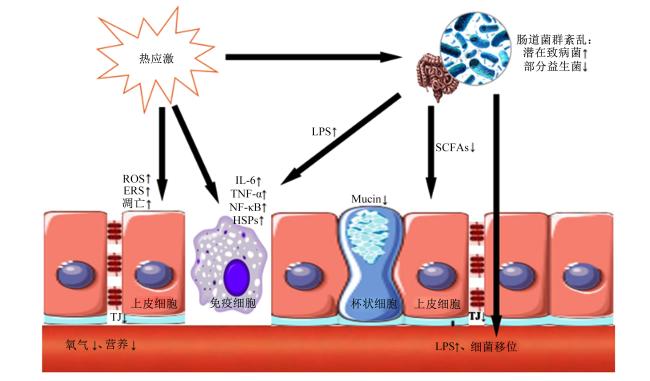
图1 热应激相关肠道损伤

ROS:活性氧reactive oxygen species;ERS:内质网应激endoplasmic reticulum stress;IL-6:白细胞介素-6 interleukin-6;TNF-α:肿瘤坏死因子-α tumor necrosis factor-α;NF-κB:核因子-κB nuclear factor-κB;HSPs:热休克蛋白 heat shock proteins;LPS:脂多糖 lipopolysaccharide;SCFAs:短链脂肪酸 short-chain fatty acids;TJ:紧密连接 tight junction;Mucin:黏蛋白。

Fig.1 Heat stress-induced intestinal injury

[1]
VICEDO-CABRERA A M, SCOVRONICK N, SERA F, et al. The burden of heat-related mortality attributable to recent human-induced climate change[J]. Nature Climate Change, 2021, 11(6):492-500.

DOI

[2]
WEN C Y, WEI S Y, ZONG X, et al. Microbiota-gut-brain axis and nutritional strategy under heat stress[J]. Animal Nutrition, 2021, 7(4):1329-1336.

DOI PMID

[3]
程雅欣, 李佳, 刘明玉, 等. 高温高湿环境对大鼠血尿酸水平的影响及其作用机制研究[J]. 中国实验动物学报, 2023, 31(7):905-912.

CHENG Y X, LI J, LIU M Y, et al. Influence and mechanism of elevated serum uric acid levels in rats in a high temperature-humidity environment[J]. Acta Laboratorium Animalis Scientia Sinica, 2023, 31(7):905-912. (in Chinese)

[4]
宋景春, 宋青, 张伟, 等. 中国热射病诊断与治疗指南(2025版)[J]. 解放军医学杂志, 2025, 50(4):367-386.

SONG J C, SONG Q, ZHANG W, et al. Chinese guideline for the diagnosis and treatment of heatstroke (2025 edition)[J]. Medical Journal of Chinese People’s Liberation Army, 2025, 50(4):367-386. (in Chinese)

[5]
CHECKLEY W, EPSTEIN L D, GILMAN R H, et al. Effect of El Niño and ambient temperature on hospital admissions for diarrhoeal diseases in Peruvian children[J]. Lancet, 2000, 355(9202):442-450.

DOI PMID

[6]
WANG Y, LI D L, WU Z Q, et al. Development and validation of a prognostic model of survival for classic heatstroke patients:a multicenter study[J]. Scientific Reports, 2023, 13(1):19265.

DOI

[7]
HII H P, LO W Z, FU Y H, et al. Improvement in heat stress-induced multiple organ dysfunction and intestinal damage through protection of intestinal goblet cells from prostaglandin E1 analogue misoprostol[J]. Life Sciences, 2022, 310:121039.

[8]
PÉRIARD J D, RACINAIS S, SAWKA M N. Adaptations and mechanisms of human heat acclimation:applications for competitive athletes and sports[J]. Scandinavian Journal of Medicine & Science in Sports, 2015, 25(S1):20-38.

[9]
REN L P, ZHANG X Y, YANG F Q, et al. Effects of heat tolerance on the gut microbiota of Sarcophaga peregrina (Diptera:Sarcophagidae) and impacts on the life history traits[J]. Parasites & Vectors, 2023, 16(1):364.

[10]
LIU S S, WEN D Q, FENG C Y, et al. Alteration of gut microbiota after heat acclimation may reduce organ damage by regulating immune factors during heat stress[J]. Frontiers in Microbiology, 2023, 14:1114233.

[11]
VICENTINI F A, KEENAN C M, WALLACE L E, et al. Intestinal microbiota shapes gut physiology and regulates enteric neurons and glia[J]. Microbiome, 2021, 9(1):210.

DOI PMID

[12]
HOU K J, WU Z X, CHEN X Y, et al. Microbiota in health and diseases[J]. Signal Transduction and Targeted Therapy, 2022, 7(1):135.

DOI PMID

[13]
ABURTO M R, CRYAN J F. Gastrointestinal and brain barriers:unlocking gates of communication across the microbiota-gut-brain axis[J]. Nature Reviews Gastroenterology & Hepatology, 2024, 21(4):222-247.

[14]
CRAMER M N, GAGNON D, LAITANO O, et al. Human temperature regulation under heat stress in health,disease,and injury[J]. Physiological Reviews, 2022, 102(4):1907-1989.

DOI

[15]
TANG Z N, YANG Y, WU Z L, et al. Heat stress-induced intestinal barrier impairment:current insights into the aspects of oxidative stress and endoplasmic reticulum stress[J]. Journal of Agricultural and Food Chemistry, 2023, 71(14):5438-5449.

DOI

[16]
OGDEN H B, CHILD R B, FALLOWFIELD J L, et al. The gastrointestinal exertional heat stroke paradigm:pathophysiology,assessment,severity,aetiology and nutritional countermeasures[J]. Nutrients, 2020, 12(2):537.

DOI

[17]
ZHANG H Y, PERTIWI H, MAJDEDDIN M, et al. Mucosa-associated lymphoid tissue lymphoma translocation protein 1 inhibition alleviates intestinal impairment induced by chronic heat stress in finisher broilers[J]. Poultry Science, 2024, 103(1):103252.

DOI

[18]
WANG Z X, SHAO D, WU S, et al. Heat stress-induced intestinal barrier damage and dimethylglycine alleviates via improving the metabolism function of microbiota gut brain axis[J]. Ecotoxicology and Environmental Safety, 2022, 244:114053.

[19]
MORERA P, BASIRICÒ L, HOSODA K, et al. Chronic heat stress up-regulates leptin and adiponectin secretion and expression and improves leptin,adiponectin and insulin sensitivity in mice[J]. Journal of Molecular Endocrinology, 2012, 48(2):129-138.

DOI

[20]
徐运杰, 季丰泉, 陈学华, 等. 热应激对家禽健康的影响[J]. 家禽科学, 2021(2):34-41.

XU Y J, JI F Q, CHEN X H, et al. Effects of heat stress on poultry health[J]. Poultry Science, 2021(2):34-41. (in Chinese)

[21]
YANG P C, HE S H, ZHENG P Y. Investigation into the signal transduction pathway via which heat stress impairs intestinal epithelial barrier function[J]. Journal of Gastroenterology and Hepatology, 2007, 22(11):1823-1831.

DOI

[22]
ZHOU J J, QIN X H, LI L, et al. Heat stress-induced intestinal epithelial cells necroptosis via TLR3-TRIF-RIP3 pathway was dependent on p53[J]. International Immunopharmacology, 2023, 122:110574.

[23]
SHIH C C, LIAO W C, KE H Y, et al. Antimicrobial peptide cathelicidin LL-37 preserves intestinal barrier and organ function in rats with heat stroke[J]. Biomedicine & Pharmacotherapy, 2023, 161:114565.

[24]
LI H, ZHANG G, LIU Y Q, et al. Hypoxia-inducible factor 1α inhibits heat stress-induced pig intestinal epithelial cell apoptosis through eif2α/ATF4/CHOP signaling[J]. Science of the Total Environment, 2024, 924:171649.

[25]
YUAN F F, CAI J Z, WU J F, et al. Z-DNA binding protein 1 promotes heatstroke-induced cell death[J]. Science, 2022, 376(6593):609-615.

DOI PMID

[26]
QUINTEIRO-FILHO W M, CALEFI A S, CRUZ D S G, et al. Heat stress decreases expression of the cytokines,avian beta-defensins 4 and 6 and Toll-like receptor 2 in broiler chickens infected with Salmonella Enteritidis[J]. Veterinary Immunology and Immunopathology, 2017, 186:19-28.

DOI

[27]
HUANG Y Y, CAI H Y, HAN Y S, et al. Mechanisms of heat stress on neuroendocrine and organ damage and nutritional measures of prevention and treatment in poultry[J]. Biology, 2024, 13(11):926.

DOI

[28]
QUINTEIRO-FILHO W M, GOMES A V S, PINHEIRO M L, et al. Heat stress impairs performance and induces intestinal inflammation in broiler chickens infected with Salmonella enteritidis[J]. Avian Pathology, 2012, 41(5):421-427.

DOI

[29]
ALHENAKY A, ABDELQADER A, ABUAJAMIEH M, et al. The effect of heat stress on intestinal integrity and Salmonella invasion in broiler birds[J]. Journal of Thermal Biology, 2017, 70(Pt B):9-14.

DOI

[30]
叶楠, 喻田甜, 郭红霞, 等. 热习服诱导Treg细胞上调提高小鼠热应激耐受的实验研究[J]. 免疫学杂志, 2015, 31(12):1013-1018.

YE N, YU T T, GUO H X, et al. Heat acclimation induces up-regulation of Treg cells and enhances heat tolerance of mice in vivo[J]. Immunological Journal, 2015, 31(12):1013-1018. (in Chinese)

[31]
GUO M Y, LIU H J, YU Y T, et al. Lactobacillus rhamnosus GG ameliorates osteoporosis in ovariectomized rats by regulating the Th17/Treg balance and gut microbiota structure[J]. Gut Microbes, 2023, 15(1):2190304.

DOI

[32]
CAO Y, LIU Y, DONG Q Y, et al. Alterations in the gut microbiome and metabolic profile in rats acclimated to high environmental temperature[J]. Microbial Biotechnology, 2022, 15(1):276-288.

DOI PMID

[33]
LUO Q, JI X Y, ZHANG L, et al. Shikonin prevents mice from heat stroke-induced death via suppressing a trigger IL-17A on the inflammatory and oxidative pathways[J]. Biomedicine & Pharmacotherapy, 2023, 166:115346.

[34]
CHAUDHURY S, KEEGAN B M, BLAGG B S J. The role and therapeutic potential of Hsp90,Hsp70,and smaller heat shock proteins in peripheral and central neuropathies[J]. Medicinal Research Reviews, 2021, 41(1):202-222.

DOI

[35]
ROSENZWEIG R, NILLEGODA N B, MAYER M P, et al. The Hsp70 chaperone network[J]. Nature Reviews Molecular Cell Biology, 2019, 20(11):665-680.

DOI PMID

[36]
WANG L L, SCHUMANN U, LIU Y F, et al. Heat shock protein 70 (Hsp70) inhibits oxidative phosphorylation and compensates ATP balance through enhanced glycolytic activity[J]. Journal of Applied Physiology, 2012, 113(11):1669-1676.

DOI PMID

[37]
D’ONOFRIO N, PRATTICHIZZO F, MARTINO E, et al. MiR-27b attenuates mitochondrial oxidative stress and inflammation in endothelial cells[J]. Redox Biology, 2023, 62:102681.

[38]
LI Y C, FU B, ZHANG J M, et al. Effects of heat stress on the chemical composition,oxidative stability,muscle metabolism,and meat quality of Nile tilapia (Oreochromis niloticus)[J]. Food Chemistry, 2023, 426:136590.

[39]
丁继, 崔凯, 李敏, 等. 劳力性热射病患者血清Hsp70、iNOS表达水平及其临床意义[J]. 微循环学杂志, 2022, 32(3):61-65.

DING J, CUI K, LI M, et al. Expression of serum Hsp70 and iNOS in patients with exertional heat stroke and its clinical signif-icance[J]. Chinese Journal of Microcirculation, 2022, 32(3):61-65. (in Chinese)

[40]
LIANG P Z, GUO M Y, WANG D, et al. Molecular and functional characterization of heat-shock protein 70 in Aphis gossypii under thermal and xenobiotic stresses[J]. Pesticide Biochemistry and Physiology, 2024, 199:105774.

[41]
LIU H Y, DICKSVED J, LUNDH T, et al. Heat shock proteins:intestinal gatekeepers that are influenced by dietary components and the gut microbiota[J]. Pathogens, 2014, 3(1):187-210.

DOI

[42]
ARNAL M E, LALLÈS J P. Gut epithelial inducible heat-shock proteins and their modulation by diet and the microbiota[J]. Nutrition Reviews, 2016, 74(3):181-197.

DOI

[43]
CAMINERO A, GUZMAN M, LIBERTUCCI J, et al. The emerging roles of bacterial proteases in intestinal diseases[J]. Gut Microbes, 2023, 15(1):2181922.

DOI

[44]
HUUS K E, LEY R E. Blowing hot and cold: body temperature and the microbiome[J]. mSystems, 2021, 6(5):e0070721.

[45]
RIEDL R A, BURNETT C M L, PEARSON N A, et al. Gut microbiota represent a major thermogenic biomass[J]. Function, 2021, 2(3):zqab019.

[46]
DOKLADNY K, ZUHL M N, MOSELEY P L. Intestinal epithelial barrier function and tight junction proteins with heat and exercise[J]. Journal of Applied Physiology, 2016, 120(6):692-701.

DOI PMID

[47]
BUCKLEY A, TURNER J R. Cell biology of tight junction barrier regulation and mucosal disease[J]. Cold Spring Harbor Perspectives in Biology, 2018, 10(1):a029314.

[48]
SCHOELER M, CAESAR R. Dietary lipids,gut microbiota and lipid metabolism[J]. Reviews in Endocrine & Metabolic Disorders, 2019, 20(4):461-472.

[49]
ZMORA N, SUEZ J, ELINAV E. You are what you eat:diet,health and the gut microbiota[J]. Nature Reviews Gastroenterology & Hepatology, 2019, 16(1):35-56.

[50]
KARL J P, HATCH A M, ARCIDIACONO S M, et al. Effects of psychological, environmental and physical stressors on the gut microbiota[J]. Frontiers in Microbiology, 2018, 9:2013.

DOI PMID

[51]
YI W Z, CHENG J, WEI Q N, et al. Effect of temperature stress on gut-brain axis in mice:regulation of intestinal microbiome and central NLRP3 inflammasomes[J]. Science of the Total Environment, 2021, 772:144568.

[52]
HU C Y, NIU X T, CHEN S W, et al. A comprehensive analysis of the colonic flora diversity,short chain fatty acid metabolism,transcripts,and biochemical indexes in heat-stressed pigs[J]. Frontiers in Immunology, 2021, 12:717723.

[53]
LE SCIELLOUR M, ZEMB O, HOCHU I, et al. Effect of chronic and acute heat challenges on fecal microbiota composition,production,and thermoregulation traits in growing pigs[J]. Journal of Animal Science, 2019, 97(9):3845-3858.

DOI

[54]
ZHU L H, LIAO R R, WU N, et al. Heat stress mediates changes in fecal microbiome and functional pathways of laying hens[J]. Applied Microbiology and Biotechnology, 2019, 103(1):461-472.

DOI PMID

[55]
DUCRAY H A G, GLOBA L, PUSTOVYY O, et al. Yeast fermentate prebiotic improves intestinal barrier integrity during heat stress by modulation of the gut microbiota in rats[J]. Journal of Applied Microbiology, 2019, 127(4):1192-1206.

DOI PMID

[56]
JIANG S, YAN F F, HU J Y, et al. Bacillus subtilis-based probiotic improves skeletal health and immunity in broiler chickens exposed to heat stress[J]. Animals, 2021, 11(6):1494.

DOI

[57]
MOORE T, GLOBA L, PUSTOVYY O, et al. Oral administration of Bacillus subtilis strain BSB3 can prevent heat stress-related adverse effects in rats[J]. Journal of Applied Microbiology, 2014, 117(5):1463-1471.

DOI

[58]
ZHANG H Y, PERTIWI H, HOU Y H, et al. Protective effects of Lactobacillus on heat stress-induced intestinal injury in finisher broilers by regulating gut microbiota and stimulating epithelial development[J]. Science of the Total Environment, 2024, 918:170410.

[59]
LI L, CHEN J L, WANG Y W, et al. Heat acclimation with probiotics-based ORS supplementation alleviates heat stroke-induced multiple organ dysfunction via improving intestinal thermotolerance and modulating gut microbiota in rats[J]. Frontiers in Microbiology, 2024, 15:1385333.

[60]
BENNETT C J, HENRY R, SNIPE R M J, et al. Is the gut microbiota bacterial abundance and composition associated with intestinal epithelial injury,systemic inflammatory profile,and gastrointestinal symptoms in response to exertional-heat stress?[J]. Journal of Science and Medicine in Sport, 2020, 23(12):1141-1153.

DOI

[61]
SARSOUR A H, KOLTES D A, KIM E J, et al. Effects of a direct fed microbial (DFM) on broiler chickens exposed to acute and chronic cyclic heat stress in two consecutive experiments[J]. Poultry Science, 2022, 101(4):101705.

DOI

[62]
KOH A, DE VADDER F, KOVATCHEVA-DATCHARY P, et al. From dietary fiber to host physiology:short-chain fatty acids as key bacterial metabolites[J]. Cell, 2016, 165(6):1332-1345.

DOI

[63]
LIU P Y, WANG Y B, YANG G, et al. The role of short-chain fatty acids in intestinal barrier function,inflammation,oxidative stress,and colonic carcinogenesis[J]. Pharmacological Research, 2021, 165:105420.

[64]
HUANG X Y, OSHIMA T, TOMITA T, et al. Butyrate alleviates cytokine-induced barrier dysfunction by modifying claudin-2 levels[J]. Biology, 2021, 10(3):205.

DOI

[65]
HU S X, KUWABARA R, DE HAAN B J, et al. Acetate and butyrate improve β-cell metabolism and mitochondrial respiration under oxidative stress[J]. International Journal of Molecular Sciences, 2020, 21(4):1542.

DOI

[66]
COSTA K A, SOARES A D N, WANNER S P, et al. L -arginine supplementation prevents increases in intestinal permeability and bacterial translocation in male Swiss mice subjected to physical exercise under environmental heat stress[J]. The Journal of Nutrition, 2014, 144(2):218-223.

DOI

[67]
HU Y, LIN L, LIU K H, et al. L-theanine alleviates heat stress-induced impairment of immune function by regulating the p38 MAPK signalling pathway in mice[J]. Food & Function, 2023, 14(1):335-343.

[68]
LIU T Y, SONG X L, AN Y P, et al. Lactobacillus rhamnosus GG colonization in early life ameliorates inflammaging of offspring by activating SIRT1/AMPK/PGC-1α pathway[J]. Oxidative Medicine and Cellular Longevity, 2021, 2021:3328505.

[69]
ZHONG G, SHAO D, WANG Q, et al. Effects of dietary supplemented of γ-amino butyric acid on growth performance,blood biochemical indices and intestinal morphology of yellow-feathered broilers exposed to a high temperature environment[J]. Italian Journal of Animal Science, 2020, 19(1):431-438.

DOI

[70]
邹晓庭, 胡家澄, 曹德瑞, 等. γ-氨基丁酸对夏季高温期生长肥育猪生产性能、抗氧化及HPA、HPT轴激素分泌的影响[J]. 畜牧兽医学报, 2009, 40(8):1196-1201.

ZOU X T, HU J C, CAO D R, et al. Effect of γ-aminobutyric acid on growth performance,antioxidation and hormones of HPA,HPT axis in growth-finishing swine in hot summer[J]. Acta Veterinaria et Zootechnica Sinica, 2009, 40(8):1196-1201.

文章导航

/