研究论文

尾菜发酵工艺优化及发酵尾菜在仔猪上的饲喂效果研究

  • 孟婷 , 1 ,
  • 王英 1 ,
  • 常华 2 ,
  • 段纲 2 ,
  • 常满霞 2 ,
  • 张志东 3 ,
  • 李继明 4 ,
  • 李正金 5 ,
  • 项勋 , 1, **
展开
  • 1 云南农业大学动物科学技术学院,昆明 650201
  • 2 云南农业大学动物医学院,昆明 650201
  • 3 昆明正大有限公司,昆明 650300
  • 4 石林县农业农村局,石林 652200
  • 5 曲靖市马龙区鸡头村街道农业农村发展服务中心,曲靖 655101
** 项勋,副研究员,硕士生导师,E-mail:

*同等贡献作者

孟婷(2002—),女,云南宣威人,硕士研究生,研究方向为动物营养与饲料科学。E-mail:

收稿日期: 2025-06-13

  网络出版日期: 2026-01-13

基金资助

云南省重大科技专项(202202AE090024)

Optimization of Fermentation Process of Vegetable Waste and Feeding Effects of Fermented Vegetable Waste in Piglets

  • MENG Ting , 1 ,
  • WANG Ying 1 ,
  • CHANG Hua 2 ,
  • DUAN Gang 2 ,
  • CHANG Manxia 2 ,
  • ZHANG Zhidong 3 ,
  • LI Jiming 4 ,
  • LI Zhengjin 5 ,
  • XIANG Xun , 1, **
Expand
  • 1 College of Animal Science and Technology, Yunnan Agricultural University, Kunming 650201, China
  • 2 College of Veterinary Medicine, Yunnan Agricultural University, Kunming 650201, China
  • 3 Kunming Chia Tai Co., Ltd., Kunming 650300, China
  • 4 Shilin County Bureau of Agriculture and Rural Affairs, Shilin 652200, China
  • 5 Agricultural and Rural Development Service Center, Jitou Village Street, Malong District, Qujing City, Qujing 655101, China
** associate professor, E-mail:

*Contributed equally

Received date: 2025-06-13

  Online published: 2026-01-13

摘要

本试验旨在对尾菜发酵工艺进行优化并探究发酵尾菜在仔猪上的饲喂效果。尾菜发酵工艺优化试验:以尾菜作为发酵原料,首先采用单因素试验设计考察发酵基质含水量、复合菌剂添加量、发酵时间对粗蛋白质含量和粗纤维降解率的影响,然后基于单因素试验结果利用响应面试验对发酵工艺进行优化,最后对优化结果进行验证。发酵尾菜在仔猪上饲喂效果试验:选取18头体重相近、体况良好的42日龄杜洛克×长白×约克夏三元杂交仔猪,随机分为3组,每组3个重复,每个重复2头。对照组、试验Ⅰ组和试验Ⅱ组分别饲喂添加0、10%、30%尾菜发酵料的试验饲粮。饲养试验共持续37 d,其中预试期7 d,正试期30 d。结果表明:1)尾菜最优发酵工艺参数为发酵基质含水量57%(发酵底物中尾菜与辅料混合物配比为3∶1)、发酵时间20 d、复合菌剂添加量2 g/kg,在此条件下发酵后,粗蛋白质含量由18.78%提高到20.13%,粗纤维含量由25.11%降低到22.76%。2)试验Ⅰ组的腹泻率、血清甘油三酯(TG)含量显著低于对照组(P<0.05),腹泻指数极显著低于对照组(P<0.01);试验Ⅰ组和试验Ⅱ组的平均日增重(ADG)、料重比(F/G)、体尺指标以及多项血清指标[包括谷丙转氨酶(ALT)活性,以及肌酐(CREA)、免疫球蛋白M(IgM)、补体3(C3)、补体4(C4)含量]与对照组相比均无显著差异(P>0.05);试验Ⅱ组的血清白蛋白(ALB)、总胆固醇(TC)含量及谷草转氨酶(AST)活性极显著低于对照组(P<0.01),血清碱性磷酸酶(ALP)活性显著低于对照组(P<0.05),平均日采食量(ADFI)极显著高于对照组(P<0.01);试验Ⅰ组和试验Ⅱ组的血清尿素(UREA)、免疫球蛋白G(IgG)含量极显著低于对照组(P<0.01),血清葡萄糖(GLU)含量极显著高于对照组(P<0.01)。综上所述,利用响应面法优化后的发酵工艺参数能提高尾菜的营养价值;发酵尾菜替代部分基础饲粮对仔猪的生长性能、体尺指标和免疫功能无负面影响,综合腹泻率等指标考虑,发酵尾菜按10%的比例替代基础饲粮效果最优。

本文引用格式

孟婷 , 王英 , 常华 , 段纲 , 常满霞 , 张志东 , 李继明 , 李正金 , 项勋 . 尾菜发酵工艺优化及发酵尾菜在仔猪上的饲喂效果研究[J]. 动物营养学报, 2026 , 38(1) : 219 -235 . DOI: 10.12418/CJAN2026.018

Abstract

This experiment aimed to optimize the vegetable waste fermentation process and investigate the feeding effects of the fermented vegetable waste in piglets. Vegetable waste fermentation optimization experiment: using vegetable waste as the raw material, a single-factor experimental design was used to examine the effects of fermentation substrate moisture content, compound bacteria addition, and fermentation time on crude protein content and crude fiber degradation rate. Based on the results of the single-factor experiments, response surface methodology was then applied to optimize the fermentation process, followed by validation of the optimized conditions. Feeding effect experiment of fermented vegetable waste in piglets: eighteen 42-day-old Duroc×Landrace×Yorkshire crossbred piglets with similar body weight and good health condition were selected and randomly divided into three groups, with three replicates per group and two piglets per replicate. The control group, trial group Ⅰ, and trial group Ⅱ were fed experimental diets supplemented with 0, 10% and 30% fermented vegetable waste, respectively. The feeding trial lasted for 37 days, including a 7-day adaptation period and a 30-day formal trial period. The results showed as follows: 1) the optimal fermentation process parameters were a fermentation substrate moisture content of 57% (with a mixture ratio of vegetable waste to auxiliary materials of 3∶1), a fermentation time of 20 days, and a compound bacteria addition rate of 2 g/kg. Under these optimized conditions, the crude protein content increased from 18.78% to 20.13%, while the crude fiber content decreased from 25.11% to 22.76%. 2) Compared with the control group, trial group Ⅰ showed a significantly lower diarrhea rate and serum triglyceride (TG) content (P<0.05), and an extremely significant reduction in the diarrhea index (P<0.01). No significant differences were observed in average daily gain (ADG), feed-to-gain ratio (F/G), body size indexes, and various serum indexes—including alanine aminotransferase (ALT) activity, as well as contents of creatinine (CREA), immunoglobulin M (IgM), complement 3 (C3), and complement 4 (C4)—between trial groups Ⅰ and Ⅱ compared with the control group (P>0.05). In trial group Ⅱ, serum albumin (ALB) and total cholesterol (TC) contents, as well as aspartate aminotransferase (AST) activity, were extremely significantly lower than those in the control group (P<0.01), while serum alkaline phosphatase (ALP) activity was also significantly reduced (P<0.05). In contrast, the average daily feed intake (ADFI) in trial group Ⅱ was extremely significantly higher than that in the control group (P<0.01). Additionally, serum urea (UREA) and immunoglobulin G (IgG) contents in the trial groups Ⅰ and Ⅱ were extremely significantly decreased (P<0.01), along with serum glucose (GLU) content was extremely significantly increased compared with the control group (P<0.01). In summary, the fermentation parameters optimized by response surface methodology can effectively enhance the nutritional value of vegetable waste. The substitution of basal diet with fermented vegetable waste does not exert any adverse effects on the growth performance, body size indexes and immune function of piglets. Taking into comprehensive consideration indicators such as diarrhea rate, replacing 10% of the basal diet with fermented vegetable waste yields the optimal results.

云南是全国重要的“南菜北运”和“南菜东调”优质基地,也是西南地区最大的蔬菜出口基地[1]。蔬菜在采摘、加工、运输及销售等环节产生的废弃物被称为尾菜[2]。云南尾菜资源丰富,年产量约800万t,产量巨大,但当前利用率较低。目前尾菜的处理方式主要有作为饲料直接饲喂动物、加工为食用菌菌包或有机肥等,但这些方式不仅存在资源浪费和处理成本高的问题,还可能对周边环境造成污染[3]。大量研究表明,新鲜尾菜中含有膳食纤维、蛋白质、脂肪、矿物质及多种维生素等多种营养成分,是一种潜在的优质饲料原料[4-5]。在传统养殖中,尾菜常以切碎后直接饲喂的方式使用,但由于其产量大、含水量高、不易储存且适口性较差,应用受到限制。此外,尾菜中含有的木质纤维素、蛋白酶抑制因子和硫代葡萄糖苷等抗营养因子,会影响动物对营养物质的消化吸收,进而降低其生长性能[6-9]
近年来,关于尾菜在动物生产中的应用研究逐渐增多。研究表明,通过发酵处理可改变尾菜的营养结构:一方面,蛋白质大分子被分解为易于吸收的小分子肽和氨基酸[10];另一方面,发酵过程中产生的有益菌及其代谢产物能够改善尾菜的营养组成和适口性,促进动物对营养物质的消化吸收[11-13],同时还可抑制病原微生物的繁殖,从而提高动物的生长性能和抗病能力[14-15]。褚晓红等[16]研究发现,在杜仙猪饲粮中添加10%和30%的青贮西兰花茎叶,可促进肌内脂肪沉积并改善猪肉风味。蓝婧婷等[17]报道,饲粮中添加20%的发酵花椰菜尾菜可提高保育猪的平均日增重(ADG),降低腹泻率以及血清总胆固醇(TC)含量和谷丙转氨酶(ALT)活性。Sun等[18]在基础饲粮中添加5%和10%的西兰花尾菜,发现生长猪的生长性能和胴体性状无显著变化,但肉色得到改善。
云南滇中地区的尾菜主要由约80%的生菜和20%的白菜及油麦菜构成,粗蛋白质平均含量约为20%,构成受季节影响小,养分相对稳定。尾菜饲料化利用已成为其资源化利用的重要途径之一[19]。然而,目前国内关于尾菜发酵工艺及其在仔猪生产中的应用的研究仍较为缺乏。因此,本研究通过调控发酵基质含水量、发酵时间及复合菌剂添加量等参数,优化尾菜发酵工艺,并探讨饲粮中添加不同比例发酵尾菜对仔猪生长性能、腹泻率、血清生化及免疫指标的影响,以期为尾菜的高效发酵工艺提供技术参数,并为发酵尾菜在仔猪饲粮中的合理应用提供参考依据。

1 材料与方法

1.1 试验材料

试验所用尾菜为经脱水处理的蔬菜叶片,由昆明福慧环保科技有限公司赠送,为多种尾菜混合物,其中生菜约占80%,白菜及其他品种蔬菜约占20%。试验所用菜籽饼和玉米购自云南众兴旺农业科技发展有限公司;试验所用仔猪基础饲粮为昆明正大有限公司生产的仔猪全价料。
所用菌剂与酶制剂来源如下:枯草芽孢杆菌、酿酒酵母和植物乳杆菌购自山东益昊生物科技有限公司。复合菌剂由上述3种菌按质量比1∶1∶1配制而成,每种菌活菌数均为1.0×10⁸ CFU/g。酶制剂购自白银赛诺生物科技有限公司,其主要成分有木聚糖酶(≥4 000 U/g)、β-葡聚糖酶(≥6 000 U/g)、蛋白酶(≥10 000 U/g)、淀粉酶(≥6 000 U/g)、纤维素酶(≥1 500 U/g)和阿拉伯木聚糖酶(1 000 U/g)。

1.2 试验方法

1.2.1 尾菜发酵工艺优化试验

发酵基质由尾菜、辅料混合物组成,辅料混合物是由菜籽饼和玉米按1∶1比例混合而成;发酵工艺采用菌酶协同发酵,发酵剂由复合菌剂和酶制剂组成,酶制剂的添加量均为1 g/kg;底物与发酵剂充分混合均匀后,装入安装有排气阀的单向排气密封发酵袋中,通过封口机进行封口,常温发酵。固态发酵结束后,将发酵料于65 ℃下烘干并粉碎,测定粗蛋白质、粗纤维含量,计算粗纤维降解率。

1.2.1.1 单因素试验设计

(1)发酵基质含水量
将尾菜与辅料混合物分别按照1∶1、2∶1、3∶1、4∶1的比例混合(测得发酵基质含水量分别为45%、55%、65%、70%),添加1 g/kg复合菌剂,充分混匀后进行21 d的固态发酵,每个发酵底物配比设置3个重复。
(2)复合菌剂添加量
将尾菜与辅料混合物按照3∶1的比例混合(发酵基质含水量为65%),分别添加0、1、2、3 g/kg复合菌剂,充分混匀后进行21 d的固态发酵,每个复合菌剂添加量设置3个重复。
(3)发酵时间
将尾菜与辅料混合物按照3∶1的比例混合(发酵基质含水量为65%),添加1 g/kg复合菌剂,充分混匀后分别进行0、7、14、21、28 d的固态发酵,每个发酵时间设置3个重复。

1.2.1.2 响应面试验设计

根据单因素试验结果,以发酵基质含水量(A)、复合菌剂添加量(B)和发酵时间(C)作为自变量,以粗纤维降解率(Y1)和粗蛋白质含量(Y2)作为响应值,采用3因素3水平的Box-Behnken试验设计进行工艺优化,响应面试验的因素及水平设计见表1
表1 响应面试验的因素及水平设计

Table 1 Design of factors and levels for response surface experiments

水平
Levels
因素Factors
发酵基质含水量
Fermentation substrate moisture
content (A)/%
复合菌剂添加量
Compound bacteria
addition (B)/(g/kg)
发酵时间
Fermentation time
(C)/d
-1 50 1 7
0 60 2 14
1 70 3 21

1.2.2 发酵尾菜在仔猪上饲喂效果试验

动物试验方案已经过云南农业大学生命科学伦理委员会批准,批准编号为APYNAU202506003。采用随机分组设计,选取42日龄健康状况良好的杜洛克×长白×约克夏(DLY)三元杂交仔猪18头,按体重相近原则随机分为3组,每组3个重复,每个重复2头。对照组饲喂基础饲粮(仔猪全价料),试验Ⅰ组和试验Ⅱ组分别饲喂用发酵尾菜(风干基础)替代10%、30%仔猪全价料的试验饲粮。仔猪全价料组成见表2,各组饲粮组成及营养水平见表3。试验期共37 d,其中预试期7 d,正试期30 d。每天分别于08:00、11:30、14:30、17:30将发酵尾菜与仔猪全价料按设定的比例混合后饲喂仔猪,自由采食和饮水,定期对食槽、水槽及圈舍进行清理、消毒,每天观察各组仔猪的腹泻情况并记录。
表2 仔猪全价料组成(风干基础)

Table 2 Composition of complete feed for piglets (air-dry basis) %

项目Items 含量Content
原料Ingredients
膨化玉米Extruded corn 47.62
豆粕Soybean meal 13.40
发酵豆粕Fermented soybean meal 10.00
麸皮Bran 7.17
碎米Broken rice 6.80
全脂大豆粉Full-fat soybean flour 3.00
蔬菜颗粒Vegetable granules 3.00
乳清粉Whey powder 1.60
豆油Soybean oil 1.30
L-赖氨酸盐酸盐L-Lys·HCl 0.50
L-苏氨酸L-Thr 0.20
L-色氨酸L-Trp 0.20
DL-蛋氨酸DL-Met 0.20
食盐NaCl 0.22
石粉Limestone 0.27
磷酸氢钙CaHPO4 1.03
预混料Premix 3.49
合计Total 100.00
表3 各组饲粮组成及营养水平(风干基础)

Table 3 Diet composition and nutrient levels of different groups (air-dry basis) %

项目
Items
对照组
Control group
试验Ⅰ组
Trail group Ⅰ
试验Ⅱ组
Trail group Ⅱ
原料Ingredients
仔猪全价料Complete feed for piglets 100 90 70
发酵尾菜Fermented vegetable residue 10 30
合计Total 100 100 100
营养水平Nutrient levels
粗蛋白质CP 19.25 19.34 19.51
粗脂肪EE 4.52 4.67 4.97
粗纤维CF 3.60 5.52 9.35
粗灰分Ash 4.75 5.43 6.79
钙Ca 0.50 0.45 0.35
总磷TP 0.63 0.57 0.44

表中各营养指标均为实测值。

All nutrient indicators in the table are actual measured values.

1.3 指标检测

1.3.1 常规营养成分

各组饲粮配制完成后,按四分法采样,采集500 g于样品袋中,烘干后粉碎过40目筛,用于常规营养成分的测定。粗蛋白质、粗纤维、粗脂肪、粗灰分、钙和总磷含量分别参照GB/T 6432—2018、GB/T 6434—2006、GB/T 6433—2006、GB/T 6438—2007、GB/T 6436—2018和GB/T 6437—2018测定。

1.3.2 仔猪生长性能和体尺指标

在正试期第1天和第30天对所有仔猪进行空腹称重,分别记录为初重(IBW)和末重(FBW),每天以重复为单位对各组仔猪的投料量和剩料量进行称量和记录,计算ADG、平均日采食量(ADFI)和料重比(F/G)[20]。饲养试验结束时,测量每头仔猪的体高、体长、胸宽、胸围、胸深和管围,计算体长指数、体躯指数、胸围指数[21]和管围指数(管围指数=100×管围/体高)。

1.3.3 仔猪腹泻率和腹泻指数

正式试验期间,每天早上和晚上饲喂时观察仔猪的腹泻情况,以重复为单位记录仔猪的腹泻头数,按粪便状态评分,评分标准见表4,评分≥2判定为仔猪发生腹泻,计算仔猪腹泻率和腹泻指数[22]
腹泻率(%)=[每个重复中腹泻仔猪头数/(每个重复中仔猪头数×试验天数)]×100;
腹泻指数=每个重复中仔猪腹泻评分之和/(每个重复中仔猪头数×试验天数)。
表4 腹泻判定评分标准

Table 4 Diarrhea evaluation and scoring criteria

粪便状态State of feces 腹泻程度Diarrhea degree 评分Score
液状,水样粪便Liquid, watery feces 重度Heavy 3
糊状,水分含量高Pasty, high moisture content 中度Intermediate 2
稀软,能成形Soft, shapeable 轻度Mild 1
干便,成形Dry stool, formed 正常Normal 0

1.3.4 仔猪血清生化和免疫指标

在正式试验第30天早上,仔猪空腹12 h后采用前腔静脉采血法采血,将采集的血液置于促凝管中,室温静置30 min后于1 160×g下离心5 min,取上清液置于-20 ℃冰箱中保存待测。利用全自动生化分析仪测定血清葡萄糖(GLU)、ALT、碱性磷酸酶(ALP)、甘油三酯(TG)、TC、尿素氮(UREA)、谷草转氨酶(AST)、肌酐(CREA)、白蛋白(ALB)、免疫球蛋白M(IgM)、免疫球蛋白G(IgG)、补体3(C3)、补体4(C4)等生化和免疫指标。

1.4 数据统计与分析

采用Excel 2019软件进行数据整理,用SPSS 27.0统计软件进行单因素方差分析,用LSD法进行组间多重比较,结果以平均值±标准差表示,以P<0.05表示差异显著,用Design-Expert 13软件进行响应面试验设计和结果分析。

2 结果与分析

2.1 尾菜发酵工艺优化单因素试验结果

2.1.1 适宜发酵基质含水量的确定

表5可知,当发酵基质含水量为65%时,粗纤维降解率极显著高于45%和70%时(P<0.01),发酵后粗蛋白质含量极显著高于45%和55%时(P<0.01),极显著低于70%时(P<0.01)。综合发酵尾菜的粗纤维降解率和粗蛋白质含量可知,适宜的发酵基质含水量为55%~65%。
表5 发酵基质含水量对粗蛋白质含量和粗纤维降解率的影响(干物质基础)

Table 5 Effects of fermentation substrate moisture content on crude protein content and crude fiber degradation rate (DM basis) %

项目
Items
发酵基质含水量
Fermentation substrate moisture content/%
P
P-value
45 55 65 70
发酵前粗纤维
Crude fiber before fermentation
47.19±0.01Cc 46.16±0.43Dd 58.46±0.07Bb 63.81±0.29Aa <0.001
发酵后粗纤维
Crude fiber after fermentation
45.74±0.23Cc 42.43±0.01Dd 53.50±0.20Bb 59.96±0.37Aa <0.001
粗纤维降解率
Crude fiber degradation rate
3.09±0.46Cc 8.08±0.87Aa 8.49±0.45Aa 6.03±0.10Bb <0.001
发酵前粗蛋白质
Crude protein before fermentation
34.30±0.40Dd 36.13±0.58Cc 44.95±0.52Bb 48.20±0.23Aa <0.001
发酵后粗蛋白质
Crude protein before fermentation
37.14±0.12Dd 38.98±0.12Cc 47.36±0.02Bb 49.37±0.31Aa <0.001

同行数据肩标不同小写字母表示差异显著(P<0.05),不同大写字母表示差异极显著(P<0.01),相同或无字母表示差异不显著(P>0.05)。下表同。

In the same row, values with different small letter superscripts mean significant difference (P<0.05), and with different capital letters indicated significant difference (P<0.01), while with the same or no letter superscripts mean no significant difference (P>0.05). The same as below.

2.1.2 适宜复合菌剂添加量的确定

表6可知,当复合菌剂添加量为1 g/kg时,粗纤维降解率极显著高于添加量为0、2、3 g/kg时(P<0.01),发酵后粗蛋白质含量极显著高于添加量为0、3 g/kg时(P<0.01),显著高于添加量为2 g/kg时(P<0.05)。因此,在发酵基质含水量不变时,复合菌剂的最适添加量为1~2 g/kg。
表6 复合菌剂添加量对粗蛋白质含量和粗纤维降解率的影响(干物质基础)

Table 6 Effects of compound bacteria addition on crude protein content and crude fiber degradation rate (DM basis) %

项目
Items
复合菌剂添加量
Compound bacteria addition/(g/kg)
P
P-value
0 1 2 3
发酵前粗纤维
Crude fiber before fermentation
58.64±0.05 58.58±0.07 58.60±0.03 58.60±0.02 0.494
发酵后粗纤维
Crude fiber after fermentation
56.19±0.08Aa 49.90±0.18Dd 51.73±0.11Cc 53.55±0.27Bb <0.001
粗纤维降解率
Crude fiber degradation rate
4.18±0.06D 14.81±0.20A 11.73±0.14B 8.62±0.48C <0.001
发酵前粗蛋白质
Crude protein before fermentation
42.84±0.50c 43.70±0.38a 43.56±0.13ab 43.00±0.08bc 0.030
发酵后粗蛋白质
Crude protein before fermentation
42.25±0.50Bc 47.01±0.12Aa 45.80±0.68Ab 41.91±0.65Bc <0.001

2.1.3 适宜发酵时间的确定

表7可知,在发酵14 d时,粗纤维降解率极显著高于发酵0、7、21、28 d时(P<0.01);发酵时间从14 d到21 d,粗蛋白质含量逐渐升高,发酵14 d时的粗蛋白质含量极显著低于发酵28 d时(P<0.01),发酵21 d时粗蛋白质含量与发酵14 d时无显著差异(P>0.05),但极显著低于发酵28 d(P<0.01)。因此,在发酵基质含水量不变时,添加适量菌种进行发酵,适宜发酵时间为14~21 d。
表7 发酵时间对粗蛋白质含量和粗纤维降解率的影响(干物质基础)

Table 7 Effects of fermentation time on crude protein content and crude fiber degradation rate (DM basis) %

项目
Items
发酵时间
Fermentation time/d
P
P-value
0 7 14 21 28
粗纤维含量CF content 58.63±0.07Aa 58.54±0.07Aa 55.10±0.13Bb 52.33±0.11Cc 51.73±0.13Dd <0.001
粗纤维降解率
Crude fiber degradation rate
0.00±0.00Dd 0.15±0.00Dd 5.88±0.11Aa 5.04±0.43Bb 1.14±0.03Cc <0.001
粗蛋白质含量CP content 43.99±0.05Cc 43.60±0.32Cc 46.30±0.70Bb 46.71±0.02Bb 47.78±0.03Aa <0.001

2.2 尾菜发酵工艺优化响应面试验结果

2.2.1 响应面试验结果及回归模型方差分析

根据上述单因素试验结果,设定响应面试验的3个因素和3个水平,以粗纤维降解率和粗蛋白质含量为响应值,响应面试验结果如表8所示。
表8 响应面试验结果

Table 8 Response surface test results

试验号
Test No.
发酵基质含水量
Fermentation
substrate moisture
content (A)/%
复合菌剂添加量
Compound bacteria
addition (B)/(g/kg)
发酵时间
Fermentation
time (C)/d
粗纤维降解率
Crude fiber
degradation
rate (Y1)/%
粗蛋白质含量
Crude protein
content (Y2)/%
1 50 1 14 2.77 18.50
2 70 1 14 3.65 18.46
3 50 3 14 4.16 18.70
4 70 3 14 4.23 18.81
5 50 2 7 4.63 18.62
6 70 2 7 5.89 18.58
7 50 2 21 6.11 19.27
8 70 2 21 7.01 19.34
9 60 1 7 6.25 19.12
10 60 3 7 6.95 19.64
11 60 1 21 7.69 20.19
12 60 3 21 8.54 20.26
13 60 2 14 8.65 20.09
14 60 2 14 8.74 20.11

表中粗蛋白质含量及粗纤维降解率为风干基础下的数据。

The data of crude protein content and the crude fiber degradation rate in the table are based on air-dry basis.

利用Design-Expert软件对尾菜发酵数据进行拟合,分别得到粗纤维降解率(Y1)和粗蛋白质含量(Y2)与发酵基质含水量(A)、复合菌剂添加量(B)和发酵时间(C)的多元二次回归方程模型:
Y1=-120.555+3.961 38×A+8.67×B-0.081 607×
C-
0.020 250×AB-0.001 286×AC+0.005 357×
BC-
0.032 200×A2-1.772 50×B2+0.008 878×C2
Y2=-23.880 00+1.387 75×A+1.407 50×B+
0.053 214×C+0.003 750×AB+0.000 393×AC-
0.016 071×BC-0.011 663×A2-0.316 250×
B2+0.000 383×C2
在方差分析中可用P值验证模型的可信性,P值越小表示自变量对响应值的影响越显著。
对回归模型进行方差分析(表9表10)可知,粗纤维降解率回归模型的F值为95.41,P值小于0.001,粗蛋白质含量回归模型的F值为258.20,P值小于0.000 1,表示预测模型显著,模型建立成功;通过比较P值,得出3个因素对粗纤维降解率和粗蛋白质含量的影响效果均为发酵时间>复合菌剂添加量>发酵基质含水量;粗纤维降解率和粗蛋白质含量回归模型的失拟项P值分别为0.167 7和0.176 0,表明试验中的测定误差或异常值对模型的拟合效果影响不显著。由表11表12可知,拟合得到粗纤维降解率和粗蛋白质含量的多元二次回归方程的决定系数为0.995 4和0.998 3,调整决定系数分别为0.984 9、0.994 4,信噪比分别为29.580 6、41.072 5,表明回归模型拟合度良好,试验误差小,能够用于优化尾菜发酵工艺并研究各因素间的交互作用。
表9 粗纤维降解率回归模型的方差分析

Table 9 Variance analysis of regression model for crude fiber degradation rate

方差来源
Sources of variance
平方和
Sum of squares
自由度
df
均方
Mean square
F
F-value
P
P-value
显著性
Significance
模型Model 49.850 0 9 5.540 0 95.41 0.000 3 **
A 1.210 0 1 1.210 0 20.82 0.010 3 *
B 1.550 0 1 1.550 0 26.68 0.006 7 **
C 3.960 0 1 3.960 0 68.25 0.001 2 **
AB 0.164 0 1 0.164 0 2.83 0.168 1
AC 0.032 4 1 0.032 4 0.56 0.496 6
BC 0.005 6 1 0.005 6 0.10 0.771 1
A2 33.180 0 1 33.180 0 571.50 <0.000 1 **
B2 10.050 0 1 10.050 0 173.17 0.000 2 **
C2 0.605 5 1 0.605 5 10.43 0.032 0 *
残差Residual 0.232 2 4 0.058 1
误差Error 0.004 0 1 0.004 0
失拟项Lack of fit 0.228 2 3 0.076 1 18.78 0.167 7
合计Total 50.080 0 13

“*”表示差异显著(P<0.05),“**”表示差异极显著(P<0.01)。表10同。

“*” means significant difference (P<0.05), and “**” means extremely significant difference (P<0.01). The same as Table 10.

表10 粗蛋白质含量回归模型的方差分析

Table 10 Variance analysis of regression model for crude protein content

方差来源
Sources of variance
平方和
Sum of squares
自由度
df
均方
Mean square
F
F-value
P
P-value
显著性
Significance
模型Model 6.040 0 9 0.671 3 258.20 <0.000 1 **
A 0.001 2 1 0.001 2 0.48 0.526 2
B 0.162 4 1 0.162 4 62.48 0.001 4 **
C 1.200 0 1 1.200 0 462.02 <0.000 1 **
AB 0.005 6 1 0.005 6 2.16 0.215 3
AC 0.003 0 1 0.003 0 1.16 0.341 5
BC 0.050 6 1 0.050 6 19.47 0.011 6 *
A2 4.350 0 1 4.350 0 1 647.02 <0.000 1 **
B2 0.320 0 1 0.320 0 123.09 0.000 4 **
C2 0.001 1 1 0.001 1 0.43 0.546 6
残差Residual 0.010 4 4 0.002 6
误差Error 0.000 2 1 0.000 2
失拟项Lack of fit 0.010 2 3 0.003 4 17.00 0.176 0
合计Total 6.050 0 13
表11 粗纤维降解率回归模型的可信度分析

Table 11 Reliability analysis of regression model for crude fiber degradation rate

参数Parameters 数值Numerical value
平均值Mean 6.090 0
变异系数Variable coefficient 3.960 0
决定系数Determination coefficient 0.995 4
调整决定系数Adjusted coefficient of determination 0.984 9
预测相关系数Predicted correlation coefficient 0.926 8
信噪比Signal to noise ratio 29.580 6
表12 粗蛋白质含量的回归模型可信度分析

Table 12 Reliability analysis of regression model for crude protein content

参数Parameters 数值Numerical value
平均值Mean 19.260 0
变异系数Variable coefficient 0.264 7
决定系数Determination coefficient 0.998 3
调整决定系数Adjusted coefficient of determination 0.994 4
预测相关系数Predicted correlation coefficient 0.972 9
信噪比Signal to noise ratio 41.072 5

2.2.2 响应面试验中各因素交互作用对粗纤维降解率和粗蛋白质含量的影响

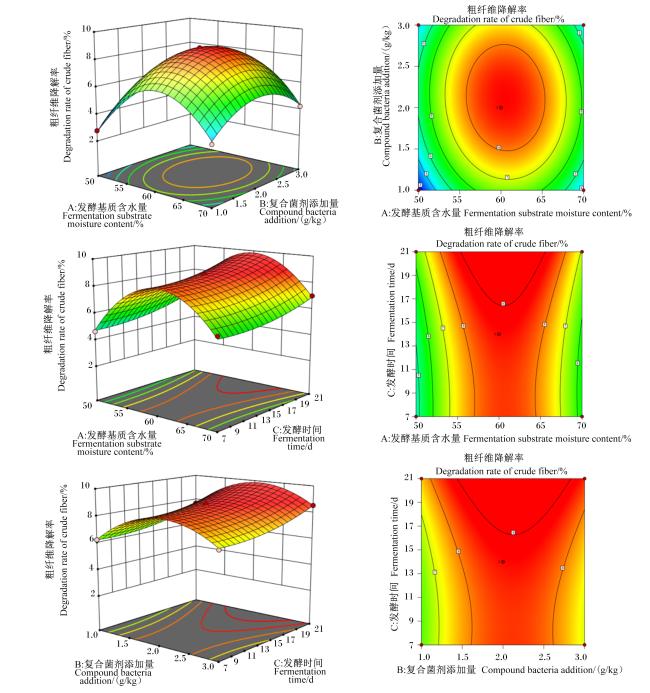
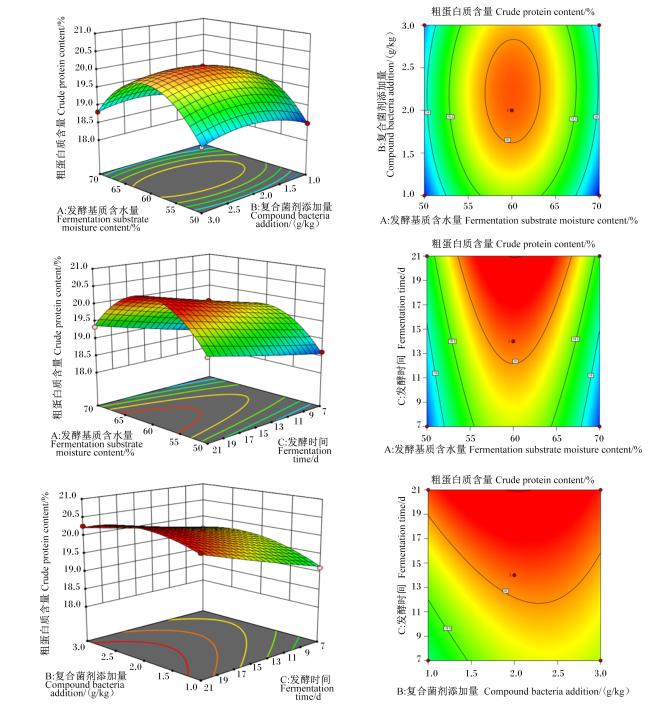
图1图2可知,发酵基质含水量和复合菌剂添加量构成的曲面较为陡峭,表明2个因素的交互作用对尾菜发酵后粗纤维降解率和发酵后粗蛋白质含量影响效果最大,其他因素组合构成的曲面相对平缓,表明组合的交互作用相对较弱。采用Design-Expert 13软件对多元二次回归方程求解,最终确定尾菜发酵工艺优化结果为发酵基质含分量为57.049%,复合菌剂添加量为2.405 g/kg,发酵时间为20.266 d,此条件下模型预测的粗纤维降解率为9.227%,粗蛋白质含量为20.310%。
图1 各因素交互作用对粗纤维降解率影响的响应面图

Fig.1 Response surface plots of interactive effects of various factors on crude fiber degradation rate

图2 各因素交互作用对粗蛋白质含量影响的响应面图

Fig.2 Response surface plots of interactive effects of various factors on crude protein content

2.2.3 模型验证结果

为了验证回归模型优化的结果,根据模型预测得出的试验条件进行3次平行的尾菜发酵优化试验,以验证模型预测的可靠性。为了便于实际操作,在发酵袋中装料3 kg,发酵底物配比为尾菜和辅料混合物3∶1,将发酵基质含水量、复合菌剂添加量、发酵时间分别调整为57%、2 g/kg、20 d进行验证试验,测定初始pH为6.74,亚硝酸盐含量为0.67 mg/kg。如表13所示,经过常温固态发酵后,粗蛋白质含量为20.13%,粗纤维降解率为9.4%,pH为4.34,亚硝酸盐含量为0.301 mg/kg,表明试验结果与预测值接近,此模型可用于蔬菜尾菜发酵工艺优化。
表13 尾菜发酵底物发酵前后营养成分含量对比(风干基础)

Table 13 Comparison of nutritional contents of vegetable waste fermentation substrate before and after fermentation (air-dry basis)

项目Items 发酵前Before fermentation 发酵后After fermentation PP-value
粗蛋白质CP/% 18.780±0.230B 20.130±0.001A <0.001
粗脂肪EE/% 5.200±0.130B 6.030±0.080A <0.001
粗纤维CF/% 25.110±0.030A 22.760±0.060B <0.001
粗灰分Ash/% 11.670±0.090 11.550±0.010 0.083
总能GE/(MJ/kg) 16.590±3.540 16.410±0.710 0.935
pH 6.740±0.030A 4.340±0.040B <0.001
亚硝酸盐Nitrite/(mg/kg) 0.673±0.078A 0.301±0.001B 0.001

2.3 发酵尾菜在仔猪上的饲喂效果

2.3.1 发酵尾菜对仔猪生长性能和腹泻率的影响

表14可知,与对照组相比,试验Ⅰ组腹泻率和腹泻指数分别显著(P<0.05)和极显著(P<0.01)降低,试验Ⅱ组平均日采食量极显著增加(P<0.01);末重、平均日增重和料重比在各组间无显著差异(P>0.05)。
表14 发酵尾菜对仔猪生长性能和腹泻率的影响

Table 14 Effects of fermented vegetable waste on growth performance and diarrhea rate of piglets

项目
Items
对照组
Control group
试验Ⅰ组
Trail group Ⅰ
试验Ⅱ组
Trail group Ⅱ
P
P-value
初重IBW/kg 11.68±2.64 12.01±0.81 11.87±1.24 0.947
末重FBW/kg 29.50±6.74 29.82±0.91 29.15±2.72 0.964
平均日增重ADG/g 593.90±66.16 593.30±12.47 576.13±9.19 0.825
平均日采食量ADFI/kg 1.22±0.01Bb 1.24±0.02ABb 1.27±0.01Aa 0.007
料重比F/G 2.07±0.23 2.09±0.05 2.20±0.02 0.492
腹泻率Diarrhea rate/% 12.22±1.72a 9.72±1.26b 11.95±1.64a 0.026
腹泻指数Diarrhea index 0.74±0.03Aa 0.62±0.03Bb 0.72±0.02Aa 0.005

2.3.2 发酵尾菜对仔猪体尺指标的影响

表15可知,2个试验组各体尺指标与对照组均无显著差异(P>0.05),但随着饲粮中发酵尾菜占比的增多,体长逐渐增长,胸宽逐渐变窄。
表15 发酵尾菜对仔猪体尺指标的影响

Table 15 Effects of fermented vegetable waste on body size indexes of piglets

项目
Items
对照组
Control group
试验Ⅰ组
Trail group Ⅰ
试验Ⅱ组
Trail group Ⅱ
P
P-value
体高Body height/cm 50.00±3.28 49.17±1.72 49.33±2.73 0.850
体长Body length/cm 76.25±5.76 76.92±3.56 77.50±5.33 0.910
胸宽Chest width/cm 23.50±2.37 23.33±1.33 22.33±1.54 0.495
胸围Chest circumference/cm 72.50±5.39 74.50±3.83 72.33±4.46 0.670
胸深Chest deep/cm 35.25±6.39 37.42±1.63 33.33±5.50 0.384
管围Tube circumference/cm 12.17±2.82 13.00±0.89 13.00±1.05 0.674
体长指数Body length index/% 152.57±7.95 156.68±10.57 157.30±10.92 0.674
体躯指数Body cmpactness index/% 95.11±1.77 96.90±3.87 93.43±3.58 0.207
胸围指数Chest circumference index/% 145.09±7.95 151.78±11.13 146.93±11.13 0.517
管围指数Tube circumference index/% 24.12±4.40 26.48±2.19 26.34±1.37 0.323

2.3.3 发酵尾菜对仔猪血清生化和免疫指标的影响

表16可知,试验Ⅱ组的血清ALB、TC含量与AST活性极显著低于对照组(P<0.01),ALP活性显著低于对照组(P<0.05);2个试验组的血清GLU含量均极显著高于对照组(P<0.01),试验Ⅰ组的血清TG含量显著低于对照组(P<0.05);2个试验组的血清UREA、IgG含量均极显著低于对照组(P<0.01);血清ALT活性与CREA、IgM、C3、C4含量各组之间均无显著差异(P>0.05)。
表16 发酵尾菜对仔猪血清生化和免疫指标的影响

Table 16 Effects of fermented vegetable waste on serum biochemical and immunological indicators of piglets

项目
Items
对照组
Control group
试验Ⅰ组
Trail group Ⅰ
试验Ⅱ组
Trail group Ⅱ
P
P-value
白蛋白ALB/(g/L) 39.88±3.46Aa 37.88±3.27Aa 31.47±4.99Bb <0.001
葡萄糖GLU/(mmol/L) 4.72±1.53Bb 6.80±1.73Aa 7.35±1.04Aa <0.001
谷丙转氨酶ALT/(U/mL) 53.46±11.73 51.37±6.33 48.12±12.93 0.552
谷草转氨酶AST/(U/mL) 49.01±7.22Aa 47.90±9.56Aa 39.70±4.31Bb 0.007
碱性磷酸酶ALP/(U/mL) 229.65±41.01a 206.80±22.76ab 190.56±43.03b 0.044
甘油三酯TG/(mmol/L) 0.51±0.05a 0.36±0.07b 0.54±0.31a 0.040
总胆固醇TC/(mmol/L) 2.47±0.38Aa 2.36±0.17Aa 2.01±0.36Bb 0.003
尿素UREA/(mmol/L) 4.21±0.58A 2.36±0.72C 3.47±1.07B <0.001
肌酐CREA/(mmol/L) 154.79±71.99 147.28±76.26 169.57±68.73 0.867
免疫球蛋白M IgM/(μg/mL) 0.37±0.07 0.40±0.09 0.39±0.09 0.584
免疫球蛋白G IgG/(μg/mL) 3.11±0.78Aa 1.22±1.16Bb 1.86±1.19Bb 0.003
补体3 C3/(g/L) 0.006±0.005 0.006±0.005 0.008±0.004 0.345
补体4 C4/(g/L) 0.026±0.011 0.022±0.007 0.020±0.003 0.220

3 讨论

3.1 发酵工艺参数对发酵尾菜营养价值的影响

蔬菜尾菜是一种营养丰富的饲料,含有较高的蛋白质等营养物质,但是直接使用尾菜饲喂动物不易被吸收和利用[23]。张继等[24]用发酵混合菌对高山娃娃菜尾菜和麸皮进行发酵,研究结果显示发酵料的粗蛋白质含量得到显著提升,可以作为饲料使用。发酵基质的含水量能影响发酵过程中微生物的活性和菌种产酶量,在一定范围内,较高的含水量能促进微生物的生长并增加产酶量,但当含水量过高时,基质之间的密度降低,影响微生物代谢,最终对发酵结果产生负面影响。本试验发现,随着发酵基质含水量的增加,尾菜发酵料中的粗蛋白质含量显著提高,可能原因是酿酒酵母繁殖速度较快,使菌体蛋白的合成效率提高,能充分利用无机氮源将尾菜中的非蛋白氮转化成蛋白氮,从而提高了发酵产物中粗蛋白质含量。在一定程度上提高尾菜中的初始含水量不仅可以提高发酵料的粗蛋白质含量,同时也可促进粗纤维的降解,但当发酵基质含水量达70%时,发酵料的粗纤维降解率有所降低,可能原因是发酵基质相对黏稠,不利于发酵反应体系空气流通,抑制菌体繁殖,影响发酵效果,导致粗纤维降解率降低[25]。本试验结果显示,发酵基质含水量为65%和57%时,发酵料的粗蛋白质含量和粗纤维降解率差异不大,但从发酵后续的干燥处理角度考虑,针对尾菜发酵,其发酵基质含水量控制在57%更合适。
复合菌剂添加量的高低会影响发酵过程中微生物的生长速率和代谢产物的合成,复合菌剂的添加量过低会延缓微生物生长,延长发酵周期;过高则易导致发酵温度失控[26]。本试验发现,增加复合菌剂添加量能提升发酵料的粗蛋白质含量。这可能是复合菌剂中的酿酒酵母能将无机铵盐转化为蛋白质,或微生物自身蛋白质贡献所致[27]
发酵时间过短不利于酶活性的表达和蛋白质的积累,发酵时间过长会导致菌种代谢旺盛使酶降解或发酵物质缺乏分解部分蛋白质[28]。本试验中,在发酵时间达到14 d后发酵料中粗蛋白质含量显著提高,粗纤维降解率也显著提高,但发酵28 d时粗纤维降解率较低,其原因可能是,发酵前期底物中有足够的养分提供微生物利用,粗纤维降解明显,而后期由于可溶性碳水化合物被消耗,使整体的粗纤维含量有所增加,因此表现为粗纤维的降解率较低。
由各因素交互作用的响应面图可知,适宜的发酵工艺参数能提高发酵料的粗纤维降解率和粗蛋白质含量。发酵基质含水量、复合菌剂添加量和发酵时间的交互作用主要通过调控微生物的代谢环境、菌群增殖周期和酶活性来对发酵料的粗纤维降解率和粗蛋白质含量产生影响。在发酵过程中,发酵基质含水量适宜,则尾菜基质密度合适,可促进枯草芽孢杆菌增殖;加入2 g/kg的复合酶剂能保证微生物的活性,缩短酶积累的延迟期,适度降解大分子蛋白质为小分子肽,同时菌群利用降解产物合成菌体蛋白;经过20 d的发酵,菌体蛋白累积达到峰值,粗蛋白质含量得到提升。

3.2 发酵尾菜在仔猪上的应用效果

生长性能可反映仔猪的营养状况和健康程度,也是评定饲料营养价值的主要指标,与家畜的经济效益相关。研究表明,发酵饲料可以显著提高试验动物的ADG、ADFI,降低F/G[29-31]。这主要是由于发酵能够消除饲粮中部分原料的抗营养因子,提高饲粮的有效利用率,且能够将原料中蛋白质等大分子物质分解为小肽等更容易被动物消化吸收的小分子物质,进而改善生长性能[32]。Czech等[33]研究显示,在饲粮中添加8%的发酵菜籽粕对断奶仔猪的生长性能无不利影响。张朋等[34]研究发现,在饲粮中添加发酵菜籽粕对育肥猪的生长性能无显著影响。饲料成本是影响养殖经济效益的关键因素,而经济效益直接决定了尾菜资源能否在仔猪饲粮中推广应用。本试验结果显示,在基础饲粮中添加发酵尾菜对仔猪的ADG、F/G及各项体尺指标均无负面影响。参考张俊峰等[35]的经济效益分析方法,添加发酵尾菜能够降低仔猪的增重成本,提高生产效益和毛利润。尽管在30%添加水平下仔猪的ADG有所下降,F/G相应上升,但综合来看,发酵尾菜仍可有效降低饲养成本。此外,本试验结果还表明,添加30%发酵尾菜能显著提高仔猪的ADFI。这一效应可能源于2方面原因:一方面,发酵过程中产生的芳香有机酸改善了饲料的适口性,从而刺激食欲[36];另一方面,饲料中含有的益生菌在肠道内定植后,其代谢产物促进了营养物质的分解与吸收,共同提升了采食表现[37]。在本试验中,饲粮中添加10%的发酵尾菜,仔猪的生长性能无显著变化,但腹泻率降低。研究表明,饲料经过发酵后能降低仔猪的腹泻率[38-39],这与本试验研究结果一致,原因可能是发酵饲料中芽孢杆菌及酵母菌等代谢过程可以提供良好的厌氧环境,也对肠道中的乳酸菌生长有积极作用[40],可有效降低有害菌的繁殖,从而降低仔猪腹泻的发生率[41]
血清生化指标能够反映机体在营养代谢、消化吸收及免疫调节等方面的生理状态,因此其变化常被用作评估家畜健康状况的重要依据[42]。其中,血清UREA、ALB和GLU含量是反映机体新陈代谢尤其是氮代谢功能的关键指标[16]。本试验中,在仔猪饲粮中添加30%发酵尾菜后,血清中ALB和UREA含量显著降低,这一结果与朱坤等[43]的研究有所不同。推测其原因,可能是发酵尾菜的添加提高了蛋白质的利用效率,减少了氨类代谢产物的生成,从而降低了UREA的积累。此外,发酵尾菜的添加还显著提高了仔猪血清GLU含量,表明机体能量代谢得到有效改善。
血清中ALT与AST活性是评估肝脏健康的重要指标,其活性越低,通常肝脏功能与发育状况良好;而ALP活性则与肠道吸收效率相关,其活性升高往往提示肠道对营养物质的吸收较好。本试验结果显示,饲粮中添加30%的发酵尾菜可显著降低仔猪血清中AST与ALP活性,ALT活性与CREA含量则无显著变化。上述结果说明,发酵尾菜未对仔猪肝脏功能产生不良影响,但ALP活性的下降提示其可能在一定程度上影响了肠道吸收功能,进而可能对生长性能产生制约。血清中TC和TG含量是反映机体脂质代谢状态的关键参数[44]。动物对脂类的吸收利用率通常与血清中脂质含量呈负相关[45]。本试验中,10%发酵尾菜组仔猪血清TG含量显著低于对照组,30%发酵尾菜组血清TC含量显著低于对照组,表明发酵尾菜对仔猪的脂质代谢具有一定的调节作用。血清中的免疫球蛋白含量是衡量机体免疫功能的重要指标[46]。本试验中,2个发酵尾菜组血清IgG含量较对照组极显著降低,而IgM、C3和C4含量未见显著变化。血清中IgG含量的下降可能与仔猪应激状态下其合成与释放受到暂时性调控有关,但从整体结果看,并未表明发酵尾菜对仔猪的免疫功能产生负面影响。

4 结论

利用响应面法得出的尾菜发酵最佳工艺参数为发酵底物配比3∶1,发酵基质含水量为57%,复合菌剂添加量为2 g/kg,发酵时间20 d,按照上述条件进行发酵后,可以提高粗蛋白质含量和粗纤维降解率;发酵尾菜替代部分基础饲粮对仔猪的生长性能、体尺指数和免疫功能无负面影响,综合考虑腹泻率,以发酵尾菜替代10%基础饲粮时效果最优。
[1]
张素, 杨淑华, 唐姜烽, 等. 云南省蔬菜产业高质量发展水平测度及影响因素研究[J]. 云南农业大学学报(社会科学), 2024, 18(6):90-97.

ZHANG S, YANG S H, TANG J F, et al. Study on the measurement and influencing factors of high-quality development level of vegetable industry in Yunnan Province[J]. Journal of Yunnan Agricultural University (Social Science), 2024, 18(6):90-97. (in Chinese)

[2]
刘春艳, 詹海杰, 闫益波. 蔬菜废弃物在畜牧业中的应用前景[J]. 湖南饲料, 2019(5):20-22.

LIU C Y, ZHAN H J, YAN Y B. Prospects of vegetable wastes in animal husbandry[J]. Hunan Feed, 2019(5):20-22. (in Chinese)

[3]
赵家进, 张元, 杨红朝, 等. 云南省尾菜资源化利用经验模式分析--以陆良县蔬菜产业为例[J]. 热带农业科技, 2025, 48(2):105-109.

ZHAO J J, ZHANG Y, YANG H C, et al. Empirical model analysis on the resource utilization of vegetable waste in Yunnan Province:take the vegetable industry of Luliang County as an example[J]. Tropical Agricultural Science & Technology, 2025, 48(2):105-109. (in Chinese)

[4]
COMAN V, TELEKY B E, MITREA L, et al. Bioactive potential of fruit and vegetable wastes[J]. Advances in Food and Nutrition Research, 2020, 91:157-225.

DOI PMID

[5]
ZHU Y D, LUAN Y T, ZHAO Y N, et al. Current technologies and uses for fruit and vegetable wastes in a sustainable system:a review[J]. Foods, 2023, 12(10):1949.

DOI

[6]
王清. 响水县西兰花-青毛豆尾菜资源化利用试验及实践[J]. 新农民, 2024(1):75-77.

WANG Q. Experiment and practice of resource utilization of broccoli-green hairy bean tail vegetable in Xiangshui County[J]. New Farmers, 2024(1):75-77. (in Chinese)

[7]
于欣卉, 黄思思, 张富涛, 等. 牛粪和白菜尾菜混合厌氧发酵产甲烷潜能和动力学解析[J]. 黑龙江八一农垦大学学报, 2023, 35(6):81-87.

YU X H, HUANG S S, ZHANG F T, et al. Methane potential and production dynamics of anaerobic co-digestion of cattle manure and cabbage waste[J]. Journal of Heilongjiang Bayi Agricultural University, 2023, 35(6):81-87. (in Chinese)

[8]
AKIYAMA R, WATANABE B, NAKAYASU M, et al. The biosynthetic pathway of potato solanidanes diverged from that of spirosolanes due to evolution of a dioxygenase[J]. Nature Communications, 2021, 12(1):1300.

DOI PMID

[9]
CHEN J Y, ULLAH C, REICHELT M, et al. The phytopathogenic fungus Sclerotinia sclerotiorum detoxifies plant glucosinolate hydrolysis products via an isothiocyanate hydrolase[J]. Nature Communications, 2020, 11(1):3090.

DOI

[10]
尹立冬, 李桂明, 张亨, 等. 尾菜饲料化开发及其在动物生产中的应用[J]. 动物营养学报, 2025, 37(3):1516-1526.

DOI

YIN L D, LI G M, ZHANG H, et al. Feed development of vegetable wastes and their application in animal production[J]. Chinese Journal of Animal Nutrition, 2025, 37(3):1516-1526. (in Chinese)

DOI

[11]
刘中华, 李强, 冯志, 等. 发酵木薯酒精糟对生产猪生产性能及营养物质消化的影响[J]. 饲料工业, 2017, 38(10):26-30.

LIU Z H, LI Q, FENG Z, et al. Effect of fermented cassava alcohol lees on production performance and nutrient digestibility of growing pigs[J]. Feed Industry, 2017, 38(10):26-30. (in Chinese)

[12]
ZHANG Y T, LU D D, CHEN J Y, et al. Effects of fermented soybean meal on carbon and nitrogen metabolisms in large intestine of piglets[J]. Animal, 2018, 12(10):2056-2064.

DOI PMID

[13]
XIE Z J, HU L S, LI Y, et al. Changes of gut microbiota structure and morphology in weaned piglets treated with fresh fermented soybean meal[J]. World Journal of Microbiology and Biotechnology, 2017, 33(12):213.

DOI

[14]
温凯欣, 司振书. 猪用乳酸菌发酵饲料的研究现状[J]. 当代畜牧, 2016(9):32-34.

WEN K X, SI Z S. Research status of lactic acid bacteria fermentation feed for pigs[J]. Contemporary Animal Husbandry, 2016(9):32-34. (in Chinese)

[15]
张琳琰. 发酵豆粕对不同阶段生猪生长性能及健康状况的影响研究[D]. 硕士学位论文. 上海: 上海交通大学,2015:36-52.

ZHANG L Y. Effect of fermented soybean meal on growth performance and health status of pigs at different stages[D]. Master’s Thesis. Shanghai: Shanghai Jiao Tong University,2015:36-52. (in Chinese)

[16]
褚晓红, 陈晓宇, 戴丽荷, 等. 青贮西兰花茎叶饲料对仙居花猪杂交土猪肉质的影响[J]. 浙江农业科学, 2022, 63(7):1539-1541.

DOI

CHU X H, CHEN X Y, DAI L H, et al. Effect of broccoli stem silage on meat quality of domestic native pig in Xianju[J]. Journal of Zhejiang Agricultural Sciences, 2022, 63(7):1539-1541. (in Chinese)

[17]
蓝婧婷, 任瑞, 周瑞, 等. 花椰菜尾菜发酵饲料对保育猪生长性能、血清生化指标、小肠组织形态及经济效益的影响[J]. 草业学报, 2021, 30(6):180-189.

DOI

LAN J T, REN R, ZHOU R, et al. Effects of feeding fermented cauliflower residue on growth performance,serum biochemical indices,intestinal tissue morphology and economic returns of nursery pigs[J]. Acta Prataculturae Sinica, 2021, 30(6):180-189. (in Chinese)

[18]
SUN H, QIAN Z C, WU Y F, et al. Effects of fermented broccoli stem and leaf residue on growth performance,serum characteristics and meat quality of growing pigs[J]. Journal of Animal Physiology and Animal Nutrition, 2023, 107(4):1035-1042.

DOI

[19]
王靖雯, 李玉双, 蔡佳敏, 等. 尾菜饲料化研究进展[J]. 饲料工业, 2023, 44(13):93-98.

WANG J W, LI Y S, CAI J M, et al. Research progress on feedingization of vegetable waste[J]. Feed Industry, 2023, 44(13):93-98. (in Chinese)

[20]
贺晨晨. 不同益生菌发酵饲料对断奶仔猪生产性能与血液生化指标的影响研究[D]. 硕士学位论文. 长沙: 湖南农业大学, 2018.

HE C C. Study on effects of probiotic fermented feeds on growth performance and blood biochemical indexes of weaned piglets[D]. Master’s Thesis. Changsha: Hunan Agricultural University, 2018. (in Chinese)

[21]
张峰硕, 周力, 马博妍, 等. 棕榈粕添加水平对高原型藏羊生长发育影响[J]. 草业科学, 2023, 40(9):2401-2410.

ZHANG F S, ZHOU L, MA B Y, et al. Effects of supplemental level of palm meal on the growth and development of plateau Tibetan sheep[J]. Pratacultural Science, 2023, 40(9):2401-2410. (in Chinese)

[22]
王淑楠. 茶树油对断奶仔猪生长性能及肠道屏障功能的影响[D]. 硕士学位论文. 扬州: 扬州大学, 2018.

WANG S N. Effects of tea tree oil on growth performance and intestinal barrier function of weaned piglets[D]. Master’s Thesis. Yangzhou: Yangzhou University, 2018. (in Chinese)

[23]
陈轲, 胡梦月, 徐阳, 等. 尾菜资源利用方式及肥料化技术研究进展[J]. 环境保护与循环经济, 2020, 40(12):5-10,58.

CHEN K, HU M Y, XV Y, et al. Research progress on utilization methods and fertilization technologies for vegetable residues[J]. Environmental Protection and Circular Economy, 2020, 40(12):5-10,58. (in Chinese)

[24]
张继, 武光朋, 高义霞, 等. 蔬菜废弃物固体发酵生产饲料蛋白[J]. 西北师范大学学报(自然科学版), 2007, 43(4):85-89.

ZHANG J, WU G P, GAO Y X, et al. Feeding-protein producing by solid-fermentation from vegetable wastes[J]. Journal of Northwest Normal University (Natural Science Edition), 2007, 43(4):85-89. (in Chinese)

[25]
丛懿洁. EM复合菌与纤维素酶协同发酵海藻残渣制备发酵海藻饲料工艺优化[J]. 动物营养学报, 2025, 37(11):7955-7969.

DOI

CONG Y J. Optimization of synergistic fermentation process for seaweed residue using EM complex bacteria and cellulase to produce fermented seaweed feed[J]. Chinese Journal of Animal Nutrition, 2025, 37(11):7955-7969. (in Chinese)

DOI

[26]
杨光瑞, 朱新强, 王春梅, 等. 固态发酵啤酒糟和葡萄渣复合蛋白饲料的研究[C]// 第四届中国草业大会论文集. 西宁: 中国畜牧业协会草业分会, 2016:173-184.

YANG G R, ZHU X Q, WANG C M, et al. Study on producing compound feed protein with brewers’ grain and grape slag by solid state-fermentation[C]// Proceedings of the Fourth China Grassland Conference. Xining: Grass Industry Branch of China Animal Husbandry Association, 2016:173-184. (in Chinese)

[27]
刘兴. 混菌发酵饲料的工艺优化及饲喂效果的研究[D]. 硕士学位论文. 哈尔滨: 黑龙江东方学院, 2020.

LIU X. Process optimization and feeding effect of fermentation feed by mixed strains[D]. Master’s Thesis. Harbin: East University of Heilongjiang, 2020. (in Chinese)

[28]
刘纪成, 李黄琨, 李秀, 等. 多菌种混合固态发酵花生秸秆生产蛋白质饲料的工艺研究[J]. 家畜生态学报, 2019, 40(4):42-47.

LIU J C, LI H K, LI X, et al. Process study on mixed multi-strain solid state fermentation of peanut straw to produce protein feed[J]. Acta Ecologae Animalis Domastici, 2019, 40(4):42-47. (in Chinese)

[29]
仲伟光, 王大广, 于维, 等. 膨化玉米秸秆发酵饲料对肉羊育肥效果的影响[J]. 中国草食动物科学, 2019, 39(1):29-32.

ZHONG W G, WANG D G, YU W, et al. Effects of puffed corn stalk fermentation feed on fattening effect of meat sheep[J]. China Herbivore Science, 2019, 39(1):29-32. (in Chinese)

[30]
CHEN W, ZHU X Z, WANG J P, et al. Effects of Bacillus subtilis var. natto and Saccharomyces cerevisiae fermented liquid feed on growth performance,relative organ weight,intestinal microflora,and organ antioxidant status in Landes geese[J]. Journal of Animal Science, 2013, 91(2):978-985.

DOI

[31]
MISSOTTEN J A, MICHIELS J, DIERICK N, et al. Effect of fermented moist feed on performance,gut bacteria and gut histomorphology in broilers[J]. British Poultry Science, 2013, 54(5):627-634.

DOI

[32]
李斌. 发酵饲料在养猪生产中的应用[J]. 养殖与饲料, 2019(7):31-32.

LI B. Application of fermented feed in pig production[J]. Animals Breeding and Feed, 2019(7):31-32. (in Chinese)

[33]
CZECH A, WLAZŁO Ł, ŁUKASZEWICZ M, et al. Fermented rapeseed meal enhances the digestibility of protein and macro- and microminerals and improves the performance of weaner pigs[J]. Animal Feed Science and Technology, 2023, 300:115656.

[34]
张朋, 姚有莉, 王永奔, 等. 不同发酵模式发酵菜籽粕对育肥猪生长性能、血清免疫指标、激素水平及粪便微生物的影响[J]. 动物营养学报, 2025, 37(3):1660-1672.

DOI

ZHANG P, YAO Y L, WANG Y B, et al. Effects of different fermentation modes of rapeseed meal on growth performance,serum immunity indexes,hormone levels and fecal microorganisms of fattening pigs[J]. Chinese Journal of Animal Nutrition, 2025, 37(3):1660-1672. (in Chinese)

DOI

[35]
张俊峰, 冷来福, 齐仁立, 等. 低蛋白质饲粮中添加发酵饲料对生长猪生长性能、血清指标和经济效益的影响[J]. 动物营养学报, 2025, 37(1):261-270.

DOI

ZHANG J F, LENG L F, QI R L, et al. Effects of adding fermented feeds to low-protein diets on growth performance,serum indices and economic benefits of growing pigs[J]. Chinese Journal of Animal Nutrition, 2025, 37(1):261-270. (in Chinese)

[36]
WANG Y, LIU X T, WANG H L, et al. Optimization of processing conditions for solid-state fermented soybean meal and its effects on growth performance and nutrient digestibility of weanling pigs[J]. Livestock Science, 2014, 170:91-99.

DOI

[37]
CHEN Y J, KIM I H, CHO J H, et al. Effects of chitooligosaccharide supplementation on growth performance,nutrient digestibility,blood characteristics and immune responses after lipopolysaccharide challenge in weanling pigs[J]. Livestock Science, 2009, 124(1/2/3):255-260.

DOI

[38]
刘莹, 王晓斌. 发酵饲料对母猪繁殖性能、养分表观消化率及仔猪生长性能的影响[J]. 饲料研究, 2023, 46(23):24-27.

LIU Y, WANG X B. Effect of fermented feed on reproductive performance,nutrient apparent digestibility of sows and growth performance of piglets[J]. Feed Research, 2023, 46(23):24-27. (in Chinese)

[39]
邓琳, 倪冬姣, 邹新华, 等. 微生物发酵料对仔猪生长性能、腹泻率、血液指标和粪便菌群的影响[J]. 中国畜牧杂志, 2019, 55(5):72-76.

DENG L, NI D J, ZHOU X H, et al. Effects of microbial fermented feed on growth performance,diarrhea incidence,blood parameters,and fecal microbiota in piglets[J]. Chinese Journal of Animal Science, 2019, 55(5):72-76. (in Chinese)

[40]
李琦. 发酵葡萄渣对保育猪免疫性能和肠道健康的影响[D]. 硕士学位论文. 杨凌: 西北农林科技大学, 2023.

LI Q. Effect of fermented grape pomace on immune performance and intestinal health of nursery pigs[D]. Master’s Thesis. Yangling: Northwest A&F University, 2023. (in Chinese)

[41]
JIANG D H, YANG M Q, XV J, et al. Three-stage fermentation of the feed and the application on weaned piglets[J]. Frontiers in Veterinary Science, 2023, 10:1123563.

[42]
许威, 张昕禹, 徐超, 等. 发酵玉米蛋白粉替代豆粕对断奶羔羊生长性能、血液生化、抗氧化及免疫指标的影响[J]. 中国畜牧杂志, 2025, 61(7):334-338,343.

XV W, ZHANG X Y, XV C, et al. Effect of fermented corn protein powder replacement of soybean meal on growth performance,blood biochemistry,antioxidant and immune indicators of weaned lambs[J]. Chinese Journal of Animal Science, 2025, 61(7):334-338,343. (in Chinese)

[43]
朱坤, 毛胜勇, 朱崇淼, 等. 发酵饲料对育肥猪生长性能、胴体性状、肉品质、血清生化指标和代谢产物的影响[J]. 动物营养学报, 2018, 30(10):4244-4250.

ZHU K, MAO S Y, ZHU C M, et al. Effects of fermented feed on growth performance,carcass traits,meat quality,serum biochemical indicators and metabolites of finishing pigs[J]. Chinese Journal of Animal Nutrition, 2018, 30(10):4244-4250. (in Chinese)

[44]
王镜岩. 生物化学[M]. 3版. 北京: 高等教育出版社, 2007.

WANG J Y. Biochemistry[M]. 3rd ed. Beijing: Higher Education Press, 2007. (in Chinese)

[45]
方勇儒, 何瑶瑶, 赵祥, 等. 包被甜菜碱对育肥后期平凉红牛生长性能及血清指标的影响[J]. 动物营养学报, 2024, 36(4):2487-2496.

DOI

FANG Y R, HE Y Y, ZHAO X, et al. Effects of coated betaine on growth performance and serum indexes of Pingliang red bull in late fattening period[J]. Chinese Journal of Animal Nutrition, 2024, 36(4):2487-2496. (in Chinese)

[46]
MIRZAEI-ALAMOUTI H, MORADI S, SHAHALIZADEH Z, et al. Both monensin and plant extract alter ruminal fermentation in sheep but only monensin affects the expression of genes involved in acid-base transport of the ruminal epithelium[J]. Animal Feed Science and Technology, 2016, 219:132-143.

DOI

文章导航

/