研究论文

丁酸梭菌对哺乳犊牛生长性能、血清生化指标、瘤胃发酵及瘤胃菌群的影响

  • 庞绍洋 ,
  • 高佩耘 ,
  • 王倩倩 ,
  • 唐雅琴 ,
  • 李秋燕 ,
  • 牛俊丽 , * ,
  • 张文举 , *
展开
  • 石河子大学动物科技学院,石河子 832003
* 牛俊丽,副教授,硕士生导师,E-mail: ;张文举,教授,博士生导师,E-mail:

收稿日期: 2025-05-27

  网络出版日期: 2026-01-13

基金资助

国家自然科学基金(32260855)

Effects of Clostridium butyricum on Growth Performance, Serum Biochemical Indices, Rumen Fermentation and Rumen Microbial Community in Suckling Calves

  • PANG Shaoyang ,
  • GAO Peiyun ,
  • WANG Qianqian ,
  • TANG Yaqin ,
  • LI Qiuyan ,
  • NIU Junli , * ,
  • ZHANG Wenju , *
Expand
  • College of Animal Science and Technology, Shihezi University, Shihezi 832003, China
* NIU Junli, associate professor, E-mail: ; ZHANG Wenju, professor, E-mail:

Received date: 2025-05-27

  Online published: 2026-01-13

摘要

本试验旨在探究补饲不同剂量的丁酸梭菌对哺乳犊牛生长性能、体尺指标、血清生化指标、瘤胃发酵参数及瘤胃菌群结构的影响。选取40头健康的新生荷斯坦母犊牛,随机分为4组,每组10头,单栏饲养。对照组犊牛常规饲喂,1 g组、3 g组和5 g组犊牛每头每天分别补饲1、3和5 g丁酸梭菌,试验期60 d。于试验第21(21日龄)、42(42日龄)、60天(60日龄)晨饲前对犊牛进行空腹称重,测量体尺指标,并采集静脉血测定血清生化指标,在第60天采集犊牛瘤胃液测定瘤胃发酵参数并分析瘤胃菌群结构。结果表明:1)与对照组相比,补饲1 g/(头·d)丁酸梭菌可显著提高42日龄犊牛的体高(P<0.05)。2)42日龄时,1 g组犊牛血清总蛋白、白蛋白含量及各补饲丁酸梭菌组血清球蛋白含量均较对照组显著增加(P<0.05)。3)与对照组相比,补饲1和3 g/(头·d)丁酸梭菌可显著增加60日龄犊牛瘤胃液中氨态氮浓度(P<0.05)。4)与对照组相比,1 g组瘤胃菌群中毛螺菌科FE2018群(Lachnospiraceae_FE2018_group)相对丰度显著增加(P<0.05);3 g组瘤胃菌群中隐匿真杆菌群(Eubacterium_saphenum_group)、巴氏杆菌属(Pasteurella)和罗斯氏菌属(Roseburia)的相对丰度显著增加(P<0.05)。综上可知,补饲丁酸梭菌对哺乳犊牛的生长发育、瘤胃发酵、血清生化指标及瘤胃菌群有积极影响,其中1 g/(头·d)的补饲量在促进犊牛生长发育方面效果较好,3 g/(头·d)的补饲量在改善瘤胃发酵功能和菌群结构方面效果较好。

本文引用格式

庞绍洋 , 高佩耘 , 王倩倩 , 唐雅琴 , 李秋燕 , 牛俊丽 , 张文举 . 丁酸梭菌对哺乳犊牛生长性能、血清生化指标、瘤胃发酵及瘤胃菌群的影响[J]. 动物营养学报, 2026 , 38(1) : 412 -426 . DOI: 10.12418/CJAN2026.033

Abstract

This experiment aimed to investigate the effects of supplementing with different dosages of Clostridium butyricum on the growth performance, body measurement indicators, serum biochemical indices, rumen fermentation parameters, and rumen microbial community structure in suckling calves. Forty healthy newborn Holstein female calves were selected and randomly divided into 4 groups with 10 calves in each group, and were housed in individual pens. The control group was fed routinely, while the calves in the 1 g group, 3 g group, and 5 g group were supplemented with 1, 3, and 5 g/(head·d) of Clostridium butyricum, respectively. The experimental period was 60 days. On trial day 21 (21 days of age), day 42 (42 days of age), and day 60 (60 days of age), before the morning feeding, the calves were weighed after fasting, their body measurement indicators were measured, and jugular vein blood was collected to determine serum biochemical indices. On day 60, rumen fluid was collected from the calves to determine rumen fermentation parameters and analyze the rumen microbial community structure. The results showed that: 1) compared with the control group, supplementing with 1 g/(head·d) of Clostridium butyricum significantly increased the body height of calves at 42 days of age (P<0.05). 2) At 42 days of age, the serum total protein and albumin contents in the 1 g group, and the serum globulin content in all Clostridium butyricum supplementation groups were significantly increased compared with the control group (P<0.05). 3) Compared with the control group, supplementing with 1 and 3 g/(head·d) of Clostridium butyricum significantly increased the ammonia nitrogen concentration in the rumen fluid of calves at 60 days of age (P<0.05). 4) Compared with the control group, the relative abundance of Lachnospiraceae_FE2018_group in rumen microbial community was significantly increased in the 1 g group (P<0.05); the relative abundances of Eubacterium_saphenum_group, Pasteurella and Roseburia in rumen microbial community were significantly increased in the 3 g group (P<0.05). In conclusion, supplementing with Clostridium butyricum has positive effects on the growth and development, rumen fermentation, serum biochemical indices, and rumen microbial community of suckling calves. Among them, a supplementation of 1 g/(head·d) shows better effects in promoting calf growth and development, while a supplementation of 3 g/(head·d) shows better effects in improving rumen fermentation function and microbial community structure.

犊牛哺乳期的健康状况对整个畜牧业发展意义重大,其生长发育情况直接关系到牧场的经济效益和产业质量[1]。在这一关键阶段,犊牛的瘤胃处于逐步发育的过程,消化机能尚不完善,若饲养管理不当,极易出现生长迟缓、疾病多发甚至死亡等问题,给养殖户造成严重的经济损失[2]。改善犊牛瘤胃发育,建立稳定、有利的瘤胃菌群结构,是改善犊牛消化、吸收养分的关键;保障犊牛健康成长,是提升畜牧业生产效益的关键环节[3]
丁酸梭菌是一类极具应用前景的微生态制剂,已引起人们的高度重视。它可以将纤维分解成短链脂肪酸,如丁酸、乙酸,犊牛不仅需要靠短链脂肪酸来提供额外的能量,还需要其调节瘤胃微生态平衡、增强机体免疫力等[4-45]。已有研究表明,在犊牛饲粮中添加丁酸梭菌能够改善瘤胃菌群结构,提高生长性能和健康水平[6]。在犊牛养殖领域,已有研究也证实了丁酸梭菌对瘤胃发酵和微生物区系有一定的积极影响[7]
然而,目前关于丁酸梭菌在犊牛饲养中的应用研究仍存在一些不足。一方面,大多数研究集中在丁酸梭菌对犊牛肠道微生物的影响,针对瘤胃微生物区系的深入研究相对较少;另一方面,对于不同剂量丁酸梭菌对犊牛生长性能、瘤胃发酵、血清生化指标以及瘤胃菌群的综合影响,尚未形成全面且系统的认识。上述问题制约了丁酸梭菌在犊牛培育过程中的精确使用。
基于上述背景,本试验拟以荷斯坦母犊牛为研究对象,通过补饲不同剂量的丁酸梭菌,深入研究其对犊牛生长发育、血清生化指标、瘤胃发酵及瘤胃菌群的影响,并探究丁酸梭菌在促进犊牛生长发育、提高瘤胃功能、改善机体健康等方面发挥最佳效果的补饲剂量,以期为犊牛健康养殖及丁酸梭菌的合理使用提供科学依据和实践指导,助力提升畜牧业的生产效益和可持续发展能力。

1 材料与方法

1.1 试验材料

试验所用丁酸梭菌为石河子大学饲料生物技术实验室保藏菌种,活菌数为1×10⁹ CFU/g。

1.2 试验设计与饲养管理

动物试验已获得石河子大学(中国新疆)动物福利委员会的批准(伦理编号: A2022-010),于2024年7—10月在新疆石河子市某规模化奶牛场进行。选取新生荷斯坦健康母犊牛[初生重为(38.36±3.51) kg]40头,随机分成4组,每组10头,单栏饲养。对照组犊牛常规饲喂,1 g组、3 g组和5 g组犊牛每头每天分别补饲1、3、5 g丁酸梭菌。试验期60 d。
试验犊牛出生后1 h内灌服4 L优质初乳,之后进入犊牛岛单栏饲养,试验期间对饲养圈舍定期进行清扫和消毒。牛奶饲喂严格遵循牛场规定,每日06:00和18:00定时饲喂巴氏杀菌牛奶。犊牛50日龄起,牛奶饲喂量每2 d递减2 L,直至完全断奶。犊牛于4日龄开始补饲开食料,且保证每日开食料有剩余,于断奶前10 d开始补饲苜蓿,补饲开食料和苜蓿后,保证犊牛自由采食开食料和苜蓿,并提供足够的饮水。丁酸梭菌与牛奶充分混合后饲喂,确保犊牛完全食入。开食料组成及营养水平见表1,苜蓿及牛奶的营养成分含量见表2,各项营养指标数据均源于实际测量,其中干物质、粗蛋白质、粗脂肪、粗灰分、钙及磷含量分别参照GB/T 6435—2014、GB/T 6432—2018、GB/T 6433—2006、GB/T 6438—2007、GB/T 6436—2018及GB/T 6437—2018进行测定,中性洗涤纤维与酸性洗涤纤维含量则是依据Van Soest等[8]的方法进行测定,乳成分使用Lactoscan LW全自动分析仪进行检测。
表1 开食料的组成及营养水平(风干基础)

Table 1 Composition and nutrient levels of the starter (air-dry basis) %

原料Ingredients 含量Content 营养水平Nutrient levels 含量Content
玉米Corn 55.10 干物质DM 87.35
玉米干酒糟及其可溶物Corn DGGS 13.00 粗脂肪EE 4.64
玉米蛋白粉Corn gluten meal 10.00 粗灰分Ash 5.38
豆粕Soybean meal 18.60 粗蛋白质CP 19.72
氯化钠NaCl 0.60 钙Ca 1.15
石粉Limestone 1.70 磷P 0.58
预混料Premix 1.00 中性洗涤纤维NDF 16.48
合计Total 100.00 酸性洗涤纤维ADF 6.07

预混料为每千克开食料提供 Premix provides the following per kg of the starter:VA 15 000 IU,VD 5 000 IU,VE 50 mg,Fe 90 mg,Cu 12.5 mg,Mn 30 mg,Zn 90 mg,Se 0.3 mg,I 1.0 mg,Co 0.5 mg。

表2 苜蓿(风干样)及牛奶(鲜样)的营养成分含量

Table 2 Nutrient contents of alfalfa (air-dried sample) and milk (fresh sample) %

项目Items 苜蓿Alfalfa 项目Items 牛奶Milk
干物质DM 91.33 乳总固形物Total milk solids 12.33
粗蛋白质CP 16.72 乳蛋白Milk protein 3.15
粗脂肪EE 1.56 乳脂肪Milk fat 3.75
粗灰分Ash 8.17 钙Ca 0.11
钙Ca 1.33 磷P 0.08
磷P 0.25
中性洗涤纤维NDF 49.44
酸性洗涤纤维ADF 33.93

1.3 指标测定

1.3.1 生长性能和体尺指标

在试验过程中,逐日准确记录各个组中犊牛的饲粮(包括牛奶和开食料,因犊牛在50~60日龄阶段苜蓿采食量极低,日均1~2 g,且该数值处于称量误差范围内,对总干物质采食量贡献微小,故未纳入最终计算)投放量及其未食用的残存量,进而通过这些数据计算出犊牛的实际摄取量,并将其转换为干物质采食量。于试验第21(21日龄)、42(42日龄)、60天(60日龄)晨饲前,用地秤称量犊牛的空腹体重,用测杖和皮尺测量体斜长(肩端到坐骨端的距离)、体高(鬐甲最高点到地面的垂直距离)、胸深(肩胛后缘的背部到胸骨下缘的垂直距离)、胸围(肩胛骨后角处体躯的垂直周径)等体尺指标。在以上数据的基础上,计算犊牛的平均日增重、牛奶和开食料干物质采食量和料重比。

1.3.2 血清生化指标

于试验第21、42和60天晨饲前,每组随机选择6头牛,采集颈静脉血10 mL,将样本放置静置30 min后,以3 200×g的离心力实施15 min的离心操作,随后将获得的血清转移至离心管内,于-20 ℃冷冻保存,以备后续检测。
采用BK-200全自动生化仪(山东博科生物产业有限公司)测定血清总蛋白(TP)、白蛋白(ALB)、碱性磷酸酶(ALP)、尿素(Urea)、葡萄糖(Glu)、甘油三酯(TG)、总胆固醇(TC)、肌酸激酶(CK)及乳酸脱氢酶(LDH)含量或活性。

1.3.3 瘤胃发酵参数

试验第60天晨饲后3 h后,每组随机选择5头犊牛,用瘤胃液收集器收集瘤胃液50 mL(弃去最初10 mL),并现场使用pH计测定其pH,然后采用4层纱布过滤法过滤瘤胃液,并立即分装在3个5 mL的冻存管中,置于液氮罐中速冻后,于-80 ℃冷冻保持待测。
瘤胃液中乙酸、丙酸、异丁酸、丁酸、异戊酸和戊酸浓度均采用7890B气相色谱仪(Agilent,美国)进行分析,氨态氮浓度参照冯宗慈等[9]报道的比色法测定。

1.3.4 瘤胃菌群

首先,采用E.Z.N.A.® Soil DNA Kit (Omega Bio-Tek,美国)的操作流程提取瘤胃液中微生物群落总基因组DNA,随后通过1%琼脂糖凝胶电泳评估提取的DNA的质量,并使用NanoDrop 2000超微量分光光度计(Thermo Scientific,美国)测定其浓度和纯度。接着,以所提取的DNA为模板,使用带Barcode的引物338F(5'-ACTCCTACGGGAGGCAGCAG-3')和806R(5'-GGACTACHVGGGTWTCTAAT-3')扩增16S rRNA基因V3~V4可变区。正式PCR选用TransStart® FastPfu Polymerase(AP221-02,北京全式金生物技术有限公司),体系为20 μL,包含4 μL的5×FastPfu Buffer、2 μL的dNTPs (2.5 mmol/L)、0.8 μL的正向引物 (5 μmol/L)、0.8 μL的反向引物(5 μmol/L)、0.4 μL的FastPfu Polymerase DNA聚合酶、0.2 μL的牛血清白蛋白(BSA)、10 ng模板DNA,最后用ddH2O补足至20 μL。PCR程序设定为:1)95 ℃预变性3 min(1个循环);2)95 ℃变性30 s,退火温度55 ℃,退火30 s,72 ℃延伸45 s(循环数×27);3)72 ℃终延伸10 min,后于10 ℃保存。PCR产物经2%琼脂糖凝胶电泳分离,采用DNA凝胶回收纯化试剂盒(PCR Clean-Up Kit,北京擎科生物科技股份有限公司)进行回收纯化,并使用Qubit 4.0荧光定量仪(Thermo Fisher Scientific,美国)定量回收产物浓度。最后,使用NEXTflex Rapid DNA-Seq Kit构建文库,主要步骤包括:1)连接接头;2)磁珠筛选去除接头自连片段;3)PCR扩增富集文库模板;4)磁珠回收PCR产物获得最终文库,该最终文库在Illumina NextSeq 2000平台进行测序(上海美吉生物医药科技有限公司)。用Qiime1.91、Mothur1.30.2、SILVA138等软件对物种分类水平、Bata多样性、Alpha多样性等进行分析整理,利用RDP classifier (version 2.11)比对Silva 16S rRNA基因数据库(v138)进行操作分类单元(OTU)物种分类学注释,置信度阈值为70%,具体相关分析过程在美吉生物云平台上进行。

1.4 数据统计与分析

试验数据用SPSS 20.0软件进行统计分析,先进行单因素方差分析,然后运用Duncan氏法进行进一步的比较,以P<0.05为差异显著的标准判断。结果用平均值和均值标准误(SEM)表示。

2 结果与分析

2.1 补饲不同剂量丁酸梭菌对哺乳犊牛生长性能的影响

表3可知,补饲不同剂量的丁酸梭菌对犊牛不同日龄阶段的平均日增重、干物质采食量、料重比均无显著影响(P>0.05)。
表3 补饲不同剂量丁酸梭菌对哺乳犊牛生长性能的影响

Table 3 Effects of supplementing with different dosages of Clostridium butyricum on growth performance of suckling calves

项目
Items
丁酸梭菌补饲剂量
Supplementing dosages of
Clostridium butyricum/[g/(头·d)]
均值标准误
SEM
P
P-value
0(对照Control) 1 3 5
1~21日龄1 to 21 days of age
平均日增重ADG/(kg/d) 0.79 0.65 0.71 0.62 0.053 0.600
干物质采食量DMI/(kg/d) 1.25 1.13 1.15 1.17 0.016 0.523
料重比F/G 1.60 1.73 1.63 1.91 0.128 0.851
22~42日龄22 to 42 days of age
平均日增重ADG/(kg/d) 0.76 0.88 0.77 0.80 0.055 0.905
干物质采食量DMI/(kg/d) 1.80 1.70 2.11 1.74 0.088 0.685
料重比F/G 2.38 1.94 2.73 2.17 0.247 0.726
43~60日龄43 to 60 days of age
平均日增重ADG/(kg/d) 1.25 1.13 1.32 1.27 0.143 0.974
干物质采食量DMI/(kg/d) 2.47 1.90 2.67 2.59 0.306 0.447
料重比F/G 1.98 1.68 2.02 2.05 0.352 0.887
1~60日龄1 to 60 days of age
平均日增重ADG/(kg/d) 0.93 0.89 0.94 0.90 0.078 0.828
干物质采食量DMI/(kg/d) 1.84 1.61 1.98 1.83 0.141 0.519
料重比F/G 1.99 1.81 2.13 2.04 0.352 0.681

同行数据肩标无字母或相同小写字母表示差异不显著(P>0.05),不同小写字母表示差异显著(P<0.05)。下表同。

In the same row, values with no letter or the same small letter superscripts mean no significant difference (P>0.05), while with different small letter superscripts mean significant difference (P<0.05). The same as below.

2.2 补饲不同剂量丁酸梭菌对哺乳犊牛体尺指标的影响

表4可知,补饲不同剂量的丁酸梭菌对犊牛21、42以及60日龄体斜长、胸深、胸围均无显著影响(P>0.05);1 g组犊牛42日龄体高显著高于3 g组(P<0.05)。
表4 补饲不同剂量丁酸梭菌对哺乳犊牛体尺指标的影响

Table 4 Effects of supplementing with different dosages of Clostridium butyricum on body measurement indicators of suckling calves cm

项目
Items
丁酸梭菌补饲剂量
Supplementing dosages of
Clostridium butyricum/[g/(头·d)]
均值标准误
SEM
P
P-value
0(对照Control) 1 3 5
体斜长Body length
21日龄21 days of age 74.00 74.75 78.25 74.00 1.068 0.517
42日龄42 days of age 83.29 84.00 82.25 82.00 0.723 0.770
60日龄60 days of age 93.43 92.86 91.13 90.29 0.653 0.306
体高Withers height
21日龄21 days of age 88.17 90.75 87.75 86.17 0.962 0.463
42日龄42 days of age 92.28ab 94.71a 90.00b 91.71ab 0.598 0.033
60日龄60 days of age 100.86 100.43 99.75 99.14 0.519 0.696
胸深Chest depth
21日龄21 days of age 36.00 40.50 36.50 43.00 3.072 0.833
42日龄42 days of age 39.00 40.29 38.00 39.43 0.605 0.614
60日龄60 days of age 46.00 45.43 43.00 43.86 0.569 0.212
胸围Chest girth
21日龄21 days of age 98.17 100.00 97.00 90.33 3.546 0.794
42日龄42 days of age 112.57 110.14 107.75 109.43 1.398 0.689
60日龄60 days of age 122.57 123.28 118.12 118.71 0.895 0.080

2.3 补饲不同剂量丁酸梭菌对哺乳犊牛血清生化指标的影响

表5可知,21日龄时,1 g组和5 g组犊牛血清白蛋白含量显著高于对照组(P<0.05);42日龄时,1 g组犊牛血清总蛋白和白蛋白含量显著高于对照组(P<0.05),3个补饲丁酸梭菌组犊牛血清球蛋白含量均显著高于对照组(P<0.05)。
表5 补饲不同剂量丁酸梭菌对哺乳犊牛血清生化指标的影响

Table 5 Effects of supplementing with different dosages of Clostridium butyricum on serum biochemical indexes of suckling calves

项目
Items
丁酸梭菌补饲剂量
Supplementing dosages of
Clostridium butyricum/[g/(头·d)]
均值标准误
SEM
P
P-value
0(对照Control) 1 3 5
总蛋白TP/(g/L)
21日龄21 days of age 62.00 65.12 64.22 66.64 1.148 0.522
42日龄42 days of age 62.64b 70.24a 61.52b 66.78ab 1.100 0.007
60日龄60 days of age 67.58 70.02 67.02 66.58 1.134 0.744
白蛋白ALB/(g/L)
21日龄21 days of age 34.82b 36.46a 35.14ab 36.90a 0.290 0.014
42日龄42 days of age 36.94b 39.36a 37.66ab 35.94b 0.411 0.012
60日龄60 days of age 37.72 38.08 38.08 36.72 0.496 0.770
球蛋白GLB/(g/L)
21日龄21 days of age 27.26 28.66 29.08 29.64 0.963 0.844
42日龄42 days of age 25.70b 30.88a 30.86a 30.84a 1.091 0.027
60日龄60 days of age 29.86 31.94 28.94 29.86 1.245 0.854
碱性磷酸酶ALP/(U/L)
21日龄21 days of age 293.60 179.40 257.60 178.60 23.674 0.309
42日龄42 days of age 395.20 292.40 443.40 275.80 32.837 0.212
60日龄60 days of age 287.40 275.80 258.40 212.00 22.443 0.686
尿素Urea/(mmol/L)
21日龄21 days of age 3.56 3.88 3.56 3.54 0.163 0.899
42日龄42 days of age 3.16 3.40 3.12 2.84 0.122 0.478
60日龄60 days of age 3.48 3.18 3.70 3.62 0.211 0.853
葡萄糖Glu/(mmol/L)
21日龄21 days of age 6.02 5.96 5.88 4.94 0.243 0.414
42日龄42 days of age 7.80 7.52 8.02 7.36 0.313 0.901
60日龄60 days of age 2.18 2.62 2.18 2.64 0.352 0.949
甘油三酯TG/(mmol/L)
21日龄21 days of age 0.36 0.40 0.35 0.27 0.044 0.743
42日龄42 days of age 0.29 0.53 0.41 0.28 0.041 0.099
60日龄60 days of age 0.23 0.27 0.30 0.27 0.023 0.738
总胆固醇TC/(mmol/L)
21日龄21 days of age 2.12 2.01 2.31 2.08 0.121 0.846
42日龄42 days of age 2.87 3.33 2.75 2.91 0.168 0.670
60日龄60 days of age 3.04 3.63 3.19 2.74 0.156 0.242
肌酸激酶CK/(U/L)
21日龄21 days of age 166.80 187.20 155.80 191.00 21.677 0.950
42日龄42 days of age 215.60 161.40 192.80 176.80 25.282 0.906
60日龄60 days of age 104.00 136.60 114.00 148.20 9.746 0.379
乳酸脱氢酶LDH/(U/L)
21日龄21 days of age 637.60 677.80 721.20 714.00 21.984 0.549
42日龄42 days of age 737.40 820.60 777.00 812.40 23.347 0.610
60日龄60 days of age 775.00 860.40 832.40 751.80 22.213 0.295

2.4 补饲不同剂量丁酸梭菌对哺乳犊牛瘤胃发酵参数的影响

表6可知,补饲不同剂量的丁酸梭菌对60日龄犊牛瘤胃液pH没有显著影响(P>0.05),对瘤胃液中各挥发性脂肪酸及总挥发性脂肪酸浓度也没有显著影响(P>0.05),但补饲1和3 g/(头·d)丁酸梭菌时瘤胃液中氨态氮浓度较对照组显著增加(P<0.05)。
表6 补饲不同剂量丁酸梭菌对哺乳犊牛瘤胃发酵参数的影响

Table 6 Effects of supplementing with different dosages of Clostridium butyricum on rumen fermentation parameters of suckling calves

项目
Items
丁酸梭菌补饲剂量
Supplementing dosages of
Clostridium butyricum/[g/(头·d)]
均值标准误
SEM
P
P-value
0(对照Control) 1 3 5
pH 6.18 6.08 5.88 6.05 0.163 0.946
氨态氮NH3-N/(mg/dL) 5.14b 7.51a 7.63a 5.82ab 0.360 0.011
乙酸Acetic acid/(mmol/L) 72.55 70.13 70.75 82.15 4.868 0.746
丙酸Propionic acid/(mmol/L) 35.04 33.00 33.28 39.47 2.250 0.764
乙酸/丙酸Acetic acid/propionic acid 2.06 2.06 2.04 2.08 0.011 0.672
丁酸Butyric acid/(mmol/L) 13.89 14.93 14.46 11.97 0.924 0.727
戊酸Valeric acid/(mmol/L) 2.25 2.89 2.85 2.66 0.426 0.961
异丁酸Isobutyric acid/(mmol/L) 0.44 0.39 0.49 0.49 0.068 0.957
异戊酸Isovaleric acid/(mmol/L) 0.50 0.40 0.52 0.49 0.080 0.962
总挥发性脂肪酸TVFA(mmol/L) 124.68 119.74 120.36 137.23 7.750 0.872

2.5 补饲不同剂量丁酸梭菌对哺乳犊牛瘤胃菌群的影响

2.5.1 犊牛瘤胃菌群Venn图和稀释曲线

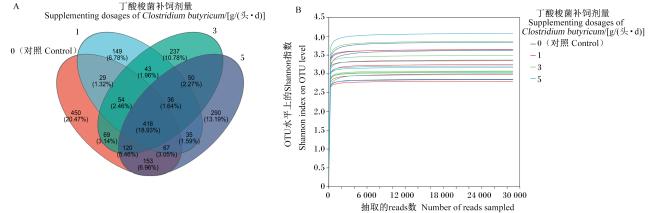
利用微生物群落中共享和独特的菌群丰度对试验组和对照组进行分析,对照组OTU数为740个,独有OTU数占OTU总数的20.47%;1 g组OTU数为829个,独有OTU数占OTU总数的6.78%;3 g组OTU数为1 025个,独有OTU数占OTU总数的10.78%;5 g组OTU数为1 167个,独有OTU数占OTU总数的13.19%;4组共有OTU数为416个,占OTU总数的18.93%(图1-A)。从上述结果可知,随着丁酸梭菌补饲剂量的增加,犊牛瘤胃菌群的OTU数也逐渐增加。稀释曲线是基于随机抽样个体数及其对应物种数构建的图形,用于评估样本的取样充分性。图1-B显示,各样本曲线均趋于平稳,说明测序数据量充足且覆盖深度合理,能够较完整地反映样本微生物群落组成,满足后续分析需求。
图1 Venn图(A)和稀释曲线(B)

Fig.1 Venn diagram (A) and rarefaction curve (B)

2.5.2 犊牛瘤胃菌群Alpha和Beta多样性

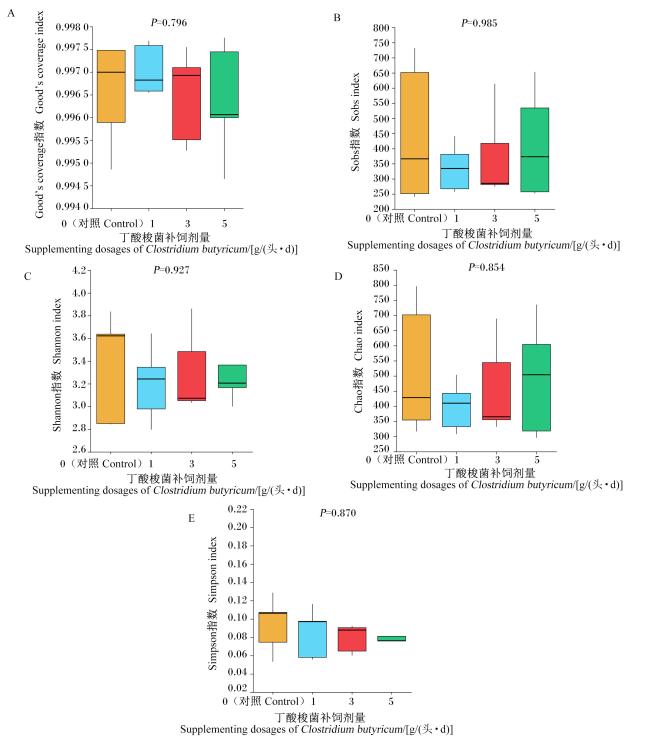
Alpha多样性分析可以揭示微生物群落结构的多样性。各组间样品Good’s coverage指数均大于99.5%,表明样品中绝大部分物种足以被测序结果所覆盖(图2-A);5 g组的Sobs、Shannon、Chao指数在4组中最高,3 g组的Simpson指数在4组中最高,但各组之间的差异均未达到显著水平(P>0.05)(图2-B~E)。
图2 Alpha多样性指数

Fig.2 Alpha diversity indexes

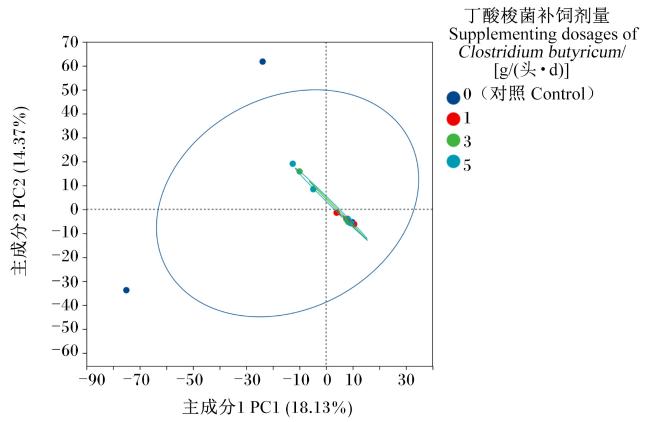
主成分分析(PCA)显示,主成分1(PC1)和主成分2(PC2)的贡献率分别为18.13%和14.37%(图3),其中各补饲丁酸梭菌组犊牛样本距离集中,说明其物种组成结构较相似,而对照组犊牛样本分布不集中,说明其样本之间物种组成结构差异较大。
图3 主成分分析

Fig.3 Principal component analysis

2.5.3 犊牛瘤胃菌群门水平及属水平组成

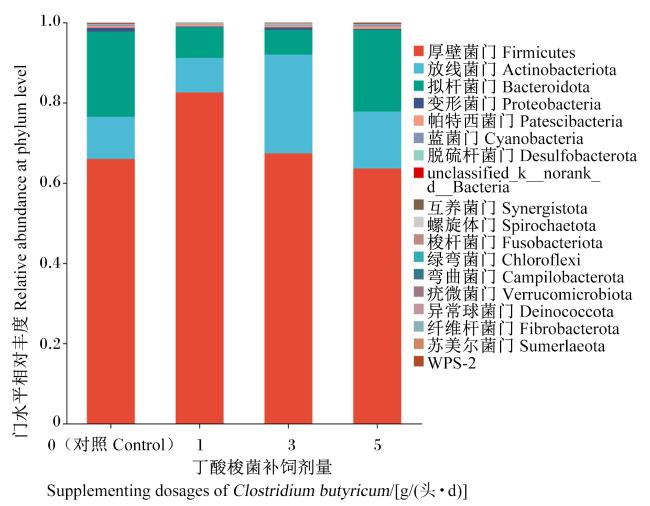
门水平上,相对丰度排名前18的菌群如图4所示,其中,相对丰度较高的5个菌门为厚壁菌门(Firmicutes)、放线菌门(Actinobacteriota)、拟杆菌门(Bacteroidota)、变形菌门(Proteobacteria)、帕特西菌门(Patescibacteria),厚壁菌门和放线菌门分别占门水平物种总丰度的69.86%和14.47%。
图4 犊牛瘤胃菌群门水平组成柱状图

Fig.4 Bar plot of phylum-level composition of rumen microbial community in calves

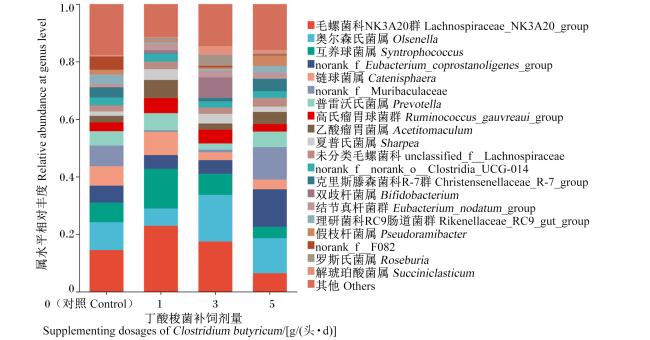
属水平上,相对丰度排名前20的菌群如图5所示,其中毛螺菌科NK3A20群(Lachnospiraceae_NK3A20_group)、奥尔森氏菌属(Olsenella)、互养球菌属(Syntrophococcus)、norank_f_Eubacterium_coprostanoligenes_group、链球菌属(Catenisphaera)为相对丰度较高的菌属,毛螺菌科NK3A20群为厚壁菌门中毛螺菌科(Lachnospiraceae)下的1个未完全分类的细菌群,占属水平物种总丰度的15.29%,奥尔森氏菌属是放线菌门下的1个属,占属水平物种总丰度的11.11%。
图5 犊牛瘤胃菌群属水平组成柱状图

Fig.5 Bar plot of genus-level composition of rumen microbial community in calves

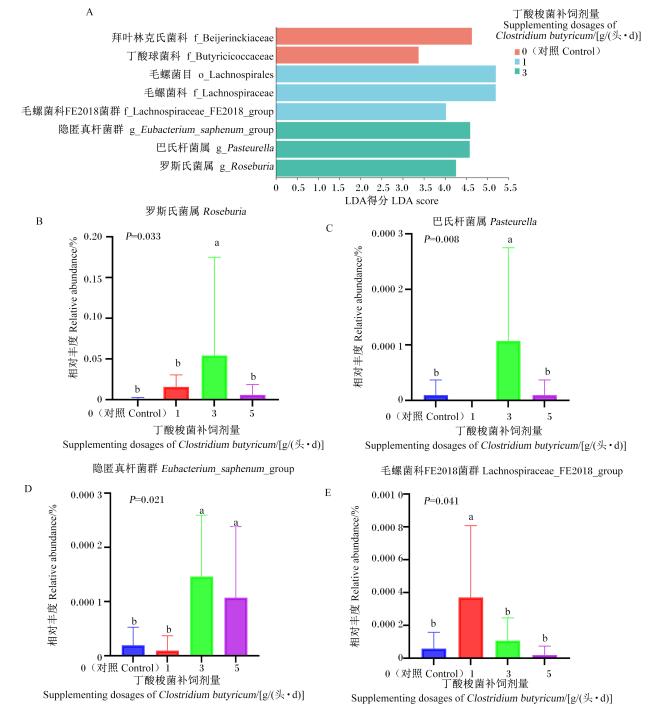
通过LEfSe差异性检验,进一步了解各组犊牛瘤胃菌群的差异。图6-A显示,对照组丁酸球菌科(Butyricicoccaceae)相对丰度显著增加(P<0.05)。对差异表达菌属的分析(图6-B~E)显示,与对照组相比,1 g组毛螺菌科FE2018群(Lachnospiraceae_FE2018_group)相对丰度显著增加(P<0.05);3 g组隐匿真杆菌群(Eubacterium_saphenum_group)、巴氏杆菌属(Pasteurella)和罗斯氏菌属(Roseburia)的相对丰度显著增加(P<0.05)。
图6 LDA得分分布柱状图(A)及差异表达菌群(B~E)

数据柱标注不同小写字母表示差异显著(P<0.05)。

Fig.6 LDA score distribution bar plot (A) and differentially expressed genera (B to E)

Data bars labeled with different lowercase letters indicated significant difference (P<0.05).

3 讨论

3.1 补饲不同剂量丁酸梭菌对哺乳犊牛生长性能及体尺的影响

犊牛在哺乳阶段,由于瘤胃发育不完全,极其容易发生腹泻[2]。丁酸梭菌是一种革兰氏阳性厌氧菌,有极强的耐酸性,可以长期存在于瘤胃的酸性环境中,同时可以降低瘤胃pH,抑制病原菌的生长,促进乳酸菌和双歧杆菌等有益菌的增殖,通过改善肠道健康和营养吸收,提高犊牛的生长性能。而卢俊言等[10]发现,丁酸梭菌可提高育肥牛的平均日采食量和平均日增重。李志霞等[11]发现,黄芪多糖+丁酸梭菌复合剂对雪山草鸡生长性能及肉鸡生长性能有较好的促进作用。李正猛等[12]发现,在犊牛哺乳阶段补饲丁酸梭菌对其生长性能无显著性提高,但有提高趋势。杨海成等[13]发现,补饲丁酸梭菌对仔猪的生长性能有显著正向影响。陆小昙等[14]发现,在代乳粉中添加0.25 g/d的丁酸梭菌提高了羔羊的平均日增重。本试验结果发现,补充丁酸梭菌对犊牛生长性能无显著影响,这与上述研究结果不完全一致,造成这种结果的原因可能是动物品种以及生理阶段的不同导致。此外,基础饲粮组成、饲养管理环境以及所用丁酸梭菌菌株本身的特性等因素,均可能交互影响最终的生长性能表现。犊牛体尺指标包括体高、体长、胸围、管围等,这些指标能够直接反映犊牛的生长发育水平,是评估其生长发育状况的重要参数,能够直观反映犊牛的骨骼发育、肌肉生长及整体营养状况。与体重相比,体尺指标受短期营养波动的影响较小,更能体现犊牛的长期生长潜力[15]。因此,体尺测量在犊牛选育、营养调控及健康管理中具有重要意义。本试验发现,补饲1 g/(头·d)丁酸梭菌在时可以显著提高42日龄犊牛的体高,说明适量的丁酸梭菌对犊牛生长发育有一定的促进作用。

3.2 补饲不同剂量丁酸梭菌对哺乳犊牛血清生化指标的影响

血清生化指标能在一定程度上反映动物的生长性能和健康状况。血清中的总蛋白、白蛋白等对维持血管的正常渗透压和pH起着至关重要的作用,是蛋白质代谢的基础,能准确反映机体对蛋白质的消化代谢水平及对营养物质的吸收能力[16-18]。本试验中,各补饲丁酸梭菌组犊牛21日龄时血清总蛋白、白蛋白含量均高于对照组,其中1 g组总蛋白含量最高,这与Huang等[19]在家兔上的研究结果一致,表明给哺乳犊牛补饲丁酸梭菌能够提高犊牛的蛋白质消化代谢水平及对营养物质的吸收能力。甘油三酯和总胆固醇等脂类是机体脂代谢过程中的重要底物,可以反映机体对脂肪的消化利用能力,且二者的含量具有相关性。研究表明,血清中高含量的甘油三酯和总胆固醇是心血管疾病的重要风险因素[20]。血液中的葡萄糖是机体能量的重要来源之一,可以反映机体对碳水化合物的消化吸收能力。本试验结果发现,在21日龄时,1 g组犊牛血清葡萄糖含量高于对照组,在42日龄时3 g组犊牛血清葡萄糖含量高于对照组,表明不同生理阶段补饲适量丁酸梭菌能够促进犊牛对碳水化合物的吸收利用。

3.3 补饲不同剂量丁酸梭菌对哺乳犊牛瘤胃发酵的影响

犊牛瘤胃发育是其从单胃消化向反刍消化的关键过渡阶段,瘤胃发酵功能的完善直接影响犊牛的生长性能和健康。有研究表明,丁酸梭菌可通过分泌蛋白酶促进瘤胃壁对小肽和氨基酸等小分子含氮物质的吸收,加速瘤胃内蛋白质的降解,从而提高犊牛瘤胃液中氨态氮浓度[10]。李文茜[21]研究发现,添加丁酸梭菌可以显著提高牛瘤胃液中氨态氮浓度,本试验结果与此一致。丁酸梭菌因能够产生丁酸、乳酸和乙酸等短链脂肪酸,近年来被广泛应用于犊牛生产中[22]。吴兴凤等[23]研究发现,丁酸梭菌可以显著提高小鼠结肠中乙酸和丁酸浓度。Sasaki等[24]研究显示,丁酸梭菌可以通过提高肠道中短链脂肪酸的浓度来改善小鼠胃肠道健康。单春乔等[25]研究发现,丁酸梭菌可以显著增加肉鸡肠道中乙酸、丙酸、异丁酸、异戊酸和戊酸的浓度。高嘉竞等[26]研究发现,丁酸梭菌可显著降低奶山羊乳中己酸浓度。侯冬强等[27]研究发现,丁酸梭菌可以显著增加大口黑鲈幼鱼肠道中乙酸、丙酸、异丁酸和异戊酸的浓度。研究表明,丁酸梭菌可以改变肠道菌群组成,增加有益菌乳杆菌属和双歧杆菌属的相对丰度,减少有害菌产气荚膜梭菌的相对丰度[28-29]。本试验发现,补饲1和3 g/(头·d)丁酸梭菌可以显著提高瘤胃液中氨态氮浓度,丁酸和戊酸浓度也有所提高,但相对于对照组差异不显著,乙酸浓度相对于对照组则有所降低,这与上述前人研究结果不完全一致,可能是物种及饲养环境差异所致。

3.4 补饲不同剂量丁酸梭菌对哺乳犊牛瘤胃菌群的影响

犊牛阶段是牛生长发育的关键期,此时瘤胃发育及菌群结构尚未成熟。稳定的瘤胃菌群对饲料消化效率、营养物质吸收和机体健康具有重要作用。丁酸梭菌作为一种耐胃酸与胆汁的革兰氏阳性厌氧芽孢杆菌,可在肠道内代谢生成丁酸等短链脂肪酸。研究表明,丁酸梭菌通过调节瘤胃微生态平衡优化微生态环境,进而提升犊牛的生长性能[30]
厚壁菌门被广泛认为是短链脂肪酸的主要生产者,其在促进营养物质吸收方面的效果优于拟杆菌门[31]。厚壁菌门和拟杆菌门均参与复杂多糖的降解,这一过程对碳水化合物的代谢及脂肪酸的代谢具有重要作用。然而,这两类菌群数量的减少可能会削弱上述功能,进而对宿主的代谢健康产生不利影响[32]
毛螺菌科FE2018群隶属于厚壁菌门,能够产生大量的短链脂肪酸以及其他代谢产物(如色氨酸),这些代谢物在调节免疫反应和炎症过程中发挥重要作用,有助于维持宿主的免疫稳态和抗炎能力[33]。本试验发现,补饲1 g/(头·d)丁酸梭菌可以显著提高犊牛瘤胃菌群中毛螺菌科FE2018群的相对丰度。
真杆菌属(Eubacterium)隶属于厚壁菌门。有研究表明,真杆菌属通过乙酰辅酶A途径参与丁酸的生物合成。在这一过程中,真杆菌属以碳水化合物代谢产生的乙酰辅酶A作为前体,在丁酸激酶和磷酸转丁酰酶等酶的催化下,最终生成丁酸[34]。同时,有研究表明,真杆菌属在调节炎症与免疫反应、维持肠道屏障完整性以及胆固醇稳态中发挥重要作用,通过其代谢产物和与宿主的相互作用,改善肠道健康和整体生理平衡[35]。本试验发现,补饲3和5 g/(头·d)丁酸梭菌可以显著增加犊牛瘤胃菌群中Eubacterium_saphenum_group的相对丰度。
罗斯氏菌属在维持肠道健康和免疫防御中可能发挥着关键作用,尤其是通过产生丁酸来调节性T细胞稳态。研究表明,在许多胃肠道疾病中,罗斯氏菌属等丁酸产生菌的相对丰度显著降低,这表示该菌属可能是评估胃肠道健康的重要生物标志物[36]。同时,有研究发现,罗斯氏菌属能够分解肠道中的非吸收性碳水化合物(如膳食纤维),并将其转化为短链脂肪酸,尤其是丁酸。高纤维饮食可以显著增加肠道中短链脂肪酸的浓度,同时促进产生丁酸的微生物(如罗斯氏菌属)的增殖,从而对肠道健康和宿主代谢产生积极影响[37-38]。本试验中,补饲3 g/(头·d)丁酸梭菌提高了犊牛瘤胃菌群中罗斯氏菌属的相对丰度,与之相对于的其瘤胃液中丁酸的浓度也有所提高,由此推测,在犊牛哺乳阶段补饲丁酸梭菌可以促进短链脂肪酸的产生,进而改善犊牛瘤胃功能。

4 结论

综上可知,补饲丁酸梭菌对哺乳犊牛的生长发育、瘤胃发酵、血清生化指标及瘤胃菌群有积极影响,其中1 g/(头·d)的补饲量在促进犊牛生长发育方面效果较好,3 g/(头·d)的补饲量在改善瘤胃发酵功能和菌群结构方面效果较好。
[1]
冶文兴, 张洁, 陈林, 等. 甘露寡糖添加方式对哺乳期犊牛瘤胃细菌菌群结构的影响[J]. 草业科学, 2020, 37(5):984-992.

YE W X, ZHANG J, CHEN L, et al. Effect of oligosaccharide addition on rumen bacterial flora of lactating calves[J]. Pratacultural Science, 2020, 37(5):984-992. (in Chinese)

[2]
王栋. 宁夏地区犊牛腹泻主要病原调查分析及肠道健康菌的筛选[D]. 博士学位论文. 杨凌: 西北农林科技大学, 2024.

WANG D. Investigation and analysis of main pathogens of calf diarrhea and screening of intestinal health bacteria in Ningxia of China[D]. Ph.D.Thesis. Yangling: Northwest A&F University, 2024. (in Chinese)

[3]
张自杰, 芦春莲, 李尚, 等. 丁酸梭菌在畜牧业中的研究进展[J]. 饲料研究, 2021, 44(17):101-103.

ZHANG Z J, LU C L, LI S, et al. Research progress of Clostridium butyricum in animal husbandry[J]. Feed Research, 2021, 44(17):101-103. (in Chinese)

[4]
王腾浩, 宗鑫, 宋德广, 等. 产抑菌蛋白的丁酸梭菌的筛选和鉴定及体外益生功能研究[J]. 中国畜牧杂志, 2015, 51(13):75-81.

WANG T H, ZONG X, SONG D G, et al. Screening, identification and in vitro functional study of Clostridium butyricum which produce antimicrobial protein[J]. Chinese Journal of Animal Science, 2015, 51(13):75-81. (in Chinese)

[5]
孙健, 乔立东, 雷莉辉, 等. 丁酸梭菌对肠道健康调节作用及应用研究进展[J]. 山东畜牧兽医, 2019, 40(1):75-77.

SUN J, QIAO L D, LEI L H, et al. Research progress on the regulatory effects and applications of Clostridium butyricum in intestinal health[J]. Shandong Journal of Animal Science and Veterinary Medicine, 2019, 40(1):75-77. (in Chinese)

[6]
杨万强. 丁酸梭菌与酿酒酵母对犊牛生长和瘤胃内环境的影响[D]. 硕士学位论文. 泰安: 山东农业大学, 2023.

YANG W Q. Effects of Clostridium butyricum and saccharomyces cerevisiae on growth and rumen environment of calves[D]. Master’s Thesis. Tai’an: Shandong Agricultural University, 2023. (in Chinese)

[7]
王燕南. 三丁酸甘油酯和丁酸梭菌对犊牛生长性能与胃肠道健康的影响[D]. 硕士学位论文. 杨凌: 西北农林科技大学, 2023.

WANG Y N. Effects of Tributyrin and Clostridium butyricum on growth performance and gastrointestinal health of calves[D]. Master’s Thesis. Yangling: Northwest A&F University, 2023. (in Chinese)

[8]
VAN SOEST P J, ROBERTSON J B, LEWIS B A. Methods for dietary fiber,neutral detergent fiber,and nonstarch polysaccharides in relation to animal nutrition[J]. Journal of Dairy Science, 1991, 74(10):3583-3597.

DOI

[9]
冯宗慈, 高民. 通过比色测定瘤胃液氨氮含量方法的改进[J]. 畜牧与饲料科学, 2010, 31(Z1):37.

FENG Z C, GAO M. Improvement of the method for determining ammonia nitrogen concentration in rumen fluid by colorimetry[J]. Animal Husbandry and Feed Science, 2010, 31(Z1): 37. (in Chinese)

[10]
卢俊言, 徐领, 董佳豪, 等. 丁酸梭菌与不同添加剂组合对育肥牛生长性能、营养物质表观消化率及血清生化、抗氧化、免疫指标的影响[J]. 动物营养学报, 2024, 36(12):7829-7839.

DOI

LU J Y, XU L, DONG J H, et al. Effects of combination of Clostridium butyricum and different additives on growth performance,nutrient apparent digestibility and serum biochemical,antioxidant and immune indices of fattening cattle[J]. Chinese Journal of Animal Nutrition, 2024, 36(12):7829-7839. (in Chinese)

[11]
李志霞, 张智浩. 黄芪多糖与丁酸梭菌对雪山草鸡生长性能和血液生化指标的影响[J]. 乡村科技, 2024, 15(16):105-107.

LI Z X, ZHANG Z H. Effects of astragalus polysaccharide and Clostridium butyricum on growth performance and blood biochemical indexes of Xueshan grass chickens[J]. Rural Science and Technology, 2024, 15(16):105-107. (in Chinese)

[12]
李正猛, 杨毅, 卜登攀, 等. 丁酸梭菌对哺乳犊牛生长性能、血清抗氧化指标及腹泻频率的影响[J]. 动物营养学报, 2024, 36(6):3772-3780.

DOI

LI Z M, YANG Y, BU D P, et al. Effects of Clostridium butyricum on growth performance,serum antioxidant indexes and diarrhea frequency of lactating calves[J]. Chinese Journal of Animal Nutrition, 2024, 36(6):3772-3780. (in Chinese)

[13]
杨海成, 邢艳艳, 曲平安. 丁酸梭菌对断奶仔猪生长性能、血清生化指标和免疫指标的影响[J]. 中国饲料, 2024(10):11-14.

YANG H C, XING Y Y, QU P A. The effects of Clostridium butyricum on the growth performance,serum biochemical indicators,and immune indicators of weaned piglets[J]. China Feed, 2024(10):11-14. (in Chinese)

[14]
陆小昙, 王棋, 季强, 等. 丁酸梭菌对羔羊生长性能、肝脏脂质代谢、抗氧化能力及血液指标的影响[J]. 动物营养学报, 2024, 36(5):3156-3169.

DOI

LU X T, WANG Q, JI Q, et al. Effects of Clostridium butyricum on growth performance,liver lipid metabolism,antioxidant capacity and blood indices of lambs[J]. Chinese Journal of Animal Nutrition, 2024, 36(5):3156-3169. (in Chinese)

[15]
HEINRICHS A J, ERB H N, ROGERS G W, et al. Variability of Holstein heifer body-weight and body measurements and their association with milk production[J]. Journal of Dairy Science, 2007, 90(1):375-382.

[16]
王东, 郭刚, 信丽凤, 等. 益生菌制剂对犊牛胃肠道健康和免疫功能的作用机理及研究进展[J]. 饲料研究, 2023, 46(12):173-176.

WANG D, GUO G, XIN L F, et al. Mechanism and research progress of probiotics on gastrointestinal health and immune function of calf[J]. Feed Research, 2023, 46(12):173-176. (in Chinese)

[17]
HAMMON H M, STÜRMER G, SCHNEIDER F, et al. Performance and metabolic and endocrine changes with emphasis on glucose metabolism in high-yielding dairy cows with high and low fat content in liver after calving[J]. Journal of Dairy Science, 2009, 92(4):1554-1566.

DOI PMID

[18]
ZHOU J, ZHAO K Q, SHAO L S, et al. Effects of Bacillus licheniformis and combination of probiotics and enzymes as supplements on growth performance and serum parameters in early-weaned grazing yak calves[J]. Animals, 2023, 13(5):785.

DOI

[19]
HUANG P, CUI X M, WANG Z P, et al. Effects of Clostridium butyricum and a bacteriophage cocktail on growth performance,serum biochemistry,digestive enzyme activities,intestinal morphology,immune responses, and the intestinal microbiota in rabbits[J]. Antibiotics, 2021, 10(11):1347.

DOI

[20]
MILLER M, STONE N J, BALLANTYNE C, et al. Triglycerides and cardiovascular disease:a scientific statement from the American Heart Association[J]. Circulation, 2011, 123(20):2292-2333.

DOI

[21]
李文茜. 丁酸梭菌对犊牛及育成牛生长性能、血液指标和瘤胃发酵的影响[D]. 硕士学位论文. 哈尔滨: 东北农业大学, 2019.

LI W Q. Effects of Clostridium butyricum on growth performance,blood index and rumen fermentation in calves and bred cattle[D]. Master’s Thesis. Harbin: Northeast Agricultural University, 2019. (in Chinese)

[22]
KOBER M M, BOWE W P. The effect of probiotics on immune regulation,acne,and photoaging[J]. International Journal of Women’s Dermatology, 2015, 1(2):85-89.

DOI

[23]
吴兴凤, 肖英平, 吕文涛, 等. 丁酸梭菌通过调节结肠微生物结构和短链脂肪酸含量影响小鼠肌纤维类型[J]. 浙江农业学报, 2025, 37(3):568-578.

DOI

WU X F, XIAO Y P, LV W T, et al. Clostridium butyricum affects muscle fiber type in mice by modulating colonic microbial structure and short-chain fatty acids content[J]. Acta Agriculturae Zhejiangensis, 2025, 37(3):568-578. (in Chinese)

[24]
SASAKI D, SASAKI K, IKEBUCHI M, et al. Oral administration of Clostridium butyricum without antibiotics directs luminal microbiota toward short-chain fatty acid-producing bacteria and improves mucosal barrier integrity in the gut[J]. Journal of Applied Microbiology, 2021, 131(1):199-215.

[25]
单春乔, 翟宏旭, 李娟, 等. 丁酸梭菌对肉鸡肠道短链脂肪酸含量和菌群多样性的影响[J]. 中国畜牧兽医, 2022, 49(11):4239-4251.

DOI

SHAN C Q, ZHAI H X, LI J, et al. Effects of Clostridium butyricum on intestinal short-chain fatty acid content and microflora diversity of broilers[J]. China Animal Husbandry & Veterinary Medicine, 2022, 49(11):4239-4251. (in Chinese)

[26]
高嘉竞, 柯振华, 韩帅琪, 等. 丁酸梭菌对奶山羊产奶量、乳成分、血浆激素指标及乳中氨基酸和脂肪酸组成的影响[J]. 动物营养学报, 2025, 37(1):463-474.

DOI

GAO J J, KE Z H, HAN S Q, et al. Effects of Clostridium butyricum on milk yield,milk composition,plasma hormone indexes,milk amino acid and fatty acid composition of dairy goats[J]. Chinese Journal of Animal Nutrition, 2025, 37(1):463-474. (in Chinese)

[27]
侯冬强, 胡俊茹, 陈冰, 等. 饲料中添加丁酸梭菌或丁酸钠对大口黑鲈幼鱼肠道短链脂肪酸含量、消化酶活性与抗氧化指标以及肠道结构的影响[J]. 动物营养学报, 2024, 36(9):5883-5894.

DOI

HOU D Q, HU J R, CHEN B, et al. Effects of dietary supplementation with Clostridium butyrate or sodium butyrate on intestinal short-chain fatty acids contents,digestive enzymes activities,antioxidant indexes and intestinal structure of juvenile largemouth bass[J]. Chinese Journal of Animal Nutrition, 2024, 36(9):5883-5894. (in Chinese)

[28]
ZHANG L, CAO G T, ZENG X F, et al. Effects of Clostridium butyricum on growth performance,immune function,and cecal microflora in broiler chickens challenged with Escherichia coli K88[J]. Poultry Science, 2014, 93(1):46-53.

DOI

[29]
孙思雨, 王秋菊, 宛宝霞, 等. 丁酸梭菌对奶牛瘤胃外植体蛋白质合成的影响[J]. 动物营养学报, 2024, 36(9):5709-5721.

DOI

SUN S Y, WANG Q J, WAN B X, et al. Effects of Clostridium butyricum on protein synthesis of rumen explants in dairy cows[J]. Chinese Journal of Animal Nutrition, 2024, 36(9):5709-5721. (in Chinese)

[30]
ZHU Y K, LI Z M, YANG Y, et al. Early-life Clostridium butyricum supplementation improved rumen development and immune by promoting the maturation of intestinal microbiota[J]. Journal of Agriculture and Food Research, 2024, 18:101517.

[31]
LI A Y, YANG Y, QIN S K, et al. Microbiome analysis reveals gut microbiota alteration of early-weaned Yimeng black goats with the effect of milk replacer and age[J]. Microbial Cell Factories, 2021, 20(1):78.

DOI

[32]
JAMI E, ISRAEL A, KOTSER A, et al. Exploring the bovine rumen bacterial community from birth to adulthood[J]. The ISME Journal, 2013, 7(6):1069-1079.

DOI

[33]
CHEN L, WILSON J E, KOENIGSKNECHT M J, et al. Corrigendum:NLRP12 attenuates colon inflammation by maintaining colonic microbial diversity and promoting protective commensal bacterial growth[J]. Nature Immunology, 2017, 18(11):1270.

[34]
LOUIS P, DUNCAN S H, MCCRAE S I, et al. Restricted distribution of the butyrate kinase pathway among butyrate-producing bacteria from the human colon[J]. Journal of Bacteriology, 2004, 186(7):2099-2106.

DOI PMID

[35]
MUKHERJEE A, LORDAN C, ROSS R P, et al. Gut microbes from the phylogenetically diverse genus Eubacterium and their various contributions to gut health[J]. Gut Microbes, 2020, 12(1):1802866.

DOI

[36]
LI J S, QING H S, ZHENG H N, et al. Front cover:roseburia hominis alleviates neuroinflammation via short-chain fatty acids through histone deacetylase inhibition[J]. Molecular Nutrition & Food Research, 2022, 66(18):e2200164.

[37]
TAMANAI-SHACOORI Z, SMIDA I, BOUSARGHIN L, et al. Roseburia spp.:a marker of health?[J]. Future Microbiology, 2017, 12:157-170.

DOI

[38]
VRIEZE A, VAN NOOD E, HOLLEMAN F, et al. Transfer of intestinal microbiota from lean donors increases insulin sensitivity in individuals with metabolic syndrome[J]. Gastroenterology, 2012, 143(4):913-916,e7.

DOI PMID

文章导航

/