研究论文

体外产气、尼龙袋和体外三步法评价南疆地区7种秸秆降解特性

  • 黄丹 , 1 ,
  • 谭鼎 1 ,
  • 刘丽丽 1 ,
  • 员炜圩 1 ,
  • 张延龙 1 ,
  • 顾皓斐 1 ,
  • 周小玲 1, 2 ,
  • 王梦芝 3 ,
  • 郭雪峰 , 1, 2, *
展开
  • 1 塔里木大学动物科学与技术学院,阿拉尔 843300
  • 2 塔里木畜牧科技兵团重点实验室,农业农村部环塔里木畜草资源利用重点实验室(部省共建),阿拉尔 843300
  • 3 扬州大学动物科学与技术学院,扬州 225000
* 郭雪峰,教授,博士生导师,E-mail:

黄丹(2000—),女,重庆人,硕士研究生,研究方向为动物营养与饲料科学。E-mail:

收稿日期: 2025-06-24

  网络出版日期: 2026-01-13

基金资助

兵团重大科技项目“揭榜挂帅”(2023AB078-03)

南京农业大学-塔里木大学科研联合基金(NNLH202409)

Evaluation of Degradation Characteristics of Seven Kinds of Straws from Southern Xinjiang Using in Vitro Gas Production, Nylon Bag and in Vitro Three-Step Methods

  • HUANG Dan , 1 ,
  • TAN Ding 1 ,
  • LIU Lili 1 ,
  • YUAN Weiwei 1 ,
  • ZHANG Yanlong 1 ,
  • GU Haofei 1 ,
  • ZHOU Xiaoling 1, 2 ,
  • WANG Mengzhi 3 ,
  • GUO Xuefeng , 1, 2, *
Expand
  • 1 College of Animal Science and Technology, Tarim University, Alar 843300, China
  • 2 Key Laboratory of Livestock and Grassland Resources Utilization Around Tarim, Ministry of Agriculture and Rural Affairs (Co-Built by Ministry and Province), Key Laboratory of Tarim Animal Husbandry Science and Technology of Xinjiang Production and Construction Corps, Alar 843300, China
  • 3 College of Animal Science and Technology, Yangzhou University, Yangzhou 225000, China
* professor, E-mail:

Received date: 2025-06-24

  Online published: 2026-01-13

摘要

本研究旨在系统评价南疆地区7种特色作物秸秆(孜然秸秆、油菜秸秆、柠条、油莎豆秸秆、棉花秸秆、粟米秸秆和甘草秸秆)的降解特性,为其饲料化高效利用提供依据。选用6只体重为(40.00±1.50) kg的健康、装有永久瘤胃瘘管的多浪羊为瘤胃液供体动物,采用体外产气法测定7种秸秆72 h产气量和产气参数;采用尼龙袋法测定7种秸秆干物质(DM)、粗蛋白质(CP)、中性洗涤纤维(NDF)和酸性洗涤纤维(ADF)在瘤胃内不同时间点(6、12、24、36、48、72 h)的降解率及其有效降解率;采用体外三步法测定7种秸秆DM和有机物(OM)体外瘤胃降解率、小肠消化率和全消化道消化率;最后,利用产气量建立营养物质瘤胃有效降解率和DM全消化道消化率预测模型。结果表明:1)孜然秸秆72 h产气量和潜在产气量最高,粟米秸秆产气速率最快,柠条产气量最低。2)孜然秸秆72 h时DM瘤胃降解率和有效降解率(甘草秸秆除外)显著高于其他秸秆(P<0.05),柠条最低;甘草秸秆72 h时CP瘤胃降解率和有效降解率显著高于其他秸秆(P<0.05),油莎豆秸秆最低;油莎豆秸秆72 h时NDF瘤胃降解率和有效降解率最高,柠条最低;油莎豆秸秆ADF瘤胃降解率和有效降解率显著高于其他秸秆(P<0.05),油菜秸秆最低。3)孜然秸秆DM和OM体外瘤胃降解率显著高于其他6种秸秆(P<0.05);油莎豆秸秆和甘草秸秆DM及甘草秸秆OM体外小肠消化率较高,柠条最低;孜然秸秆DM和OM体外全消化道消化率最高,柠条最低;粟米秸秆与甘草秸秆间DM体外全消化道消化率以及甘草秸秆、粟米秸秆和棉花秸秆间OM体外全消化道消化率无显著差异(P>0.05)。4)DM有效降解率与12、48和72 h产气量呈显著正相关(P<0.05),ADF有效降解率与48和72 h产气量呈显著正相关(P<0.05);DM体外全消化道消化率与各时间点产气量均呈显著正相关(P<0.05)。采用6 h产气量作为DM全消化道消化率预测因子时,所得到的预测方程具有最高的决定系数(R2),预测方程为DM全消化道消化率=31.869+1.296×6 h产气量(R2=0.719,P=0.016)。综上所述,孜然秸秆综合饲用潜力最高,油莎豆秸秆纤维降解特性优越,柠条饲用性最低,本研究为南疆地区特色秸秆资源的饲料化筛选和高效利用提供了数据支撑。

本文引用格式

黄丹 , 谭鼎 , 刘丽丽 , 员炜圩 , 张延龙 , 顾皓斐 , 周小玲 , 王梦芝 , 郭雪峰 . 体外产气、尼龙袋和体外三步法评价南疆地区7种秸秆降解特性[J]. 动物营养学报, 2026 , 38(1) : 751 -766 . DOI: 10.12418/CJAN2026.058

Abstract

This study aimed to systematically evaluate the degradation characteristics of seven characteristic crop straws (cumin straw, rape straw, Caragana korshinskii, tiger nut straw, cotton straw, millet straw, and licorice straw) in southern Xinjiang, providing a basis for their efficient utilization as feed. Six healthy Duolang sheep with a body weight of (40.00±1.50) kg and equipped with permanent rumen fistulas were selected as rumen fluid donors. The in vitro gas production method was used to determine the 72-hour gas production and gas production parameters of seven kinds of straws. The degradation rates and effective degradation rates of dry matter (DM), crude protein (CP), neutral detergent fiber (NDF), and acid detergent fiber (ADF) in seven kinds of straws at different time points (6, 12, 24, 36, 48 and 72 hours) in rumen were determined by the nylon bag method. The in vitro rumen degradation rates, small intestinal digestibilities and total digestive tract digestibilities of DM and organic matter (OM) in seven kinds of straws were determined by the in vitro three-step method. Finally, a prediction model for the rumen effective degradation rates of nutrients and the total digestive tract digestibility of DM was established using gas production. The results showed as follows: 1) cumin straw had the highest gas production and potential gas production within 72 hours, millet straw had the fastest gas production rate, and Caragana korshinskii had the lowest gas production. 2) At 72 hours, the rumen degradation rate and effective degradation rate (except for licorice straw) of DM in cumin straw were significantly higher than those in the other straws (P<0.05), while those in Caragana korshinskii were the lowest; the rumen degradation rate and effective degradation rate of CP in licorice straw were significantly higher than those in the other straws (P<0.05), while those in tiger nut straw were the lowest; the rumen degradation rate and effective degradation rate of NDF in tiger nut straw were the highest, while those in Caragana korshinskii were the lowest; the rumen degradation rate and effective degradation rate of ADF in tiger nut straw were significantly higher than those in the other straws (P<0.05), while those in rape straw were the lowest. 3) The in vitro rumen degradation rates of DM and OM in cumin straw were significantly higher than those in the other six kinds of straws (P<0.05). The in vitro small intestinal digestibilities of DM in tiger nut straw and licorice straw, as well as OM in licorice straw, were relatively high, while those in Caragana korshinskii were the lowest. The in vitro total digestive tract digestibilities of DM and OM in cumin straw were the highest, while those in Caragana korshinskii were the lowest. There was no significant difference in the in vitro total digestive tract digestibility of DM between millet straw and licorice straw, nor in vitro total digestive tract digestibility of OM among licorice straw, millet straw and cotton straw (P>0.05). 4) The effective degradation rate of DM was significantly positively correlated with the gas production at 12, 48 and 72 hours (P<0.05), and the effective degradation rate of ADF was significantly positively correlated with the gas production at 48 and 72 hours (P<0.05). The in vitro total digestive tract digestibility of DM was significantly positively correlated with the gas production at each time point (P<0.05). When the gas production at 6 hours was used as the predictor of the total digestive tract digestibility of DM, the obtained prediction equation had the highest determination coefficient (R2), and the prediction equation was the total digestive tract digestibility of DM=31.869+1.296×gas production at 6 hours (R2=0.719, P=0.016). In conclusion, the cumin straw exhibits the best overall feeding potential, the tiger nut straw shows superior fiber degradation characteristics, and Caragana korshinskii has the lowest feed value. This study provides data support for the screening and efficient utilization of characteristic straw resources in southern Xinjiang as feed.

我国秸秆资源丰富,将其转化为反刍动物饲料对发展“节粮型”畜牧业、缓解饲草料供给压力意义重大[1]。孙仁华等[2]研究调查发现,新疆畜牧养殖业规模和秸秆饲料需求量均位居全国第2,其秸秆饲料化利用量仍不足,开发潜力巨大;尤其在南疆干旱区,气候干燥寒冷导致秸秆还田后难以腐解[3]。然而,反刍动物瘤胃微生物系统具备高效降解秸秆纤维的天然优势[4]。因此,立足区域资源禀赋,因地制宜开发特色秸秆资源,是填补当地饲草料缺口的有效途径。新疆南疆作为我国重要的农牧业生产基地,其特色经济作物秸秆(如孜然秸秆、棉花秸秆、油莎豆秸秆等)资源较为丰富。当前研究多集中于大宗作物秸秆如玉米秸秆、小麦秸秆等[5-7],对特色经济作物秸秆的系统性研究仍显不足,新疆特色经济作物秸秆如孜然秸秆、油莎豆秸秆等饲料化开发仍处于探索阶段。粗饲料营养物质的瘤胃降解特性是评定反刍动物饲料营养价值的重要指标[8],体外产气法(人工模拟瘤胃法)和尼龙袋法广泛应用于饲料营养价值评价[9]。其中,体外产气法具有高效、快捷、操作简便等优点[10];尼龙袋法作为评价饲料原料瘤胃降解率的常用方法,试验重复性好、操作简单[11],可准确反映瘤胃内环境对饲料各组分消化降解的程度[12]。此外,Calsamiglia等[13]建立的体外三步法通过模拟瘤胃微生物发酵、胃蛋白酶消化及小肠胰酶消化的连续过程,为定量评价饲料的体外干物质(DM)或有机物(OM)消化率提供了重要依据。这些方法共同构成了评估粗饲料营养价值的关键技术体系。
基于此,本研究以南疆地区7种特色作物秸秆为研究对象,通过系统测定其产气量与产气参数、营养物质瘤胃降解率及体外小肠消化率等指标,全面评估7种秸秆在反刍动物体内的消化性能,旨在为我国南疆地区特色经济作物秸秆的饲料化高效利用提供科学支撑。

1 材料与方法

1.1 试验材料

试验秸秆样品分别从和田、图木舒克等地采集,采样时间为2023年9月16日至2023年11月24日,每个样本采集500 g,密封后于-20 ℃冷冻保存,运输过程中采用冷藏箱维持低温。样品经自然风干后,用粉碎机粉碎过40目筛,备用。7种秸秆样品信息见表1,常规养分含量见表2
表1 7种秸秆样品信息

Table 1 Information of 7 kinds of straw samples

项目
Items
科属
Family and genus
生长年限
Growth years
采样地点
Sampling position
采样时间
Sampling time
孜然秸秆Cumin straw 伞形科孜然芹属 一年生 和田津垦 2023-09-16
油菜秸秆Rape straw 十字花科芸薹属 一年生 和田一牧场 2023-11-22
柠条Caragana korshinskii 豆科锦鸡儿属 多年生 和田津垦 2023-09-16
油莎豆秸秆Tiger nut straw 莎草科莎草属 多年生 三师53团 2023-11-22
棉花秸秆Cotton straw 锦葵科棉属 一年生 一师10团 2023-10-16
粟米秸秆Millet straw 禾本科狗尾草属 一年生 一师10团 2023-10-16
甘草秸秆Licorice straw 豆科甘草属 多年生 二师27团 2023-11-18
表2 7种秸秆饲料常规养分含量(风干基础)

Table 2 Conventional nutrient contents of 7 kinds of straw feeds (air-dry basis) %

项目
Items
干物质
DM
粗蛋
白质
CP
中性洗
涤纤维
NDF
酸性洗
涤纤维
ADF
粗脂肪
EE
粗灰分
Ash
酸性洗
涤木质素
ADL
孜然秸秆Cumin straw 94.92 4.48 55.14 34.10 3.21 8.63 20.44
油菜秸秆Rape straw 94.70 3.43 63.16 41.76 5.68 4.66 19.12
柠条Caragana korshinskii 95.33 5.87 62.05 33.34 2.33 15.52 23.17
油莎豆秸秆Tiger nut straw 93.74 3.35 48.23 22.69 4.78 11.44 10.93
棉花秸秆Cotton straw 98.21 4.96 57.48 39.02 4.59 4.23 17.07
粟米秸秆Millet straw 93.40 3.09 59.72 33.24 3.31 7.97 16.89
甘草秸秆Licorice straw 95.11 8.09 46.50 32.28 4.06 7.22 16.48

以上数据均为实测值。The above data were measured values.

1.2 试验动物和饲粮

本试验于2024年10月在新疆阿拉尔市塔里木大学动物科学与技术学院试验站进行,试验获得塔里木大学科技伦理委员会的批准,伦理批准编号为PB20250618001。选用6只体重为(40.00±1.50) kg的健康、装有永久瘤胃瘘管的多浪羊为瘤胃液供体动物,饲喂由玉米、棉籽粕、棉籽壳等原料配制的基础饲粮,每日09:30和19:30进行饲喂,自由采食和饮水。基础饲粮组成及营养水平见表3
表3 基础饲粮组成及营养水平(风干基础)

Table 3 Composition and nutrient levels of the basal diet (air-dry basis) %

项目Items 含量Content
原料Ingredients
棉籽壳Cottonseed hull 36.50
苜蓿Alfalfa 23.50
玉米Corn 16.70
麸皮Wheat bran 12.67
棉籽粕Cottonseed meal 5.25
食盐NaCl 0.73
碳酸钙CaCO3 0.75
磷酸氢钙CaHPO4 0.90
预混料Premix1) 3.00
合计Total 100.00
营养水平Nutrient levels2)
干物质DM 84.25
代谢能ME/(MJ/kg) 8.32
粗蛋白质CP 12.01
粗灰分Ash 5.69
粗脂肪EE 4.21
酸性洗涤纤维ADF 30.58
中性洗涤纤维NDF 51.99
钙Ca 0.85
磷P 0.48

1)每千克预混料含有 One kilogram of the premix contained the following:VA 55 000 IU,VD3 13 000 IU,VE 500 mg,Fe 1 300 mg,Se 10.8 mg,Mn 1 100 mg,Zn 1 500 mg,Cu 200 mg。

2)代谢能为计算值,根据《肉羊营养需要量》(NY/T 816—2021)计算;其余为实测值。ME was a calculated value based on Nutrient Requirements of Meat-Type Sheep and Goat (NY/T 816—2021), while the others were measured values.

1.3 体外产气试验

1.3.1 试验方法

分别称取0.200 0 g待发酵秸秆样品于全玻璃注射器中,每个样品设置3个平行,按照Menke等[14]的方法制备培养液,将瘤胃液与人工唾液按照1∶2混合作为体外发酵的培养液,通入二氧化碳(CO2)并使用磁力搅拌器搅拌均匀。每个玻璃注射器中装30 mL培养液,排尽空气,记录其初始刻度,同时设置3个空白管。快速将玻璃注射器依次放入39 ℃的恒温摇床培养箱中,分别于培养6、12、24、36、48和72 h时读取并记录注射器刻度值。

1.3.2 产气量和产气参数

分别记录发酵6、12、24、36、48和72 h时各注射器的产气量并用空白进行校正。产气量和产气参数按如下公式计算:
产气量(mL)=某时间段内培养管产气量(mL)-对应时间段内空白管平均产气量(mL);
GP=a+b(1-e-ct)。
式中:t为发酵时间(h);GPt时刻的产气量(mL);a为快速产气部分(mL);b为慢速产气部分(mL);c为产气速率(%/h);a+b为潜在产气量(mL)[15]

1.4 尼龙袋试验

1.4.1 试验方法

将孔径为300目、尺寸为8 cm×12 cm的尼龙袋编号后,用清水浸泡5 min于65 ℃烘干24 h直至恒重并称量记录数据。准确称取3.0 g秸秆样品于尼龙袋底部,设定6个取样时间点,每个时间点设置3个重复,尼龙袋绑紧后夹绑在塑料管上。尼龙袋于晨饲前1 h经瘘管投入瘤胃中,依次按6、12、24、36、48和72 h时间节点取出,用自来水冲洗干净后,转移至65 ℃恒温干燥箱内烘48 h,直至恒重后称重;样品降解后的残渣用微型粉碎机粉碎过40目筛,置于密封袋中常温密封保存,用于测定样品瘤胃降解后的营养物质降解率。
饲粮或秸秆样品及降解后残渣的DM含量参考GB/T 6435—2014中方法测定,粗蛋白质(CP)含量参照GB/T 6432—2018中方法测定,粗脂肪(EE)含量参照GB/T 6433—2006中方法测定,粗灰分(Ash)含量参照GB/T 6438—2007中方法测定,钙(Ca)含量参照GB/T 6436—2018中方法测定,磷(P)含量参照GB/T 6437—2018中方法测定,中性洗涤纤维(NDF)、酸性洗涤纤维(ADF)和酸性洗涤木质素(ADL)含量参照Van Soest等[16]的方法测定。

1.4.2 瘤胃降解率和降解参数

营养物质瘤胃降解率计算公式如下:
某营养物质某个时间点的瘤胃降解率(%)=
100×[降解前该营养物质含量(g)-
降解后某个时间点该营养物质含量(g)]/
降解前该营养物质含量(g)。
根据Ørskov等[15]提出的模型,计算动态降解模型参数和有效降解率(ED):
P=a+b(1-e-ct);
有效降解率=a+bc/(k+c)
式中:P为饲料某营养物质在瘤胃t时刻的瘤胃降解率(%);t为饲料在瘤胃内的停留时长(h);a为快速降解部分(%);b为慢速降解部分(%);cb的降解速率(%/h);k为瘤胃外流速率(%/h),参照Ørskov等[15]的研究取0.031%/h。

1.5 体外三步法试验

1.5.1 试验方法

采集瘤胃液,配制Kansas缓冲液[14],采用Daisy Ⅱ型体外模拟培养装置(Ankom,美国)进行体外批次培养。准确称取2.000 g过40目筛饲料样品装入预编号尼龙袋,细线封口后悬挂于发酵罐中,每罐放置6个样品袋及1个空白对照袋。
瘤胃降解阶段:向每个发酵罐中加入266 mL缓冲溶液B和1 330 mL缓冲溶液A,调整pH至6.8,39 ℃平衡20 min后,注入400 mL经CO2饱和的新鲜瘤胃液(4层纱布过滤),通入CO2 30 s密封;(39.0±0.5) ℃培养48 h,冰浴终止反应;取出尼龙袋,冰蒸馏水冲洗至滤液澄清,65 ℃烘干至恒重,测定DM和Ash含量,计算DM和OM体外瘤胃降解率。
胃蛋白酶消化阶段:将残渣袋转入含2 L胃蛋白酶消化液的发酵罐,胃蛋白酶消化液中含2 g/L胃蛋白酶(CP8291L,Coolaber)和pH 1.9的盐酸溶液;39 ℃旋转培养1 h,冲洗干净。
胰酶小肠消化阶段:转至含2 L小肠培养液的发酵罐,小肠培养液中含3 g/L胰酶(CT11501,Coolaber)、1 mL/L 0.5%氯霉素和pH 7.75的磷酸盐缓冲液;39 ℃旋转培养24 h,冲洗烘干后测定DM和Ash含量,计算DM和OM体外小肠消化率和全消化道消化率。

1.5.2 体外瘤胃降解率、小肠消化率和全消化道消化率计算公式

某营养物质体外瘤胃降解率=100×
(降解前饲料中该营养物质含量-经瘤胃
降解后饲料残渣中该营养物质含量)/
降解前饲料中该营养物质含量;
某营养物质体外小肠消化率=100×(经瘤胃
降解后饲料残渣中该营养物质含量-
经胃和小肠消化后饲料残渣中
该营养物质含量)/经瘤胃降解后饲料
残渣中该营养物质含量;
某营养物质体外全消化道消化率=100×(降解前
饲料中该营养物质含量-经瘤胃、胃和小肠
消化后饲料残渣中该营养物质
含量)/降解前饲料中该营养物质含量。

1.6 数据处理

采用Excel 2019对试验数据进行初步整理,然后采用SPSS 25.0软件进行单因素方差分析,并采用Duncan氏法进行多重比较,结果用平均值和均值标准误(SEM)表示,P<0.05表示差异显著,P>0.05表示差异不显著;采用SPSS 25.0软件进行Pearson相关性分析和线性回归分析。

2 结果与分析

2.1 7种秸秆产气量和产气参数

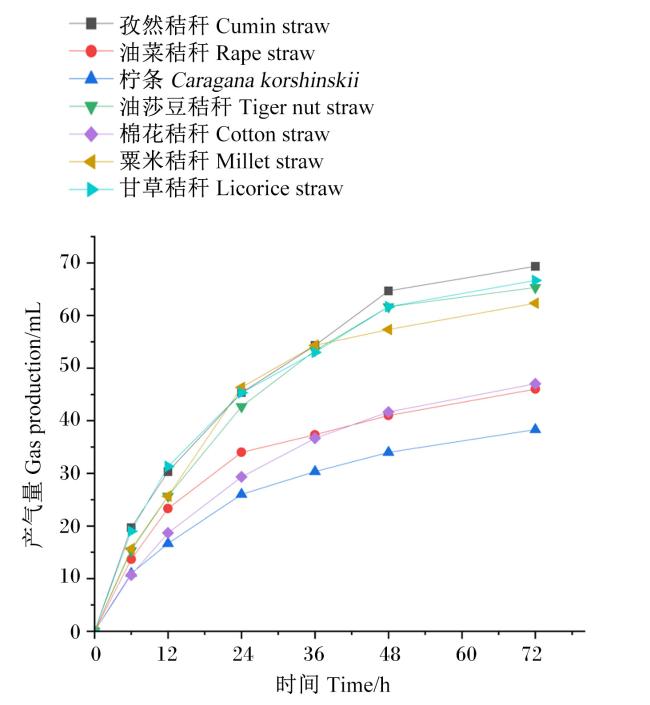
图1所示,7种秸秆72 h内的产气速率均呈上升趋势,其中0~24 h产气速率提高较快,24~48 h增速逐渐变得平缓,直至72 h时基本不再升高。72 h累积产气量由高到低依次为孜然秸秆、甘草秸秆、油莎豆秸秆、粟米秸秆、棉花秸秆、油菜秸秆和柠条。
图1 7种秸秆产气量动态变化

Fig.1 Dynamic variation of gas production of 7 kinds of straws

表4可知,孜然秸秆72 h产气量显著高于除油莎豆秸秆和甘草秸秆外的其他4种秸秆(P<0.05)。其中,孜然秸秆的快速产气部分显著高于除甘草秸秆外的其他5种秸秆(P<0.05);油莎豆秸秆和粟米秸秆的快速产气部分为负值;孜然秸秆、油莎豆秸秆、粟米秸秆和甘草秸秆的慢速产气部分显著高于其他3种秸秆(P<0.05);各种秸秆间产气速率无显著差异(P>0.05);7种秸秆的潜在产气量由高到低依次为孜然秸秆、甘草秸秆、油莎豆秸秆、粟米秸秆、棉花秸秆、油菜秸秆和柠条。
表4 7种秸秆72 h累积产气量和产气参数

Table 4 Cumulative gas production and gas production parameters in 72 h of 7 kinds of straws

项目
Items
孜然秸秆
Cumin
straw
油菜
秸秆
Rape
straw
柠条
Caragana
korshinskii
油莎
豆秸秆
Tiger nut
straw
棉花秸秆
Cotton
straw
粟米秸秆
Millet
straw
甘草秸秆
Licorice
straw
均值
标准误
SEM
P
P-value
72 h产气量
Gas production at 72 h
69.33a 46.00c 38.33d 65.33ab 47.00c 62.33b 66.67ab 2.623 <0.001
产气参数Gas production parameters
快速产气部分a/mL 7.35a 3.64bc 3.22bc -0.32d 1.72cd -3.89e 5.67ab 0.851 <0.001
慢速产气部分b/mL 69.95a 42.55c 38.40c 70.73a 51.50b 67.64a 65.73a 2.903 <0.001
产气速率c/(%/h) 0.03 0.05 0.04 0.04 0.03 0.05 0.04 0.002 0.240
潜在产气量a+b/mL 77.30a 46.19e 41.61e 70.41b 53.22d 63.75c 71.40ab 2.911 <0.001

同行数据肩标无字母或相同字母表示差异不显著(P>0.05),不同字母表示差异显著(P<0.05)。表5表10同。

In the same row, values with no letter or the same letter superscripts indicated no significant difference (P>0.05), while with different letter superscripts indicated significant difference (P<0.05). The same as Table 5 to Table 10.

2.2 7种秸秆瘤胃降解率和降解参数

2.2.1 DM瘤胃降解率和降解参数

表5可知,前6 h内棉花秸秆和甘草秸秆DM瘤胃降解率显著高于其他5种秸秆(P<0.05);除36 h时的甘草秸秆外,12~72 h孜然秸秆DM瘤胃降解率均显著高于其他6种秸秆(P<0.05);除24 h时的油莎豆秸秆外,柠条在所有时间点的DM瘤胃降解率均显著低于其他秸秆(P<0.05);72 h时DM瘤胃降解率由高到低依次为孜然秸秆、甘草秸秆、油莎豆秸秆、粟米秸秆、油菜秸秆、棉花秸秆和柠条。此外,棉花秸秆DM的快速降解部分显著高于除甘草秸秆外的其他5种秸秆(P<0.05),油莎豆秸秆DM的慢速降解部分显著高于其他6种秸秆(P<0.05),DM有效降解率由高到低依次为孜然秸秆、甘草秸秆、棉花秸秆、油莎豆秸秆、粟米秸秆、油菜秸秆和柠条。
表5 7种秸秆DM瘤胃降解率和降解参数

Table 5 DM rumen degradation rate and degradation parameters of 7 kinds of straws

项目
Items
孜然
秸秆
Cumin
straw
油菜
秸秆
Rape
straw
柠条
Caragana
korshinskii
油莎豆
秸秆
Tiger nut
straw
棉花秸秆
Cotton
straw
粟米秸秆
Millet
straw
甘草秸秆
Licorice
straw
均值
标准误
SEM
P
P-value
瘤胃降解率Rumen degradation rate/%
6 h 17.29b 13.46c 11.21d 18.74b 23.77a 13.39c 21.87a 0.992 <0.001
12 h 33.51a 23.19d 19.25e 24.64d 27.35c 27.61c 30.47b 0.996 <0.001
24 h 40.45a 34.21bc 28.48e 30.54de 33.30bcd 31.51cd 34.68b 0.840 <0.001
36 h 41.75a 39.48c 32.41e 36.67d 39.66bc 38.09cd 41.40ab 0.692 <0.001
48 h 50.10a 44.11c 35.77d 45.15bc 43.59c 45.52bc 46.50b 0.929 <0.001
72 h 54.35a 48.06c 38.43e 50.76b 45.74d 49.41bc 50.84b 1.061 <0.001
瘤胃降解参数Rumen degradation parameters
快速降解部分a/% 8.19c 2.62d 1.35d 14.03b 18.00a 7.30c 16.99ab 1.424 <0.001
慢速降解部分b/% 45.70b 46.90b 37.72c 56.04a 32.29d 45.55b 39.63c 1.645 <0.001
慢速降解部分的
降解速率
c/(%/h)
0.05a 0.05a 0.05a 0.02c 0.03b 0.04b 0.03b 0.003 <0.001
有效降解率ED/% 36.37a 30.53d 24.95e 32.66bc 33.83b 31.45cd 35.62a 0.806 <0.001

2.2.2 CP瘤胃降解率和降解参数

表6可知,前6 h内油菜秸秆CP瘤胃降解率显著高于其他6种秸秆(P<0.05),12 h时孜然秸秆、油菜秸秆、柠条和甘草秸秆CP瘤胃降解率显著高于其他3种秸秆(P<0.05),24 h时孜然秸秆和甘草秸秆CP瘤胃降解率显著高于其他5种秸秆(P<0.05),36~72 h甘草秸秆CP瘤胃降解率显著高于其他6种秸秆(P<0.05)。此外,油菜秸秆CP的快速降解部分显著高于其他6种秸秆(P<0.05),棉花秸秆CP的慢速降解部分显著高于其他6种秸秆(P<0.05),CP有效降解率由高到低依次为甘草秸秆、孜然秸秆、油菜秸秆、柠条、棉花秸秆、粟米秸秆和油莎豆秸秆。
表6 7种秸秆CP瘤胃降解率和降解参数

Table 6 CP rumen degradation rate and degradation parameters of 7 kinds of straws

项目
Items
孜然
秸秆
Cumin
straw
油菜
秸秆
Rape
straw
柠条
Caragana
korshinskii
油莎豆
秸秆
Tiger nut
straw
棉花秸秆
Cotton
straw
粟米秸秆
Millet
straw
甘草秸秆
Licorice
straw
均值
标准误
SEM
P
P-value
瘤胃降解率Rumen degradation rate/%
6 h 23.54d 38.96a 26.47c 18.61e 18.30e 26.54c 32.57b 1.556 <0.001
12 h 42.82a 43.67a 41.28a 21.59d 29.82c 37.64b 43.80a 1.781 <0.001
24 h 55.50a 46.55b 43.55c 26.53e 36.32d 41.69c 54.61a 2.119 <0.001
36 h 59.36b 49.27cd 49.73c 29.19e 54.10c 44.61d 67.66a 2.553 <0.001
48 h 64.48b 52.57c 54.23c 37.28e 64.40b 47.50d 74.35a 2.567 <0.001
72 h 69.34b 55.10d 59.09c 42.14f 69.26b 52.36e 79.21a 2.596 <0.001
瘤胃降解参数Rumen degradation parameters
快速降解部分a/% 1.90e 36.40a 20.89b 15.69c 7.78d 20.60b 20.75b 2.327 <0.001
慢速降解部分b/% 65.28b 22.79e 39.30c 61.14b 79.46a 31.19d 64.81b 4.405 <0.001
慢速降解部分的
降解速率
c/(%/h)
0.07a 0.03d 0.04bc 0.01e 0.03d 0.05b 0.04c 0.004 <0.001
有效降解率ED/% 47.69b 46.59b 43.18c 28.14e 41.67c 39.56d 54.81a 1.717 <0.001

2.2.3 NDF瘤胃降解率和降解参数

表7可知,前6 h内甘草秸秆NDF瘤胃降解率最高,显著高于除孜然秸秆外的其他5种秸秆(P<0.05),12和36 h时油莎豆秸秆和粟米秸秆NDF瘤胃降解率显著高于其他5种秸秆(P<0.05),48~72 h油莎豆秸秆NDF瘤胃降解率显著高于除粟米秸秆外的其他5种秸秆(P<0.05)。此外,甘草秸秆NDF的快速降解部分显著高于其他6种秸秆(P<0.05),孜然秸秆、油菜秸秆、油莎豆秸秆和粟米秸秆NDF的慢速降解部分显著高于其他3种秸秆(P<0.05),NDF有效降解率由高到低依次为油莎豆秸秆、粟米秸秆、孜然秸秆、甘草秸秆、油菜秸秆、棉花秸秆和柠条。
表7 7种秸秆NDF瘤胃降解率和降解参数

Table 7 NDF rumen degradation rate and degradation parameters of 7 kinds of straws

项目
Items
孜然
秸秆
Cumin
straw
油菜
秸秆
Rape
straw
柠条
Caragana
korshinskii
油莎豆
秸秆
Tiger nut
straw
棉花秸秆
Cotton
straw
粟米秸秆
Millet
straw
甘草秸秆
Licorice
straw
均值
标准误
SEM
P
P-value
瘤胃降解率Rumen degradation rate/%
6 h 14.32ab 10.86c 12.40bc 11.69c 11.16c 12.39bc 15.81a 0.443 0.004
12 h 23.84b 17.16d 17.62d 27.96a 21.95c 27.54a 25.41b 0.930 <0.001
24 h 32.51b 26.38d 24.36e 35.46a 26.70d 31.78b 29.31c 0.842 <0.001
36 h 38.84b 30.80c 27.26d 41.67a 30.68c 41.38a 32.49c 1.216 <0.001
48 h 45.42b 37.25d 30.48f 48.44a 35.54e 46.53ab 38.71c 1.337 <0.001
72 h 50.28b 44.44c 35.34e 55.30a 38.87d 51.39ab 43.57c 1.359 <0.001
瘤胃降解参数Rumen degradation parameters
快速降解部分a/% 6.63b 5.27b 7.74b 0.94c 5.09b 4.63b 12.67a 0.802 <0.001
慢速降解部分b/% 48.46a 49.98a 31.45c 51.78a 34.99bc 49.56a 36.46b 1.839 <0.001
慢速降解部分的
降解速率
c/(%/h)
0.03bc 0.02c 0.03bc 0.05a 0.04ab 0.04ab 0.03c 0.002 0.003
有效降解率ED/% 31.49a 25.74c 22.89d 32.55a 25.19c 32.02a 29.12b 0.806 <0.001

2.2.4 ADF瘤胃降解率和降解参数

表8可知,前24 h内甘草秸秆ADF瘤胃降解率显著高于其他6种秸秆(P<0.05),36 h时油莎豆秸秆ADF瘤胃降解率显著高于除甘草秸秆外的其他5种秸秆(P<0.05),48~72 h油莎豆秸秆ADF瘤胃降解率显著高于其他6种秸秆(P<0.05)。此外,油菜秸秆和棉花秸秆ADF的快速降解部分显著高于除柠条外的其他4种秸秆(P<0.05),油莎豆秸秆ADF的慢速降解部分显著高于其他6种秸秆(P<0.05),ADF有效降解率由高到低依次为油莎豆秸秆、甘草秸秆、孜然秸秆、棉花秸秆、柠条、粟米秸秆和油菜秸秆。
表8 7种秸秆ADF瘤胃降解率和降解参数

Table 8 ADF rumen degradation rate and degradation parameters of 7 kinds of straws

项目
Items
孜然
秸秆
Cumin
straw
油菜
秸秆
Rape
straw
柠条
Caragana
korshinskii
油莎豆
秸秆
Tiger nut
straw
棉花秸秆
Cotton
straw
粟米秸秆
Millet
straw
甘草秸秆
Licorice
straw
均值
标准误
SEM
P
P-value
瘤胃降解率Rumen degradation rate/%
6 h 9.66c 8.57d 9.30cd 9.87bc 10.59b 8.71d 11.84a 0.249 <0.001
12 h 15.93b 12.59d 14.05c 15.79b 15.89b 14.92bc 19.51a 0.458 <0.001
24 h 21.13cd 17.25f 19.71de 24.75b 21.81c 19.49e 28.69a 0.804 <0.001
36 h 32.73b 23.44e 26.00d 34.59a 27.65c 26.48cd 33.85ab 0.926 <0.001
48 h 36.73b 27.89d 31.50c 42.18a 30.82c 31.82c 36.21b 0.999 <0.001
72 h 42.40b 32.72e 34.83d 44.68a 33.82de 33.98de 37.38c 0.978 <0.001
瘤胃降解参数Rumen degradation parameters
快速降解部分a/% 3.24b 4.55a 4.10ab 0.87c 4.83a 3.24b 0.70c 0.365 <0.001
慢速降解部分b/% 49.34b 39.30c 37.93c 51.45a 32.18de 35.95d 37.53cd 1.486 <0.001
慢速降解部分的
降解速率
c/(%/h)
0.02c 0.02c 0.02c 0.03b 0.03b 0.03b 0.06a 0.003 <0.001
有效降解率ED/% 26.67b 21.00d 22.68c 28.64a 23.20c 22.52c 26.96b 0.598 <0.001

2.3 体外三步法试验结果

2.3.1 7种秸秆体外瘤胃降解率和小肠消化率

表9可知,孜然秸秆DM和OM体外瘤胃降解率显著高于其他6种秸秆(P<0.05),油莎豆秸秆DM体外瘤胃降解率显著低于除柠条外的其他5种秸秆(P<0.05),柠条和油莎豆秸秆OM体外瘤胃降解率显著低于其他5种秸秆(P<0.05)。同时,油莎豆秸秆和甘草秸秆DM体外小肠消化率显著高于其他5种秸秆(P<0.05),柠条DM体外小肠消化率显著低于其他6种秸秆(P<0.05),油菜秸秆、粟米秸秆、孜然秸秆和棉花秸秆之间DM体外小肠消化率无显著差异(P>0.05);甘草秸秆OM体外小肠消化率显著高于除油莎豆秸秆外的其他5种秸秆(P<0.05),柠条OM体外小肠消化率显著低于其他6种秸秆(P<0.05);孜然秸秆与粟米秸秆间DM和OM体外小肠消化率均无显著差异(P>0.05)。
表9 7种秸秆体外瘤胃降解率和小肠消化率

Table 9 In vitro rumen degradation rate and small intestinal digestibility of 7 kinds of straws %

项目
Items
孜然
秸秆
Cumin
straw
油菜
秸秆
Rape
straw
柠条
Caragana
korshinskii
油莎豆
秸秆
Tiger nut
straw
棉花秸秆
Cotton
straw
粟米秸秆
Millet
straw
甘草秸秆
Licorice
straw
均值
标准误
SEM
P
P-value
体外瘤胃降解率In vitro rumen degradation rate
干物质DM 39.65a 27.86d 27.21de 23.94e 28.88cd 35.46b 31.56c 1.163 <0.001
有机物OM 34.21a 25.09c 21.73d 19.71d 27.14bc 30.29b 27.73bc 1.072 <0.001
体外小肠消化率In vitro small intestinal digestibility
干物质DM 20.02b 20.05b 17.48c 23.80a 19.90b 20.04b 23.34a 0.490 <0.001
有机物OM 17.28c 18.05bc 13.94d 19.59ab 18.70bc 17.12c 20.52a 0.466 <0.001

2.3.2 7种秸秆体外全消化道消化率

表10可知,孜然秸秆DM和OM体外全消化道消化率均显著高于其他6种秸秆(P<0.05);柠条DM体外全消化道消化率显著低于除油菜秸秆和油莎豆秸秆外的其他4种秸秆(P<0.05),OM体外全消化道消化率显著低于其他6种秸秆(P<0.05);粟米秸秆与甘草秸秆间DM体外全消化道消化率无显著差异(P>0.05);油菜秸秆、油莎豆秸秆和棉花秸秆之间DM体外全消化道消化率无显著差异(P>0.05);甘草秸秆、粟米秸秆和棉花秸秆之间OM体外全消化道消化率无显著差异(P>0.05)。
表10 7种秸秆体外全消化道消化率

Table 10 In vitro total digestive tract digestibility of 7 kinds of straws %

项目
Items
孜然
秸秆
Cumin
straw
油菜
秸秆
Rape
straw
柠条
Caragana
korshinskii
油莎豆
秸秆
Tiger nut
straw
棉花秸秆
Cotton
straw
粟米秸秆
Millet
straw
甘草秸秆
Licorice
straw
均值
标准误
SEM
P
P-value
干物质DM 59.67a 47.90cd 44.69d 47.74cd 48.77c 55.50b 54.90b 1.163 <0.001
有机物OM 51.49a 43.14c 35.66e 39.29cd 45.84b 47.41b 48.25b 1.178 <0.001

2.4 7种秸秆产气量与营养物质瘤胃有效降解率和体外消化率的相关性分析

表11可知,DM有效降解率与12、48和72 h产气量呈显著正相关(P<0.05),ADF有效降解率与48和72 h产气量呈显著正相关(P<0.05)。由表12可知,DM体外全消化道消化率与各时间点产气量均呈显著正相关(P<0.05)。基于相关性分析结果,选取12和72 h产气量作为DM有效降解率的预测因子,48 h产气量作为ADF有效降解率的预测因子,6、12和24 h产气量作为DM全消化道消化率的预测因子,得到预测方程见表13,其中6 h产气量与DM全消化道消化率的预测方程表现出最高的决定系数(R2)。
表11 7种秸秆产气量与营养物质瘤胃有效降解率相关关系

Table 11 Correlation between gas production and effective degradation rates of nutrients in rumen of 7 kinds of straws

项目
Items
产气量Gas production
6 h 12 h 24 h 36 h 48 h 72 h
DM有效降解率EDDM 0.702 0.768* 0.672 0.707 0.765* 0.784*
CP有效降解率EDCP 0.400 0.359 0.266 0.342 0.432 0.438
NDF有效降解率EDNDF 0.625 0.617 0.453 0.407 0.481 0.465
ADF有效降解率EDADF 0.620 0.616 0.575 0.674 0.776* 0.757*

*表示显著相关(P<0.05)。表12同。

* indicated significant correlation (P<0.05). The same as Table 12.

表12 7种秸秆产气量与体外小肠和全消化道消化率相关关系

Table 12 Correlation between gas production and in vitro small intestinal and total digestive tract digestibilities of 7 kinds of straws

项目
Items
产气量Gas production
6 h 12 h 24 h 36 h 48 h 72 h
体外小肠消化率In vitro small intestinal digestibility
干物质DM 0.541 0.659 0.641 0.683 0.713 0.706
有机物OM 0.440 0.595 0.518 0.546 0.575 0.585
体外全消化道消化率In vitro total digestive tract digestibility
干物质DM 0.848* 0.815* 0.803* 0.773* 0.773* 0.794*
有机物OM 0.682 0.703 0.640 0.609 0.612 0.644
表13 基于产气量预测7种秸秆瘤胃有效降解率及DM全消化道消化率方程

Table 13 Equations for predicting effective degradation rate in rumen and DM total tract digestibility of 7 kinds of straws based on gas production

项目Items 预测方程Prediction equations 决定系数R2 PP-value
有效降解率ED DM有效降解率=18.46+0.244GP72 h 0.615 0.037
DM有效降解率=19.05+0.536GP12 h 0.589 0.044
ADF有效降解率=15.292+0.179GP48 h 0.602 0.040
全消化道消化率
Total digestive tract digestibility
DM全消化道消化率=31.869+1.296GP6 h 0.719 0.016
DM全消化道消化率=31.611+0.803GP12 h 0.664 0.026
DM全消化道消化率=31.683+0.511GP24 h 0.645 0.030

GP:产气量 gas production。

3 讨论

3.1 7种秸秆产气量和产气参数

产气量能够反映瘤胃微生物对饲料营养物质的降解状况及其活性,同时也可作为评估饲料品质优劣的重要指标,且饲料在瘤胃中的发酵程度直接影响饲草体外发酵的产气量[17-18]。本试验中,孜然秸秆、甘草秸秆、油莎豆秸秆和粟米秸秆体外发酵产气量自24 h后高于其他3种秸秆,且柠条产气量最低,这与葛翠翠等[19]的研究结果相似,说明上述4种秸秆在瘤胃中的发酵程度较高,微生物活性较强,对饲料的降解能力也相对较好。相比之下,棉花秸秆、油菜秸秆和柠条产气量相对较低,这可能与其秸秆的纤维结构、营养成分以及抗降解物质含量有关。柴鹤瑜等[20]对山东9种包括作物秸秆在内的非常规粗饲料进行了产气量测定,结果显示72 h累积产气量均未超过30 mL,而本试验所测秸秆72 h累积产气量为38.33~69.33 mL,说明本试验的秸秆可能含有更高比例的可快速发酵碳水化合物或更易被微生物降解的纤维组分,从而在相同体外培养条件下表现出更强的发酵潜力。李陇平等[21]研究发现,花生秧、玉米秸秆和马铃薯秧在体外发酵时快速产气部分为负值,说明这些饲料存在产气滞后现象,这与本试验中油莎豆秸秆和粟米秸秆的产气滞后效应结果相似。饲草的产气量和产气速率越高,饲草可发酵碳水化合物含量越高,微生物活性越强[22]。本试验中,孜然秸秆72 h产气量最高,粟米秸秆产气速率最高,表明这2种秸秆可发酵碳水化合物含量可能较高。此外,产气参数如产气速率、潜在产气量等也反映了饲料在瘤胃中的发酵特性,这些参数的综合分析可以进一步揭示不同秸秆的降解特性及其潜在利用价值。

3.2 7种秸秆瘤胃降解率和降解参数

DM瘤胃降解率能够体现瘤胃微生物的转化效率,反映饲料被草食家畜消化利用的难易程度。DM瘤胃降解率越高,表明瘤胃的发酵效果越佳,DM采食量也越多,不同种类饲料的DM瘤胃降解率存在显著差异[19,23]。本试验测定的7种秸秆营养物质降解主要发生在48 h内,随后增速趋于平稳,这与邵鹏程等[24]的研究结果一致。前6 h内棉花秸秆和甘草秸秆DM瘤胃降解率显著高于其他秸秆,说明这2种秸秆相较其他秸秆在瘤胃中能够被快速降解的部分较多。本试验中,孜然秸秆12~72 h DM瘤胃降解率显著高于其他秸秆(36 h时甘草秸秆除外)。李杨辉等[25]用30%和60%孜然秸秆替代小麦秸秆饲喂羔羊发现,添加孜然秸秆能提高羔羊采食量,并提高生长性能、屠宰性能以及营养代谢和抗氧化能力,说明孜然秸秆在瘤胃中容易被降解且在实践生产中具有较大开发潜力。武莹莲等[26]测定了多个不同品种油菜秸秆的营养物质降解率,各指标均低于本试验所得结果,这可能的原因是不同地区及不同品种的油菜秸秆纤维类物质含量不同或试验所用瘤胃液微生物群落组成存在差异,导致营养物质降解率不同。柠条72 h时DM瘤胃降解率和DM有效降解率均显著低于其他6种秸秆,这与柠条中ADL含量较高有关[27]。本试验所测柠条DM瘤胃降解率高于刘笑梅等[12]的结果,低于虎雪姣等[23]的结果,这可能是因为柠条的降解特性受到地域、品种和生长环境等多重因素的影响。油莎豆和粟米的研究偏重于籽实应用,秸秆副产物的研究利用尚少。本试验中,油莎豆秸秆DM的慢速降解部分比例最高,故其潜在可降解性也较高,这与其较低的NDF和ADF含量有关,表明其较低的纤维含量意味着更高的潜在消化率和能量可利用性,具有作为优质反刍动物饲料原料的开发潜力,为拓展油莎豆全株利用价值提供了新方向。粟米秸秆的瘤胃降解特性在本试验评价的7种秸秆中居于中位水平(72 h时DM瘤胃降解率为49.41%,有效降解率为31.45%),其产气速率高于其他秸秆,表明其初期可发酵碳水化合物含量较高,但其DM有效降解率显著低于孜然秸秆,这可能与其相对较高的NDF(59.72%)和ADL(16.89%)含量限制了纤维组分的持续降解有关。本试验所研究的7种秸秆的DM有效降解率为24.95%~36.37%,其中,孜然秸秆和甘草秸秆降解性能较优,显著优于其他5种秸秆,柠条最低,这种差异主要源于原料自身的化学组成特性,如孜然秸秆和甘草秸秆较低的NDF含量有利于微生物降解,而柠条较高的ADL含量(23.17%)则显著抑制了其降解过程。
瘤胃微生物合成菌体蛋白所需的氮源主要来自饲粮CP的瘤胃降解,该过程主要受饲粮瘤胃滞留时间和CP含量共同调控[28],且动物体内蛋白质的可消化性与CP的蛋白质分子结构有关[29]。本试验中,甘草秸秆CP有效降解率最高,原因可能是其较高的CP含量与适宜的瘤胃滞留时间共同促进了氮的释放。研究报道,CP主要分布于细胞内,而细胞壁作为细胞的保护屏障,其中NDF和ADF含量越高,CP被瘤胃微生物消化利用的难度越大[30]。本试验中,油莎豆秸秆NDF和ADF含量最低,但其72 h时CP瘤胃降解率和有效降解率均为最低,这可能与油莎豆秸秆本身CP含量(3.35%)较低或不可利用蛋白质比例较高有关。CP有效降解率由高到低依次为甘草秸秆、孜然秸秆、油菜秸秆、柠条、棉花秸秆、粟米秸秆和油莎豆秸秆,CP有效降解率为28.14%~54.81%。王国秀等[31]测定的大麦秸秆和玉米秸秆CP有效降解率分别为35.72%和28.93%,均处于本试验所测范围但仅高于油莎豆秸秆,说明南疆地区特色秸秆的CP瘤胃降解性能整体优于或持平于大宗作物秸秆。
饲料纤维物质对维持反刍动物瘤胃正常发酵和内环境稳态至关重要,其中NDF和ADF瘤胃降解率是衡量粗饲料营养价值的关键指标,直接反映了饲料在瘤胃中被消化的难易程度[32-33]。本试验通过测定7种秸秆的NDF和ADF瘤胃降解动力学参数,进一步验证了不同秸秆的降解特性存在显著差异。在7种秸秆中,油莎豆秸秆在NDF和ADF降解中均表现最佳,其低快速降解部分和高慢速降解部分共同构成较优的营养价值;其次是粟米秸秆,但其ADF瘤胃降解率较低,表明粟米秸秆中的半纤维素易降解而纤维素较难降解。瘤胃内环境严格厌氧,而大多数降解ADL的酶都依赖于氧气,这导致ADL在瘤胃内降解率很低[27],因此ADL含量较高的柠条在NDF和ADF瘤胃降解率中均表现为较低水平,而ADL含量最低的油莎豆秸秆NDF和ADF瘤胃降解率最高,说明其细胞壁可能更容易被瘤胃微生物降解。本试验中,7种秸秆的NDF和ADF有效降解率分别为22.89%~32.55%和21.00%~28.64%,整体偏低。此现象主要归因于其较高的ADL含量,不仅降低了适口性,更阻碍动物消化,严重制约饲用价值[34]。研究表明,纤维素酶、葡聚糖酶或木聚糖酶等添加剂能通过破解秸秆细胞壁结构、增加表面空隙,有效降低木质纤维素含量并改善适口性,从而显著提升饲料品质[35-36]。因此,应用此类酶制剂是提升低降解率秸秆资源化利用效率的有效技术途径。

3.3 7种秸秆体外瘤胃降解率、小肠消化率和全消化道消化率

本试验中,7种秸秆DM体外小肠消化率为17.48%~23.34%,OM体外小肠消化率为13.94%~20.52%,整体水平偏低且变幅较小。刘畅等[37]研究了不同粗饲料组合的胃-小肠营养物质体外消化率,其DM和OM消化率略高于本试验结果,原因可能在于本试验所用秸秆的非纤维性营养物质含量较低。反刍动物更依赖于瘤胃中的微生物对饲料的消化,这是其能够大量利用粗饲料并产生甲烷的重要原因[38]。小肠对营养物质的消化主要依赖于胰蛋白酶的作用,由于缺乏降解纤维的酶系,粗饲料中的纤维组分在小肠中难以被有效降解,因此其在该消化段的降解比例较低。本试验中,7种秸秆DM和OM体外小肠消化率有细微偏差,如孜然秸秆、油菜秸秆、棉花秸秆和粟米秸秆间DM体外小肠消化率无显著差异;但在OM体外小肠消化率中,孜然秸秆和粟米秸秆略低于油菜秸秆和棉花秸秆。这种偏差主要源于Ash含量的差异,Ash含量较高的孜然秸秆和粟米秸秆,其OM中不可消化的矿物质比例相对更高,使得其OM消化率较低。此外,7种秸秆DM体外全消化道消化率为44.69%~59.67%,OM体外全消化道消化率为35.66%~51.49%,高于其相应的体外小肠消化率。这一差异主要源于瘤胃微生物对秸秆纤维组分(如纤维素、半纤维素)的强效发酵作用[39],有效弥补了小肠消化能力的不足,从而大幅提升了整体营养物质的消化利用率。

3.4 7种秸秆产气量与营养物质瘤胃有效降解率和体外消化率的相关性分析

本试验发现,7种秸秆DM有效降解率与12、48和72 h产气量呈显著正相关,这与马绍楠等[40]的研究结果相似;ADF有效降解率与48和72 h产气量呈显著正相关,表明中后期的累积产气量可有效预测南疆地区特色秸秆的DM和ADF瘤胃有效降解率。然而,CP有效降解率与各时间点产气量均无显著相关性,这可能是因为CP的降解更多依赖于蛋白质结构[29]、溶解度及瘤胃微生物蛋白酶活性等因素[28],而这些因素对产气量的贡献较弱。同样,NDF有效降解率虽与产气量呈正相关趋势,但未达到统计学显著水平,这可能与NDF降解受木质素化程度和纤维结构等多因素影响有关,这些因素与产气量无简单线性关系。此外,DM体外全消化道消化率与各时间点产气量均呈显著正相关,说明体外产气量,尤其是6、12和24 h产气量,能有效反映秸秆在反刍动物体内的DM消化利用情况,进一步凸显了体外产气法在预测秸秆整体营养价值上的实用性。相比之下,DM和OM体外小肠消化率以及OM体外全消化道消化率与产气量虽呈正相关,但未达到显著水平,这可能是因为这些消化过程涉及瘤胃发酵和小肠消化的综合影响,因素更为复杂,或与样本量及秸秆种类特性相关。本试验中,预测DM有效降解率分别选取相关性较强的12和72 h产气量作为预测因子,分别建立了线性预测方程:DM有效降解率=18.46+0.244×72 h产气量,DM有效降解率=19.05+0.536×12 h产气量;预测方程表明,通过12或72 h产气量数据,可解释约60%的DM有效降解率变异。预测ADF有效降解率选取48 h产气量作为预测因子,建立了线性预测方程:ADF有效降解率=15.292+0.179×48 h产气量;该方程能更精准地评估和预测ADF有效降解率。预测DM全消化道消化率,相关性分析显示6 h产气量与之相关性最高,构建的线性预测方程为DM全消化道消化率=31.869+1.296×6 h产气量,这表明早期的产气量对预测最终的DM整体消化率具有较大的潜力;同时,也建立了基于12(R2=0.664)和24 h(R2=0.645)产气量的预测方程。预测方程为快速评估南疆地区特色秸秆饲用价值提供了较为简便的方法,减少了对尼龙袋法或三步法体外消化试验的依赖,适用于大批量秸秆的初步筛选和营养价值排序。但需注意,这些方程基于本试验的7种秸秆建立,普适性需在更多种类和样本中验证。

4 结论

在南疆地区7种特色秸秆中,孜然秸秆在产气量、DM瘤胃降解率及全消化道消化率上表现最优,是极具潜力的优质粗饲料;油莎豆秸秆NDF和ADF瘤胃降解率高且速率快,是优质纤维源,但CP瘤胃降解率低;甘草秸秆CP瘤胃降解性能好,DM和OM小肠和全消化道消化率较高,是良好的CP来源;粟米秸秆产气速率快,全消化道消化率较高,降解特性居于中间水平;柠条因ADL含量高降解性能最差,需预处理提升价值;油菜秸秆和棉花秸秆各项指标表现中等或偏下。同时,本试验基于DM有效降解率、ADF有效降解率和DM全消化道消化率与产气量的强相关性,建立了预测模型,可快速、有效地评价南疆地区特色秸秆营养价值,为南疆地区特色秸秆资源的饲料化筛选和高效利用提供了数据支撑。
[1]
葛新成, 龚宜超, 孟琦, 等. 中国秸秆资源饲料化利用潜力分析[J]. 黑龙江农业科学, 2025(5):8-16.

GE X C, GONG Y C, MENG Q, et al. Analysis of feed utilization potential of straw resources in China[J]. Heilongjiang Agricultural Sciences, 2025(5):8-16. (in Chinese)

[2]
孙仁华, 胡潇方, 李晓阳, 等. 基于需求导向的秸秆饲料化利用潜力分析与讨论[J]. 中国农业资源与区划, 2024, 45(12):85-93.

SUN R H, HU X F, LI X Y, et al. Analysis and discussion on the utilization potential of straw feed based on demand orientation[J]. Chinese Journal of Agricultural Resources and Regional Planning, 2024, 45(12):85-93. (in Chinese)

[3]
侯敏, 黄新新, 林青, 等. 新疆秸秆饲料化高效利用现状及发展趋势[J]. 新疆农业科学, 2024, 61(增刊1):153-157.

HOU M, HUANG X X, LIN Q, et al. Problems and countermeasures in the efficient use of straw for animal feed in Xinjiang-a case study of Kashi region[J]. Xinjiang Agricultural Sciences, 2024, 61(Suppl.1):153-157. (in Chinese)

[4]
杜海东, 李科南, 娜梅拉, 等. 粗饲料对反刍动物瘤胃微生物和生产性能的影响研究进展[J]. 饲料研究, 2024, 47(5):133-138.

DU H D, LI K N, NA M L, et al. Research progress on effect of roughage on rumen microorganism and production performance of ruminants[J]. Feed Research, 2024, 47(5):133-138. (in Chinese)

[5]
满建军, 胡庆勇, 宫平, 等. 小麦秸的饲料化利用方式及其在牛羊生产中的应用[J]. 中国畜牧杂志, 2025, 61(1):86-91.

MAN J J, HU Q Y, GONG P, et al. The feed utilization approaches of wheat straw and its application in cattle and sheep production[J]. Chinese Journal of Animal Science, 2025, 61(1):86-91. (in Chinese)

[6]
马东旺, 席琳乔, 汤佳, 等. 秸秆种类及粒度对体外发酵、微生物表面物理特性及纤维降解菌组成的影响[J]. 动物营养学报, 2023, 35(11):7446-7460.

DOI

MA D W, XI L Q, TANG J, et al. Effects of straw species and particle size on in vitro fermentation,microbial physical surface characteristics and composition of cellulolytic bacteria[J]. Chinese Journal of Animal Nutrition, 2023, 35(11):7446-7460. (in Chinese)

[7]
陈远航, 程明军, 李洪泉, 等. 不同添加剂对水稻秸秆黄贮饲料营养品质及适口性的影响[J]. 草地学报, 2024, 32(11):3646-3653.

DOI

CHEN Y H, CHENG M J, LI H Q, et al. Effects of different additives on nutritional quality and palatability of rice straw yellow stored feed[J]. Acta Agrestia Sinica, 2024, 32(11):3646-3653. (in Chinese)

[8]
KAUR R, GARCIA S C, FULKERSON W J, et al. Degradation kinetics of leaves,petioles and stems of forage rape (Brassica napus) as affected by maturity[J]. Animal Feed Science and Technology, 2011, 168(3/4):165-178.

DOI

[9]
VIEIRA DE SOUZA A D, ÍTAVO L C V, FÁVARO S P, et al. Thermal decomposition,chemical composition,in vitro digestibility and gas production and in situ degradability of oilseed residues from the biofuel industry[J]. Animal Science Journal, 2018, 89(1):79-87.

DOI

[10]
UNNAWONG N, SURIYAPHA C, KHONKHAENG B, et al. Comparison of cassava chips and winged bean tubers with various starch modifications on chemical composition,the kinetics of gas,ruminal degradation,and ruminal fermentation characteristics using an in situ nylon bag and an in vitro gas production technique[J]. Animals, 2023, 13(10):1640.

DOI

[11]
LI S, HE L W, MO F, et al. In situ degradation kinetics of 25 feedstuffs and the selection of time points in mathematical statistics[J]. Animals, 2023, 13(5):947.

DOI

[12]
刘笑梅, 郝小燕, 张宏祥, 等. 4种粗饲料在肉羊瘤胃中降解特性的研究[J]. 中国畜牧杂志, 2021, 57(4):179-183.

LIU X M, HAO X Y, ZHANG H X, et al. Study on the degradation characteristics of four kinds of roughages in the rumen of meat sheep[J]. Chinese Journal of Animal Science, 2021, 57(4):179-183. (in Chinese)

[13]
CALSAMIGLIA S, STERN M D. A three-step in vitro procedure for estimating intestinal digestion of protein in ruminants[J]. Journal of Animal Science, 1995, 73(5):1459-1465.

DOI

[14]
MENKE K H, RAAB L, SALEWSKI A, et al. The estimation of the digestibility and metabolizable energy content of ruminant feedingstuffs from the gas production when they are incubated with rumen liquor in vitro[J]. The Journal of Agricultural Science, 1979, 93(1):217-222.

DOI

[15]
ØRSKOV E R, MCDONALD I. The estimation of protein degradability in the rumen from incubation measurements weighted according to rate of passage[J]. The Journal of Agricultural Science, 1979, 92(2):499-503.

DOI

[16]
VAN SOEST P J, ROBERTSON J B, LEWIS B A. Methods for dietary fiber,neutral detergent fiber,and nonstarch polysaccharides in relation to animal nutrition[J]. Journal of Dairy Science, 1991, 74(10):3583-3597.

DOI

[17]
赵超, 马广明, 吕静怡, 等. 添加乳酸菌和纤维素酶对豆渣与桑叶混贮品质及体外瘤胃发酵特性的影响[J]. 动物营养学报, 2021, 33(4):2168-2177.

DOI

ZHAO C, MA G M, LV J Y, et al. Effects of adding lactic acid bacteria and cellulase on quality of mixed silage of soybean residue and mulberry leaves and rumen fermentation characteristics in vitro[J]. Chinese Journal of Animal Nutrition, 2021, 33(4):2168-2177. (in Chinese)

[18]
CHUZAEMI S, MASHUDI, ERYANTRISTAN H, et al. Effect of pollard and soybean meal protected with condensed tannin in concentrate on in vitro gas production[J]. IOP Conference Series:Earth and Environmental Science, 2020, 478(1):12053.

DOI

[19]
葛翠翠, 梁戈, 李昊, 等. 玉米秸秆、柠条及葵花盘在滩羊瘤胃体外的消化及发酵性能[J]. 草业科学, 2018, 35(8):2009-2015.

GE C C, LIANG G, LI H, et al. Digestion and fermentation performance of corn straw,Caragana korshinskii,and sunflower calathide in Tan sheep in vitro[J]. Pratacultural Science, 2018, 35(8):2009-2015. (in Chinese)

[20]
柴鹤瑜, 秦飞宇, 李建沅, 等. 体外产气法评价9种非常规粗饲料的饲用价值[J]. 黑龙江畜牧兽医, 2025(1):108-114,122.

CHAI H Y, QIN F Y, LI J Y, et al. Evaluation of feeding value of nine unconventional roughages by gas production method in vitro[J]. Heilongjiang Animal Science and Veterinary Medicine, 2025(1):108-114,122. (in Chinese)

[21]
李陇平, 吴仪, 王旭辉, 等. 陕北白绒山羊几种非常规饲料营养成分、体外发酵参数和酶活性研究[J]. 动物营养学报, 2025, 37(1):603-616.

DOI

LI L P, WU Y, WANG X H, et al. Study on nutritional composition,in vitro fermentation parameters and enzyme activity of several unconventional feeds for Shaanbei white cashmere goats[J]. Chinese Journal of Animal Nutrition, 2025, 37(1):603-616. (in Chinese)

[22]
MAYORGA O L, KINGSTON-SMITH A H, KIM E J, et al. Temporal metagenomic and metabolomic characterization of fresh perennial ryegrass degradation by rumen bacteria[J]. Frontiers in Microbiology, 2016, 7:1854.

PMID

[23]
虎雪姣, 马林, 张建勇, 等. 不同生长年限柠条在肉牛瘤胃中降解规律研究[J]. 黑龙江畜牧兽医, 2024(14):81-87.

HU X J, MA L, ZHANG J Y, et al. Study on degradation regulation of caragana with different growth years in rumen of beef cattle[J]. Heilongjiang Animal Science and Veterinary Medicine, 2024(14):81-87. (in Chinese)

[24]
邵鹏程, 唐庆凤, 覃林杰, 等. 6种水牛饲料原料的营养价值评定及瘤胃降解特性研究[J]. 动物营养学报, 2024, 36(12):7819-7828.

DOI

SHAO P C, TANG Q F, QIN L J, et al. Evaluation of nutritional value and rumen degradation characteristics of six water buffalo feedstuffs[J]. Chinese Journal of Animal Nutrition, 2024, 36(12):7819-7828. (in Chinese)

DOI

[25]
李杨辉, 许涛, 张淑贤, 等. 孜然秸秆替代小麦秸秆对羔羊生长和屠宰性能及血浆生化指标的影响[J]. 中国畜牧兽医, 2023, 50(6):2296-2304.

DOI

LI Y H, XU T, ZHANG S X, et al. Effect of replacing wheat straw with cumin straw on growth performance,slaughter performance and plasma biochemical parameters of lambs[J]. China Animal Husbandry & Veterinary Medicine, 2023, 50(6):2296-2304. (in Chinese)

[26]
武莹莲, 屠焰, 薛颖昊, 等. 油菜及其秸秆在肉羊瘤胃降解率的研究[J]. 中国饲料, 2023(20):115-120.

WU Y L, TU Y, XUE Y H, et al. Study on the degradation rate of rape and its straw in the rumen of meat sheep[J]. China Feed, 2023(20):115-120. (in Chinese)

[27]
KHAN M U, AHRING B K. Lignin degradation under anaerobic digestion:influence of lignin modifications-a review[J]. Biomass and Bioenergy, 2019, 128:105325.

[28]
王敬林, 魏元浩, 赵国琦. 奶牛对不同糟渣类饲料营养成分的瘤胃降解率和小肠消化率对比研究[J]. 动物营养学报, 2022, 34(3):1592-1603.

DOI

WANG J L, WEI Y H, ZHAO G Q. Comparative study on rumen degradation rates and small intestinal digestibilities of nutrients of different residue feeds of dairy cows[J]. Chinese Journal of Animal Nutrition, 2022, 34(3):1592-1603. (in Chinese)

[29]
YU P Q. Protein secondary structures (alpha-helix and beta-sheet) at a cellular level and protein fractions in relation to rumen degradation behaviours of protein:a new approach[J]. British Journal of Nutrition, 2005, 94(5):655-665.

DOI

[30]
张村宇, 杨嘉骅, 高鑫, 等. 南方地区五种常用粗饲料营养价值评估及其在水牛瘤胃中的降解特性研究[J]. 中国饲料, 2023(17):15-21.

ZHANG C Y, YANG J H, GAO X, et al. Evaluation of the nutritional value of five commonly used forages in southern China and their degradation characteristics in the rumen of buffalo[J]. China Feed, 2023(17):15-21. (in Chinese)

[31]
王国秀, 马东方, 黄永亮, 等. 纤维素酶和木聚糖酶处理大麦秸秆和玉米秸秆的绵羊瘤胃降解特性[J]. 动物营养学报, 2023, 35(3):1781-1790.

DOI

WANG G X, MA D F, HUANG Y L, et al. Degradation characteristics of cellulase and xylanase treated barley straw and corn straw in sheep rumen[J]. Chinese Journal of Animal Nutrition, 2023, 35(3):1781-1790. (in Chinese)

DOI

[32]
GOULART R S, VIEIRA R A M, DANIEL J L P, et al. Effects of source and concentration of neutral detergent fiber from roughage in beef cattle diets on feed intake,ingestive behavior,and ruminal kinetics[J]. Journal of Animal Science, 2020, 98(5):skaa107.

[33]
WHITE R R, HALL M B, FIRKINS J L, et al. Physically adjusted neutral detergent fiber system for lactating dairy cow rations.Ⅰ:deriving equations that identify factors that influence effectiveness of fiber[J]. Journal of Dairy Science, 2017, 100(12):9551-9568.

DOI

[34]
WANG L L, LI Y F, YU Y S, et al. Effects of a delayed harvest and additives on the fermentation quality of corn stalk silage[J]. Agriculture, 2024, 14(2):174.

DOI

[35]
CHEN H M, ZHAO X B, LIU D H. Relative significance of the negative impacts of hemicelluloses on enzymatic cellulose hydrolysis is dependent on lignin content:evidence from substrate structural features and protein adsorption[J]. ACS Sustainable Chemistry & Engineering, 2016, 4(12):6668-6679.

[36]
HU J G, ARANTES V, SADDLER J N. The enhancement of enzymatic hydrolysis of lignocellulosic substrates by the addition of accessory enzymes such as xylanase:is it an additive or synergistic effect?[J]. Biotechnology for Biofuels, 2011, 4:36.

DOI

[37]
刘畅, 赵艳丽, 郭晓宇, 等. 利用体外胃蛋白酶-胰酶-盲肠液法评价驴不同粗饲料组合的营养物质降解率与组合效应[J]. 动物营养学报, 2024, 36(5):3183-3191.

DOI

LIU C, ZHAO Y L, GUO X Y, et al. Evaluation on nutrient degradation rate and combination effects of different roughage combinations of donkey by in vitro pepsin-trypsin-cecal fluid method[J]. Chinese Journal of Animal Nutrition, 2024, 36(5):3183-3191. (in Chinese)

[38]
成艳芬, 胡光辉. 农作物秸秆瘤胃内降解的时空程序性及其饲料效率提升技术[J]. 饲料工业, 2023, 44(18):1-8.

CHENG Y F, HU G H. Temporal and spatial programmatic degradation of crop straw in the rumen and techniques for improving feed efficiency[J]. Feed Industry, 2023, 44(18):1-8. (in Chinese)

[39]
李娜. 体外法研究不同粗饲料来源纤维组分对瘤胃发酵及菌群结构的影响[D]. 硕士学位论文. 银川: 宁夏大学, 2020.

LI N. Effects of different crude feed fiber sources on rumen fermentation and microbial community structure in vitro[D]. Master’s Thesis. Yinchuan: Ningxia University, 2020. (in Chinese)

[40]
马绍楠, 许贵善, 王晓慧, 等. 新疆南疆地区肉羊常用精饲料体外产气量与有效降解率的相关性分析[J]. 动物营养学报, 2018, 30(3):1052-1062.

MA S N, XU G S, WANG X H, et al. Correlation analysis between in vitro gas production and effective degradation rate of common concentrates for mutton sheep in southern Xinjiang[J]. Chinese Journal of Animal Nutrition, 2018, 30(3):1052-1062. (in Chinese)

文章导航

/