研究论文

胚蛋注射牛血清白蛋白对罗斯308肉鸡早期生长性能、血清生化指标、肠道形态以及盲肠菌群的影响

  • 王淋敬 , 1 ,
  • 奴尔古扎力·艾热提 , 1, 2, * ,
  • 杨华 , 1, 2, * ,
  • 张建斌 1
展开
  • 1 天津农学院动物科学与动物医学学院,天津市农业动物繁育与健康养殖重点实验室,天津 300384
  • 2 和田职业技术学院,和田 848000
* 奴尔古扎力·艾热提,助教,E-mail: ;
杨 华,教授,硕士生导师,E-mail:

王淋敬(2001—),女,河北唐山人,硕士研究生,研究方向为动物性食品安全。E-mail:

Office editor: 菅景颖

收稿日期: 2025-06-06

  网络出版日期: 2026-02-12

基金资助

新疆维吾尔自治区自然科学基金(2022D01B157)

Effects of in Ovo Injection of Bovine Serum Albumin on Early Growth Performance, Serum Biochemical Indices, Intestinal Morphology and Cecal Microbiota of Ross 308 Broilers

  • WANG Linjing , 1 ,
  • AYRAT Nurgvzalg , 1, 2, * ,
  • YANG Hua , 1, 2, * ,
  • ZHANG Jianbin 1
Expand
  • 1 Tianjin Key Laboratory of Animal Breeding and Healthy Farming, College of Animals Science and Veterinary Medicine, Tianjin Agricultural University, Tianjin 300384, China
  • 2 Hetian Vocational and Technical College, Hetian 848000, China
* AYRAT Nurgvzalg, teaching assistant, E-mail: ;
YANG Hua, professor, E-mail:

Received date: 2025-06-06

  Online published: 2026-02-12

摘要

本试验旨在研究胚蛋注射牛血清白蛋白(BSA)对罗斯308肉鸡早期生长性能、血清生化指标、肠道形态以及盲肠菌群的影响。选取360枚1胚龄的罗斯308肉鸡种蛋,随机分为A、B、C、D 4个组(每组6个重复,每个重复15枚),在孵化第18天时进行胚胎羊膜腔注射,A组不做处理(对照组),B组注射0.5 mL 0.85%生理盐水,C、D组注射0.5 mL浓度分别为20、40 μg/mL的BSA的生理盐水溶液。出孵后,4组仔鸡按区组顺序转入对应鸡笼,每组6笼,每笼12只鸡,饲喂相同饲粮至21日龄。结果表明:1)与对照组相比,C和D组肉鸡21日龄体重以及1~21日龄平均日增重均显著升高(P<0.05)。2)与对照组相比,C和D组肉鸡21日龄血清总蛋白、白蛋白和总胆固醇含量显著升高(P<0.05),且D组血清谷丙转氨酶活性显著降低(P<0.05)。3)与对照组相比,C和D组肉鸡21空肠绒毛高度和绒隐比均显著升高(P<0.05),且D组十二指肠绒隐比显著升高(P<0.05)。4)C和D组肉鸡盲肠菌群α多样性与对照组无显著差异(P>0.05),但β多样性分析显示盲肠菌群结构发生了显著变化(P<0.05)。与对照组相比,C组盲肠菌群中普拉梭菌属(Faecalibacterium)的相对丰度显著升高(P<0.05),且D组Faecalibacterium和罗姆布茨菌属(Romboutsia)的相对丰度显著升高(P<0.05);FaecalibacteriumRomboutsia的相对丰度与平均日增重呈显著或极显著正相关(P<0.05或P<0.01)。综上所述,在孵化第18天时给胚蛋注射BSA可以通过改善血清生化指标、优化肠道形态、调节盲肠菌群组成来提高肉鸡早期生长性能,以注射0.5 mL 40 μg/mL的BSA生理盐水溶液效果更佳。

本文引用格式

王淋敬 , 奴尔古扎力·艾热提 , 杨华 , 张建斌 . 胚蛋注射牛血清白蛋白对罗斯308肉鸡早期生长性能、血清生化指标、肠道形态以及盲肠菌群的影响[J]. 动物营养学报, 2026 , 38(2) : 1075 -1088 . DOI: 10.12418/CJAN2026.086

Abstract

This experiment aimed to investigate the effects of in ovo injection of bovine serum albumin (BSA) on early growth performance, serum biochemical indices, intestinal morphology, and cecal microbiota of Ross 308 broilers. A total of 360 one-day-old embryonated Ross 308 broiler eggs were randomly divided into four groups (groups A, B, C and D), with 6 replicates per group and 15 eggs per replicate. On day 18 of incubation, amniotic cavity injections were administered as follows: group A received no treatment (control group), group B was injected with 0.5 mL of 0.85% saline solution, while groups C and D were injected with 0.5 mL of saline solution containing BSA at concentrations of 20 and 40 μg/mL, respectively. After hatching, chicks from all four groups were transferred to corresponding cages in a block order, with 6 cages per group and 12 chicks per cage. All birds were fed the same diet until 21 days of age. The results showed as follows: 1) compared with the control group, the body weight at 21 days of age and the average daily gain from 1 to 21 days of age were significantly increased in both groups C and D (P<0.05). 2) Compared with the control group, the serum contents of total protein, albumin, and total cholesterol at 21 days of age were significantly increased in groups C and D (P<0.05), while the serum alanine aminotransferase activity was significantly decreased in group D (P<0.05). 3) Compared with the control group, the jejunal villus height and villus height to crypt depth ratio at 21 days of age were significantly increased in groups C and D (P<0.05), and the duodenal villus height to crypt depth ratio was significantly increased in group D (P<0.05). 4) No significant difference in the α diversity of cecal microbiota was observed between groups C, D and the control group (P>0.05). However, β diversity analysis revealed significant changes in cecal microbiota structure (P<0.05). Compared with the control group, the relative abundance of Faecalibacterium was significantly increased in group C (P<0.05), while the relative abundances of both Faecalibacterium and Romboutsia were significantly increased in group D (P<0.05). The relative abundances of Faecalibacterium and Romboutsia showed significant or extremely significant positive correlations with average daily gain (P<0.05 or P<0.01). In conclusion, the in ovo injection of BSA on day 18 of incubation can enhance the early growth performance of broilers by improving serum biochemical indices, optimizing intestinal morphology, and modulating the composition of the cecal microbiota, with the injection of 0.5 mL of 40 μg/mL BSA in saline solution obtaining the better effects.

胚蛋注射技术是指向家禽胚蛋中注入外源性营养物质,以此来促进家禽在胚胎期及出壳后的生长发育[1]。该技术主要应用于家禽免疫,且作用效果良好[2]。随着对该技术的不断深入研究,目前禽蛋给养技术正在向多领域广泛扩展,应用于家禽胚胎孵化后期及出壳后初期,旨在提高胚蛋孵化率,促进家禽的生长和发育[3]。众多研究表明,胚蛋给养技术在家禽胚胎发育和雏鸡生长发育过程中取得显著效果,展现出良好的应用前景。赵敏孟等[4]发现,在孵化17.5 d时胚蛋注射0.6 mL丙酮酸肌酸溶液(12 mg丙酮酸肌酸溶解于0.6 mL 0.75%生理盐水),显著提高了肉鸡的初生体重和第3周末重以及前3周的饲粮摄入量,有效促进了肉鸡的生长发育。戴东等[5]研究显示,胚蛋注射1 mL 10%的精氨酸溶液可优化蛋雏鸡1日龄时的空肠长度、3日龄时的十二指肠长度和14日龄时的空肠和回肠长度,促进了早期肠道发育,并进一步增强了雏鸡的抗病能力。Wilson等[6]发现,胚蛋注射200 μL的乳酸菌(102 CFU)可丰富肉鸡10日龄时肠道微生物群的多样性,提高免疫力,优化肠道微生态体系[7]。于潇等[8]发现,胚蛋注射100 μL的罗伊氏乳杆菌(102 CFU)可显著提高黄羽肉鸡21日龄时血清白蛋白和总蛋白含量。
本试验拟通过胚蛋注射牛血清白蛋白(BSA),分析其对白羽肉鸡早期生长性能、血清生化指标、肠道形态及菌群的影响,旨在探究胚蛋注射BSA的效果,为卵内牛BSA营养供给的科学应用提供参考。

1 材料与方法

1.1 伦理声明

本研究所有试验程序和动物试验方案均经天津农学院实验动物伦理委员会批准(批准号:2024LLSC45)。

1.2 试验材料

1胚龄种鸡蛋购于天津市武清区一种鸡场;BSA型号为ST2249,购于碧云天生物技术公司。

1.3 试验设计

选取360枚重量[(62.30±0.42) g]相近的罗斯308肉鸡种蛋,在18胚龄时,随机取90枚种蛋作为对照组(A组),不注射进行注射处理,其余种蛋随机接受以下3种处理:90枚注射0.5 mL 0.85%生理盐水(B组)、90枚注射0.5 mL含20 μg/mL BSA的0.85%生理盐水(C组)、90枚注射0.5 mL含40 μg/mL BSA的0.85%生理盐水(D组)。A、B、C和D组的孵化率依次为92.2%、92.1%、94.9%和93.4%,无显著差异(P>0.05)。孵化21 d出雏后,每组选取72只健康雏鸡进行饲养,分成6个重复,每个重复12只鸡。出雏后立即给水,第2天各组饲喂相同的基础饲粮,持续饲喂21 d,期间肉鸡自由采食,给予充足饮水,并按常规饲养管理规程及免疫程序进行饲养和免疫。基础饲粮营养水平参考NY/T 33—2004设计,其组成及营养水平见表1
表1 基础饲粮组成及营养水平(风干基础)

Table 1 Composition and nutrient levels of the basal diet (air-dry basis) %

原料Ingredients 含量Content 营养水平Nutrient levels2) 含量Content
玉米Corn 55.62 代谢能ME/(MJ/kg) 12.52
豆粕Soybean meal 32.00 粗蛋白质CP 21.41
豆油Soybean oil 4.00 钙Ca 1.00
鱼粉Fish meal 3.00 总磷TP 0.65
食盐NaCl 0.30 赖氨酸Lys 1.44
石粉Limestone 1.21 蛋氨酸Met 0.55
磷酸氢钙CaHPO4 1.29 蛋氨酸+半胱氨酸Met+Cys 0.88
L-赖氨酸盐酸盐L-Lys·HCl 0.37 苏氨酸Thr 0.80
DL-蛋氨酸DL-Met 0.21 色氨酸Try 0.24
预混料Premix1) 2.00
合计Total 100.00

1)预混料为每千克饲粮提供The premix provided the following per kg of the diet:VA 8 000 IU,VB1 2 mg,VB2 8 mg,VB5 10 mg,VB6 3.5 mg,VB12 0.025 mg,VD 1 000 IU,VE 20 IU,VK3 0.5 mg,烟酸 nicotinic acid 40 mg,生物素 biotin 0.015 mg,叶酸 folic acid 0.60 mg,Mn (as manganese sulfate) 80 mg,Cu (as copper sulfate) 10 mg,Fe (as ferrous sulfate) 100 mg,Zn (as zinc sulfate) 60 mg,Se (as sodium selenite) 10 mg,I (as potassium iodide) 0.50 mg。

2)代谢能和氨基酸为计算值,参照NY/T 33—2004进行计算;粗蛋白质、钙和总磷为实测值,分别参照GB/T 6432—2018、GB/T 6436—2018和GB/T 6437—2018测定。ME and amino acids were calculated according to NY/T 33—2004; CP, Ca and TP were determined according to GB/T 6432—2018, GB/T 6436—2018 and GB/T 6437—2018, respectively.

1.4 胚蛋注射方法

种蛋在18胚龄时进行胚蛋注射,方法如下:在确定羊膜腔和气室位置后进行标记,分别用碘酊和75%酒精棉球擦拭气室端进行消毒;在种蛋顶部位置用打孔器进行打孔,使用1 mL无菌注射器按照试验设计分组别向羊膜腔内注射添加不同剂量(0、20、40 μg/mL)BSA的0.85%生理盐水;使用热蜡封口,冷却后将种蛋放回孵化箱。为避免环境对种蛋产生影响,每组注射需在1 h内完成。

1.5 检测指标

1.5.1 生长性能指标

于1和21日龄对肉鸡空腹称重,计算1~21日龄的平均日增重(ADG)、平均日采食量(ADFI)、料重比(F/G)。
平均日采食量=1~21日龄每重复总采食量/(每重复只数×21);
平均日增重=1~21日龄每重复增重量/(每重复只数×21);
料重比=每重复消耗饲料总量/每重复增重总量。

1.5.2 血清生化指标

在1和21日龄时,每组每重复选取1只健康肉鸡进行翅下静脉釆血,每只采集5 mL,室温静置20 min后以866×g离心10 min,分离血清置于-80 ℃冰箱保存。采用GLAMOUR 3000全自动生化分析仪和中生北控生物科技有限公司生产的试剂盒测定血清生化指标,包括总蛋白(TP)、白蛋白(ALB)、总胆固醇(TC)、低密度脂蛋白胆固醇(LDL-C)、高密度脂蛋白胆固醇(HDL-C)、葡萄糖(GLU)、甘油三酯(TG)含量和谷丙转氨酶(ALT)活性。

1.5.3 肠道形态

在21日龄时,每重复随机选取1只鸡,剖开腹腔,采集十二指肠、空肠、回肠中间部位的肠段约2 cm,用注射器吸取磷酸盐缓冲液(PBS)清洗肠道食糜后,固定在4%甲醛溶液中,后续将其制成石蜡切片,并进行苏木精-伊红(HE)染色,最后用显微镜观测肠道形态,在4倍正倒置集成荧光显微镜(Echo Revolve,美国Echo Laboratories公司)视野下测量绒毛高度(VH)、隐窝深度(CD),并计算绒隐比(VH/CD)。

1.5.4 肠道菌群

取上述1.5.3中取样肉鸡的盲肠内容物,置于冻存管中转入液氮保存,送至元莘生物科技有限公司进行测序。
高通量16S rRNA基因测序:根据制造商的说明,使用磁珠法粪便DNA试剂盒[美基生物科技(广州)有限公司]从肉鸡盲肠内容物中提取总基因组DNA。对细菌16S rRNA基因的高变区V3~V4区使用引物对338F(5'-ACTCCTACGGGAGGCAGCA-3')和806R(5'-GGACTACHVGGGTWTCTAAT-3')进行扩增。在琼脂糖凝胶上检查PCR产物,并通过Omega DNA纯化试剂盒(Omega Inc.,美国)纯化。收集纯化后的PCR产物,在Illumina NovaSeq 6000平台上进行配对末端测序(2×250 bp)。
生物信息学分析:使用USEARCH(10.0版)在97%的相似度阈值下将合格序列聚类为操作分类单元(OTU)。随后,在QIIME2软件中,利用Naive Bayes分类器并基于SILVA数据库(138.1版)对OTU进行分类学注释,置信度阈值设置为70%。使用QIIME2软件计算各样本的α多样性指数,以评估其物种多样性。通过主坐标分析(PCoA)可视化β多样性,从而评估不同样本间微生物群落结构的差异。最后,采用LEfSe分析来识别组间相对丰度具有显著差异的菌群,并通过线性判别分析(LDA)得分分布柱状图进行展示,设置的LDA得分阈值为2。

1.6 数据统计分析

试验数据通过Excel 2021整理后,采用SPSS 22.0软件中的单因素方差分析(one-way ANOVA)和Duncan氏多重比较法进行统计分析,结果用“平均值±标准差”表示,P<0.05为差异显著。

2 结果与分析

2.1 胚蛋注射BSA对1~21日龄肉鸡生长性能的影响

表2可知,A、B、C、D组的初重、平均日采食量和料重比无显著差异(P>0.05);与A组相比,C和D组的末重以及平均日增重显著提高(P<0.05)。
表2 胚蛋注射BSA对1~21日龄肉鸡生长性能的影响

Table 2 Effects of embryonic egg injection of BSA on growth performance of broilers at 1 to 21 days of age

项目
Items
组别Groups P
P-value
A B C D
初重IBW/g 45.74±0.76 47.10±0.66 46.63±0.57 47.60±0.47 0.255
末重FBW/g 519.06±7.64c 530.54±7.30bc 558.50±13.89ab 587.20±15.53a <0.001
平均日采食量ADFI/g 35.66±3.61 36.06±3.86 36.11±3.80 38.49±4.01 0.951
平均日增重ADG/g 22.47±0.36c 23.11±0.35bc 24.47±0.65ab 25.78±0.74a <0.001
料重比F/G 1.62±0.17 1.56±0.17 1.49±0.16 1.51±0.16 0.947

同行数据肩标不同小写字母表示差异显著(P<0.05),无字母或相同字母表示差异不显著(P>0.05)。下表同。

In the same row, values with different lowercase letter superscripts indicated significant difference (P<0.05), while with no letter or the same letter superscripts indicated no significant difference (P>0.05). The same as below.

2.2 胚蛋注射BSA对1和21日龄肉鸡血清生化指标的影响

表3可知,1日龄时,A、B、C、D组各项血清生化指标均无显著差异(P>0.05);21日龄时,与A组相比,C、D组血清TP、ALB和TC含量均显著升高(P<0.05),D组血清ALT活性显著降低(P<0.05),除此之外的其他血清生化指标在4个组间均无显著差异(P>0.05)。
表3 胚蛋注射BSA对1和21日龄肉鸡血清生化指标的影响

Table 3 Effects of embryonic egg injection of BSA on serum biochemical indices of broilers at 1 and 21 days of age

项目
Items
组别Groups P
P-value
A B C D
1日龄1 day of age
总蛋白TP/(g/L) 16.45±0.42 18.61±0.33 19.29±1.54 19.32±1.79 0.353
白蛋白ALB/(g/L) 8.29±0.52 9.09±0.05 8.57±0.09 8.50±0.51 0.502
总胆固醇TC/(mmol/L) 1.67±0.33 1.67±0.33 2.33±0.33 2.00±0.00 0.363
低密度脂蛋白胆固醇LDL-C/(mmol/L) 4.16±0.22 4.82±0.25 4.52±0.28 4.18±0.16 0.262
高密度脂蛋白胆固醇HDL-C/(mmol/L) 4.28±0.12 4.02±0.36 3.85±0.07 3.72±0.25 0.412
葡萄糖GLU/(mmol/L) 10.42±0.18 12.45±0.64 10.80±0.90 12.20±0.37 0.098
甘油三酯TG/(mmol/L) 0.70±0.07 0.65±0.05 0.71±0.03 0.73±0.02 0.677
谷丙转氨酶ALT/(U/L) 9.56±0.18 10.31±0.56 10.16±0.93 9.87±0.34 0.800
21日龄21 days of age
总蛋白TP/(g/L) 21.21±1.32b 19.37±1.09b 27.80±2.43a 33.04±2.24a 0.003
白蛋白ALB/(g/L) 12.40±0.95b 12.33±0.62b 17.13±1.98a 17.71±0.89a 0.022
总胆固醇TC/(mmol/L) 1.67±0.58c 2.33±0.33c 4.33±0.33b 5.67±0.33a <0.001
低密度脂蛋白胆固醇LDL-C/(mmol/L) 2.68±0.41 2.19±0.24 2.42±0.16 1.87±0.28 0.302
高密度脂蛋白胆固醇HDL-C/(mmol/L) 3.93±0.37 3.77±0.20 3.38±0.23 3.14±0.15 0.180
葡萄糖GLU/(mmol/L) 12.14±1.00 11.25±1.16 15.10±1.09 12.79±1.24 0.174
甘油三酯TG/(mmol/L) 0.19±0.02 0.19±0.02 0.24±0.02 0.24±0.03 0.318
谷丙转氨酶ALT/(U/L) 8.61±0.45b 9.97±0.33a 7.78±0.11bc 7.19±0.57c 0.006

2.3 胚蛋注射BSA对21日龄肉鸡肠道形态的影响

表4可知,与A组相比,C、D组的十二指肠、空肠、回肠隐窝深度均无显著变化(P>0.05),但空肠绒毛高度和绒隐比均显著升高(P<0.05);此外,D组十二指肠绒隐比显著升高(P<0.05)。
表4 胚蛋注射BSA对21日龄肉鸡肠道形态的影响

Table 4 Effects of embryonic egg injection of BSA on intestinal morphology of broilers at 21 days of age

项目
Items
组别Groups P
P-value
A B C D
十二指肠Duodenum
绒毛高度VH/μm 1 224.86±44.36ab 1 165.99±67.65b 1 256.00±17.94ab 1 358.93±30.52a 0.020
隐窝深度CD/μm 115.60±8.03 123.51±5.66 113.35±3.66 103.73±3.29 0.090
绒隐比VH/CD 12.16±0.22b 9.58±0.22c 12.08±0.33b 12.98±0.18a 0.005
空肠Jejunum
绒毛高度VH/μm 779.94±17.93c 764.38±22.99c 860.52±25.81b 973.41±18.80a <0.001
隐窝深度CD/μm 89.90±2.48 97.13±8.23 87.05±3.75 89.78±3.95 0.501
绒隐比VH/CD 8.73±0.31b 8.00±0.56b 11.13±0.95a 11.17±0.47a <0.001
回肠Ileum
绒毛高度VH/μm 549.73±16.01bc 483.76±30.57c 581.89±17.99b 705.41±47.27a <0.001
隐窝深度CD/μm 68.61±4.63 81.29±3.28 85.12±6.80 84.27±8.96 0.410
绒隐比VH/CD 7.97±0.84ab 6.25±0.33b 8.13±0.61ab 9.11±0.76a 0.013

2.4 胚蛋注射BSA对21日龄肉鸡盲肠菌群的影响

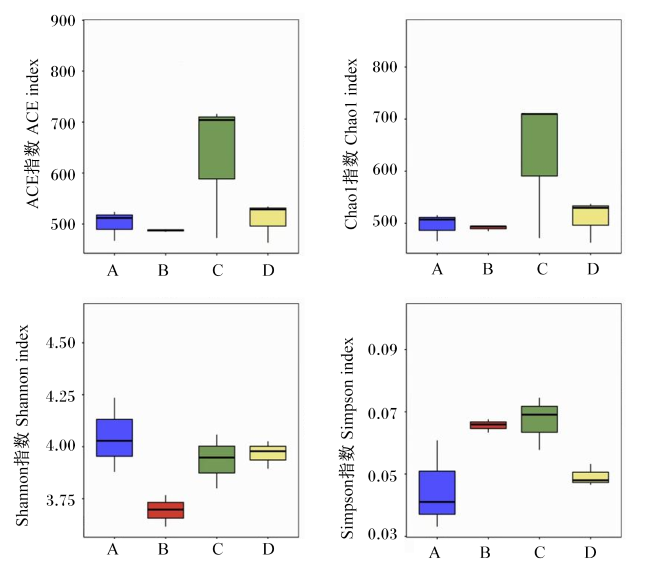
图1可知,C、D组盲肠菌群的ACE、Chao1、Shannon和Simpson指数与A组均无显著差异(P>0.05),说明胚蛋注射BSA对盲肠菌群丰富度及多样性未产生显著影响。
图1 α多样性指数

A、B、C、D分别代表A、B、C、D组。下图同。

Fig.1 α diversity indices

A, B, C and D represented groups A, B, C and D, respectively. The same as below.

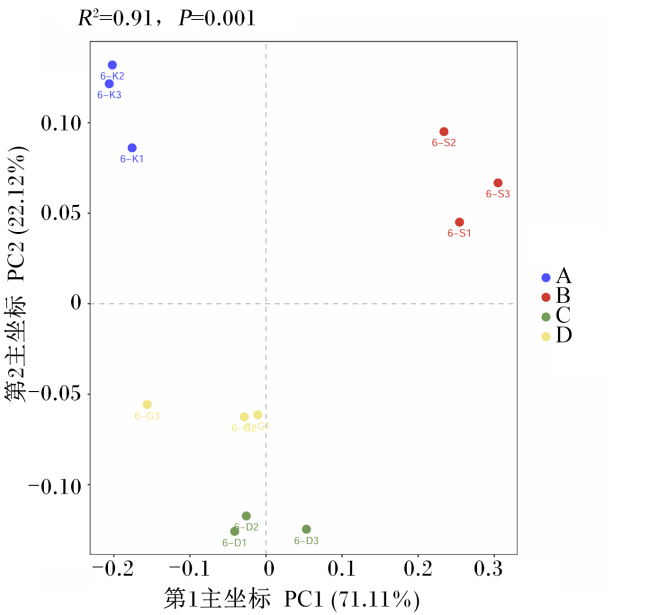
PCoA(图2)分析显示,C、D组样本与A组之间距离较远,且C、D组样本之间距离较近,说明C、D组中的盲肠菌群相似性较高,但与A组相似性较低,盲肠菌群β多样性受到胚蛋注射BSA的显著影响(P<0.05)。
图2 主坐标分析

Fig.2 PCoA

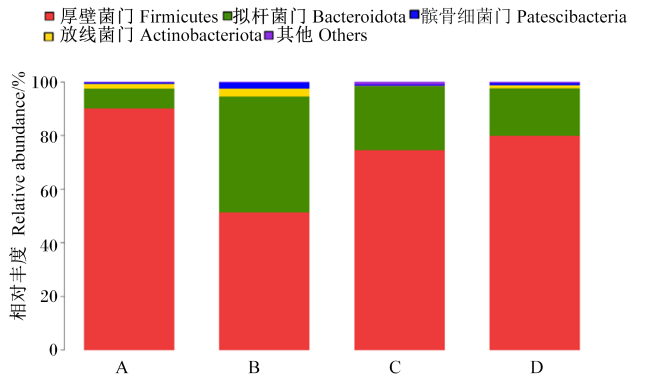
图3显示,4组盲肠菌群中均以厚壁菌门(Firmicutes)和拟杆菌门(Bacteroidota)为主导,二者相对丰度之和占据了微生物群落总丰度的90%以上。由表5可知,与A组相比,C、D组盲肠菌群中Firmicutes和髌骨细菌门(Patescibacteria)的相对丰度显著降低(P<0.05),Bacteroidota的相对丰度显著升高(P<0.05)。
图3 门水平上相对丰度排在前4位的物种分布图

Fig.3 Distribution maps of top 4 species in relative abundance at phylum level

表5 门水平上相对丰度排在前4位的物种分析

Table 5 Analysis of top 4 species in relative abundance at phylum level %

项目
Items
组别Groups P
P-value
A B C D
厚壁菌门Firmicutes 90.05±0.49a 51.40±1.71c 74.64±2.01b 79.86±2.68b <0.001
拟杆菌门Bacteroidota 7.52±0.50c 43.16±0.64a 23.76±2.20b 17.80±3.90b <0.001
髌骨细菌门Patescibacteria 1.70±0.15ab 2.85±0.45a 0.11±0.02c 1.09±0.59bc 0.006
放线菌门Actinobacteriota 0.47±0.05 2.41±1.12 0.43±0.05 0.74±0.37 0.129
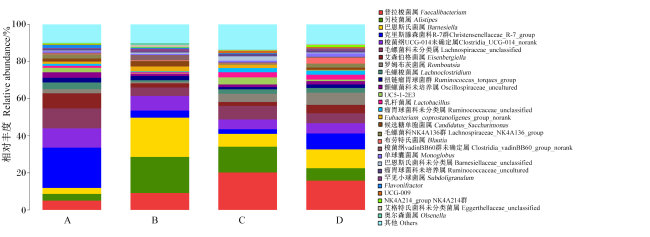
图4显示,4组盲肠菌群中排名前10位的优势菌属为普拉梭菌属(Faecalibacterium)、另枝菌属(Alistipes)、巴恩斯氏菌属(Barnesiella)、克里斯滕森菌科R-7群(Christensenellaceae_R-7_group)、梭菌纲UCG-014未确定属(Clostridia_UCG-014_norank)、毛螺菌科未分类属(Lachnospiraceae_unclassified)、艾森伯格菌属(Eisenbergiella)、罗姆布茨菌属(Romboutsia)、毛螺梭菌属(Lachnoclostridium)、扭链瘤胃球菌群(Ruminococcus_torques_group)。由表6可知,与A组相比,C、D组FaecalibacteriumBarnesiella的相对丰度显著升高(P<0.05),Christensenellaceae_R-7_group、Clostridia_UCG-014_norank、Lachnospiraceae_unclassified和Eisenbergiella的相对丰度显著降低(P<0.05);此外,D组Romboutsia的相对丰度显著升高(P<0.05),C组肠道LachnoclostridiumAlistipesRuminococcus_torques_group的相对丰度显著降低(P<0.05)。
图4 属水平上相对丰度排在前28位的物种分布图

Fig.4 Distribution maps of top 28 species in relative abundance at genus level

表6 属水平上相对丰度排在前10位的物种分析

Table 6 Analysis of top 10 species in relative abundance at genus level %

项目
Items
组别Groups P
P-value
A B C D
普拉梭菌属Faecalibacterium 5.09±1.29d 9.20±0.84c 20.27±0.72a 15.81±1.04b <0.001
另枝菌属Alistipes 3.63±0.49c 19.39±0.76a 13.79±2.00b 6.68±2.60c 0.001
巴恩斯氏菌属Barnesiella 3.11±0.21d 21.09±1.28a 6.90±0.34c 10.20±1.44b <0.001
克里斯滕森菌科R-7群
Christensenellaceae_R-7_group
21.74±2.08a 3.92±0.57c 2.63±0.07c 8.54±0.75b <0.001
梭菌纲UCG-014未确定属
Clostridia_UCG-014_norank
10.46±1.28a 7.85±0.92ab 5.16±0.44b 5.55±0.65b 0.010
毛螺菌科未分类属
Lachnospiraceae_unclassified
10.81±0.94a 4.50±0.35c 7.39±0.84b 5.33±0.79bc 0.002
艾森伯格菌属Eisenbergiella 8.03±0.79a 2.35±0.73b 2.17±0.17b 4.58±1.24b 0.003
罗姆布茨菌属Romboutsia 2.38±0.03bc 0.86±0.31c 4.37±0.68ab 6.47±1.89a 0.021
毛螺梭菌属Lachnoclostridium 3.51±0.45a 0.80±0.20c 2.42±0.28b 2.62±0.19ab 0.001
扭链瘤胃球菌群
Ruminococcus_torques_group
2.44±0.19a 2.37±0.08a 1.21±0.08b 1.95±0.19a 0.001
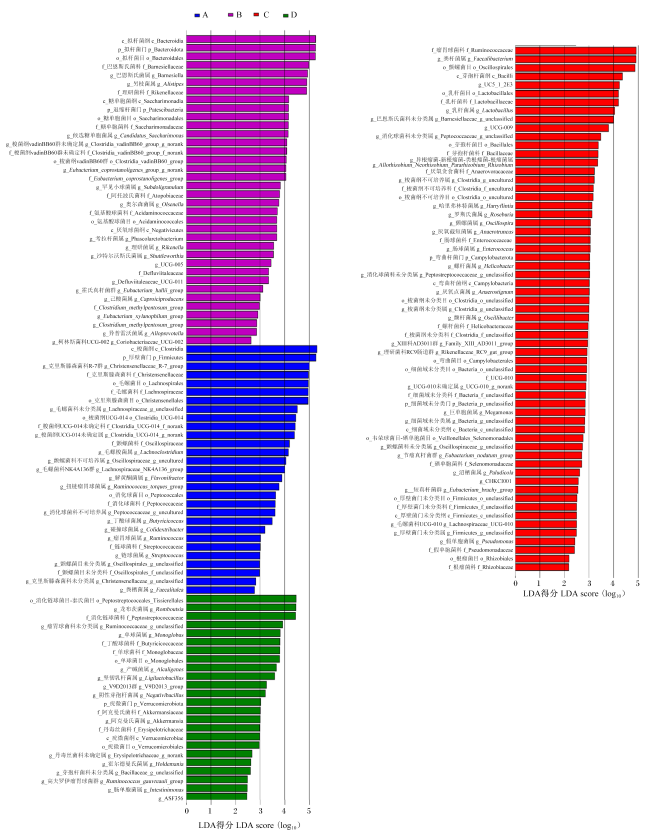
图5为LEfSe多级物种差异判别分析结果,可知A、B、C、D组分别有29、36、61、24种差异菌属。
图5 LDA得分柱形图

Fig.5 LDA score bar chart

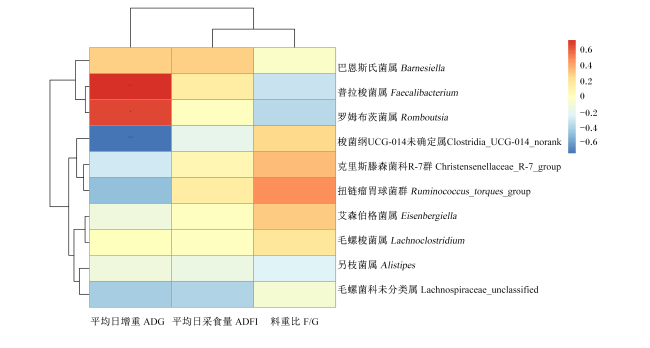
对肉鸡盲肠中相对丰度排在前10位优势菌属与生长性能进行Spearman相关性分析,结果显示,FaecalibacteriumRomboutsia的相对丰度与平均日增重分别呈极显著(P<0.01)和显著(P<0.05)正相关,Clostridia_UCG-014_norank的相对丰度与平均日增重呈极显著负相关(P<0.01)(图6)。
图6 肉鸡盲肠优势菌属与生长性能的相关性分析

“*”表示显著相关(P<0.05),“**”表示极显著相关(P<0.01)。

Fig.6 Correlation analysis of cecal dominant bacterial genera and growth performance of broilers

“*” indicated significant correlation (P<0.05), and “**” indicated extremely significant correlation (P<0.01).

3 讨论

3.1 胚蛋注射BSA对肉鸡早期生长性能的影响

家禽胚胎在孵化后期基础代谢旺盛,需要大量的能量和营养物质来维持其快速发育。不同于哺乳动物,禽类胚胎发育所需养分完全依赖胚蛋中的储存,常出现能量和营养不足等问题[9]。胚蛋注射是通过外源给养的方式补充营养和能量,改善孵化后期的营养不足,促进家禽胚胎期和出壳后初期生长性能的提高,从而提升家禽在实际生产中的效益[10-11]。研究显示,胚蛋中给予的碳水化合物、维生素、氨基酸、益生菌、植物提取物、矿物质、肌酸以及其他营养物质都可能促进胚胎及家禽的早期生长发育并提高机体健康水平[12-17]。Teague等[18]在孵育18 d的鸡胚蛋羊膜腔中注入104 CFU乳酸菌,结果显示试验组雏鸡在1周龄时体重相较对照组增加了9.10%。Li等[19]向朗德鹅胚蛋注射1.5 mL添加25 g/L麦芽糖和25 g/L蔗糖的氯化钠溶液(MS组),发现MS组雏鹅出壳当日体重较对照组提高了20.4 g,且在后续1周的饲养观察中,MS组表现出更优异的生长性能,其平均日增重和平均日采食量分别比对照组高出7.29和3.64 g。高天[20]研究表明,在孵化后期于胚蛋羊膜腔内注射0.6 mL精氨酸营养液,能提升雏鸡胃肠道的消化吸收能力,改善雏鸡早期营养和生长性能。马友彪等[21]在试验中发现,向17.5胚龄的鸡胚蛋注射1 mL 4.5 mmol/L吡咯喹啉醌二钠溶液能显著提高肉鸡的出壳体重,有助于雏鸡生长初期阶段的发育和肌肉形成,但这种促进效果会随着日龄增加而逐渐降低。本研究发现,胚蛋注射不同剂量BSA均可以提高肉鸡21日龄体重及1~21日龄平均日增重,以注射0.5 mL 40 μg/mL BSA生理盐水溶液时效果更佳。

3.2 胚蛋注射BSA对肉鸡血清生化指标的影响

血清生化指标可有效反映动物的健康状况、机体内营养水平以及代谢情况。TP主要包含ALB和球蛋白(GLB)2种类型,在生物体内承担着重要的生理功能,包括保持血液胶体渗透压和酸碱平衡、运送各类代谢产物、调控被运输物质的生理作用、参与免疫反应以及提供营养支持等[22]。ALB主要由肝脏合成,是血清中一种重要的转运蛋白,并具有较高的肝脏特异性[23]。它不仅能够维持血管与组织间的胶体渗透压平衡,还能结合并转运多种小分子物质,参与代谢产物的解毒与再利用过程。此外,ALB还具有抑制血小板聚集和抗凝血的活性,并可能发挥抗氧化及清除自由基等作用[24]。血清中TP与ALB含量的升高,通常反映机体蛋白质代谢活跃,有助于促进蛋白质沉积。同时,TP与ALB也是评估肝脏功能的重要指标,肝脏损伤往往导致血清TP与ALB含量下降[25]。本试验中,21日龄时,C和D组肉鸡血清TP和ALB含量均较对照组显著升高,提示胚蛋注射BSA有助于促进21日龄肉鸡体内蛋白质沉积,维护肝脏健康,并支持其生长发育。TC是反映机体脂质代谢状态的重要指标。
作为必需营养物质,胆固醇一方面参与构成细胞膜的基本结构,另一方面可转化为维生素D3和胆汁酸,在骨骼发育、血管修复、免疫功能提升以及脂肪消化等方面发挥重要作用[26]。本试验中,C和D组血清TC含量均较对照组显著升高,表明胚蛋注射BSA能够促进21日龄肉鸡的脂质代谢。ALT是评估肝脏代谢功能的另一指标,其活性降低通常提示血脂代谢效率提高[27],而血清ALT活性升高则可能与急性炎症或内脏损伤相关[28]。本试验中D组血清ALT活性较对照组显著降低,说明该组肉鸡的血脂代谢效率得到改善。

3.3 胚蛋注射BSA对肉鸡肠道形态的影响

雏鸡肠道的发育状态可通过其形态结构进行评估[29-30]。肠道绒毛高度反映了肠道绒毛与营养物质的接触面积,隐窝深度则体现了上皮细胞的更新与迁移能力,这些形态参数的改善有助于提高家禽肠道的消化与吸收功能[31]。在胚胎发育后期,充足的营养供给对肠道发育至关重要,有助于改善雏鸡在孵化后期及首次采食前的营养储备。Shehata等[32]研究发现,向肉鸡胚蛋注射0.2 mL含4×10⁶ CFU枯草芽孢杆菌与3 mg棉籽糖的溶液,可显著提高21日龄肉鸡回肠绒毛高度,促进肠道发育。另有研究显示,在孵化第18天向羊膜腔内注射1 mL 0.5% L-精氨酸或0.5% L-鸟氨酸营养液,能够刺激隐窝细胞的增殖与分化,从而增强雏鸡肠道的消化吸收能力[33]。本试验中,C和D组空肠绒毛高度和绒隐比均显著提高,这些形态变化直接增大了营养物质的消化吸收面积,增强了肠道功能,进而促进肉鸡生长性能的提升,与本研究中生长性能的结果相一致。

3.4 胚蛋注射BSA对肉鸡盲肠菌群的影响

家禽肠道内栖息着数量庞大、种类丰富的微生物群落,这些微生物在饲料降解消化、营养物质吸收以及维持肠道稳态等方面发挥着重要作用[30]。健康的肠道依赖于稳定的微生态环境,若有害微生物过度增殖并打破菌群平衡,将引发肠道微生态紊乱,增加家禽感染病原菌的风险[34-35]。研究表明,在鸡胚胎发育期间,肠道中既有微生物开始定植,其主要来源于母鸡生殖道[36-38]。幼禽阶段肠道菌群结构尚未成熟,易受外界因素影响,因此可通过早期干预促进其快速建立稳定、成熟的菌群结构。潘亚丽[39]报道,胚蛋注射0.5 mL含4 mg绿原酸的0.75%生理盐水溶液,可显著促进肉鸡肠道中Firmicutes和乳杆菌属(Lactobacillus)的增殖,并提高盲肠菌群的多样性。本试验中,胚蛋注射不同剂量BSA显著影响了肉鸡盲肠菌群的β多样性,反映出BSA对雏鸡早期肠道菌群结构具有调控作用。
此外,Duan等[40]在18.5胚龄的鸡胚中注射由植物乳杆菌(1×10⁶ CFU)与黄芪多糖(2 mg)组成的复合制剂,有效降低了鸡肠道中有害菌大肠杆菌的比例,同时提高了有益菌双歧杆菌的比例。Shehata等[31]分别于胚蛋内注射0.2 mL枯草芽孢杆菌(4×10⁶ CFU)、棉籽糖(3 mg)以及两者复合物,发现其可增加盲肠中有益菌枯草芽孢杆菌和乳酸菌的数量,并降低有害菌大肠杆菌与肠球菌的数量。本试验通过属水平上的物种分析及LEfSe多级物种差异判别分析发现,与A组相比,C组中Faecalibacterium的相对丰度较高,而D组中FaecalibacteriumRomboutsia的相对丰度均显著提升;相关性分析进一步表明,肉鸡盲肠中的优势菌属FaecalibacteriumRomboutsia与平均日增重呈显著或极显著正相关。Faecalibacterium属于Firmicutes,最初是从人类粪便中分离得到的一种严格厌氧菌,能够在肠道中稳定定植。该菌是丁酸盐的重要生产者,具备抗炎特性,可维持细菌酶活性,并帮助消化系统抵御肠道病原体的侵害[41]Romboutsia同样属于Firmicutes,以往曾被归入毛螺菌科(Lachnospiraceae),该科细菌能够通过水解淀粉及其他糖类产生丁酸盐等短链脂肪酸[42]。丁酸盐在提高肉鸡采食量、日增重和饲料转化率等方面具有积极作用[43]。李凯年[44]报道,饲喂0.2%丁酸盐对肉鸡采食量无负面影响,并可显著提高42日龄肉鸡体重。刘丽华等[45]研究也表明,在肉仔鸡饲粮中添加500 mg/kg丁酸钠能显著提升14日龄肉仔鸡的采食量、平均日增重及体重。综上可知,在本试验中,胚蛋注射BSA通过增加丁酸盐生成菌(如FaecalibacteriumRomboutsia)的相对丰度,促进了肉鸡早期生长性能的提升。

4 结论

综上所述,于孵化后期(18胚龄)胚蛋注射BSA,可通过改善血清生化指标、优化肠道形态及调节盲肠菌群,有效提升肉鸡早期生长性能,以注射0.5 mL 40 μg/mL的BSA生理盐水溶液效果最佳。
[1]
FREEMAN B M. The importance of glycogen at the termination of the embryonic existence of Gallus domesticus[J]. Comparative Biochemistry and Physiology, 1965, 14(2):217-222.

DOI

[2]
PEEBLES E D. In ovo applications in poultry:a review[J]. Poultry Science, 2018, 97(7):2322-2338.

DOI

[3]
黄萌. 我国胚蛋给养技术研究进展[J]. 黑龙江动物繁殖, 2021, 29(1):29-32.

HUANG M. In ovo feeding studies in China[J]. Heilongjiang Journal of Animal Reproduction, 2021, 29(1):29-32. (in Chinese)

[4]
赵敏孟, 高天, 张林, 等. 胚蛋注射丙酮酸肌酸对肉鸡孵化率、生长性能及能量储备的影响[C]// 中国畜牧兽医学会动物营养学分会第十二次动物营养学术研讨会论文集. 北京:中国农业大学出版社,2016:368.

ZHAOM M, GAOT, ZHANGL, et al. The impact of embryo injection of pyruvate and creatine on the incubation rate,growth performance,and energy reserve in broilers[C]// Proceedings of the 12th Animal Nutrition Academic Seminar of the Chinese Society of Animal Husbandry and Veterinary Medicine. Beijing: China Agricultural University Press,2016:368. (in Chinese)

[5]
戴东, 王晶, 张海军, 等. 胚蛋注射L-精氨酸对蛋雏鸡孵化性能、1-14日龄肠道发育及血清生化指标的影响[J]. 动物营养学报, 2020, 32(4):1641-1649.

DOI

DAI D, WANG J, ZHANG H J, et al. Effects of in ovo feeding of L-arginine on hatchability,intestinal development and serum biochemical indexes of layer chicks from 1 to 14 days of age[J]. Chinese Journal of Animal Nutrition, 2020, 32(4):1641-1649. (in Chinese)

[6]
WILSON K M, RODRIGUES D R, BRIGGS W N, et al. Evaluation of the impact of in ovo administered bacteria on microbiome of chicks through 10 days of age[J]. Poultry Science, 2019, 98(11):5949-5960.

DOI

[7]
PEDROSO A A, BATAL A B, LEE M D. Effect of in ovo administration of an adult-derived microbiota on establishment of the intestinal microbiome in chickens[J]. American Journal of Veterinary Research, 2016, 77(5):514-526.

DOI

[8]
于潇, 姚杰, 苏琳洁, 等. 胚蛋注射鼠李糖乳杆菌对黄羽肉鸡早期生长性能、肠道健康、血清生化指标和盲肠微生物区系的影响[J]. 动物营养学报, 2025, 37(2):938-949.

DOI

YU X, YAO J, SU L J, et al. Effects of in ovo injection of Lactobacillus rhamnosus on growth performance,intestinal health,serum biochemical indices and cecal microflora of yellow-feathered broilers at early stage[J]. Chinese Journal of Animal Nutrition, 2025, 37(2):938-949. (in Chinese)

[9]
李德生, 娄玉杰. 胚蛋给养对家禽早期营养及免疫应答影响研究进展[J]. 中国畜牧杂志, 2016, 52(7):86-91.

LI D S, LOU Y J. Research progress of in ovo feeding on early nutrition and immune response in poultry[J]. Chinese Journal of Animal Science, 2016, 52(7):86-91. (in Chinese)

[10]
卫城朝, 原雪峰, 耿彦超, 等. 家禽胚蛋给养技术的研究[J]. 现代畜牧科技, 2024, 52(8):125-127.

WEI C Z, YUAN X F, GENG Y C, et al. A study on the feeding technology of poultry embryo eggs[J]. Modern Animal Husbandry Science & Technology, 2024, 52(8):125-127. (in Chinese)

[11]
卢佳慧, 徐久鹏, 李孜恒, 等. 胚蛋注射乳酸菌对雏鸡孵化性能和肠道黏膜结构的影响[J]. 饲料研究, 2024, 47(16):40-45.

LU J H, XU J P, LI Z H, et al. Effect of embryo egg injection of lactic acid bacteria on hatching performance and intestinal mucosal structure of chicks[J]. Feed Research, 2024, 47(16):40-45. (in Chinese)

[12]
贾良梁. 家禽胚蛋注射技术的应用研究(综述)-总结篇[J]. 国外畜牧学(猪与禽), 2020, 40(3):9-10.

JIA L L. Application research on the injection technology of poultry embryo eggs (review):summary[J]. Foreign Animal Husbandry (Pigs and Poultry), 2020, 40(3):9-10. (in Chinese)

[13]
贾良梁. 家禽胚蛋注射技术的应用研究(综述)-概述篇[J]. 国外畜牧学(猪与禽), 2020, 40(1):1-2.

JIA L L. Application research on embryo injection technology for poultry (review):overview[J]. Foreign Animal Husbandry(Pigs and Poultry), 2020, 40(1):1-2. (in Chinese)

[14]
贾良梁. 家禽胚蛋注射技术的应用研究(综述)-碳水化合物篇[J]. 国外畜牧学(猪与禽), 2020, 40(2):7-8.

JIA L L. Application research on the injection technology of poultry embryo eggs (review):carbohydrates[J]. Foreign Animal Husbandry(Pigs and Poultry), 2020, 40(2):7-8. (in Chinese)

[15]
贾良梁. 家禽胚蛋注射技术的应用研究(综述)-蛋白质、氨基酸和多肽篇[J]. 国外畜牧学(猪与禽), 2020, 40(2):3-6.

JIA L L. Application of embryo injection technology in poultry (review):proteins,amino acids and peptides[J]. Foreign Animal Science (Pigs and Poultry), 2020, 40(2):3-6. (in Chinese)

[16]
贾良梁. 家禽胚蛋注射技术的应用研究(综述)-维生素篇[J]. 国外畜牧学(猪与禽), 2020, 40(3):4-6.

JIA L L. Application research on the injection technology of poultry embryo eggs (review):vitamin[J]. Foreign Animal Husbandry (Pigs and Poultry), 2020, 40(3):4-6. (in Chinese)

[17]
贾良梁. 家禽胚蛋注射技术的应用研究(综述)-矿物质篇[J]. 国外畜牧学(猪与禽), 2020, 40(3):1-3.

JIA L L. Application research on the injection technology of poultry embryo eggs (review):minerals[J]. Foreign Animal Husbandry (Pigs and Poultry), 2020, 40(3):1-3. (in Chinese)

[18]
TEAGUE K D, GRAHAM L E, DUNN J R, et al. In ovo evaluation of FloraMax-B11 on Marek’s disease HVT vaccine protective efficacy,hatchability,microbiota composition,morphometric analysis,andSalmonella enteritidis infection in broiler chickens[J]. Poultry Science, 2017, 96(7):2074-2082.

DOI

[19]
LI D S, DANG D X, XU H, et al. Growth performance,jejunal morphology,disaccharidase activities,and sugar transporter gene expression in Langde geese as affected by the in ovo injection of maltose plus sucrose[J]. Frontiers in Veterinary Science, 2023,10:1061998.

[20]
高天. 胚蛋注射精氨酸对肉仔鸡早期肠道发育和功能的影响及其作用机制研究[D]. 博士学位论文. 南京: 南京农业大学, 2017.

GAO T. Effects and mechanisms of in ovo feeding of L-arginine on the early development and function of intestine in broiler chickens[D]. Ph.D.Thesis. Nanjing: Nanjing Agricultural University, 2017. (in Chinese)

[21]
马友彪, 张海军, 王晶, 等.胚蛋给养吡咯喹啉醌二钠对肉仔鸡生长性能、 胴体组成和血液生化指标的影响[C]//第七届中国饲料营养学术研讨会论文集. 北京:中国农业大学出版社,2014:180.

MA Y B, ZHANGH J, WANGJ, et al. The effects of piroxicam dihydrate on the growth performance,carcass composition,and blood biochemical indicators of broiler chickens[C]// Proceedings of the 7th China Feed Nutrition Academic Seminar. Beijing: China Agricultural University Press,2014:180. (in Chinese)

[22]
李龙, 卫城朝, 张伟, 等. 胚蛋注射25-羟基胆钙化醇对樱桃谷雏鸭孵化性能、早期发育与血清生化指标的影响[J]. 中国农业大学学报, 2023, 28(3):121-130.

LI L, WEI C C, ZHANG W, et al. Effects of in ovo injecting 25-hydroxycholecalciferol on hatchability,early development and serum biochemical indexes of cherry valley ducklings[J]. Journal of China Agricultural University, 2023, 28(3):121-130. (in Chinese)

[23]
SHAMAY A, HOMANS R, FUERMAN Y, et al. Expression of albumin in nonhepatic tissues and its synthesis by the bovine mammary gland[J]. Journal of Dairy Science, 2005, 88(2):569-576.

PMID

[24]
郭蓉. 白蛋白(ALB)基因生物信息学分析[J]. 黑龙江畜牧兽医, 2016(21):45-48,293.

GUO R. Bioinformatics analysis of albumin (ALB) gene in animals[J]. Heilongjiang Animal Science and Veterinary Medicine, 2016(21):45-48,293. (in Chinese)

[25]
HOSEINI S M, YOUSEFI M, HOSEINIFAR S H, et al. Antioxidant, enzymatic and hematological responses of common carp (Cyprinus carpio) fed with myrcene- or menthol-supplemented diets and exposed to ambient ammonia[J]. Aquaculture, 2019,506:246-255.

[26]
区秋儒, 李彩容, 王雪娇, 等. 辣椒粉对1-42日龄“麒麟”鸡生产性能及血清生化指标的影响[J]. 广东饲料, 2020, 29(5):31-35.

QV Q R, LI C R, WANG X J, et al. The effects of chili powder on the production performance and serum biochemical indexes of ‘Qilin’ chickens aged 1-42 days[J]. Guangdong Feed, 2020, 29(5):31-35. (in Chinese)

[27]
蔡友莉, 廖丽. 复合益生菌对肉羊生长性能、屠宰性能、血清生化指标及经济效益的影响[J]. 中国饲料, 2024(2):18-21.

CAI Y L, LIAO L. The influence of compound probiotics on the growth performance,slaughter performance,serum biochemical index and economic benefits of mutton sheep[J]. China Feed, 2024(2):18-21. (in Chinese)

[28]
梁艳茹. 饲粮添加有机碘对大肠杆菌攻毒肉鸭生长性能、免疫功能和肠道健康的影响[D]. 硕士学位论文. 雅安: 四川农业大学, 2023.

LIANG Y R. Effects of dietary organic iodine supplementation on growth performance,immune function and intestinal health of broiler ducks attacked by Escherichia coli[D]. Master’s Thesis. Ya’an: Sichuan Agricultural University, 2023. (in Chinese)

[29]
张炎达, 潘慧青, 李珠金. 家禽无抗养殖中饲用乳酸菌应用研究进展[J]. 中国家禽, 2018, 40(11):41-46.

ZHANG Y D, PAN H Q, LI Z J. Research advances on application of feed Lactobacillus in antibiotic-free breeding in poultry[J]. China Poultry, 2018, 40(11):41-46. (in Chinese)

[30]
苏亚星, 蒋维维, 李毅, 等. 不同饲喂方式对E麻雏鸡体重以及内脏器官发育的影响[J]. 养禽与禽病防治, 2022(5):14-18.

SU Y X, JIANG W W, LI Y, et al. Effects of different feeding methods on the body weight and visceral organ development of E-maca chicks[J]. Poultry Husbandry and Disease Control, 2022(5):14-18. (in Chinese)

[31]
卢佳慧, 王许刚, 王瑞, 等. 胚蛋接种对家禽生长发育及肠道健康的影响的研究进展[J]. 饲料研究, 2023, 46(20):182-186.

LU J H, WANG X G, WANG R, et al. Research progress on effect of embryo egg inoculation on growth and development and intestinal health of poultry[J]. Feed Research, 2023, 46(20):182-186. (in Chinese)

[32]
SHEHATA A M, PASWAN V K, ATTIA Y A, et al. In ovo inoculation of Bacillus subtilis and raffinose affects growth performance,cecal microbiota,volatile fatty acid,ileal morphology and gene expression,and sustainability of broiler chickens (Gallus gallus)[J]. Frontiers in Nutrition, 2022,9:903847.

[33]
师昆景, 谭荣炳, 吴灵英. 胚胎给养L-精氨酸和L-鸟氨酸对肉仔鸡早期肠道发育的影响[C]// 第二届全国家禽营养与饲料科技研讨会论文集. 北京: 中国农业科学技术出版社,2007:246-252.

SHI K J, TAN R B, WU L Y. Effects of in ovo feeding of L-arginine and L-ornithine on the early development of broiler intestine[C]// Proceedings of the Second National Symposium on Poultry Nutrition and Feed Science. Beijing: China Agricultural Science and Technology Press,2007:246-252. (in Chinese)

[34]
孙玲利, 宁俊平, 韩战强, 等. 家禽肠道菌群与营养物质代谢的研究进展[J]. 黑龙江畜牧兽医, 2021(3):54-57.

SUN L L, NING J P, HAN Z Q, et al. Research progress of poultry gut microflora and nutrient metabolism[J]. Heilongjiang Animal Science and Veterinary Medicine, 2021(3):54-57. (in Chinese)

[35]
胡泽琼, 王浦卉, 朱婷, 等. 肠道健康标准和影响家禽肠道健康的因素分析及其防控方案[J]. 中国家禽, 2021, 43(3):89-96.

HU Z Q, WANG P H, ZHU T, et al. Intestinal health criteria and factors affecting poultry intestinal health and its prevention and control programs[J]. China Poultry, 2021, 43(3):89-96. (in Chinese)

[36]
LEE S, LA T M, LEE H J, et al. Characterization of microbial communities in the chicken oviduct and the origin of chicken embryo gut microbiota[J]. Scientific Reports, 2019, 9(1):6838.

DOI PMID

[37]
DING J M, DAI R H, YANG L Y, et al. Inheritance and establishment of gut microbiota in chickens[J]. Frontiers in Microbiology, 2017,8:1967.

[38]
王晶, 戴东, 武书庚, 等. 鸡肠道微生物演替与早期定植的研究进展[J]. 生物技术通报, 2020, 36(2):1-8.

DOI

WANG J, DAI D, WU S G, et al. Advances in successional development and early establishment of the chicken intestinal microbiota[J]. Biotechnology Bulletin, 2020, 36(2):1-8. (in Chinese)

DOI

[39]
潘亚丽. 胚蛋给养绿原酸对肉鸡抗氧化性能与肠道微生物的影响[D]. 硕士学位论文. 泰安: 山东农业大学, 2022.

PAN Y L. Effects of in ovo feeding of chlorogenic acid on antioxidant capacity and gut microbiota of broilers[D]. Master’s Thesis. Tai’an: Shandong Agricultural University, 2022. (in Chinese)

[40]
DUAN A Y, JU A Q, ZHANG Y N, et al. The effects of in ovo injection of synbiotics on the early growth performance and intestinal health of chicks[J]. Frontiers in Veterinary Science, 2021,8:658301.

[41]
DUNCAN S H, HOLD G L, HARMSEN H J M, et al. Growth requirements and fermentation products of Fusobacterium prausnitzii,and a proposal to reclassify it as Faecalibacterium prausnitzii gen.nov.,comb.nov[J]. International Journal of Systematic and Evolutionary Microbiology, 2002, 52(Pt 6):2141-2146.

DOI

[42]
TOGO A H, KHELAIFIA S, BITTAR F, et al. ‘Eisenbergiella massiliensis’,a new species isolated from human stool collected after bariatric surgery[J]. New Microbes and New Infections, 2016,13:15-16.

[43]
朱元芳. 丁酸盐的生物学功能及在肉鸡生产中的应用[J]. 广东饲料, 2024, 33(8):39-41.

ZHU Y F. Biological functions of butyrate and its application in broiler production[J]. Guangdong Feed, 2024, 33(8):39-41. (in Chinese)

[44]
李凯年. 丁酸可以替代抗生素生长促进剂饲喂肉鸡[J]. 中国动物保健, 2006(3):45-46.

LI K N. Butyric acid can replace antibiotic growth promoters in feeding broilers[J]. China Animal Health, 2006(3):45-46. (in Chinese)

[45]
刘丽华, 张卫辉, 夏新成, 等. 丁酸钠对肉仔鸡生产性能及免疫功能的影响[J]. 中国粮油学报, 2009, 24(10):84-88.

LIU L H, ZHANG W H, XIA X C, et al. Effects of sodium butyrate on growth performance and immune function in broilers[J]. Journal of the Chinese Cereals and Oils Association, 2009, 24(10):84-88. (in Chinese)

文章导航

/