综述

植物乳杆菌调控动物肠道健康的分子机制及其应用

  • 田丽娇 , 1 ,
  • 臧荣鑫 1, 2 ,
  • 周瑞 1, 2 ,
  • 徐红伟 , 1, 2, *
展开
  • 1 西北民族大学生命科学与工程学院,兰州 730100
  • 2 西北民族大学双碳研究院绿色牧业技术研究中心,兰州 730030
* 徐红伟,副教授,硕士生导师,E-mail:

田丽娇(2000—),女,贵州铜仁人,硕士研究生,研究方向为益生菌与肠道健康。E-mail:

Office editor: 靳爽

收稿日期: 2025-07-23

  网络出版日期: 2026-02-12

基金资助

甘肃省科技项目(24ZDNA004)

甘肃省科技项目(24YFWA016)

甘肃省废旧农膜回收利用和尾菜处理利用新技术(新设备)研发推广项目(HT-SHGK-2025-053)

中央高校基本科研业务费项目(31920250024)

Molecular Mechanisms of Lactiplantibacillus plantarum in Regulating Animal Intestinal Health and Its Applications

  • TIAN Lijiao , 1 ,
  • ZANG Rongxin 1, 2 ,
  • ZHOU Rui 1, 2 ,
  • XU Hongwei , 1, 2, *
Expand
  • 1 School of Life Science and Engineering, Northwest Minzu University, Lanzhou 730100, China
  • 2 Green Animal Husbandry Technology Research Center, Institute of Carbon Neutrality, Northwest Minzu University, Lanzhou 730030, China
* associate professor, E-mail:

Received date: 2025-07-23

  Online published: 2026-02-12

摘要

植物乳杆菌(Lactiplantibacillus plantarum)是一种广泛应用于畜牧业的益生菌,具备良好的耐酸性、耐胆盐性、黏附性及广谱抑菌特性。肠道健康对维持动物正常生理功能、提升生产性能及增强疾病抵抗力具有关键作用。植物乳杆菌可通过增强肠道屏障功能、调节免疫应答、优化菌群组成以及与微生物代谢产物协同作用等途径提升动物健康水平。本文系统综述了植物乳杆菌调控肠道微生物屏障、化学屏障、物理屏障及免疫屏障的分子机制,并深入探讨其与短链脂肪酸、胆汁酸和色氨酸等微生物代谢产物的互作机制,进一步总结其在畜牧养殖中作为发酵菌剂和防治疾病手段的应用,旨在为其精准应用于动物肠道健康调控和高效养殖实践提供参考。

本文引用格式

田丽娇 , 臧荣鑫 , 周瑞 , 徐红伟 . 植物乳杆菌调控动物肠道健康的分子机制及其应用[J]. 动物营养学报, 2026 , 38(2) : 889 -899 . DOI: 10.12418/CJAN2026.070

Abstract

Lactiplantibacillus plantarum is a probiotic widely used in animal husbandry, characterized by its strong acid resistance, bile salt tolerance, adhesion capacity and broad-spectrum antimicrobial properties. Intestinal health plays a critical role in maintaining normal physiological functions, enhancing production performance and improving disease resistance in animals. L. plantarum promotes animal health by strengthening the intestinal barrier, modulating immune responses, optimizing microbial composition and synergizing with microbial metabolites. This paper systematically summarizes the molecular mechanisms by which L. plantarum regulates the intestinal microbial barrier, chemical barrier, physical barrier and immune barrier. Furthermore, it explores in depth the interaction mechanisms between L. plantarum and microbial metabolites such as short-chain fatty acids, bile acids and tryptophan. Additionally, the applications of L. plantarum as a fermentation agent and a disease prevention strategy in livestock farming are summarized. The aim of this review is to provide a theoretical foundation for the precise application of L. plantarum in intestinal health regulation and efficient animal husbandry practices.

植物乳杆菌学名为Lactobacillus plantarum,最初归属于乳杆菌属(Lactobacillus),后基于分子生物学与基因组学证据,其分类地位被调整为植物乳植杆菌属(Lactiplantibacillus),学名修订为Lactiplantibacillus plantarum[1]。植物乳杆菌为革兰氏阳性、兼性厌氧的杆状细菌,是食品、益生菌制剂、乳制品及哺乳动物胃肠道中最常见的细菌类群之一。其可通过产生多种细菌素及有机酸(如乳酸、乙酸)发挥天然防腐作用,同时在各类食品中被广泛用作发酵剂,以改善食品的风味、质地及感官特性[2]。此外,植物乳杆菌基因组中含有编码纤连蛋白结合蛋白、伴侣蛋白热休克蛋白33的相关基因,这些基因在增加益生菌黏附于宿主肠道黏膜或上皮并实现定植方面发挥重要作用[3]。Guo等[4]研究表明,在植物乳杆菌WCFS1中,一种含WYL结构域的甲基苯途径调控因子(methyl-benzene pathway regulator,MbpR)能够感知环二鸟苷酸(c-di-GMP)信号,进而从黏液结合蛋白(mucin-binding protein,MucBP)的编码区解离,逆转MbpR对MucBP表达的抑制作用,增强植物乳杆菌的肠道定植能力。欧洲食品安全局依托长期安全使用记录及全基因组数据,对植物乳杆菌ATCC55944作为饲料添加剂的安全性进行了评估,结果证实,该菌株具备长期安全使用历史,且不携带四环素耐药M基因(tetM)、红霉素耐药B基因(ermB)等可转移耐药基因[5]。植物乳杆菌凭借良好的胃肠道耐受性、黏附性、抗菌特性以及安全性,被认为是抗生素的理想替代品,广泛应用于动物健康养殖、发酵饲料及人类营养保健等领域。
肠道是动物免疫系统的重要组成部分,约70%的免疫细胞集中分布于肠道黏膜区域。因此,肠道健康直接关系到动物的生长发育、生产性能、疾病抵抗力乃至整体福利水平。维护肠道健康不仅有助于降低对抗生素的依赖,提升养殖经济效益,也契合当前绿色可持续发展的养殖理念。本文系统综述了植物乳杆菌调控动物肠道健康的分子机制,重点聚焦其在维护肠道屏障、调节免疫应答、干预菌群稳态及调控代谢产物方面的作用机制,同时探讨其在发酵饲料优化和肠道疾病防控方面的应用,以期为植物乳杆菌在动物肠道疾病预防、治疗以及高效安全养殖中的推广应用提供参考。

1 植物乳杆菌调控肠道屏障功能的分子机制
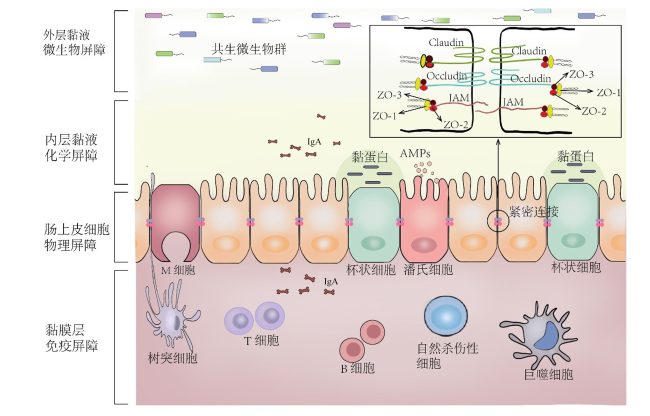
肠道屏障作为机体的重要防线,从肠腔到肠壁依次由微生物屏障、化学屏障、物理屏障和免疫屏障4部分组成(图1)。这四重屏障功能相互耦合,任何一环受损均可能导致整体屏障功能的级联失效。
图1 肠道屏障示意图

AMPs:抗菌肽 antimicrobial peptides;IgA:免疫球蛋白A immunoglobulin A;ZO-1:闭锁小带蛋白-1 zonula occludens-1;ZO-2:闭锁小带蛋白-2 zonula occludens-2;ZO-3:闭锁小带蛋白-3 zonula occludens-3;JAM:连接黏附分子 junctional adhesion molecule;Occludin:闭合蛋白;Claudin:密封蛋白。

Fig.1 Schematic diagram of intestinal barrier

1.1 微生物屏障

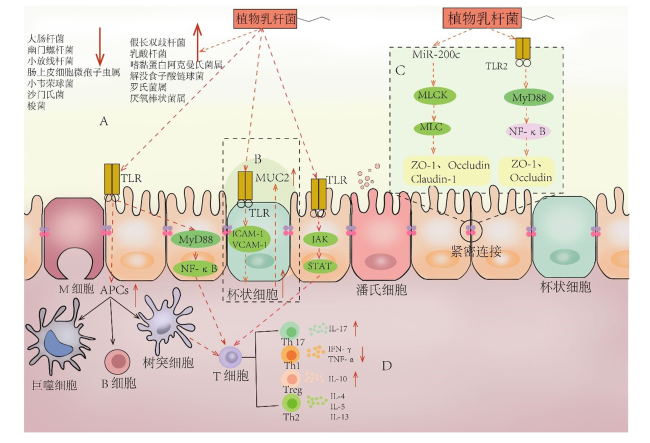
肠道微生物屏障由肠道菌群及其代谢产物共同构成,是感知肠腔刺激与环境变化的第1道防线,也是调节下游物理屏障、化学屏障和免疫屏障生理功能及维持肠道稳态的关键介质[6]。植物乳杆菌调节肠道微生物群的作用机制体现在2个方面:一是竞争性抑制病原菌增殖与黏附,二是促进有益菌在肠道内定植(图2-A)。研究表明,植物乳杆菌ZLP001能够抑制产肠毒性大肠杆菌(enterotoxigenic Escherichia coli,ETEC)的生长和黏附[7];在断奶前公犊牛饲粮中补充植物乳杆菌可显著提升粪便中乳酸杆菌的数量,并有效抑制大肠杆菌(Escherichia coli)、沙门氏菌(Salmonella)和梭菌(Clostridium)等病原菌的增殖,从而维持肠道健康[8];膳食补充植物乳杆菌P-8后,断奶仔猪肠道中乳杆菌属和解没食子酸链球菌(Streptococcus gallolyticus)显著富集,同时致病菌小放线杆菌(Actinobacillus minor)、肠道上皮细胞微孢子虫属(Enterocytozoon)以及小韦荣球菌(Veillonella parvula)丰度明显降低[9];植物乳杆菌JM113可缓解脱氧雪腐镰刀菌烯醇(DON)引发的毒性应激,改善肉鸡盲肠菌群结构,在属水平上显著提升罗氏菌属(Roseburia)、厌氧棒状菌属(Anaerofustis)及厌氧柱形菌属(Anaerostipe)的丰度[10];植物乳杆菌HUN082可显著降低结肠炎小鼠中幽门螺杆菌(Helicobacter pylori)等致病菌丰度,提升假长双歧杆菌(Bifidobacterium pseudolongum)、嗜黏蛋白阿克曼氏菌(Akkermansia muciniphila)等有益菌丰度,进而提高短链脂肪酸(short-chain fatty acids,SCFAs)含量[11]
图2 植物乳杆菌调控肠道屏障功能的分子机制

A:微生物屏障 microbial barrier;B:化学屏障 chemical barrier;C:物理屏障 physical barrier;D:免疫屏障 immune barrier。

TLR:Toll样受体 Toll-like receptor;MiR-200c:微小RNA-200c microRNA-200c;TLR2:Toll样受体2 Toll-like receptor 2;MLCK:肌球蛋白轻链激酶 myosin light chain kinase;MLC:肌球蛋白轻链 myosin light chain;NF-κB:核因子-κB nuclear factor-κB;ZO-1:闭锁小带蛋白-1 zonula occludens-1;Occludin:闭合蛋白;Claudin-1:密封蛋白-1;MyD88:髓样分化因子88 myeloid differentiation primary response 88;ICAM-1:细胞间黏附分子-1 intercellular adhesion molecule-1;VCAM-1:血管细胞黏附分子-1 vascular cell adhesion molecule-1;JAK:Janus激酶 Janus kinase;STAT:信号转导与转录激活因子 signal transducer and activator of transcription;Th17:辅助性T细胞17 T helper cell 17;Th1:辅助性T细胞1 T helper cell 1;Treg:调节性T细胞 regulatory T cell;Th2:辅助性T细胞2 T helper cell 2;IL-17:白细胞介素-17 interleukin-17;IFN-γ:干扰素-γ interferon-γ;TNF-α:肿瘤坏死因子-α tumor necrosis factor-α;IL-10:白细胞介素-10 interleukin-10;IL-4:白细胞介素-4 interleukin-4;IL-5:白细胞介素-5 interleukin-5;IL-13:白细胞介素-13 interleukin-13;MUC2:黏蛋白2 mucin 2;APCs:抗原呈递细胞 antigen-presenting cells。图3同 the same as Fig.3

Fig.2 Molecular mechanisms underlying regulation of intestinal barrier function by Lactiplantibacillus plantarum

1.2 化学屏障

肠道化学屏障主要由黏蛋白、抗菌肽、消化酶、溶菌酶及多种抗菌物质构成,其中黏蛋白以黏蛋白2(MUC2)为核心功能成分。MUC2是一种主要由肠道杯状细胞分泌的O-糖化蛋白,能通过二硫键交联形成网状凝胶结构[12]。其高度糖基化特征赋予分子良好的亲水性、黏弹性及丰富的化学结合位点,这正是其发挥强大“诱捕”功能的化学基础。植物乳杆菌增强肠道化学屏障功能的重要机制之一是促进肠道黏膜层中黏蛋白的分泌(图2-B)。研究表明,MUC2缺失会导致小鼠自发发生结肠炎[13]。杯状细胞的黏液分泌受转录因子叉头框蛋白O1(fork head box O1,Foxo1)调控,Foxo1缺失会引起杯状细胞自噬异常及黏液分泌缺陷,导致MUC2分泌减少,最终造成肠道屏障受损[14]。Watanabe-Yasuoka等[15]以一种可分泌黏蛋白的杯状细胞样细胞系HT-29甲氨蝶呤适应性黏液分泌亚克隆E12(HT-29 methotrexate-adapted mucus-secreting subclone E12,HT-29-MTX-E12)为模型,探讨植物乳杆菌OLL2712是否通过自噬途径调控黏蛋白分泌,结果显示,经OLL2712刺激72 h后,细胞黏蛋白分泌量显著增加;而加入自噬抑制剂后该效应未被逆转,表明OLL2712并非通过诱导HT-29-MTX-E12细胞分化为杯状细胞发挥作用,而是直接促进其黏蛋白分泌。此外,植物乳杆菌HNU082可通过下调细胞间黏附分子-1(intercellular adhesion molecule-1,ICAM-1)和血管细胞黏附分子(vascular cell adhesion molecule,VCAM)的表达增加杯状细胞数量、促进MUC2分泌,改善肠道化学屏障功能[11]

1.3 物理屏障

肠道上皮细胞通过在肠腔与免疫系统之间构建物理屏障来发挥关键功能,而该屏障的选择通透性由紧密连接(tight junction,TJ)结构决定。TJ结构主要由闭锁小带蛋白(zonula occludens,ZO)、闭合蛋白(Occludin)、密封蛋白(Claudin)家族及连接黏附分子(junctional adhesion molecules,JAM)等蛋白构成,可调控物质转运,阻止有害成分渗入,从而维持肠道屏障稳态[16]。这些蛋白的表达和功能受到多条信号通路调控(图2-C)。研究表明,经植物乳杆菌MB452处理后,人结直肠腺癌细胞(Caco-2细胞)中4种TJ蛋白均呈现高强度荧光信号,提示该菌株可通过增强TJ相关基因表达改善肠道屏障功能[17];植物乳杆菌WCSF1可通过激活Toll样受体2(Toll-like receptor 2,TLR2)信号通路,经核因子-κB(nuclear factor-κB,NF-κB)信号转导上调闭锁小带蛋白-1(ZO-1)的表达,并且显著减轻了佛波醇12,13-二丁酸酯(phorbol 12,13-dibutyrate,PDBu)诱导的ZO-1和Occludin错位及上皮通透性增加[18];Zhang等[19]研究发现,植物乳杆菌可通过其表层蛋白抑制肠道上皮细胞中微小RNA-200c(MiR-200c)表达,抑制肌球蛋白轻链激酶-肌球蛋白轻链(myosin light chain kinase-myosin light chain,MLCK-MLC)信号通路,进而上调ZO-1、Occludin和密封蛋白-1(Claudin-1)基因表达,从而修复TJ损伤;植物乳杆菌OLL2712则通过髓样分化因子88(myeloid differentiation primary response 88,MyD88)介导的自噬途径,显著上调Claudin-1和JAM基因的表达来增强TJ的完整性,但对OccludinZO-1基因的表达无显著影响[15]。值得注意的是,黏液层是独立于肠道上皮细胞的另一重要物理屏障。该层由杯状细胞分泌的MUC2形成,紧密覆盖于肠道上皮细胞表面;若MUC2分泌减少,会直接导致黏液层厚度降低、结构完整性受损,使病原体易于渗透至黏膜内,增加肠道上皮细胞与微生物群的异常接触,最终造成肠道屏障受损。

1.4 免疫屏障

肠道免疫屏障主要由T细胞、B细胞、巨噬细胞和树突状细胞等免疫细胞组成。Toll样受体(Toll-like receptor,TLR)作为先天免疫的关键模式识别受体,在巨噬细胞和树突状细胞等抗原呈递细胞(antigen-presenting cells,APCs)识别病原体并激活先天免疫后,驱动B细胞与T细胞的激活与分化,进而启动适应性免疫应答[20]。植物乳杆菌与宿主免疫系统的互作,在维持肠道免疫稳态中发挥重要作用(图2-D)。例如,植物乳杆菌C9O4能够刺激细胞因子分泌,调节促炎与抗炎反应的平衡,并通过Janus激酶(Janus kinase,JAK)/信号转导与转录激活因子(signal transducer and activator of transcription,STAT)途径逆转干扰素-γ(interferon-γ,IFN-γ)对发炎肠道细胞的损伤[21];植物乳杆菌GSLP-7的脂磷壁酸可通过抑制肠道上皮细胞中TLR4、MyD88和丝裂原活化蛋白激酶(mitogen-activated protein kinase,MAPK)关键蛋白的表达,阻断TLR4-MyD88-MAPK和NF-κB信号通路,促进抗炎因子白细胞介素-10(IL-10)分泌,从而缓解小鼠肠炎[22]。此外,植物乳杆菌来源的胞外囊泡(Lactiplantibacillus plantarum extracellular vesicles,LpEVs)对感染猪流行性腹泻病毒(PEDV)的肠道上皮细胞具有显著抗病毒活性:其通过依赖干扰素基因刺激蛋白的机制,激活环鸟苷酸-腺苷酸合成酶-干扰素基因刺激因子(cyclic GMP-AMP synthase-stimulator of interferon genes,c GAS-STING)天然免疫通路,显著上调Ⅰ型干扰素[干扰素-α/β(IFN-α/β)]及干扰素刺激基因(interferon-stimulated genes,ISGs)的表达,建立有效抗病毒状态;同时,LpEVs启动的自噬在抑制PEDV复制的同时,又以负反馈方式适度遏制c GAS-STING通路的过度激活,从而维持免疫稳态[23]。Xu等[24]将重组植物乳杆菌表达的抗菌肽添加到肉鸡饮用水中,发现十二指肠中分泌型免疫球蛋白A含量增加,干扰素-α(IFN-α)、干扰素-β(IFN-β)以及TLR基因表达水平显著降低,减少了肉鸡肠道炎症发生。Betancur等[25]研究表明,口服植物乳杆菌CAM6可显著增强断奶仔猪的免疫应答,并使血清免疫球蛋白A含量明显提升。另有研究表明,植物乳杆菌HNU082可通过抑制NF-κB信号通路,降低小鼠肠道白细胞介素-1β(IL-1β)、白细胞介素-6(IL-6)、肿瘤坏死因子-α(TNF-α)、髓过氧化物酶(myeloperoxidase,MPO)及IFN-γ含量,提高IL-10、转化生长因子-β1(TGF-β1)和转化生长因子-β2(TGF-β2)含量,优化肠道免疫屏障功能[11]

2 植物乳杆菌与肠道微生物代谢产物的协同作用

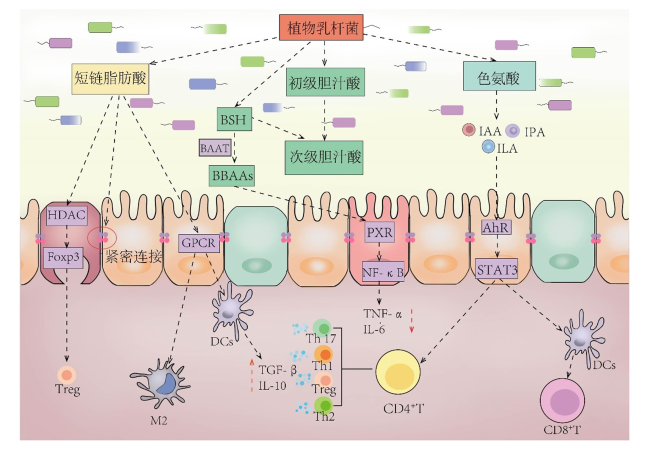
植物乳杆菌不仅可通过增强肠道屏障功能、调节免疫反应、优化菌群组成等方式改善肠道环境,还能与肠道微生物代谢产物协同发挥调控功能,进一步参与维持肠道稳态。这些代谢产物包括SCFAs、胆汁酸(bile acids,BAs)和色氨酸等,它们可通过激活G蛋白偶联受体(G-protein-coupled receptor,GPCR)和芳香烃受体(aryl hydrocarbon receptor,AhR)等信号分子,调控免疫细胞分化、炎症因子释放和肠道上皮细胞再生过程(图3)。
图3 植物乳杆菌与肠道微生物群代谢产物的协同作用

BSH:胆盐水解酶 bile salt hydrolase;BAAT:胆汁酸辅酶A:氨基酸N-酰基转移酶 bile acid coenzyme A: amino acid N-acyltransferase;BBAAs:细菌胆汁酸酰胺 bacterial bile acid amidates;HDAC:组蛋白脱乙酰酶 histone deacetylase;Foxp3:叉头框蛋白P3 forkhead box P3;GPCR:G蛋白偶联受体 G-protein-coupled receptor;PXR:孕烷X受体 pregnane X receptor;AhR:芳香烃受体 aryl hydrocarbon receptor;STAT3:信号转导及转录激活因子3 signal transducer and activator of transcription 3;DCs:树突状细胞 dendritic cells;M2:M2型巨噬细胞 M2-type macrophage;TGF-β:转化生长因子-β transforming growth factor-β;IL-6:白细胞介素-6 interleukin-6;CD4+T:CD4+T细胞 CD4+ T cell;CD8+T:CD8+T细胞 CD8+ T cell;IAA:吲哚-3-乙酸 indole-3-acetic acid;IPA:吲哚-3-丙酸 indole-3-propionic acid;ILA:吲哚-3-乳酸 indole-3-lactic acid。

Fig.3 Synergistic effects of Lactiplantibacillus plantarum and metabolites of gut microbiota

2.1 SCFAs

SCFAs主要包括乙酸、丙酸和丁酸,是肠道菌群发酵膳食纤维等非消化性碳水化合物的代谢产物,在维持肠道稳态、调节能量代谢及免疫功能方面发挥重要作用。SCFAs的产生源于肠道内多种微生物类群,包括厚壁菌门(Firmicutes)、拟杆菌门(Bacteroidetes)、放线菌门(Actinobacteria)和疣微菌门(Verrucomicrobia)等菌群。其中,厚壁菌门成员(尤其是梭菌纲)被认为是最高效的丁酸生产者[26]。研究显示,结肠内丁酸含量下降或其吸收受阻可能与结肠癌的早期发生发展相关[27]。在体外共培养体系中,植物乳杆菌CO502可通过产生乳酸和乙酸为酪丁酸梭菌(Clostridium tyrobutyricum)提供底物,显著促进丁酸合成,使其产量提高至单菌培养的4.58倍[28]。此外,植物乳杆菌FP37、FP38和FP48能够以菌株依赖的代谢方式产生丁酸,其中FP48是脂肪底物中产丁酸能力最强的菌株[29]。另有研究表明,植物乳杆菌ZJ316可增加葡聚糖硫酸钠(DSS)诱导结肠炎小鼠肠道中产丁酸菌[如粪杆菌属(Faecalibacterium)、阿加索杆菌属(Agathobacter)和罗氏菌属]的丰度,进而提升肠道SCFAs含量、优化菌群结构并缓解炎症反应[30]。SCFAs含量降低不仅会削弱肠道黏膜的保护屏障功能,还可能导致B细胞分化障碍及调节性T细胞(regulatory T cell,Treg)数量下降,从而影响免疫耐受的建立[31]。SCFAs对淋巴细胞具有特异性调控作用,可增强T细胞的活性,促进肠道免疫平衡与免疫耐受形成。具体而言,SCFAs通过激活G蛋白偶联受体109A(GPR109A)及抑制组蛋白脱乙酰酶(histone deacetylase,HDAC)活性,减少巨噬细胞中TNF-α、IL-6等促炎细胞因子的分泌,促进其向抗炎表型转换;同时降低树突状细胞表面主要组织相容性复合体Ⅱ类(MHC-Ⅱ)及分化簇80(CD80)/分化簇86(CD86)的表达,减少辅助性T细胞1(Th1)和辅助性T细胞17(Th17)的极化;此外,SCFAs还可通过HDAC的抑制作用上调叉头框蛋白P3(FoxP3)的表达,增强Treg分化并促进IL-10分泌,从而维持肠道免疫平衡[32]

2.2 胆汁酸

胆汁酸由肝脏以胆固醇为原料通过酶促反应合成,可分为初级胆汁酸和次级胆汁酸。胆汁酸除参与脂质代谢外,还在调节肠道免疫、炎症反应及微生物群落结构中发挥重要作用[33]。初级胆汁酸由肝细胞合成后,以甘氨酸或牛磺酸结合物(结合胆汁酸)的形式排入肠道;进入结肠后,初级胆汁酸可作为底物被肠道微生物转化为次级胆汁酸。若粪便中结合胆汁酸水平升高而次级胆汁酸水平降低,通常提示肠道菌群功能紊乱。体外试验证实,植物乳杆菌GR-4能够水解牛磺鹅脱氧胆酸和甘氨鹅脱氧胆酸2种结合胆汁酸,表明其具有高效的胆汁酸去结合能力;同时,该菌株可显著增加肠道中与胆汁酸代谢相关有益菌的丰度,如乳杆菌属、罗氏菌属和布劳特氏菌属(Blautia)等,而这类菌群丰度的增加可增强胆汁盐水解酶(bile salt hydrolase,BSH)活性,促进胆汁酸的去结合来缓解溃疡性结肠炎[34]。此外,植物乳杆菌DGIA1也被证实具有BSH合成能力[35]。BSH不仅能够水解结合胆汁酸,还具有与胆汁酸辅酶A:氨基酸N-酰基转移酶(bile acid coenzyme A:amino acid N-acyltransferase,BAAT)类似的酰基转移活性,能够以不依赖辅酶A的方式催化胺类与胆汁酸结合形成细菌胆汁酸酰胺(bacterial bile acid amidates,BBAAs)[36]。BBAAs在胃肠道中广泛存在,并与炎症性肠病(inflammatory bowel disease,IBD)有关。另有研究表明,次级胆汁酸3β-羟基脱氧胆酸也可通过作用于树突状细胞促进Treg的分化,进而增强肠道的免疫耐受性[37]。Prete等[38]从发酵食品中分离出来的植物乳杆菌同样具有BSH活性,能够解离甘氨酸结合型胆汁酸,生成游离胆汁酸。然而,大多数次级胆汁酸长期高浓度积累对肠道具有潜在危害,其异常蓄积通常与高脂饮食、肠道菌群失衡及胆汁酸排泄障碍密切相关。研究表明,植物乳杆菌能抑制参与胆汁酸生物转化的关键细菌——梭菌属(Clostridium)的增殖[39],并通过调节肠道中乳杆菌属、巨球型菌属(Megasphaera)和柯林斯菌属(Collinsella)等菌群的丰度,减少次级胆汁酸的产生,优化胆汁酸代谢谱[40]。总之,植物乳杆菌通过调节BSH酶活性和肠道菌群介入胆汁酸转化过程,重塑胆汁酸代谢通路,并通过激活孕烷X受体(pregnane X receptor,PXR)、AhR等核受体通路实现免疫平衡和屏障保护效应。

2.3 色氨酸

色氨酸主要来源于食物摄入,亦可通过宿主细胞与肠道微生物的协同代谢产生,其在肠道中有3条代谢途径,分别为犬尿氨酸途径、5-羟色胺途径以及吲哚途径。其中,吲哚途径可将色氨酸转化为吲哚及其衍生物,如吲哚-3-乙酸(IAA)、吲哚-3-丙酸(IPA)、吲哚-3-乳酸(ILA)等,这类化合物可作为AhR的天然配体,激活AhR及抑制NF-κB信号通路,促进白细胞介素-22(IL-22)分泌,减少促炎因子表达,进而调节肠道免疫[41]。ILA作为色氨酸的重要代谢物,在维持肠道健康和免疫调节中发挥关键作用。研究表明,ILA不仅能预防肠道炎症,还可通过增强参与色氨酸代谢的细菌酶表达,逆转肠道菌群失调,进而促进IPA、IAA等其他有益吲哚衍生物的合成;同时,ILA能增加有益菌群数量并减少有害细菌增殖,例如补充ILA可提高梭状芽孢杆菌等色氨酸代谢菌的丰度[42]。此外,植物乳杆菌ZJ316产生的ILA衍生物,还对沙门氏菌、葡萄球菌(Staphylococcus)、大肠杆菌及单核细胞增生李斯特氏菌(Listeria monocytogenes)等食源性病原体具有抑制作用[43]。AhR的激活可促进肠道上皮内CD4+CD8αα+T细胞的发育,进而抑制炎症的发生[44]。植物乳杆菌DPUL-S164可通过代谢ILA,激活AhR/核因子E2相关因子2(nuclear factor erythroid 2-related factor 2,Nrf2)信号通路,显著改善肠道屏障功能并减轻炎症反应[45]。色氨酸及其代谢物还可介导多种免疫调节反应,例如植物乳杆菌及其代谢产物ILA能增加白细胞介素-12a(IL-12a)的产生,促进树突状细胞成熟,进而激活CD8+T细胞的抗肿瘤活性[46]。植物乳杆菌KLDS 1.0386是一种具有高色氨酸代谢活性的菌株,可产生IAA,进一步上调AhR的表达,激活STAT3信号通路,抑制炎性细胞因子的产生[47]

3 植物乳杆菌在畜牧业生产上的应用

3.1 提升发酵饲料品质

植物乳杆菌作为极具应用潜力的替抗饲料添加剂,在畜牧业生产中已被广泛研究。其在提升饲料消化利用率、改善饲料营养价值方面的作用机制具有多维度特性,主要涉及肠道微生物调控、营养成分强化及代谢产物优化等途径。研究表明,在高水分苋菜青贮饲料发酵中,添加植物乳杆菌可显著改变微生物群落结构,提高了植物乳杆菌和布氏扁豆乳杆菌(Lactobacillus buchneri)的丰度,同时抑制了阴沟肠杆菌(Enterobacter cloacae)和酪丁酸梭菌的生长,并完全消除了米黄单胞菌(Xanthomonas oryzae)[48]。作为典型的同型发酵乳酸菌,植物乳杆菌在发酵过程中能高效代谢碳水化合物,产生的有机酸可显著降低饲料pH,构建强酸性微环境以抑制病原菌(如大肠菌群、梭菌属)增殖;该机制不仅能减少有害微生物数量,还可抑制真菌生长,进而提升青贮饲料的有氧稳定性、延长保质期并改善饲料整体品质[49-50]。而基因工程改造获得的重组菌株(如植物乳杆菌LP11AG)通过表达外源糖苷水解酶,可分解纤维素和半纤维素,释放更多可发酵糖,使高温(40 ℃)条件下苜蓿青贮的水溶性碳水化合物(water-soluble carbohydrates,WSC)含量显著提升至155%[51]。此外,植物乳杆菌通过与其他微生物的协同发酵作用,能够充分发挥菌种间的优势互补效应,相较于单一菌种发酵,可更显著地提升饲料品质。Wu等[52]研究表明,酿酒酵母(Saccharomyces cerevisiae)和植物乳杆菌协同发酵饲料能增加粗蛋白质含量,同时降低中性洗涤纤维和酸性洗涤纤维含量,从而有效提高饲料品质。值得注意的是,协同发酵还能上调甘氨酸/丝氨酸/苏氨酸代谢途径、蛋白质消化吸收途径及氨酰基-tRNA生物合成途径的代谢产物表达,这一变化不仅提高了发酵饲料的营养水平,还有助于调节动物瘤胃微生态环境,进一步增强饲料的消化利用率。

3.2 防范疾病发生

IBD是一种慢性非特异性肠道炎症性疾病,主要包括溃疡性结肠炎和克罗恩病,其发病与全身炎症反应密切相关[53]。Wu等[54]研究发现,植物乳杆菌可通过抑制肠道上皮细胞的凋亡,缓解IBD小鼠模型的疾病症状,这一保护作用依赖于肠道细胞对植物乳杆菌衍生的LpEVs的有效摄取。Zang等[55]的研究证实,植物乳杆菌LR002能通过减少促炎因子分泌、增强TJ蛋白表达及调节肠道微生物群结构,显著缓解小鼠溃疡性结肠炎症状。坏死性肠炎是家禽养殖中由产气荚膜梭菌(Clostridium perfringens)引发的常见肠道疾病。植物乳杆菌HW1可通过改善肠道免疫反应和降低盲肠中产气荚膜梭菌、沙门氏菌、大肠杆菌和金黄色葡萄球菌(Staphylococcus aureus)数量,有效减轻坏死性肠炎引起的肉鸡肠道损伤[56]。ETEC是引起犊牛和仔猪腹泻的主要病原菌之一。植物乳杆菌可缓解ETEC所致仔猪肠道损伤,改善ETEC引起的日增重下降和空肠形态结构异常,显著提升有益代谢物磷脂酰乙醇胺和紫松果黄素的含量。此外,其还可通过调控WNT信号通路调节因子(LBH)和核糖核酸酶A家族成员1(RNASE1)等基因表达,减轻腹泻症状、修复肠道损伤并增强免疫功能[57]。抗生素相关性腹泻(antibiotic-associated diarrhea,AAD)是指因使用抗生素引发的原因不明性腹泻。植物乳杆菌ELF051可通过改善肠道组织形态、调节炎性细胞因子水平、增加结肠中SCFAs的产生和调节肠道微生物群,同时抑制TLR4/MyD88/NF-κB和磷脂酰肌醇3-激酶(phosphatidylinositol 3-kinase,PI3K)/蛋白激酶B(protein kinase B,AKT)/NF-κB信号通路,缓解AAD炎症反应[58]。华文静等[59]对一株产抗奶牛乳房炎主要病原菌细菌素的植物乳杆菌MX1进行全基因组序列分析,挖掘其功能特性相关基因,发现该菌株含有多种细菌素合成相关基因,为开发新型替抗产品用于奶牛乳房炎的防治提供了理论基础。上述研究表明,植物乳杆菌作为益生菌,在疾病预防中可发挥关键作用,且能减少抗生素的使用。

4 小结与展望

植物乳杆菌通过增强肠道屏障功能、调节免疫反应、优化菌群组成以及与肠道微生物代谢产物协同作用,在肠道健康维护及疾病预防方面,尤其在抗生素替代应用中展现出巨大潜力。目前,相关研究多集中于应用效果的实证验证,而对其作用机制的解析仍较为零散,缺乏系统性认知。例如,在不同宿主或应激状态下,植物乳杆菌如何精确调控转录因子、免疫通路及代谢协同效应尚不清楚,且缺乏多组学整合分析;同时,多数研究未充分考虑菌株间遗传背景的差异,导致菌株异质性的影响被忽视。因此,未来研究需明确不同植物乳杆菌菌株调控免疫细胞活性与炎症信号通路的关键机制与作用靶点;并结合基因编辑与高通量功能筛选技术,构建具有特定屏障修复或免疫调节功能的工程菌株,实现个性化菌株和多菌株复合剂的开发,以促进植物乳杆菌在畜牧领域中的精准应用与可持续发展。
[1]
ZHENG J S, WITTOUCK S, SALVETTI E, et al. A taxonomic note on the genus Lactobacillus:description of 23 novel genera,emended description of the genus Lactobacillus Beijerinck 1901,and union of Lactobacillaceae and Leuconostocaceae[J]. International Journal of Systematic and Evolutionary Microbiology, 2020, 70(4):2782-2858.

DOI

[2]
YILMAZ B, BANGAR S P, ECHEGARAY N, et al. The impacts of Lactiplantibacillus plantarum on the functional properties of fermented foods:a review of current knowledge[J]. Microorganisms, 2022, 10(4):826.

DOI

[3]
DARMASTUTI A, HASAN P N, WIKANDARI R, et al. Adhesion properties of Lactobacillus plantarum Dad-13 and Lactobacillus plantarum Mut-7 on Sprague Dawley rat intestine[J]. Microorganisms, 2021, 9(11):2336.

DOI

[4]
GUO Q, WANG G A, ZHENG L J, et al. A WYL domain transcription factor regulates Lactiplantibacillus plantarum intestinal colonization via perceiving c-di-GMP[J]. Nature Communications, 2025, 16(1):2193.

DOI

[5]
EFSA Panel on Additives and Products or Substances used in Animal Feed (FEEDAP). Assessment of the feed additive consisting of Lactiplantibacillus plantarum DSM 18114 for all animal species for the renewal of its authorisation (Pioneer Hi-Bred International,Inc.)[J]. EFSA Journal, 2024, 22(5):e8767.

[6]
CHEN K Y, WANG H, YANG Y Y, et al. Common mechanisms of gut microbe-based strategies for the treatment of intestine-related diseases:based on multi-target interactions with the intestinal barrier[J]. Cell Communication and Signaling, 2025, 23(1):288.

DOI

[7]
WANG J, ZENG Y X, WANG S X, et al. Swine-derived probiotic Lactobacillus plantarum inhibits growth and adhesion of enterotoxigenic Escherichia coli and mediates host defense[J]. Frontiers in Microbiology, 2018,9:1364.

[8]
AYYAT M S, EL-NAGAR H A, WAFA W M, et al. Comparable evaluation of nutritional benefits of Lactobacillus plantarum and Bacillus toyonensis probiotic supplementation on growth,feed utilization,health,and fecal microbiota in pre-weaning male calves[J]. Animals, 2023, 13(21):3422.

DOI

[9]
YU J, ZUO B, LI Q, et al. Dietary supplementation with Lactiplantibacillus plantarum P-8 improves the growth performance and gut microbiota of weaned piglets[J]. Microbiology Spectrum, 2024, 12(2):e0234522.

DOI

[10]
WU S R, LIU Y L, DUAN Y L, et al. Intestinal toxicity of deoxynivalenol is limited by supplementation with Lactobacillus plantarum JM113 and consequentially altered gut microbiota in broiler chickens[J]. Journal of Animal Science and Biotechnology, 2018, 9(1):74.

DOI

[11]
WU Y Q, JHA R, LI A, et al. Probiotics (Lactobacillus plantarum HNU082) supplementation relieves ulcerative colitis by affecting intestinal barrier functions,immunity-related gene expression,gut microbiota,and metabolic pathways in mice[J]. Microbiology Spectrum, 2022, 10(6):e0165122.

DOI

[12]
LIU Y, YU X J, ZHAO J X, et al. The role of MUC2 mucin in intestinal homeostasis and the impact of dietary components on MUC2 expression[J]. International Journal of Biological Macromolecules, 2020,164:884-891.

[13]
VAN DER SLUIS M, DE KONING B A E,DE BRUIJN A C J M, et al. Muc2-deficient mice spontaneously develop colitis,indicating that MUC2 is critical for colonic protection[J]. Gastroenterology, 2006, 131(1):117-129.

DOI

[14]
CHEN Z J, LUO J L, LI J, et al. FOXO1 controls gut homeostasis and commensalism by regulating mucus secretion[J]. Journal of Experimental Medicine, 2021, 218(9):e20210324.

DOI

[15]
WATANABE-YASUOKA Y, GOTOU A, SHIMIZU S, et al. Lactiplantibacillus plantarum OLL2712 induces autophagy via MyD88 and strengthens tight junction integrity to promote the barrier function in intestinal epithelial cells[J]. Nutrients, 2023, 15(12):2655.

DOI

[16]
GÓRECKA A, JURA-PÓŁTORAK A, KOŹMA E M, et al. Biochemical modulators of tight junctions (TJs):occludin,claudin-2 and zonulin as biomarkers of intestinal barrier leakage in the diagnosis and assessment of inflammatory bowel disease progression[J]. Molecules, 2024,29(19):4577.

[17]
ANDERSON R C, COOKSON A L, MCNABB W C, et al. Lactobacillus plantarum MB452 enhances the function of the intestinal barrier by increasing the expression levels of genes involved in tight junction formation[J]. BMC Microbiology, 2010,10:316.

[18]
KARCZEWSKI J, TROOST F J, KONINGS I, et al. Regulation of human epithelial tight junction proteins by Lactobacillus plantarum in vivo and protective effects on the epithelial barrier[J]. American Journal of Physiology:Gastrointestinal and Liver Physiology, 2010, 298(6):G851-G859.

[19]
ZHANG X, LI Y, ZHANG C, et al. Postbiotics derived from Lactobacillus plantarum 1.0386 ameliorate lipopolysaccharide-induced tight junction injury via microRNA-200c-3p mediated activation of the MLCK-MLC pathway in Caco-2 cells[J]. Food & Function, 2022, 13(21):11008-11020.

[20]
DEMPSEY E, CORR S C. Lactobacillus spp.for gastrointestinal health:current and future perspectives[J]. Frontiers in Immunology, 2022,13:840245.

[21]
CUFARO M C, PRETE R, MARCO F D, et al. A proteomic insight reveals the role of food-associated Lactiplantibacillus plantarum C9O4 in reverting intestinal inflammation[J]. iScience, 2023, 26(12):108481.

DOI

[22]
张露婷, 刘榉元, 孔淑文, 等. 植物乳杆菌脂磷壁酸对小鼠肠炎的作用及其机制[J]. 食品科学技术学报, 2025, 43(1):44-54.

ZHANG L T, LIU J Y, KONG S W, et al. Effects of lipoteichoic acid from Lactobacillus plantarum on inflammatory bowel disease in mice and its mechanism[J]. Journal of food science and technology, 2025, 43(1):44-54. (in Chinese)

[23]
ZHANG S H, SHAN X, QU G L, et al. Lactiplantibacillus plantarum extracellular vesicles exert anti-PEDV effects through STING-dependent autophagy[J]. BMC Microbiology, 2025, 25(1):271.

DOI

[24]
XU L, ZHOU J, QU G, et al. Recombinant lactobacillin PlnK adjusts the gut microbiome distribution in broilers[J]. British Poultry Science, 2020, 61(4):390-399.

DOI PMID

[25]
BETANCUR C, MARTÍNEZ Y, MERINO-GUZMAN R, et al. Evaluation of oral administration of Lactobacillus plantarum CAM6 strain as an alternative to antibiotics in weaned pigs[J]. Animals, 2020, 10(7):1218.

DOI

[26]
SHIN Y, HAN S H, KWON J, et al. Roles of short-chain fatty acids in inflammatory bowel disease[J]. Nutrients, 2023, 15(20):4466.

DOI

[27]
KURATA N, TOKASHIKI N, FUKUSHIMA K, et al. Short chain fatty acid butyrate uptake reduces expressions of prostanoid EP4 receptors and their mediation of cyclooxygenase-2 induction in HCA-7 human colon cancer cells[J]. European Journal of Pharmacology, 2019,853:308-315.

[28]
ZHOU Z P, WANG X Y, DUAN C Y, et al. A synergistic fermentation system of probiotics with low-cost and high butyric acid production:Lactiplantibacillus plantarum and Clostridium tyrobutyricum[J]. Food Bioscience, 2024,62:105152.

[29]
AIELLO A, PIZZOLONGO F, DE LUCA L, et al. Production of butyric acid by different strains of Lactobacillus plantarum (Lactiplantibacillus plantarum)[J]. International Dairy Journal, 2023,140:105589.

[30]
GU Q, XIA C L, LIU N N, et al. Lactobacillus plantarum ZJ316 alleviates ulcerative colitis by inhibiting inflammation and regulating short-chain fatty acid levels and the gut microbiota in a mouse model[J]. Food & Function, 2023, 14(9):3982-3993.

[31]
HUANG C L, HAO W J, WANG X Y, et al. Probiotics for the treatment of ulcerative colitis:a review of experimental research from 2018 to 2022[J]. Frontiers in Microbiology, 2023,14:1211271.

[32]
KIM C H. Control of lymphocyte functions by gut microbiota-derived short-chain fatty acids[J]. Cellular & Molecular Immunology, 2021, 18(5):1161-1171.

[33]
LEE M H, NUCCIO S P, MOHANTY I, et al. How bile acids and the microbiota interact to shape host immunity[J]. Nature Reviews Immunology, 2024, 24(11):798-809.

DOI PMID

[34]
FAN J J, JIN W L, SU S C, et al. A probiotic targets bile acids metabolism to alleviate ulcerative colitis by reducing conjugated bile acids[J]. Molecular Nutrition & Food Research, 2024, 68(7):e2300731.

[35]
HERNÁNDEZ-GÓMEZ J G, LÓPEZ-BONILLA A, TREJO-TAPIA G, et al. In vitro bile salt hydrolase (BSH) activity screening of different probiotic microorganisms[J]. Foods, 2021, 10(3):674.

DOI

[36]
RIMAL B, COLLINS S L, TANES C E, et al. Bile salt hydrolase catalyses formation of amine-conjugated bile acids[J]. Nature, 2024, 626(8000):859-863.

DOI

[37]
CAMPBELL C, MCKENNEY P T, KONSTANTINOVSKY D, et al. Bacterial metabolism of bile acids promotes generation of peripheral regulatory T cells[J]. Nature, 2020, 581(7809):475-479.

DOI

[38]
PRETE R, LONG S L, GALLARDO A L, et al. Beneficial bile acid metabolism from Lactobacillus plantarum of food origin[J]. Scientific Reports, 2020, 10(1):1165.

DOI

[39]
MONTEIRO C R A V, DO CARMO M S, MELO B O, et al. In vitro antimicrobial activity and probiotic potential of Bifidobacterium and Lactobacillus against species of Clostridium[J]. Nutrients, 2019, 11(2):448.

DOI

[40]
LIN S, YANG X M, LONG Y R, et al. Dietary supplementation with Lactobacillus plantarum modified gut microbiota,bile acid profile and glucose homoeostasis in weaning piglets[J]. British Journal of Nutrition, 2020, 124(8):797-808.

DOI

[41]
LI H Y, PAN M, LI Y F, et al. New targets for the treatment of ulcerative colitis:gut microbiota and its metabolites[J]. Computational and Structural Biotechnology Journal, 2025,27:1850-1863.

[42]
WANG G, FAN Y X, ZHANG G L, et al. Microbiota-derived indoles alleviate intestinal inflammation and modulate microbiome by microbial cross-feeding[J]. Microbiome, 2024, 12(1):59.

DOI PMID

[43]
ZHOU Q Q, XIE Z R, WU D L, et al. The effect of indole-3-lactic acid from Lactiplantibacillus plantarum ZJ316 on human intestinal microbiota in vitro[J]. Foods, 2022, 11(20):3302.

DOI

[44]
AHERN P P, MALOY K J. Understanding immune-microbiota interactions in the intestine[J]. Immunology, 2020, 159(1):4-14.

DOI PMID

[45]
WANG A R, GUAN C, WANG T Q, et al. Indole-3-lactic acid,a tryptophan metabolite of Lactiplantibacillus plantarum DPUL-S164,improved intestinal barrier damage by activating AhR and Nrf2 signaling pathways[J]. Journal of Agricultural and Food Chemistry, 2023, 71(48):18792-18801.

DOI

[46]
ZHANG Q Q, ZHAO Q, LI T, et al. Lactobacillus plantarum-derived indole-3-lactic acid ameliorates colorectal tumorigenesis via epigenetic regulation of CD8+ T cell immunity[J]. Cell Metabolism, 2023, 35(6):943-960.e9.

DOI

[47]
SHI J L, DU P, XIE Q G, et al. Protective effects of tryptophan-catabolizing Lactobacillus plantarum KLDS 1.0386 against dextran sodium sulfate-induced colitis in mice[J]. Food & Function, 2020, 11(12):10736-10747.

[48]
ZHAO M Q E, WANG Z J, DU S, et al. Lactobacillus plantarum and propionic acid improve the fermentation quality of high-moisture amaranth silage by altering the microbial community composition[J]. Frontiers in Microbiology, 2022,13:1066641.

[49]
CHEN J, MOU L Y, WANG L, et al. Mixed Bacillus subtilis and Lactiplantibacillus plantarum-fermented feed improves gut microbiota and immunity of Bamei piglet[J]. Frontiers in Microbiology, 2024,15:1442373.

[50]
PENG W, ZHANG L Y, WEI M L, et al. Effects of Lactobacillus plantarum (L) and molasses (M) on nutrient composition,aerobic stability,and microflora of alfalfa silage in sandy grasslands[J]. Frontiers in Microbiology, 2024,15:1358085.

[51]
GUO J G, XIE Y X, YU Z, et al. Effect of Lactobacillus plantarum expressing multifunctional glycoside hydrolases on the characteristics of alfalfa silage[J]. Applied Microbiology and Biotechnology, 2019, 103(19):7983-7995.

DOI

[52]
WU X, WANG S Y, TIAN J J, et al. Effects of Lactobacillus plantarum and Saccharomyces cerevisiae on rumen fermentation parameters,microbial diversity and metabolites of fermented feed in vitro[J]. Animal Feed Science and Technology, 2025,325:116366.

[53]
SAEZ A, HERRERO-FERNANDEZ B, GOMEZ-BRIS R, et al. Pathophysiology of inflammatory bowel disease:innate immune system[J]. International Journal of Molecular Sciences, 2023, 24(2):1526.

DOI

[54]
WU Y Y, HUANG X Y, LI Q B, et al. Reducing severity of inflammatory bowel disease through colonization of Lactiplantibacillus plantarum and its extracellular vesicles release[J]. Journal of Nanobiotechnology, 2025, 23(1):227.

DOI

[55]
ZANG R X, ZHOU R, LI Y D, et al. The probiotic Lactobacillus plantarum alleviates colitis by modulating gut microflora to activate PPARγ and inhibit MAPKs/NF-κB[J]. European Journal of Nutrition, 2024, 64(1):32.

DOI

[56]
CHEN P, LV H M, LIU W Y, et al. Effects of Lactobacillus plantarum HW1 on growth performance,intestinal immune response,barrier function,and cecal microflora of broilers with necrotic enteritis[J]. Animals, 2023, 13(24):3810.

DOI

[57]
HAN X B, GAO R, DING S J, et al. Lactobacillus plantarum and Lactobacillus brevis alleviate enterotoxigenic Escherichia coli-induced intestinal inflammation and stabilize intestinal microorganisms and serum metabolites in piglets[J]. Animal Nutrition, 2025,22:165-178.

[58]
LIANG W, GAO Y S, ZHAO Y J, et al. Lactiplantibacillus plantarum ELF051 alleviates antibiotic-associated diarrhea by regulating intestinal inflammation and gut microbiota[J]. Probiotics and Antimicrobial Proteins, 2024, 16(6):1996-2006.

DOI

[59]
华文静, 李文洁, 刘咪咪, 等. 一株产细菌素植物乳杆菌MX1的全基因组测序分析[J]. 家畜生态学报, 2025, 46(1):44-49.

HUA W J, LI W J, LIU M M, et al. Complete genome sequencing analysis of a bacteriocin-producing Lactobacillus plantarum MX1[J]. Acta Ecologae Animalis Domastici, 2025, 46(1):44-49. (in Chinese)

文章导航

/