研究论文

饲粮添加韭菜籽黄酮对湖羊复胃菌群的影响及胃肠道菌群演替的整合分析

  • 赵箐 , 1 ,
  • 孙旭春 2 ,
  • 马友记 , 1, *
展开
  • 1 甘肃农业大学动物科学技术学院, 兰州 730070
  • 2 临夏回族自治州畜牧技术推广站, 临夏 731100
* 马友记,教授,博士生导师,E-mail:

赵 箐(2000—),女,辽宁凌海人,硕士研究生,从事羊生产学研究。E-mail:

Office editor: 田艳明

收稿日期: 2025-11-16

  网络出版日期: 2026-06-13

基金资助

甘肃省农业农村厅种业攻关项目(ZYGG-2025-1)

甘肃省农业农村厅种业攻关项目(ZYGG-2026-04)

Effects of Dietary Supplementation with Chinese Chive Seed Flavonoids on Compound Stomach Microbiota and Integrated Analysis of Microbial Succession along Gastrointestinal Tract of Hu Sheep

  • ZHAO Qing , 1 ,
  • SUN Xuchun 2 ,
  • MA Youji , 1, *
Expand
  • 1 College of Animal Science and Technology, Gansu Agricultural University, Lanzhou 730070, China
  • 2 Animal Husbandry Technology Extending Stations of Linxia Hui Autonomous Prefecture, Linxia 731100, China
* professor, E-mail:

Received date: 2025-11-16

  Online published: 2026-06-13

摘要

本试验旨在探究饲粮添加韭菜籽黄酮对湖羊复胃发酵特性的影响,并结合胃肠道视角解析菌群的空间演替规律。选取20只体重[(19.56±1.59) kg]相近的3月龄湖羊公羔,随机分为2组,每组10个重复,每个重复1只。对照组饲喂基础饲粮,试验组在饲喂基础饲粮的基础上添加0.24%韭菜籽黄酮。预试期7 d,正试期90 d。结果表明:1)饲粮添加韭菜籽黄酮显著提高湖羊干物质采食量(P<0.05),但对终末体重、平均日增重和料重比无显著影响(P>0.05)。2)在瘤胃发酵参数方面,试验组瘤胃总挥发性脂肪酸以及丙酸、丁酸、异戊酸和戊酸含量均显著高于对照组(P<0.05)。3)胃肠道菌群分析显示,在门水平上,与对照组相比,试验组复胃各胃室螺旋体门(Spirochaetota)相对丰度显著提高(P<0.05),且在瓣胃和皱胃中特异性检出奇异球菌门(Deinococcota)和蛭弧菌门(Bdellovibrionota);试验组十二指肠黏细菌门(Myxococcota)、空肠酸杆菌门(Acidobacteriota)和直肠硝化螺旋菌门(Nitrospirota)相对丰度显著提高(P<0.05)。在属水平上,与对照组相比,试验组复胃中瘤胃球菌属(Ruminococcus)和纤维杆菌属(Fibrobacter)等纤维分解菌显著富集(P<0.05)。线性判别分析(LDA)效应大小(LEfSe)分析(LDA>4)揭示,复胃内主要富集差异菌群为鞘氨醇杆菌属(Sphingobacterium)、密螺旋体属(Treponema)和普雷沃氏菌属(Prevotella),肠道内主要富集差异菌群为拟杆菌属(Bacteroides)、芽孢杆菌属(Bacillus)和双歧杆菌属(Bifidobacterium)等。综上所述,饲粮添加韭菜籽黄酮能优化湖羊胃肠道菌群结构,改善瘤胃发酵模式,进而改善其养分摄入及机体代谢稳态。

本文引用格式

赵箐 , 孙旭春 , 马友记 . 饲粮添加韭菜籽黄酮对湖羊复胃菌群的影响及胃肠道菌群演替的整合分析[J]. 动物营养学报, 2026 , 38(6) : 4377 -4389 . DOI: 10.12418/CJAN2026.351

Abstract

This experiment was conducted to investigate the effects of dietary supplementation with Chinese chive seed flavonoids on the fermentation characteristics of compound stomach of Hu sheep, while elucidating the spatial succession patterns of microbiota from the perspective of gastrointestinal tract. Twenty 3-month-old male Hu sheep with a similar body weight of (19.56±1.59) kg were selected and randomly divided into 2 groups, with 10 replicates in each group and 1 lamb in each replicate. The control group was fed a basal diet, while the experimental group was fed the basal diet supplemented with 0.24% Chinese chive seed flavonoids. The pre-test period lasted for 7 days, followed by a main experimental period of 90 days. The results showed as follows: 1) dietary supplementation with Chinese chive seed flavonoids significantly increased the dry matter intake of Hu sheep (P<0.05), while no significant differences were observed in final body weight, average daily gain and feed to gain ratio (P>0.05). 2) Regarding the rumen fermentation parameters, the contents of total volatile fatty acids, propionic acid, butyric acid, isovaleric acid and valeric acid in rumen in the experimental group were significantly higher than those in the control group (P<0.05). 3) Analysis of the gastrointestinal microbiota revealed that, at the phylum level, compared with the control group, the Spirochaetota relative abundance in all compartments of compound stomach in the experimental group was significantly increased (P<0.05). Notably, Deinococcota and Bdellovibrionota were specifically detected in the omasum and abomasum in the experimental group. Furthermore, the relative abundances of Myxococcota in duodenum, Acidobacteriota in jejunum, and Nitrospirota in rectum in the experimental group were significantly increased (P<0.05). At the genus level, compared with the control group, the cellulolytic bacteria such as Ruminococcus and Fibrobacter in compound stomach in the experimental group were significantly enriched (P<0.05). Linear discriminant analysis (LDA) effect size (LEfSe) analysis (LDA>4) revealed that the differentially enriched genera in the compound stomach primarily included Sphingobacterium, Treponema and Prevotella, while Bacteroides, Bacillus and Bifidobacterium were the predominant enriched genera in the intestinal segments. In conclusion, dietary supplementation with Chinese chive seed flavonoids can optimize the gastrointestinal microbiota structure, improve the rumen fermentation pattern, and thereby enhance the nutrient intake and metabolic homeostasis of Hu sheep.

韭菜作为一种百合科葱属的多年生植物,具有极强的耐寒性[1]。研究表明,葱属植物含有丰富的生物活性成分,包括黄酮、多糖、多酚及槲皮素等[2],这些成分在生物体内展现出显著的抗氧化、抗菌及免疫调节特性[3]。韭菜籽是韭菜成熟后的干燥种子,其主要活性成分涵盖含硫化合物、甾体皂苷及黄酮类物质等[4-6]。其中,黄酮类化合物作为重要的植物次生代谢产物,通过调节机体免疫、抑制病原菌生长及清除自由基等多重途径维系生物体健康[7]。在反刍动物生产中,植物黄酮的生物学效应已得到初步证实。饲粮添加柑橘类黄酮可优化羔羊瘤胃菌群结构,并调节瘤胃上皮的发育状态[8]。此外,柑橘类黄酮能增强奶牛的抗氧化能力并改善泌乳性能[9];槲皮素可改善肉牛瘤胃的发酵参数,并提高有益菌的相对丰度[10];黄芩黄酮则通过调控胃肠道菌群,对奶牛生产性能产生积极影响[11]。这些研究表明了植物黄酮在调节反刍动物瘤胃发酵和微生物稳态方面的巨大潜力。尽管韭菜籽黄酮具有多重的生物活性,但目前关于其在湖羊生产中的应用研究仍较少,其对湖羊全消化道(包括复胃各室及肠道)微生物群落的系统性影响尚未得到充分阐明。因此,本研究旨在探究饲粮添加韭菜籽黄酮对湖羊生长性能、瘤胃发酵参数及胃肠道菌群的影响,不仅为韭菜籽黄酮在湖羊生产中的应用提供基础数据,也为深入解析植物黄酮调节反刍动物消化道微生态平衡提供依据。

1 材料与方法

1.1 试验材料

试验所用韭菜籽黄酮为市购产品,其中总黄酮含量>80%。经高效液相色谱(HPLC)检测,其主要活性成分包括山奈酚-3-O-芸香糖苷、山奈酚及槲皮素等黄酮类化合物。

1.2 试验设计

本试验于2024年7—11月在甘肃临夏州陇昇源农牧科技有限责任公司进行,湖羊公羔由该公司提供。试验所有动物的使用均遵循动物伦理和试验规程进行,并获得甘肃农业大学实验动物伦理委员会的批准(伦理批准编号:GSAU-AEW-2021-0017)。
试验选取20只健康状况良好、初始体重为(19.56±1.59) kg的3月龄湖羊公羔,随机分为2组,每组10个重复,每个重复1只。对照组饲喂基础饲粮,试验组在饲喂基础饲粮的基础上添加0.24%韭菜籽黄酮[以饲粮干物质(DM)为基础]。韭菜籽黄酮添加剂量参考前期预试验设定。基础饲粮参照《肉羊营养需要量》(NY/T 816—2021)[12]配制,其组成及营养水平见表1。预试期7 d,正试期90 d。
表1 基础饲粮组成及营养水平(干物质基础)

Table 1 Composition and nutrient levels of the basal diet (DM basis) %

项目 Items 含量 Content
原料 Ingredients
玉米 Corn 33.00
全株玉米青贮 Whole corn silage 22.00
苜蓿干草 Alfalfa hay 14.00
豆粕 Soybean meal 12.00
棉籽粕 Cottonseed meal 6.00
玉米胚芽粕 Corn germ meal 6.00
麦麸 Wheat bran 4.00
石粉 Limestone 1.20
小苏打 NaHCO3 0.90
食盐 NaCl 0.60
预混料 Premix1) 0.30
合计 Total 100.00
营养水平 Nutrient levels2)
干物质(风干基础) DM (air-dry basis) 89.20
粗蛋白质 CP 17.23
粗脂肪 EE 3.14
中性洗涤纤维 NDF 25.60
酸性洗涤纤维 ADF 16.14
钙 Ca 0.83
磷 P 0.42
代谢能 ME/(MJ/kg) 11.52

1)预混料为每千克饲粮提供 The premix provided the following per kg of the diet:VA 5 000 IU,VD 2 000 IU,VE 50 IU,Fe (as ferrous sulfate) 100 mg,Cu (as copper sulfate) 8.5 mg,Zn (as zinc sulfate) 65 mg,Se (as sodium selenite) 0.25 mg,I (as potassium iodide) 0.5 mg,Co 0.30 mg,Mn (as manganese sulfate) 40 mg。
2)代谢能为计算值,其余为实测值。ME was a calculated value, while the others were measured values.

1.3 饲养管理

试验开始前对圈舍进行彻底消毒,对试验羊打耳标,按流程注射疫苗,然后进行称重分栏。试验期间,每天07:00和18:00进行饲喂,饲喂期间羔羊自由采食和饮水,羊圈定期消毒。

1.4 测定指标及方法

1.4.1 饲粮营养水平

饲粮DM、粗蛋白质(CP)、粗脂肪(EE)、中性洗涤纤维(NDF)、酸性洗涤纤维(ADF)、钙和磷含量分别参照GB/T 6435—2014[13]、GB/T 6432—2018[14]、GB/T 6433—2006[15]、GB/T 20806—2022[16]、NY/T 1459—2022[17]、GB/T 13885—2017[18]和GB/T 6437—2018[19]中方法测定;代谢能(ME)依据《肉羊营养需要量》(NY/T 816—2021)[12]计算得出。

1.4.2 生长性能

试验期间每日记录饲粮饲喂量和次日饲喂前的剩余量,计算干物质采食量(DMI);分别于正试期第1、30、60和90天晨饲前对试验羊进行空腹称重,计算平均日增重(ADG),并计算料重比(F/G)。计算公式如下:
DMI(kg/d)=(每组日饲粮饲喂量×DM含量-每组日饲粮剩余量×DM含量)/每组试验羊只数;
ADG(kg/d)=(终末体重-初始体重)/试验天数;
F/G=DMI(kg/d)/ADG(kg/d)。
正试期结束时,试验羊断食12 h后进行屠宰,称量胴体重,并分别收集瘤胃、网胃、瓣胃、皱胃内容物,将其存储在2 mL冷冻管中,采用液氮快速冷冻的方式处理,随后转移至-80 ℃超低温冰箱中保存。

1.4.3 瘤胃发酵参数

采用气相色谱法测定瘤胃总挥发性脂肪酸(TVFA)及乙酸、丙酸、丁酸、异戊酸和戊酸含量。

1.4.4 复胃微生物区系

利用16S rRNA基因高通量测序技术评估复胃各胃室微生物区系。采用引物338F(5'-ACTCCTACGGGAGGCAGCAG-3')和806R(5'-GGACTACHVGGGTWTCTAAT-3')对16S rRNA基因的V3~V4可变区进行扩增。测序委托上海派森诺生物科技股份有限公司进行,利用Illumina NovaSeq 6000平台执行2×250 bp双端测序策略,产出序列已存入NCBI数据库(接受号:PRJNA1308815)。原始数据采用QIIME 2(2022.2)进行处理。首先利用VSEARCH插件对双端序列进行拼接(最小重叠长度10 bp,最大允许错配比例0.1),随后进行质量过滤(Q>20),剔除含有N碱基及长度异常的序列。针对嵌合体序列,采用UCHIME算法(de novo模式)进行识别并剔除。序列去冗余后,利用cluster_fast算法按照97%相似度阈值聚类生成操作分类单元(OTU)。物种分类标注基于Silva 138数据库,采用置信度阈值0.7的分类器进行鉴定。为确保统计严谨性并规避假阳性干扰,本研究执行了严格的丰度过滤,剔除总相对丰度低于0.005%的稀有OTU。基于此筛选后的OTU丰度表,按样本最小序列数执行平齐化抽样,并据此重新计算α多样性指数。

1.4.5 胃肠道菌群整合分析

为系统评估韭菜籽黄酮对湖羊胃肠道菌群空间分布的调节效应,将本试验实测的4个胃室数据与课题组前期已发表的6个肠道节段原始数据[20]进行整合。所有数据均在上述研究的统一生信Pipeline下重新解析,通过标准化的处理流程最大程度消除批次效应,从而增强胃肠道菌群演替规律分析的严谨性。

1.5 数据处理及统计分析

试验原始数据采用Excel 2021进行初步整理,对于生长性能和瘤胃发酵参数,采用SPSS 27.0软件进行统计分析,组间差异显著性通过独立样本t检验进行分析,结果数据以“平均值±标准差”形式表示,P<0.05表示差异显著。
本研究中所有微生物测序数据及统计结果的可视化主要依托R软件(v4.0.2)及其相关程序包完成。利用ggplot2包绘制α多样性指数分布图以及不同分类水平下的物种相对丰度堆叠条形图;基于vegan包计算Bray-Curtis距离矩阵,并通过主坐标分析(PCoA)结合置换多元方差分析(PERMANOVA)显著性检验(999次置换迭代)展示群落结构的二维空间分布。线性判别分析(LDA)效应大小(LEfSe)差异分析图采用Python(v2.7)环境下的LEfSe软件包绘制,通过plot_res.py脚本生成横向柱状图(LDA>4.0且P<0.05)。所有生成的矢量图最终利用Adobe Illustrator 2021进行标注优化。

2 结果与分析

2.1 韭菜籽黄酮对湖羊生长性能的影响

表2可知,与对照组相比,试验组湖羊DMI显著提高(P<0.05),表明饲粮添加韭菜籽黄酮能够提高湖羊采食量;试验组终末体重、ADG和胴体重有所提高,但差异均不显著(P>0.05)。2组间F/G无显著差异(P>0.05)。
表2 韭菜籽黄酮对湖羊生长性能的影响

Table 2 Effects of Chinese chive seed flavonoids on growth performance of Hu sheep

项目
Items
对照组
Control group
试验组
Experimental group
P
P-value
初始体重 IBW/kg 26.14±0.92 26.98±1.16 0.239
终末体重 FBW/kg 43.34±2.40 45.96±3.15 0.177
平均日增重 ADG/(kg/d) 0.23±0.03 0.25±0.03 0.206
干物质采食量 DMI/(kg/d) 1.48±0.08 1.58±0.06 0.038
胴体重 Carcass weight/kg 21.64±2.15 23.86±1.99 0.129
料重比 F/G 6.47±0.44 6.35±1.04 0.824

2.2 韭菜籽黄酮对湖羊瘤胃发酵参数的影响

表3可知,与对照组相比,试验组湖羊瘤胃丙酸、丁酸、异戊酸、戊酸和TVFA含量均显著提高(P<0.05),瘤胃乙酸含量有升高趋势,但差异不显著(P>0.05)。
表3 韭菜籽黄酮对湖羊瘤胃发酵参数的影响

Table 3 Effects of Chinese chive seed flavonoids on rumen fermentation parameters of Hu sheepmmol/L

项目
Items
对照组
Control group
试验组
Experimental group
P
P-value
乙酸 Acetic acid 21.93±0.06 22.36±0.42 0.054
丙酸 Propionic acid 8.36±0.03 8.45±0.02 <0.001
丁酸 Butyric acid 2.55±0.11 2.82±0.15 0.013
异戊酸 Isovaleric acid 0.97±0.02 1.09±0.02 <0.001
戊酸 Valeric acid 0.28±0.02 0.35±0.01 <0.001
总挥发性脂肪酸 TVFA 34.09±0.13 35.07±0.45 0.012

2.3 韭菜籽黄酮对湖羊复胃菌群的影响及胃肠道菌群演替整合分析

2.3.1 OTU聚类分析

通过对各组湖羊复胃各胃室菌群进行聚类分析获得OTU数量,并绘制韦恩图,如图1所示,在瘤胃、网胃、瓣胃和皱胃中,对照组独有的OTU数量分别为580、640、520和710个,试验组独有的OTU数量分别为620、610、780和830个,2组共有的核心OTU数量分别为1 850、1 780、1 250和1 560个。
图1 湖羊复胃菌群操作分类单元韦恩图

L:瘤胃;W:网胃;B:瓣胃;Z:皱胃。CK:对照组;T:试验组。下图同。

Fig.1 Venn diagram of OTU in compound stomach microbiota of Hu sheep

L: rumen; W: reticulum; B: omasum; Z: abomasum. CK: control group; T: experimental group. The same as below.

2.3.2 α多样性分析

表4可知,α多样性分析结果显示,在瘤胃中,试验组Chao1指数显著高于对照组(P<0.05);在网胃中,试验组Shannon指数显著高于对照组(P<0.05);在瓣胃中,试验组ACE指数和Chao1指数均显著高于对照组(P<0.05),但Shannon指数显著低于对照组(P<0.05);在皱胃中,试验组Shannon指数显著高于对照组(P<0.05)。以上结果表明,饲粮添加韭菜籽黄酮能够提高湖羊复胃菌群多样性和丰富度。
表4 韭菜籽黄酮对湖羊复胃菌群α多样性的影响

Table 4 Effects of Chinese chive seed flavonoids on α diversity of compound stomach microbiota of Hu sheep

项目
Items
对照组
Control group
试验组
Experimental group
P
P-value


瘤胃 Rumen
ACE指数 ACE index 2 485.42±112.35 2 532.18±98.41 0.762
Chao1指数 Chao1 index 2 498.76±125.41 2 545.83±106.75 0.030
Simpson指数 Simpson index 0.99±0.01 1.00±0.04 0.100
Shannon指数 Shannon index 9.46±0.07 9.63±0.55 0.439


网胃 Reticulum
ACE指数 ACE index 2 470.18±85.08 2 445.94±92.11 0.269
Chao1指数 Chao1 index 2 485.40±88.08 2 460.94±95.11 0.263
Simpson指数 Simpson index 0.98±0.02 0.98±0.02 0.722
Shannon指数 Shannon index 9.39±0.02 9.63±0.04 <0.001


瓣胃 Omasum
ACE指数 ACE index 1 815.25±50.76 2 080.53±150.15 0.004
Chao1指数 Chao1 index 1 833.25±56.76 2 107.53±165.15 0.005
Simpson指数 Simpson index 0.99±0.01 0.99±0.01 0.561
Shannon指数 Shannon index 9.33±0.13 9.16±0.13 0.030


皱胃 Abomasum
ACE指数 ACE index 2 310.38±140.76 2 435.28±160.55 0.968
Chao1指数 Chao1 index 2 335.38±152.76 2 463.28±167.55 0.402
Simpson指数 Simpson index 0.98±0.02 0.98±0.02 0.722
Shannon指数 Shannon index 9.29±0.07 9.42±0.06 0.013

2.3.3 β多样性分析

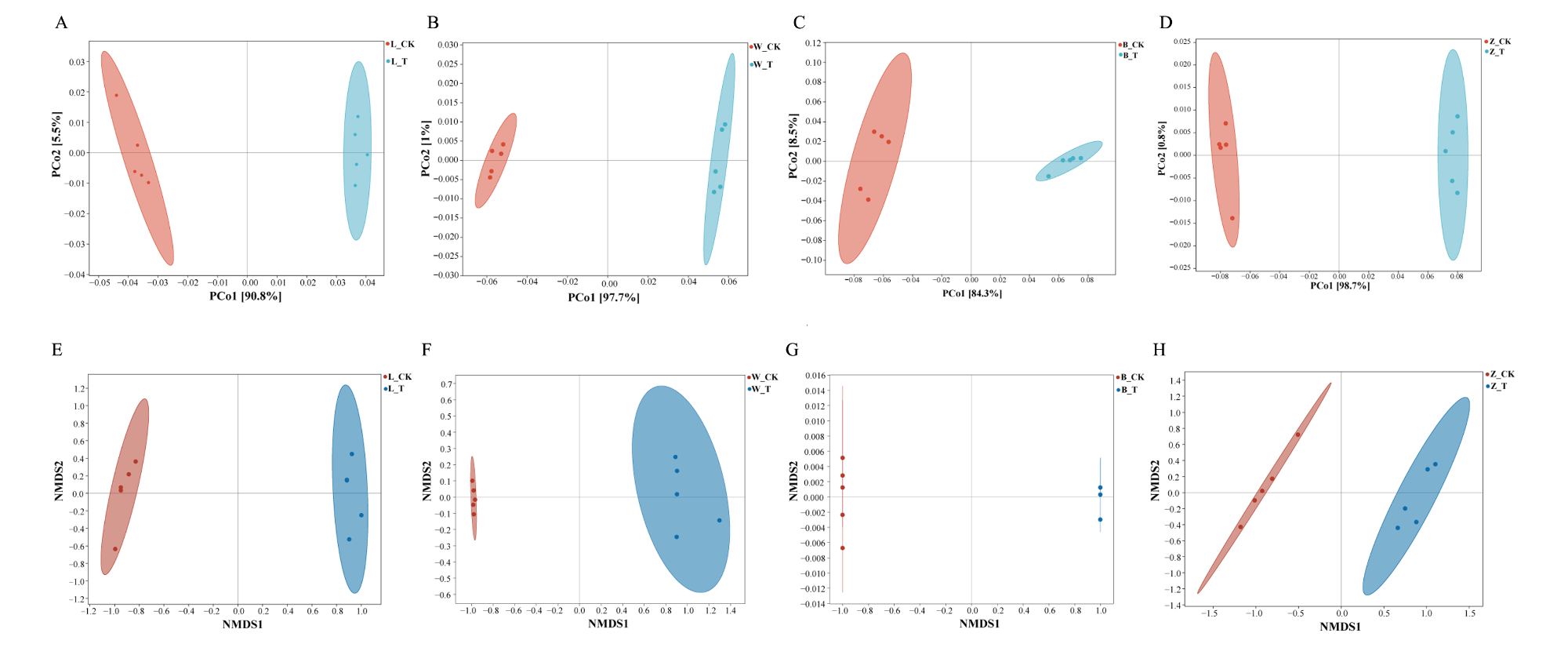
图2所示,采用PCoA和非度量多维尺度(NMDS)分析湖羊复胃菌群的分布差异,结果表明,2组间复胃各胃室菌群在结构上明显分开,表明饲粮添加韭菜籽黄酮能够改变湖羊复胃菌群的整体结构。
图2 湖羊复胃菌群主坐标分析和非度量多维尺度分析

PCo1:主坐标1 principal coordinate 1;PCo2:主坐标2 principal coordinate 2;NMDS1:非度量多维尺度1 non-metric multi-dimensional scaling 1;NMDS2:非度量多维尺度2 non-metric multi-dimensional scaling 2。

Fig.2 PCoA and NMDS analysis of compound stomach microbiota of Hu sheep

2.3.4 胃肠道菌群在门水平上的组成

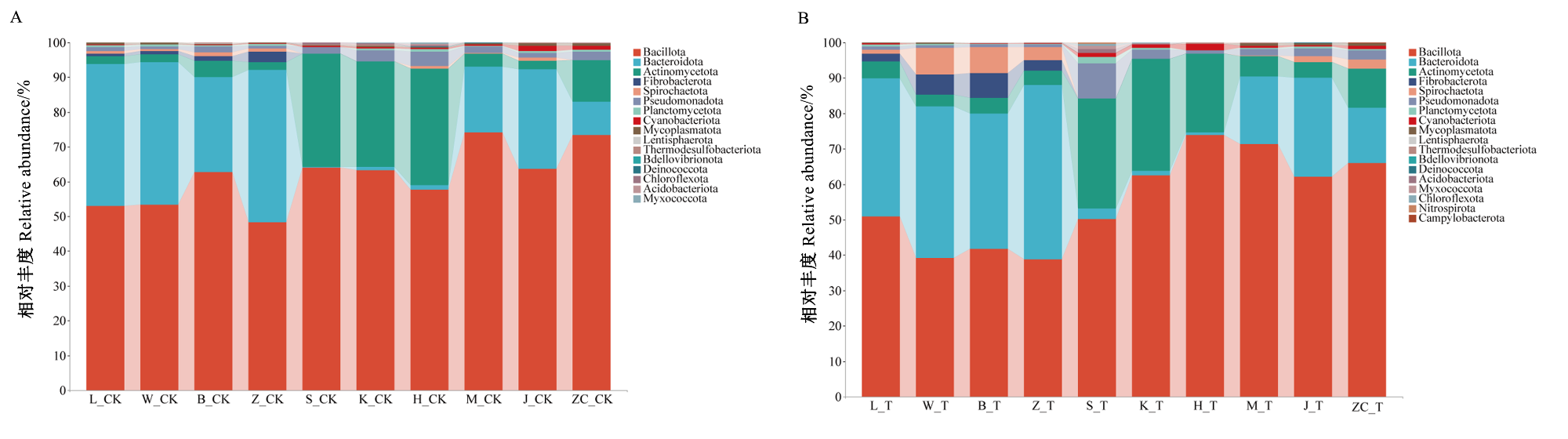
为了深入探究饲粮添加韭菜籽黄酮对湖羊胃肠道菌群结构演替的影响,本研究基于前期已有的肠道微生物数据[20]进行深入分析。如图3所示,试验组胃肠道菌群在门水平上组成较对照组发生明显变化。在复胃中,与对照组相比,试验组网胃、瓣胃和皱胃芽孢杆菌门(Bacillota)相对丰度显著降低(P<0.05),而拟杆菌门(Bacteroidota)相对丰度显著提高(P<0.05);同时,试验组各胃室螺旋体门(Spirochaetota)相对丰度均显著提高(P<0.05);此外,在试验组瓣胃中特异性检出奇异球菌门(Deinococcota),在瓣胃和皱胃中特异性检出蛭弧菌门(Bdellovibrionota),而上述菌门在对照组中均未检出。在肠道中,与对照组相比,试验组十二指肠黏细菌门(Myxococcota)、空肠酸杆菌门(Acidobacteriota)以及直肠硝化螺旋菌门(Nitrospirota)相对丰度显著提高(P<0.05);此外,在试验组回肠中检测到纤维杆菌门(Fibrobacterota),并在直肠中检测到Nitrospirota,这2个菌门在相应肠段的对照组中均未被检测到。
图3 湖羊胃肠道菌群在门水平上的组成

复胃各胃室数据为本研究实测,肠道节段(十二指肠至直肠)数据引自本课题组前期研究结果[20],所有数据在统一流程下重新分析。S:十二指肠;K:空肠;H:回肠;M:盲肠;J:结肠;ZC:直肠。下图同。

Bacillota:芽孢杆菌门;Bacteroidota:拟杆菌门;Actinomycetota:放线菌门;Fibrobacterota:纤维杆菌门;Spirochaetota:螺旋体门;Pseudomonadota:假单胞菌门;Planctomycetota:浮霉菌门;Cyanobacteriota:蓝细菌门;Mycoplasmatota:软壁菌门;Lentisphaerota:黏胶球形菌门;Thermodesulfobacteriota:热脱硫杆菌门;Bdellovibrionota:蛭弧菌门;Deinococcota:奇异球菌门;Chloroflexota:绿弯菌门;Acidobacteriota:酸杆菌门;Myxococcota:黏细菌门;Nitrospirota:硝化螺旋菌门;Campylobacterota:弯曲杆菌门。图5同 the same as Fig.5

Fig.3 Composition of gastrointestinal microbiota at phylum level of Hu sheep

Data of each compartment of compound stomach were measured in this study, and data of intestinal segments (duodenum to rectum) were cited from previous research results of our research group[20]; all data were re-analyzed using a unified pipeline. S: duodenum; K: jejunum; H: ileum; M: cecum; J: colon; ZC: rectum. The same as below.

2.3.5 胃肠道菌群在属水平上的组成

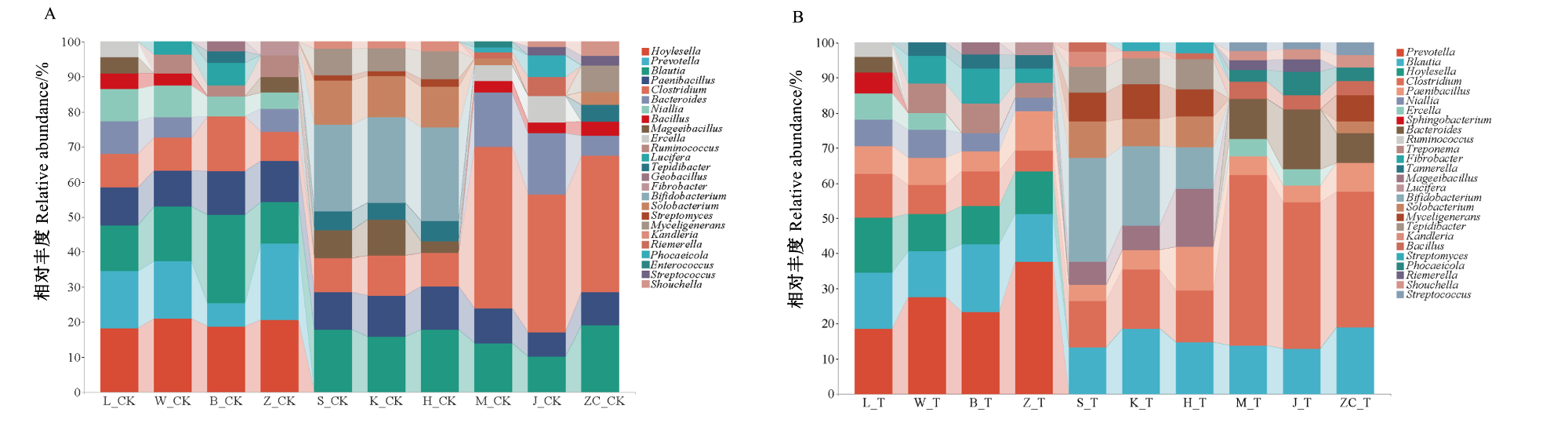
图4所示,在对照组中,霍伊氏菌属(Hoylesella)在4个胃室中均稳定存在,普雷沃氏菌属(Prevotella)在皱胃中相对丰度最高,布劳特氏菌属(Blautia)在瓣胃中相对丰度达到峰值。经统计分析发现,与对照组相比,试验组瘤胃瘤胃球菌属(Ruminococcus)、网胃纤维杆菌属(Fibrobacter)和坦纳氏菌属(Tannerella)、瓣胃FibrobacterTannerella和玛吉杆菌属(Mageeibacillus)以及皱胃Tannerella和卢西菲拉菌属(Lucifera)相对丰度均显著提高(P<0.05)。在肠道节段中,十二指肠、空肠和回肠以双歧杆菌属(Bifidobacterium)和Blautia为优势菌属;盲肠和结肠以梭菌属(Clostridium)为优势菌属,同时拟杆菌属(Bacteroides)相对丰度明显提高;直肠仍以Clostridium为优势菌属,且菌群结构更加复杂。此外,与对照组相比,试验组十二指肠和回肠芽孢杆菌属(Bacillus)、盲肠舒氏菌属(Shouchella)和链球菌属(Streptococcus)以及直肠居海事城球杆菌属(Phocaeicola)相对丰度均有所提高,但差异不显著(P>0.05)。
图4 湖羊胃肠道菌群在属水平上的组成

Hoylesella:霍伊氏菌属;Prevotella:普雷沃氏菌属;Blautia:布劳特氏菌属;Paenibacillus:类芽孢杆菌属;Clostridium:梭菌属;Bacteroides:拟杆菌属;Niallia:尼尔菌属;Bacillus:芽孢杆菌属;Mageeibacillus:玛吉杆菌属;Ercella:艾氏菌属;Ruminococcus:瘤胃球菌属;Lucifera:卢西菲拉菌属;Tepidibacter:温暖杆菌属;Geobacillus:地芽孢杆菌属;Fibrobacter:纤维杆菌属;Bifidobacterium:双歧杆菌属;Solobacterium:独居杆菌属;Streptomyces:链霉菌属;Myceligenerans:生菌丝菌属;Kandleria:坎德拉菌属;Riemerella:里默氏菌属;Phocaeicola:居海事城球杆菌属;Enterococcus:肠球菌属;Streptococcus:链球菌属;Shouchella:舒氏菌属;Sphingobacterium:鞘氨醇杆菌属;Treponema:密螺旋体属;Tannerella:坦纳氏菌属。图5同 the same as Fig.5

Fig.4 Composition of gastrointestinal microbiota at genus level of Hu sheep

2.3.6 差异菌群LEfSe分析

为了进一步识别对照组与试验组之间具有显著差异的标志性微生物,本研究采用LEfSe分析,选取LDA>4.0且P<0.05的菌群,整合分析结果如图5所示,结果表明,韭菜籽黄酮诱导了明显的“由胃至肠”的差异菌群演替规律:在复胃中,试验组显著富集的差异标志菌属主要包括鞘氨醇杆菌属(Sphingobacterium)、密螺旋体属(Treponema)、FibrobacterHoylesella等;对照组显著富集的差异标志菌属包括ClostridiumPrevotella等。随着消化道节段向下游推移,标志性菌群发生特征性更迭:十二指肠和空肠中主要以Bacillus和双歧杆菌属(Bifidobacterium)的显著富集为特征;回肠至直肠段则主要表现为拟杆菌属(Bacteroides)和Treponema的显著富集。
图5 湖羊胃肠道差异菌群LEfSe分析

LEfSe analysis:LEfSe分析;The current LDA threshold is 4:当前LDA阈值为4;Taxa:分类群;LDA Score:LDA得分。

Actinomycetes:放线菌纲;Bacilli:芽孢杆菌纲;Clostridia:梭菌纲;Negativicutes:负球菌纲;Bacteroidia:拟杆菌纲;Sphingobacteriia:鞘氨醇杆菌纲;Fibrobacteria:纤维杆菌纲;Spirochaetia:螺旋体纲;Erysipelotrichia:丹毒丝菌纲;Flavobacteriia:黄杆菌纲;Alphaproteobacteria:α-变形菌纲;Bacillales:芽孢杆菌目;Lactobacillales:乳杆菌目;Eubacteriales:真细菌目;Veillonellales:韦荣氏球菌目;Bacteroidales:拟杆菌目;Sphingobacteriales:鞘氨醇杆菌目;Fibrobacterales:纤维杆菌目;Spirochaetales:螺旋体目;Bifidobacteriales:双歧杆菌目;Kitasatosporales:北里孢菌目;Micrococcales:微球菌目;Mycobacteriales:分枝杆菌目;Erysipelotrichales:丹毒丝菌目;Flavobacteriales:黄杆菌目;Bacillaceae:芽孢杆菌科;Paenibacillaceae:类芽孢杆菌科;Lactobacillaceae:乳杆菌科;Clostridiaceae:梭菌科;Lachnospiraceae:毛螺菌科;Oscillospiraceae:颤螺菌科;Veillonellaceae:韦荣氏球菌科;Bacteroidaceae:拟杆菌科;Porphyromonadaceae:紫单胞菌科;Prevotellaceae:普雷沃氏菌科;Tannerellaceae:坦纳氏菌科;Sphingobacteriaceae:鞘氨醇杆菌科;Fibrobacteraceae:纤维杆菌科;Treponemataceae:密螺旋体科;Bifidobacteriaceae:双歧杆菌科;Streptomycetaceae:链霉菌科;Promicromonosporaceae:原小单孢菌科;Streptococcaceae:链球菌科;Peptostreptococcaceae:消化链球菌科;Coprobacillaceae:粪杆菌科;Erysipelotrichaceae:丹毒丝菌科;Weeksellaceae:威克斯氏菌科;Lysinibacillus:赖氨酸芽孢杆菌属。

Fig.5 LEfSe analysis of differential microbiota in gastrointestinal tract of Hu sheep

3 讨论

3.1 韭菜籽黄酮对湖羊生长性能和瘤胃发酵参数的影响

瘤胃作为反刍动物能量代谢的中枢,其产生的挥发性脂肪酸(VFA)为宿主提供了绝大部分的能量来源[21]。作为衡量瘤胃功能的核心,瘤胃发酵参数极易受饲粮组成的调控。本研究发现,饲粮添加韭菜籽黄酮显著提高湖羊DMI,其机制可能与韭菜籽中所含的挥发性活性成分影响采食行为有关,但具体作用途径仍需进一步验证。尽管2组间终末体重和ADG在统计学上未达到显著差异,但采食量的增加揭示了韭菜籽黄酮在促进营养摄入方面具有一定调节作用。此外,2组间F/G亦无显著差异,表明韭菜籽黄酮在不干扰基础代谢效率的前提下,通过改善摄食行为增加了湖羊的养分摄入总量,可能为机体营养供给提供更充足的底物条件。
在瘤胃发酵方面,VFA对维持瘤胃上皮功能和机体稳态具有核心调控作用[22]。本研究发现,饲粮添加韭菜籽黄酮显著提高湖羊瘤胃TVFA含量,提示韭菜籽黄酮可能增强了瘤胃发酵活性。进一步分析发现,与对照组相比,试验组瘤胃丙酸、丁酸、异戊酸和戊酸含量均显著升高。其中,丙酸作为葡萄糖异生的关键前体[23],其含量提高有助于提高机体能量利用效率;丁酸在供给瘤胃上皮能量的同时,对维系肠道屏障的完整性至关重要[24]。此外,与对照组相比,试验组瘤胃乙酸含量虽有上升,但未达到差异显著水平。结合本课题组前期观察到的韭菜籽黄酮对瘤胃乳头发育的正向促进作用,推测韭菜籽黄酮通过重塑瘤胃发酵微环境,优化VFA生成速率,从而为湖羊整体的机体代谢和生长潜能奠定了生理基础。本研究结果与此前关于沙葱黄酮[25]、竹叶黄酮[26]调节反刍动物瘤胃发酵特性的报道基本一致。

3.2 韭菜籽黄酮对湖羊胃肠道菌群的调节作用

本研究通过16S rRNA基因高通量测序技术,解析了韭菜籽黄酮对湖羊复胃菌群的调控效应,并结合课题组前期研究整合探讨了其在胃肠道的空间演替特征。α多样性分析结果表明,饲粮添加韭菜籽黄酮显著提高部分胃室菌群ACE指数、Chao1指数和Shannon指数;结合β多样性分析结果,表明韭菜籽黄酮能够有效重塑胃肠道微生态的物种宽幅和群落结构。在门水平上,菌群组成分析结果显示,湖羊复胃内的优势菌门为Bacteroidota和Bacillota,结果与之前的研究[27]一致。Bacteroidota成员是降解膳食纤维、促进蛋白质转化及生成短链脂肪酸(SCFA)的核心力量[28];而Bacillota则在维持瘤胃稳态及初级纤维素降解中发挥关键作用[29]。本研究观察到试验组湖羊复胃各胃室Bacillota相对丰度较对照组下降而Bacteroidota相对丰度升高,这一变化通常与消化代谢能力改善相关[30]。此外,Fibrobacterota在网胃、瓣胃和皱胃中的同步富集,提示其可能增强了纤维降解潜能[31]。值得关注的是,试验组瓣胃和皱胃中特异性检出的Deinococcota和Bdellovibrionota,前者具有极强的环境抗逆性,有助于维系消化过程的稳定性[32];后者作为捕食性细菌,可通过调控其他菌群的相对丰度来维持生态平衡[33]。这些具有特异性生理功能的菌群可能共同发挥“生态调节者”的功能,保障复杂胃室微生态的稳态。
在属水平上,Prevotella作为Bacteroidota中相对丰度最高的菌属,不仅能分泌有助于降解多糖的木聚糖[34],还广泛参与纤维、半纤维素和蛋白质的降解利用[35]。因此其在皱胃中相对丰度的升高暗示了韭菜籽黄酮具有增强该部位多糖及蛋白质降解潜力的可能。本研究中,试验组瘤胃Ruminococcus以及网胃、瓣胃FibrobacterTannerella的显著富集,与此前瘤胃内TVFA及丙酸、丁酸含量的同步提升高度契合。RuminococcusFibrobacter是反刍动物体内最主要的纤维素分解菌。研究表明,Ruminococcus不仅在分解纤维素、半纤维素和淀粉等碳水化合物中起关键作用,产生SCFA;还可促进免疫激活,参与免疫调节[36]Fibrobacter能高效降解纤维素,并在SCFA生成中发挥核心作用[37]。因此它们相对丰度的提高可能参与促进结构性碳水化合物向VFA的转化过程。此外,Tannerella相对丰度在试验组网胃、瓣胃和皱胃中显著升高,可能进一步提高了纤维降解能力[38]。同时,瓣胃中Blautia的富集,不仅能通过产生丁酸发挥抗炎及免疫调节功能,还可能通过调节细胞因子表达强化湖羊的防御屏障[39-40]
在肠道节段中,韭菜籽黄酮诱导了明显的部位特异性功能演替。前段肠道(十二指肠至回肠)以Bacillota和放线菌门(Actinomycetota)为优势菌门,后者凭借强大的酶分泌能力促进纤维素降解,保障养分的初始消化[41]。与之相对,盲肠、结肠和直肠Bacteroidota相对丰度明显上升,表明后段肠道发酵功能显著增强。此外,试验组湖羊十二指肠中的Myxococcota及空肠中的Acidobacteriota,分别有助于调控菌群平衡[42]和增强酸性环境下的代谢能力[43];并且,直肠中还出现Nitrospirota,可通过氮循环进一步优化蛋白质代谢产物的利用[44]。在属水平上,前段肠道以BacillusBifidobacterium为核心优势菌属,其中Bacillus凭借强大的产酶能力促进养分的初始消化,保障营养物质的高效吸收[45]。而盲肠、结肠和直肠则表现为ClostridiumBacteroides相对丰度的上升,其中Clostridium具有较强的纤维素降解能力,能够产生丁酸和乙酸[46];同时,盲肠中富集的ShouchellaStreptococcus,负责后续碳水化合物的发酵[47];最终,直肠中Phocaeicola相对丰度的升高,则进一步优化了发酵终产物的处理效率[48],表明后段肠道发酵功能的代偿性增强。LEfSe分析证实,SphingobacteriumTreponema在试验组复胃中显著富集,其中Sphingobacterium是一类革兰氏阴性细菌,参与木质素和纤维素的分解[49],提示韭菜籽黄酮可能参与调节多糖分解相关的关键微生物类群。通过对胃肠道菌群的整合LEfSe分析发现,韭菜籽黄酮诱导了明显的部位特异性功能演替。在复胃中,以RuminococcusFibrobacter等纤维分解菌的显著富集为特征,保障了粗纤维的初步降解;而随着食糜向后段肠道流动,差异标志微生物转变为以BifidobacteriumBacteroides为代表的益生菌及代谢调节菌,这种“由胃至肠”的菌群流动性变化,构成了韭菜籽黄酮调控湖羊肠道微生态的整体观。
综上所述,饲粮添加韭菜籽黄酮在湖羊消化道内形成了由前至后的菌群演替变化:在复胃中,RuminococcusFibrobacter等纤维分解菌相对丰度升高,提示其可能参与增强对粗饲料结构性碳水化合物的初级降解能力;随后在小肠段,BifidobacteriumBacillus等菌群的富集有助于促进营养物质的进一步消化吸收;最终在后段肠道中,由专性厌氧菌主导的发酵过程增强,可能促进SCFA等代谢产物的生成。尽管在本研究条件下,2组间湖羊F/G在统计学上尚未达到差异显著水平,但胃肠道不同节段关键功能菌群的演替及瘤胃发酵参数的改善,共同表明韭菜籽黄酮在调节湖羊胃肠道微生态及代谢潜能方面具有积极作用。其潜在分子调控机制及对宿主生产性能的长期影响,仍需结合多组学技术开展进一步研究。

4 结论

综上所述,饲粮添加韭菜籽黄酮能优化湖羊胃肠道菌群结构,改善瘤胃发酵模式,进而对湖羊的养分摄入及机体代谢稳态产生积极的生理调节作用。
[1]
JO Y, BACK C G, KIM K H, et al. Using RNA-Sequencing data to examine tissue-specific garlic microbiomes[J]. International Journal of Molecular Sciences, 2021, 22(13):6791.

DOI

[2]
黄晴, 吴忠坤, 吴中琴, 等. 葱属类植物中有机硫化物的抗氧化性研究进展[J]. 食品研究与开发, 2018, 39(1):214-220.

HUANG Q, WU Z K, WU Z Q, et al. The research progress of antioxidant activity of organic sulfides in Allium plants[J]. Food Research and Development, 2018, 39(1):214-220. (in Chinese)

[3]
GARGI B, SINGH P, PAINULI S, et al. Literature-based screening and bibliometric analysis of the chemical composition,antioxidant and antimicrobial potential of essential oils isolated from Allium genus:23 years of investigation[J]. Pharmacological Research-Modern Chinese Medicine, 2024, 10:100354.

DOI

[4]
卫煜英, 曹艳平, 李延墨, 等. 韭菜花挥发性成分的气相色谱-质谱分析[J]. 色谱, 2003, 21(1):96.

WEI Y Y, CAO Y P, LI Y M, et al. Study on composition of volatile oil of Chinese leek blossom by gas chromatography-mass spectrometry[J]. Chinese Journal of Chromatography, 2003, 21(1):96-96. (in Chinese)

[5]
OOI L S M, YU H, CHEN C M, et al. Isolation and characterization of a bioactive mannose-binding protein from the Chinese chive Allium tuberosum[J]. Journal of Agricultural and Food Chemistry, 2002, 50(4):696-700.

DOI

[6]
SANG S, MAO S, LAO A, et al. Four new steroidal saponins from the seeds of Allium tuberosum[J]. Journal of Agricultural and Food Chemistry, 2001, 49(3):1475-1478.

DOI

[7]
VAN HUNG P. Phenolic compounds of cereals and their antioxidant capacity[J]. Critical Reviews in Food Science and Nutrition, 2016, 56(1):25-35.

DOI PMID

[8]
AL-GHAMDI S, AL-BAADANI H H, ALHARTHI A S, et al. Effect of adding citrus flavonoid (Bioflavex) to diet on growth, feed efficiency,rumen histomorphology,carcass traits and meat quality of lambs[J]. Frontiers in Veterinary Science, 2025, 12:1572911.

DOI

[9]
YU S Q, LI L X, ZHAO H Y, et al. Dietary citrus flavonoid extract improves lactational performance through modulating rumen microbiome and metabolites in dairy cows[J]. Food & Function, 2023, 14(1):94-111.

[10]
XIAO M, DU L, WEI M L, et al. Effects of quercetin on in vitro rumen fermentation parameters,gas production and microflora of beef cattle[J]. Frontiers in Microbiology, 2025, 16:1527405.

DOI

[11]
DAI D W, DONG C X, KONG F L, et al. Dietary supplementation of Scutellariae radix flavonoid extract improves lactation performance in dairy cows by regulating gastrointestinal microbes,antioxidant capacity and immune function[J]. Animal Nutrition, 2025, 20:499-508.

DOI

[12]
中华人民共和国农业农村部. 肉羊营养需要量:NY/T816—2021[S]. 北京: 中国农业出版社, 2021.

Ministry of Agriculture and Rural Affairs of the People’s Republic of China. Nutrient requirements of meat-type sheep and goat:NY/T 816—2021[S]. Beijing: China Agriculture Press, 2021. (in Chinese)

[13]
中华人民共和国国家质量监督检验检疫总局, 中国国家标准化管理委员会. 饲料中水分的测定:GB/T6435—2014[S]. 北京: 中国标准出版社, 2014.

General Administration of Quality Supervision,Inspection and Quarantine of the People’s Republic of China,Standardization Administration of the People’s Republic of China. Determination of moisture in feedstuffs:GB/T 6435—2014[S]. Beijing: Standards Press of China, 2014. (in Chinese)

[14]
国家市场监督管理总局, 中国国家标准化管理委员会. 饲料中粗蛋白的测定凯氏定氮法:GB/T6432—2018[S]. 北京: 中国标准出版社, 2018.

State Administration for Market Regulation, Standardization Administration of the People’s Republic of China. Determination of crude protein in feeds-Kjeldahl method:GB/T 6432—2018[S]. Beijing: Standards Press of China, 2018. (in Chinese)

[15]
中华人民共和国国家质量监督检验检疫总局, 中国国家标准化管理委员会. 饲料中粗脂肪的测定:GB/T6433—2006[S]. 北京: 中国标准出版社, 2006.

General Administration of Quality Supervision,Inspection and Quarantine of the People’s Republic of China,Standardization Administration of the People’s Republic of China. Determination of crude fat in feeds:GB/T 6433—2006[S]. Beijing: Standards Press of China, 2006. (in Chinese)

[16]
国家市场监督管理总局, 国家标准化管理委员会. 饲料中中性洗涤纤维(NDF)的测定:GB/T20806—2022[S]. 北京: 中国标准出版社, 2022.

State Administration for Market Regulation, National Standardization Administration. Determination of neutral detergent fiber (NDF) in feeds:GB/T 20806—2022[S]. Beijing: Standards Press of China, 2022. (in Chinese)

[17]
中华人民共和国农业农村部. 饲料中酸性洗涤纤维的测定:NY/T1459—2022[S]. 北京: 中国农业出版社, 2022.

Ministry of Agriculture and Rural Affairs of the People’s Republic of China. Determination of acid detergent fiber (ADF) in feeds:NY/T 1459—2022[S]. Beijing: China Agriculture Press, 2022. (in Chinese)

[18]
中华人民共和国国家质量监督检验检疫总局, 中国国家标准化管理委员会. 饲料中钙、铜、铁、镁、锰、钾、钠和锌含量的测定原子吸收光谱法:GB/T13885—2017[S]. 北京: 中国标准出版社, 2017.

General Administration of Quality Supervision,Inspection and Quarantine of the People’s Republic of China,Standardization Administration of the People’s Republic of China. Determination of the contents of calcium,copper,iron,magnesium,manganese,potassium,sodium and zinc in feeds—method using atomic absorption spectrometry:GB/T 13885—2017[S]. Beijing: Standards Press of China, 2017. (in Chinese)

[19]
国家市场监督管理总局, 中国国家标准化管理委员会. 饲料中总磷的测定分光光度法:GB/T6437—2018[S]. 北京: 中国标准出版社, 2018.

State Administration for Market Regulation, Standardization Administration of the People’s Republic of China. Determination of phosphorus in feeds—spectrophotometry:GB/T 6437—2018[S]. Beijing: Standards Press of China, 2018. (in Chinese)

[20]
LI X J, LI D P, WANG C H, et al. Metagenomic insights into the effects of chive seed flavonoid on intestinal fermentation,morphology,and microbiota composition in sheep[J]. Frontiers in Microbiology, 2025, 16:1590400.

DOI

[21]
NEWBOLD C J, RAMOS-MORALES E. Review:ruminal microbiome and microbial metabolome:effects of diet and ruminant host[J]. Animal, 2020, 14(Suppl.1):S78-S86.

DOI

[22]
DIAO Q Y, ZHANG R, FU T. Review of strategies to promote rumen development in calves[J]. Animals, 2019, 9(8):490.

DOI

[23]
TAETHAISONG N, PAENGKOUM S, NAKHARUTHAI C, et al. Effect of purple Neem foliage as a feed supplement on nutrient apparent digestibility,nitrogen utilization,rumen fermentation,microbial population,plasma antioxidants,meat quality and fatty acid profile of goats[J]. Animals, 2022, 12(21):2985.

DOI

[24]
蒲仕文, 杨燕, 茹先古丽·买买提依明, 等. 大蒜素对小尾寒羊生长性能、血清免疫指标、抗氧化指标及瘤胃发酵参数的影响[J]. 饲料研究, 2022, 45(3):1-6.

PU S W, YANG Y, RUXIANGULI M, et al. Effect of allicin on growth performance,serum immunity indexes and antioxidant capacity and rumen fermentation parameters of small tail Han sheep[J]. Feed Research, 2022, 45(3):1-6. (in Chinese)

[25]
ZHAO Y B, ZHANG Y M, KHAS E, et al. Effects of Allium mongolicum regel ethanol extract on three flavor-related rumen branched-chain fatty acids,rumen fermentation and rumen bacteria in lambs[J]. Frontiers in Microbiology, 2022, 13:978057.

DOI

[26]
LI Y, FANG L Y, XUE F G, et al. Effects of bamboo leaf extract on the production performance,rumen fermentation parameters,and rumen bacterial communities of heat-stressed dairy cows[J]. Animal Bioscience, 2021, 34(11):1784-1793.

DOI

[27]
DE OLIVEIRA M N V, JEWELL K A, FREITAS F S, et al. Characterizing the microbiota across the gastrointestinal tract of a Brazilian Nelore steer[J]. Veterinary Microbiology, 2013, 164(3/4):307-314.

DOI

[28]
ERTURK-HASDEMIR D, KASPER D L. Finding a needle in a haystack:Bacteroides fragilis polysaccharide A as the archetypical symbiosis factor[J]. Annals of the New York Academy of Sciences, 2018, 1417(1):116-129.

DOI

[29]
RABEE A E, SAYED ALAHL A A, LAMARA M, et al. Fibrolytic rumen bacteria of camel and sheep and their applications in the bioconversion of barley straw to soluble sugars for biofuel production[J]. PLoS One, 2022, 17(1):e0262304.

DOI

[30]
YIN Y, YANG T Z, TIAN Z Y, et al. Progress in the investigation of the Firmicutes/Bacteroidetes ratio as a potential pathogenic factor in ulcerative colitis[J]. Journal of Medical Microbiology, 2025, 74(1):001966.

[31]
JAHANI-AZIZABADI H, BARAZ H, BAGHERI N, et al. Effects of a mixture of phytobiotic-rich herbal extracts on growth performance,blood metabolites,rumen fermentation,and bacterial population of dairy calves[J]. Journal of Dairy Science, 2022, 105(6):5062-5073.

DOI

[32]
SHARMA D K, SONI I, RAJPUROHIT Y S. Surviving the storm: exploring the role of natural transformation in nutrition and DNA repair of stressed Deinococcus radiodurans[J]. Applied and Environmental Microbiology, 2025, 91(1):e0137124.

DOI

[33]
JOHNKE J, FRAUNE S, BOSCH T C G, et al. Bdellovibrio and like organisms are predictors of microbiome diversity in distinct host groups[J]. Microbial Ecology, 2020, 79(1):252-257.

DOI

[34]
KIM M, MORRISON M, YU Z T. Status of the phylogenetic diversity census of ruminal microbiomes[J]. FEMS Microbiology Ecology, 2011, 76(1):49-63.

DOI PMID

[35]
WEIMER P J. Degradation of cellulose and hemicellulose by ruminal microorganisms[J]. Microorganisms, 2022, 10(12):2345.

DOI

[36]
GUO J L, WANG H J, JIANG F, et al. Ingesting stellera chamaejasme significantly impacts the gastrointestinal tract bacterial community and diversity in plateau zokors (Eospalax baileyi)[J]. Microorganisms, 2024, 12(11):2182.

DOI

[37]
BENSOUSSAN L, MORAÏS S, DASSA B, et al. Broad phylogeny and functionality of cellulosomal components in the bovine rumen microbiome[J]. Environmental Microbiology, 2017, 19(1):185-197.

DOI PMID

[38]
MIURA H, TSUKAHARA T, INOUE R. Whole-genome metagenomic analysis of functional profiles in the fecal microbiome of farmed sows with different reproductive performances[J]. Microorganisms, 2024, 12(11):2180.

DOI

[39]
朱逸枭, 张云卓, 冉扬, 等. 不同水平复合益生菌制剂对育肥湖羊生长性能、免疫功能、抗氧化功能和瘤胃菌群的影响[J]. 饲料研究, 2025, 48(1):21-26.

ZHU Y X, ZHANG Y Z, RAN Y, et al. Effects of different levels of composite probiotic preparations on growth performance,immune function,antioxidant function,and rumen flora of fattening Hu sheep[J]. Feed Research, 2025, 48(1):21-26. (in Chinese)

[40]
WEI J T, LIU Y, LI H, et al. Unlocking the power of swine gut bacteria:newly isolated Blautia strain and its metabolites inhibit the replication of Salmonella typhimurium in macrophages and alleviate DSS-induced colitis in mice[J]. Journal of Animal Science and Biotechnology, 2025, 16(1):87.

DOI

[41]
LEWIN G R, CARLOS C, CHEVRETTE M G, et al. Evolution and ecology of Actinobacteria and their bioenergy applications[J]. Annual Review of Microbiology, 2016, 70:235-254.

DOI PMID

[42]
DAI W, LIU Y, YAO D D, et al. Phylogenetic diversity of stochasticity-dominated predatory myxobacterial community drives multi-nutrient cycling in typical farmland soils[J]. Science of the Total Environment, 2023, 871:161680.

DOI

[43]
EICHORST S A, TROJAN D, ROUX S, et al. Genomic insights into the Acidobacteria reveal strategies for their success in terrestrial environments[J]. Environmental Microbiology, 2018, 20(3):1041-1063.

DOI PMID

[44]
KOCH H, LÜCKER S, ALBERTSEN M, et al. Expanded metabolic versatility of ubiquitous nitrite-oxidizing bacteria from the genus Nitrospira[J]. Proceedings of the National Academy of Sciences of the United States of America, 2015, 112(36):11371-11376.

[45]
YUAN C M, JI X, ZHANG Y Y, et al. Important role of Bacillus subtilis as a probiotic and vaccine carrier in animal health maintenance[J]. World Journal of Microbiology and Biotechnology, 2024, 40(9):268.

DOI

[46]
DIMITROVA L, ILIEVA Y, GOULIAMOVA D, et al., Isolation,enrichment and analysis of aerobic,anaerobic,pathogen-free and non-resistant cellulose-degrading microbial populations from methanogenic bioreactor[J]. Genes, 2025, 16(5):551.

DOI

[47]
YANG Y J, SONG X, WANG H, et al. Transcriptomics of Streptococcus thermophilus S-3:patterns of nutrient requirements and metabolic responses under high-density fermentation conditions[J]. Food Bioscience, 2025, 69:107001.

DOI

[48]
WANG C, LI S J, ZHANG Z D, et al. Phocaeicola faecalis sp. nov.,a strictly anaerobic bacterial strain adapted to the human gut ecosystem[J]. Antonie van Leeuwenhoek, 2021, 114(8):1225-1235.

DOI

[49]
BESAURY L, FLORET J, RÉMOND C. Sphingobacterium prati sp. nov.,isolated from agricultural soil and involved in lignocellulose deconstruction[J]. International Journal of Systematic and Evolutionary Microbiology, 2021, 71(8):004963.

文章导航

/