研究论文

解脂耶氏酵母替代鱼粉对罗氏沼虾生长、氮磷排放及肠道健康的影响

  • 冯俏 , 1 ,
  • 吴炜欣 1 ,
  • 宗昊婕 1 ,
  • 吴江楠 1 ,
  • 谭朋 2 ,
  • 丁志丽 1 ,
  • 孔有琴 , 1, *
展开
  • 1 湖州师范学院生命科学学院, 水生动物繁育与营养国家地方联合工程实验室,浙江省水生生物资源养护与开发技术研究重点实验室, 湖州 313000
  • 2 浙江省海洋水产研究所, 舟山 316021
* 孔有琴,副教授,硕士生导师,E-mail:

冯 俏(2000—),女,吉林长春人,硕士研究生,从事水产动物营养与饲料研究。E-mail:

Office editor: 靳 爽

收稿日期: 2025-10-29

  网络出版日期: 2026-06-13

基金资助

浙江省“尖兵领雁+X”研发攻关计划项目(2024C02012)

Effects of Replacing Fish Meal with Yarrowia lipolytica on Growth, Nitrogen and Phosphorus Excretion and Intestinal Health of Macrobrachium rosenbergii

  • FENG Qiao , 1 ,
  • WU Weixin 1 ,
  • ZONG Haojie 1 ,
  • WU Jiangnan 1 ,
  • TAN Peng 2 ,
  • DING Zhili 1 ,
  • KONG Youqin , 1, *
Expand
  • 1 Zhejiang Provincial Key Laboratory of Aquatic Biological Resources Conservation and Development Technology, National-Local Joint Engineering Laboratory of Aquatic Animal Breeding and Nutrition, College of Life Sciences, Huzhou University, Huzhou 313000, China
  • 2 Zhejiang Marine Fisheries Research Institute, Zhoushan 316021, China
* associate professor, E-mail:

Received date: 2025-10-29

  Online published: 2026-06-13

摘要

本试验旨在探究解脂耶氏酵母(Yarrowia lipolytica)替代鱼粉对罗氏沼虾(Macrobrachium rosenbergii)生长、氮磷排放及肠道健康的影响。选取750尾初始体重为(0.25±0.03) g的健康罗氏沼虾,随机分为5组,每组3个重复,每个重复50尾。5组试验虾分别饲喂以解脂耶氏酵母替代基础饲料中0(YL0组)、5%(YL5组)、10%(YL10组)、20%(YL20组)和40%(YL40组)鱼粉的试验饲料。试验期8周。结果表明:1)与YL0和YL40组相比,YL10组增重率(WGR)显著提高(P<0.05),饲料系数(FCR)显著降低(P<0.05)。2)YL10组蛋白质沉积率(PDR)和磷沉积率(PPDR)显著高于YL0和YL40组(P<0.05),粗蛋白质表观消化率(ADCP)显著高于YL40组(P<0.05),氮排放量(NE)和磷排放量(PE)显著低于YL0和YL40组(P<0.05)。3)与YL0和YL40组相比,YL20组血清甘油三酯(TG)含量显著降低(P<0.05),YL10组血清总胆固醇(T-CHO)含量及谷丙转氨酶(ALT)、谷草转氨酶(AST)活性显著降低(P<0.05),YL5和YL10组血清葡萄糖(GLU)含量显著提高(P<0.05)。4)与YL0和YL40组相比,YL10组肠道胰蛋白酶、脂肪酶和淀粉酶活性及绒毛高度显著提高(P<0.05);与YL0组相比,YL10组肠道菌群中厚壁菌门(Firmicutes)及芽孢杆菌属(Bacillus)相对丰度显著提高(P<0.05),拟杆菌门(Bacteroidota)及Cloacibacterium相对丰度显著降低(P<0.05)。综上所述,以解脂耶氏酵母替代饲料中适宜比例的鱼粉,可显著提升罗氏沼虾的氮、磷沉积效率,减少氮、磷代谢废物排放,同时增强机体抗氧化能力,改善肠道健康,并促进其生长性能提升。基于WGR、PDR及NE的回归分析显示,罗氏沼虾饲料中解脂耶氏酵母替代鱼粉的适宜比例为15.43%~16.93%。

本文引用格式

冯俏 , 吴炜欣 , 宗昊婕 , 吴江楠 , 谭朋 , 丁志丽 , 孔有琴 . 解脂耶氏酵母替代鱼粉对罗氏沼虾生长、氮磷排放及肠道健康的影响[J]. 动物营养学报, 2026 , 38(6) : 4434 -4451 . DOI: 10.12418/CJAN2026.356

Abstract

This experiment was conducted to investigate the effects of replacing fish meal with Yarrowia lipolytica on growth, nitrogen and phosphorus excretion and intestinal health of Macrobrachium rosenbergii. A total of 750 healthy M. rosenbergii with an initial body weight of (0.25±0.03) g were randomly divided into 5 groups with 3 replicates per group and 50 shrimps per replicate. Shrimps in the 5 groups were fed experimental diets in which fish meal in the basal diet was replaced with Y. lipolytica at the levels of 0 (YL0 group), 5% (YL5 group), 10% (YL10 group), 20% (YL20 group) and 40% (YL40 group), respectively. The feeding trial lasted for 8 weeks. The results showed as follows: 1) compared with YL0 and YL40 groups, the weight gain rate (WGR) of YL10 group was significantly increased (P<0.05), and the feed conversion ratio (FCR) was significantly decreased (P<0.05). 2) The protein deposition rate (PDR) and phosphorus deposition rate (PPDR) in YL10 group were significantly higher than those in YL0 and YL40 groups (P<0.05), the apparent digestibility of crude protein (ADCP) was significantly higher than that in YL40 group (P<0.05), and the nitrogen excretion (NE) and phosphorus excretion (PE) were significantly lower than those in YL0 and YL40 groups (P<0.05). 3) Compared with YL0 and YL40 groups, the serum triglyceride (TG) content in YL20 group was significantly decreased (P<0.05); the serum total cholesterol (T-CHO) content and the activities of alanine aminotransferase (ALT) and aspartate aminotransferase (AST) in YL10 group were significantly decreased (P<0.05); the serum glucose (GLU) content in YL5 and YL10 groups was significantly increased (P<0.05). 4) Compared with YL0 and YL40 groups, the activities of intestinal trypsin, lipase and amylase and the intestinal villus height in YL10 group were significantly increased (P<0.05). Compared with YL0 group, the relative abundances of Firmicutes and Bacillus in intestinal microflora of YL10 group were significantly increased (P<0.05), while the relative abundances of Bacteroidota and Cloacibacterium were significantly decreased (P<0.05). In conclusion, replacing fish meal with an appropriate proportion of Y. lipolytica in the diet could significantly improve the nitrogen and phosphorus deposition efficiency of M. rosenbergii, reduce the excretions of nitrogen and phosphorus metabolic wastes, enhance the antioxidant capacity, improve intestinal health, and promote the growth performance. Based on the regression analysis of WGR, PDR and NE, the appropriate replacement proportion of fish meal with Y. lipolytica in the diet of M. rosenbergii is 15.43% to 16.93%.

罗氏沼虾(Macrobrachium rosenbergii),又名淡水长臂大虾,主要分布于马来西亚、泰国、印度和孟加拉国等国家[1]。该虾食性广、生长快、经济价值高,已成为我国主要的淡水养殖虾类之一,2024年其淡水养殖产量达24.57万t[2]。罗氏沼虾作为一种杂食性虾类,对饲料中蛋白质的需求量较高,其适宜蛋白质水平为35%~40%[3]。鱼粉因具有蛋白质含量高[4]、氨基酸平衡[5]等优点,已成为虾类饲料中的主要优质蛋白质源。然而,随着对鱼粉需求的增加和环境污染等的影响,鱼粉出现价格上涨、供应不稳定等问题,限制了虾类养殖的可持续发展[6]。此外,鱼粉磷含量较高,虾类饲料中大量使用鱼粉可使未被虾类吸收利用的磷排入养殖水体,导致水体氮磷失衡,引发富营养化[7]。因此,寻找可替代罗氏沼虾饲料中鱼粉的其他优质蛋白质源一直是研究者关注的焦点。已有研究探讨了豆粕[8]、向日葵籽饼[9]等原料替代鱼粉的可行性。然而,植物蛋白质源普遍存在氨基酸不平衡、胰蛋白酶抑制剂和植酸等抗营养因子含量高及适口性差等问题,这些因素共同限制了其在水产饲料中的应用[10]
酵母作为一种真菌,具有蛋白质含量高(45%~60%),富含核苷酸、肌醇、维生素和多糖等物质,以及便于工厂化生产等优点,是水产饲料中的优质蛋白质源[11-12]。据报道,使用酿酒酵母(Saccharomyces cerevisiae)和异常威克汉姆酵母(Wickerhamomyces anomalus)替代虹鳟(Oncorhynchus mykiss)饲料中40%的鱼粉,不会对其生长性能、营养物质消化率和肠道健康产生负面影响[13];使用酿酒酵母替代饲料中45%的鱼粉,对巴沙鱼(Pangasianodon hypophthalmus×Pangasius bocourti)生长性能与饲料效率无负面影响,同时可改善其免疫功能[14]。对甲壳动物的研究发现,产朊假丝酵母(Candida utilis)最高可替代凡纳滨对虾(Litopenaeus vannamei)饲料中60%的鱼粉,不会对其氮源利用效率、生长性能及蛋白质消化率产生抑制效应,且可提高其肠道有益菌丰度和免疫功能[15]。然而,饲料中添加过量的酵母可能对水产动物的生长和健康产生不利影响。酿酒酵母替代鱼粉的比例超过77.88%时会抑制攀鲈(Anabas testudineus)的生长[16];替代比例超过18%时会导致凡纳滨对虾特定生长率显著下降[17];替代比例为40%时会对北极红点鲑(Salvelinus alpinus)的肠道健康产生不利影响[18]。这些结果表明,饲料中酵母替代鱼粉的适宜比例存在物种差异性。因此,开展不同物种的酵母营养生理研究、寻找酵母替代鱼粉的最适比例,是酵母在水产动物饲料中科学应用的基础。
目前,水产饲料中研究应用的酵母主要有酿酒酵母[19]、产朊假丝酵母[20]和解脂耶氏酵母(Yarrowia lipolytica)[21]等。其中,解脂耶氏酵母因能高效合成蛋白质与功能性脂质,可利用废弃油脂类、糖类及其衍生物和工业废料等低成本碳源规模化培养,且经代谢调控能优化其营养组成等特点而逐渐受到关注[22]。据报道,饲料中添加3%~7%的解脂耶氏酵母可显著提高尼罗罗非鱼(Oreochromis niloticus)增重率(WGR)和免疫功能[23];添加5%的解脂耶氏酵母可改善虹鳟肠道菌群结构,提高有益菌丰度,降低潜在致病菌比例,增强免疫性能和抗病力[24]。此外,解脂耶氏酵母替代饲料中10.54%的鱼粉对凡纳滨对虾的生长性能、消化酶活性、脂质代谢和抗氧化能力均具有积极促进效应[25]。然而,目前关于解脂耶氏酵母在罗氏沼虾饲料中的应用研究尚未见报道。因此,本研究从生长性能、氮磷排放、抗氧化能力、肠道健康等角度入手,探讨解脂耶氏酵母替代鱼粉对罗氏沼虾的影响并确定其适宜替代比例,以期为解脂耶氏酵母在罗氏沼虾配合饲料中的应用提供基础数据。

1 材料与方法

1.1 伦理声明

动物试验方案已获得湖州师范学院动物伦理委员会批准(批准编号:20240701),所有试验程序均严格遵循我国《实验动物管理条例》的相关规定。

1.2 试验饲料

试验所用解脂耶氏酵母为市购产品,其水分含量为9.79%,粗蛋白质含量为61.15%,粗脂肪含量为8.75%,赖氨酸含量为3.01%,蛋氨酸含量为1.81%。首先以鱼粉、肉粉和豆粕为主要蛋白质源,鱼油、大豆油和大豆卵磷脂为脂肪源,三氧化二钇(Y2O3)为外源指示剂,配制鱼粉含量为36%的基础饲料,然后在基础饲料配方的基础上,以解脂耶氏酵母分别替代0、5%、10%、20%和40%的鱼粉,配制5种等氮等脂的试验饲料,依次记为YL0、YL5、YL10、YL20和YL40。试验饲料制作流程:首先采用逐步扩大法分别制备维生素预混料与矿物质预混料,然后将所有饲料原料粉碎并过60目筛,按配方精准称重后充分混合,随后将鱼油与大豆油混匀,加水后再次混合原料,最后使用双螺杆挤出机(华南理工大学化学工程研究所)制得粒径为1.5 mm的颗粒饲料,40 ℃烘干后于-20 ℃冰箱保存备用。试验饲料组成及营养水平见表1,试验饲料氨基酸组成见表2。饲料水分含量采用105 ℃干燥法(GB/T 6435—2014)测定,粗蛋白质含量采用凯氏定氮法(GB/T 6432—2018)测定,粗脂肪含量采用索氏抽提法(GB/T 6433—2025)测定,粗灰分含量采用550 ℃灼烧法(GB/T 6438—2007)测定,磷含量采用钼酸铵分光光度法(GB/T 6437—2018)测定;氨基酸含量参照GB 5009.124—2016的方法,使用日立L-8900型自动氨基酸分析仪测定。
表1 试验饲料组成及营养水平(风干基础)

Table 1 Composition and nutrient levels of experimental diets (air-dry basis) %

项目
Items
饲料 Diets
YL0 YL5 YL10 YL20 YL40
原料 Ingredients
鱼粉 Fish meal 36.00 34.20 32.40 28.80 21.60
肉粉 Meat meal 19.00 19.00 19.00 19.00 19.00
豆粕 Soybean meal 18.00 18.00 18.00 18.00 18.00
解脂耶氏酵母 Yarrowia lipolytica 1.80 3.60 7.20 14.40
面粉 Wheat flour 17.00 17.00 17.00 17.00 17.00
鱼油 Fish oil 1.00 1.05 1.05 1.05 1.10
大豆油 Soybean oil 1.00 1.05 1.05 1.05 1.10
大豆卵磷脂 Soybean lecithin 0.50 0.50 0.50 0.50 0.50
胆固醇 Cholesterol 0.50 0.50 0.50 0.50 0.50
氯化胆碱 Choline chloride 0.50 0.50 0.50 0.50 0.50
维生素预混料 Vitamin premix1) 0.50 0.50 0.50 0.50 0.50
矿物质预混料 Mineral premix2) 0.50 0.50 0.50 0.50 0.50
磷酸二氢钙 Ca(H2PO4)2 1.50 1.50 1.50 1.50 1.50
羧甲基纤维素钠 CMC-Na 2.00 2.00 2.00 2.00 2.00
赖氨酸 Lys 0.00 0.05 0.10 0.20 0.35
蛋氨酸 Met 0.10 0.10 0.10 0.10 0.10
微晶纤维素 MCC 1.40 1.25 1.20 1.10 0.85
三氧化二钇 Y2O3 0.50 0.50 0.50 0.50 0.50
合计 Total 100.00 100.00 100.00 100.00 100.00
营养水平 Nutrient levels3)
水分 Moisture 7.06 7.23 7.15 7.77 7.77
粗蛋白质 CP 45.85 46.14 45.90 45.35 45.88
粗脂肪 EE 9.47 9.34 9.32 9.23 9.36
粗灰分 Ash 11.57 12.75 13.05 13.30 13.38
磷 P 2.27 2.21 2.22 1.99 1.90

1)每千克维生素预混料含有 One kilogram of vitamin premix contained the following:VA 6.4 g,VC 30.3 g,VD3 0.8 g,VK3 2 g,VB1 3.2 g,VB2 9 g,VB6 4 g,VB12 0.08 g,VE 72 g,烟酸 nicotinic acid 15.6 g,叶酸 folic acid 1 g,肌醇 inositol 64 g,生物素 biotin 0.2 g,泛酸钙 calcium pantothenate 14 g,沸石粉 zeolite powder 777.42 g。
2)每千克矿物质预混料含有 One kilogram of mineral premix contained the following: MgSO4·7H2O 244.9 g,Na2SeO3 0.09 g,Ca(IO3)2 0.46 g,FeSO4·7H2O 24.83 g,ZnSO4·7H2O 30.91 g,MnSO4·H2O 5.23 g,CuSO4·5H2O 1.95 g,CoCl2·6H2O 0.32 g,沸石粉 zeolite powder 691.31 g。
3)营养水平为实测值。Nutrient levels were measured values.

表2 试验饲料氨基酸组成(风干基础)

Table 2 Amino acid composition of experimental diets (air-dry basis) %

项目
Items
饲料 Diets
YL0 YL5 YL10 YL20 YL40
天冬氨酸 Asp 4.32 4.33 4.38 4.34 4.37
苏氨酸 Thr 1.86 1.88 1.89 1.91 1.90
YL0 YL5 YL10 YL20 YL40
丝氨酸 Ser 1.93 1.96 1.91 1.90 1.93
谷氨酸 Glu 7.95 7.93 7.99 7.93 7.94
甘氨酸 Gly 3.33 3.38 3.35 3.31 3.33
丙氨酸 Ala 2.81 2.84 2.86 2.81 2.82
半胱氨酸 Cys 0.36 0.34 0.36 0.39 0.35
缬氨酸 Val 2.32 2.37 2.31 2.30 2.32
蛋氨酸 Met 1.07 1.07 1.08 1.07 1.06
异亮氨酸 Ile 1.98 1.97 1.97 1.98 1.99
亮氨酸 Leu 3.61 3.61 3.66 3.62 3.61
酪氨酸 Tyr 1.39 1.38 1.38 1.39 1.32
苯丙氨酸 Phe 1.99 1.99 2.03 1.99 2.02
赖氨酸 Lys 2.86 2.87 2.87 2.86 2.86
组氨酸 His 1.19 1.17 2.04 1.19 1.18
精氨酸 Arg 3.04 3.04 3.06 3.03 3.00
脯氨酸 Pro 6.35 6.31 6.33 6.32 6.21

色氨酸在酸水解过程中被破坏,未检出。

Trp was destroyed during acid hydrolysis and not detected.

1.3 试验设计与饲养管理

试验所用罗氏沼虾幼虾购于当地一水产苗种场,正式养殖试验前将其置于实验室暂养1周以适应养殖环境,暂养期间投喂基础饲料。暂养结束后,随机选取100尾幼虾用于初始虾体组成分析;随后挑选健康、规格均匀、初始体重为(0.25±0.03) g的罗氏沼虾750尾,随机分为5组(YL0、YL5、YL10、YL20和YL40组),每组3个重复,每个重复50尾,以重复为单位养殖于15个水槽(300 L)中,分别投喂对应的试验饲料,进行为期8周的养殖试验。各水槽内放置适量蓝色水管与网片作为隐蔽物,以减少试验虾互残行为。每日于08:00和16:00进行饱食投喂,投喂前准确称量并记录各重复的饲料投喂量,投喂1 h后收集残饵,60 ℃烘至恒重后称量并记录残饵重,根据饲料投喂量与残饵量的差值计算各重复的实际摄食量。每次投喂前后观察试验虾生长状态,并统计死虾数量。养殖用水为曝气自来水,每日换水量为1/3;养殖期间水温控制在25~28 ℃,溶解氧含量>6.5 mg/L,氨和亚硝酸盐含量<0.1 mg/L,水体pH维持在7.6~8.1。养殖试验最后2周,于每日投饲3 h后收集试验虾粪便,将粪便沥干后于60 ℃烘干、粉碎,过80目筛后保存备用。

1.4 样品采集

养殖试验结束后,将试验虾禁食24 h,随后统计各水槽中存活虾数量并称重。从每个水槽随机选取10尾虾,采用1 mL无菌注射器于围心腔采集血淋巴,静置后于2 680×g离心10 min后收集血清,于-80 ℃保存备用;同步采集该部分虾的肠道组织,于-80 ℃保存,用于后续消化酶活性测定。从每个水槽另随机选取13尾虾,在无菌条件下采集肠道组织,于-80 ℃保存,用于肠道菌群分析。每个水槽选取3尾虾,采集其肠道置于4%多聚甲醛溶液中,室温保存以用于后续组织形态学观察。剩余试验虾经冷冻处理后保存,用于虾体组成分析。

1.5 指标测定

1.5.1 生长性能

生长性能相关指标计算公式如下:
成活率(SR,%)=100×终末尾数/初始尾数;
WGR(%)=100×(终末体重-初始体重)/初始体重;
饲料系数(FCR)=饲料摄入量/(终末体重-初始体重);
蛋白质效率(PER)=(终末体重-初始体重)/(饲料摄入量×饲料粗蛋白质含量)。

1.5.2 全虾体组成、营养物质沉积率及消化率

虾体水分、粗蛋白质、粗脂肪和磷含量及粪便粗蛋白质含量参照1.2中方法测定。采用凯氏定氮法(GB/T 6432—2018)测定虾体及饲料氮含量,采用等离子体发射光谱法(ICP-OES,iCAP 7600,Thermo Fisher)测定饲料及粪便钇含量。营养物质沉积率及消化率相关指标计算公式[26]如下:
蛋白质沉积率(PDR,%)=100×(终末体重×终末虾体粗蛋白质含量-初始体重×初始虾体粗蛋白质含量)/(饲料摄入量×饲料粗蛋白质含量);
氮储积效率(NRE,%)=100×(终末体重×终末虾体氮含量-初始体重×初始虾体氮含量+死虾体重×死虾氮含量)/(饲料摄入量×饲料氮含量);
氮排放量(NE,g/kg增重)=1 000×(饲料摄入量×饲料氮含量)×(1-氮储积效率)/(终末体重-初始体重+死虾体重);
磷沉积率(PPDR,%)=100×(终末体重×终末虾体磷含量-初始体重×初始虾体磷含量)/(饲料摄入量×饲料磷含量);
磷储积效率(PRE,%)=100×(终末体重×终末虾体磷含量-初始体重×初始虾体磷含量+死虾体重×死虾磷含量)/(饲料摄入量×饲料磷含量);
磷排放量(PE,g/kg增重)=1 000×(饲料摄入量×饲料磷含量)×(1-磷储积效率)/(终末体重-初始体重+死虾体重);
干物质表观消化率(ADDM,%)=100×(1-饲料钇含量/粪便钇含量);
粗蛋白质表观消化率(ADCP,%)=100×[1-(饲料钇含量×粪便粗蛋白质含量)/(粪便钇含量×饲料粗蛋白质含量)]。

1.5.3 血清生化及抗氧化指标

血清甘油三酯(triglyceride,TG)、总胆固醇(total cholesterol,T-CHO)、葡萄糖(glucose,GLU)、丙二醛(malondialdehyde,MDA)含量和超氧化物歧化酶(super oxide dismutase,SOD)、谷丙转氨酶(alanine aminotransferase,ALT)、谷草转氨酶(aspartate aminotransferase,AST)活性及总抗氧化能力(total antioxidant capacity,T-AOC)均采用南京建成生物工程研究所生产的试剂盒测定。

1.5.4 肠道消化酶活性

称取冷冻保存的肠道样品,按重量体积比1∶9加入生理盐水,充分匀浆后以2 680×g离心10 min,收集上清液,测定胰蛋白酶(trypsin,TRY)、脂肪酶(lipase,LPS)和淀粉酶(amylase,AMS)活性,所用试剂盒均购自南京建成生物工程研究所。

1.5.5 肠道形态结构

将置于4%多聚甲醛溶液中固定保存的肠道组织取出,经梯度脱水、透明、浸蜡和包埋处理后制备成石蜡包埋块;采用石蜡切片机将其切为5 μm厚的切片,切片经烤片、苏木精-伊红(HE)染色后,置于显微镜下观察肠道组织的形态结构,并测定绒毛高度和绒毛宽度。

1.5.6 肠道菌群

采用E.Z.N.A.®Stool DNA Kit(Omega公司,美国)提取罗氏沼虾肠道菌群总DNA,经1%琼脂糖凝胶电泳检测合格后,委托上海美吉生物医药科技有限公司在Illumina NextSeq 2000测序平台完成16S rRNA基因高通量测序;基于美吉生物云平台对罗氏沼虾肠道菌群的组成结构、物种丰富度等指标进行生物信息学分析及数据挖掘[27]

1.6 数据统计分析

试验数据用SPSS 25.0软件进行单因素方差分析(one-way ANOVA),若组间差异显著(P<0.05),采用Tukey法进行多重比较;采用正交多项式分析检验数据的线性和二次变化趋势。结果以平均值和均值标准误(SEM)表示,P<0.05为差异显著。

2 结果与分析

2.1 解脂耶氏酵母替代鱼粉对罗氏沼虾生长性能的影响

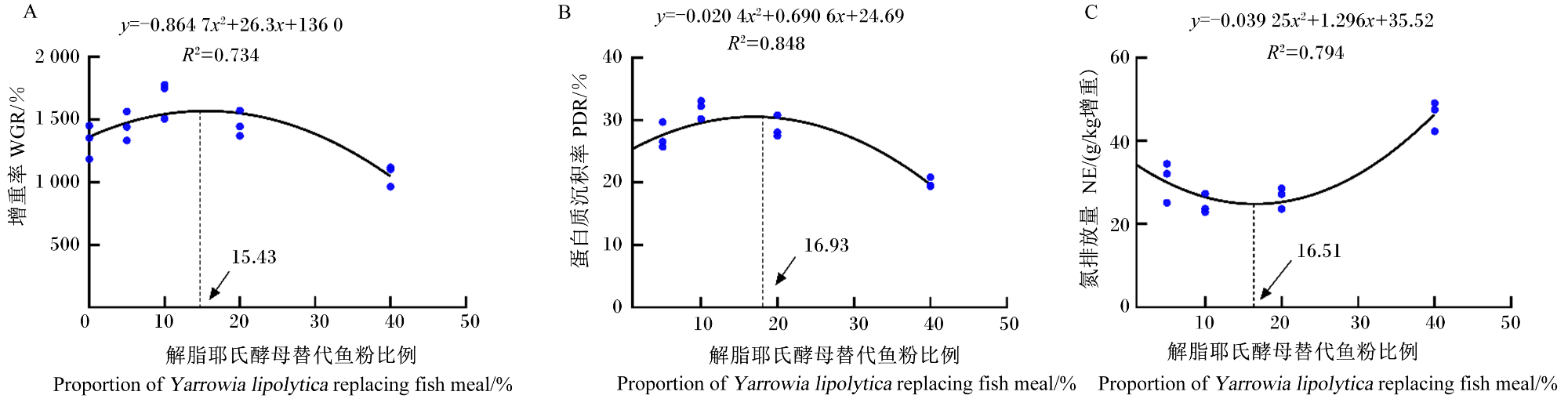
表3可知,随着解脂耶氏酵母替代鱼粉比例的增加,罗氏沼虾成活率呈下降趋势,YL40组成活率最低,且显著低于YL0和YL10组(P<0.05);YL0、YL5、YL10和YL20组之间无显著差异(P>0.05)。WGR随解脂耶氏酵母替代鱼粉比例的增加呈先升后降的二次变化(P<0.05),YL10组WGR最高,且显著高于YL0和YL40组(P<0.05)。与YL0组相比,YL5、YL10和YL20组FCR显著降低(P<0.05),YL40组FCR显著提高(P<0.05)。PER以YL10和YL20组较高,且显著高于YL0和YL40组(P<0.05)。基于WGR的回归分析结果(图1-A)表明,罗氏沼虾饲料中解脂耶氏酵母替代鱼粉的适宜比例为15.43%。
表3 解脂耶氏酵母替代鱼粉对罗氏沼虾生长性能的影响

Table 3 Effects of replacing fish meal with Yarrowia lipolytica on growth performance of Macrobrachium rosenbergii

项目
Items
组别 Groups SEM PP-value
YL0 YL5 YL10 YL20 YL40 方差分析
ANOVA
线性
Linear
二次
Quadratic
成活率 SR/% 88.00a 83.50ab 84.50a 82.50ab 77.00b 1.041 0.004 <0.001 0.002
增重率 WGR/% 1 321.66b 1 424.92ab 1 630.72a 1 492.60ab 1 020.84c 52.420 <0.001 0.155 <0.001
饲料系数 FCR 1.34b 1.24c 1.20c 1.22c 1.59a 0.034 <0.001 0.040 <0.001
蛋白质效率 PER 1.69bc 1.86ab 2.04a 2.04a 1.45c 0.065 <0.001 0.509 <0.001

同行数据肩标无字母或相同小写字母表示差异不显著(P>0.05),不同小写字母表示差异显著(P<0.05)。下表同。

In the same row, values with no letter or the same small letter superscripts mean no significant difference (P>0.05), while with different small letter superscripts mean significant difference (P<0.05). The same as below.

图1 基于WGR、PDR及NE的回归分析

Fig.1 Regression analysis based on WGR, PDR and NE

2.2 解脂耶氏酵母替代鱼粉对罗氏沼虾体组成和营养物质沉积率的影响

表4可知,虾体粗蛋白质含量以YL10组最高,且显著高于其余各组(P<0.05);以YL40组最低,与YL20和YL0组之间无显著差异(P>0.05)。各组虾体粗脂肪、粗灰分及磷含量均无显著差异(P>0.05)。PDR和PPDR随解脂耶氏酵母替代鱼粉比例的增加呈先升后降的二次变化(P<0.05),二者均以YL10组最高,且显著高于YL0、YL5和YL40组(P<0.05);以YL40组最低,且显著低于其余各组(P<0.05)。基于PDR的回归分析结果(图1-B)表明,罗氏沼虾饲料中解脂耶氏酵母替代鱼粉的适宜比例为16.93%。
表4 解脂耶氏酵母替代鱼粉对罗氏沼虾体组成和营养物质沉积率的影响

Table 4 Effects of replacing fish meal with Yarrowia lipolytica on body composition and nutrient deposition rates of Macrobrachium rosenbergii %

项目
Items
组别 Groups SEM PP-value
YL0 YL5 YL10 YL20 YL40 方差分析
ANOVA
线性
Linear
二次
Quadratic
体组成 Body composition
粗蛋白质 CP 48.01bc 49.49b 52.36a 47.69bc 46.81c 0.545 <0.001 0.295 0.004
粗脂肪 EE 6.77 7.35 7.43 6.96 6.25 0.166 0.134 0.241 0.022
粗灰分 Ash 18.46 18.76 18.51 18.70 18.84 0.137 0.923 0.493 0.793
磷 P 1.22 1.13 1.19 1.11 1.09 0.019 0.153 0.027 0.097
营养物质沉积率 Nutrient deposition rate
蛋白质沉积率
PDR
24.04c 27.31bc 31.82a 28.77ab 19.92d 1.138 <0.001 0.420 <0.001
磷沉积率 PPDR 10.14c 11.41b 12.60a 10.16c 8.33d 0.388 <0.001 0.075 <0.001

2.3 解脂耶氏酵母替代鱼粉对罗氏沼虾营养物质表观消化率和氮、磷排放量的影响

表5可知,各组ADDM无显著差异(P>0.05)。YL10组ADCP最高,且显著高于YL5和YL40组(P<0.05)。NE和PE随解脂耶氏酵母替代鱼粉比例的增加呈先降后升的二次变化(P<0.05),二者均以YL10组最低,且显著低于YL0和YL40组(P<0.05)。基于NE的回归分析结果(图1-C)表明,罗氏沼虾饲料中解脂耶氏酵母替代鱼粉的适宜比例为16.51%。
表5 解脂耶氏酵母替代鱼粉对罗氏沼虾营养物质表观消化率和氮、磷排放量的影响

Table 5 Effects of replacing fish meal with Yarrowia lipolytica on nutrient apparent digestibility and nitrogen and phosphorus excretion of Macrobrachium rosenbergii

项目
Items
组别 Groups SEM PP-value
YL0 YL5 YL10 YL20 YL40 方差分析
ANOVA
线性
Linear
二次
Quadratic
干物质表观
消化率
ADDM/%
74.35 69.45 75.36 74.18 72.19 0.620 0.059 0.942 0.979
粗蛋白质
表观消化率
ADCP/%
85.17ab 82.75b 86.82a 84.91ab 82.17b 0.527 0.005 0.321 0.197
氮排放量
NE/(g/kg增重)
35.86b 30.56bc 24.61c 26.45c 46.28a 2.197 <0.001 0.298 <0.001
磷排放量
PE/(g/kg增重)
20.07ab 16.15cd 15.06d 18.27bc 22.15a 0.729 <0.001 0.235 <0.001

2.4 解脂耶氏酵母替代鱼粉对罗氏沼虾血清生化和抗氧化指标的影响

表6可知,随着解脂耶氏酵母替代鱼粉比例的增加,血清TG和T-CHO含量呈先降后升的二次变化(P<0.05),GLU含量呈先升后降的二次变化(P<0.05)。其中,YL20组血清TG含量最低,且显著低于YL0和YL40组(P<0.05);YL10组血清T-CHO含量最低,且显著低于YL0和YL40组(P<0.05);YL5和YL10组血清GLU含量显著高于其余各组(P<0.05)。随着解脂耶氏酵母替代鱼粉比例的增加,血清ALT和AST活性呈先降后升的二次变化(P<0.05),二者均以YL10组最低,YL40组最高。血清SOD活性和T-AOC均以YL10组最高,且显著高于YL5和YL40组(P<0.05)。YL10和YL20组血清MDA含量显著低于YL0和YL40组(P<0.05),与YL5组无显著差异(P>0.05)。
表6 解脂耶氏酵母替代鱼粉对罗氏沼虾血清生化和抗氧化指标的影响

Table 6 Effects of replacing fish meal with Yarrowia lipolytica on serum biochemical and antioxidant indices of Macrobrachium rosenbergii

项目
Items
组别 Groups SEM PP-value
YL0 YL5 YL10 YL20 YL40 方差分析
ANOVA
线性
Linear
二次
Quadratic
甘油三酯
TG/(mmol/L)
2.87b 2.68bc 2.55bc 2.46c 3.17a 0.074 <0.001 0.485 0.001
总胆固醇
T-CHO/(mmol/L)
2.61ab 2.27bc 1.88c 1.96bc 3.00a 0.126 0.002 0.615 <0.001
葡萄糖
GLU/(mmol/L)
1.93b 3.26a 3.21a 2.13b 1.28c 0.208 <0.001 0.097 <0.001
谷丙转氨酶
ALT/(U/L)
99.11ab 87.50bc 78.80c 88.58bc 109.74a 3.132 <0.001 0.331 <0.001
谷草转氨酶
AST/(U/L)
96.90ab 83.43bc 71.29c 80.63bc 101.62a 3.308 <0.001 0.789 <0.001
超氧化物歧化酶
SOD/(U/mL)
377.21abc 321.41bc 410.03a 399.65ab 303.10c 13.465 0.009 0.483 0.222
丙二醛
MDA/(nmol/mL)
16.28a 13.24ab 9.50b 10.48b 16.78a 0.897 0.003 0.791 <0.001
总抗氧化能力
T-AOC/(U/mL)
4.56c 5.34b 8.01a 5.75b 3.20d 0.428 <0.001 0.468 <0.001

2.5 解脂耶氏酵母替代鱼粉对罗氏沼虾肠道消化酶活性的影响

表7可知,随着解脂耶氏酵母替代鱼粉比例的增加,肠道TRY和AMS活性呈先升后降的二次变化(P<0.05)。YL10组肠道TRY和LPS活性最高,且显著高于YL0、YL20和YL40组(P<0.05)。YL5和YL10组肠道AMS活性显著高于YL0、YL20和YL40组(P<0.05)。
表7 解脂耶氏酵母替代鱼粉对罗氏沼虾肠道消化酶活性的影响

Table 7 Effects of replacing fish meal with Yarrowia lipolytica on intestinal digestive enzyme activities of Macrobrachium rosenbergii

项目
Items
组别 Groups SEM PP-value
YL0 YL5 YL10 YL20 YL40 方差分析
ANOVA
线性
Linear
二次
Quadratic
胰蛋白酶
TRY/(U/mg prot)
65.44cd 86.11bc 124.00a 93.00b 44.77d 7.410 <0.001 0.531 <0.001
脂肪酶
LPS/(U/g prot)
14.19b 15.11ab 17.06a 13.39b 14.38b 0.403 0.015 0.655 0.252
淀粉酶
AMS/(U/mg prot)
0.40b 0.46a 0.45a 0.39bc 0.38c 0.010 <0.001 0.095 0.001

2.6 解脂耶氏酵母替代鱼粉对罗氏沼虾肠道形态结构的影响

图2可知,YL10组肠道绒毛高度显著高于YL0和YL40组(P<0.05),与YL5和YL20组无显著差异(P>0.05);YL40组肠道绒毛高度显著低于其余各组(P<0.05)。各组肠道绒毛宽度无显著差异(P>0.05)。
图2 解脂耶氏酵母替代鱼粉对罗氏沼虾肠道形态结构的影响

VW:绒毛宽度 villus width;VH:绒毛高度 villus height。YL0:YL0组 YL0 group;YL5:YL5组 YL5 group;YL10:YL10组 YL10 group;YL20:YL20组 YL20 group;YL40:YL40组 YL40 group。

数据柱形标注不同字母表示差异显著(P<0.05),无字母或相同字母表示差异不显著(P>0.05)。图5同。Value columns with different letters mean significant difference (P<0.05), while with no letters or the same letters mean no significant difference (P>0.05). The same as Fig.5.

Fig.2 Effects of replacing fish meal with Yarrowia lipolytica on intestinal morphological structure of Macrobrachium rosenbergii (20×)

2.7 解脂耶氏酵母替代鱼粉对罗氏沼虾肠道菌群的影响

2.7.1 肠道菌群多样性

根据生长性能、氮磷利用与排放等结果,选取YL0、YL10和YL40组进行肠道菌群分析。基于操作分类单元(OTU)水平分析肠道菌群生态特征的各项指数结果(表8)显示,各组菌群覆盖率均高于99%,表明本研究样本中获得的16S rRNA基因序列可代表样本中绝大多数细菌。YL0组Shannon指数显著高于YL10和YL40组(P<0.05),而YL10组与YL40组之间无显著差异(P>0.05);YL40组Simpson指数显著高于YL0和YL10组(P<0.05);各组间Sobs指数、Chao1指数和Ace指数均无显著差异(P>0.05)。
表8 肠道菌群α多样性

Table 8 Intestinal microbiota α diversity

项目
Items
组别 Groups SEM P
P-value
YL0 YL10 YL40
Sobs指数 Sobs index 423.00 367.33 246.33 32.990 0.053
Shannon指数 Shannon index 3.45a 2.16b 1.30b 0.333 0.001
Simpson指数 Simpson index 0.08c 0.37b 0.51a 0.064 <0.001
覆盖率 Coverage/% 99.89 99.87 99.89 0.004 0.293
Chao1指数 Chao1 index 461.08 412.88 290.37 32.814 0.064
Ace指数 Ace index 461.14 413.75 295.31 31.209 0.053
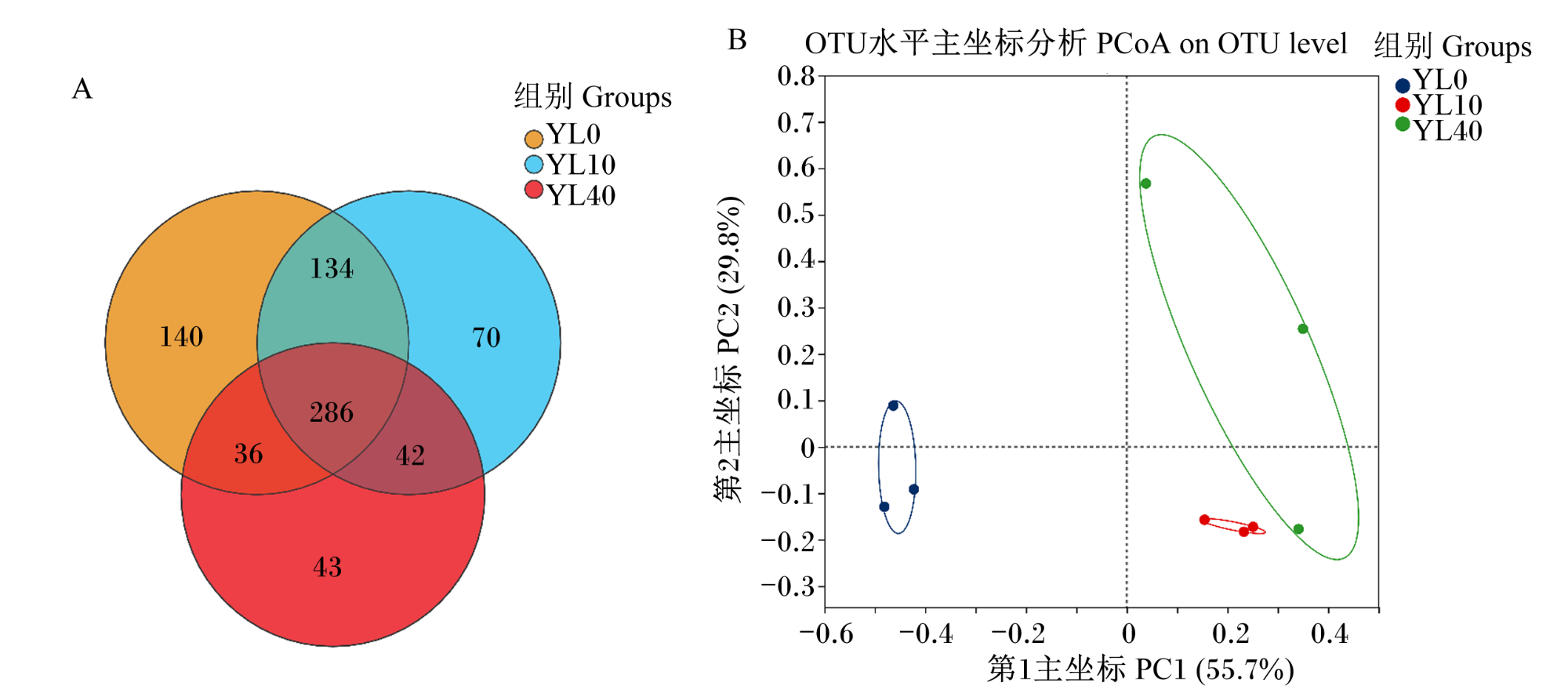
图3可知,在YL0、YL10和YL40组罗氏沼虾的肠道菌群中共检测到751个OTU,其中共有OTU为286个,3组独有的OTU数量依次为140、70和43个。主坐标分析(PCoA)结果显示,3组样本彼此分离,无明显重叠,表明解脂耶氏酵母替代鱼粉改变了罗氏沼虾肠道菌群的群落结构。
图3 肠道菌群OTU分布(A)和主坐标分析(B)

Fig.3 Intestinal microbiota OTU distribution (A) and principal coordinate analysis (B)

2.7.2 肠道菌群组成

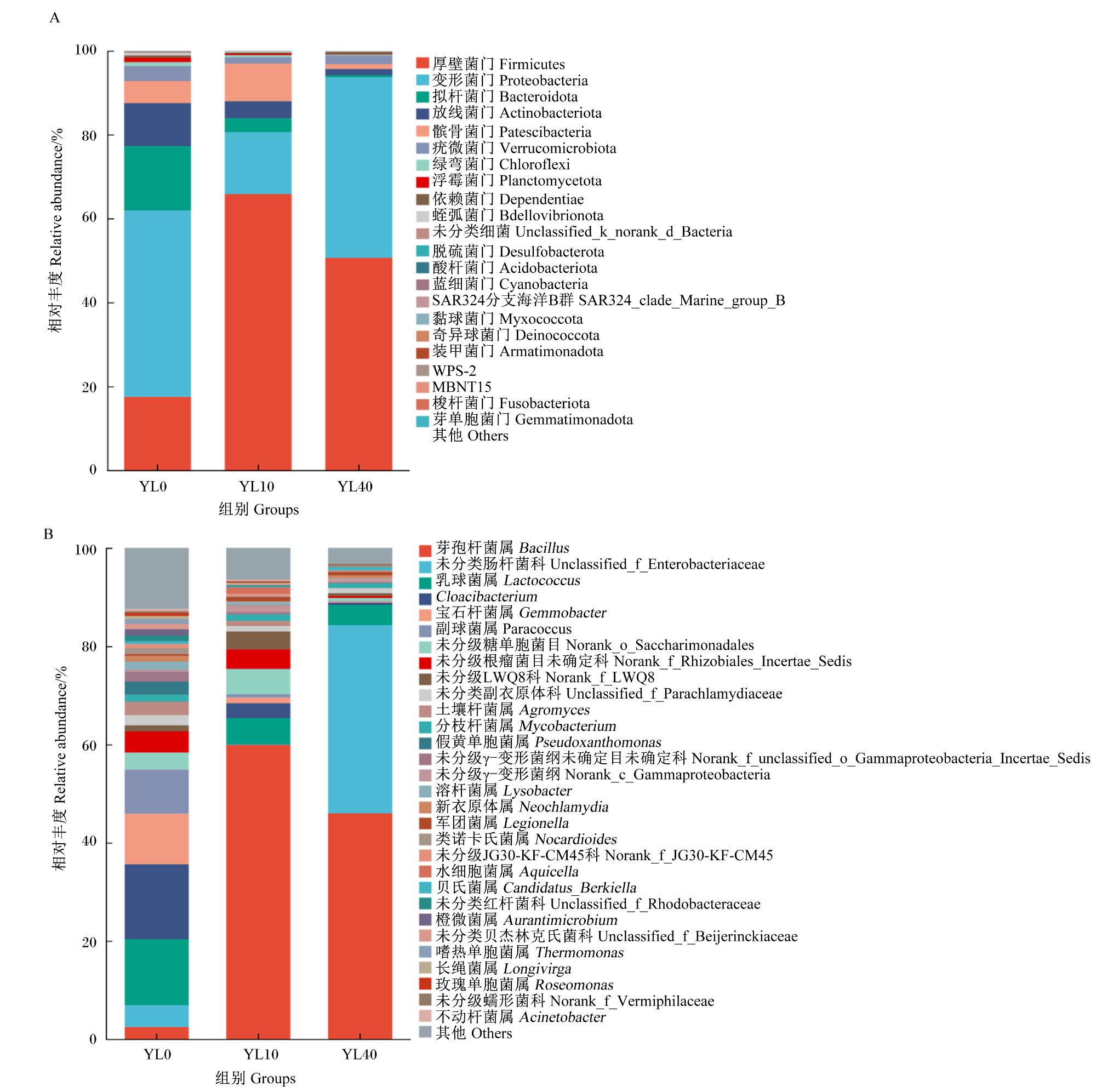
在门和属分类水平上的肠道菌群组成如图4所示。在门水平上,厚壁菌门(Firmicutes)、变形菌门(Proteobacteria)和拟杆菌门(Bacteroidota)为主要优势菌门;在属水平上,芽孢杆菌属(Bacillus)、未分类肠杆菌科(unclassified_f_Enterobacteriaceae)、乳球菌属(Lactococcus)和Cloacibacterium为主要优势菌属。
图4 肠道菌群门(A)和属(B)水平组成

Fig.4 Intestinal microbiota composition at phylum (A) and genus (B) levels

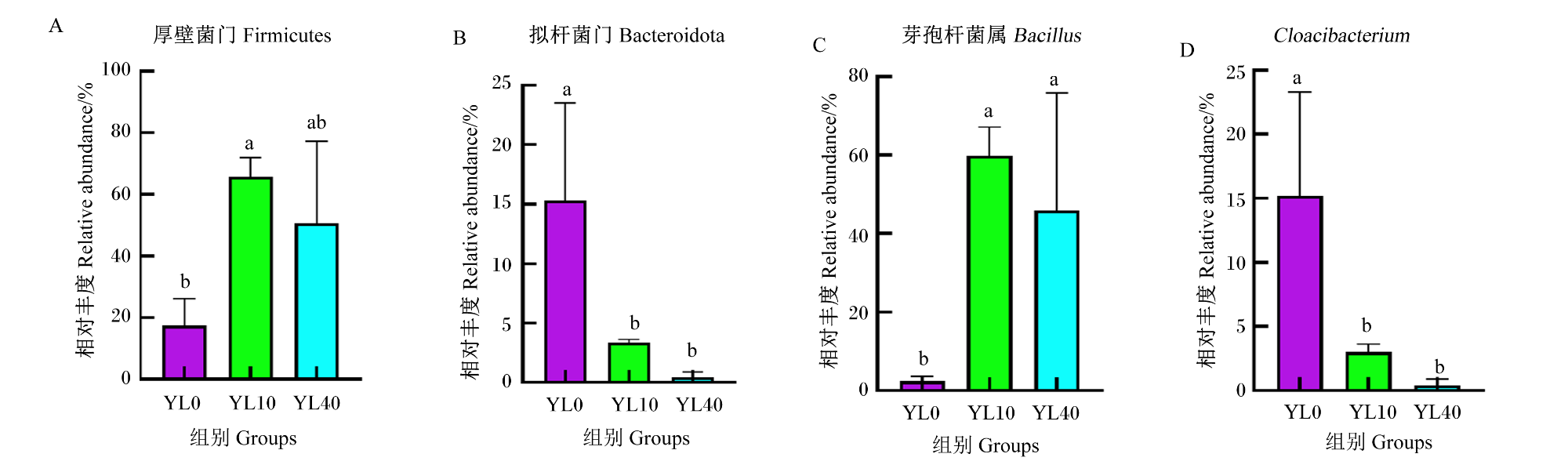
图5可知,在门水平上,YL10组厚壁菌门相对丰度显著高于YL0组(P<0.05),与YL40组无显著差异(P>0.05)。YL10和YL40组拟杆菌门相对丰度显著低于YL0组(P<0.05),YL10组与YL40组之间无显著差异(P>0.05);在属水平上,YL10和YL40组芽孢杆菌属相对丰度显著高于YL0组(P<0.05),Cloacibacterium相对丰度显著低于YL0组(P<0.05),YL10组与YL40组间上述2个菌属的相对丰度无显著差异(P>0.05)。
图5 解脂耶氏酵母替代鱼粉对罗氏沼虾肠道菌群相对丰度的影响

Fig.5 Effects of replacing fish meal with Yarrowia lipolytica on relative abundance of intestinal microbiota in Macrobrachium rosenbergii

3 讨论

3.1 解脂耶氏酵母替代鱼粉对罗氏沼虾生长性能的影响

生长性能是衡量虾类生理状态的关键指标[28]。本研究发现,与YL0组相比,解脂耶氏酵母替代鱼粉比例为10%时(YL10组),罗氏沼虾的WGR显著提高,而替代比例达到40%时(YL40组),WGR则显著降低;同时,YL5、YL10和YL20组FCR均较YL0组显著降低。类似的规律在其他水产动物酵母替代鱼粉的研究中也得到验证:用酿酒酵母替代欧洲舌齿鲈鱼(Dicentrarchus labrax)饲料中30%的鱼粉时,其饲料转化率优于对照组,而替代比例达到50%时,饲料转化率显著降低[29];酿酒酵母替代攀鲈饲料中77.88%的鱼粉时,其WGR达到峰值,替代比例超过此值后WGR则呈下降趋势[16];用产朊假丝酵母完全替代克氏原螯虾(Procambarus clarkii)饲料中的鱼粉,会显著降低其生长性能[30]。上述结果表明,用解脂耶氏酵母替代适宜比例的鱼粉对罗氏沼虾的生长具有促进作用。这可能是因为解脂耶氏酵母富含的核苷酸、维生素及矿物质等营养物质能够提高饲料的适口性,促进其对营养物质的消化与吸收,从而改善生长性能[31]。而过量解脂耶氏酵母对罗氏沼虾生长的抑制效应,则可能归因于酵母细胞壁中含有的几丁质、β-葡聚糖等难消化成分。这些成分会随酵母添加量的增加在饲料中累积,降低饲料的整体消化性及虾体对营养物质的吸收效率,最终抑制生长[32-33]。前人研究亦证实,齐口裂腹鱼(Schizothorax prenanti Tchang)摄入高剂量的β-葡聚糖会显著抑制其生长[34]

3.2 解脂耶氏酵母替代鱼粉对罗氏沼虾氮磷排放的影响

ADCP及体组成中粗蛋白质含量是衡量水产动物对饲料蛋白质消化吸收效率和蛋白质在机体内沉积效果的关键指标[35-36]。本研究发现,与YL0组相比,解脂耶氏酵母替代10%的鱼粉可显著提高虾体粗蛋白质含量及PDR,同时减少NE;且其ADCP显著高于YL5和YL40组。这表明,解脂耶氏酵母替代适宜比例的鱼粉既能提高罗氏沼虾对饲料蛋白质的消化吸收效率,又能促进蛋白质在体内的沉积,与在欧洲舌齿鲈鱼[29]和大菱鲆(Scophthalmus maximus)[37]上的研究结果类似。这一促进作用可能与解脂耶氏酵母中的核苷酸和甘露寡糖有关:核苷酸作为DNA合成的基本单位,是蛋白质生物合成的重要基础[38],而甘露寡糖则被证实可提高薄唇鲻(Liza ramada)的PDR[39]。然而,当替代比例增至40%时,上述指标呈现相反变化趋势。这可能是因为高剂量解脂耶氏酵母引入的高剂量几丁质影响了营养吸收——已有研究表明,饲料中几丁质含量过高会降低虹鳟的ADCP[40]。磷作为虾类的必需营养素,其过量排放是引发水体富营养化的重要诱因[41]。本研究中,YL10组PPDR的升高与PE的降低,表明该替代比例下罗氏沼虾对磷的利用效率较高;而YL40组的反向变化说明高比例替代可能破坏磷代谢平衡,类似的现象在大口黑鲈(Micropterus salmoides)[26]中亦有报道。

3.3 解脂耶氏酵母替代鱼粉对罗氏沼虾血清生化和抗氧化指标的影响

本研究中,与YL0组相比,YL20组血清TG含量显著降低,YL10组血清T-CHO含量显著降低,表明解脂耶氏酵母替代适宜比例的鱼粉能够减少脂肪在血清中的蓄积。这一作用可能与解脂耶氏酵母所含的β-葡聚糖等多糖物质有关,此类物质可激活脂肪分解,加速脂肪酸的β-氧化[42]。类似地,尼罗罗非鱼幼鱼摄食含海洋红酵母(Rhodosporidium sphaerocarpum)的饲料后,其血清TG和T-CHO含量也呈现降低趋势[43],进一步佐证了酵母对水产动物脂质代谢的积极调控作用。此外,当解脂耶氏酵母替代饲料中5%和10%的鱼粉时,罗氏沼虾血清GLU含量显著提高。这可能是因为解脂耶氏酵母富含的β-葡聚糖可提升胰岛素敏感性[44],从而提高虾对碳水化合物的代谢效率,促进GLU经肠上皮转运入血。充足的GLU能够减少组织蛋白质的分解代谢[45],促使机体将摄入的蛋白质更多用于体蛋白质合成与沉积,进而降低含氮代谢废物的排放。这一结果与前述PDR的变化趋势相对应。
MDA是脂质过氧化的重要标志物,广泛用于评估细胞氧化应激水平[46]。SOD和T-AOC则是反映机体抗氧化能力的关键指标。本研究中,与YL0组相比,YL10组血清T-AOC显著提高,MDA含量显著降低,且该组血清SOD活性显著高于YL5和YL40组,表明解脂耶氏酵母替代适宜比例的鱼粉能显著增强罗氏沼虾的抗氧化能力。类似的研究结果在尼罗罗非鱼[47]和大菱鲆[37]中亦有报道。这种抗氧化能力的提升可能归因于酵母所含的甘露寡糖的作用[48]。已有研究证实,适量的甘露寡糖对中华绒螯蟹(Eriocheir sinensis)的抗氧化能力具有积极促进作用[49]
AST和ALT是重要的氨基酸转氨酶,在介导机体脂肪、蛋白质与糖类间的物质转化中发挥关键作用[50],其主要在动物肝脏内合成。这2种酶主要在动物肝脏内合成,其血清活性变化是量化肝脏健康状态的重要依据[51]。本研究结果显示,YL10组血清ALT和AST活性显著低于YL0组,而YL40组较YL0组有所升高,表明解脂耶氏酵母替代适宜比例的鱼粉对罗氏沼虾的肝脏健康具有积极调控作用。这一作用可能源于酵母中的β-葡聚糖可直接与机体巨噬细胞或白细胞相互作用,激活免疫细胞活性,进而改善水生动物的健康状态[52]。已有研究报道,饲料中添加β-葡聚糖可显著上调黄鳍结鱼(Tor putitora)免疫球蛋白基因的表达水平[53],同时降低凡纳滨对虾血清AST和ALT活性[54],与本研究结果相对应。

3.4 解脂耶氏酵母替代鱼粉对罗氏沼虾肠道消化酶活性和形态结构的影响

肠道是动物消化吸收营养物质的核心器官,其消化酶活性是衡量营养物质消化效率的关键指标。本研究发现,解脂耶氏酵母替代10%的鱼粉对肠道LPS、AMS和TRY活性均有积极促进作用。类似地,酿酒酵母替代适宜比例的鱼粉能显著提升露斯塔野鲮(Labeo rohita)肠道总蛋白酶及LPS活性[19];酿酒酵母替代25%的鱼粉可提高牛蛙(Lithobates catesbeiana)肠道TRY活性[55]。推测YL10组肠道消化酶活性的升高与解脂耶氏酵母细胞壁含有的β-葡聚糖等功能性多糖有关。已有研究报道,多糖可通过与肠道上皮细胞表面的模式识别受体结合,激活细胞内信号通路[56],进而调控转录因子的核转位,最终促进消化酶相关基因的转录与翻译过程。
肠道绒毛宽度与高度是评价肠道健康状态的重要指标[57]。本研究结果显示,YL10组肠道绒毛高度较YL0组显著提高,提示解脂耶氏酵母替代适宜比例的鱼粉可显著提升罗氏沼虾肠道绒毛高度。这一现象可能与解脂耶氏酵母所含的甘露寡糖和β-葡聚糖有关。已有研究证实,甘露寡糖能改善中华绒螯蟹肠道微绒毛结构,增加绒毛长度,从而增强肠道营养物吸收效率[49];酵母中的β-葡聚糖可以改善草鱼(Ctenopharyngodon idella)肠道屏障完整性,进而增加肠道绒毛高度[58]。然而,YL40组的绒毛高度较YL0组显著下降,表明摄入过量解脂耶氏酵母会对罗氏沼虾肠道形态结构产生负面影响。这可能是由于添加高剂量解脂耶氏酵母导致饲料中β-葡聚糖含量过高所致。已有研究表明,过量的β-葡聚糖会损伤罗氏沼虾肠道形态结构,影响肠道绒毛高度,抑制其生长[59]。这也与本文前述的生长性能结果相对应,说明解脂耶氏酵母替代适宜比例的鱼粉可改善罗氏沼虾肠道绒毛形态,提升生长性能;而过高的替代比例则会破坏肠道结构并抑制生长。

3.5 解脂耶氏酵母替代鱼粉对罗氏沼虾肠道菌群的影响

肠道菌群作为调控宿主代谢与免疫功能的关键“微生物器官”,可影响动物对营养物质的利用、生长发育及健康状态,是维持动物生理功能的重要生物学基础[60]。本研究发现,YL10和YL40组Shannon指数较YL0组显著下降,表明解脂耶氏酵母替代鱼粉会导致肠道菌群群落的物种丰富度或分布均匀性降低;Simpson指数则随替代比例升高呈逐渐升高趋势,提示菌群群落结构趋向单一化[61-62]。YL10和YL40组菌群多样性的降低,可能与酵母细胞壁成分在肠道内的累积改变了肠道微环境有关,过量的非淀粉多糖会抑制肠道内部分敏感菌的增殖[63]。在门水平上,罗氏沼虾肠道菌群以厚壁菌门、变形菌门和拟杆菌门为主,这与多数甲壳类动物的肠道菌群特征一致[64]。值得注意的是,YL10组厚壁菌门相对丰度显著高于YL0组,而YL40组则较YL10组有所下降。YL10组厚壁菌门的富集,可能与解脂耶氏酵母细胞壁中含有的葡聚糖等功能性多糖有关,此类物质可作为厚壁菌门的特异性营养底物驱动其增殖。厚壁菌门微生物基因组中富含编码碳水化合物活性酶的基因,可通过分泌胞外酶将饲料中的复杂多糖、脂质降解为葡萄糖、脂肪酸等小分子可吸收物质,从而强化宿主对碳水化合物与脂肪的利用效率[65]。而YL40组厚壁菌门相对丰度的下降,可能是由于高比例解脂耶氏酵母带来的过量非淀粉多糖难以被厚壁菌门中多数类群利用,反而抑制了其进一步增殖。拟杆菌门菌群一方面可通过分泌多种水解酶,参与宿主对碳水化合物的降解与利用,对维持肠道物质代谢平衡具有重要作用[66];另一方面,当肠道内拟杆菌门菌群过度增殖时,其分泌的黏液降解酶会破坏肠道上皮细胞表面的黏多糖层,导致肠道物理屏障完整性受损,进而增加病原菌入侵风险[67]。本研究结果表明,与YL0组相比,YL10与YL40组拟杆菌门相对丰度显著降低,这可能是因为解脂耶氏酵母的添加改变了罗氏沼虾肠道碳源构成与营养竞争格局,其含有的功能性多糖可为厚壁菌门提供营养竞争优势,从而抑制拟杆菌门增殖。在属水平上,与YL0组相比,YL10和YL40组芽孢杆菌属相对丰度显著提高,而Cloacibacterium相对丰度显著降低。芽孢杆菌属中的许多细菌被认为是潜在益生菌:它们可以分泌蛋白酶、AMS等胞外酶,直接辅助宿主消化营养物质[68];还可以通过自身生长代谢过程主动合成并分泌胞外多糖来调节肠道黏膜免疫,增强屏障功能[69]。据报道,Cloacibacterium与肠道抗菌基因的表达相关,其相对丰度的降低会引起抗菌相关基因表达上调,从而降低肠道潜在炎症风险[70]。这一变化可能与酵母寡糖通过“益生元效应”改善肠道微生态有关[71]

4 结论

综上所述,以解脂耶氏酵母替代饲料中适宜比例的鱼粉,可显著提升罗氏沼虾的氮、磷沉积效率,减少氮、磷代谢废物排放,同时增强机体抗氧化能力,改善肠道健康,并促进其生长性能提升。基于WGR、PDR及NE的回归分析显示,罗氏沼虾饲料中解脂耶氏酵母替代鱼粉的适宜比例为15.43%~16.93%。
[1]
TAN K, WANG W M. The early life culture and gonadal development of giant freshwater prawn,Macrobrachium rosenbergii:a review[J]. Aquaculture, 2022, 559:738357.

DOI

[2]
中华人民共和国农业农村部渔业渔政管理局, 全国水产技术推广总站, 中国水产学会. 2025中国渔业统计年鉴[M]. 北京: 中国农业出版社, 2025:25.

Bureau of Fisheries and Fishery Administration,Ministry of Agriculture and Rural Affairs of the People’s Republic of China, National Fisheries Technology Extension Center,Chinese Society of Fisheries, 2025 China fisheries statistical yearbook[M]. Beijing: China Agriculture Press, 2025:25. (in Chinese)

[3]
SARMAN V, VISHAL R, MAHAVADIYA D, et al. Nutritional aspect for freshwater prawn (Macrobrachium rosenbergii) farming[J]. International Journal of Fauna and Biological Studies, 2018, 5(2):172-175.

[4]
WATANABE T. Strategies for further development of aquatic feeds[J]. Fisheries Science, 2002, 68(2):242-252.

DOI

[5]
FLORETO E A T, BAYER R C, BROWN P B. The effects of soybean-based diets,with and without amino acid supplementation,on growth and biochemical composition of juvenile American lobster,Homarus americanus[J]. Aquaculture, 2000, 189(3/4):211-235.

DOI

[6]
MCLEAN E, BARROWS F T, CRAIG S R, et al. Complete replacement of fishmeal by soybean and poultry meals in pacific white shrimp feeds:growth and tolerance to EMS/AHPND and WSSV challenge[J]. Aquaculture, 2020, 527:735383.

DOI

[7]
LUO G Z. Review of waste phosphorus from aquaculture:source,removal and recovery[J]. Reviews in Aquaculture, 2023, 15(3):1058-1082.

DOI

[8]
DING Z L, ZHOU D S, ZHENG J X, et al. Replacing fishmeal with soybean meal affects survival,antioxidant capacity,intestinal microbiota,and mRNA expression of TOR and S6K1 in Macrobrachium rosenbergii[J]. Journal of Oceanology and Limnology, 2022, 40(2):805-817.

DOI

[9]
HOSSAIN M M, CHAKRABORTY S C. Growth and economic analysis of freshwater prawn,Macrobrachium rosenbergii (de Man),produced with feeds substituting sunflower cake for fish meal,soya bean meal and mustard oil cake[J]. Aquaculture Research, 2017, 48(10):5418-5429.

DOI

[10]
GATLIN D M, BARROWS F T, BROWN P, et al. Expanding the utilization of sustainable plant products in aquafeeds:a review[J]. Aquaculture Research, 2007, 38(6):551-579.

DOI

[11]
GLENCROSS B D, HUYBEN D, SCHRAMA J W. The application of single-cell ingredients in aquaculture feeds-a review[J]. Fishes, 2020, 5(3):20-22.

DOI

[12]
AGBOOLA J O, ØVERLAND M, SKREDE A, et al. Yeast as major protein-rich ingredient in aquafeeds:a review of the implications for aquaculture production[J]. Reviews in Aquaculture, 2021, 13(2):949-970.

DOI

[13]
VIDAKOVIC A, HUYBEN D, SUNDH H, et al. Growth performance,nutrient digestibility and intestinal morphology of rainbow trout (Oncorhynchus mykiss) fed graded levels of the yeasts Saccharomyces cerevisiae and Wickerhamomyces anomalus[J]. Aquaculture Nutrition, 2020, 26(2):275-286.

DOI

[14]
PONGPET J, PONCHUNCHOOVONG S, PAYOOHA K. Partial replacement of fishmeal by brewer’s yeast (Saccharomyces cerevisiae) in the diets of Thai panga (Pangasianodon hypophthalmus×Pangasius bocourti)[J]. Aquaculture Nutrition, 2016, 22(3):575-585.

DOI

[15]
GAMBOA-DELGADO J, FERNÁNDEZ-DÍAZ B, NIETO-LÓPEZ M, et al. Nutritional contribution of torula yeast and fish meal to the growth of shrimp Litopenaeus vannamei as indicated by natural nitrogen stable isotopes[J]. Aquaculture, 2016, 453:116-121.

DOI

[16]
GOKULAKRISHNAN M, KUMAR R, PILLAI B R, et al. Dietary brewer’s spent yeast enhances growth, hematological parameters,and innate immune responses at reducing fishmeal concentration in the diet of climbing perch,Anabas testudineus fingerlings[J]. Frontiers in Nutrition, 2022, 9:982572.

DOI

[17]
CARVALHO D A, REYES P S, CALVO N S, et al. Reuse of spent brewer’s yeast to produce a south American freshwater prawn:effects on growth performance,amino acid profile,proximate and elemental composition,and egg development[J]. Aquaculture International, 2024, 32(3):3405-3427.

DOI

[18]
VIDAKOVIC A, LANGELAND M, SUNDH H, et al. Evaluation of growth performance and intestinal barrier function in Arctic charr (Salvelinus alpinus) fed yeast (Saccharomyces cerevisiae),fungi (Rhizopus oryzae) and blue mussel (Mytilus edulis)[J]. Aquaculture Nutrition, 2016, 22(6):1348-1360.

DOI

[19]
PRADHAN D, SWAIN H S, UPADHYAY A, et al. On valorization of brewer’s yeast as an environmentally sustainable fishmeal replacement in Labeo rohita nutrition:insight to growth attributes,digestive enzyme activities and haemato-biochemical indices[J]. Waste and Biomass Valorization, 2024, 15(6):3503-3517.

DOI

[20]
LEEPER A, EKMAY R, KNOBLOCH S, et al. Torula yeast in the diet of Atlantic salmon Salmo salar and the impact on growth performance and gut microbiome[J]. Scientific Reports, 2022, 12(1):567.

DOI

[21]
MAMAEV D, ZVYAGILSKAYA R. Yarrowia lipolytica:a multitalented yeast species of ecological significance[J]. FEMS Yeast Research, 2021, 21(2):foab008.

DOI

[22]
BAO W J, LI Z F, WANG X M, et al. Approaches to improve the lipid synthesis of oleaginous yeast Yarrowia lipolytica:a review[J]. Renewable and Sustainable Energy Reviews, 2021, 149:111386.

DOI

[23]
NEULS L, DE SOUZA V J, ROMÃO S, et al. Immunomodulatory effects of Yarrowia lipolytica as a food additive in the diet of Nile tilapia[J]. Fish & Shellfish Immunology, 2021, 119:272-279.

[24]
SINGH A, VIDAKOVIC A, SINGH A, et al. Yarrowia lipolytica yeast as a dietary supplement for rainbow trout (Oncorhynchus mykiss):effects on gut microbiota,health and immunity[J]. Aquaculture, 2024, 590:741065.

DOI

[25]
ZHANG L, ZHANG P, TAN P, et al. Yarrowia lipolytica as a promising protein source for pacific white shrimp (Litopenaeus vannamei) diet:impact on growth performance,metabolism,antioxidant capacity,and apparent digestibility[J]. Frontiers in Marine Science, 2024, 11:1370371.

DOI

[26]
崔正贺, 余聪, 李云梦, 等. 饲料中发酵啤酒酵母添加水平对大口黑鲈生长、饲料利用效率和水质的影响[J]. 中国水产科学, 2022, 29(2):274-283.

CUI Z H, YU C, LI Y M, et al. Effect of fermented brewer’s yeast (Saccharomyces cerevisiae) supplementation on growth,feed utilization,and water quality in large-mouth bass (Micropterus salmoides) farming[J]. Journal of Fishery Sciences of China, 2022, 29(2):274-283. (in Chinese)

[27]
HAN C, SHI C P, LIU L M, et al. Majorbio cloud 2024:update single-cell and multiomics workflows[J]. iMeta, 2024, 3(4):e217.

DOI

[28]
BRANDÃO H, DOS REIS W G, KRUMMENAUER D, et al. Growth performance of Litopenaeus vannamei under biofloc system using denitrified seawater[J]. Aquaculture International, 2024, 32(3):3129-3145.

DOI

[29]
OLIVA-TELES A, GONÇALVES P. Partial replacement of fishmeal by brewers yeast (Saccaromyces cerevisae) in diets for sea bass (Dicentrarchus labrax) juveniles[J]. Aquaculture, 2001, 202(3/4):269-278.

DOI

[30]
黄莹, 兰怡菲, 叶忠勋, 等. 产朊假丝酵母替代鱼粉蛋白对克氏原螯虾幼虾生长性能、抗氧化能力和消化系统组织形态的影响[J]. 水生生物学报, 2025, 49(12):122513.

HUANG Y, LAN Y F, YE Z X, et al. Replacing fish meal protein with Candida utilis on growth performance,antioxidant capacity,and digestive system morphology of juvenile Procambarus clarkii[J]. Acta Hydrobiologica Sinica, 2025, 49(12):122513. (in Chinese)

[31]
YANG L, WU X X, LIU D C. Mechanism and application of yeast and its culture in regulating intestinal antioxidant defense in ruminants[J]. Frontiers in Veterinary Science, 2025, 12:1657244.

DOI

[32]
DONG W J, LI Y C, XUE S R, et al. Yeast polysaccharides:the environmentally friendly polysaccharides with broad application potentials[J]. Comprehensive Reviews in Food Science and Food Safety, 2024, 23(5):e70003.

DOI

[33]
GLENCROSS B, RUTHERFORD N, BOURNE N. The influence of various starch and non-starch polysaccharides on the digestibility of diets fed to rainbow trout (Oncorhynchus mykiss)[J]. Aquaculture, 2012,356-357:141-146.

[34]
张辽. β-葡聚糖对齐口裂腹鱼生长及非特异性免疫功能的影响[D].硕士学位论文. 雅安: 四川农业大学, 2009.

ZHANG L. Effects of β-glucan on growth on and non-specific immunity in Schizothorax prenanti Tchang[D].Master’s Thesis. Ya’an: Sichuan Agriculture University, 2009. (in Chinese)

[35]
QIU X, NGUYEN L, DAVIS D A. Apparent digestibility of animal,plant and microbial ingredients for pacific white shrimp Litopenaeus vannamei[J]. Aquaculture Nutrition, 2018, 24(3):930-939.

DOI

[36]
XIAO F, WANG J W, LIU H M, et al. Effects of dietary protein levels on growth,digestive enzyme activity,antioxidant capacity,and gene expression related to muscle growth and protein synthesis of juvenile greasyback shrimp (Metapenaeus ensis)[J]. Animals, 2023, 13(24):3886.

DOI

[37]
SUN J W, LI Y H, REN T C, et al. Effects of yeast extract supplemented in diet on growth performance,digestibility,intestinal histology,and the antioxidant capacity of the juvenile turbot (Scophthalmus maximus)[J]. Frontiers in Physiology, 2024, 15:1329721.

DOI

[38]
MINCHIN S, LODGE J. Understanding biochemistry:structure and function of nucleic acids[J]. Essays in Biochemistry, 2019, 63(4):433-456.

DOI

[39]
MAGOUZ F I, BASSUINI M I, KHALAFALLA M M, et al. Mannan oligosaccharide enhanced the growth rate,digestive enzyme activity,carcass composition,and blood chemistry of thinlip grey mullet (Liza ramada)[J]. Animals, 2021, 11(12):3559.

DOI

[40]
EGGINK K M, AALTO S L, PEDERSEN P B, et al. Effects of dietary chitin on nutrient digestibility,cholesterol metabolism,digestive enzyme activity,and gut microbiome in rainbow trout[J]. Animal Feed Science and Technology, 2025, 328:116447.

DOI

[41]
DUHAMEL S. The microbial phosphorus cycle in aquatic ecosystems[J]. Nature Reviews Microbiology, 2025, 23(4):239-255.

DOI

[42]
CHEN C H, HUANG X J, WANG H, et al. Effect of β-glucan on metabolic diseases:a review from the gut microbiota perspective[J]. Current Opinion in Food Science, 2022, 47:100907.

DOI

[43]
LIU Y Q, HUANG E H, LI X M, et al. Serum biochemistry,fatty acids,lipid metabolism,antioxidants,and inflammation response were significantly affected by feeding different marine red yeast supplementation in juvenile tilapia (GIFT strain,Oreochromis niloticus)[J]. Frontiers in Marine Science, 2024, 11:1426848.

DOI

[44]
MITCHELSON K A J, TRAN T T T, DILLON E T, et al. Yeast β-glucan improves insulin sensitivity and hepatic lipid metabolism in mice humanized with obese type 2 diabetic gut microbiota[J]. Molecular Nutrition & Food Research, 2022, 66(22):e2100819.

[45]
VAN HAMONT D, HARVEY C R, MASSICOTTE D, et al. Reduction in muscle glycogen and protein utilization with glucose feeding during exercise[J]. International Journal of Sport Nutrition and Exercise Metabolism, 2005, 15(4):350-365.

PMID

[46]
MURO P, ZHANG L, LI S X, et al. The emerging role of oxidative stress in inflammatory bowel disease[J]. Frontiers in Endocrinology, 2024, 15:1390351.

DOI

[47]
LIU Y Q, HUANG E H, LI X M, et al. Effects of dietary marine red yeast supplementation on growth performance,antioxidant,immunity,lipid metabolism and mTOR signaling pathway in juvenile tilapia (Oreochromis niloticus)[J]. Aquaculture Reports, 2024, 37:102196.

DOI

[48]
FAUSTINO M, DURÃO J, PEREIRA C F, et al. Mannans and mannan oligosaccharides (MOS) from Saccharomyces cerevisiae—a sustainable source of functional ingredients[J]. Carbohydrate Polymers, 2021, 272:118467.

DOI

[49]
LU J T, QI C L, LIMBU S M, et al. Dietary mannan oligosaccharide (MOS) improves growth performance,antioxidant capacity,non-specific immunity and intestinal histology of juvenile Chinese mitten crabs (Eriocheir sinensis)[J]. Aquaculture, 2019, 510:337-346.

DOI

[50]
SOOKOIAN S, PIROLA C J. Alanine and aspartate aminotransferase and glutamine-cycling pathway:their roles in pathogenesis of metabolic syndrome[J]. World Journal of Gastroenterology, 2012, 18(29):3775-3781.

DOI

[51]
ABDELKADER S V, HAUGE J G. Serum enzyme determination in the study of liver disease in dogs[J]. Acta Veterinaria Scandinavica, 1986, 27(1):59-70.

PMID

[52]
HAN B, ZHANG X, CHANG E H, et al. Effects of dietary Saccharomyces cerevisiae and β-glucan on the growth performance,antioxidant capacity and immunity response in Macrobrachium rosenbergii[J]. Aquaculture Nutrition, 2021, 27(S1):20-28.

DOI

[53]
AKHTAR M S, TRIPATHI P H, PANDEY A, et al. Transgenerational effects of β-glucan on thermal tolerance,growth performance,and immune gene expression of endangered cyprinid Tor putitora progeny[J]. Journal of Thermal Biology, 2021, 102:103120.

DOI

[54]
赵红霞, 陈冰, 莫文艳, 等. 饲料添加β-1,3-葡聚糖对凡纳滨对虾生长性能、血清代谢、免疫相关基因表达和抗亚硝酸氮应激能力的影响[J]. 水生生物学报, 2021, 45(3):593-600.

ZHAO H X, CHEN B, MO W Y, et al. Effects of dietary β-1,3-glucan on growth performance,serum metabolite,immune-related gene expression and resistance to nitrite stress in Litopenaeus vannamei[J]. Acta Hydrobiologica Sinica, 2021, 45(3):593-600. (in Chinese)

[55]
CHEN Y F, SUN Z C, YANG X, et al. The substitution of fish meal or chicken meal with yeast culture in diets of bullfrogs (Lithobates catesbeianus):growth performance,serum biochemical indices,intestinal digestive enzyme, hepatic antioxidant,and hepatic and intestinal histology[J]. Aquaculture Nutrition, 2024, 2024:2178697.

DOI

[56]
LI M Z, WEN J J, HUANG X J, et al. Interaction between polysaccharides and Toll-like receptor 4:primary structural role,immune balance perspective,and 3D interaction model hypothesis[J]. Food Chemistry, 2022, 374:131586.

DOI

[57]
HOU Y Q, WANG L, YI D, et al. N-acetylcysteine and intestinal health:a focus on its mechanism of action[J]. Frontiers in Bioscience, 2015, 20(5):872-891.

DOI

[58]
LUO W J, ZHANG L N, ZHU Y T, et al. Effects of combined application of nucleotides and β-glucan on intestinal health and flesh quality in grass carp (Ctenopharyngodon idella)[J]. Aquaculture Reports, 2024, 39:102497.

DOI

[59]
MESHRAM S J, MURTHY H S, SWAIN H S, et al. Preliminary study of the effect of dietary beta-glucan on the gut morphology of giant freshwater prawn,Macrobrachium rosenbergii[J]. Journal of Aquatic Microbiology and Biotechnology, 2016, 4(4):00090.

[60]
PURCHIARONI F, TORTORA A, GABRIELLI M, et al. The role of intestinal microbiota and the immune system[J]. European Review for Medical and Pharmacological Sciences, 2013, 17(3):323-333.

DOI PMID

[61]
HE F L, HU X S. Hubbell’s fundamental biodiversity parameter and the Simpson diversity index[J]. Ecology Letters, 2005, 8(4):386-390.

DOI

[62]
GAUTHIER J, DEROME N. Evenness-richness scatter plots:a visual and insightful representation of Shannon entropy measurements for ecological community analysis[J]. mSphere, 2021, 6(2):e01019-e01020.

[63]
NGUYEN H T, BEDFORD M R, WU S B, et al. Dietary soluble non-starch polysaccharide level influences performance,nutrient utilisation and disappearance of non-starch polysaccharides in broiler chickens[J]. Animals, 2022, 12(5):547.

DOI

[64]
LI M, GHONIMY A, CHEN D Q, et al. Profile of the gut microbiota of pacific white shrimp under industrial indoor farming system[J]. Applied Microbiology and Biotechnology, 2024, 108(1):225.

DOI PMID

[65]
SUN Y G, ZHANG S S, NIE Q X, et al. Gut firmicutes:relationship with dietary fiber and role in host homeostasis[J]. Critical Reviews in Food Science and Nutrition, 2023, 63(33):12073-12088.

DOI

[66]
MCKEE L S, LA ROSA S L, WESTERENG B, et al. Polysaccharide degradation by the bacteroidetes:mechanisms and nomenclature[J]. Environmental Microbiology Reports, 2021, 13(5):559-581.

DOI

[67]
GLOVER J S, TICER T D, ENGEVIK M A. Characterizing the mucin-degrading capacity of the human gut microbiota[J]. Scientific Reports, 2022, 12(1):8456.

DOI PMID

[68]
AKHTAR N, CAI H Y, KIARIE E G, et al. A novel Bacillus sp. with rapid growth property and high enzyme activity that allows efficient fermentation of soybean meal for improving digestibility in growing pigs[J]. Journal of Applied Microbiology, 2022, 133(1):3-17.

DOI

[69]
KUANG J H, HUANG Y Y, HU J S, et al. Exopolysaccharides from Bacillus amyloliquefaciens DMBA-K4 ameliorate dextran sodium sulfate-induced colitis via gut microbiota modulation[J]. Journal of Functional Foods, 2020, 75:104212.

DOI

[70]
王思如, 矣林圆, 杨慧君, 等. 大豆球蛋白对克氏原螯虾肠道菌群和抗菌相关基因的影响[J]. 水生生物学报, 2024, 48(8):1300-1314.

WANG S R, YI L Y, YANG H J, et al. Glycinin on intestinal microbiota and antimicrobial related genes in red swamp crayfish (Procambarus clarkii)[J]. Acta Hydrobiologica Sinica, 2024, 48(8):1300-1314. (in Chinese)

[71]
KWAK S, ROBINSON S J, LEE J W, et al. Dissection and enhancement of prebiotic properties of yeast cell wall oligosaccharides through metabolic engineering[J]. Biomaterials, 2022, 282:121379.

DOI

文章导航

/