综述

饲粮纤维对猪肠道生理功能影响的研究进展

  • 李精鑫 ,
  • 永锋 ,
  • 韩蕊 ,
  • 车东升 , *
展开
  • 吉林农业大学动物科学技术学院, 动物生产及产品质量安全教育部重点实验室,吉林省动物营养与饲料科学重点实验室,吉林省生猪产业技术科技创新中心, 长春 130118
*车东升,教授,博士生导师,E-mail:

李精鑫(2001—),男,吉林吉林人,硕士研究生,从事单胃动物营养研究。E-mail:

Office editor: 田艳明

收稿日期: 2026-02-05

  网络出版日期: 2026-08-13

基金资助

吉林省科技厅杰出青年基金项目(20230508090RC)

Research Progress on Effects of Dietary Fiber on Intestinal Physiological Function in Pigs

  • LI Jingxin ,
  • YONG Feng ,
  • HAN Rui ,
  • CHE Dongsheng , *
Expand
  • Jilin Provincial Swine Industry Technology Innovation Center, Jilin Province Key Laboratory of Animal Nutrition and Feed Science, Key Laboratory of Animal Production and Product Quality Safety, Ministry of Education, College of Animal Science and Technology, Jilin Agricultural University, Changchun 130118, China
*professor, E-mail:

Received date: 2026-02-05

  Online published: 2026-08-13

摘要

在我国养猪生产中,杂粮杂粕型多元化饲粮的推广使用,为缓解饲料资源短缺局面、减轻粮食安全风险提供了重要的技术保障。饲粮纤维作为非粮型饲料原料的主要营养组分,在调节不同生长阶段猪肠道健康方面发挥着关键作用。饲粮纤维经消化道内的微生物降解产生短链脂肪酸等代谢产物,能够有效调节肠道上皮细胞能量代谢,促进细胞增殖分化进程,维持肠道屏障的结构完整和功能健全。与此同时,饲粮纤维对肠道生理所产生的效应随其理化特性的不同而产生改变。可溶性饲粮纤维在猪消化道内与水结合,使食糜的物理性质转向黏性状态,从而降低食糜在肠腔内的转运速率,延长养分的消化吸收时间;不可溶性饲粮纤维因其持水能力低,能够提升肠道食糜转运速率,缩短盲肠和结肠中养分的发酵时间并增加食糜排出量。本文概述了饲粮纤维的定义及分类体系,重点阐述了其对猪肠道生理状态、微生物群落及肠道屏障功能的调控作用,以期为非常规饲料资源的高效利用及通过饲粮纤维营养特性调控肠道健康以提高猪生产性能提供参考。

本文引用格式

李精鑫 , 永锋 , 韩蕊 , 车东升 . 饲粮纤维对猪肠道生理功能影响的研究进展[J]. 动物营养学报, 2026 , 38(8) : 5571 -5582 . DOI: 10.12418/CJAN2026.445

Abstract

In China’s pig production, the promotion and use of diversified diets of miscellaneous grains and meals provides an important technical guarantee for alleviating the shortage of feed resources and reducing the risk of food security. As the main nutritional component of non-grain feed raw materials, dietary fiber plays a key role in regulating intestinal health of pigs at different growth stages. Dietary fiber is degraded by microorganisms in the digestive tract to produce metabolites such as short-chain fatty acids, which can effectively regulate the energy metabolism of intestinal epithelial cells, promote cell proliferation and differentiation, and maintain the structural integrity and functional integrity of the intestinal barrier. At the same time, the effect of dietary fiber on intestinal physiology varies with its physical and chemical properties. Soluble dietary fiber is combined with water in the digestive tract of pigs, which makes the physical properties of chyme turn to a viscous state, thus delaying the transport rate of chyme in the intestinal lumen and prolonging the digestion and absorption time of nutrients. Insoluble dietary fiber can increase the transport rate of intestinal chyme, shorten the fermentation time of nutrients in the cecum and colon, and increase the output of chyme due to its low water-holding capacity. This paper summarizes the definition and classification system of dietary fiber, and focuses on its regulation on intestinal physiological state, microbiota and intestinal barrier function in pigs, in order to provide reference for the efficient utilization of unconventional feed resources and the regulation of intestinal health through dietary fiber nutritional characteristics to improve pig performance.

在饲料行业加速向绿色低碳转型的发展背景下,饲粮纤维(dietary fiber,DF)作为主要的“绿色-节粮”非粮型饲料组分在猪全阶段营养研究及生产实践中占据着不可替代的关键地位。DF是指饲料中不能被动物消化道内源性消化酶消化分解的碳水化合物,广泛存在于蔬果、全谷物和豆类植物中。在传统营养学认知中,较高水平的DF因其本身不易被消化吸收,在饲粮配比中常受到限制[1]。近年来,随着对DF研究的不断深化与拓展,其对猪的营养调控和肠道健康影响的重要性逐渐受到广泛关注。众多研究表明,适宜水平的DF不仅能改善猪肉品质[2]、提高繁殖性能及增加饱腹感[3-4],还能作为肠道微生物的主要营养底物,对改善肠道健康(调节肠道形态、微生物群落和屏障功能)和维持肠道免疫稳态起到重要作用。
肠道作为猪营养物质消化吸收和发挥免疫屏障功能的核心器官,其功能状态直接影响猪对营养物质的利用效率以及肠道健康和生产性能。猪肠道内的微生物对DF降解发酵可生成短链脂肪酸(short-chain fatty acid,SCFA)[5],后者从肠腔释放,被结肠、肌肉、肝脏及其他器官组织吸收利用,既可为机体供能(SCFA通过柠檬酸循环促进ATP的生成)[6],又能够缓解肠道炎症和减少致病菌对黏膜的黏附,维持免疫稳态[7]。一方面,SCFA能降低肠道内环境pH,抑制有害菌过度繁殖[8];另一方面,SCFA中的丁酸盐可通过靶向抑制组蛋白去乙酰化酶(histone deacetylase,HDAC)活性以及激活G蛋白偶联受体(G protein-coupled receptor,GPR)如GPR109A,诱导树突状细胞(dendritic cells,DCs)将T细胞分化为1型调节性T细胞,从而促进抗炎因子分泌[9]。同时,DF的发酵性、溶解度和黏度等理化性质可通过直接或间接的方式,影响猪肠道的生理结构、微生物群落和屏障功能[10-11]。因此,深入阐明DF理化性质对猪肠道生理功能的影响及其机制对推动非常规饲料资源规模化应用、实现生猪绿色养殖具有重要意义。本文聚焦DF的理化特性及其对猪肠道生理状态、屏障功能和微生物区系的调控效应,整合国内外相关研究结论,深入解析DF介导猪肠道健康的内在机制,以期为后续研究和生产应用提供参考。

1 DF的定义和分类

1.1 DF的定义

1953年,Hipsley[12]首次提出DF的概念,将其描述为植物细胞壁中难以消化的组分。随着研究的深入,DF的定义被不断完善,2009年国际食品法典委员会(Codex Alimentarius Commission,CAC)对DF给出明确定义:由3个及以上单体单元组成的碳水化合物聚合物[13],该类物质难以被动物消化道内源性消化酶水解,但可在后肠道内经菌群发酵降解。DF在化学组成上复杂多样,涵盖了非淀粉多糖(如果胶、β-葡聚糖、阿拉伯木聚糖等)、木质素、不可消化的低聚糖和抗性淀粉等成分[14]

1.2 DF的分类

DF的物理化学性质包括发酵速率、黏性、溶解度、持水能力、吸附性和粒径构成等[15],但由于DF空间结构的复杂性、理化功能及加工方式的独特性,迄今为止对DF的分类方式仍不完善。当前,应用最广泛的DF分类方式是依据其在水中的溶解度,将其划分为可溶性饲粮纤维(soluble dietary fiber,SDF)和不可溶性饲粮纤维(insoluble dietary fiber,IDF)[16]。两者理化功能差异显著,SDF持水性强、易于发酵,可降低血清胆固醇含量、减少葡萄糖吸收、形成胶体增加饱腹感;IDF持水性弱、在肠道内不易发酵,但能促进肠道蠕动,有助于规律性排便[17]。然而,目前研究将DF进行简单的二分类法对于单独的纯化纤维研究具有意义,但由于饲料原料中的纤维类型复杂多样,这种简单的分类对于生理效应的研究仍有局限,不足以概括DF的结构功能及多方面机制。本实验室研究发现,在总饲粮纤维(TDF)水平一致的前提下,DF结构(β-葡聚糖与阿拉伯木聚糖比值)和表观黏度是决定其发酵特性、养分利用效率及肠道调控效应的重要因素,二者的互作会对生长猪生长性能、肠道微生物区系及脂质代谢产生差异化影响[18]。β-葡聚糖与阿拉伯木聚糖比值和表观黏度的增加可减少皮下脂肪沉积,改善肉质嫩度和营养成分含量;促进产丁酸菌的富集以及提高结肠丁酸盐含量;调控肝脏脂质合成和氧化相关基因表达,降低血清葡萄糖和总胆固醇含量,提高血浆胰高血糖素样肽-1含量[19]
DF的功能特性与其空间结构存在紧密的构效关系。构成DF的单糖(葡萄糖、半乳糖、甘露糖等)通过不同糖苷键及氢键连接,形成多样的二级和三级结构,呈现高度异质化特征。因此,为精准预测DF的生理效应,基于“结构-功能”关联的分类方式更为精确,主要包括:主链结构、水合能力、结构电荷、纤维基质和发酵速率[20],具体分类见表1
表1 优化的DF分类

Table 1 Optimized DF classification[20]

分类
Classifications
结构功能影响
Effects of structural functions
类别
Categories
主链结构
Backbone structure
影响纤维膨胀性、水合能力及发酵性 长链纤维(聚合度>10)、
短链纤维(聚合度<10)
水合能力
Water-holding-capacity
影响粪便软化及饱腹感 低(<2 g/g)、中(2~10 g/g)、
高(>10 g/g)
结构电荷 Structure charge 影响纤维与阳离子的结合能力、溶胀性及水合能力 负电、中性和正电
纤维基质 Fiber matrix 影响纤维在胃肠道中的物理状态 刚性、胶体和聚合物
发酵速率 Fermentation rate 影响短链脂肪酸产生 快速、慢速

2 DF对猪肠道生理状态的影响

2.1 DF对猪肠道形态结构的影响

DF在调控猪肠道形态结构方面发挥着关键作用,其摄入量、类型及理化特性均会对肠道发育、黏膜形态以及功能产生差异化调节。肠道上皮作为营养物质吸收的主要场所,其形态完整是肠道维持正常吸收功能的基础。相关研究表明,适量的DF摄入可促进猪肠道生长发育,改善肠道黏膜形态,增加肠道长度和重量,有效提升营养物质的消化吸收效率[21]。有研究证实,DF类型对猪肠道上皮形态以及细胞更新过程具有显著调控作用。Hedemann等[22]研究发现,当分别饲喂仔猪含有果胶(SDF组)和大麦壳(IDF组)的饲粮时,SDF组肠道绒毛高度较短,隐窝深度较浅,但绒毛高度与隐窝深度的比值无显著变化;与之相比,IDF组通过增加绒毛高度和提高黏膜酶活性来改善肠道形态以及功能。研究表明,在仔猪饲粮中添加SDF可能增加肠道内容物黏度,加快绒毛细胞脱落速度,导致绒毛萎缩。McDonald等[23]进一步研究证实,高黏度羧甲基纤维素(耐微生物发酵的水溶性合成黏性多糖)显著增加了仔猪肠道内容物黏度,使仔猪小肠绒毛高度下降;而低黏度组小肠绒毛高度显著上升,表明SDF的高黏度特性可能损害肠道健康。
肠道隐窝是调控肠上皮细胞增殖的核心区域[24],其深度与肠道分泌吸收能力以及上皮完整性直接相关。DF可通过调控隐窝深度,增强肠上皮细胞增殖活性以及更新速率,改善肠道形态以及功能[25]。新生成的上皮细胞沿肠道隐窝向上迁移并逐渐分化成吸收细胞、杯状细胞、潘氏细胞等成熟的肠道上皮细胞,补充因磨损、凋亡等原因而损失的细胞,维持肠道上皮的完整性[26]。研究表明,较高DF水平的饲粮可通过增加隐窝深度提高肠黏膜细胞更新速率,改善肠道形态以及功能。Jin等[27]研究发现,饲喂生长猪高DF水平饲粮后,猪肠道隐窝深度显著增加,而隐窝深度能反映细胞的更新速率,较深的隐窝意味着细胞增殖更为活跃、更新速率更快。

2.2 DF发酵产物对猪肠道形态结构的影响

DF不仅可以直接调控肠道隐窝深度,影响肠上皮细胞增殖过程;还能通过促进后肠微生物降解发酵产生SCFA,间接调控肠上皮细胞的更新和生理功能[28]。Haenen等[29]饲喂猪高含量抗性淀粉饲粮发现,其盲肠和结肠中SCFA含量显著升高,其中乙酸和丙酸含量增幅明显,丁酸含量在结肠中也显著增加。SCFA含量的升高可显著降低肠腔内环境pH[30],而酸性环境能够诱导肠道上皮细胞分裂[31]。丁酸是结肠上皮细胞主要的能量底物,能够满足结肠上皮细胞70%的能量需求,其可通过线粒体β-氧化和三羧酸循环生成大量ATP,维持细胞的自我更新。丁酸介导的线粒体能量代谢能够促进结肠黏膜细胞增殖与修复[32]。在空肠形态发育方面,体内研究发现,丙酸通过盲肠输注显著增加了生长猪的空肠绒毛高度[33];体外试验证实,丙酸能够通过抑制HDAC活性,激活GPR43-信号转导与转录激活因子3(STAT3)信号通路,显著增强肠上皮细胞的迁移速率和持续时间[34]。类似试验发现,在猪空肠上皮细胞系IPEC-J2中,丙酸和乙酸均能有效促进损伤修复[35]。利用肠道类器官模型,Pearce等[36]发现,丁酸和丙酸倾向于促进细胞分化,增加肠细胞、潘氏细胞和杯状细胞等终末分化细胞标志物的表达,而乙酸则更倾向于维持干细胞活性。此外,SCFA能够上调肠道L细胞中GPR41、GPR43表达,增加胃泌素和胰高血糖素样肽分泌,促进肠道上皮细胞增殖[37]。Tsukahara等[38]研究发现,饲喂仔猪以低聚果糖(fructooligosaccharide,FOS,10%)为底物的发酵饲粮后,后肠丁酸、正丁酸含量显著升高,同时肠上皮中有丝分裂和黏蛋白(mucin,MUC)细胞数量均显著增加,隐窝加深。综上所述,DF可通过其理化性质直接影响猪肠道绒毛形态和促进隐窝细胞增殖,也可通过后肠微生物发酵产生的SCFA间接发挥生理效应,共同促进猪肠道生长发育过程。

3 DF对猪肠道屏障功能的影响

肠道屏障是维持猪肠道健康和整体生理功能的关键因素,由多个协同作用部分共同构成,主要分为黏膜(物理、化学)屏障、微生物屏障和免疫屏障[39]

3.1 DF对猪肠道黏膜屏障的影响

肠道黏膜屏障是机体抵御外界病原体的重要防线,由肠道上皮细胞、紧密连接蛋白及黏液层共同构成,其完整性对于确保肠腔内容物与淋巴和血液系统的分离至关重要[40]。肠道黏膜与相关淋巴组织、微生物群落相互作用形成脆弱的动态平衡。
DF对猪肠道黏膜屏障的保护作用存在多种调控机制,其效应因纤维类型、理化特性及作用肠道部位的不同而呈现显著差异。一方面,DF可以改善肠道形态结构,提高对病原菌的物理抵御能力[41];另一方面,DF能促进杯状细胞增殖,而杯状细胞能够分泌MUC及三叶因子家族(trefoil factor family,TFF)等黏膜屏障因子,增强黏液层的防御屏障功能[42]。Hino等[43]研究发现,饲喂大鼠DF后回肠杯状细胞数量显著增加,唾液酸化MUC产生量增加;Chen等[44]对比5种不同DF源对断奶仔猪肠道功能的调控作用发现,饲粮添加10%麦麸纤维(IDF为主)和10%豌豆纤维(SDF为主)均能显著增加仔猪结肠杯状细胞数量,然而两者的作用靶点存在差异:麦麸纤维对结肠杯状细胞增殖的促进作用更显著,且可提高前肠二胺氧化酶(diamine oxidase,DAO)活性,侧重改善前肠黏膜和上皮细胞的修复能力;豌豆纤维则显著提升结肠TFF和转化生长因子-α(transforming growth factor-α,TGF-α)含量,对后肠黏膜屏障的保护作用更突出。由此可见,DF不同理化特性对仔猪不同肠段屏障功能具有差异化的调控作用。
MUC的合成和分泌是维持猪肠道黏膜屏障的关键环节,其表达调控与DF及SCFA密切相关。Gaudier等[45]研究发现,DF发酵产生的丁酸盐可调控MUC基因的表达,编码蛋白骨架以增加MUC的分泌。Burger-van Paassen等[46]研究进一步证实,SCFA中的丙酸盐和丁酸酯能够上调LS174T细胞中MUC2的分泌。相反,Desai等[47]研究发现,当DF不足时,肠道细菌会以结肠黏液作为营养底物维持生长,导致结肠黏膜屏障受损。
紧密连接蛋白是维持猪肠道上皮屏障完整性的核心因素,DF的发酵产物丁酸盐可通过靶向调控紧密连接蛋白基因表达和上皮跨膜电阻,强化肠道屏障的机械防御功能[48]。闭合小带蛋白-1(zonula occludens-1,ZO-1)、密封蛋白1(claudin 1,CLDN1)和闭合蛋白(occludin,OCLN)等紧密连接蛋白通过密封上皮细胞之间的细胞旁空间有效阻止肠道细菌和其他抗原跨上皮细胞扩散[49]。体外研究表明,SCFA通过单磷酸腺苷活化蛋白激酶(AMPK)信号通路改善受损的Caco-2细胞紧密连接完整性[50]。Wang等[51]利用单层尾型同源框2(CDX2)-肠上皮细胞体外培养模型模拟肠道屏障发现,DF发酵产物丁酸盐能显著提升跨膜电阻,促进紧密连接蛋白CLDN1的表达,增强肠道上皮屏障功能。Diao等[52]将乙酸酯、丙酸盐和丁酸盐注入断奶仔猪胃中发现,前肠和结肠中与肠道发育和紧密连接相关的基因表达量均有所提高。综上所述,DF能够通过促进杯状细胞增殖及MUC分泌、上调紧密连接蛋白基因表达,并通过丁酸盐的调控作用改善肠道屏障功能,有效抵御病原体入侵。

3.2 DF对猪肠道微生物屏障的影响

肠道微生物区系稳态是维持猪肠道健康和正常生长发育的基础,DF作为肠道微生物的主要能量来源,在维持肠道稳态过程中发挥着关键作用。在正常生理状态下,猪肠道微生物区系处于相对稳定的动态平衡;当肠道受到刺激损伤时,菌群失衡会引发腹泻和肠道炎症,影响猪生长发育[53]
DF可被猪后肠特定微生物降解发酵产生SCFA、乳酸等有机酸及二氧化碳、甲烷等气体,其中SCFA通过构建酸性抑菌环境、调控菌群结构,实现对肠道微生态和黏膜健康的双重保护[54]。产SCFA菌群的分布存在显著差异:产乙酸盐细菌[涵盖嗜黏蛋白阿克曼氏菌(Akkermansia muciniphila)、瘤胃球菌属(Ruminococcus)及拟杆菌属(Bacteroides)等]分布广泛;产丙酸盐细菌[如拟杆菌属、卵形瘤胃球菌(Ruminococcus obeum)等]和产丁酸盐细菌[如粪球菌属(Coprococcus)]则具有高度特异性[55]。不同SCFA的合成途径也存在明显分化,乙酸盐主要通过乙酰辅酶A水解途径和Wood-Ljungdahl途径生成[56];丙酸盐通过琥珀酸、丙烯酸及丙烯二醇途径合成[57-58];丁酸盐则经丁酰辅酶A通过磷酸转丁酰化酶和丁酸激酶转化生成[59]。此外,当DF摄入不足时,肠道微生物会转而发酵未被宿主消化的蛋白质和氨基酸,产生对宿主健康有潜在危害的支链脂肪酸[60-61]
SCFA含量在猪不同肠段间存在差异,盲肠和近端结肠含量最高(70~140 mmol/L),向远端结肠逐渐下降(20~70 mmol/L)[62]。这种差异源于SCFA的吸收特性,一方面凭借疏水性通过非离子扩散(被动吸收)穿过结肠细胞顶端膜[63];另一方面依赖单羧酸转运蛋白(MCTs)和钠偶联单羧酸转运蛋白(SMCTs)等转运载体主动吸收[64]。此外,SCFA可通过激活猪肠道上皮及免疫细胞表面的GPR启动信号传导[65]。不同SCFA的代谢去向存在差异:丁酸盐作为结肠细胞主要能量来源在后肠内被大量消耗;乙酸和丙酸经门静脉转运后,丙酸在肝脏内代谢,乙酸成为外周循环中最丰富的SCFA,且能穿过血脑屏障调控食欲[66-67]。不过,丙酸和丁酸即便外周含量较低,仍能通过激素和神经系统间接调控外周器官功能。
SCFA不仅能为猪肠道上皮细胞供能、促进细胞增殖,还可通过降低肠道pH维持酸性环境,抑制沙门氏菌、大肠杆菌、梭菌属等致病菌的增殖,同时为双歧杆菌属、乳杆菌属等有益菌提供适宜的生长环境[68]。刘畅等[69]给马身猪饲喂添加不同比例大豆皮的饲粮发现,各试验组大肠杆菌、梭状芽孢杆菌相对丰度显著降低,9.35%组的乳杆菌属、18.64%组的普雷沃氏菌属以及28.03%组的甲烷杆菌属和理研菌属相对丰度均显著提高。本实验室研究进一步证实,在育肥猪饲粮中提高DF水平,可显著提升结肠微生物群落α多样性,提高乳杆菌属等有益菌的相对丰度,为纤维降解和SCFA生成提供微生物基础[70]。此外,DF摄入不足会降低益生菌的相对丰度,并导致有害代谢物的积累,如胺、氨、N-亚硝基化合物和支链脂肪酸,损伤肠道黏膜[71]
由于猪肠道微生物对底物存在偏好性,不同类型DF对猪肠道菌群结构的调节具有特异性[72],且降解效率受微生物类型和纤维链长的共同影响。Xu等[73]对比添加菊粉、生马铃薯淀粉和富含果胶的饲粮发现,果胶显著提高了猪结肠厚壁菌门和变形菌门相对丰度,同时降低了拟杆菌门相对丰度;而菊粉、生马铃薯淀粉诱导的微生物群落组成与对照组无显著差异。Liu等[74]以玉米皮为纤维源饲喂断奶仔猪发现,肠道中与谷物麸皮多糖发酵相关的纤维杆菌属、普雷沃氏菌属、产粪甾醇真杆菌相对丰度显著升高。研究表明,微生物类型和纤维链长共同影响DF的降解效率,短链果聚糖可被拟杆菌属、粪杆菌属、双歧杆菌属和乳杆菌属等多种微生物利用,而长链果聚糖仅能被少数微生物降解[75-76]。这种链长降解差异主要源于微生物对GH32家族糖苷水解酶的差异化表达,短链果聚糖可通过胞内或膜结合酶转运利用[77],而长链果聚糖需要胞外酶协同水解为短链组分后被摄取[78-79]。因此,同一肠道内环境中的不同微生物通过底物偏好实现资源分化和协同共存,构成DF调节后肠微生物区系的分子基础。综上所述,DF通过促进猪肠道微生物发酵产生SCFA维持酸性抑菌环境,同时选择性调节有益菌属,抑制病原菌的生长;不同理化特性的DF可特异性调节后肠微生物群落结构,从而维持肠道微生态平衡,保护肠道健康。

3.3 DF对猪肠道免疫屏障的影响

猪肠道的正常免疫功能建立在肠道黏膜屏障和微生物屏障稳定的基础上。DF在调控肠道免疫功能方面发挥着重要作用。近年来研究报道,DF对肠道免疫的调控机制根据菌群的依赖性分为“独立效应”和“非独立效应”[80]:前者指DF不依赖肠道菌群直接调控肠道免疫;后者则通过肠道菌群发挥生理效应,实现对肠道免疫的间接调控[81]
DF的“独立效应”体现为不依赖肠道菌群,直接作用于肠上皮细胞和免疫细胞,通过调控细胞因子、趋化因子的分泌和释放,实现对肠道免疫的差异化调节。体外试验表明,DF可影响不同肠上皮细胞模型中细胞因子和趋化因子的分泌。菊粉、低聚半乳糖(galactooligosaccharide,GOS)能促进单核细胞趋化因子、白细胞介素(IL)-8和巨噬细胞炎性蛋白-2的释放[82];而在炎性因子刺激下,DF又可对细胞因子、趋化因子的表达和释放发挥抑制作用,如人乳寡糖能够抑制肿瘤坏死因子-α(TNF-α)表达,GOS能够减少霉菌毒素诱导的IL-8分泌[83]。在DCs中,GOS和FOS混合物通过促进IL-10释放,促进免疫反应[84];燕麦β-葡聚糖能够刺激巨噬细胞释放IL-1,促进其吞噬功能[85];当归多糖能抑制肥大细胞释放组胺、白三烯等过敏介质[86]。综上可知,不同类型、结构和来源的DF可通过作用于不同的肠上皮细胞和单核细胞发挥差异化调节功能。
DF的“非独立效应”通过肠道微生物发酵来发挥生理功能,调节免疫稳态。其发酵产物SCFA作为关键介质,通过靶向信号通路维持免疫平衡,增强肠道屏障功能[87]。SCFA是DF发挥其抗炎作用的关键介质,主要通过抑制HDAC活性和激活GPR实现免疫调节。研究表明,SCFA可通过抑制HDAC活性促进调节性T细胞(Tregs)的分化[88]。丙酸盐和丁酸盐能诱导Tregs的生成,并上调转录因子叉头框p3(Foxp3)的表达,后者还可通过增加Foxp3基因位点的乙酰化在缓解肠道炎症中发挥关键作用[89]。此外,SCFA作为GPR41、GPR43和GPR109A的配体,参与多种免疫调节过程。例如:丁酸能够激活GPR109A和GPR43,诱导IL-18转录并激活NOD样受体热蛋白结构域蛋白3(NLRP3)炎性小体,缓解黏膜炎症反应[90],同时下调TNF-α介导的血管内皮细胞黏附分子1表达,抑制白细胞迁移,增强IL-10依赖的Tregs抗炎功能[91]。SCFA还能促进免疫细胞的分化,激活其功能,如激活GPR109A可促进结肠巨噬细胞和DCs成熟,刺激转化生长因子分泌,诱导Tregs分化;DCs通过产生IL-10,抑制促炎辅助性T细胞17(Th17)生成,减少炎症性肠病和结肠癌风险[92]。丁酸盐和丙酸盐协同抑制核因子-κB(NF-κB)信号通路,下调TNF-αIL-1βIL-6等促炎细胞因子基因表达[92]。综上所述,DF通过“独立效应”和“非独立效应”协同作用,精准调控肠道免疫应答,既能直接调节免疫细胞功能,又能借助SCFA介导的信号通路维持免疫平衡,增强肠道屏障功能,有效抵御病原体入侵并抑制过度炎症反应。
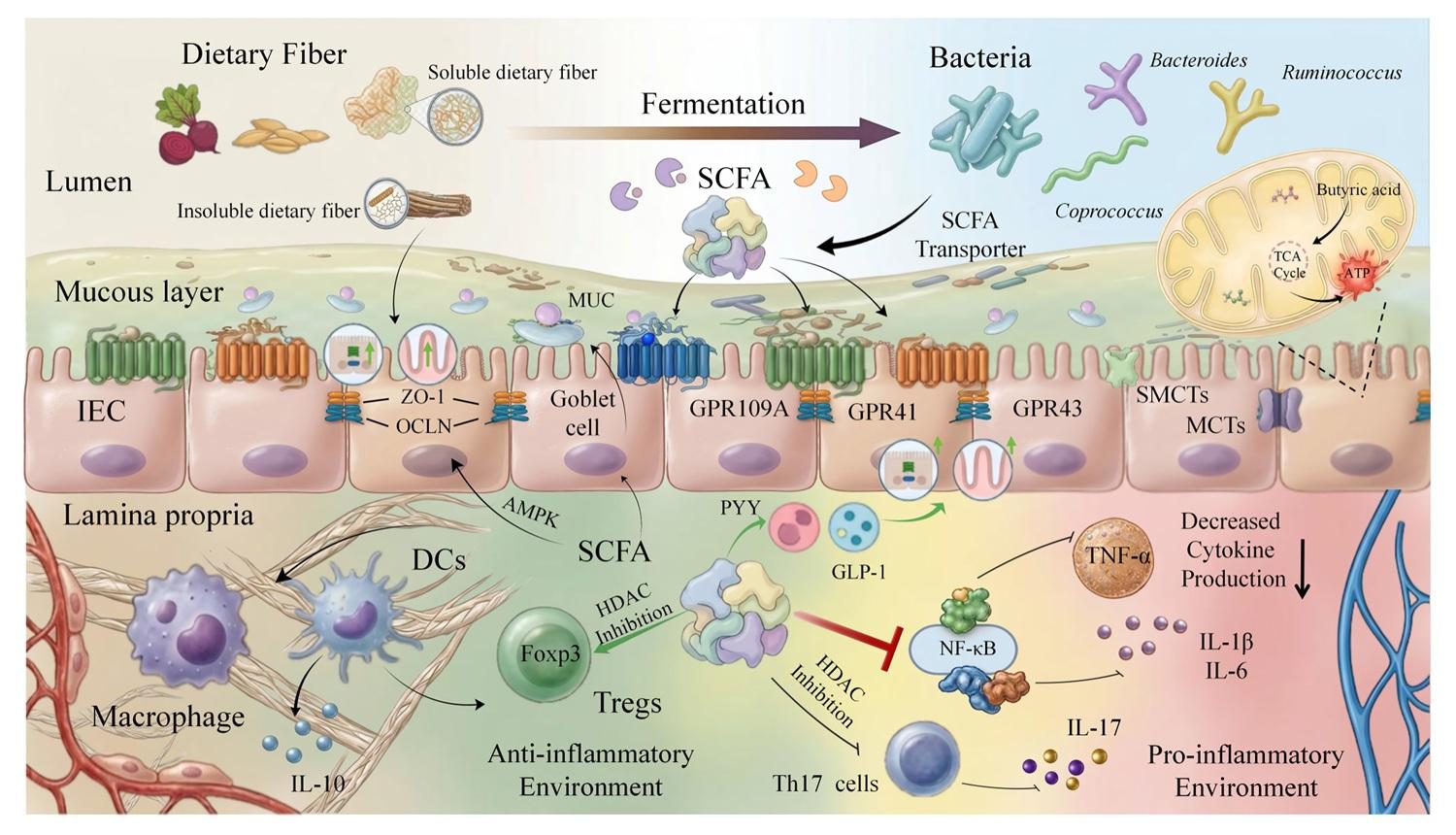
图1总结了DF调控猪肠道生理状态和屏障功能的机制。
图1 DF调控猪肠道生理状态和屏障功能的机制

Dietary Fiber:饲粮纤维;Soluble dietary fiber:可溶性饲粮纤维;Insoluble dietary fiber:不可溶性饲粮纤维;Lumen:肠腔;Fermentation:发酵;SCFA:短链脂肪酸 short-chain fatty acid;Bacteria:细菌;SCFA Transporter:短链脂肪酸转运载体 short-chain fatty acid transporter;Bacteroides:拟杆菌属;Ruminococcus:瘤胃球菌属;Coprococcus:粪球菌属;Butyric acid:丁酸;TCA Cycle:三羧酸循环 tricarboxylic acid cycle;Mucous layer:黏液层;MUC:黏蛋白 mucin;IEC:肠上皮细胞 intestinal epithelial cell;ZO-1:闭锁小带蛋白-1 zonula occludens-1;OCLN:闭合蛋白 occludin;Goblet cell:杯状细胞;GPR:G蛋白偶联受体 G protein-coupled receptor;SMCTs:钠偶联单羧酸转运蛋白 sodium-coupled monocarboxylate transporters;MCTs:单羧酸转运蛋白 monocarboxylate transporters;Lamina propria:固有层;Macrophage:巨噬细胞;IL:白细胞介素 interleukin;DCs:树突状细胞 dendritic cells;AMPK:单磷酸腺苷活化蛋白激酶 adenosine monophosphate-activated protein kinase;PYY:肽YY peptide YY;Foxp3:叉头框p3 forkhead box p3;HDAC Inhibition:组蛋白去乙酰化酶抑制 histone deacetylase inhibition;Tregs:调节性T细胞 regulatory T cells;Anti-inflammatory Environment:抗炎环境;GLP-1:胰高血糖素样肽-1 glucagon-like peptide-1;NF-κB:核因子-κB nuclear factor-κB;Th17 cells:辅助性T细胞17 T helper 17 cells;TNF-α:肿瘤坏死因子-α tumor necrosis factor-α;Decreased Cytokine Production:减少细胞因子产生;Pro-inflammatory Environment:促炎环境。

Fig.1 Mechanism of DF regulating intestinal physiological state and barrier function in pigs[93-94]

4 小结与展望

本文综述了DF对猪肠道生理状态、微生物区系和屏障功能的影响及其调控机制。DF凭借黏度、溶解度、持水能力等理化特性直接调控猪肠道的生理结构和功能;同时通过发酵产生的SCFA间接改善黏膜屏障、重塑菌群结构及调节免疫应答,形成“理化-代谢”的双调控机制。近年来,DF研究的深度和广度显著提高,体现在分类体系的优化和作用机制的精准解析。DF的研究不再局限于传统的二分类法,而是建立起基于主链结构、水合能力等多维参数的优化分类体系;同时,通过深入解析SCFA的介导机制,揭示了SCFA通过HDAC抑制和GPR激活介导的多种免疫调节途径。基于当前研究基础,未来DF研究可聚焦以下方面:解析纤维结构与微生物互作的分子机制;结合猪生长阶段(如断奶仔猪、育肥猪)建立DF的精准配比模型;探索DF与益生菌等功能性添加剂的协同增效机制。总之,DF的研究不仅能为非粮型饲料资源高效开发与利用提供理论支撑,也能为畜牧业减抗替抗、绿色可持续发展提供关键技术路径,同时为人类膳食纤维营养研究提供重要的动物参考模型。
[1]
ZHANG W J, LI D F, LIU L, et al. The effects of dietary fiber level on nutrient digestibility in growing pigs[J]. Journal of Animal Science and Biotechnology, 2013, 4(1):17.

[2]
HAN R, YONG F, FANG X, et al. Influences of fermented corn straw fiber on performance and nutrient utilization in different breeds of finishing pigs[J]. Animals, 2024, 14(23):3393.

[3]
MA J X, HUANGFU W K, YANG X, et al. “King of the forage”—Alfalfa supplementation improves growth,reproductive performance,health condition and meat quality of pigs[J]. Frontiers in Veterinary Science, 2022, 9:1025942.

[4]
LI H, YIN J, TAN B, et al. Physiological function and application of dietary fiber in pig nutrition:a review[J]. Animal Nutrition, 2021, 7(2):259-267.

[5]
LIU P Y, WANG Y B, YANG G, et al. The role of short-chain fatty acids in intestinal barrier function,inflammation,oxidative stress,and colonic carcinogenesis[J]. Pharmacological Research, 2021, 165:105420.

[6]
SCHÖNFELD P, WOJTCZAK L. Short- and medium-chain fatty acids in energy metabolism:the cellular perspective[J]. Journal of Lipid Research, 2016, 57(6):943-954.

[7]
PARADA VENEGAS D, DE LA FUENTE M K, LANDSKRON G, et al. Short chain fatty acids (SCFAs)-mediated gut epithelial and immune regulation and its relevance for inflammatory bowel diseases[J]. Frontiers in Immunology, 2019, 10:277.

[8]
HSIAO C P, SIEBERT K J. Modeling the inhibitory effects of organic acids on bacteria[J]. International Journal of Food Microbiology, 1999, 47(3):189-201.

[9]
KAISAR M M M, PELGROM L R, VAN DER HAM A J, et al. Butyrate conditions human dendritic cells to prime type 1 regulatory T cells via both histone deacetylase inhibition and G protein-coupled receptor 109A signaling[J]. Frontiers in Immunology, 2017, 8:1429.

[10]
HU R Q, LI S W, DIAO H, et al. The interaction between dietary fiber and gut microbiota,and its effect on pig intestinal health[J]. Frontiers in Immunology, 2023, 14:1095740.

[11]
LINDBERG J E. Fiber effects in nutrition and gut health in pigs[J]. Journal of Animal Science and Biotechnology, 2014, 5(1):15.

[12]
HIPSLEY E H. Dietary “fibre” and pregnancy toxaemia[J]. British Medical Journal, 1953, 2(4833):420-422.

[13]
DE MENEZES E W, GIUNTINI E B, DAN M C T, et al. Codex dietary fibre definition-justification for inclusion of carbohydrates from 3 to 9 degrees of polymerisation[J]. Food Chemistry, 2013, 140(3):581-585.

[14]
STEPHEN A M, CHAMP M M J, CLORAN S J, et al. Dietary fibre in Europe:current state of knowledge on definitions,sources,recommendations,intakes and relationships to health[J]. Nutrition Research Reviews, 2017, 30(2):149-190.

[15]
GUILLON F, CHAMP M. Structural and physical properties of dietary fibres,and consequences of processing on human physiology[J]. Food Research International, 2000, 33(3):233-245.

[16]
GIDLEY M J, YAKUBOV G E. Functional categorisation of dietary fibre in foods:beyond ‘soluble’ vs ‘insoluble’[J]. Trends in Food Science & Technology, 2019, 86:563-568.

[17]
DHINGRA D, MICHAEL M, RAJPUT H, et al. Dietary fibre in foods:a review[J]. Journal of Food Science and Technology, 2012, 49(3):255-266.

[18]
YONG F, LIU B, LI H J, et al. Relationship between dietary fiber physicochemical properties and feedstuff fermentation characteristics and their effects on nutrient utilization,energy metabolism,and gut microbiota in growing pigs[J]. Journal of Animal Science and Biotechnology, 2025, 16(1):1.

[19]
YONG F, LI H J, HU B, et al. Effect of the interaction between dietary fiber structure and apparent viscosity on the production performance of growing pigs[J]. Animals, 2025, 15(22):3310.

[20]
OPPERMAN C, MAJZOOBI M, FARAHNAKY A, et al. Beyond soluble and insoluble:a comprehensive framework for classifying dietary fibre’s health effects[J]. Food Research International, 2025, 206:115843.

[21]
DIAO H, JIAO A R, YU B, et al. Beet pulp:an alternative to improve the gut health of growing pigs[J]. Animals, 2020, 10(10):1860.

[22]
HEDEMANN M S, ESKILDSEN M, LAERKE H N, et al. Intestinal morphology and enzymatic activity in newly weaned pigs fed contrasting fiber concentrations and fiber properties[J]. Journal of Animal Science, 2006, 84(6):1375-1386.

[23]
MCDONALD D E, PETHICK D W, MULLAN B P, et al. Increasing viscosity of the intestinal contents alters small intestinal structure and intestinal growth,and stimulates proliferation of enterotoxigenic Escherichia coli in newly-weaned pigs[J]. The British Journal of Nutrition, 2001, 86(4):487-498.

[24]
ENGLAND F J, LIN M Q, SIGAL M, et al. Defining the mucosal ecosystem:epithelial-mesenchymal interdependence in gastrointestinal health and disease[J]. Nature Reviews Gastroenterology & Hepatology, 2025, 22(11):741-754.

[25]
CORRÊA R O, CASTRO P R, FACHI J L, et al. Inulin diet uncovers complex diet-microbiota-immune cell interactions remodeling the gut epithelium[J]. Microbiome, 2023, 11(1):90.

[26]
BONIS V, ROSSELL C, GEHART H. The intestinal epithelium-fluid fate and rigid structure from crypt bottom to villus tip[J]. Frontiers in Cell and Developmental Biology, 2021, 9:661931.

[27]
JIN L, REYNOLDS L P, REDMER D A, et al. Effects of dietary fiber on intestinal growth,cell proliferation,and morphology in growing pigs[J]. Journal of Animal Science, 1994, 72(9):2270-2278.

[28]
ZHANG J, LUPTON J R. Dietary fibers stimulate colonic cell proliferation by different mechanisms at different sites[J]. Nutrition and Cancer, 1994, 22(3):267-276.

[29]
HAENEN D, ZHANG J, SOUZA DA SILVA C, et al. A diet high in resistant starch modulates microbiota composition,SCFA concentrations,and gene expression in pig intestine[J]. The Journal of Nutrition, 2013, 143(3):274-283.

[30]
JIANG M W, BIANCHI F, VAN DEN BOGAART G. Protonophore activity of short-chain fatty acids induces their intracellular accumulation and acidification[J]. FEBS Letters, 2025, 599(15):2157-2166.

[31]
LUPTON J R, KURTZ P P. Relationship of colonic luminal short-chain fatty acids and pH to in vivo cell proliferation in rats[J]. The Journal of Nutrition, 1993, 123(9):1522-1530.

[32]
ORNELAS A, COUNTESS J A, KIM J Y, et al. Modifying microbially derived short chain fatty acids to promote health[J]. The Journal of Physiology, 2025, 604(1):116-128.

[33]
ZHANG Y N, CHEN H Z, ZHU W Y, et al. Cecal infusion of sodium propionate promotes intestinal development and jejunal barrier function in growing pigs[J]. Animals, 2019, 9(6):284.

[34]
BILOTTA A J, MA C Y, YANG W J, et al. Propionate enhances cell speed and persistence to promote intestinal epithelial turnover and repair[J]. Cellular and Molecular Gastroenterology and Hepatology, 2021, 11(4):1023-1044.

[35]
VAN BOCKSTAL L, PRIMS S, VAN CRUCHTEN S, et al. Cell migration and proliferation capacity of IPEC-J2 cells after short-chain fatty acid exposure[J]. PLoS One, 2024, 19(8):e0309742.

[36]
PEARCE S C, WEBER G J, VAN SAMBEEK D M, et al. Intestinal enteroids recapitulate the effects of short-chain fatty acids on the intestinal epithelium[J]. PLoS One, 2020, 15(4):e0230231.

[37]
TOLHURST G, HEFFRON H, LAM Y S, et al. Short-chain fatty acids stimulate glucagon-like peptide-1 secretion via the G-protein-coupled receptor FFAR2[J]. Diabetes, 2012, 61(2):364-371.

[38]
TSUKAHARA T, IWASAKI Y, NAKAYAMA K, et al. Stimulation of butyrate production in the large intestine of weaning piglets by dietary fructooligosaccharides and its influence on the histological variables of the large intestinal mucosa[J]. Journal of Nutritional Science and Vitaminology, 2003, 49(6):414-421.

[39]
GAO Y N, MENG L, LIU H M, et al. The compromised intestinal barrier induced by mycotoxins[J]. Toxins, 2020, 12(10):619.

[40]
SUN N N, LIU W Y, LI J, et al.Composition,function,and detection methods of the intestinal barrier[J]. The Journal of Nutritional Biochemistry, 2026, 149:110179.

[41]
FORGIE A J, FOUHSE J M, WILLING B P. Diet-microbe-host interactions that affect gut mucosal integrity and infection resistance[J]. Frontiers in Immunology, 2019, 10:1802.

[42]
BERGSTROM K S B, GUTTMAN J A, RUMI M, et al. Modulation of intestinal goblet cell function during infection by an attaching and effacing bacterial pathogen[J]. Infection and Immunity, 2008, 76(2):796-811.

[43]
HINO S, TAKEMURA N, SONOYAMA K, et al. Small intestinal goblet cell proliferation induced by ingestion of soluble and insoluble dietary fiber is characterized by an increase in sialylated mucins in rats[J]. The Journal of Nutrition, 2012, 142(8):1429-1436.

[44]
CHEN H, MAO X B, HE J, et al. Dietary fibre affects intestinal mucosal barrier function and regulates intestinal bacteria in weaning piglets[J]. The British Journal of Nutrition, 2013, 110(10):1837-1848.

[45]
GAUDIER E, JARRY A, BLOTTIÈRE H M, et al. Butyrate specifically modulates MUC gene expression in intestinal epithelial goblet cells deprived of glucose[J]. American Journal of Physiology:Gastrointestinal and Liver Physiology, 2004, 287(6):G1168-G1174.

[46]
BURGER-VAN PAASSEN N, VINCENT A, PUIMAN P J, et al. The regulation of intestinal mucin MUC2 expression by short-chain fatty acids:implications for epithelial protection[J]. The Biochemical Journal, 2009, 420(2):211-219.

[47]
DESAI M S, SEEKATZ A M, KOROPATKIN N M, et al. A dietary fiber-deprived gut microbiota degrades the colonic mucus barrier and enhances pathogen susceptibility[J]. Cell, 2016, 167(5):1339-1353.e21.

[48]
MA X, FAN P X, LI L S, et al. Butyrate promotes the recovering of intestinal wound healing through its positive effect on the tight junctions[J]. Journal of Animal Science, 2012,90 (Suppl.4):266-268.

[49]
RUNKLE E A, MU D. Tight junction proteins: from barrier to tumorigenesis[J]. Cancer Letters, 2013, 337(1):41-48.

[50]
ELAMIN E E, MASCLEE A A, DEKKER J, et al. Short-chain fatty acids activate AMP-activated protein kinase and ameliorate ethanol-induced intestinal barrier dysfunction in Caco-2 cell monolayers[J]. The Journal of Nutrition, 2013, 143(12):1872-1881.

[51]
WANG H B, WANG P Y, WANG X, et al. Butyrate enhances intestinal epithelial barrier function via up-regulation of tight junction protein claudin-1 transcription[J]. Digestive Diseases and Sciences, 2012, 57(12):3126-3135.

[52]
DIAO H, JIAO A R, YU B, et al. Gastric infusion of short-chain fatty acids can improve intestinal barrier function in weaned piglets[J]. Genes & Nutrition, 2019, 14:4.

[53]
DUARTE M E, KIM S W. Intestinal microbiota and its interaction to intestinal health in nursery pigs[J]. Animal Nutrition, 2022, 8(1):169-184.

[54]
RINNINELLA E, CINTONI M, RAOUL P, et al. Food components and dietary habits:keys for a healthy gut microbiota composition[J]. Nutrients, 2019, 11(10):2393.

[55]
ZENG H W, UMAR S, RUST B, et al. Secondary bile acids and short chain fatty acids in the colon:a focus on colonic microbiome,cell proliferation,inflammation,and cancer[J]. International Journal of Molecular Sciences, 2019, 20(5):1214.

[56]
RAGSDALE S W, PIERCE E. Acetogenesis and the Wood-Ljungdahl pathway of CO2 fixation[J]. Biochimica et Biophysica Acta:Proteins and Proteomics, 2008, 1784(12):1873-1898.

[57]
HETZEL M, BROCK M, SELMER T, et al. Acryloyl-CoA reductase from Clostridium propionicum.An enzyme complex of propionyl-CoA dehydrogenase and electron-transferring flavoprotein[J]. European Journal of Biochemistry, 2003, 270(5):902-910.

[58]
SCOTT K P, MARTIN J C, CAMPBELL G, et al. Whole-genome transcription profiling reveals genes up-regulated by growth on fucose in the human gut bacterium “Roseburia inulinivorans”[J]. Journal of Bacteriology, 2006, 188(12):4340-4349.

[59]
LOUIS P, DUNCAN S H, MCCRAE S I, et al. Restricted distribution of the butyrate kinase pathway among butyrate-producing bacteria from the human colon[J]. Journal of Bacteriology, 2004, 186(7):2099-2106.

[60]
VAN DEUREN T, VAN KALKEREN C, VENEMA K, et al. Identifying a complex carbohydrate mixture in context of a high-protein diet that is able to steer microbial fermentation to improve metabolic health:the DISTAL study[J]. Proceedings, 2023, 91(1):25.

[61]
CHOI B S Y, DANIEL N, HOUDE V P, et al. Feeding diversified protein sources exacerbates hepatic insulin resistance via increased gut microbial branched-chain fatty acids and mTORC1 signaling in obese mice[J]. Nature Communications, 2021, 12(1):3377.

[62]
SUN M M, WU W, LIU Z J, et al. Microbiota metabolite short chain fatty acids,GPCR,and inflammatory bowel diseases[J]. Journal of Gastroenterology, 2017, 52(1):1-8.

[63]
CHARNEY A N, MICIC L, EGNOR R W. Nonionic diffusion of short-chain fatty acids across rat colon[J]. The American Journal of Physiology, 1998, 274(3):G518-G524.

[64]
VIJAY N, MORRIS M E. Role of monocarboxylate transporters in drug delivery to the brain[J]. Current Pharmaceutical Design, 2014, 20(10):1487-1498.

[65]
BOLOGNINI D, TOBIN A B, MILLIGAN G, et al. The pharmacology and function of receptors for short-chain fatty acids[J]. Molecular Pharmacology, 2016, 89(3):388-398.

[66]
KOH A, DE VADDER F, KOVATCHEVA-DATCHARY P, et al. From dietary fiber to host physiology:short-chain fatty acids as key bacterial metabolites[J]. Cell, 2016, 165(6):1332-1345.

[67]
FROST G, SLEETH M L, SAHURI-ARISOYLU M, et al. The short-chain fatty acid acetate reduces appetite via a central homeostatic mechanism[J]. Nature Communications, 2014, 5:3611.

[68]
LIU H Y, LU H D, WANG Y X, et al. Unlocking the power of short-chain fatty acids in ameliorating intestinal mucosal immunity:a new porcine nutritional approach[J]. Frontiers in Cellular and Infection Microbiology, 2024, 14:1449030.

[69]
刘畅, 崔子旭, 左周, 等. 饲粮纤维水平对猪肠道屏障功能、结肠微生物及代谢产物的影响[J]. 中国农业科学, 2023, 56(22):4532-4551.

LIU C, CUI Z X, ZUO Z, et al. Effects of dietary fiber level on intestinal barrier function,colonic microbiota and metabolites in pigs[J]. Scientia Agricultura Sinica, 2023, 56(22):4532-4551. (in Chinese)

[70]
LIU B, YAN J, HAO H X, et al. Effects of dietary fiber and copper on the performance and gut microbiota of finishing pigs[J]. Animals, 2024, 14(22):3168.

[71]
GUAN Z W, YU E Z, FENG Q. Soluble dietary fiber,one of the most important nutrients for the gut microbiota[J]. Molecules, 2021, 26(22):6802.

[72]
ZHANG Y J, LIU Q, ZHANG W M, et al. Gastrointestinal microbial diversity and short-chain fatty acid production in pigs fed different fibrous diets with or without cell wall-degrading enzyme supplementation[J]. Livestock Science, 2018, 207:105-116.

[73]
XU R Y, LU Y, WANG J, et al. Effects of the different dietary fibers on luminal microbiota composition and mucosal gene expression in pig colons[J]. Journal of Functional Foods, 2019, 59:71-79.

[74]
LIU P, ZHAO J B, WANG W, et al. Dietary corn bran altered the diversity of microbial communities and cytokine production in weaned pigs[J]. Frontiers in Microbiology, 2018, 9:2090.

[75]
DE VUYST L, LEROY F. Cross-feeding between bifidobacteria and butyrate-producing colon bacteria explains bifdobacterial competitiveness,butyrate production,and gas production[J]. International Journal of Food Microbiology, 2011, 149(1):73-80.

[76]
RAMIREZ-FARIAS C, SLEZAK K, FULLER Z, et al. Effect of inulin on the human gut microbiota:stimulation of Bifidobacterium adolescentis and Faecalibacterium prausnitzii[J]. British Journal of Nutrition, 2009, 101(4):541-550.

[77]
CHEN C, ZHAO G Z, CHEN W, et al. Metabolism of fructooligosaccharides in Lactobacillus plantarum ST-Ⅲ via differential gene transcription and alteration of cell membrane fluidity[J]. Applied and Environmental Microbiology, 2015, 81(22):7697-7707.

[78]
RIVIÈRE A, SELAK M, GEIRNAERT A, et al. Complementary mechanisms for degradation of inulin-type fructans and arabinoxylan oligosaccharides among bifidobacterial strains suggest bacterial cooperation[J]. Applied and Environmental Microbiology, 2018, 84(9):e02893-17.

[79]
BOGER M C L, LAMMERTS VAN BUEREN A, DIJKHUIZEN L. Cross-feeding among probiotic bacterial strains on prebiotic inulin involves the extracellular exo-inulinase of Lactobacillus paracasei strain W20[J]. Applied and Environmental Microbiology, 2018, 84(21):e01539-18.

[80]
ARMET A M, LI F Y, DEEHAN E C, et al. Mechanistic insights into microbiome-dependent and personalized responses to dietary fibre in a randomized controlled trial[J/OL]. medRxiv, 2025(2025-11-21)[2026-01-10]. https://www.medrxiv.org/content/10.1101/2025.11.20.25340625v1.

[81]
张春, 刘博, 杨连玉, 等. 饲粮纤维对肠道免疫调控机制的独立效应的研究进展[J]. 饲料工业, 2021, 42(22):14-18.

ZHANG C, LIU B, YANG L Y, et al. Independent effect of dietary fiber on intestinal immune regulation mechanism:a review[J]. Feed Industry, 2021, 42(22):14-18. (in Chinese)

[82]
ORTEGA-GONZÁLEZ M, OCÓN B, ROMERO-CALVO I, et al. Nondigestible oligosaccharides exert nonprebiotic effects on intestinal epithelial cells enhancing the immune response via activation of TLR4-NFκB[J]. Molecular Nutrition & Food Research, 2014, 58(2):384-393.

[83]
NEWBURG D S, KO J S, LEONE S, et al. Human milk oligosaccharides and synthetic galactosyloligosaccharides contain 3'-,4-,and 6'-galactosyllactose and attenuate inflammation in human T84,NCM-460,and H4 cells and intestinal tissue ex vivo[J]. The Journal of Nutrition, 2016, 146(2):358-367.

[84]
LEHMANN S, HILLER J, VAN BERGENHENEGOUWEN J, et al. In vitro evidence for immune-modulatory properties of non-digestible oligosaccharides:direct effect on human monocyte derived dendritic cells[J]. PLoS One, 2015, 10(7):e0132304.

[85]
ESTRADA A, YUN C H, VAN KESSEL A, et al. Immunomodulatory activities of oat β-glucan in vitro and in vivo[J]. Microbiology and Immunology, 1997, 41(12):991-998.

[86]
MAO W A, SUN Y Y, MAO J Y, et al. Inhibitory effects of angelica polysaccharide on activation of mast cells[J]. Evidence-Based Complementary and Alternative Medicine, 2016, 2016:6063475.

[87]
DU Y H, HE C H, AN Y C, et al. The role of short chain fatty acids in inflammation and body health[J]. International Journal of Molecular Sciences, 2024, 25(13):7379.

[88]
FURUSAWA Y, OBATA Y, FUKUDA S, et al. Commensal microbe-derived butyrate induces the differentiation of colonic regulatory T cells[J]. Nature, 2013, 504(7480):446-450.

[89]
ARPAIA N, CAMPBELL C, FAN X Y, et al. Metabolites produced by commensal bacteria promote peripheral regulatory T-cell generation[J]. Nature, 2013, 504(7480):451-455.

[90]
MACIA L, TAN J, VIEIRA A T, et al. Metabolite-sensing receptors GPR43 and GPR109A facilitate dietary fibre-induced gut homeostasis through regulation of the inflammasome[J]. Nature Communications, 2015, 6:6734.

[91]
MEIJER K, DE VOS P, PRIEBE M G. Butyrate and other short-chain fatty acids as modulators of immunity:what relevance for health?[J]. Current Opinion in Clinical Nutrition and Metabolic Care, 2010, 13(6):715-721.

[92]
SINGH N, GURAV A, SIVAPRAKASAM S, et al. Activation of Gpr109a,receptor for niacin and the commensal metabolite butyrate,suppresses colonic inflammation and carcinogenesis[J]. Immunity, 2014, 40(1):128-139.

[93]
HAN X B, MA Y, DING S J, et al. Regulation of dietary fiber on intestinal microorganisms and its effects on animal health[J]. Animal Nutrition, 2023, 14:356-369.

[94]
HUANGFU W K, CAO S X, LI S R, et al. In vitro and in vivo fermentation models to study the function of dietary fiber in pig nutrition[J]. Applied Microbiology and Biotechnology, 2024, 108(1):314.

文章导航

/