研究论文

妊娠后期和泌乳期饲粮中添加低聚木糖对母猪繁殖性能及母仔猪肠道菌群的影响

  • 吴雨杰 , 1 ,
  • 吴俊哲 1, * ,
  • 车炼强 1 ,
  • 冯斌 1 ,
  • 徐盛玉 1 ,
  • 卓勇 1 ,
  • 花伦 1 ,
  • 吴德 1 ,
  • 唐孝兵 2 ,
  • 蒋小军 3 ,
  • 林燕 , 1, **
展开
  • 1 四川农业大学动物营养研究所, 成都 610000
  • 2 宜宾雅泰生物科技有限公司, 宜宾 644000
  • 3 四川大北农农牧科技有限责任公司, 成都 610000
** 林 燕,教授,博士生导师,E-mail:

* 同等贡献作者

吴雨杰(2002—),男,四川仪陇人,硕士研究生,研究方向为种猪的营养。E-mail:

Office editor: 菅景颖

收稿日期: 2026-01-14

  网络出版日期: 2026-09-12

基金资助

四川省“十四五”重点研发项目(2021YFD1300202)

国家现代农业产业技术体系四川省生猪创新团队(SCCXTD-2024-8)

Effects of Dietary Xyl-Oligosaccharide Supplementation during Late Gestation and Lactation on Reproductive Performance of Sows and Gut Microbiota of Sows and Their Offspring

  • WU Yujie , 1 ,
  • WU Junzhe 1 ,
  • CHE Lianqiang 1 ,
  • FENG Bin 1 ,
  • XU Shengyu 1 ,
  • ZHUO Yong 1 ,
  • HUA Lun 1 ,
  • WU De 1 ,
  • TANG Xiaobing 2 ,
  • JIANG Xiaojun 3 ,
  • LIN Yan , 1, **
Expand
  • 1 Institute of Animal Nutrition, Sichuan Agricultural University, Chengdu 610000, China
  • 2 Yibin Yatai Biotechnology Co., Ltd., Yibin 644000, China
  • 3 Sichuan Dabeinong Agriculture and Animal Husbandry Technology Co., Ltd., Chengdu 610000, China
** professor, E-mail:

* Contributed equally

Received date: 2026-01-14

  Online published: 2026-09-12

摘要

本试验旨在研究母猪妊娠后期和泌乳期饲粮中添加低聚木糖对其繁殖性能、肠道菌群及后代断奶仔猪肠道菌群的影响。选取长白×大白妊娠母猪共60头,随机分为3个组(n=20):对照组(CON组)饲喂基础饲粮,试验组在基础饲粮中分别添加0.05%(XOS1组)和0.10%低聚木糖(XOS2组),饲喂时间为妊娠第90天至泌乳第21天(断奶)。仔猪21日龄断奶后,从上述每组中选取50头,均饲喂相同的饲粮至56日龄。结果显示:1)与CON组相比,XOS1组断奶窝重增加了3.77 kg(P>0.05),母猪背膘损失有降低趋势(0.05≤P<0.10)。2)与CON组相比,XOS1和XOS2组母猪分娩时粪便评分显著降低(P<0.05)。3)与CON组相比,XOS1和XOS2组初乳中总寡糖含量分别增加了60%和40%(P>0.05),且XOS2组常乳中总蛋白含量显著提高(P<0.05)。4)与CON组相比,XOS1组母猪分娩时血清白细胞介素-10含量有升高趋势(0.05≤P<0.10),母猪断奶时血清碱性磷酸酶活性和总蛋白含量显著降低(P<0.05);XOS2组母猪断奶时血清谷草转氨酶活性和总蛋白含量显著降低(P<0.05),白细胞介素-1β含量有降低趋势(0.05≤P<0.10)。5)与CON组相比,XOS2组母猪断奶时粪便中异丁酸含量显著提高(P<0.05)。6)与CON组相比,XOS1组母猪分娩时肠道菌群中拟杆菌门、氨基酸球菌目、考拉杆菌属的相对丰度和断奶时互养菌门、互养菌目和互养菌科的相对丰度显著增加(P<0.05)。7)与CON组相比,XOS1组后代断奶仔猪肠道菌群中鼠杆菌科和NK4A214群(NK4A214_group)的相对丰度显著增加(P<0.05)。综上可知,妊娠后期和泌乳期饲粮中添加0.05%低聚木糖可缓解母猪便秘,降低背膘损失与炎症反应,并优化乳成分与母仔猪肠道菌群结构,且对仔猪断奶窝重有一定的提高作用。

本文引用格式

吴雨杰 , 吴俊哲 , 车炼强 , 冯斌 , 徐盛玉 , 卓勇 , 花伦 , 吴德 , 唐孝兵 , 蒋小军 , 林燕 . 妊娠后期和泌乳期饲粮中添加低聚木糖对母猪繁殖性能及母仔猪肠道菌群的影响[J]. 动物营养学报, 2026 , 38(9) : 6536 -6550 . DOI: 10.12418/CJAN2026.524

Abstract

This experiment was conducted to investigate the effects of dietary xyl-ooligosaccharide (XOS) supplementation during late gestation and lactation on reproductive performance and gut microbiota of sows, as well as gut microbiota of their weaned offspring. A total of 60 Landrace×Yorkshire pregnant sows were randomly assigned to three groups (n=20 per group): the control group (CON group) was fed a basal diet, while the experimental groups were fed the basal diet supplemented with 0.05% (XOS1 group) or 0.10% XOS (XOS2 group) from day 90 of gestation to day 21 of lactation (weaning). After weaning at 21 days of age, fifty weaned piglets from each group were selected and fed the same diet until 56 days of age. The results showed as follows: 1) compared with the CON group, the XOS1 group showed a 3.77 kg increase in weaning litter weight (P>0.05), and sow backfat loss tended to decrease (0.05≤P<0.10). 2) Compared with the CON group, fecal score at parturition was significantly reduced in both XOS1 and XOS2 groups (P<0.05). 3) Compared with the CON group, total oligosaccharide content in colostrum increased by 60% and 40% in XOS1 and XOS2 groups (P>0.05), respectively, and total protein content in milk was significantly increased in the XOS2 group (P<0.05). 4) Compared with the CON group, serum interleukin-10 content at parturition tended to increase in the XOS1 group (0.05≤P<0.10), while serum alkaline phosphatase activity and total protein content at weaning were significantly decreased (P<0.05); in the XOS2 group, serum aspartate aminotransferase activity and total protein content at weaning were significantly decreased (P<0.05), and serum interleukin-1β content tended to decrease (0.05≤P<0.10). 5) Compared with the CON group, fecal isobutyric acid content at weaning was significantly increased in the XOS2 group (P<0.05). 6) Compared with the CON group, the relative abundances of Bacteroidota, Acidaminococcales and Phascolarctobacterium at parturition, as well as Synergistota, Synergistales and Synergistaceae at weaning, were significantly increased in the XOS1 group (P<0.05). 7) Compared with the CON group, the relative abundances of Muribaculaceae and NK4A214_group in the gut microbiota of weaned piglets were significantly increased in the XOS1 group (P<0.05). In conclusion, dietary supplementation with 0.05% XOS during late gestation and lactation can alleviate constipation, reduce backfat loss and inflammatory responses, optimize milk composition and gut microbiota structure of sows and their offspring, and can show a tendency to improve weaning litter weight of piglets.

母猪妊娠期常伴随氧化应激和炎症反应增强,而这些变化与便秘、胎儿宫内生长迟缓等繁殖障碍密切相关。初生仔猪因缺乏褐色脂肪储备,及时摄入初乳是其获取能量的关键途径;同时,初乳中的免疫球蛋白等生物活性物质对仔猪免疫机能具有重要调节作用。因此,母猪妊娠期和泌乳期的营养与健康状态,不仅影响其自身生理机能,也对胎儿发育、仔猪生长及免疫调节具有重要作用。研究表明,在妊娠期和泌乳期补充益生元,可降低母猪腹泻率并提高仔猪生长性能[1]。低聚木糖(XOS)是由2~6个木糖单元通过β-(1→4)糖苷键连接形成的低聚物,能够被肠道微生物选择性发酵,从而调节菌群组成、改善宿主健康,符合益生元的定义[2]。研究显示,在断奶仔猪饲粮中添加XOS可改善其生长性能与肠道健康[3];在生长育肥猪饲粮中补充XOS可提高骨骼羟基磷灰石的结晶度,改善骨骼健康[4]。此外,XOS还可通过调节肠道菌群结构及短链脂肪酸代谢缓解小鼠便秘[5]。然而,目前关于XOS在母猪饲粮中应用的研究尚未见报道。已有研究指出,其他类型的寡糖可改善母猪繁殖性能(如减少泌乳期背膘损失、增加产仔数),并对后代仔猪生长发育产生积极影响[6-7],这为XOS在母猪饲粮中的应用提供了参考。因此,本试验拟在母猪妊娠后期与泌乳期饲粮中添加不同水平的XOS,探究其对母猪繁殖性能、粪便菌群及其后代断奶仔猪粪便菌群的影响,以期为XOS在母猪饲粮中的应用提供理论依据。

1 材料与方法

1.1 试验材料

本试验所用XOS由宜宾雅泰生物科技股份有限公司提供,产品中XOS有效含量为35%。

1.2 试验设计

本试验方案已获得四川农业大学动物护理与使用委员会批准,审批编号为SCAUA202308-4。
选取体况相近、健康状况良好的长白×大白妊娠母猪共60头,随机分为3组,每组20个重复,每个重复1头猪。对照组(CON组)饲喂基础饲粮,基础饲粮参照NRC(2012)妊娠母猪营养需要配制,其组成及营养水平见表1。试验组在基础饲粮中分别添加0.05%(XOS1组)和0.10%(XOS2组)的XOS(添加量以产品计)。饲喂时间为妊娠第90天至泌乳第21天(断奶)。
表1 母猪基础饲粮组成及营养水平(风干基础)

Table 1 Composition and nutrient levels of basal diets for sows (air-dry basis)

项目
Items
阶段Stages
妊娠期
Gestation
period
泌乳期
Lactation
period
原料Ingredients
玉米Corn 30.50 40.85
面粉Flour 15.00 20.00
豆粕Soybean meal 10.00 14.80
大麦Barley 15.00 10.00
小麦麸Wheat bran 20.00
大豆皮Soybean hull 5.00 4.00
鱼粉Fish meal 2.00
膨化大豆Expanded soybean 3.00
豆油Soybean oil 0.95 1.50
磷酸氢钙CaHPO4 0.88 1.20
碳酸钙CaCO3 1.30 1.20
食盐NaCl 0.40 0.40
预混料Premix1) 0.97 1.05
合计Total 100.00 100.00
营养水平Nutrient levels2)
粗蛋白质CP 14.30 16.39
净能NE/(MJ/kg) 10.63 11.42
总磷TP 0.63 0.69
钙Ca 0.77 0.87
标准回肠可消化赖氨酸SID-Lys 0.56 0.74
标准回肠可消化蛋氨酸SID-Met 0.21 0.26
标准回肠可消化苏氨酸SID-Thr 0.42 0.49
标准回肠可消化色氨酸SID-Trp 0.13 0.15

1)预混料为每千克饲粮提供The premix provided the following per kg of diets:VA 10 000 IU,VD3 2 000 IU,VE 60 IU,VK3 5 mg,VB1 5 mg,VB2 10 mg,VB6 6 mg,VB12 0.05 mg,叶酸 folic acid 2 mg,D-泛酸 D-pantothenic acid 20 mg,烟酸 nicotinic acid 40 mg,Cu (as CuSO4·5H2O) 20 mg,Fe (as FeSO4·H2O) 120 mg,Mn (as MnSO4·H2O) 60 mg,Zn (as ZnSO4·H2O) 120 mg,I (as KI) 0.5 mg,Se (as Na2SeO3) 0.3 mg。

2)粗蛋白质(GB/T 6432—2018)、总磷(GB/T 6437—2018)、钙(GB/T 6436—2018)为实测值,其余营养水平为计算值,参照《中国饲料原料及营养价值表(2022年第33版)》计算。表2同。CP (GB/T 6432—2018), TP (GB/T 6437—2018) and Ca (GB/T 6436—2018) were measured values, while the other nutrient levels were calculated values based on Tables of Feed Composition and Nutritive Values in China (33rd edition, 2022). The same as Table 2.

仔猪断奶后,从上述3个组母猪所产断奶仔猪中,根据平均体重一致原则,每组各选取50头,相应分为3个组(CON、XOS1、XOS2组)。所有仔猪均饲喂参照NRC(2012)7~11 kg和11~25 kg断奶仔猪营养需要配制的基础饲粮,其组成及营养水平见表2。试验期从仔猪21日龄开始至56日龄结束。
表2 仔猪基础饲粮组成及营养水平(风干基础)

Table 2 Composition and nutrient levels of basal diets for piglets (air-dry basis)

项目
Items
阶段Stages
7~11 kg 11~25 kg
原料Ingredients
玉米Corn 16.76 20.61
膨化玉米Extruded corn 30.00 30.00
碎米Broken rice 12.00 12.00
豆油Soybean oil 0.50 0.50
蔗糖Sucrose 2.50 2.50
葡萄糖Glucose 2.50 2.50
去皮豆粕
Dehulled soybean
meal (CP 46%)
10.00 10.00
发酵豆粕
Fermented soybean meal
4.00 4.00
膨化大豆
Extruded soybean
5.00 4.00
低蛋白质乳清粉
Low protein whey powder
8.00 6.00
鱼粉Fish meal 5.00 4.00
L-赖氨酸L-Lys (98.5%) 0.69 0.75
L-色氨酸L-Trp (98%) 0.08 0.17
L-苏氨酸L-Thr (98.5%) 0.29 0.31
DL-蛋氨酸DL-Met (99%) 0.12 0.12
氯化胆碱
Choline chloride (50%)
0.16 0.16
碳酸钙CaCO3 0.55 0.40
磷酸氢钙CaHPO4 0.50 0.50
食盐NaCl 0.40 0.40
维生素预混料Vitamin premix1) 0.05 0.05
矿物质预混料Mineral premix2) 0.20 0.20
酸化剂Acidifier 0.50 0.50
酶制剂Enzyme preparation 0.03
氧化锌ZnO 0.20 0.30
合计Total 100.00 100.00
营养水平Nutrient levels
粗蛋白质CP 17.97 17.10
消化能DE/(MJ/kg) 14.77 14.81
总磷TP 0.59 0.55
钙Ca 0.70 0.59
标准回肠可消化赖氨酸SID-Lys 1.36 1.35
标准回肠可消化蛋氨酸SID-Met 0.40 0.38
标准回肠可消化苏氨酸SID-Thr 0.80 0.79
标准回肠可消化色氨酸SID-Trp 0.22 0.29

1)维生素预混料为每千克饲粮提供Vitamin premix provided the following per kg of diets:VA 15 000 IU,VD3 5 000 IU,VE 40 IU,VK3 5 mg,VB1 5.0 mg,VB2 12.5 mg,VB6 6.0 mg,VB12 0.6 mg,生物素 biotin 2.5 mg,泛酸 pantothenic acid 25 mg,烟酸 nicotinic acid 50 mg,叶酸 folic acid 2.5 mg。

2)矿物质预混料为每千克饲粮提供Mineral premix provided the following per kg of diets:Zn (as ZnSO4·H2O) 130 mg,Cu (as CuSO4·5H2O) 80 mg,Fe (as FeSO4·H2O) 130 mg,Mn (as MnSO4·H2O) 50 mg,Se (as Na2SeO3) 0.3 mg,I (as KI) 0.65 mg。

1.3 饲养管理

饲养试验在绵阳某种猪场进行。母猪妊娠第90~110天饲喂量为3.1 kg/d,妊娠第111天至分娩逐渐减少饲喂量直到2 kg/d;分娩当天不饲喂,第2天饲喂2 kg,逐日增加0.5 kg直到饲喂量达到4 kg/d,分娩第7天开始自由采食;分娩舍温度控制在20~25℃,注意保温或散热措施;仔猪出生后48 h内完成交叉寄养,保证每只母猪带仔数为10~11头,并使仔猪尽快能够吃上初乳;免疫和消毒制度按猪场计划统一进行。

1.4 样品采集

1.4.1 血清样品

每组任选8头母猪,在分娩当天和断奶当天分别耳缘静脉采血10 mL于离心管中,静置20~30 min后于4 ℃、1 095×g条件下离心10 min,分离血清后于-20 ℃保存待测。

1.4.2 初乳和常乳样品

每组任选8头母猪,分别在分娩当天收集初乳20 mL、在泌乳第14天收集常乳30 mL于离心管中,于-20 ℃保存待测。

1.4.3 粪便样品

每组任选8头母猪,在分娩当天和断奶当天早上收集新鲜粪便样品。各组断奶仔猪在饲养第35天每组任选8头收集粪便样品。所有粪便样品均于-20 ℃保存待测。

1.5 测定指标

1.5.1 生长和繁殖性能

背膘厚度:在妊娠第90天、分娩当天和断奶当天距背中线6.5 cm处用超声波测膘仪测母猪两侧背膘厚度,计算平均值。
繁殖性能:母猪分娩后,记录窝产仔数、窝产活仔数、健仔数、弱仔数和死胎数,同时记录仔猪初生重、断奶重、断奶头数和断奶窝重。

1.5.2 粪便评分

试验期间每天观察母猪粪便形态,并采用5分制记录粪便评分,具体量化标准见表3
表3 母猪粪便评分标准

Table 3 Scoring criteria for sow feces

评分Score 标准Criteria
0 排粪次数正常,粪便呈圆柱状,很少结粒,松软
1 排粪次数正常,粪便颗粒大,较软
2 排粪次数少,粪便结粒大,稍软
3 排粪有难度,时有努责;排粪次数少,粪便结粒,稍小,较硬
4 排粪难,常有努责;排粪次数少,粪便结粒,呈葡萄或羊粪球形状,坚硬

1.5.3 血清生化指标

采用日立-7020全自动生化分析仪(日本日立高新技术公司)测定血清中总蛋白、葡萄糖、免疫球蛋白M、白蛋白、尿素含量及碱性磷酸酶、谷丙转氨酶、谷草转氨酶活性。

1.5.4 血清细胞因子

采用酶联免疫吸附试验法测定血清中白细胞介素-6、白细胞介素-1β、白细胞介素-10和肿瘤坏死因子-α含量,试剂盒购于泉州市睿信生物科技有限公司。

1.5.5 乳成分

采用Milk-Yway-CP2型乳成分自动分析仪(上海存简流体技术有限公司)测定初乳和常乳中乳脂、总蛋白、真蛋白、乳糖、干物质、非脂固形物和尿素氮含量。此外,采用超高效液相色谱串联三重四级杆质谱仪(Waters Corporation,美国)测定初乳中寡糖含量。

1.5.6 粪便短链脂肪酸

采用VARIAN CP-3800气相色谱仪(Varian Associates,美国)测定母猪断奶时粪便中乙酸、丙酸、丁酸、异丁酸、戊酸和异戊酸含量。

1.5.7 肠道菌群

本研究以母猪及仔猪的粪便样品作为肠道菌群的指示样本,委托上海美吉生物有限公司进行16S rDNA高通量测序,分析肠道菌群的α多样性、组成结构及相对丰度变化。

1.6 数据统计与分析

试验数据经Excel 2019初步整理后,采用SAS 9.4统计软件中的ANOVA过程进行单因素方差分析,差异显著时进一步采用LSD法进行组间多重比较。数据以平均值±标准差表示,P<0.05为差异显著,0.05≤P<0.10为差异有显著趋势。

2 结果与分析

2.1 XOS对母猪背膘厚度和繁殖性能的影响

表4表5可知,与CON组相比,XOS1组断奶窝重增加了3.77 kg(P>0.05),且妊娠第90天至断奶时背膘损失有减少的趋势(0.05≤P<0.10);而XOS1和XOS2组在窝产仔数、窝产活仔数、健仔数、弱仔数、死胎数、初生重、断奶重、断奶头数上均无显著影响(P>0.05)。
表4 XOS对母猪背膘厚度的影响

Table 4 Effects of XOS on backfat thickness of sows mm

项目
Items
组别Groups P
P-value
CON XOS1 XOS2
背膘厚度Backfat thickness
妊娠第90天Gestation day 90 18.37±4.15 18.67±3.79 18.32±3.75 0.964
分娩Parturition 18.91±4.31 19.54±4.21 19.48±3.78 0.897
断奶Weaning 16.15±4.45 17.93±4.40 17.08±4.73 0.550
背膘增加Backfat thickness gain
妊娠第90天至分娩Gestation day 90 to parturition 0.39±0.86 0.80±1.54 1.15±1.56 0.330
分娩至断奶Parturition to weaning -3.17±1.37 -1.61±2.49 -2.39±2.12 0.153
妊娠第90天至断奶Gestation day 90 to weaning -2.78±1.73 -0.74±2.95 -1.24±2.36 0.082

同行数据肩标无字母或相同字母表示差异不显著(P>0.05),不同小写字母表示差异显著(P<0.05)。下表同。

In the same row, values with no letter or the same letter superscripts mean no significant difference (P>0.05), while with different small letter superscripts mean significant difference (P<0.05). The same as below.

表5 XOS对母猪繁殖性能的影响

Table 5 Effects of XOS on reproductive performance of sows

项目
Items
组别Groups P
P-value
CON XOS1 XOS2
窝产仔数Litter size/头 13.93±1.57 13.38±1.76 13.53±2.25 0.679
窝产活仔数Live-born litter size/头 13.81±1.56 13.15±1.77 12.78±2.33 0.440
健仔数Number of healthy piglets/头 12.50±1.63 11.92±1.66 11.22±2.53 0.198
弱仔数Number of weak piglets/头 1.31±1.45 1.23±1.51 1.56±3.13 0.924
死胎数Number of stillborn piglets/头 0.13±0.34 0.27±0.59 0.31±0.92 0.274
初生重Birth weight/kg 1.39±0.16 1.34±0.16 1.45±0.23 0.285
断奶重Weaning weight/kg 5.79±0.66 5.98±0.55 6.01±0.64 0.985
断奶头数Weaned piglets/头 10.53±1.41 10.93±1.38 10.50±1.30 0.624
断奶窝重Litter weight at weaning/kg 61.42±9.29 65.19±9.27 63.00±9.80 0.231

2.2 XOS对母猪粪便评分的影响

表6可知,与CON组相比,XOS1和XOS2组在分娩时的粪便评分显著降低(P<0.05)。
表6 XOS对母猪粪便评分的影响

Table 6 Effects of XOS on fecal score of sows

项目
Items
组别Groups P
P-value
CON XOS1 XOS2
妊娠第90天Gestation day 90 2.65±1.15 2.40±0.99 2.29±0.85 0.629
分娩Parturition 2.43±0.73b 1.73±0.80a 1.47±0.87a 0.004
妊娠期Gestation period 1.79±0.67 1.47±0.55 1.49±0.52 0.238
泌乳期Lactation period 1.38±0.39 1.56±0.33 1.51±0.44 0.443

2.3 XOS对母猪乳成分的影响

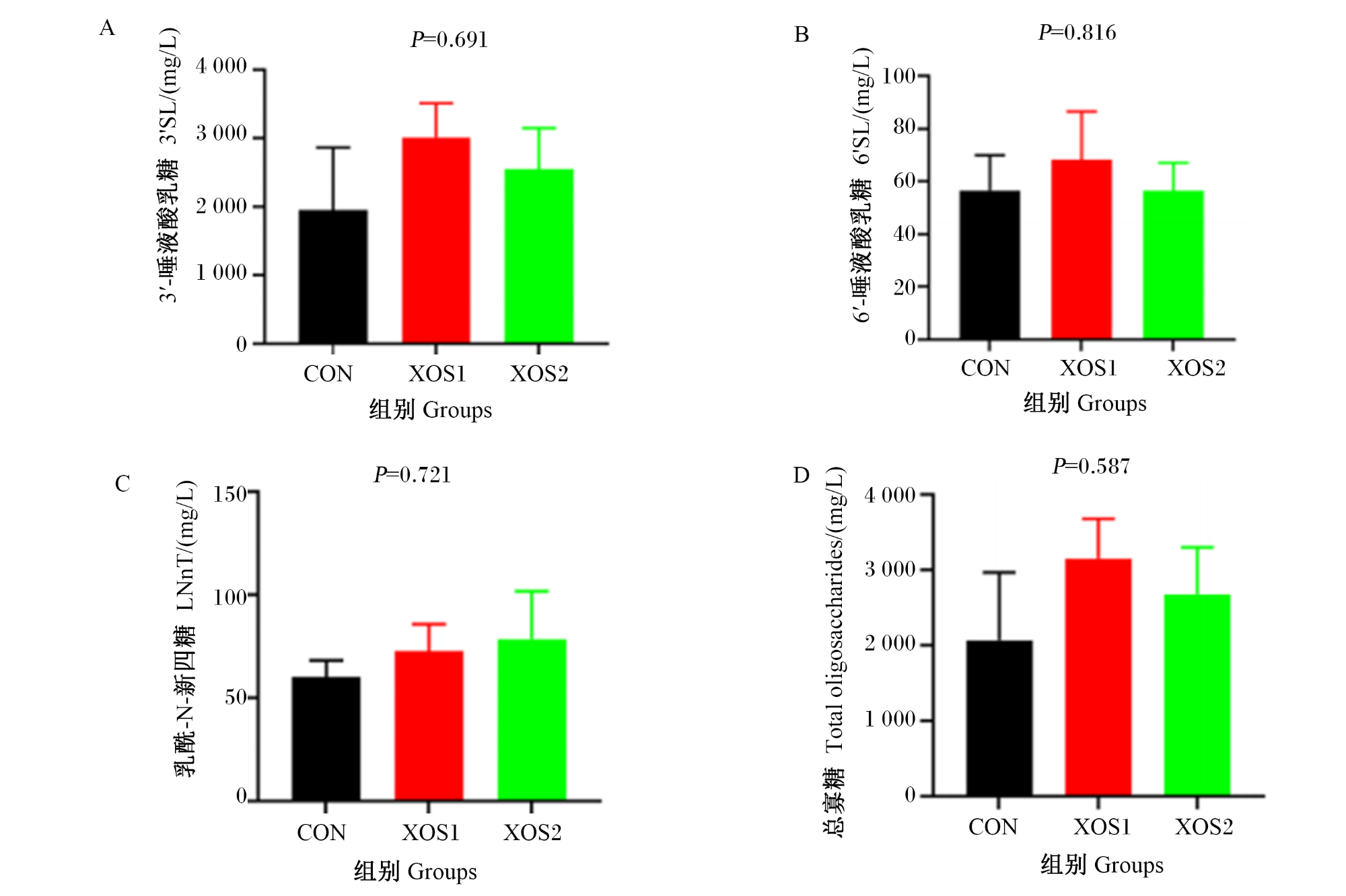
表7图1可知,与CON组相比,XOS2组常乳中TP含量显著增加(P<0.05),真蛋白、干物质和非脂固形物含量有增加的趋势(0.05≤P<0.10);此外,XOS1组初乳中3'-唾液酸乳糖(3'SL)、6'-唾液酸乳糖(6'SL)、乳酰-N-新四糖(LNnT)和总寡糖含量分别增加了50%、17%、25%、60%(P>0.05),而XOS2组初乳中3'SL、LNnT和总寡糖含量分别增加了40%、50%、40%(P>0.05)。
表7 XOS对母猪乳成分的影响

Table 7 Effects of XOS on milk composition of sows

项目
Items
组别Groups P
P-value
CON XOS1 XOS2
初乳Colostrum
乳脂MF/% 5.80±2.25 6.07±1.95 6.21±1.42 0.903
总蛋白TP/% 17.24±3.31 16.66±2.70 17.31±4.01 0.772
真蛋白TrP/% 16.08±3.09 15.00±2.61 15.50±3.80 0.775
乳糖Lac/% 3.66±0.36 4.04±1.17 3.80±0.61 0.606
干物质DM/% 35.33±6.74 34.46±4.02 35.63±6.25 0.892
非脂固形物SNF/% 30.76±4.87 29.45±3.85 30.72±5.34 0.782
尿素氮UN/(mg/mL) 0.83±0.19 0.82±0.13 0.81±.0.14 0.967
常乳Milk
乳脂MF/% 7.16±0.66 8.45±1.50 7.61±1.92 0.209
总蛋白TP/% 5.69±0.47a 6.43±0.68ab 6.71±1.07b 0.039
真蛋白TrP/% 4.41±0.43 5.02±0.49 5.17±0.87 0.051
乳糖Lac/% 5.65±0.75 6.09±0.62 6.19±0.92 0.346
干物质DM/% 23.88±1.09 26.86±2.59 27.10±4.32 0.074
非脂固形物SNF/% 17.87±1.37 19.63±2.71 21.23±3.43 0.054
尿素氮UN/(mg/mL) 0.52±0.09 0.58±0.07 0.58±0.10 0.288
图1 母猪初乳中寡糖含量

Fig.1 Oligosaccharide contents in colostrum of sows

2.4 XOS对母猪血清生化指标和细胞因子的影响

表8可知,与CON组相比,在母猪断奶时,XOS1组血清ALP活性和TP含量显著降低(P<0.05),XOS2组血清AST活性、IgM和TP含量显著降低(P<0.05)。
表8 XOS对母猪血清生化指标的影响

Table 8 Effects of XOS on serum biochemical indexes of sows

项目
Items
组别Groups P
P-value
CON XOS1 XOS2
分娩Parturition
白蛋白ALB/(g/L) 30.29±2.99 31.15±3.40 32.99±3.17 0.157
碱性磷酸酶ALP/(U/L) 108.70±48.15 73.60±26.69 95.18±45.08 0.177
谷丙转氨酶ALT/(U/L) 40.20±7.71 42.62±11.82 50.04±15.32 0.170
谷草转氨酶AST/(U/L) 35.23±17.64 43.05±22.13 49.16±20.21 0.314
葡萄糖GLU/(mmol/L) 3.85±0.50 3.38±0.88 4.25±1.34 0.100
免疫球蛋白M IgM/(g/L) 0.82±0.13 0.85±0.11 0.78±0.13 0.304
总蛋白TP/(g/L) 58.55±5.05 61.07±2.18 60.42±3.89 0.335
尿素Urea/(mmol/L) 3.66±0.85 3.45±0.66 4.15±0.68 0.102
断奶Weaning
白蛋白ALB/(g/L) 29.21±2.05 29.17±2.94 28.86±2.29 0.951
碱性磷酸酶ALP/(U/L) 75.50±25.39b 42.30±13.75a 50.22±27.71ab 0.036
谷丙转氨酶ALT/(U/L) 29.97±5.54 29.97±3.81 31.57±4.84 0.657
谷草转氨酶AST/(U/L) 30.76±14.20b 25.30±8.13ab 22.44±4.28a 0.046
葡萄糖GLU/(mmol/L) 3.46±0.40 3.22±0.77 2.95±1.00 0.558
免疫球蛋白M IgM/(g/L) 0.81±0.16b 0.81±0.11ab 0.61±0.15a 0.028
总蛋白TP/(g/L) 68.13±3.99b 64.02±4.82a 61.39±3.52a 0.005
尿素Urea/(mmol/L) 3.69±0.99 3.54±0.94 3.24±1.09 0.617
表9可知,在母猪分娩时XOS1组血清IL-10含量有高于CON组的趋势(0.05≤P<0.10),在母猪断奶时XOS2组血清IL-1β含量有低于CON组的趋势(0.05≤P<0.10)。
表9 XOS对母猪血清细胞因子的影响

Table 9 Effects of XOS on serum cytokines of sows pg/mL

项目
Items
组别Groups P
P-value
CON XOS1 XOS2
分娩Parturition
白细胞介素-6 IL-6 113.48±36.78 82.64±33.72 97.30±49.22 0.490
白细胞介素-1β IL-1β 90.78±29.43 66.12±26.97 77.84±39.38 0.490
白细胞介素-10 IL-10 15.38±5.30 23.84±3.90 15.88±5.43 0.094
肿瘤坏死因子-α TNF-α 9.81±4.64 6.92±4.70 7.69±4.64 0.609
断奶Weaning
白细胞介素-6 IL-6 162.66±14.49 167.91±22.73 96.25±33.75 0.103
白细胞介素-1β IL-1β 130.13±17.59 134.33±26.18 77.00±27.00 0.083
白细胞介素-10 IL-10 21.50±4.92 23.25±3.96 23.58±5.27 0.890
肿瘤坏死因子-α TNF-α 15.56±2.31 12.49±6.36 10.18±3.70 0.274

2.5 XOS对母猪断奶时粪便短链脂肪酸的影响

表10可知,与CON组相比,母猪断奶时XOS2组粪便中异丁酸含量显著提高(P<0.05)。
表10 XOS对母猪断奶时粪便短链脂肪酸的影响

Table 10 Effects of XOS on fecal short-chain fatty acids of sows at weaning μmol/mg

项目
Items
组别Groups P
P-value
CON XOS1 XOS2
乙酸Acetic acid 2.67±0.96 2.77±0.98 3.21±0.85 0.580
丙酸Propionic acid 0.85±0.37 1.02±0.27 1.29±0.43 0.164
异丁酸Isobutyric acid 0.10±0.04a 0.16±0.07ab 0.21±0.06b 0.040
丁酸Butyric acid 0.67±0.30 0.73±0.23 0.83±0.28 0.590
异戊酸Isovaleric acid 0.31±0.07 0.34±0.05 0.37±0.06 0.215
戊酸Valeric acid 0.17±0.05 0.22±0.08 0.23±0.07 0.300
总短链脂肪酸Total SCFAs 4.75±1.69 5.22±1.55 5.75±2.20 0.669

2.6 XOS对母猪肠道菌群的影响

各组母猪分娩时肠道菌群的α多样性指数如表11所示。与CON组相比,XOS1组Shannon指数显著提高(P<0.05),XOS1和XOS2组Simpson指数显著降低(P<0.05)。
表11 母猪分娩时肠道菌群α多样性指数

Table 11 Gut microbial α diversity indexes of sows at parturition

项目
Items
组别Groups P
P-value
CON XOS1 XOS2
Ace指数Ace index 869.20±219.50 1 013.00±181.20 892.70±96.12 0.273
Coverage指数Coverage index 0.99±0.00 0.99±0.00 0.99±0.00 0.600
Shannon指数Shannon index 3.84±0.50a 4.55±0.25b 4.18±0.19ab 0.006
Simpson指数Simpson index 0.08±0.04b 0.03±0.00a 0.04±0.01a 0.038
Sobs指数Sobs index 674.40±163.90 817.80±139.80 704.30±79.46 0.145
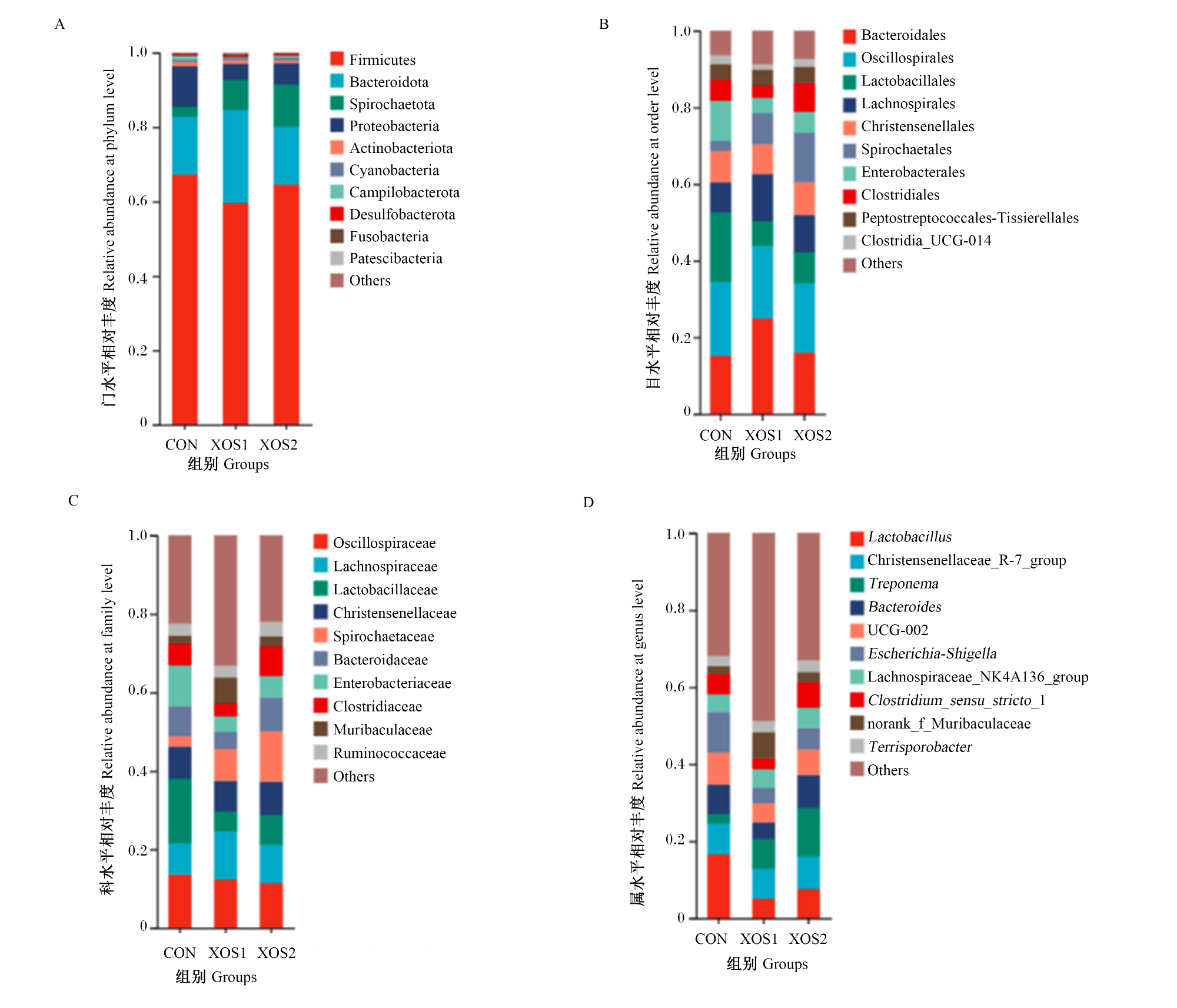
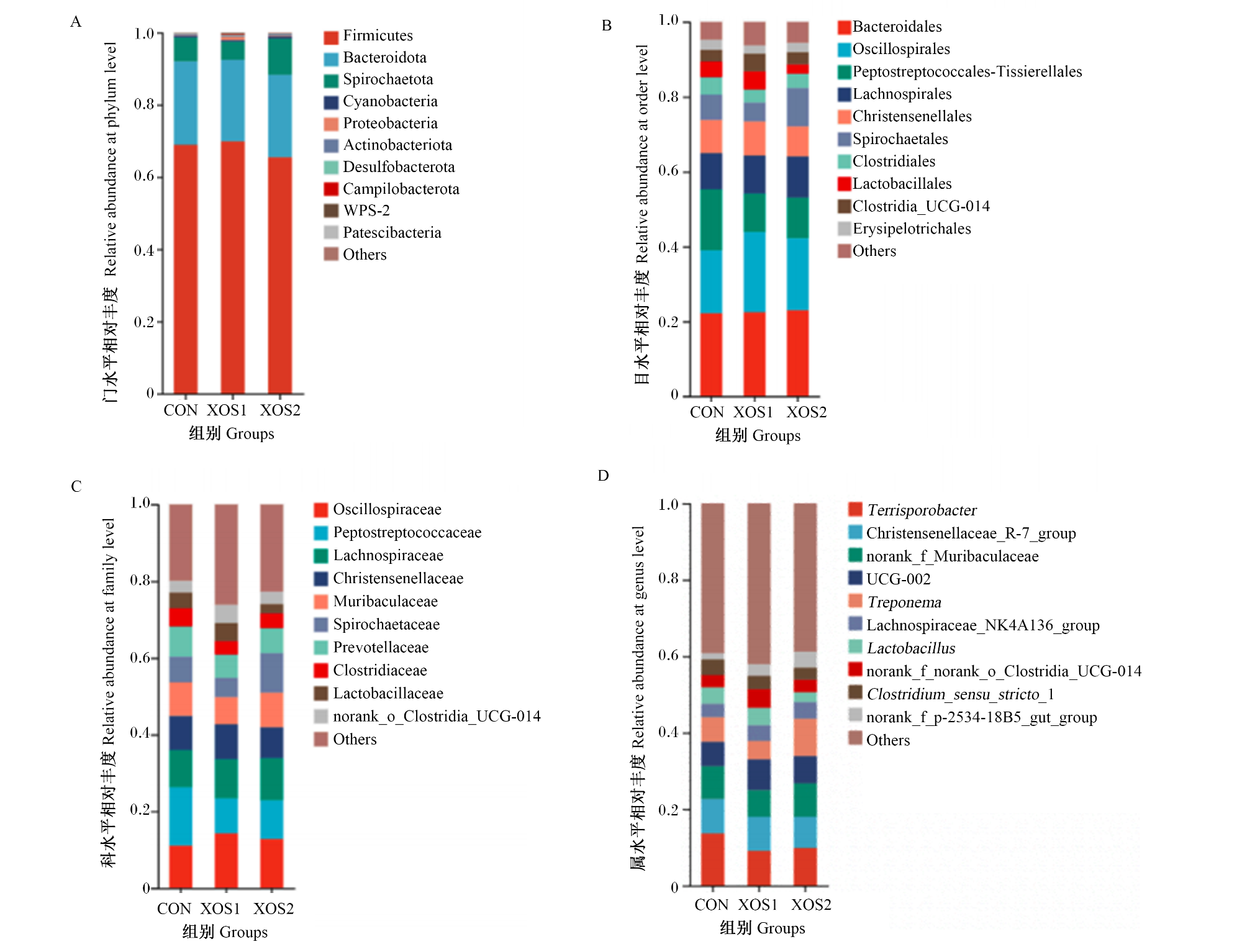
图2图3分别展示了各组母猪分娩和断奶时肠道菌群在各分类水平上的组成情况,可以看出母猪分娩和断奶时3个组的主要优势菌门均为厚壁菌门(Firmicutes)和拟杆菌门(Bacteroidota)。母猪分娩和断奶时组间存在显著差异的肠道菌群分别见表12表13。分娩时,与CON组相比,XOS1组中拟杆菌门(Bacteroidota)、拟杆菌目(Bacteroidales)、氨基酸球菌目(Acidaminococcales)、UCG-010、UCG-005、norank_f_UCG-010、氨基酸球菌科(Acidaminococcaceae)、考拉杆菌属(Phascolarctobacterium)及球形螺旋体属(Sphaerochaeta)的相对丰度均显著增加(P<0.05);断奶时,与CON组相比,XOS1组中互养菌门(Synergistota)、互养菌目(Synergistales)和互养菌科(Synergistaceae)的相对丰度显著增加(P<0.05),XOS2组中多尔氏菌属(Dorea)和毛螺菌科FCS020群(Lachnospiraceae_FCS020_group)的相对丰度显著增加(P<0.05)。
图2 母猪分娩时肠道菌群组成

Firmicutes:厚壁菌门;Bacteroidota:拟杆菌门;Spirochaetota:螺旋体门;Proteobacteria:变形菌门;Actinobacteriota:放线菌门;Cyanobacteria:蓝细菌门;Campilobacterota:弯曲菌门;Desulfobacterota:脱硫杆菌门;Fusobacteria:梭杆菌门;Patescibacteria:髌骨细菌门;Bacteroidales:拟杆菌目;Oscillospirales:颤螺旋菌目;Lactobacillales:乳杆菌目;Lachnospirales:毛螺菌目;Christensenellales:克里斯滕森菌目;Spirochaetales:螺旋体目;Enterobacterales:肠杆菌目;Clostridiales:梭菌目;Peptostreptococcales-Tissierellales:消化链球菌目-蒂西耶菌目;Clostridia_UCG-014:梭菌纲UCG-014;Oscillospiraceae:颤螺旋菌科;Lachnospiraceae:毛螺菌科;Lactobacillaceae:乳杆菌科;Christensenellaceae:克里斯滕森菌科;Spirochaetaceae:螺旋体科;Bacteroidaceae:拟杆菌科;Enterobacteriaceae:肠杆菌科;Clostridiaceae:梭菌科;Muribaculaceae:鼠杆菌科;Ruminococcaceae:瘤胃球菌科;Lactobacillus:乳杆菌属;Christensenellaceae_R-7_group:克里斯滕森菌科 R-7群;Treponema:密螺旋体属;Bacteroides:拟杆菌属;Escherichia-Shigella:埃希氏菌-志贺氏菌属;Lachnospiraceae_NK4A136_group:毛螺菌科NK4A136群;Clostridium_sensu_stricto_1:狭义梭菌属1;norank_f_Muribaculaceae:未分类的鼠杆菌科;Terrisporobacter:产孢杆菌属;Others:其他。图3同 the same as Fig.3

Fig.2 Gut microbiota composition of sows at parturition

图3 母猪断奶时肠道菌群组成

Fig.3 Gut microbiota composition of sows at weaning

表12 母猪分娩时肠道差异菌群

Table 12 Gut differential microbiota of sows at parturition

项目
Items
组别Groups P
P-value
CON XOS1 XOS2
门水平Phylum level
拟杆菌门Bacteroidota 15.53±8.01a 25.04±7.23b 15.59±6.11a 0.026
目水平Order level
拟杆菌目Bacteroidales 15.50±8.06a 24.90±7.19b 15.58±6.11a 0.026
氨基酸球菌目Acidaminococcales 0.20±0.11a 0.56±0.27b 0.16±0.14a 0.003
科水平Family level
UCG-010 0.57±0.23a 1.12±0.36b 0.79±0.43ab 0.029
氨基酸球菌科Acidaminococcaceae 0.20±0.11a 0.56±0.27b 0.16±0.14a 0.003
属水平Genus level
UCG-005 1.99±0.88a 3.98±0.92b 2.44±0.80a 0.002
norank_f_UCG-010 0.57±0.23a 1.12±0.36b 0.79±0.43ab 0.029
考拉杆菌属Phascolarctobacterium 0.20±0.11a 0.55±0.28b 0.16±0.14a 0.003
球形螺旋体属Sphaerochaeta 0.19±0.11a 0.39±0.24b 0.29±0.12a 0.041
表13 母猪断奶时肠道差异菌群

Table 13 Gut differential microbiota of sows at weaning

项目
Items
组别Groups P
P-value
CON XOS1 XOS2
门水平Phylum level
互养菌门Synergistota <0.01±0.01a 0.02±0.01b <0.01±0.01a 0.041
目水平Order level
互养菌目Synergistales <0.01±0.01a 0.02±0.01b <0.01±0.01a 0.041
科水平Family level
互养菌科Synergistaceae <0.01±0.01a 0.02±0.01b <0.01±0.01a 0.041
属水平Genus level
多尔氏菌属Dorea 0.03±0.02a 0.04±0.03ab 0.13±0.12b 0.049
毛螺菌科FCS020群
Lachnospiraceae_FCS020_group
<0.01±0.01a 0.01±0.01ab 0.03±0.02b 0.043

2.7 XOS对母猪后代断奶仔猪肠道菌群的影响

表14所示为各组仔猪断奶后第35天肠道菌群的α多样性指数,从表中数据可知3组的各项α多样性指数均没有显著差异(P>0.05)。表15所示为仔猪断奶后第35天组间存在显著差异的肠道菌群,与CON组相比,XOS1组中鼠杆菌科(Muribaculaceae)和NK4A214群(NK4A214_group)的相对丰度显著增加(P<0.05),XOS1、XOS2组未分类的毛螺菌科(unclassified_f_Lachnospiraceae)和罗斯氏菌属(Roseburia)相对丰度显著降低(P<0.05)。
表14 仔猪断奶后第35天肠道菌群α多样性指数

Table 14 Gut microbial α diversity indexes of piglets on day 35 post-weaning

项目
Items
组别Groups P
P-value
CON XOS1 XOS2
Ace指数Ace index 974.90±257.60 969.20±213.30 853.40±197.70 0.192
Coverage指数Coverage index 0.99±0.00 0.99±0.00 0.99±0.00 0.267
Shannon指数Shannon index 4.51±0.65 4.49±0.45 4.31±0.48 0.150
Simpson指数Simpson index 0.04±0.02 0.04±0.02 0.05±0.03 0.359
Sobs指数Sobs index 783.10±215.80 787.60±176.00 689.10±154.90 0.156
表15 仔猪断奶后第35天肠道差异菌群

Table 15 Gut differential microbiota of piglets on day 35 post-weaning

项目
Items
组别Groups P
P-value
CON XOS1 XOS2
目水平Order level
梭菌纲UCG-014 Clostridia_UCG-014 1.57±0.56ab 1.96±1.05b 1.07±0.73a 0.006
科水平Family level
鼠杆菌科Muribaculaceae 4.38±2.76a 5.91±2.01b 3.35±2.41a 0.009
未分类的梭菌纲UCG-014目
norank_o_Clostridia_UCG-014
1.57±0.56ab 1.96±1.05b 1.07±0.73a 0.006
厌氧噬菌科Anaerovoracaceae 0.47±0.31ab 0.64±0.27b 0.42±0.21a 0.049
属水平Genus level
未分类的鼠杆菌科norank_f_Muribaculaceae 4.25±2.65ab 5.52±1.75b 3.28±2.37a 0.017
未分类的毛螺菌科
unclassified_f_Lachnospiraceae
2.27±1.51b 0.98±0.67a 1.00±0.63a 0.009
NK4A214群NK4A214_group 0.85±0.54a 1.47±0.60b 0.88±0.59a 0.004
罗斯氏菌属Roseburia 1.58±0.99b 0.67±0.48a 0.87±0.58a 0.028

3 讨论

3.1 XOS对母猪繁殖性能的影响

胎儿约2/3的生长发育集中于妊娠最后1/3阶段。本试验发现,在母猪饲粮中添加XOS对仔猪初生重和断奶重均无显著影响,这与Le Bourgot等[8]在母猪妊娠后期饲粮中添加短链低聚果糖的研究结论一致。窝产仔数主要由妊娠早期受精率及胚胎存活率决定,妊娠后期饲粮干预对其影响有限[9],这可能是本试验中各组窝产仔数无显著差异的原因。此外,饲粮添加0.05% XOS对断奶窝重呈现一定程度提升(约6%),这可能与母猪体况改善及泌乳支持有关。研究表明,背膘厚度维持在18.0~23.0 mm有利于满足母体生长及胎儿发育的营养需求[10],且背膘储备充足的母猪体脂动员能力更强,能更好地满足泌乳期的产奶需求[11]。本试验发现,饲粮中添加0.05% XOS可缓解母猪从妊娠第90天至断奶阶段的背膘损失,这对减少泌乳期体脂过度消耗、维持母猪体况、稳定泌乳性能及保障后续繁殖性能具有重要意义。

3.2 XOS对母猪粪便形态的影响

便秘是妊娠母猪常见的肠道健康问题,不仅导致肠道蠕动减缓、粪便干结,还可能增加肠道内有害微生物代谢产物(如内毒素)的吸收风险,进而提高感染性疾病的发生率[12]。研究证实,膳食纤维可通过调节肠道菌群平衡、刺激肠道平滑肌收缩等多重途径促进肠道蠕动,加速粪便排泄,从而有效降低胃肠道疾病的发生风险[13]。XOS作为一种水溶性膳食纤维,同样能够通过靶向富集双歧杆菌等有益菌来改善便秘症状[14]。本试验中,饲粮中添加XOS后母猪分娩时的粪便评分显著降低,表明XOS作为功能性益生元可有效缓解妊娠母猪的便秘问题,为其妊娠后期肠道健康提供保障。

3.3 XOS对母猪乳成分的影响

初乳富含脂质、蛋白质、乳糖等多种营养物质,是新生仔猪获取营养与被动免疫的主要来源。本试验中,饲粮中添加XOS未对初乳上述成分产生显著影响,可能与添加剂量或干预时间尚未达到影响阈值有关。这一结果与Li等[15]和Le Bourgot等[16]的研究一致。寡糖作为母乳中的重要活性成分,在调节肠道屏障、免疫及菌群定植方面具有重要作用[17]。本试验发现,饲粮中添加XOS可使初乳中3'SL、6'SL、LNnT和总寡糖含量均呈现不同程度的提升,提示其可能通过促进乳中功能性寡糖的富集,为仔猪提供更具支持性的“功能化母乳”。与初乳结果不同,饲粮中添加0.10% XOS可使常乳中总蛋白、真蛋白、干物质及非脂固形物含量增加。其中,总蛋白与真蛋白是仔猪生长发育所需氨基酸的重要供给来源,不仅能为肌肉生长、器官发育提供物质支撑,还可参与肠道黏膜修复与免疫功能构建[18];而干物质与非脂固形物含量的上升则反映了常乳中营养密度的提高。

3.4 XOS对母猪血清生化指标和细胞因子的影响

血清AST、ALP活性是评估肝脏功能的关键生化指标,其异常升高常提示肝细胞损伤或代谢障碍[19]。本试验发现,饲粮中添加0.05%和0.10% XOS分别降低了母猪断奶时血清ALP和AST活性,表明其可能有助于减轻泌乳期母猪的肝脏代谢负担。血清TP含量是反映机体蛋白质代谢和免疫储备的重要指标,其中部分蛋白质可通过乳腺转运至乳汁中,为后代仔猪提供营养支持[20]。本试验中,饲粮中添加XOS使母猪断奶时血清TP含量降低,这可能与XOS改善肠道营养吸收后,蛋白质更多被分配至乳腺用于乳蛋白合成有关,也与前述常乳中TP含量升高的结果相呼应。IL-10作为关键抗炎因子,能够抑制IL-1β、TNF-α等促炎因子的产生,从而减轻炎症损伤。Wang等[21]研究证实,XOS可通过抑制炎症反应减轻脂多糖诱导的仔猪肠道损伤。本试验进一步发现,饲粮中添加0.05% XOS可提高母猪分娩时血清IL-10含量,而添加0.10% XOS则降低了断奶时血清IL-1β含量,表明XOS可能通过调节炎症因子平衡,增强母猪的抗炎能力。

3.5 XOS对母猪粪便短链脂肪酸的影响

短链脂肪酸对维持机体健康具有重要作用,包括调控肠道稳态、发挥抗炎活性和增强肠道屏障功能,从而有助于预防肠漏综合征[22-23]。其中,乙酸、丙酸和丁酸主要由碳水化合物经微生物糖酵解发酵产生,而异丁酸、异戊酸等支链短链脂肪酸则主要来源于支链氨基酸的微生物发酵[24]。研究表明,丁酸盐是结肠上皮细胞的首选能量来源,但在其供应不足时,其他短链脂肪酸(如异丁酸)也可作为替代碳源被结肠上皮利用[25]。本研究发现,饲粮中添加0.10% XOS可显著提高母猪断奶时粪便中异丁酸含量,提示XOS可能通过促进支链氨基酸的微生物发酵增加异丁酸生成,进而在丁酸供应相对不足时提供替代性能量来源。

3.6 XOS对母猪肠道菌群的影响

肠道菌群失衡是系统性低度炎症的重要驱动因素,并与糖尿病等慢性疾病的发生密切相关[26]。本试验发现,饲粮中添加0.05% XOS可显著提高母猪肠道菌群的α多样性(Shannon指数升高、Simpson指数降低)。研究表明,XOS能够选择性促进肠道中有益菌群(如Bacteroidota、Acidaminococcales等)的增殖,进而调控菌群结构与代谢功能[27-28]。与此一致,本试验中添加0.05% XOS组母猪分娩时肠道菌群中Bacteroidota、Acidaminococcales及Phascolarctobacterium的相对丰度均显著上升。其中,Bacteroidota作为核心多糖降解菌,可增强膳食纤维等营养物质的代谢利用[29];Phascolarctobacterium能利用促炎信号分子琥珀酸,并将其转化为具有抗炎作用的丙酸,从而降低肠道炎症风险[30];Acidaminococcales则是重要的氨基酸发酵菌群,可代谢氨基酸生成乙酸、异丁酸等短链脂肪酸。此外,饲粮中添加0.05% XOS组母猪断奶时肠道菌群中Synergistota的相对丰度亦显著提高,该菌门同样为典型的氨基酸发酵菌,尤其擅长支链氨基酸的代谢。综上可知,饲粮中添加0.05% XOS可有效调节母猪肠道菌群结构,提升微生物多样性,促进碳水化合物及氨基酸代谢相关功能菌群的富集,进而改善母猪肠道健康。

3.7 XOS对母猪后代断奶仔猪肠道菌群的影响

Muribaculaceae能够降解内源性黏蛋白聚糖和外源性膳食纤维等多糖类物质,进而生成乙酸、丙酸等短链脂肪酸[31]。XOS作为木聚糖的低聚衍生物,无需依赖宿主消化酶即可直接作为Muribaculaceae的发酵底物,这可能是母源添加0.05% XOS能显著提高后代断奶仔猪肠道中该菌科相对丰度的关键原因。对于断奶仔猪而言,Muribaculaceae的靶向增殖可有效弥补其肠道发酵功能的不成熟,减少未被消化底物的异常发酵,从而降低腹泻风险。该结果与Sutton等[32]的研究结论一致,但不同之处在于本试验通过母源途径而非直接饲喂仔猪的方式进行干预。此外,NK4A214_group的相对丰度已被证实与肠道胆汁酸水平及维生素A吸收效率呈正相关[33]。本试验发现,母源添加0.05% XOS可显著提高后代仔猪肠道中该菌属的相对丰度,提示XOS可能通过促进该菌群的增殖,对仔猪肠道胆汁酸代谢和维生素A吸收产生正向调控作用。

4 结论

综上所述,在母猪妊娠后期及泌乳期饲粮中添加0.05%的XOS可以缓解母猪便秘、降低背膘损失与炎症反应,同时优化乳成分,减轻泌乳期母猪的肝脏代谢负担,促进母猪肠道中有益菌的增殖,并对仔猪断奶窝重有一定的提高作用;此外,XOS还可通过母源传递优化后代断奶仔猪的肠道菌群结构。
[1]
MA K D, SU B, LI F Y, et al. Maternal or post-weaning dietary fructo-oligosaccharide supplementation reduces stillbirth rate of sows and diarrhea of weaned piglets[J]. Animal Nutrition, 2024, 17:155-164.

DOI PMID

[2]
GONZÁLEZ-SOLÉ F, SOLÀ-ORIOL D, RAMAYO-CALDAS Y, et al. Supplementation of xylo-oligosaccharides to suckling piglets promotes the growth of fiber-degrading gut bacterial populations during the lactation and nursery periods[J]. Scientific Reports, 2022, 12(1):11594.

DOI

[3]
MA W F, GAO M M, ZHANG X L, et al. Effects of xylooligosaccharide supplementation on performance,intestinal morphology,antioxidant capacity and cecal microflora in weaning pigs[J]. Frontiers in Veterinary Science, 2025, 12:1655379.

DOI

[4]
WANG S J, ZHANG P H, KONG X F, et al. Delicate changes of bioapatite mineral in pig femur with addition of dietary xylooligosaccharide:evidences from Raman spectroscopy and ICP[J]. Animal Science Journal, 2017, 88(11):1820-1826.

DOI

[5]
SONG H, GUO R, SUN X B, et al. Xylo-oligosaccharides from corn cobs alleviate loperamide-induced constipation in mice via modulation of gut microbiota and SCFA metabolism[J]. Food & Function, 2023, 14(19):8734-8746.

[6]
LE BOURGOT C, FERRET-BERNARD S, LE NORMAND L, et al. Maternal short-chain fructooligosaccharide supplementation influences intestinal immune system maturation in piglets[J]. PLoS One, 2014, 9(9):e107508.

DOI

[7]
YU X R, FU C S, CUI Z C, et al. Inulin and isomalto-oligosaccharide alleviate constipation and improve reproductive performance by modulating motility-related hormones,short-chain fatty acids,and feces microflora in pregnant sows[J]. Journal of Animal Science, 2021, 99(10):skab257.

[8]
LE BOURGOT C, FERRET-BERNARD S, APPER E, et al. Perinatal short-chain fructooligosaccharides program intestinal microbiota and improve enteroinsular axis function and inflammatory status in high-fat diet-fed adult pigs[J]. The FASEB Journal, 2019, 33(1):301-313.

DOI

[9]
EDWARDS A K, WESSELS J M, KERR A, et al. An overview of molecular and cellular mechanisms associated with porcine pregnancy success or failure[J]. Reproduction in Domestic Animals, 2012, 47(S4):394-401.

DOI

[10]
LAVERY A, LAWLOR P G, MAGOWAN E, et al. An association analysis of sow parity,live-weight and back-fat depth as indicators of sow productivity[J]. Animal, 2019, 13(3):622-630.

DOI

[11]
STROBEL S, ENCARNAÇÃO J A, BECKER N I, et al. Histological and histochemical analysis of the gastrointestinal tract of the common pipistrelle bat (Pipistrellus pipistrellus)[J]. European Journal of Histochemistry, 2015, 59(2):2477.

DOI PMID

[12]
TABELING R, SCHWIER S, KAMPHUES J. Effects of different feeding and housing conditions on dry matter content and consistency of faeces in sows[J]. Journal of Animal Physiology and Animal Nutrition, 2003, 87(3/4):116-121.

DOI

[13]
ZHUO Y, FENG B, XUAN Y D, et al. Inclusion of purified dietary fiber during gestation improved the reproductive performance of sows[J]. Journal of Animal Science and Biotechnology, 2020, 11(1):47.

DOI

[14]
YI W Y, WANG Q Y, XUE Y Z, et al. Xylo-oligosaccharides improve functional constipation by targeted enrichment of Bifidobacterium[J]. Food Science & Nutrition, 2023, 12(2):1119-1132.

DOI

[15]
LI Y, HE J Q, ZHANG L J, et al. Effects of dietary fiber supplementation in gestation diets on sow performance,physiology and milk composition for successive three parities[J]. Animal Feed Science and Technology, 2021, 276:114945.

DOI

[16]
LE BOURGOT C, LOLLIER V, RICHER Y, et al. Maternal short chain fructo-oligosaccharides supplementation during late gestation and lactation influences milk components and offspring gut metabolome:a pilot study[J]. Scientific Reports, 2024, 14(1):4236.

DOI

[17]
DONOVAN S M, COMSTOCK S S. Human milk oligosaccharides influence neonatal mucosal and systemic immunity[J]. Annals of Nutrition and Metabolism, 2016, 69(S2):42-51.

[18]
HOJGAARD C K, BRUUN T S, THEIL P K. Impact of milk and nutrient intake of piglets and sow milk composition on piglet growth and body composition at weaning[J]. Journal of Animal Science, 2020, 98(3):skaa060.

[19]
BINTVIHOK A, KOSITCHAROENKUL S. Effect of dietary calcium propionate on performance,hepatic enzyme activities and aflatoxin residues in broilers fed a diet containing low levels of aflatoxin B1[J]. Toxicon, 2006, 47(1):41-46.

DOI

[20]
ACHARD C S, EUGENIO F A, et al. Effect of live yeast supplementation in sow diet during gestation and lactation on sow and piglet fecal microbiota,health,and performance[J]. Journal of Animal Science, 2022, 100(8):skac209.

[21]
WANG X Y, XIAO K, YU C, et al. Xylooligosaccharide attenuates lipopolysaccharide-induced intestinal injury in piglets via suppressing inflammation and modulating cecal microbial communities[J]. Animal Nutrition, 2021, 7(3):609-620.

DOI PMID

[22]
FAN Y, PEDERSEN O. Gut microbiota in human metabolic health and disease[J]. Nature Reviews Microbiology, 2021, 19(1):55-71.

DOI

[23]
PARADA VENEGAS D, DE LA FUENTE M K, LANDSKRON G, et al. Short chain fatty acids (SCFAs)-mediated gut epithelial and immune regulation and its relevance for inflammatory bowel diseases[J]. Frontiers in Immunology, 2019, 10:277.

DOI PMID

[24]
DABEK-DROBNY A, KACZMARCZYK O, WOŹNIAKIEWICZ M, et al. Association between fecal short-chain fatty acid levels,diet,and body mass index in patients with inflammatory bowel disease[J]. Biology, 2022, 11(1):108.

DOI

[25]
XU D F, FENG M Y, CHU Y F, et al. The prebiotic effects of oats on blood lipids,gut microbiota,and short-chain fatty acids in mildly hypercholesterolemic subjects compared with rice:a randomized,controlled trial[J]. Frontiers in Immunology, 2021, 12:787797.

DOI

[26]
HANSEN C H F, FRØKIÆR H, CHRISTENSEN A G, et al. Dietary xylooligosaccharide downregulates IFN-γ and the low-grade inflammatory cytokine IL-1β systemically in mice[J]. The Journal of Nutrition, 2013, 143(4):533-540.

DOI

[27]
SUN W X, LIU G M, SHEN F, et al. Xylo-oligosaccharides enhance intestinal and thymic immunity by modulating pyroptosis,gut microbiota,and Th17/Treg immune response in lipopolysaccharide-challenged piglets[J]. Journal of Animal Science, 2025,103:skaf050.

[28]
PAN J, YIN J, ZHANG K, et al. Dietary xylo-oligosaccharide supplementation alters gut microbial composition and activity in pigs according to age and dose[J]. AMB Express, 2019, 9(1):134.

DOI PMID

[29]
YANG L, CHEN L, ZHENG K, et al. Effects of fenugreek seed extracts on growth performance and intestinal health of broilers[J]. Poultry Science, 2022, 101(7):101939.

DOI

[30]
WATANABE Y, NAGAI F, MOROTOMI M. Characterization of Phascolarctobacterium succinatutens sp. nov.,an asaccharolytic,succinate-utilizing bacterium isolated from human feces[J]. Applied and Environment Microbiology, 2012, 78(2):511-518.

DOI

[31]
ZHU Y Q, CHEN B R, ZHANG X Y, et al. Exploration of the Muribaculaceae family in the gut microbiota:diversity,metabolism,and function[J]. Nutrients, 2024, 16(16):2660.

DOI

[32]
SUTTON T A, O’NEILL H V M, BEDFORD M R, et al. Effect of xylanase and xylo-oligosaccharide supplementation on growth performance and faecal bacterial community composition in growing pigs[J]. Animal Feed Science and Technology, 2021, 274:114822.

DOI

[33]
ZHANG T, SUN P, GENG Q, et al. Disrupted spermatogenesis in a metabolic syndrome model:the role of vitamin A metabolism in the gut-testis axis[J]. Gut, 2022, 71(1):78-87.

DOI

文章导航

/