研究论文

益生菌对肠道损伤条件下断奶仔猪生长性能影响的Meta分析

  • 高靖春 , 1, 2 ,
  • 曹舒婷 2 ,
  • 姚康 2 ,
  • 黄凯勇 2 ,
  • 李耀杰 2 ,
  • 何振涛 2 ,
  • 展宪亮 2 ,
  • 蒋宗勇 2 ,
  • 王丽 , 2, *
展开
  • 1 仲恺农业工程学院动物科技学院,广州 510225
  • 2 广东省农业科学院动物科学研究所,农业农村部华南动物营养与饲料重点实验室,畜禽育种国家重点实验室,岭南现代农业科学与技术广东省实验室茂名分中心,广东省畜禽育种与营养重点实验室,广州 510640
*王 丽,研究员,硕士生导师,E-mail:

高靖春(1997—),女,内蒙古赤峰人,硕士研究生,研究方向为猪营养与饲料。E-mail:

收稿日期: 2022-08-11

  网络出版日期: 2023-03-16

基金资助

茂名实验室科研启动项目(2021TDQD002)

财政部和农业农村部——国家现代农业产业技术体系

广东省农业科学院科技计划项目(R2020PY-JG009)

广东省农业科学院科技计划项目(202106TD)

广东省现代农业产业技术体系生猪创新团队项目(2022KJ126)

A Meta Analysis of Effects of Probiotics on Growth Performance of Weaned Piglets Under Intestinal Injury Conditions

  • GAO Jingchun , 1, 2 ,
  • CAO Shuting 2 ,
  • YAO Kang 2 ,
  • HUANG Kaiyong 2 ,
  • LI Yaojie 2 ,
  • HE Zhentao 2 ,
  • ZHAN Xianliang 2 ,
  • JIANG Zongyong 2 ,
  • WANG Li , 2, *
Expand
  • 1 College of Animal Science and Technology, Zhongkai University of Agriculture and Engineering, Guangzhou 510225, China
  • 2 Guangdong Provincial Key Laboratory of Livestock and Poultry Breeding and Nutrition, Maoming Branch Center of Guangdong Provincial Laboratory of Modern Agricultural Science and Technology, State Key Laboratory of Livestock and Poultry Breeding, Key Laboratory of Animal Nutrition and Feed in South China, Ministry of Agriculture and Rural Affairs, Institute of Animal Science, Guangdong Academy of Agricultural Sciences, Guangzhou 510640, China
*professor, E-mail:

Received date: 2022-08-11

  Online published: 2023-03-16

摘要

本试验旨在整理以产肠毒素大肠杆菌及脂多糖作为损伤模型的断奶仔猪研究数据并进行Meta分析,探究添加益生菌制剂对损伤处理断奶仔猪生长性能的影响。通过检索中国知网、PubMed、Web of Science、Science Direct数据库,筛选益生菌添加对损伤处理断奶仔猪生长性能影响的随机对照试验,选择同时具备损伤处理组及益生菌干预损伤处理组的试验纳入到本项研究中。自1999年6月30日至2022年4月20日,筛选获得12篇相关体内研究文献纳入本次试验,所纳入总样本909例,用Review Manager 5.4对纳入研究进行相关数据分析。选择标准化均数差(SMD)作为效应指标。结果表明:相较于损伤模型组,饲喂添加益生菌的饲粮可以有效提高断奶仔猪平均日增重[SMD=1.35,95%置信区间(CI)=0.86~1.83,P<0.000 01],影响平均日采食量(SMD=0.46,95%CI=-0.16~0.76,P<0.000 01),降低料重比(SMD=-1.10,95%CI=-1.61~-0.59,P<0.000 01)。这些结果表明,益生菌制剂可以改善损伤断奶仔猪的生长性能。

本文引用格式

高靖春 , 曹舒婷 , 姚康 , 黄凯勇 , 李耀杰 , 何振涛 , 展宪亮 , 蒋宗勇 , 王丽 . 益生菌对肠道损伤条件下断奶仔猪生长性能影响的Meta分析[J]. 动物营养学报, 2023 , 35(3) : 1520 -1531 . DOI: 10.12418/CJAN2023.144

Abstract

In this experiment, the research data of weaned piglets challenged with enterotoxigenic Escherichia coli and lipopolysaccharide as the injury model were collected and Meta analyzed to explore the effects of probiotics on the growth performance of the intestinal injury model in weaned piglets. By searching the databases of CNKI, PubMed, Web of Science and Science Direct, randomized controlled trials related to the effects of probiotics on the growth performance of the weaned piglets' intestinal injury model were screened. And the trials with both injury treatment groups and probiotic intervention injury treatment groups were included in this study. From June 30, 1999 to April 20, 2022, 12 related in vivo study references were screened for inclusion in this trial, with a total sample of 909 cases, and Review Manager 5.4 was used to analyze the included studies. Select the standardized mean difference (SMD) as the effect indicator. The results showed that the addition of probiotic feeding could effectively increase the average daily gain of weaned piglets [SMD=1.35, 95% CI=0.86 to 1.83, P<0.000 01], affect the average daily feed intake [SMD=0.46, 95% CI=-0.16 to 0.76, P<0.000 01], and reduce the feed/gain [SMD=-1.10, 95%CI=-1.61 to -0.59, P<0.000 01]. These results suggest that probiotic preparations can improve the growth performance of the intestinal injury model in the weaned piglets.

断奶作为仔猪生命周期中重要的过渡阶段,在这一时期由于受到饲料性状改变、生存环境差异、等级秩序重建、肠道发育尚不完善等多种因素的影响,容易发生断奶应激反应导致厌食、腹泻、营养不良,影响生长发育及生长性能[1]。环境因素与外界病原微生物感染的联合作用易引起断奶仔猪腹泻,其中大肠杆菌等部分致病毒株是断奶仔猪发病的易感因素之一。为研究其发病机理,试验过程中多利用产肠毒素大肠杆菌、脂多糖等作为损伤处理模型开展相关研究[2-4]。在众多关于断奶仔猪的研究中,益生菌、益生元、酶制剂、植物提取物、抗菌肽等由于其对多种病原微生物的拮抗、促进生长等作用而广受关注[5-7]。益生菌作为一种生物活性制剂,来源于健康生物体本身,是人及动物固有菌群的重要组成部分。多项研究表明,益生菌添加可以占位性抵御病原菌、改善肠道屏障功能、调节免疫系统、预防和缓解腹泻、改善生长性能。
Meta分析能够通过将数据进行整理与解析,直观地阐释研究结果并提高初步结论的论证强度、分析同类研究结果的分歧及原因,便于得出更加科学的结论[8]。但是关于益生菌添加对断奶仔猪损伤模型生长性能影响的Meta分析的相关研究较少,因此,本文以Meta分析的形式对这一结果进行研究,旨在为益生菌在生猪养殖过程中的应用提供科学依据。

1 材料与方法

1.1 检索策略

检索维普、中国知网、PubMed、Web of Science、Science Direct数据库并设置关键词,检索发表时间为1999年6月30日至2022年4月20日的相关研究型文章,检索已发表的随机对照试验且研究对象为健康断奶仔猪,同时具备损伤处理组及益生菌干预损伤处理组的研究。

1.2 文献筛选标准

文献纳入标准:1)选择已发表的随机对照试验且研究对象为健康断奶仔猪;2)同时具备损伤处理组及损伤处理且添加益生菌处理组;3)设定结果指标为平均日增重(ADG)、平均日采食量(ADFI)、料重比(F/G),所纳入文章中需给出相关指标的平均值、标准差或标准误。
文献排除标准:文献初筛排除非试验性文章(综述、会议文章)、重复发表文献;文献复筛排除研究内容不符合纳入要求、试验组非益生菌单独干预的文献;文献终筛排除研究方法不符、数据不全的文献后,剩余文献纳入本次Meta分析,并将所纳入文献依据统一标准进行质量评估分析。

1.3 数据提取

提取以下数据材料进行后续试验:1)文献第一作者;2)试验组样本数、对照组样本数;3)断奶日龄、初始体重、断奶仔猪品种、试验期长;4)饲喂方式、益生菌类型、损伤处理类型、添加量;5)断奶仔猪平均日增重、平均日采食量、料重比。当同一文献中含有不同浓度益生菌处理时,则每1个浓度作为1项独立研究进行数据提取,文献中如有数据不全等相关问题通过电话及邮件联系作者获取数据。

1.4 统计方法

运用Review Manager 5.4进行相关数据统计分析与绘图。由于不同研究中的表达单位、统计方法、检测方法等方面存在差异,选择标准化均数差(SMD)作为效应指标。并结合Q检验(检验水准为α=0.1),当P<0.1时表明研究存在异质性,反之则具有同质性。同时结合I2值(0~100%)对异质性大小进行定量分析,I2值越大则表明研究间的异质性越大。当I2值大于推荐标准40%时应采用随机效应模型进行Meta分析。在95%置信区间(CI)的设定上,将0值作为无效值,当分析结果的CI跨越无效值时,则表示无法对该项研究做出定性结论结果分析。

2 结果与分析

2.1 文献检索与筛选

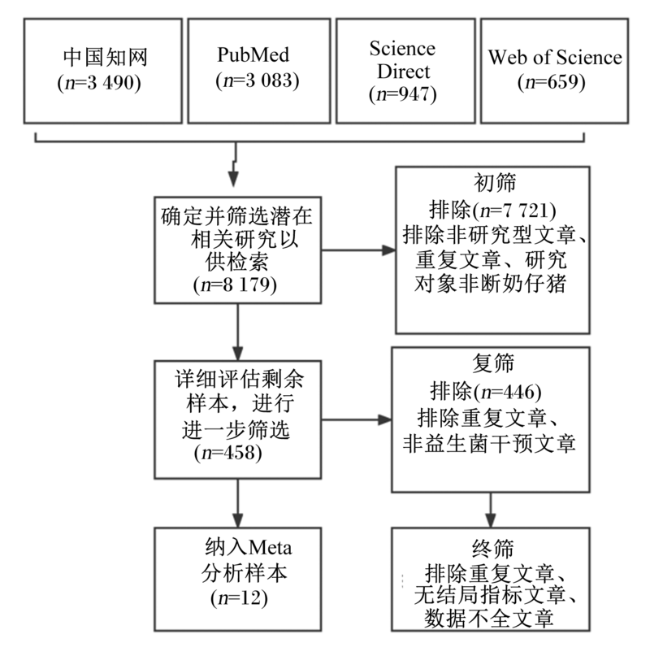
依据检索式[主题:断奶仔猪(精确)]AND[全文:生长性能(精确)]OR[全文:生长性能(精确)]AND[篇名:菌(精确)];“weaned piglets、LPS、Escherichia coli”关键词自由组合。检索试验型文献总计8 179篇,依据文献标题及摘要排除非研究型文章、研究对象非断奶仔猪、非益生菌干预文章总计7 721篇,依据试验方法及文献内容排除无结局指标、与纳入标准不符文献总计446篇,最终纳入样本文献12篇,总样本数为909头。文献筛选流程图如图1所示。
图1 文献筛选流程图

Fig.1 Flow chart of literature screening

2.2 纳入文献基本特征

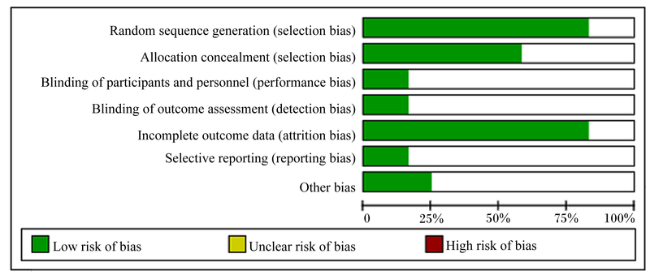
本次Meta分析纳入样本的研究对象均为断奶仔猪,总计样本量为909头。在益生菌添加对断奶仔猪生长性能影响的分析中对照组为无添加基础饲粮组,试验组为益生菌添加组。在益生菌添加对损伤处理下的断奶仔猪生长性能影响的分析中对照组为大肠杆菌或脂多糖添加构建的损伤模型组,试验组为益生菌添加与损伤模型共同处理组。添加方式分别为腹腔注射、悬液灌服、饲粮添加。基本特征信息详见表1,文献质量评估见图2
表1 基本特征

Table 1 Basic characteristics

序号
No.
文献来源
Literature
source
样本数量
Number of
samples
断奶日龄
Weaned
age
初始体重
Initial body
weight/
kg
试验
天数
Test
days/d
菌株添
加类型
Strain addition
type
添加量
Dosage
干预措施
Intervention measure
饲喂方式
Feeding
mode
品种
Breed
结局指标
Outcome
indicator
试验组
Test
group
对照组
Control
group
试验组
Test
group
对照组
Control
group
1 张娟等[9] 144 36 21 8.42~9.13 28 植物乳杆菌 1×10⁸、1×10⁹
1×10¹⁰ CFU/kg
损伤处理+
益生菌
大肠杆菌
6×10⁹ CFU/kg
饲粮添加 二元断
奶仔猪
①②③
2 Deng等[10] 10 10 - 5.83±0.24 21 发酵乳杆菌I5007
尼氏大肠杆菌 1917
1×10⁹ CFU/mL 损伤处理+
益生菌
大肠杆菌
1×10⁹ CFU/mL
2 mL/头
灌服 大×长 ①②③
3 Qiao等[11] 90 30 - 7.53±0.21 28 嗜酸乳杆菌 0.05%、0.1%、0.2% 损伤处理+
益生菌
200 μg/kg 饲粮添加 杜×长×大 ①②③
4 Trevisi等[12] 18 18 21 5.6±0.2 14 鼠李糖乳杆菌 1×10¹⁰ CFU/mL 损伤处理+
益生菌
大肠杆菌
1×10¹⁰ CFU/mL
灌服 杜×长 ①②③
5 唐志如等[13] 5 5 21 6.35±0.30 24 尼氏大肠
杆菌 1917
1×10¹⁰ CFU 损伤处理+
益生菌
大肠杆菌
5×10⁹ CFU
灌服 杜×长×大 ①②③
6 Sun等[14] 54 18 21±2 6.44±0.25 14 唾液乳杆菌 0.05%、0.1%、0.2% 损伤处理+
益生菌
腹腔注射脂多糖
200 μg/kg
饲粮添加 杜×长×大 ①②③
7 Lee等[15] 10 10 24~25 7.10±0.22 14 嗜酸乳杆菌 0.10% 损伤处理+
益生菌
脂多糖0.1 g/kg 饲粮添加 杜×长×大 ①②③
8 Chen等[16] 12 12 25 7.14±0.16 28 德尔布鲁氏乳杆菌 2.01×10¹⁰ CFU/g 损伤处理+
益生菌
脂多糖
100 μg/kg
饲粮添加 杜×长×大 ①②③
9 师丽刚[17] 30 15 28 - 21 复合益生菌制剂 1.0、1.5 g/kg 损伤处理+
益生菌
大肠杆菌
109 CFU/mL
10 mL/头
灌服 杜×长×大 ①②③
10 柳成东等[18] 8 8 25 7.38/7.37±0.02 30 凝结芽孢杆菌 0.91×10¹⁰ CFU/g 损伤处理+
益生菌
大肠杆菌
1×10⁹ CFU/mL
5 mL/头
灌服 杜×长×大 ①②③
11 张连忠[19] 175 175 21 6.31±0.03 21 植物乳杆菌 1× 10⁸ CFU/kg 损伤处理+
益生菌
大肠杆菌
1×10⁶ CFU/mL
2 mL/头
灌服 ①②③
12 Sun等[20] 8 8 21 6.99±0.33 25 混合益生菌 0.10% 损伤处理+
益生菌
大肠杆菌
2×10⁹ CFU/mL
灌服 杂交仔猪 ①②

①:平均日增重 ADG;②:平均日采食量 ADFI;③:料重比 F/G。

图2 文献风险评估图

Random sequence generation (selection bias):随机序列生成(选择偏倚);Allocation concealment (selection bias):分配隐藏(选择偏倚);Blinding of participants and personnel (performance bias):受试者和研究人员的盲法(实施偏倚);Blinding of outcome assessment (detection bias):结果评价的盲法(测量偏倚);Incomplete outcome data (attrition bias):不完整的结果数据(随访偏倚);Selective reporting (reporting bias):选择性报告(报告偏倚);Other bias:其他偏倚;Low risk of bias:低偏倚风险;Unclear risk of bias:偏倚风险不明确;High risk of bias:高偏倚风险。

Fig.2 Literature risk assessment map

2.3 Meta分析结果

2.3.1 益生菌添加对肠道损伤断奶仔猪平均日增重影响的森林图、亚组分析及漏斗图
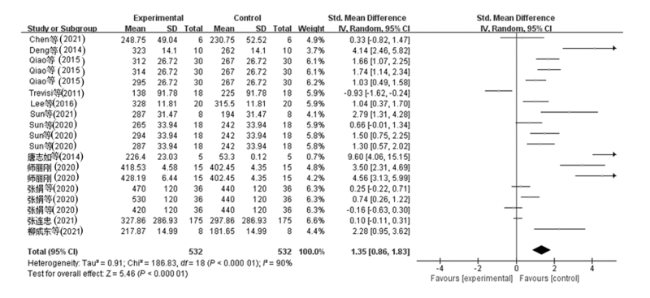
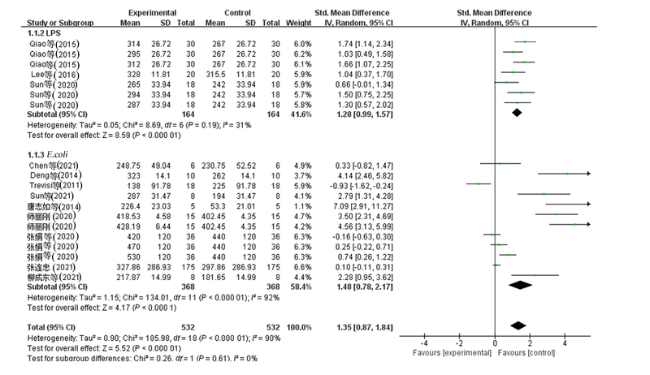
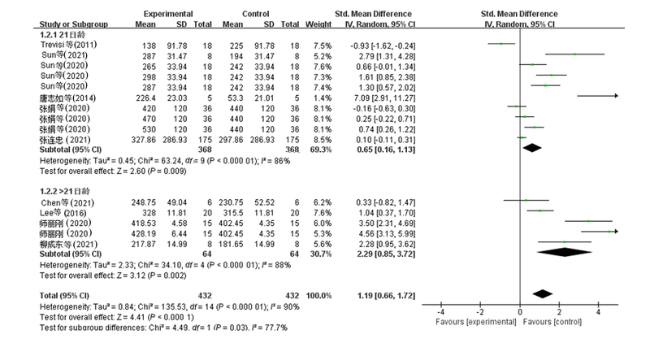
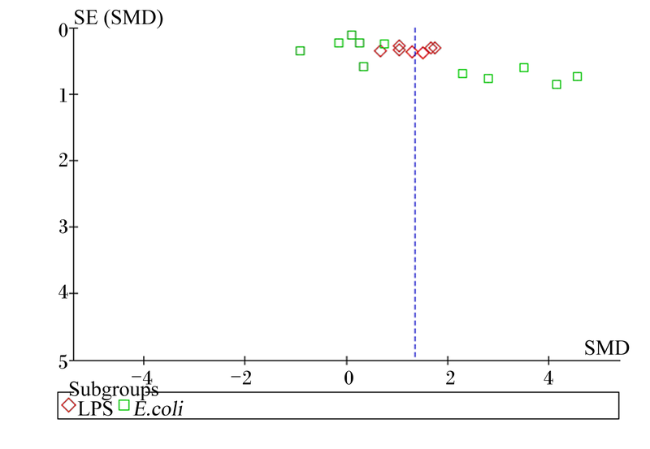
纳入关于断奶仔猪损伤模型添加益生菌与平均日增重的相关研究(总计研究对象1 064头)。由图3可知,其I2=90%,自由度(df)=18,P<0.000 01。由于异质性较大,所以选择随机效应模型进行进一步分析。最终结果显示,SMD=1.35,95%CI为0.86~1.83,表明平均日增重与纳入益生菌间具有相关性。依据文献中损伤模型为脂多糖或大肠杆菌进行分类,进一步进行亚组分析,结果如图4所示,结果显示益生菌添加可以提高脂多糖仔猪肠道损伤模型及大肠杆菌仔猪肠道损伤模型平均日增重。为了探究断奶日龄对肠道损伤断奶仔猪平均日增重的影响,结合纳入文献,我们以断奶日龄是否大于21日龄进行分类,并作出亚组分析,结果表明(图5)益生菌可以提高21断奶日龄及大于21日龄断奶仔猪平均日增重。最后利用漏斗图法检验发表偏倚(图6),依据漏斗图结果显示,此平均日增重的研究间对称性较好,发表偏倚程度较小。最终结果提示,与损伤处理对照组相比,添加益生菌后可以有效提高损伤模型下的断奶仔猪平均日增重。
图3 益生菌添加对肠道损伤断奶仔猪平均日增重影响的森林图

Experimental:试验组 experimental group;Control:对照组 control group;Std.Mean Difference:标准化均数差;Study or Subgroup:研究或组别;Mean:均值;SD:标准差standard deviation;Total:样本数;95% CI:95%置信区间95% confidence interval;Weight:权重;Heterogeneity:异质性;Test for overall effect:总体效应检验;Favours (experimental):试验组获益;Favours(control):对照组获益;图7图11同 the same as Fig.7 and Fig.11

Fig.3 Forest map of effects of probiotic addition on average daily gain of weaned piglets with intestinal damage

图4 益生菌添加对肠道损伤断奶仔猪平均日增重影响的亚组分析图(损伤模型亚组)

Experimental:试验组 experimental group;Control:对照组 control group;Std.Mean Difference:标准化均数差;Study or Subgroup:研究或组别;Mean:均值;SD:标准差standard deviation;Total:样本数;95% CI:95%置信区间95% confidence interval;Weight:权重;Heterogeneity:异质性;Test for overall effect :整体检测效果;Test for subaroub differences:亚组差异;LPS:脂多糖处理组 LPS group; E.coli:大肠杆菌处理组 E.coli group;Favours (experimental):试验组获益;Favours (control):对照组获益;图5图8图9图12图13同 the same as Fig.5, Fig.8, Fig.9, Fig.12 and Fig.13

Fig.4 Subgroup analysis of effects of probiotic addition on averge daily gain of weaned piglets with intestinal injury (injury model subgroup)

图5 益生菌添加对肠道损伤断奶仔猪平均日增重影响的亚组分析图(断奶日龄亚组)

Fig.5 Subgroup analysis of effects of probiotic addition on averge daily gain of weaned piglets with intestinal injury (weaned age subgroup)

图6 益生菌添加对肠道损伤断奶仔猪平均日增重影响的漏斗图

SE(SMD):标准误(标准化均数差);Subgroups:亚组;LPS:脂多糖处理组 LPS group;E.coli:大肠杆菌处理组 E.coli group;图10图14同 the same as Fig.10 and Fig.14

Fig.6 Funnel plot of effects of probiotic addition on average daily gain of weaned piglets with intestinal damage

2.3.2 益生菌添加对损伤处理断奶仔猪平均日采食量影响的森林图、亚组分析及漏斗图
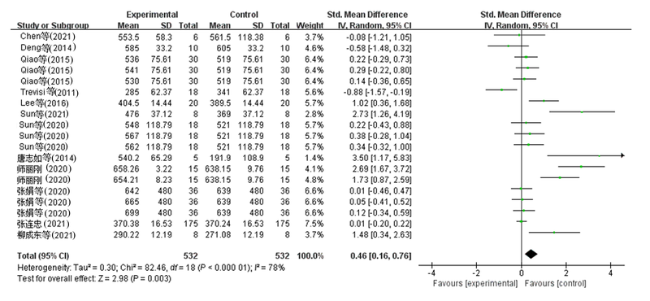
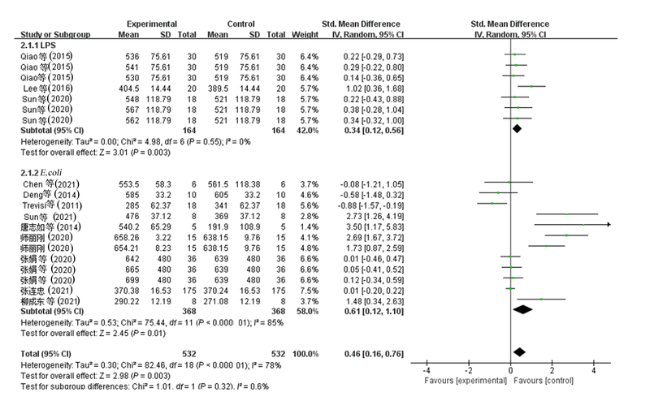
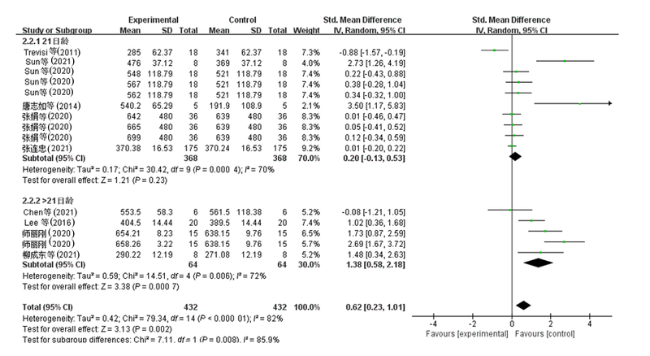
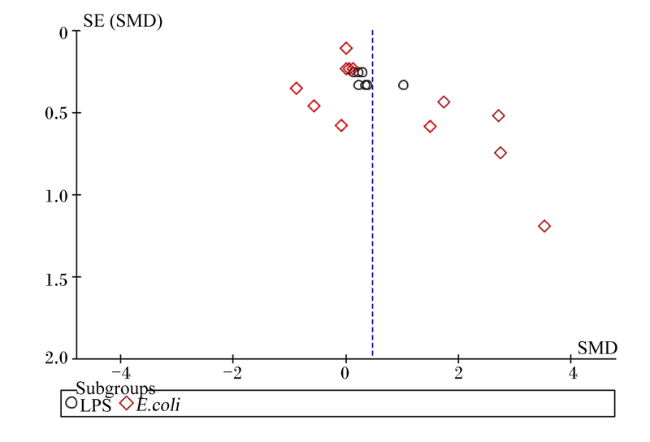
纳入断奶仔猪损伤模型添加益生菌与平均日采食量的相关研究(总计研究对象1 064头)。分析结果显示,其I2=78%,df=18,P<0.00 001。存在较大异质性,因此选择随机效应模型进行进一步分析。最终结果显示,SMD=0.46,95%CI为0.16~0.76,表明平均日采食量与纳入益生菌间具有统计学相关性,结果如图7所示。亚组分析结果显示,添加益生菌处理能够提高脂多糖及大肠杆菌肠道损伤处理模型断奶仔猪的平均日采食量(图8)。进一步探究断奶日龄对肠道损伤断奶仔猪平均日采食量的影响,结合纳入文献,以断奶日龄是否大于21日龄进行分类,并作出亚组分析,结果表明(图9)益生菌可以提高大于21断奶日龄的断奶仔猪平均日增重,但对21日龄断奶仔猪平均日采食量的影响无统计学意义。漏斗图对称性较好,不存在发表偏倚(图10)。断奶仔猪平均日采食量与添加益生菌处理二者间存在统计学相关性且添加益生菌饲喂可以有效提高断奶仔猪平均日采食量。
图7 益生菌添加对肠道损伤断奶仔猪平均日采食量影响的森林图

Fig.7 Forest plot of effects of probiotic addition on average daily feed intake of weaned piglets with intestinal damage

图8 益生菌添加对肠道损伤断奶仔猪平均日采食量影响的亚组分析图(损伤模型亚组)

Fig.8 Subgroup analysis of effects of probiotic addition on average daily feed intake of weaned piglets with intestinal injury (injury model subgroup)

图9 益生菌添加对肠道损伤断奶仔猪平均日采食量影响的亚组分析图(断奶日龄亚组)

Fig.9 Subgroup analysis of effects of probiotic addition on average daily feed intake of weaned piglets with intestinal injury (weaning age subgroup)

图10 益生菌添加对肠道损伤断奶仔猪平均日采食量影响的漏斗图

Fig.10 Funnel plot of effecst of probiotic addition on average daily feed intake of weaned piglets with intestinal damage

2.3.3 益生菌添加对断奶仔猪肠道损伤模型料重比影响的森林图、亚组分析及漏斗图
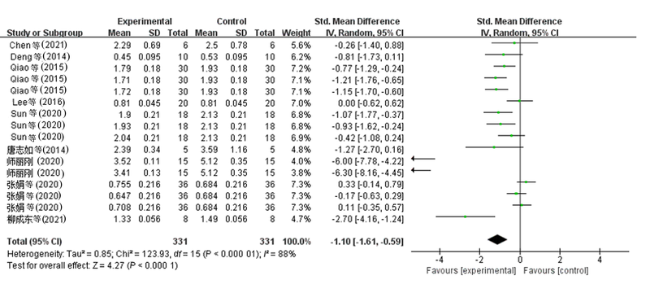
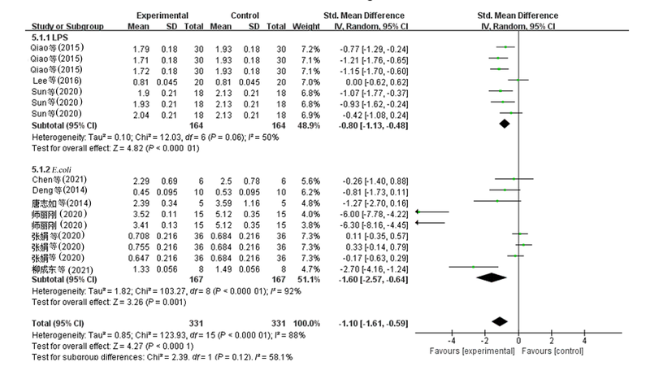
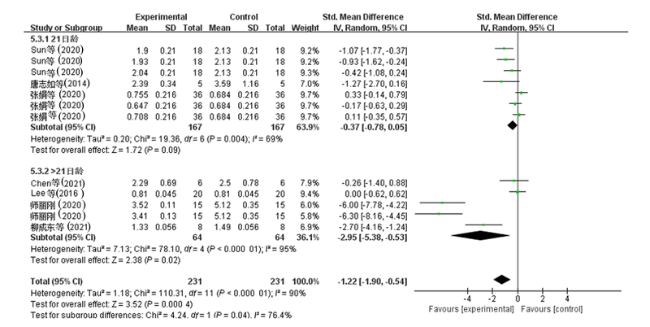
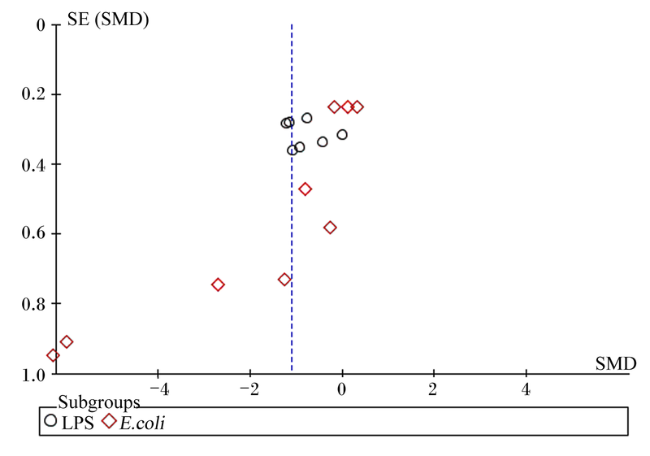
纳入断奶仔猪损伤模型添加益生菌与料重比的相关研究(总计研究对象662头)。分析结果显示,其I2=88%,df=15,P<0.00 001,这提示异质性较大,因此选择随机效应模型进行进一步分析。最终结果显示,SMD=-1.10,95%CI为-1.61~-0.59,表明料重比与纳入益生菌存在统计学相关性,结果如图11所示。依据文献分别分为大肠杆菌损伤处理亚组及脂多糖损伤处理亚组,进一步进行亚组分析,结果如图12所示。我们进一步探究了断奶日龄对肠道损伤断奶仔猪料重比的影响,结合纳入文献,以断奶日龄是否大于21日龄进行分类,并作出亚组分析,结果表明(图13)益生菌可以降低大于21断奶日龄的断奶仔猪料重比,但对21日龄断奶仔猪料重比的影响无统计学意义。采用漏斗图法检验发表偏倚,在本项研究中,应用漏斗图评价法时,依据图14漏斗图结果显示,此料重比的研究间对称性较好,说明发表偏倚程度较小。最终结果提示,与损伤处理对照组相比添加益生菌后可以有效降低损伤模型下的断奶仔猪料重比。
图11 益生菌添加对肠道损伤断奶仔猪料重比影响的森林图

Fig.11 Forest plot of effects of probiotic addition on feed/gain of weaned piglets with intestinal damage

图12 益生菌添加对肠道损伤断奶仔猪料重比影响的亚组分析图(损伤模型亚组)

Fig.12 Subgroup analysis of effects of probiotic addition on feed/gain of weaned piglets with intestinal injury (injury model subgroup)

图13 益生菌添加对肠道损伤断奶仔猪料重比影响的亚组分析图(断奶日龄亚组)

Fig.13 Subgroup analysis of effects of probiotic addition on feed/gain of weaned piglets with intestinal damage (weaning age subgroup)

图14 益生菌添加对肠道损伤断奶仔猪料重比影响的漏斗图

Fig.14 Funnel diagram of effects of probiotic addition on feed/gain of weaned piglets with intestinal damage

3 讨论

在自然条件下仔猪断奶是一个循序渐进的过程,但为提高母猪生长性能、防控疫病,商品猪场多采取早期断奶这一措施,通常情况下在仔猪出生21~28 d采取断奶措施[21]。而在这一过程中,断奶仔猪自身胃肠道功能发育尚不完善,在受到环境改变、饲粮性状改变适口性差、运输刺激、母仔分离、产肠毒素大肠杆菌、轮状病毒等病原微生物的感染等诸多因素的影响下,易发生断奶应激[22]。研究表明,断奶仔猪生长性能与断奶日龄密切相关,断奶日龄对仔猪平均日增重、平均日采食量、相对生长速率均有显著影响,早期断奶会影响断奶仔猪消化器官、免疫器官发育,导致仔猪免疫能力降低,引发断奶腹泻甚至死亡[23-24]。在本研究中发现,仔猪21日龄断奶时添加益生菌可以提高肠道损伤断奶仔猪平均日增重,但对平均日采食量及料重比的影响无统计学意义,但当断奶日龄大于21日龄时添加益生菌则可以显著提高肠道损伤断奶仔猪平均日增重与平均日采食量,并降低断奶仔猪料重比。同时,研究发现仔猪早期断奶会改变仔猪肠道氧化还原环境,引起断奶仔猪肠道菌群紊乱,导致大肠杆菌数量提高及乳酸杆菌、双歧杆菌数量降低[25]
产肠毒素大肠杆菌属于革兰氏阴性菌,是诱发仔猪断奶后腹泻的主要原因之一,由此引发的仔猪白痢、黄痢等疾病具有高发病率、高传染率的特点,给全球生猪养殖带来了巨大损失[26]。断奶仔猪感染产肠毒素大肠杆菌会引起肠腔内电解质失调、渗透压过高、水分吸收异常,进而引发断奶仔猪腹泻[27]。产肠毒素大肠杆菌黏附定植于小肠上皮细胞,会提高肠道上皮细胞通透性,改变肠道微生物群多样性并通过调节炎症因子表达,诱导肠道炎症反应、破坏肠道形态及营养物质转运功能[28]。脂多糖是来源于革兰氏阴性菌的细胞膜的毒力因子,研究发现断奶仔猪感染细菌脂多糖,会导致肠上皮损伤,刺激机体炎症因子表达,降低断奶仔猪肠道黏膜细胞增殖率,改变肠道免疫细胞组成,增加肠道黏膜通透性并导致细菌移位,破坏肠道菌群平衡及肠道形态,从而加重急性感染症状[29-30]。因此,常通过产肠毒素大肠杆菌及脂多糖外源刺激来构建断奶仔猪肠道损伤模型[25]
饲用抗生素禁用以后,寻找一种绿色高效、方便生产的抗生素替代物,对于生猪养殖十分关键。益生菌作为一种生物活性制剂,是优质的抗生素替代产品之一,广泛应用于实际生产过程中,多项研究表明,益生菌能够调节断奶仔猪营养物质的吸收与利用、改善肠道菌群结构、调节肠道免疫功能缓解肠道炎症反应[31]。我国农业农村部《饲料添加剂品种目录(2013)》中允许包括地衣芽孢杆菌、乳酸肠球菌、嗜酸乳杆菌等34个饲用益生菌在畜禽、水产饲料中使用。研究发现,复合益生菌发酵饲料能有效改善饲料适口性,通过产生多种酶代谢物、大量菌体蛋白以及游离氨基酸、单糖等小分子物质,有助于饲粮的消化吸收[32]。乳酸杆菌添加有助于改善肠道菌群结构,提高有益菌的比例,抑制致病性大肠杆菌、沙门氏菌等病原菌的生长繁殖[33]。有研究表明,添加乳酸乳球菌可以促进断奶仔猪回肠半胱氨酸的表达,减少空肠大肠杆菌的黏附定植并改善断奶仔猪生长性能[34]
同时添加鼠李糖乳杆菌有助于改善T细胞的组成,调节肠道炎症因子的分泌,进而缓解大肠杆菌诱导肠道炎症反应[35]。本研究的结果显示,添加益生菌可以提高损伤处理下的断奶仔猪平均日增重与平均日采食量,降低损伤模型断奶仔猪料重比。
但本研究仍存在一定的局限性:1)纳入研究样本量较少;2)样本间异质性较大;3)各项研究之间的种系、饲粮配方、试验周期、益生菌添加浓度及菌株种类等差异较大;4)缺少质量评估标准,无法对试验结果的科学性进行客观验证。因此本研究也需要进一步拓宽数据采集途径、提高样本数量、优化筛选及提取流程,进一步验证研究结果。

4 结论

本研究表明,添加益生菌可以有效提高肠道损伤处理下的仔猪断奶平均日增重,提高平均日采食量,降低料重比。
[1]
BOMBA L, MINUTI A, MOISÁ S J, et al. Gut response induced by weaning in piglet features marked changes in immune and inflammatory response[J]. Functional & Integrative Genomics, 2014, 14(4):657-671.

[2]
CAMPBELL J M, CRENSHAW J D, POLO J. The biological stress of early weaned piglets[J]. Journal of Animal Science and Biotechnology, 2013, 4(1):19.

DOI PMID

[3]
NABUURS M J A, HOOGENDOORN A, VAN ZIJDERVELD F G. Effects of weaning and enterotoxigenic Escherichia coli on net absorption in the small intestine of pigs[J]. Research in Veterinary Science, 1994, 56(3):379-385.

DOI

[4]
SALZMAN A L, WANG H, WOLLERT P S, et al. Endotoxin-induced ileal mucosal hyperpermeability in pigs:role of tissue acidosis[J]. The American Journal of Physiology, 1994, 266(4):G633-G646.

[5]
SONG Y Y, LUO Y, YU B, et al. Tannic acid extracted from gallnut prevents post-weaning diarrhea and improves intestinal health of weaned piglets[J]. Animal Nutrition, 2021, 7(4):1078-1086.

DOI PMID

[6]
WAN J, ZHANG J, CHEN D W, et al. Alginate oligosaccharide enhances intestinal integrity of weaned pigs through altering intestinal inflammatory responses and antioxidant status[J]. RSC Advances, 2018, 8(24):13482-13492.

DOI

[7]
WANG X Y, XIAO K, YU C, et al. Xylooligosaccharide attenuates lipopolysaccharide-induced intestinal injury in piglets via suppressing inflammation and modulating cecal microbial communities[J]. Animal Nutrition, 2021, 7(3):609-620.

DOI PMID

[8]
EGGER M, SMITH G D, PHILLIPS A N. Meta-analysis:principles and procedures[J]. BMJ, 1997, 315(7121):1533-1537.

DOI

[9]
张娟, 李福泉, 陈张华, 等. 植物乳杆菌对感染产肠毒素大肠杆菌断奶仔猪生长性能和细胞因子反应的影响[J]. 中国饲料, 2020(4):41-45.

ZHANG J, LI F Q, CHEN Z H, et al. Effects of lactobacillus plantans on growth performance and cytokine response of weaned piglets infected with enterotoxin-producing Escherichia coli[J]. China Feed, 2020(4):41-45. (in Chinese)

[10]
DENG H, XU L, TANG Z R, et al. Effects of orally administered Escherichia coli Nissle 1917 on growth performance and jejunal mucosal membrane integrity,morphology,immune parameters and antioxidant capacity in early weaned piglets[J]. Animal Feed Science and Technology, 2014, 198:286-294.

DOI

[11]
QIAO J Y, LI H H, WANG Z X, et al. Effects of Lactobacillus acidophilus dietary supplementation on the performance,intestinal barrier function,rectal microflora and serum immune function in weaned piglets challenged with Escherichia coli lipopolysaccharide[J]. Antonie Van Leeuwenhoek, 2015, 107(4):883-891.

DOI

[12]
TREVISI P, CASINI L, COLORETTI F, et al. Dietary addition of Lactobacillus rhamnosus GG impairs the health of Escherichia coli F4-challenged piglets[J]. Animal, 2011, 5(9):1354-1360.

DOI

[13]
唐志如, 邓欢, 孙卫忠, 等. 口服益生菌Escherichia coli Nissle 1917调控断奶仔猪空肠黏膜屏障功能的机理研究[J]. 畜牧兽医学报, 2014, 45(1):78-86.

TANG Z R, DENG H, SUN W Z, et al. Study on the mechanism of orally administered probiotics Escherichia coli nissle 1917 regulating intestine barrier in weaned piglets[J]. Acta Veterinaria et Zootechnica Sinica, 2014, 45(1):78-86. (in Chinese)

[14]
SUN Z Y, LI H H, LI Y P, et al. Lactobacillus salivarius,a potential probiotic to improve the health of LPS-challenged piglet intestine by alleviating inflammation as well as oxidative stress in a dose-dependent manner during weaning transition[J]. Frontiers in Veterinary Science, 2020, 7:547425.

[15]
LEE S I, KIM H S, KOO J M, et al. Lactobacillus acidophilus modulates inflammatory activity by regulating the TLR4 and NF-κB expression in porcine peripheral blood mononuclear cells after lipopolysaccharide challenge[J]. The British Journal of Nutrition, 2016, 115(4):567-575.

DOI

[16]
CHEN F M, CHEN J Y, CHEN Q H, et al. Lactobacillus delbrueckii protected intestinal integrity,alleviated intestinal oxidative damage, and activated Toll-like receptor-Bruton's tyrosine kinase-nuclear factor erythroid 2-related factor 2 pathway in weaned piglets challenged with lipopolysaccharide[J]. Antioxidants, 2021, 10(3):468.

DOI

[17]
师丽刚. 复合益生菌制剂对感染产毒素大肠杆菌断奶仔猪生长性能、免疫机能及肠道菌群结构的影响[J]. 中国饲料, 2020(21):53-56.

SHI L G. Effects of probiotics on growth performance,immune function and intestinal microflora structure of weaned piglets infected with enterotoxigenic E.coli[J]. China Feed, 2020(21):53-56. (in Chinese)

[18]
柳成东, 肖明霞, 赵平, 等. 饲用凝结芽孢杆菌对感染产肠毒素大肠杆菌K88断奶仔猪生长性能和肠道健康的影响[J]. 动物营养学报, 2021, 33(8):4373-4383.

DOI

LIU C D, XIAO M X, ZHAO P, et al. Effect of dietary bacillus coagulans on growth performance and intestinal health of weaned piglets challenged with enterotoxigenic Escherichia coli K88[J]. Chinese Journal of Animal Nutrition, 2021, 33(8):4373-4383. (in Chinese)

[19]
张连忠. 植物乳杆菌对感染肠毒性大肠杆菌断奶猪生长性能、绒毛形态及粪微生物含量的影响[J]. 中国饲料, 2021(18):45-48.

ZHANG L Z. Effects of Lactobacillus plantarum on growth performance,villus morphology and fecal microorganism contents of weaned pigs infected with enterotoxic Escherichia coli[J]. China Feed, 2021(18):45-48. (in Chinese)

[20]
SUN Y W, DUARTE M E, KIM S W. Dietary inclusion of multispecies probiotics to reduce the severity of post-weaning diarrhea caused by Escherichia coli F18+ in pigs[J]. Animal Nutrition, 2021, 7(2):326-333.

DOI

[21]
KO K B, KIM G D, KANG D G, et al. The influences of weaning age and weight on carcass traits and meat quality of pigs[J]. Animal Science Journal, 2015, 86(4):428-434.

DOI PMID

[22]
GRESSE R, CHAUCHEYRAS-DURAND F, FLEURY M A, et al. Gut microbiota dysbiosis in postweaning piglets:understanding the keys to health[J]. Trends in Microbiology, 2017, 25(10):851-873.

DOI

[23]
程学慧, 彭健. 猪肠道屏障及早期断奶屏障损伤机制[J]. 国外畜牧学(猪与禽), 2002(1):38-40.

CHENG X H, PENG J. Injury mechanism of intestinal barrier and early weaning barrier in pigs[J]. Animal Science Abroad (Pigs and Poultry), 2002(1):38-40. (in Chinese)

[24]
NOVAIS A K, DESCHÊNE K, MARTEL-KENNES Y, et al. Weaning differentially affects mitochondrial function,oxidative stress,inflammation and apoptosis in normal and low birth weight piglets[J]. PLoS One, 2021, 16(2):e0247188.

[25]
孙景童, 史唤, 李艳娇, 等. 断奶日龄对仔猪生长性能、肠道菌群及腹泻率的影响[J]. 饲料工业, 2016, 37(17):31-35.

SUN J T, SHI H, LI Y J, et al. Effect of weaning age on growth performance,intestinal flora and diarrhea rate[J]. Feed Industry, 2016, 37(17):31-35. (in Chinese)

[26]
JENSEN G M, FRYDENDAHL K, SVENDSEN O, et al. Experimental infection with Escherichia coli O149:F4ac in weaned piglets[J]. Veterinary Microbiology, 2006, 115(1/2/3):243-249.

DOI

[27]
LAIRD T J, ABRAHAM S, JORDAN D, et al. Porcine enterotoxigenic Escherichia coli:antimicrobial resistance and development of microbial-based alternative control strategies[J]. Veterinary Microbiology, 2021, 258:109117.

[28]
SIMPSON B W, TRENT M S. Pushing the envelope:LPS modifications and their consequences[J]. Nature Reviews Microbiology, 2019, 17(7):403-416.

DOI

[29]
YI D, HOU Y Q, WANG L, et al. Gene expression profiles in the intestine of lipopolysaccharide-challenged piglets[J]. Frontiers in Bioscience (Landmark Edition), 2016, 21(3):487-501.

DOI PMID

[30]
WYNS H, PLESSERS E, DE BACKER P, et al. In vivo porcine lipopolysaccharide inflammation models to study immunomodulation of drugs[J]. Veterinary Immunology and Immunopathology, 2015, 166(3/4):58-69.

DOI

[31]
ZAMOJSKA D, NOWAK A, NOWAK I, et al. Probiotics and postbiotics as substitutes of antibiotics in farm animals:a review[J]. Animals, 2021, 11(12):3431.

DOI

[32]
蓝海恩, 麦伟虹, 黄焕昌, 等. 复合益生菌发酵饲料对断奶仔猪生长性能、肠道微生物菌群、血清生化指标和免疫指标的影响[J]. 中国饲料, 2020(15):120-124.

LAN H E, MAI W H, HUANG H C, et al. Effects of compound probiotic fermented feed on growth performance,intestinal microflora,serum biochemical index and immune index of weaned piglets[J]. China Feed, 2020(15):120-124. (in Chinese)

[33]
YANG F J, HOU C L, ZENG X F, et al. The use of lactic acid bacteria as a probiotic in swine diets[J]. Pathogens, 2015, 4(1):34-45.

DOI PMID

[34]
YU D M, XIA Y Y, GE L P, et al. Effects of Lactococcus lactis on the intestinal functions in weaning piglets[J]. Frontiers in Nutrition, 2021, 8:713256.

[35]
ZHU Y H, LI X Q, ZHANG W, et al. Dose-dependent effects of Lactobacillus rhamnosus on serum interleukin-17 production and intestinal T-cell responses in pigs challenged with Escherichia coli[J]. Applied and Environmental Microbiology, 2014, 80(5):1787-1798.

DOI

文章导航

/