研究论文

蝉花菌质对大黄鱼生长性能、肝脏抗氧化能力和肠道菌群的影响

  • 尹恒 ,
  • 霍润明 ,
  • 柴若愚 ,
  • 水晓梅 ,
  • 黄玲 ,
  • 王涵颖 ,
  • 王萍 , *
展开
  • 浙江海洋大学,浙江省海洋养殖装备与工程技术重点实验室,舟山 316000
*王 萍,教授,硕士生导师,E-mail:

尹 恒(1998—),男,湖北孝感人,硕士研究生,研究方向为海洋生物养殖学。E-mail:

收稿日期: 2022-08-08

  网络出版日期: 2023-03-16

基金资助

国家自然科学基金面上项目(42176119)

蓝色粮仓项目(2019YFD0900901)

Effects of Isaria cicadae Spent Mushroom Substrate on Growth, Liver Antioxidant Capacity and Intestinal Microflora of Large Yellow Croaker (Larimichthys crocea)

  • YIN Heng ,
  • HUO Runming ,
  • CHAI Ruoyu ,
  • SHUI Xiaomei ,
  • HUANG Ling ,
  • WANG Hanying ,
  • WANG Ping , *
Expand
  • Zhejiang Key Laboratory of Marine Aquaculture Equipment and Engineering Technology, Zhejiang Ocean University, Zhoushan 316000, China
*professor, E-mail:

Received date: 2022-08-08

  Online published: 2023-03-16

摘要

本试验旨在研究蝉花菌质对大黄鱼生长性能、肝脏抗氧化能力、血清免疫能力、肠道形态和肠道菌群的影响,为大黄鱼绿色饲料添加剂的开发和利用提供参考。将初始体重为(273.07±14.90) g的180尾大黄鱼随机分为3组,每组3个网箱,每个网箱20尾。3组试验鱼分别投喂基础饲料(IC0组,作为对照组)、基础饲料+2%蝉花菌质(IC2组)、基础饲料+6%蝉花菌质(IC6组)。养殖周期为56 d。结果表明:1)IC6组的增重率(WGR)、特定生长率(SGR)和饲料效率(FE)显著高于IC0组(P<0.05);IC2组的肝体比(HSI)和脏体比(VSI)显著高于IC0和IC6组(P<0.05);各组间存活率无显著差异(P>0.05)。2)与IC0组相比,IC2组肌肉和全鱼粗脂肪含量显著提高(P<0.05),肌肉水分含量显著下降(P<0.05);而IC6组肌肉和全鱼粗脂肪含量显著下降(P<0.05),水分含量显著提高(P<0.05)。3)与IC0组相比,IC6组肝脏总超氧化物歧化酶(T-SOD)和过氧化氢酶(CAT)活性显著提高(P<0.05);IC2组肝脏过氧化氢酶(CAT)活性显著提高(P<0.05),肝脏谷胱甘肽过氧化物酶(GSH-Px)活性显著降低(P<0.05);各组间肝脏丙二醛(MDA)含量以及血清补体3(C3)、补体4(C4)含量与溶菌酶(LZM)、谷丙转氨酶(ALT)和谷草转氨酶(AST)活性均无显著差异(P>0.05)。4)IC6组肠道单根绒毛杯状细胞数量显著高于IC0和IC2组(P<0.05)。5)与IC0组相比,IC6组的Simpson和Shannon指数显著上升(P<0.05),IC2组的Shannon指数显著上升(P<0.05)。在门水平上,与IC0组相比,IC2和IC6组变形菌门(Proteobacteria)和放线菌门(Actinobacteriota)相对丰度显著提高(P<0.05),拟杆菌门(Bacteroidota)、脱硫杆菌门(Desulfobacterota)、互养菌门(Synergistota)和绿弯菌门(Chloroflexi)相对丰度显著降低(P<0.05);在属水平上,与IC0组相比,IC6组拟杆菌属(Bacteroides)相对丰度显著提高(P<0.05),IC2组克雷伯氏菌属(Klebsiella)相对丰度显著提高(P<0.05),IC2和IC6组瘤胃杆菌属(Ruminofilibacter)、脱硫菌属(Desulfomicrobium)和氨基杆菌属(Aminobacterium)相对丰度显著降低(P<0.05)。综上所述,饲料中添加蝉花菌质有利于改善大黄鱼的生长性能、抗氧化能力和肠道菌群结构,以6%的添加量效果较好。

本文引用格式

尹恒 , 霍润明 , 柴若愚 , 水晓梅 , 黄玲 , 王涵颖 , 王萍 . 蝉花菌质对大黄鱼生长性能、肝脏抗氧化能力和肠道菌群的影响[J]. 动物营养学报, 2023 , 35(3) : 1895 -1909 . DOI: 10.12418/CJAN2023.178

Abstract

This study was conducted to investigate the effects of Isaria cicadae spent mushroom substrate on growth performance, liver antioxidant capacity, serum immunity, intestinal morphology and intestinal microflora of large yellow croaker (Larimichthys crocea), and to provide reference for the development and utilization of green feed additives for large yellow croaker. A total of 180 large yellow croaker with an initial body weight of (273.07±14.90) g were randomly divided into 3 groups with 3 cages in each group and 20 fish in each cage. Fish in the 3 groups were fed a basal diet (IC0 group, as control group) and the basal diet supplemented with 2% (IC2 group) and 6% (IC6 group) of Isaria cicadae spent mushroom substrate, respectively. The experiment lasted for 56 days. The results showed as follows: 1) the weight gain rate (WGR), specific growth rate (SGR) and feed efficiency (FE) in IC6 group were significantly higher than those in IC0 group (P<0.05); the hepatosomatic index (HSI) and viscerosomatic index (VSI) in IC2 group were significantly higher than those in IC0 and IC6 groups (P<0.05); there was no significant difference in survival rate (SR) among all groups (P>0.05). 2) Compared with the control group, the ether extract content of muscle and whole fish in IC2 group was significantly increased (P<0.05), and moisture content of muscle was significantly decreased (P<0.05); the ether extract content of muscle and whole fish in IC6 group was significantly decreased (P<0.05), and the moisture content was significantly increased (P<0.05). 3) Compared with the control group, the activities of liver total superoxide dismutase (T-SOD) and catalase (CAT) in IC6 group were significantly increased (P<0.05); the activity of liver CAT in IC2 group was significantly increased (P<0.05), and the activity of liver glutathione peroxidase (GSH-Px) was significantly decreased (P<0.05); there were no significant differences in the content of malondialdehde (MDA) in liver, the contents of complement 3 (C3), complement 4 (C4), and the activities of lysozyme (LZM), alanine aminotransferase (ALT) and aspartate aminotransferase (AST) in serum among all groups (P>0.05). 4) The number of gobletcells per villus of intestine in IC6 group was significantly higher than that in IC0 and IC2 groups (P<0.05). 5) Compared with IC0 group, the Simpson index and Shannon index of IC6 group were significantly increased (P<0.05), the Shannon index of IC2 group was significantly increased (P<0.05). At the phylum level, compare with IC0 group, the relative abundances of Proteobacteria and Actinobacteriota were significantly improved in IC2 and IC6 groups (P<0.05), while the relative abundances of Bacteroidota, Desulfobacterota, Synergistota and Chloroflexi were significantly decreased in IC2 and IC6 groups (P<0.05). At the genus level, compared with IC0 group, the relative abundance of Bacteroides was significantly improved in IC6 group (P<0.05), the relative abundance of Klebsiella was significantly improved in IC2 group (P<0.05), and the relative abundances of Ruminofilibacter, Desulfomicrobium and Aminobacterium were significantly decreased in IC2 and IC6 groups (P<0.05). In conclusion, the growth performance, antioxidant capacity and intestinal microflora structure of large yellow crook can be improved by adding Isaria cicadae spent mushroom substrate in the diet, and the effect of 6% is better.

大黄鱼(Larimichthys crocea),属鲈形目(Perciformes),石首鱼科(Sciaenidae),黄鱼属(Larimichthys),是一种近海集群暖温性洄游鱼类。野生大黄鱼主要分布于我国黄海南部、南海北部、东海、台湾海峡等海域,而养殖大黄鱼主要集中于我国浙江、广东和福建沿海地区[1-2]。大黄鱼因肉质鲜美、营养丰富,市场需求极大。自19世纪50年代以来,人们对野生大黄鱼的大规模捕捞,导致野生大黄鱼濒临灭绝,目前市场上流通的大黄鱼95%以上为人工养殖,使大黄鱼成为我国网箱养殖规模最大的海水鱼类[3]。近海网箱养殖呈现出网箱密度饱和及鱼群高密度养殖的趋势,但养殖户习惯于使用抗生素来控制鱼病的爆发,这对耐药性病菌的产生提供了更有利的条件[4],进而对近海海洋生态环境造成了不利影响。因此,寻找无毒、抗菌且对环境友好的绿色抗生素替代品成为水产养殖业研究的热点之一[5]
蝉花(Isaria cicadae)俗称大虫草,是蝉若虫感染蝉拟青霉菌后形成的虫生真菌,蝉花中的主要活性物质蝉花多糖是一种具有明显抗氧化和抗衰老活性的生物活性物质,能显著提高果蝇抗氧化相关基因的表达并延长果蝇的寿命[6-7]。蝉花菌质(Isaria cicadae spent mushroom substrate)则是由蝉花的营养菌丝及其发酵后的培养基质组成的具有营养价值的物质[8],其含有丰富的维生素、矿物元素及腺苷、甘露醇、麦角甾醇、虫草素、多糖等多种生物活性物质,具有调节免疫、抗氧化以及抗菌的功效[6,9-10]。现如今包括蝉花和蛹虫草(Cordyceps militaris)在内的虫草产业的规模在不断发展与扩大,虫草的产量与日俱增,大量的蝉花菌质、蛹虫草菌质等作为培养残基被丢弃,不仅为环境治理带来负担,也造成了资源的浪费[11-12]。因此,研究人员在养殖动物饲粮中添加蝉花菌质或蛹虫草菌质,研究其作为饲料添加剂的应用效果。
目前,蛹虫草菌质在动物饲粮中应用的相关研究要明显多于蝉花菌质。Boontiam等[13]通过在仔猪饲粮中添加蛹虫草菌质,改善了仔猪生长性能、脂代谢效率及免疫能力,并提高了肠道中乳酸菌数量,降低了大肠杆菌数量。Chanjula等[14]研究表明,蛹虫草菌质能提高山羊的养分消化率,促进糖异生。马新宇[15]研究显示,在蛋鸡饲粮中添加蛹虫草菌质提高了蛋清含量、产蛋率和肠道微生物的多样性。Van Doan等[16]研究发现,在罗非鱼(Oreochromis niloticus)饲料中添加1%的蛹虫草菌质对改善鱼体生长性能和提高体表黏液中溶菌酶及过氧化物酶的活性有显著效果。蛹虫草菌质添加于饲粮中的试验结果均印证了其对动物健康调节的积极作用。Liu等[17]在肉鸡饲粮中添加蝉花菌质改善了鸡肉的肉质,并且提高了机体抗氧化能力,这显示出蝉花菌质在养殖动物中与蛹虫草菌质具有相似的功能。因此,本研究通过在大黄鱼饲料中分别添加2%和6%的蝉花菌质来探究其对大黄鱼生长性能、肝脏抗氧化能力、血清免疫能力、肠道形态和肠道菌群的影响,以期为大黄鱼配合饲料开发和人工绿色养殖提供理论依据。

1 材料与方法

1.1 试验材料

本试验所用蝉花菌质是由蝉花菌质营养菌丝和培养基经过干燥并粉碎制成,蝉花菌质原料由浙江某公司提供。该蝉花菌质中蝉花占总真菌含量的95.57%,其营养成分含量实测值为:粗蛋白质17.03%,粗脂肪2.43%,粗灰分1.59%,水分4.92%。

1.2 试验饲料

参考何娇娇等[18]的试验方法,以鱼粉(秘鲁)、豆粕和谷朊粉为主要蛋白质源,鱼油、大豆油和大豆卵磷脂为主要脂肪源,并分别添加0(IC0组,作为对照组)、2%(IC2组)和6%(IC6组)的蝉花菌质配制3种试验饲料。蝉花菌质添加比例参考Liu等[17]的试验,试验饲料组成及营养水平见表1
表1 试验饲料组成及营养水平

Table 1 Composition and nutrient levels of experimental diets%

项目
Items
组别 Groups
IC0 IC2 IC6
原料(风干基础) Ingredients (air-dry basis)
鱼粉 Fish meal 40.00 40.00 40.00
蝉花菌质 Isaria cicadae spent mushroom substrate 2.00 6.00
谷朊粉 Wheat gluten 12.00 12.00 12.00
豆粕 Soybean meal 14.70 14.70 14.70
小麦淀粉 Wheat starch 13.00 13.00 13.00
鱼油 Fish oil 2.43 2.42 2.40
大豆油 Soybean oil 2.43 2.42 2.40
大豆卵磷脂 Soybean lecithin 1.50 1.50 1.50
维生素预混料 Vitamin premix1) 3.00 3.00 3.00
矿物质预混料 Mineral premix2) 2.00 2.00 2.00
磷酸二氢钙 Ca(H2PO4)2 1.50 1.50 1.50
氯化胆碱 Choline chloride 0.30 0.30 0.30
纤维素 Cellulose 7.14 5.16 1.20
合计 Total 100.00 100.00 100.00
营养水平(干物质基础) Nutrient levels (DM basis)3)
粗蛋白质 Crude protein 44.16 44.45 45.08
粗脂肪 Crude lipid 10.24 10.28 10.35
粗灰分 Ash 10.48 10.54 10.44

1)维生素预混料为每千克饲料提供Vitamin premix provided the following per kg of diets:维生素A乙酸酯 vitamin A acetate 4.5 mg,VD3 1.875 mg,DL-α-生育酚乙酸酯 DL-α-tocopheryl acetate 3.8 mg,亚硫酸氢烟酰胺甲萘醌 nicotinamide bisulfite menadione 0.25 mg,VB1 0.38 mg,VB2 0.7 mg,VB6 0.5 mg,VB12 0.004 mg,肌醇 inositol 4 mg,L-抗坏血酸-2-磷酸酯 L-ascorbic acid-2-phosphate 5.5 mg,烟酰胺 niacinamide 3.7 mg,泛酸钙 calcium pantothenate 1.6 mg,叶酸 folic acid 0.08 mg,生物素 biotin 0.04 mg,乙氧基喹啉 ethoxyquin 2.3 mg,二丁基羟基甲苯 dibutylhydroxytoluene 0.75 mg。

2)矿物质预混料为每千克饲料提供Mineral premix provided the following per kg of diets:C4H8CuN2O4 0.2 mg,FeSO4·H2O 1.8 mg,MnSO4·H2O 0.55 mg,ZnSO4·H2O 4.5 mg,Ca(IO3)2 0.1 mg,CoSO4·H2O 0.05 mg,Na2SeO3 0.015 mg,沸石粉 zeolite powder 8.45 g。

3)营养水平为测定值。Nutrient levels were measured values.

饲料原料分别粉碎并过60目筛,通过逐级扩大法将各粉状原料均匀混合,然后放入搅拌机中分别加入脂肪源和水混匀。再将混匀后的饲料用饲料颗粒机(125型,郑州亿赛达机械设备有限公司)挤压成直径为3 mm、长度为5~8 mm的条状饲料,将条状饲料置于45 ℃烘箱中使水分含量降至10%以下,置于阴凉通风处风干,塑封保存于4 ℃冰箱备用。

1.3 试验设计与饲养管理

试验用大黄鱼购自舟山市半岛水产养殖有限公司,并在该公司养殖区域进行养殖试验。正式试验开始前将大黄鱼放入4 m×4 m×4 m的海水网箱中进行2周的驯养,期间投喂对照组饲料使其适应试验饲料的投喂。驯养结束后,挑选规格均匀且健康的大黄鱼180尾,平均体重(273.07±14.90) g,随机分配至9个网箱(1 m×1 m×1 m),每个网箱投放20尾,每3个网箱为1组,共分为3个组,投喂对应的试验饲料。养殖周期为56 d,每日定时饱食投喂2次(05:00和17:00),并记录投喂量。试验期间水温为18.8~25.8 ℃,盐度在22‰~26‰,溶解氧含量6.2~7.5,亚硝酸盐含量<0.005 g/mL,氨氮含量<0.2 g/mL。

1.4 样品采集

养殖试验结束后,使大黄鱼饥饿24 h,然后计数和称重,用于生长性能测定。从每个网箱中捞出10尾大黄鱼,使用丁香酚溶液(丁香酚:水=1:1 000,体积比)进行麻醉。每个网箱随机取4尾麻醉后的试验鱼,用一次性采血盛血器自鱼尾部静脉取血,血液在4 ℃条件下静置4 h后离心(3 000 r/min,4 ℃)10 min,取上层血清保存于-80 ℃冰箱,用于血清免疫指标测定;将取血后的试验鱼解剖,取内脏团和肝脏,分别称重,用于计算脏体比和肝体比,并将肝脏保存至-80 ℃冰箱,用于抗氧化指标测定;取整个肠道,浸入50 mL 4%多聚甲醛进行固定,用于肠道形态观察。每个网箱再随机取3尾麻醉后的试验鱼,取其肠道保存至-80 ℃冰箱,用于肠道菌群测定;取其背部肌肉去皮后保存至-20 ℃冰箱,用于肌肉营养成分分析。将每个网箱剩余的3尾麻醉后的试验鱼保存于-20 ℃冰箱,用于全鱼营养成分分析。

1.5 指标测定

1.5.1 生长性能计算

存活率(survival ratio,SR,%)=100×Nt/N0;
增重率(weight gain rate,WGR,%)=100×(Wt-W0)/W0;
特定生长率(specific growth rate,SGR,%/d)=100×(lnWt-lnW0)/t;
饲料效率(feed efficiency,FE)=(Wt-W0)/Wf;
肝体比(hepatosomatic index,HSI,%)=100×Wh/Wt;
脏体比(viscerosomatic index,VSI,%)=100×Wv/Wt
式中:N0为初始尾数;Nt为终末尾数;W0为初始体重(g);Wt为终末体重(g);Wf为平均摄食量(g);Wh为肝脏重量(g);Wv为内脏重量(g);t为试验天数(d)。

1.5.2 营养成分分析

饲料、试验鱼背部肌肉和鱼体常规营养成分含量采用文献[19]的方法进行测定。其中水分含量通过在105 ℃烘箱中烘至恒重测定,粗蛋白质含量采用凯氏定氮法测定,粗脂肪含量采用索氏抽提法测定,粗灰分含量通过在马弗炉中550 ℃灼烧3 h测定。每组测定3个样本,每个样本重复测定3次。

1.5.3 肝脏抗氧化指标和血清免疫指标测定

肝脏总超氧化物歧化酶(T-SOD)、过氧化氢酶(CAT)、谷胱甘肽过氧化物酶(GSH-Px)活性和丙二醛(MDA)含量以及血清补体3(C3)、补体4(C4)含量与溶菌酶(LZM)、谷丙转氨酶(ALT)、谷草转氨酶(AST)活性均使用试剂盒测定,试剂盒由南京建成生物工程研究所提供。计算酶活所用到的肝脏样品蛋白质含量使用Bradford蛋白浓度测定试剂盒(PH0325,Phygene)测定,测定过程严格按照试剂盒说明书进行。每组测定4个样本,每个样本重复测定3次。

1.5.4 肠道形态观察

肠道固定状态良好后进行修剪、脱水、包埋、切片和封片,使用Eclipse Ci-L拍照显微镜选取组织目的区域进行成像并拍照。肠道切片使用Image-Pro Plus软件测量单根绒毛杯状细胞数量、黏膜厚度、皱褶高度和固有膜宽度。每组取6个样本,每个样本测量5个观测点。

1.5.5 肠道菌群测定

将肠道样品送至北京百迈客生物科技有限公司进行菌群多样性测定,每组测定3个样本。从DNA提取到建库、测序、数据分析等,均由该公司进行。首先,基于Illumina NovaSeq测序平台,利用双末端(paired-end)测序的方法,构建小片段文库进行测序;其次,使用Trimmomatic v0.33软件和cutadapt v1.9.1软件进行去引物质量过滤;再次,使用Usearch v10软件,通过overlap对每个样品的去引物序列进行拼接和长度过滤;最后,使用QIIME2软件中的dada方法去噪并去除嵌合体序列,进行物种注释及丰度分析。

1.6 数据处理与分析

采用SPSS 26软件对试验数据进行单因素方差分析(one-way ANOVA),采用Duncan氏法进行组间多重比较检验差异的显著性,P<0.05为差异显著。结果以平均值±标准差表示。

2 结果与分析

2.1 蝉花菌质对大黄鱼生长性能的影响

表2可知,IC6组的终末体重、WGR、SGR和FE显著高于IC0组(P<0.05);与IC0组相比,IC2组的HSI显著提高(P<0.05),IC6组的HSI显著下降(P<0.05);IC2组的VSI显著高于IC0和IC6组(P<0.05);各组之间SR无显著差异(P>0.05)。
表2 蝉花菌质对大黄鱼生长性能的影响

Table 2 Effects of Isaria cicadae spent mushroom substrate on growth performances of large yellow croaker (Larimichthys crocea)

项目
Items
组别 Groups P
P-value
IC0 IC2 IC6
初始体重 IBW/g 272.05±14.33 272.93±16.00 274.22±14.49 0.728
终末体重 FBW/g 326.63±29.81b 336.96±33.65ab 345.28±34.01a 0.011
存活率 SR/% 93.33±7.64 93.33±2.89 95.00±5.00 0.914
增重率 WGR/% 20.06±10.96b 23.46±12.33ab 25.91±12.40a 0.035
特定生长率 SGR/(%/d) 0.32±0.16b 0.37±0.17ab 0.40±0.17a 0.030
饲料效率 FE 0.35±0.03b 0.42±0.06ab 0.46±0.04a 0.024
肝体比 HSI/% 1.72±0.36b 2.03±0.32a 1.37±0.33c <0.001
脏体比 VSI/% 10.14±0.78b 11.49±2.10a 9.52±1.12b 0.007

同行数据肩标无字母或相同字母表示差异不显著(P>0.05),不同字母表示差异显著(P<0.05)。下表同。

In the same row, values with no letter or the same letter superscripts mean no significant difference (P>0.05), while with different letter superscripts mean significant difference (P<0.05). The same as below.

2.2 蝉花菌质对大黄鱼肌肉和全鱼营养成分含量的影响

表3可知,与IC0组相比,IC2组的肌肉水分含量显著下降(P<0.05),粗脂肪含量显著提高(P<0.05);而IC6组的肌肉水分含量显著提高(P<0.05),粗脂肪含量显著下降(P<0.05);肌肉粗蛋白质和粗灰分含量各组之间无显著差异(P>0.05)。与IC0组相比,IC2组全鱼粗脂肪含量显著提高(P<0.05);而IC6组全鱼粗脂肪含量显著下降(P<0.05),水分含量显著提高(P<0.05)。全鱼粗蛋白质和粗灰分含量各组之间无显著差异(P>0.05)。
表3 蝉花菌质对大黄鱼肌肉和全鱼营养成分含量的影响(湿重基础)

Table 3 Effects of Isaria cicadae spent mushroom substrate on nutrient contents in muscle and whole fish of large yellow croaker (Larimichthys crocea) (wet weight basis)%

项目
Items
组别 Groups P
P-value
IC0 IC2 IC6
肌肉 Muscle
粗蛋白质 Crude protein 14.52±0.53 14.42±0.71 14.53±0.46 0.906
粗脂肪 Crude lipid 8.78±0.20b 12.67±0.19a 6.09±0.46c <0.001
水分 Moisture 74.23±0.22b 70.53±0.79c 76.87±0.14a <0.001
粗灰分 Ash 1.36±0.15 1.32±0.08 1.30±0.07 0.423
全鱼 Whole fish
粗蛋白质 Crude protein 14.87±0.28 15.12±0.46 14.83±0.50 0.311
粗脂肪 Crude lipid 8.42±2.18b 10.22±0.69a 6.27±1.15c <0.001
水分 Moisture 74.14±1.08b 73.40±0.43b 76.27±0.92a <0.001
粗灰分 Ash 3.17±0.50 3.06±0.55 3.30±0.28 0.545

2.3 蝉花菌质对大黄鱼肝脏抗氧化指标的影响

表4所示,与IC0组相比,IC2和IC6组肝脏CAT活性均显著升高(P<0.05),且IC6组肝脏T-SOD活性也显著升高(P<0.05),而IC2组肝脏GSH-Px活性显著降低(P<0.05)。肝脏MDA含量各组之间无显著差异(P>0.05)。
表4 蝉花菌质对大黄鱼肝脏抗氧化指标的影响

Table 4 Effects of Isaria cicadae spent mushroom substrate on liver antioxidant indices of large yellow croaker (Larimichthys crocea)

项目
Items
组别 Groups P
P-value
IC0 IC2 IC6
总超氧化物歧化酶 T-SOD/(U/mg prot) 19.92±2.03b 18.48±1.90b 22.16±1.40a <0.001
丙二醛 MDA/(nmol/mg prot) 1.37±0.55 1.45±0.36 1.68±0.45 0.238
过氧化氢酶 CAT/(U/mg prot) 11.99±0.45c 13.11±0.50b 14.58±0.29a <0.001
谷胱甘肽过氧化物酶 GSH-Px/(U/mg prot) 63.76±6.00a 51.61±5.85b 66.84±6.28a <0.001

2.4 蝉花菌质对大黄鱼血清免疫指标的影响

表5可知,各组之间血清C3、C4含量与LZM、ALT和AST活性均无显著差异(P>0.05)。
表5 蝉花菌质对大黄鱼血清免疫指标的影响

Table 5 Effects of Isaria cicadae spent mushroom substrate on serum immune indices of large yellow croaker (Larimichthys crocea)

项目
Items
组别 Groups P
P-value
IC0 IC2 IC6
补体3 C3/(g/L) 0.01±0.00 0.02±0.01 0.01±0.01 0.213
补体4 C4/(g/L) 0.04±0.01 0.04±0.02 0.04±0.01 0.878
溶菌酶 LZM/(U/mL) 5.05±0.41 4.84±0.43 4.95±0.43 0.513
谷丙转氨酶 ALT/(U/L) 4.54±1.48 5.17±1.16 4.47±0.66 0.274
谷草转氨酶 AST/(U/L) 28.22±4.15 30.02±3.87 27.00±4.97 0.246

2.5 蝉花菌质对大黄鱼肠道形态的影响

表6可知,IC6组肠道单根绒毛杯状细胞数量显著高于IC0和IC2组(P<0.05)。肠道黏膜厚度、皱褶高度和固有膜宽度各组之间均无显著差异(P>0.05)。
表6 蝉花菌质对大黄鱼肠道形态的影响

Table 6 Effects of Isaria cicadae spent mushroom substrate on intestinal morphology of large yellow croaker (Larimichthys crocea)

项目
Items
组别 Groups P
P-value
IC0 IC2 IC6
单根绒毛杯状细胞数量
Gobletcell quantity per villi/个
17.45±5.20b 10.57±8.05b 27.90±9.94a <0.001
黏膜厚度 Mucosa thickness/μm 75.55±42.89 77.79±37.66 87.41±24.09 0.417
皱褶高度 Mucosa fold height/μm 547.02±149.06 585.24±196.47 598.26±96.13 0.503
固有膜宽度 Lamina propria/μm 38.20±7.23 37.51±6.24 36.20±6.13 0.535

2.6 蝉花菌质对大黄鱼肠道菌群alpha多样性和beta多样性的影响

2.6.1 特征值(feature)分布Venn图
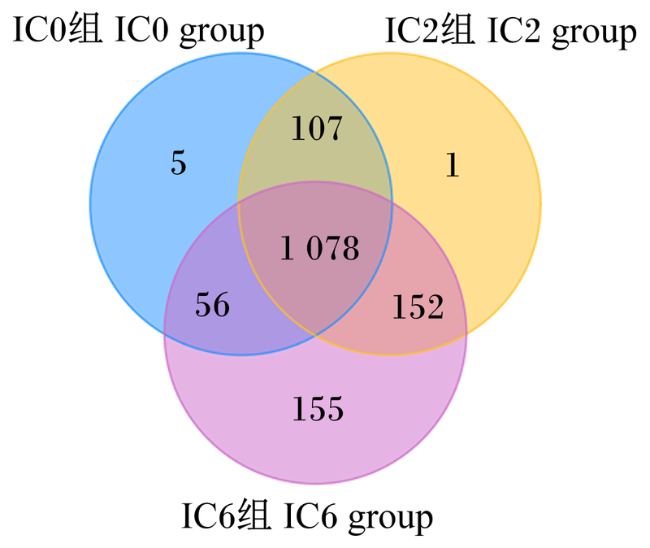
各组间共有和各组特有feature的数量可通过Venn图展现出来,不同颜色图形之间交叠部分数字为组间共有feature的数量,非交叠部分为各组特有feature的数量。由图1可知,IC0、IC2和IC6组特有的feature分别为5、1和155个。
图1 特征值分布Venn图

Fig.1 Feature distribution Venn diagram

2.6.2 alpha多样性

表7可知,与IC0组相比,IC6组的Simpson和Shannon指数显著上升(P<0.05),IC2组的Shannon指数显著上升(P<0.05)。
表7 蝉花菌质对大黄鱼肠道菌群alhpa多样性的影响

Table 7 Effects of Isaria cicadae spent mushroom substrate on alpha diversity of intestinal microflora of large yellow croaker (Larimichthys crocea)

项目
Items
组别 Groups P
P-value
IC0 IC2 IC6
Chao1指数 Chao1 index 1 101.99±40.92 1 051.45±48.74 1 038.03±12.37 0.168
Simpson指数 Simpson index 0.98±0.00b 0.99±0.00ab 0.99±0.01a 0.025
Shannon指数 Shannon index 7.09±0.10b 8.33±0.03a 8.23±0.21a <0.001

2.6.3 beta多样性

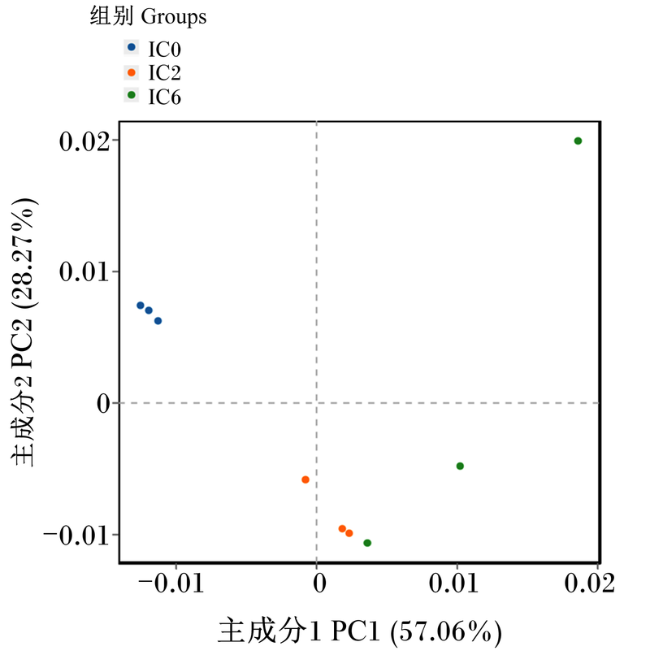
基于样品feature组成的主成分分析(PCA,图2)表明,IC2和IC6组与IC0组之间肠道菌群结构具有明显差异,IC6组部分样品组成与IC2组相似。
图2 主成分分析图

Fig.2 PCA diagram

2.7 蝉花菌质对大黄鱼肠道菌群组成的影响

2.7.1 门水平菌群相对丰度差异分析

在门水平对相对丰度排名前10的优势菌门进行差异分析,结果见表8。3组大黄鱼肠道菌群均以厚壁菌门(Firmicutes)、变形菌门(Proteobacteria)和拟杆菌门(Bacteroidota)为主要优势菌门。与IC0组相比,IC2和IC6组Proteobacteria和放线菌门(Actinobacteriota)相对丰度显著提高(P<0.05),Bacteroidota、脱硫杆菌门(Desulfobacterota)、互养菌门(Synergistota)和绿弯菌门(Chloroflexi)相对丰度显著降低(P<0.05);IC6组酸杆菌门(Acidobacteriota)相对丰度显著高于IC0和IC2组(P<0.05);梭杆菌门(Fusobacteriota)相对丰度具有随蝉花菌质添加量的增加而上升的趋势,但各组间差异不显著(P>0.05)。
表8 蝉花菌质对大黄鱼肠道菌群门水平组成的影响

Table 8 Effects of Isaria cicadae spent mushroom substrate on intestinal microflora composition at phylum level of large yellow croaker (Larimichthys crocea)%

项目
Items
组别 Groups P
P-value
IC0 IC2 IC6
厚壁菌门 Firmicutes 42.82±1.37 38.04±1.27 37.68±10.70 0.565
变形菌门 Proteobacteria 10.23±0.54b 23.31±1.62a 22.95±4.38a 0.002
拟杆菌门 Bacteroidota 23.47±0.82a 16.99±0.90b 15.22±1.62b <0.001
脱硫杆菌门 Desulfobacterota 7.65±0.20a 2.98±0.75b 1.19±0.65c <0.001
放线菌门 Actinobacteriota 1.71±0.23b 3.82±0.51a 4.48±0.58a 0.001
梭杆菌门 Fusobacteriota 0.22±0.06 1.69±0.36 5.97±7.25 0.291
互养菌门 Synergistota 5.43±0.26a 1.54±0.55b 0.24±0.39c <0.001
未分类菌门 Unclassified_Bacteria 1.09±0.12c 3.74±0.51a 2.31±0.92b 0.005
酸杆菌门 Acidobacteriota 0.29±0.01b 1.36±0.16b 3.29±1.38a 0.011
绿弯菌门 Chloroflexi 2.00±0.17a 1.15±0.01b 1.10±0.35b 0.005
其他 Others 5.09±0.18b 5.37±0.20ab 5.57±0.27a 0.037

2.7.2 属水平菌群相对丰度差异分析

在属水平对相对丰度排名前10的优势菌属进行差异分析,结果见表9。相对于IC0组,IC2和IC6组拟杆菌目UCG001未分类属(unclassified_Bacteroidales UCG001)、瘤胃杆菌属(Ruminofilibacter)、脱硫微菌属(Desulfomicrobium)和氨基杆菌属(Aminobacterium)相对丰度显著降低(P<0.05),IC2组鼠杆菌科未分类属(unclassified_Muribaculaceae)和克雷伯氏菌属(Klebsiella)相对丰度显著提高(P<0.05),IC6组拟杆菌属(Bacteroides)和unclassified_Muribaculaceae相对丰度显著提高(P<0.05)。其中Bacteroides属于Bacteroidota,RuminofilibacterKlebsiellaAminobacterium属于Proteobacteria,Desulfomicrobium属于Desulfobacterota。
表9 蝉花菌质对大黄鱼肠道菌群属水平组成的影响

Table 9 Effects of Isaria cicadae spent mushroom substrate on intestinal microflora composition at genus level of large yellow croaker (Larimichthys crocea)%

项目
Items
组别 Groups P
P-value
IC0 IC2 IC6
毛螺菌科未分类属 Unclassified_Lachnospiraceae 4.90±0.30 4.60±0.58 3.13±1.65 0.158
瘤胃杆菌属 Ruminofilibacter 6.39±0.15a 1.97±0.56b 0.42±0.42c <0.001
拟杆菌属 Bacteroides 0.89±0.11b 3.09±0.26ab 4.65±2.01a 0.021
鼠杆菌科未分类属Unclassified_Muribaculaceae 1.14±0.16b 2.84±0.13a 4.14±1.19a 0.006
拟杆菌目UCG001未分类属
Unclassified_Bacteroidales UCG001
5.60±0.34a 1.73±0.44b 0.40±0.38c <0.001
脱硫微菌属 Desulfomicrobium 5.46±0.10a 1.59±0.74b 0.27±0.25c <0.001
未分类菌属 Unclassified_Bacteria 1.09±0.12c 3.74±0.51a 2.31±0.92b 0.005
克雷伯氏菌属 Klebsiella 0.44±0.12b 3.90±0.56a 1.86±1.25ab 0.045
氨基杆菌属 Aminobacterium 4.66±0.23a 1.34±0.51b 0.21±0.35c <0.001
Dubosiella 1.91±0.08 1.55±0.14 2.23±1.44 0.853
其他 Others 67.52±0.24c 73.65±1.31b 80.39±4.74a 0.004

3 讨论

3.1 蝉花菌质对大黄鱼生长性能的影响

本试验结果表明,饲料中添加蝉花菌质可以提高大黄鱼的WGR、SGR和FE,当饲料中添加6%的蝉花菌质时,大黄鱼的生长性能显著提高,与Cheng等[20]、Boontiam等[21]、Han等[22]、Van Doan等[16]分别在断奶仔猪、生长猪、肉鸡和罗非鱼饲料中添加蛹虫草菌质所得研究结果类似。Van Doan等[16]研究还发现,饲料中蛹虫草菌质添加量为1%时,罗非鱼的WGR显著高于添加更高水平蛹虫草菌质的试验组,该结果表明饲料中蛹虫草菌质的添加量与罗非鱼生长性能的提高并非呈线性正相关。Liu等[17]研究发现,饲粮中添加6%和8%的蝉花菌质可以显著提高饲养3周肉鸡的增重率,效果优于添加10%蝉花菌质的试验组,该结果与Van Doan等[16]的研究结果类似。本研究中6%的蝉花菌质对大黄鱼生长性能的改善效果优于3%的蝉花菌质,该结果可能受到试验组数量的限制,因此未得到与此前研究类似的规律。

3.2 蝉花菌质对大黄鱼体成分的影响

真菌饲料添加剂中的多糖、多酚、萜类、腺苷等活性物质能在机体代谢调节中起重要作用[23],蛹虫草中含有降低血脂和抑制脂肪细胞分化等活性的多糖[24-26],而目前尚未报道蝉花中含有与能量物质代谢相关的活性物质。大黄鱼体内的脂肪主要分布在肝脏和肠系膜脂肪组织[27],肝脏和内脏团在鱼体中的占比能有效反映鱼体脂肪积累程度。本研究中,HSI和VSI的结果显示添加低水平的蝉花菌质促使了大黄鱼对脂肪的积累,而添加高水平的蝉花菌质会抑制大黄鱼机体对脂质的积累。该结果表明蝉花菌质中含有能够调节大黄鱼脂肪代谢的物质,而添加高水平和低水平蝉花菌质时出现不同结果可能与蝉花菌质中复杂的营养成分有关。
研究表明,蛹虫草脂质提取物可提高动物在运动过程中细胞内ATP的合成和腺苷酸活化蛋白激酶(AMPK)的表达,从而促进血液中营养物质的运输和细胞的分解代谢过程,其中包括骨骼肌细胞及脂肪组织细胞对葡萄糖和脂肪酸的摄取与消耗[28-29]。本试验中,与对照组相比,IC2组肌肉和全鱼中粗脂肪含量显著提高,IC6组全鱼和肌肉中粗脂肪含量均显著降低,该结果进一步证明添加低水平和高水平蝉花菌质对大黄鱼的脂肪积累造成了不同影响,推测蝉花菌质可能含有类似蛹虫草中能促进营养物质代谢的物质,同时还含有刺激脂肪积累的物质,这些物质对大黄鱼体成分的综合影响随添加量的变化发生变化。

3.3 蝉花菌质对大黄鱼肝脏抗氧化能力的影响

超氧化物歧化酶(SOD)可以将机体产生的氧自由基还原为过氧化氢(H2O2),CAT再将H2O2转化为水(H2O)和氧气(O2),以避免氧自由基对细胞造成损伤,在此过程中GSH-Px能与SOD产生协同作用,共同抵御过氧化损伤,机体高水平的抗氧化酶活性能够降低氧自由基造成的氧化应激[30-32]。当机体内发生脂质过氧化时,细胞内的多不饱和脂肪酸经过过氧化反应最终会生成MDA[33],因此机体内抗氧化酶活性和MDA含量能反映机体抗氧化能力强弱和过氧化损伤程度。已有研究结果表明,饲料添加不同水平蝉花菌质会在不同程度上提高肉鸡体内抗氧化酶活性[17]。本研究中,添加高水平蝉花菌质提高了大黄鱼肝脏CAT和T-SOD活性,添加低水平蝉花菌质提高了大黄鱼肝脏CAT活性,与已有研究结果类似,而添加低水平蝉花菌质组肝脏GSH-Px活性下降,该结果可能与肝脏细胞中脂肪的积累有关。2个试验组与对照组之间肝脏MDA含量没有显著差异,表明大黄鱼肝脏中并未发生明显的氧化损伤,2个试验组大黄鱼肝脏抗氧化能力的变化可能是蝉花菌质中的活性物质参与肠道菌群或代谢调控的结果。

3.4 蝉花菌质对大黄鱼血清免疫能力的影响

ALT和AST是动物体健康的重要血清指示物,这2种转氨酶在蛋白质和氨基酸代谢中起着重要作用,在组织受到损伤时会被释放到血浆当中[34]。LZM是鱼类先天免疫系统中的一种重要防御分子,具有溶解细菌的作用,LZM可在多种组织中表达,能够通过体表黏液、淋巴组织或血液检测其水平或活性,是检测鱼体免疫能力的重要指标[35-36]。补体系统是先天免疫系统中的重要组成部分,在补体反应体系中C4参与经典途径的激活,C3则是经典途径、凝集素途径和旁路途经的枢纽,通过产生多种调节因子调节巨噬细胞,以抵御外来有害物质,在抗菌、炎症反应以及抗体生成过程中产生作用[37-38]。补体在脂肪组织中广泛表达,且肝脏是产生C3的主要场所,当肝脏发生损伤时,补体功能下降,C3含量会降低,但当个体发生肥胖或炎症时,脂肪组织中补体的表达量会升高[37-39]。Van Doan等[16]在罗非鱼上的研究表明,添加不同水平蛹虫草菌质的试验组血清LZM活性均高于对照组,Boontiam等[13]在使用蛹虫草菌质饲养断奶仔猪的研究中也得到类似的结果。而在本研究中,添加低水平蝉花菌质使大黄鱼的血清LZM活性呈现出下降趋势,C3含量呈现上升趋势,表明机体对脂肪的积累并未导致肝脏明显损伤,但造成鱼体发生肥胖。

3.5 蝉花菌质对大黄鱼肠道形态的影响

肠道是鱼类对食物进行消化和吸收的重要场所,其形态结构能直接影响机体对营养物质消化吸收的效率。位于肠道内壁表面的黏膜层可为消化道提供更大的吸收面积,黏膜中的柱状上皮细胞和杯状细胞分别具有吸收营养物质和分泌消化酶以及黏液的功能,黏膜层的黏膜厚度和褶皱高度越大,消化道的消化和吸收能力就越强[40]。Sun等[41]在乳鸽(Columba livia)饲粮中添加丁酸钠和蝉花多糖,结果显示乳鸽肠道绒毛高度与隐窝深度的比值显著提高;朱艳芝等[42]的研究也发现,虫草多糖可以显著提高蛋鸡的空肠和回肠绒毛高度以及产蛋率;Shi等[43]的研究发现,饲料中添加蛹虫草可改善猪的肠道形态,增加杯状细胞的数量。本试验结果与上述研究结果类似,本试验结果显示,添加6%的蝉花菌质可显著提高大黄鱼肠道单根绒毛杯状细胞数量,这与前面IC6组WGR升高的结果相呼应,因此杯状细胞数量的升高提高了肠道的消化和吸收功能,从而有利于大黄鱼生长性能的提高。

3.6 蝉花菌质对大黄鱼肠道菌群的影响

动物肠道中的微生物经过长期的演化过程在宿主体内具有高度适应性,这些微生物不仅扩展了宿主从食物中获取营养的能力,还能提供宿主必需的非营养因子和参与免疫系统[44],宿主-微生物-免疫系统之间相互作用,保证鱼类的健康生长[45]。因此,鱼类肠道微生物结构与鱼体的健康紧密相关[46-47]。本试验结果显示,蝉花菌质使大黄鱼肠道菌群组成发生明显变化,添加高水平蝉花菌质组大黄鱼肠道中菌群多样性得到提高,添加低水平蝉花菌质组也有相同趋势。
Proteobacteria、Bacteroidota、Actinobacteriota、Firmicutes、Fusobacteriota和Chloroflexi是鱼类肠道中的主要优势门[48-49],在大黄鱼幼鱼肠道中Firmicutes和Proteobacteria占绝对优势[46]。本试验中,大黄鱼肠道中的主要优势菌门为Firmicutes、Proteobacteria和Bacteroidota,蝉花菌质使大黄鱼肠道菌群的结构在门水平及属水平上均发生了显著变化,在门水平上相对丰度升高的有Proteobacteria、Actinobacteriota和Acidobacteriota,相对丰度下降的有Bacteroidota、Desulfobacterota、Synergistota和Chloroflexi。有研究表明,蛹虫草可使肠道微生物alpha多样性下降,降低Firmicutes相对丰度和升高Bacteroidota相对丰度[50],这与本试验结果相反;而Chen等[51]的研究发现,在高脂肪饲粮中添加冬虫夏草多糖后,小鼠肠道Bacteroidota的相对丰度降低,Actinobacteriota和Acidobacteriota的相对丰度增加,体重增长受到抑制,但小鼠肝脏发生纤维化且导致非酒精性脂肪性肝病,该结果与本试验结果类似。但在本试验中,2个试验组大黄鱼WGR并未受到抑制,且添加高水平蝉花菌质组大黄鱼肝脏未发生脂肪沉积。已有研究表明,Bacteroidota通常能够分解糖类物质和产生短链脂肪酸,通过其发酵作用调节肠道环境[52];Actinobacteriota相对丰度的增加与饲粮中膳食纤维含量有关,其通过发酵膳食纤维产生丁酸[53];Acidobacteriota相对丰度的增加则是与动物脂肪肝严重程度相关[54]。结合上述结果,推测蝉花菌质中的蝉花多糖能起到调节Bacteroidota、Actinobacteriota和Acidobacteriota相对丰度的作用,从而促进机体对脂肪的吸收和积累,而高水平蝉花菌质组大黄鱼体内脂肪含量明显下降,这进一步表明蝉花菌质中可能含有促进脂肪代谢的生物活性物质,机体脂肪的积累或代谢可能随蝉花菌质添加量的变化在鱼体内分别产生主导作用,因此造成低水平和高水平蝉花菌质组大黄鱼鱼体粗脂肪含量分别上升和下降的结果。Synergistota和Chloroflexi在土壤和海洋中广泛存在,且它们的代谢多样性极高,目前研究表明,Synergistota能通过分解长链脂肪酸产生甲烷[55],Chloroflexi通常也能以糖类物质作为发酵底物,并且能降解一些复杂有机化合物[56],然而,这两大菌门在鱼类肠道中的主要作用还并未得到充分解释,因此影响其相对丰度发生改变的机制还需更多研究结果来阐明。
在属水平上相对丰度发生变化较明显的菌属为Bacteroidota中的Bacteroides,Proteobacteria中的RuminofilibacterKlebsiellaAminobacterium,以及Desulfobacterota中的Desulfomicrobium。有研究表明,Bacteroides可通过消化多糖和寡糖产生短链脂肪酸和维生素,供宿主和其他肠道微生物吸收利用[57],因此,Bacteroides相对丰度的增加可能是改变肠道菌群组成的关键。Kong等[58]研究发现,肠道中丁酸产生菌的相对丰度与鸡血清和肠道的抗氧化能力和免疫功能呈正相关;Li等[59]的研究结果也表明,短链脂肪酸产生菌的相对丰度与黄姑鱼(Nibea coibor)的总抗氧化能力和免疫功能呈正相关。本试验结果与上述研究结果类似,Bacteroides相对丰度在添加低水平蝉花菌质组有上升趋势,在添加高水平蝉花菌质组显著提高,这也表明大黄鱼抗氧化能力的提高可能与肠道中Bacteroides的相对丰度升高有关,与前文试验组肝脏抗氧化能力受到调节的结果相呼应。Bacteroides相对丰度的增加可以减轻人类和小鼠个体的肥胖程度,并且患有炎症性肠病的患者肠道中Bacteroides的相对丰度会降低[60-61],这与本试验中体积高水平蝉花菌质组的结果一致,但添加低水平蝉花菌质组大黄鱼却出现大量脂肪积累,通过分析发现,添加低水平蝉花菌质组相对丰度明显高于其他组的菌属为KlebsiellaKlebsiella包括正常菌群和条件性致病菌,正常菌群可存在于人类和养殖动物胃肠道内,目前有关致病性Klebsiella报道最多的是Klebsiella pneumoniae,当该致病性菌被人体摄入时会导致肺炎等症状,被鱼类摄入时也会导致不良症状如腹水、出血性败血症等,甚至死亡[62-63],由于2个试验组大黄鱼血清免疫指标并未发生显著变化,大黄鱼肠道中的Klebsiella应为正常菌群,因此我们推测本试验中的Klebsiella可能与大黄鱼的脂肪积累有关。Desulfobacterota中的Desulfomicrobium主要通过还原硫酸盐来达到自养的目的,但在此过程中会产生硫化氢(H2S),对肠道上皮细胞产生危害[64],其相对丰度的下降可能促进了肠道形态的改善;Ruminofilibacter主要以纤维素为发酵底物[65],由于其发酵底物与Actinobacteriota相同,其相对丰度下降可能与Actinobacteriota相对丰度的上升有关;Aminobacterium的主要作用则是分解氨基酸和产生NH4+[66],其相对丰度的下降为大黄鱼提供了更多氨基酸来源,这有利于大黄鱼WGR的提高。
综上所述,蝉花菌质可以提高大黄鱼肠道菌群多样性,使产生短链脂肪酸的Bacteroides的相对丰度升高,使分解纤维素的Ruminofilibacter和产生H2S的Desulfomicrobium的相对丰度下降,改善肠道菌群和肠道形态,提高肠道消化吸收能力和鱼体抗氧化能力。

4 结论

蝉花菌质可以提高大黄鱼的生长性能,调控大黄鱼肝脏抗氧化能力,改善肠道形态和肠道菌群,添加量为6%时效果显著。
[1]
何志刚, 艾庆辉, 麦康森. 大黄鱼营养需求研究进展[J]. 饲料工业, 2010, 31(24):56-59.

HE Z G, AI Q H, MAI K S. Advances in nutrition and feed for large yellow croaker[J]. Feed Industry, 2010, 31(24):56-59. (in Chinese)

[2]
柳海, 申屠基康, 徐胜威, 等. 大黄鱼营养需求与配合饲料应用现状[J]. 现代食品, 2020, 3(5):40-42.

LIU H, SHENTU J K, XU S W, et al. Nutritional requirements of Larimichthys crocea and application status of compound feed[J]. Modern Food, 2020, 3(5):40-42. (in Chinese)

[3]
CHEN S X, SU Y Q, HONG W S. Aquaculture of the large yellow croaker[M]// GUI J F,TANG Q S,LI Z J,et al.Aquaculture in China:success stories and modern trends. Hoboken: John Wiley & Sons Ltd., 2018:297-308.

[4]
SANTOS L, RAMOS F. Antimicrobial resistance in aquaculture:current knowledge and alternatives to tackle the problem[J]. International Journal of Antimicrobial Agents, 2018, 52(2):135-143.

DOI

[5]
包樱钰, 李菲菲, 温东辉. 我国海水养殖业的抗生素污染现状[J]. 海洋环境科学, 2021, 40(2):294-302.

BAO Y Y, LI F F, WEN D H. Antibiotic contamination in mariculture in China[J]. Marine Environmental Science, 2021, 40(2):294-302. (in Chinese)

[6]
LI C R, WANG Y Q, CHENG W M, et al. Review on research progress and prospects of cicada flower,Isaria cicadae (Ascomycetes)[J]. International Journal of Medicinal Mushrooms, 2021, 23(4):81-91.

DOI

[7]
ZHU Y, YU X, GE Q, et al. Antioxidant and anti-aging activities of polysaccharides from Cordyceps cicadae[J]. International Journal of Biological Macromolecules, 2020, 157:394-400.

DOI

[8]
于士军, 柴新义, 樊美珍. 蝉花菌质主要营养成分和活性成分分析[J]. 食品与机械, 2015, 31(1):155-158.

YU S J, CHAI X Y, FAN M Z. Analysis of nutritional and bioactive components of solid-state fermented substrate of Isaria cicadae[J]. Food & Machinery, 2015, 31(1):155-158. (in Chinese)

[9]
于士军, 何玲艳, 程铭, 等. 硒对蝉花孢梗束营养和功能成分的影响[J]. 浙江农业学报, 2021, 33(12):2245-2253.

DOI

YU S J, HE L Y, CHENG M, et al. Effect of selenium on nutritional and functional components of synnemata of Isaria cicadae[J]. Acta Agriculturae Zhejiangensis, 2021, 33(12):2245-2253.

[10]
王琪, 刘作易. 药用真菌蝉花的研究进展[J]. 中草药, 2004, 35(4):469-471.

WANG Q, LIU Z Y. Advances in studies on medicinal fungi Cordyceps cicadae[J]. Chinese Traditional and Herbal Drugs, 2004, 35(4):469-471. (in Chinese)

[11]
李吉要, 徐振栋, 沈佳奇, 孙长胜. 不同虫草菌质对肉鸡生长、免疫和肉质的影响[J]. 浙江农业科学, 2022, 63(4):822-825.

LI J Y, XU Z D, SHEN J Q, et al. Effects of different cordyceps quality on growth,immunity and meat quality of broilers[J]. Journal of Zhejiang Agricultural Sciences, 2022, 63(4):822-825.

[12]
LIN Q Y, LONG L K, WU L L, et al. Evaluation of different agricultural wastes for the production of fruiting bodies and bioactive compounds by medicinal mushroom Cordyceps militaris[J]. Journal of the Science of Food and Agriculture, 2017, 97(10):3476-3480.

DOI

[13]
BOONTIAM W, WACHIRAPAKORN C, PHAENGPHAIREE P, et al. Effect of spent mushroom (Cordyceps militaris) on growth performance,immunity,and intestinal microflora in weaning pigs[J]. Animals, 2020, 10(12):2360.

DOI

[14]
CHANJULA P, CHERDTHONG A. Effects of spent mushroom Cordyceps militaris supplementation on apparent digestibility,rumen fermentation,and blood metabolite parameters of goats[J]. Journal of Animal Science, 2018, 96(3):1150-1158.

DOI

[15]
马新宇. 蛹虫草米基饲料研究及在蛋鸡养殖中的应用[D].硕士学位论文. 沈阳: 沈阳师范大学, 2019.

MA X Y. Research on Cordyceps militaris rice-based feed and its application in laying hens[D].Master's Thesis. Shenyang: Shenyang Normal University, 2019. (in Chinese)

[16]
VAN DOAN H, HOSEINIFAR S H, DAWOOD M A O, et al. Effects of Cordyceps militaris spent mushroom substrate and Lactobacillus plantarum on mucosal,serum immunology and growth performance of Nile tilapia (Oreochromis niloticus)[J]. Fish & Shellfish Immunology, 2017, 70:87-94.

[17]
LIU S S, YAN W J, MA C, et al. Effects of supplemented culture media from solid-state fermented Isaria cicadae on performance,serum biochemical parameters, serum immune indexes, antioxidant capacity and meat quality of broiler chickens[J]. Asian-Australasian Journal of Animal Sciences, 2020, 33(4):568-578.

DOI

[18]
何娇娇, 王萍, 冯建, 等. 玉米蛋白粉替代鱼粉对大黄鱼生长、血清生化指标及肝脏组织学的影响[J]. 水生生物学报, 2017, 41(3):506-515.

HE J J, WANG P, FENG J, et al. Effects of replacing fish meal with corn gluten meal on the growth,serum biochemical indices and liver histology of large yellow croaker Larimichthys crocea[J]. Acta Hydrobiologica Sinica, 2017, 41(3):506-515. (in Chinese)

[19]
HORWITZ W. Official methods of analysis of AOAC International.Volume I,agricultural chemicals,contaminants,drugs[M]. Gaithersburg: AOAC International, 2006.

[20]
CHENG Y H, WEN C M, DYBUS A, et al. Fermentation products of Cordyceps militaris enhance performance and modulate immune response of weaned piglets[J]. South African Journal of Animal Science, 2016, 46(2):121-128.

DOI

[21]
BOONTIAM W, WACHIRAPAKORN C, WATTANACHAI S. Growth performance and hematological changes in growing pigs treated with Cordyceps militaris spent mushroom substrate[J]. Veterinary World, 2019, 13(4):768-773.

DOI

[22]
HAN J C, QU H X, WANG J G, et al. Effects of fermentation products of Cordyceps militaris on growth performance and bone mineralization of broiler chicks[J]. Journal of Applied Animal Research, 2015, 43(2):236-241.

DOI

[23]
CHUANG W Y, HSIEH Y C, LEE T T. The effects of fungal feed additives in animals:a review[J]. Animals, 2020, 10(5):805.

DOI

[24]
YU W Q, YIN F, SHEN N, et al. Polysaccharide CM1 from Cordyceps militaris hinders adipocyte differentiation and alleviates hyperlipidemia in LDLR(+/-) hamsters[J]. Lipids in Health and Disease, 2021, 20(1):178.

DOI

[25]
YANG X Q, LIN P, WANG J, et al. Purification,characterization and anti-atherosclerotic effects of the polysaccharides from the fruiting body of Cordyceps militaris[J]. International Journal of Biological Macromolecules, 2021, 181:890-904.

DOI

[26]
HUANG Z F, ZHANG M L, ZHANG S, et al. Structural characterization of polysaccharides from Cordyceps militaris and their hypolipidemic effects in high fat diet fed mice[J]. RSC Advances, 2018, 8(71):41012-41022.

DOI

[27]
WU J L, ZHANG J L, DU X X, et al. Evaluation of the distribution of adipose tissues in fish using magnetic resonance imaging (MRI)[J]. Aquaculture, 2015, 448:112-122.

DOI

[28]
CHOI E, OH J, SUNG G H. Beneficial effect of Cordyceps militaris on exercise performance via promoting cellular energy production[J]. Mycobiology, 2020, 48(6):512-517.

DOI

[29]
KE R, XU Q C, LI C, et al. Mechanisms of AMPK in the maintenance of ATP balance during energy metabolism[J]. Cell Biology International, 2018, 42(4):384-392.

DOI PMID

[30]
MA X Y, DENG D, CHEN W D. Inhibitors and activators of SOD,GSH-Px,and CAT[M]// ŞENTÜRK M.Enzyme inhibitors and activators. London: IntechOpen, 2017:207-224.

[31]
MILLER A F. Superoxide dismutases:active sites that save,but a protein that kills[J]. Current Opinion in Chemical Biology, 2004, 8(2):162-168.

DOI

[32]
WENDEL A. Glutathione peroxidase[J]. Methods in Enzymology, 1981, 77:325-333.

PMID

[33]
GAWEŁ S, WARDAS M, NIEDWOROK E, et al. [Malondialdehyde (MDA) as a lipid peroxidation marker][J]. Wiadomosci Lekarskie, 2004, 57(9/10):453-455.

[34]
ONER M, ATLI G, CANLI M. Changes in serum biochemical parameters of freshwater fish Oreochromis niloticus following prolonged metal (Ag,Cd,Cr,Cu,Zn) exposures[J]. Environmental Toxicology and Chemistry, 2008, 27(2):360-366.

DOI

[35]
LI X, JI L Q, WU L L, et al. Effect of flow velocity on the growth,stress and immune responses of turbot (Scophthalmus maximus) in recirculating aquaculture systems[J]. Fish & Shellfish Immunology, 2019, 86:1169-1176.

[36]
SAURABH S, SAHOO P K. Lysozyme:an important defence molecule of fish innate immune system[J]. Aquaculture Research, 2008, 39(3):223-239.

DOI

[37]
XIN Y, HERTLE E, VAN DER KALLEN C J H, et al. Complement C3 and C4,but not their regulators or activated products,are associated with incident metabolic syndrome:the CODAM study[J]. Endocrine, 2018, 62(3):617-627.

DOI

[38]
HOLLAND M C H, LAMBRIS J D. The complement system in teleosts[J]. Fish & Shellfish Immunology, 2002, 12(5):399-420.

[39]
昝琦, 刘欣, 逄越, 等. 补体C3结构与功能研究进展[J]. 中国免疫学杂志, 2014, 30(4):549-553.

ZAN Q, LIU X, PANG Y, et al. Advances in the structure and function of complement 3[J]. Chinese Journal of Immunology, 2014, 30(4):549-553. (in Chinese)

[40]
何娇娇, 王萍, 冯建, 等. 发酵豆粕对大黄鱼生长、肠道结构及肠道微生物菌群的研究[J]. 水生生物学报, 2018, 42(5):919-928.

HE J J, WANG P, FENG J, et al. Effects of fermented soybean meal on the growth and intestinal histology and microbiota of juvenile large yellow croaker Larimichthys crocea[J]. Acta Hydrobiologica Sinica, 2018, 42(5):919-928. (in Chinese)

[41]
SUN H X, LIU Y L, ZENG T, et al. Effects of coated sodium butyrate and polysaccharides from Cordyceps cicadae on intestinal tissue morphology and ileal microbiome of squabs[J]. Frontiers in Veterinary Science, 2022, 9:813800.

[42]
朱艳芝, 马文锋, 张耀文, 等. 虫草多糖对蛋鸡产蛋后期生产性能、蛋品质和肠道形态结构的影响[J]. 动物营养学报, 2019, 31(5):2323-2329.

ZHU Y Z, MA W F, ZHANG Y W, et al. Effects of cordyceps polysaccharide on performance,egg quality and intestinal morphology of laying hens during later laying period[J]. Chinese Journal of Animal Nutrition, 2019, 31(5):2323-2329. (in Chinese)

[43]
SHI X E, ZHENG H M, CAO H G, et al. Cordyceps militaris modulates intestinal barrier function and gut microbiota in a pig model[J]. Frontiers in Microbiology, 2022, 13:332.

[44]
MAYNARD C L, ELSON C O, HATTON R D, et al. Reciprocal interactions of the intestinal microbiota and immune system[J]. Nature, 2012, 489(7415):231-241.

DOI

[45]
LÓPEZ NADAL A, IKEDA-OHTSUBO W, SIPKEMA D, et al. Feed,microbiota,and gut immunity:using the zebrafish model to understand fish health[J]. Frontiers in Immunology, 2020, 11:114.

DOI

[46]
WANG P, ZHOU Q C, FENG J, et al. Effect of dietary fermented soybean meal on growth,intestinal morphology and microbiota in juvenile large yellow croaker,Larimichthys crocea[J]. Aquaculture Research, 2019, 50(3):748-757.

DOI

[47]
SHUI X M, CHAI R Y, YIN H, et al. Effects of Setipinna taty protein peptides on the growth,body composition,antioxidant ability and intestinal flora of Nibea albiflora[J]. Aquaculture Research, 2021, 52(5):2276-2285.

DOI

[48]
BLANCH A R, ALSINA M, SIMÓN M, et al. Determination of bacteria associated with reared turbot (Scophthalmus maximus) larvae[J]. Journal of Applied Microbiology, 1997, 82(6):729-734.

DOI

[49]
APPER E, WEISSMAN D, RESPONDEK F, et al. Hydrolysed wheat gluten as part of a diet based on animal and plant proteins supports good growth performance of Asian seabass (Lates calcarifer),without impairing intestinal morphology or microbiota[J]. Aquaculture, 2016, 453:40-48.

DOI

[50]
JI Y, SU A X, MA G X, et al. Comparison of bioactive constituents and effects on gut microbiota by in vitro fermentation between Ophicordyceps sinensis and Cordyceps militaris[J]. Journal of Functional Foods, 2020, 68:103901.

[51]
CHEN L, ZHANG L Y, WANG W D, et al. Polysaccharides isolated from Cordyceps sinensis contribute to the progression of NASH by modifying the gut microbiota in mice fed a high-fat diet[J]. PLoS One, 2020, 15(6):e0232972.

[52]
SCHWALM N D 3RD, GROISMAN E A. Navigating the gut buffet:control of polysaccharide utilization in Bacteroides spp.[J]. Trends in Microbiology, 2017, 25(12):1005-1015.

DOI

[53]
ZHAO J B, LIU P, WU Y, et al. Dietary fiber increases butyrate-producing bacteria and improves the growth performance of weaned piglets[J]. Journal of Agricultural and Food Chemistry, 2018, 66(30):7995-8004.

DOI PMID

[54]
ZHOU Y L, ZHENG T Y, CHEN H T, et al. Microbial intervention as a novel target in treatment of non-alcoholic fatty liver disease progression[J]. Cellular Physiology and Biochemistry, 2018, 51(5):2123-2135.

DOI PMID

[55]
USMAN M, ZHAO S, JEON B H, et al. Microbial β-oxidation of synthetic long-chain fatty acids to improve lipid biomethanation[J]. Water Research, 2022, 213:118164.

[56]
ISLAM Z F, CORDERO P R F, FENG J, et al. Two Chloroflexi classes independently evolved the ability to persist on atmospheric hydrogen and carbon monoxide[J]. The ISME Journal, 2019, 13(7):1801-1813.

DOI

[57]
ZAFAR H, SAIER M H,Jr. Gut Bacteroides species in health and disease[J]. Gut Microbes, 2021, 13(1):1848158.

[58]
KONG L L, WANG Z H, XIAO C P, et al. Glycerol monolaurate ameliorated intestinal barrier and immunity in broilers by regulating intestinal inflammation,antioxidant balance,and intestinal microbiota[J]. Frontiers in Immunology, 2021, 12:713485.

[59]
LI Z Z, TRAN N T, JI P N, et al. Effects of prebiotic mixtures on growth performance,intestinal microbiota and immune response in juvenile Chu's croaker,Nibea coibor[J]. Fish & Shellfish Immunology, 2019, 89:564-573.

[60]
WEXLER H M. Bacteroides:the good,the bad,and the nitty-gritty[J]. Clinical Microbiology Reviews, 2007, 20(4):593-621.

DOI

[61]
ZHOU Y T, ZHI F C. Lower level of Bacteroides in the gut microbiota is associated with inflammatory bowel disease:a meta-analysis[J]. BioMed Research International, 2016, 2016:5828959.

[62]
卢玉婷, 郑丹丹, 胡扬扬, 等. 鲤鱼肺炎克雷伯氏菌分离与鉴定[J]. 中国兽药杂志, 2014, 48(9):9-13.

LU Y T, ZHENG D D, HU Y Y, et al. Isolation and identification of Klebsiella pneumoniae from carp[J]. Chinese Journal of Veterinary Drug, 2014, 48(9):9-13. (in Chinese)

[63]
滕涛, 梁利国, 谢骏, 等. 团头鲂源肺炎克雷伯氏菌的分离鉴定[J]. 水生态学杂志, 2016, 37(6):95-100.

TENG T, LIANG L G, XIE J, et al. Isolation and identification of pathogenic Klebsiella pneumoniae from Megalobrama amblycephala[J]. Journal of Hydroecology, 2016, 37(6):95-100. (in Chinese)

[64]
THEVENIEAU F, FARDEAU M L, OLLIVIER B, et al. Desulfomicrobium thermophilum sp. nov.,a novel thermophilic sulphate-reducing bacterium isolated from a terrestrial hot spring in Colombia[J]. Extremophiles, 2007, 11(2):295-303.

DOI

[65]
BABA Y, MATSUKI Y, TAKIZAWA S, et al. Pretreatment of lignocellulosic biomass with cattle rumen fluid for methane production:fate of added rumen microbes and indigenous microbes of methane seed sludge[J]. Microbes and Environments, 2019, 34(4):421-428.

DOI

[66]
BAENA S, FARDEAU M L, LABAT M, et al. Aminobacterium colombiense gen. nov. sp. nov.,an amino acid-degrading anaerobe isolated from anaerobic sludge[J]. Anaerobe, 1998, 4(5):241-250.

DOI

文章导航

/