研究论文

绞股蓝水提物对科宝肉鸡生长性能、屠宰性能、肉品质和气味组分的影响

  • 胡建 ,
  • 胡忠泽 , *
展开
  • 安徽科技学院动物科学学院,凤阳 233100
*胡忠泽,教授,硕士生导师,E-mail:

胡 建(1992—),女,安徽六安人,硕士研究生,从事动物营养与饲料研究。E-mail:

Copy editor: 陈鑫

收稿日期: 2022-10-13

  网络出版日期: 2023-04-12

基金资助

安徽省重点研究与开发计划项目(202104a06020033)

安徽省教育厅重大项目(KJ2016SD15)

Effects of Gynostemma pentaphyllum Aqueous Extract on Growth Performance, Slaughter Performance, Meat Quality and Odor Component of Cobb Broilers

  • HU Jian ,
  • HU Zhongze , *
Expand
  • College of Animal Science, Anhui Science and Technology University, Fengyang 233100, China
*professor, E-mail:

Received date: 2022-10-13

  Online published: 2023-04-12

摘要

本试验旨在探究绞股蓝水提物(GPW)对科宝肉鸡生长性能、屠宰性能、肉品质和气味组分的影响。试验将300只1日龄科宝肉鸡分为5组,组内设6个重复,每个重复10只。空白对照组(CT组)饲喂基础饲粮,试验组分别在基础饲粮中添加0.5%、1.0%、2.0%、4.0% GPW,连续饲喂42 d。试验结束后,测定肉鸡生长性能、屠宰性能、肉品质和气味组分。结果表明:1)与CT组相比,添加2.0% GPW可以显著降低肉鸡平均日采食量(P<0.05),添加1.0%、2.0% GPW可以显著降低料重比(P<0.05)。2)与CT组相比,添加2.0%、4.0% GPW使腹脂率有下降趋势(P=0.06)。3)与CT组相比,添加0.5%、1.0%、2.0%、4.0% GPW均能显著降低肉鸡胸肌红度值和腿肌亮度值(P<0.05);添加0.5%、2.0%、4.0% GPW可以显著降低腿肌剪切力(P<0.05)。4)在不同GPW添加量下,鸡肉样品的气味组分可以明显区分;添加2.0%、4.0%的GPW使鸡肉气味组分中的无机硫化物、有机硫化物类芳香成分、醇类和醛酮产生不同响应,即添加2.0%、4.0%的GPW使鸡肉香气更加浓郁。综上所述,GPW可以提高肉鸡的生长性能、屠宰性能,改善肉品质及气味组分,以添加2.0% GPW效果最佳。

本文引用格式

胡建 , 胡忠泽 . 绞股蓝水提物对科宝肉鸡生长性能、屠宰性能、肉品质和气味组分的影响[J]. 动物营养学报, 2023 , 35(4) : 2209 -2219 . DOI: 10.12418/CJAN2023.208

Abstract

In order to explore the effects of Gynostemma pentaphyllum aqueous extract (GPW) on growth performance, slaughter performance, meat quality and odor components of Cobb broilers. In this experiment, 300 Cobb broilers with 1-day-old were randomly divided into 5 groups with 6 replicates of 10 birds each, and the blank control group (CT group) was fed a basal diet and the experimental groups was fed 0.5%, 1.0%, 2.0% and 4.0% GPW for 42 d. At the end of the experiment, the growth performance, slaughter performance, meat quality and odor components of broilers were measured. The results showed as follows: 1)compared with CT group, the addition of 2% GPW could significantly reduce broiler average daily feed intake (P<0.05), and the addition of 1.0% and 2.0% GPW could significantly reduce the feed to gain ratio (P<0.05). 2)Compared with CT group, the addition of 2% and 4% GPW resulted in a trend toward lower abdominal fat percentage (P=0.06). 3) Compared with CT group, the addition of 0.5%, 1.0%, 2.0% and 4.0% GPW could significantly reduce the redness value of broiler breast muscle and brightness of thigh muscle (P<0.05) and the addition of 0.5%, 2.0% and 4.0% GPW could significantly reduce thigh muscle shear force value (P<0.05).4) The odor component of broiler meat could be clearly distinguished at different GPW additions, and the addition of 2.0% and 4.0% GPW produced different responses of inorganic sulfides, organic sulfide-based aromatic components, alcohols and aldehydes, and ketones in the odor components of chicken meat, that indicated the aroma of chicken meat was stronger with the addition of 2.0% and 4.0% GPW. Therefore, GPW can improve the growth performance, slaughter performance, meat quality and odor components of broiler chickens, and the best effect is achieved by adding 0.2% GPW.

在当前的养殖背景下,高密度和集约化已成为我国主要的养殖模式[1]。与传统散养式的养殖模式相比,现代养殖模式通过有效的空间利用提高畜禽的饲养密度,同时通过限制畜禽的活动范围提高其日增重及饲料转化率,但是也存在影响肉品质及其风味的问题[2-3]。因此,如何在现代化养殖条件下保障畜禽生长性能和屠宰性能的同时改善肉品质及其风味,已成为当下畜禽养殖的研究热点之一。前人研究表明,中草药饲料添加剂具有促进畜禽生长[4]、提高屠宰性能[5]、改善肉品质[6]和气味组分[7]的作用。绞股蓝为葫芦科绞股蓝属草质藤本植物,最早作为野菜用于灾荒时充饥,记载于明代朱橚所著的《救荒本草》中;而后作为防治虫咬、凉血解毒的药物,记载于李时珍所著的《本草纲目》[8-9]。绞股蓝富含皂苷、多糖、黄酮等多种有效成分,且具有促进生长、增强免疫、降低血脂等多种功效[10]。有研究证实,绞股蓝对畜禽的生长性能具有一定的促进作用[11-12],但绞股蓝对畜禽的屠宰性能、肉品质和气味组分是否有作用效果却鲜有报道。因此,本试验在基础饲粮中添加不同水平绞股蓝水提物(GPW),研究其对肉鸡生长性能、屠宰性能、肉品质及气味组分的影响,为绞股蓝在肉鸡生产中的应用提供科学依据和技术支撑。

1 材料与方法

1.1 试验动物及基础饲粮

1日龄健康科宝肉鸡300只(公母各占1/2),购自安徽省宿州市泗县祺翔农业科技发展有限公司,体重(43.02±2.12) g。基础饲粮组成及营养水平见表1
表1 基础饲粮组成及营养水平(风干基础)

Table 1 Composition and nutrient levels of basal diets (air-dry basis) %

项目
Items
1~21日龄
1 to 21 days
of age
22~42日龄
22 to 42
days of age
原料Ingredients
玉米Corn 53.84 58.37
豆粕Soybean meal 32.56 27.03
进口鱼粉Imported fish meal 2.00 2.00
次粉Wheat middling 3.00 4.00
豆油Soybean oil 3.00 3.50
石粉Limestone 1.50 1.20
磷酸氢钙CaHPO4 1.70 1.50
食盐NaCl 0.24 0.24
多维Multi-vitamin1) 0.06 0.06
氯化胆碱
Choline chloride (50%)
0.10 0.10
预混料Premix2) 2.00 2.00
合计Total 100.00 100.00
营养水平Nutrient levels3)
代谢能ME/(MJ/kg) 12.22 12.55
粗蛋白质CP 21.00 19.11
粗纤维CF 2.61 2.41
粗脂肪EE 5.59 6.21
粗灰分Ash 6.06 5.35
钙Ca 1.13 0.95
总磷TP 0.70 0.66
蛋氨酸+半胱氨酸Met+Cys 0.70 0.65
项目
Items
1~21日龄
1 to 21 days
of age
22~42日龄
22 to 42
days of age
赖氨酸Lys 1.13 1.00
食盐NaCl 0.30 0.30

1)每千克多维含有 Per kg multi-vitamin contained the following:VA 3 000 000 IU,VD3 1 000 000 IU,VE 5 000 mg,VK3 2 000 mg,VB1 1 500 mg,VB2 3 000 mg,VB6 3 000 mg,VB12 10 mg,烟酰胺 niacinamide 5 000 mg,D-泛酸钙 D-pantothenic acid calcium 5 000 mg。

2)每千克预混料含有 Per kg premix contained the following:VA 200 000 IU,VD3 100 000 IU,VE 300 mg,VK3 100 mg,VB2 110 mg,VB6 70 mg,烟酸 nicotinic acid 600 mg,泛酸 pantothenic acid 220 mg,VB12 0.2 mg,叶酸 folic acid 16 mg,生物素 biotin 1.3 mg,Cu (as copper sulfate) 400 mg,Fe (as ferrous sulfate) 3 000 mg,Zn (as zinc sulfate) 2 400 mg,Mn (as manganese sulfate) 3 000 mg。

3)代谢能、氨基酸为计算值,其余为实测值。ME and amino acids were calculated values, while the others were measured values.

1.2 主要仪器

双效节能浓缩器(SJN-1500,温州成东药机公司);pH酸度计(PT-15,sartorious,德国);色度计(CR-400,konica minolta,日本);肌肉嫩度仪(C-LM3,北京布拉德科技公司);电子鼻(PEN3,airsense,德国),不同传感器响应不同气味物质,具体见表2
表2 PEN3型便携式电子鼻传感器性能描述

Table 2 PEN3 type portable electronic nose sensor performance description

阵列序号Array serial number 传感器Sensors 性能描述Performance description
R1 W1C 芳香成分苯类
R2 W5S 灵敏度大,对氮氧化合物灵敏
R3 W3C 氨类,对芳香成分灵敏
R4 W6S 主要对氢化物有选择性
R5 W5C 烷烃芳香成分
R6 W1S 对甲烷等短链烷烃灵敏
R7 W1W 对无机硫化物灵敏
R8 W2S 对醇类、醛酮灵敏
R9 W2W 芳香成分,对有机硫化物灵敏
R10 W3S 对长链烷烃灵敏

1.3 GPW与添加方式

称取80 kg绞股蓝放入双效节能浓缩器中,加入13倍水浸泡12 h后,沸腾后煎煮90 min,过滤去渣后将滤液减压浓缩至热密度为1.05 g/mL的水提物,并进行LC-MS定性分析发现,GPW主要成分为黄酮和皂苷,分装后-20 ℃保存备用。根据GPW的添加水平,计算各组单位质量饲粮中GPW的添加质量,用基础饲粮吸附水提物(2∶1),按照逐级混合的方法将其添加到基础饲粮中。

1.4 动物试验

试验将300只1日龄科宝肉鸡分为5组,组内设6个重复,每个重复10只,其中空白对照组(CT组)饲喂基础饲粮,试验组分别在基础饲粮中添加0.5%、1.0%、2.0%、4.0% GPW。试验期42 d。试验期内,各组的试验鸡平养于鸡舍内,鸡舍内前3 d室温33 ℃,之后每周降低3 ℃直至24 ℃。保持通风,自由采食和饮水,24 h白炽灯照明。

1.5 测定指标

1.5.1 生长性能测定

试验第1、42天对试验肉鸡进行空腹称重,计算各组平均日增重(ADG)。根据试验期内各组每个重复的每周饲粮添加量和余料量,计算每个重复的周采食量,周采食量累加获得每个重复的总采食量,再计算平均日采食量(ADFI)。并根据ADG和ADFI计算料重比(F/G)。

1.5.2 屠宰性能测定

依据中华人民共和国农业行业标准NY/T 843—2004,于试验第42天将肉鸡称重后颈静脉放血处死,湿拔法除去羽毛,清净胴体并晾干表面水分,测定其屠体重、两侧胸肌重、两侧净腿肌肉重、半净膛重、全净膛重、腹脂重,并计算屠宰率、半净膛率、全净膛率、胸肌率、腿肌率和腹脂率。

1.5.3 肉品质测定

试验第42天,肉鸡空腹称重、屠宰后,立即采集胸肌和腿肌。
pH45 min和pH24 h:将肌肉组织放置45 min和24 h(4 ℃保存)后,在肌肉组织的3个不同点,将pH酸度计45°插入肌肉中1 cm左右处进行测定。
肉色:采用色度计测定,使用之前按照产品说明书要求校准,对于每个样本,在肌肉周围检测3个不同的点。肉色以国际肉色委员会的亮度(L*)、红度(a*)和黄度(b*)表示,最终值是每组样本读数的平均值。
滴水损失:测定前对所有的肌肉样品去除脂肪或结缔组织的覆盖,切成5 cm(长)×3 cm(宽)的长条,称重。使用塑料袋法测定吊挂肌肉样品24 h(4 ℃)后的滴水损失。
蒸煮损失:将每块肌肉样品称重后放入蒸煮袋,80 ℃水浴40 min。煮熟后,将样品冷冻至室温,轻拭样品表面的水分,重新称量每个样品,计算蒸煮损失。
剪切力:将肌肉样品置于蒸煮袋中,80 ℃水浴40 min,按照1.0 cm(宽)×0.5 cm(厚)×2.5 cm(长)平行于肌纤维进行垂直剪切。使用肌肉嫩度仪对每个肌肉样品重复测定3次,取平均值。

1.5.4 电子鼻测定

取1.0 cm(宽)×1.0 cm(厚)×1.0 cm(长)的肌肉样品,锡纸包裹后,放入蒸煮袋,80 ℃蒸10 min,蒸熟冷却10 min后,快速将样品转移至样品瓶中,静置60 s待样品瓶中气体稳定,使用电子鼻进行检测,并选取60 s作为信号采集时间,每个肌肉样品重复测定3次。

1.6 数据处理

生长性能、屠宰性能、肉品质数据在Excel 2019中处理后,采用SPSS 21.0软件进行统计分析,通过ANOVA程序进行单因素方差分析,Duncan氏法进行多重比较检验,P<0.05表示差异显著,数据结果用“平均值±标准差”表示。鸡肉的气味组分用WinMuster软件进行主成分分析(PCA)和传感器贡献率(Loadings)分析。

2 结果与分析

2.1 GPW对科宝肉鸡生长性能的影响

表3可知,与CT组相比,1.0% GPW组肉鸡的F/G显著降低(P<0.05),ADG、ADFI无显著变化(P>0.05);2.0% GPW组肉鸡的ADFI、F/G显著降低(P<0.05),ADG无显著变化(P>0.05);0.5% GPW、4.0% GPW组肉鸡的ADG、ADFI、F/G均无显著变化(P>0.05)。
表3 绞股蓝水提物对科宝肉鸡生长性能的影响

Table 3 Effects of Gynostemma pentaphyllum aqueous extract on growth performance of Cobb broilers

项目
Items
CT组
Control group
0.5% GPW组
0.5% GPW
group
1.0% GPW组
1.0% GPW
group
2.0% GPW组
2.0% GPW
group
4.0% GPW组
4.0% GPW
group
P
P-value
初始体重IBW/g 42.92±1.93 42.91±2.10 43.17±2.10 42.99±2.26 43.09±2.27 0.953
终末体重FBW/g 2 106.15±147.76 2 146.91±178.76 2 143.29±143.45 2 179.59±182.03 2 106.58±172.54 0.386
平均日增重
ADG/(g/d)
49.12±1.56 50.09±0.76 50.01±1.58 50.71±1.78 49.12±1.42 0.294
平均日采食量
ADFI/(g/d)
91.24±3.04bc 93.12±3.04b 87.94±3.04ac 87.23±3.04a 92.33±3.04c 0.007
料重比F/G 1.86±0.09b 1.86±0.07b 1.76±0.05a 1.72±0.09a 1.88±0.07b 0.004

同行数据肩标无字母或相同字母表示差异不显著(P>0.05),不同小写字母表示差异显著(P<0.05)。下表同。

In the same row, values with no letter or the same letter superscripts mean no significant difference (P>0.05), while with different small letter superscripts mean significant difference (P<0.05). The same as below.

2.2 GPW对科宝肉鸡屠宰性能的影响

表4可知,与CT组相比,0.5% GPW、1.0% GPW、2.0% GPW、4.0% GPW组肉鸡的屠宰率、胸肌率、腿肌率、半净膛率和全净膛率均没有显著变化(P>0.05);而2.0% GPW、4.0% GPW组肉鸡的腹脂率有下降趋势(P=0.060),0.5% GPW、1.0% GPW组腹脂率没有显著变化(P>0.05)。
表4 绞股蓝水提物对科宝肉鸡屠宰性能的影响

Table 4 Effects of Gynostemma pentaphyllum aqueous extract on slaughter performance of Cobb broilers %

项目
Items
CT组
Control group
0.5% GPW组
0.5% GPW
group
1.0%GPW组
1.0% GPW
group
2.0% GPW组
2.0% GPW
group
4.0% GPW组
4.0% GPW
group
P
P-value
屠宰率
Dressing percentage
85.97±3.54 87.84±6.04 89.84±2.55 89.56±0.96 88.84±3.49 0.391
半净膛率
Semi-eviscerated
percentage
78.49±2.82 81.06±5.20 81.43±2.65 81.65±1.82 81.17±4.01 0.533
全净膛率
Eviscerated percentage
73.03±2.28 75.01±5.09 76.56±3.50 76.06±1.73 76.02±3.14 0.400
胸肌率
Breast muscle
percentage
22.87±1.25 23.17±1.61 23.16±1.23 22.68±4.36 22.64±0.40 0.989
腿肌率
Leg muscle percentage
17.38±1.34 17.55±1.03 17.58±0.97 18.04±1.21 17.98±1.06 0.814
腹脂率
Abdomen fat percentage
2.59±0.57 2.45±0.62 2.27±0.28 1.89±0.57 1.76±0.56 0.060

2.3 GPW对科宝肉鸡肉品质的影响

表5表6可知,与CT组相比,各GPW组鸡肉的pH、滴水损失率、蒸煮损失率均没有显著变化(P>0.05),其中0.5% GPW、1.0% GPW组腿肌的蒸煮损失率有下降趋势(P=0.055),而2.0% GPW、4.0% GPW组腿肌的蒸煮损失率有上升趋势(P=0.055)。在胸肌样本中,与CT组相比,各GPW组的a*值均显著降低(P<0.05),而L*、b*值和剪切力没有显著变化(P>0.05)。在腿肌样本中,与CT组相比,各GPW组的L*值均显著降低(P<0.05),而a*和b*值没有显著变化(P>0.05);0.5% GPW、2.0% GPW、4.0% GPW组的剪切力显著降低(P<0.05),1.0% GPW组的剪切力无显著变化(P>0.05)。
表5 绞股蓝水提物对科宝肉鸡胸肌肉品质的影响

Table 5 Effects of Gynostemma pentaphyllum aqueous extract on breast muscle quality of Cobb broilers

项目
Items
CT组
Control group
0.5% GPW组
0.5% GPW
group
1.0%GPW组
1.0% GPW
group
2.0% GPW组
2.0% GPW
group
4.0% GPW组
4.0% GPW
group
P
P-value
肉色
Muscle color
亮度L* 49.26±1.30 49.81±1.84 50.84±4.06 50.51±3.57 47.83±1.05 0.337
红度a* 0.85±0.15a 0.55±0.10b 0.44±0.09b 0.49±0.09b 0.48±0.09b <0.001
黄度b* 12.72±1.14 12.93±2.14 14.18±2.01 13.24±1.93 13.17±1.25 0.652
pH45 min 6.21±0.15 6.15±0.14 6.24±0.17 6.31±0.28 6.32±0.15 0.514
pH24 h 5.80±0.17 5.85±0.16 5.73±0.09 5.83±0.14 5.86±0.06 0.420
滴水损失率Drip loss rate/% 1.68±0.17 1.61±0.32 1.78±0.32 1.77±0.28 1.88±0.19 0.469
蒸煮损失率Cooking loss rate/% 21.13±3.90 21.35±2.56 18.91±3.42 18.68±3.24 18.54±2.33 0.345
剪切力Shear force/N 48.93±4.85 51.10±3.92 55.32±6.78 47.02±7.20 47.78±7.83 0.186
表6 绞股蓝水提物对科宝肉鸡腿肌肉品质的影响

Table 6 Effects of Gynostemma pentaphyllum aqueous extract on thigh muscle quality of Cobb broilers

项目
Items
CT组
Control group
0.5% GPW组
0.5% GPW
group
1.0% GPW组
1.0% GPW
group
2.0% GPW组
2.0% GPW
group
4.0% GPW组
4.0% GPW
group
P
P-value
肉色
Muscle color
亮度L* 61.56±3.42a 57.83±2.31b 58.62±1.21b 57.15±2.20b 57.22±1.20b 0.012
红度a* 2.01±0.47 2.15±0.32 2.19±0.40 1.97±0.37 1.97±0.36 0.761
黄度b* 13.99±1.32 15.55±2.52 16.04±1.68 15.02±2.55 15.63±1.36 0.444
pH45 min 6.44±0.12 6.39±0.12 6.32±0.12 6.43±0.13 6.38±0.10 0.454
Ph24 h 6.14±0.19 6.18±0.09 6.09±0.05 6.12±0.08 6.13±0.08 0.737
滴水损失率Drip loss rate/% 2.01±0.32 1.80±0.39 2.08±0.32 2.27±0.45 2.10±0.35 0.295
蒸煮损失率Cooking loss rate/% 31.38±4.23 28.57±5.56 28.05±1.54 32.87±2.51 33.29±2.77 0.055
剪切力Shear force/N 40.52±5.37a 27.82±5.01b 34.20±5.31ab 31.21±7.46b 31.67±6.01b 0.014

2.4 GPW对科宝肉鸡肌肉气味组分的影响

2.4.1 不同GPW添加量下的科宝肉鸡肌肉气味组分的PCA
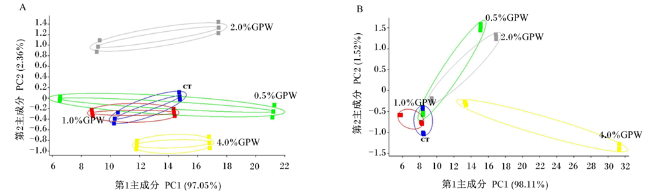
通过WinMuster软件对不同GPW添加量下肉鸡肌肉的气味组分进行PCA。不同GPW添加量下肉鸡肌肉的PCA见图1,不同GPW添加量下肉鸡肌肉的区分度分别见表7表8
图1 不同绞股蓝水提物添加量下科宝肉鸡肌肉气味组分的PCA

A:胸肌 breast muscles;B:腿肌 thigh muscles。

Fig.1 Principal component analysis of muscle odor components of Cobb broilers at different Gynostemma pentaphyllum aqueous extract additions

表7 不同绞股蓝水提物添加量下科宝肉鸡胸肌区分度

Table 7 Differentiation of Cobb broiler breast muscles at different Gynostemma pentaphyllum aqueous extract additions

项目
Items
CT组
Control group
0.5% GPW组
0.5% GPW
group
1.0% GPW组
1.0% GPW
group
2.0% GPW组
2.0% GPW
group
4.0% GPW组
4.0% GPW
group
CT组Control group / 0.016 0.046 0.161 0.168
0.5% GPW组0.5% GPW group 0.016 / 0.043 0.083 0.030
1.0% GPW组1.0% GPW group 0.046 0.043 / 0.152 0.244
2.0% GPW组2.0% GPW group 0.161 0.083 0.152 / 0.384
4.0% GPW组4.0% GPW group 0.168 0.030 0.224 0.384 /
表8 不同绞股蓝水提物添加量下科宝肉鸡腿肌区分度

Table 8 Differentiation of Cobb broiler thigh muscles at different Gynostemma pentaphyllum aqueous extract additions

项目
Items
CT组
Control group
0.5% GPW组
0.5% GPW
group
1.0% GPW组
1.0% GPW
group
2.0% GPW组
2.0% GPW
group
4.0% GPW组
4.0% GPW
group
CT组Control group / 0.346 0.394 0.457 0.547
0.5% GPW组0.5% GPW group 0.346 / 0.473 0.040 0.386
1.0% GPW组1.0% GPW group 0.394 0.473 / 0.554 0.590
2.0% GPW组2.0% GPW group 0.457 0.040 0.554 / 0.318
4.0% GPW组4.0% GPW group 0.547 0.386 0.590 0.318 /
图1可知,肉鸡胸肌的第1主成分(PC1)、第2主成分(PC2)贡献率分别为97.05%、2.36%,总贡献率为99.41%;腿肌的PC1、PC2贡献率分别为98.11%、1.52%,总贡献率为99.63%。这说明PC1和PC2能很好地反映肉鸡肌肉样品的特征。
表7可知,CT组与0.5% GPW、1.0% GPW组胸肌样品区分度在0.01~0.05,与2.0% GPW、4.0% GPW组胸肌样品区分度在0.16以上,区分度良好。由表8可知,CT组与0.5% GPW、1.0% GPW组腿肌样品区分度在0.34~0.40,与2.0% GPW、4.0% GPW组腿肌样品区分度在0.45以上,区分度良好。这说明在不同GPW添加量下鸡肉样品的气味可以有效区分。

2.4.2 不同GPW添加量下科宝肉鸡肌肉气味组分的传感器Loadings分析
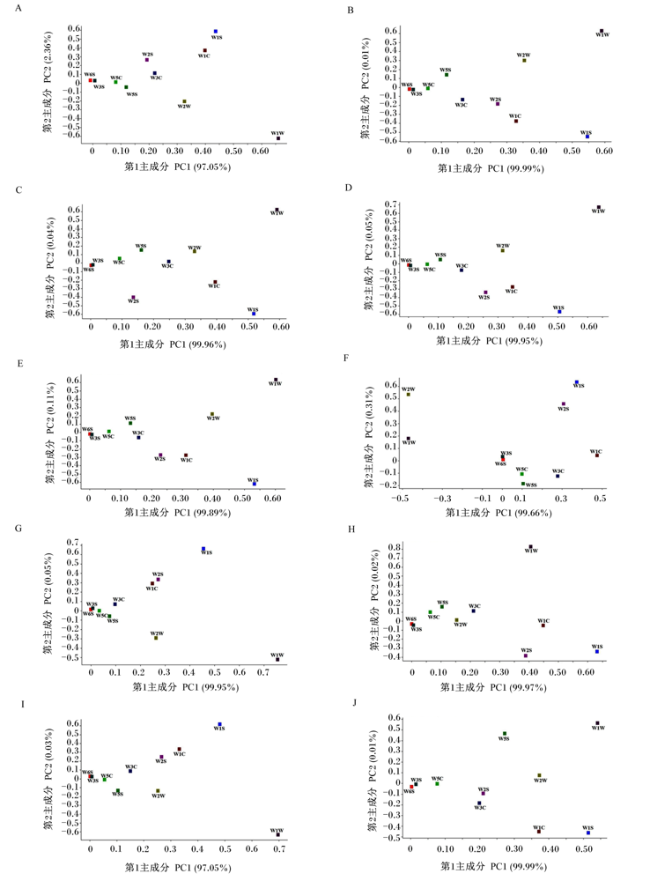
图2可知,CT组胸肌PC1、PC2贡献率分别为97.05%、2.36%,总贡献率为99.41%。0.5% GPW组胸肌PC1、PC2贡献率分别为99.99%、0.01%,总贡献率为100%。1.0% GPW组胸肌PC1、PC2贡献率分别为99.96%、0.04%,总贡献率为100%。2.0% GPW组胸肌PC1、PC2贡献率分别为99.96%、0.04%,总贡献率为100%。4.0% GPW组胸肌PC1、PC2贡献率分别为99.89%、0.11%,总贡献率100%。无机硫化物(W1W传感器)对所有胸肌样品中的PC1贡献率较大,其次是甲烷等短链烷烃(W1S传感器);但醇类、醛酮(W2S传感器)对2.0% GPW和4.0% GPW组胸肌样品的PC1贡献率有不同响应。甲烷等短链烷烃对CT胸肌的PC2贡献率较大;而无机硫化物对所有添加GPW胸肌中的PC2贡献率较大。
图2 不同绞股蓝水提物添加量下科宝肉鸡肌肉气味组分传感器Loadings分析

A~E:胸肌,依次为CT组、0.5% GPW组、1.0% GPW组、2.0% GPW组、4.0% GPW组;F~J:腿肌,依次为CT组、0.5% GPW组、1.0% GPW组、2.0% GPW组、4.0% GPW组。

Fig.2 Sensor Loadings analysis of muscle odor components of Cobb broilers at different Gynostemma pentaphyllum aqueous extract addition

A-E: breast muscles,in order of control group, 0.5% GPW group, 1.0% GPW group, 2.0% GPW group, 4.0% GPW group; F-J:high muscles, in order of control group, 0.5% GPW group, 1.0% GPW group, 2.0% GPW group, 4.0% GPW group.

CT组腿肌PC1、PC2贡献率分别为99.66%、0.31%,总贡献率为99.97%。0.5% GPW组腿肌PC1、PC2贡献率分别为99.95%、0.05%,总贡献率为100.00%。1.0% GPW组腿肌PC1、PC2贡献率分别为99.97%、0.02%,总贡献率99.99%。2.0% GPW组腿肌PC1、PC2贡献率分别为99.97%、0.03%,总贡献率为100.00%。4.0% GPW组腿肌PC1、PC2贡献率分别为99.99%、0.01%,总贡献率为100.00%。苯类芳香成分(W1C传感器)对CT组腿肌的PC1贡献率较大,其次是甲烷等短链烷烃、醇类和醛酮、氨类芳香成分(W3C传感器)、氮氧化合物(W5S传感器)。而无机硫化物对2.0% GPW和4.0% GPW组腿肌的PC1贡献率较大;且有机硫化物类芳香成分(W2W传感器)对其存在不同响应。
通过对比不同GPW添加量下传感器分布发现,与CT组相比,2.0% GPW、4.0% GPW组胸肌样品对W2S传感器存在不同响应;腿肌样品对W1W、W2W传感器存在不同响应,即电子鼻可以区分不同GPW添加量下的鸡肉,与PCA中的GPW添加量区分度结果相似。

3 讨论

周贞兵等[13]研究发现,0.5%、1.0%的绞股蓝粉可以降低金陵花鸡的死亡率,显著提高ADG和饲料转化率。王雨林等[14]发现,绞股蓝可以使绿壳蛋鸡的产蛋率提高1.3%~4.3%。管倩等[15]研究发现,复合益生菌发酵绞股蓝可以显著提高蛋鸡的生产性能,改善蛋品质。本试验发现,饲粮中添加GPW可以显著影响肉鸡的ADFI和F/G,提高肉鸡的生长性能,与前人研究结果相似。GPW提高肉鸡生长性能可能与其改善肠道微生物菌群结构相关。前人研究表明,GPW可以增加肠道丁酸蓖麻单胞菌、乳酸杆菌和明串珠菌等有益细菌的相对丰度,降低厚壁菌门和拟杆菌门的相对丰度,调节小鼠肠道微生物菌群的失衡[16];而肠道微生物有益菌群相对丰度的增加可以使饲粮中的营养物质被更充分的吸收,从而对肉鸡的健康、生长状况产生积极作用[17]
肉鸡的脂肪沉积直接影响其屠宰性能,而肉鸡的腹部脂肪与其他脂肪组织相比,生长速度更快,并成为影响其体内脂肪含量的主要因素,因此降低肉鸡脂肪含量及相关机制仍是目前研究的热点之一[18]。本试验自提的GPW主要成分为黄酮和皂苷。有研究发现,黄酮可以通过改善鸡肉的脂肪酸组成、激活过氧化物酶体增殖物激活受体-γ,或钝化核因子-κB介导的通路,从而调节脂质的代谢、沉积[19-20]。绞股蓝皂苷可以通过法尼酯X受体介导的胆酸汁代谢通路作用,或通过抑制动物机体内的磷脂酰胆碱合成氧化三甲胺,影响脂质代谢,调节脂肪沉积[21-22]。试验证实,富含绞股蓝皂苷的GPW通过降低CCAAT/增强子结合蛋白-α、过氧化物酶体增殖物激活受体-γ、甾醇调节元件结合蛋白-1C、过氧化物酶体增殖物激活受体γ辅激活因子-1α、脂肪酸合成酶和脂肪细胞蛋白-2的mRNA表达,增强肉碱棕榈酰转移酶和激素敏感性脂肪酶的表达,显著增强腺苷酸活化蛋白激酶信号通路的激活并抑制脂肪沉积[23]。本研究发现,添加2%、4%的GPW使肉鸡腹脂率有下降趋势,与前人研究结果相似,但具体影响机制仍需进一步研究。
pH、肉色、蒸煮损失、滴水损失和剪切力是评价鸡肉品质的主要指标[24]。但目前关于GPW对肉鸡肉品质的影响较为少见。本研究发现,在基础饲粮中添加GPW并未对科宝肉鸡的pH、滴水损失、蒸煮损失产生显著影响,但显著降低了腿肌的L*值和剪切力。研究表明,黄酮类物质可以通过清除引发氧化的自由基、分解过氧化物等抑制脂质氧化,延缓肌红蛋白氧化速度,从而改善肉鸡的肉色[25]。本试验中,腿肌L*值的降低是否与GPW中黄酮的抗氧化活性有关尚需进一步研究。肌肉剪切力的大小可以反映其结缔组织、肌原纤维和肌浆蛋白的含量和结构状态,剪切力越小,肉越嫩[26]。本试验发现,饲粮中添加GPW能够降低科宝肉鸡腿肌剪切力,说明GPW在一定程度上可以提高肉鸡的肉品质。
电子鼻通技术通过气体传感器阵列模拟人类嗅觉功能,检测、识别和定性鸡肉样品的挥发性气体,可以对肉类的新鲜度、品种、畜禽的饲养方式等进行区分[27-29]。本试验通过使用电子鼻对鸡肉样品进行检测、分析发现不同GPW添加量下的鸡肉样品可以明显区分;饲粮中添加GPW后鸡肉的气味组分主要为无机硫化物、苯类芳香成分、甲烷等短链烷烃、醇类和醛酮、氨类芳香成分等。同时,与CT组相比,2.0% GPW、4.0% GPW组鸡肉对W2S、W1W、W2W传感器有不同响应,即与CT组相比,在2.0% GPW、4.0% GPW组中醇类、醛酮对胸肌PC1贡献率较大,无机硫化物和有机硫化物类芳香成分对腿肌PC1贡献率较大。醛类作为鸡肉加热后脂肪降解的特征香味物质,具有脂肪香和青香[30];醇类通过亚油酸降解反应形成,具有蘑菇香[31];硫化物通过鸡肉加热过程中美拉德反应[32]、氨基酸热解[33]和硫胺素降解[34]等反应产生,具有蔬菜香[31]。因此,与CT组相比,2.0% GPW、4.0% GPW组鸡肉的香气更加浓郁。

4 结论

饲粮中添加GPW可以提高肉鸡的生长性能,降低腹脂率,改善肉品质,提升鸡肉的香气,且以添加2.0% GPW效果最佳。
[1]
KHUBEIZ M M, SHIRIF A M. Effect of coriander (Coriandrum sativum L.) seed powder as feed additives on performance and some blood parameters of broiler chickens[J]. Open Veterinary Journal, 2020, 10(2):198-205.

[2]
刘艳丰, 王晶, 於建国, 等. 不同饲养方式对芦花鸡屠宰性能和肉品质的影响[J]. 中国家禽, 2017, 39(6):53-55.

LIU Y F, WANG J, YU J G, et al. Effect of different feeding methods on slaughter performance and meat quality of rutabaga chickens[J]. China Poultry, 2017, 39(6):53-55. (in Chinese)

[3]
杨媛丽, 沙坤, 孙宝忠, 等. 不同养殖模式对牦牛背最长肌挥发性风味物质及脂肪酸组成的影响[J]. 肉类研究, 2020, 34(4):46-52.

YANG Y L, SHA K, SUN B Z, et al. Effects of different feeding systems on volatile flavor and fatty acid composition of yak longissimus dorsi[J]. Meat Research, 2020, 34(4):46-52. (in Chinese)

[4]
LI Y, SUN T H, HONG Y X, et al. Mixture of five fermented herbs (Zhihuasi Tk) alters the intestinal microbiota and promotes the growth performance in piglets[J]. Frontiers in Microbiology, 2021, 12:725196.

DOI

[5]
韩梅红, 郭利伟, 张明辉. 复方中草药对肉仔鸡的生长性能、屠宰性能和免疫器官指数的影响[J]. 长江大学学报(自然科学版), 2022, 19(5):120-126.

HAN M H, GUO L W, ZHANG M H. Effects of compound Chinese herbal medicine on growth performance,slaughter performance and immune organ indexes of broilers[J]. Journal of Yangtze University (Natural Science Edition), 2022, 19(5):120-126.

[6]
王霞, 刘建国, 马友记, 等. 复方中草药添加剂对湖羊屠宰性能、肉品质及瘤胃组织形态学的影响[J]. 中国草食动物科学, 2019, 39(3):22-25.

WANG X, LIU J G, MA Y J, et al. Effects of compound Chinese herbal medicine additives on slaughter performance,meat quality and rumen histomorphology of Hu sheep[J]. China Herbivore Science, 2019, 39(3):22-25. (in Chinese)

[7]
锡建中, 赵超. 复方中草药对鸡肉风味化合物组成的影响[J]. 中国家禽, 2016, 38(2):25-28.

XI J Z, ZHAO C. Effect of compound Chinese herbal medicine on flavor compounds of chicken muscle[J]. China Poultry, 2016, 38(2):25-28. (in Chinese)

[8]
陈书坤. 绞股蓝属植物的分类系统和分布[J]. 植物分类学报, 1995, 33(4):403-410.

CHEN S K. A classificatory system and geographical distribution of the genus Gynostemma BL. (Cucurbitaceae)[J]. Journal of Systematics and Evolution, 1995, 33(4):403-410. (in Chinese)

[9]
SHI L, CAO J Q, LI W, et al. Three new triterpene saponins from Gynostemma pentaphyllum[J]. Helvetica Chimica Acta, 2010, 93(9):1785-1794.

DOI

[10]
SU C, LI N, REN R R, et al. Progress in the medicinal value,bioactive compounds,and pharmacological activities of Gynostemma pentaphyllum[J]. Molecules, 2021, 26(20):6249.

DOI

[11]
杨贵兴, 陈渠, 邓淑婷. 饲料中添加绞股蓝提取物对育肥猪生长性能、免疫机能及经济效益的影响[J]. 中国饲料, 2020(17):80-83.

YANG G X, CHEN Q, DENG S T. Effects of Gynostemma pentaphyllum extract on growth performance,immune function and economic benefits of finishing pigs[J]. China Feed, 2020(17):80-83. (in Chinese)

[12]
易洪斌. 绞股蓝对产蛋鸡夏季产蛋性能的影响[J]. 中兽医医药杂志, 2003, 22(2):25-26.

YI H B. Influence of Gynostemma pentaphyllum (thunb) makino to production performance of layer in summer[J]. Journal of Traditional Chinese Veterinary Medicine, 2003, 22(2):25-26. (in Chinese)

[13]
周贞兵, 杨慧芳, 李玉, 等. 绞股蓝添加剂对肉鸡的饲养试验[J]. 广西农业科学, 2007, 38(4):465-467.

ZHOU Z B, YANG H F, LI Y, et al. Feeding experiment on Jinling broiler with Gynostemma pentaphylla additive[J]. Guangxi Agricultural Sciences, 2007, 38(4):465-467. (in Chinese)

[14]
王雨林, 陈晓兰. 绞股蓝添加剂对绿壳蛋鸡生产性能的影响[J]. 江苏农业科学, 2011, 39(5):294-295.

WANG Y L, CHEN X L. Effect of additive of Gynostemma pentaphyllum on production performance of green-shell layer[J]. Jiangsu Agricultural Sciences, 2011, 39(5):294-295. (in Chinese)

[15]
管倩, 李登云, 李灵娟, 等. 复合益生菌发酵绞股蓝对蛋鸡生产性能,蛋品质及ND抗体水平的影响[J]. 黑龙江畜牧兽医, 2019(6):123-125,128.

GUAN Q, LI D Y, LI L J, et al. Effect of fermentation of Gynostemma pentaphyllum with complex probiotics on the production performance,egg quality and ND antibody level of laying hens[J]. Heilongjiang Animal Science and Veterinary Medicine, 2019(6):123-125,128. (in Chinese)

[16]
SHU X, CHEN R, YANG M L, et al. Gynostemma pentaphyllum and gypenoside-Ⅳ ameliorate metabolic disorder and gut microbiota in diet-induced-obese mice[J]. Plant Foods for Human Nutrition, 2022, 77(3):367-372.

DOI

[17]
SAHU J, KOLEY K M, SAHU B D. Attribution of antibacterial and antioxidant activity of Cassia tora extract toward its growth promoting effect in broiler birds[J]. Veterinary World, 2017, 10(2):221-226.

DOI

[18]
BUTTERWITH S C. Contribution of lipoprotein lipase activity to the differential growth of three adipose tissue depots in young broiler chickens[J]. British Poultry Science, 1989, 30(4):927-933.

DOI

[19]
ZHENG C D, DUAN Y Q, GAO J M, et al. Screening for anti-lipase properties of 37 traditional Chinese medicinal herbs[J]. Journal of the Chinese Medical Association, 2010, 73(6):319-324.

DOI

[20]
GONZÁLEZ-CASTEJÓN M, RODRIGUEZ-CASADO A. Dietary phytochemicals and their potential effects on obesity:a review[J]. Pharmacological Research, 2011, 64(5):438-455.

DOI

[21]
WANG M, WANG F, WANG Y N, et al. Metabonomics study of the therapeutic mechanism of Gynostemma pentaphyllum and atorvastatin for hyperlipidemia in rats[J]. PLoS One, 2013, 8(11):e78731.

DOI

[22]
LI H S, XI Y F, LIU H L, et al. Gypenosides ameliorate high-fat diet-induced non-alcoholic steatohepatitis via farnesoid X receptor activation[J]. Frontiers in Nutrition, 2022, 9:914079.

DOI

[23]
LEE H S, LIM S M, JUNG J I, et al. Gynostemma pentaphyllum extract ameliorates high-fat diet-induced obesity in C57BL/6N mice by upregulating SIRT1[J]. Nutrients, 2019, 11(10):2475.

DOI

[24]
FERNÁNDEZ-BARROSO M Á, SILIÓ L, RODRÍGUEZ C, et al. Genetic parameter estimation and gene association analyses for meat quality traits in open-air free-range Iberian pigs[J]. Journal of Animal Breeding and Genetics, 2020, 137(6):581-598.

DOI

[25]
LI J J, YANG C W, PENG H, et al. Effects of slaughter age on muscle characteristics and meat quality traits of Da-Heng meat type birds[J]. Animals:an Open Access Journal From MDPI, 2019, 10(1):69.

[26]
MIR N A, RAFIQ A, KUMAR F, et al. Determinants of broiler chicken meat quality and factors affecting them:a review[J]. Journal of Food Science and Technology, 2017, 54(10):2997-3009.

DOI

[27]
WASILEWSKI T, MIGOÑ D, GEBICKI J, et al. Critical review of electronic nose and tongue instruments prospects in pharmaceutical analysis[J]. Analytica Chimica Acta, 2019, 1077:14-29.

DOI PMID

[28]
ZHANG J H, CAO J, PEI Z S, et al. Volatile flavour components and the mechanisms underlying their production in golden pompano (Trachinotus blochii) fillets subjected to different drying methods:a comparative study using an electronic nose,an electronic tongue and SDE-GC-MS[J]. Food Research International, 2019, 123:217-225.

DOI

[29]
HUSSEIN K, FRIEDRICH L, KISKO G, et al. Use of allyl-isothiocyanate and carvacrol to preserve fresh chicken meat during chilling storage[J]. Czech Journal of Food Sciences, 2019, 37(6):417-424.

DOI

[30]
WHITFIELD F B. Volatiles from interactions of Maillard reactions and lipids[J]. Critical Reviews in Food Science and Nutrition, 1992, 31(1/2):1-58.

[31]
MA Q L, HAMID N, BEKHIT A E D, et al. Evaluation of pre-rigor injection of beef with proteases on cooked meat volatile profile after 1 day and 21 days post-mortem storage[J]. Meat Science, 2012, 92(4):430-439.

DOI PMID

[32]
HEMMLER D, ROULLIER-GALL C, MARSHALL J W, et al. Evolution of complex maillard chemical reactions,resolved in time[J]. Scientific Reports, 2017, 7(1):3227.

DOI

[33]
CHOI S S, KO J E. Analysis of cyclic pyrolysis products formed from amino acid monomer[J]. Journal of Chromatography a, 2011, 1218(46):8443-8455.

DOI

[34]
PARK W S, LEE J, HONG T, et al. Comparative pharmacokinetic analysis of thiamine and its phosphorylated metabolites administered as multivitamin preparations[J]. Clinical Therapeutics, 2016, 38(10):2277-2285.

DOI

文章导航

/