研究论文

植物乳杆菌对氧化应激肉鸡抗氧化能力和肠道真菌结构的影响

  • 原君梦 , 1 ,
  • 赵凡 1 ,
  • 史淑艳 2 ,
  • 李璐 1 ,
  • 臧晓瑞 1 ,
  • 王如月 1 ,
  • 郎亚宁 1 ,
  • 温寒月 1 ,
  • 李雪敏 1 ,
  • 刘华伟 , 1, * ,
  • 王阳 , 1, *
展开
  • 1 青岛农业大学动物科技学院,青岛 266109
  • 2 青岛易邦生物工程有限公司,青岛 266114
*刘华伟,教授,硕士生导师,E-mail: ;
王阳,副教授,硕士生导师,E-mail:

原君梦(1999—),男,山东威海人,硕士研究生,动物营养与饲料科学专业。E-mail:

Copy editor: 陈 鑫

收稿日期: 2022-11-16

  网络出版日期: 2023-05-11

基金资助

国家自然科学基金(32102586)

山东省自然科学基金(ZR2020QC183)

山东省自然科学基金(ZR2021MC118)

青岛市民生科技项目(19-6-1-63-nsh)

青岛市科技计划项目(22-3-7-xdny-11-nsh)

青岛农业大学研究生创新项目(QNYCX22008)

Effects of Lactiplantibacillus plantarum on Antioxidant Capacity and Intestinal Fungi Structure of Oxidative Stressed Broilers

  • YUAN Junmeng , 1 ,
  • ZHAO Fan 1 ,
  • SHI Shuyan 2 ,
  • LI Lu 1 ,
  • ZANG Xiaorui 1 ,
  • WANG Ruyue 1 ,
  • LANG Yaning 1 ,
  • WEN Hanyue 1 ,
  • LI Xuemin 1 ,
  • LIU Huawei , 1, * ,
  • WANG Yang , 1, *
Expand
  • 1 College of Animal Science and Technology, Qingdao Agricultural University, Qingdao 266109, China
  • 2 Qingdao Yebio Bioengineering Co., Ltd., Qingdao 266114, China
*LIU Huawei, professor, E-mail: ;
WANG Yang, associate professor, E-mail:

Received date: 2022-11-16

  Online published: 2023-05-11

摘要

益生菌能够通过调节肠道菌群提高肉鸡的抗氧化能力,但肠道真菌在其中发挥的作用鲜有研究。因此,本试验旨在研究植物乳杆菌P8对氧化应激肉鸡回肠形态、抗氧化能力和盲肠真菌结构的影响。试验选用300只体重相近的1日龄肉鸡,随机分为3组,每组10个重复,每个重复10只鸡。对照组(Con组)肉鸡饲喂基础饲粮,地塞米松(DEX)处理组(DEX组)肉鸡饲喂基础饲粮并于试验第16天腹腔注射DEX,DEX和植物乳杆菌P8共处理组(DEX_P8组)肉鸡饲喂含有1×10⁸ CFU/g植物乳杆菌P8菌粉的饲粮并于试验第16天腹腔注射DEX。试验第21天采集肉鸡血浆、回肠和盲肠内容物,测定回肠形态、抗氧化指标和盲肠内容物真菌组成结构。结果表明:1)与Con组相比,DEX处理对肉鸡回肠形态无显著影响(P>0.05),但显著降低了血浆和回肠黏膜中核因子E2相关因子2(Nrf2)、谷胱甘肽(GSH)含量及血红素氧合酶-1(HO-1)活性和总抗氧化能力(T-AOC)(P<0.05);饲粮中添加植物乳杆菌P8菌粉对DEX处理肉鸡回肠形态无显著影响(P>0.05),但显著提高了血浆和回肠黏膜中Nrf2、GSH含量及HO-1活性和T-AOC(P<0.05)。2)盲肠内容物ITS测序结果显示,与Con组相比,DEX和DEX_P8的处理改变了肉鸡盲肠内容物真菌组成结构。与Con组相比,DEX组肉鸡盲肠内容物中未分类的格孢腔菌属、鬼伞属、肉座菌属、拟点霉属、亚隔孢壳属、未分类的格孢腔菌种、Coprinellus_hiascenenTrichoderma_arundimaceum、未分类的拟点霉种和未分类的亚隔孢壳种的相对丰度显著降低(P<0.05),马拉色氏霉菌属和限制马拉色氏霉菌种的相对丰度显著增加(P<0.05)。与DEX组相比,DEX_P8组肉鸡盲肠内容物中发菌科、间座壳科、亚隔孢壳科、锁霉属、亚隔孢壳属、拟点霉属、Itersonilia_perplexans、未分类的亚隔孢壳种和未分类的拟点霉种的相对丰度显著增加(P<0.05);接合菌门、酵母科、被孢霉科、接合酵母菌属、被孢霉属、未分类的接合酵母菌种和长枝被孢霉种的相对丰度显著降低(P<0.05)。3)皮尔逊相关性分析结果显示,回肠GSH含量与酵母菌属相对丰度呈显著负相关(P<0.05);血浆Nrf2含量与锁霉属和未分类的伞菌属相对丰度呈显著正相关(P<0.05);回肠HO-1活性与嗜热子囊菌属相对丰度呈极显著正相关(P<0.01)。综合以上指标,在本试验条件下,植物乳杆菌P8能够有效地缓解肉鸡氧化应激并调控盲肠内容物真菌结构,相关性分析进一步表明,植物乳杆菌P8可能通过调控盲肠真菌结构提高氧化应激肉鸡的抗氧化功能。

本文引用格式

原君梦 , 赵凡 , 史淑艳 , 李璐 , 臧晓瑞 , 王如月 , 郎亚宁 , 温寒月 , 李雪敏 , 刘华伟 , 王阳 . 植物乳杆菌对氧化应激肉鸡抗氧化能力和肠道真菌结构的影响[J]. 动物营养学报, 2023 , 35(5) : 2929 -2942 . DOI: 10.12418/CJAN2023.274

Abstract

Probiotics can regulate gut bacteria to benefit the antioxidant capacity of animals, but little is known about the gut fungi. Thus, this study was to investigate the effects of Lactiplantibacillus plantarum P8 on the ileal morphology, antioxidant capacity and cecal fungi structure of oxidative stressed broilers. A total of 300 one-day-old broilers were allocated to three groups with 10 replicates per group and 10 broilers per replicate: control group (Con group), control diet+DEX injection group (DEX group) and control diet containing 1×10⁸ CFU/g Lactiplantibacillus plantarum P8+DEX injection group (DEX_P8 group). On day 16, broilers in the DEX and DEX_P8 groups were injected intraperitoneally with DEX. On day 21, broilers were sacrificed for the determination of ileal morphology, antioxidant indexes and fungal composition of cecal contents.Results showed as follows: 1) compared with Con group, DEX treatment had no significant effects on ileum morphology (P>0.05), but significantly decreased the contents of nuclear factor E2-related factor 2 (Nrf2), glutathione (GSH), heme oxygenase-1 (HO-1) activity and total antioxidant capacity (T-AOC) in plasma and ileum mucosa of broilers (P<0.05). Dietary Lactobacillus plantarum P8 powder had no significant effects on ileum morphology of broilers treated with DEX (P>0.05), but significantly increased the contents of Nrf2 and GSH, HO-1 activity and T-AOC in plasma and ileum mucosa of broilers treated with DEX (P<0.05). 2) ITS sequencing results showed that DEX and DEX_P8 significantly changed the fungal composition of cecal contents. Particularly, the relative abundance of Pleosporales_unclassified, Coprinellus, Hypocrea, Phomopsis, Didymella, Pleosporales_unclassified, Coprinellus_hiascenen, Trichoderma_arundimaceum, Phomopsis_unclassified, Didymella_unclassified was significantly decreased in the DEX group compared with the Con group (P<0.05), while the relative abundance of Malassezia, Malassezia_restricta was significantly increased (P<0.05). The relative abundance of Trichocomaceae, Diaporthaceae, Didymellaceae, Itersonilia, Didymella, Phomopsis, Itersonilia_perplexans, Didymella_unclassified, Phomopsis_unclassified was significantly elevated in the DEX_P8 group compared with the DEX group (P<0.05), while the relative abundance of Zygomycota, Saccharomycetaceae, Mortierellaceae, Zygosaccharomyces, Mortierella, Zygosaccharomyces_unclassified, Mortierella_elongata was significantly decreased (P<0.05). 3) Pearson’s correlation analysis indicated that the ileal GSH content was negatively correlated with the relative abundance of Saccharomyces (P<0.05). Plasmal Nrf2 content was positively correlated with the relative abundance of Itersonilia and Agaricomycetes_unclassified (P<0.05). Ileal HO-1 activity was positively correlated with the relative abundance of Thermoasus (P<0.01). Based on the above indexes, Lactobacillus plantarum P8 can effectively relieve oxidative stress and regulate the fungal structure of cecum contents in broilers under the conditions of this experiment. Correlation analysis further indicate that Lactobacillus plantarum P8 may improve the antioxidant function of broilers with oxidative stress by regulating the fungal structure of cecum.

高密度、集约化养殖以及饲料污染等因素会引发家禽的氧化应激反应,导致生长性能降低、免疫机能下降、死淘率升高等问题。因此,如何提高家禽的抗氧化能力在家禽生产过程中尤为重要。应激发生时,动物的肾上腺会分泌大量糖皮质激素[1],所以,过量糖皮质激素的分泌被认为是应激的标志[2]。地塞米松(DEX)是一种人工合成的糖皮质激素,被广泛用于动物氧化应激模型的建立[3-4]。研究表明,注射DEX可以造成肉鸡氧化还原失衡[3]、免疫功能障碍[5]和肠道损伤[6]等现象。此外,肠道微生物与氧化应激的调控密切相关[7],动物肠道中存在数量庞大的微生物,主要包括细菌和一些数量较少的微生物,如古细菌、病毒和真菌[8-9]。目前大多数研究集中在细菌菌群对氧化应激的影响上[10-11],而有关肠道真菌对氧化应激调控作用的研究较少。虽然真菌只占肠道微生物总数的0.1%[12],但是,肠道真菌能够通过影响肠道营养、新陈代谢和免疫力等对宿主的健康发挥作用[13]。例如,在克罗恩病患者体内发现了酿酒酵母菌的抗体[14],酿酒酵母菌加剧了结肠炎小鼠的肠道通透性[15],强直性脊柱炎患者肠道内的链格孢属、酵母菌和念珠菌数量增加[16],人类对碳水化合物的消耗与念珠菌数量增加相关[17],然而人们对家禽肠道真菌的组成和作用的了解仍然非常有限。
众所周知,益生菌可以通过调节肠道细菌的组成和功能发挥一系列有益作用[18]。由于肠道细菌和真菌之间存在相互作用[19],益生菌也可能影响真菌组成。Schei等[20]研究发现,孕妇食用含鼠李糖乳杆菌GG、动物双歧杆菌亚种、乳酸乳球菌Bb-12和嗜酸乳杆菌La-5的牛奶后肠道真菌丰度增加。开菲尔(Kefir)是一种由含有益生菌和酵母菌的发酵奶,Kim等[21]发现开菲尔可以通过调节肠道细菌和真菌结构来缓解高脂饮食小鼠的肥胖和肝脏脂肪变性。植物乳杆菌是常见的益生菌,能够改善宿主肠道微生物结构发挥免疫调节[22]和抗氧化[23]等作用。植物乳杆菌P8分离自内蒙古牧民家庭天然发酵的酸奶[23],具有许多有益作用,能够降低成年人压力水平[24],改善大鼠的脂质代谢[25]和调节大菱鲆的肠道形态[26]。此外,本课题组前期研究还发现,在肉鸡中,植物乳杆菌P8可以通过调节肠道微生物群来改善艾美球虫诱导的肠道炎症,并减轻DEX诱导的氧化应激反应,提高生产性能[5,23]。但植物乳杆菌P8对肉鸡盲肠真菌的调控作用尚不清楚。因此,本研究以DEX诱导的氧化应激肉鸡为研究对象,探讨植物乳杆菌P8对肠道形态、抗氧化能力和盲肠内容物真菌结构的调控作用。通过研究抗氧化指标与盲肠真菌的相关性,初步分析植物乳杆菌P8缓解肉鸡氧化应激的可能机制。

1 材料与方法

1.1 试验材料

DEX购自黑龙江省北安市某动物药厂(兽药生产许可证号080061147,5 mg/mL),植物乳杆菌P8购自北京某生物技术股份有限公司(1×1011 CFU/g)。

1.2 试验设计

将300只1日龄体重[(440.0±3.0) g]相近的健康雄性科宝(Cobb)肉鸡(购自河南省农业科学院)随机分为3组,每组10个重复,每个重复10只鸡。对照组(Con组)肉鸡饲喂基础饲粮,DEX处理组(DEX组)肉鸡饲喂基础饲粮并腹腔注射DEX,DEX和植物乳杆菌P8共处理组(DEX_P8组)肉鸡饲喂含有1×10⁸ CFU/g植物乳杆菌P8菌粉的基础饲粮并腹腔注射DEX。16日龄时,DEX组和DEX_P8组肉鸡腹腔注射200 μL 3 mg/kg BW的DEX[27],Con组肉鸡注射等量生理盐水。试验期为21 d,试验鸡按照重复分栏笼养,自由采食,自由饮水,按正常免疫程序进行免疫接种。

1.3 基础饲粮

基础饲粮由青岛某有限公司提供,参照NRC(1994)和Cobb肉仔鸡营养需要并结合生产实践配制。基础饲粮组成及营养水平见表1
表1 基础饲粮组成及营养水平(风干基础)

Table 1 Composition and nutrient levels of the basal diet (air-dry basis) %

项目Items 含量Content
原料Ingredients
玉米Corn 61.38
豆粕Soybean meal 31.00
鱼粉Fish meal 2.00
豆油Soybean oil 2.00
石粉Limestone 1.50
磷酸氢钙CaHPO4 1.30
DL-蛋氨酸DL-Met 0.22
食盐NaCl 0.30
预混料Premix1) 0.20
氯化胆碱Choline chloride 0.10
合计Total 100.00
营养水平Nutrient levels2)
代谢能ME/(MJ/kg) 12.47
粗蛋白质CP 20.55
粗纤维CF 4.59
钙Ca 0.95
有效磷AP 0.46
赖氨酸Lys 1.10
蛋氨酸Met 0.55

1)预混料为每千克饲粮提供 The premix provided the following per kg of the diet:VA 8 000 IU,VB1 4.2 mg,VB2 4 mg,VB6 4.5 mg,VB12 0.02 mg,VD3 3 000 IU,VE 20 IU,VK3 2 mg,生物素 biotin 0.15 mg,叶酸 folic acid 1.0 mg,D-泛酸 D-pantothenic acid 11 mg,烟酸 nicotinic acid 10 mg,Cu (as copper sulfate) 10 mg,Fe (as ferrous sulfate) 80 mg,Mn (as manganese sulfate) 80 mg,Zn (as zinc sulfate) 75 mg,I (as potassium iodide) 0.40 mg,Se (as sodium selenite) 0.30 mg。

2)代谢能为计算值,其余为实测值。ME was a calculated value, while the others were measured values.

1.4 样品采集

试验结束后,肉鸡禁食12 h,每个重复随机选取1只肉鸡进行采样。颈静脉采血5 mL置于抗凝血采血管中,4 ℃离心10 min(3 000×g),收集血浆样本于1.5 mL无菌管中。用新洁尔灭进行鸡体消毒后,拔掉腹部羽毛,小心剪开腹部皮肤,露出胸肌,剪断两边肋骨,暴露胸腔,回肠前端从肠段由粗变细处末梢剪断,后端从回盲瓣剪断,用灭菌生理盐水漂洗掉大块的内容物,重复清洗3次,一部分回肠固定于10%多聚甲醛溶液中,一部分回肠用剪刀将肠段纵向剪开,用玻璃载玻片于Meckel’s憩室近端5 cm处刮取黏膜。切除盲肠,无菌挤压出盲肠内容物收集到无菌管中。所有样品采集后立即置于液氮中。随后,将血浆样品置于-20 ℃保存,回肠和盲肠内容物样品置于-80 ℃保存,用于后续试验指标的测定。

1.5 回肠形态分析

将固定好的回肠样本用乙醇脱水、二甲苯透明、石蜡包埋、切片,然后用苏木精-伊红(HE)染色,通过OLYMPUS显微镜(OLYMPUS,日本)对组织形态进行观察。利用HMIAS-2000图像处理系统对肠道绒毛高度、隐窝深度进行测量,计算绒毛高度与隐窝深度的比值(绒隐比,CD/VH)。

1.6 抗氧化指标分析

采用酶联免疫吸附试验(ELISA)试剂盒(上海酶联生物技术有限公司)检测血浆和回肠黏膜中核因子E2相关因子2(Nrf2)、谷胱甘肽(GSH)含量及血红素氧合酶-1(HO-1)活性。使用羟基自由基清除法和铁离子还原能力(FRAP)试剂盒(南京建成生物工程研究所)测定血浆和回肠黏膜中总抗氧化能力(T-AOC)。

1.7 盲肠内容物DNA提取及ITS测序

饲养试验结束后将盲肠内容物样品送至青岛科创生物科技有限公司进行基因组DNA提取和ITS测序。使用TIANamp粪便DNA试剂盒(北京天根生化科技有限公司)提取盲肠内容物微生物基因组DNA。使用Qubit 2.0荧光仪(Invitrogen,美国)对DNA样品进行定量,并使用0.8%琼脂糖凝胶电泳确定DNA质量。使用正向引物fITS7(5’-GTGARTCATCGAATCTTTG-3’)和反向引物ITS4(5’-TCCTCCGCTTATTGATATGC-3’)进行ITS测序。测序条件如下:98 ℃ 40 s,54 ℃ 30 s,72 ℃ 45 min,32个循环。纯化的PCR产物在Illumina Nova6000(Illumina,美国)平台上进行测序。原始数据保存于NCBI的SRA(Sequence Read Archive)数据库(登录号:PRJNA843786)。
原始fastq文件通过Trimmomatic软件进行质量过滤,利用FLASH(version 1.20)软件进行序列拼接。使用UPARSE(7.1, http://drive5.com/uparse/)将高质量序列以97%的相似性阈值聚类成可操作分类单元(OTU)。参照Unite(http://unite.ut.ee/index.php)数据库,利用RDP分类算法(http://rdp.cme.msu.edu/),按照70%的置信阈值,进行OTU的分类注释。为了比较不同测序深度的样品,将所有样品按照门、科、属、种的分类水平统计样本的菌落组成,并制作韦恩图分析各组的核心OTU。使用Mothur(1.30.2)软件对菌群进行alpha多样性分析,使用QIIME(Version 1.9.1, http://qiime.org/tutorials/ tutorial.html)进行菌群未加权UniFrac距离的度量,使用R studio(3.5.2)软件实现数据的可视化展示。

1.8 数据统计分析

试验数据使用Excel 2019整理,采用SPSS 24.0统计软件进行单因素方差分析(one-way ANOVA),采用Duncan氏法进行多重比较,以P<0.05作为差异显著的标准。使用在线分析平台OmicStudio(https://www.omicstudio.cn)对抗氧化指标和真菌菌属丰度进行皮尔逊相关性分析。相关性分析结果中筛选相关系数(r)大于0.60或小于-0.60且P<0.05的数据。结果采用平均值和均值标准误的方式表示。

2 结果与分析

2.1 饲粮添加植物乳杆菌P8对氧化应激肉鸡回肠形态结构的影响

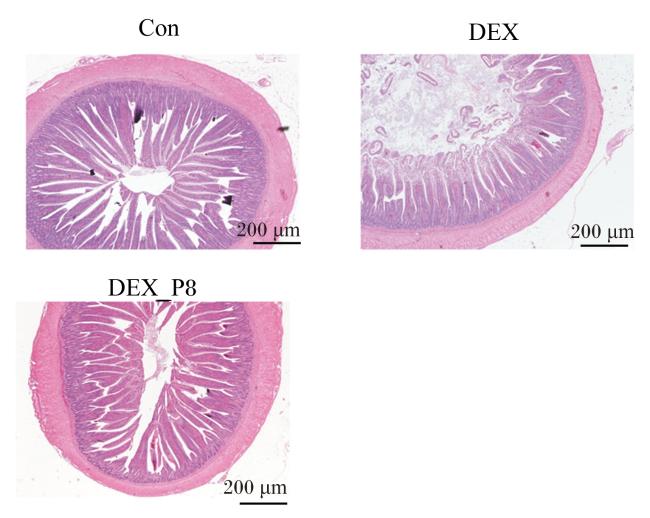
各组间肉鸡绒毛高度、隐窝深度及绒隐比无显著差异(P>0.05)(表2),并且各组间绒毛结构完整,未见明显损伤(图1)。
表2 植物乳杆菌P8对氧化应激肉鸡回肠形态结构的影响

Table 2 Effects of Lactiplantibacillus plantarum P8 on ileal morphological structure of oxidative stressed broilers

项目
Items
组别Groups SEM P
P-value
Con DEX DEX_P8
绒毛高度Villus height/μm 650.91 642.57 643.82 4.01 0.122
隐窝深度Crypt depth/μm 116.57 118.57 115.37 1.67 0.196
绒隐比V/C 5.59 5.42 5.58 0.08 0.118

同行数据肩标相同字母或无字母表示差异不显著(P>0.05),不同小写字母表示差异显著(P<0.05)。下表同。

In the same row, values with the same letter or no letter superscripts mean no significant difference (P>0.05), while with different small letter superscripts mean significant difference (P<0.05). The same as below.

图1 肉鸡回肠形态结构的显微照片(HE染色)

Con:对照组 control group; DEX:DEX组 DEX group;DEX_P8:DEX_P8组 DEX_P8 group.下图同 the same as below。

Fig.1 Micrograph of ileum morphological structure of broilers (HE staining)

2.2 饲粮添加植物乳杆菌P8对氧化应激肉鸡血浆和回肠抗氧化指标的影响

表3可知,在血浆和回肠黏膜中,与Con组相比,注射DEX显著降低了Nrf2、GSH含量以及HO-1活性和T-AOC(P<0.05);此外,与DEX组相比,DEX_P8处理可显著提高Nrf2、GSH含量以及HO-1活性和T-AOC(P<0.05)。
表3 植物乳杆菌P8对氧化应激肉鸡血浆和回肠黏膜抗氧化指标的影响

Table 3 Effects of Lactiplantibacillus plantarum P8 on antioxidant indexes in plasma and ileal mucosa of oxidative stressed broilers

项目
Items
组别Groups SEM P
P-value
Con DEX DEX_P8
血浆Plasma
核因子E2相关因子2 Nrf2/(pg/mL) 22.59a 17.79b 23.61a 0.94 <0.001
血红素氧合酶-1 HO-1/(pg/mL) 308.51b 245.22c 361.94a 11.55 <0.001
谷胱甘肽GSH/(ng/L) 786.50a 660.25b 770.25a 17.85 <0.001
总抗氧化能力T-AOC/(mg/mL) 80.54a 64.70b 81.62a 0.57 <0.001
回肠黏膜Ileal mucosa
核因子E2相关因子2 Nrf2/(pg/mg prot) 2.80a 1.84b 3.09a 0.17 <0.001
血红素氧合酶-1 HO-1/(pg/mg prot) 23.80a 21.13b 24.30a 0.82 0.002
谷胱甘肽GSH/(μg/mg prot) 71.40a 64.03b 75.28a 2.20 <0.001
总抗氧化能力T-AOC/(mmol/mg prot) 2.17a 1.54b 2.15a 0.39 <0.001

2.3 饲粮添加植物乳杆菌P8对氧化应激肉鸡盲肠内容物真菌多样性的影响

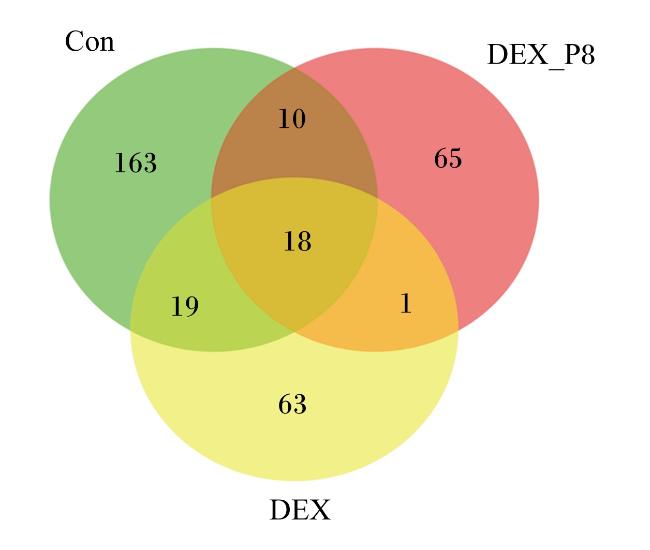
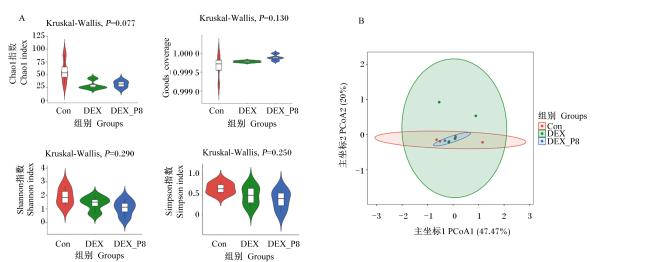
图2可知,Con组、DEX组和DEX_P8组分别有134、68和52个OTU。Con组和DEX组共享37个OTU,DEX组和DEX_P8组共享19个OTU。Alpha多样性结果表明,不同处理对Chao1指数、Goods_coverage、Shannon指数和Simpson指数的影响不显著(P>0.05)(图3-A)。主坐标分析(PCoA)结果显示盲肠内容物中获得的真菌序列在各组间聚类不显著(P>0.05,图3-B)。
图2 肉鸡盲肠真菌的韦恩图

Fig.2 Venn diagram of cecal fungi of broilers

图3 植物乳杆菌P8对肉鸡盲肠真菌多样性的影响

A:以Chao1指数、Goods_coverage、Shannon指数和Simpson指数表示的α-多样性;B:真菌菌落结构的主坐标分析(PCoA)。A: α-diversity, indicated by the Chao1 index, Goods_coverage, Shannon index and Simpson indexe; B: principal coordinate analysis (PCoA) of fungal community structures.

Fig.3 Effects of Lactiplantibacillus plantarum P8 on diversity of cecal fungi of broilers

2.4 肉鸡盲肠内容物中真菌群及组成

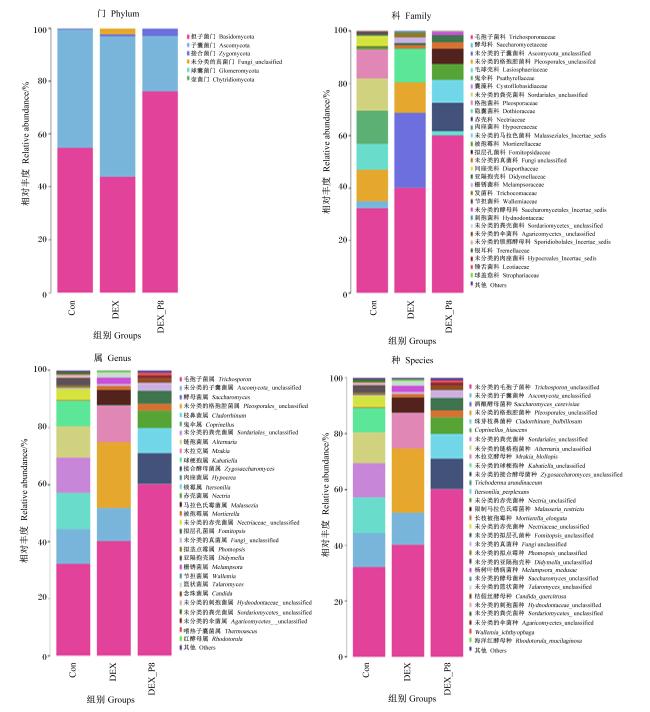
表4图4可知,肠道菌群在门、科、属、种分类水平上存在显著差异。在门水平上,鉴定出担子菌门、子囊菌门、接合菌门、球藻菌门和壶菌门5个菌门。担子菌门和子囊菌门是Con、DEX和DEX_P8组中相对丰度最高的2个真菌门,其他真菌门的占比小于5%。此外,与DEX组相比,DEX_P8组肉鸡盲肠内容物中接合菌门的相对丰度显著降低(P<0.05)。
表4 肉鸡盲肠内容物门水平显著差异真菌

Table 4 Significantly different fungal at phylum level in cecal contents of broilers

项目
Item
P
P-value
调控
Regulation
DEX_P8组
DEX_P8 group
DEX组
DEX group
接合菌门p_Zygomycota 0.047 下调 0.00 2.26
图4 植物乳杆菌P8对肉鸡盲肠内容物真菌结构的影响

Fig.4 Effects of Lactiplantibacillus plantarum P8 on fungal structure in cecal contents of broilers

表5图4可知,在科水平上,丝孢酵母科(17.27%)、未分类的格孢腔菌科(15.93%)、鬼伞科(15.36%)、未分类的子囊菌科(14.62%)和未分类的粪壳菌科(13.79%)是Con组中相对丰度最高的5个科。丝孢酵母科(40.18%)、酵母科(28.51%)、格孢腔菌科(12.81%)、未分类的子囊菌科(11.56%)和被孢霉科(2.26%)是DEX组中相对丰度最高的5个科。丝孢酵母科(65.77%)、毛球壳科(15.56%)、隐囊菌科(10.27%)、囊藻科(3.34%)和赤壳科(2.07%)是DEX_P8组中相对丰度最高的5个科。此外,与Con组相比,DEX组肉鸡盲肠内容物中未分类的格孢腔菌科、鬼伞科、亚隔孢壳科、未分类出的肉座菌科、锥毛壳科、球盖菌科、肉座菌科和间座壳科相对丰度显著降低(P<0.05),酵母科和未分类的马拉色氏霉菌科的相对丰度显著增加(P<0.05)。与DEX组相比,DEX_P8组肉鸡盲肠内容物中酵母科和被孢霉科相对丰度显著降低(P<0.05),而发菌科、间座壳科和亚隔孢壳科相对丰度显著增加(P<0.05)。
表5 肉鸡盲肠内容物科水平显著差异真菌

Table 5 Significantly different fungal at family level in cecal contents of broilers

项目
Items
P
P-value
调控
Regulation
Con组
Con group
DEX组
DEX group
未分类的格孢腔菌科f_Pleosporales_unclassified 0.014 上调 15.93 0.00
鬼伞科f_Psathyrellaceae 0.014 上调 15.36 0.00
亚隔孢壳科f_Didymellaceae 0.014 上调 1.23 0.00
未分类的肉座菌科f_Hypocreales_Incertae_sedis 0.014 上调 0.07 0.00
锥毛壳科f_Coniochaetaceae 0.014 上调 0.01 0.00
酵母科f_Saccharomycetaceae 0.038 下调 0.00 28.51
球盖菌科f_Strophariaceae 0.038 上调 0.05 0.00
肉座菌科f_Hypocreaceae 0.047 上调 4.92 0.00
未分类的马拉色氏霉菌科f_Malasseziales_Incertae_sedis 0.047 下调 0.00 1.29
间座壳科f_Diaporthaceae 0.047 上调 1.33 0.00
项目
Items
P
P-value
调控
Regulation
DEX-P8组
DEX_P8 group
DEX组
DEX group
酵母科f_Saccharomycetaceae 0.014 下调 0.00 28.51
发菌科f_Trichocomaceae 0.021 上调 0.33 0.02
被孢霉科f_Mortierellaceae 0.047 下调 0.00 2.26
间座壳科f_Diaporthaceae 0.047 上调 0.03 0.00
亚隔孢壳科f_Didymellaceae 0.047 上调 0.13 0.00
表6图4可知,在属水平上,毛孢子菌属(17.27%)、未分类的格孢腔菌属(15.93%)、鬼伞属(15.36%)、未分类的子囊菌属(14.62%)和未分类的粪壳菌属(13.79%)是Con组中相对丰度最高的5个真菌属。毛孢子菌属(40.18%)、酵母菌属(23.16%)、链孢菌属(12.81%)、未分类的子囊菌属(11.56%)和接合酵母菌属(5.35%)是DEX组中相对丰度最高的5个真菌属。毛孢子菌属(65.77%)、枝鼻菌属(15.56%)、球梗孢属(10.27%)、锁霉属(3.34%)和未分类的赤壳菌属(2.07%)是DEX_P8组中相对丰度最高的5个真菌属。此外,与Con组相比,DEX组肉鸡盲肠内容物中未分类的格孢腔菌属、鬼伞属、肉座菌属、拟点霉属、亚隔孢壳属相对丰度显著降低(P<0.05),马拉色氏霉菌属的相对丰度显著增加(P<0.05)。与DEX组相比,DEX_P8组肉鸡盲肠内容物中接合酵母菌属、被孢霉属相对丰度显著降低(P<0.05),而锁霉属、亚隔孢壳属和拟点霉属的相对丰度增加(P<0.05)。
表6 肉鸡盲肠内容物属水平显著差异真菌

Table 6 Significantly different genus at genus level in cecal contents of broilers

项目
Items
P
P-value
调控
Regulation
Con组
Con group
DEX组
DEX group
未分类的格孢腔菌属g_Pleosporales_unclassified 0.014 上调 15.93 0.00
鬼伞属g_Coprinellus 0.014 上调 15.36 0.00
亚隔孢壳属g_Didymella 0.014 上调 1.23 0.00
肉座菌属g_Hypocrea 0.047 上调 4.92 0.00
马拉色氏霉菌g_Malassezia 0.047 下调 0.00 1.29
拟茎点霉属g_Phomopsis 0.047 上调 1.33 0.00
接合酵母菌属g_Zygosaccharomyces 0.047 下调 0.00 5.35
锁霉属g_Itersonilia 0.047 上调 3.34 0.00
被孢霉属g_Mortierella 0.047 下调 0.00 2.26
拟茎点霉属g_Phomopsis 0.047 上调 0.03 0.00
亚隔孢壳属g_Didymella 0.047 上调 0.13 0.00
表7图4可知,在种水平上,未分类的毛孢子菌种(17.27%)、未分类的格孢腔菌种(15.93%)、Coprinellus_hiascens(15.34%)、未分类的粪壳菌种(13.79%)和木拉克酵母种(11.11%)是Con组中相对丰度最高的5个真菌种。未分类的毛孢子菌种(40.18%)、酒酿酵母菌种(22.89%)、未分类的链格孢菌种(12.81%)、未分类的子囊菌种(11.56%)、未分类的接合酵母菌种(5.39%)和长枝被孢霉种(2.26%)是DEX组中相对丰度最高的5个真菌种。未分类的毛孢子菌种(65.77%)、珠芽枝鼻菌种(15.56%)、未分类的球梗孢种(10.27%)、Itersonilia_perplexans(3.34%)和未分类的赤壳菌种(2.07%)是DEX_P8组中相对丰度最高的5个真菌种。此外,与Con组相比,DEX组肉鸡盲肠内容物中未分类的格孢腔菌种、Coprinellus_hiascenenTrichoderma_arundimaceum、未分类的拟点霉种、未分类的亚隔孢壳种的相对丰度显著降低(P<0.05),限制马拉色氏霉菌种的相对丰度显著增加(P<0.05)。与DEX组相比,DEX_P8组肉鸡盲肠内容物中未分类的接合酵母菌种、长枝被孢霉种的相对丰度显著降低(P<0.05),Itersonilia_perplexans、未分类的亚隔孢壳种、未分类的拟点霉种的相对丰度显著增加(P<0.05)。
表7 肉鸡盲肠内容物种水平显著差异排名前30的真菌

Table 7 Top30 significantly different fungal at species level in cecal contents of broilers

项目
Items
P
P-value
调控
Regulation
Con组
Con group
DEX组
DEX group
未分类的格孢腔菌种s_Pleosporales_unclassified 0.014 上调 15.93 0.00
未分类的亚隔孢壳种s_Didymella_unclassified 0.014 上调 1.23 0.00
s_Coprinellus_hiascens 0.047 上调 15.34 0.00
s_Trichoderma_arundinaceum 0.047 上调 4.92 0.00
限制马拉色氏霉菌种s_Malassezia_restricta 0.047 下调 0.00 1.29
未分类的拟茎点霉种s_Phomopsis_unclassified 0.047 上调 1.33 0.00
未分类的接合酵母菌种s_Zygosaccharomyces_unclassified 0.047 下调 0.00 5.35
s_Itersonilia_perplexans 0.047 上调 3.34 0.00
长枝被孢霉种s_Mortierella_elongata 0.047 下调 0.00 2.26
未分类的拟茎点霉种s_Phomopsis_unclassified 0.047 上调 0.03 0.00
未分类的亚隔孢壳种s_Didymella_unclassified 0.047 上调 0.13 0.00

2.5 抗氧化指数与真菌属相对丰度的相关性分析

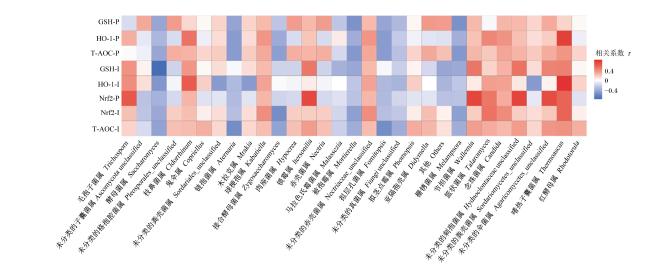
对抗氧化指标和真菌在属水平上的相对丰度进行相关性分析(表8图5),试验筛选相关系数(r)大于0.60或小于-0.60且P<0.05的数据。结果显示,回肠GSH含量与酵母菌属相对丰度呈显著负相关(r=-0.69,P<0.05);血浆Nrf2含量与锁霉属(r=0.66,P<0.05)和未分类的伞菌属(r=0.63,P<0.05)相对丰度呈显著正相关;回肠HO-1含量与嗜热子囊菌属相对丰度呈显著正相关(r=0.75,P<0.05)。
表8 真菌属与抗氧化指数相关系数(r)和P值的相关性分析

Table 8 Correlation coefficient (r) and P-value for correlation analysis between fungal genus and antioxidant indexes

项目
Items

Genus
相关系数
r
P
P-value
回肠谷胱甘肽Ileum GSH-I 酵母菌属Saccharomyces -0.69 0.01
血浆核因子E2相关因子2 Plasma Nrf2 锁霉属Itersonilia 0.66 0.02
血浆核因子E2相关因子2 Plasma Nrf2 未分类的伞菌属Agaricomycetes_unclassified 0.63 0.03
回肠血红素氧合酶-1 Ileum HO-1 嗜热子囊菌属Thermoascus 0.75 0.00
图5 抗氧化指数与真菌属相对丰度的皮尔逊相关性分析

GSH-P:血浆谷胱甘肽 plasma GSH;HO-1-P:血浆血红素氧合酶-1 plasma HO-1;T-AOC-P:血浆总抗氧化能力 plasma T-AOC;GSH-I:回肠谷胱甘肽 ileal GSH;HO-1-I:回肠血红素氧合酶-1 ileal HO-1;Nrf2-P:血浆核因子E2相关因子2 plasma Nrf2;Nrf2-I:回肠核因子E2相关因子2 ileal Nrf2;T-AOC-I:回肠总抗氧化能力ileal T-AOC。

Fig.5 Pearson’s correlation analysis between antioxidant indexes and relative abundance of fungal genus

3 讨论

益生菌具有抵抗肠道氧化应激的作用。研究表明,植物乳杆菌16和多黏杆菌10能够通过上调回肠中的Nrf2和HO-1表达提高肉鸡肠道的抗氧化能力[28]。饲粮中添加植物乳杆菌JM113可显著提高脱氧雪腐镰刀菌烯醇诱导肉鸡血浆中Nrf2及其下游靶基因HO-1的表达量[29]。植物乳杆菌1.2567通过改善肠道微绒毛结构对肉鸡坏死性肠炎起到抵抗作用[30]。本课题组前期研究表明,植物乳杆菌P8可改善患球虫病肉鸡的肠道形态、盲肠菌群结构并减轻氧化应激[23]。在本试验中,植物乳杆菌P8同样可提高DEX诱导的氧化应激肉鸡血浆和回肠黏膜中的Nrf2、GSH含量及HO-1活性和T-AOC,但是DEX和植物乳杆菌P8对肉鸡回肠形态无显著影响。与本研究结果相似,Wang等[31]同样发现,植物乳杆菌B1对大肠杆菌K88攻毒肉鸡的回肠形态无显著影响。
研究表明,益生菌可通过调控肠道菌群缓解氧化应激[32]。例如,饲粮中添加枯草芽孢杆菌能够通过抑制毛螺菌科_FCS20群(Lachnospiraceae_FCS020_group)、瘤胃梭菌属(Ruminiclostridium)、毛螺菌科_UCG-010(Lachnospiraceae_UCG-010)和草酸杆菌属(Oxalobacter)等肠道有害菌缓解蛋鸡氧化应激[33];饮水中添加干酪乳杆菌、嗜酸乳杆菌和双歧杆菌能够通过减少大肠杆菌和沙门氏菌的数量缓解肉鸡的氧化应激[34]。肠道菌群主要由细菌(99.1%)和真菌(0.02%)等组成[35]。虽然真菌在肠道中的数量较少,但其对宿主健康有重要的调控作用,例如,肥胖小鼠肠道真菌多样性较正常小鼠显著降低,且毛霉属和青霉菌属的丰度较高[36]。葡聚糖硫酸钠诱导的结肠炎小鼠和正常小鼠肠道中曲霉菌和青霉菌占比最高,其中隐球菌、节担菌属(Wallemia)和未鉴定的酵母菌属的丰度和正常小鼠相比显著降低[37]。Sokol等[38]在炎症性肠病患者中观察到肠道真菌群失调,与健康对照组相比,酿酒酵母的比例降低而白色念珠菌的比例增加。在本研究中,韦恩图显示各组肉鸡盲肠真菌存在差异,但DEX和植物乳杆菌P8对盲肠真菌多样性无显著影响。此外,在门水平上,各组肉鸡盲肠优势真菌主要为子囊菌门和担子菌门,这与前人在肉鸡、仔猪、牛、绵羊和山羊中的研究结果[39-43]一致,囊菌门和担子菌门相对丰度较高可能与动物食草特性有关。子囊菌门是迄今为止真菌界最大的门,具有降解木质素和角蛋白等有机物质的作用,在营养循环中发挥重要作用[44]。研究表明,动物肠道中较高的子囊菌门丰度可能与植物多糖的发酵有关[45]。此外,与DEX组相比,DEX_P8组接合菌门的相对丰度显著降低。接合菌门是真菌门中研究较少的一个门,由毛菌纲和接合菌纲组成。接合菌纲的真菌主要是腐生菌[46],虽然其在肉鸡中的作用尚不清楚,但研究显示接合菌门真菌的相对丰度与纤维素分解作用或产生纤维素酶有关[39]。在科水平上,DEX的处理使未分类的格孢腔菌科、鬼伞科、肉座菌科、间座壳科、亚隔孢壳科、未分类的肉座菌科、球盖菇科和Coniochaetaceae的相对丰度降低,而酵母科和未分类的马拉色氏霉菌科的相对丰度增加。与DEX组相比,DEX_P8的处理使酵母科、被孢霉科的相对丰度降低,而毛孢子菌科、亚隔孢壳科、间座壳科的相对丰度增加。研究显示,在对羊茅毒具有高耐受性的牛中,格孢腔菌目的相对丰度增加[47],表明格孢腔菌目可能对动物具有一定的保护作用。相反,毛孢子菌科和鬼伞科中含有多种条件性致病细菌[48]。El Mouzan等[49]的研究发现,鬼伞科与儿童克罗恩病密切相关。在属水平上,肉座菌属、拟茎点霉属、亚隔孢壳属等在DEX处理后相对丰度降低,而马拉色氏霉菌属相对丰度增加。与DEX组相比,接合酵母菌属和被孢霉属的相对丰度在DEX_P8处理后显著降低,而锁霉属、亚隔孢壳属和拟茎点霉属的相对丰度显著增加。研究表明,肉座菌属、亚隔孢壳属和拟茎点霉属与垫料、谷物和腐生菌有关[50-52]。因此,肉鸡肠道中上述真菌可能来自于饲料或饮水。此外,锁霉属通常是植物的共生菌或病原菌,因此,它的存在可能与饲料的摄入有关[35,53-54]。然而,Li等[55]研究表明,在腹泻的长颈鹿肠道中,锁霉属、异壳二孢属、毛霉菌属、黑粉菌属、Protostropharia、头囊聚孢霉属和耐干霉菌属的相对丰度显著降低,甚至在其肠道中未发现锁霉属,说明锁霉属可能在维持动物健康状态方面发挥一定作用,但锁霉属在肉鸡中的具体作用还有待进一步研究。本试验中,肉鸡肠道真菌在种水平上的结构变化与在属水平上的变化相似,未分类的格孢腔菌种、未分类的亚隔孢壳种、未分类的拟茎点霉种等在DEX处理后相对丰度降低,而限制马拉色氏霉菌相对丰度增加。与DEX组相比,未分类的接合酵母菌种和长枝被孢霉种的相对丰度在DEX_P8处理后显著降低,而Itersonilia_perplexans、未分类的拟茎点霉种和未分类的亚隔孢壳种的相对丰度显著增加,同样表明Itersonilia可能在维持动物健康状态方面发挥作用。此外,相关性分析进一步表明抗氧化指标与真菌相对丰度之间具有显著相关性,如血浆Nrf2含量与锁霉属相对丰度呈正相关,回肠HO-1含量与嗜热子囊菌属相对丰度呈显著正相关等。由于在DEX_P8组中,锁霉属的相对丰度显著升高,因此,锁霉属可能是植物乳杆菌P8缓解肉鸡氧化应激的关键真菌。

4 结论

在本试验中,植物乳杆菌P8能够显著提高DEX诱导氧化应激肉鸡的血浆和回肠抗氧化能力,还能够改变肉鸡盲肠内容物中真菌的组成。相关性分析表明,植物乳杆菌P8对氧化应激的调控可能与盲肠真菌的变化有关。
[1]
SIEGEL H S. Physiological stress in birds[J]. Bioscience, 1980, 30(8):529-534.

DOI

[2]
CHROUSOS G P, GOLD P W. The concepts of stress and stress system disorders.Overview of physical and behavioral homeostasis[J]. JAMA, 1992, 267(9):1244-1252.

DOI

[3]
GAO J, LIN H, WANG X J, et al. Vitamin E supplementation alleviates the oxidative stress induced by dexamethasone treatment and improves meat quality in broiler chickens[J]. Poultry Science, 2010, 89(2):318-327.

DOI PMID

[4]
OSHO S O, ADEOLA O. Chitosan oligosaccharide supplementation alleviates stress stimulated by in-feed dexamethasone in broiler chickens[J]. Poultry Science, 2020, 99(4):2061-2067.

DOI PMID

[5]
LIU H W, ZHAO F, ZHANG K, et al. Investigating the growth performance,meat quality,immune function and proteomic profiles of plasmal exosomes in Lactobacillus plantarum-treated broilers with immunological stress[J]. Food & Function, 2021, 12(23):11790-11807.

[6]
BAREKATAIN R, NATTRASS G, TILBROOK A J, et al. Reduced protein diet and amino acid concentration alter intestinal barrier function and performance of broiler chickens with or without synthetic glucocorticoid[J]. Poultry Science, 2019, 98(9):3662-3675.

DOI PMID

[7]
QIAO Y, SUN J, DING Y Y, et al. Alterations of the gut microbiota in high-fat diet mice is strongly linked to oxidative stress[J]. Applied Microbiology and Biotechnology, 2013, 97(4):1689-1697.

DOI PMID

[8]
SHANG Y, KUMAR S, OAKLEY B, et al. Chicken gut microbiota:importance and detection technology[J]. Frontiers in Veterinary Science, 2018, 5:254.

DOI

[9]
CANI P D. Human gut microbiome:hopes,threats and promises[J]. Gut, 2018, 67(9):1716-1725.

DOI

[10]
DAM B, MISRA A, BANERJEE S. Role of gut microbiota in combating oxidative stress[M]//CHAKRABORTI S,CHAKRABORTI T,CHATTOPADHYAY D,et al. Oxidative stress in microbial diseases.Singapore:Springer, 2019:43-82.

[11]
HU Y L, CHEN D W, ZHENG P, et al. The bidirectional interactions between resveratrol and gut microbiota:an insight into oxidative stress and inflammatory bowel disease therapy[J]. BioMed Research International, 2019, 2019:5403761.

[12]
ARUMUGAM M, RAES J, PELLETIER E, et al. Enterotypes of the human gut microbiome[J]. Nature, 2011, 473(7346):174-180.

DOI

[13]
HOOKER C A, LEE K Z, SOLOMON K V. Leveraging anaerobic fungi for biotechnology[J]. Current Opinion in Biotechnology, 2019, 59:103-110.

DOI PMID

[14]
RODRIGUES I K, ANDRIGUETI M, DE OLIVEIRA GIL I D, et al. An investigation into the relationship between anti-Helicobacter pylori and anti-Saccharomyces cerevisiae antibodies in patients with axial spondyloarthritis and Crohn disease[J]. Rheumatology International, 2015, 35(2):359-366.

DOI

[15]
CHIARO T R, SOTO R, STEPHENS W Z, et al. A member of the gut mycobiota modulates host purine metabolism exacerbating colitis in mice[J]. Science Translational Medicine, 2017, 9(380):eaaf9044.

DOI

[16]
LI M, DAI B B, TANG Y W, et al. Altered bacterial-fungal interkingdom networks in the guts of ankylosing spondylitis patients[J]. mSystems, 2019, 4(2):e00176-18.

[17]
HOFFMANN C, DOLLIVE S, GRUNBERG S, et al. Archaea and fungi of the human gut microbiome:correlations with diet and bacterial residents[J]. PLoS One, 2013, 8(6):e66019.

DOI

[18]
KIM S K, GUEVARRA R B, KIM Y T, et al. Role of probiotics in human gut microbiome-associated diseases[J]. Journal of Microbiology and Biotechnology, 2019, 29(9):1335-1340.

DOI

[19]
SAM Q H, CHANG M W, CHAI L Y A. The fungal mycobiome and its interaction with gut bacteria in the host[J]. International Journal of Molecular Sciences, 2017, 18(2):330.

DOI

[20]
SCHEI K, AVERSHINA E, ØIEN T, et al. Early gut mycobiota and mother-offspring transfer[J]. Microbiome, 2017, 5(1):107.

DOI PMID

[21]
KIM D H, KIM H, JEONG D, et al. Kefir alleviates obesity and hepatic steatosis in high-fat diet-fed mice by modulation of gut microbiota and mycobiota:targeted and untargeted community analysis with correlation of biomarkers[J]. The Journal of Nutritional Biochemistry, 2017, 44:35-43.

DOI

[22]
HÅKANSSON Å, ANDRÉN ARONSSON C, BRUNDIN C, et al. Effects of Lactobacillus plantarum and Lactobacillus paracasei on the peripheral immune response in children with celiac disease autoimmunity:a randomized,double-blind,placebo-controlled clinical trial[J]. Nutrients, 2019, 11(8):1925.

DOI

[23]
WANG Y, LV X G, LI X M, et al. Protective effect of Lactobacillus plantarum P8 on growth performance,intestinal health,and microbiota in Eimeria-infected broilers[J]. Frontiers in Microbiology, 2021, 12:705758.

DOI

[24]
LEW L C, HOR Y Y, YUSOFF N A A, et al. Probiotic Lactobacillus plantarum P8 alleviated stress and anxiety while enhancing memory and cognition in stressed adults:a randomised,double-blind,placebo-controlled study[J]. Clinical Nutrition, 2019, 38(5):2053-2064.

DOI

[25]
BAO Y, WANG Z L, ZHANG Y, et al. Effect of Lactobacillus plantarum P-8 on lipid metabolism in hyperlipidemic rat model[J]. European Journal of Lipid Science and Technology, 2012, 114(11):1230-1236.

DOI

[26]
WANG L, ZHOU H H, HE R J, et al. Effects of soybean meal fermentation by Lactobacillus plantarum P8 on growth,immune responses,and intestinal morphology in juvenile turbot (Scophthalmus maximus L.)[J]. Aquaculture, 2016, 464:87-94.

DOI

[27]
王锦. 硒和维生素E缓解肉鸡氧化应激的研究[D].硕士学位论文. 杨凌: 西北农林科技大学, 2012.

WANG J. Dietary selenium and vitamin E alleviate DEX-induced oxidative stress in broilers[D].Master’s Thesis. Yangling: Northwest A&F University, 2012. (in Chinese)

[28]
WU Y P, WANG B K, ZENG Z H, et al. Effects of probiotics Lactobacillus plantarum 16 and Paenibacillus polymyxa 10 on intestinal barrier function,antioxidative capacity,apoptosis,immune response,and biochemical parameters in broilers[J]. Poultry Science, 2019, 98(10):5028-5039.

DOI

[29]
YANG X, LI L, DUAN Y L, et al. Antioxidant activity of JM113 in vitro and its protective effect on broiler chickens challenged with deoxynivalenol[J]. Journal of Animal Science, 2017, 95(2):837-846.

[30]
CAO L, WU X H, BAI Y L, et al. Anti-inflammatory and antioxidant activities of probiotic powder containing Lactobacillus plantarum 1.2567 in necrotic enteritis model of broiler chickens[J]. Livestock Science, 2019, 223:157-163.

DOI

[31]
WANG S, PENG Q, JIA H M, et al. Prevention of Escherichia coli infection in broiler chickens with Lactobacillus plantarum B1[J]. Poultry Science, 2017, 96(8):2576-2586.

DOI

[32]
WANG Y, WU Y P, WANG Y Y, et al. Antioxidant properties of probiotic bacteria[J]. Nutrients, 2017, 9(5):521.

DOI

[33]
ZOU X Y, ZHANG M, TU W J, et al. Bacillus subtilis inhibits intestinal inflammation and oxidative stress by regulating gut flora and related metabolites in laying hens[J]. Animal, 2022, 16(3):100474.

DOI

[34]
ZHANG L H, ZHANG R N, JIA H, et al. Supplementation of probiotics in water beneficial growth performance,carcass traits,immune function,and antioxidant capacity in broiler chickens[J]. Open Life Sciences, 2021, 16(1):311-322.

DOI

[35]
MCGOVERN R J, HORITA H, STILES C M, et al. Host range of Itersonilia perplexans and management of Itersonilia petal blight of China aster[J]. Plant Health Progress, 2006, 7(1):7.

DOI

[36]
RODRÍGUEZ M M, PÉREZ D, CHAVES F J, et al. Obesity changes the human gut mycobiome[J]. Scientific Reports, 2015, 5(1):14600.

DOI

[37]
QIU X Y, ZHANG F, YANG X, et al. Changes in the composition of intestinal fungi and their role in mice with dextran sulfate sodium-induced colitis[J]. Scientific Reports, 2015, 5:10416.

DOI PMID

[38]
SOKOL H, LEDUCQ V, ASCHARD H, et al. Fungal microbiota dysbiosis in IBD[J]. Gut, 2017, 66(6):1039-1048.

DOI PMID

[39]
RICHARDSON M J. Diversity and occurrence of coprophilous fungi[J]. Mycological Research, 2001, 105(4):387-402.

DOI

[40]
ELSHAFIE A E. Coprophilous mycobiota of Oman[J]. Mycotaxon, 2005, 93:355-357.

[41]
KITTELMANN S, NAYLOR G E, KOOLAARD J P, et al. A proposed taxonomy of anaerobic fungi (class Neocallimastigomycetes) suitable for large-scale sequence-based community structure analysis[J]. PLoS One, 2012, 7(5):e36866.

DOI

[42]
YANG Q, LIU J, ROBINSON K J, et al. Perturbations of the ileal mycobiota by necrotic enteritis in broiler chickens[J]. Journal of Animal Science and Biotechnology, 2021, 12(1):107.

DOI PMID

[43]
KONG Q H, LIU S Z, LI A Y, et al. Characterization of fungal microbial diversity in healthy and diarrheal Tibetan piglets[J]. BMC Microbiology, 2021, 21(1):204.

DOI PMID

[44]
BEIMFORDE C, FELDBERG K, NYLINDER S, et al. Estimating the phanerozoic history of the ascomycota lineages:combining fossil and molecular data[J]. Molecular Phylogenetics and Evolution, 2014, 78:386-398.

DOI

[45]
LI J Y, LUO Y H, CHEN D w, et al. The fungal community and its interaction with the concentration of short-chain fatty acids in the caecum and colon of weaned piglets[J]. Journal of Animal Physiology and Animal Nutrition, 2020, 104(2):616-628.

DOI PMID

[46]
BENNY G L, HUMBER R A, MORTON J B. Zygomycota:zygomycetes[M]//MCLAUGHLIN D J,MCLAUGHLIN E G,LEMKE P A. Systematics and evolution.Berlin, Heidelberg:Springer, 2001:113-146.

[47]
KOESTER L R, POOLE D H, SERÃO N V L, et al. Beef cattle that respond differently to fescue toxicosis have distinct gastrointestinal tract microbiota[J]. PLoS One, 2020, 15(7):e0229192.

DOI

[48]
ALIYU H, GORTE O, DE MAAYER P, et al. Genomic insights into the lifestyles,functional capacities and oleagenicity of members of the fungal family Trichosporonaceae[J]. Scientific Reports, 2020, 10(1):2780.

DOI

[49]
EL MOUZAN M, WANG F, AL MOFARREH M, et al. Fungal microbiota profile in newly diagnosed treatment-naïve children with crohn’s disease[J]. Journal of Crohn’s and Colitis, 2017, 11(5):586-592.

DOI

[50]
CROMEY M G, GANEV S, BRAITHWAITE M, et al. Didymella exitialis on wheat in New Zealand[J]. New Zealand Journal of Crop and Horticultural Science, 1994, 22(2):139-144.

DOI

[51]
KUBICEK C P, KOMON-ZELAZOWSKA M, DRUZHININA I S. Fungal genus Hypocrea/Trichoderma:from barcodes to biodiversity[J]. Journal of Zhejiang University Science B, 2008, 9(10):753-763.

DOI

[52]
UDAYANGA D, LIU X Z, MCKENZIE E H C, et al. The genus Phomopsis:biology,applications,species concepts and names of common phytopathogens[J]. Fungal Diversity, 2011, 50(1):189-225.

DOI

[53]
ADEDEJI A R, ADENIYI D O. Comparative fungal profile of tea leaves from highland and lowland in Nigeria[J]. African Journal of Agricultural Research, 2015, 10(13):1531-1535.

DOI

[54]
BUBICI G. First report of Itersonilia perplexans on Anethum graveolens in Italy[J]. Journal of Plant Pathology, 2015, 97(1):221.

[55]
LI A Y, LIU B X, LI F R, et al. Integrated bacterial and fungal diversity analysis reveals the gut microbial alterations in diarrheic giraffes[J]. Frontiers in Microbiology, 2021, 12:712092.

DOI

文章导航

/