研究论文

蛋鸡产蛋高峰至后期生产性能和抗氧化能力的变化特征研究

  • 陈炳旭 , 1, 2 ,
  • 宋丹 1, 2 ,
  • 段涛 2 ,
  • 王薇薇 , 2, * ,
  • 闵育娜 , 1, *
展开
  • 1 西北农林科技大学动物科技学院,杨凌 712100
  • 2 国家粮食和物资储备局科学研究院,北京 100037
*王薇薇,副研究员,硕士生导师,E-mail: ;
闵育娜,教授,博士生导师,E-mail:

陈炳旭(1998—),女,吉林白山人,硕士研究生,动物营养与饲料科学专业。E-mail:

Copy editor: 田艳明

收稿日期: 2022-10-26

  网络出版日期: 2023-05-11

基金资助

中央级公益性科研院所基本科研业务费专项(ZX2215)

国家现代农业产业技术体系(CARS-40)

Variation Characteristics of Performance and Antioxidant Capacity of Laying Hens from Peak to Late Laying Period

  • CHEN Bingxu , 1, 2 ,
  • SONG Dan 1, 2 ,
  • DUAN Tao 2 ,
  • WANG Weiwei , 2, * ,
  • MIN Yuna , 1, *
Expand
  • 1 College of Animal Science and Technology, Northwest A&F University, Yangling 712100, China
  • 2 Academy of National Food and Strategic Reserves Administration, Beijing 100037, China
*WANG Weiwei, associate professor, E-mail: ;
MIN Yuna, professor, E-mail:

Received date: 2022-10-26

  Online published: 2023-05-11

摘要

本试验旨在研究产蛋高峰至产蛋后期蛋鸡生产性能、蛋品质以及血浆、肝脏和输卵管氧化损伤随时间的变化特征。选取135只健康、体况基本一致的34周龄海兰褐蛋鸡,设9个重复,每个重复15只鸡。试验期48周,在34、46、58、70和82周龄采样,测定蛋品质、血浆氧化损伤标志物和抗氧化酶活性;测定34、58和82周龄蛋鸡肝脏、输卵管膨大部和子宫部的氧化损伤标志物和抗氧化酶活性。结果表明:1)与34、40和46周龄相比,76周龄时产蛋率显著降低(P<0.05);与34和40周龄相比,76周龄时平均蛋重显著提高(P<0.05);与64周龄相比,82周龄时破蛋率显著提高(P<0.05)。2)82周龄时蛋壳强度和蛋黄颜色显著低于34、46和58周龄时(P<0.05),70和82周龄时蛋白高度和哈氏单位显著低于34和46周龄时(P<0.05),70和82周龄时蛋壳指数显著高于34和46周龄时(P<0.05)。3)82周龄时血浆中丙二醛(MDA)、8-羟基脱氧鸟苷(8-OHdG)和硝基酪氨酸(NT)含量显著高于34周龄时(P<0.05),58周龄时血浆中超氧化物歧化酶(SOD)活性显著高于34和46周龄时(P<0.05),46和58周龄时血浆中谷胱甘肽过氧化物歧化酶(GSH-Px)活性和总抗氧化能力(T-AOC)显著高于34、70和82周龄时(P<0.05);82周龄时肝脏中MDA、8-OHdG、NT含量以及T-AOC和SOD、GSH-Px活性显著高于34和58周龄时(P<0.05);82周龄时输卵管膨大部中MDA、8-OHdG和NT含量显著高于34周龄时(P<0.05),82周龄时输卵管膨大部中T-AOC和GSH-Px活性显著低于34周龄时(P<0.05),58周龄时输卵管膨大部中SOD活性显著高于34和82周龄时(P<0.05);82周龄输卵管子宫部中MDA和8-OHdG含量显著高于34周龄时(P<0.05),58周龄输卵管子宫部中SOD和GSH-Px活性显著高于34和82周龄时(P<0.05),58和82周龄时输卵管子宫部中T-AOC显著低于34周龄时(P<0.05)。综上所述,从产蛋高峰期到产蛋后期,蛋鸡的生理代谢活动会随周龄增长而变化,导致蛋鸡生产性能降低,蛋品质下降,输卵管膨大部和子宫部抗氧化能力退化。

本文引用格式

陈炳旭 , 宋丹 , 段涛 , 王薇薇 , 闵育娜 . 蛋鸡产蛋高峰至后期生产性能和抗氧化能力的变化特征研究[J]. 动物营养学报, 2023 , 35(5) : 2981 -2989 . DOI: 10.12418/CJAN2023.278

Abstract

This experiment was conducted to study the variation characteristics of performance, egg quality and oxidative damage in plasma, liver and oviduct of laying hens from peak to late laying period with time. A total of 135 healthy Hy-Line brown laying hens at 34 weeks of age with similar body condition were selected and 9 replicates were set with 15 hens per replicate. The experiment lasted for 48 weeks. Samples were collected at 34, 46, 58, 70 and 82 weeks of age to determine egg quality, plasma markers of oxidative damage and antioxidant enzyme activity; and markers of oxidative damage and activities of antioxidant enzymes in liver, oviduct enlargement and uterine oviduct of laying hens at 34, 58 and 82 weeks of age were also determined. The results showed as follows: 1) compared with 34, 40 and 46 weeks of age, the laying rate at 76 weeks of age was significantly decreased (P<0.05); compared with 34 and 40 weeks of age, the average egg weight at 76 weeks of age was significantly increased (P<0.05); and compared with 64 weeks of age, the broken egg rate at 82 weeks of age was significantly increased (P<0.05). 2) The eggshell strength and yolk color at 82 weeks of age were significantly lower than those at 34, 46 and 58 weeks of age (P<0.05), the egg white height and Haugh unit at 70 and 82 weeks of age were significantly lower than those at 34 and 46 weeks of age (P<0.05), and the eggshell index at 70 and 82 weeks of age was significantly higher than those at 34 and 46 weeks of age (P<0.05). 3) The contents of malondialdehyde (MDA), 8-hydroxy-deoxyguanosine (8-OHdG) and nitrotyrosine (NT) in plasma at 82 weeks of age were significantly higher than those at 34 weeks of age (P<0.05), the superoxide dismutase (SOD) activity in plasma at 58 weeks of age was significantly higher than that at 34 and 46 weeks of age (P<0.05), and the glutathione peroxidase dismutase (GSH-Px) activity and total antioxidant capacity (T-AOC) in plasma at 46 and 58 weeks of age were significantly higher than those at 34, 70 and 82 weeks of age (P<0.05); the contents of MDA, 8-OHdG and NT and T-AOC as well as the activities of SOD and GSH-Px in liver at 82 weeks of age were significantly higher than those at 34 and 58 weeks of age (P<0.05); the contents of MDA, 8-OHdG and NT in oviduct enlargement at 82 weeks of age were significantly higher than those at 34 weeks of age (P<0.05), the T-AOC and GSH-Px activity in oviduct enlargement at 82 weeks of age were significantly lower than those at 34 weeks of age (P<0.05), and the SOD activity in oviduct enlargement at 58 weeks of age was significantly higher than that at 34 and 82 weeks of age (P<0.05); the contents of MDA and 8-OHdG in uterine oviduct at 82 weeks of age were significantly higher than those at 34 weeks of age (P<0.05), the activities of SOD and GSH-Px in uterine oviduct at 58 weeks of age were significantly higher than those at 34 and 82 weeks of age (P<0.05), and the T-AOC in uterine oviduct at 58 and 82 weeks of age was significantly lower than that at 34 weeks of age (P<0.05). In conclusion, the physiological and metabolic activities of laying hens change with the increase of weeks of age from peak to late laying period, leading to the decrease of performance, egg quality, and the degradation of antioxidant capacity in oviduct enlargement and uterine oviduct of laying hens.

近年来,随着现代育种技术的大力发展和养殖体系的完善,家禽养殖业提出将蛋鸡的淘汰周龄从72周龄延长至100周龄,从而降低生产成本,这造成蛋鸡产蛋期大大延长。在产蛋高峰期结束后,产蛋率、蛋壳质量和鸡蛋中的部分营养物质逐渐下降[1-2],蛋鸡养殖的经济效益受到影响。在鸡蛋生产过程中,蛋鸡在雌激素的影响下在肝脏内合成大量的卵黄前体(甘油三酯、磷脂和胆固醇)[3],这些物质进入到卵巢,经过一系列的生理过程,卵巢排出成熟的卵细胞,随后进入输卵管伞部形成卵黄膜,继而进入输卵管膨大部形成蛋白,再进入输卵管峡部形成外壳膜,然后在输卵管子宫部形成蛋壳,最后形成鸡蛋从泄殖腔排出体外[4]。商品蛋鸡在200日龄左右时产蛋率最高可达95%以上,但到480日龄后产蛋率迅速下降[5]。研究表明,肝细胞体积减少、肝细胞核形态发生变化[6],会引起肝脏卵黄前体物合成和转运能力降低[7],并且引起卵巢抗氧化能力下降[8],导致老年蛋鸡产蛋率降低。然而,作为影响蛋鸡生产性能和蛋品质的重要因素,鸡肝脏和输卵管的抗氧化能力随年龄增长发生的变化鲜有报道。在正常细胞中,有抗氧化防御系统来清除活性氧(reactive oxygen species,ROS),从而减轻氧化应激损伤。然而,衰老过程会导致抗氧化物质水平逐渐下降,ROS生成和抗氧化系统之间的平衡可能会被破坏[9]。因此,推测机体抗氧化防御功能的降低可能是导致老龄蛋鸡产蛋性能下降的主要原因。基于此,本试验旨在研究蛋鸡自产蛋高峰至产蛋后期生产性能、蛋品质和抗氧化能力随周龄的变化规律,为产蛋后期的营养调控提供理论依据。

1 材料与方法

1.1 试验设计

选取135只体重、健康和体况基本一致(P>0.05)的34周龄海兰褐蛋鸡,设9个重复,每个重复15只鸡。试验期48周。基础饲粮组成及营养水平见表1
表1 基础饲粮组成及营养水平(风干基础)

Table 1 Composition and nutrient levels of the basal diet (air-dry basis) %

项目Items 含量Content
原料Ingredients
玉米Corn 60.09
豆粕Soybean meal 26.17
石粉Limestone 9.40
大豆油Soybean oil 1.55
磷酸氢钙CaHPO4 1.32
胆碱Chloride 0.10
DL-蛋氨酸DL-Met 0.22
氯化钠NaCl 0.20
L-赖氨酸盐酸盐L-Lys·HCl 0.03
L-苏氨酸L-Thr 0.03
植酸酶Phytase 0.02
预混料Premix1) 0.87
合计Total 100.00
营养水平Nutrient levels2)
粗蛋白质CP 16.70
钙Ca 3.66
总磷TP 0.54
可利用磷AP 0.33
氯化钠NaCl 0.23
赖氨酸Lys 0.90
蛋氨酸Met 0.45
苏氨酸Thr 0.70
代谢能ME/(MJ/kg) 11.21

1)预混料为每千克饲粮提供 The premix provided the following per kilogram of the diet:VA 14 300 IU,VD3 2 700 IU,VE 29 IU,VK1 0.80 mg,VB1 2.25 mg,VB2 8 mg,VB6 1.50 mg,VB12 0.03 mg,烟酸 niacin 35.75 mg,D-泛酸 D-pantothenic acid 7.00 mg,叶酸 folic acid 0.50 mg,生物素 biotin 0.06 mg,Mg 87.50 mg,Fe 100.00 mg,Cu 5.00 mg,Zn 75.00 mg,Se 0.25 mg,I 0.35 mg,Mn 120 mg。

2)营养水平为计算值。Nutrient levels were calculated values.

1.2 饲养管理

动物试验在天津市畜牧兽医研究所武清养殖试验基地开展。试验采用3层阶梯式笼养,鸡舍温度为15~22 ℃,相对湿度为30%~50%,每天人工光照16 h。每天饲喂3次(08:00、11:00和16:00),17:00准时收集鸡蛋。试验鸡自由采食和饮水,机械清粪。每天观察鸡群健康状况,记录死淘鸡数。采用常规免疫、消毒和饲养管理程序。

1.3 检测指标及方法

1.3.1 生产性能

试验期间,每天准确记录蛋鸡产蛋量、破蛋数和蛋重,计算蛋鸡产蛋率、平均蛋重、平均日产蛋量和破蛋率。
产蛋率=100×每重复产蛋个数/每重复鸡数;
平均蛋重=每重复总蛋重/每重复鸡蛋个数;
平均日产蛋量=100×平均蛋重×日产蛋率;
破蛋率=100×破蛋数/产蛋总数。

1.3.2 蛋品质

蛋鸡在34、46、58、70和82周龄时,每个重复随机选取5枚鸡蛋,共计225枚,用于蛋品质检测,包括蛋重、蛋壳厚度、蛋壳强度、蛋黄颜色、蛋白高度、哈氏单位和蛋形指数等。采用蛋品分析仪(EMT-5200,Robotmation,日本)测定蛋重、蛋白高度、蛋黄颜色和哈氏单位,采用蛋壳强度测定仪(EFG-0503,Robotmation,日本)测定蛋壳强度,采用蛋壳厚度测量仪(ETG-1061,Robotmation,日本)测定蛋壳厚度;采用游标卡尺分别测量鸡蛋的纵经与横径,计算得到蛋形指数。
蛋形指数=鸡蛋长径/鸡蛋短径。

1.3.3 样品采集与制备

蛋鸡在34、46、58、70和82周龄时,每重复随机选取1只体况健康的蛋鸡进行采样,每个周龄测定9只鸡,空腹过夜,进行翅静脉采血,每只鸡采血5 mL于抗凝管中,室温静置1 h后3 500 r/min离心15 min分离血浆,分装于0.5 mL EP管中,并做好标号,-20 ℃保存备用。蛋鸡分别在34、58和82周龄时进行屠宰取样,在采样时每重复随机选取1只蛋鸡,二氧化碳(CO2)窒息后颈静脉放血致死,打开腹腔,迅速分离并取出肝脏、输卵管膨大部和子宫,液氮速冻,-80 ℃保存待测。

1.3.4 血浆与组织抗氧化指标

血浆、肝脏及输卵管膨大部和子宫部中超氧化物歧化酶(SOD)、谷胱甘肽过氧化物歧化酶(GSH-Px)活性以及总抗氧化能力(T-AOC)和丙二醛(MDA)含量按照试剂盒(南京建成生物工程研究所)说明书,用酶标仪进行测定;8-羟基脱氧鸟苷(8-OHdG)、硝基酪氨酸(nitrotyrosine,NT)含量按照酶联免疫吸附试验(ELISA)试剂盒(上海酶科生物科技有限公司)说明书,用酶标仪进行测定。

1.4 数据统计分析

采用SPSS 26.0软件对试验数据进行单因素方差分析(one-way ANOVA),并用Duncan氏法进行多重比较检验,试验结果用平均值和均值标准误(SEM)表示,P<0.05为差异显著。

2 结果与分析

2.1 不同周龄蛋鸡生产性能的变化

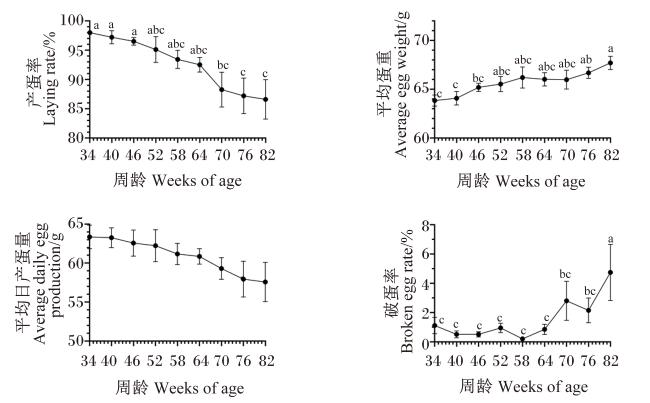
图1所示,从整体来看,随着周龄的增长,蛋鸡产蛋率和平均日产蛋量呈下降趋势,平均蛋重呈上升趋势。与34、40和46周龄相比,蛋鸡在76周龄时产蛋率显著降低(P<0.05);与34和40周龄相比,76周龄时平均蛋重显著提高(P<0.05);与64周龄相比,82周龄时蛋鸡破蛋率显著提高(P<0.05)。
图1 不同周龄蛋鸡生产性能的变化

数据柱标注不同小写字母表示差异显著(P<0.05)。

Fig.1 Changes in performance of laying hens of different weeks of age

Value columns with different small letters mean significant difference (P<0.05).

2.2 不同周龄蛋鸡蛋品质的变化

表2可知,70和82周龄时鸡蛋蛋壳强度显著低于34、46和58周龄时(P<0.05);82周龄时鸡蛋蛋黄颜色显著低于34、46、58和70周龄时(P<0.05);58、70和82周龄时鸡蛋蛋白高度显著低于34和46周龄时(P<0.05);70和82周龄时鸡蛋哈氏单位显著低于34和46周龄时(P<0.05);46、58、70和82周龄时鸡蛋蛋壳厚度显著高于34周龄时(P<0.05);70和82周龄时鸡蛋蛋形指数显著高于34和46周龄时(P<0.05)。
表2 不同周龄蛋鸡蛋品质的变化

Table 2 Changes in egg quality of laying hens of different weeks of age

项目
Items
周龄Weeks of age SEM P
P-value
34 46 58 70 82
蛋壳强度Eggshell strength/N 45.29a 42.11a 39.39a 33.29b 32.47b 0.867 <0.001
蛋黄颜色Yolk color 6.98a 6.81a 6.79a 6.63a 4.29b 0.125 <0.001
蛋白高度Egg white height/mm 7.70a 7.33a 6.50b 6.40b 6.32b 0.121 0.003
哈氏单位Haugh unit 86.10a 85.86a 80.27ab 78.26b 77.38b 0.878 0.003
蛋壳厚度Eggshell thickness/mm 0.33c 0.43a 0.42a 0.39b 0.39b 0.004 <0.001
蛋形指数Egg shape index 1.24c 1.25bc 1.29ab 1.33a 1.33a 0.007 <0.001

同行数据肩标无字母或相同字母表示差异不显著(P>0.05),不同小写字母表示差异显著(P<0.05)。下表同。

In the same row, values with no letter or the same letter superscripts mean no significant difference (P>0.05), while with different small letter superscripts mean significant difference (P<0.05). The same as below.

2.3 不同周龄蛋鸡抗氧化能力的变化

2.3.1 不同周龄蛋鸡血浆抗氧化指标的变化

表3可知,82周龄时蛋鸡血浆中MDA含量显著高于34和46周龄时(P<0.05);70和82周龄时蛋鸡血浆中8-OHdG含量显著高于34和46周龄时(P<0.05);46、58、70和82周龄时蛋鸡血浆中NT含量显著高于34周龄时(P<0.05);58、70和82周龄时蛋鸡血浆中SOD活性显著高于34周龄时(P<0.05);34、70和82周龄时蛋鸡血浆中T-AOC和GSH-Px活性显著低于46和58周龄时(P<0.05)。
表3 不同周龄蛋鸡血浆抗氧化指标的变化

Table 3 Changes in plasma antioxidant indices of laying hens of different weeks of age

项目
Items
周龄Weeks of age SEM P
P-value
34 46 58 70 82
丙二醛MDA/(nmol/mL) 2.95b 3.25b 4.31ab 5.10ab 6.38a 0.411 0.041
8-羟基脱氧鸟苷8-OHdG/(ng/mL) 25.85d 29.54c 30.92bc 33.13b 37.31a 0.803 <0.001
硝基酪氨酸NT/(nmol/L) 137.93b 200.20a 206.70a 210.93a 222.91a 6.040 <0.001
超氧化物歧化酶SOD/(U/mL) 305.83c 407.33b 469.73a 436.75ab 429.02ab 12.880 <0.001
总抗氧化能力T-AOC/(U/mL) 0.20c 0.56a 0.59a 0.41b 0.25c 0.037 <0.001
谷胱甘肽过氧化物酶GSH-Px/(U/mL) 2 036.13c 3 057.14a 3 403.33a 2 576.00b 2 297.14bc 110.796 <0.001

2.3.2 不同周龄蛋鸡肝脏抗氧化指标的变化

表4可知,82周龄时蛋鸡肝脏中MDA、8-OHdG、NT含量以及T-AOC和SOD、GSH-Px活性显著高于34和58周龄时(P<0.05)。
表4 不同周龄蛋鸡肝脏抗氧化指标的变化

Table 4 Changes in liver antioxidant indices of laying hens of different weeks of age

项目
Items
周龄Weeks of age SEM P
P-value
34 58 82
丙二醛MDA/(nmol/g prot) 132.96b 140.87b 393.42a 49.970 0.021
8-羟基脱氧鸟苷8-OHdG/(ng/mg prot) 1.58b 2.08b 3.05a 0.170 <0.001
硝基酪氨酸NT/(nmol/g prot) 10.62b 12.84b 15.02a 0.587 <0.001
超氧化物歧化酶SOD/(U/mg prot) 138.46b 164.68b 197.12a 7.850 0.001
总抗氧化能力T-AOC/(U/g prot) 68.78b 69.50b 77.93a 1.495 0.046
谷胱甘肽过氧化物酶GSH-Px/(U/mg prot) 5.86c 27.79b 40.71a 3.819 <0.001

2.3.3 不同周龄蛋鸡输卵管膨大部抗氧化指标的变化

表5可知,82周龄时蛋鸡输卵管膨大部中MDA含量显著高于34和58周龄时(P<0.05);58和82周龄时蛋鸡输卵管膨大部中8-OHdG和NT含量显著高于34周龄时(P<0.05);58周龄时蛋鸡输卵管膨大部中SOD活性显著高于34和82周龄时(P<0.05);34周龄时蛋鸡输卵管膨大部中T-AOC显著高于58和82周龄时(P<0.05);34周龄时蛋鸡输卵管膨大部中GSH-Px活性显著高于82周龄时(P<0.05)。
表5 不同周龄蛋鸡输卵管膨大部抗氧化指标的变化

Table 5 Changes in antioxidant indices in oviduct enlargement of laying hens of different weeks of age

项目
Items
周龄Weeks of age SEM P
P-value
34 58 82
丙二醛MDA/(nmol/g prot) 186.13b 224.98b 302.41a 18.915 0.026
8-羟基脱氧鸟苷8-OHdG/(ng/mg prot) 1.58b 2.08a 3.06a 0.170 <0.001
硝基酪氨酸NT/(nmol/g prot) 5.55b 8.93a 9.34a 0.759 0.039
超氧化物歧化酶SOD/(U/mg prot) 4.53c 17.00a 8.43b 7.850 <0.001
总抗氧化能力T-AOC/(U/g prot) 37.36a 18.55b 10.79c 1.495 <0.001
谷胱甘肽过氧化物酶GSH-Px/(U/mg prot) 8.23ab 12.38a 6.06b 1.026 <0.001

2.3.4 不同周龄蛋鸡输卵管子宫部抗氧化指标的变化

表6可知,82周龄时蛋鸡输卵管子宫部中MDA含量显著高于34和58周龄时(P<0.05);58和82周龄时蛋鸡输卵管子宫部中8-OHdG含量显著高于34周龄时(P<0.05);58周龄时蛋鸡输卵管子宫部中SOD和GSH-Px活性显著高于34和82周龄时(P<0.05);34周龄时蛋鸡输卵管子宫部中T-AOC显著高于58和82周龄时(P<0.05)。
表6 不同周龄蛋鸡输卵管子宫部抗氧化指标的变化

Table 6 Changes in antioxidant indices in uterine oviduct of laying hens of different weeks of age

项目
Items
周龄Weeks of age SEM P
P-value
34 58 82
丙二醛MDA/(nmol/g prot) 676.09b 818.94b 1 145.29a 71.738 0.014
8-羟基脱氧鸟苷8-OHdG/(ng/mg prot) 1.61b 2.92a 3.11a 0.239 0.002
硝基酪氨酸NT/(nmol/g prot) 14.69 16.46 17.70 0.601 0.124
超氧化物歧化酶SOD/(U/mg prot) 26.82b 32.99a 26.40b 1.027 0.005
总抗氧化能力T-AOC/(U/g prot) 159.86a 38.06b 34.99b 14.123 <0.001
谷胱甘肽过氧化物酶GSH-Px/(U/mg prot) 49.85b 76.82a 60.86b 3.867 0.005

3 讨论

3.1 不同周龄蛋鸡生产性能的变化

生产性能是衡量蛋鸡产蛋状况最有效的指标,了解蛋鸡生产性能的变化可以及时发现问题,并采取有效的措施,提高蛋鸡生产。Joyner等[5]研究发现,200日龄左右蛋鸡的产蛋率最高可达95%以上,但到480日龄后产蛋率迅速下降。老龄蛋鸡产蛋量下降的主要原因是机体老化,并伴随着内分泌变化[10]、卵黄合成减少等。Wang等[11]和张琦等[12]研究发现,从24到43周龄和从62到74周龄,蛋鸡平均蛋重增加;王斌等[13]、吴寒萧[7]和王永侠等[14]研究结果显示,从45到53周龄、从50到72周龄和从70到80周龄,蛋鸡产蛋率下降。这些研究结果与本试验结果一致。由此可见,自产蛋高峰至产蛋后期,随着周龄的增长,蛋鸡的产蛋率下降,平均蛋重增加,破蛋率提高。

3.2 不同周龄蛋鸡蛋品质的变化

蛋形指数与种用价值、破蛋率和孵化率有关,本试验的蛋形指数随着周龄增长而提高。王永侠等[14]和徐晶云[15]研究结果与本文一致,从70到80周龄和从90到97周龄,鸡蛋蛋形指数提高。哈氏单位是衡量蛋白品质的重要指标。蛋壳厚度与钙、磷吸收及破蛋率有关,能够影响蛋贮藏和运输。在鸡蛋生产的后期阶段,收集和运输过程中的鸡蛋破裂的可能性更大,蛋壳质量差的表现为蛋壳指数和厚度降低以及变形增加[16]。鸡蛋的蛋壳强度不仅取决于鸡蛋的形状和蛋壳厚度,还取决于其微观结构的质量[17]。蛋黄颜色是蛋品质的主要感官指标,取决于吸收类胡萝卜素含量,可影响蛋的商品价值和价格,蛋黄颜色与消费者偏好直接相关,在墨西哥、中国和孟加拉国等国,颜色深的蛋黄被认为是更健康的产品[18]。本研究结果显示,产蛋后期鸡蛋蛋壳强度、蛋黄颜色、蛋白高度和哈氏单位低于产蛋前期和产蛋高峰期,蛋壳厚度随周龄增长先提高后降低。这与刘兵[19]的研究结果一致,从36到84周龄,鸡蛋的蛋白高度、哈氏单位和蛋壳强度显著下降。老年蛋鸡蛋清品质下降,可能是分泌黏蛋白的输卵管膨大部ROS的积累过多,使输卵管上皮细胞损伤,导致蛋白高度和哈氏单位降低[20]

3.3 不同周龄蛋鸡抗氧化能力的变化

越来越多的证据表明,在衰老过程中,由于ROS的累积、抗氧化物质水平的下降,机体抗氧化能力会退化,器官将失去正常的生理功能[21-22]。ROS是含氧、有高度化学活性的分子的总称,除超氧阴离子、过氧化氢和羟自由基外,还包括脂质过氧化的中间产物如烷氧自由基和烷过氧自由基等[23]。ROS对生物机体可产生一系列损害作用,如引起脂质过氧化、改变细胞膜的流动性和通透性,从而改变细胞结构和功能;使蛋白质变性、交联,使酶失活;损伤DNA致细胞突变。这些损害与疾病的发生有密切关系,因此生物体内ROS的生成和清除的平衡对生命过程的正常进行至关重要。在正常细胞中,有一个主要的抗氧化防御系统来清除ROS,从而减轻氧化应激损伤。在抗氧化防御系统中,SOD被认为是将超氧阴离子自由基解毒为过氧化氢的第一线,过氧化氢再被过氧化氢酶(CAT)转化为水。谷胱甘肽过氧化物酶(GSH-Px)可以清除脂质过氧化物,通过催化过氧化氢氧化其他底物后转化为水。然而,由于在衰老过程中抗氧化酶水平逐渐下降且ROS逐渐积累,抗氧化系统之间的平衡可能会被破坏[6]
肝脏是氧化应激的靶向和效应器官。肝脏中抗氧化酶活性的高低也是动物机体免疫水平高低的重要体现,机体可通过提高肝脏抗氧化酶活性来维持肝脏中氧化平衡状态,减少氧化应激对肝脏功能的影响。越来越多的证据表明,衰老可导致脂质过氧化和蛋白质氧化,导致抗氧化剂的产生和恢复延迟,抑制肝细胞增殖和肝组织修复[24-26]。本研究中,产蛋后期蛋鸡肝脏中MDA、8-OHdG、NT含量以及T-AOC和SOD、GSH-Px活性显著高于产蛋前期和产蛋高峰期。随着周龄的增长,蛋鸡肝脏的氧化损伤加剧,肝脏中抗氧化酶的活性提高从而调节氧化平衡,防止肝脏出现疾病和损伤。这与Çoban等[27]的研究结果一致,该研究已经证明老年Wistar大鼠(20月龄)的肝脏中MDA、二烯结合物和蛋白质羰基含量都比年轻大鼠(3月龄)有所提高。
蛋鸡的生殖道不是胚胎发育的场所,而是每个卵泡形成的通道,在卵巢形成蛋黄、在输卵管膨大部形成蛋白、在输卵管峡部形成蛋壳膜和在输卵管子宫部形成蛋壳[28]。因此,蛋鸡输卵管的健康程度与鸡蛋的内外品质有着密切的关系。有研究表明,子宫蛋白或代谢产物可以影响蛋壳钙化的过程[29],并决定蛋壳的质量,其机械性能(蛋壳强度和蛋壳厚度)[30]和外观(蛋壳颜色和表面粗糙程度)[31]。1只鸡每年通过其输卵管可产生300多枚鸡蛋,目前蛋鸡的淘汰周龄从72周龄延长至100周龄,蛋鸡生殖能力随着年龄增加而降低,高强度的生产过程会对繁殖系统造成损伤,导致繁殖系统先于机体其他系统出现衰老症状[32]。本研究中,产蛋后期蛋鸡血浆、输卵管膨大部和子宫部中MDA、8-OHdG和NT含量高于产蛋前期和产蛋高峰期。这与Gu等[33]的试验结果一致,525日龄鸡血清中脂质过氧化的最终产物MDA含量比雏鸡高,这进一步表明衰老对蛋鸡氧化还原平衡的不利影响。本研究中,蛋鸡血浆、输卵管膨大部和子宫部中GSH-Px和SOD活性随着周龄增长先提高后降低;产蛋后期蛋鸡输卵管膨大部和子宫部中T-AOC低于产蛋前期和产蛋高峰期。这些结果表明,蛋鸡从雏鸡到青年时期,机体的抗氧化防御体系逐渐增强,以清除ROS,维持机体的氧化还原平衡;在衰老过程中,随着周龄的增长,机体ROS逐渐积累,抗氧化剂减少,ROS的生成和清除这一平衡被破坏,氧化应激加剧,老年蛋鸡机体抗氧化能力退化,更容易受到ROS和自由基的攻击,可能是因为氧化还原系统的不活跃的适应性调节[34]。Liu等[35]试验发现,580日龄母鸡卵巢组织中总超氧化物歧化酶(T-SOD)、GSH-Px活性和T-AOC低于青年母鸡,而MDA含量高于青年母鸡。在18月龄大鼠的小脑组织中,SOD、CAT活性和谷胱甘肽含量显著低于6和12月龄的大鼠[36]。Lim等[37]认为,小鼠卵巢功能下降的主要原因是卵巢组织积累的氧化损伤和抗氧化基因的表达量下降。本研究结果发现,ROS的累积过多,氧化还原平衡被打破,抗氧化酶活性降低,氧化损伤加剧,输卵管损伤加剧,导致蛋鸡生产性能降低,蛋品质下降。

4 结论

综上所述,从产蛋高峰期到产蛋后期,蛋鸡的生理代谢活动会随周龄增长而变化,导致蛋鸡生产性能降低,蛋品质下降,输卵管膨大部和子宫部抗氧化能力退化。
[1]
LIU M Y, YIN Y, YE X Y, et al. Resveratrol protects against age-associated infertility in mice[J]. Human Reproduction, 2013, 28(3):707-717.

DOI

[2]
TŮMOVÁ E, UHLÍ$\check{R}$OVÁ L, T ŮMA R, et al. Age related changes in laying pattern and egg weight of different laying hen genotypes[J]. Animal Reproduction Science, 2017, 183:21-26.

DOI PMID

[3]
JOHNSON A L. Chapter 28-reproduction in the female[M]//SCANES C G. Sturkie’s avian physiology. 6th ed. London: Academic Press, 2015:635-665.

[4]
沈涛涛, 张佳兰, 吴艳, 等. 蛋壳形成及其调控机制的研究进展[J]. 中国畜牧杂志, 2021, 57(6):31-36.

SHEN T T, ZHANG J L, WU Y, et al. Research progress on eggshell formation and its regulation mechanism[J]. Chinese Journal of Animal Science, 2021, 57(6):31-36. (in Chinese)

[5]
JOYNER C J, PEDDIE M J, TAYLOR T G. The effect of age on egg production in the domestic hen[J]. General and Comparative Endocrinology, 1987, 65(3):331-336.

PMID

[6]
HOARE M, DAS T, ALEXANDER G. Ageing,telomeres,senescence,and liver injury[J]. Journal of Hepatology, 2010, 53(5):950-961.

DOI

[7]
吴寒萧. 不同产蛋率广西麻鸡卵黄形成能力的差异研究[D].硕士学位论文. 南宁: 广西大学, 2022.

WU H X. Differences in egg yolk formation of Guangxi Ma chickens with dissimilar laying rates[D].Master’s Thesis. Nanning: Guangxi University, 2022. (in Chinese)

[8]
刘兴廷. 衰老蛋鸡卵巢氧化应激缓解措施及其机理的研究[D].博士学位论文. 杭州: 浙江大学, 2018.

LIU X T. Attenuation of the oxidative stress in the ovaries of the aging laying chickens[D].Ph.D. Thesis. Hangzhou: Zhejiang University, 2018. (in Chinese)

[9]
TONG L, CHUANG C C, S W U, et al. Reactive oxygen species in redox cancer therapy[J]. Cancer Letters, 2015, 367(1):18-25.

DOI PMID

[10]
BUYUK E, NEJAT E, NEAL-PERRY G. Determinants of female reproductive senescence:differential roles for the ovary and the neuroendocrine axis[J]. Seminars in Reproductive Medicine, 2010, 28(5):370-379.

DOI

[11]
WANG Y P, JIN T H, ZHANG N B, et al. Effect of stocking density and age on physiological performance and dynamic gut bacterial and fungal communities in Langya hens[J]. Microbial Cell Factories, 2021, 20(1):218.

DOI PMID

[12]
张琦, 张克英, 白世平, 等. 包被丁酸钠对蛋鸡生产性能和肠道健康的影响[J]. 动物营养学报, 2022, 34(10):6502-6513.

DOI

ZHANG Q, ZHANG K Y, BAI S P, et al. Effects of coated sodium butyrate on performance and intestinal health of laying hens[J]. Chinese Journal of Animal Nutrition, 2022, 34(10):6502-6513. (in Chinese)

DOI

[13]
王斌, 谭鑫, 邹仕庚, 等. 产蛋高峰后期添加黑水虻虫干对蛋鸡生产性能、蛋品质、器官指数和血清指标的影响[J]. 中国畜牧杂志, 2021, 57(9):149-154.

WANG B, TAN X, ZOU S G, et al. Effects of dietary supplementation with black soldier fly meal on performance,egg quality,organ index and serum biochemical parameter in Jing tint 1 laying hens[J]. Chinese Journal of Animal Science, 2021, 57(9):149-154. (in Chinese)

[14]
王永侠, 薛雅婕, 杨剑峰, 等. 不同硒源对产蛋后期蛋鸡硒沉积、抗氧化、免疫、生产性能和蛋品质的影响[J]. 饲料工业, 2022, 43(18):31-35.

WANG Y X, XUE Y J, YANG J F, et al. Effects of different selenium sources on selenium deposition,antioxidant capacity,immune function,production performance and egg quality of laying hens during the late laying period[J]. Feed Industry, 2022, 43(18):31-35. (in Chinese)

[15]
徐晶云. VA和VK3对产蛋后期蛋鸡生产性能和抗氧化性能的影响[D].硕士学位论文. 武汉: 武汉轻工大学, 2020.

XU J Y. Effects of VA and VK3 on production performance and antioxidation function of laying hens in late laying period[D].Master’s Thesis. Wuhan: Wuhan Polytechnic University, 2020. (in Chinese)

[16]
MOLNÁR A, MAERTENS L, AMPE B, et al. Changes in egg quality traits during the last phase of production:is there potential for an extended laying cycle?[J]. British Poultry Science, 2016, 57(6):842-847.

DOI

[17]
MOLNÁR A, MAERTENS L, AMPE B, et al. Supplementation of fine and coarse limestone in different ratios in a split feeding system:effects on performance,egg quality,and bone strength in old laying hens[J]. Poultry Science, 2017, 96(6):1659-1671.

DOI

[18]
HEYING E K, TANUMIHARDJO J P, VASIC V, et al. Biofortified orange maize enhances β-cryptoxanthin concentrations in egg yolks of laying hens better than tangerine peel fortificant[J]. Journal of Agricultural and Food Chemistry, 2014, 62(49):11892-11900.

DOI PMID

[19]
刘兵. 日粮硒和DHA改善产蛋后期蛋鸡肉蛋品质的效果和机制研究[D].博士学位论文. 无锡: 江南大学, 2021.

LIU B. Effects and mechanism of dietary selenium and DHA on improving the quality of meat and egg from aged laying hens[D].Ph.D. Thesis. Wuxi: Jiangnan University, 2021. (in Chinese)

[20]
张倚剑, 胡艳, 梁明振, 等. 改善产蛋后期鸡蛋蛋壳质量研究进展[J]. 动物营养学报, 2021, 33(2):686-697.

DOI

ZHANG Y J, HU Y, LIANG M Z, et al. Research progress on improving eggshell quality in late laying period[J]. Chinese Journal of Animal Nutrition, 2021, 33(2):686-697. (in Chinese)

[21]
BEN-MEIR A, BURSTEIN E, BORREGO-ALVAREZ A, et al. Coenzyme Q10 restores oocyte mitochondrial function and fertility during reproductive aging[J]. Aging Cell, 2015, 14(5):887-895.

DOI

[22]
OKUDAN N, BELVIRANLI M. Effects of exercise training on hepatic oxidative stress and antioxidant status in aged rats[J]. Archives of Physiology and Biochemistry, 2016, 122(4):180-185.

PMID

[23]
FINKEL T, HOLBROOK N J. Oxidants,oxidative stress and the biology of ageing[J]. Nature, 2000, 408(6809):239-247.

DOI

[24]
HANADA S, HARADA M, ABE M, et al. Aging modulates susceptibility to mouse liver mallory-denk body formation[J]. Journal of Histochemistry & Cytochemistry, 2012, 60(6):475-483.

DOI

[25]
CHENG Y J, WANG X, WANG B, et al. Aging-associated oxidative stress inhibits liver progenitor cell activation in mice[J]. Aging, 2017, 9(5):1359-1374.

DOI

[26]
TANIMIZU N, ICHINOHE N, SUZUKI H, et al. Prolonged oxidative stress and delayed tissue repair exacerbate acetaminophen-induced liver injury in aged mice[J]. Aging, 2020, 12(19):18907-18927.

DOI

[27]
ÇOBAN J, ÖZTEZCAN S, DO$\check{G}$RU-ABBASO$\check{G}$LU S, et al. Olive leaf extract decreases age-induced oxidative stress in major organs of aged rats[J]. Geriatrics & Gerontology International, 2014, 14(4):996-1002.

[28]
SAH N, MISHRA B. Regulation of egg formation in the oviduct of laying hen[J]. World’s Poultry Science Journal, 2018, 74(3):509-522.

DOI

[29]
GAUTRON J, HINCKE M T, NYS Y. Precursor matrix proteins in the uterine fluid change with stages of eggshell formation in hens[J]. Connective Tissue Research, 1997, 36(3):195-210.

PMID

[30]
SUN C J, XU G Y, YANG N. Differential label-free quantitative proteomic analysis of avian eggshell matrix and uterine fluid proteins associated with eggshell mechanical property[J]. Proteomics, 2013, 13(23/24):3523-3536.

DOI

[31]
NYS Y, ZAWADZKI J, GAUTRON J, et al. Whitening of brown-shelled eggs:mineral composition of uterine fluid and rate of protoporphyrin deposition[J]. Poultry Science, 1991, 70(5):1236-1245.

DOI

[32]
STOOP D, COBO A, SILBER S. Fertility preservation for age-related fertility decline[J]. The Lancet, 2014, 384(9950):1311-1319.

DOI

[33]
GU Y F, CHEN Y P, JIN R, et al. A comparison of intestinal integrity,digestive function,and egg quality in laying hens with different ages[J]. Poultry Science, 2021, 100(3):100949.

DOI

[34]
SURAI P F, KOCHISH I I. Nutritional modulation of the antioxidant capacities in poultry:the case of selenium[J]. Poultry Science, 2019, 98(10):4231-4239.

DOI

[35]
LIU X T, LIN X, ZHANG S Y, et al. Lycopene ameliorates oxidative stress in the aging chicken ovary via activation of Nrf2/HO-1 pathway[J]. Aging, 2018, 10(8):2016-2036.

DOI

[36]
SUBRAMANIAN M V, JAMES T J. Age-related protective effect of deprenyl on changes in the levels of diagnostic marker enzymes and antioxidant defense enzymes activities in cerebellar tissue in Wistar rats[J]. Cell Stress and Chaperones, 2010, 15(5):743-751.

DOI PMID

[37]
LIM J, LUDERER U. Oxidative damage increases and antioxidant gene expression decreases with aging in the mouse ovary[J]. Biology of Reproduction, 2011, 84(4):775-782.

DOI PMID

文章导航

/