研究论文

N-氨甲酰谷氨酸对荷斯坦公牛胃肠道微生物组成的影响

  • 孙雪丽 , 1 ,
  • 田雨晴 1, * ,
  • 李树静 2 ,
  • 张秀江 3 ,
  • 沈宜钊 1 ,
  • 李建国 1 ,
  • 高艳霞 1 ,
  • 赵超 1 ,
  • 李秋凤 , 1, ** ,
  • 曹玉凤 , 1, ** ,
  • 肖阳 4
展开
  • 1 河北农业大学动物科技学院,保定 071000
  • 2 河北天和肉牛养殖有限公司,石家庄 050200
  • 3 保定市畜牧工作站,保定 071051
  • 4 定兴县动物疫病预防控制中心,保定 072650
**李秋凤,教授,硕士生导师,E-mail: ;
曹玉凤,教授,硕士生导师,E-mail:

*同等贡献作者

孙雪丽(1992—),女,河北涞源人,硕士,从事反刍动物营养与饲料研究。E-mail:

Copy editor: 陈 鑫

收稿日期: 2022-10-12

  网络出版日期: 2023-05-11

基金资助

国家现代农业产业技术体系(CARS-37)

河北省二期现代农业产业技术体系肉牛创新团队高效养殖岗位建设项目(HBCT2018130202)

Effects of N-Carbamylglutamate on Gastrointestinal Microflora Composition of Holstein Bulls

  • SUN Xueli , 1 ,
  • TIAN Yuqing 1 ,
  • LI Shujing 2 ,
  • ZHANG Xiujiang 3 ,
  • SHEN Yizhao 1 ,
  • LI Jianguo 1 ,
  • GAO Yanxia 1 ,
  • ZHAO Chao 1 ,
  • LI Qiufeng , 1, ** ,
  • CAO Yufeng , 1, ** ,
  • XIAO Yang 4
Expand
  • 1 College of Animal Science and Technology, Hebei Agricultural University, Baoding 071000, China
  • 2 Hebei Tianhe Beef Cattle Breeding Co., Ltd., Shijiazhuang 050200, China
  • 3 Animal Husbandry Workstation of Baoding, Baoding 070051, China
  • 4 Dingxing County Animal Epidemic Prevention and Control Center, Baoding 072650, China
**LI Qiufeng, professor, E-mail: ;
CAO Yufeng, professor, E-mail:

*Contributed equally

Received date: 2022-10-12

  Online published: 2023-05-11

摘要

本试验旨在研究添加不同水平的N-氨基甲酰谷氨酸(NCG)对荷斯坦公牛瘤胃及直肠微生物组成的影响。试验选择45头健康荷斯坦公牛[初始体重(478.00±13.66) kg,12~13月龄],随机分成3组,每组15头。3组公牛分别饲喂在基础饲粮中添加0(Ⅰ组)、15(Ⅱ组)、25 g/(d·头)(Ⅲ组)的NCG的试验饲粮。试验预试期7 d,正试期90 d。结果表明:随着NCG添加水平的增加,瘤胃微生物群多样性未受显著影响(P>0.05),但添加NCG后拟杆菌门的相对丰度呈线性降低趋势(0.05<P<0.10),而厚壁菌门的相对丰度呈线性增加趋势(0.05<P<0.10)。从属水平上分析,添加不同水平NCG,Ⅱ组瘤胃球菌属1的相对丰度显著高于Ⅰ组(P<0.05),瘤胃球菌科UCG-005的相对丰度有增加趋势(P=0.05);随着NCG添加水平的提高,琥珀酸弧菌属相对丰度呈线性增加(P<0.05),毛罗菌科2的相对丰度呈线性增加趋势(0.05<P<0.10)。在直肠微生物区系中,随着NCG添加水平的增加,直肠微生物群多样性未受显著影响(P>0.05);从门水平上分析,添加NCG对直肠微生物区系无显著影响(P>0.05),但随着NCG添加水平的增加,Patescibacteria相对丰度呈二次曲线变化(0.05<P<0.10);从属水平上分析,添加不同水平NCG,理研菌科RC9肠道群的相对丰度呈线性增加趋势(0.05<P<0.10);Ⅱ组肠道双歧杆菌属和瘤胃球菌科UCG-010的相对丰度显著高于Ⅰ组(P<0.05),且与Ⅲ组相比差异不显著(P>0.05)。综上所述,除瘤胃中瘤胃球菌属1以及直肠中双歧杆菌属、瘤胃球菌科UCG-010之外,添加NCG对瘤胃和直肠微生物相对丰度均无显著影响。

本文引用格式

孙雪丽 , 田雨晴 , 李树静 , 张秀江 , 沈宜钊 , 李建国 , 高艳霞 , 赵超 , 李秋凤 , 曹玉凤 , 肖阳 . N-氨甲酰谷氨酸对荷斯坦公牛胃肠道微生物组成的影响[J]. 动物营养学报, 2023 , 35(5) : 3081 -3092 . DOI: 10.12418/CJAN2023.287

Abstract

This experiment was conducted to investigate the effects of N-carbamylglutamate(NCG) supplementation in different doses on microflora composition in rumen and rectum of Holstein bulls. Forty-five healthy Holstein bulls [initial body weight (478±13.66) kg, 12 to 13 months of age] were randomly divided into three groups, and there were 15 bulls in each group, 0 (group Ⅰ), 15 (group Ⅱ) and 25 g/(d·bull) NCG(group Ⅲ) were added in a basal diet, respectively. The pre-test period lasted for 7 days and the experimental period lasted for 90 days. Results showed as follows: with the increase of NCG supplemental dose, rumen microbial diversity was not significantly affected (P>0.05), but the relative abundance of Bacteroidetes showed linear decreasing trend (0.05<P<0.10), while the relative abundance of Firmicutes showed linear increasing trend (0.05<P<0.10). At genus level, the relative abundance of Ruminococcus 1 in group Ⅱ was significantly higher than that in group Ⅰ (P<0.05). The relative abundance of Ruminococcaceae UCG-005 showed increasing trend (P=0.05), and the relative abundance of Succinivibrio showed linear increasing with the increase of NCG supplemental dose (P<0.05), and the relative abundance of Lachnospiraceae 2 showed linear increasing trend with the increase of NCG supplemental dose (0.05<P<0.10). In the rectal microflora, the diversity of rectal microflora showed liner increasing trend with the increase of NCG supplemental dose (P>0.05). At phylum level, the supplement of NCG had no significant effect on rectal microflora (P>0.05), but the relative abundance of Patescibacteria showed quadratic curve change with the increase of NCG dose (0.05<P<0.10). At genus level, the relative abundance of Rikenellaceae RC9 gut group showed liner increasing trend with doses the increase of NCG (0.05<P<0.10), the relative abundance of Bifidobacterium and Ruminococcaceae UCG-010 in group Ⅱ was significantly higher than that in group Ⅰ (P<0.05), and there was no significant difference compared with group Ⅲ (P>0.05). In conclusion, the addition of NCG does not significantly increase the relative abundance of microorganisms in rumen and rectum except for Rumenococcus 1 at rumen genus level and Bifidobacterium and Ruminococcaceae UCG-010 at rectum genus level.

反刍动物的健康状态可以通过瘤胃以及粪便中的微生物菌群进行评估[1-2],其胃肠道微生物群落的稳定可影响机体营养物质的消化吸收[3]、宿主健康状况[4]以及稳定生产潜能。瘤胃中含有种类繁多的原核和真核微生物,有助于反刍动物利用粗纤维获得能量,并形成菌体蛋白,提供反刍动物所需氨基酸。此外,肠道微生物可影响反刍动物的营养吸收、能量平衡以及免疫调节等方面[5]。精氨酸是一种具有调节肠道微生物菌群功能的氨基酸。外源精氨酸可促进单胃动物对氨基酸的吸收和利用[6]、改善肠道的卫生状况、提高动物体的免疫力[7]、促进肠绒毛的生长、改变肠道中的挥发性脂肪酸含量[8-10]。由于反刍动物瘤胃系统中存在纤毛虫、真菌以及大量细菌,而外源性精氨酸在瘤胃内24 h的降解率为100%[11],因此研究过瘤胃精氨酸或者精氨酸类似物对反刍动物生产性能的影响具有较大意义,其中赵宏丽[12]在细毛羊羔羊饲粮中添加过瘤胃精氨酸发现可提高肠道免疫、抗氧化性能,维护肠道的屏障功能,促进肠道发育。N-氨基甲酰谷氨酸(N-carbamylglutamate, NCG)是N-乙酰谷氨酸的结构类似物,是氨基甲酰磷酸酯合成酶-1的辅助因子,而氨基甲酰磷酸酯合成酶-1是尿素循环和氩合成途径的限速酶。NCG可增强精氨酸的合成,维持体内较高的精氨酸水平并改善动物生长性能,且价格较为低廉[13]。周笑犁等[14]的研究表明,在饲粮中添加0.1% NCG,可提高断奶环江香猪肠道菌群多样性,并促进双歧杆菌等有益菌的增殖。目前,关于NCG的研究主要集中在单胃动物上,在反刍动物领域研究较少,而NCG对反刍动物瘤胃及肠道菌群的影响则鲜有报道。因此,本试验通过高通量测序技术研究不同水平NCG对荷斯坦公牛瘤胃及直肠微生物区系的影响,为后期评估NCG对肉牛健康状况的影响以及在生产中的应用奠定基础。

1 材料与方法

1.1 试验材料

NCG购自某(北京)科技有限公司,有效含量≥97.00%。

1.2 试验设计及饲粮组成

采用单因素完全随机试验设计,选择45头12~13月龄、体重(478.00±13.66) kg、健康且膘情正常的荷斯坦公牛,按照体重、日龄相近的原则随机分成3组,每组15头牛。3组公牛饲喂全混合日粮,Ⅰ组(对照组)为基础饲粮中添加0 g/(d·头) NCG,Ⅱ组为基础饲粮中添加15 g/(d·头)NCG,Ⅲ组为基础饲粮中添加25 g/(d·头) NCG。将NCG与100 g精料均匀混合,并于每日07:00投喂给Ⅱ组和Ⅲ组公牛,确保每头牛全部采食,Ⅰ组的公牛每日只额外饲喂100 g精料。基础饲粮参考我国《肉牛饲养标准》(NY/T 815—2004)[15]配制,其组成及营养水平见表1。预试期7 d,正试期90 d。
表1 基础饲粮组成及营养水平(干物质基础)

Table 1 Composition and nutrient levels of the basal diet (DM basis) %

项目Items 含量Content
原料Ingredients
麸皮Bran 1.70
甜菜粕Beet meal 12.00
压片玉米Flaked corn 39.70
豆粕Soybean meal 4.20
玉米干酒糟及其可溶物Corn DDGS 4.30
全株玉米青贮Whole corn silage 30.20
苇草Reed 2.30
羊草Chinese wildrye 2.50
石粉Limestone 0.20
磷酸氢钙CaHPO4 0.10
食盐NaCl 0.10
小苏打NaHCO3 0.10
预混料Premix1) 2.60
合计Total 100.00
营养水平Nutrient levels2)
综合净能NEmf/(MJ/kg) 6.78
粗蛋白质CP 11.49
粗脂肪EE 2.74
中性洗涤纤维NDF 26.19
酸性洗涤纤维ADF 13.67
钙Ca 0.60
磷P 0.30

1)预混料为每千克饲粮提供 The premix provided the following per kilogram of the diet:VA 3 600 IU,VD3 1 280 IU,VE 30 IU,D-生物素 D-biotin 5 mg,Cu 10.0 mg,Mn 20 mg,Mg 1 200 mg,Co 0.15 mg。

2)综合净能为计算值,其余营养水平为实测值。NEmf was a calculated value, while the other nutrient levels were measured values.

1.3 样品采集

1.3.1 瘤胃液采集与处理

试验末期,每组随机选取5头牛,共采集15头牛,用口腔插管法采集瘤胃液,-80 ℃保存,待测瘤胃微生物区系。

1.3.2 直肠粪样采集

试验结束前,每组随机选取5头牛,共采集15头牛,采用直肠采粪法收集粪样,-80 ℃保存,待测直肠微生物区系。

1.4 指标测定

对细菌的16S V4区进行高通量测序,引物序列为上游引物515F:5'- GTGCCAGCMGCCGCGGTAA-3';下游引物806R:5'- GGACTACHVGGGTWTCTAAT-3'。测序平台使用HiSeq2500 PE250,由北京诺禾致源科技有限公司代测。利用Uparse v7.0.1001软件[16]以97%的一致性进行分类操作单元(OTUs)聚类,用Mothur方法与SILVA132[17]的SSUrRNA数据库[18]OTUs的代表序列进行物种注释。

1.5 数据统计与分析

使用距离矩阵做主坐标分析(PCoA),输出QZV文件并将其可视化。同时,可使用R脚本在R中进行PCoA输出样本点的PCoA坐标,并将其绘制成二维散点图。
采用SAS 9.4软件的MIXED模型进行分析,用PDIFF矫正的Tukey模型进行多重比较。P<0.05表示差异显著,0.05≤P<0.10表示有差异显著趋势。数据以平均值和均值标准误来表示。

2 结果与分析

2.1 饲粮添加不同水平NCG对荷斯坦公牛瘤胃细菌群落结构的影响

2.1.1 饲粮添加不同水平NCG对荷斯坦公牛瘤胃细菌α多样性的影响

表2可知,3个试验组物种数的范围是1 440~1 612,覆盖率均大于99%,表明瘤胃的测序量是合理的,可反映瘤胃中细菌群落种类和结构多样性。Ⅱ组和Ⅲ组瘤胃细菌群落的Chao1指数、ACE指数、Shannon指数、Simpson指数与Ⅰ组之间均无显著差异(P>0.05)。饲粮中添加NCG后瘤胃细菌的物种数、覆盖率和系统发育多样性均无显著变化(P>0.05)。
表2 NCG对荷斯坦公牛瘤胃细菌α多样性的影响

Table 2 Effects of NCG on rumen bacterial alpha diversity of Holstein bulls

项目
Items
组别Groups 均值
标准误
SEM
PP-value
处理
Treatment
线性
Linear
二次
Quadratic
Chao1指数Chao1 index 1 756.70 1 687.79 1 583.54 112.60 0.56 0.31 0.81
ACE指数ACE index 1 772.21 1 699.60 1 592.95 111.30 0.54 0.29 0.80
香农指数Shannon index 8.33 8.04 7.87 0.256 0.46 0.22 0.97
辛普森指数Simpson index 0.99 0.99 0.98 0.004 0.45 0.22 0.83
物种数Observed_species 1 612 1 549 1 440 109.10 0.55 0.30 0.77
覆盖率Goods_coverage 0.996 0.996 0.996 0.000 0.84 0.61 0.82
系统发育多样性PD_whole_tree 100.88 99.87 92.18 5.767 0.53 0.33 0.57

同行数据肩标无字母或相同字母表示差异不显著(P>0.05),不同字母表示差异显著(P<0.05)。下表同。

In the same row, values with no letter or the same letter superscripts mean no significant difference (P>0.05), while with different letter superscripts mean significant difference (P<0.05). The same as below.

2.1.2 饲粮添加不同水平NCG对荷斯坦公牛瘤胃细菌菌群丰度的影响

表3可知,在门水平上,拟杆菌门和厚壁菌门为3个试验组瘤胃细菌群落的优势菌门;变形菌门与软壁菌门为次优势菌门,饲粮中添加不同水平NCG,拟杆菌门的相对丰度呈线性降低趋势(0.05<P<0.10),厚壁菌门的相对丰度呈线性增加趋势(0.05<P<0.10)。
表3 NCG对荷斯坦公牛瘤胃细菌菌群组成的影响(门水平)

Table 3 Effects of NCG on rumen bacterial community composition of Holstein bulls (phylum level) %

项目
Items
组别Groups 均值
标准误
SEM
PP-value
处理
Treatment
线性
Linear
二次
Quadratic
拟杆菌门Bacteroidetes 62.32 56.85 52.15 3.367 0.16 0.06 0.88
厚壁菌门Firmicutes 26.81 34.68 34.03 2.740 0.13 0.08 0.32
变形菌门Proteobacteria 3.52 3.33 2.93 0.478 0.68 0.42 0.78
软壁菌门Tenericutes 3.29 2.70 2.87 0.549 0.75 0.57 0.63
螺旋体门Spirochaetes 1.09 1.18 0.92 0.340 0.86 0.76 0.65
Patescibacteria 1.04 0.57 1.06 0.295 0.44 0.93 0.21
纤维杆菌门Fibrobacteres 0.48 0.55 0.42 0.135 0.80 0.81 0.55
放线菌门Actinobacteria 0.21 0.27 0.44 0.129 0.46 0.26 0.62
浮霉菌门Planctomycetes 0.15 0.12 0.07 0.047 0.56 0.31 0.78
Kiritimatiellaeota 0.20 0.28 0.12 0.057 0.22 0.45 0.12
表4可知,在属水平上,3个试验组的荷斯坦公牛瘤胃优势菌群均为普雷沃氏菌属1。Ⅱ组瘤胃球菌属1的相对丰度显著高于Ⅰ组(P<0.05),瘤胃球菌科UCG-005的相对丰度与Ⅰ组相比有增加趋势(P=0.05),在0~25 g/(d·头)范围内,随NCG添加水平的提高,琥珀弧菌属相对丰度线性增加(P<0.05),和毛罗菌科2的相对丰度均呈线性增加趋势(0.05<P<0.10)。
表4 NCG对荷斯坦公牛瘤胃细菌菌群组成的影响(属水平)

Table 4 Effects of NCG on rumen bacterial community composition of Holstein bulls (genus level) %

项目
Items
组别Groups 均值
标准误
SEM
PP-value
处理
Treatment
线性
Linear
二次
Quadratic
普雷沃氏菌属1 Prevotella 1 21.97 23.25 22.92 2.000 0.90 0.72 0.78
理研菌科RC9肠道群
Rikenellaceae RC9 gut group
10.37 10.82 8.32 1.247 0.36 0.32 0.30
未培养的瘤胃细菌
Uncultured rumen bacterium
6.05 6.51 6.52 1.035 0.94 0.74 0.89
瘤胃球菌属2 Ruminococcus 2 3.72 4.56 3.72 1.090 0.83 0.94 0.55
普雷沃氏菌科UCG-014
Prevotellaceae UCG-014
2.96 2.97 2.79 0.371 0.93 0.77 0.82
普雷沃氏菌科UCG-001
Prevotellaceae UCG-001
2.52 2.64 2.33 0.425 0.87 0.79 0.66
普雷沃氏菌科UCG-003
Prevotellaceae UCG-003
2.15 2.16 2.15 0.340 1.00 1.00 0.98
瘤胃球菌科NK4A214群
Ruminococcaceae NK4A214 group
1.95 3.75 1.89 1.128 0.45 0.91 0.22
克里斯滕森菌科R-7群
Christensenellaceae R-7 group
1.56 2.17 1.76 0.258 0.28 0.48 0.16
普雷沃氏菌科NK3B31群
Prevotellaceae NK3B31 group
1.53 1.60 1.30 0.352 0.82 0.69 0.64
普雷沃氏菌科UCG-004
Prevotellaceae UCG-004
1.26 1.00 1.09 0.154 0.53 0.52 0.44
密螺旋体2 Treponema 2 1.09 1.18 0.92 0.340 0.86 0.76 0.65
瘤胃球菌属1 Ruminococcus 1 0.56b 1.07a 0.85ab 0.098 0.02 0.04 0.02
新月形单胞菌属Selenomonas 0.42 0.60 0.58 0.099 0.40 0.24 0.52
双歧杆菌属Bifidobacterium 0.20 0.26 0.38 0.113 0.56 0.32 0.73
琥珀酸弧菌属Succinivibrio 0.82 0.13 1.49 0.169 0.06 0.02 0.81
项目
Items
组别Groups 均值
标准误
SEM
PP-value
处理
Treatment
线性
Linear
二次
Quadratic
毛罗菌科NK3A20
Lachnospiraceae NK3A20
0.73 0.83 1.18 0.221 0.36 0.20 0.54
毛罗菌科2 Lachnospiraceae 2 0.45 0.68 0.64 0.074 0.12 0.08 0.23
瘤胃球菌科UCG-005
Ruminococcaceae UCG-005
0.32 1.43 0.94 0.276 0.05 0.10 0.06
布劳特氏菌属Blautia 0.18 0.16 0.16 0.038 0.93 0.72 0.93

2.2 饲粮添加不同水平NCG对荷斯坦公牛直肠细菌群落结构的影响

2.2.1 饲粮添加不同水平NCG对荷斯坦公牛直肠细菌α多样性的影响

表5可知,添加不同水平NCG后Shannon指数与Simpson指数呈先增加后降低的趋势(0.05<P<0.10),添加15 g/(d·头)NCG后荷斯坦公牛直肠微生物的丰富度和多样性均无显著变化(P>0.05)。
表5 NCG对荷斯坦公牛直肠细菌α多样性的影响

Table 5 Effects of NCG on rectum bacterial alpha diversity of Holstein bulls

项目
Items
组别Groups 均值
标准误
SEM
PP-value
处理
Treatment
线性
Linear
二次
Quadratic
物种观察指数Observed_species 583.80 598.20 588.60 14.360 0.77 0.76 0.53
Shannon指数Shannon index 6.37 6.98 6.65 0.202 0.15 0.25 0.10
Simpson指数Simpson index 0.96 0.98 0.97 0.007 0.13 0.26 0.09
Chao1指数Chao1 index 602.86 621.59 608.15 11.240 0.50 0.65 0.28
覆盖率Goods_coverage 0.999 4 0.999 5 0.999 5 0.000 0.90 0.71 0.80
普系多样性指数PD_whole_tree 52.96 54.50 53.49 1.105 0.61 0.66 0.38

2.2.2 直肠细菌基于OTU的Venn图和PCoA

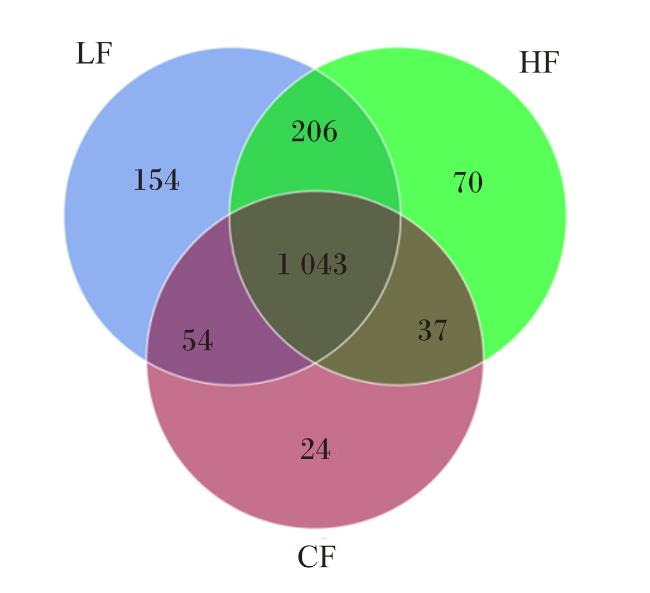
图1可知,3个试验组OTU共有的数目为1 043个,Ⅰ组、Ⅱ组和Ⅲ组分别有OTU数目1 158、1 457、1 356个,3个试验组所独有的OTU数目分别为24、154、70个,分别占各组OTU总数的2.07%、10.57%、5.16%。
图1 Venn图分析

CF、LF和HF分别为Ⅰ组、Ⅱ组和Ⅲ组。下图同。

Fig.1 Venn diagram analysis

CF, LF and HF refer to group Ⅰ, group Ⅱ and group Ⅲ. The same as below.

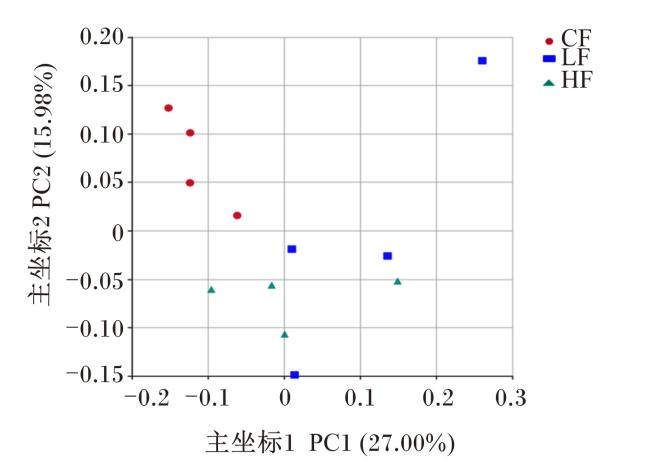
图2可知,本试验中主坐标1和主坐标2的贡献率分别为27.00%和15.98%,Ⅱ组与Ⅲ组围绕在一起,Ⅰ组与Ⅱ组和Ⅲ组无交集,同时Ⅰ组与Ⅱ组和Ⅲ组群落之间有所差异,说明Ⅱ组和Ⅲ组内样本相似度较高。本试验中,可明显观察到各组样品基本聚在一起,说明样品结构相似度高。
图2 Unweighted Unifrac主坐标分析

Fig.2 Unweighted Unifrac PCoA

2.2.3 饲粮添加不同水平NCG对荷斯坦公牛直肠细菌菌群丰度的影响

表6可知,在门水平上,对直肠微生物的相对丰度进行分析,厚壁菌门、拟杆菌门为3个试验组直肠细菌群落的优势菌门,相对丰度大于30%;当添加15 g/(d·头)的NCG时,Patescibacteria的相对丰度有增加趋势(0.05<P<0.10)。
表6 NCG对荷斯坦公牛直肠细菌菌群组成的影响(门水平)

Table 6 Effects of NCG on rectum bacterial community composition of Holstein bulls (phylum level) %

项目
Items
组别Groups 均值
标准误
SEM
PP-value
处理
Treatment
线性
Linear
二次
Quadratic
厚壁菌门Firmicutes 47.04 48.72 48.94 5.000 0.96 0.78 0.93
拟杆菌门Bacteroidetes 30.95 40.23 35.77 3.606 0.24 0.29 0.18
螺旋体门Spirochaetes 4.79 4.91 6.14 1.299 0.72 0.51 0.67
放线菌门Actinobacteria 3.24 2.87 5.68 1.172 0.24 0.21 0.24
柔膜菌门Tenericutes 1.13 2.27 2.47 0.502 0.18 0.08 0.6
变形杆菌Proteobacteria 0.46 0.23 0.32 0.110 0.40 0.37 0.31
未分配的菌Unassigned bacterium 0.04 0.23 0.15 0.046 0.04 0.08 0.05
疣微菌门Verrucomicrobia 0.06 0.08 0.80 0.008 0.15 0.11 0.23
Patescibacteria 0.02 0.06 0.03 0.013 0.13 0.53 0.06
Psilonbacteraeota 0.040 0.002 0.020 0.002 0.44 0.38 0.37
表7可知,在属水平上,3个试验组的荷斯坦公牛直肠优势菌群均为瘤胃球菌科UCG-005。Ⅱ组理研菌科RC9肠道群的相对丰度与Ⅰ组相比有增加趋势(0.05<P<0.10)。Ⅱ组、Ⅲ组双歧杆菌属的相对丰度显著高于Ⅰ组(P<0.05);Ⅱ组瘤胃球菌科UCG-010的相对丰度显著高于Ⅰ组(P<0.05)。随着NCG添加水平的提高,拟杆菌属的相对丰度呈线性增加(P<0.05);随着NCG添加水平的提高瘤胃球菌科NK4A214群的相对丰度有线性增加趋势(0.05<P<0.10)。
表7 NCG对荷斯坦公牛直肠细菌菌群组成的影响(属水平)

Table 7 Effects of NCG on rectum bacterial community composition of Holstein bulls (genus level) %

项目
Items
组别Groups 均值
标准误
SEM
PP-value
处理
Treatment
线性
Linear
二次
Quadratic
瘤胃球菌科UCG-005
Ruminococcaceae UCG-005
12.35 13.36 11.06 3.045 0.87 0.81 0.64
理研菌科RC9肠道群
Rikenellaceae RC9 gut group
7.34 14.59 11.87 1.920 0.07 0.09 0.09
双歧杆菌属Bifidobacterium 4.16b 6.59a 6.15a 0.613 0.04 0.03 0.13
密螺旋体2 Treponema 2 4.77 4.86 6.10 1.300 0.73 0.51 0.67
未培养的细菌Uncultured bacterium 4.16 5.22 3.05 1.119 0.42 0.59 0.24
另枝菌属Alistipes 3.47 5.18 3.85 0.712 0.26 0.58 0.13
拟杆菌属Bacteroides 3.45 3.83 5.50 0.580 0.073 0.04 0.26
克里斯滕森菌科R-7群
Christensenellaceae_R-7_group
1.56 1.87 1.44 0.224 0.41 0.84 0.20
瘤胃球菌科UCG-010
Ruminococcaceae UCG-010
1.12b 3.78a 3.18ab 0.646 0.04 0.03 0.11
瘤胃球菌科UCG-013
Ruminococcaceae UCG-013
1.15 3.62 2.66 0.931 0.22 0.22 0.20
瘤胃球菌属2 Ruminococcus 2 1.04 1.14 0.59 0.302 0.43 0.37 0.35
乳酸杆菌属Lactobacillus 0.96 1.09 1.17 0.169 0.65 0.37 0.99
Tyzzerella 4 1.00 1.08 1.07 0.193 0.94 0.77 0.87
普雷沃氏菌属1 Prevotella 1 0.76 1.01 0.86 0.247 0.77 0.71 0.54
罗氏菌属Roseburia 1.12 0.96 0.81 0.327 0.80 0.53 0.94
瘤胃球菌科UCG-014
Ruminococcaceae UCG-014
0.67 1.61 1.12 0.303 0.14 0.23 0.11
聚乙酸菌属Acetitomaculum 0.95 0.32 0.58 0.269 0.31 0.30 0.25
毛罗菌科NK4A136群
Lachnospiraceae NK4A136 group
0.53 0.67 0.64 0.136 0.75 0.55 0.66
丹毒丝菌科UCG-004
Erysipelotrichaceae UCG-004
0.41 0.34 0.35 0.081 0.81 0.61 0.71
毛罗菌科NK3A20群
Lachnospiraceae NK3A20 group
0.6 0.24 0.50 0.121 0.15 0.42 0.07
毛罗菌科UCG-001
Lachnospiraceae UCG-001
0.39 0.16 0.54 0.141 0.21 0.6 0.09
瘤胃球菌科UCG-009
Ruminococcaceae UCG-009
0.30 0.32 0.19 0.056 0.29 0.26 0.28
瘤胃球菌科NK4A214群
Ruminococcaceae NK4A214 group
0.15 0.20 0.22 0.027 0.23 0.09 0.82
厌氧原体属Anaeroplasma 0.12 0.19 0.20 0.034 0.27 0.12 0.69
考拉杆菌属Phascolarctobacterium 0.11 0.27 0.16 0.047 0.08 0.30 0.04

2.2.4 直肠细菌区系聚类分析

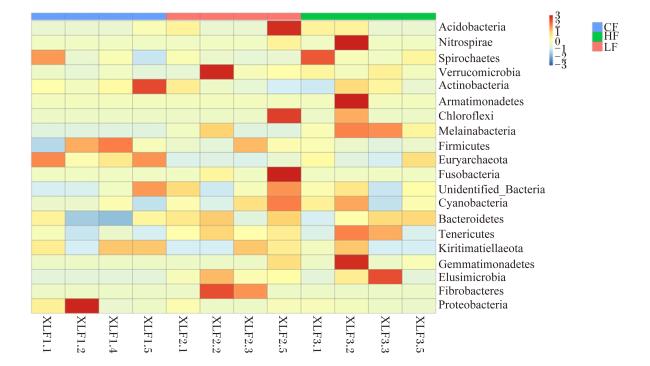
图3可见,在门水平上,相对丰度在前20的菌群的聚类热图,Ⅱ组、Ⅲ组颜色较Ⅰ组颜色加深,Ⅰ组变形菌门为高表达量,Ⅱ组酸杆菌门、疣微菌科、梭杆菌门为高表达量,Ⅲ组硝化螺旋菌门、装甲菌门、芽单胞菌门为高表达量。
图3 直肠样品的细菌区系门水平热图

XLF1.1、XLF1.2、XLF1.4、XLF1.5代表Ⅰ组样品;XLF2.1、XLF2.2、XLF2.3、XLF2.5代表Ⅱ组样品;XLF3.1、XLF3.2、XLF3.3、XLF3.5代表Ⅲ组样品。
XLF1.1, XLF1.2, XLF1.4 and XLF1.5 represent group Ⅰ samples; XLF2.1, XLF2.2, XLF2.3 and XLF2.5 represent group Ⅱ samples; XLF3.1, XLF3.2, XLF3.3 and XLF3.5 represent group Ⅲ samples.
Acidobacteria: 酸杆菌门; Nitrospirae: 硝化螺旋菌门; Spirochaetes: 螺旋体门; Verrucomicrobia: 疣微菌门; Actinobacteria: 放线菌门; Armatimonadetes: 装甲菌门; Chloroflexi: 绿弯菌门; Melainabacteria: 黑水仙菌门; Firmicutes: 厚壁菌门; Euryarchaeota: 广古菌门; Fusobacteria: 梭杆菌门; Unidentified_Bacteria: 未辨认细菌; Cyanobacteria: 蓝菌门; Bacteroidetes: 拟杆菌门; Tenericutes: 软壁菌门; Kiritimatiellaeota: 圣诞岛盐菌门; Gemmatimonadetes: 芽单胞菌门; Elusimicrobia: 迷踪菌门; Fibrobacteres: 纤维杆菌门; Proteobacteria: 变形菌门。

Fig.3 Horizontal heat map of bacterial community at phylum level in rectal samples

3 讨论

3.1 饲粮添加不同水平NCG对荷斯坦公牛瘤胃细菌群落结构的影响

反刍动物瘤胃是一个由细菌、古细菌、纤毛原生动物、真菌、噬菌体以及病毒组成的生态系统,其中细菌的种类和数量最多[19]。拟杆菌门和厚壁菌门相互共生,在瘤胃微生物进行营养调控和吸收中起重要作用。本试验中,3个试验组的优势菌门均为拟杆菌门和厚壁菌门,但Ⅱ组、Ⅲ组与Ⅰ组相比差异均不显著。大量的纤维分解菌存在于瘤胃的厚壁菌门中,可增强机体从饲粮中获得能量的能力,提高碳水化合物的代谢[20-21],以及纤维分解能力,从而增加瘤胃乙酸含量。NCG促进体内精氨酸的生成,改善肠道消化功能,增加肠道消化酶的活性,提高营养物质表观消化率,研究结果表明添加适宜的NCG可提高奶公牛粗蛋白质与纤维的表观消化率,这可能与瘤胃中纤维分解菌活性有关[22]。Jami等[23]的研究发现,随着瘤胃中厚壁菌门的增加,乳脂产量及脂肪沉积会随之提高,进而影响反刍动物的日增重。本课题组前期研究表明,添加15 g/(d·头)NCG组和25 g/(d·头)NCG组与0 g/(d·头)NCG组相比,饲料转化效率分别改善了6.91%和7.91%[24]
本试验中,在属水平上分析发现,各组中普雷沃氏菌属1的相对丰度最高,与Guo等[25]的研究结果一致。普雷沃氏菌属属于耗氢菌,在瘤胃中对蛋白质水解、多肽的吸收及发酵发挥着非常重要的作用[26-27],此过程中产生的蛋白酶可降解蛋白质,使瘤胃微生物蛋白(MCP)浓度升高。此外,普雷沃氏菌属有类似纤维分解菌分泌纤维酶的能力[26],有助于提高纤维的消化率。本试验结果显示,添加不同水平NCG,Ⅱ组、Ⅲ组普雷沃氏菌属1、普雷沃氏菌科UCG-001与普雷沃氏菌科UCG-003的相对丰度与Ⅰ组相比无显著差异,是由于NCG增加了公牛尿素循环再利用[22],进而增加了瘤胃内蛋白质的浓度,为普雷沃氏菌属生长提供了必要的物质来源。
克里斯滕森菌科R-7群属于厚壁菌门,可维持动物胃肠道结构与功能、调节动物机体免疫力[28-29]。本试验中,添加15 g/(d·头)的NCG可提高瘤胃中克里斯滕森菌科R-7群的相对丰度,其参与细胞抗氧化应激,启动自身防御系统抵御外源性有毒物质[30],激活一系列抗氧化和解毒因子,提高机体抗氧化性能。
瘤胃球菌属是瘤胃中主要的纤维降解细菌,可分泌大量的纤维素酶、半纤维素酶、木聚糖酶,降解饲料中的纤维素与半纤维素[31]。琥珀酸弧菌属能利用琥珀酸生成丙酸[32],本试验中添加15 g/(d·头)NCG可提高瘤胃球菌属1的相对丰度,20 g/(d·头)NCG有提高琥珀酸弧菌属相对丰度的趋势,使机体对纤维的消化能力提高,改善瘤胃发酵,促进碳水化合物的吸收。

3.2 饲粮添加不同水平NCG对荷斯坦公牛直肠细菌群落结构的影响

反刍动物肠道微生物有助于营养成分的吸收以及肠道健康的维持。肠道菌群的多样性使其在营养物质消化吸收、机体免疫调控和微生物区系平衡中起着最重要的作用[33]。精氨酸对肠道细菌的生长、生存有着重要作用[34-35],并且能够调节肠道细菌的代谢[36]。本试验中,添加不同水平NCG,α多样性指数的Shannon与Simpson指数的排序为Ⅱ组>Ⅲ组>Ⅰ组,本试验中,添加NCG对直肠细菌α多样性无显著影响。添加NCG后,公牛直肠细菌OTU数量先增加后降低,说明高剂量的NCG对一部分细菌有抑制作用。本试验得出公牛直肠门水平上的优势菌群为厚壁菌门和拟杆菌门,Ⅱ组和Ⅲ组的厚壁菌门与拟杆菌门的相对丰度与Ⅰ组无显著差异,与前人在牛直肠微生物组成的研究结果[37]一致。
瘤胃球菌科中部分细菌产生的纤维素酶、淀粉酶参与动物机体葡萄糖(碳水化合物)、脂肪、蛋白质、粗纤维的利用及代谢[38]。本试验中,各试验组直肠微生物在属水平上分析发现瘤胃球菌科有一定的优势,Gu等[39]研究表明,在小鼠大肠和粪便中瘤胃球菌科亦属于优势菌群。本试验各试验组中直肠细菌属水平优势菌与瘤胃有所不同,王继文[40]对山羊瘤胃和直肠微生物研究测序也得到了类似的结果,这可能与部分瘤胃微生物随食糜流经肠道后发生溶解甚至死亡或食糜在后肠道停留时间较短有关[41]。添加15 g/(d·头)的NCG瘤胃球菌科UCG-010的相对丰度显著提高,说明添加NCG增强了公牛后肠道碳水化合物发酵,主要是由于添加NCG促进内源精氨酸的生成,增强肠道吸收淀粉和纤维的能力,调节了机体血浆氨基酸的平衡[42]。本课题组前期研究表明,添加15 g/(d·头)NCG组体内精氨酸含量显著高于0 g/(d·头)NCG组和25 g/(d·头)NCG组[43]
饲粮添加氨基酸能改善肠道抗菌肽的表达,维持肠道微生物内环境稳态,从而减少肠道炎症的发生[44]。NCG通过改善瘤胃及肠道微生物相对丰度,维持肠道结构和功能,进而改善机体的免疫力。理研菌科是有益菌,具有肠道保护功能[45]。本试验中,添加NCG后理研菌科RC9肠道群的相对丰度有增加趋势,且Ⅱ组高于Ⅰ组,是由于NCG提高一氧化氮合酶(NOS)活性,进而提高一氧化氮(NO)水平,提高了白细胞介素-2(IL-2)与干扰素-γ(IFN-γ)的水平,降低肿瘤坏死因子-α(TNF-α)的水平,抑制促炎因子包括TNF-α、白细胞介素-1β(IL-1β)的表达,缓解炎症的发生,增加了血清中免疫球蛋白M(IgM)、免疫球蛋白G(IgG)的水平,因此理研菌科相对丰度显著提高有助于机体免疫力的提高[46-48]
双歧杆菌可降低非选择性肠道通透性,防止抗原/毒素从肠道进入宿主循环系统[49],促进营养物质消化,调节肠道免疫力,维持微生物平衡和改善胃肠道功能[50],从而保护肠道健康,降低有害菌的数量。在饲粮中添加15 g/(d·头)NCG的试验组中,公牛后肠道双歧杆菌属的相对丰度显著增加,说明适量NCG能够促进公牛肠道健康,其原因可能是由于厌氧菌能够利用精氨酸,提高肠道免疫功能,使有益菌有更大的繁殖空间,保证肠道健康,促进营养物质的吸收[51]

4 结论

添加15 g/(d·头)NCG可显著提高瘤胃球菌属1、直肠双歧杆菌属以及瘤胃球菌科UCG-010相对丰度,添加25 g/(d·头)NCG可显著提高直肠双歧杆菌属的相对丰度;0~25 g/(d·头)NCG对瘤胃和直肠细菌α多样性、门水平以及其他属水平均无显著影响。
[1]
DOWD S E, CALLAWAY T R, WOLCOTT R D, et al. Evaluation of the bacterial diversity in the feces of cattle using 16S rDNA bacterial tag-encoded FLX amplicon pyrosequencing (bTEFAP)[J]. BMC Microbiology, 2008, 8:125.

DOI PMID

[2]
LETTAT A, NOZIÈRE P, SILBERBERG M, et al. Rumen microbial and fermentation characteristics are affected differently by bacterial probiotic supplementation during induced lactic and subacute acidosis in sheep[J]. BMC Microbiology, 2012, 12:142.

DOI PMID

[3]
RUSSELL J B, RYCHLIK J L. Factors that alter rumen microbial ecology[J]. Science, 2001, 292(5519):1119-1122.

DOI PMID

[4]
MACKIE R I, WHITE B A. Recent advances in rumen microbial ecology and metabolism:potential impact on nutrient output[J]. Journal of Dairy Science, 1990, 73(10):2971-2995.

DOI

[5]
WU G D, CHEN J, HOFFMANN C, et al. Linking long-term dietary patterns with gut microbial enterotypes[J]. Science, 2011, 334(6052):105-108.

DOI PMID

[6]
周笑犁, 汤文杰, 孔祥峰, 等. 精氨酸对环江香猪营养物质消化率和血液指标的影响[J]. 华北农学报, 2012, 27(4):234-238.

DOI

ZHOU X L, TANG W J, KONG X F, et al. Effects of arginine on nutrient digestibility and blood parameters in Huanjiang mini-pigs[J]. Acta Agriculturae Boreali-Sinica, 2012, 27(4):234-238. (in Chinese)

[7]
柏美娟, 孔祥峰, 印遇龙, 等. 日粮添加精氨酸对肥育猪免疫功能的调节作用[J]. 扬州大学学报(农业与生命科学版), 2009, 30(3):45-49.

BAI M J, KONG X F, YIN Y L, et al. Regulation of dietary supplemental arginine on immune response in fattening pigs[J]. Journal of Yangzhou University(Agricultural and Life Science Edition), 2009, 30(3):45-49. (in Chinese)

[8]
高天. 胚蛋注射精氨酸对肉仔鸡早期肠道发育和功能的影响及其作用机制研究[D].博士学位论文. 南京: 南京农业大学, 2017.

GAO T. Effects and mechanisms of in ovo feeding of L-arginine on the early development and function of intestine in broiler chickens[D].Ph.D.Thesis. Nanjing: Nanjing Agricultural University, 2017. (in Chinese)

[9]
YANG Y, WU Z L, JIA S C, et al. Safety of long-term dietary supplementation with L-arginine in rats[J]. Amino Acids, 2015, 47(9):1909-1920.

DOI

[10]
WU X, RUAN Z, GAO Y L, et al. Dietary supplementation with L-arginine or N-carbamylglutamate enhances intestinal growth and heat shock protein-70 expression in weanling pigs fed a corn- and soybean meal-based diet[J]. Amino Acids, 2010, 39(3):831-839.

DOI

[11]
CHACHER B. N-甲酰谷氨酸作为精氨酸增强剂的评定及其对高产奶牛瘤胃发酵、泌乳性能和氮利用的影响[D].博士学位论文. 杭州: 浙江大学, 2013.

CHACHER B. Evaluation of N-carbamoylglutamate as argininineenhancer and its effect on rumen fermentation,lactation performance and nitrogen utilization in high yielding lactating dairy cows[D].Ph.D.Thesis. Hangzhou: Zhejiang University, 2013. (in Chinese)

[12]
赵宏丽. 精氨酸对细毛羊肠道蛋白质合成、氨基酸转运蛋白mRNA表达及肠道健康的影响[D].硕士学位论文. 呼和浩特: 内蒙古农业大学, 2012.

ZHAO H L. Effect of arginine on the intestinal protein synthesis,expression of amino acid transport protein mRNA and gut health in the fine-wool sheep[D].Master’s Thesis. Hohhot: Inner Mongolia Agricultural University, 2012. (in Chinese)

[13]
林丽花, 王长康, 王全溪. N-氨甲酰谷氨酸的研究进展[J]. 福建畜牧兽医, 2012, 34(5):31-34.

LIN L H, WANG C K, WANG Q X. Research progress of N-carbamylglutamate[J]. Fujian Journal of Animal Husbandry and Veterinary Medicine, 2012, 34(5):31-34. (in Chinese)

[14]
周笑犁, 连国琦, 孔祥峰, 等. N-氨甲酰谷氨酸对断奶环江香猪肠道微生物区系的影响[J]. 天然产物研究与开发, 2014, 26(2):263-267.

ZHOU X L, LIAN G Q, KONG X F, et al. Effects of N-carbamyglutamate on intestinal microflora of weaned Huanjiang mini-pigs[J]. Natural Product Research and Development, 2014, 26(2):263-267. (in Chinese)

[15]
佚名. 中华人民共和国农业行业标准——肉牛饲养标准(NY/T 815—2004)[J]. 湖南饲料, 2006(5):14-18.

Anon. Agricultural Ministry of the People’s Republic of China. NY/T 815—2004 China feeding standard of beef cattle[J]. Hunan Feed, 2006(5):14-18. (in Chinese)

[16]
HAAS B J, GEVERS D, EARL A M, et al. Chimeric 16S rRNA sequence formation and detection in Sanger and 454-pyrosequenced PCR amplicons[J]. Genome Research, 2011, 21(3):494-504.

DOI PMID

[17]
EDGAR R C. UPARSE:highly accurate OTU sequences from microbial amplicon reads[J]. Nature Methods, 2013, 10(10):996-998.

DOI

[18]
WANG Q, GARRITY G M, TIEDJE J M, et al. Naive Bayesian classifier for rapid assignment of rRNA sequences into the new bacterial taxonomy[J]. Applied and Environmental Microbiology, 2007, 73(16):5261-5267.

DOI PMID

[19]
MIRON J, BEN-GHEDALIA D, MORRISON M. Invited review:adhesion mechanisms of rumen cellulolytic bacteria[J]. Journal of Dairy Science, 2001, 84(6):1294-1309.

DOI

[20]
TURNBAUGH P J, LEY R E, MAHOWALD M A, et al. An obesity-associated gut microbiome with increased capacity for energy harvest[J]. Nature, 2006, 444(7122):1027-1031.

DOI

[21]
TREMAROLI V, BÄCKHED F. Functional interactions between the gut microbiota and host metabolism[J]. Nature, 2012, 489(7415):242-249.

DOI

[22]
孙雪丽. N-氨甲酰谷氨酸对荷斯坦奶公牛氮代谢及甲烷排放的影响[D].硕士学位论文. 保定: 河北农业大学, 2020.

SUN X L. Effects of dietary supplementation with N-carbamylglutamate on nitrogen metabolism and methane emission of Holstein bulls[D].Master’s Thesis. Baoding: Agricultural University of Hebei, 2020. (in Chinese)

[23]
JAMI E, WHITE B A, MIZRAHI I. Potential role of the bovine rumen microbiome in modulating milk composition and feed efficiency[J]. PLoS One, 2014, 9(1):e85423.

DOI

[24]
孙雪丽, 李秋凤, 曹玉凤, 等. N-氨甲酰谷氨酸对荷斯坦奶公牛生长性能、瘤胃发酵及微生物区系和甲烷排放量的影响[J]. 畜牧兽医学报, 2020, 51(8):1903-1912.

SUN X L, LI Q F, CAO Y F, et al. Effects of dietary addition of N-carbamylglutamate on growth performance,rumen fermentation,rumen microflora and methane emission of Holstein bulls[J]. Acta Veterinaria et Zootechnica Sinica, 2020, 51(8):1903-1912. (in Chinese)

[25]
GUO W, LI Y, WANG L Z, et al. Evaluation of composition and individual variability of rumen microbiota in yaks by 16S rRNA high-throughput sequencing technology[J]. Anaerobe, 2015, 34:74-79.

DOI PMID

[26]
MATSUI H, OGATA K, TAJIMA K, et al. Phenotypic characterization of polysaccharidases produced by four Prevotella type strains[J]. Current Microbiology, 2000, 41(1):45-49.

DOI

[27]
STEVENSON D M, WEIMER P J. Erratum to:dominance of Prevotella and low abundance of classical ruminal bacterial species in the bovine rumen revealed by relative quantification real-time PCR[J]. Applied Microbiology and Biotechnology, 2009, 83(5):987-988.

DOI

[28]
HE J, HAI L, ORGOLDOL K, et al. High-throughput sequencing reveals the gut microbiome of the bactrian camel in different ages[J]. Current Microbiology, 2019, 76(7):810-817.

DOI PMID

[29]
LIU J H, XUE C X, SUN D M, et al. Impact of high-grain diet feeding on mucosa-associated bacterial community and gene expression of tight junction proteins in the small intestine of goats[J]. MicrobiologyOpen, 2019, 8(6):e00745.

[30]
LI W G, KONG A N. Molecular mechanisms of Nrf2-mediated antioxidant response[J]. Molecular Carcinogenesis, 2009, 48(2):91-104.

DOI PMID

[31]
张红涛. 不同玉米青贮水平对荷斯坦后备牛瘤胃液微生物组及其代谢组的影响[D].博士学位论文. 北京: 中国农业大学, 2017.

ZHANG H T. Effects of corn silage levels on rumen fluid microbiota and its metabolome in Holstein heifers[D].Ph.D.Thesis. Beijing: China Agricultural University, 2017. (in Chinese)

[32]
KETTLE H, LOUIS P, HOLTROP G, et al. Modelling the emergent dynamics and major metabolites of the human colonic microbiota[J]. Environmental Microbiology, 2015, 17(5):1615-1630.

DOI PMID

[33]
DICKS L M T, GELDENHUYS J, MIKKELSEN L S, et al. Our gut microbiota:a long walk to homeostasis[J]. Beneficial Microbes, 2018, 9(1):3-20.

DOI

[34]
DAI Z L, ZHANG J, WU G Y, et al. Utilization of amino acids by bacteria from the pig small intestine[J]. Amino Acids, 2010, 39(5):1201-1215.

DOI

[35]
DAI Z L, LI X L, XI P B, et al. Metabolism of select amino acids in bacteria from the pig small intestine[J]. Amino Acids, 2012, 42(5):1597-1608.

DOI

[36]
DAI Z L, LI X L, XI P B, et al. Regulatory role for L-arginine in the utilization of amino acids by pig small-intestinal bacteria[J]. Amino Acids, 2012, 43(1):233-244.

DOI

[37]
DE OLIVEIRA M N V, JEWELL K A, FREITAS F S, et al. Characterizing the microbiota across the gastrointestinal tract of a Brazilian Nelore steer[J]. Veterinary Microbiology, 2013, 164(3/4):307-314.

DOI

[38]
MAI V. Dietary modification of the intestinal microbiota[J]. Nutrition Reviews, 2004, 62(6 Pt.1):235-242.

PMID

[39]
GU S H, CHEN D D, ZHANG J N, et al. Bacterial community mapping of the mouse gastrointestinal tract[J]. PLoS One, 2013, 8(10):e74957.

DOI

[40]
王继文. 红曲米对山羊甲烷排放、瘤胃古菌多样性及饲料利用率的影响研究[D].硕士学位论文. 雅安: 四川农业大学.

WANG J W. Study on the effect of red yeast rice on methaneemissions、rumen archaeal diversity and feed efficiency in goats[D].Master’s Thesis. Ya’an: Sichuan Agricultural University (in Chinese)

[41]
FREY J C, PELL A N, BERTHIAUME R, et al. Comparative studies of microbial populations in the rumen,duodenum,ileum and faeces of lactating dairy cows[J]. Journal of Applied Microbiology, 2010, 108(6):1982-1993.

[42]
FERNÁNDEZ M, ZÚÑIGA M. Amino acid catabolic pathways of lactic acid bacteria[J]. Critical Reviews in Microbiology, 2006, 32(3):155-183.

PMID

[43]
孙雪丽, 李秋凤, 曹玉凤, 等. N-氨甲酰谷氨酸对荷斯坦奶公牛氮代谢的影响[J]. 动物营养学报, 2020, 32(7):3224-3233.

DOI

SUN X L, LI Q F, CAO Y F, et al. Effects of N-carbamylglutamate on nitrogen metabolism of Holstein bulls[J]. Chinese Journal of Animal Nutrition, 2020, 32(7):3224-3233. (in Chinese)

[44]
HASHIMOTO T, PERLOT T, REHMAN A, et al. ACE2 links amino acid malnutrition to microbial ecology and intestinal inflammation[J]. Nature, 2012, 487(7408):477-481.

DOI

[45]
COX L M, YAMANISHI S, SOHN J, et al. Altering the intestinal microbiota during a critical developmental window has lasting metabolic consequences[J]. Cell, 2014, 158(4):705-721.

DOI PMID

[46]
LUO J M, HAN L L, LIU L, et al. Catechin supplemented in a FOS diet induces weight loss by altering cecal microbiota and gene expression of colonic epithelial cells[J]. Food & Function, 2018, 9(5):2962-2969.

[47]
HOWE C, KIM S J, MITCHELL J, et al. Differential expression of tumor-associated genes and altered gut microbiome with decreased Akkermansia muciniphila confer a tumor-preventive microenvironment in intestinal epithelial Pten-deficient mice[J]. Biochimica et Biophysica Acta (BBA):Molecular Basis of Disease, 2018, 1864(12):3746-3758.

[48]
KUBINAK J L, PETERSEN C, STEPHENS W Z, et al. MyD88 signaling in T cells directs IgA-mediated control of the microbiota to promote health[J]. Cell Host & Microbe, 2015, 17(2):153-163.

[49]
GRIFFITHS E A, DUFFY L C, SCHANBACHER F L, et al. In vivo effects of bifidobacteria and lactoferrin on gut endotoxin concentration and mucosal immunity in Balb/c mice[J]. Digestive Diseases and Sciences, 2004, 49(4):579-589.

DOI

[50]
SANZ Y, NADAL I, SÁNCHEZ E. Probiotics as drugs against human gastrointestinal infections[J]. Recent Patents on Anti-Infective Drug Discovery, 2007, 2(2):148-156.

PMID

[51]
HU S D, LI X L, REZAEI R, et al. Safety of long-term dietary supplementation with L-arginine in pigs[J]. Amino Acids, 2015, 47(5):925-936.

DOI

文章导航

/