研究论文

稀土壳糖胺螯合盐对水牛犊牛生长性能、养分表观消化率和瘤胃细菌菌群结构的影响

  • 李浩 , 1 ,
  • 吴宇航 1, * ,
  • 张洁 1 ,
  • 顾啟超 1 ,
  • 邹彩霞 , 1, ** ,
  • 林波 , 1, 2, **
展开
  • 1 广西大学动物科学技术学院,南宁 530004
  • 2 广西泰民兴牧业有限公司,南宁 532101
**邹彩霞,研究员,硕士生导师,E-mail: ;
林波,副研究员,硕士生导师,E-mail:

*同等贡献作者

李 浩(1994—),男,山东泰安人,硕士研究生,研究方向为动物营养与饲料科学。E-mail:

Copy editor: 田艳明

收稿日期: 2022-10-11

  网络出版日期: 2023-05-11

基金资助

广西科技重大专项(桂科AA22068099-5)

广西自然科学基金项目(2021GXNSFAA196034)

Effects of Rare Earth-Chitosan Chelate on Growth Performance, Nutrient Apparent Digestibility and Rumen Bacterial Flora Structure of Buffalo Calves

  • LI Hao , 1 ,
  • WU Yuhang 1 ,
  • ZHANG Jie 1 ,
  • GU Qichao 1 ,
  • ZOU Caixia , 1, ** ,
  • LIN Bo , 1, 2, **
Expand
  • 1 College of Animal Science and Technology, Guangxi University, Nanning 530004, China
  • 2 Guangxi Tai Min Xing Pastoral Industry Co., Ltd., Nanning 532101, China
**ZOU Caixia, professor, E-mail: ;
LIN Bo, associate professor, E-mail:

*Contributed equally

Received date: 2022-10-11

  Online published: 2023-05-11

摘要

本试验旨在探究稀土壳糖胺螯合盐(RECC)对水牛犊牛生长性能、养分表观消化率和瘤胃细菌菌群结构的影响。选取18头体重为(72.45±4.26) kg、健康状况良好的100日龄断奶水牛公犊牛,随机分为3个组,每组6头。对照组饲喂不含RECC的基础饲粮,试验Ⅰ组、试验Ⅱ组分别饲喂在基础饲粮的基础上添加0.03%和0.06%RECC的饲粮。预试期7 d,正试期60 d。结果表明:1)与对照组相比,试验Ⅱ组粗饲料平均日采食量显著提高(P<0.05)。2)与对照组相比,试验Ⅰ组和试验Ⅱ组干物质表观消化率显著提高(P<0.05)。3)在门水平上,各组排名前4的优势菌门均为变形菌门、厚壁菌门、拟杆菌门和纤维杆菌门,且其相对丰度各组间无显著差异(P>0.05)。在属水平上,试验Ⅰ组月单胞菌属相对丰度显著低于对照组和试验Ⅱ组(P<0.05);与对照组相比,试验Ⅰ组和试验Ⅱ组不动杆菌属相对丰度显著降低(P<0.05)。4)Spearman相关性分析表明,粗蛋白质表观消化率与欧陆森氏菌属和琥珀酸弧菌科未分类菌属相对丰度呈显著正相关(r=1.0,P<0.05),中性洗涤纤维表观消化率与不动杆菌属相对丰度呈极显著负相关(r=-1.0,P<0.01),酸性洗涤纤维表观消化率与欧陆森氏菌属、纤维杆菌属和琥珀酸弧菌科未分类菌属相对丰度呈显著正相关(r=1.0,P<0.05)。综上所述,饲粮添加RECC对水牛犊牛生长性能和养分表观消化率有一定的提高作用,能够调节瘤胃菌群结构,以0.06%添加水平效果较佳。

本文引用格式

李浩 , 吴宇航 , 张洁 , 顾啟超 , 邹彩霞 , 林波 . 稀土壳糖胺螯合盐对水牛犊牛生长性能、养分表观消化率和瘤胃细菌菌群结构的影响[J]. 动物营养学报, 2023 , 35(5) : 3119 -3129 . DOI: 10.12418/CJAN2023.290

Abstract

This experiment was conducted to investigate the effects of rare earth-chitosan chelate (RECC) on growth performance, nutrient apparent digestibility and rumen bacterial flora structure of buffalo calves. Eighteen healthy 100-day-old weaned buffalo male calves with body weight of (72.45±4.26) kg were randomly divided into 3 groups with 6 calves per group. Calves in the control group were fed a basal diet without RECC, and the others in experimental groups Ⅰ and Ⅱ were fed the basal diet supplemented with 0.03% and 0.06% RECC, respectively. The pre-trial period lasted for 7 days and the experimental period lasted for 60 days. The results showed as follows: 1) compared with the control group, the average daily feed intake of roughage in experimental group Ⅱ was significantly increased (P<0.05). 2) Compared with the control group, the dry matter apparent digestibility in experimental groups Ⅰ and Ⅱ was significantly increased (P<0.05). 3) At the phylum level, the top 4 dominant phyla in each group were Proteobacteria, Firmicutes, Bacteroidetes and Fibrobacteres, and there was no significant difference in their relative abundances among all groups (P>0.05). At the genus level, the Selenomonas relative abundance in experimental group Ⅰ was significantly lower than that in the control group and experimental group Ⅱ (P<0.05); compared with the control group, the Acinetobacter relative abundance in experimental groups Ⅰ and Ⅱ was significantly decreased (P<0.05). 4) Spearman correlation analysis showed that the crude protein apparent digestibility was significantly positively correlated with the relative abundances of Olsenella and Succinivibrionaceae_unclassified (r=1.0, P<0.05), the neutral detergent fiber apparent digestibility was extremely significantly negatively correlated with the Acinetobacter relative abundance (r=-1.0, P<0.01), and the acid detergent fiber apparent digestibility was significantly positively correlated with the relative abundances of Olsenella, Acinetobacter and Succinivibrionaceae_unclassified (r=1.0, P<0.05). In conclusion, dietary RECC supplementation can improve the growth performance and nutrient apparent digestibility and regulate the structure of rumen microflora of buffalo calves, and the effect of 0.06% supplemental level is better.

在反刍动物生长过程中,幼龄时期的养分吸收和瘤胃发育是至关重要的。目前,饲料添加剂已经被广泛用于提高幼龄反刍动物能量利用率、维持机体健康生长以及改善瘤胃内环境等方面。稀土元素是一种活性金属,能够调节体内酶的活性和激素的分泌[1],维持胃肠道菌群平衡[2],对机体的免疫功能有一定的增强作用[3]。壳糖胺又名壳聚糖,为甲壳素的脱乙酰化形式,是一种线性多糖,耐热性强,在提高动物生长速度[4]、调节脂肪代谢[5-6]、抗菌[7]、免疫调节[8]和抗病毒方面发挥着重要作用。有研究发现,壳糖胺-金属络合物对动物机体的作用优于游离的壳聚糖和金属盐[9]。稀土壳糖胺螯合盐(rare earth-chitosan chelate,RECC)同时具备了稀土元素和壳糖胺的生理功能,在抑菌、提高机体免疫力以及抗氧化等方面效果显著。据报道,RECC对断奶仔猪的生长性能和养分消化利用率有一定的提高作用,能够维持仔猪肠道微生物平衡[10]。有关RECC在家禽上的研究表明,RECC能够提高生长性能和饲料利用率,并且提高家禽产蛋率,对家禽热应激带来的负效应有缓解作用[11-12]。此外,研究表明,RECC能够提高鱼的生长性能,增强免疫力[13]。户如霞等[14]研究发现,RECC能够促进泌乳奶牛脂类代谢。
RECC作为添加剂在幼龄反刍动物上的应用鲜见报道。因此,本试验通过探究饲粮添加不同水平RECC对水牛犊牛生长性能、养分表观消化率、瘤胃pH及细菌菌群结构的影响,研究RECC作为水牛犊牛饲料添加剂的可行性,以期为RECC在幼龄反刍动物养殖中的应用提供理论依据。

1 材料与方法

1.1 试验材料和试验设计

本试验所用RECC中壳糖胺占10%,铈和镧占85%。试验选取18头体重为(72.45±4.26) kg、健康状况良好的100日龄断奶水牛公犊牛,随机分为3个组,每组6头。对照组饲喂不含RECC的基础饲粮,试验Ⅰ组、试验Ⅱ组分别饲喂在基础饲粮的基础上添加0.03%和0.06%RECC的饲粮。试验精粗饲料比为7∶3,其中精料组成及营养水平见表1,粗饲料主要营养成分见表2。试验预试期7 d,正试期60 d。
表1 精料组成及营养水平(风干基础)

Table 1 Composition and nutrient levels of the concentrate (air-dry basis) %

项目Items 含量Content
原料Ingredients
玉米Corn 58.60
豆粕Soybean meal 33.00
大豆油Soybean oil 1.20
玉米麸Corn bran 3.00
氯化钠NaCl 0.60
磷酸氢钙CaHPO4 1.80
石粉Limestone 0.80
预混料Premix1) 1.00
合计Total 100.00
营养水平Nutrient levels2)
干物质DM 89.98
粗蛋白质CP 24.72
总能GE/(MJ/kg) 18.45
中性洗涤纤维NDF 19.76
酸性洗涤纤维ADF 5.69

1)预混料为每千克精料提供 The premix provided the following per kg of the concentrate:VA 5 000 IU,VD3 3 000 IU,VE 50 IU,Fe (as ferrous sulfate) 250 mg,Cu (as copper sulfate) 80 mg,Mn (as manganese sulfate) 200 mg,Zn (as zinc sulfate) 150 mg,Se (as sodium selenite) 0.5 mg,I (as potassium iodide) 1 mg,Co (as cobaltous chloride) 2 mg。

2)营养水平均为实测值。Nutrient levels were measured values.

表2 粗饲料主要营养成分(风干基础)

Table 2 Main nutrients in roughage (air-dry basis) %

项目
Items
全株玉米青贮
Whole plant
corn silage
燕麦干草
Oat hay
干物质DM 29.60 90.23
粗蛋白质CP 6.82 5.27
总能GE/(MJ/kg) 17.86 16.44
中性洗涤纤维NDF 40.86 54.52
酸性洗涤纤维ADF 21.07 31.13

1.2 饲养管理

试验牛定期健康检查,做好防护和消毒工作。定期清粪,确保牛舍整洁干净。水牛犊牛单栏单饲,每天饲喂2次(08:00和16:00),自由采食和饮水。

1.3 样品采集及指标测定

1.3.1 采食量及生长性能

在正试期开始前3 d以及正试期最后3 d的晨饲前,利用地磅测定试验牛的初重及末重。每天记录饲喂饲粮的重量和剩料重量,计算平均日采食量(ADFI)、平均日增重(ADG)和干物质采食量(DMI),通过干物质采食量和平均日增重计算料重比(F/G)。计算公式如下:
平均日增重=(末重-初重)/试验天数;
料重比=干物质采食量/平均日增重。

1.3.2 粪便评分和腹泻率

试验正试期每天(07:00和15:00)观察牛粪便,按表3的评分标准进行粪便评分,3分及以上为腹泻。
表3 粪便评分标准

Table 3 Fecal scoring criteria

项目Items 外观Appearance 评分Score
正常Normal 稳固但不坚硬,沉积后外形略微改变 1
松软Soft 不能保持外形,成堆但略微松软 2
软膏Paste 易扩散成6 mm厚的薄饼状 3
水状Aqueous 液状,粪水有分离现象 4

1.3.3 养分表观消化率

在正试期最后1周进行消化试验,预饲2 d,后5 d用全收粪法收集粪样。每天于07:00—09:00收集粪样,每次采集2份各100 g,混合均匀后放置4 h,加入10 mL浓度为10%的硫酸进行固氮;每天07:00采集饲粮样品100 g。饲粮和粪便样品在烘箱中60 ℃烘干,密封保存,后期粉碎过40目筛,测定干物质(DM)、粗蛋白质(CP)、总能(GE)、中性洗涤纤维(NDF)和酸性洗涤纤维(ADF)含量。养分表观消化率计算公式如下:
某养分表观消化率(%)=100×[(摄入的粗饲料和精料中该养分含量-粪便中该养分含量)/摄入的粗饲料和精料中该养分含量]。

1.3.4 瘤胃pH及细菌菌群

试验最后1 d 08:00进行瘤胃液的采集,弃去初始流出的约50 mL瘤胃液,收集约120 mL瘤胃液,用4层纱布过滤后测定pH,每份瘤胃液测定3次。瘤胃液送至北京诺禾致源科技股份有限公司测定瘤胃细菌菌群。

1.4 数据处理

将测定的数据通过Excel 2010进行预整理,利用SPSS 19.0软件对各项指标进行单因素方差分析(one-way ANOVA),并利用Duncan氏法进行多重比较检验,P<0.05表示差异显著,结果用“平均值±标准误”表示。利用Past 3.0软件和Spearman秩相关系数检验分析细菌属水平物种相对丰度与养分表观消化率之间的关系,并通过R软件(3.6.0)可视化成相关性矩阵图。

2 结果与分析

2.1 RECC对水牛犊牛生长性能的影响

表4可知,试验Ⅱ组水牛犊牛粗饲料平均日采食量显著高于对照组(P<0.05),各组其他生长性能指标之间均无显著差异(P>0.05)。
表4 RECC对水牛犊牛生长性能的影响

Table 4 Effects of RECC on growth performance of buffalo calves

项目
Items
对照组
Control group
试验Ⅰ组
Experimental group Ⅰ
试验Ⅱ组
Experimental group Ⅱ
精料平均日采食量Concentrate ADFI/(kg/d) 1.15±0.32 1.17±0.52 1.23±0.45
粗饲料平均日采食量Roughage ADFI/(kg/d) 0.26±0.09b 0.26±0.11ab 0.30±0.12a
初重IBW/kg 72.20±4.18 72.80±5.15 72.40±4.18
末重FBW/kg 117.70±4.37 121.90±7.33 126.30±5.57
平均日增重ADG/(kg/d) 0.76±0.14 0.82±0.32 0.90±0.29
料重比F/G 1.53±0.19 1.39±0.45 1.44±0.26

同行数据肩标无字母或相同字母表示差异不显著(P>0.05),不同小写字母表示差异显著(P<0.05)。下表同。

In the same row, values with no letter or the same letter superscripts mean no significant difference (P>0.05), while with different small letter superscripts mean significant difference (P<0.05). The same as below.

2.2 RECC对水牛犊牛粪便评分和腹泻率的影响

表5可知,与对照组相比,饲粮添加RECC可以降低水牛犊牛粪便评分和腹泻率,但均无显著差异(P>0.05)。
表5 RECC对水牛犊牛粪便评分和腹泻率的影响

Table 5 Effects of RECC on fecal score and diarrhea rate of buffalo calves

项目
Items
对照组
Control group
试验Ⅰ组
Experimental group Ⅰ
试验Ⅱ组
Experimental group Ⅱ
粪便评分Fecal score 2.04±0.07 1.94±0.01 1.89±0.06
腹泻率Diarrhea rate/% 5.14±0.72 4.83±1.02 4.20±0.35

2.3 RECC对水牛犊牛养分表观消化率的影响

表6可知,与对照组相比,试验Ⅰ组和试验Ⅱ组干物质表观消化率显著提高(P<0.05),总能、粗蛋白质、中性洗涤纤维和酸性洗涤纤维表观消化率无显著差异(P>0.05)。
表6 RECC对水牛犊牛养分表观消化率的影响

Table 6 Effects of RECC on nutrient apparent digestibility of buffalo calves %

项目
Items
对照组
Control group
试验Ⅰ组
Experimental group Ⅰ
试验Ⅱ组
Experimental group Ⅱ
干物质DM 67.77±2.39b 74.94±2.42a 74.16±2.34a
总能GE 73.35±2.53 75.44±1.45 75.70±2.18
粗蛋白质CP 69.26±3.52 75.19±2.62 72.45±1.88
中性洗涤纤维NDF 42.79±1.46 44.10±2.02 44.41±1.83
酸性洗涤纤维ADF 32.54±0.67 32.92±0.76 32.71±0.77

2.4 RECC对水牛犊牛瘤胃pH及细菌菌群结构的影响

2.4.1 RECC对水牛犊牛瘤胃pH的影响

表7可知,各组水牛犊牛瘤胃pH之间均无显著差异(P>0.05)。
表7 RECC对水牛犊牛瘤胃pH的影响

Table 7 Effects of RECC on pH in rumen of buffalo calves

项目
Item
对照组
Control group
试验Ⅰ组
Experimental group Ⅰ
试验Ⅱ组
Experimental group Ⅱ
pH 6.71±0.09 6.59±0.04 6.54±0.07

2.4.2 RECC对水牛犊牛瘤胃细菌门水平菌群结构的影响

表8可知,各组水牛犊牛瘤胃细菌相对丰度在1%以上的菌门有变形菌门(Proteobacteria)、厚壁菌门(Firmicutes)、拟杆菌门(Bacteroidetes)、纤维杆菌门(Fibrobacteres)、螺旋体门(Spirochaetes)和广古菌门(Euryarchaeota),其中变形菌门、厚壁菌门、拟杆菌门和纤维杆菌门为各组门水平上相对丰度前4的优势菌门。此外,各组水牛犊牛瘤胃细菌在门水平上的相对丰度之间均无显著差异(P>0.05)。
表8 RECC对水牛犊牛瘤胃细菌门水平相对丰度的影响

Table 8 Effects of RECC on relative abundance of rumen bacteria at phylum level of buffalo calves

项目
Items
对照组
Control group
试验Ⅰ组
Experimental group Ⅰ
试验Ⅱ组
Experimental group Ⅱ
变形菌门Proteobacteria 48.32±10.25 61.01±12.03 53.09±10.40
厚壁菌门Firmicutes 34.14±6.81 25.17±8.00 31.56±8.62
拟杆菌门Bacteroidetes 11.25±3.73 4.26±1.82 5.96±3.08
纤维杆菌门Fibrobacteres 3.46±2.32 6.22±5.31 4.66±2.07
螺旋体门Spirochaetes 1.69±0.85 2.00±1.14 3.58±1.70
广古菌门Euryarchaeota 1.04±0.45 1.04±0.47 1.11±0.45
其他Others 0.10±0.08 0.30±0.15 0.04±0.03

2.4.3 RECC对水牛犊牛瘤胃细菌属水平菌群结构的影响

表9可知,各组水牛犊牛瘤胃细菌相对丰度在1%以上的菌属有琥珀酸弧菌科未分类菌属(Succinivibrionaceae_unclassified)、丁酸弧菌属(Butyrivibrio)、普雷沃氏菌属(Prevotella)、纤维杆菌属(Fibrobacter)、氨基酸球菌属(Acidaminococcus)、密螺旋体属(Treponema)、光冈菌属(Mitsuokella)和甲烷短杆菌属(Methanobrevibacter)。此外,试验Ⅰ组月单胞菌属(Selenomonas)相对丰度显著低于试验Ⅱ组和对照组(P<0.05),试验Ⅰ组和试验Ⅱ组不动杆菌属(Acinetobacter)相对丰度显著低于对照组(P<0.05)。
表9 RECC对水牛犊牛瘤胃细菌属水平相对丰度的影响

Table 9 Effects of RECC on relative abundance of rumen bacteria at genus level of buffalo calves

项目
Items
对照组
Control group
试验Ⅰ组
Experimental
group Ⅰ
试验Ⅱ组
Experimental
group Ⅱ
琥珀酸弧菌科未分类菌属Succinivibrionaceae_unclassified 45.41±11.96 60.18±12.49 52.81±10.42
丁酸弧菌属Butyrivibrio 22.26±3.61 11.11±5.66 18.55±6.31
普雷沃氏菌属Prevotella 11.24±3.72 4.26±1.83 5.96±3.08
纤维杆菌属Fibrobacter 3.46±2.32 6.22±5.31 4.66±2.07
月单胞菌属Selenomonas 5.40±4.05a 0.48±0.43b 4.19±2.99a
氨基酸球菌属Acidaminococcus 1.77±1.19 5.40±2.49 3.03±1.43
密螺旋体属Treponema 1.69±0.85 2.00±1.14 3.57±1.70
罕见小球菌属Subdoligranulum 0.77±0.25 4.30±3.14 2.06±0.72
光冈菌属Mitsuokella 1.90±1.11 1.44±0.54 1.73±0.62
瘤胃球菌属Ruminococcus 1.43±0.31 0.53±0.21 1.57±0.58
不动杆菌属Acinetobacter 2.58±2.51a 0.73±0.63b 0.25±0.17b
甲烷短杆菌属Methanobrevibacter 1.04±0.45 1.04±0.47 1.11±0.45
欧陆森氏菌属Olsenella 0.02±0.02 0.05±0.02 0.04±0.03
其他Others 1.03±0.81 2.26±1.22 0.47±0.35

2.4.4 水牛犊牛瘤胃细菌属水平相对丰度与养分表观消化率的相关性分析

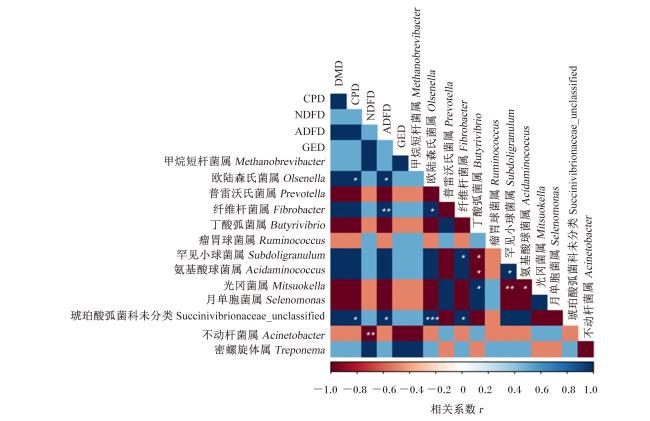
图1可知,欧陆森氏菌属(Olsenella)相对丰度与粗蛋白质和酸性洗涤纤维表观消化率呈显著正相关(r=1.0,P<0.05);纤维杆菌属相对丰度与酸性洗涤纤维表观消化率呈极显著正相关(r=1.0,P<0.01),与欧陆森氏菌属相对丰度呈显著正相关(r=1.0,P<0.05);罕见小球菌属(Subdoligranulum)相对丰度与纤维杆菌属相对丰度呈显著正相关(r=1.0,P<0.05),与丁酸弧菌属相对丰度呈显著负相关(r=-1.0,P<0.05);氨基酸球菌属相对丰度与丁酸弧菌属相对丰度呈显著负相关(r=-1.0,P<0.05),与罕见小球菌属相对丰度呈显著正相关(r=1.0,P<0.05);光冈菌属相对丰度与丁酸弧菌属相对丰度呈显著正相关(r=1.0,P<0.05),与罕见小球菌属相对丰度呈极显著负相关(r=-1.0,P<0.01),与氨基酸球菌属相对丰度呈显著负相关(r=-1.0,P<0.05);琥珀酸弧菌科未分类菌属相对丰度与粗蛋白质和酸性洗涤纤维表观消化率以及纤维杆菌属相对丰度呈显著正相关(r=1.0,P<0.05),与欧陆森氏菌属相对丰度呈极显著正相关(r=1.0,P<0.001);不动杆菌属相对丰度与中性洗涤纤维表观消化率呈极显著负相关(r=-1.0,P<0.01)。
图1 水牛犊牛瘤胃细菌属水平相对丰度与养分表观消化率的相关性分析

*表示P<0.05,**表示P<0.01,***表示P<0.001。DMD表示干物质表观消化率,CPD表示粗蛋白质表观消化率,NDFD表示中性洗涤纤维表观消化率,ADFD表示酸性洗涤纤维表观消化率,GED表示总能表观消化率。

Fig.1 Correlation analysis of relative abundance of rumen bacteria at genus level and nutrient apparent digestibility of buffalo calves

* mean P<0.05, ** mean P<0.01, and *** mean P<0.001. DMD indicated apparent digestibility of dry matter, CPD indicated apparent digestibility of crude protein, NDFD indicated apparent digestibility of neutral detergent fiber, ADFD indicated apparent digestibility of acid detergent fiber, and GED indicated apparent digestibility of gross energy.

3 讨论

3.1 RECC对水牛犊牛生长性能以及粪便评分和腹泻率的影响

RECC同时具备了稀土元素和壳糖胺的生物学功能,适量添加能够提高动物生长性能,促进养分代谢,对免疫力的提高以及激素的释放起到正向作用。研究表明,饲喂添加适量壳糖胺的饲粮能提高动物的生产性能,但添加过量会产生负面影响[15];饲粮添加低剂量柠檬酸稀土可以提高肉仔鸡的生长性能和饲料转换率,对胴体性状没有显著影响[16]
稀土元素富含镧和铈,镧系元素具有取代钙离子(Ca2+)、镁离子(Mg2+)、铁离子(Fe3+)、亚铁离子(Fe2+)和锰离子(Mn2+)金属离子的作用,因而具有强大的生物学功能[17]。Xiong等[18]研究发现,经产母猪在妊娠晚期饲喂添加稀土元素的饲粮可以提高母猪和仔猪的免疫力,显著降低仔猪初生重窝内变异系数,提高断奶重和平均日增重;同时,在围产期补充稀土元素可以提高母猪的繁殖力以及仔猪的生长性能。稀土元素与某些金属离子(如Ca2+)不仅在离子半径和结合位点方面表现出了极强的相似性,而且在配位几何及供体上也极为类似,稀土元素通过结合钙调素、肌浆网ATP酶等Ca2+或Mg2+结合位点与生物分子相互作用,从而影响细胞和能量代谢[19]。稀土元素还会改变细菌膜的表面结构而使细菌产生絮凝作用[20],起到类似抗生素的作用,抑制胃肠道细菌生长,促进仔猪生长[21]。然而,Schwabe等[22]研究表明,育肥公牛饲粮中添加不同水平稀土对料重比和养分消化率无显著影响,这可能与动物日龄、稀土元素种类与含量等因素有关。户如霞[23]研究发现,泌乳奶牛饲粮中添加0.15%稀土壳糖胺(干物质基础)显著提高泌乳奶牛的干物质采食量、产奶量和养分表观消化率,并且改善血液生理生化指标,但添加比例超过0.75%(干物质基础)则会使干物质、粗蛋白质、中性洗涤纤维、酸性洗涤纤维和有机物表观消化率显著降低。本试验结果表明,断奶水牛犊牛饲粮中添加0.06% RECC时能够显著提高粗饲料平均日采食量。因此,添加适量RECC能够显著提高水牛犊牛的采食量,但添加量的选择还有待研究,添加过量的RECC反而会降低生产性能。
犊牛腹泻主要与犊牛自身免疫力较弱有关。犊牛腹泻主要发生于21日龄以下的犊牛,全年均可发病,在春初气温骤变和夏季湿度较大时发病率较高,主要原因有饲养管理不当、病原菌感染和不良环境影响等[24]。犊牛发病后出现腹泻、脱水等症状,会影响增重和机能发育,严重损害肉牛健康和养殖效益[25]。而稀土离子中的镧和铈离子能够提高动物肠道内核苷酸水平,从而加速肠细胞的分化、生长和修复,促进小肠成熟,修复受损的肠黏膜,提高动物的肠道机能,降低腹泻率。本试验结果表明,断奶水牛犊牛饲粮中添加不同水平的RECC对水牛犊牛粪便评分和腹泻率没有显著影响,这可能与水牛自身抗腹泻能力强,粪便评分低有关[26]

3.2 RECC对水牛犊牛养分表观消化率的影响

稀土对动物生产性能的影响与养分的利用率和消化率密切相关。本研究发现,饲粮添加RECC能显著提高水牛干物质表观消化率,这可能是因为饲粮添加稀土元素提高了瘤胃纤维溶解细菌的活性,进而提高了反刍动物对饲粮的消化率[27]。此外,稀土元素通过调节瘤胃微生物群落,促进瘤胃发酵,从而有效提高动物生产性能[28]。绵羊[29]和猪[10]采食稀土元素可以提高其对养分的消化率。其原因一方面,补充的稀土元素会在胃肠道内蓄积,促进消化液的分泌,影响肠道的通透性,从而提高养分的消化和吸收;另一方面,特定的稀土元素能够抑制特定的细菌的生长,从而起到抗菌的作用[30]。这些机制表明,稀土能刺激胃肠道内的微生物或酶,提高纤维溶解能力和蛋白质水解活性。Agbede等[31]研究发现,饲粮添加适量的稀土元素能够提高生长期肉鸡总增重。饲粮中添加150 mg/kg稀土时,动物氮吸收率、能量及营养素的消化率显著提高[32]。另外还有研究表明,添加适量稀土可以降低胃肠道pH[33],进而增强动物消化酶活性。同时,不可溶的膳食纤维,如纤维素,往往会减少水和养分通过肠道的时间,使得养分消化率下降,增加粪便的体积[34]

3.3 RECC对水牛犊牛瘤胃pH及细菌菌群结构的影响

瘤胃pH直接影响着瘤胃健康、饲粮消化吸收、奶产量及生奶质量等,对犊牛瘤胃发育来说至关重要。一般情况下瘤胃pH变化范围为5.00~7.50,本试验中各组瘤胃pH均处于正常范围内,且各组间无显著差异,这与张洁等[35]的研究结果一致。
稀土元素对微生物有类似于激素的作用,即在低浓度情况下促进微生物生长,在高浓度情况下产生抑制效果[30]。壳聚糖对细菌、霉菌和酵母菌具有抗菌作用。稀土元素作为饲料添加剂可能会以剂量依赖的方式选择性地影响胃肠道内所菌群的发展,从而提高动物的生长性能。杨军等[36]使用抑菌圈法发现稀土元素的抑菌能力随稀土元素浓度的提高而加强,且抑菌具有选择性。壳聚糖的抗菌作用主要是由于细胞渗透性的变化,这是壳聚糖表面正电荷和微生物表面负电荷之间的相互作用[37],当瘤胃液的pH降低到一定程度时,细胞的渗透性发生变化。研究发现,1.0×10-4 mol/L的三价镧离子对金黄色葡萄球菌和大肠杆菌有抑制作用[38]。这可能是因为稀土离子可以与细菌转运RNA(tRNA)中的磷酰基键合,抑制了其核酸酶的活性及功能,从而使细菌的生长受到抑制。稀土元素镧会破坏革兰氏阴性菌细胞表面的脂多糖(LPS),从而减少革兰氏阴性菌的数量[39],对大肠杆菌的抑菌作用可能与此有关。
水牛与其他品种牛在瘤胃微生物结构上有显著差异[40],其瘤胃细菌包括500多个不同的种类,并且含有更高数量的纤维素分解菌、较低的原虫数量和较强的瘤胃氮循环能力[41]。本试验中,公水牛犊牛瘤胃前3的优势菌门依次为变形菌门、厚壁菌门和拟杆菌门,与前人研究结果[42]基本一致,但优势菌门相对丰度并不完全相同,引起这种差异的原因可能是与动物日龄和饲粮结构有关。研究表明,厚壁菌门含有丰富的代谢酶,能够促进机体对能量的吸收和对脂肪的沉积[43]。拟杆菌门具有强大的多糖降解能力,有助于消化道发育[44]。放线菌门是动物肠道的优势菌群之一,种类丰富,能产生各种酶制剂、有机酸,是抗生素的主要生产者[45],能够显著增强动物肠道抗病能力,在维持瘤胃内环境稳态方面发挥重要作用。
瘤胃菌群多样性与养分消化率之间的关联能够揭示微生物在宿主机体中的作用。研究表明,饲粮添加稀土元素可有效调节瘤胃微生物群落,增加瘤胃内纤维降解菌如纤维杆菌数量,促进瘤胃纤维消化,提高饲料转化率,抑制脂肪沉积,最终提高肉牛的产量和肉质[28]。Zou等[46]进行Spearman相关性分析得出,在奶水牛瘤胃内增加丁酸弧菌和不动杆菌的数量,可以改善奶水牛的产奶性能。Xiong等[18]研究发现,在经产母猪饲粮中添加稀土元素能够改变母猪及其仔猪的肠道微生物群落和组成,Spearman相关性分析表明,粪便中的细菌与母猪和仔猪的抗氧化酶、炎症因子以及哺乳仔猪的平均日增重有关;此外,该研究还发现,在妊娠期和哺乳期补充稀土元素比只在妊娠后期补充更有利于母猪及其仔猪的生长性能和免疫力。本研究对水牛犊牛瘤胃细菌属水平相对丰度与养分表观消化率进行了相关性分析发现,水牛犊牛瘤胃中欧陆森氏菌属和琥珀酸弧菌科未分类菌属的相对丰度与粗蛋白质和酸性洗涤纤维的表观消化率呈显著正相关,纤维杆菌属的相对丰度与酸性洗涤纤维的表观消化率呈极显著正相关,而不动杆菌属的相对丰度与中性洗涤纤维的表观消化率呈极显著负相关。虽然有研究表明,不动杆菌产生的蛋白水解酶和脂解酶能够改善乳制品的风味和质地[47],但更多的研究发现不动杆菌是一种被低估的致病原[48-50]

4 结论

① 在断奶水牛犊牛饲粮中添加RECC可以提高其粗饲料平均日采食量和干物质表观消化率,降低瘤胃不动杆菌属的相对丰度,对瘤胃菌群结构有改善作用。
② 综合生长性能、养分表观消化率及瘤胃菌群测定结果,本试验中,饲粮中添加0.06%RECC饲喂断奶水牛犊牛效果较佳。
[1]
ABDELNOUR S A, ABD EL-HACK M E, KHAFAGA A F, et al. Impacts of rare earth elements on animal health and production:highlights of cerium and lanthanum[J]. Science of the Total Environment, 2019, 672:1021-1032.

DOI

[2]
RAMBECK W A, WEHR U. Use of rare earth elements as feed additives in pig production[J]. Pig News and Information, 2005, 26(2):41N-47 N.

[3]
KAWAGOE M, HIRASAWA F, CUN WANG S, et al. Orally administrated rare earth element Cerium induces metallothionein synthesis and increases glutathione in the mouse liver[J]. Life Sciences, 2005, 77(8):922-937.

PMID

[4]
HU S L, WANG Y, WEN X L, et al. Effects of low-molecular-weight chitosan on the growth performance,intestinal morphology,barrier function,cytokine expression and antioxidant system of weaned piglets[J]. BMC Veterinary Research, 2018, 14(1):215.

DOI

[5]
CHIU C Y, FENG S A, LIU S H, et al. Functional comparison for lipid metabolism and intestinal and fecal microflora enzyme activities between low molecular weight chitosan and chitosan oligosaccharide in high-fat-diet-fed rats[J]. Marine Drugs, 2017, 15(7):234.

DOI

[6]
LIU S H, CHIU C Y, SHI C M, et al. Functional comparison of high and low molecular weight chitosan on lipid metabolism and signals in high-fat diet-fed rats[J]. Marine Drugs, 2018, 16(8):251.

DOI

[7]
MA Z X, GARRIDO-MAESTU A, JEONG K C. Application,mode of action,and in vivo activity of chitosan and its micro- and nanoparticles as antimicrobial agents:a review[J]. Carbohydrate Polymers, 2017, 176:257-265.

DOI

[8]
CHA S H, LEE J S, SONG C B, et al. Effects of chitosan-coated diet on improving water quality and innate immunity in the olive flounder,Paralichthys olivaceus[J]. Aquaculture, 2008, 278:110-118.

DOI

[9]
WANG X H, DU Y M, FAN L H, et al. Chitosan-metal complexes as antimicrobial agent:synthesis,characterization and structure-activity study[J]. Polymer Bulletin, 2005, 55(1):105-113.

DOI

[10]
李方方, 周晶, 朱宇旌, 等. 稀土壳糖胺螯合盐对断奶仔猪生长性能、血清生化指标、营养物质消化率及粪中微生物菌群的影响[J]. 动物营养学报, 2016, 28(2):498-506.

DOI

LI F F, ZHOU J, ZHU Y J, et al. Effects of rare earth-chitosan chelate on growth performance,serum biochemical indices,nutrient digestibility and fecal microbial flora of weaned piglets[J]. Chinese Journal of Animal Nutrition, 2016, 28(2):498-506. (in Chinese)

[11]
肖凯, 赵胜军, 郑中朝, 等. 添加稀土壳糖胺螯合盐条件下不同蛋白质水平对蛋鸡生产性能的影响[J]. 中国饲料, 2007(4):25-26,29.

XIAO K, ZHAO S J, ZHENG Z C, et al. Effect of different levels of protein on growth performance in layers under the supplementation of rare earth chitosan chelation[J]. China Feed, 2007(4):25-26,29. (in Chinese)

[12]
王菊花, 刘琦, 董静, 等. 稀土壳糖胺螯合盐对热应激肉鸡生长性能和肉品质的影响[J]. 中国农业大学学报, 2019, 24(7):104-111.

WANG J H, LIU Q, DONG J, et al. Effects of rare earth-chitosan chelate on the growth performance and meat quality of yellow-feathered broilers under heat stress[J]. Journal of China Agricultural University, 2019, 24(7):104-111. (in Chinese)

[13]
ZHOU Q L, XIE J, GE X P, et al. Growth performance and immune responses of gibel carp,Carassius auratus gibelio,fed with graded level of rare earth-chitosan chelate[J]. Aquaculture International, 2016, 24(2):453-463.

DOI

[14]
户如霞, 周凌云, 卜登攀, 等. 稀土壳糖胺对泌乳奶牛血液生理生化指标及脂类代谢的影响[J]. 甘肃农业大学学报, 2014, 49(2):29-34,40.

HU R X, ZHOU L Y, BU D P, et al. Effects of feeding rare earth-chitosan chelate on blood physiological and biochemical parameters and lipid metabolism in lactating dairy cows[J]. Journal of Gansu Agricultural University, 2014, 49(2):29-34,40. (in Chinese)

[15]
TARASEWICZ Z, BALICKA-RAMISZ A, SZCZERBIÑSKA D, et al. Effects of chitosan on selected production characteristics and hatching success of the Pharaoh quail[J]. Electronic Journal of Polish Agricultural Universities:Series Animal Husbandry, 2003, 6(2):1-6.

[16]
HE M L, WEHR U, RAMBECK W A. Effect of low doses of dietary rare earth elements on growth performance of broilers[J]. Journal of Animal Physiology and Animal Nutrition, 2010, 94(1):86-92.

DOI PMID

[17]
HAN Y K, THACKER P A. Effects of antibiotics,zinc oxide or a rare earth mineral-yeast product on performance,nutrient digestibility and serum parameters in weanling pigs[J]. Asian-Australasian Journal of Animal Sciences, 2010, 23(8):1057-1065.

DOI

[18]
XIONG Y, PANG J M, LV L K, et al. Effects of maternal supplementation with rare earth elements during late gestation and lactation on performances,health,and fecal microbiota of the sows and their offspring[J]. Animals, 2019, 9(10):738.

DOI

[19]
TARIQ H, SHARMA A, SARKAR S, et al. Perspectives for rare earth elements as feed additive in livestock-a review[J]. Asian-Australasian Journal of Animal Sciences, 2020, 33(3):373-381.

DOI

[20]
BENTZ J, ALFORD D, COHEN J, et al. La3+-induced fusion of phosphatidylserine liposomes:close approach,intermembrane intermediates,and the electrostatic surface potential[J]. Biophysical Journal, 1988, 53(4):593-607.

DOI

[21]
KRAATZ M, TARAS D, MÄNNER K, et al. Weaning pig performance and faecal microbiota with and without in-feed addition of rare earth elements[J]. Journal of Animal Physiology and Animal Nutrition, 2006, 90(9/10):361-368.

DOI

[22]
SCHWABE A, MEYER U, FLACHOWSKY G, et al. Effect of graded levels of rare earth elements in diets of fattening bulls on growing and slaughtering performance,and on nutrient digestibility of wethers[J]. Archives of Animal Nutrition, 2011, 65(1):55-73.

DOI

[23]
户如霞. 稀土壳糖胺对泌乳奶牛生产性能、血液代谢、瘤胃发酵及营养物质表观消化率的影响[D].硕士学位论文. 兰州: 甘肃农业大学, 2013.

HU R X. Effect of rare-earth chitosan chelate on production performance,blood metabolism,rumen fermentation and apparent digestibility of nutrients in lactation Holstein dairy cows[D].Master’s Thesis. Lanzhou: Gansu Agricultural University, 2013. (in Chinese)

[24]
杨小颜. 犊牛腹泻的原因及防治措施[J]. 浙江畜牧兽医, 2022, 47(1):49.

YANG X Y. Causes and preventive measures of calf diarrhea[J]. Zhejiang Journal Animal Science and Veterinary Medicine, 2022, 47(1):49. (in Chinese)

[25]
伙国斌. 浅谈犊牛腹泻的防治方法[J]. 特种经济动植物, 2022, 25(3):42-43.

HUO G B. A brief talk on prevention and treatment of calf diarrhea[J]. Special Economic Animal and Plant, 2022, 25(3):42-43. (in Chinese)

[26]
杨云燕. 肉桂醛对犊牛生长性能、健康及瘤胃发酵相关指标的影响[D].硕士学位论文. 南宁: 广西大学, 2019.

YANG Y Y. Effects of addition of cinnamaldehyde on growth performance,healthy and rumem fermentation related parameter of calves[D].Master’s Thesis. Nanning: Guangxi University, 2019. (in Chinese)

[27]
LIU Q, WANG C, HUANG Y X, et al. Effects of lanthanum on rumen fermentation,urinary excretion of purine derivatives and digestibility in steers[J]. Animal Feed Science and Technology, 2008, 142(1/2):121-132.

DOI

[28]
XU L J, WEN L H, GE Y, et al. Metagenomic insights into the effects of rare-earth elements supplementation on rumen digestibility and meat quality of beef cattle[J]. Frontiers in Microbiology, 2020, 11:1933.

DOI PMID

[29]
XUN W J, SHI L G, HOU G Y, et al. Effect of rare earth elements on feed digestibility,rumen fermentation,and purine derivatives in sheep[J]. Italian Journal of Animal Science, 2014, 13(2):357-362.

[30]
刘志龙, 蒋昊, 李美, 等. 稀土在抗菌材料应用中的研究进展[J]. 有色金属工程, 2022, 12(4):20-30.

LIU Z L, JIANG H, LI M, et al. Research progress of rare earth in antibacterial materials[J]. Nonferrous Metal Engineering, 2022, 12(4):20-30.

[31]
AGBEDE J O, ARIMAH A A, ADU O A, et al.Growth-enhancing, health impact and bacteria suppressive property of lanthanum supplementation in broiler chicken[J]. Archiva Zootechnica, 2011, 14(2):44-56.

[32]
PRAUSE B, GEBERT S, WENK C, et al. The impact of rare earth elements on energy-,carbon-,and nitrogen-balance of growing pigs[C]// 10th Symposium of Vitamins and Additives in Nutrition of Man and Animal. Jena: Friedrich Schiller University, 2005:28-29.

[33]
尹召华, 茆建昱, 张宜辉, 等. 活力素对荷斯坦牛泌乳性能和血液生化指标的影响[J]. 中国奶牛, 2019(2):5-8.

YIN Z H, MAO J Y, ZHANG Y H, et al. Effect of vigor on lactating performance and blood biochemical indexes in Holstein dairy cows[J]. China Dairy Cattle, 2019(2):5-8. (in Chinese)

[34]
RAZDAN A, PETTERSSON D. Effect of chitin and chitosan on nutrient digestibility and plasma lipid concentrations in broiler chickens[J]. The British Journal of Nutrition, 1994, 72(2):277-288.

DOI

[35]
张洁, 王坤, 李浩, 等. 粗饲料来源及长度对水牛犊牛生长性能、养分表观消化率和瘤胃菌群结构的影响[J]. 动物营养学报, 2021, 33(12):6876-6888.

DOI

ZHANG J, WANG K, LI H, et al. Effects of roughage source and length on growth performance,nutrient apparent digestibility and rumen microflora structure of buffalo calves[J]. Chinese Journal of Animal Nutrition, 2021, 33(12):6876-6888. (in Chinese)

[36]
杨军, 张赫, 王甲辰, 等. 稀土抑菌作用研究[J]. 稀土, 2009, 30(1):35-39.

YANG J, ZHANG H, WANG J C, et al. Inhibition of rare earth on bacteria and fungi[J]. Chinese Rare Earths, 2009, 30(1):35-39. (in Chinese)

[37]
KONG M, CHEN X G, XING K, et al. Antimicrobial properties of chitosan and mode of action:a state of the art review[J]. International Journal of Food Microbiology, 2010, 144(1):51-63.

DOI

[38]
吴士筠. La(Ⅲ)的抑菌作用研究[J]. 中南民族大学学报(自然科学版), 2005, 24(3):23-26.

WU S J. Studies on the bacterionstasis of La(Ⅲ)[J]. Journal of South-Central Minzu University (Natural Science Edition), 2005, 24(3):23-26. (in Chinese)

[39]
LIU P, LIU Y, LU Z X, et al. Study on biological effect of La3+ on Escherichia coli by atomic force microscopy[J]. Journal of Inorganic Biochemistry, 2004, 98(1):68-72.

DOI

[40]
梁停停, 刘文丽, 许浩, 等. 水牛瘤胃微生物研究进展[J]. 中国奶牛, 2017(2):1-5.

LIANG T T, LIU W L, XU H, et al. Research progress of Buffalo rumen microorganisms[J]. China Dairy Cattle, 2017(2):1-5. (in Chinese)

[41]
WANAPAT M. Rumen manipulation to increase the efficient use of local feed resources and productivity of ruminants in the tropics[J]. Asian-Australasian Journal of Animal Sciences, 2000, 13:59-67.

[42]
彭科兰, 任大喜, 刘建新. 不同年龄奶水牛瘤胃菌群多样性研究[J]. 动物营养学报, 2019, 31(11):5054-5065.

PENG K L, REN D X, LIU J X. Diversity of rumen microflora in dairy buffaloes at different ages[J]. Chinese Journal of Animal Nutrition, 2019, 31(11):5054-5065. (in Chinese)

[43]
TURNBAUGH P J, LEY R E, MAHOWALD M A, et al. An obesity-associated gut microbiome with increased capacity for energy harvest[J]. Nature, 2006, 444(7122):1027-1031.

DOI

[44]
THOMAS F, HEHEMANN J H, REBUFFET E, et al. Environmental and gut Bacteroidetes: the food connection[J]. Frontiers in Microbiology, 2011, 2:93.

DOI PMID

[45]
DEMAIN A L, SANCHEZ S. Microbial drug discovery:80 years of progress[J]. The Journal of Antibiotics, 2009, 62(1):5-16.

DOI

[46]
ZOU C X, GU Q C, ZHOU X K, et al. Ruminal microbiota composition associated with ruminal fermentation parameters and milk yield in lactating buffalo in Guangxi,China-a preliminary study[J]. Journal of Animal Physiology and Animal Nutrition, 2019, 103(5):1374-1379.

DOI

[47]
PANGALLO D, SAKOVÁ N, KOREÑOVÁ J, et al. Microbial diversity and dynamics during the production of May bryndza cheese[J]. International Journal of Food Microbiology, 2014, 170:38-43.

DOI PMID

[48]
AMORIM A M B D, NASCIMENTO J D S. Acinetobacter:an underrated foodborne pathogen?[J]. Journal of Infection in Developing Countries, 2017, 11(2):111-114.

DOI

[49]
BERGOGNE-BÉRÉZIN E, TOWNER K J. Acinetobacter spp. as nosocomial pathogens:microbiological,clinical,and epidemiological features[J]. Clinical Microbiology Reviews, 1996, 9(2):148-165.

DOI

[50]
GURUNG M, NAM H M, TAMANG M D, et al. Prevalence and antimicrobial susceptibility of Acinetobacter from raw bulk tank milk in Korea[J]. Journal of Dairy Science, 2013, 96(4):1997-2002.

DOI

文章导航

/