研究论文

发酵精料对肉兔饲粮养分消化率、肠道发育及盲肠微生物多样性的影响

  • 刘静华 , 1 ,
  • 吴峰洋 1 ,
  • 周思源 1 ,
  • 江皓天 1 ,
  • 樊佳奇 1 ,
  • 陈宝江 , 1, 2, *
展开
  • 1 河北农业大学动物科技学院,保定 071001
  • 2 河北省牛羊胚胎工程技术创新中心,保定 071001
*陈宝江,教授,博士生导师,E-mail:

刘静华(1992—),女,河北邢台人,硕士研究生,研究方向为动物营养与饲料科学。E-mail:

Copy editor: 武海龙

收稿日期: 2022-11-11

  网络出版日期: 2023-05-11

基金资助

国家兔产业技术体系(CARS-43-B-2)

河北省农业科技园区(基地)建设专项(20536603D)

Effects of Fermented Concentrate on Dietary Nutrient Digestibility, Intestinal Development and Cecal Microbial Diversity of Meat Rabbits

  • LIU Jinghua , 1 ,
  • WU Fengyang 1 ,
  • ZHOU Siyuan 1 ,
  • JIANG Haotian 1 ,
  • FAN Jiaqi 1 ,
  • CHEN Baojiang , 1, 2, *
Expand
  • 1 College of Animal Science and Technology, Hebei Agricultural University, Baoding 071001, China
  • 2 Cattle and Sheep Embryo Engineering Technology Innovation Center of Hebei Province, Baoding 071001, China
*professor, E-mail:

Received date: 2022-11-11

  Online published: 2023-05-11

摘要

本试验旨在研究发酵精料对肉兔饲粮养分消化率、肠道形态、胃肠道pH及盲肠微生物多样性的影响。选择160只35日龄体重相近的健康伊拉肉兔,随机分为4组,每组8个重复,每个重复5只。对照组(CON组)饲喂基础饲粮,试验组分别用5%(T1组)、10%(T2组)和15%(T3组)发酵精料等量替代基础饲粮中精料部分(玉米、次粉、大豆粕)。预试期7 d,正试期28 d,其中消化试验7 d。结果表明:1)与CON组相比,T1、T2和T3组酸性洗涤纤维(ADF)消化率均显著升高(P<0.05),T2和T3组粗脂肪(EE)、粗纤维(CF)、中性洗涤纤维(NDF)和钙(Ca)消化率均显著升高(P<0.05),T3组磷(P)消化率显著升高(P<0.05)。2)与CON组相比,T1组回肠隐窝深度显著降低(P<0.05),T3组盲肠黏膜厚度显著降低(P<0.05),T1、T2和T3组胃pH有降低趋势(0.05≤P<0.10)。3)在门水平上,与CON组相比,T1组盲肠厚壁菌门(Firmicutes)相对丰度显著升高(P<0.05),T1和T3组盲肠拟杆菌门(Bacteroidetes)相对丰度显著降低(P<0.05),T3组盲肠蓝细菌门(Cyanobacteria)相对丰度显著升高(P<0.05)。在属水平上,与CON组相比,T1和T2组盲肠瘤胃球菌科未分类菌属(Ruminococcaceae_unclassified)、毛螺菌科未分类菌属(Lachnospiraceae_unclassified)、醋酸菌属(Acetivibrio)相对丰度显著升高(P<0.05),T1和T3组盲肠另枝菌属(Alistipes)相对丰度显著降低(P<0.05)。综上所述,饲粮中添加发酵精料在一定程度上可以降低断奶仔兔胃肠道pH,改善肠道形态,调节盲肠微生物平衡,从而提高饲粮养分消化率。

本文引用格式

刘静华 , 吴峰洋 , 周思源 , 江皓天 , 樊佳奇 , 陈宝江 . 发酵精料对肉兔饲粮养分消化率、肠道发育及盲肠微生物多样性的影响[J]. 动物营养学报, 2023 , 35(5) : 3237 -3248 . DOI: 10.12418/CJAN2023.301

Abstract

This experiment was conducted to study the effects of fermented concentrate on dietary nutrient digestibility, intestinal morphology, gastrointestinal pH and cecal microbial diversity of meat rabbits. One hundred and sixty healthy 35-day-old Ira meat rabbits with similar body weight were randomly divided into 4 groups with 8 replicates in each group and 5 rabbits in each replicate. The control group (CON) was fed a basal diet, and the test groups were fed 5% (T1 group),10% (T2 group) and 15% (T3 group) fermented concentrate replaced the basal diet concentrate part (corn, wheat middlings and soybean meal), respectively. The pre-test period was 7 days, and the test period was 28 days, with the digestion test was 7 days. The results showed as follows:1) compared with the CON group, the dietary acid detergent fiber (ADF) digestibility of T1, T2 and T3 groups was significantly increased (P<0.05), the digestibility of ether extract (EE), crude fiber (CF), neutral detergent fiber (NDF) and calcium (Ca) of T2 and T3 groups were significantly increased (P<0.05), and the phosphorus (P) digestibility of T3 group was significantly increased (P<0.05). 2) Compared with the CON group, the ileal crypt depth of T1 group was significantly decreased (P<0.05), the cecal mucosal thickness of T3 group was significantly decreased (P<0.05), and the gastric pH of T1, T2 and T3 groups had a decreasing trend (0.05≤P<0.10). 3) At the phylum level, compared with the CON group, the cecal Firmicutes relative abundance of T1 group was significantly increased (P<0.05), the cecal Bacteroidetes relative abundance of T1 and T3 group was significantly decreased (P<0.05), and the cecal Cyanobacteria of T3 group was significantly increased (P<0.05). At genus level cecal, compared with the CON group, the relative abundances of Ruminococcaceae_unclassified, Lachnospiraceae_unclassified and Acetivibrio in cecum of T1 and T2 group were significantly increased (P<0.05), and the cecal Alistipes relative abundance of T1 and T3 group was significantly decreased (P<0.05). In conclusion, dietary fermented concentrate can reduce gastrointestinal pH to a certain extent, improve the intestinal morphology, regulate the cecal microbial balance, thus increase dietary nutrient digestibility of weaned rabbits.

我国是世界最大家兔养殖国家,兔肉产量占世界总产量的50%以上。肉兔是一种小型草食性动物,抗病能力相对较差。仔兔断奶后,肠道屏障功能减弱,腹泻率高,严重制约兔养殖行业的发展。因此,改善仔兔肠道健康,提高其生长性能是家兔产业发展的关键所在。近几年来,发酵饲料因其绿色、安全且具有促进畜禽生长、缓解腹泻的特点,广受人们关注。大量研究表明,饲料发酵可显著降低饲料原料中抗营养因子含量[1],提高养分利用率[2-3];能降低畜禽胃肠道pH,调节肠道菌群结构,改善畜禽肠道形态,促进畜禽肠道健康,被认为是一种潜在的抗生素替代品[4-7]。正旭城等[8]研究表明,在580日龄蛋鸡饲粮中添加2.5%的发酵饲料可以较好地提高产蛋率,改善肠道功能,提高饲粮养分利用率。何敏等[9]研究发现,在仔猪饲粮中添加10%的发酵豆粕能增加肠道菌群的多样性,显著增加肠道中厚壁菌门(Firmicutes)、乳酸菌科(Lactobacillaceae)的相对丰度,维持肠道的健康,促进养分的代谢。目前,发酵精料作为一种新型的饲料产品,多应用于猪、鸡方面,在家兔方面的研究很少。因此,本试验拟通过研究不同添加水平的发酵精料对肉兔饲粮养分消化率、肠道形态、胃肠道pH及盲肠微生物多样性的影响,以期为发酵精料在养兔业中的精准应用提供依据。

1 材料与方法

1.1 试验材料

发酵菌剂:含有枯草芽孢杆菌3.0×10⁹ CFU/g、地衣芽孢杆菌1.0×109 CFU/g、乳酸菌2.0×108 CFU/g、酵母菌5.0×105 CFU/g。
发酵精料制备:将发酵菌剂与无菌水按1∶50比例配制,搅拌均匀,37 ℃条件保持10 h,制成益生菌溶液。益生菌溶液接种于精料(含25%玉米、50%次粉、25%大豆粕)内、混合,使发酵精料水分含量达到30%~35%,放入带单向呼吸阀的呼吸袋中,35 ℃厌氧发酵7 d。低温干燥至风干态。

1.2 发酵精料质量分析

基础精料和发酵精料质量分析见表1
表1 基础精料和发酵精料质量分析(风干基础)

Table 1 Quality analysis of base concentrate and fermented concentrate (air-dry basis)

项目
Items
基础精料
Base
concentrate
发酵精料
Fermented
concentrate
干物质DM/% 90.80 91.20
粗蛋白质CP/% 22.19 23.75
酸溶蛋白Acid-soluble protein/% 1.97 7.13
酸溶蛋白/粗蛋白质
Acid-soluble protein/CP
8.88 30.02
pH 6.08 4.25
乳酸Lactic acid/(g/kg) 1.70 20.65
粗纤维CF/% 9.50 8.00
中性洗涤纤维NDF/% 21.14 18.39
酸性洗涤纤维ADF/% 12.56 9.67
乳酸菌LAB/(CFU/g) 8.83×10³ 6.03×10⁶
酵母菌Yeast/(CFU/g) 1.36×10⁴ 1.38×10⁵
芽孢杆菌Bacillus/(CFU/g) 9.78×10³ 1.82×10⁵

1.3 试验设计与饲养管理

选取160只35日龄健康断奶伊拉肉兔,公母各占1/2,随机分为4组,每组8个重复,每个重复5只,各组之间初始体重无显著差异(P>0.05)。对照组(CON组)饲喂基础饲粮,试验组分别用5%(T1组)、10%(T2组)和15%(T3组)发酵精料等量替代基础饲粮中精料部分(玉米、次粉、豆粕)。试验前对兔舍和兔笼彻底清理和消毒,常规饲养管理,自由采食与饮水,每天08:00和18:00各饲喂1次,按规定对兔群进行免疫接种。预试期7 d,正试期28 d,其中消化试验7 d。

1.4 试验饲粮

基础饲粮参照De Blas等[10]推荐的家兔饲养标准进行配方设计,制成颗粒料。试验饲粮组成及营养水平见表2
表2 试验饲粮组成及营养水平(风干基础)

Table 2 Composition and nutrient levels of basal diets (air-dry basis) %

项目
Items
组别Groups
CON T1 T2 T3
原料Ingredients
玉米Corn 10.00 8.75 7.50 6.25
次粉Wheat middlings 20.00 17.50 15.00 12.50
豆粕Soybean meal 10.00 8.75 7.50 6.25
发酵精料Fermented concentrate 5.00 10.00 15.00
苜蓿草粉Alfalfa meal 27.00 27.00 27.00 27.00
大豆皮Soybean hull 27.00 27.00 27.00 27.00
L-赖氨酸硫酸盐L-Lys·H2SO4 0.30 0.30 0.30 0.30
DL-蛋氨酸DL-Met 0.15 0.15 0.15 0.15
预混料Premix1) 3.55 3.55 3.55 3.55
大豆油Soybean oil 1.00 1.00 1.00 1.00
膨润土Bentonite 1.00 1.00 1.00 1.00
合计Total 100.00 100.00 100.00 100.00
营养水平Nutrient levels2)
干物质DM 91.50 92.17 92.22 92.88
消化能DE/(MJ/kg) 9.28 9.48 10.05 9.96
粗蛋白质CP 18.69 19.13 19.32 19.24
粗脂肪EE 3.37 3.27 3.91 3.84
粗纤维CF 16.13 16.06 15.98 15.91
中性洗涤纤维NDF 37.74 36.89 36.04 35.19
酸性洗涤纤维ADF 21.23 21.02 20.82 20.61
酸性洗涤木质素ADL 5.47 5.40 5.30 5.25
钙Ca 1.33 1.53 1.35 1.36
磷P 0.62 0.62 0.57 0.62
赖氨酸Lys 0.81 0.81 0.81 0.81
蛋氨酸+半胱氨酸Met+Cys 0.60 0.60 0.60 0.60

1)预混料为每千克饲粮提供 The premix provided the following per kg of diets:CaHPO4 500 mg,石粉 limestone 1 050 mg,NaCl 500 mg,Cu (as copper sulfate) 20 mg,Fe (as ferric sulfate) 70 mg,Zn (as zinc sulfate) 70 mg,Se (as sodium sulfate) 0.25 mg,Mn (as manganese sulfate) 10 mg,Co 0.15 mg,I (as potassium iodide) 0.2 mg,VB1 2 mg,VB2 6 mg,VB5 50 mg,VB6 2 mg,VB12 0.02 mg,VB3 50 mg,胆碱 choline 1 000 mg,生物素 biotin 0.2 mg,VA 10 000 IU,VD 900 IU,VE 50 mg,VK 2 mg。

2)营养水平均为实测值。Nutrient levels were measured values.

1.5 测定指标及方法

1.5.1 发酵精料质量分析

基础精料和发酵精料中干物质(DM)、粗蛋白质(CP)、粗纤维(CF)、中性洗涤纤维(NDF)、酸性洗涤纤维(ADF)含量参照张丽英[11]的方法测定。
有效活菌数:取10 g样品放入250 mL三角瓶,加入90 mL无菌水,振荡摇匀1 h。不同菌梯度稀释后取100 μL涂布到不同培养基上,YPD菌板倒置,在28 ℃恒温培养箱培养,MRS琼脂、LB营养琼脂培养基倒置,在37 ℃恒温培养箱培养,待长出菌落后,计数。
pH:取10 g样品放入250 mL三角瓶,加入90 mL无菌水,搅拌30 min后使用pH SJ-3F型酸度计进行pH测定。
酸溶蛋白含量:称取3 g样品,加入25 mL 15%三氯乙酸浸泡4 h[12],离心5 min(10 000 r/min)。取5 mL上清液进行消煮,后续步骤参照CP含量测定。
乳酸含量:采用酶膜标定法,使用S-10生物传感器分析仪测定。

1.5.2 饲粮养分消化率

饲粮养分消化率的测定采用盐酸不溶灰分内源指示剂方法。试验期结束前1周,每组随机选择8只试验兔(公母各占1/2)转到消化代谢笼进行消化试验,期间记录各组肉兔每天的实际采食量,每天将收集的粪便分为2份,一份加10%盐酸固氮,用于测定CP含量,另一份用于测定其他养分含量。试验结束后将粪样烘干粉碎,放入样品袋中备测。参照张丽英[11]的方法测定各养分消化率。

1.5.3 肠道形态结构的测定

试验结束后,每组选取体重相近的8只试验兔进行屠宰,取回肠、盲肠固定,制作石蜡切片,用苏木精-伊红(HE)染色显示肠黏膜结构,采用BA210 Digital数码三目摄像显微镜对切片进行图像采集,测量各试验兔盲肠的黏膜厚度、肌层厚度;回肠的黏膜厚度、绒毛高度、隐窝深度,并计算绒毛高度/隐窝深度。
取盲肠食糜于5 mL冻存管中,-80 ℃保存,用于测定盲肠食糜中纤维素酶活性,试剂盒购于北京博锐长远科技有限公司,具体操作步骤参照试剂盒说明书进行。

1.5.4 胃肠道pH的测定

屠宰后立即用pH SJ-3F型酸度计插入胃、空肠、回肠和盲肠内进行测定,取各部位3次测定的平均值。

1.5.5 微生物多样性

取盲肠食糜于5 mL无菌冻存管中,-80 ℃保存,由杭州联川生物技术股份有限公司对样品中所有的细菌(16S rDNA)进行高通量测序,分析微生物群体的多样性、丰富度。

1.6 数据统计分析

采用SPSS 21.0统计软件对试验数据进行单因素方差分析,Duncan氏法进行多重比较;微生物多样性数据显著性采用Graphpad Software非参数检验分析。结果以平均值±标准误表示,P<0.05表示差异显著,0.05≤P<0.10表示有变化趋势。

2 结果

2.1 发酵精料对肉兔饲粮养分消化率的影响

表3可知,与CON组相比,T1、T2和T3组总能(GE)消化率分别提高了2.49%、6.46%和5.29%,有升高趋势(0.05≤P<0.10);T1、T2和T3组ADF消化率均显著升高(P<0.05);T2和T3组EE、CF、NDF和钙(Ca)消化率均显著升高(P<0.05);T3组磷(P)消化率显著升高(P<0.05)。各组之间CP消化率无显著差异(P>0.05)。
表3 发酵精料对肉兔饲粮养分消化率的影响

Table 3 Effects of fermented concentrate on dietary nutrient digestibility of meat rabbits %

项目
Items
组别Groups P
P-value
CON T1 T2 T3
总能GE 51.08±0.91 52.35±0.62 54.38±1.10 53.78±0.87 0.077
粗蛋白质CP 70.25±1.40 68.17±0.75 68.96±0.62 67.63±0.94 0.273
粗脂肪EE 79.01±0.73b 80.18±0.74b 83.31±0.81a 83.76±0.91a 0.001
粗纤维CF 19.05±0.48b 20.29±1.31b 29.52±1.61a 29.12±1.11a <0.001
中性洗涤纤维NDF 27.63±0.98c 30.97±1.13bc 35.95±1.20a 31.88±0.90b 0.001
酸性洗涤纤维ADF 20.09±1.14b 25.60±0.43a 29.06±1.18a 26.54±0.97a <0.001
钙Ca 57.76±1.57c 61.26±1.78bc 68.33±1.21a 63.68±1.21b 0.001
磷P 32.91±2.24b 35.83±1.19ab 30.68±1.53b 39.66±1.68a 0.005

同行数据肩标不同小写字母表示差异显著(P<0.05),相同或无字母表示差异不显著(P>0.05)。下表同。

In the same row, values with different small letter superscripts mean significant difference (P<0.05), while with the same or no letter superscripts mean no significant difference (P>0.05). The same as below.

2.2 发酵精料对肉兔肠道形态的影响

表4可知,与CON组相比,T1组回肠隐窝深度显著降低(P<0.05),T3组盲肠黏膜厚度显著降低(P<0.05)。各组之间回肠绒毛高度、绒毛高度/隐窝深度、黏膜厚度及盲肠肌层厚度、纤维素酶活性均无显著差异(P>0.05)。
表4 发酵精料对肉兔肠道形态的影响

Table 4 Effects of fermented concentrate on intestinal morphology of meat rabbits

项目
Items
组别Groups P
P-value
CON T1 T2 T3
回肠Ileum
绒毛高度Villus height/μm 685.62±68.56 627.22±60.10 637.57±21.16 697.10±60.92 0.765
隐窝深度Crypt depth/μm 132.03±11.81a 80.21±8.97b 110.61±5.40ab 122.32±14.84a 0.017
绒毛高度/隐窝深度V/C 5.71±0.69 8.52±0.68 6.28±0.37 7.29±1.60 0.203
黏膜厚度Mucosal thickness/μm 176.52±17.74 161.20±31.69 195.20±18.65 240.37±23.62 0.130
盲肠Cecum
黏膜厚度Mucosal thickness/μm 306.04±15.42a 271.03±11.64ab 307.23±17.85a 251.55±12.62b 0.039
肌层厚度Muscle thickness/μm 354.18±18.88 311.89±14.78 324.45±29.33 322.23±22.29 0.524
纤维素酶活性Cellulase activity/(U/mL) 498.21±7.74 452.99±16.09 455.71±18.29 497.79±22.91 0.161

2.3 发酵精料对肉兔胃肠道pH的影响

表5可知,各组之间空肠、回肠和盲肠pH均无显著差异(P>0.05),与CON组相比,T1、T2和T3组胃pH有降低趋势(0.05≤P<0.10)。
表5 发酵精料对肉兔胃肠道pH的影响

Table 5 Effects of fermented concentrate on gastrointestinal tract pH of meat rabbits

项目
Items
组别Groups P
P-value
CON T1 T2 T3
胃Stomach 1.66±0.07 1.44±0.06 1.49±0.06 1.48±0.07 0.076
空肠Jejunum 7.08±0.05 7.14±0.06 7.07±0.10 7.14±0.06 0.791
回肠Ileum 7.29±0.08 7.21±0.15 7.26±0.06 7.23±0.06 0.945
盲肠Cecum 6.57±0.09 6.36±0.12 6.32±0.06 6.33±0.09 0.217

2.4 发酵精料对肉兔盲肠微生物多样性的影响

2.4.1 特征值(feature)分布Venn图
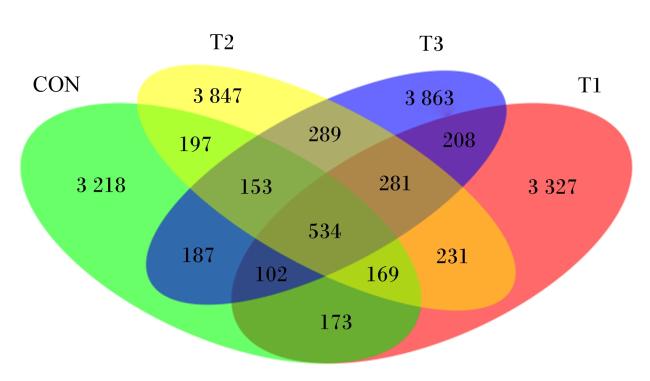
根据特征值丰度表,计算各组共有特征值的数量,并通过Venn图呈现各组共有和特有的特征值数目,若特征值只存在于1个分组,则该特征值为该分组特有。由图1可知,CON、T1、T2、T3组特有的特征值数目分别为3 218、3 327、3 847、3 863个。
图1 特征值分布Venn图

CON、T1、T2、T3分别代表对照组、T1组、T2组和T3组。下图同。

Fig.1 Venn diagram of feature distribution

CON, T1, T2 and T3 represented control group, T1 group, T2 group and T3 group, respectively. The same as below.

2.4.2 Alpha多样性分析

表6可知,在物种均匀度上,与CON组相比,T1、T2和T3组Shannon指数有升高趋势(0.05≤P<0.10)。各组之间操作分类单元(OTU)数量指数、Simpson指数、Chao1指数均无显著差异(P>0.05)。
表6 盲肠微生物菌群Alpha多样性指数

Table 6 Alpha diversity indexes of cecal microbial flora

项目
Items
组别Groups P
P-value
CON T1 T2 T3
操作分类单元数量指数
OTU number index
1 192.00±58.53 1 264.40±110.71 1 420.40±111.76 1 390.40±65.97 0.359
Shannon指数Shannon index 7.35±0.20 7.98±0.15 8.11±0.18 7.79±0.11 0.067
Simpson指数Simpson index 0.967 9±0.008 4 0.983 8±0.002 5 0.986 0±0.002 4 0.977 2±0.005 5 0.215
Chao1指数Chao1 index 1 197.66±58.92 1 268.39±112.41 1 426.65±113.73 1 397.98±66.23 0.361

2.4.3 发酵精料对肉兔盲肠微生物菌群相对丰度的影响

2.4.3.1 门水平分析
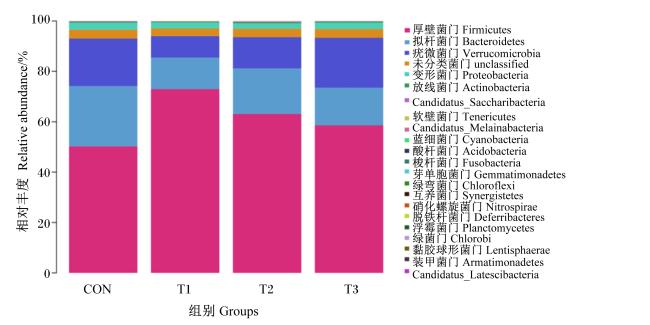
图2可知,肉兔盲肠微生物在门水平上均主要由厚壁菌门、拟杆菌门(Bacteroidetes)、疣微菌门(Verrucomicrobia)和变形菌门(Proteobacteria)4种菌门组成,各组4种菌门总和分别为95.78%、96.38%、95.77%、95.89%。
图2 门水平上盲肠微生物菌群相对丰度

Fig.2 Relative abundance of cecal microbial flora at phylum level

表7可知,在门水平上,与CON组相比,T1组盲肠厚壁菌门相对丰度显著升高(P<0.05),T1和T3组盲肠拟杆菌门相对丰度显著降低(P<0.05),T3组盲肠蓝细菌门(Cyanobacteria)相对丰度显著升高(P<0.05),T1和T2组盲肠疣微菌门相对丰度有降低趋势(0.05≤P<0.10)
表7 肉兔盲肠微生物菌群在门水平上的分布

Table 7 Distribution of cecal microbial flora of meat rabbits at phylum level %

项目
Items
组别Groups P
P-value
CON T1 T2 T3
厚壁菌门Firmicutes 50.23±2.79b 72.91±3.84a 63.06±3.02ab 58.56±3.37b 0.011
拟杆菌门Bacteroidetes 23.95±2.30a 12.58±1.82b 18.09±1.69ab 14.96±3.44b 0.032
疣微菌门Verrucomicrobia 18.82±3.24 8.52±1.92 12.46±1.95 19.79±3.87 0.055
变形菌门Proteobacteria 2.78±0.47 2.37±0.50 2.16±0.51 2.58±0.67 0.917
放线菌门Actinobacteria 0.40±0.08 0.32±0.04 0.46±0.05 0.37±0.05 0.338
Candidatus_Saccharibacteria 0.15±0.04 0.07±0.02 0.24±0.12 0.09±0.03 0.384
软壁菌门Tenericutes 0.01±0.01 0.12±0.05 0.11±0.05 0.07±0.03 0.060
Candidatus_Melainabacteria 0.05±0.01 0.04±0.01 0.06±0.03 0.02±0.01 0.313
蓝细菌门Cyanobacteria 0.01±0.00b 0.01±0.00ab 0.02±0.01ab 0.03±0.01a 0.049
酸杆菌门Acidobacteria 0.01±0.00 0.01±0.00 0.00±0.00 0.01±0.00 0.119

2.4.3.2 属水平分析

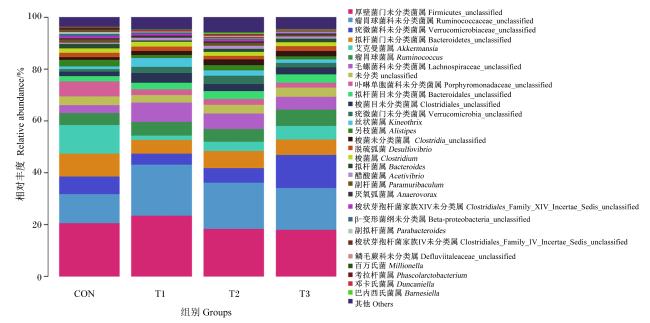
图3可知,各组肉兔盲肠微生物在属水平上均主要由厚壁菌门未分类菌属(Firmicutes_unclassified)、瘤胃球菌科未分类菌属(Ruminococcaceae_unclassified)、疣微菌科未分类菌属(Verrucomicrobiaceae_unclassified)、拟杆菌门未分类菌属(Bacteroidetes_unclassified)、艾克曼菌属(Akkermansia)、瘤胃球菌属(Ruminococcus)、毛螺菌科未分类菌属(Lachnospiraceae_unclassified)7种菌属组成。
图3 属水平上盲肠微生物菌群相对丰度

Fig.3 Relative abundance of cecal microbial flora at genus level

表8可知,在属水平上,与CON组相比,T1和T2组盲肠瘤胃球菌科未分类菌属、毛螺菌科未分类菌属、醋酸菌属(Acetivibrio)相对丰度显著升高(P<0.05),T1和T3组盲肠另枝菌属(Alistipes)相对丰度显著降低(P<0.05),T1、T2和T3组盲肠艾克曼菌属相对丰度有降低趋势(0.05≤P<0.10),梭菌目未分类菌属(Clostridiales_unclassified)有升高趋势(0.05≤P<0.10)。
表8 肉兔盲肠微生物菌群在属水平上的分布

Table 8 Distribution of cecal microbial flora of meat rabbits at genus level %

项目
Items
组别Groups P
P-value
CON T1 T2 T3
厚壁菌门未分类菌属
Firmicutes_unclassified
20.68±2.39 23.47±3.67 18.47±2.29 18.11±1.30 0.633
瘤胃球菌科未分类菌属
Ruminococcaceae_unclassified
11.12±0.92b 19.68±2.18a 17.79±2.69a 16.04±2.07ab 0.028
疣微菌科未分类菌属
Verrucomicrobiaceae_unclassified
6.74±3.13 4.28±1.84 5.63±1.00 12.73±2.90 0.130
拟杆菌门未分类菌属
Bacteroidetes_unclassified
8.97±2.02 5.18±1.21 6.51±1.13 6.02±1.94 0.501
艾克曼菌属Akkermansia 10.90±3.87 1.76±0.81 3.61±1.76 5.25±3.54 0.085
瘤胃球菌属Ruminococcus 4.66±0.95 5.37±0.95 4.95±1.12 6.29±0.84 0.537
毛螺菌科未分类菌属
Lachnospiraceae_unclassified
2.95±0.52b 7.37±1.04a 5.96±1.14a 4.93±0.56ab 0.020
卟啉单胞菌科未分类菌属
Porphyromonadaceae_unclassified
5.69±2.85 2.06±0.91 2.25±0.67 1.96±0.84 0.930
拟杆菌目未分类菌属
Bacteroidales_unclassified
2.06±0.28 2.65±0.68 3.05±0.41 3.14±1.44 0.596
梭菌目未分类菌属
Clostridiales_unclassified
1.64±0.18 3.59±1.01 2.74±0.23 2.76±0.43 0.055
疣微菌门未分类菌属
Verrucomicrobia_unclassified
1.17±0.32 2.48±1.52 3.22±2.46 1.81±0.78 0.964
丝状菌属Kineothrix 0.90±0.51 3.38±1.54 2.04±0.84 1.37±0.69 0.323
另枝菌属Alistipes 2.56±0.44a 1.12±0.24b 2.14±0.70ab 1.06±0.12b 0.027
梭菌未分类菌属
Clostridia_unclassified
1.15±0.13 1.62±0.38 2.06±0.44 2.03±0.46 0.329
脱硫弧菌Desulfovibrio 1.54±0.63 1.70±0.55 1.37±0.41 2.01±0.64 0.926
梭菌属Clostridium 1.67±0.08 1.83±0.31 1.61±0.12 1.39±0.20 0.622
拟杆菌属Bacteroides 1.79±0.47 0.50±0.13 1.11±0.46 1.32±0.83 0.189
醋酸菌属Acetivibrio 0.56±0.13b 1.09±0.13a 1.28±0.13a 0.91±0.05ab 0.016
副杆菌属Paramuribaculum 1.12±0.81 0.15±0.04 0.91±0.32 0.49±0.28 0.424

3 讨论

3.1 发酵精料对肉兔饲粮养分消化率的影响

养分消化率是动物对饲粮消化能力及动物肠道功能相关的生理现象的定量评估。
Li等[13]研究发现,饲粮中添加发酵饲料可提高肉仔鸡EE和Ca的表观代谢率。魏金涛等[14]试验结果表明,在断奶仔猪饲粮中用50%发酵饲料等量替代基础饲料,饲粮CP、Ca和P的表观消化率提高。彭忠利等[15]研究发现,对山羊饲喂发酵饲粮可以显著提高其对饲粮中CP、CF、NDF、ADF的表观消化率。本试验结果表明,与CON组相比,T1、T2和T3组GE、EE、CF、NDF、ADF、Ca及P消化率均有所升高,其中CF、NDF、ADF、Ca及P消化率显著升高,与前人研究结果一致。这是因为,本试验结果显示饲粮中添加发酵精料可以提高盲肠厚壁菌门、梭菌目未分类菌属相对丰度,厚壁菌门与能量相关,丁酸梭菌可以将寡糖转化成短链脂肪酸及乳酸。因此,与CON组相比,T1、T2和T3组肉兔GE消化率提高,胃肠道pH有降低趋势,良好的酸性环境有益于Ca的吸收;与CON组相比,T1、T2和T3组盲肠毛螺菌科和瘤胃球菌科相对丰度提高,毛螺菌科和瘤胃球菌科有降解植物中纤维素和半纤维素转化为短链脂肪酸的作用,因此提高了肉兔CF、NDF及ADF消化率。且本试验结果显示,与CON组相比,T1、T2和T3组回肠隐窝深度降低,黏膜厚度增加,说明发酵精料可以促进肉兔肠道结构发育完整,提高消化能力。综上所述,发酵精料可以通过降低胃肠道pH、改善肉兔肠道形态结构,调整微生物区系组成,提高养分消化率。

3.2 发酵精料对肉兔肠道形态的影响

小肠作为家兔进行消化吸收营养物质的重要组成部位,肠绒毛高度、隐窝深度和黏膜厚度是指示其发育程度的重要指标。肠绒毛是分泌消化酶、吸收养分的主要结构;隐窝可分泌肠上皮细胞,是肠黏膜屏障的主要结构成分,同时作为屏障,用于隔开宿主组织和共生菌,维持肠道的自身稳定[16]。隐窝变浅表明肠上皮细胞成熟率上升,小肠营养吸收功能增强[17]。鲁春灵[18]研究发现,在肉鸡饲粮中添加发酵豆粕能显著提高肉鸡小肠绒毛高度,降低隐窝深度。田凤云[19]试验结果表明,5%~20%发酵苜蓿颗粒等量替代基础饲粮能改善临武鸭小肠形态,促进肠道发育。本试验结果表明,与CON组相比,T1组回肠隐窝深度显著降低,T1、T2和T3组回肠绒毛高度/隐窝深度提高,T2和T3组回肠黏膜厚度增加,这与前人研究结果一致,表明发酵精料可以改善肉兔肠道形态结构,提高肠道的消化吸收功能。这可能是因为发酵精料进入消化道后,其中有益菌如乳酸菌、芽孢杆菌在胃肠道萌发和增殖,一方面可以调节胃肠道微生物区系平衡,同时发酵精料中益生菌及其代谢产物能刺激肠上皮细胞的更新[20],促进小肠对饲粮中养分的消化吸收。此外,发酵精料中益生菌还能调节肠道黏液的分泌,上调肠道上皮细胞紧密连接蛋白和细胞骨架蛋白的表达[21-23],增强肠上皮细胞间的紧密连接,促进隐窝处上皮细胞增殖,改善肠道黏膜屏障的完整性。

3.3 发酵精料对肉兔胃肠道pH的影响

胃肠道作为动物机体消化吸收营养物质最主要的场所,其pH在一定的范围内才能维持各种消化酶的活性,促进食物消化吸收。在本试验中,与CON组相比,T1、T2和T3组肉兔胃pH有降低趋势。刘金阳等[24]研究结果表明,益生菌与饲粮组合对苏淮猪胃肠道的pH无显著影响。陈振等[25]研究发现,在断奶仔猪饲粮中添加1.0%复合益生菌能显著降低断奶仔猪胃和十二指肠pH,对其他肠段pH无显著影响。王庆争等[26]研究发现,在饲粮中添加0.1%的酸化剂能显著降低哺乳仔兔胃和十二指肠的pH,但对于空肠、回肠和盲肠起不到增加酸度的效果。本试验结果与前人结论基本一致,说明添加发酵精料可以在一定程度上降低肉兔的胃肠道pH,改善消化道酸性环境,同时也发现这种作用在消化道前段发挥的影响更大。这是因为发酵精料中含有丰富的乳酸菌,可以分解饲粮中碳水化合物,产生乳酸和乙酸,降低饲粮pH,从而降低胃肠道pH。

3.4 发酵精料对肉兔盲肠微生物多样性的影响

肠道微生物菌群在宿主健康中起着至关重要的作用。肉兔盲肠内的主要优势菌门为厚壁菌门、拟杆菌门、疣微菌门。本试验结果表明,在门水平上,与CON组相比,T1组厚壁菌门相对丰度显著提高,T1和T3组拟杆菌门相对丰度降低;在属水平上,与CON组相比,T1和T2组瘤胃球菌科未分类属、毛螺菌科未分类属及醋酸菌属相对丰度显著提高,梭菌目未分类菌属相对丰度有升高趋势,T1和T3组另枝菌属相对丰度显著降低。廖清华等[27]研究发现,添加益生菌能改善肉兔肠道微生物区系,增加有益菌群数量,降低有害菌群数量。孙海涛等[28]研究表明,在断奶肉兔饲粮中添加发酵豆粕能显著促进断奶~2月龄伊拉肉兔的肠道发育,改善盲肠微生物菌群。方静等[29]研究发现,在饲粮中添加发酵小麦麸可有效调节肠道菌群结构,促进断奶仔猪肠道健康,本试验结果与前人研究结果基本一致。肠道中厚壁菌门主要包括革兰氏阳性细菌,如乳酸杆菌、芽孢杆菌、梭菌,这类菌对动物健康有益[30-31];精料发酵后乳酸菌和芽孢杆菌数量增加,厚壁菌门相对丰度升高,厚壁菌门通过碳水化合物代谢产生短链脂肪酸,与能量获得密切相关[32]。梭菌是主要的产丁酸菌,丁酸梭菌被认为是益生菌,能降解食物中的寡糖和调控肠道微生物区系平衡[33];毛螺菌为厌氧菌,是微生物区系中重要的一员,具有促进健康的作用[34-36]。毛螺菌科和瘤胃球菌科可以维持肠道健康,降解植物中纤维素和半纤维素转化为短链脂肪酸,被宿主吸收利用[37-38]。精料发酵后乳酸菌数量增加,乳酸含量提高,胃肠道pH降低,为肉兔盲肠内厌氧益生菌的生存繁殖提供了条件。本试验结果表明,饲粮中添加发酵精料可以提高肉兔盲肠有益菌相对丰度,降低有害菌相对丰度,调节盲肠菌群平衡。

4 结论

① 饲粮中添加10%~15%的发酵精料可以提高肉兔饲粮养分消化率。
② 饲粮中添加5%~10%的发酵精料可以在一定程度上降低肉兔胃肠道pH,改善肠道形态,调节盲肠微生物平衡。
[1]
DZIALO M C, PARK R, STEENSELS J, et al. Physiology,ecology and industrial applications of aroma formation in yeast[J]. FEMS Microbiology Reviews, 2017,41 (Supp.1):S95-S128.

[2]
CHI C H, CHO S J. Improvement of bioactivity of soybean meal by solid-state fermentation with Bacillus amyloliquefaciens versus Lactobacillus spp. and Saccharomyces cerevisiae[J]. LWT-Food Science and Technology, 2016, 68:619-625.

DOI

[3]
刘泽, 郭云霞, 郭晓军, 等. 复合益生菌发酵全价料对Z型鸭生长性能、血清生化指标及表观消化率的影响[J]. 饲料工业, 2021, 42(15):57-64.

LIU Z, GUO Y X, GUO X J, et al. Effects of compound probiotics fermented complete feed on growth performance,serun biochemical indices and apparent digestibility of Z-type ducks[J]. Feed Industry, 2021, 42(15):57-64. (in Chinese)

[4]
舒刚, 梁娜, 曾敏, 等. 发酵饲料对肉鸡生长性能和肠道菌群、pH值的影响[J]. 中国畜牧杂志, 2013, 49(13):51-54,64.

SHU G, LIANG N, ZENG M, et al. Effects of fermented feed on growth performance,intestinal flora and pH value of broilers[J]. Chinese Journal of Animal Science, 2013, 49(13):51-54,64. (in Chinese)

[5]
谢童, 董涛, 王伟唯, 等. 复合乳酸菌制剂对黄羽肉鸡生长性能、胃肠道pH、肠道形态和盲肠微生物的影响[J]. 动物营养学报, 2022, 34(1):254-263.

DOI

XIE T, DONG T, WANG W W, et al. Effects of compound Lactobacillus preparation on growth performance,gastrointestinal pH,intestinal morphology and cecal microorganism of yellow-feathered broilers[J]. Chinese Journal of Animal Nutrition, 2022, 34(1):254-263. (in Chinese)

[6]
LIU Y L, FENG J, WANG Y M, et al. Fermented corn-soybean meal mixed feed modulates intestinal morphology,barrier functions and cecal microbiota in laying hens[J]. Animals, 2021, 11(11):3059.

DOI

[7]
LIU S, XIAO H, XIONG Y X, et al. Effects of fermented feed on the growth performance,intestinal function,and microbiota of piglets weaned at different age[J]. Frontiers in Veterinary Science, 2022, 9:841762.

DOI

[8]
正旭城, 严明, 杨海明, 等. 饲粮添加发酵饲料对产蛋后期蛋鸡肠道功能、养分排泄量及血清生化指标的影响[J]. 饲料研究, 2022, 45(10):29-34.

ZHENG X C, YAN M, YANG H M, et al. Effect of diet supplemented with fermented feed on intestinal function,nutrient excretion and serum biochemical indexes of laying hens in later stage of laying period[J]. Feed Research, 2022, 45(10):29-34. (in Chinese)

[9]
何敏, 党文庆, 梁兴龙, 等. 饲粮中添加发酵豆粕对断奶仔猪粪便菌群多样性的影响[J]. 动物营养学报, 2019, 31(6):2560-2571.

HE M, DANG W Q, LIANG X L, et al. Effects of dietary fermented soybean meal on diversity of faecal microbiota of weaned pigs[J]. Chinese Journal of Animal Nutrition, 2019, 31(6):2560-2571. (in Chinese)

[10]
DE BLAS C, WISEMAN J. Nutrition of the rabbit[M]. 3rd ed. New york: CABI Publishing, 2020.

[11]
张丽英. 饲料分析及饲料质量检测技术[M]. 4版. 北京: 中国农业大学出版社, 2016:48-105.

ZHANG L Y. Feed analysis and quality test technology[M]. 4th ed. Beijing: China Agricultural University Press, 2016:48-105. (in Chinese)

[12]
肖志明, 李丽蓓, 邓涛, 等. 饲料原料中酸溶蛋白的测定方法研究[J]. 中国畜牧杂志, 2016, 52(2):72-75,80.

XIAO Z M, LI L B, DENG T, et al. Study for the determination of acid-soluble protein in feed materials[J]. Chinese Journal of Animal Science, 2016, 52(2):72-75,80. (in Chinese)

[13]
LI J T, TAO L J, ZHANG R, et al. Effects of fermented feed on growth performance,nutrient metabolism and cecal microflora of broilers[J]. Animal Bioscience, 2022, 35(4):596-604.

DOI

[14]
魏金涛, 赵娜, 杨雪海, 等. 发酵饲料对断奶仔猪生产性能、血液生化指标和饲料养分表观消化率的影响[J]. 中国粮油学报, 2009, 24(2):129-133.

WEI J T, ZHAO N, YANG X H, et al. Effects of fermented feed on growth performance,plasma biochemical parameters and digestibility of dietary components in weaned piglets[J]. Journal of the Chinese Cereals and Oils Association, 2009, 24(2):129-133. (in Chinese)

[15]
彭忠利, 郭春华, 柏雪, 等. 微生物发酵饲料对山羊生产性能的影响[J]. 贵州农业科学, 2013, 41(6):134-137.

PENG Z L, GUO C H, BAI X, et al. Effects of fermented feed on goat production performance[J]. Guizhou Agricultural Sciences, 2013, 41(6):134-137. (in Chinese)

[16]
XIE S, ZHAO S Y, JIANG L, et al. Lactobacillus reuteri stimulates intestinal epithelial proliferation and induces differentiation into goblet cells in young chickens[J]. Journal of Agricultural and Food Chemistry, 2019, 67(49):13758-13766.

DOI

[17]
张卫辉, 王玉璘, 朱秋凤, 等. 高纤维日粮对22-60日龄海兰褐蛋鸡生长性能、器官发育及肠道结构的影响[J]. 中国畜牧杂志, 2020, 56(4):137-140.

ZHANG W H, WANG Y L, ZHU Q F, et al. Effects of high-fiber diets on growth performance,organ development and intestinal structure of 22-60-day-old Hylan laying hens[J]. Chinese Journal of Animal Science, 2020, 56(4):137-140. (in Chinese)

[18]
鲁春灵. 湿态发酵豆粕不同添加方式对颗粒饲料质量及肉鸡生长性能影响[D].硕士学位论文. 邯郸: 河北工程大学, 2020:42-44.

LU C L. Effects of different adding methods of wet fermented soybean meal on pellet feed quality and growth performance of broilers[D].Master’s Thesis. Handan: Hebei University of Engineering, 2020:42-44. (in Chinese)

[19]
田凤云. 苜蓿发酵颗粒饲料对育成后期临武鸭生产性能的影响[D].硕士学位论文. 长沙: 湖南农业大学, 2021:17-21.

TIAN F Y. Effects of fermented alfalfa granuler feed on the production performance of Linwu duck at the late growing stage[D].Master’s Thesis. Changsha: Hunan Agricultural University, 2021:17-21. (in Chinese)

[20]
张俊, 朱建津, 刘江英, 等. 益生菌发酵产物对肉鸡肠道形态和肠道屏障功能的影响[J]. 浙江农业学报, 2016, 28(10):1657-1662.

DOI

ZHANG J, ZHU J J, LIU J Y, et al. Effects of fermentation metabolite produced by probiotics on intestinal morphology and intestinal barrier function in chicken[J]. Acta Agriculturae Zhejiangensis, 2016, 28(10):1657-1662. (in Chinese)

DOI

[21]
王文娟, 孙笑非, 孙冬岩. 肠道上皮细胞与菌群的相互作用及益生菌对肠道上皮细胞的保护机制[J]. 饲料研究, 2016(1):28-30,56.

WANG W J, SUN X F, SUN D Y. Interaction between intestinal epithelial cells and flora and the protective mechanism of probiotics on intestinal epithelial cells[J]. Feed Research, 2016(1):28-30,56. (in Chinese)

[22]
PATEL R M, MYERS L S, KURUNDKAR A R, et al. Probiotic bacteria induce maturation of intestinal claudin 3 expression and barrier function[J]. The American Journal of Pathology, 2012, 180(2):626-635.

DOI

[23]
ANDERSON R C, COOKSON A L, MCNABB W C, et al. Lactobacillus plantarum MB452 enhances the function of the intestinal barrier by increasing the expression levels of genes involved in tight junction formation[J]. BMC Microbiology, 2010, 10:316.

DOI

[24]
刘金阳, 王在贵, 张宏福, 等. 益生菌与饲粮组合效应对苏淮猪生长性能、胃肠道pH和肉品质的影响[J]. 畜牧兽医学报, 2014, 45(10):1648-1655.

LIU J Y, WANG Z G, ZHANG H F, et al. Effects of diets supplemented with probiotic on growth performance,gastrointestinal pH and meat quality of Suhuai pigs[J]. Acta Veterinaria et Zootechnica Sinica, 2014, 45(10):1648-1655. (in Chinese)

[25]
陈振, 谢全喜, 亓秀晔, 等. 复合益生菌替代抗生素对断奶仔猪生长性能、胃肠道pH和免疫器官指数的影响[J]. 中国畜牧杂志, 2017, 53(4):112-115.

CHEN Z, XIE Q X, QI X Y, et al. Effects of compound probiotics instead of antibiotics on growth performance,gastrointestinal pH and immune organ index in weaned piglets[J]. Chinese Journal of Animal Science, 2017, 53(4):112-115. (in Chinese)

[26]
王庆争, 郭志强, 谢晓红, 等. 酸化剂和血浆蛋白粉对哺乳仔兔生长性能、胃肠道pH、胃蛋白酶活性及肠黏膜形态的影响[J]. 动物营养学报, 2019, 31(2):713-720.

WANG Q Z, GUO Z Q, XIE X H, et al. Effects of acidifiers and spray-dried plasma protein on growth performance,gastrointestinal pH,pepsin activity and intestinal mucosal morphology of suckling rabbits[J]. Chinese Journal of Animal Nutrition, 2019, 31(2):713-720. (in Chinese)

[27]
廖清华, 陈红. 益生菌对肉兔消化道微生物区系影响的研究[J]. 当代畜牧, 2014(12):22-23.

LIAO Q H, CHEN H. Study on the effect of probiotics on the microflora of the digestive tract of meat rabbits[J]. Contemporary Animal Husbandry, 2014(12):22-23. (in Chinese)

[28]
孙海涛, 杨丽萍, 姜文学, 等. 发酵豆粕对断奶-2月龄肉兔生长发育、血清生化及肠道发育的影响[J]. 山东农业科学, 2017, 49(8):131-135.

SUN H T, YANG L P, JIANG W X, et al. Effects of fermented soybean meal on growth performance,serum biochemistry and intestinal development of weaner to two-month-old growing meat rabbits[J]. Shandong Agricultural Sciences, 2017, 49(8):131-135. (in Chinese)

[29]
方静, 石宝明, 何威, 等. 发酵小麦麸对断奶仔猪生长性能、养分表观消化率、免疫功能及粪便菌群的影响[J]. 动物营养学报, 2022, 34(1):150-158.

DOI

FANG J, SHI B M, HE W, et al. Effects of fermented wheat bran on growth performance,nutrient apparent digestibility,immune function and fecal microbiota of weaned piglets[J]. Chinese Journal of Animal Nutrition, 2022, 34(1):150-158. (in Chinese)

[30]
SEONG C N, KANG J W, LEE J H, et al. Taxonomic hierarchy of the phylum Firmicutes and novel Firmicutes species originated from various environments in Korea[J]. Journal of Microbiology, 2018, 56(1):1-10.

DOI PMID

[31]
CHE L Q, HU L, ZHOU Q, et al. Microbial insight into dietary protein source affects intestinal function of pigs with intrauterine growth retardation[J]. European Journal of Nutrition, 2020, 59(1):327-344.

DOI PMID

[32]
WALKER A W, INCE J, DUNCAN S H, et al. Dominant and diet-responsive groups of bacteria within the human colonic microbiota[J]. The ISME Journal, 2011, 5(2):220-230.

DOI

[33]
LOUIS P, FLINT H J. Diversity,metabolism and microbial ecology of butyrate-producing bacteria from the human large intestine[J]. FEMS Microbiology Letters, 2009, 294(1):1-8.

DOI

[34]
SORBARA M T, DUBIN K, LITTMANN E R, et al. Inhibiting antibiotic-resistant Enterobacteriaceae by microbiota-mediated intracellular acidification[J]. Journal of Experimental Medicine, 2019, 216(1):84-98.

DOI

[35]
LOPETUSO L R, SCALDAFERRI F, PETITO V, et al. Commensal clostridia:leading players in the maintenance of gut homeostasis[J]. Gut Pathogens, 2013, 5(1):23.

DOI

[36]
DAVID L A, MAURICE C F, CARMODY R N, et al. Diet rapidly and reproducibly alters the human gut microbiome[J]. Nature, 2014, 505(7484):559-563.

DOI

[37]
BIDDLE A, STEWART L, BLANCHARD J, et al. Untangling the genetic basis of fibrolytic specialization by Lachnospiraceae and Ruminococcaceae in diverse gut communities[J]. Diversity, 2013, 5(3):627-640.

DOI

[38]
YANG Q Z M, WEI C C, GUO S T, et al. Cloning and characterization of a L-lactate dehydrogenase gene from Ruminococcaceae bacterium CPB6[J]. World Journal of Microbiology and Biotechnology, 2020, 36(12):182.

DOI

文章导航

/