

1 材料与方法
1.1 试验动物及饲养管理
表1 基础饲粮组成及营养水平(风干基础)Table 1 Composition and nutrient levels of the basal diet (air-dry basis) % |
| 项目Items | 含量Content |
|---|---|
| 原料Ingredients | |
| 玉米Corn | 20.70 |
| 高粮Sorghum | 10.50 |
| 小麦Wheat | 8.40 |
| 豌豆Peas | 15.70 |
| 颗粒料Pellets1) | 44.70 |
| 合计Total | 100.00 |
| 营养水平Nutrient levels2) | |
| 粗蛋白质CP | 14.92 |
| 代谢能ME/(MJ/kg) | 12.58 |
| 粗脂肪EE | 2.96 |
| 水分Moisture | 12.26 |
| 粗灰分Ash | 3.45 |
| 钙Ca | 0.59 |
| 磷P | 0.42 |
1)商业复合颗粒饲料(广东惠州华宝饲料有限公司),其组成如下:玉米、豆粕、磷酸氢钙、硫酸铜、硫酸亚铁、硫酸锰、维生素A、维生素D3、DL-α-生育酚乙酸酯、维生素B6、维生素B12、蛋氨酸、L-赖氨酸硫酸盐。A commercial compound pellet feed (Guangdong Huizhou Huabao Feed Co., Ltd.), and the composition of it as follows: corn, soybean meal, calcium hydrogen phosphate, copper sulfate, ferrous sulfate, manganese sulfate, vitamin A, vitamin D3, DL-α-tocopherol acetate, vitamin B6, vitamin B12, methionine and L-lysine sulfate. | |
2)营养水平为实测值。Nutrient levels were measured values. |
1.2 样品采集及指标测定
1.2.1 乳鸽屠宰性能和器官指数测定
1.2.2 乳鸽糖血清生化指标测定
1.2.3 乳鸽肉品质测定
1.2.4 乳鸽肠道形态测定
1.3 数据统计分析
2 结果与分析
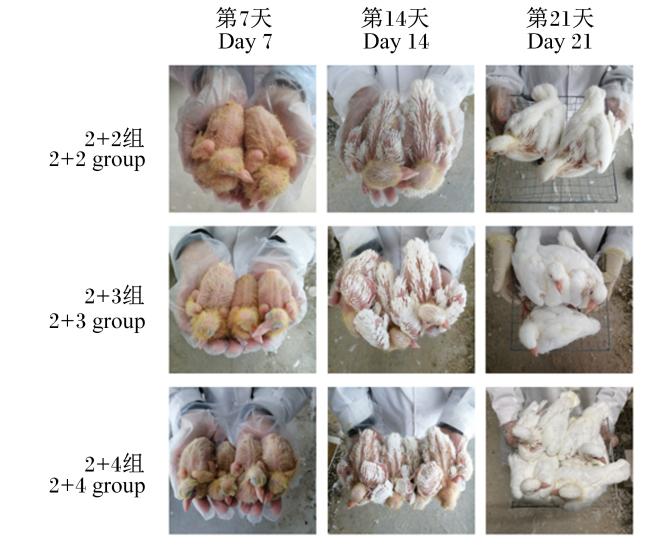
2.1 不同带仔模式对乳鸽屠宰性能的影响
表2 不同带仔模式对乳鸽屠宰性能的影响Table 2 Effects of different rearing patterns on slaughter performance of squabs |
| 项目 Items | 组别Groups | SEM | P值P-value | ||||
|---|---|---|---|---|---|---|---|
| 2+2 | 2+3 | 2+4 | 线性 Linear | 二次 Quadratic | 方差分析 ANOVA | ||
| 活重Live weight/g | 483.57a | 466.44a | 417.83b | 34.10 | <0.000 1 | <0.000 1 | <0.000 1 |
| 屠体重Slaughter weight/g | 388.50a | 376.04a | 338.14b | 26.23 | <0.000 1 | <0.000 1 | <0.000 1 |
| 半净膛重Half eviscerated weight/g | 334.45a | 319.65a | 283.92b | 25.98 | <0.000 1 | <0.000 1 | <0.000 1 |
| 全净膛重Eviscerated weight/g | 299.63a | 284.80a | 251.32b | 24.75 | <0.000 1 | <0.000 1 | <0.000 1 |
| 胸肌重Breast muscle weight/g | 53.29a | 49.53a | 38.08b | 7.92 | <0.000 1 | <0.000 1 | <0.000 1 |
| 屠宰率Slaughter rate/% | 80.37 | 80.64 | 80.93 | 0.28 | 0.380 6 | <0.000 1 | 0.682 1 |
| 半净膛率Half eviscerated rate/% | 86.06a | 84.99ab | 83.88b | 1.09 | 0.002 3 | <0.000 1 | 0.009 8 |
| 全净膛率Eviscerated rate/% | 77.07a | 75.71ab | 74.22b | 1.43 | <0.000 1 | <0.000 1 | 0.000 5 |
| 胸肌率Breast muscle rate/% | 17.67a | 17.36a | 15.03b | 1.44 | <0.000 1 | <0.000 1 | <0.000 1 |
同行数据肩标不同小写字母表示差异显著(P<0.05),相同或无字母表示差异不显著(P>0.05)。下表同。 | |
In the same row, values with different small letter superscripts mean significant difference (P<0.05), while with the same or no letter superscripts mean no significant difference (P>0.05). The same as below. |
2.2 不同带仔模式对乳鸽血清生化指标的影响
表3 不同带仔模式对乳鸽血清生化指标的影响Table 3 Effects of different rearing patterns on serum biochemical indices of squabs nmol/mL |
| 项目 Items | 组别Groups | SEM | P值P-value | ||||
|---|---|---|---|---|---|---|---|
| 2+2 | 2+3 | 2+4 | 线性 Linear | 二次 Quadratic | 方差分析 ANOVA | ||
| 总胆固醇TC | 7.70 | 7.41 | 7.52 | 0.15 | 0.743 4 | 0.000 3 | 0.879 3 |
| 葡萄糖GLU | 15.56 | 15.66 | 16.43 | 0.48 | 0.053 0 | 0.564 8 | 0.104 2 |
| 甘油三酯TG | 3.14 | 3.41 | 3.19 | 0.14 | 0.868 9 | 0.000 1 | 0.792 0 |
| 高密度脂蛋白胆固醇HDL-C | 3.23 | 3.12 | 3.19 | 0.06 | 0.705 3 | 0.000 1 | 0.596 7 |
| 低密度脂蛋白胆固醇LDL-C | 3.60 | 3.15 | 3.49 | 0.23 | 0.704 3 | 0.004 7 | 0.403 2 |
2.3 不同带仔模式对乳鸽器官重量和指数的影响
表4 不同带仔模式对乳鸽器官重量和指数的影响Table 4 Effects of different rearing patterns on organ weight and index of squabs |
| 项目 Items | 组别Groups | SEM | P值P-value | ||||||||||||
|---|---|---|---|---|---|---|---|---|---|---|---|---|---|---|---|
| 2+2 | 2+3 | 2+4 | 线性 Linear | 二次 Quadratic | 方差分析 ANOVA | ||||||||||
| 心脏重量Heart weight/g | 4.90a | 4.68ab | 4.49b | 0.20 | 0.006 0 | <0.000 1 | 0.023 1 | ||||||||
| 肝脏重量Liver weight/g | 16.47 | 16.11 | 16.73 | 0.31 | 0.677 7 | <0.000 1 | 0.592 7 | ||||||||
| 肾脏重量Kidney weight/g | 4.33a | 3.62bc | 3.30c | 0.53 | <0.000 1 | <0.000 1 | <0.000 1 | ||||||||
| 肌胃重量Muscular stomach weight/g | 12.29a | 11.63ab | 11.23b | 0.53 | 0.011 0 | <0.000 1 | 0.037 2 | ||||||||
| 腺胃重量Glandular stomach weight/g | 1.90 | 1.95 | 1.95 | 0.03 | 0.545 5 | 0.098 3 | 0.778 9 | ||||||||
| 胰腺重量Pancreas weight/g | 2.77 | 2.67 | 2.54 | 0.12 | 0.095 4 | 0.006 8 | 0.246 6 | ||||||||
| 心脏指数Heart index/% | 1.01b | 1.01b | 1.08a | 0.04 | 0.041 3 | 0.205 5 | 0.035 0 | ||||||||
| 肝脏指数Liver index/% | 3.42b | 3.46b | 4.02a | 0.34 | <0.000 1 | <0.000 1 | <0.000 1 | ||||||||
| 肾脏指数Kidney index/% | 0.90a | 0.78b | 0.79b | 0.07 | 0.018 0 | 0.099 6 | 0.014 4 | ||||||||
| 肌胃指数Muscular stomach index/% | 2.55 | 2.49 | 2.70 | 0.11 | 0.098 9 | <0.000 1 | 0.055 3 | ||||||||
| 腺胃指数Glandular stomach index/% | 0.40b | 0.42b | 0.47a | 0.04 | 0.000 1 | 0.007 9 | 0.035 6 | ||||||||
| 胰腺指数Pancreas index/% | 0.57 | 0.58 | 0.61 | 0.02 | 0.197 0 | 0.283 0 | 0.355 1 | ||||||||
2.4 不同带仔模式对乳鸽免疫器官指数的影响
表5 不同带仔模式对乳鸽免疫器官重量和指数的影响Table 5 Effects of different rearing patterns on immune organ weight and index of squabs |
| 项目 Items | 组别Groups | SEM | P值P-value | ||||
|---|---|---|---|---|---|---|---|
| 2+2 | 2+3 | 2+4 | 线性 Linear | 二次 Quadratic | 方差分析 ANOVA | ||
| 脾脏重量Spleen weight/g | 0.59 | 0.55 | 0.47 | 0.06 | 0.110 3 | 0.453 3 | 0.259 1 |
| 胸腺重量Thymus weight/g | 2.60 | 2.69 | 2.30 | 0.20 | 0.182 0 | 0.607 0 | 0.188 8 |
| 法氏囊重量Bursa of Fabricius weight/g | 0.80 | 0.65 | 0.61 | 0.10 | 0.006 9 | 0.364 7 | 0.193 1 |
| 脾脏指数Spleen index/% | 0.12 | 0.12 | 0.11 | 0.01 | 0.581 1 | 0.054 8 | 0.851 6 |
| 胸腺指数Thymus index/% | 0.54 | 0.58 | 0.55 | 0.02 | 0.822 4 | 0.070 0 | 0.673 5 |
| 法氏囊指数Bursa of Fabricius index/% | 0.17 | 0.14 | 0.15 | 0.02 | 0.567 5 | 0.166 8 | 0.634 2 |
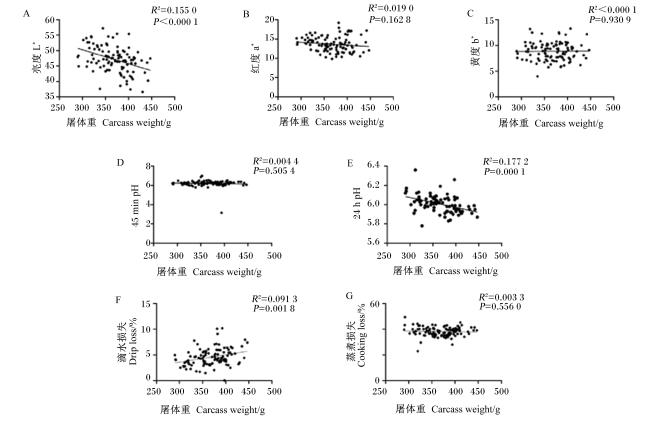
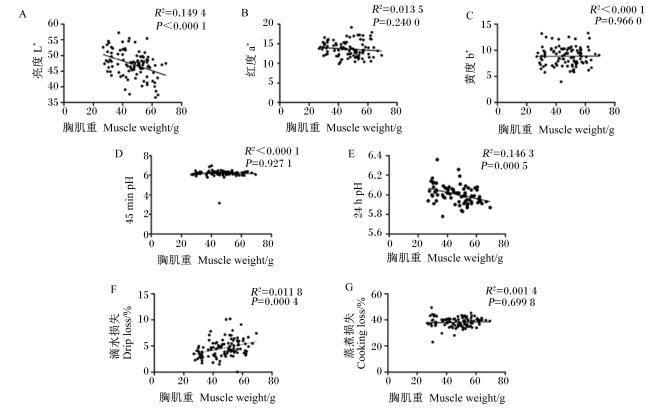
2.5 不同带仔模式对乳鸽肉品质的影响
表6 不同带仔模式对乳鸽肉品质的影响Table 6 Effects of different rearing patterns on meat quality of squabs |
| 项目 Items | 组别Groups | SEM | P值P-value | ||||
|---|---|---|---|---|---|---|---|
| 2+2 | 2+3 | 2+4 | 线性 Linear | 二次 Quadratic | 方差分析 ANOVA | ||
| pH 45 min | 6.25 | 6.11 | 6.23 | 0.07 | 0.882 0 | <0.000 1 | 0.208 9 |
| 24 h pH | 5.98b | 5.94b | 6.05a | 0.05 | 0.004 0 | <0.000 1 | 0.000 6 |
| 亮度L* | 45.63b | 47.09ab | 48.81a | 1.59 | 0.001 4 | <0.000 1 | 0.006 3 |
| 红度a* | 13.81 | 13.41 | 13.77 | 0.22 | 0.938 8 | <0.000 1 | 0.642 0 |
| 黄度b* | 9.35a | 9.20a | 8.07b | 0.70 | 0.002 0 | <0.000 1 | 0.003 2 |
| 滴水损失Drip loss/% | 5.12a | 4.58ab | 3.83b | 0.65 | 0.002 4 | 0.012 0 | 0.009 8 |
| 蒸煮损失Cooking loss/% | 39.32 | 37.79 | 37.34 | 1.04 | 0.021 1 | <0.000 1 | 0.053 9 |
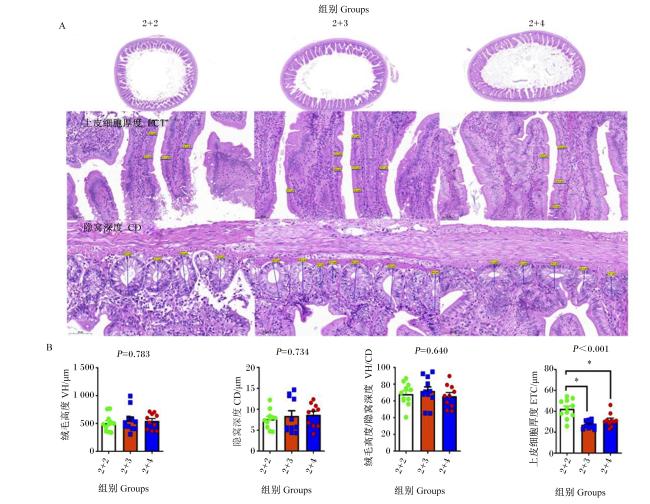
2.6 不同带仔模式对乳鸽肠道发育的影响
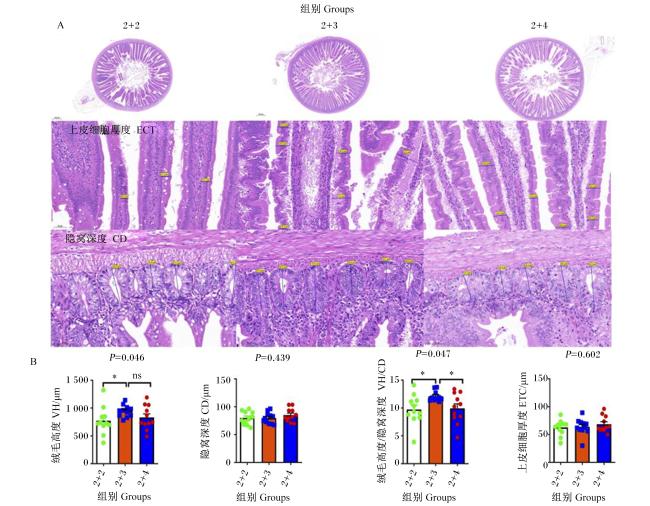
图4 不同带仔模式对乳鸽空肠发育的影响A:HE染色;B:统计结果。*表示差异显著(P<0.05),ns表示差异不显著(P>0.05)。下图同。 Fig.4 Effects of different rearing patterns on jejunum development of squabs (40×,n=12) A: HE stains; B: statistical results. * indicated significant difference (P<0.05), and ns indicated no significant difference (P>0.05). The same as below. |
2.7 经济效益分析
表7 1个哺乳期内不同带仔模式的经济效益Table 7 Economic benefits of different rearing patterns during a lactation period |
| 项目 Items | 组别Groups | ||
|---|---|---|---|
| 2+2 | 2+3 | 2+4 | |
| 乳鸽数Pigeon squab number/只 | 96.00 | 144.00 | 192.00 |
| 死亡乳鸽数Dead pigeon squab number/只 | 2.00 | 35.00 | 79.00 |
| 鸽蛋成本Pigeon egg cost/元1) | 294.00 | 537.00 | 813.00 |
| 饲料成本Feed cost/元2) | 512.80 | 833.67 | 1 054.36 |
| 总成本Total cost/元 | 806.80 | 1 370.67 | 1 867.36 |
| 乳鸽单价Pigeon squab unit price/元3) | 12.50 | ||
| 总收入Total income/元 | 1 200 | 1 800 | 2 400 |
| 总利润Total profit/元 | 393.20 | 429.33 | 532.64 |
1)鸽蛋成本=(理论饲养总数+死亡乳鸽数)×3。Pigeon egg cost=(theoretical total number of rearing+dead pigeon squab number)×3. | |
2)饲料成本=(哺乳期种鸽总采食量+死亡乳鸽消耗饲料)×3。Feed cost=(total feed intake of breeding pigeon in the whole period+feed waste of dead squabs)×3. | |
3)根据市场价格,乳鸽的市场价格为12.5元/只,鸽蛋为3元/个,饲料成本为3元/kg;总收入=市场价格×乳鸽数。According to the market price, the market price of pigeons is 12.5 yuan per pigeon, pigeon eggs are 3 yuan per egg, and the feed cost is 3 yuan/kg; total income=market price×pigeon squab number. |
 京公网安备 11010802041926号


