研究论文

丁酸梭菌对白羽肉鸡生长性能、免疫功能和肠道健康的影响

  • 李莹 , 1 ,
  • 张庆华 1 ,
  • 钟丽娟 1 ,
  • 胡琴琴 1 ,
  • 杜天宁 1 ,
  • 郑莉 2 ,
  • 章磊 3 ,
  • 赵新海 , 1, *
展开
  • 1 辽宁省微生物科学研究院,朝阳 122000
  • 2 朝阳市生态环境局北票分局,北票 122100
  • 3 喀左生态环境技术保障服务分中心,喀左 122300
*赵新海,研究员,E-mail:

李 莹(1987—),女,辽宁朝阳人,助理研究员,硕士,研究方向为农业微生物资源与利用。E-mail:

Office editor: 田艳明

收稿日期: 2023-02-20

  网络出版日期: 2023-08-10

基金资助

辽宁省重点研发项目(2022020386-JH2/1013)

辽宁省农业种质资源发掘、创制与利用专项(2021GR2922)

辽宁省农业科学院院长基金项目(2023QN2410)

Effects of Clostridium butyricum on Growth Performance, Immune Function and Intestine Health of White-Feathered Broilers

  • LI Ying , 1 ,
  • ZHANG Qinghua 1 ,
  • ZHONG Lijuan 1 ,
  • HU Qinqin 1 ,
  • DU Tianning 1 ,
  • ZHENG Li 2 ,
  • ZHANG Lei 3 ,
  • ZHAO Xinhai , 1, *
Expand
  • 1 Microbial Research Institute of Liaoning Province, Chaoyang 122000, China
  • 2 Beipiao Branch of Chaoyang City Ecological Environment Bureau, Beipiao 122100, China
  • 3 Harqin Left Wing Mongolian Autonomous County Branch of Ecological Environment Technology Guarantee Service Center, Harqin Left Wing Mongolian Autonomous County 122300, China
*professor, E-mail:

Received date: 2023-02-20

  Online published: 2023-08-10

摘要

本试验旨在研究丁酸梭菌对白羽肉鸡生长性能、免疫功能和肠道健康的影响。选取800只1日龄健康爱拔益加(AA)白羽肉鸡,随机分为5个组,每组5个重复,每个重复32只。对照组饲喂基础饲粮,试验组在基础饲粮中分别添加100、200、400和600 g/t丁酸梭菌制剂。试验期43 d。结果表明:1)与对照组相比,饲粮中添加400和600 g/t丁酸梭菌能显著提高白羽肉鸡末重和平均日增重(P<0.05),并显著降低料重比(P<0.05)。2)与对照组相比,饲粮中添加400 g/t丁酸梭菌能显著提高白羽肉鸡21日龄血清免疫球蛋白M(IgM)、免疫球蛋白G(IgG)和免疫球蛋白(IgA)含量以及脾脏指数、胸腺指数和法氏囊指数(P<0.05);显著提高43日龄血清IgM和IgA含量以及脾脏指数和胸腺指数(P<0.05),显著降低法氏囊指数(P<0.05)。3)与对照组相比,饲粮中添加400 g/t丁酸梭菌能够显著提高白羽肉鸡21日龄盲肠及43日龄十二指肠和回肠绒毛高度(P<0.05),显著降低21日龄盲肠和43日龄十二指肠隐窝深度(P<0.05),并显著提高21日龄盲肠及43日龄十二指肠和回肠绒隐比(绒毛高度/隐窝深度)(P<0.05)。4)与对照组相比,饲粮中添加400 g/t丁酸梭菌能够显著降低白羽肉鸡21、43日龄粪便及43日龄盲肠内容物菌群Shannon指数(P<0.05)。在门水平上,与对照组相比,试验组白羽肉鸡21日龄粪便厚壁菌门和拟杆菌门相对丰度提高,变形菌门相对丰度降低;试验组43日龄粪便厚壁菌门和变形菌门相对丰度提高,拟杆菌门相对丰度降低;试验组43日龄盲肠内容物厚壁菌门相对丰度提高,变形菌门和拟杆菌门相对丰度降低。5)与对照组相比,验证试验中试验组白羽肉鸡末重和平均日增重显著提高(P<0.05),料重比和死淘率降低,且试验组肉鸡平均重量从14日龄开始显著高于对照组。综上所述,饲粮中添加400 g/t丁酸梭菌制剂能够提高白羽肉鸡生长性能和免疫功能,改善肠道组织形态,调节肠道菌群结构,保持肠道健康。

本文引用格式

李莹 , 张庆华 , 钟丽娟 , 胡琴琴 , 杜天宁 , 郑莉 , 章磊 , 赵新海 . 丁酸梭菌对白羽肉鸡生长性能、免疫功能和肠道健康的影响[J]. 动物营养学报, 2023 , 35(8) : 5023 -5035 . DOI: 10.12418/CJAN2023.466

Abstract

This experiment was conducted to investigate the effects of Clostridium butyricum on growth performance, immune function and intestine health of white-feathered broilers. A total of 800 healthy Arbor Acres (AA) white-feathered broilers of 1-day-old were randomly divided into 5 groups with 5 replicates per group and 32 broilers per replicate. Broilers in the control group were fed a basal diet, and those in experimental groups were fed the basal diets supplemented with 100, 200, 400 and 600 g/t Clostridium butyricum preparation, respectively. The experiment lasted for 43 days. The results showed as follows: 1) compared with the control group, dietary 400 and 600 g/t Clostridium butyricum significantly increased the final weight and average daily gain of white-feathered broilers (P<0.05), and significantly decreased the ratio of feed to gain (P<0.05). 2) Compared with the control group, dietary 400 g/t Clostridium butyricum significantly increased the contents of serum immunoglobulin M (IgM), immunoglobulin G (IgG) and immunoglobulin (IgA), as well as the indices of spleen, thymus and bursa of Fabricius of white-feathers broilers at 21 days of age (P<0.05); significantly increased the contents of serum IgM and IgA as well as the indices of spleen and thymus at 43 days of age (P<0.05), and significantly decreased the bursa of Fabricius index (P<0.05). 3) Compared with the control group, dietary 400 g/t Clostridium butyricum significantly increased the villus height in cecum of white-feathers broilers at 21 days of age and in duodenum and ileum at 43 days of age (P<0.05), significantly decreased the crypt depth in cecum at 21 days of age and in duodenum at 43 days of age (P<0.05), and significantly increased the ratio of villus height to crypt depth in cecum at 21 days of age and in duodenum and ileum at 43 days of age (P<0.05). 4) Compared with the control group, dietary 400 g/t Clostridium butyricum significantly decreased the Shannon index of microbiota in feces of white-feathered broilers at 21 and 43 days of age and in cecal content at 43 days of age (P<0.05). At phylum level, compared with control group, the relative abundances of Firmicutes and Bacteroidota in feces of white-feathered broilers at 21 days of age in experimental group were increased, while the Proteobacteria relative abundance was decreased; the relative abundances of Firmicutes and Proteobacteria in feces at 43 days of age in experimental group were increased, while the Bacteroidota relative abundance was decreased; the Firmicutes relative abundance in cecal content at 43 days of age in experimental group was increased, while the relative abundance of Proteobacteria and Bacteroidota were decreased. 5) Compared with the control group, the final weight and average daily gain of white-feathered broilers in experimental group in the validation test were significantly increased (P<0.05), the ratio of feed to gain and mortality were decreased, and the average weight of broilers in experimental group was significantly higher than that in control group from 14 days of age. In conclusion, dietary 400 g/t Clostridium butyricum preparation can improve the growth performance and immune function, improve intestinal tissue morphology, regulate intestinal flora structure, and maintain intestine health of white-feathered broilers.

集约化养殖的肉鸡生长速度快、生产周期短,在此期间提高营养物质的消化吸收和维持肠道健康是提高肉鸡生长性能的重要保障。我国于2020年开始全面禁止促生长类药物饲料添加剂的使用,因此如何提高畜禽生长性能、增强免疫力并维持肠道菌群平衡,成为养殖业面临的重要问题[1]。在无抗饲养的大环境下,具有“替抗”潜力的益生菌,在提高饲料利用率、改善动物健康及减少环境污染等方面备受关注[2]。丁酸梭菌(Clostridium butyricum)作为新一代饲用芽孢益生菌,因其能形成内生芽孢而具有较强的抗逆性,其能够耐胃酸、耐胆盐和耐高温,其代谢产物酶类、短链脂肪酸和维生素等对动物健康具有积极意义[3-5]。丁酸梭菌对于肠道损伤、炎症性肠病和代谢性疾病等具有保护和改善的作用[6-9]。在生产实践上,饲粮中添加丁酸梭菌能够提高动物生长性能,提升机体免疫力,促进肠道发育,调节肠道菌群平衡[10-13]。目前,关于丁酸梭菌在爱拔益加(AA)白羽肉鸡饲粮中的适宜添加量以及对粪便和肠道微生物群落影响的综合分析和大规模验证试验的报道较少。因此,本试验探究了饲粮中添加丁酸梭菌对AA白羽肉鸡生长性能的影响,并在适宜添加量的基础上系统地研究了丁酸梭菌对AA白羽肉鸡免疫功能、肠道组织形态及肠道微生物区系的影响,并开展大规模验证试验,以期为丁酸梭菌作为饲料添加剂在肉鸡养殖业中的合理添加和实际应用提供理论依据。

1 材料与方法

1.1 试验材料

试验所用丁酸梭菌制剂为有效活菌数≥1×10⁹ CFU/g的固体菌粉,由辽宁某科研单位研制;鸡用免疫球蛋白G(IgG)、免疫球蛋白A(IgA)和免疫球蛋白M(IgM)试剂盒购自上海某公司;组织固定液购自江苏某公司;全波长酶标仪(Multiskan GO,美国);尼康生物显微镜(ECLIPSE Ci-S,日本)。

1.2 试验设计和饲粮

试验选取800只1日龄健康且体重相近的AA白羽肉鸡,随机分为5个组,每组5个重复,每个重复32只。对照组饲喂基础饲粮,试验组在基础饲粮中分别添加100、200、400和600 g/t丁酸梭菌制剂。基础饲粮为玉米-豆粕型,参照《鸡饲养标准》(NY/T 33—2004)由试验鸡场自行配制,其组成及营养水平见表1。试验期43 d。
表1 基础饲粮组成及营养水平(风干基础)

Table 1 Composition and nutrient levels of basal diets (air-dry basis) %

项目
Items
1~14日龄
1 to 14 days
of age
15~28日龄
15 to 28 days
of age
29~35日龄
29 to 35 days
of age
36~43日龄
36 to 43 days
of age
原料Ingredients
玉米Corn 39.19 37.53 38.50 40.51
豆粕Soybean meal 27.70 27.04 24.19 26.36
稻谷玉米混合物Rice and corn mixture 20.00 20.00 20.00 20.00
玉米蛋白粉Corn gluten meal 4.41 4.00 5.00
次粉Wheat middling 2.00 2.00 2.00 2.00
磷酸氢钙CaHPO4 1.66 1.17 1.08 1.02
石粉Limestone 1.14 1.23 1.16 1.18
赖氨酸Lysine 0.73 0.65 0.66 0.63
大豆油Soybean oil 0.70 1.00 1.00 1.00
水解羽毛粉Hydrolyzed feather meal 0.50 0.60 0.60 0.60
鸡(鸭)油Chicken (duck) oil 0.46 2.77 3.63 5.16
预混料Premix1) 1.51 2.01 2.18 1.54
合计Total 100.00 100.00 100.00 100.00
营养水平Nutrient levels2)
粗蛋白质CP 21.00 20.50 20.00 17.91
粗脂肪EE 3.22 5.63 6.45 7.91
代谢能ME/(MJ/kg) 12.31 12.98 13.31 13.56
可消化赖氨酸DLys 1.26 1.20 1.15 1.13
可消化蛋氨酸DMet 0.63 0.60 0.55 0.58
钙Ca 0.92 0.85 0.80 0.80
总磷TP 0.57 0.48 0.45 0.43
有效磷AP 0.37 0.29 0.27 0.26
氯化钠NaCl 0.24 0.26 0.22 0.27

1)每千克预混料含有 One kg premix provided the following:Cu 662.25 mg,Fe 5 298.01 mg,Zn 3 973.51 mg,Mn 3 973.51 mg,Se 13.25 mg,I 33.11 mg,VA 662 251.66 IU,VD3 198 675.50 IU,VE 1 986.75 mg,VK3 165.56 mg,VB1 132.45 mg,VB2 529.80 mg,VB6 298.01 mg,VB12 0.66 mg,D-泛酸钙 D-pantothenate calcium 993.38 mg,烟酸 nicotinic acid 2 649.01 mg,叶酸 folic acid 39.74 mg,生物素 biotin 13.25 mg,胆碱 choline 13 245.03 mg。

2)营养水平中粗蛋白质、钙和总磷为实测值,其余为计算值。CP, Ca and TP in the nutrient levels were measured values, while the others were calculated values.

1.3 饲养管理

饲养试验在北票市龙潭镇某自养场进行,采用3层立体式笼养模式。试验期间饲养管理及免疫程序按常规进行,试验鸡自由采食和饮水。每日观察鸡群精神状态,记录死亡和淘汰只数。

1.4 样品采集和指标测定

1.4.1 生长性能

分别于试验第1天(始重)和第43天(末重)禁食12 h(自由饮水)后以重复为单位进行称重,统计整个试验期间采食量,计算平均日增重、料重比和死淘率。

1.4.2 免疫功能

分别于试验第21天和第43天,各组选取体重均匀且接近平均体重的白羽肉鸡各3只,称重后以乙二胺四乙酸(EDTA)为抗凝剂采集翅静脉血10 mL,3 000 r/min离心15 min,取上层血清,于-20 ℃保存备用。血清中IgA、IgG和IgM含量采用酶联免疫吸附测定(ELISA)法使用酶标仪进行测定。肉鸡采血后颈静脉放血处死,剖取脾脏、胸腺和法氏囊,剔除表面脂肪和结缔组织,滤纸吸干血水后称重,计算免疫器官指数。
免疫器官指数(g/kg)=免疫器官鲜重(g)/活体重(kg)[14]

1.4.3 肠道组织形态

分别于试验第21天和第43天,截取解剖肉鸡十二指肠、空肠、回肠和盲肠中段各2 cm左右,经0.9%生理盐水洗净后于组织固定液中固定24 h,制作石蜡切片,采用苏木精-伊红(HE)染色后镜检,在40倍视野下测量绒毛高度和隐窝深度,并计算绒隐比(绒毛高度/隐窝深度)。

1.4.4 肠道微生物区系

分别于试验第21天和第43天采集粪便,并在洁净条件下收集第43天的盲肠内容物。取粪便和盲肠内容物各2 mL,分别放于5 mL离心管中,于-80 ℃冻存,将样品送至上海美吉生物医药科技有限公司进行16S rRNA测序,通过操作分类单元(OTU)数量计算α多样性指数(Shannon指数和Ace指数),并在门和属水平上比较菌群组成,分组样本以平均值计算,相对丰度小于1%的合并为其他(others)。

1.5 验证试验

验证试验在喀左县兴隆庄镇某自养场进行。对照组饲喂基础饲粮,由某牧业有限公司配制;试验组在基础饲粮中添加400 g/t丁酸梭菌制剂。饲养试验采用4层立体式笼养模式,每栋鸡舍饲养肉鸡规模为54 000只,实际进雏只数为对照组54 540只、试验组54 540只,均整栋饲喂,按照不同位置固定取样点,每周称量32只鸡进行生长性能监测,饲养管理同1.3。

1.6 数据统计与分析

试验数据采用Excel 2007进行整理,并采用SPSS 25.0软件进行统计分析,其中生长性能、免疫功能、肠道组织形态和微生物区系数据进行单因素方差分析,差异显著者采用Duncan氏法进行多重比较,验证试验数据进行独立样本t检验,结果均以“平均值±标准差”表示,P<0.05表示差异显著。

2 结果与分析

2.1 丁酸梭菌对白羽肉鸡生长性能的影响

经统计,43日龄时每只鸡平均耗料量为4.2 kg。由表2可知,与对照组相比,饲粮中添加丁酸梭菌对白羽肉鸡末重、平均日增重和料重比有显著影响(P<0.05),其中饲粮中添加400和600 g/t丁酸梭菌能够显著提高末重和平均日增重(P<0.05),并显著降低料重比(P<0.05),且2个添加量之间均无显著差异(P>0.05);而饲粮中添加100和200g/t丁酸梭菌对白羽肉鸡生长性能指标无显著影响(P>0.05);此外,400 g/t丁酸梭菌添加组死淘率为0。以生长性能为评价指标,综合应用效果和饲喂成本,饲粮中丁酸梭菌的适宜添加量为400 g/t。因此,对400 g/t丁酸梭菌添加组(试验组)白羽肉鸡免疫功能、肠道组织形态和微生物区系进行分析,并开展验证试验。
表2 丁酸梭菌对白羽肉鸡生长性能的影响

Table 2 Effects of Clostridium butyricum on growth performance of white-feathered broilers

项目
Items
丁酸梭菌添加量Clostridium butyricum supplementation/(g/t)
0(对照Control) 100 200 400 600
始重Initial weight/g 42.11±0.91 42.12±1.34 42.10±1.00 42.12±0.72 42.11±1.17
末重Final weight/g 2 770.31±39.13b 2 837.22±72.43ab 2 840.38±40.96ab 2 905.06±67.68a 2 894.09±30.25a
平均日增重ADG/g 63.45±0.91b 65.00±1.66ab 65.08±0.96ab 66.58±1.58a 66.33±0.71a
料重比F/G 1.54±0.02a 1.50±0.04ab 1.50±0.02ab 1.47±0.04b 1.47±0.02b
死淘率Mortality/% 1.56 1.56 1.56 0.00 0.78

同行数据肩标无字母或相同字母表示差异不显著(P>0.05),肩标不同字母表示差异显著(P<0.05),死淘率除外。表3表5表6同。

In the same row, values with no letter or the same letter superscripts mean no significant difference (P>0.05), while with different letter superscripts mean significant difference (P<0.05), except for the mortality. The same as Table 3, Table 5 and Table 6.

2.2 丁酸梭菌对白羽肉鸡免疫功能的影响

表3可知,与对照组相比,饲粮中添加400 g/t丁酸梭菌能够显著提高白羽肉鸡21日龄血清IgM、IgG和IgA含量以及脾脏指数、胸腺指数和法氏囊指数(P<0.05);显著提高43日龄血清IgM和IgA含量以及脾脏指数和胸腺指数(P<0.05),显著降低法氏囊指数(P<0.05),但对血清IgG含量无显著影响(P>0.05)。相较于21日龄时,43日龄时对照组和试验组白羽肉鸡血清免疫球蛋白(IgM、IgG和IgA)含量和法氏囊指数显著降低(P<0.05),胸腺指数和脾脏指数显著提高(P<0.05)。
表3 丁酸梭菌对白羽肉鸡免疫功能的影响

Table 3 Effects of Clostridium butyricum on immune function of white-feathered broilers

项目
Items
21日龄21 days of age 43日龄43 days of age
试验组
Experimental group
对照组
Control group
试验组
Experimental group
对照组
Control group
免疫球蛋白M IgM/(μg/mL) 167.38±1.54a 145.33±2.91b 77.90±3.11c 70.97±2.35d
免疫球蛋白G IgG/(μg/mL) 248.11±2.22a 219.22±2.94b 173.67±2.94c 171.08±3.57c
免疫球蛋白A IgA/(μg/mL) 36.21±0.73a 30.71±0.21b 25.93±0.25c 20.43±0.30d
脾脏指数Spleen index/(g/kg) 0.98±0.01b 0.71±0.02c 1.16±0.06a 0.94±0.01b
胸腺指数Thymus index/(g/kg) 1.24±0.01c 1.11±0.04d 2.47±0.03a 2.24±0.08b
法氏囊指数Bursa of Fabricius index/(g/kg) 2.03±0.02a 1.74±0.05b 0.45±0.01d 0.62±0.03c

2.3 丁酸梭菌对白羽肉鸡肠道组织形态的影响

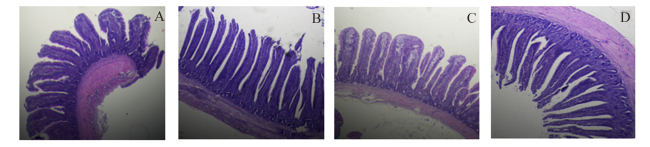
表4可知,与对照组相比,饲粮中添加400 g/t丁酸梭菌能够显著提高白羽肉鸡21日龄盲肠及43日龄十二指肠和回肠绒毛高度(P<0.05),显著降低21日龄盲肠和43日龄十二指肠隐窝深度(P<0.05),并显著提高21日龄盲肠及43日龄十二指肠和回肠绒隐比(P<0.05);但对空肠组织形态指标无显著影响(P>0.05)(图1)。相较于21日龄时,43日龄时对照组和试验组白羽肉鸡各肠段绒毛高度和绒隐比(对照组回肠除外)显著提高(P<0.05),十二指肠和空肠隐窝深度显著降低(P<0.05),且对照组盲肠隐窝深度显著降低(P<0.05)。
表4 丁酸梭菌对白羽肉鸡肠道组织形态的影响

Table 4 Effects of Clostridium butyricum on intestinal tissue morphology of white-feathered broilers

项目
Items
21日龄21 days of age 43日龄43 days of age
绒毛高度
Villus height/μm
隐窝深度
Crypt depth/μm
绒隐比
V/C
绒毛高度
Villus height/μm
隐窝深度
Crypt depth/μm
绒隐比
V/C
十二指肠Duodenum
试验组
Experimental group
644.83±95.84aB 141.90±38.17aC 4.88±1.54bF 778.25±76.14aA 94.04±17.66bD 8.49±1.49aE
对照组
Control group
633.73±86.44aB 146.59±40.65aC 4.47±0.98bcF 720.83±74.04bA 111.76±24.41aD 6.71±1.47bE
空肠Jejunum
试验组
Experimental group
460.78±37.17bB 159.65±45.61aC 3.35±1.98dF 607.37±84.18cA 109.86±18.43abD 5.73±1.60bcE
对照组
Control group
454.51±68.15bB 148.80±40.65aC 3.34±1.29dF 591.90±31.62cA 108.86±27.66abD 5.76±1.37bcE
回肠Ileum
试验组
Experimental group
331.62±20.86cB 93.20±13.68bC 3.66±0.76dE 510.31±51.94dA 107.10±30.75abC 5.14±1.52cD
对照组
Control group
338.10±29.33cB 75.53±12.54cD 4.65±1.21bcE 438.15±62.11eA 109.62±24.71abC 4.14±0.93dE
盲肠Cecum
试验组
Experimental group
140.99±17.44dB 19.88±5.10eC 7.58±2.19aE 166.45±10.50fA 18.13±3.90cC 9.56±1.99aD
对照组
Control group
107.44±17.82eB 28.30±8.51dC 4.03±1.06bcdF 158.64±15.79fA 19.14±5.43cD 8.92±2.51aE

同列数据肩标不同小写字母表示差异显著(P<0.05),同行数据肩标不同大写字母表示差异显著(P<0.05),同列或同行数据肩标相同字母表示差异不显著(P>0.05)。

Values in the same column with different capital letter superscripts mean significant difference (P<0.05), values in the same row with different small letter superscripts mean significant difference (P<0.05), and values in the same column or the same row with no letter superscripts mean no significant difference (P>0.05).

图1 丁酸梭菌对白羽肉鸡回肠形态结构的影响

A、B分别为试验组21和43日龄回肠形态结构,C、D分别为对照组21和43日龄回肠形态结构。

Fig.1 Effects of Clostridium butyricum on morphological structure of ileum of white-feathered broilers (40×)

A and B were morphological structure of ileum at 21 and 43 days of age in experimental group, and C and D were morphological structure of ileum at 21 and 43 days of age in control group.

2.4 丁酸梭菌对白羽肉鸡肠道微生物区系的影响

表5可知,各组覆盖度均高于0.99,表明本次测序覆盖率高,能够真实反映样本情况。与对照组相比,饲粮中添加400 g/t丁酸梭菌能够显著降低白羽肉鸡21、43日龄粪便及43日龄盲肠内容物菌群Shannon指数(P<0.05),显著提高21日龄粪便菌群Ace指数(P<0.05),但显著降低43日龄粪便菌群Ace指数(P<0.05),对43日龄盲肠内容物菌群Ace指数无显著影响(P>0.05)。相较于21日龄时,43日龄时对照组和试验组粪便菌群Shannon指数显著提高(P<0.05),对照组粪便菌群Ace指数显著提高(P<0.05),试验组粪便菌群Ace指数显著降低(P<0.05)。
表5 丁酸梭菌对白羽肉鸡肠道菌群α多样性的影响(OTU水平)

Table 5 Effects of Clostridium butyricum on intestinal microbial α diversity of white-feathered broilers (OTU level)

项目
Items
21日龄粪便
Feces at 21 days of age
43日龄粪便
Feces at 43 days of age
43日龄盲肠内容物
Cecal contents at 43 days of age
试验组
Experimental
group
对照组
Control
group
试验组
Experimental
group
对照组
Control
group
试验组
Experimental
group
对照组
Control
group
Shannon指数
Shannon index
1.76±0.09f 2.00±0.21e 2.69±0.16d 3.01±0.07c 4.44±0.04b 4.61±0.06a
Ace指数Ace index 357.21±70.71c 258.06±15.72d 268.38±59.29d 435.42±28.49b 611.06±16.75a 615.84±10.51a
覆盖度Coverage 0.998 0.998 0.999 0.998 0.998 0.997
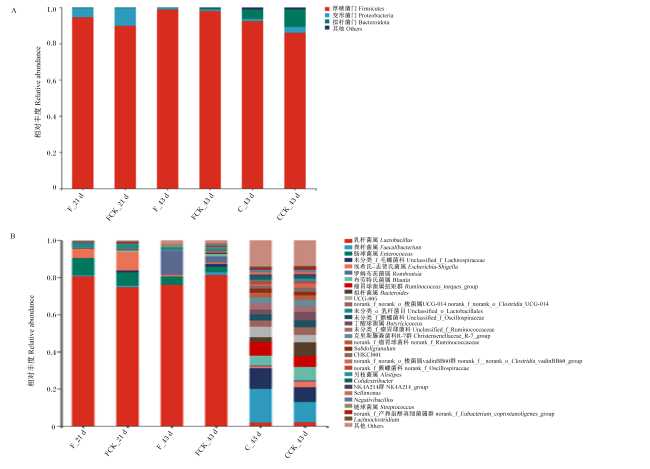
图2-A所示,在门水平上,厚壁菌门(Firmicutes)、变形菌门(Proteobacteria)和拟杆菌门(Bacteroidota)总相对丰度在白羽肉鸡粪便和盲肠内容物中均占98.50%以上,且厚壁菌门占绝对优势,相对丰度超过85.00%。与对照组相比,试验组白羽肉鸡21日龄粪便厚壁菌门和拟杆菌门相对丰度分别提高5.30%和34.62%,变形菌门相对丰度降低49.08%;试验组43日龄粪便厚壁菌门和变形菌门相对丰度分别提高0.87%和7.32%,拟杆菌门相对丰度降低87.91%;试验组43日龄盲肠内容物厚壁菌门相对丰度提高7.60%,变形菌门和拟杆菌门相对丰度分别降低63.27%和47.38%。相较于21日龄时,43日龄时试验组白羽肉鸡粪便厚壁菌门相对丰度提高4.50%,粪便变形菌门和拟杆菌门相对丰度分别降低82.40%和68.57%。
图2 丁酸梭菌对白羽肉鸡肠道微生物区系在门(A)和属(B)水平上的影响

FCK_21 d、FCK_43 d分别为对照组21和43日龄粪便样品,F_21 d、F_43 d分别为试验组21和43日龄粪便样品,C_43 d、CCK_43 d分别为试验组和对照组43日龄盲肠内容物。

Fig.2 Effects of Clostridium butyricum on intestinal microflora of white-feathered broilers at phylum (A) and genus (B) levels

FCK_21 d and FCK_43 d were fecal samples at 21 and 43 days of age in control group, F_21 d and F_43 d were fecal samples at 21 and 43 days of age in experimental group, and C_43 d and CCK_43 d were cecal contents at 43 days of age in experimental group and control group, respectively.

图2-B所示,在属水平上,白羽肉鸡粪便所有样品中乳杆菌属(Lactobacillus)占绝对优势,相对丰度在70%以上,但随着日龄的增加,试验组乳杆菌属相对丰度呈下降趋势,与对照组正好相反。43日龄时,试验组白羽肉鸡粪便中罗姆布茨菌属(Romboutsia)相对丰度排名第二(12.89%),高于对照组(3.32%);盲肠内容物中微生物群落在属水平上组成相似,但相对丰度不同,其中试验组粪杆菌属(Faecalibacterium)、未分类_f_毛螺菌科(unclassified_f_Lachnospiraceae)、瘤胃球菌属扭矩群(Ruminococcus_torques_group)、颤螺菌科(Oscillospiraceae)和乳杆菌属(Lactobacillus)等有益菌总相对丰度(56.42%)高于对照组(42.55%),盲肠内容物拟杆菌属(Bacteroides)、未定义的梭菌属(Clostridia)、丁酸球菌属(Butyricicoccus)、埃希氏-志贺氏菌属(Escherichia-Shigella)和产粪甾醇真细菌属群(Eubacterium_coprostanoligenes_group)等有害菌的总相对丰度(11.04%)低于对照组(22.46%)。此外,白羽肉鸡盲肠内容物中没有绝对的优势菌群,其中乳杆菌属占比仅为2%左右,与粪便样品差异较大。

2.5 验证试验

表6可知,与对照组相比,试验组白羽肉鸡末重和平均日增重分别提高了5.47%和5.55%(P<0.05),料重比和死淘率分别降低了4.02%和24.32%;同时,与表2相比,验证试验中试验组白羽肉鸡末重和平均日增重均有所提高。此外,从14日龄开始,试验组白羽肉鸡平均体重显著高于对照组(P<0.05),且该提高趋势持续到43日龄。
表6 丁酸梭菌对白羽肉鸡生长性能影响的验证

Table 6 Verification of effects of Clostridium butyricum on growth performance of white-feathered broilers

项目Items 试验组Experimental group 对照组Control group
体重Body weight/g
1日龄1 day of age 43.62±0.07 43.71±0.29
7日龄7 days of age 201.36±2.44b 206.83±2.50a
14日龄14 days of age 529.64±2.64a 503.34±4.28b
21日龄21 days of age 970.54±7.16a 923.54±5.21b
28日龄28 days of age 1 620.45±10.62a 1 582.15±9.95b
35日龄35 days of age 2 294.86±23.35a 2 228.45±25.67b
43日龄43 days of age 2 986.64±20.10a 2 831.86±21.02b
平均日增重ADG/g 68.44±0.47a 64.84±0.48b
料重比F/G 1.601 1.668
死淘率Mortality/% 5.60 7.40

3 讨论

3.1 丁酸梭菌对白羽肉鸡生长性能的影响

使用饲料添加剂的主要目的是提高动物生产性能,丁酸梭菌进入肠道后会产生多种酶类,能提高饲料转化率,从而促进动物生长。邹俊等[15]以科宝肉鸡为试验对象,在基础饲粮中添加300 mg/kg丁酸梭菌制剂,结果发现,试验组平均日增重显著高于对照组,料重比显著低于对照组,肉鸡经济效益有所提高;赵强等[16]在科宝肉鸡基础饲粮中添加丁酸梭菌制剂,采食量和平均日增重均有一定程度增加,但随着丁酸梭菌制剂添加量的增加呈下降趋势,料重比也有降低趋势。本试验结果与上述结果一致,饲粮中添加丁酸梭菌能够提高白羽肉鸡末重和平均日增重,降低料重比和死淘率,且末重和平均日增重随着添加量的增加呈上升趋势,料重比呈下降趋势;不过,饲粮中添加600 g/t丁酸梭菌制剂时,肉鸡末重和平均日增重出现降低,料重比未发生改变,这说明生长性能随着丁酸梭菌添加量的增加呈下降趋势,推测可能是丁酸梭菌制剂添加过量会使肠道菌群失衡[17],而且大量的丁酸梭菌也会消耗肠道内的营养物质,从而影响肉鸡的生长性能。

3.2 丁酸梭菌对白羽肉鸡免疫功能的影响

免疫球蛋白是评估体液免疫的重要指标[18],而促进免疫器官发育对提高免疫力也尤为重要[19]。Yang等[20]研究丁酸梭菌对肉鸡免疫性能的影响时发现,饲粮中添加丁酸梭菌可以显著提高肉鸡血清IgA、IgG和IgM含量,提高机体免疫力。李可等[21]研究表明,在肉鸡饲粮中添加丁酸梭菌,其脾脏指数和法氏囊指数显著提高。本试验结果表明,饲粮中添加丁酸梭菌能够显著提高白羽肉鸡21日龄血清免疫球蛋白含量和免疫器官指数,推测是丁酸梭菌能够通过细胞壁中的磷壁酸、肽聚糖等抗原物质激活免疫系统[22],提高免疫球蛋白含量,同时免疫系统的刺激作用能够促进免疫器官发育,因此试验组43日龄时胸腺和脾脏指数依然升高且显著高于对照组。随着日龄的增加,肉鸡自身免疫能力增强,免疫机制完善,能够清除外界刺激达到稳定状态,因此43日龄时血清免疫球蛋白含量处于较低水平状态。此外,43日龄时试验组法氏囊指数显著低于对照组,说明试验组法氏囊退化较快,推测是法氏囊的发育退化与免疫刺激有关,刺激越大,退化越快。

3.3 丁酸梭菌对白羽肉鸡肠道组织形态的影响

肠道组织形态是肠道健康的重要依据之一,绒毛高度增加有利于营养物质吸收,隐窝变浅则意味着肠道细胞分泌功能增强,而绒隐比降低代表肠道消化吸收功能下降[23-25]。农斯伟等[26]认为,饲粮中添加丁酸梭菌有提高广西黎村黄鸡十二指肠、空肠和回肠绒毛高度的趋势,但不显著,能显著降低空肠隐窝深度并能显著提高空肠和回肠的绒隐比;刘亭婷等[27]研究发现,饲粮中添加1 000 mg/kg丁酸梭菌能够显著提高蛋用仔公鸡小肠各肠段的绒毛高度和绒隐比。本试验结果表明,饲粮中添加丁酸梭菌能够显著提高白羽肉鸡21日龄盲肠及43日龄十二指肠绒毛高度和绒隐比,显著降低隐窝深度;并显著提高43日龄回肠绒毛高度和绒隐比,这说明丁酸梭菌对肉鸡生长前期盲肠的发育有促进作用,而生长后期主要促进十二指肠和回肠的发育,对空肠作用不明显。此外,21日龄时,试验组回肠绒毛高度低于对照组,与以上研究结果不同,可能是由于解剖的肉鸡肠道受到刺激或病原菌侵害而损伤了上皮细胞结构,导致绒毛高度降低,但43日龄时回肠的绒毛高度显著高于对照组,说明丁酸梭菌能够修复受损的肠道组织形态结构。

3.4 丁酸梭菌对白羽肉鸡肠道微生物区系的影响

α多样性能够反映微生物群落的丰富度和多样性,而本试验中,饲粮中添加丁酸梭菌未能提高白羽肉鸡盲肠内容和粪便菌群的丰富度,这与丁酸梭菌代谢产生的有机酸降低了肠道pH有关,低pH在一定程度上能抑制有害菌的增殖,减少菌群数量,因此试验组微生物丰富度相对较低。肠道微生物的丰富度与机体健康呈正相关,越丰富代表肠道菌群越成熟,但多样化的微生物区系可能会降低免疫功能,不利于机体生长发育[28-30]
肠道微生物通过影响消化吸收、生长发育和免疫功能等来影响机体性能,而菌群结构也因饲粮成分、抗生素和饲养环境等因素不同而不同。本试验中,在门水平上,与对照组相比,试验组白羽肉鸡21日龄粪便中厚壁菌门和拟杆菌门相对丰度增加,变形菌门相对丰度降低;43日龄粪便厚壁菌门和变形菌门相对丰度与对照组较为接近,拟杆菌门相对丰度降低,这说明饲粮中添加丁酸梭菌对21日龄肠道菌群影响较大,而43日龄时粪便菌群结构趋于稳定,厚壁菌门和变形菌门达到适宜比例,仅对拟杆菌门影响明显。对于43日龄盲肠内容物而言,试验组厚壁菌门相对丰度高于对照组,变形菌门和拟杆菌门相对丰度低于对照组,但厚壁菌门相对丰度改变仅为提高了7.60%,而变形菌门和拟杆菌门相对丰度受丁酸梭菌影响较大。Singh等[31]研究肉鸡肠道时发现,厚壁菌门与拟杆菌门占比呈负相关时肉鸡的料重比较低,本研究结果与其相似。此外有研究表明,动物脂肪随着厚壁菌门与拟杆菌门比值(F/B)的提高而增加[32],本试验在饲粮中添加丁酸梭菌后白羽肉鸡盲肠内容物的F/B(17.79)高于对照组(8.83),根据试验组末重、平均日增重显著高于对照组的结果可以推断,厚壁菌门的增加和拟杆菌门的减少会促进动物脂肪的沉积。
在属水平上,饲粮中添加丁酸梭菌提高了白羽肉鸡21日龄粪便乳杆菌属相对丰度,此时血清免疫球蛋白含量也处于高水平状态,说明肠道可能处于应激状态,乳杆菌属通过调节免疫应答来发挥免疫稳态作用[33],因此43日龄时血清免疫球蛋白含量及粪便、盲肠内容物的乳杆菌属相对丰度均下降,推测是乳杆菌属减轻了免疫刺激,对免疫稳态起到积极作用。此外,21日龄时,试验组粪便中未检出罗姆布茨菌属,但在43日龄时成为优势菌属,且试验组高于对照组,说明罗姆布茨菌属在生长后期出现,而罗姆布茨菌属隶属于消化链球菌科,能将淀粉和非淀粉多糖水解为短链脂肪酸[34],这也表明丁酸梭菌促进了罗姆布茨菌属的生长,从而提高了饲粮利用率。此外,试验组粪便中粪杆菌属相对丰度随日龄增加而降低,而对照组呈上升趋势,且43日龄时试验组相对丰度仅为0.01%,低于对照组的1.49%。由于粪杆菌属严格厌氧,又因其在胃肠道内适宜生长的pH为5.7~6.7,而添加丁酸梭菌会降低肠道pH,不利于其生长,所以试验组低于对照组。陈圣蕾等[35]发现高剂量发酵酸奶组断奶仔猪粪便Negativibacillus相对丰度显著低于对照组,而高剂量发酵酸奶组乳酸菌是优势菌,结合本试验盲肠内容物中乳杆菌属相对丰度降低,Negativibacillus相对丰度提高,推测乳杆菌属相对丰度与Negativibacillus可能存在负相关的关系。布劳特氏菌属(Blautia)、克里斯滕森菌科(Christensenellaceae)均属于厚壁菌门,其相对丰度分别与内脏脂肪面积、脂肪沉积呈显著负相关[36-37],本试验中试验组这2个菌属的相对丰度降低,结合试验组生长性能的提高,表明添加丁酸梭菌可能会使脂肪沉积,这与F/B提高会使机体脂肪沉积相契合。除此之外,本试验在粪便、盲肠内容物菌群中均未发现梭菌属,推测丁酸梭菌在菌群中占比极低,并非优势菌属。也有研究认为,丁酸梭菌不能长期定植于肠道,需要经常补充[38],而丁酸梭菌即使未在动物肠道内定植,也能发挥益生作用[39]。与对照组相比,试验组盲肠内容物中粪杆菌属、未分类_f_毛螺菌科、瘤胃球菌属扭矩群、颤螺菌科和乳杆菌属等有益菌总相对丰度提高,拟杆菌属、未定义的梭菌属、丁酸球菌属、埃希氏-志贺氏菌属和产粪甾醇真细菌属群等有害菌的总相对丰度降低,这说明丁酸梭菌能够调节有益菌和有害菌的占比,通过降低有害菌的相对丰度,使有益菌成为优势菌群,保持肠道处于较为健康的状态。

4 结论

基础饲粮中添加丁酸梭菌能够提高AA白羽肉鸡生长性能,提高血清免疫球蛋白含量和免疫器官指数,促进绒毛生长,降低隐窝深度,改变肠道菌群结构,有效调节有益菌和有害菌占比,使肠道处于健康状态。综合试验结果,丁酸梭菌制剂的适宜添加量为400 g/t。
[1]
李爱科, 王薇薇, 王永伟, 等. 生物饲料及其替代和减少抗生素使用技术研究进展[J]. 动物营养学报, 2020, 32(10):4793-4806.

DOI

LI A K, WANG W W, WANG Y W, et al. Research progress of biological feed and its use technology in substitution and reduction of antibiotics[J]. Chinese Journal of Animal Nutrition, 2020, 32(10):4793-4806. (in Chinese)

[2]
SARANGI N R, BABU L K, KUMAR A, et al. Effect of dietary supplementation of prebiotic,probiotic,and synbiotic on growth performance and carcass characteristics of broiler chickens[J]. Veterinary World, 2016, 9(3):313-319.

DOI

[3]
林华林, 秦颖超, 周加义, 等. 丁酸梭菌及其代谢产物对畜禽肠道健康影响的研究进展[J]. 饲料工业, 2019, 40(6):7-12.

LIN H L, QIN Y C, ZHOU J Y, et al. Research progress on the effects of Clostridium butyricum and its metabolites on intestinal health of livestock[J]. Feed Industry, 2019, 40(6):7-12. (in Chinese)

[4]
NAKANISHI S, TANAKA M. Sequence analysis of a bacteriocinogenic plasmid of Clostridium butyricum and expression of the bacteriocin gene in Escherichia coli[J]. Anaerobe, 2010, 16(3):253-257.

DOI

[5]
范雪, 于洁, 赵敏孟, 等. 丁酸梭菌在家禽生产中应用的研究进展[J]. 中国饲料, 2021(3):12-15.

FAN X, YU J, ZHAO M M, et al. Research progress in application of Clostridium butyricum in poultry production[J]. China Feed, 2021(3):12-15. (in Chinese)

[6]
ZHANG J, SU H, LI Q H, et al. Oral administration of Clostridium butyricum CGMCC0313-1 inhibits β-lactoglobulin-induced intestinal anaphylaxis in a mouse model of food allergy[J]. Gut Pathogens, 2017, 9:11.

DOI

[7]
CHEN H, MA X M, LIU Y Y, et al. Gut microbiota interventions with Clostridium butyricum and norfloxacin modulate immune response in experimental autoimmune encephalomyelitis mice[J]. Frontiers in Immunology, 2019, 10:1662.

DOI

[8]
ZHOU D, PAN Q, LIU X L, et al. Clostridium butyricum B1 alleviates high-fat diet-induced steatohepatitis in mice via enterohepatic immunoregulation[J]. Journal of Gastroenterology and Hepatology, 2017, 32(9):1640-1648.

DOI

[9]
ZHAO Q, YANG W R, WANG X H, et al. Clostridium butyricum alleviates intestinal low-grade inflammation in TNBS-induced irritable bowel syndrome in mice by regulating functional status of lamina propria dendritic cells[J]. World Journal of Gastroenterology, 2019, 25(36):5469-5482.

DOI

[10]
崔锦, 杨倩茹, 朱宽佑, 等. 丁酸梭菌对断奶仔猪生长性能、血清免疫功能、抗氧化能力和肠道形态的影响[J]. 饲料研究, 2023, 46(2):40-45.

CUI J, YANG Q R, ZHU K Y, et al. Effect of Clostridium butyricum on growth performance,immune function,antioxidant capacity and intestinal morphology of weaned piglets[J]. Feed Research, 2023, 46(2):40-45. (in Chinese)

[11]
周奕含. 丁酸梭菌对肉仔鸡生长性能、免疫机能及血液生理生化指标的影响[J]. 饲料研究, 2021, 44(7):55-59.

ZHOU Y H. Effect of Clostridium butyricum on growth performance,immune function and serum physiological and biochemical indexes of broilers[J]. Feed Research, 2021, 44(7):55-59. (in Chinese)

[12]
张金金, 张耀文, 陈佳勇, 等. 丁酸梭菌对蛋鸡产蛋后期生产性能、蛋品质及肠道组织形态的影响[J]. 家畜生态学报, 2020, 41(6):46-51.

ZHANG J J, ZHANG Y W, CHEN J Y, et al. Effects of Clostridium butyricum on laying performance,egg quality and intestinal morphology of hens during the late laying period[J]. Journal of Domestic Animal Ecology, 2020, 41(6):46-51. (in Chinese)

[13]
吴杨, 杨铿, 黄小林, 等. 饲料中添加丁酸梭菌对卵形鲳鲹幼鱼生长性能和肠道菌群的影响[J]. 南方水产科学, 2022, 18(3):155-162.

WU Y, YANG K, HUANG X L, et al. Effects of dietary Clostridium butyricum supplementation on growth performance and intestinal flora of juvenile Trachinotus ovatus[J]. South China Fisheries Science, 2022, 18(3):155-162. (in Chinese)

[14]
郭欣怡, 张曼, 韩飞, 等. 不同益生菌制剂对肉鸡生产性能、免疫功能和肠道菌群的影响[J]. 家畜生态学报, 2016, 37(11):79-83.

GUO X Y, ZHANG M, HAN F, et al. Effects of different probiotics on production performance,immunologic function and gut bacteria of broiler chickens[J]. Journal of Domestic Animal Ecology, 2016, 37(11):79-83. (in Chinese)

[15]
邹俊, 龚建刚, 郝艳霜, 等. 丁酸梭菌、二甲酸钾及其组合对肉鸡生长性能、屠宰性能及免疫器官指数的影响[J]. 饲料研究, 2022, 45(7):36-40.

ZOU J, GONG J G, HAO Y S, et al. Effect of Clostridium butyricum,potassium diformate and their combination on growth performance,slaughter performance and immune organ index of broiler[J]. Feed Research, 2022, 45(7):36-40. (in Chinese)

[16]
赵强, 张伟, 付大波, 等. 丁酸梭菌对肉鸡生长性能、血液指标、屠宰性能的影响[J]. 中国畜牧杂志, 2019, 55(11):138-142.

ZHAO Q, ZHANG W, FU D B, et al. Effects of Clostridium butyric acid on growth performance,blood indexes and slaughter performance of broilers[J]. Chinese Journal of Animal Science, 2019, 55(11):138-142. (in Chinese)

[17]
YU Y B, WANG C H, WANG A M, et al. Effects of various feeding patterns of Bacillus coagulans on growth performance,antioxidant response and Nrf2-Keap1 signaling pathway in juvenile gibel carp (Carassius auratus gibelio)[J]. Fish & Shellfish Immunology, 2018, 73:75-83.

[18]
刘珂飞, 孟铁健, 任凯, 等. 液态混合型饲料添加剂丁酸梭菌在肉鸡上的应用效果评价[J]. 今日畜牧兽医, 2021, 37(8):6-7.

LIU K F, MENG T J, REN K, et al. Evaluation of the application effect of liquid mixed feed additive Clostridium butyricius in broilers[J]. Today Animal Husbandry and Veterinary, 2021, 37(8):6-7. (in Chinese)

[19]
霍文颖, 王志祥, 黄艳群, 等. 能量限饲对肉鸡生长性能、血清免疫球蛋白含量、外周血T淋巴细胞亚群和血脂水平的影响[J]. 动物营养学报, 2018, 30(6):2118-2127.

HUO W Y, WANG Z X, HUANG Y Q, et al. Effects of energy restriction on growth performance,serum immunoglobulin contents,peripheral T lymphocyte subsets and blood lipid level of broilers[J]. Chinese Journal of Animal Nutrition, 2018, 30(6):2118-2127. (in Chinese)

[20]
YANG C M, CAO G T, FERKET P R, et al. Effects of probiotic,Clostridium butyricum,on growth performance,immune function,and cecal microflora in broiler chickens[J]. Poultry Science, 2012, 91(9):2121-2129.

DOI

[21]
李可, 罗建杰, 孟昆, 等. 益生菌对肉仔鸡生产性能、胴体性状、免疫功能和肉品质的影响[J]. 动物营养学报, 2015, 27(9):2903-2910.

DOI

LI K, LUO J J, MENG K, et al. Effects of probiotics on performance,carcass traits,immune function and meat quality of broiler chickens[J]. Chinese Journal of Animal Nutrition, 2015, 27(9):2903-2910. (in Chinese)

[22]
王伟唯. 丁酸梭菌对产蛋后期蛋鸡肠道功能和脂质代谢的调节作用[D].博士学位论文. 北京: 中国农业科学院, 2020.

WANG W W. Regulatory effects of Clostridium butyricum on intestinal functions and lipid metabolism of laying hens in the late phase of production[D]. Ph.D. Thesis. Beijing: Chinese Academy of Agricultural Sciences, 2020. (in Chinese)

[23]
杨玲, 夏嗣廷, 胡睿智, 等. 丁酸梭菌的功能性研究进展及其在畜禽生产中的应用[J]. 中国畜牧兽医, 2018, 45(11):3077-3085.

YANG L, XIA S T, HU R Z, et al. Clostridium butyricum:research progress on biological function and application in livestock and poultry production[J]. China Animal Husbandry & Veterinary Medicine, 2018, 45(11):3077-3085. (in Chinese)

[24]
徐国华. 复合益生菌对黄羽肉鸡生长性能与肠道内环境的影响[D].硕士学位论文. 广州: 华南农业大学, 2017:21.

XU G H. Effects of compound probiotics on growth performance and intestinal environmental factors of yellow-feathered broilers[D].Master’s Thesis. Guangzhou: South China Agricultural University, 2017:21. (in Chinese)

[25]
武丽达, 沈雪梅, 杨鑫, 等. 丁酸梭菌、黑曲霉菌丝体对肉鸡生长性能、血清生化指标和肠道形态的影响[J]. 中国饲料, 2022(9):25-29.

WU L D, SHEN X M, YANG X, et al. Effects of Clostridium butyricum or Aspergillus niger mycelium on growth performance,serum biochemical indexes and intestinal morphology of broilers[J]. China Feed, 2022(9):25-29. (in Chinese)

[26]
农斯伟, 沈水宝, 韦晓芳, 等. 丁酸梭菌和枯草芽孢杆菌对广西黎村黄鸡生长性能、肠道形态及盲肠微生物区系的影响[J]. 饲料工业, 2021, 42(3):19-24.

NONG S W, SHEN S B, WEI X F, et al. Effects of Clostridium butyricum and Bacillus subtilis on the growth performance,intestinal morphology and cecal microflora of Guangxi Licun yellow chickens[J]. Feed Industry, 2021, 42(3):19-24. (in Chinese)

[27]
刘亭婷, 滑静, 王晓霞, 等. 丁酸梭菌对蛋用仔公鸡肠道菌群、形态结构及黏膜免疫相关细胞的影响[J]. 动物营养学报, 2012, 24(11):2210-2221.

DOI

LIU T T, HUA J, WANG X X, et al. Clostridium butyricum:effects on intestinal microflora,morphology and mucosal immunity-associated cells in egg-laying male chicks[J]. Chinese Journal of Animal Nutrition, 2012, 24(11):2210-2221. (in Chinese)

[28]
LE CHATELIER E, NIELSEN T, QIN J J, et al. Richness of human gut microbiome correlates with metabolic markers[J]. Nature, 2013, 500(7464):541-546.

DOI

[29]
WOOD K M, PALMER S I, STEELE M A, et al. The influence of age and weaning on permeability of the gastrointestinal tract in Holstein bull calves[J]. Journal of Dairy Science, 2015, 98(10):7226-7237.

DOI PMID

[30]
NYLUND L, SATOKARI R, NIKKIL? J, et al. Microarray analysis reveals marked intestinal microbiota aberrancy in infants having eczema compared to healthy children in at-risk for atopic disease[J]. BMC Microbiology, 2013, 13:12.

DOI PMID

[31]
SINGH N, ARIOLI S, WANG A, et al. Impact of Bifidobacterium bifidum MIMBb75 on mouse intestinal microorganisms[J]. FEMS Microbiology Ecology, 2013, 85(2):369-375.

DOI

[32]
TURNBAUGH P J, LEY R E, MAHOWALD M A, et al. An obesity-associated gut microbiome with increased capacity for energy harvest[J]. Nature, 2006, 444(7122):1027-1031.

DOI

[33]
LUDWIG I S, BROERE F, MANURUNG S, et al. Lactobacillus rhamnosus GG-derived soluble mediators modulate adaptive immune cells[J]. Frontiers in Immunology, 2018, 9:1546.

DOI

[34]
BIDDLE A, STEWART L, BLANCHARD J, et al. Untangling the genetic basis of fibrolytic specialization by Lachnospiraceae and Ruminococcaceae in diverse gut communities[J]. Diversity, 2013, 5(3):627-640.

DOI

[35]
陈圣蕾, 林爱莲, 闫晓曦, 等. 补饲发酵酸奶对断奶仔猪生长性能、养分消化和粪便菌群的影响[J]. 动物营养学报, 2022, 34(8):4904-4918.

DOI

CHEN S L, LIN A L, YAN X X, et al. Effects of supplementing fermented yoghurt on growth performance,nutrient digestion and fecal flora of weaned piglets[J]. Chinese Journal of Animal Nutrition, 2022, 34(8):4904-4918. (in Chinese)

[36]
OZATO N, SAITO S, YAMAGUCHI T, et al. Blautia genus associated with visceral fat accumulation in adults 20-76 years of age[J]. npj Biofilms and Microbiomes, 2019, 5(1):28.

DOI

[37]
WATERS J L, LEY R E. The human gut bacteria Christensenellaceae are widespread,heritable,and associated with health[J]. BMC Biology, 2019, 17(1):83.

DOI

[38]
SATO R, TANAKA M. Intestinal distribution and intraluminal localization of orally administered Clostridium butyricum in rats[J]. Microbiology and Immunology, 1997, 41(9):665-671.

DOI

[39]
DUAN Y F, WANG Y, DONG H B, et al. Changes in the intestine microbial,digestive,and immune-related genes of Litopenaeus vannamei in response to dietary probiotic Clostridium butyricum supplementation[J]. Frontiers in Microbiology, 2018, 9:2191.

DOI

文章导航

/