研究论文

饲粮添加不同来源纤维对肉鸡生长性能、养分消化和肠道健康的影响

  • 冯玉静 ,
  • 张莹 ,
  • 刘优优 ,
  • 王钰明 ,
  • 赵峰 ,
  • 萨仁娜 ,
  • 解竞静 , *
展开
  • 中国农业科学院北京畜牧兽医研究所,动物营养学国家重点实验室,北京 100193
*解竞静,副研究员,硕士生导师,E-mail:

冯玉静(1997—),女,吉林吉林人,硕士研究生,从事饲料营养价值评定研究。E-mail:

Office editor: 陈鑫

收稿日期: 2023-02-21

  网络出版日期: 2023-08-10

基金资助

现代农业产业技术体系北京市家禽创新团队岗位专家项目(BAIC06-2022)

Effects of Dietary Different Fiber Sources on Growth Performance, Nutrients Digestion and Gut Health in Broilers

  • FENG Yujing ,
  • ZHANG Ying ,
  • LIU Youyou ,
  • WANG Yuming ,
  • ZHAO Feng ,
  • SA Renna ,
  • XIE Jingjing , *
Expand
  • State Key Laboratory of Animal Nutrition, Institute of Animal Sciences, Chinese Academy of Agricultural Sciences, Beijing 100193, China
*associate professor, E-mail:

Received date: 2023-02-21

  Online published: 2023-08-10

摘要

本试验旨在研究不同来源纤维对肉鸡生长性能、养分消化和肠道健康的影响。依照等能原则分别配制添加3.0%燕麦麸(OB)、1.5%木质纤维素(LC)、3.0%小麦麸(WB)的玉米-豆粕型饲粮。选取爱拔益加(AA)肉仔鸡162只,依据7日龄体重分为6组,每组3个重复,每个重复9只。7~21日龄分别饲喂3种试验饲粮,测定肉鸡生长性能、养分存留率、肠道微生物区系;并在22~28日龄测定肉鸡对同一玉米-豆粕型饲粮(不含OB、LC、WB)的养分消化率,比较饲喂不同纤维源后肉鸡的消化能力差异。结果表明:1)饲粮添加不同来源的纤维对21日龄肉鸡体重、平均日增重、平均日采食量、料重比无显著影响(P>0.05)。2)7~21日龄,LC组饲粮中总能存留率有高于WB组的趋势(P=0.089),WB组氮沉积量有高于LC组和OB组的趋势(P=0.061);但各组间同一饲粮中营养物质存留率和氮沉积量无显著差异(P>0.05)。3)不同来源的纤维对21日龄肉鸡消化器官指数、肠道形态无显著影响(P>0.05);与LC组相比,添加WB可以显著提高28日龄肉鸡回肠绒毛高度(P<0.05)。4)不同来源的纤维影响了21日龄肉鸡盲肠微生物属水平组成,OB组显著提高了未分类毛螺菌科、乳杆菌属、拟杆菌属的相对丰度(P<0.05),LC组显著提高了毛螺菌科UCG-010、拟杆菌属的相对丰度(P<0.05),WB组也有提高乳杆菌属相对丰度的趋势(0.05≤P<0.10);但不同来源的纤维对28日龄肉鸡盲肠微生物影响很小。5)不同来源的纤维对21日龄肉鸡盲肠食糜中短链脂肪酸(SCFAs)组成无显著影响(P>0.05),但与OB组相比,LC组和WB组有提高28日龄肉鸡盲肠乙酸(P=0.060)和总短链脂肪酸(SCFAs)(P=0.052)含量的趋势。由此可见,在能量浓度相同条件下,7~21日龄肉鸡饲粮添加不同来源纤维对生长性能、消化道发育和肠道形态无显著影响,但在饲粮养分消化、肠道微生物组成和SCFAs含量的作用上有一定差异。

本文引用格式

冯玉静 , 张莹 , 刘优优 , 王钰明 , 赵峰 , 萨仁娜 , 解竞静 . 饲粮添加不同来源纤维对肉鸡生长性能、养分消化和肠道健康的影响[J]. 动物营养学报, 2023 , 35(8) : 5095 -5106 . DOI: 10.12418/CJAN2023.472

Abstract

This experiment was aimed to investigate the effects of different fiber sources on the growth performance, nutrient digestion and gut health in broilers. Three isocaloric experimental diets were formulated by including 3.0% oat bran (OB), 1.5% lignocellulose (LC), 3.0% wheat bran (WB) in the corn-soybean meal diet, respectively. A total of 162 broiler chickens were divided into 6 groups according to the body weight on 7 days of age, with 3 replicates per group, 9 replicates per replicate. Broilers were fed one of the 3 experimental diets during 7 to 21 days of age and growth performance, nutrient retention rate and gut microbiome were measured. At 22 to 28 days of age, digestibility of the same corn-soybean meal diet was measured to establish the differences in digestion capacity after fiber inclusion. The results showed as follows: 1) there were no differences in body weight, average daily gain, average daily feed intake and feed/gain on 21 days of age when broilers fed fibers from different sources (P>0.05). 2) At 7 to 21 days of age, the retention rate of gross energy in LC group was tended to be higher than that in WB group (P=0.089), while nitrogen deposition in WB group was tended to be higher than that in LC and OB groups (P=0.061). However, there were no differences in the retention rate of nutrients and nitrogen retention when broilers consumed the same basal diet (P>0.05). 3) No differences in the indexes of digestive organs and intestinal histomorphology were noted in broilers fed different fibers at 21 days of age (P>0.05); but compared with LC group, the villi height in the ileum in WB group was increased at 28 days of age (P<0.05). 4) Dietary inclusion of different fibers could influence the composition of cecal microbiota at the genus level at 21 days of age, where the relative abundances of Lachnospiraceae, Lactobacillus and Bacteroides in OB group was increased (P<0.05), the relative abundances of Lachnospiraceae and Bacteroides in LC group was increased (P<0.05), and the abundance of Lactobacillus was tended to increase (0.05≤P<0.10); in contrast, few impacts of dietary treatments were found at 28 days of age. 5) Dietary inclusion of different fibers did not affect short chain fatty acid (SCFAs) contents at 21 days of age (P>0.05), but cecal acetate and total SCFAs contents at 28 days of age in LC and WB groups were increased (P=0.060). In conclusion, with the same energy concentration, dietary inclusion of different fibers during 7 to 21 days of age does not affect the growth performance, the development and morphology of digestive tract, but imposes different impacts on nutrient digestion, microbiota composition and SCFAs contents in the gut.

长期以来,纤维被认为是家禽饲粮中的抗营养因子。然而,近些年研究发现肉鸡生长前期饲粮中添加少量的不溶性纤维能够促进肌胃的发育,改善粗蛋白质、粗脂肪等养分的消化率,从而提高采食量和饲料转化效率[1-7]。通过比较不同来源纤维,欧洲学者发现1~21日龄肉鸡饲粮中添加3%燕麦壳、葵花籽壳等能够使肌胃重量提高10%~40%,使饲粮干物质、粗蛋白质、粗脂肪等养分消化率提高2~3个百分点,饲粮表观代谢能也增加了约100 kcal/kg (1 kcal=4.186 8 kJ)[3-4,6,8-10],而在1~21日龄肉鸡饲粮中添加1%木质纤维素(LC),肉鸡在21日龄时的体重增加了37.3 g[11],LC是可以运用在肉鸡生产中的比较好的不溶性纤维源。小麦麸(WB)是我国产量最高的纤维性原料,其化学成分与燕麦麸(OB)较为接近。目前WB很少使用在肉鸡饲粮中,但是有文献报道,肉鸡饲粮中添加WB可以减少沙门氏菌感染[12],促进高粱[13]、大麦[14-15]等的消化,提示肉鸡饲粮中添加麸皮可以发挥一定的营养作用。不同来源的纤维组成差异很大,它们在消化道的停留时间[16]和持水力[17]不同,造成其在消化道发育、营养物质消化、微生物区系的作用差异,影响肉鸡的生长性能。因此,本试验旨在比较饲粮添加OB、LC和WB对生长前期(7~21日龄)肉鸡生长性能、养分消化、肠道发育和肠道微生物区系的影响,为在肉鸡饲粮中选择和使用纤维性原料提供科学依据。

1 材料与方法

1.1 试验设计

试验采用单因素完全随机区组设计。从河北滦平华都肉鸡公司购入爱拔益加(AA)肉公雏饲养至7日龄后,按体重分为6组,每组3个重复,每个重复9只鸡,分别饲喂添加3.0% OB、1.5% LC和3.0% WB的玉米-豆粕型饲粮,至21日龄。肉鸡22~28日龄时,所有肉鸡饲喂不添加OB、LC、 WB的同一玉米-豆粕型饲粮。7~21日龄肉鸡试验饲粮配制基于等能原则,OB、LC、WB分别以3.0%、1.5%、3.0%的比例替代基础饲粮中的玉米和豆粕,通过大豆油调整各饲粮的酶水解物能(EHGE)值,配方空白通过膨润土补充。试验饲粮参照《鸡饲养标准》(NY/T 33—2004)进行配制,其组成及营养水平见表1。肉仔鸡自由采食,充足饮水。舍内通风、饲养密度和免疫程序等均按照《爱拔益加肉鸡管理手册》进行。
表1 试验饲粮组成及营养水平

Table 1 Composition and nutrient levels of experimental diets %

项目
Items
7~21日龄7 to 21 days of age 22~28日龄
22 to 28
days of age
燕麦麸组
OB group
木质纤维素组
LC group
小麦麸组
WB group
原料(风干基础) Ingredients (air-dry basis)
玉米Corn 48.14 48.14 48.14 57.57
豆粕Soybean meal 37.15 37.15 37.15 31.50
燕麦麸Oat bran 3.00
木质纤维素Lignocellulose 1.50
小麦麸Wheat bran 3.00
大豆油Soybean oil 5.11 5.80 5.10 5.50
玉米蛋白粉Corn gluten meal 2.00 2.00 2.00 2.00
L-赖氨酸盐酸盐L-Lys·HCl 0.25 0.25 0.25 0.14
DL-蛋氨酸DL-Met 0.20 0.20 0.20 0.13
L-苏氨酸L-Thr 0.10 0.10 0.10 0.03
缬氨酸Val 0.10 0.10 0.10 0.01
植酸酶Phytase 0.02 0.02 0.02 0.02
磷酸氢钙CaHPO4 1.89 1.89 1.89 1.43
石粉Limestone 1.06 1.06 1.06 0.92
预混料Premix1) 0.50 0.50 0.50 0.50
食盐NaCl 0.30 0.30 0.30 0.25
膨润土Bentonite 0.18 0.99 0.19
合计Total 100.00 100.00 100.00 100.00
营养水平(干物质基础) Nutrient levels (DM basis)2)
酶水解物能EHGE/(MJ/kg) 14.68 14.68 14.68 15.34
表观代谢能AME/(MJ/kg) 14.40 14.40 14.40 15.07
粗蛋白质CP 26.10 25.69 26.11 21.79
中性洗涤纤维NDF 9.80 10.24 9.95 9.20
酸性洗涤纤维ADF 5.18 6.07 5.26 4.85

1)7~21日龄预混料为每千克饲粮提供The premix provided the following per kg of diets for 7 to 21 days of age: VA 9 000 IU,VB1 2 mg,VB2 10 mg,VB6 5 mg,VB12 0.02 mg,VD3 2 000 IU,VE 30 IU,VK3 1.0 mg,生物素 biotin 0.3 mg,叶酸 folic acid 1.0 mg,泛酸 pantothenic acid 15 mg,烟酸 nicotinic acid 50 mg,Cu (as copper sulfate) 10 mg,Fe (as ferrous sulfate) 120 mg,Mn (as manganese sulfate) 120 mg,Zn (as zinc sulfate) 100 mg,I (as potassium iodide) 0.7 mg,Se (as sodium selenite) 0.3 mg,氯化胆碱 choline chloride 1 500 mg。22~28日龄预混料为每千克饲粮提供The premix provided the following per kg of diets for 22 to 28 days of age: VA 8 000 IU,VB1 2 mg,VB2 8 mg,VB6 4 mg,VB12 0.02 mg,VD3 1 000 IU,VE 15 IU,VK3 0.8 mg,生物素 biotin 0.2 mg,叶酸 folic acid 0.55 mg,泛酸 pantothenic acid 10 mg,烟酸 nicotinic acid 40 mg,Cu (as copper sulfate) 8 mg,Fe (as ferrous sulfate) 80 mg,Mn (as manganese sulfate) 100 mg,Zn (as zinc sulfate) 80 mg,I (as potassium iodide) 0.7 mg,Se (as sodium selenite) 0.3 mg,氯化胆碱 choline chloride 1 300 mg。

2)CP、NDF、ADF为实测值,EHGE、AME为计算值。CP, NDF, ADF were measured values, while EHGE and AME were calculated values.

1.2 试验材料

OB、LC、WB化学组成实测值见表2
表2 燕麦麸、木质纤维素、小麦麸化学组成实测值(干物质基础)

Table 2 Measured values of chemical composition of oat bran, lignocellulose and wheat bran (DM basis)

项目
Items
总能
GE/(MJ/kg)
酶水解物能
EHGE/
(MJ/kg)
粗蛋白质
CP/%
粗脂肪
EE/%
中性洗
涤纤维
NDF/%
酸性洗
涤纤维
ADF/%
粗灰分
Ash/%
燕麦麸OB 20.59 10.17 21.66 8.39 29.95 7.50 6.51
木质纤维素LC 19.36 0.18 1.43 0.97 89.02 74.41 1.70
小麦麸WB 19.54 10.38 20.71 4.73 34.95 10.05 4.97

1.3 检测指标

1.3.1 生长性能

分别在7和21日龄,以重复为单元,称量肉鸡21日龄的体重(BW),并计算7~21日龄平均日采食量(ADFI)、平均日增重(ADG)和料重比(F/G)。

1.3.2 全收粪代谢试验

采用全收粪法进行2期肉鸡消化代谢试验。第1期代谢试验收集17日龄21:00至20日龄21:00的全部排泄物,同时计录每个重复的累计采食量。为了比较饲喂不同来源纤维后肉鸡消化能力的差异,在22~28日龄开展针对同一饲粮的第2期消化代谢试验。第2期试验于22~24日龄预饲3 d,所有肉鸡预饲相同的饲粮,收集24日龄21:00至27日龄21:00的全部排泄物,记录每个重复的累计采食量。以重复为单位,把每次收集的粪样混合均匀,挑出羽毛、皮屑等,放置-20 ℃保存备用。排泄物在65 ℃鼓风干燥箱中烘干,冷却至室温放置24 h后称重。

1.3.3 化学成分分析

饲粮和排泄物样品粉碎过0.42 mm筛后待测。水分含量测定按照GB/T 6435—2006的方法;总能测定使用Parr 6400全自动绝热式氧弹计,参照ISO 9831:1998的方法进行;粗蛋白质含量测定使用K-9840凯氏定氮仪,参照GB/T 6432—1994方法进行;EHGE值的测定使用SDS-Ⅲ单胃动物仿生消化系统,参照《单胃动物仿生消化系统操作手册》进行。营养物质存留率计算公式如下:
营养物质存留率(%)=(1-粪中营养物质排出量/饲粮营养物质摄入量)×100。

1.3.4 消化器官指数

于21日龄,从每个重复中随机选择3只鸡,采用二氧化碳窒息法处死试验鸡只,并分离消化道,对去除脂肪和内容物的腺胃和肌胃进行称重,量取小肠和盲肠长度,消化器官指数计算公式如下:
消化器官指数=胃重(g)或肠段长度(cm)/活体重(kg)。

1.3.5 肠道组织形态学

取21和28日龄肉鸡十二指肠中段、空肠中段、回肠末端新鲜肠道组织2~3 cm,于4%的多聚甲醛中固定。按照Liu等[18]的试验步骤对固定好的肠道组织进行包埋、切片和苏木精-伊红(HE)染色、拍照。采用Image J软件测量肠段绒毛高度、隐窝深度、绒毛宽度,并计算绒毛表面积,计算公式如下:
绒毛表面积(mm2)=绒毛高度(mm)×绒毛宽度(mm)×π。

1.3.6 盲肠食糜DNA提取、PCR和16S rDNA测序

分别于21和28日龄,从每组的每个重复中随机选取1只肉鸡,二氧化碳致死后采集盲肠食糜,液氮冷冻后转移到-80 ℃保存。采用E.Z.N.A.® soil DNA kit提取盲肠微生物总基因组DNA,使用338F(5'-ACTCCTACGGGAGGCAGCAG-3')和806R(5'-GGACTACHVGGGTWTCTAAT-3')对16S rDNA V3~V4可变区进行PCR扩增。利用Illumina公司的MiSeq PE300平台进行测序,使用QIIME2流程中的DADA2插件对质控拼接序列进行降噪处理,基于Sliva 16S rRNA基因数据库(v138)进行物种注释,剔除与叶绿体和线粒体序列的ASVs。采用Mothur 1.30软件计算各盲肠样本微生物的Chao 1、ACE、Simpson、Shannon指数等,分别对各组α-多样性差异进行Kruskal-Wallis秩和检验。首先,基于Bray-curtis距离对不同样本属水平进行主坐标分析(PCoA),并采用ANOSIM进行组间差异检验。其次,针对各组肉鸡盲肠微生物组成的差异,采用Kruskal-Wallis秩和检验对物种丰度进行差异检验,并进行多重检验校正(FDR)。

1.3.7 盲肠食糜短链脂肪酸(SCFAs)含量测定

准确称取约1 g盲肠食糜,5 mL蒸馏水4 ℃孵育过夜,2 000×g离心10 min,取上清液提取物;残渣再用4 mL蒸馏水进行提取。合并上清提取物,并用蒸馏水定容至12 mL,2 000×g离心10 min取上清液。将上清液按9∶1的比例与25%偏磷酸水溶液进行混合,室温静置4 h后,10 000×g离心10 min,收集上清液并过0.22 μm滤膜,置于上样瓶中。SCFAs含量测定使用气相色谱仪,采用外标法进行。

1.4 统计分析

试验数据采用JMP Pro 16.0进行统计。7~21日龄的生长性能、营养物质存留率等数据按照完全随机区组试验设计进行统计,其中饲粮处理为主效应,区组为随机效应;饲粮处理主效应显著时,采用LSD方法比较组间差异的显著性。22~28日龄的营养物质存留率、小肠形态学数据分别以21日龄体重、采样动物体重为协方差进行统计分析。采用Pearson’s相关性分析肉鸡氮沉积量与ADG的关系。所有数据均用平均值与均值标准误(SEM)表示。当P<0.05,认为差异显著,0.05≤P<0.10,认为有差异显著的趋势。

2 结果

2.1 肉鸡7~21日龄生长性能

表3可知,饲粮添加OB、LC、WB对21日龄肉鸡体重以及7~21日龄的ADG、ADFI、F/G无显著影响(P>0.05)。
表3 不同来源纤维对7~21日龄肉鸡生长性能的影响

Table 3 Effects of different fiber sources on growth performance of broilers aged 7 to 21 days

组别
Groups
21日龄体重
BW at 21 days of age/g
平均日增重
ADG/(g/d)
平均日采食量
ADFI/(g/d)
料重比
F/G
燕麦麸OB 1 070.2 62.8 77.3 1.23
木质纤维素LC 1 056.9 61.9 76.0 1.23
小麦麸WB 1 092.4 64.5 78.2 1.21
SEM 13.5 1.0 1.2 0.01
PP-value 0.217 0.209 0.450 0.487

同列数据肩标不同小写字母表示差异显著(P<0.05),无字母或相同字母表示差异不显著(P>0.05)。表5表6同。

In the same column, values with different small letter superscripts mean significant difference (P<0.05), while with no letter or the same letter superscripts mean no significant difference (P>0.05). The same as Table 5 and Table 6.

2.2 肉鸡营养物质消化和沉积

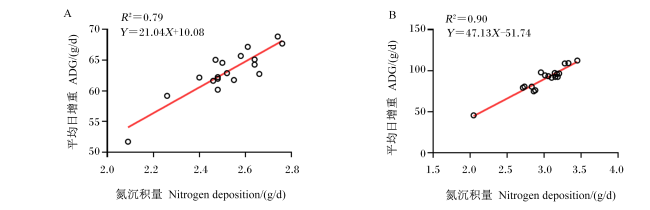
17~20日龄的代谢试验结果表明,OB、LC和WB组干物质、粗蛋白质存留率无显著差异(P>0.05);LC组总能存留率有高于WB组的趋势(P=0.089),而WB组氮沉积量有高于其他2组的趋势(表4,P=0.061)。当3个组肉鸡采食同一玉米-豆粕型饲粮时,干物质、总能、粗蛋白质存留率和氮沉积量均无显著差异(表4,P>0.05)。相关分析结果表明,肉鸡氮沉积量与ADG有显著的正相关(7~21日龄,P<0.001,R2=0.79;22~28日龄,P<0.001,R2=0.90)。
表4 不同来源纤维对肉鸡营养物质的存留率和氮沉积量的影响

Table 4 Effects of different fiber sources on nutrient retention rates and nitrogen deposition of broilers

项目
Items
组别Groups SEM P
P-value
燕麦麸OB 木质纤维素LC 小麦麸WB
7~21日龄7 to 21 days of age
干物质存留率Retention rate of DM/% 69.83 69.69 69.73 0.30 0.946
总能存留率Retention rate of GE/% 74.70 75.51 74.57 0.29 0.089
粗蛋白质存留率Retention rate of CP/% 62.45 62.46 62.89 0.50 0.786
表观代谢能Apparent metabolized energy/(MJ/kg) 14.66 14.75 14.67 0.06 0.498
氮沉积量Nitrogen deposition/(g/d) 2.48 2.48 2.60 0.04 0.061
22~28日龄22 to 28 days of age
干物质存留率Retention rate of DM/% 74.54 75.13 74.71 0.27 0.413
总能存留率Retention rate of GE/% 78.38 78.99 78.69 0.32 0.472
粗蛋白质存留率Retention rate of CP/% 63.61 64.49 64.65 0.54 0.285
氮沉积量Nitrogen deposition/(g/d) 2.95 2.99 3.08 0.07 0.608

同行数据肩标无字母或相同字母表示差异不显著(P>0.05)。

In the same row, values with no letter or the same letter superscripts mean no significant difference (P>0.05).

图1 7~21日龄(A)、22~28日龄(B)肉鸡氮沉积量与ADG的相关分析

Fig.1 Correlation analysis between nitrogen deposition and average daily gain of broilers aged 7 to 21 days (A) and 22 to 28 days (B)

2.3 肉鸡消化道器官指数

表5可知,饲喂添加OB、LC、WB的试验饲粮后,21日龄肉鸡消化道器官指数无显著差异(P>0.05)。
表5 不同来源纤维对21日龄肉鸡消化道器官指数的影响

Table 5 Effects of different fiber sources on digestive organ indexes of broilers aged 21 days

组别
Groups
腺胃指数
Proventriculus
index/(g/kg)
肌胃指数
Gizzard index/
(g/kg)
小肠指数
Small intestin
indexe/(cm/kg)
盲肠指数
Cecum index/
(cm/kg)
燕麦麸OB 0.44 1.12 140.1 12.2
木质纤维素LC 0.45 1.15 141.6 12.6
小麦麸WB 0.43 1.11 135.4 12.3
SEM 0.02 0.04 2.2 0.3
PP-value 0.720 0.674 0.123 0.700

2.4 肉鸡肠道形态

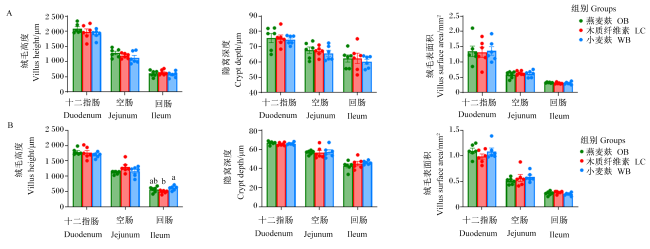
图2可知,肉鸡饲粮中添加OB、LC、WB对21日龄肉鸡十二指肠、空肠、回肠以及28日龄肉鸡十二指肠、空肠的绒毛高度、隐窝深度、绒毛表面积均无显著影响(P>0.05);但是肉鸡饲喂添加WB的试验饲粮2周后,回肠绒毛高度显著高于LC组(P=0.048)。
图2 不同来源纤维对21和28日龄肉鸡肠道形态的影响

A:21日龄 21 days of age; B:28日龄 28 days of age。

数据柱形标注不同字母表示差异显著(P<0.05)。下图同。

Fig.2 Effects of different fiber sources on intestinal morphology of broilers aged 21 and 28 days

Data columns with different letters mean significant difference (P<0.05). The same as below.

2.5 肉鸡盲肠微生物区系

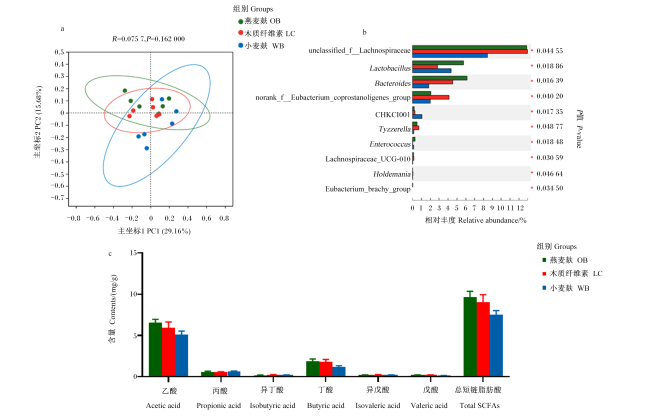
表6可知,饲喂添加不同纤维饲粮2周后,各组间21日龄肉鸡盲肠微生物ACE、Chao1、Shannon和Simpson指数无显著差异(P>0.05)。PCoA结果表明,OB组和LC组的肉鸡盲肠微生物在属水平上组成十分接近,而WB组盲肠肉鸡微生物组成差异略大(图3-A)。OB组和LC组中未分类毛螺菌科、拟杆菌属等盲肠优势菌属相对丰度显著高于WB组(P<0.05);OB组盲肠中乳杆菌属相对丰度显著高于LC组(P<0.05);而LC组中产粪甾醇真杆菌科未知属群相对丰度显著高于其他2组(P<0.05,图3-B)。盲肠食糜中乙酸、丙酸、丁酸、异丁酸、戊酸、异戊酸和总SCFAs含量各组间无显著差异(P>0.05,图3-C)。
表6 不同来源纤维对21日龄肉鸡α-多样性指数的影响

Table 6 Effects of different fiber sources on α-diversity indexes of broilers aged 21 days

组别
Groups
ACE指数
ACE index
Chao1指数
Chao1 index
Shannon指数
Shannon index
Simpson指数
Simpson index
燕麦麸OB 69.00 69.00 3.07 0.09
木质纤维素LC 65.50 65.50 2.94 0.10
小麦麸WB 67.83 67.83 3.11 0.07
SEM 2.43 2.43 0.08 0.01
PP-value 0.620 0.620 0.248 0.143
图3 不同来源纤维对21日龄肉鸡盲肠微生物属水平组成和SCFAs含量的影响

a:基于PCoA的β多样性分析; b:差异微生物; c:SCFAs含量。下图同。

Fig.3 Effects of different fiber sources on genus-level composition of cecal microbiota and SCFAs contents of broilers aged 21 days

a: β diversity analysis based on PCoA; b: differed microflora; c: SCFAs content. The same as below.

unclassified_f_Lachnospiraceae:未分类的毛螺菌科;Lactobacillus: 乳杆菌属;Bacteroides: 拟杆菌属; norank_f_Eubacterium_coprostanoligenes_group: 产粪甾醇真杆菌科未知属群; Tyzzerella: 泰泽雷拉菌属; Enterococcus: 肠球菌属; Lachnospiraceae_UCG-010: 毛螺菌科UCG-010; Holdemania: 霍尔德曼氏菌属; Eubacterium_brachy_group: 短真杆菌群。

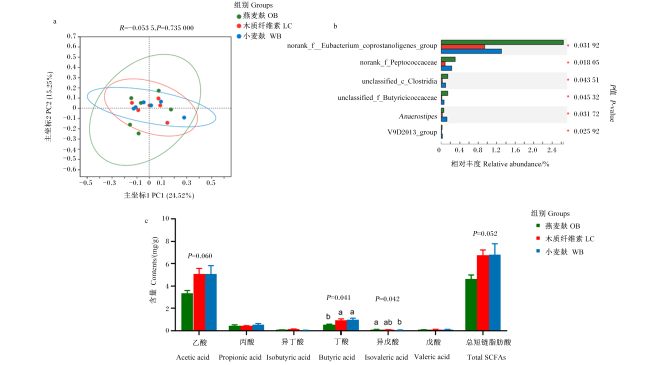
当所有组肉鸡采食同一玉米-豆粕型饲粮时,盲肠微生物属水平组成差异进一步减小(图4-A),相对丰度>1%的优势菌仅产粪甾醇真杆菌科未知属群相对丰度在不同组有显著差异,该菌属在OB组和WB组的相对丰度高于LC组。蛋白胨链球菌科未知属、未分类的梭状芽孢杆菌、未分类的丁酸菌球科相对丰度也有类似的趋势(图4-B)。但是,7~21日龄肉鸡饲喂添加OB、LC、WB的试验饲粮对28日龄盲肠食糜SCFAs含量有显著影响,其中LC组和WB组肉鸡盲肠中丁酸含量显著高于OB组(P<0.05),乙酸和总SCFAs含量有提高的趋势(图4-C,P=0.060,P=0.052)。
图4 不同来源纤维对28日龄肉鸡盲肠微生物属水平组成和SCFAs含量的影响

norank_f_Eubacterium_coprostanoligenes_group: 产粪甾醇真杆菌科未知属群; norank_f_Peptococcaceae: 蛋白胨链球菌科未知属; unclassified_c_Clostridia: 未分类的梭状芽孢杆菌属; unclassified_f_Butyricicoccaceae: 未分类的丁酸菌球科; Anaerostipes: 厌氧棒菌属; V9D2013_group: V9D2013群。

Fig.4 Effects of different fiber sources on genus-level composition of cecal microbiota and SCFAs contents of broilers aged 28 days

3 讨论

3.1 不同来源纤维对肉鸡生长性能的影响

此前研究表明,依照等能等氮原则,以纤维替代部分玉米、豆粕配制饲粮时,肉鸡的采食量、增重等基本不受到纤维添加的影响[2]。为了减少采食量对研究结果的干扰,本研究中各试验饲粮配制是根据EHGE值配制成等能饲粮,本试验发现,饲喂添加不同来源纤维的试验饲粮2周后,各组ADFI、BW和F/G均无显著差异。与《爱拔益加肉鸡饲养管理手册》提供的肉鸡生长数据相比,各组均达到了推荐标准。可见,7~21日龄肉鸡饲粮添加低水平的OB、LC、WB对生长性能无负面影响。

3.2 不同来源纤维对肉鸡营养物质消化和沉积的影响

不同来源纤维对肉鸡营养物质消化代谢有一定影响,特别是不溶性纤维可以提高肉鸡蛋白质、脂肪的消化率[3-6]。本研究发现,在相同能量浓度条件下,与其他2组相比,7~21日龄LC组肉鸡总能存留率有提高的趋势,而WB组肉鸡氮沉积量有提高的趋势,但各组肉鸡对同一饲粮中营养物质消化和沉积并无显著差异,提示各组营养物质消化代谢的差异与饲粮组成相关。为了保证各试验饲粮代谢能相等,LC组饲粮配方中大豆油比例比另外2组饲粮高出0.7%。LC可能促进脂肪乳化[19],提高脂肪的消化和吸收[20];与之相反,WB具有较强的油脂结合能力,促进油脂排出体外[21]。可见,油脂摄入量和消化率高可能是LC组总能存留率高的原因。尽管LC组肉鸡总能存留率高,但ADG与其他2组并无显著差异,总能存留率与ADG相关性也不显著。由于动物摄入能量能否用于增长体重上还受到热增耗的影响,不同来源纤维的热增耗不同[22],可能平衡了各组间的能量沉积。在Tejeda等[23]的研究中发现,在饲粮配方中分别添加4%的纤维素和大豆壳,饲粮配方等能等氮的条件下,大豆油水平相差1.25%,粗蛋白质消化率和能量消化率没有显著差异,该结论与本试验研究结果一致。与17~20日龄代谢试验的结果不同,22~28日龄采食同一饲粮后,各组肉鸡总能存留率无显著差异,仅在数值上提高了0.3%~0.6%,提示LC对能量消化代谢的调节作用与自身的理化性质相关,不依赖于消化生理的调节作用。本试验中还发现,肉鸡氮沉积量与ADG呈显著正相关,尽管不同纤维处理间粗蛋白质存留率无显著差异,但WB组肉鸡有提高氮沉积量的趋势。从化学组成来看,WB粗蛋白质含量(20.71%)与OB(21.66%)接近,远高于LC(1.43%)。尽管ADFI无显著差异,从数值上看WB组的ADFI要高于OB和LC组。这2个因素叠加造成了WB组肉鸡氮沉积量增高。此外,有文献报道OB可以促进蛋白酶的分泌[24],从而提高回肠末端蛋白质的消化[25]。由于氮沉积量是影响肉鸡增重的重要因素,与OB组和LC相比较,饲粮添加WB更有利于肉鸡粗蛋白质沉积和体重增长。与总能存留率类似,WB对氮沉积量影响随着肉鸡采食同一饲粮而变小,再次说明2周少量纤维的添加对肉鸡消化生理的调节作用比较有限。

3.3 不同来源纤维对肉鸡盲肠微生物区系的影响

尽管肉鸡对纤维消化能力远不如猪,但饲粮添加纤维可以促进肉鸡消化道发育,调节肠道微生物,提高肉鸡对肠道疾病抵抗力[26-27]。已发表的文献表明,饲粮纤维主要是通过提高肉鸡采食量[17]、增加纤维在肌胃中滞留[16]等途径刺激肌胃和肠道的发育[8-9]。由于各组间采食量接近,肉鸡消化器官发育、消化道形态也无明显差异,但是不同来源的纤维影响了肠道微生物组成。人类医学上很多研究都证实高脂饮食会造成肠道菌群紊乱,但这些文献的油脂水平差异在3~5倍[28-29]。本试验中,LC组大豆油水平仅提高了0.7%,这么小幅度的油脂水平变化是否会对肉鸡肠道微生物产生影响尚无相关文献报道。OB促进了肉鸡盲肠中未分类的毛螺菌科、乳杆菌属、拟杆菌属等的增殖,LC促进了未分类的毛螺菌科、拟杆菌属、产粪甾醇真杆菌科未知属群等的生长,WB也对乳杆菌属生长有一定的促进作用。OB、LC、WB在纤维组分上存在比较大的差异,肠道微生物对不同组分利用能力不同,因此饲喂添加不同来源纤维后的试验饲粮肠道微生物组成有所变化。本试验中发现的不同来源纤维与肉鸡肠道微生物生长的调控作用,与之前报道结果[9-10,30-31]相一致。例如Vermeulen等[30]通过体内外试验证实BW促进乳酸菌增殖。Moradi等[9]也发现饲粮添加燕麦壳、稻谷壳、葵花籽壳等增加了肉鸡盲肠乳杆菌属和厌氧菌的相对丰度。Zeitz等[31]研究结果表明,LC影响肉鸡盲肠中降低了瘤胃菌科、毛螺菌科的相对丰度,而增加了消化链球菌科等的相对丰度。这些优势菌属分别在生成SCFAs、调节肠道pH、提高肠道抗病力等方面发挥着重要的作用[32-34],提示OB、LC、WB均有类似益生元作用。但是,肉鸡盲肠食糜中SCFAs含量和微生物组成的变化并不同步。21日龄肉鸡盲肠各组间SCFAs含量无显著差异;在28日龄,饲喂添加WB和LC的试验饲粮的肉鸡盲肠中乙酸和SCFAs含量有提高的趋势,与文献报道结果[31,35-36]一致,提示纤维作用有滞后性。

4 结论

在能量浓度相同条件下,7~21日龄肉鸡饲粮添加OB、LC和WB在生长性能、消化道发育和肠道形态的作用上无显著差异,但在对粮养分消化、肠道微生物组成和SCFAs含量的作用上有一定差异。与OB和LC相比,WB在提高肉鸡氮沉积量、提高肠道SCFAs含量上略有优势。
[1]
SVIHUS B. The gizzard:function,influence of diet structure and effects on nutrient availability[J]. World’s Poultry Science Journal, 2011, 67(2):207-224.

DOI

[2]
RÖHE I, ZENTEK J. Lignocellulose as an insoluble fiber source in poultry nutrition:a review[J]. Journal of Animal Science and Biotechnology, 2021, 12(1):82.

DOI

[3]
JIMÉNEZ-MORENO E, GONZÁLEZ-ALVARADO J M, GONZÁLEZ-SERRANO A, et al. Effect of dietary fiber and fat on performance and digestive traits of broilers from one to twenty-one days of age[J]. Poultry Science, 2009, 88(12):2562-2574.

DOI

[4]
JIMÉNEZ-MORENO E, GONZÁLEZ-ALVARADO J M, LÁZARO R, et al. Effects of type of cereal,heat processing of the cereal,and fiber inclusion in the diet on gizzard pH and nutrient utilization in broilers at different ages[J]. Poultry Science, 2009, 88(9):1925-1933.

DOI

[5]
MTEI A W, ABDOLLAHI M R, SCHREURS N, et al. Dietary inclusion of fibrous ingredients and bird type influence apparent ileal digestibility of nutrients and energy utilization[J]. Poultry Science, 2019, 98(12):6702-6712.

DOI PMID

[6]
JIMÉNEZ-MORENO E, GONZÁLEZ-ALVARADO J M, DE COCA-SINOVA A, et al. Insoluble fiber sources in mash or pellets diets for young broilers.2.Effects on gastrointestinal tract development and nutrient digestibility[J]. Poultry Science, 2019, 98(6):2531-2547.

DOI

[7]
TEJEDA O J, KIM W K. Role of dietary fiber in poultry nutrition[J]. Animals, 2021, 11(2):461.

DOI

[8]
JIMÉNEZ-MORENO E, DE COCA-SINOVA A, GONZÁLEZ-ALVARADO J M, et al. Inclusion of insoluble fiber sources in mash or pellet diets for young broilers.1.Effects on growth performance and water intake[J]. Poultry Science, 2016, 95(1):41-52.

DOI

[9]
MORADI S, MORADI A, ATABAIGI ELMI V, et al. Interactive effect of corn particle size and insoluble fiber source on performance,nutrient utilization and intestine morphology in broilers fed pelleted diets[J]. Journal of Animal Physiology and Animal Nutrition, 2021, 105(6):1113-1126.

DOI

[10]
WRÓBLEWSKA P, HIKAWCZUK T, SIERŻANT K, et al. Effect of oat hull as a source of insoluble dietary fibre on changes in the microbial status of gastrointestinal tract in broiler chickens[J]. Animals, 2022, 12(19):2721.

DOI

[11]
SOZCU A. Growth performance,pH value of gizzard,hepatic enzyme activity,immunologic indicators,intestinal histomorphology,and cecal microflora of broilers fed diets supplemented with processed lignocellulose[J]. Poultry Science, 2019, 98(12):6880-6887.

DOI

[12]
VERMEULEN K, VERSPREET J, COURTIN C M, et al. Reduced particle size wheat bran is butyrogenic and lowers Salmonella colonization,when added to poultry feed[J]. Veterinary Microbiology, 2017, 198:64-71.

DOI

[13]
MORGAN N K, WALLACE A, BEDFORD M R. Improving sorghum digestion in broilers by targeting fermentation of xylan[J]. Animal Nutrition, 2022, 10:198-206.

DOI PMID

[14]
CRAIG A D, BEDFORD M R, HASTIE P, et al. The effect of carbohydrases or prebiotic oligosaccharides on growth performance,nutrient utilisation and development of small intestine and immune organs in broilers fed nutrient-adequate diets based on either wheat or barley[J]. Journal of the Science of Food and Agriculture, 2019, 99(7):3246-3254.

DOI

[15]
POURAZADI Z, SALARI S, TABANDEH M R, et al. Effect of particle size of insoluble fibre on growth performance,apparent ileal digestibility and caecal microbial population in broiler chickens fed barley-containing diets[J]. British Poultry Science, 2020, 61(6):734-745.

DOI

[16]
KOUZOUNIS D, VAN ERVEN G, SOARES N, et al. The fate of insoluble arabinoxylan and lignin in broilers:influence of cereal type and dietary enzymes[J]. International Journal of Biological Macromolecules, 2023, 225:1096-1106.

DOI

[17]
TAYLOR J, KYRIAZAKIS I. Towards the prediction of feed intake capacity of modern broilers on bulky feeds[J]. Poultry Science, 2021, 100(12):101501.

DOI

[18]
LIU Y Y, ZHAO B Y, FENG Y J, et al. In vitro release and in vivo growth-promoting effects of coated cysteamine in broilers[J]. Poultry Science, 2023, 102(4):102475.

DOI

[19]
LI Y F, YUE P P, HAO X, et al. Comparison of emulsifying capacity of two hemicelluloses from moso bamboo in soy oil-in-water emulsions[J]. RSC Advances, 2020, 10(8):4657-4663.

DOI

[20]
JIMÉNEZ-MORENO E, GONZÁLEZ-ALVARADO J M, GONZÁLEZ-SÁNCHEZ D, et al. Effects of type and particle size of dietary fiber on growth performance and digestive traits of broilers from 1 to 21 days of age[J]. Poultry Science, 2010, 89(10):2197-2212.

DOI

[21]
SURIANO F, BINDELS L B, VERSPREET J, et al. Fat binding capacity and modulation of the gut microbiota both determine the effect of wheat bran fractions on adiposity[J]. Scientific Reports, 2017, 7(1):5621.

DOI PMID

[22]
JØRGENSEN H, ZHAO X Q, KNUDSEN K E, et al. The influence of dietary fibre source and level on the development of the gastrointestinal tract,digestibility and energy metabolism in broiler chickens[J]. British Journal of Nutrition, 1996, 75(3):379-395.

DOI

[23]
TEJEDA O J, KIM W K. Effects of fiber type,particle size,and inclusion level on the growth performance,digestive organ growth,intestinal morphology,intestinal viscosity,and gene expression of broilers[J]. Poultry Science, 2021, 100(10):101397.

DOI

[24]
SHANG Q H, WU D, LIU H S, et al. The impact of wheat bran on the morphology and physiology of the gastrointestinal tract in broiler chickens[J]. Animals, 2020, 10(10):1831.

DOI

[25]
GALLARDO C, DADALT J C, TRINDADE NETO M A. Nitrogen retention,energy,and amino acid digestibility of wheat bran,without or with multicarbohydrase and phytase supplementation,fed to broiler chickens[J]. Journal of Animal Science, 2018, 96(6):2371-2379.

DOI

[26]
ANTONISSEN G, EECKHAUT V, VAN DRIESSCHE K, et al. Microbial shifts associated with necrotic enteritis[J]. Avian Pathology, 2016, 45(3):308-312.

DOI PMID

[27]
SADEGHI A, TOGHYANI M, TABEIDIAN S A, et al. Efficacy of dietary supplemental insoluble fibrous materials in ameliorating adverse effects of coccidial challenge in broiler chickens[J]. Archives of Animal Nutrition, 2020, 74(5):362-379.

DOI PMID

[28]
LIU Y, YANG K N, JIA Y Q, et al. Gut microbiome alterations in high-fat-diet-fed mice are associated with antibiotic tolerance[J]. Nature Microbiology, 2021, 6(7):874-884.

DOI PMID

[29]
KÜBECK R, BONET-RIPOLL C, HOFFMANN C, et al. Dietary fat and gut microbiota interactions determine diet-induced obesity in mice[J]. Molecular Metabolism, 2016, 5(12):1162-1174.

DOI PMID

[30]
VERMEULEN K, VERSPREET J, COURTIN C M, et al. Reduced-particle-size wheat bran is efficiently colonized by a lactic acid-producing community and reduces levels of Enterobacteriaceae in the cecal microbiota of broilers[J]. Applied and Environmental Microbiology, 2018, 84(21):e01343-18.

[31]
ZEITZ J O, NEUFELD K, POTTHAST C, et al. Effects of dietary supplementation of the lignocelluloses FibreCell and OptiCell on performance,expression of inflammation-related genes and the gut microbiome of broilers[J]. Poultry Science, 2019, 98(1):287-297.

DOI

[32]
BROOM L J. Gut barrier function:effects of antibiotic growth promoters on key barrier components and associations with growth performance[J]. Poultry Science, 2018, 97(5):1572-1578.

DOI

[33]
VACCA M, CELANO G, CALABRESE F M, et al. The controversial role of human gut lachnospiraceae[J]. Microorganisms, 2020, 8(4):573.

DOI

[34]
SHI Y, LUO J Q, NARBAD A, et al. Advances in Lactobacillus restoration for β-lactam antibiotic-induced dysbiosis:a system review in intestinal microbiota and immune homeostasis[J]. Microorganisms, 2023, 11(1):179.

DOI

[35]
OLUKOSI O A, OLUSEYIFUNMI I W, LIN Y, et al. Short-term partial replacement of corn and soybean meal with high-fiber or high-protein feedstuffs during metabolizable energy assay influenced intestinal histomorphology,cecal short-chain fatty acids,and selected nutrient transporters in 21-day-old broiler chickens[J]. Animals, 2022, 12(17):2193.

DOI

[36]
RÖHE I, METZGER F, VAHJEN W, et al. Effect of feeding different levels of lignocellulose on performance,nutrient digestibility,excreta dry matter,and intestinal microbiota in slow growing broilers[J]. Poultry Science, 2020, 99(10):5018-5026.

DOI

文章导航

/