研究论文

发酵饲料对猪肉品质影响的Meta分析

  • 申远航 , 1, 2 ,
  • 李登云 , 1, 2, * ,
  • 陈华 2 ,
  • 姚学丹 2
展开
  • 1 河南牧翔动物药业有限公司,郑州 450000
  • 2 河南牧翔生物科技有限公司,郑州 450000
*李登云,E-mail:

申远航(1993—),男,河南汝州人,畜牧师,硕士,研究方向为动物营养与饲料科学。E-mail:

Office editor: 陈鑫

收稿日期: 2023-03-03

  网络出版日期: 2023-08-10

基金资助

河南省重点研发专项(221111111600)

河南省重点研发专项(22111111160)

Meta-Analysis of Effects of Fermented Feed on Pork Quality

  • SHEN Yuanhang , 1, 2 ,
  • LI Dengyun , 1, 2, * ,
  • CHEN Hua 2 ,
  • YAO Xuedan 2
Expand
  • 1 Henan Muxiang Animal Pharmaceutical Co., Ltd., Zhengzhou 450000, China
  • 2 Henan Muxiang Biotechnology Co., Ltd., Zhengzhou 450000, China

Received date: 2023-03-03

  Online published: 2023-08-10

摘要

为探究发酵饲料对猪肉品质的影响,本文进行了系统回顾和Meta分析。计算机检索万方(Wanfang)、中国知网(CNKI)、维普(CQVIP)、Web of Science、Science Direct数据库,查找发酵饲料对外三元杂交猪肉品质影响的相关试验研究。检索年限从2010年到2022年,按照纳入和排除标准筛选文献、提取资料,用Review Manager 5.4软件进行Meta分析。结果表明:纳入21个研究,共计样本410例,Meta分析结果显示,发酵饲料组猪肉红度值显著高于对照组[P=0.005,标准化均数差(SMD)=0.71,95%置信区间(CI):0.21~1.20];剪切力显著低于对照组(P=0.008,SMD=-1.46,95%CI:-2.54~-0.39);滴水损失显著低于对照组(P<0.001,SMD=-0.83,95%CI:-1.22~-0.43);肌内脂肪含量显著高于对照组(P=0.020,SMD=0.96,95%CI:0.15~1.76);背最长肌谷氨酸(P=0.030,SMD=1.00,95%CI:0.07~1.92)、丙氨酸(P=0.003,SMD=1.46,95%CI:0.49~2.43)、甘氨酸(P=0.020,SMD=1.59,95%CI:0.28~2.91)和赖氨酸含量(P=0.005,SMD=0.98,95%CI:0.30~1.66)显著高于对照组;硬脂酸含量显著低于对照组(P=0.020,SMD=-0.53,95%CI:-0.96~-0.10),2组间其他的肉品质指标、氨基酸和脂肪酸含量指标差异均不显著(P>0.05)。综上所述,饲喂发酵饲料可显著改善猪肉色泽、提升嫩度和系水力等感官质量,亦可增加肌内脂肪含量,增加谷氨酸、丙氨酸、甘氨酸、赖氨酸含量,减少硬脂酸含量,进而改善猪肉口感,增加风味。

本文引用格式

申远航 , 李登云 , 陈华 , 姚学丹 . 发酵饲料对猪肉品质影响的Meta分析[J]. 动物营养学报, 2023 , 35(8) : 5374 -5383 . DOI: 10.12418/CJAN2023.495

Abstract

In order to explore the effects of fermented feed on pork quality, this paper carried out a systematic review and Meta-analysis. Computer retrieval of Wanfang, CNKI, CQVIP, Web of Science, Science Direct databases to find out the relevant experimental studies on the influence of fermented feed on the quality of external ternary hybrid pork. The retrieval period was from 2010 to 2022. According to the inclusion and exclusion criteria, documents were selected, data were extracted, and Meta-analysis was performed with Review Manager 5.4 software. Results showed that a total of 410 samples were included in 21 studies. The results of Meta-analysis showed that the pork redness value in the fermented feed group was significantly higher than that in the control group [P=0.005, stabdarduzed mean difference (SMD)=0.71, 95% confidence interval (CI): 0.21 to 1.20]; the shear force was significantly lower than that in the control group (P=0.008, SMD=-1.46, 95% CI: -2.54 to -0.39); drip loss was significantly lower than that in the control group (P<0.001, SMD=-0.83, 95% CI: -1.22 to -0.43); the intramuscular fat content was significantly higher than that in the control group (P=0.020, SMD=0.96, 95% CI: 0.15 to 1.76); the contents of glutamic acid (P=0.030, SMD=1.00, 95% CI: 0.07 to 1.92), alanine (P=0.003, SMD=1.46, 95% CI: 0.49 to 2.43), glycine (P=0.020, SMD=1.59, 95% CI: 0.28 to 2.91) and lysine (P=0.005, SMD=0.98, 95% CI: 0.30 to 1.66) in the longissimus dorsi muscle were significantly higher than those in the control group; the content of stearic acid was significantly lower than that in the control group (P=0.020, SMD=-0.53, 95% CI: -0.96 to -0.10). There was no significant difference in other meat quality indicators, amino acid indicators and fatty acid contents between the two groups (P>0.05). In conclusion, feeding fermented feed can significantly improve the sensory quality of pork, such as color, tenderness, and water retention. It can also increase the content of intramuscular fat, increase the contents of glutamate, alanine, glycine, and lysine, reduce the content of stearic acid, and improve the taste and flavor of pork.

随着人民生活水平的不断提高,人们对优质猪肉的需求不断增加。然而我国饲养品种以“杜长大”外三元猪为主,与国内地方品种猪相比在肉色、风味等方面稍显逊色,并不能满足人民对猪肉感官、猪肉风味等肉品质指标的追求。对于畜牧工作者而言,如何在现有品种前提下,通过饲养管理等干预手段,改善猪肉风味和质量,满足人民对美好生活的追求具有极其重要的意义。研究表明,发酵饲料不仅能显著提高饲料的可消化性和动物的消化率[1],而且在改善肉品质方面效果显著,如改善红度值、提高肌内脂肪含量、提高鲜味氨基酸含量、改善猪肉嫩度等方面[2-3],所以在生产中应用发酵饲料对猪肉品质有一定程度的提高。
近年来,发酵饲料产业发展极其迅速,越来越多的饲料生产企业进行发酵饲料的生产和技术探索,更多的发酵饲料被应用于畜禽的生产中,而发酵饲料在生产中的应用效果却褒贬不一,所以本研究拟采用Meta分析方法进行发酵饲料对猪肉品质影响的深入分析。Meta分析是运用统计学方法对多个研究结果进行系统、定量和客观的综合分析,对效应指标进行准确和科学的评估,以达到增大样本数量、提高检验效能的效果,为临床决策提供有力的依据[4]。本研究搜集发酵饲料对猪肉品质影响的相关试验数据,进行Meta分析和总结,为畜禽生产上发酵饲料的应用提供参考。

1 材料与方法

1.1 检索策略

计算机检索万方(Wanfang)、中国知网(CNKI)、维普(CQVIP)、Web of Science、Science Direct数据库。检索年限从2010年至2022年10月。中文检索关键字包括:发酵饲料、猪、肉品质,英文检索关键字包括:Fermented feed、Pig、Meat quality。根据不同数据库的特征分别进行主题词联合自由词的方式收集文献。

1.2 文献纳入和排除标准

文献纳入标准:1)研究类型,已发表的随机对照试验;2)研究对象,外三元杂交猪,必须是健康无疾病;3)干预措施,饲粮中添加一定比例的发酵饲料并以常规饲粮作为对照;4)结局指标,亮度、红度、黄度值及剪切力、滴水损失、肌内脂肪含量,谷氨酸、天冬氨酸、苯丙氨酸、丙氨酸、甘氨酸、酪氨酸、赖氨酸、蛋氨酸、异亮氨酸、亮氨酸含量,肉豆寇酸、棕榈酸、棕榈油酸、硬脂酸、油酸、亚油酸、亚麻酸含量;5)纳入文献中给出了指标的平均值和标准差(standard deviation,SD)或标准误(standard error of mean,SE)。
文献排除标准:1)重复发表、质量较低的文献;2)综述类文章、无空白对照组的文献;3)数据不全或数据明显有误的文献;4)试验组干预措施为发酵饲料以外的文献。

1.3 数据资料提取

仔细阅读全文后,由2名评价者独立提取评价材料。从文献中提取以下数据:题目、第一作者、发表年份;研究对象、试验组动物总数、对照组动物总数、饲喂方式、试验天数、动物品种、初重、末重;亮度、红度、黄度值,剪切力,滴水损失,肌内脂肪含量,谷氨酸、天冬氨酸、苯丙氨酸、丙氨酸、甘氨酸、酪氨酸、赖氨酸、蛋氨酸、异亮氨酸、亮氨酸含量,肉豆寇酸、棕榈酸、棕榈油酸、硬脂酸、油酸、亚油酸、亚麻酸含量。各研究中如有缺乏的资料,尝试通过电话或邮件与作者进行联系补充。

1.4 统计学方法

数据分析和相关图表的制作运用Review Manager 5.4软件进行,选择标准化均数差(standardized mean difference,SMD)为效应尺度,解决了文献中数据类型及研究中数据测量方法和单位的误差问题。选择更为保守的随机效应模型(randomized effect model,REM),以解决多个研究间试验过程中的不一致因素。文中如有平均值或标准差不全的,我们将根据标准误、95%置信区间(confidence interval,CI)或其他统计指标进行计算,计算公式如下:
SD=SE× n;
SE=MD/t
式中:SD为标准差;SE为标准误;MD为均数差;n为样本量;tt统计量的值。

2 结果与分析

2.1 文献检索与筛选结果

按照检索策略共得到文献436篇,阅读文献题目及摘要,排除非研究性论文、综述、重复发表的文献365篇,阅读全文,排除对照组不是空白组的文献,共排除不符合纳入标准的文献50篇,最终纳入文献21篇。
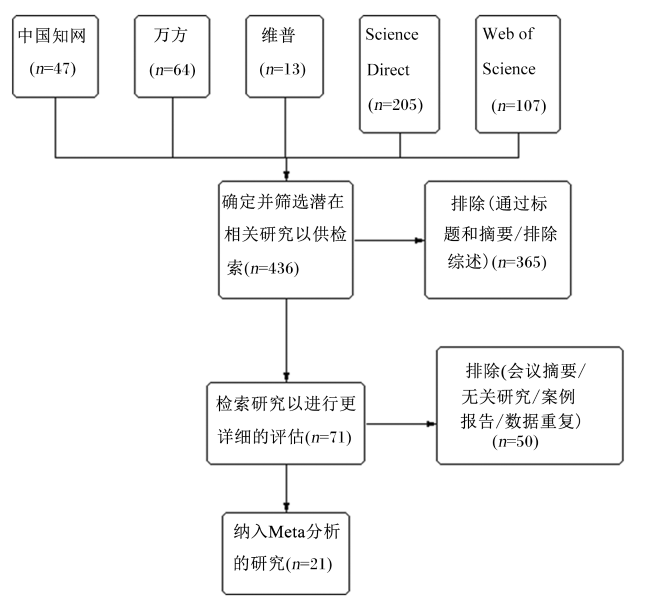
图1 文献筛选流程

Fig.1 Literature screening process

2.2 文献质量评估

图2显示了纳入研究的质量评估。评价随机化方法:1篇的随机方法不明确;评价随机化的隐藏方法:3篇分配方法隐藏;评价治疗(干预)过程中的盲法:过程中一般都是盲法;评价结果测量中的盲法:11篇结果评估盲法偏倚不清楚;评价结局数据完整性:1篇结果数据偏倚不明确;评价选择性报告研究结果:8篇选择性报导偏倚不清楚;其他偏倚:6篇其他偏倚不明朗;其他研究的各项偏倚风险较低,因此,所纳入的试验具有低偏倚风险。
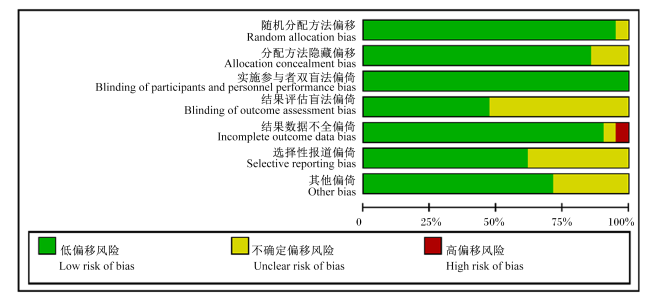
图2 文献质量评估

Fig.2 Literature quality evaluation

2.3 纳入文献的基本特征

研究对象外三元杂交猪,试验组21组,共计205头,对照组21组,共计205头。试验组均为发酵饲料添加至饲粮中,对照组为常规饲粮,研究中样本量为试验结束后屠宰的样本数,基本特征见表1
表1 基本特征

Table 1 Basic characteristics

序号
No.
第一作者
The first
author
年份
Year
品种
Breed
试验天数
Test
days/d
试验组样本量
Number of
samples in
test group
对照组样本量
Number of
samples in
control group
干预措施Intervention 饲喂方式
Feeding
mode
结局指标
Outcome
indicator
初重
Initial
weight/
kg
末重
Final
weight/
kg
试验组
Test group
对照组
Control group
1 黄小乘等[5] 2021 杜长大 48 3 3 15%发酵原料 常规饲粮 拌入饲粮 ①②③ 61 96
2 张娜娜等[6] 2016 杜长大 66 3 3 15%发酵原料 常规饲粮 拌入饲粮 ①② 66 119
3 张旭晖等[7] 2018 杜长大 63 4 4 12%发酵原料 常规饲粮 拌入饲粮 ①② 55 113
4 李涛等[8] 2014 杜长大 136 4 4 0.1%发酵料 常规饲粮 拌入饲粮 20 100
5 武鹤天[9] 2020 杜长大 45 8 8 0.1%发酵料 常规饲粮 拌入饲粮 90 130
6 刘金伟[10] 2014 杜长大 90 5 5 10%发酵原料 常规饲粮 拌入饲粮 50 97
7 郝丽红[11] 2020 杜长大 39 12 12 10%发酵饲料 常规饲粮 拌入饲粮 ①②③ 90 125
8 宋博等[12] 2020 杜长大 45 7 7 10%发酵原料 常规饲粮 拌入饲粮 ①③ 64 103
9 薛云等[13] 2021 杜长大 73 10 10 60%发酵原料 常规饲粮 拌入饲粮 ①②③ 36 110
10 朱坤[14] 2018 杜长大 28 4 4 20%发酵饲料 常规饲粮 拌入饲粮 66 89
11 代张超[15] 2019 杜长大 67 6 6 5.5%发酵原料 常规饲粮 拌入饲粮 ①②③ 48 110
12 胡新旭等[16] 2015 杜长大 154 3 3 20%发酵料 常规饲粮 拌入饲粮 18 110
13 段文辉[17] 2019 杜长大 39 6 6 15%发酵原料 常规饲粮 拌入饲粮 75 99
14 Chu等[18] 2012 杜长大 42 8 8 40%发酵原料 常规饲粮 拌入饲粮 73 110
15 Chu等[19] 2012 杜长大 42 10 10 5%发酵原料 常规饲粮 拌入饲粮 ①② 75 105
16 Lu等[20] 2020 杜长大 85 6 6 发酵饲料 常规饲粮 拌入饲粮 ①②③ 55 115
17 Yan等[21] 2011 杜长大 105 28 28 发酵原料 常规饲粮 拌入饲粮 ①② 19 105
18 Ahmed等[22] 2016 杜长大 70 32 32 0.4%发酵原料 常规饲粮 拌入饲粮 39 102
19 Ding等[23] 2020 杜长大 60 12 12 15%发酵原料 常规饲粮 拌入饲粮 70 124
20 Yan等[24] 2011 杜长大 84 28 28 发酵原料 常规饲粮 拌入饲粮 56 117
21 Xie等[25] 2022 杜长大 50 6 6 5.9%发酵原料 常规饲粮 拌入饲粮 75 122

①:亮度、红度、黄度及剪切力、滴水损失、肌内脂肪含量 L*, a*, b* value and shear force, drip loss, intramuscular fat content;②:谷氨酸、天冬氨酸、苯丙氨酸、丙氨酸、甘氨酸酪氨酸、赖氨酸、蛋氨酸、异亮氨酸、亮氨酸含量 glutamate, aspartate, phenylalanine, alanine, glycine, tyrosine, lysine, methionine, isoleucine, leucine content; ③:肉豆寇酸、棕榈酸、棕榈油酸、硬脂酸、油酸、亚油酸、亚麻酸含量 myristic acid, palmitic acid, palmitoleic acid, stearic acid, oleic acid, linoleic acid, linolenic acid content。

2.4 发酵饲料对猪肉质量影响的Meta分析结果

表2可知,汇总纳入研究中亮度(15篇)、红度(14篇)、黄度值(14篇)及剪切力(15篇)、滴水损失(15篇)和肌内脂肪含量(9篇)的全部数据,进行试验组和对照组的Meta分析,结果显示,2组之间猪肉亮度值没有显著差异(P=0.520,SMD=-0.13,95%CI:-0.53~0.27),而试验组猪肉红度值(P=0.005,SMD=0.71,95%CI:0.21~1.20)显著高于对照组,猪肉黄度值2组间没有显著差异(P=0.460,SMD=-0.17,95%CI:-0.60~0.27)。试验组剪切力(P=0.008,SMD=-1.46,95%CI:-2.54~-0.39)显著低于对照组。试验组滴水损失(P<0.001,SMD=-0.83,95%CI:-1.22~-0.43)显著低于对照组,肌内脂肪含量(P=0.020,SMD=0.96,95%CI:0.15~1.76)试验组显著高于对照组。对添加量的亚组分析得出,发酵饲料添加量在10%以上时,对亮度、红度值及剪切力、滴水损失的影响较为显著。
表2 肉品质的Meta分析结果

Table 2 Meta analysis results of meat quality

项目
Items
添加量亚组
Addition
subgroup
样本数
Sample
number
标准化均数差
SMD
95%置信区间
95%CI
P
P-value
异质性
I2/%
模型
Model
15 -0.13 -0.53~0.27 0.520 54 REM
亮度L* 10%以下 7 0.26 -0.16~0.69 0.230 31 REM
10%以上 8 -0.57 -0.18~-0.07 0.030 36 REM
14 0.71 0.21~1.20 0.005 64 REM
红度a* 10%以下 7 0.19 -0.14~0.52 0.250 1 REM
10%以上 7 1.55 0.69~2.40 <0.010 61 REM
14 -0.17 -0.60~0.27 0.460 56 REM
黄度b* 10%以下 6 0.09 -0.63~0.81 0.810 68 REM
10%以上 8 -0.37 -0.83~0.09 0.110 23 REM
15 -1.46 -2.54~-0.39 0.008 86 REM
剪切力Shear force 10%以下 4 -1.38 -3.46~0.69 0.190 88 REM
10%以上 11 -1.52 -2.87~-0.18 0.030 86 REM

滴水损失
15 -0.83 -1.22~-0.43 <0.001 33 REM

Drip loss
10%以下 5 -0.61 -1.30~0.09 0.090 43 REM
10%以上 10 -0.96 -1.45~-0.47 <0.001 29 REM

肌内脂肪
9 0.96 0.15~1.76 0.020 67 REM

Intramuscular fat
10%以下 2 0.87 -0.12~1.86 0.080 34 REM
10%以上 7 1.08 -0.02~2.18 0.050 73 REM

REM:随机效应模型random effect model。下表同the same as below。

2.5 发酵饲料对猪肉中氨基酸含量影响的Meta分析结果

表3可知,汇总纳入研究中谷氨酸(7篇)、天冬氨酸(7篇)、苯丙氨酸(5篇)、丙氨酸(7篇)、甘氨酸(7篇)、酪氨酸(6篇)、赖氨酸(6篇)、蛋氨酸(7篇)、异亮氨酸(6篇)和亮氨酸(6篇)含量的全部数据,并进行试验组和对照组数据的Meta分析,结果显示,试验组谷氨酸含量(P=0.030,SMD=1.00,95%CI:0.07~1.92)显著高于对照组,2组间天冬氨酸(P=0.090,SMD=0.72,95%CI:-0.12~1.55)和苯丙氨酸含量(P=0.360,SMD=0.86,95%CI:-0.96~2.68)差异不显著。试验组丙氨酸(P=0.003,SMD=1.46,95%CI:0.49~2.43)、甘氨酸含量(P=0.020,SMD=1.59,95%CI:0.28~2.91)均显著高于对照组,2组间酪氨酸含量(P=0.090,SMD=0.78,95%CI:-0.12~1.67)差异不显著,试验组赖氨酸含量(P=0.005,SMD=0.98,95%CI:0.30~1.66)显著高于对照组,2组间蛋氨酸(P=0.570,SMD=0.21,95%CI:-0.52~0.94)、异亮氨酸(P=0.470,SMD=-0.30,95%CI:-1.12~0.51)、亮氨酸含量(P=0.320,SMD=0.42,95%CI:-0.40~1.24)差异均不显著。另外,氨基酸含量指标相关文献都是10%以上添加量的文章,说明10%以上发酵饲料添加量对猪肉中氨基酸含量有提高效果。
表3 氨基酸含量的Meta分析结果

Table 3 Meta analysis results of amino acid contents

项目
Items
样本数
Sample
number
标准化均数差
SMD
95%置信区间
95%CI
P
P-value
异质性
I2/%
模型
Model
谷氨酸Glu 7 1.00 0.07~1.92 0.030 71 REM
天冬氨酸Asp 7 0.72 -0.12~1.55 0.090 67 REM
苯丙氨酸Phe 5 0.86 -0.96~2.68 0.360 88 REM
丙氨酸Ala 7 1.46 0.49~2.43 0.003 72 REM
甘氨酸Gly 7 1.59 0.28~2.91 0.020 83 REM
酪氨酸Tyr 6 0.78 -0.12~1.67 0.090 69 REM
赖氨酸Lys 6 0.98 0.30~1.66 0.005 49 REM
蛋氨酸Met 7 0.21 -0.52~0.94 0.570 65 REM
异亮氨酸Ile 6 -0.30 -1.12~0.51 0.470 66 REM
亮氨酸Leu 6 0.42 -0.40~1.24 0.320 65 REM

2.6 发酵饲料对猪肉中脂肪酸含量影响的Meta分析结果

表4可知,汇总纳入研究中肉豆寇酸(8篇)、棕榈酸(11篇)、棕榈油酸(8篇)、硬脂酸(11篇)、油酸(9篇)、亚油酸(9篇)和亚麻酸(6篇)含量的全部数据,并进行试验组和对照组数据的Meta分析,结果显示,2组间肉豆蔻酸(P=0.940,SMD=0.02,95%CI:-0.41~0.44)、棕榈酸(P=0.800,SMD=-0.06,95%CI:-0.48~0.37)、棕榈油酸含量(P=0.600,SMD=0.19,95%CI:-0.53~0.91)差异均不显著。然而试验组硬脂酸含量(P=0.020,SMD=-0.53,95%CI:-0.96~-0.10)显著低于对照组,2组间油酸(P=0.110,SMD=0.63,95%CI:-0.14~1.40)、亚油酸(P=0.440,SMD=0.38,95%CI:-0.57~1.32)、亚麻酸含量(P=0.050,SMD=0.81,95%CI:0.00~1.61)差异均不显著。添加量的亚组分析结果显示,发酵饲料添加量10%以上或以下对棕榈酸、棕榈油酸和亚油酸含量影响均不显著。
表4 脂肪酸含量的Meta分析结果

Table 4 Meta analysis results of fatty acid contents

项目
Items
添加量亚组
Addition
subgroup
样本数
Sample
number
标准化均数差
SMD
95%置信区间
95%CI
P
P-value
异质性
I2/%
模型
Model
8 0.02 -0.41~0.44 0.940 35 REM
肉豆蔻酸C14∶0 10%以下 3 0.38 0.04~0.73 0.030 0 REM
10%以上 5 -0.49 -1.07~0.10 0.100 0 REM
11 -0.06 -0.48~0.37 0.800 51 REM
棕榈酸C16∶0 10%以下 4 -0.12 -0.63~0.39 0.650 52 REM
10%以上 7 0.02 -0.74~0.78 0.950 57 REM
8 0.19 -0.53~0.91 0.600 62 REM
棕榈油酸C16∶1 10%以下 2 0.39 -0.32~1.10 0.280 0 REM
10%以上 6 0 -1.04~1.03 0.990 71 REM
11 -0.53 -0.96~-0.10 0.020 52 REM
硬脂酸C18∶0 10%以下 4 -0.39 -0.75~-0.02 0.040 15 REM
10%以上 7 -0.69 -1.52~0.13 0.100 65 REM
9 0.63 -0.14~1.40 0.110 69 REM
油酸C18∶1n9c 10%以下 2 1.23 0.45~2.01 <0.010 0 REM
10%以上 7 0.39 -0.61~1.38 0.450 74 REM
9 0.38 -0.57~1.32 0.440 78 REM
亚油酸C18∶2n6c 10%以下 2 -0.84 -3.83~2.15 0.580 90 REM
10%以上 7 0.73 -0.33~1.79 0.180 75 REM
亚麻酸C18∶3n6 6 0.81 0.00~1.61 0.050 58 REM

3 讨论

饲料原料或农作物副产品通过微生物发酵能够提高其营养价值和可消化性,同时微生物的作用产生了大量消化酶、有机酸和氨基酸等有益代谢产物,提高了饲料原料的可消化性和动物的消化率。诸多研究显示,微生物发酵后降低了原料中的粗纤维含量和pH[26],并提高了有机酸、粗蛋白质和氨基酸含量[27],饲料消化吸收率大大增加。发酵后的酸香味也刺激了猪的采食,有研究显示发酵饲料可提高生长育肥猪平均日采食量和平均日增重[2],在提高生长性能方面效果显著。另外,发酵后饲料中粗蛋白质和氨基酸等其他有益代谢产物的增加可能是其对猪生长性能和肉品质改善的重要因素。
肉色预示着其新鲜程度,主要通过猪肉的亮度、红度、黄度值判断,这些感官指标影响着人们的购买欲望。此外,反映肉品质的另一种重要指标是肌内脂肪含量,与肉的嫩度、多汁性和风味相关[28]。发酵饲料可以通过改善这些指标来提高猪肉的感官、风味和营养成分。有学者用发酵型饲粮饲喂后,肉中的总抗氧化能力显著提高,滴水损失和剪切力显著降低[11,29],同时,Mitsumoto等[30]提出抗氧化剂有助于肌红蛋白的抗氧化,进而改善肉色。所以本研究也认为是发酵饲料产生的有益代谢产物的抗氧化作用和特定氨基酸起到了关键作用,提高了猪肉的感官指标。本研究结果表明,饲喂发酵饲料增加了猪肉红度值和嫩度,提高系水力,肌内脂肪含量增加明显,与上述结果一致,发酵饲料可有效改善猪肉感官质量,添加量以10%以上为宜。
猪肉烹饪后的风味主要受鲜肉中所含的风味物质前体物所影响,而这些前体物质主要依托于鲜肉中的氨基酸、肌苷酸、脂肪酸等呈味物质[31]。发酵饲料中的有益菌及其代谢产物可使猪肉产生一定风味前体物质,肉中的风味氨基酸是其中重要组成部分,如谷氨酸、丙氨酸、甘氨酸和异亮氨酸等都是猪肉产生鲜味的主要成分[32]。所以发酵过程中饲料氨基酸含量的增加成为肉中鲜味氨基酸含量随之增加的原因[33],本研究分析结果符合上述结论。脂肪酸的组成和含量直接关系肉品质的变化,而本研究分析结果显示发酵饲料对脂肪酸的影响不明显,但减少了硬脂酸含量,亦有学者表示硬脂酸含量与肉的风味呈负相关[34],所以分析饲喂发酵饲料可减轻肉膻味等不良气味[35]。本研究结果表明,发酵饲料可增加肌肉中谷氨酸、丙氨酸、甘氨酸和赖氨酸含量,减少硬脂酸含量,最终改善猪肉风味,增加其营养品质。
本研究也存在潜在的局限性:纳入的各研究试验的饲养环境、饲粮情况、饲喂策略等的差异,可能对分析结果造成一定的影响。本结果还需要后来学者开展更多大样本且周期长的试验进一步验证。

4 结论

基于现有信息,发酵饲料在优质猪肉生产中发挥着较为重要的作用,发酵饲料可增加猪肉红度值、嫩度,提高系水力,增加肌内脂肪含量,达到增强猪肉感官质量和口感的目的;可增加肌肉中谷氨酸、丙氨酸、甘氨酸和赖氨酸含量,减少硬脂酸含量,进而提高猪肉风味和营养品质,且发酵料添加量以10%以上为宜。以上结论可为发酵饲料在优质猪肉生产中的使用提供参考。
[1]
ZHANG Y, SHI C Y, WANG C, et al. Effect of soybean meal fermented with Bacillus subtilis BS12 on growth performance and small intestinal immune status of piglets[J]. Food and Agricultural Immunology, 2018, 29(1):133-146.

DOI

[2]
XU B C, ZHU L Y, FU J, et al. Overall assessment of fermented feed for pigs:a series of Meta-analyses[J]. Journal of Animal Science, 2019, 97(12):4810-4821.

DOI

[3]
QIU Y Q, LI K B, ZHAO X C, et al. Fermented feed modulates meat quality and promotes the growth of longissimus thoracis of late-finishing pigs[J]. Animals, 2020, 10(9):1682.

DOI

[4]
GUREVITCH J, HEDGES L V. Statistical issues in ecological Meta-analyses[J]. Ecology, 1999, 80(4):1142-1149.

DOI

[5]
黄小乘, 田怡豪, 王宣力, 等. 不同发酵剂发酵饲料对育肥猪屠宰性能、肉品质及肌肉中氨基酸、脂肪酸含量的影响[J]. 饲料研究, 2021, 44(14):33-37.

HUANG X C, TIAN Y H, WANG X L, et al. Effect of straw fermented feeds with different starter fermentation on slaughter performance,meat quality and muscle amino acid and fatty acid content of finishing pigs[J]. Feed Research, 2021, 44(14):33-37. (in Chinese)

[6]
张娜娜, 曹洪战, 李同洲, 等. 发酵饲料桑粉对育肥猪生长性能和猪肉质量的影响[J]. 中国兽医学报, 2016, 36(12):2166-2170.

ZHANG N N, CAO H Z, LI T Z, et al. Effect of feeding fermented feed mulberry powder on growth performance and meat quality indicators of fattening pigs[J]. Chinese Journal of Veterinary Science, 2016, 36(12):2166-2170. (in Chinese)

[7]
张旭晖, 吴元媛, 汪贵斌, 等. 发酵元宝枫叶对育肥猪生产性能、肉品质和肠道菌群的影响[J]. 动物营养学报, 2018, 30(1):246-254.

ZHANG X H, WU Y Y, WANG G B, et al. Effect of fermented acer truncatum leaves on performance,meat quality and intestinal microflora of finishing pigs[J]. Chinese Journal of Animal Nutrition, 2018, 30(1):246-254. (in Chinese)

[8]
李涛, 曾东, 倪学勤, 等. 乳酸杆菌发酵饲料对猪生长性能和肉质及血清抗氧化性能的影响[J]. 湖南农业大学学报(自然科学版), 2014, 40(2):192-195.

LI T, ZENG D, NI X Q, et al. Effect of lactic acid bacteria fermented feed on growth performance,meat quality and serum antioxidant activity of pigs[J]. Journal of Hunan Agricultural University(Natural Sciences), 2014, 40(2):192-195. (in Chinese)

[9]
武鹤天. 发酵全价料对肥育猪肉质量的影响[D].硕士学位论文. 佛山: 佛山科学技术学院, 2020.

WU H T. Effects of fermenting full-price ingredients on quality of fattening pork[D].Master’s Thesis. Foshan: Foshan University, 2020. (in Chinese)

[10]
刘金伟. 狼尾草微生物发酵饲料加工及其饲喂肉猪效果研究[D].硕士学位论文. 福州: 福建农林大学, 2014.

LIU J W. Effect of microbial fermented feed of hybrid Pennisetum on processing and finishing of pigs[D].Master’s Thesis. Fuzhou: Fujian Agriculture and Forestry University, 2014. (in Chinese)

[11]
郝丽红. 新型乳酸菌发酵饲料对猪肉质量的影响及机制研究[D].博士学位论文. 杭州: 浙江大学, 2020.

HAO L H. Research of novel lactic acid bacteria fermentation feed on pork quality and its mechanism[D]. Ph.D.Thesis. Hangzhou: Zhejiang University, 2020. (in Chinese)

[12]
宋博, 郑昌炳, 仲银召, 等. 低蛋白质饲粮中添加构树全株发酵饲料对育肥猪生长性能、胴体性状和肉品质的影响[J]. 动物营养学报, 2020, 32(10):4841-4851.

DOI

SONG B, ZHENG C B, ZHONG Y Z, et al. Effects of low-protein diet supplemented with fermented Broussonetia papyrifera on growth performance,carcass traits and meat quality of finishing pigs[J]. Chinese Journal of Animal Nutrition, 2020, 32(10):4841-4851. (in Chinese)

[13]
薛云, 雷胜辉, 吴昊旻, 等. 发酵豆粕对生长肥育猪生长性能、胴体性状及肉品质的影响[J]. 养猪, 2021(1):14-17.

XUE Y, LEI S H, WU H M, et al. Effects of fermented soybean meal on growth performance,carcass traits and meat quality of growing finishing pigs[J]. Swine Production, 2021(1):14-17. (in Chinese)

[14]
朱坤. 发酵饲料对育肥猪生长性能、肉品质及结肠微生物的影响[D].硕士学位论文. 南京: 南京农业大学, 2018.

ZHU K. Effects of fermented feed on growth performance,meat quality and colon microbiota in finishing pigs[D].Master’s Thesis. Nanjing: Nanjing Agricultural University, 2018. (in Chinese)

[15]
代张超. 发酵小麦酒精糟在畜禽方面的应用研究[D].硕士学位论文. 合肥: 安徽农业大学, 2019.

DAI Z C. Application research of fermented wheat distiller’s grains in livestock and poultry[D].Master’s Thesis. Hefei: Anhui Agricultural University, 2019. (in Chinese)

[16]
胡新旭, 周映华, 卞巧, 等. 无抗发酵饲料对生长育肥猪生产性能、血液生化指标和肉品质的影响[J]. 华中农业大学学报, 2015, 34(1):72-77.

HU X X, ZHOU Y H, BIAN Q, et al. Effects of complex probiotics fermented feed without antibiotic on growth performance,plasma biochemical parameters,immune function and meat quality in growing-finishing pig[J]. Journal of Huazhong Agricultural University, 2015, 34(1):72-77. (in Chinese)

[17]
段文辉. 益生菌发酵豆渣在育肥猪无抗养殖中的作用研究[D].硕士学位论文. 南京: 南京农业大学, 2019.

DUAN W H. The role of probiotic fermented soybean residue in antibiotic free pork production[D].Master’s Thesis. Nanjing: Nanjing Agricultural University, 2019. (in Chinese)

[18]
CHU G M, KANG S N, KIM H Y, et al. Effect of substitution of fermented king oyster mushroom by-products diet on pork quality during storage[J]. Korean Journal for Food Science of Animal Resources, 2012, 32(2):133-141.

DOI

[19]
CHU G M, KANG S N, NAM J M, et al. Effects of dietary fermented persimmon diet on the meat quality of fattening pigs[J]. Korean Journal for Food Science of Animal Resources, 2012, 32(5):604-611.

DOI

[20]
LU J F, HAN Q C, WANG S Y, et al. Effect of fermented corn-soybean meal on carcass and meat quality of grower-finisher pigs[J]. Journal of Animal Physiology and Animal Nutrition, 2021, 105(4):693-698.

DOI

[21]
YAN L, KIM I H. Effect of dietary grape pomace fermented by saccharomyces boulardii on the growth performance,nutrient digestibility and meat quality in finishing pigs[J]. Asian-Australasian Journal of Animal Sciences, 2011, 24(12):1763-1770.

DOI

[22]
AHMED S T, MUN H S, ISLAM M M, et al. Effects of dietary natural and fermented herb combination on growth performance,carcass traits and meat quality in grower-finisher pigs[J]. Meat Science, 2016, 122:7-15.

DOI

[23]
DING X Q, LI H Y, WEN Z W, et al. Effects of fermented tea residue on fattening performance,meat quality,digestive performance,serum antioxidant capacity,and intestinal morphology in fatteners[J]. Animals, 2020, 10(2):185.

DOI

[24]
YAN L, MENG Q W, AO X, et al. Effects of fermented garlic powder supplementation on growth performance,blood characteristics and meat quality in finishing pigs fed low-nutrient-density diets[J]. Livestock Science, 2011, 137(1/2/3):255-259.

DOI

[25]
XIE K H, DAI Y Q, ZHANG A R, et al. Effects of fermented soybean meal on growth performance,meat quality,and antioxidant capacity in finishing pigs[J]. Journal of Functional Foods, 2022, 94:105128.

DOI

[26]
SHI C, ZHANG Y, YIN Y, et al. Amino acid and phosphorus digestibility of fermented corn-soybean meal mixed feed with Bacillus subtilis and Enterococcus faecium fed to pigs[J]. Journal of Animal Science, 2017, 95(9):3996-4004.

[27]
LOHLUM S A, FORCADOS E G, CHUKU A, et al. Corn cob as a feed component through fungal fermentation using Aspergillus niger[J]. CIBTech Journal of Microbiology, 2014, 3(2):37-42.

[28]
XIE L, QIN J, RAO L, et al. Accurate prediction and genome-wide association analysis of digital intramuscular fat content in longissimus muscle of pigs[J]. Animal Genetics, 2021, 52(5):633-644.

DOI PMID

[29]
任向蕾, 吴菊清, 谭建庄, 等. 日粮中添加湿发酵饲料对育肥猪肉质量及抗氧化性能的影响[J]. 食品工业科技, 2022, 43(18):97-104.

REN X L, WU J Q, TAN J Z, et al. Effects of dietary supplementation of wet fermented feed on quality and antioxidant property of fattening pork[J]. Science and Technology of Food Industry, 2022, 43(18):97-104. (in Chinese)

[30]
MITSUMOTO M, ARNOLD R N, SCHAEFER D M, et al. Dietary versus postmortem supplementation of vitamin E on pigment and lipid stability in ground beef[J]. Journal of Animal Science, 1993, 71(7):1812-1816.

PMID

[31]
宋倩倩, 张金枝, 刘健, 等. 不同品种猪肉质性状和脂肪酸含量的研究[J]. 家畜生态学报, 2018, 39(2):24-28.

SONG Q Q, ZHANG J Z, LIU J, et al. Study on the meat quality and fatty acid of longissimus muscle in different breeds of pigs[J]. Acta Ecologae Animalis Domastici, 2018, 39(2):24-28. (in Chinese)

[32]
陈国顺. 子午岭野家杂种猪和合作猪肉质特性比较及风味挥发性成分的提取与分析[D].博士学位论文. 兰州: 甘肃农业大学, 2004.

CHEN G S. Comparison of meat quality and analysis of flavor chemical components of crossbred pigs bred by sus scrofa from Ziwuling mountain and hezuo pig[D]. Ph.D.Thesis. Lanzhou: Gansu Agricultural University, 2004. (in Chinese)

[33]
LIU S Q, DU M, TU Y, et al. Fermented mixed feed alters growth performance, carcass traits, meat quality and muscle fatty acid and amino acid profiles in finishing pigs[J]. Animal Nutrition, 2023, 4(1):87-95.

[34]
高侠, 边连全, 郭伟. 高能复合酶蛋白饲料对生长育肥猪生长性能、脂肪酸组成的影响[J]. 江苏农业科学, 2007(2):134-135,141.

GAO X, BIAN L Q, GUO W. Effects of protein feed with high energy and compound enzyme on growth property and fatty acids composition in growing-finishing pigs[J]. Jiangsu Agricultural Sciences, 2007(2):134-135,141. (in Chinese)

[35]
张利平, 吴建平. 肉羊体脂脂肪酸与肉品质关系的研究[J]. 甘肃农业大学学报, 2000, 35(4):363-369.

ZHANG L P, WU J P. Study on short chain and 18.0 fatty acids in sheep meat and its influence on meat flavor[J]. Journal of Gansu Agricultural University, 2000, 35(4):363-369. (in Chinese)

文章导航

/