综述

微塑料来源及其在动物体内的暴露途径与毒性作用研究进展

  • 李志青 ,
  • 刘磊 ,
  • 沈维军 ,
  • 肖定福 , *
展开
  • 湖南农业大学动物科学技术学院,长沙 410128
* 肖定福,教授,博士生导师,E-mail:

李志青(1997—),男,甘肃临夏人,博士研究生,研究方向为反刍动物营养与饲料科学。E-mail:

Copy editor: 田艳明

收稿日期: 2023-03-14

  网络出版日期: 2023-09-13

基金资助

湖南省科技厅科技创新团队项目(2021RC4060)

湖南省自然科学基金项目(2019JJ50279)

湖南省自然科学基金项目(2021JJ30011)

国家现代农业产业技术体系建设专项资助(CARS-37)

国家自然科学基金面上项目(32172758)

Advances in Research on Sources of Microplastics and Their Exposure Routes and Toxic Effects in Animals

  • LI Zhiqing ,
  • LIU Lei ,
  • SHEN Weijun ,
  • XIAO Dingfu , *
Expand
  • College of Animal Science and Technology, Hunan Agricultural University, Changsha 410128, China
* professor, E-mail:

Received date: 2023-03-14

  Online published: 2023-09-13

摘要

微塑料(MPs)作为一种新型的环境污染物,其对动物和人类健康的危害受到广泛关注。研究显示,动物消化道和呼吸道是MPs主要的暴露途径,MPs诱导的氧化应激和炎症反应能够导致肠道功能紊乱、菌群失调以及肺部损伤,严重影响动物的健康状况。基于国内外已有研究,本文综述了当前MPs对于动物的主要暴露途径、毒性作用和毒性机制的研究进展,有助于系统认识MPs对动物健康的危害,为进一步在渔业和畜禽生产过程中开展MPs的风险评估提供参考。

本文引用格式

李志青 , 刘磊 , 沈维军 , 肖定福 . 微塑料来源及其在动物体内的暴露途径与毒性作用研究进展[J]. 动物营养学报, 2023 , 35(9) : 5453 -5464 . DOI: 10.12418/CJAN2023.502

Abstract

As a new type of environmental pollutant, microplastics (MPs) have attracted extensive attention for their harm to animal and human health. Studies have shown that the digestive tract and respiratory tract of animals are the main exposure routes of MPs, and the oxidative stress and inflammation induced by MPs can lead to intestinal dysfunction, flora disturbance and lung injury, which seriously affect the health of animals. Based on existing studies at home and abroad, this paper reviewed the current research progress on the main exposure routes, toxic effects and toxic mechanisms of MPs to animals, which is helpful to systematically understand the harm of MPs to animal health and provide references for further risk assessment of MPs in fisheries and livestock production.

塑料由于化学性质稳定、重量轻以及耐腐蚀等特点,被广泛应用于人类生产生活[1]。塑料制品在为人类带来极大便利的同时,也造成了非常严重的环境污染。最新统计结果表明,2016—2020年仅5年间全球塑料总产量累计约17.78亿t,中国约占5.69亿t[2]。有近80%的塑料制品最终会成为塑料垃圾,被散布在海洋或陆地生态系统中造成“白色污染”[3]。塑料在化学、物理和生物等外力作用下,在环境中分解破碎成塑料颗粒、纤维或碎片[4]。塑料粒径小于或等于5 mm的颗粒、纤维或碎片被美国国家海洋和大气管理局(National Oceanic and Atmospheric Administration,NOAA)定义为微塑料(microplastics,MPs)[5-6]。根据不同来源可将MPs划分为2种类型,即原生MPs和次生MPs。原生MPs是指无需外力作用且粒径范围小于或等于5 mm的塑料颗粒,常见于洗漱化妆用品和工业磨料等[7];次生MPs是指在外力作用下大块塑料分解破碎后形成的塑料碎片、颗粒或纤维[8]。聚酯类(PET)、聚乙烯(PE)、聚氯乙烯(PVC)、聚丙烯(PP)、聚酰胺(PA)和聚苯乙烯(PS)等是目前环境中检出的主要MPs种类[9-10]。据测算,每年排放到陆地环境中的MPs超过43万t[11],其中除了包含塑料垃圾分解产生的MPs颗粒,还有通过精饲料加工、塑料料槽磨损以及裹包青贮膜破碎产生的MPs颗粒。这些颗粒极易进入动物消化道和呼吸道,通过循环系统富集在胃肠道、肺部组织、肝脏和肾脏等重要器官,诱导动物产生氧化应激和炎症反应,从而导致器官损伤,进一步对动物健康造成严重危害[12-13]。塑料制品在生产制造过程中会加入大量的塑化剂以增强其柔韧性,例如邻苯二甲酸酯(phthalic acid esters,PAEs)和多溴联苯醚(poly brominated diphenyl ethers,PBDEs)等有毒物质,当动物长期暴露在MPs环境中时,这些塑化剂在动物体内累积和释放,进而引发严重的化学毒性反应[14-15]。此外,MPs粒径较小但比表面积较大且具有较强的疏水特性,进入环境后的MPs颗粒可成为众多有机污染物、重金属以及病原微生物的载体,这加速了这些污染物在动物体内富集的速度,进而造成更严重的动物和人类健康风险[16]。有研究报道,在人类粪便中检测出了粒径为20~800 μm、重量为0.01~14.6 mg的MPs[17],这表明MPs能够通过食物链或其他途径进入人体[18]。交替摄入MPs在危害动物健康的同时,还可能引发人类基因毒性,从而导致癌症、肥胖甚至不育等潜在危害[5]。这些证据使得相关学者对于MPs对动物和人类可能造成的健康危害产生了强烈的关注。
目前,关于MPs的研究多集中在其对海洋水体以及海洋生物产生的毒性效应,少有研究关注MPs对于养殖动物的影响。本文通过总结、归纳国内外相关研究进展,系统梳理了陆地环境中尤其是养殖环境中的MPs来源以及主要暴露途径,重点关注MPs对饲养动物的暴露途径以及毒性作用研究进展,为MPs对渔业和畜牧业造成的潜在风险评估提供参考。MPs的主要类型和潜在风险见表1[19-23]
表1 MPs的主要类型和潜在风险

Table 1 Main types and potential risks of MPs

类型
Types
用途
Application
潜在风险
Potential risks
参考文献
References
聚酯类 PET 塑料薄膜、包装袋、塑料试管、
培养皿、矿泉水瓶
由PET制成的塑料制品可能浸出
各种塑化剂,具有潜在的致癌风险
[19]
聚乙烯 PE 化妆品包装瓶、洗涤剂瓶、
管材、保温管材
PE能够释放雌激素类化学物质,导致动物
细胞结构改变,具有潜在的致癌风险
[20]
聚氯乙烯 PVC 浴帘、窗框、
地板、下水管道
PVC燃烧后产生的烟雾可导致癌症、遗传
变异和慢性支气管炎等疾病
[21]
聚酰胺 PP 瓶盖、塑料压力管道系统、
水壶水杯、酸奶容器、
服装纤维制品
进入肺部的PP提高了小鼠血清中白细胞介
素-8(IL-8)和肺部肿瘤坏死因子-α(TNF-α)的
含量,导致肺部功能损伤
[22]
聚苯乙烯 PS 一次性餐具、CD光盘、
塑料餐具、泡沫包装
长期暴露在一定浓度的PS环境中会增加
动物淋巴和造血系统癌变的风险
[23]

1 MPs的来源

工农业生产、人类生活、医疗垃圾处理以及大气沉降是陆地环境中MPs来源的最主要途径。随着我国覆膜栽培技术的不断发展,塑料薄膜的使用量急速增长,农用地膜的破碎裂解成为土壤MPs残留的主要来源[24-25];农业和工业生产活动会产生大量塑料废弃物,如塑料包装袋、化肥和饲料编织袋以及裹包青贮膜等都会成为危害畜禽健康的重要MPs污染来源。粗饲料塑料污染和塑料制品使用是奶牛养殖过程中MPs暴露的来源之一。花生秧是秋冬季节奶牛散户养殖过程中常喂的粗饲料,路珍珍[26]研究表明,花生在种植过程中需要使用塑料地膜,因此花生秧很容易吸附MPs并残留塑化剂,3种花生秧样品中分别检出塑化剂含量为0.62、1.32和3.67 mg/kg。除了饲料样品中含有塑料残留以外,贯穿着奶牛养殖各个环节的塑料器具也会导致塑料残留:青贮饲料需要使用塑料雨布防水,粗饲料常用塑料膜裹包贮存;奶牛生产中还会用到多种塑料或带有部分塑料的器具,例如一次性口罩、塑料手套、塑料桶、塑料防滑垫、雨靴、注射器、塑料盆以及塑料水管等。
污水处理厂排放的污泥中含有大量的营养元素,常用于制造化肥以改善土壤肥力[27],但污水在净化处理过程中会将90%的MPs沉积在污泥中,并伴随污泥利用进入土壤生态系统[28]。畜禽粪便经堆肥处理后的有机肥是农业生产过程中重要的土壤肥料,但是畜禽有机肥中也含有大量的MPs颗粒,有机肥中MPs的含量最高可达180 mg/kg[29];我国商品有机肥的实际用量为2 220万t[30]。如果以目前的统计量来估算,每年通过有机肥进入到土壤中的MPs最高可达26 400 t[31]。进入土壤的MPs能够进一步迁移到植物根系或茎叶内。Zhao等[32]研究表明,水稻、玉米、大豆和拟南芥等作物能够吸收土壤中的MPs。由于MPs难以降解,土壤中的MPs污染物不仅能够储存在植物根系中,而且能够以可溶性或不溶性降解产物的形式转移到植物茎叶和籽实当中,部分植物茎叶和籽实又会作为畜禽饲料来源被重新利用,这将导致土壤和植物中富集的MPs进入动物机体[33]。因此,目前高排放MPs的污水处理厂和堆肥处理厂急需建立以控制MPs为目标的技术标准,以减少MPs排放到生态系统中对动物健康造成危害。
2020年以来,一次性塑料用品如口罩、手套、食品包装以及一次性餐具等被广泛用于新冠病毒感染的预防与治疗。据统计,疫情高峰期间,全球每月会使用将近1 290亿只口罩和650亿只手套,而在处理这些塑料垃圾的过程中必将导致更加严重的塑料污染[34-35]。填埋是目前处理塑料垃圾的主要措施,填埋场中塑料垃圾的渗流成为MPs产生的又一途径,垃圾填埋渗滤液中以PE和PP为主的MPs含量为0.42~24.58个/L[36]。此外,垃圾的非法倾倒、塑料制品磨损和汽车轮胎摩擦等是空气中MPs的主要来源之一。据估算,全球每年人均排放的轮胎磨损MPs微粒为810 g[37]。MPs碎屑还能凭借风力作用在空气中广泛传输,通过大气迁移能够到达所有地区,这表明大气沉降可以使MPs通过动物呼吸道暴露直接影响动物健康[38]

2 MPs在动物体内的暴露途径与毒性效应机制

MPs可通过食物摄取、饮水、呼吸和皮肤接触等暴露途径进入动物体内,造成动物消化道、呼吸道、肝脏和肾脏组织以及免疫系统产生氧化应激或毒性效应,从而直接或间接影响动物以及人类健康[39-40]

2.1 MPs消化道暴露以及毒性效应和机制

消化道是动物机体吸收和利用营养物质的重要部位,消化道内环境稳态对维持动物机体的生长发育和健康尤为重要[41]。MPs可以通过食物和饮水进入并在动物消化道内富集[42]。研究发现,MPs在水生动物体内富集的现象最为常见,也更容易导致较为严重的炎症反应[43-44]。将贻贝较长时间暴露在高浓度的MPs条件下,96 h后在贻贝的腮、胃和消化腺中均检测到MPs颗粒,研究结果还表明,MPs在贻贝体内富集的含量与粒径大小呈负相关[45]。MPs污染的食物或水源被动物摄入后,MPs和食糜一起被蠕动的消化道搅磨,使得MPs与肠道和胃部空间的接触更加广泛。由于MPs本身的形状特性,如塑料纤维的尖端或塑料碎片不规则的边缘,加上其较大的比表面积,可能更容易刮伤组织器官;此外,MPs持续在消化道内富集,还有存在堵塞消化器官,导致动物食欲减退或进一步加重炎症损伤的风险[46]。虾虎鱼在摄入MPs 96 h后,试验组的采食量显著低于对照组,这可能与MPs堵塞消化器官有关[47]。MPs在贻贝肠道富集后能够被肠腔上皮细胞吸收,然后透过肠壁进入淋巴和血液循环系统,进而迁移到肝脏和胆囊等造成器官损伤和代谢紊乱[48-50]
相比于水生动物,哺乳动物具有更为复杂和完整的消化系统,MPs进入哺乳动物体内的分布规律及病理损伤与水生动物研究结果存在一定的差异。使用粒径为5和20 μm的MPs(0.1 mg/d)对小鼠进行消化道暴露试验,结果表明,2种粒径的MPs都能够在小鼠肠道中积累并影响机体的能量和脂质代谢,5 μm的MPs还可以诱导小鼠肠道屏障功能障碍、肠道菌群失调以及胆汁酸代谢紊乱[13,51]。MPs进入肠道后会通过物理磨损从而加重隐窝细胞和肠道绒毛的损伤程度,并伴有白细胞浸润和炎症反应,甚至会透过肠道进入其他组织[52-53]。Li等[54]研究发现,小鼠消化道暴露较高浓度MPs后,肠道黏膜受到严重损伤,并且Toll样受体4(Toll-like receptor 4,TLR4)、干扰素调节因子5(interferon regulatory factor 5,IRF5)和转录因子激活蛋白-1(activating protein-1,AP-1)的表达量显著升高。有研究发现,胃肠道管腔的旁细胞能够摄入MPs,这可能是其透过消化道进入到动物组织可能的机制之一;此外,MPs还会被肠道树突细胞吞噬,将其转运至血液和淋巴系统,进一步分散进入肝脏、肌肉和大脑等[55]。Chen等[56]研究发现,MPs消化道暴露会刺激肉鸡成肌细胞增殖,诱导细胞凋亡;长期的MPs暴露会改变宿主基因表达,影响宿主代谢从而引发肌肉和肝脏的慢性炎症,诱导肌肉肥大,降低肉品质;MPs残留会对动物健康造成一系列严重后果,畜禽作为人类肉食品的重要来源,应从源头预防MPs的污染。Yin等[57]在雏鸡上的研究结果也表明,暴露于较高浓度的MPs(100 mg/L)会诱导肠上皮细胞的焦亡和坏死,使雏鸡的肠道通透性增加;此外,MPs还提高了有害菌的相对丰度,其代谢物通过肠-肝轴导致脂质代谢紊乱,从而诱导雏鸡肝脏损伤。Volkheimer[58]研究发现,在饲喂MPs几分钟后,可以在猪、山羊、大鼠、豚鼠和鸡的血液中发现塑料颗粒。这可能与MPs和红细胞之间存在的范德华力和疏水力等有关,这些作用力可以使MPs吸附并渗透到红细胞中,从而延长了其在动物体内的循环时间[59-60]。也有研究表明,MPs在通过消化器官到达血液循环以后可能会与白蛋白吸附结合形成蛋白冠(protein corona),从而破坏白蛋白的结构和生理功能,且蛋白冠会随血液循环转移到其他组织器官,对动物器官造成更严重的损伤[61]。由此可见,动物摄入的MPs能够被消化道上皮细胞吸收并进入血液循环系统,但MPs进入血液的方式和机制仍待进一步探究。
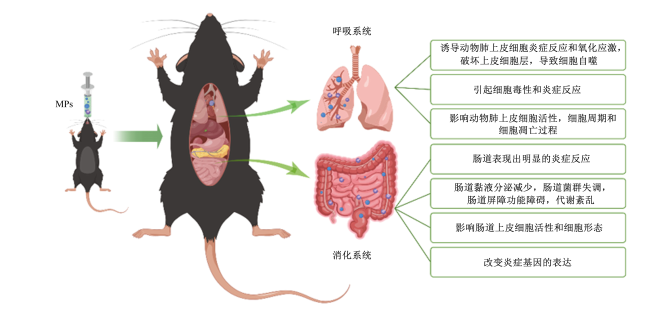
图1 MPs对动物呼吸和消化系统的毒性效应

Fig.1 Toxic effects of MPs on respiratory and digestive systems in animals

动物肠道中共栖着多种微生物包括细菌、古细菌、真菌、原生生物和病毒,它们彼此之间以及与宿主细胞之间存在相互作用,构成一个相对稳定的生态系统[62]。肠道菌群能够依赖这个系统在调节宿主代谢和维持机体健康方面发挥着至关重要的作用[63]。已有研究证明,肠道菌群紊乱能够直接影响宿主的健康状况[64]。MPs经口暴露后,首先影响动物消化系统,主要表现为肠道中有害菌的相对丰度提高,引起肠道微生态失调,能量代谢紊乱,肠黏膜屏障功能障碍,肠道通透性增加,使得有害菌代谢产物和纳米级的MPs会透过肠道屏障进入血液循环系统,进一步对其他组织和器官造成损伤[54,65]。就水生动物而言,MPs在鱼类肠道中不断富集,引起肠道菌群结构失衡,从而影响鱼类对营养物质的吸收和能量代谢[66-67]。已有研究表明,MPs会引起斑马鱼肠道菌群紊乱从而引起肠道炎症,影响其正常生长发育[68]。MPs同样会影响哺乳动物肠道菌群结构,有研究发现小鼠消化道在经过较高浓度MPs暴露后,盲肠中的厚壁菌门(Firmicutes)和变形菌门(Proteobacteria)的相对丰度显著降低[54]。厚壁菌门相对丰度降低可能会为病原菌创造一个有利的定植环境,进一步增加动物肠道感染疾病的风险;此外,厚壁菌门还能够影响机体对能量物质,尤其是短链脂肪酸(short-chain fatty acids,SCFAs)的吸收和代谢,并通过反馈机制提高机体能量代谢相关激素的含量导致动物采食量增加,从而造成饲料资源浪费[69-71]。但哺乳动物MPs消化道暴露通过影响肠道菌群引起能量代谢紊乱的机制还需要进一步探究。

2.2 MPs呼吸道暴露以及毒性效应和机制

肺脏是动物直接暴露于空气环境中的组织器官,因此很容易受到空气污染物的直接刺激引起病理损伤[72]。大气沉降是呼吸道MPs暴露的主要来源。空气中的MPs可经由纺织产品、农业土壤、轮胎磨损和海洋环境等多种途径释放到大气中[42,73]。空气具有很强的流动性,MPs可随空气迁移和传输,能够到达人类生产活动的各个区域,严重危害动物以及人类健康。
世界卫生组织(World Health Organization,WHO)将长度大于5 μm、直径小于3 μm的MPs定义为可通过呼吸道进入肺部组织的颗粒或纤维[74]。呼吸道暴露的MPs主要来自于城市环境中的大气沉降物,动物每天通过呼吸系统摄入MPs的量可能远超消化系统,因此肺部可能成为MPs污染最严重的部位。人体模型空气采样结果表明,1名成年男性在轻度活动状态下每天至少吸入272个MPs颗粒或纤维[75-76]。MPs的大小和密度是影响其在呼吸系统富集的主要因素,普遍认为较小密度和粒径的MPs能够到达肺部组织深处,进一步导致更加严重的毒性反应[73]。但是较长粒径的塑料纤维也会通过一定的角度偶然进入到肺部组织深处,如Pauly等[77]曾在人体肺组织中发现了长度为250 μm的塑料纤维。在肺内富集的MPs能够穿过较薄的肺内衬液与上皮细胞接触,然后通过扩散转位或细胞摄入等方式继续迁移进入其他组织,对动物造成更为严重的毒性反应[55]。因此,探究MPs通过呼吸道暴露对动物产生的毒性效应和机制尤为重要。
关于动物MPs呼吸道暴露的相关研究非常有限。目前的研究主要集中在通过体外细胞系暴露探究MPs的毒理效应机制。Brown等[78]研究表明,64 nm粒径的MPs(2 mg/mL)能够诱导大鼠肺噬中性粒细胞内流进而导致炎症反应。在体外细胞系MPs暴露的研究结果显示,MPs粒径越小其毒性效应越明显,60 μm的PS可诱导人肺上皮细胞BEAS-2B氧化应激和炎症反应,但60 nm的PS能够诱导小鼠单核巨噬细胞RAW 264结构改变,导致细胞坏死[79-80]。Lim等[81]研究发现,相同粒径的MPs在不同浓度时的细胞毒性不同,60 nm的PS在高浓度(50 mg/mL)时对人肺上皮细胞BEAS-2B表现出明显的毒性作用,但在低浓度(10 mg/mL)时只能诱导细胞代谢变化和内质网应激反应。人非小细胞肺癌细胞A549分别暴露25和70 nm的PS后,2种粒径的PS都能明显抑制细胞活性,上调部分促炎细胞因子和核因子-κB(nuclear factor kappa B,NF-κB)的表达量[82];除了MPs颗粒以外,空气中悬浮的增塑剂也能够随吸入的气体直接到达肺部,经由血液循环到达其他脏器从而引起机体损伤[83]。MPs消化道和呼吸道暴露的毒性效应和机制见表2[56,78-79,84-87]
表2 MPs消化道和呼吸道暴露的毒性效应和机制

Table 2 Toxic effects and mechanisms of digestive tract and respiratory tract exposure to MPs

受试对象
Test
subjects
暴露途径
Exposure
pathways
材质与尺寸
Material
and size
剂量与暴露时间
Dose and
exposure time
毒性效应
Toxic effects
参考文献
References
小鼠 Mice 消化道 PS、PE(0.5~
1.0 μm)
2 mg/L
(90 d)
MPs暴露导致小鼠产生了氧化应激、神经
损伤和代谢紊乱等毒性反应
[84]
雏鸡 Chicken 消化道 PS(5 μm) 1~100 mg/L
(42 d)
MPs暴露造成鸡肠道黏膜屏障损伤、肠道菌
群紊乱和脂多糖积累,从而引起肝脏免
疫损伤,促进肝脏脂质代谢紊乱和细胞凋亡
[56]
小鼠 Mice 消化道 PS(100 nm) 10 mg/mL
(28 d)
纳米塑料(NPs)暴露在小鼠脾脏、肺部、
肾脏、小肠及大肠等组织中累积,并
诱发血液系统损伤和脂质代谢紊乱
[85]
河蚬
Corbicula
fluminea
消化道 PS(100 nm~
5 mm)
0.1~
1.0 mg/L
MPs和NPs都可以诱导河蚬产生炎症反应,
导致肠道上皮损伤,同时显著改变肠道微生物
群落结构。与MPs不同,NPs对肠道菌群的
影响较小,但对肠黏膜屏障的损伤更为严重
[86]
SD大鼠和人非小细胞肺癌细胞A549
SD rats and human non-small cell lung cancer cells A549
呼吸道 PS(64、202
和535 nm)
0~1 mg
(24 h)
更小粒径的MPs将导致更严重的炎症
损伤;64 nm PS处理人非小细胞肺癌细胞
A549后,炎性因子IL-8基因表达量
显著高于其他2组
[78]
人正常肺上皮细胞BEAS-2B Human normal lung epithelial cells BEAS-2B PS(4 μm) 1~1 000 μg/mL
(48 h)
诱导细胞产生氧化应激和炎症反应,
导致细胞上皮层破裂
[79]
人非小细胞肺癌细胞A549
Human non-small
cell lung cancer
cells A549
PS(40~
50 nm)
25 μg/mL
(0~4 h)
PS进入人非小细胞肺癌细胞A549后
富集在溶酶体内造成不可逆毒性反应;
细胞内MPs的浓度随着孵育
时间的延长而升高
[87]
此外,除了体积较小的MPs能够通过呼吸进入肺脏以外,还有部分增塑剂也能够到达肺脏引起机体损伤。有研究表明,邻苯二甲酸二异壬酯(diisononyl phthalate,DINP;20和200 mg/kg)可经呼吸道或消化道暴露,经血液循环途径到达动物肺脏造成器官损伤,小鼠肺组织随染毒剂量的增加,肺组织匀浆活性氧、丙二醛含量和肺组织细胞DNA-蛋白质交联(DNA-protein cross links,DPCs)系数上升,谷胱甘肽含量逐渐降低,小鼠肺细胞的病理损伤逐渐加重[88]
张也等[89]在小鼠上的研究也得到相似的结论。除了DINP,邻苯二甲酸二酯(diethylhexyl phthalate,DEHP)也会引起机体的炎症反应。Zhou等[90]研究发现,DEHP暴露后会导致大鼠脂肪组织巨噬细胞浸润增多,同时提高白细胞介素-1β(IL-1β)和TNF-α的含量。Zhang等[91]用不同浓度的DEHP灌胃染毒高脂大鼠,结果发现高剂量组大鼠肝脏TNF-α表达水平显著提高,由此推断过量的脂肪酸氧化可能会进一步加重炎症反应。DEHP由于其化学性质稳定,在水中也能够诱导鲤鱼中性粒细胞IL-1β和白细胞介素-10(IL-10)表达上调,其可能通过影响宿主炎性细胞因子的表达水平从而导致鲤鱼的免疫抑制[92]。此外,维生素E能够降低DEHP对小鼠肺组织造成的病理损伤,这可能是维生素E通过拮抗氧化应激反应实现的[93]。这说明MPs中的PAEs诱导小鼠产生毒理反应和相关疾病的机制可能与氧化应激有关,氧化应激能够对蛋白质和核酸等生物大分子造成损伤,从而诱导细胞凋亡或炎症反应,导致肺部组织表现出各种病理学改变,直接或间接危害动物健康[73]

3 小结

MPs具有数量多、分布广以及难降解等特点,在环境中日渐积累,严重威胁人类和动物健康。现有研究结果表明,MPs对动物的毒理机制主要包括氧化应激、炎症反应、免疫损伤以及肠道菌群失调等,不同毒理机制之间是否存在相互作用还需进一步探究。国内外针对MPs的相关毒理学的研究仍相对匮乏,特别是对长期处在养殖环境中存在较高MPs暴露风险的动物(如蛋鸡、奶牛和肉牛等)造成的不良影响,目前尚未有成熟的研究方法。今后,关于MPs对动物毒性作用的研究过程应从以下几个方面考虑:1)注重环境中MPs本底浓度的检测,研究过程中应选择与环境本底值一致的MPs类型、粒径和浓度,进一步关注MPs进入机体后因其自身物理特性改变导致的毒性效应变化;2)注重MPs种类的多样性,需要探究不同来源、化学成分、增塑剂类型、形状和粒径的MPs对动物的影响;3)注重受试物种的多样性,目前关于MPs毒性的研究仅限于水生生物或小鼠等模式动物,集约化养殖过程中长期暴露在较高浓度MPs中的畜禽是否由于MPs的影响导致健康问题需要进一步探究。
[1]
CHAE Y, AN Y J. Current research trends on plastic pollution and ecological impacts on the soil ecosystem:a review[J]. Environmental Pollution, 2018, 240:387-395.

DOI

[2]
GEYER R, JAMBECK J R, LAW K L. Production,use,and fate of all plastics ever made[J]. Science Advances, 2017, 3(7):e1700782.

DOI

[3]
Plastics Europe. An analysis of European plastics production,demand and waste data[R]. Brussels: Plastics Europe, 2019.

[4]
徐湘博, 孙明星, 张林秀, 等. 土壤微塑料污染研究进展与展望[J]. 农业资源与环境学报, 2021, 38(1):1-9.

XU X B, SUN M X, ZHANG L X, et al. Research progress and prospect of soil microplastic pollution[J]. Journal of Agricultural Resources and Environment, 2021, 38(1):1-9. (in Chinese)

[5]
ARTHUR C, BAKER J E, BAMFORD H A. Proceedings of the international research workshop on the occurrence,effects,and fate of microplastic marine debris[C]. Tacoma:NOAA, 2009.

[6]
BARNES D K A, GALGANI F, THOMPSON R C, et al. Accumulation and fragmentation of plastic debris in global environments[J]. Philosophical Transactions of the Royal Society B:Biological Sciences, 2009, 364(1526):1985-1998.

DOI

[7]
SHARMA S, CHATTERJEE S. Microplastic pollution,a threat to marine ecosystem and human health:a short review[J]. Environmental Science and Pollution Research, 2017, 24(27):21530-21547.

DOI

[8]
COLE M, LINDEQUE P N, HALSBAND C, et al. Microplastics as contaminants in the marine environment:a review[J]. Marine Pollution Bulletin, 2011, 62(12):2588-2597.

DOI

[9]
WAGNER M, SCHERER C, ALVAREZ-MUÑOZ D, et al. Microplastics in freshwater ecosystems:what we know and what we need to know[J]. Environmental Sciences Europe, 2014, 26(1):12.

DOI

[10]
屈沙沙, 朱会卷, 刘锋平, 等. 微塑料吸附行为及对生物影响的研究进展[J]. 环境卫生学杂志, 2017, 7(1):75-78.

QU S S, ZHU H J, LIU F P, et al. Adsorption behavior and effect on biont of microplastic[J]. Journal of Environmental Hygiene, 2017, 7(1):75-78. (in Chinese)

[11]
NIZZETTO L, FUTTER M, LANGAAS S. Are agricultural soils dumps for microplastics of urban origin?[J]. Environmental Science&Technology, 2016, 50(20):10777-10779.

[12]
KOELMANS A A, MOHAMED NOR N H, HERMSEN E, et al. Microplastics in freshwaters and drinking water:critical review and assessment of data quality[J]. Water Research, 2019, 155:410-422.

DOI

[13]
DENG Y F, ZHANG Y, LEMOS B, et al. Tissue accumulation of microplastics in mice and biomarker responses suggest widespread health risks of exposure[J]. Scientific Reports, 2017, 7:46687.

DOI PMID

[14]
CAPOLUPO M, SØRENSEN L, JAYASENA K D R, et al. Chemical composition and ecotoxicity of plastic and car tire rubber leachates to aquatic organisms[J]. Water Research, 2020, 169:115270.

DOI

[15]
WARDROP P, SHIMETA J, NUGEGODA D, et al. Chemical pollutants sorbed to ingested microbeads from personal care products accumulate in fish[J]. Environmental Science & Technology, 2016, 50(7):4037-4044.

DOI

[16]
陈雅兰, 孙可, 高博. 微塑料吸附机制研究进展[J]. 环境化学, 2021, 40(8):2271-2287.

CHEN Y L, SUN K, GAO B. Sorption behavior,mechanisms,and models of organic pollutants and metals on microplastics:a review[J]. Environmental Chemistry, 2021, 40(8):2271-2287. (in Chinese)

[17]
ZHANG N, LI Y B, HE H R, et al. You are what you eat:microplastics in the feces of young men living in Beijing[J]. Science of the Total Environment, 2021, 767:144345.

DOI

[18]
LUO T, ZHANG Y, WANG C Y, et al. Maternal exposure to different sizes of polystyrene microplastics during gestation causes metabolic disorders in their offspring[J]. Environmental Pollution, 2019, 255(Part 1):113122.

DOI

[19]
AL-OTOUM F, AL-GHOUTI M A, COSTA O S,Jr, et al. Impact of temperature and storage time on the migration of antimony from polyethylene terephthalate (PET) containers into bottled water in Qatar[J]. Environmental Monitoring and Assessment, 2017, 189(12):631.

DOI

[20]
ADENIRAN A A, SHAKANTU W. The health and environmental impact of plastic waste disposal in South African townships:a review[J]. International Journal of Environmental Research and Public Health, 2022, 19(2):779.

DOI

[21]
LESTARI F, HAYES A J, GREEN A R, et al. In vitro cytotoxicity and morphological assessment of smoke from polymer combustion in human lung derived cells (A549)[J]. International Journal of Hygiene and Environmental Health, 2012, 215(3):320-332.

DOI

[22]
ATIS S, TUTLUOGLU B, LEVENT E, et al. The respiratory effects of occupational polypropylene flock exposure[J]. European Respiratory Journal, 2005, 25(1):110-117.

PMID

[23]
DOROUDIANI S, OMIDIAN H. Environmental,health and safety concerns of decorative mouldings made of expanded polystyrene in buildings[J]. Building and Environment, 2010, 45(3):647-654.

DOI

[24]
郝爱红, 赵保卫, 张建, 等. 土壤中微塑料污染现状及其生态风险研究进展[J]. 环境化学, 2021, 40(4):1100-1111.

HAO A H, ZHAO B W, ZHANG J, et al. Research progress on pollution status and ecological risk of microplastics in soil[J]. Environmental Chemistry, 2021, 40(4):1100-1111. (in Chinese)

[25]
韩丽花, 李巧玲, 徐笠, 等. 大辽河流域土壤中微塑料的丰度与分布研究[J]. 生态毒理学报, 2020, 15(1):174-185.

HAN L H, LI Q L, XU L, et al. Abundance and distribution of microplastics of soils in Daliao river basin[J]. Asian Journal of Ecotoxicology, 2020, 15(1):174-185. (in Chinese)

[26]
路珍珍. 奶牛散户养殖场塑料器具使用情况调查及塑化剂DEHP对雌性动物繁殖力不良影响的初步探究[D].硕士学位论文. 杨凌: 西北农林科技大学, 2019.

LU Z Z. Investigation on the use of plastic utensils in retail dairy farms and preliminary study on the adverse effects of plasticizer DEHP on female animal fecundity[D].Master’s Thesis. Yangling: Northwest A&F University, 2019. (in Chinese)

[27]
董姝楠, 夏继红, 王为木, 等. 土壤-地下水中微塑料迁移的影响因素及机制研究进展[J]. 农业工程学报, 2020, 36(14):1-8.

DONG S N, XIA J H, WANG W M, et al. Review on impact factors and mechanisms of microplastic transport in soil and groundwater[J]. Transactions of the Chinese Society of Agricultural Engineering, 2020, 36(14):1-8. (in Chinese)

[28]
李小伟, 纪艳艳, 梅庆庆, 等. 污水处理厂污水和污泥中微塑料的研究展望[J]. 净水技术, 2019, 38(7):13-22,84.

LI X W, JI Y Y, MEI Q Q, et al. Review of microplastics in wastewater and sludge of wastewater treatment plant[J]. Water Purification Technology, 2019, 38(7):13-22,84. (in Chinese)

[29]
BLÄSING M, AMELUNG W. Plastics in soil:analytical methods and possible sources[J]. Science of the Total Environment, 2018, 612:422-435.

DOI

[30]
杨帆, 李荣, 崔勇, 等. 我国有机肥料资源利用现状与发展建议[J]. 中国土壤与肥料, 2010(4):77-82.

YANG F, LI R, CUI Y, et al. Utilization and develop strategy of organic fertilizer resources in China[J]. Soils and Fertilizers Sciences in China, 2010(4):77-82. (in Chinese)

[31]
骆永明, 周倩, 章海波, 等. 重视土壤中微塑料污染研究防范生态与食物链风险[J]. 中国科学院院刊, 2018, 33(10):1021-1030.

LUO Y M, ZHOU Q, ZHANG H B, et al. Pay attention to research on microplastic pollution in soil for prevention of ecological and food chain risks[J]. Bulletin of the Chinese Academy of Sciences, 2018, 33(10):1021-1030. (in Chinese)

[32]
ZHAO Q, MA C X, WHITE J C, et al. Quantitative evaluation of multi-wall carbon nanotube uptake by terrestrial plants[J]. Carbon, 2017, 114:661-670.

DOI

[33]
CHANG X, FANG Y, WANG Y, et al. Microplastic pollution in soils,plants,and animals:a review of distributions,effects and potential mechanisms[J]. Science of the Total Environment, 2022, 850:157857.

DOI

[34]
HAQUE F, FAN C. Prospect of microplastic pollution control under the “New normal” concept beyond COVID-19 pandemic[J]. Journal of Cleaner Production, 2022, 367:133027.

DOI

[35]
XU E G, REN Z J. Preventing masks from becoming the next plastic problem[J]. Frontiers of Environmental Science&Engineering, 2021, 15(6):125.

[36]
HE P J, CHEN L Y, SHAO L M, et al. Municipal solid waste (MSW) landfill:a source of microplastics?-Evidence of microplastics in landfill leachate[J]. Water Research, 2019, 159:38-45.

DOI

[37]
KOLE P J, LÖHR A J, VAN BELLEGHEM F G A J, et al. Wear and tear of tyres:a stealthy source of microplastics in the environment[J]. International Journal of Environmental Research and Public Health, 2017, 14(10):1265.

DOI

[38]
BERGMANN M, MÜTZEL S, PRIMPKE S, et al. White and wonderful?Microplastics prevail in snow from the Alps to the Arctic[J]. Science Advances, 2019, 5(8):eaax1157.

DOI

[39]
秦潇, 周颖, 黄艺. 微塑料的人群暴露途径及其健康危害[J]. 生态毒理学报, 2021, 16(5):221-227.

QIN X, ZHOU Y, HUANG Y. A review of population exposure routes of microplastics and their possible health hazards[J]. Asian Journal of Ecotoxicology, 2021, 16(5):221-227. (in Chinese)

[40]
王英雪, 徐熳, 王立新, 等. 微塑料在哺乳动物的暴露途径、毒性效应和毒性机制浅述[J]. 环境化学, 2021, 40(1):41-54.

WANG Y X, XU M, WANG L X, et al. The exposure routes,organ damage and related mechanism of the microplastics on the mammal[J]. Environmental Chemistry, 2021, 40(1):41-54. (in Chinese)

[41]
慕春龙, 李轩, 吴海琴, 等. 微生物群系与动物消化道营养[J/OL]. 中国科学(生命科学):1-11[2023-03-01]. http://kns.cnki.net/kcms/detail/11.5840.q.20220708.1641.002.html.

MU C L, LI X, WU H Q, et al. Gut microbiome and gastrointestinal nutrition in animals[J/OL]. Scientia Sinica(Vitae):1-11[2023-03-01]. http://kns.cnki.net/kcms/detail/11.5840.q.20220708.1641.002.html. (in Chinese)

[42]
PRATA J C, DA COSTA J P, LOPES I, et al. Environmental exposure to microplastics:an overview on possible human health effects[J]. Science of the Total Environment, 2020, 702:134455.

DOI

[43]
WELDEN N A, ABYLKHANI B, HOWARTH L M. The effects of trophic transfer and environmental factors on microplastic uptake by plaice,Pleuronectes plastessa,and spider crab,Maja squinado[J].Environmental Pollution, 2018, 239:351-358.

[44]
NELMS S E, GALLOWAY T S, GODLEY B J, et al. Investigating microplastic trophic transfer in Marine top predators[J]. Environmental Pollution, 2018, 238:999-1007.

DOI PMID

[45]
BELLAS J, MARTÍNEZ-ARMENTAL J, MARTÍNEZ-CÁMARA A, et al. Ingestion of microplastics by demersal fish from the Spanish Atlantic and Mediterranean coasts[J]. Marine Pollution Bulletin, 2016, 109(1):55-60.

DOI PMID

[46]
BOLTON T F, HAVENHAND J N. Physiological versus viscosity-induced effects of an acute reduction in water temperature on microsphere ingestion by trochophore larvae of the serpulid polychaete Galeolaria caespitosa[J]. Journal of Plankton Research, 1998, 20(11):2153-2164.

DOI

[47]
RIOS L M, MOORE C, JONES P R. Persistent organic pollutants carried by synthetic polymers in the ocean environment[J]. Marine Pollution Bulletin, 2007, 54(8):1230-1237.

PMID

[48]
VON MOOS N, BURKHARDT-HOLM P, KÖHLER A. Uptake and effects of microplastics on cells and tissue of the blue mussel Mytilus edulis L. after an experimental exposure[J]. Environmental Science&Technology, 2012, 46(20):11327-11335.

[49]
BROWNE M A, DISSANAYAKE A, GALLOWAY T S, et al. Ingested microscopic plastic translocates to the circulatory system of the mussel,Mytilus edulis (L.)[J]. Environmental Science&Technology, 2008, 42(13):5026-5031.

[50]
GARRETT N L, LALATSA A, UCHEGBU I, et al. Exploring uptake mechanisms of oral nanomedicines using multimodal nonlinear optical microscopy[J]. Journal of Biophotonics, 2012, 5(5/6):458-468.

DOI

[51]
JIN Y A, LU L, TU W Q, et al. Impacts of polystyrene microplastic on the gut barrier,microbiota and metabolism of mice[J]. Science of the Total Environment, 2019, 649:308-317.

DOI

[52]
WAHLSTRÖM A, SAYIN S I, MARSCHALL H U, et al. Intestinal crosstalk between bile acids and microbiota and its impact on host metabolism[J]. Cell Metabolism, 2016, 24(1):41-50.

DOI PMID

[53]
WEISS M, BYRNE A J, BLAZEK K, et al. IRF5 controls both acute and chronic inflammation[J]. Proceedings of the National Academy of Sciences, 2015, 112(35):11001-11006.

DOI

[54]
LI B Q, DING Y F, CHENG X, et al. Polyethylene microplastics affect the distribution of gut microbiota and inflammation development in mice[J]. Chemosphere, 2020, 244:125492.

DOI

[55]
张思梦, 查金, 孟伟, 等. 环境中的微塑料及其对人体健康的影响[J]. 中国塑料, 2019, 33(4):81-88.

ZHANG S M, ZHA J, MENG W, et al. A review of microplastics in environment and their effects on human health[J]. China Plastics, 2019, 33(4):81-88. (in Chinese)

[56]
CHEN J H, CHEN G H, PENG H Q, et al. Microplastic exposure induces muscle growth but reduces meat quality and muscle physiological function in chickens[J]. Science of the Total Environment, 2023, 882:163305.

DOI

[57]
YIN K, WANG D X, ZHANG Y, et al. Dose-effect of polystyrene microplastics on digestive toxicity in chickens (Gallus gallus):multi-omics reveals critical role of gut-liver axis[J/OL]. Journal of Advanced Research, 2022:1-16[2023-02-20]. https://doi.org/10.1016/j.jare.2022.10.015.

[58]
VOLKHEIMER G. Hematogenous dissemination of ingested polyvinyl chloride particles[J]. Annals of the New York Academy of Sciences, 1975, 246:164-171.

PMID

[59]
ANSELMO A C, GUPTA V, ZERN B J, et al. Delivering nanoparticles to lungs while avoiding liver and spleen through adsorption on red blood cells[J]. ACS Nano, 2013, 7(12):11129-11137.

DOI PMID

[60]
CHAMBERS E, MITRAGOTRI S. Prolonged circulation of large polymeric nanoparticles by non-covalent adsorption on erythrocytes[J]. Journal of Controlled Release, 2004, 100(1):111-119.

PMID

[61]
JU P, ZHANG Y, DING J F, et al. New insights into the toxic interactions of polyvinyl chloride microplastics with bovine serum albumin[J]. Environmental Science and Pollution Research, 2021, 28(5):5520-5531.

DOI

[62]
SENDER R, FUCHS S, MILO R. Revised estimates for the number of human and bacteria cells in the body[J]. PLOS Biology, 2016, 14(8):e1002533.

DOI

[63]
JIN M C, QIAN Z Y, YIN J Y, et al. The role of intestinal microbiota in cardiovascular disease[J]. Journal of Cellular and Molecular Medicine, 2019, 23(4):2343-2350.

DOI PMID

[64]
ZENG S L, LI S Z, XIAO P T, et al. Citrus polymethoxyflavones attenuate metabolic syndrome by regulating gut microbiome and amino acid metabolism[J]. Science Advances, 2020, 6(1):eaax6208.

DOI

[65]
QIAO R X, DENG Y F, ZHANG S H, et al. Accumulation of different shapes of microplastics initiates intestinal injury and gut microbiota dysbiosis in the gut of zebrafish[J]. Chemosphere, 2019, 236:124334.

DOI

[66]
JIN Y X, XIA J Z, PAN Z H, et al. Polystyrene microplastics induce microbiota dysbiosis and inflammation in the gut of adult zebrafish[J]. Environmental Pollution, 2018, 235:322-329.

DOI PMID

[67]
EVARISTE L, BARRET M, MOTTIER A, et al. Gut microbiota of aquatic organisms:a key endpoint for ecotoxicological studies[J]. Environmental Pollution, 2019, 248:989-999.

DOI

[68]
LU L, LUO T, ZHAO Y, et al. Interaction between microplastics and microorganism as well as gut microbiota:a consideration on environmental animal and human health[J]. Science of the Total Environment, 2019, 667:94-100.

DOI

[69]
MOLIST F, MANZANILLA E G, PÉREZ J F, et al. Coarse,but not finely ground,dietary fibre increases intestinal Firmicutes:Bacteroidetes ratio and reduces diarrhoea induced by experimental infection in piglets[J]. British Journal of Nutrition, 2012, 108(1):9-15.

DOI

[70]
MORENO J. Prevotella copri and the microbial pathogenesis of rheumatoid arthritis[J]. Reumatología Clínica, 2015, 11(2):61-63.

DOI

[71]
EVERARD A, CANI P D. Gut microbiota and GLP-1[J]. Reviews in Endocrine and Metabolic Disorders, 2014, 15(3):189-196.

DOI

[72]
MA P, YAN B, ZENG Q, et al. Oral exposure of Kunming mice to diisononyl phthalate induces hepatic and renal tissue injury through the accumulation of ROS. protective effect of melatonin[J]. Food and Chemical Toxicology, 2014, 68:247-256.

DOI PMID

[73]
张群. 人居环境空气沉降中微塑料污染特征研究[D].博士学位论文. 上海: 华东师范大学, 2022.

ZHANG Q. Characteristics of microplastics in atmospheric fallout of human settlements[D].Ph.D.Thesis Shanghai: East China Normal University, 2022. (in Chinese)

[74]
GASPERI J, WRIGHT S L, DRIS R, et al. Microplastics in air:are we breathing it in?[J]. Current Opinion in Environmental Science & Health, 2018, 1:1-5.

[75]
RIST S, CARNEY ALMROTH B, HARTMANN N B, et al. A critical perspective on early communications concerning human health aspects of microplastics[J]. Science of the Total Environment, 2018, 626:720-726.

DOI

[76]
VIANELLO A, JENSEN R L, LIU L, et al. Simulating human exposure to indoor airborne microplastics using a breathing thermal manikin[J]. Scientific Reports, 2019, 9:8670.

DOI PMID

[77]
PAULY J L, STEGMEIER S J, ALLAART H A, et al. Inhaled cellulosic and plastic fibers found in human lung tissue[J]. Cancer Epidemiology,Biomarkers&Prevention, 1998, 7(5):419-428.

[78]
BROWN D M, WILSON M R, MACNEE W, et al. Size-dependent proinflammatory effects of ultrafine polystyrene particles:a role for surface area and oxidative stress in the enhanced activity of ultrafines[J]. Toxicology and Applied Pharmacology, 2001, 175(3):191-199.

DOI

[79]
DONG C D, CHEN C W, CHEN Y C, et al. Polystyrene microplastic particles:in vitro pulmonary toxicity assessment[J]. Journal of Hazardous Materials, 2020, 385:121575.

DOI

[80]
XIA T, KOVOCHICH M, LIONG M, et al. Cationic polystyrene nanosphere toxicity depends on cell-specific endocytic and mitochondrial injury pathways[J]. ACS Nano, 2008, 2(1):85-96.

DOI PMID

[81]
LIM S L, NG C T, ZOU L, et al. Targeted metabolomics reveals differential biological effects of nanoplastics and nano ZnO in human lung cells[J]. Nanotoxicology, 2019, 13(8):1117-1132.

DOI

[82]
XU M K, HALIMU G, ZHANG Q R, et al. Internalization and toxicity:a preliminary study of effects of nanoplastic particles on human lung epithelial cell[J]. Science of the Total Environment, 2019, 694:133794.

DOI

[83]
王心如. 毒理学基础[M]. 6版. 北京: 人民卫生出版社, 2012:391-413.

WANG X R. Fundamentals of toxicology[M]. 6th ed. Beijing: People’s Medical Publishing House, 2012:391-413. (in Chinese)

[84]
DENG Y F, ZHANG Y, QIAO R X, et al. Evidence that microplastics aggravate the toxicity of organophosphorus flame retardants in mice (Mus musculus)[J]. Journal of Hazardous Materials, 2018, 357:348-354.

DOI PMID

[85]
XU D H, MA Y H, HAN X D, et al. Systematic toxicity evaluation of polystyrene nanoplastics on mice and molecular mechanism investigation about their internalization into Caco-2 cells[J]. Journal of Hazardous Materials, 2021, 417:126092.

DOI

[86]
LI Z L, FENG C H, PANG W, et al. Nanoplastic-induced genotoxicity and intestinal damage in freshwater benthic clams (Corbicula fluminea):comparison with microplastics[J]. ACS Nano, 2021, 15(6):9469-9481.

DOI

[87]
SALVATI A, ÅBERG C, DOS SANTOS T, et al. Experimental and theoretical comparison of intracellular import of polymeric nanoparticles and small molecules:toward models of uptake kinetics[J]. Nanomedicine:Nanotechnology,Biology,and Medicine, 2011, 7(6):818-826.

DOI

[88]
马萍, 李金泉, 晏彪, 等. 增塑剂邻苯二甲酸二异壬酯致小鼠肺细胞氧化损伤作用的研究[J]. 生态毒理学报, 2016, 11(2):702-707.

MA P, LI J Q, YAN B, et al. Study on oxidative damage of mouse lung cells induced by plasticizers diisononyl phthalate[J]. Asian Journal of Ecotoxicology, 2016, 11(2):702-707. (in Chinese)

[89]
张也, 李崇尧, 刘蕾, 等. 增塑剂邻苯二甲酸二异癸酯致小鼠肺组织氧化损伤作用[J]. 生态毒理学报, 2018, 13(6):242-249.

ZHANG Y, LI C Y, LIU L, et al. Oxidative damages induced by plasticizer diisodecyl phthalate in lung tissue of mice[J]. Asian Journal of Ecotoxicology, 2018, 13(6):242-249. (in Chinese)

[90]
ZHOU L T, CHEN H J, XU Q, et al. The effect of di-2-ethylhexyl phthalate on inflammation and lipid metabolic disorder in rats[J]. Ecotoxicology and Environmental Safety, 2019, 170:391-398.

DOI PMID

[91]
ZHANG Y X, GE S S, YANG Z H, et al. Disturbance of di-(2-ethylhexyl) phthalate in hepatic lipid metabolism in rats fed with high fat diet[J]. Food and Chemical Toxicology, 2020, 146:111848.

DOI PMID

[92]
WANG S T, CAO Y R, WANG S C, et al. DEHP induces immunosuppression through disturbing inflammatory factors and CYPs system homeostasis in common carp neutrophils[J]. Fish&Shellfish Immunology, 2020, 96:26-31.

[93]
王超云, 张娟娟, 段鹏. 维生素E对邻苯二甲酸二异辛酯致雄性大鼠生殖毒性的拮抗作用[J]. 中华男科学杂志, 2018, 24(7):589-595.

WANG C Y, ZHANG J J, DUAN P. Antagonistic effect of vitamin E on di-2-ethylhexyl phthalate-induced reproductive toxicity in male rats[J]. National Journal of Andrology, 2018, 24(7):589-595. (in Chinese)

文章导航

/