研究论文

不同品种肉牛肌内脂肪沉积相关基因比较研究

  • 施安 , 1 ,
  • 孙文阳 1 ,
  • 陈志龙 2 ,
  • 李博 3 ,
  • 侯鹏霞 , 1, * ,
  • 梁小军 , 1, *
展开
  • 1 宁夏农林科学院动物科学研究所,银川 750002
  • 2 宁夏农林科学院固原分院,固原 756099
  • 3 西北农林科技大学动物科技学院,杨凌 712100
* 侯鹏霞,助理研究员,E-mail: ;
梁小军,研究员,E-mail:

施安(1988—),男,宁夏银川人,助理研究员,博士,从事动物遗传育种研究。E-mail:

Copy editor: 田艳明

收稿日期: 2023-04-04

  网络出版日期: 2023-09-13

基金资助

宁夏农业科技自主创新项目(NGSB-2021-12-02)

国家重点研发计划(2021YFD1100508)

宁夏优秀人才支持计划

Comparative Study on Genes Related to Intramuscular Fat Deposition in Different Breeds of Beef Cattle

  • SHI An , 1 ,
  • SUN Wenyang 1 ,
  • CHEN Zhilong 2 ,
  • LI Bo 3 ,
  • HOU Pengxia , 1, * ,
  • LIANG Xiaojun , 1, *
Expand
  • 1 Institute of Animal Science, Ningxia Academy of Agriculture and Forestry Sciences, Yinchuan 750002, China
  • 2 Guyuan Branch, Ningxia Academy of Agriculture and Forestry Sciences, Guyuan 756099, China
  • 3 College of Animal Science and Technology, Northwest A&F University, Yangling 712100, China
* HOU Pengxia, assistant professor, E-mail: ;
LIANG Xiaojun, professor, E-mail:

Received date: 2023-04-04

  Online published: 2023-09-13

摘要

本试验旨在通过分析西门塔尔牛和安格斯牛背最长肌肉质特性及转录组测序表达谱,筛选肌内脂肪沉积相关基因,为其脂肪沉积机制研究提供参考依据。试验选择饲养管理条件一致、体重[(700±10) kg]相近的健康西门塔尔和安格斯公牛各3头,屠宰后采集背最长肌进行肉品质、氨基酸和脂肪酸组成测定及转录组测序。结果表明:1)安格斯牛肌内脂肪含量和系水力极显著高于西门塔尔(P<0.01),而肌纤维直径显著低于西门塔尔牛(P<0.05);安格斯牛肌肉酪氨酸含量极显著高于西门塔尔牛(P<0.01),肌肉精氨酸含量极显著低于西门塔尔牛(P<0.01);2种牛之间肌肉脂肪酸含量无显著差异(P>0.05)。2)转录组测序分析显示,与安格斯牛相比,西门塔尔牛共有1 214个候选基因在肌肉组织中差异表达{校正后的P值(Padj)<0.05及|log2[差异倍数(FC)]|>1},其中上调基因736个,下调基因478个。基因本体(GO)功能富集分析注释到43个条目,其中生物过程20个,细胞组分15个,分子功能8个。京都基因与基因组百科全书(KEGG)通路富集分析显著富集到心肌收缩(cardiac muscle contraction)和逆行内源性大麻素信号(retrograde endocannabinoid signaling)等脂肪沉积相关通路中,结合GeneCards功能查询获得3个与脂肪沉积相关的基因——淀粉样前体蛋白(APP)、原肌球蛋白2(TPM2)和钙电压门控通道亚基α1 S(CACNA1S)。实时荧光定量PCR(RT-qPCR)验证结果与转录组测序结果一致,即安格斯牛肌肉CACNA1STPM2表达量显著高于西门塔尔牛(P<0.05),表明其对脂肪沉积有促进作用;安格斯牛肌肉APP表达量较西门塔尔牛呈降低趋势(P>0.05),表明其对脂肪沉积有负调控作用。综上可知,安格斯牛肌内脂肪沉积能力较强,肉品质较好;转录组测序发现了3个与肉牛肌内脂肪沉积相关的候选基因,为肉牛肌内脂肪沉积调控机制研究提供了参考。

本文引用格式

施安 , 孙文阳 , 陈志龙 , 李博 , 侯鹏霞 , 梁小军 . 不同品种肉牛肌内脂肪沉积相关基因比较研究[J]. 动物营养学报, 2023 , 35(9) : 6013 -6025 . DOI: 10.12418/CJAN2023.552

Abstract

The aim of this experiment was to screen for the genes related to intramuscular fat deposition by analyzing the meat quality characteristics and transcriptome sequencing expression profiles of the longissimus dorsi muscle of Simmental and Angus cattle, and to provide reference for the study of the mechanism of fat deposition. Each three healthy Simmental and Angus cattle with the same feeding and management conditions and similar body weight of (700±10) kg were selected, and the longissimus dorsi muscle was collected after slaughter for the determination of meat quality, amino acid and fatty acid composition and transcriptome sequencing. The results showed as follows: 1) the intramuscular fat content and water binding capacity of Angus cattle were extremely significantly higher than those of Simmental cattle (P<0.01), while the muscle fiber diameter was significantly lower than that of Simmental cattle (P<0.05); the muscle tyrosine content of Angus cattle was extremely significantly higher than that of Simmental cattle (P<0.01), and the muscle arginine content of Angus cattle was extremely significantly lower than that of Simmental cattle (P<0.01); there was no significant difference in muscle fatty acid content between the two breeds (P>0.05). 2) The transcriptome sequencing analysis showed that compared with Angus cattle, a total of 1 214 candidate genes were differential expressed in muscle tissues of Simental cattle {corrected P-value (Padj)<0.05 and |log2[fold change (FC)]|>1}, including 736 up-regulated genes and 478 down-regulated genes. The gene ontology (GO) functional enrichment analysis annotated 43 items, including 20 biological processes, 15 cell components, and 8 molecular functions. The Kyoto encyclopedia of genes and genomes (KEGG) pathway enrichment analysis showed significant enrichment in fat deposition associated pathways such as cardiac muscle contraction and retrograde endocannabinoid signals and so on, and three genes related to fat deposition as amyloid precursor protein (APP), tropomyosin 2 (TPM2), and calcium voltage-gated channel subunit α1 S (CACNA1S) were obtained in combination with GeneCards function query. Real-time fluorescence quantitative PCR (RT-qPCR) verification results were consistent with transcriptome sequencing results, that was, the expression levels of CACNA1S and TPM2 in muscle of Angus cattle were significantly higher than those of Simmental cattle (P<0.05), indicating that both had a promoting effect on fat deposition; the expression level of APP in muscle of Angus cattle was lower than Simmental cattle (P>0.05), indicating that it had a negative regulatory effect on fat deposition. In conclusion, the muscle fat deposition capacity of Angus cattle is stronger and the meat quality is better; transcriptome sequencing identifies three candidate genes related to intramuscular fat deposition in beef cattle, providing a reference for the study of the regulatory mechanism of intramuscular fat deposition in beef cattle.

西门塔尔(Simmental)和安格斯(Angus)是我国具有优势特色和发展潜力的主要肉牛品种。研究发现,安格斯牛肉有呈现低饱和脂肪酸(saturated fatty acid,SFA)、高亚麻酸(C18:3n3)和不饱和脂肪酸(unsaturated fatty acid,UFA)含量的趋势,并且其肌内脂肪(intramuscular fat,IMF)含量较高[1-2]。此外,安格斯牛肉在多汁、嫩度和风味上均优于中国西门塔尔牛肉[3-4],是打造高端牛肉市场上的主推品种。
IMF直接影响牛肉的品质和风味[5-6],其由肌原性干细胞和前脂肪细胞分化转移形成[7],也可以从成纤维细胞样前脂肪细胞到成熟脂肪细胞的多步骤分化形成[8];其中,前脂肪细胞还通过旁分泌因子的细胞间通讯、细胞外基质(extracellular matrix,ECM)和细胞-细胞黏附调节与周围结缔组织的增殖、分化和脂肪生成[9]。前脂肪细胞向成熟脂肪细胞的转化是由一系列转录因子控制的,其中过氧化物酶体增殖物激活受体γ(peroxisome proliferator-activated receptor γ,PPARγ)和CCAAT/增强子结合蛋白α(CCAAT/enhancer binding protein α,C/EBPα)被认为是关键的成脂因子,它们共同发挥多效转录激活因子的作用,包括脂肪酸结合蛋白4(fatty acid binding protein 4,FABP4)、脂蛋白脂肪酶(lipoprotein lipase,LPL)、脂肪酸转位酶(fatty acid translocase,FAT)和产生脂肪细胞表型的周围脂素[10-11]。在PPARγ和C/EBPα诱导之前,还有其他转录因子驱动成脂程序,包括CCAAT/增强子结合蛋白β(CCAAT/enhancer binding protein β,C/EBPβ)、CCAAT/增强子结合蛋白δ(CCAAT/enhancer binding protein δ,C/EBPδ)、Krüpple样转录因子(Krüppel-like factor,KLF)和成纤维细胞生长因子(fibroblast growth factor,FGF)等早期成脂因子[12-13]
转录组测序(transcriptome sequencing,RNA-Seq)可精确获得某一物种在特定条件下所有转录产物的表达状况。利用高通量测序计算mRNA表达量,结合生物信息分析可高效获得性状相关基因的表达模式与功能差异[14-15]。Zheng等[3]对安格斯牛和中国西门塔尔牛的粪便和背最长肌进行多组学分析发现,安格斯牛的肠道微生物多样性明显高于中国西门塔尔牛,中国西门塔尔牛蛋白上调的差异表达基因(differentially expressed genes,DEGs)主要参与免疫和炎症反应,而安格斯牛蛋白上调的DEGs主要参与肌肉系统和肌原纤维的调节,且该研究鉴定出了17个与肌肉和脂肪代谢相关的基因,包括肌肉生长抑制素(myostatin,MSTN)、肌球蛋白轻链磷酸化快肌(myosin light chain, phosphorylatable, fast skeletal muscle,MYLPF)、快速骨骼肌钙蛋白T3(troponin T3, fast skeletal type,TNNT3)和脂肪酸结合蛋白3(FABP3)/FABP4等。Zhang等[16]对云岭牛和中国西门塔尔牛的背肌转录组检测出1 347个DEGs,且被差异调节的主要代谢途径是脂肪分解和糖代谢。Ueda等[17]通过RNA-Seq鉴定出与日本和牛皮下和IMF形成的8个关键基因,包括羧肽酶E(carboxypeptidase E,CPE)、生腱蛋白C(tenascin C,TNC)、转凝蛋白(transgelin,TAGLN)、Ⅳ型胶原α5(collagen type IV α5,COL4A5)、半胱氨酸和甘氨酸富集蛋白2(cysteine and glycine-rich protein 2,CSP2)、PDZ和LIM域3(PDZ and LIM domain 3,PDLIM3)、磷酸酶1调节抑制因子14A亚基(phosphatase 1 regulatory inhibitor subunit 14A,PPP1R14A)和钙调神经磷酸酶调节因子2(regulator of calcineurin 2,RCAN2)。本试验对宁夏地区西门塔尔和安格斯肉牛的背最长肌肉质特性进行了对比研究及RNA-Seq,结合生物信息鉴定出可能影响IMF沉积的DEGs,并对其表达特性进行分析,为阐明肉牛IMF沉积的调控机制和改善肉品质提供一定的理论借鉴。

1 材料与方法

1.1 试验动物和样品采集

选用来自宁夏永宁某养殖场亲缘关系和月龄相近、饲粮结构相同以及饲养管理条件一致的西门塔尔和安格斯公牛各3头,平均体重为(700±10) kg,组间差异不显著(P>0.05)。
试验牛于2022年5月统一屠宰,采集胴体第12根肋骨处背最长肌样品。取500 g样品于4 ℃熟化24 h,用于熟肉率和系水力(参考NY/T 1333—2007方法)、剪切力(参考NY/T 1180—2006方法)以及氨基酸(参考GB 5009.124—2016方法)和脂肪酸(参考GB 5009.168—2016方法)含量的测定;另取500 g样品于-20 ℃保存,用于蛋白质和IMF含量的测定(剔除表面筋膜和脂肪);采集5 g左右样品组织于专用固定液保存,用于肌纤维组织特性的测定[苏木精-伊红(HE)染色];取1 cm3左右样品锡纸包裹投入液氮于-80 ℃保存,用于RNA提取。

1.2 RNA的提取与建库测序

采用TRIzol(Invitrogen,美国)试剂盒从背最长肌样品中提取RNA样本,通过Agilent 2100生物分析仪(Agilent Technologies,美国)检测RNA样本的完整性和纯度。筛选出符合28S rRNA:18S rRNA≥1.0且RNA完整度(RIN)≥7条件的样本,通过Oligo(dt)磁珠吸附法构建mRNA文库,库检合格后,不同文库按照有效浓度及目标上机数据量的需求进行Illumina NovaSeq 6000测序。

1.3 测序数据分析

对测序获取的原始数据筛选过滤后得到高质量数据(clean reads),利用HISAT2 2.0.5软件与牛(Bos taurus)的参考基因组比对(参考基因组版本为USDA ARS-UCD1.2)[18]。采用FeatureCounts 1.5.0统计每个基因的每千个碱基的转录每百万映射读取的片段(fragments per kilobase of transcript per million mapped reads,FPKM),再结合StringTie 1.3.3b对基因进行定量[19]。采用DESeq2 1.20.0软件进行2个肉牛品种之间的差异基因表达分析[20],显著差异表达阈值为校正后的P值(Padj)<0.05及|log2[差异倍数(fold change,FC)]|>1,对DEGs进行主成分分析(PCA),并可视化每个个体的基因表达谱。

1.4 DEGs富集分析

采用clusterProfile 3.8.1 R语言包对DEGs集进行基因本体(gene ontology,GO)功能和京都基因与基因组百科全书(Kyoto encyclopedia of genes and genomes,KEGG)通路富集分析[21],均以Padj<0.05作为显著性富集的阈值,根据DEGs的显著性水平和肌纤维、脂质发育关联注释信息筛选出与IMF沉积相关的主控基因和调控通路。

1.5 实时荧光定量PCR(RT-qPCR)分析

为验证RNA测序数据,采用RT-qPCR检测DEGs。背最长肌组织分离的总RNA样品采用PrimeScriptTM RT试剂盒(TaKaRa,日本)反转录成cDNA,去除基因组DNA。采用SYBR Green试剂盒(QIAGEN,美国)进行RT-qPCR分析。将所选DEGs的表达水平与内参基因β-肌动蛋白(β-actin)进行归一化处理。PCR反应条件为:95 ℃反应10 min,40个循环,95 ℃反应15 s,60 ℃反应60 s。采用2-ΔΔCt法计算DEGs的相对表达量。所有供试基因引物信息见表1
表1 引物信息

Table 1 Primer information

基因
Genes
登录号
Accession No.
引物序列
Primer sequences
(5'—3')
退火温度
Tm/℃
扩增长度
Amplicon
size/bp
淀粉样前体蛋白
APP
NM_001076796.1 F:AGGTGGTCCGAGTTCCTACA
R:ACATCCTCTCACGGTGCTTG
59.89
60.04
141
原肌球蛋白2
TPM2
NM_001010995.2 F:CGAGTACCTGATGTTCGCCC
R:GGAGGCCAGGAAAGTGTCGAT
60.53
62.12
265
钙电压门控通道亚基α1 S
CACNA1S
XM_024976574.1 F:ATGGATCAGGCCCTCAAGTC
R:GTGCATAGACTTCATCTTCCAGG
59.16
58.87
190
β-肌动蛋白
β-actin
NM_173979.3 F:ACCACACCTTCTACAACGAGC
R:GGTCTCGAACATGATCTGGGT
60.27
59.52
119

1.6 数据统计分析

采用SPSS 19.0统计软件中的独立样品t检验进行差异显著性分析,结果用“平均值±标准差”表示,P<0.05为差异显著,P<0.01为差异极显著,P>0.05为差异不显著。

2 结果与分析

2.1 西门塔尔牛和安格斯牛肉品质及肌纤维特性分析

表2可知,安格斯牛IMF含量和系水力极显著高于西门塔尔牛(P<0.01),肌纤维直径显著低于西门塔尔牛(P<0.05);安格斯牛肌肉粗蛋白质含量、熟肉率和肌纤维密度都高于西门塔尔牛,但差异均不显著(P>0.05)。
表2 西门塔尔牛和安格斯牛肉品质及肌纤维特性分析

Table 2 Analysis of meat quality and muscle fiber characteristic of Simmental and Angus cattle

项目
Items
西门塔尔牛
Simmental cattle
安格斯牛
Angus cattle
P
P-value
粗蛋白质 CP/% 22.50±0.35 23.20±1.90 0.327
肌内脂肪 IMF/% 1.37±0.15A 2.33±0.20B <0.001
熟肉率 Cooking yield/% 56.27±2.35 56.97±4.16 0.498
系水力 Water binding capacity/% 22.61±1.33A 37.07±1.60B 0.008
剪切力 Shear force/N 49.20±5.10 43.70±11.79 0.517
肌纤维密度 Muscle fiber density/(束/μm2) 1.50×10⁻⁴±1.28×10⁻⁵ 2.07×10⁻⁴±1.86×10⁻⁵ 0.137
肌纤维直径 Muscle fiber diameter/μm 141.12±0.28b 85.67±0.32a 0.042

同行数据肩标不同大写字母表示差异极显著(P<0.01),不同小写字母表示差异显著(P<0.05),无字母表示差异不显著(P>0.05)。下表同。

In the same row, values with different capital letter superscripts mean extremely significant difference (P<0.01), and with different small superscripts mean significant difference (P<0.05), while with no letter mean no significant difference (P>0.05). The same as below.

2.2 西门塔尔牛和安格斯牛肌肉氨基酸和脂肪酸含量分析

表3可知,试验测定了非必需氨基酸(non essential amino acid,NEAA)和必需氨基酸(essential amino acid,EAA)各8种,2个品种牛肌肉的氨基酸组成成分一致,但含量存在差异。在NEAA中,安格斯牛肌肉酪氨酸含量极显著高于西门塔尔牛(P<0.01),肌肉精氨酸含量极显著低于西门塔尔牛(P<0.01)。在EAA中,2个品种牛肌肉各氨基酸含量差异均不显著(P>0.05)。2个品种牛肌肉NEAA和EAA的总含量差异均不显著(P>0.05),且EAA/TAA值均接近40%(理想值),即2个品种牛肌肉蛋白质含量丰富。
表3 西门塔尔牛和安格斯牛肌肉氨基酸含量分析

Table 3 Analysis of amino acid contents in muscle of Simmental and Angus cattle

项目
Items
西门塔尔牛
Simmental cattle
安格斯牛
Angus cattle
P
P-value
天冬氨酸 Asp 2.09±0.05 1.98±0.17 0.353
丝氨酸 Ser 0.90±0.02 0.85±0.08 0.326
谷氨酸 Glu 3.57±0.05 3.43±0.26 0.413
非必需氨基酸 甘氨酸 Gly 0.95±0.04 0.92±0.07 0.481
NEAA/(g/kg) 丙氨酸 Ala 1.29±0.03 1.25±0.08 0.502
脯氨酸 Pro 0.85±0.02 0.80±0.06 0.262
酪氨酸 Tyr 0.75±0.02A 1.35±0.12B 0.001
精氨酸 Arg 1.41±0.01B 0.74±0.05A <0.001
总含量 Total content 11.81±0.19 11.33±0.87 0.398
缬氨酸 Val 1.10±0.03 1.04±0.07 0.283
苏氨酸 Thr 1.04±0.02 0.98±0.09 0.321
蛋氨酸 Met 0.60±0.03 0.58±0.05 0.534
必需氨基酸 异亮氨酸 Ile 1.05±0.01 1.01±0.08 0.485
EAA/(g/kg) 亮氨酸 Leu 1.81±0.03 1.73±0.14 0.372
苯丙氨酸 Phe 0.92±0.02 0.88±0.06 0.269
赖氨酸 Lye 2.05±0.04 1.96±0.17 0.408
组氨酸 His 0.90±0.03 0.83±0.09 0.227
总含量 Total content 9.47±0.13 9.01±0.73 0.345
必需氨基酸/氨基酸总量 EAA/TAA 0.45±0.07 0.44±0.05 0.743
肌肉中的脂肪酸可分为SFA、单不饱和脂肪酸(monounsaturated fatty acid,MUFA)和多不饱和脂肪酸(polyunsaturated fatty acid,PUFA)。由表4可知,2个品种牛分别检测到4种SFA、3种MUFA和4种PUFA,且各分类中的脂肪酸含量差异均不显著(P>0.05),但西门塔尔牛肌肉SFA总含量高于安格斯牛,肌肉MUFA总含量低于安格斯牛,且肌肉PUFA含量2个品种接近,脂肪酸组成整体差异不大。
表4 西门塔尔牛和安格斯牛肌肉脂肪酸含量分析

Table 4 Analysis of fatty acid contents in muscle of Simmental and Angus cattlemg/kg

项目
Items
西门塔尔牛
Simmental cattle
安格斯牛
Angus cattle
P
P-value
肉豆蔻酸 C14:0 0.17±0.09 0.10±0.07 0.430
十七烷酸 C17:0 0.03±0.01 0.02±0.02 0.760
饱和脂肪酸 棕榈酸 C16:0 1.65±0.73 0.98±0.60 0.334
SFA 硬脂酸 C18:0 0.96±0.31 0.54±0.35 0.267
二十碳酸甲酯 C20:0 ND ND
总含量 Total content 2.81±1.12 1.64±1.04 0.317
棕榈油酸 C16:1 ND ND
油酸 C18:1n9c 0.74±0.83 1.74±0.60 0.305
单不饱和脂肪酸 异油酸 C18:1n9t 0.03±0.04 0.05±0.03 0.634
MUFA 顺-11-二十碳烯酸 C20:1 0.02±0.02 0.01±0.00 0.499
总含量 Total content 0.77±0.88 1.79±0.64 0.315
亚油酸 C18:2n6c 0.16±0.02 0.14±0.03 0.571
α-亚麻酸 C18:3n3 0.02±0.02 0.00±0.00 0.314
多不饱和脂肪酸 γ-亚麻酸 C18:3n6 ND ND
PUFA 二十碳三烯酸 C20:3n6 0.01±0.00 0.01±0.01 0.241
花生四烯酸 C20:4n6 0.02±0.02 0.01±0.02 0.884
二十二碳六烯酸 C22:6n3 ND ND
总含量 Total content 0.19±0.01 0.17±0.01 0.275

“ND”表示未检出。“ND” mean not detected.

2.3 西门塔尔牛和安格斯牛肌肉RNA-Seq结果分析

表5可知,采用Illumina NovaSeq 6000平台对西门塔尔牛和安格斯牛背最长肌进行RNA-Seq,结果显示,每组3个重复平均共产生45 677 571条cleanreads,150bp clean reads的碱基质量值≥30的碱基所占百分比(Q30)平均值为93.96%,而每个样品的平均鸟嘌呤和胞嘧啶(GC)含量为51.02%,表明测序数据的结果可靠,质量稳定。此外,每个样本约96%被定位到参考基因组,有93%左右被定位到唯一参考基因组的基因区域。
表5 西门塔尔牛和安格斯牛肌肉RNA-Seq结果分析

Table 5 Analysis of RNA-Seq results in muscle of Simmental and Angus cattle

项目
Items
样本
Sample
GC含量
GC
content/%
Q30/% 总片段数
Total reads
对比值
Mapped
reads/%
唯一对比值
Uniquely mapped
reads/%
多重对比值
Multiple mapped
reads/%

西门塔尔牛
1 50.15 93.96 44 574 546 97.78 92.86 3.18

Simmental cattle
2 52.60 94.27 44 992 360 97.91 93.08 2.89
3 52.99 93.94 43 261 740 97.79 93.25 2.56

安格斯牛
4 49.77 93.74 48 576 706 95.42 92.67 2.75

Angus cattle
5 50.58 94.12 47 621 214 95.82 93.10 2.71
6 50.02 93.70 45 038 862 96.31 93.91 2.40

2.4 西门塔尔牛和安格斯牛肌肉DEGs分析

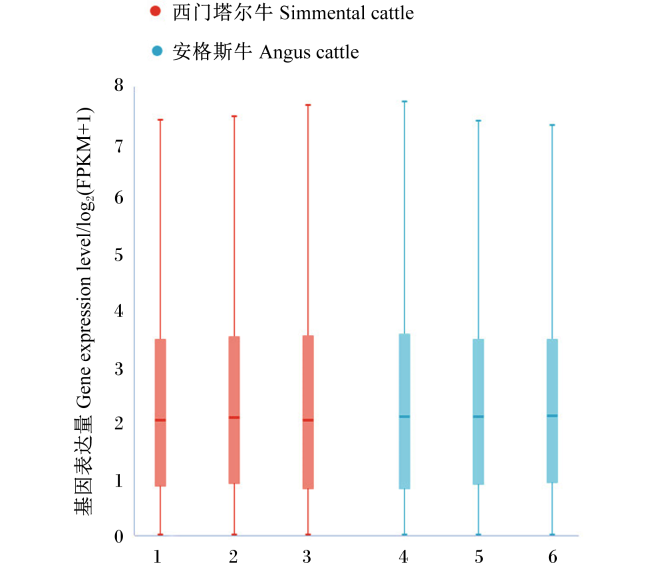
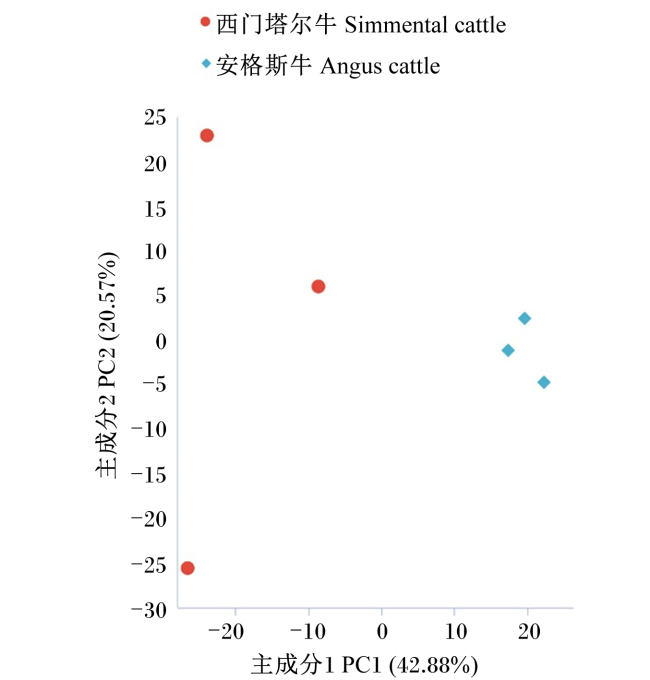
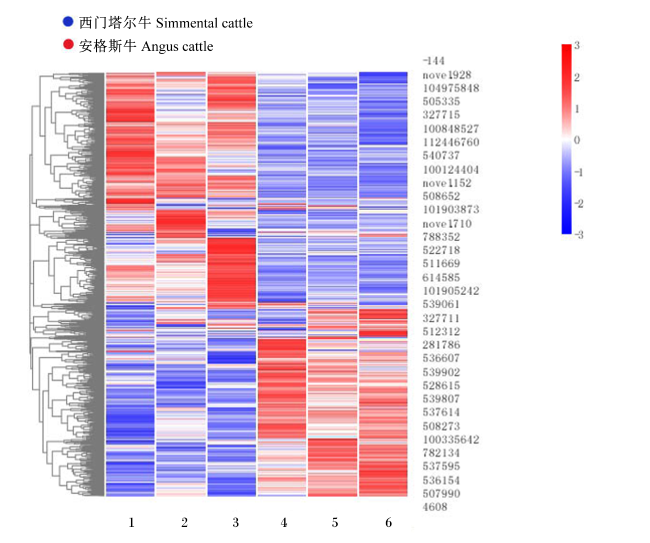
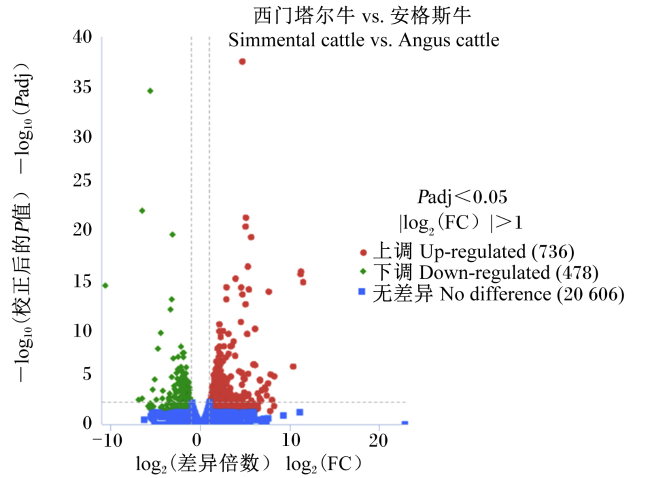
图1可知,通过盒形图展示西门塔尔牛和安格斯牛之间基因表达值FPKM分布的对比情况发现,西门塔尔牛和安格斯牛肌肉DEGs的表达模式相似。PCA结果(图2)表明,主成分1(PC1)和主成分2(PC2)分别为42.88%和20.57%。由图3可知,安格斯牛3个重复样本聚合紧密,重复性较好;而西门塔尔牛组内分散,重复性较差,但2个品种之间比较分散,说明所用样本分组合理。由图4可知,与安格斯牛相比,西门塔尔牛共有1 214个候选基因在肌肉组织中差异表达,其中上调基因736个,下调基因478个。
图1 西门塔尔牛和安格斯牛肌肉基因表达量分布盒形图

Fig.1 Box plot of muscle gene expression level distribution of Simmental and Angus cattle

图2 西门塔尔牛和安格斯牛肌肉FPKM PCA结果

Fig.2 PCA result of FPKM in muscle of Simmental and Angus cattle

图3 西门塔尔牛和安格斯牛肌肉DEGs热图及聚类分析

Fig.3 Heat map and cluster analysis of DEGs in muscle of Simmental and Angus cattle

图4 西门塔尔牛和安格斯牛肌肉DEGs火山图

Fig.4 Volcano plot of DEGs in muscle of Simmental and Angus cattle

2.5 西门塔尔牛和安格斯牛肌肉DEGs GO功能富集分析

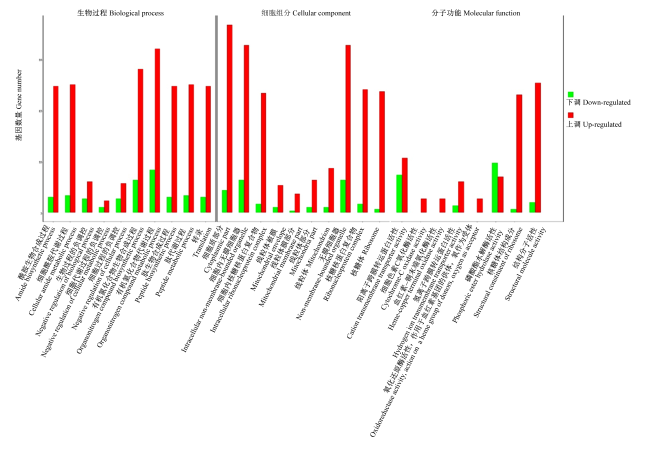
DEGs注释到GO数据库中共显著富集在了43个GO条目,在生物过程(biological process,BP)、细胞组分(cellular component,CC)和分子功能(molecular function,MF)分类中,包含的亚类分别为20、15和8个。从每个分类中各选取最显著的前10个(分子功能为8个)条目绘制柱状图(图5)。在生物过程分类中,参与生物合成和代谢的DEGs最多,数量分别为103和121个;在细胞组分分类中,细胞质部分和细胞内无膜细胞器富集的DEGs最多,数量分别为123和117个;在分子功能分类中,DEGs主要参与核糖体结构成分、结构分子活性和磷酸酯水解酶活性,数量分别为71、82和50个。
图5 西门塔尔牛和安格斯牛肌肉DEGs GO功能富集分析

Fig.5 GO functional enrichment analysis of DEGs in muscle of Simmental and Angus cattle

2.6 西门塔尔牛和安格斯牛肌肉DEGs KEGG通路富集分析

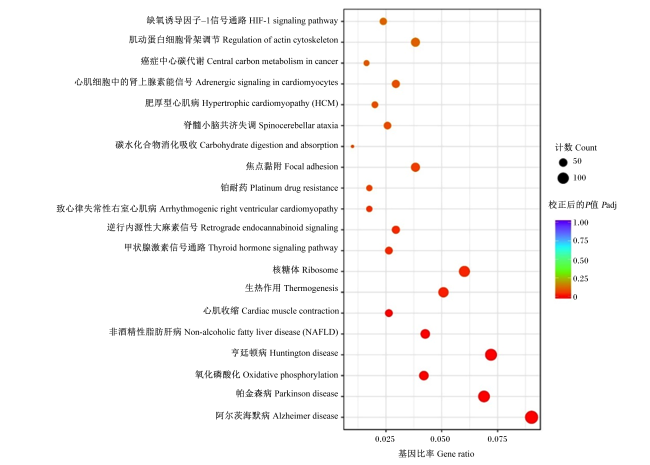
从KEGG通路富集分析结果中,选取最显著的20个注释绘制散点图(图6),结合GeneCards在线查询基因功能,进一步筛选与IMF沉积相关的DEGs,发现其主要富集在了心肌收缩(cardiac muscle contraction)、非酒精性脂肪肝病(non-alcoholic fatty liver disease)和逆行内源性大麻素信号(retrograde endocannabinoid signaling)通路中,数量分别为42和47个;同时,共筛选出3个可能与IMF沉积相关的DEGs。与安格斯牛相比,西门塔尔牛肌肉淀粉样前体蛋白(APP)为下调基因,肌肉原肌球蛋白2(TPM2)和钙电压门控通道亚基α1 S(CACNA1S)为上调基因,这3个调控基因的关键信息见表6
图6 西门塔尔牛和安格斯牛肌肉DEGs前20 KEGG通路富集气泡图

Fig.6 Bubble plot of top 20 KEGG pathways of DEGs in muscle of Simmental and Angus cattle

表6 IMF沉积相关DEGs

Table 6 DEGs related to IMF deposition

基因
Genes
log2
(差异倍数)
log2(FC)
校正后的
P
Padj
KEGG通路
KEGG pathways
基因功能
Gene function
淀粉样前体蛋白
APP
-1.29 0.02 阿尔茨海默病
Alzheimer disease
在神经元表面执行与神经突生长有关的
生理功能 Performs physiological functions
on the surface of neurons relevant to
neurite growth
原肌球蛋白2
TPM2
1.09 0.01 心肌收缩
Cardiac muscle contraction
使肌动蛋白纤维结合
Enables actin filament binding
钙电压门控通道亚基α1 S
CACNA1S
1.70 0.04 逆行内源性大麻素信号
Retrograde endocannabinoid
signaling
心肌素相关转录因子A
调节钙离子释放
MRTF-A regulates Ca2+ release

2.7 RT-qPCR验证结果

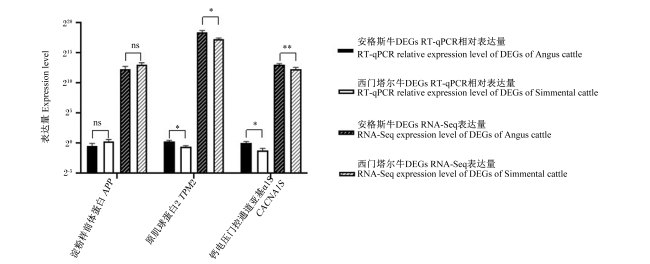
图7可知,在2种肉牛品种背最长肌中,安格斯牛肌肉CACNA1S RNA-Seq表达量极显著高于西门塔尔牛(P<0.01),肌肉TPM2 RNA-Seq表达量也显著高于西门塔尔牛(P<0.05),表明这2个基因对IMF沉积有促进作用;而肌肉APP RNA-Seq表达量在2种牛之间差异不显著(P>0.05)。RT-qPCR验证结果与RNA-Seq结果相一致。
图7 IMF沉积相关DEGs在西门塔尔牛和安格斯牛肌肉中RNA-Seq表达量和RT-qPCR相对表达量比较

*表示差异显著(P<0.05),**表示差异极显著(P<0.01),ns表示差异不显著(P>0.05)。

Fig.7 Comparison of RNA-Seq expression level and RT-qPCR relative expression level of IMF deposition-associated DEGs in muscle of Simmental and Angus cattle

* mean significant difference (P<0.05), ** mean extremely significant difference (P<0.01), and ns mean no significant difference (P>0.05).

3 讨论

牛肉IMF含量与肉质的细嫩多汁和口感风味等特性密切相关[22]。通常来说,IMF与肌肉嫩度[23-25]、系水力[26]、多汁性[27]以及肌纤维密度[28]呈正相关,与剪切力[29]和肌纤维直径[28]呈负相关。本试验测定肉质相关性状发现,安格斯牛的IMF含量和系水力极显著高于西门塔尔牛,肌纤维直径显著低于西门塔尔牛,肌肉粗蛋白质含量、熟肉率和肌纤维密度都高于西门塔尔牛,而剪切力低于西门塔尔牛。这与上述IMF与肉品质的相关性规律一致,也与赵伟明等[30]和韩信嵘[2]研究发现安格斯牛IMF含量高、肉品质好的结果一致。此外,2个品种肉牛肌肉氨基酸组成的分析结果发现,两者EAA/TAA值都接近40%理想值,表明肌肉中都具有丰富的优质蛋白质。不过,与西门塔尔牛相比,安格斯牛肌肉的SFA总含量较低,而肌肉的MUFA总含量较高,但差异均不显著,且两者的PUFA总含量接近,总体而言,2个品种肌肉脂肪酸组成差异不大。通常来说,过高的肌肉SFA含量不利于人体健康,将会提升血液胆固醇水平[31],而不饱和脂肪酸不仅可以阻止动脉硬化[32],还能预防高血脂和冠心病的发生[33]。Chambaz等[4]在背最长肌平均IMF含量为3.25%的条件下,比较安格斯、西门塔尔、夏罗莱和利木赞阉牛的肉质和大理石花纹特性发现,安格斯牛的脂肪含量得分最高,IMF沉积最好,同时安格斯和利木赞牛比西门塔尔牛肉质更嫩,这进一步说明了安格斯牛肉的优秀品质。为了进一步确定影响这些表型差异的候选基因和通路,本试验采用Illumina NovaSeq 6000平台对安格斯和西门塔尔2个肉牛品种的背最长肌组织进行RNA-Seq,并通过对DEGs GO功能和KEGG通路进行富集分析,鉴定出与IMF沉积有关的功能基因,结果发现,一些DEGs参与了脂肪形成的生物过程,一些DEGs参与了脂肪组织发育的重要信号通路,结合GeneCards和RT-qPCR对相关功能基因进一步验证筛选,得出了APPTPM2和CACNA1S这3个基因,可为肉牛的脂肪沉积机制研究提供参考依据。
APP是一类具有胞外N端区、跨膜结构域和胞质C端尾短的大蛋白分子[34]APP与阿尔茨海默病(Alzheimer disease,AD)斑块相关,已知存在于大脑突触和成人神经肌肉接头中[35],还存在于小鼠骨骼肌和培养的肌源细胞中,成年小鼠骨骼肌中APP mRNA下调,会抑制脂肪细胞的成脂分化[36-37]。此外,Wu等[38]研究发现,当APP在小鼠肌肉中过度表达时,会引起肌无力和萎缩,表明APP低表达有利于肌肉及脂肪的适度沉积;通过荧光素酶报告基因检测证明,APP是miR-101-1的潜在靶基因,而miR-101-1是一种广泛表达的微小RNA(miRNA),主要在牛骨骼肌中富集,其丰度在胎牛、犊牛和成年牛的骨骼肌中存在差异;在C2C12成肌细胞细胞系分化过程中,内源性miR-101-1会上调,转染miR-101-1会抑制C2C12成肌细胞分化,同时显著降低肌原分化(myogenic differentiation,MyOD)、肌细胞生成素(myogenin,MyOG)和肌球蛋白重链(myosin heavy chain,MyHC)的mRNA表达。APP与肉质性状有强相关,可作为猪肉剪切力和嫩度的数量性状位点(QTL)[39]。而Lee等[40]在人体脂肪组织中研究发现,APP参与肥胖相关胰岛素抵抗和脂肪组织炎症,在脂肪组织和肥胖群体中均高表达,其表达水平与脂肪沉积水平呈正相关,这与本试验结果呈相反趋势,可能与研究对象不同有关,其脂肪组织的细胞组成及成脂机制存在较大差异,具体原因需进一步研究。
CACNA1S是编码骨骼肌细胞中缓慢失活的L型电压依赖性钙通道的5个亚基之一,基因突变与骨骼肌代谢生长和脂肪堆积相关[41]。骨骼肌电压传感器Cav1.1也是一个电压依赖性钙离子(Ca2+)通道,允许少量Ca2+内流进入哺乳动物骨骼肌纤维[42]。Georgiou等[43]研究发现,骨骼肌中发现了一条通路Cav1.1→钙离子/钙调蛋白依赖激酶Ⅱ(CaMKⅡ)→一氧化氮和酶(NOS),能调节脂肪酸转运蛋白CD36在细胞内的分布从而改变脂肪酸代谢。阻断这一通路途径可减少线粒体β氧化和能量消耗,促进肌纤维密度增大,由此说明CACNA1S能通过影响肌肉线粒体功能调节骨骼肌的能量消耗降低,从而导致IMF的沉积。Xue等[44]研究发现,CACNA1S还涉及胰岛素分泌、抵抗和信号通路相关的表观遗传调控网络,通过调控长链非编码RNA(long noncoding RNA,lncRNA)的变化和甲基化影响能量代谢、信号通路和细胞增殖相关过程,是脂质代谢的上游调控途径,还与其他靶基因共同调控肌内沉积过程。Ma等[45]研究结果也证实了上述结果,CACNA1S在启动子区发生甲基化,与修饰基因表达呈负相关。Xue等[44]和Ma等[45]分别在蒙古羊和牦牛中均发现CACNA1S在启动子区发生甲基化,参与脂质代谢的上游调控途径,调控动物肌肉的发育和肉质。方晓敏等[46]推测CACNA1S是一个适合作为影响猪肉品质性状QTL的候选基因。有研究发现,基本螺旋-环-螺旋芳香烃受体核转位蛋白样1(BMAL1)通过反向定位c-erbA-1α(reverse orientation the c-erbA-1alpha,REV-ERBα)控制CACNA1S表达来调节钙信号,从而决定肌肉合成代谢或分解状态的信号通路,可能是肌肉活动的分子传感器[47]
TPM2编码β-原肌球蛋白,是肌动蛋白纤维结合蛋白家族的一员,主要表达在慢速Ⅰ型肌纤维中,该基因的突变可改变其他肌原肌球蛋白蛋白的表达。TPM2在肌肉和非肌肉细胞中与肌动蛋白纤维结合,与肌钙蛋白复合物一起,在脊椎动物横纹肌收缩的钙依赖调节中起核心作用[48]。Cho等[49]通过RNA和蛋白定量验证了原肌球蛋白家族成员在韩牛、阉牛和公牛的肌内脂肪组织(intramuscular adipose tissue,IMAT)和大血管脂肪组织(macrovascular adipose tissue,MAT)中参与肌肉发育密切相关的调控通路,与奶牛或阉牛相比,IMAT中TPM2 mRNA和蛋白表达水平均较低,表明它们与大理石花纹评分和质量等级呈正相关。本试验中,DEGs富集注释结果显示,TPM2与肌原纤维、收缩纤维部分和肌动蛋白细胞骨架结构的KEGG通路相关,这与之前的研究结果[50-51]也一致,这为TPM2直接或间接参与脂肪沉积和脂肪酸代谢提供了证据。
在本研究中,在RT-qPCR验证DEGs表达结果中,安格斯牛肌肉CACNA1STPM2 RT-qPCR相对表达量显著高于西门塔尔牛,表明其对IMF沉积有促进作用,且与RNA-Seq的结果趋势一致;而2种肉牛之间肌肉APP表达量差异不显著,但相比于西门塔尔牛,安格斯牛肌肉APP表达量呈降低趋势,表明其对脂肪沉积有负调控作用,这与RNA-Seq结果也是一致的,这也进一步支持了APPCACNA1STPM2能够参与调节IMF沉积关键通路,具有调节脂肪细胞分化和脂肪酸新陈代谢的分子功能的结论。

4 结论

安格斯牛IMF沉积能力较强,肉品质较好。RNA-Seq共筛选出了3个(APPCACNA1STPM2)与肉牛IMF沉积相关的候选基因,这为研究肉牛IMF沉积调控机制提供了参考。
[1]
LIU T, WU J P, LEI Z M, et al. Fatty acid profile of muscles from crossbred Angus-Simmental,Wagyu-Simmental,and Chinese Simmental cattles[J]. Food Science of Animal Resources, 2020, 40(4):563-577.

DOI

[2]
韩信嵘. 基于转录组测序分析中国西门塔尔牛和安格斯牛脂肪沉积相关基因的差异表达[D].硕士学位论文. 通辽: 内蒙古民族大学, 2020.

HAN X R. Analysis of differentially expressed genes related to fat deposition in Simmental and Angus based on transcriptome sequencing[D].Master’s Thesis. Tongliao: Inner Mongolia University for the Nationalities, 2020. (in Chinese)

[3]
ZHENG Y, CHEN J J, WANG X X, et al. Metagenomic and transcriptomic analyses reveal the differences and associations between the gut microbiome and muscular genes in Angus and Chinese Simmental cattle[J]. Frontiers in Microbiology, 2022, 13:815915.

DOI

[4]
CHAMBAZ A, SCHEEDER M R L, KREUZER M, et al. Meat quality of Angus,Simmental,Charolais and Limousin steers compared at the same intramuscular fat content[J]. Meat Science, 2003, 63(4):491-500.

DOI

[5]
FERNANDEZ X, MONIN G, TALMANT A, et al. Influence of intramuscular fat content on the quality of pig meat-2.Consumer acceptability of M. longissimus lumborum[J]. Meat Science, 1999, 53(1):67-72.

DOI

[6]
FERNANDEZ X, MONIN G, TALMANT A, et al. Influence of intramuscular fat content on the quality of pig meat-1.Composition of the lipid fraction and sensory characteristics of m.longissimus lumborum[J]. Meat Science, 1999, 53(1):59-65.

DOI

[7]
WANG L Y, SHAN T Z. Factors inducing transdifferentiation of myoblasts into adipocytes[J]. Journal of Cellular Physiology, 2021, 236(4):2276-2289.

DOI

[8]
CAMPOS C F, DUARTE M S, GUIMARÃES S E F, et al. Review:animal model and the current understanding of molecule dynamics of adipogenesis[J]. Animal, 2016, 10(6):927-932.

DOI

[9]
LI X, FU X, YANG G, et al. Review:enhancing intramuscular fat development via targeting fibro-adipogenic progenitor cells in meat animals[J]. Animal, 2020, 14(2):312-321.

DOI

[10]
HWANG C S, LOFTUS T M, MANDRUP S, et al. Adipocyte differentiation and leptin expression[J]. Annual Review of Cell and Developmental Biology, 1997, 13:231-259.

PMID

[11]
LEFTEROVA M I, ZHANG Y, STEGER D J, et al. PPARgamma and C/EBP factors orchestrate adipocyte biology via adjacent binding on a genome-wide scale[J]. Genes & Development, 2008, 22(21):2941-2952.

DOI

[12]
ROSEN E D, MACDOUGALD O A. Adipocyte differentiation from the inside out[J]. Nature Reviews Molecular Cell Biology, 2006, 7(12):885-896.

DOI PMID

[13]
SIERSBÆK R, NIELSEN R, MANDRUP S. Transcriptional networks and chromatin remodeling controlling adipogenesis[J]. Trends in Endocrinology & Metabolism, 2012, 23(2):56-64.

[14]
HAAS B J, ZODY M C. Advancing RNA-Seq analysis[J]. Nature Biotechnology, 2010, 28(5):421-423.

DOI PMID

[15]
杨帅, 史明月, 李文霞, 等. 猪肌内脂肪沉积相关基因的筛选及其表达特性分析[J]. 中国畜牧兽医, 2022, 49(5):1651-1661.

YANG S, SHI M Y, LI W X, et al. Screening and expression analysis of genes related to porcine intramuscular fat deposition[J]. China Animal Husbandry & Veterinary Medicine, 2022, 49(5):1651-1661. (in Chinese)

[16]
ZHANG H M, XIA H L, JIANG H R, et al. Longissimus dorsi muscle transcriptomic analysis of Yunling and Chinese Simmental cattle differing in intramuscular fat content and fatty acid composition[J]. Genome, 2018, 61(8):549-558.

DOI

[17]
UEDA S, HOSODA M, YOSHINO K I, et al. Gene expression analysis provides new insights into the mechanism of intramuscular fat formation in Japanese black cattle[J]. Genes, 2021, 12(8):1107.

DOI

[18]
KIM D, LANGMEAD B, SALZBERG S L. HISAT:a fast spliced aligner with low memory requirements[J]. Nature Methods, 2015, 12(4):357-360.

DOI

[19]
PERTEA M, PERTEA G M, ANTONESCU C M, et al. StringTie enables improved reconstruction of a transcriptome from RNA-seq reads[J]. Nature Biotechnology, 2015, 33(3):290-295.

DOI PMID

[20]
LOVE M I, HUBER W, ANDERS S. Moderated estimation of fold change and dispersion for RNA-seq data with DESeq2[J]. Genome Biology, 2014, 15(12):550.

DOI

[21]
YU G A, WANG L G, HAN Y Y, et al. clusterProfiler:an R package for comparing biological themes among gene clusters[J]. OMICS-A Journal of Integrative Biology, 2012, 16(5):284-287.

DOI

[22]
陈东. 基于转录组学进行肉牛不同大理石花纹等级分子机制的研究[D].博士学位论文. 北京: 中国农业大学, 2015.

CHEN D. Transcriptome study on the molecular mechanism of the different marbling phenotype in beef cattle[D].Ph.D. Thesis. Beijing: China Agricultural University, 2015. (in Chinese)

[23]
俄木曲者, 熊朝瑞, 范景胜, 等. 肥羔型黑山羊新品种羔羊肉品质研究[J]. 黑龙江畜牧兽医, 2016(1):108-111.

EMU Q Z, XIONG C R, FAN J S, et al. Study on meat quality of new fattening black goat variety lamb[J]. Heilongjiang Animal Science and Veterinary Medicine, 2016(1):108-111.

[24]
MCCORMICK R J. The flexibility of the collagen compartment of muscle[J]. Meat Science, 1994, 36(1/2):79-91.

DOI

[25]
MCCORMICK R J. Extracellular modifications to muscle collagen:implications for meat quality[J]. Poultry Science, 1999, 78(5):785-791.

DOI

[26]
SMITH S B, JOHNSON B J. 0794 Marbling:management of cattle to maximize the deposition of intramuscular adipose tissue[J]. Journal of Animal Science, 2016,94 (Suppl.5):382.

[27]
张月, 靳烨, 郭月英, 等. 肉碱棕榈酰转移酶1的生物学功能及其对肉品质影响的研究进展[J]. 动物营养学报, 2021, 33(8):4315-4322.

DOI

ZHANG Y, JIN Y, GUO Y Y, et al. Research progress on biological function of carnitine palmitoyl transferase 1 and its influence on meat quality[J]. Chinese Journal of Animal Nutrition, 2021, 33(8):4315-4322. (in Chinese)

[28]
胡波, 陈若楠, 杨朝永, 等. 玫瑰冠鸡、科宝鸡的肌纤维特性与肉品质分析[J]. 中国畜牧杂志, 2021, 57(9):114-118.

HU B, CHEN R N, YANG C Y, et al. Analysis of muscle fiber characteristics and meat quality of rose crown chicken and cobb chicken[J]. Chinese Journal of Animal Science, 2021, 57(9):114-118. (in Chinese)

[29]
SEIDEMAN S C, KOOHMARAIE M, CROUSE J D. Factors associated with tenderness in young beef[J]. Meat Science, 1987, 20(4):281-291.

DOI PMID

[30]
赵伟明, 吴慧光, 吴江鸿, 等. 基于转录组测序分析西门塔尔牛和安格斯牛脂肪沉积相关基因的差异表达[J]. 农业生物技术学报, 2020, 28(4):693-701.

ZHAO W M, WU H G, WU J H, et al. Analysis of differentially expressed genes related to fat deposition in Simmental and Angus cattle (Bos taurus) based on transcriptome sequencing[J]. Journal of Agricultural Biotechnology, 2020, 28(4):693-701. (in Chinese)

[31]
余力, 贺稚非, 王兆明, 等. 肉中脂肪酸组成与健康关系的研究进展[J]. 食品工业科技, 2014, 35(22):359-363.

YU L, HE Z F, WANG Z M, et al. Research progress in the relationship between fatty acid composition of meat and health[J]. Science and Technology of Food Industry, 2014, 35(22):359-363. (in Chinese)

[32]
王贵印, 高爱琴, 达布希拉图, 等. 乌拉特羊肉品质特性分析报告[J]. 新疆农业科学, 2010, 47(S2):173-178.

WANG G Y, GAO A Q, DABU X L T, et al. Analysis report of Urat mutton quality characteristics[J]. Xinjiang Agricultural Sciences, 2010, 47(S2):173-178. (in Chinese)

[33]
SALTER A M. Dietary fatty acids and cardiovascular disease[J]. Animal, 2013, 7(S1):163-171.

DOI

[34]
TANZI R E, GUSELLA J F, WATKINS P C, et al. Amyloid beta protein gene:cDNA,mRNA distribution,and genetic linkage near the Alzheimer locus[J]. Science, 1987, 235(4791):880-884.

DOI

[35]
SCHUBERT W, PRIOR R, WEIDEMANN A, et al. Localization of Alzheimer βA4 amyloid precursor protein at central and peripheral synaptic sites[J]. Brain Research, 1991, 563(1/2):184-194.

DOI

[36]
SHIGEMATSU K, MCGEER P L, MCGEER E G. Localization of amyloid precursor protein in selective postsynaptic densities of rat cortical neurons[J]. Brain Research, 1992, 592(1/2):353-357.

DOI

[37]
ASKANAS V, ENGEL W K, ALVAREZ R B. Strong immunoreactivity of β-amyloid precursor protein,including the β-amyloid protein sequence,at human neuromuscular junctions[J]. Neuroscience Letters, 1992, 143(1/2):96-100.

DOI

[38]
WU J Y, HE D D, YUE B L, et al. miR-101-1 expression pattern in Qinchuan cattle and its role in the regulation of cell differentiation[J]. Gene, 2017, 636:64-69.

DOI

[39]
LOBJOIS V, LIAUBET L, SANCRISTOBAL M, et al. A muscle transcriptome analysis identifies positional candidate genes for a complex trait in pig[J]. Animal Genetics, 2008, 39(2):147-162.

DOI PMID

[40]
LEE Y H, THARP W G, MAPLE R L, et al. Amyloid precursor protein expression is upregulated in adipocytes in obesity[J]. Obesity, 2008, 16(7):1493-1500.

DOI

[41]
LIANG C, XU Y, PENG Z, et al. MRTF-A regulates Ca2+ release through CACNA1S[J]. Journal of Biosciences, 2021, 46:40.

DOI

[42]
CHANDLER W K, RAKOWSKI R F, SCHNEIDER M F. A non-linear voltage dependent charge movement in frog skeletal muscle[J]. The Journal of Physiology, 1976, 254(2):245-283.

DOI

[43]
GEORGIOU D K, DAGNINO-ACOSTA A, LEE C S, et al. Ca2+ binding/permeation via calcium channel,CaV1.1,regulates the intracellular distribution of the fatty acid transport protein,CD36,and fatty acid metabolism[J]. The Journal of Biological Chemistry, 2015, 290(39):23751-23765.

DOI

[44]
XUE J D, LV Q, KHAS E, et al. Tissue-specific regulatory mechanism of lncRNAs and methylation in sheep adipose and muscle induced by Allium mongolicum regel extracts[J]. Scientific Reports, 2021, 11(1):9186.

DOI

[45]
MA X M, JIA C J, CHU M, et al. Transcriptome and DNA methylation analyses of the molecular mechanisms underlying with longissimus dorsi muscles at different stages of development in the polled yak[J]. Genes, 2019, 10(12):970.

DOI

[46]
方晓敏, 赵晓枫, 郭晓令, 等. 应用辐射杂种细胞系对猪CACNA1S基因的定位研究[J]. 畜牧兽医学报, 2006, 37(3):309-312.

FANG X M, ZHAO X F, GUO X L, et al. Mapping CACNA1S gene in porcine by radiation hybrid panel[J]. Acta Veterinaria Et Zootechnica Sinica, 2006, 37(3):309-312. (in Chinese)

[47]
WADA T, ICHIHASHI Y, SUZUKI E, et al. Deletion of Bmal1 prevents diet-induced ectopic fat accumulation by controlling oxidative capacity in the skeletal muscle[J]. International Journal of Molecular Sciences, 2018, 19(9):2813.

DOI

[48]
CLARKE N F, DOMAZETOVSKA A, WADDELL L, et al. Cap disease due to mutation of the beta-tropomyosin gene (TPM2)[J]. Neuromuscular Disorders, 2009, 19(5):348-351.

DOI PMID

[49]
CHO J H, JEONG J Y, LEE R H, et al. Regional differences of proteins expressing in adipose depots isolated from cows,steers and bulls as identified by a proteomic approach[J]. Asian-Australasian Journal of Animal Sciences, 2016, 29(8):1197-1206.

DOI

[50]
D’ALESSANDRO A, MARROCCO C, ZOLLA V, et al. Meat quality of the longissimus lumborum muscle of Casertana and large white pigs:metabolomics and proteomics intertwined[J]. Journal of Proteomics, 2011, 75(2):610-627.

DOI

[51]
PIERZCHALA M, HOEKMAN A J W, URBANSKI P, et al. Validation of biomarkers for loin meat quality (M. longissimus) of pigs[J]. Journal of Animal Breeding and Genetics, 2014, 131(4):258-270.

DOI PMID

文章导航

/