

1 材料与方法
1.1 数据库平台
表1 本研究所用数据库网址Table 1 Database website used in this study |
| 数据库 Databases | 网址 Website |
|---|---|
| 中药系统药理数据库与分析平台 TCMSP | https://lsp.nwu.edu.cn/tcmsp.php |
| PubChem | https://pubchem.ncbi.nlm.nih.gov/ |
| Uniprot | https://www.uniprot.org/ |
| Genecards | https://www.genecards.org/ |
| OMIM | https://omim.org/ |
| Venny | https://bioinfogp.cnb.csic.es/tools/venny/ |
| String | https://www.string-db.org/ |
| DAVID | https://david.ncifcrf.gov/tools.jsp |
1.2 试验方法
1.2.1 苦参药效成分筛选
1.2.2 苦参药效成分-靶点网络图的构建
1.2.3 抑菌相关基因检索
1.2.4 苦参抑菌作用的基因靶点筛选
1.2.5 苦参抑菌的关键靶点蛋白相互作用(PPI)网络图的构建
1.2.6 苦参抑菌作用靶点GO功能和KEGG富集分析
1.2.7 分子对接
2 结果与分析
2.1 苦参所含药效成分
表2 苦参主要药效成分Table 2 Main medicinal ingredients of Sophorae flavescentis Radix |
| 编号 ID | 分子名称 Molecular name | 口服生物利用度 OB/% | 类药性 DL | 度 Degree |
|---|---|---|---|---|
| MOL000098 | 槲皮素 Quercetin | 46.43 | 0.28 | 148 |
| MOL000006 | 木犀草素 Luteolin | 36.16 | 0.25 | 56 |
| MOL000392 | 刺芒柄花素 Formononetin | 69.67 | 0.21 | 36 |
| MOL003542 | 8-异戊烯基山奈酚8-isopentenyl-kaempferol | 38.04 | 0.39 | 26 |
| MOL000456 | 菜豆素 Phaseolin | 78.20 | 0.73 | 23 |
| MOL003673 | Wighteone | 42.80 | 0.36 | 17 |
| MOL003648 | (+)-高丽槐素 Inermin | 65.83 | 0.54 | 16 |
| MOL006596 | 大豆抗毒素 Glyceollin | 97.27 | 0.76 | 16 |
| MOL001484 | (-)-高丽槐素 Inermine | 75.18 | 0.54 | 15 |
| MOL004941 | 甘草素(2R)-7-hydroxy-2-(4-hydroxyphenyl)chroman-4-one | 71.12 | 0.18 | 13 |
| MOL006613 | 苦参醇 Ckushenin | 47.62 | 0.38 | 13 |
| MOL006604 | (2S)-7-hydroxy-2-(4-hydroxyphenyl)-5- methoxy-8-(3-methylbut-2-enyl)chroman-4-one | 48.09 | 0.39 | 12 |
| MOL005944 | 苦参碱 Matrine | 63.77 | 0.25 | 11 |
| MOL001040 | 柚皮素 (2R)-5,7-dihydroxy-2-(4-hydroxyphenyl)chroman-4-one | 42.36 | 0.21 | 8 |
| MOL005100 | 二氢黄酮甙 5,7-dihydroxy-2-(3-hydroxy-4-methoxyphenyl)chroman-4-one | 47.74 | 0.27 | 8 |
| MOL006626 | 里查酮G Leachianone G | 60.97 | 0.40 | 8 |
| MOL004580 | 花旗松素 Cis-dihydroquercetin | 66.44 | 0.27 | 6 |
| MOL006620 | 苦参醇J Kushenol J | 50.86 | 0.24 | 6 |
| MOL003347 | 贯叶金丝桃素 Hyperforin | 44.03 | 0.60 | 5 |
| MOL006623 | 苦参醇T Kushenol T | 51.28 | 0.64 | 5 |
| MOL006630 | 桑叶活性黄酮 Norartocarpetin | 54.93 | 0.24 | 4 |
| MOL003627 | 槐果碱 Sophocarpine | 64.26 | 0.25 | 3 |
| MOL003680 | 槐定碱 Sophoridine | 60.07 | 0.25 | 3 |
| MOL006650 | (-)-maackiain-3-O-glucosyl-6'-O-malonate | 48.69 | 0.52 | 2 |
2.2 苦参药效成分-靶点网络图的构建
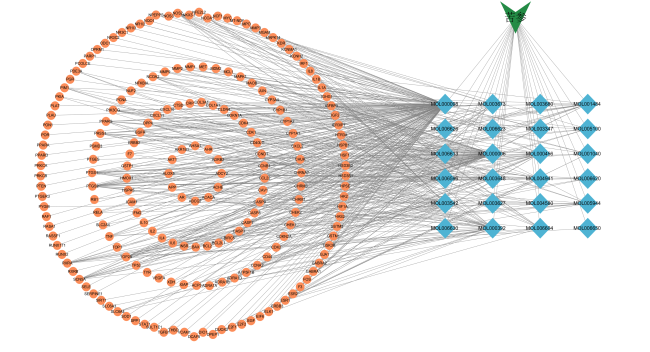
图1 苦参药效成分-靶点网络图PSMD3:蛋白酶体26S非腺嘌呤核苷三磷酸酶调节亚基3 26S proteasome non-ATPase regulatory subunit 3;HSD3B1:3β羟基类固醇脱氢酶/δ5-4异构酶1型 3 beta-hydroxysteroid dehydrogenase/delta 5-4-isomerase type 1;HSD3B2:3β羟基类固醇脱氢酶/δ5-4异构酶2型 3 beta-hydroxysteroid dehydrogenase/delta 5-4-isomerase type 2;HTR3A:5-羟色胺受体3A 5-hydroxytryptamine receptor 3A;MMP2:基质金属蛋白酶2 matrix metalloproteinase 2;HSPA5:热休克蛋白5 heat shock protein 5;ACHE:乙酰胆碱酯酶 acetylcholinesterase;ACACA:乙酰辅酶A羧化酶 acetyl-CoA carboxylase;AHSA1:热休克90 kDa蛋白ATP酶同源物1(酵母)激活因子 activator of 90 kDa heat shock protein ATPase homolog 1;APC2:腺瘤性多发性大肠杆菌蛋白2 adenomatous polyposis coli protein 2;ADCY2:腺苷酸环化酶2 adenylate cyclase type 2;AKR1C3:醛固酮类还原酶家族1成员C3 Aldo-keto reductase family 1 member C3;AKR1B1:醛糖还原酶 aldose reductase;AAGAB:α-γ衔接蛋白p34 alpha- and gamma-adapt in-binding protein p34;ADRA1A:α-1A肾上腺素能受体 alpha-1A adrenergic receptor;ADRA1B:α-1B肾上腺素能受体 alpha-1B adrenergic receptor;ADRA1D:α-1D肾上腺素能受体 alpha-1D adrenergic receptor;ADRA2A:α-2A肾上腺素能受体 alpha-2A adrenergic receptor;ADRA2B:α-2B肾上腺素能受体 alpha-2B adrenergic receptor;ADRA2C:α-2C肾上腺素能受体 alpha-2C adrenergic receptor;MAOA:胺氧化酶A amine oxidase [flavin-containing] A;MAOB:胺氧化酶B amine oxidase [flavin-containing] B;APP:β淀粉样蛋白A4 amyloid beta A4 protein;AR:雄激素受体 androgen receptor;BAX:细胞凋亡调节因子 apoptosis regulator;BCL2:细胞凋亡调节因子2 apoptosis regulatory factor 2;ALOX5:花生四烯酸5-脂氧合酶 arachidonate 5-lipoxygenase;AHR:芳香烃受体 aryl hydrocarbon receptor;ATP5F1B:ATP合酶β,线粒体 ATP synthase subunit beta, mitochondrial;ABCG2:腺苷三磷酸结合盒转运蛋白G2 ATP-binding cassette sub-family G member 2;XIAP:抑制细胞凋亡样蛋白 baculoviral IAP repeat-containing protein;BIRC5:抑制细胞凋亡样蛋白5 baculoviral IAP repeat-containing protein 5;BAD:BCL2细胞死亡拮抗剂 BCL2 antagonist of cell death;BCL2L1:BCL-2样蛋白1 BCL-2-like protein 1;ADRB1:肾上腺素β1受体 beta-1 adrenergic receptor;ADRB2:肾上腺素β2受体 beta-2 adrenergic receptor;KCNMA1:钙激活钾通道蛋白α1 calcium-activated potassium channel subunit alpha 1;PKIA:cAMP环磷酸腺苷依赖的蛋白激酶抑制因子α cAMP-dependent protein kinase inhibitor alpha;CA2:碳酸酐酶2 carbonic anhydrase 2;CASP3:半胱氨酸-天冬氨酸蛋白酶3 caspase 3;CASP7:半胱氨酸-天冬氨酸蛋白酶7 caspase 7;CASP8:半胱氨酸-天冬氨酸蛋白酶8 caspase 8;CASP9:半胱氨酸-天冬氨酸蛋白酶9 caspase 9;CTSD:组织蛋白酶D cathepsin D;CAV1:微囊蛋白1 caveolin 1;CCL2:CC基序趋化因子配体2 CC motif chemokine 2;CD40LG:CD40配体 CD40 ligand;CD44:CD44抗原 CD44 antigen;CDK2:细胞分裂蛋白激酶2 cell division protein kinase 2;CDK4:细胞分裂蛋白激酶4 cell division protein kinase 4;CDK6:细胞分裂蛋白激酶6 cell division protein kinase 6;TP53:肿瘤蛋白p53 cellular tumor antigen p53;CTRB1:胰凝乳蛋白酶B1 chymotrypsinogen B1;CLDN4:紧密链接蛋白4 claudin 4;F7:凝血因子7 coagulation factor Ⅶ;COL1A1:1型α-1胶原蛋白链 collagen alpha-1(I) chain;COL3A1:3型α-1胶原蛋白链 collagen alpha-1(Ⅲ) chain;CRP:C反应蛋白 C-reactive protein;CXCL10:趋化因子10(C-X-C基序) C-X-C motif chemokine 10;CXCL11:趋化因子11(C-X-C基序) C-X-C motif chemokine 11;CXCL2:趋化因子2(C-X-C基序) C-X-C motif chemokine 2;CCNA2:周期蛋白A2 cyclin-A2;CDKN1A:细胞周期蛋白依赖性激酶抑制剂1A cyclin-dependent kinase inhibitor 1A;CDKN2A:细胞周期蛋白依赖性激酶抑制剂2A cyclin-dependent kinase inhibitor 2A;CYCS:细胞色素C cytochrome C;CYP19A1:细胞色素P450家族19亚族A多肽1 cytochrome P450 19A1;CYP1A1:细胞色素P450家族1亚族A多肽1 cytochrome P450 1A1;CYP1A2:细胞色素P450家族1亚族A多肽2 cytochrome P450 1A2;CYP1B1:细胞色素P450家族1亚族B多肽1 cytochrome P450 1B1;CYP3A4:细胞色素P450家族3亚族A多肽4 cytochrome P450 3A4;DCAF5:DDB1与CUL4蛋白链接因子5 DDB1- and CUL4-associated factor 5;DPP4:二肽激肽酶-4 dipeptidyl peptidase IV;TOP1:DNA拓扑异构酶1 DNA topoisomerase 1;TOP2A:DNA拓扑异构酶2α DNA topoisomerase 2-alpha;ALG5:多萜基磷酸β-葡糖基转移酶5 dolichyl-phosphate beta-glucosyltransferase 5;DUOX2:双氧化酶2 dual oxidase 2;EGFR:表皮生长因子受体 epidermal growth factor receptor;SELE:选择素E E-selectin;ESR1:雌激素受体1 estrogen receptor 1;ESR2:雌激素受体β2 estrogen receptor beta 2;SULT1E1:类固醇硫酸酯酶 estrogen sulfotransferase;ELK1:转录激活因子ETS样蛋白Elk-1 ETS domain-containing protein Elk-1;EEF1E1:真核翻译延伸因子1 eukaryotic translation elongation factor 1 epsilon-1;EIF6:真核翻译起始因子6 eukaryotic translation initiation factor 6;CCND1:周期蛋白D1 G1/S-specific cyclin-D1;CCND2:周期蛋白D2 G1/S-specific cyclin-D2;CCNB1:周期蛋白B1 G2/mitotic-specific cyclin-B1;GABRA1:γ氨基丁酸亚基受体α1 gamma-aminobutyric acid receptor subunit alpha-1;GABRA2:γ氨基丁酸亚基受体α2 gamma-aminobutyric-acid receptor alpha-2 subunit;NR3C1:糖皮质激素受体 glucocorticoid receptor;G6PC2:葡萄糖-6-磷酸酶 glucose-6-phosphatase;GSTM1:谷胱甘肽S转移酶Mu 1 glutathione S-transferase Mu 1;GSTM2:谷胱甘肽S转移酶Mu 2 glutathione S-transferase Mu 2;GSTP1:谷胱甘肽S转移酶P glutathione S-transferase P;PYGM:肌肉糖原磷酸化酶 glycogen phosphorylase muscle form;GSK3B:糖原合酶激酶3β glycogen synthase kinase 3 beta;HSF1:热休克因子蛋白1 heat shock factor protein 1;HSPB1:热休克蛋白β1 heat shock protein beta 1;HMOX1:血红素氧合酶1 heme oxygenase 1;HPSE:乙酰肝素酶 heparanase;MET:肝细胞生长因子受体 hepatocyte growth factor receptor;HK2:己糖激酶2 hexokinase 2;MS4A2:高亲和力免疫球蛋白ε受体亚基β high affinity immunoglobulin epsilon receptor subunit beta;HAS2:透明质酸合成酶2 hyaluronan synthase 2;HIF1A:缺氧诱导因子1α hypoxia-inducible factor 1 alpha;IER3IP1:即早反应蛋白3相互作用蛋白1 immediate early response 3-interacting protein 1;MCL1:诱导骨髓白血病细胞分化蛋白1 induced myeloid leukemia cell differentiation protein 1;CHUK:核因子抑制剂kappa-B激酶亚基α inhibitor of nuclear factor kappa-B kinase subunit alpha;INS:胰岛素 insulin;INSR:胰岛素受体 insulin receptor;IGF1R:胰岛素样生长因子受体1 insulin-like growth factor 1 receptor;IGF2:胰岛素样生长因子2 insulin-like growth factor 2;IGFBP3:胰岛素样生长因子结合蛋白3 insulin-like growth factor-binding protein 3;ICAM1:细胞间黏附分子1 intercellular adhesion molecule 1;IFNG:干扰素γ interferon gamma;IRF1:干扰素调节因子1 interferon regulatory factor 1;IL-1α:白细胞介素-1α interleukin-1 alpha;IL-1β:白细胞介素-1β interleukin-1 beta;IL-10:白细胞介素-10 interleukin-10;IL-13:白细胞介素-13 interleukin-13;IL-2:白细胞介素-2 interleukin-2;IL-4:白细胞介素-4 interleukin-4;IL-6:白细胞介素-6 interleukin-6;IL-8:白细胞介素-8 interleukin-8;MMP1:间质胶原酶1 interstitial collagenase 1;ALPI:肠道碱性磷酸酶 intestinal-type alkaline phosphatase;FCER2:低亲和力免疫球蛋白εFc受体2 low affinity immunoglobulin epsilon Fc receptor 2;MMP9:基质金属蛋白酶9 matrix metalloproteinase 9;NR3C2:盐皮质激素受体 mineralocorticoid receptor;MAPK1:丝裂原活化蛋白激酶1 mitogen-activated protein kinase 1;MAPK14:丝裂原活化蛋白激酶14 mitogen-activated protein kinase 14;CHRM1:毒蕈碱型乙酰胆碱受体M1 muscarinic acetylcholine receptor M1;CHRM2:毒蕈碱型乙酰胆碱受体M2 muscarinic acetylcholine receptor M2;CHRM3:毒蕈碱型乙酰胆碱受体M3 muscarinic acetylcholine receptor M3;MPO:过氧化酶 myeloperoxidase;NQO1:NAD(P)H醌脱氢酶1 NAD(P)H dehydrogenase [quinone] 1;MT-ND6:NADH复合体6 NADH-ubiquinone oxidoreductase chain 6;POR:NADPH细胞色素P450还原酶 NADPH-cytochrome P450 reductase;NCF1:中性粒细胞胞质因子1 neutrophil cytosol factor 1;IKBKG:NF-kappa-B基本调节剂 NF-kappa-B essential modulator;NFKBIA:NF-kappa-B抑制剂α NF-kappa-B inhibitor alpha;NOS3:一氧化氮合酶3 nitric oxide synthase 3;NOS2:一氧化氮合酶2 nitric oxide synthase 2;NFE2L2:核因子相关因子2 nuclear factor erythroid 2-related factor 2;NCOA1:核受体共激活因子1 nuclear receptor coactivator 1;NCOA2:核受体共激活因子2 nuclear receptor coactivator 2;ODC1:鸟氨酸脱羧酶1 ornithine decarboxylase 1;SPP1:骨桥蛋白1 osteopontin 1;PPARG:过氧化物酶体增值物活化受体γ peroxisome proliferator activated receptor gamma;PPARA:过氧化物酶体增值物活化受体α peroxisome proliferator-activated receptor alpha;PPARD:过氧化物酶体增值物活化受体δ peroxisome proliferator-activated receptor delta;SERPINE1:纤溶酶原激活物抑制剂1 plasminogen activator inhibitor 1;PARP1:多聚ADP核糖聚合酶1 poly [ADP-ribose] polymerase 1;PCOLCE1:前胶原C内肽酶增强子1 procollagen C-endopeptidase enhancer 1;EGF:表皮生长因子 pro-epidermal growth factor;PGR:孕激素受体 progesterone receptor;PCNA:增殖细胞核抗原 proliferating cell nuclear antigen;PTGES:前列腺素E合成酶 prostaglandin E synthase;PTGER3:前列腺素E2受体EP3 prostaglandin E2 receptor EP3 subtype;PTGS1:前列腺素内过氧化物合酶1 prostaglandin G/H synthase 1;PTGS2:前列腺素内过氧化物合酶2 prostaglandin G/H synthase 2;ACP3:前列腺酸性磷酸酶3 prostatic acid phosphatase 3;PSME3:蛋白酶体激活因子复合体亚基3 proteasome activator complex subunit 3;PRKCA:蛋白激酶C-α protein kinase C alpha type;PRKCB:蛋白激酶C-β protein kinase C beta type;FOS:转录因子c-Fos proto-oncogene c-Fos;NPEPPS:嘌呤霉素敏感性氨肽酶 puromycin-sensitive aminopeptidase;AKT1:丝氨酸/苏氨酸蛋白激酶1 serine/threonine-protein kinase 1;RAF1:原癌基因丝氨酸/苏氨酸蛋白激酶 RAF proto-oncogene serine/threonine-protein kinase;RASSF1:包含Ras关联域的蛋白1 Ras association domain-containing protein 1;RASA1:GTP酶活化蛋白1 Ras GTPase-activating protein 1;ERBB2:受体酪氨酸蛋白激酶2 receptor tyrosine-protein kinase 2;ERBB3:受体酪氨酸蛋白激酶3 receptor tyrosine-protein kinase 3;RB1:视网膜母细胞瘤相关蛋白1 retinoblastoma-associated protein 1;RXRA:维甲酸X受体α retinoic acid receptor RXR-alpha;RXRB:维甲酸X受体β retinoic acid receptor RXR-beta;RUNX2:Runt相关转录因子2 Runt-related transcription factor 2;CHEK1:丝氨酸/苏氨酸蛋白激酶1 serine/threonine-protein kinase 1;CHEK2:丝氨酸/苏氨酸蛋白激酶2 serine/threonine-protein kinase 2;PON1:对氧磷酸1 serum paraoxonase/arylesterase 1;STAT1:信号转导子与转录激活子1 signal transducer and activator of transcription 1;SCN10A:钠通道蛋白10亚基α sodium channel protein type 10 subunit alpha;SCN5A:钠通道蛋白5亚基α sodium channel protein type 5 subunit alpha;SLC5A5:钠/碘同向转运蛋白5 sodium/iodide cotransporter 5;FXYD2:钠/钾转运ATP酶亚基γ 2 sodium/potassium-transporting ATPase subunit gamma 2;SLC6A3:钠依赖性多巴胺转运蛋白 sodium-dependent dopamine transporter;SLC6A2:钠依赖性去甲肾上腺素转运蛋白 sodium-dependent noradrenaline transporter;SLC6A4:钠依赖性5-羟色胺转运体 sodium-dependent serotonin transporter;SOD1:超氧化物歧化酶1 superoxide dismutase 1;THBD:血栓调节蛋白 thrombomodulin;F3:组织因子 tissue factor;PLAT:组织型纤溶酶原激活剂 tissue-type plasminogen activator;JUN:转录因子AP-1 transcription factor AP-1;E2F1:转录因子E2F1 transcription factor E2F1;E2F2:转录因子E2F2 transcription factor E2F2;RELA:转录因子p65 transcription factor p65;TGFB1:转化生长因子β1 transforming growth factor beta-1;TRPM2:瞬时受体电位阳离子通道亚家族M成员2 transient receptor potential cation channel subfamily M member 2;PRSS1:胰蛋白酶1 trypsin-1;TNF:肿瘤坏死因子 tumor necrosis factor;DIO1:Ⅰ型碘甲状腺原氨酸脱碘酶 type I iodothyronine deiodinase;TYR:酪氨酸酶 tyrosinase;PLAU:尿激酶型纤溶酶原激活物 urokinase-type plasminogen activator;VCAM1:血管细胞黏附蛋白1 vascular cell adhesion protein 1;VEGFA:血管内皮生长因子A vascular endothelial growth factor A;KDR:血管内皮生长因子受体 vascular endothelial growth factor receptor;XDH:黄嘌呤脱氢酶 xanthine dehydrogenase/oxidase。下同 the same as below。 绿色V型形代表中药,蓝色菱形代表苦参的药效成分,橙色圆形代表苦参潜在作用靶点。 Fig.1 Medicinal ingredients-target network of Sophorae flavescentis Radix The green shapes represent Chinese medicine, the blue diamonds represent the medicinal ingredients of Sophorae flavescentis Radix, and the orange circles represent the potential targets of Sophorae flavescentis Radix. |
2.3 苦参药物-成分-疾病-靶点网络图的构建
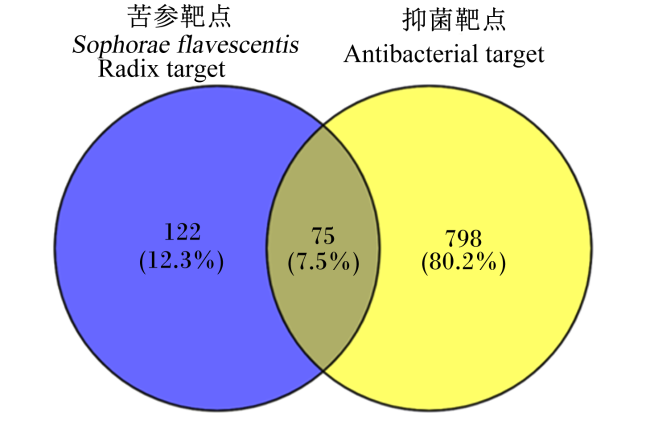
图2 苦参与抑菌靶点韦恩图Fig.2 Venn diagram of Sophorae flavescentis Radix and antibacterial targets |
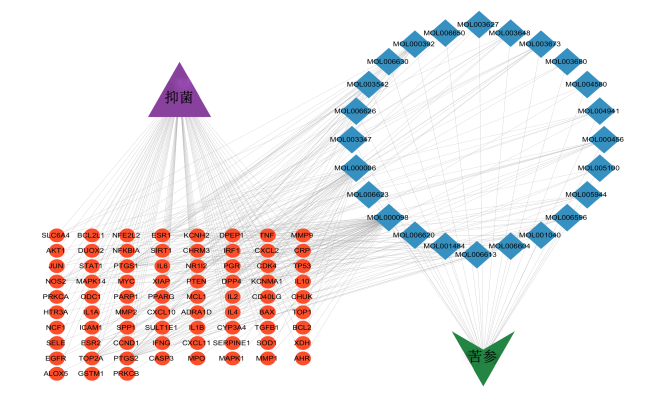
图3 药物-成分-疾病-靶点网络图苦参药效成分为蓝色菱形,苦参为绿色的V形,交集靶点为橙色圆形,抑菌为紫色三角形。 Fig.3 Drugs-ingredients-diseases-targets network diagram The blue diamonds represent the medicinal ingredients of Sophorae flavescentis Radix, the green V shape represents Sophorae flavescentis Radix, the orange circles represent the intersection targets, and the purple triangle represents bacteriostasis. |
表3 苦参药效成分对应的抑菌靶点Table 3 Antibacterial targets corresponding to medicinal ingredients of Sophorae flavescentis Radix |
| 药效成分 Medicinal ingredients | 抑菌靶点基因 Antibacterial target genes |
|---|---|
| 槲皮素 Quercetin | MMP2、BAX、BCL2、ALOX5、AHR、BCL2L1、CASP3、CD40LG、TP53、CRP、CXCL10、CXCL11、 CXCL2、CYP3A4、DPP4、TOP1、TOP2A、DUOX2、EGFR、SELE、SULT1E1、CCND1、GSTM1、 CHUK、ICAM1、IFNG、IRF1、IL-1α、IL-1β、IL-10、IL-2、IL-6、MMP1、MMP9、MAPK1、MYC、 MPO、NCF1、NFKBIA、NFE2L2、NR1I2、ODC1、SPP1、PPARG、PTEN、SERPINE1、 PARP1、KCNH2、PTGS1、PTGS2、PRKCA、PRKCB、AKT1、 STAT1、SOD1、JUN、TGFB1、TNF、XDH |
| 木犀草素 Luteolin | MMP2、XIAP、BCL2L1、CASP3、CD40LG、CDK4、TP53、DPP4、TOP1、TOP2A、EGFR、 CCND1、MCL1、ICAM1、IFNG、IL-10、IL-2、IL-4、IL-6、MMP1、MMP9、MAPK1、NFKBIA、 PPARG、PTGS1、PTGS2、AKT1、JUN、TNF、XDH |
| 刺芒柄花素 Formononetin | DPEP1、DPP4、ESR1、ESR2、IL-4、MAPK14、SIRT1、NOS2、PPARG、 PTGS1、PTGS2、SLC6A4、JUN |
| 8-异戊烯基山奈酚 8-isopentenyl-kaempferol | KCNMA1、DPP4、ESR1、MAPK14、PPARG、KCNH2、PTGS1、PTGS2 |
| 菜豆素 Phaseolin | ADRA1D、ESR1、ESR2、MAPK14、CHRM3、NOS2、PPARG、PTGS1、PTGS2 |
| Wighteone | DPP4、ESR1、ESR2、MAPK14、NOS2、PPARG、PTGS2 |
| 高丽槐素 Inermin | HTR3A、ADRA1D、CHRM3、PTGS1、PTGS2、SLC6A4 |
| 大豆抗毒素 Glyceollin | KCNMA1、ESR1、ESR2、NOS2、PTGS1、PTGS2 |
| 高丽槐素 Inermine | HTR3A、ADRA1D、CHRM3、PTGS1、PTGS2 |
| 甘草素 (2R)-7-hydroxy-2-(4-hydroxyphenyl)chroman-4-one | DPEP1、ESR1、PTGS1、PTGS2、SLC6A4 |
| 苦参素 Kushenin | DPP4、ESR1、ESR2、NOS2、PTGS1、PTGS2 |
| 异黄腐酚 (2S)-7-hydroxy-2-(4-hydroxyphenyl)-5-methoxy-8-(3-methylbut-2-enyl)chroman-4-one | ESR1、NOS2、KCNH2、PTGS2 |
| 苦参碱 Matrine | MMP2,CASP3、ICAM1、IL-6、MYC、TNF |
| 柚皮素 (2R)-5,7-dihydroxy-2-(4- hydroxyphenyl)chroman-4-one | DPEP1、ESR1、PGR、PTGS1、PTGS2 |
| 二氢黄酮甙 5,7-dihydroxy-2-(3-hydroxy-4- methoxyphenyl)chroman-4-one | PTGS1、PTGS2 |
| 里查酮G Leachianone G | ESR1、NOS2、PTGS2 |
| 花旗松素 Cis-dihydroquercetin | PTGS1、PTGS2 |
| 苦参醇J Kushenol J | PTGS1、PTGS2 |
| 贯叶金丝桃素 Hyperforin | CYP3A4、ICAM1、NR1I2 |
| 苦参醇T Kushenol T | PTGS2 |
| 桑叶活性黄酮 Norartocarpetin | PTGS1、PTGS2 |
| 槐果碱 Sophocarpine | IL-6、TNF |
| 槐定碱 Sophoridine | IL-6、TNF |
| (-)-maackiain-3-O-glucosyl-6'- O-malonate | TOP2A |
2.4 苦参抑菌的PPI网络图的构建
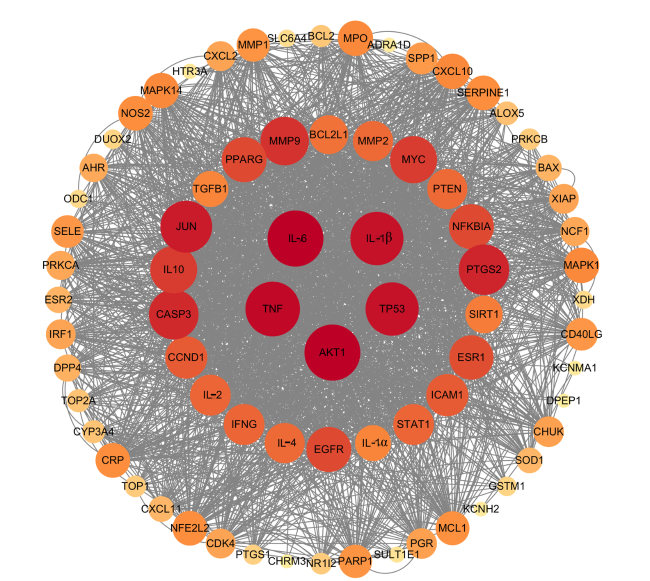
图4 苦参关键抑菌靶点PPI网络图通过拓扑分析,确定苦参抑菌相关靶点的PPI网络,颜色越深,圆圈越大,其度值越高。 Fig.4 PPI network of key antibacterial targets of Sophorae flavescentis Radix Through topological selection, the PPI network of targets related to the antibacterial effect of Sophorae flavescentis was determined, and the darker color, the bigger circle, the higher degree value. |
表4 苦参抑菌STRING网络关键抑菌靶点Table 4 Key antibacterial targets of STRING network of Sophorae flavescentis Radix |
| 序号 No. | 基因名称 Gene name | 度 Degree | 序号 No. | 基因名称 Gene name | 度 Degree | ||||||||
|---|---|---|---|---|---|---|---|---|---|---|---|---|---|
| 1 | AKT1 | 62 | 39 | CD40LG | 28 | ||||||||
| 2 | IL-6 | 62 | 40 | SELE | 28 | ||||||||
| 3 | TNF | 60 | 41 | SPP1 | 27 | ||||||||
| 4 | IL-1β | 58 | 42 | CHUK | 25 | ||||||||
| 5 | TP53 | 58 | 43 | PGR | 25 | ||||||||
| 6 | JUN | 56 | 44 | CDK4 | 24 | ||||||||
| 7 | PTGS2 | 54 | 45 | CXCL2 | 24 | ||||||||
| 8 | CASP3 | 53 | 46 | IRF1 | 24 | ||||||||
| 9 | MMP9 | 51 | 47 | XIAP | 24 | ||||||||
| 10 | MYC | 49 | 48 | NCF1 | 23 | ||||||||
| 11 | EGFR | 46 | 49 | PRKCA | 23 | ||||||||
| 12 | NFKBIA | 46 | 50 | AHR | 22 | ||||||||
| 13 | PPARG | 46 | 51 | DPP4 | 20 | ||||||||
| 14 | ESR1 | 45 | 52 | BAX | 19 | ||||||||
| 15 | CCND1 | 42 | 53 | ESR2 | 19 | ||||||||
| 16 | ICAM1 | 42 | 54 | CXCL11 | 18 | ||||||||
| 17 | IFNG | 40 | 55 | SOD1 | 18 | ||||||||
| 18 | IL-10 | 40 | 56 | ALOX5 | 15 | ||||||||
| 19 | IL-2 | 40 | 57 | CYP3A4 | 14 | ||||||||
| 20 | STAT1 | 40 | 58 | TOP2A | 14 | ||||||||
| 21 | IL-4 | 39 | 59 | BCL2 | 13 | ||||||||
| 22 | MMP2 | 39 | 60 | NR1I2 | 12 | ||||||||
| 23 | PTEN | 39 | 61 | PRKCB | 12 | ||||||||
| 24 | BCL2L1 | 37 | 62 | TOP1 | 12 | ||||||||
| 25 | SIRT1 | 35 | 63 | PTGS1 | 10 | ||||||||
| 26 | IL-1α | 33 | 64 | DUOX2 | 9 | ||||||||
| 27 | TGFB1 | 33 | 65 | GSTM1 | 9 | ||||||||
| 28 | CXCL10 | 32 | 66 | ODC1 | 7 | ||||||||
| 29 | MAPK1 | 32 | 67 | XDH | 7 | ||||||||
| 30 | MAPK14 | 32 | 68 | SLC6A4 | 6 | ||||||||
| 31 | MPO | 32 | 69 | SULT1E1 | 4 | ||||||||
| 32 | CRP | 31 | 70 | HTR3A | 3 | ||||||||
| 33 | NFE2L2 | 31 | 71 | ADRA1D | 2 | ||||||||
| 34 | NOS2 | 31 | 72 | KCNH2 | 2 | ||||||||
| 35 | SERPINE1 | 31 | 73 | KCNMA1 | 2 | ||||||||
| 36 | MCL1 | 30 | 74 | CHRM3 | 1 | ||||||||
| 37 | MMP1 | 29 | 75 | DPEP1 | 1 | ||||||||
| 38 | PARP1 | 29 | |||||||||||
2.5 苦参GO功能富集分析
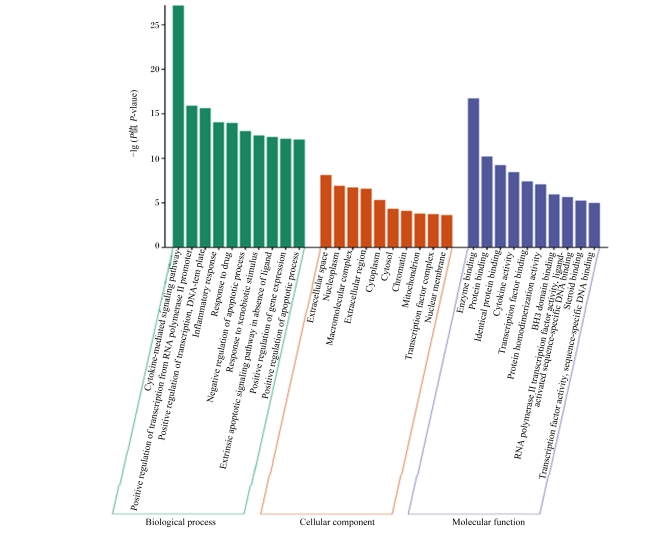
图5 苦参抑菌靶点的GO功能富集分析Biological process:生物过程;cytokine-mediated signaling pathway:细胞因子介导的信号通路;inflammatory response:炎症反应;response to drug:对药物的反应;negative regulation of apoptotic process:凋亡过程的负调控;response to xenobiotic stimulus:对异物刺激的反应;extrinsic apoptotic signaling pathway in absence of ligand:缺乏配体的外源性凋亡信号通路;positive regulation of gene expression:基因表达的正向调控;positive regulation of apoptotic process:凋亡过程的正调控; positive regulation of transcription from RNA polymerase Ⅱ promoter:RNA聚合酶Ⅱ启动子对pri-miRNA转录的正调控;positive regulation of transcription, DNA-template:转录的正调控,DNA模板;cellular component:细胞组分;extracellular space:细胞外空间;nucleoplasm:核质;macromolecular complex:大分子复合物;extracellular region:细胞外区;cytoplasm:细胞质;cytosol:胞质溶胶;chromatin:染色质;mitochondrion:线粒体;transcription factor complex:转录因子复合物;nuclear membrane:核膜;molecular function:分子功能;enzyme binding:酶结合;protein binding:蛋白结合;cytokine activity:细胞因子活性;transcription factor binding:转录因子结合;protein homodimerization activity:蛋白质同源二聚化活性;BH3 domain binding: BH3结构域结合;sequence-specific DNA binding:序列特异性DNA结合;identical protein binding:相同蛋白结合;RNA polymerase Ⅱ transcription factor activity, ligand-activated sequence-specific DNA binding:RNA聚合酶Ⅱ转录因子活性,配体激活特殊DNA结合序列;steroid binding:胆固醇结合。 Fig.5 GO functional enrichment analysis of antibacterial targets of Sophorae flavescentis Radix |
2.6 KEGG通路富集分析
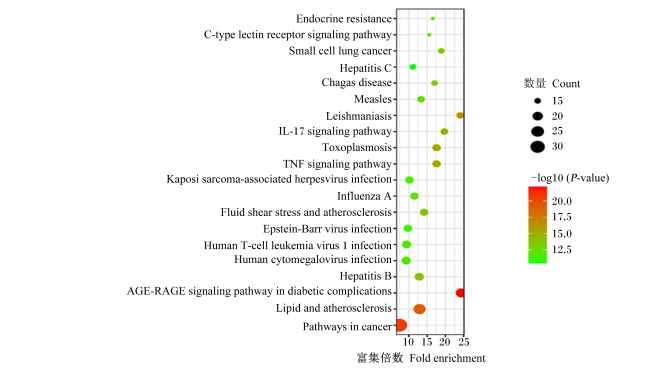
图6 苦参关键抑菌靶点KEGG通路富集分析TNF signaling pathway:肿瘤坏死因子信号通路;IL-17 signaling pathway:白细胞介素-17信号通路;C-type lectin receptor signaling pathway:C型凝集素受体信号通路;AGE-RAGE signaling pathway in diabetic complications:晚期糖基化终末化产物信号通路在糖尿病并发症中的作用;Pathways in cancer:癌症途径;Lipid and atherosclerosis:血脂和动脉粥样硬化;Leishmaniasis:利什曼病;Toxoplasmosis:弓形虫病;Hepatitis B:乙型肝炎;Small cell lung cancer:肺小细胞癌;Fluid shear stress and atherosclerosis:流体剪切应力与动脉粥样硬化;Chagas disease:美洲锥虫病;Measles:麻疹;Influenza A:甲型流感;Endocrine resistance:抵抗内分泌;Human T-cell leukemia virus 1 infection:人类T细胞白血病;Human cytomegalovirus infection:人类巨细胞病毒感染;Kaposi sarcoma-associated herpesvirus infection:卡波西肉瘤相关疱疹病毒;Epstein-Barr virus infection:EB病毒感染;Hepatitis C:丙型肝炎。 Fig.6 KEGG pathway enrichment analysis of key antibacterial targets of Sophorae flavescentis Radix |
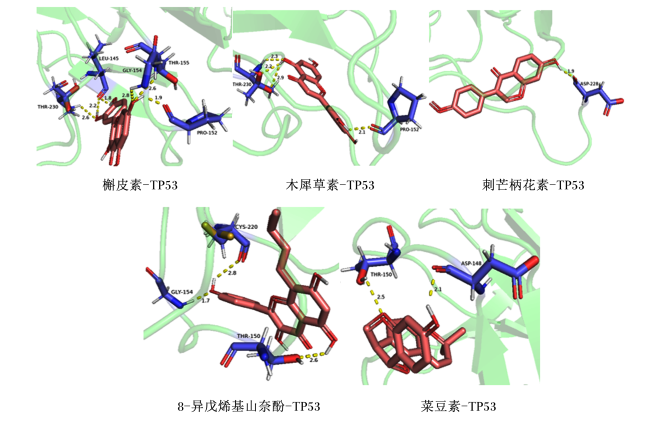
2.7 分子对接
表5 苦参核心药效成分与关键抑菌靶点的结合能Table 5 Binding energy of core medicinal ingredients of Sophorae flavescentis Radix and key antibacterial targetskcal/mol |
| 分子名称 Molecular names | 化学式 Chemical formula | PubChem 编号 PubChem ID | 与AKT1 结合能 AKT1 binding energy | 与IL-6 结合能 IL-6 binding energy | 与TNF 结合能 TNF binding energy | 与IL-1β 结合能 IL-1β binding energy | 与TP53 结合能 TP53 binding energy |
|---|---|---|---|---|---|---|---|
| 槲皮素 Quercetin | C15H10O7 | 5280343 | -11.05 | -7.38 | -12.37 | -9.57 | -11.00 |
| 木犀草素 Luteolin | C15H10O6 | 5280445 | -8.15 | -5.86 | -9.61 | -7.99 | -9.24 |
| 刺芒柄花素 Formononetin | C16H12O4 | 5280378 | -8.54 | -6.25 | -8.05 | -7.50 | -9.88 |
| 8-异戊烯基山奈酚 8-isopentenyl-kaempferol | C20H18O6 | 129716399 | -7.86 | -6.12 | -7.79 | -7.27 | -8.53 |
| 菜豆素 Phaseolin | C20H18O4 | 4063834 | -7.37 | -6.14 | -8.01 | -7.57 | -8.24 |
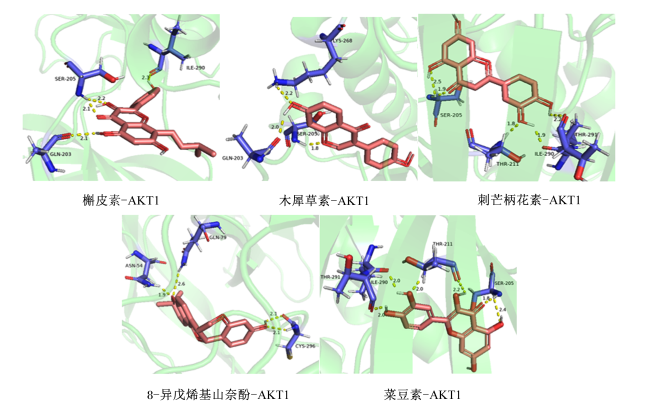
图7 AKT1与苦参核心药效成分分子对接3D图(结合能≤-5.0 kcal/mol)Fig.7 Molecular docking 3D diagram of AKT1 and core medicinal ingredients of Sophorae flavescentis Radix (binding energy≤-5.0 kcal/mol) |
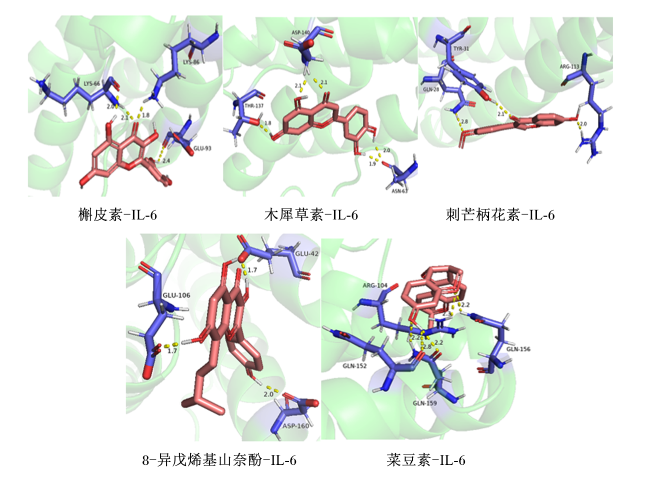
图8 IL-6与苦参核心药效成分分子对接3D图(结合能≤-5.0 kcal/mol)Fig.8 Molecular docking 3D diagram of IL-6 and core medicinal ingredients of Sophorae flavescentis Radix (binding energy≤-5.0 kcal/mol) |
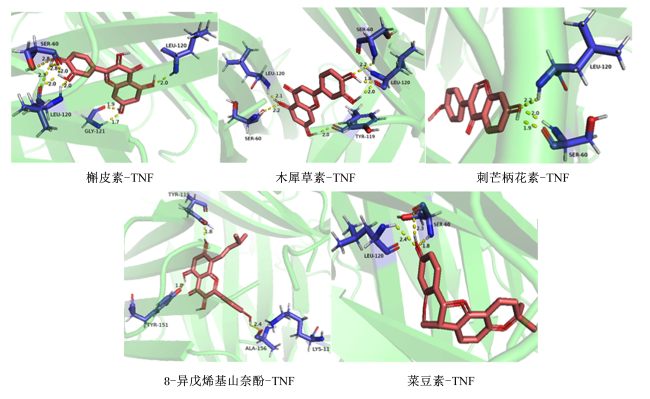
图9 TNF与苦参核心药效成分分子对接3D图(结合能≤-5.0 kcal/mol)Fig.9 Molecular docking 3D diagram of TNF and core medicinal ingredients of Sophorae flavescentis Radix (binding energy≤-5.0 kcal/mol) |
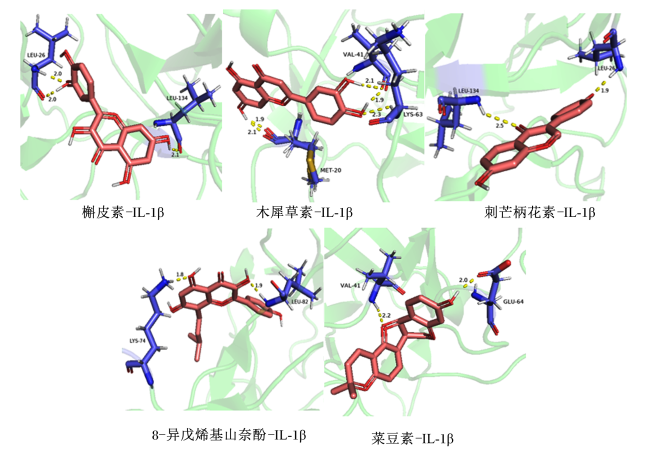
图10 IL-1β与苦参核心药效成分分子对接3D图(结合能≤-5.0 kcal/mol)Fig.10 Molecular docking 3D diagram of IL-1β and core medicinal ingredients of Sophorae flavescentis Radix (binding energy≤-5.0 kcal/mol) |
 京公网安备 11010802041926号


