综述

地衣芽孢杆菌的生物学功能及其作为青贮饲料添加剂的应用潜力

  • 任文义 ,
  • 程雨辰 ,
  • 何金童 ,
  • 徐晓锋 , *
展开
  • 宁夏大学动物科技学院,银川 750021
*徐晓锋,教授,博士生导师,E-mail:

任文义(1999—),男,河南洛阳人,硕士研究生,从事反刍动物营养与饲料科学研究。E-mail:

Office editor: 菅景颖

收稿日期: 2023-04-10

  网络出版日期: 2023-10-12

基金资助

国家自然科学基金项目(32160769)

Biological Functions of Bacillus licheniformis and Its Potential Application as Silage Additive

  • REN Wenyi ,
  • CHENG Yuchen ,
  • HE Jintong ,
  • XU Xiaofeng , *
Expand
  • College of Animal Science and Technology, Ningxia University, Yinchuan 750021, China
*professor, E-mail:

Received date: 2023-04-10

  Online published: 2023-10-12

摘要

青贮是调节反刍动物青饲料盈缺平衡、保存青饲料及减少贮藏过程中营养损耗的最佳方式。青贮饲料在生产和使用过程中,会受到多种霉菌毒素污染。青贮饲料中的霉菌毒素会对反刍动物的生产性能和健康产生不利影响,并危害人类健康。因此,有必要在青贮过程中选择合适的添加剂。目前,由于地衣芽孢杆菌具有提供优异特性功能性酶、益生菌功能以及生物脱氮、改善畜禽肠道健康和调节免疫力等生物学潜力,已被用于现代和可持续的农业系统中,但其作为青贮添加剂的应用甚少。因此,本文着重从地衣芽孢杆菌改善青贮发酵、抑制微生物腐败和霉菌毒素产生的潜在途径等方面进行综述,并提出未来的研究重点是关注地衣芽孢杆菌的特性和作用机制,以更好地实现其作为青贮饲料添加剂的潜在应用。

本文引用格式

任文义 , 程雨辰 , 何金童 , 徐晓锋 . 地衣芽孢杆菌的生物学功能及其作为青贮饲料添加剂的应用潜力[J]. 动物营养学报, 2023 , 35(10) : 6269 -6276 . DOI: 10.12418/CJAN2023.576

Abstract

Silage is the best method for regulating the balance of green forage for ruminant animals, preserving green forage, and reducing nutrient losses during storage. During the production and utilization of silage feed, contamination by various mycotoxins is a common issue. Mycotoxins in silage can negatively impact the performance and health of ruminant animals while also posing a risk to human health. Therefore, it is necessary to select suitable additives during the silage process. Currently, Bacillus licheniformis have been utilized in modern and sustainable agricultural systems due to their excellent functional enzymatic properties, probiotic functions, biological denitrification, improvement of animal gut health, and immune regulation. However, their application as silage additives is limited. Therefore, this article focused on reviewing the potential pathways of Bacillus licheniformis in improving silage fermentation, inhibiting microbial spoilage, and mycotoxin production, and it was suggested that future research should concentrate on the characteristics and mechanisms of Bacillus licheniformis to better realize their potential application as silage additives.

青贮饲料在收割、制作及使用过程中易受霉菌毒素的污染,对动物和人类健康带来很大危害,已经成为行业研究的一个热点。地衣芽孢杆菌(Bacillus licheniformis)是一种具有高度生物技术意义的革兰氏阳性内生孢子菌,具有许多潜在的用途,包括生产生物活性化合物(多糖类物质、酶类活性物质、脂肽类生物表面活性剂、杆菌肽以及小分子活性物质等),这些化合物被应用于广泛的领域,如水产养殖、农业、食品、生物医学和制药业[1-5]。由于新型基因操作工具的可行性,地衣芽孢杆菌作为生产酶和其他生物产品的表达载体也越来越受到关注[6]。此外,除了作为益生菌,对地衣芽孢杆菌的生物技术应用还包括生物絮凝、生物矿化和抗生物膜活性等[7-9]。研究表明,饲喂经地衣芽孢杆菌处理青贮饲料的动物产品对人类和环境安全[10]。地衣芽孢杆菌具有较强的蛋白酶、脂肪酶和淀粉酶活性,能促进饲料中营养成分的降解,使动物更充分地吸收和利用饲料。此外,地衣芽孢杆菌具有很强的降解纤维的能力,可显著提高饲料中中性洗涤纤维(NDF)和淀粉的消化率,进而提高饲料利用率[11-12]。目前,地衣芽孢杆菌在青贮饲料中应用的研究较少,其对青贮饲料的影响有待进一步研究。基于此,本文将主要介绍地衣芽孢杆菌改善青贮发酵、抑制微生物腐败和霉菌毒素产生的潜在途径,以期为地衣芽孢杆菌在青贮发酵中的合理利用提供参考依据。

1 地衣芽孢杆菌的生理学功能及其在青贮发酵过程中的应用潜力

青贮的主要原理是通过乳酸菌厌氧发酵快速达到低pH和维持厌氧条件。青贮过程可分为好氧阶段、发酵阶段、稳定阶段和饲喂阶段(图1)。好氧阶段植物细胞和需氧(兼性)微生物的呼吸活动会使青贮环境中的氧气迅速减少;发酵阶段开始时已是厌氧环境,不同种类的微生物(乳酸菌、肠杆菌、梭状芽孢杆菌和酵母菌)能够厌氧生长,竞争可用的营养物质,在保存良好的青贮饲料中,乳酸菌迅速主导发酵,乳酸的积累以及在较小程度上由糖(主要是葡萄糖、果糖和蔗糖)形成的乙酸的积累而导致pH降低;稳定阶段存活的微生物数量开始减少,一些耐酸微生物(如一些酵母菌)在此期间几乎处于非活性状态,其他微生物(如梭菌和杆菌)以孢子形式存活;饲喂阶段在青贮饲料暴露于空气时开始,青贮窖打开后暴露在空气中是不可避免的,此时极易由耐酸酵母菌引起有氧变质。
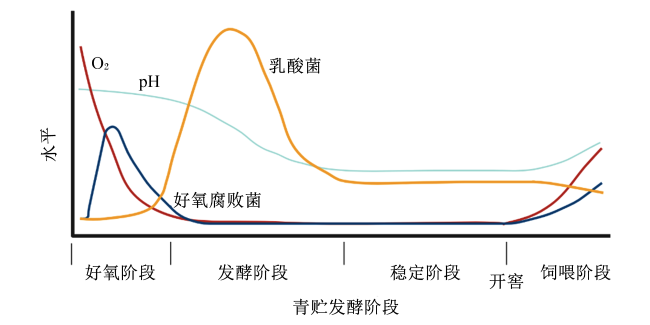
图1 青贮发酵阶段图

Fig.1 Ensilage fermentation stage diagram

1.1 地衣芽孢杆菌的无氧代谢

地衣芽孢杆菌作为兼性厌氧菌,可以通过感知环境中氧浓度来改变细胞代谢,其分泌的地衣素在有氧状态下能迅速消耗环境中的游离氧,产生强大的生物夺氧作用,快速创造厌氧环境[13]。在好氧微生物的有氧呼吸中,氧气通常作为电子传递链的最终受体。地衣芽孢杆菌尽管喜欢有氧生长,但其在厌氧条件下也能显示出很强的适应性[14]。厌氧呼吸过程中,硝酸盐或亚硝酸盐都可以作为地衣芽孢杆菌的电子受体[15-16],许多关键的转录因子,如ArcR、Fnr,参与调控厌氧呼吸的关键途径[17-18]。地衣芽孢杆菌在厌氧环境中表现出较好适应性的原因可能是由于其基因组中存在编码非氧依赖性核糖核苷酸还原酶的基因,该酶可将核糖核苷酸还原为脱氧核糖核苷酸(DNA合成所需的前体)。此外,地衣芽孢杆菌具有很强的通过一氧化氮还原酶途径进行无氧呼吸的能力。Shariat等[19]发现,地衣芽孢杆菌可利用葡萄糖在厌氧发酵下生成乙酸、2,3-丁二醇、乙醇、甲酸、乳酸、琥珀酸和丙酮酸等代谢产物;当硝酸盐存在时,地衣芽孢杆菌可利用葡萄糖在厌氧发酵下主要生成乙酸,也可以诱导甲酸盐-硝酸盐氧化还原酶系统生成甲酸,并且在加入硝酸盐时活性增加。然而,在有氧条件下,地衣芽孢杆菌没有这种活性。地衣芽孢杆菌的代谢产物中,乙酸、乙醇、乳酸和甲酸都可以改善青贮饲料的质量和有氧稳定性,2,3-丁二醇和琥珀酸不仅是发酵产品的风味成分,而且琥珀酸对人体健康有许多益处[20-23]

1.2 地衣芽孢杆菌的反硝化能力

过量的铵态氮(N H 4 +-N)、硝酸盐氮(N O 3 --N)和亚硝酸盐氮(N O 2 --N)可导致富营养化风险,并对人类造成持续威胁[24-26]。过量的一氧化二氮(N2O)排放到大气中会导致平流层臭氧消耗和全球温室效应[27]。青贮饲料中的硝酸盐可以威胁到动物健康以及动物产品的安全,甚至造成重大经济损失,减少青贮饲料中的硝酸盐是迫切需要解决的问题[28]。地衣芽孢杆菌对氮代谢具有很强的调节能力,这使其能够有效地将胞外无机氮转运到细胞中,并在酶的催化作用下将其同化为生物质。张洁[29]发现,不同碳源培养下的地衣芽孢杆菌对氮化合物具有反硝化作用,有利于减少反刍动物瘤胃中甲烷排放量,且微晶纤维素对于地衣芽抱杆菌氮化合物的反硝化作用具有促进作用。Jiang等[30]发现,地衣芽孢杆菌通过分泌脂肽类生物表面活性剂来提高好氧反硝化的膜通透性,随着膜通透性的提高,N O 3 --N和葡萄糖的膜转运速率加快,前者促进硝酸盐还原酶(NAR)获得更多的N O 3 --N,从而提高N O 3 --N的还原速率,后者导致更多的还原型烟酰胺腺嘌呤二核苷酸(NADH)生成。赵坤等[31]研究发现,地衣芽孢杆菌可以通过硝化作用将N H 4 +-N转化为N2O;可通过硝化或反硝化作用将N O 2 --N和N O 3 --N转化为N2O和氮气(N2)。因此,添加地衣芽孢杆菌可能有助于青贮过程中硝酸盐的降解。

1.3 地衣芽孢杆菌的功能酶和胞外多糖

酶制剂在动物饲料中的应用已经得到普及,可以提高营养物质的消化率,同时减少对环境的不利影响[32-33]。研究表明,地衣芽孢杆菌可以提高植酸酶活性,植酸酶可以有效降解植酸,进而释放被螯合的金属元素,改善矿物元素的生物利用率[34]。地衣芽孢杆菌能够生产非常广泛的酶,例如杆菌肽和地衣素,能够在食品制造等行业中充分发挥其生物催化功能。地衣芽孢杆菌的分泌组涉及大量不同化合物,包括脂质、多糖、蛋白质和其他物质,因此可以产生极高数量的不同酶。地衣芽孢杆菌是嗜热细菌,其生产的α-淀粉酶通常比从其他微生物(包括芽孢杆菌属其他物种)获得的α-淀粉酶更耐热,适宜温度范围在50~100 ℃[35-36]。其他从地衣芽孢杆菌获得酶,如β-葡萄糖苷酶、几丁质酶、内切葡聚糖酶和木聚糖酶,不仅具有高温稳定性,而且具有宽范围的pH耐受性,并且与地衣芽孢杆菌的来源无关[37-40]。Han等[41]研究发现,地衣芽孢杆菌能显著提高肉鸡空肠和回肠中α-淀粉酶、麦芽糖酶和蔗糖酶活性。地衣芽孢杆菌在肠道上部能迅速复活并分泌高活性的蛋白酶、脂肪酶、淀粉酶,有助于降解植物性饲料中某些复杂的碳水化合物,同时通过生物夺氧机制消耗肠道内氧气创造厌氧环境,有利于减少有害微生物数量,进而维持肠道生态平衡[42]
细菌胞外聚合物是细菌响应外界环境的刺激而合成并分泌到胞外的大分子物质,对细胞具有重要的生理意义。地衣芽孢杆菌具有较强的分泌胞外多糖的能力,eps基因簇是其参与胞外多糖合成的重要功能基因,其中epsK基因编码的蛋白EpsK作为一种跨膜转运蛋白在胞外聚合物的合成和分泌中起到关键调控作用[43]。陈震[44]发现,epsDEF基因簇的过表达可以促进地衣芽抱杆菌在稳定期胞外多糖的积累,同时发现gtaB-2基因为地衣芽孢杆菌合成胞外多糖的关键基因,其过表达可有效促进地衣芽孢杆菌胞外多糖的合成。Petrova等[45]在地衣芽孢杆菌中发现一种由半乳糖、葡萄糖和甘露糖组成的胞外多糖,具有良好的抗氧化和抗菌活性。Abinaya等[4]分离纯化的地衣芽孢杆菌的胞外多糖具有较强的抗氧化能力,且对革兰氏阴性菌具有很强的抗菌活性和抗生物被膜活性。地衣芽孢杆菌合成的胞外多糖具有多种调控因子,细胞通过对这些调控因子的控制来协调不同种类聚合物的合成,进而响应外界条件变化。因此,增加对地衣芽孢杆菌及其产生的胞外多糖生物聚合物能力的研究具有重要意义,胞外多糖的合成代谢机制及生物学功能仍需进一步深入研究。

2 地衣芽孢杆菌的抗真菌作用和霉菌毒素解毒能力

反刍动物被认为对霉菌毒素较不敏感,主要是因为瘤胃微生物群具有降解某些霉菌毒素的能力。然而,Gallo等[46]通过体外瘤胃发酵参数评估霉菌毒素在瘤胃环境中的稳定性时发现,随着霉菌毒素浓度的增加,产气量呈线性下降,总挥发性脂肪酸浓度呈二次方下降。有学者指出,霉菌毒素不仅对牛肠道健康造成潜在负面影响[47],还会影响奶牛血清γ-谷氨酰转肽酶活性和总抗氧化能力[48]。例如,饲喂含有霉变玉米粉和棉籽的饲粮能够会奶牛采食量、产奶量以及乳脂、乳蛋白和乳糖的产量[49]。Rocchetti等[50]报道,奶牛食用黄曲霉毒素污染的玉米青贮后,牛乳样品中氧化型谷胱甘肽含量显著积累,易导致机体氧化/抗氧化失衡。除此之外,为保证奶牛高产期营养需要,通常饲喂大量精料,这往往会造成瘤胃环境的酸化,减弱瘤胃微生物的解毒作用,使反刍动物对霉菌毒素更加敏感[51]。即使饲粮中黄曲霉毒素B1(AFB1)浓度很低,也可能导致基因毒性致癌物代谢物黄曲霉毒素M1(AFM1)从乳汁中排出,对人健康构成潜在威胁[52]

2.1 地衣芽孢杆菌的抗真菌作用

地衣芽孢杆菌能够分泌多种抗菌物质,具有抑制真菌的作用[53]。地衣芽孢杆菌可以产生多种酶,具有病原真菌广谱抗性。李娅楠[54]发现,添加地衣芽孢杆菌会改变微贮稻草中细菌和真菌的菌群结构,尤其是腐败菌和曲霉菌的丰度。Gong等[55]发现,茶树根系土壤中的芽孢杆菌TR-1具有广谱抗真菌活性。Ling等[56]从地衣芽孢杆菌发酵液中分理出具有抗真菌的丝氨酸蛋白酶成分,可以抑制辣椒疫霉、立枯丝核菌、禾谷镰刀菌、尖孢镰刀菌和灰霉菌的生长。地衣芽孢杆菌还具有产生几丁质酶的能力,几丁质是植物病原真菌细胞壁以及节肢动物、甲壳动物和线虫外骨骼的基本化合物。地衣芽孢杆菌产生的几丁质酶可以降解真菌细胞壁,破坏尖孢镰刀菌的活性[57],还可以通过菌丝肿胀和球状结构的改变抑制真菌植物病原菌[58-59]。Arbsuwan等[60]从木瓜中分离出的地衣芽孢杆菌可以产生细胞外抗菌物质,对重要的动植物病原体和腐败微生物具有抑制作用。Ul Hassan等[61]发现,地衣芽孢杆菌可以产生多种挥发性有机化合物,其中3-甲基-1-丁醇是含量最高的化合物,这些化合物具有广泛的生物活性,对曲霉和青霉的产毒菌株具有拮抗作用,适合作为抗真菌毒素的生物防治剂。

2.2 地衣芽孢杆菌的霉菌毒素解毒能力

物理和化学方法已广泛用于去除霉菌毒素,但这些方法可能降低饲料的营养品质和感官特性。霉菌毒素的微生物转化法与物理和化学方法相比,具有更高的特异性和环境友好性,是一种很有前途的霉菌毒素脱毒方法。地衣芽孢杆菌基因组序列中存在参与CotA漆酶生成的相关基因,可有效降解霉菌毒素。地衣芽孢杆菌中CotA漆酶不仅能够有效氧化AFB1,并将其分解为无毒产物黄曲霉毒素Q1(AFQ1)及其差向异构体(epiAFQ1),还可以有效降解玉米赤霉烯酮和链格孢霉毒素,锰离子(Mn2+)和铜离子(Cu2+)诱导和氧化还原介质可以增强CotA漆酶对玉米赤霉烯酮的降解能力[62-65]。Raksha等[66]研究发现,地衣芽孢杆菌可以减少94.7%的AFB1,并且可以丧失AFB1的致突变作用。地衣芽孢杆菌具有开发成饲料添加剂用于去除玉米赤霉烯酮的巨大潜力,在受玉米赤霉烯酮污染的玉米粉培养基中培养36 h后,地衣芽孢杆菌减少了98%以上的玉米赤霉烯酮。Wang等[67]从发霉的土壤样品中分离并鉴定了具有强大的呕吐毒素解毒能力的地衣芽孢杆菌菌株,可以在37 ℃条件下48 h内降解1 mg/L呕吐毒素的82.67%以上,并且在模拟胃液中具有很强的存活率和呕吐毒素降解率,还修复了呕吐毒素引起的肠道菌群失调。综上可知,地衣芽孢杆菌可能是在饲料青贮过程中对霉菌毒素进行生物修复和解毒的一个理想选择。

3 小结与展望

地衣芽孢杆菌能够加速青贮发酵进程,分泌生物酶等物质改变有害菌生物膜表面结构,破坏霉菌生长环境及营养供应,提高有害菌的抗生素敏感性,从而起到抑菌作用。目前,地衣芽孢杆菌由于缺乏生产数据在青贮发酵中尚未推广使用。未来,需要进一步深入研究地衣芽孢杆菌的作用机制和关键基因,以更好地应用于青贮饲料生产中。此外,开展对地衣芽孢杆菌品种和菌株的筛选和优化工作,选择具有较高生物活性和适应性的菌株用于实际生产。同时,还应加强对地衣芽孢杆菌与其他微生物的相互作用的研究,以最大限度地发挥其在青贮饲料中的效果。综合而言,地衣芽孢杆菌在青贮饲料领域的应用前景广阔,并有望为畜牧业的可持续发展作出积极贡献。
[1]
CHEN S J, YE W D, CLEMENTS K D, et al. Bacillus licheniformis FA6 affects zebrafish lipid metabolism through promoting acetyl-CoA synthesis and inhibiting β-oxidation[J]. International Journal of Molecular Sciences, 2023, 24(1):673.

DOI

[2]
LAM N T, SONG S X, DUNG B T N, et al. Potential role of combined microbial inoculants and plant of Limnocharis flava on eliminating cadmium from artificial contaminated soil[J]. Sustainability, 2022, 14(19):12209.

DOI

[3]
ARBSUWAN N, PAYOUNGKIATTIKUN W, SIRITHORN P, et al. Purification and characterization of macrolactins and amicoumacins from Bacillus licheniformis BFP011:a new source of food antimicrobial substances[J]. CyTA-Journal of Food, 2018, 16(1):50-60.

DOI

[4]
ABINAYA M, VASEEHARAN B, DIVYA M, et al. Structural characterization of Bacillus licheniformis Dahb1 exopolysaccharide-antimicrobial potential and larvicidal activity on malaria and Zika virus mosquito vectors[J]. Environmental Science and Pollution Research, 2018, 25(19):18604-18619.

DOI

[5]
XU Z X, CHEN G Q, XUE L, et al. Isolation,structural characterizations and bioactivities of exopolysaccharides produced by Bacillus licheniformis[J]. International Journal of Biological Macromolecules, 2019, 141:298-306.

DOI

[6]
LI K F, CAI D B, WANG Z Q, et al. Development of an efficient genome editing tool in Bacillus licheniformis using CRISPR-Cas9 nickase[J]. Applied and Environmental Microbiology, 2018, 84(6):e02608-e02617.

[7]
BISWAS J K, BANERJEE A, SARKAR B, et al. Exploration of an extracellular polymeric substance from earthworm gut bacterium (Bacillus licheniformis) for bioflocculation and heavy metal removal potential[J]. Applied Sciences, 2020, 10(1):349.

DOI

[8]
CHENG Y J, ZHANG T T, ZHANG L, et al. Resource recovery:adsorption and biomineralization of cerium by Bacillus licheniformis[J]. Journal of Hazardous Materials, 2022, 426:127844.

DOI

[9]
DÍAZ P R, TORRES M J, PETROSELLI G, et al. Antibacterial activity of Bacillus licheniformis B6 against viability and biofilm formation of foodborne pathogens of health importance[J]. World Journal of Microbiology and Biotechnology, 2022, 38(10):181.

DOI

[10]
EFSA Panel on Additives and Products or Substances used in Animal Feed FEEDAP, BAMPIDIS V, AZIMONTI G, et al. Safety and efficacy of Bacillus licheniformis DSM 32457 as a silage additive for all animal species[J]. EFSA Journal, 2019, 17(8):e05787.

[11]
MARA G, BECZE A, VARGA O, et al. Screening of multifunctional bacterial inoculants with lignocellulose degradation ability for agricultural applications[J]. Studia Universitatis “Vasile Goldiş”,Seria Ştiinȶele Vieȶi, 2016, 26(2):225-233.

[12]
OLIVEIRA C A, SOUSA D O, PENSO J F, et al. 1353 Effect of different doses of a Bacillus-based probiotic on the in vitro digestibility of concentrates and forages[J]. Journal of Animal Science, 2016, 94(Suppl.5):654.

[13]
PATTNAIK P, KAUSHIK J K, GROVER S, et al. Purification and characterization of a bacteriocin-like compound (Lichenin) produced anaerobically by Bacillus licheniformis isolated from water buffalo[J]. Journal of Applied Microbiology, 2001, 91(4):636-645.

DOI

[14]
CLEMENTS L D, MILLER B S, STREIPS U N. Comparative growth analysis of the facultative anaerobes Bacillus subtilis,Bacillus licheniformis,and Escherichia coli[J]. Systematic and Applied Microbiology, 2002, 25(2):284-286.

DOI

[15]
宁雪伟, 何贺贺, 李由然, 等. 亚/硝酸盐电子受体及全局厌氧调节因子Fnr对地衣芽孢杆菌厌氧生长及代谢的影响[J/OL]. 应用与环境生物学报:1-9.https://doi.org/10.19675/j.cnki.1006-687x.2022.08018.

NING X W, HE H H, LI Y R, et al. Effects of electron acceptor and global anaerobic regulator Fnr onanaerobic growth and metabolism of Bacillus licheniformis[J/OL]. Chinese Journal of Applied and Environmental Biology:1-9.https://doi.org/10.19675/j.cnki.1006-687x.2022.08018. (in Chinese)

[16]
LI J, DU C W, LIU Z Y, et al. Electrochemical studies of microbiologically influenced corrosion of X80 steel by nitrate-reducing Bacillus licheniformis under anaerobic conditions[J]. Journal of Materials Science&Technology, 2022, 118:208-217.

[17]
WOHLKÖNIG A, STALON V, VANDER WAUVEN C. Purification of ArcR,an oxidation-sensitive regulatory protein from Bacillus licheniformis[J]. Protein Expression and Purification, 2004, 37(1):32-38.

DOI

[18]
KLINGER A, SCHIRAWSKI J, GLASER P, et al. The fnr gene of Bacillus licheniformis and the cysteine ligands of the C-terminal FeS cluster[J]. Journal of Bacteriology, 1998, 180(13):3483-3485.

DOI

[19]
SHARIAT P, MITCHELL W J, BOYD A, et al. Anaerobic metabolism in Bacillus licheniformis NCIB 6346[J]. Microbiology, 1995, 141(5):1117-1124.

DOI

[20]
石子墨, 肖晴, 玉柱. 全株玉米青贮有氧稳定性研究进展[J]. 饲料工业, 2022, 43(23):14-19.

SHI Z M, XIAO Q, YU Z. Advances in aerobic stability of whole plant corn silage[J]. Feed Industry, 2022, 43(23):14-19. (in Chinese)

[21]
DONG Z H, ZHAO J, CHEN S F, et al. Effects of different additives on fermentation quality and aerobic stability of a total mixed ration prepared with local feed resources on Tibetan plateau[J]. Animal Science Journal, 2020, 91(1):e13482.

DOI

[22]
岳一轮, 秦晓威, 李付鹏, 等. 不同基因型可可发酵过程中挥发性香气成分变化规律研究[J/OL]. 热带作物学报:1-13. http://kns.cnki.net/kcms/detail/46.1019.S.20230203.1336.001.html.

YUE Y L, QIN X W, LI F P, et al. Analysis of volatile aroma components of different genotypes cococa beans during fermentation periods[J/OL]. Chinese Journal of Tropical Crops:1-13. http://kns.cnki.net/kcms/detail/46.1019.S.20230203.1336.001.html. in Chinese)

[23]
HE Q, ZHOU W, CHEN X Y, et al. Chemical and bacterial composition of Broussonetia papyrifera leaves ensiled at two ensiling densities with or without Lactobacillus plantarum[J]. Journal of Cleaner Production, 2021, 329:129792.

DOI

[24]
ISAKA K, KIMURA Y, OSAKA T, et al. High-rate denitrification using polyethylene glycol gel carriers entrapping heterotrophic denitrifying bacteria[J]. Water Research, 2012, 46(16):4941-4948.

DOI PMID

[25]
WU Z S, XU F, YANG C, et al. Highly efficient nitrate removal in a heterotrophic denitrification system amended with redox-active biochar:a molecular and electrochemical mechanism[J]. Bioresource Technology, 2019, 275:297-306.

[26]
EDWARDS T M, HAMLIN H J. Reproductive endocrinology of environmental nitrate[J]. General and Comparative Endocrinology, 2018, 265:31-40.

DOI PMID

[27]
CHAKERA A. Driving down embedded emissions from medical nitrous oxide[J]. BMJ, 2021, 375:n2922.

[28]
EFSA Panel on Contaminants in the Food Chain CONTAM,SCHRENK D, BIGNAMI M, et al. Risk assessment of nitrate and nitrite in feed[J]. EFSA Journal, 2020, 18(11):e06290.

[29]
张洁. 奶牛瘤胃地衣芽孢杆菌的分离鉴定及其对两种不同碳源的响应[D]. 硕士学位论文. 银川: 宁夏大学, 2021.

ZHANG J. Isolation and identification of Bacillus licheniformis from rumen of dairy cattle and its response to two different carbon sources[D]. Master’s Thesis. Yinchuan: Ningxia University, 2021. (in Chinese)

[30]
JIANG M, LI Q X, HU S Y, et al. Enhanced aerobic denitrification performance with Bacillus licheniformis via secreting lipopeptide biosurfactant lichenysin[J]. Chemical Engineering Journal, 2022, 434:134686.

DOI

[31]
赵坤, 田相利, 董双林, 等. 一株异养硝化-好氧反硝化地衣芽孢杆菌的脱氮特性及机制研究[J]. 中国海洋大学学报(自然科学版), 2020, 50(8):43-52.

ZHAO K, TIAN X L, DONG S L, et al. Nitrogen removal characteristic and mechanism of heterotrophic nitrifying-aerobic denitrifying Bacillus licheniformis[J]. Periodical of Ocean University of China (Natural Science Edition), 2020, 50(8):43-52. (in Chinese)

[32]
AURELI R, LA-MARTA J, GROSSI A B, et al. A novel glucuronoxylan hydrolase produced by fermentation is safe as feed additive:toxicology and tolerance in broiler chickens[J]. Regulatory Toxicology and Pharmacology, 2018, 99:213-224.

DOI

[33]
REBELLO S, BALAKRISHNAN D, ANOOPKUMAR A N, et al. Industrial enzymes as feed supplements-advantages to nutrition and global environment[M]//PARAMESWARAN B,VARJANI S,RAVEENDRAN S. Green bio-processes: Enzymes in Industrial Food Processing. Singapore: Springer, 2019:293-304.

[34]
TRELA J, KIEROŃCZYK B, RAWSKI M, et al. The effects of a Bacillus licheniformis and phytase mixture added to broiler diets on growth performance,nutrient digestibility,and cecal microecosystem[J]. Annals of Animal Science, 2023, 23(2):545-559.

DOI

[35]
VIHINEN M, MÄNTSÄLÄ P. Microbial amylolytic enzymes[J]. Critical Reviews in Biochemistry and Molecular Biology, 1989, 24(4):329-418.

PMID

[36]
IVANOVA V N, DOBREVA E P, EMANUILOVA E I. Purification and characterization of a thermostable alpha-amylase from Bacillus licheniformis[J]. Journal of Biotechnology, 1993, 28(2/3):277-289.

DOI

[37]
IBRAHIM D, ZHU H L, YUSOF N, et al. Bacillus licheniformis BT5.9 isolated from Changar Hot spring,Malang,Indonesia,as a potential producer of thermostable α-amylase[J]. Tropical Life Sciences Research, 2013, 24(1):71-84.

[38]
TOHARISMAN A, SUHARTONO M T, SPINDLER-BARTH M, et al. Purification and characterization of a thermostable chitinase from Bacillus licheniformis Mb-2[J]. World Journal of Microbiology and Biotechnology, 2005, 21(5):733-738.

DOI

[39]
SEO J K, PARK T S, KWON I H, et al. Characterization of cellulolytic and xylanolytic enzymes of Bacillus licheniformis JK7 isolated from the rumen of a native Korean goat[J]. Asian-Australasian Journal of Animal Sciences, 2013, 26(1):50-58.

DOI

[40]
ZAFAR A, AFTAB M N, DIN Z U, et al. Cloning,expression,and purification of xylanase gene from Bacillus licheniformis for use in saccharification of plant biomass[J]. Applied Biochemistry and Biotechnology, 2016, 178(2):294-311.

DOI

[41]
HAN Y S, XU X, WANG J X, et al. Dietary Bacillus licheniformis shapes the foregut microbiota,improving nutrient digestibility and intestinal health in broiler chickens[J]. Frontiers in Microbiology, 2023, 14:1113072.

DOI

[42]
FAN Y, WANG X L, WANG Y H, et al. Effect of dietary Bacillus licheniformis on growth,intestinal health,and resistance to nitrite stress in Pacific white shrimp Litopenaeus vannamei[J]. Aquaculture International, 2021, 29(6):2555-2573.

DOI

[43]
XU Y Y, YANG L J, WANG H Y, et al. Putative functions of EpsK in teichuronic acid synthesis and phosphate starvation in Bacillus licheniformis[J]. Synthetic and Systems Biotechnology, 2022, 7(2):815-823.

DOI

[44]
陈震. 地衣芽孢杆菌胞外多糖合成代谢机制研究与应用探索[D]. 博士学位论文. 厦门: 厦门大学, 2018.

CHEN Z. Metabolic mechanism and applications of the exopolysaccharide from Bacillus licheniformis[D]. Ph.D.Thesis. Xiamen: Xiamen University, 2018. (in Chinese)

[45]
PETROVA P, ARSOV A, IVANOV I, et al. New exopolysaccharides produced by Bacillus licheniformis 24 display substrate-dependent content and antioxidant activity[J]. Microorganisms, 2021, 9(10):2127.

DOI

[46]
GALLO A, GIUBERTI G, BERTUZZI T, et al. Study of the effects of PR toxin,mycophenolic acid and roquefortine C on in vitro gas production parameters and their stability in the rumen environment[J]. The Journal of Agricultural Science, 2015, 153(1):163-176.

DOI

[47]
REISINGER N, SCHÜRER-WALDHEIM S, MAYER E, et al. Mycotoxin occurrence in maize silage-A neglected risk for bovine gut health?[J]. Toxins, 2019, 11(10):577.

DOI

[48]
WANG Q, ZHANG Y D, ZHENG N, et al. The biochemical and metabolic profiles of dairy cows with mycotoxins-contaminated diets[J]. PeerJ, 2020, 8:e8742.

DOI

[49]
WU X F, GUO L Y, HUANG G X, et al. Effects of dietary natural mycotoxins exposure on performance,biochemical parameters and milk small molecule metabolic pathways of lactating cows[J]. Agriculture, 2022, 12(3):420.

DOI

[50]
ROCCHETTI G, GHILARDELLI F, BONINI P, et al. Changes of milk metabolomic profiles resulting from a mycotoxins-contaminated corn silage intake by dairy cows[J]. Metabolites, 2021, 11(8):475.

DOI

[51]
BOUDRA H. Mycotoxins:an insidiously menacing factor for the quality of forages and the performances of the ruminants[J]. Fourrages, 2009, 199:265-280.

[52]
KEMBOI D C, ANTONISSEN G, OCHIENG P E, et al. A review of the impact of mycotoxins on dairy cattle health:challenges for food safety and dairy production in sub-Saharan Africa[J]. Toxins, 2020, 12(4):222.

DOI

[53]
孔令露, 梁幸, 沈贺彬. 黄曲霉毒素B1脱毒技术的研究进展[J]. 福建农业科技, 2022, 53(11):74-81.

KONG L L, LIANG X, SHEN H B. Research progress on the detoxification technology of aflatoxin B1[J]. Fujian Agricultural Science and Technology, 2022, 53(11):74-81. (in Chinese)

[54]
李娅楠. 乳杆菌与地衣芽孢杆菌复合微贮对稻草营养价值影响及机理研究[D]. 硕士学位论文. 银川: 宁夏大学, 2022.

LI Y N. Effect and mechanism research of compound silage of Lactobacillus and Bacillus licheniformis on nutritional value of rice straw[D]. Master’s Thesis. Yinchuan: Ningxia University, 2022. (in Chinese)

[55]
GONG A D, SONG M G, WANG H L, et al. Inhibitory effect of volatile organic compounds from Bacillus flexus TR-1 against Aspergillus flavus and aflatoxins in grains during storage[J]. BioControl, 2023, 68(2):181-190.

DOI

[56]
LING L J, CHENG W T, JIANG K L, et al. The antifungal activity of a serine protease and the enzyme production of characteristics of Bacillus licheniformis TG116[J]. Archives of Microbiology, 2022, 204(10):601.

DOI

[57]
WON S J, CHOUB V, KWON J H, et al. The control of fusarium root rot and development of coastal pine (Pinus thunbergii Parl.) seedlings in a container nursery by use of Bacillus licheniformis MH48[J]. Forests, 2019, 10(1):6.

DOI

[58]
WON S J, KWON J H, KIM D H, et al. The effect of Bacillus licheniformis MH48 on control of foliar fungal diseases and growth promotion of Camellia oleifera seedlings in the coastal reclaimed land of Korea[J]. Pathogens, 2019, 8(1):6.

DOI

[59]
KWON J H, WON S J, MOON J H, et al. Bacillus licheniformis PR2 controls fungal diseases and increases production of jujube fruit under field conditions[J]. Horticulturae, 2021, 7(3):49.

DOI

[60]
ARBSUWAN N, SIRITHORN P, DADUANG S, et al. Purification and characterization of antimicrobial substances from Bacillus licheniformis BFP011[J]. Applied Biochemistry and Microbiology, 2014, 50(6):580-587.

DOI

[61]
UL HASSAN Z, AL THANI R, ALNAIMI H, et al. Investigation and application of Bacillus licheniformis volatile compounds for the biological control of toxigenic Aspergillus and Penicillium spp[J]. ACS Omega, 2019, 4(17):17186-17193.

DOI

[62]
GUO Y P, QIN X J, TANG Y, et al. CotA laccase,a novel aflatoxin oxidase from Bacillus licheniformis,transforms aflatoxin B1 to aflatoxin Q1 and epi-aflatoxin Q1[J]. Food Chemistry, 2020, 325:126877.

DOI

[63]
HE S, FENG K, DING T, et al. Complete genome sequence of Bacillus licheniformis BL-010[J]. Microbial Pathogenesis, 2018, 118:199-201.

DOI

[64]
SUN F, YU D Z, ZHOU H Y, et al. CotA laccase from Bacillus licheniformis ZOM-1 effectively degrades zearalenone,aflatoxin B1 and alternariol[J]. Food Control, 2023, 145:109472.

DOI

[65]
GUO Y P, WANG Y N, LIU Y R, et al. Detoxification of the mycoestrogen zearalenone by Bacillus licheniformis spore CotA laccase and application of immobilized laccase in contaminated corn meal[J]. LWT, 2022, 163:113548.

DOI

[66]
RAKSHA R K, VIPIN A V, HARIPRASAD P, et al. Biological detoxification of aflatoxin B1 by Bacillus licheniformis CFR1[J]. Food Control, 2017, 71:234-241.

DOI

[67]
WANG S W, HOU Q Q, GUO Q Q, et al. Isolation and characterization of a deoxynivalenol-degrading bacterium Bacillus licheniformis YB9 with the capability of modulating intestinal microbial flora of mice[J]. Toxins, 2020, 12(3):184.

DOI

文章导航

/