

1 材料与方法
1.1 试验试剂
 胨10 g、大豆胨3 g、酵母浸粉5 g、牛肉粉2.2 g、消化血清粉13.5 g、牛肝浸粉1.2 g、葡萄糖3 g、磷酸二氢钾(KH2PO4)2.5 g、可溶性淀粉5 g、L-半胱氨酸盐0.3 g、硫乙醇酸钠0.3 g,按照说明书配制后调节pH至6.8。
1.2 试验方法
1.2.1 大黄鱼肠道菌群的采集与处理
1.2.2 肠道菌群的体外培养
1.2.3 指标测定与分析
1.3 统计分析
2 结果与分析
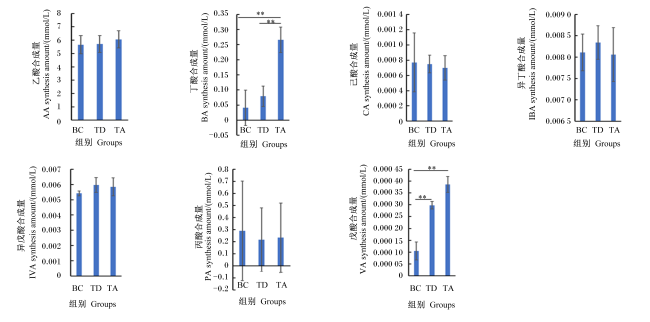
2.1 SCFAs合成量
2.2 肠道菌群结构特征
2.2.1 分组差异性分析
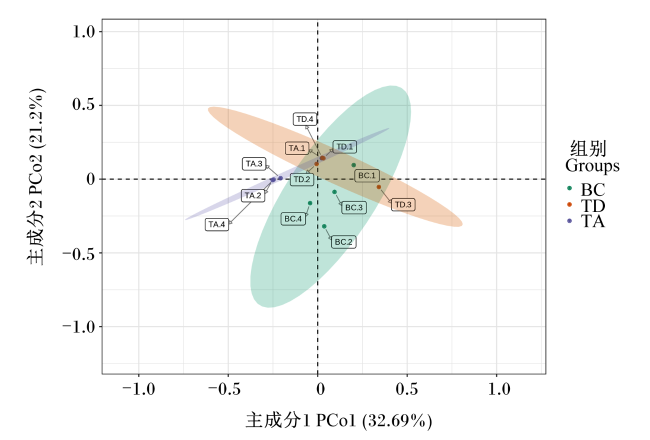
图2 大黄鱼肠道菌群体外不同条件下培养后的PCoA图基于Unweighted Unifrac距离的PCoA,方差分析:P=0.004。图中的每个点表示一个样本,同一个组的样本使用同一种颜色表示,颜色区域代表置信区间。 BC.1、BC.2、BC.3,BC.4为BC组的4个样本;TD.1、TD.2、TD.3、TD.4为TD的4个样本;TA.1、TA.2、TA.3、TA.4为TA组的4个样本。同一数字编号表示肠道菌群来自同一条大黄鱼。图7和图8同。 Fig.2 PCoA plot of Larimichthys crocea intestinal microflora after cultured under different conditions in vitro PCoA based on Unweighted Unifrac distance, ANOVA: P=0.004. Each point in the figure represents a sample, the samples of the same group are represented by the same color, and the color area represents the confidence interval. BC.1, BC.2, BC.3 and BC.4 are four samples from BC group; TD.1, TD.2, TD.3 and TD.4 are four samples from TD group; TA.1, TA.2, TA.3 and TA.4 are four samples from TA group. The same No. represents the intestinal flora comes from the same Larimichthys crocea. The same as Fig.7 and Fig.8. |
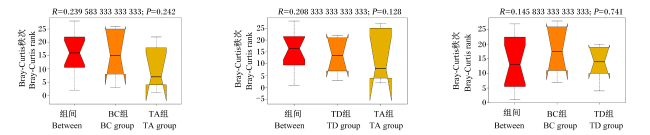
图3 大黄鱼肠道菌群体外不同条件下培养后的组间群落结构差异显著性检验Bray-Curtis Anosim分析:R介于-1和1之间。R>0,说明组间差异显著;R<0,说明组内差异大于组间差异;P值表示统计分析的可信度,P<0.05表示统计具有显著性。BC组vs TD组,R=-0.146,P=0.741;BC组vs TA组,R=0.240,P=0.242;TD组vs TA组,R=0.208,P=0.128。 Fig.3 Significance test for differences in community structure between groups of Larimichthys crocea intestinal microflora after cultured under different conditions in vitro Bray-Curtis Anosim analysis: R is between -1 and 1。 R>0, indicating significant difference between groups; R<0, indicating that the intra group difference is greater than the inter group difference. P-value indicates the reliability of statistical analysis, and P<0.05 indicates statistical significance. BC group vs TD group, R=-0.146, P=0.741; BC group vs TA group, R=0.240, P=0.242; TD group vs TA group, R=0.208, P=0.128. |
2.2.2 样本差异性分析
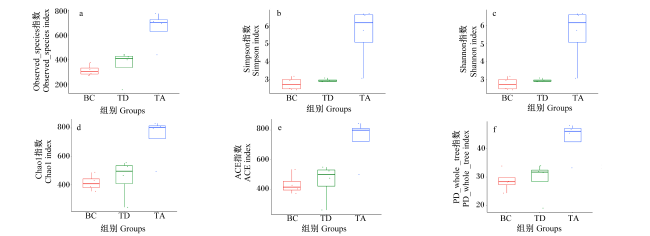
图4 大黄鱼肠道菌群体外不同条件下培养后的α多样性比较a:Observed_species指数组间差异箱形图;b:Shannon指数组间差异箱形图;c:Simpson指数组间差异箱形图;d:Chao1指数组间差异箱形图;e:ACE指数组间差异箱形图;f:PD_whole_tree指数组间差异箱形图。 Fig.4 Comparison on α diversity of Larimichthys crocea intestinal microflora after cultured under different conditions in vitro a: box chart of difference between groups of Observed_species index; b: box chart of difference between groups of Shannon index; c: box chart of difference between groups of Simpson index; d: box chart of difference between groups of Chao1 index; e: box chart of difference between groups of ACE index; f: box chart of difference between groups of PD_whole_tree index. |
2.2.3 菌群特征和变化
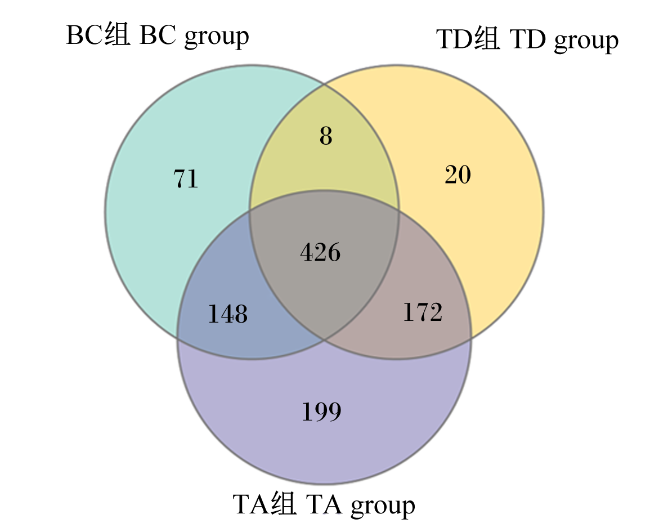
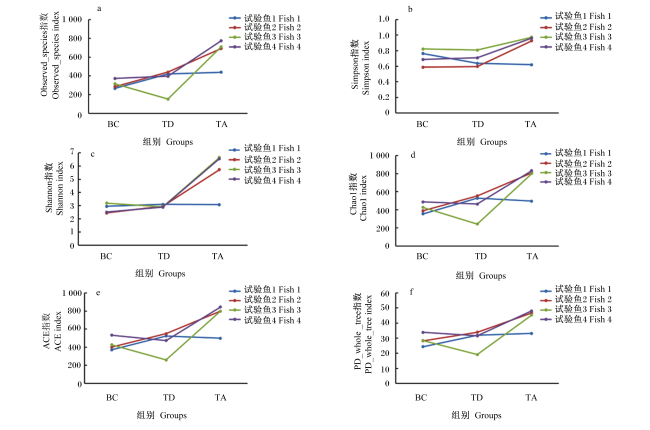
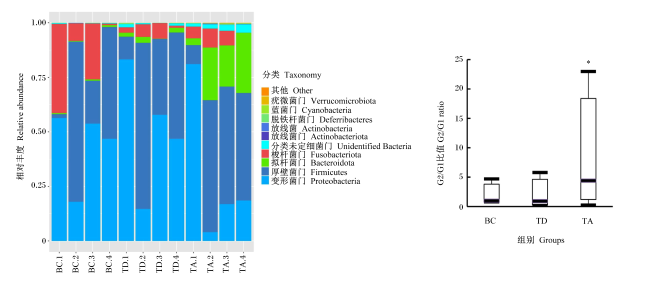
图7 大黄鱼肠道菌群体外不同条件下培养后主要优势菌门的相对丰度和功能群的转换其他表示图中给出的这10个菌门之外的其他所有门的相对丰度之和。G1:功能组1,为变形菌门相对丰度;G2:功能组2,为梭杆菌门、厚壁菌门和拟杆菌门相对丰度之和。“*”表示与BC组相比差异显著(P<0.05)。 Fig.7 Relative abundance of main dominant bacterial phyla and conversion of functional group of Larimichthys crocea intestinal microflora after cultured under different conditions in vitro Other represents the sum of relative abundances except the 10 bacterial phyla listed in the figure. G1: functional group1, which is the relative abundance of Proteobacteria; G2: functional group 2, which is the sum of relative abundances of Fusobacteriota, Firmicutes and Bacteroidetes.“*” mean significant difference compared with BC group (P<0.05). |
2.2.4 生物标志物分析
2.3 SCFAs合成与肠道菌群的相关性
2.3.1 丁酸与肠道菌群的相关性
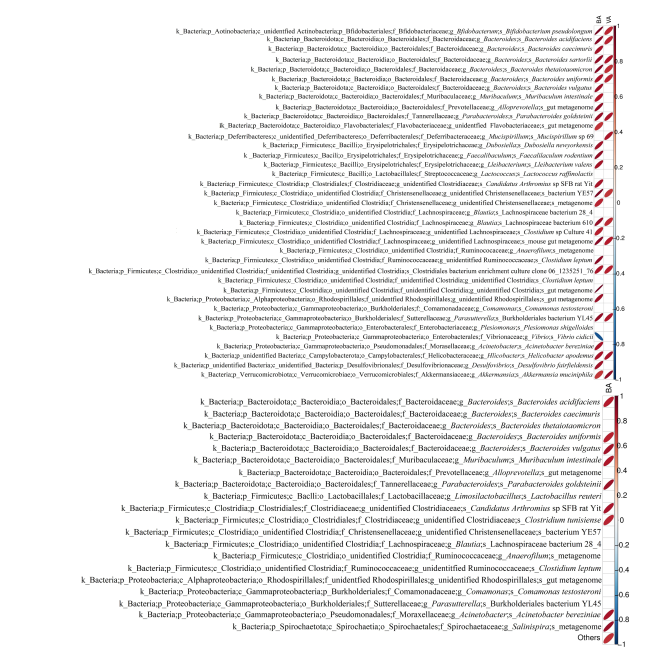
图9 大黄鱼肠道菌群差异代谢物(丁酸:BC组vs TA组、TD组vs TA组;戊酸:BC组vs TA组)与差异微生物的Spearman相关性热图上图:BC组vs TA组;下图:TD组vs TA组。红色椭圆表示正相关,蓝色椭圆表示负相关。相关性绝对值越大,椭圆越细。空白格子表示相关性不显著(P>0.05)。从左到右分别为微生物的不同分类水平,包括界(k_)、门(p_)、纲(c_)、目(o_)、科(f_)、属(g_)、种(s_)。BA:丁酸;VA:戊酸。Above figure: BC group vs TA group; below figure: TD group vs TA group. The red ellipse indicates positive correlation, and the blue ellipse indicates negative correlation. The greater the absolute value of correlation, the thinner the ellipse. The blank grid indicates that the correlation is not significant (P>0.05). From left to right, there are different classification levels of microorganisms, including kingdom (k_), phylum (p_), class (c_), order (o_), family (f_), genus (g_) and species (s_).BA: butyric acid; VA: valeric acid. Aotinobacteria:放线菌门;unidentified Actinobacteria:放线菌门未确定纲;Bfidobacteria:双歧杆菌目;Bfidobacteriaceae:双歧杆菌科;Bfidobacterum:双歧杆菌属;Bifidobacterium pseudolongum:假长双歧杆菌;Bacteroidota:拟杆菌门;Bacteroidia:拟杆菌纲;Bacteroidales:拟杆菌目;Bacteroidaceae:拟杆菌科;Bacteroides:拟杆菌属;Bacteroides acidifaciens:产酸拟杆菌;Bacteroides caecimuris:盲肠拟杆菌;Bacteroides sartorii:赛多利拟杆菌;Bacteroides thetaiotaomicron:多形拟杆菌;Bacteroides uniformis:单形拟杆菌;Bacteroides vulgatus:普通拟杆菌;Prevotellaceae:普雷沃氏菌科;Alloprevotella:异普雷沃氏菌属;gut metagenome:肠道宏基因组;Tannerellaceae:鞣菌科;Parabacteroides:副拟杆菌属;Parabacteroides goldsteinii:金氏类拟杆菌;Muribaculum intestinale:肠鼠杆菌;Flavobacteriales:黄杆菌目;Flavobacteriaceae:黄杆菌科;unidentified Flavobacteriaceae:黄杆菌科未确定属;Deferribacteres:脱铁杆菌门;unidentified Deferribacteres:脱铁杆菌门未确定纲;Deferribacteres:脱铁杆菌目;Deferribacteraceae:脱铁杆菌科;Mucispirillum:黏液螺旋菌属;Mucispirillum sp 69:黏液螺旋菌属69亚种;Firmicutes:厚壁菌门;Bacili:芽孢杆菌纲;Erysipelotrichales:丹毒丝菌目;Erysipelotrichaceae:丹毒丝菌科;Dubosella:杜波西氏菌属;Dubosiella newyorkensis:纽约杜波西氏菌;Faecalibaculum:栖粪杆菌属;Faecalibaculum rodentum:地鼠栖粪杆菌;Lleibacterium:回肠杆菌属;Lleibacterium valens:瓦伦斯回肠杆菌;Lactobacilales:乳杆菌目;Streptococcaceae:链球菌科;Lactococcus:乳球菌属;Lactococcus raffinolactis:棉子糖乳球菌;Lactobacillaceae:乳杆菌科;Limosilactobacillus:利莫西乳杆菌属;Lactobacillus reuteri:罗伊氏乳杆菌;Clostridia:梭菌纲;Clostidiales:梭菌目;Clostridiaceae:梭菌科;unidentified Clostidiaceae:梭菌科未确定属;Candidatus Arthromitus sp. SFB rat Yit:关节假丝酵母种SFB rat Yit亚种;Clostridium tunisiense:突尼斯梭菌;unidentifid Lachnospiraceae:毛螺菌科未确定属;Clostridium sp Culture 41:梭菌属41培养菌亚种;mouse gut metagenome:鼠肠道宏基因组;unidentified Clostidiales:梭菌纲未确定目;Ruminococcaceae:瘤胃球菌科;Anaerofilum:细杆菌属;unidentitfied Ruminococaceae:瘤胃球菌科未确定属;Clostidium leptum:柔嫩梭菌;Christensenellaceae:克里斯滕森菌科;unidentified Christensenellaceae:克里斯滕森菌科未确定属;bacterium YE57:YE57菌;Lachnospiraceae:毛螺菌科;Blautia:布劳特氏菌属;Lachnospiraceae bacterium 28_4:毛螺菌科28_4菌;Lachnospiraceae bacterium 610:毛螺菌科610菌;Proteobacteria:变形菌门;Alphaproteobacteria:α-变形菌纲;Rhodospirillales:红螺菌目;unidentified Rhodospirillales:红螺菌目未确定科;unidentified Rhodospirillales:红螺菌目未确定科;Gammaproteobacteria:γ-变形菌纲;Burkholderiales:伯克氏菌目;Comamonadaceae:丛毛单胞菌科;Comamonas:丛毛单胞菌属;Comamonas testosteroni:睾丸酮丛毛单胞菌;Sutterellaceae:萨特氏菌科;Parasutterella:帕拉苏特氏菌属;Burkholderiales bacterium YL45:伯克霍尔德氏菌目YL45菌;Moraxellaceae:莫拉菌科;Acinetobacter:不动杆菌属;Acinetobacter bereziniae:别氏不动杆菌;Spirochaetota:螺旋体门;Spirochaetia:螺旋体纲;Spirochaetales:螺旋体目;Spirochaetaceae:螺旋体科;Salinispira:螺旋体属;metagenome:宏基因组;Others:其他。 Fig.9 Heatmap of Spearman correlation between differential metabolites (butyric acid: BC group vs TA group, TD group vs TA group; valeric acid: BC group vs TA group) and differential microorganisms of Larimichthys crocea intestinal microflora |
2.3.2 戊酸与肠道菌群的相关性
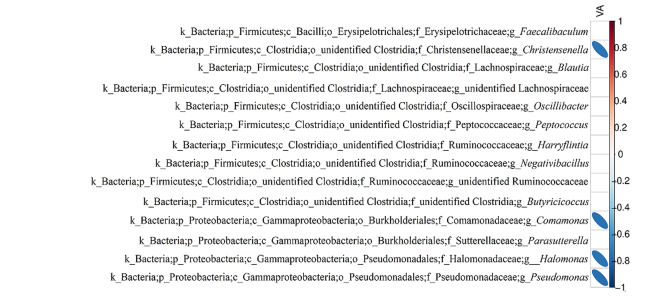
图10 大黄鱼肠道菌群差异代谢物戊酸(BC组vs TD组)与差异微生物的Spearman相关性热图红色椭圆表示正相关,蓝色椭圆表示负相关。相关性绝对值越大,椭圆越细。空白格子表示相关性不显著(P>0.05)。从左到右分别为微生物的不同分类水平,包括界(k_)、门(p_)、纲(c_)、目(o_)、科(f_)、属(g_)。VA:戊酸。The red ellipse indicates positive correlation, and the blue ellipse indicates negative correlation. The greater the absolute value of correlation, the thinner the ellipse. The blank grid indicates that the correlation is not significant (P>0.05). From left to right, there are different classification levels of microorganisms, including kingdom (k_), phylum (p_), class (c_), order (o_), family (f_) and genus (g_). VA: valeric acid. Harryflintia:哈里夫林氏菌属;unidentified Ruminococcaceae:瘤胃球菌科未确定属;Christensenella:克里斯滕森菌属;unidentified Lachnospiraceae:毛螺菌科未确定属;Oscillospiraceae:颤螺旋菌科;Oscillibacter:颤杆菌克属;Peptococcaceae:消化球菌科;Peptococcus:消化球菌属;unidentified Clostidia:梭菌目未确定科;Butyricicoccus:丁酸球菌属;Pseudomonadaceae:假单胞菌科;Pseudomonas:假单胞菌属;Halomonadaceae:嗜盐性单胞菌科;Halomonas:嗜盐性单胞菌属。 Fig.10 Heatmap of Spearman correlation between differential metabolite valeric acid (BC group vs TD group) and differential microorganisms of Larimichthys crocea intestinal microflora |
 京公网安备 11010802041926号


