研究论文

复合酸对肉鸡生长性能、屠宰性能、血清免疫指标及盲肠菌群结构的影响

  • 林苗 ,
  • 肖亚红 ,
  • 张谚鹏 ,
  • 温刘发 , *
展开
  • 华南农业大学动物科学学院,广州 510642
* 温刘发,副教授,硕士生导师,E-mail:

林 苗(1996—),女,海南海口人,硕士研究生,畜牧专业,研究方向为饲料添加剂的开发与应用。E-mail:

Copy editor: 菅景颖

收稿日期: 2023-05-31

  网络出版日期: 2023-11-12

Effects of Compound Acid on Growth Performance, Slaughtering Performance, Serum Immune Indexes and Cecal Microflora Structure of Broilers

  • LIN Miao ,
  • XIAO Yahong ,
  • ZHANG Yanpeng ,
  • WEN Liufa , *
Expand
  • College of Animal Science, South China Agricultural University, Guangzhou 510642, China
* associate professor, E-mail:

Received date: 2023-05-31

  Online published: 2023-11-12

摘要

本试验旨在研究饲粮中添加由腐殖酸钠、三丁酸甘油酯、苯甲酸和单宁酸组成的复合酸对肉鸡生长性能、屠宰性能、血清免疫指标及盲肠菌群结构的影响。选用1 800只56日龄、体况相近的健康文昌鸡(母),完全随机分为10组,每组5个重复,每个重复36只鸡。各组分别饲喂基础饲粮(Ⅰ组,作为对照组)和添加复合酸的试验饲粮(Ⅱ~Ⅹ组),腐殖酸钠、三丁酸甘油酯、苯甲酸和单宁酸添加量在Ⅱ组分别为250、350、500和200 g/t,在Ⅲ组分别为250、700、1 000和400 g/t,在Ⅳ组分别为250、1 050、1 500和600 g/t,在Ⅴ组分别为500、350、1 000和600 g/t,在Ⅵ组分别为500、700、1 500和200 g/t,在Ⅶ组分别为500、1 050、500和400 g/t,在Ⅷ组分别为750、350、1 500和400 g/t,在Ⅸ组分别为750、700、500和600 g/t,在Ⅹ组分别为750、1 050、1 000和200 g/t。试验期35 d(56~91日龄)。结果显示:1)与Ⅰ组相比,Ⅲ、Ⅴ、Ⅵ、Ⅶ、Ⅷ和Ⅸ组肉鸡的平均日采食量均显著提高(P<0.05)。2)与Ⅰ组相比,Ⅲ组肉鸡的腿肌率显著提高(P<0.05)。3)与Ⅰ组相比,Ⅱ和Ⅲ组肉鸡的血清免疫球蛋白A和免疫球蛋白M含量极显著提高(P<0.01),Ⅱ组肉鸡的血清免疫球蛋白G含量也极显著提高(P<0.01)。4)与Ⅰ组相比,Ⅲ组变形菌门(Proteobacteria)的相对丰度显著降低(P<0.05),乳杆菌属(Lactobacillus)的相对丰度显著提高(P<0.05)。综上所述,在本试验条件下,饲粮中添加由250 g/t腐殖酸钠、700 g/t三丁酸甘油酯、1 000 g/t苯甲酸和400 g/t单宁酸组成的复合酸可改善56~91日龄文昌鸡的生长性能和屠宰性能,提高机体特异性免疫水平,改善盲肠菌群结构。

本文引用格式

林苗 , 肖亚红 , 张谚鹏 , 温刘发 . 复合酸对肉鸡生长性能、屠宰性能、血清免疫指标及盲肠菌群结构的影响[J]. 动物营养学报, 2023 , 35(11) : 7024 -7035 . DOI: 10.12418/CJAN2023.640

Abstract

The purpose of this experiment was to study the effects of dietary compound acid composed of sodium humate, glycerol tributyrate, benzoic acid and tannic acid on growth performance, slaughtering performance, serum immune indexes and cecal microflora structure of broilers. A total of 1 800 Wenchang chickens (female) at 56 days of age with similar physical condition were randomly divided into 10 groups with 5 replicates in each group and 36 chickens in each group. Each group was fed with a basal diet (group Ⅰ, as control group) and experimental diets supplemented with compound acid (groupsⅡ to Ⅹ). The addition amounts of sodium humate, glycerol tributyrate, benzoic acid and tannic acid in group Ⅱ were 250, 350, 500 and 200 g/t, while those in group Ⅲ were 250, 700, 1 000 and 400 g/t, in group Ⅳ were 250, 1 050, 1 500 and 600 g/t, in group Ⅴ were 500, 350, 1 000 and 600 g/t, in group Ⅵ were 500, 700, 1 500 and 200 g/t, in group Ⅶ were 500, 1 050, 500 and 400 g/t, in group Ⅷ were 750, 350, 1 500 and 400 g/t, in group Ⅸ were 750, 700, 500 and 600 g/t, and in group Ⅹ were 750, 1 050, 1 000 and 200 g/t, respectively. The experimental period lasted for 35 days (56 to 91 days of age). The results showed as follows: 1) compared with groupⅠ, the average daily feed intake of broilers in groups Ⅲ, Ⅴ, Ⅵ, Ⅶ, Ⅷ and Ⅸ was significantly increased (P<0.05). 2) Compared with the group Ⅰ, the leg muscle rate of broilers in group Ⅲ was significantly increased (P<0.05). 3) Compared with the group Ⅰ, the contents of serum immunoglobulin A (IgA) and immunoglobulin M (IgM) in groups Ⅱ and Ⅲ were extremely significantly increased (P<0.01), while the content of serum immunoglobulin G (IgG) in group Ⅱ was also extremely significantly increased (P<0.01). 4) Compared with the group Ⅰ, the relative abundances of Proteobacteria was significantly decreased (P<0.05), and the relative abundance of Lactobacillus was significantly increased in group Ⅲ (P<0.05). To sum up, under the condition of this experiment, supplemented with compound acid (composed of 250 g/t sodium humate, 700 g/t glycerol tributyrate, 1 000 g/t benzoic acid at and 400 g/t tannic acid) in the diet can significantly improve the growth performance and slaughtering performance, increase the level of specific immune and improve the structure of cecal microflora of 56 to 91 days old Wenchang chickens.

酸化剂可调节畜禽免疫功能[1]、改善肠道微生态[2-3]、提高营养物质消化率和生长性能[4],作为一种无毒无害的新型绿色饲料添加剂和替抗产品,在畜牧生产中已经得到了广泛的应用。腐殖酸钠复杂的结构使其具有较强的络合作用、离子交换及吸附作用,应用于畜牧生产中能提高动物生产性能,增强抗病能力,还具有抗菌抑菌、吸附脱毒等作用[5]。三丁酸甘油酯能为肠道上皮细胞供能[6-7],还能通过改善肠道形态、减少炎症反应[8-9]、抑制病原菌生长、促进益生菌的增殖来调节肠道菌群平衡[10]。苯甲酸具有抗菌、提高营养物质利用率、维持肠道微生态平衡、减少免疫防御应激反应等作用[11-13]。单宁酸在动物生产中具有良好的抗腹泻、抑菌杀菌、抗氧化、抗炎症和改善肠道健康的作用[14-15],适量的单宁酸能够改善动物的营养和健康状况。目前,国内外对肉鸡饲粮中单独添加腐殖酸钠、三丁酸甘油酯、苯甲酸和单宁酸的效果已有一定研究,但将其复合添加于肉鸡饲粮的研究报道较少。为此,本试验通过探究不同配比的腐殖酸钠、三丁酸甘油酯、苯甲酸和单宁酸组成的复合酸对肉鸡生长性能、屠宰性能、血清免疫指标以及盲肠菌群结构的影响,以确定复合酸中腐殖酸钠、三丁酸甘油酯、苯甲酸和单宁酸的最佳配比,为科学合理地设计酸化剂的组合配伍及适宜添加量提供参考。

1 材料与方法

1.1 试验材料

腐殖酸钠,由北京某生物技术有限责任公司提供,有效含量≥50%;三丁酸甘油酯,为瑞典某公司产品,有效含量≥51.4%;苯甲酸,由荷兰某公司生产,有效含量≥99.5%;单宁酸,由上海某生物化工有限公司提供,有效含量≥37.5%。

1.2 试验设计

选用1 800只56日龄文昌鸡(母),完全随机分为10组,每组5个重复,每个重复36只鸡。试验鸡采用笼养,试验期35 d(56~91日龄)。本试验采用正交试验设计方法,以腐殖酸钠(250、500和750 g/t)、三丁酸甘油酯(350、700、1 050 g/t)、苯甲酸(500、1 000、1 500 g/t)和单宁酸(200、400、600 g/t)为4个试验因子,每个因子各有3个水平,选用L9(34)正交试验表设计得到9个正交试验组,具体见表1
表1 试验设计

Table 1 Experiment design

组别Groups 饲粮Diets
Ⅰ(对照Control) 基础饲粮
基础饲粮+250 g/t A+350 g/t B+500 g/t C+200 g/t D
基础饲粮+250 g/t A+700 g/t B+1 000 g/t C+400 g/t D
基础饲粮+250 g/t A+1 050 g/t B+1 500 g/t C+600 g/t D
基础饲粮+500 g/t A+350 g/t B+1 000 g/t C+600 g/t D
基础饲粮+500 g/t A+700 g/t B+1 500 g/t C+200 g/t D
基础饲粮+500 g/t A+1 050 g/t B+500 g/t C+400 g/t D
基础饲粮+750 g/t A+350 g/t B+1 500 g/t C+400 g/t D
基础饲粮+750 g/t A+700 g/t B+500 g/t C+600 g/t D
基础饲粮+750 g/t A+1 050 g/t B+1 000 g/t C+200 g/t D

表中,A表示腐殖酸钠,B表示三丁酸甘油酯,C表示苯甲酸,D表示单宁酸。表4同。

In the table, A represents sodium humate, B represents glycerol tributyrate, C represents benzoic acid and D represents tannic acid. The same as Table 4.

1.3 基础饲粮与饲养管理

参照《鸡饲养标准》(NY/T 33—2004)设计肉鸡基础饲粮,基础饲粮组成及营养水平见表2。饲粮粗蛋白质、粗脂肪、钙、总磷、赖氨酸、蛋氨酸、苏氨酸和食盐含量参照相应国标方法测定。饲养试验于惠州京基致农畜牧有限公司进行。试验前将鸡舍冲洗干净,严格消毒,自由采食和饮水,每天24 h光照,免疫程序按鸡场规程进行。每日08:00加料,记录投料量。
表2 基础饲粮组成及营养水平(风干基础)

Table 2 Composition and nutrient levels of the basal diet (air-dry basis) %

原料Ingredients 含量Content 营养水平Nutrient levels2) 含量Content
玉米Corn 68.40 代谢能ME/(MJ/kg) 11.81
小麦麸Wheat bran 3.50 粗蛋白质CP 17.50
豆粕Soybean meal 21.00 粗脂肪EE 2.80
赖氨酸Lys 0.30 钙Ca 0.92
蛋氨酸Met 0.20 总磷TP 0.50
贝壳粉Shell powder 1.50 有效磷AP 0.32
磷酸氢钙CaHPO4 1.70 赖氨酸Lys 0.80
食盐NaCl 0.40 食盐NaCl 0.40
预混料Premix1) 3.00 蛋氨酸Met 0.38
合计Total 100.00 苏氨酸Thr 0.63

1)预混料为每千克饲粮提供 The premix provided the following per kg of the diet:Fe 80 mg,Cu 8 mg,Mn 80 mg,Zn 80 mg,Se 0.3 mg,VA 2 700 IU,VD 400 IU,VE 10 IU,VK 0.5 mg,VB12 0.007 mg,硫胺素 thiamin 2.0 mg,核黄素 riboflavin 5.0 mg,泛酸 pantothenic acid 10 mg,叶酸 folic acid 0.5 mg,烟酸 niacin 30 mg,生物素 biotin 0.10 mg,吡哆醇 pyridoxine 3.0 mg,胆碱 choline 750 mg,适量抗氧化剂和防霉剂 appropriate amounts of antioxidant and anti-mildew agent。

2)代谢能和有效磷为计算值,其他为实测值。ME and AP were calculated values, while the others were measured values.

1.4 指标测定与方法

1.4.1 生长性能测定

在饲养试验开始和结束前,空腹12 h后对各组鸡进行称重并记录鸡重,试验结束后,计算各重复鸡平均日增重、平均日采食量和耗料增重比。计算公式如下:
平均日增重[g/(只·d)]=[末重(g/只)-初重(g/只)]/饲养天数(d);
平均日采食量[g/(只·d)]=总耗料量(g/只)/饲养天数(d);
耗料增重比=平均日采食量/平均日增重。

1.4.2 屠宰性能测定

饲养试验结束后,根据生长性能结果,选择Ⅰ、Ⅱ和Ⅲ组进行屠宰和采样。分别从Ⅰ、Ⅱ和Ⅲ组的每个重复中选择2只生长状态良好、体重接近该重复均重的鸡进行屠宰,参照NY/T 823—2020测定其活重、屠体重、全净膛重、腿肌重、胸肌重和腹脂重,计算屠宰性能指标,计算公式如下:
屠宰率(%)=(屠体重/活重)×100;
全净膛率(%)=(全净膛重/活重)×100;
胸肌率(%)=(胸肌重/全净膛重)×100;
腿肌率(%)=(腿肌重/全净膛重)×100;
腹脂率(%)=[腹脂重/(全净膛重+腹脂重)]×100。

1.4.3 血清免疫指标测定

鸡群空腹24 h后,将待采样的鸡进行活体称重后颈动脉放血,每只鸡用15 mL的离心管取2管血液,每管10 mL,倾斜静置30~60 min,3 000 r/min下离心10 min,取上清于2.5 mL离心管中-80 ℃保存。使用酶联免疫吸附试验(ELISA)试剂盒(江苏酶免实业有限公司)测定血清中免疫球蛋白G(IgG)、免疫球蛋白M(IgM)和免疫球蛋白A(IgA)含量,具体操作方法详见相应指标试剂盒说明书。

1.4.4 盲肠微生物16S rRNA测序分析

在回盲韧带处用灭菌棉线打结,之后将打结好的2根盲肠切下来,装于2 mL无菌冻存管中,编号,-80 ℃保存,该盲肠内容物用于16S扩增子测序分析,利用高保真PCR对16S V3~V4区进行扩增,使用高通量测序技术对目标区域进行正反向测序,通过检测目标区域的序列变异和丰度,对盲肠内容物中的微生物进行基于操作分类单元(OTUs)上的物种组成及相对丰度分析、alpha多样性分析和beta多样性分析等。以上指标由深圳微科盟科技集团有限公司检测和分析。

1.5 数据处理与统计分析

使用Excel 2013记录和计算各项指标数据,用SPSS 23.0软件的单因素方差分析(one-way ANOVA)程序对数据进行方差分析,并采用Duncan氏法进行组间多重比较,P<0.05表示差异显著,P<0.01表示差异极显著。结果用平均值±标准误(mean±SE)表示。

2 结果与分析

2.1 复合酸对肉鸡生长性能的影响

表3可知,与Ⅰ组相比,Ⅲ、Ⅴ、Ⅵ、Ⅶ、Ⅷ和Ⅸ组的平均日采食量均显著提高(P<0.05),而各添加复合酸组(Ⅱ~Ⅹ组)的平均日增重和耗料增重比均无显著变化(P>0.05)。
表3 复合酸对肉鸡生长性能的影响

Table 3 Effects of compound acid on growth performance of broilers

项目
Items
初重
Initial BW/g
末重
Final BW/g
平均日增重
ADG/
[g/(只·d)]
平均日采食量
ADFI/
[g/(只·d)]
耗料增重比
F/G
Ⅰ组Group Ⅰ 709.80±1.01 1 239.57±10.53 15.20±0.26 67.52±1.08d 4.44±0.03
Ⅱ组Group Ⅱ 714.12±2.35 1 255.39±14.16 15.46±0.45 69.55±0.45abcd 4.51±0.10
Ⅲ组Group Ⅲ 714.79±1.15 1 287.60±5.17 16.36±0.17 72.10±0.52a 4.41±0.02
Ⅳ组Group Ⅳ 712.30±2.30 1 262.32±4.45 15.72±0.09 69.34±0.77bcd 4.41±0.04
Ⅴ组Group Ⅴ 716.30±1.12 1 256.68±14.15 15.44±0.39 70.57±0.91abc 4.58±0.05
Ⅵ组Group Ⅵ 710.93±2.41 1 270.28±13.39 15.98±0.38 71.31±0.95ab 4.47±0.05
Ⅶ组Group Ⅶ 713.03±2.75 1 271.29±14.50 15.95±0.49 70.16±1.25abc 4.41±0.07
Ⅷ组Group Ⅷ 715.06±1.63 1 274.50±6.03 15.99±0.14 70.76±0.66abc 4.43±0.02
Ⅸ组Group Ⅸ 711.18±2.70 1 280.50±4.63 16.27±0.11 70.67±0.63abc 4.35±0.04
Ⅹ组Group Ⅹ 715.40±1.78 1 263.08±9.90 15.65±0.28 68.59±0.47cd 4.39±0.06
PP-value 0.350 0.114 0.199 0.014 0.194

同列数据肩标无字母或相同字母表示差异不显著(P>0.05),不同小写字母表示差异显著(P<0.05)。

In the same column, values with no letter or the same letter superscripts mean no significant difference (P>0.05), while with different small letter superscripts mean significant difference (P<0.05).

极差分析是基于腐殖酸钠、三丁酸甘油酯、苯甲酸和单宁酸的正交试验生长性能结果上进行的分析,极差的大小代表影响因素的主次。从表4中的结果可以看出,以平均日增重为指标时,各因素对平均日增重的影响由大到小依次为三丁酸甘油酯、单宁酸、腐殖酸钠、苯甲酸;以平均日采食量为指标时,各因素对平均日采食量的影响同平均日增重一样,由大到小依次为三丁酸甘油酯、单宁酸、腐殖酸钠、苯甲酸;以耗料增重比为指标时,各因素对耗料增重比的影响由大到小依次为三丁酸甘油酯、腐殖酸钠、单宁酸、苯甲酸。由此可知,在正交试验中三丁酸甘油酯的添加量对生长性能的影响最大,其次是单宁酸,再次是腐殖酸钠,而苯甲酸对生长性能的影响最小,因此,在实际生产中苯甲酸的添加量可根据节约成本考虑选择。
表4 正交试验结果

Table 4 Results of orthogonal experiment

项目
Items
因素Factors 平均日增重
ADG/
[g/(只·d)]
平均日采食量
ADFI/
[g/(只·d)]
耗料增重比
F/G
A B C D
Ⅱ组Group Ⅱ 1 1 1 1 15.46 69.55 4.51
Ⅲ组Group Ⅲ 1 2 2 2 16.36 72.10 4.41
Ⅳ组Group Ⅳ 1 3 3 3 15.72 69.34 4.41
Ⅴ组Group Ⅴ 2 1 2 3 15.44 70.57 4.58
Ⅵ组Group Ⅵ 2 2 3 1 15.98 71.31 4.47
Ⅶ组Group Ⅶ 2 3 1 2 15.95 70.16 4.41
Ⅷ组Group Ⅷ 3 1 3 2 15.99 70.76 4.43
Ⅸ组Group Ⅸ 3 2 1 3 16.27 70.67 4.35
Ⅹ组Group Ⅹ 3 3 2 1 15.65 68.59 4.39
K1 47.54 46.89 47.68 47.09
平均日增重 K2 47.37 48.61 47.45 48.30
ADG K3 47.91 47.32 47.69 47.43
极差R 0.54 1.72 0.24 1.21
K1 210.99 210.88 210.38 209.45
平均日采食量 K2 212.04 214.08 211.26 213.02
ADFI K3 210.02 208.09 211.41 210.58
极差R 2.02 5.99 1.03 3.57
K1 13.33 13.52 13.27 13.37
耗料增重比 K2 13.46 13.23 13.38 13.25
F/G K3 13.17 13.21 13.31 13.34
极差R 0.29 0.31 0.11 0.12

2.2 复合酸对肉鸡屠宰性能的影响

表5可知,与Ⅰ组相比,Ⅲ组的腿肌率显著升高(P<0.05),Ⅱ和Ⅲ组的屠宰率、全净膛率、胸肌率和腹脂率均无显著变化(P>0.05)。
表5 复合酸对肉鸡屠宰性能的影响

Table 5 Effects of compound acid on slaughtering performance of broilers %

项目
Items
Ⅰ组
Group Ⅰ
Ⅱ组
Group Ⅱ
Ⅲ组
Group Ⅲ
P
P-value
屠宰率Dressing percentage 86.71±0.23 86.96±1.11 87.58±0.73 0.728
全净膛率Eviscerated percentage 74.99±0.83 74.16±1.71 75.64±0.57 0.675
胸肌率Breast muscle percentage 15.99±1.01 16.06±1.49 16.82±0.16 0.828
腿肌率Leg muscle percentage 18.63±0.77b 20.49±0.59ab 22.26±0.64a 0.025
腹脂率Abdomen fat percentage 3.81±0.13 4.26±0.69 3.92±0.50 0.810

同行数据肩标无字母或相同字母表示差异不显著(P>0.05),不同小写字母表示差异显著(P<0.05),不同大写字母表示差异极显著(P<0.01)。下表同。

In the same row, values with no letter or the same letter superscripts mean no significant difference (P>0.05), while with different small letter superscripts mean significant difference (P<0.05), and with different capital letter superscripts mean extremely significant difference (P<0.05). The same as below.

2.3 复合酸对肉鸡血清免疫指标的影响

表6可知,与Ⅰ组相比,Ⅱ组和Ⅲ组血清中IgA和IgM含量极显著升高(P<0.01),同时II组血清中IgG含量也极显著提高(P<0.01)。这表明由腐殖酸钠、三丁酸甘油酯、苯甲酸和单宁酸组成的复合酸能提高肉鸡的免疫功能。
表6 复合酸对肉鸡血清免疫指标的影响

Table 6 Effects of compound acid on serum immune indexes of broilers

项目
Items
Ⅰ组
Group Ⅰ
Ⅱ组
Group Ⅱ
Ⅲ组
Group Ⅲ
P
P-value
免疫球蛋白G IgG/(μg/mL) 75.98±1.75Bb 85.08±1.50Aa 77.15±1.27Bb <0.001
免疫球蛋白A IgA/(ng/mL) 6 086.41±112.44Cc 7 391.65±118.76Aa 6 818.13±97.22Bb <0.001
免疫球蛋白M IgM/(ng/mL) 4 174.74±72.56Bb 5 520.17±83.57Aa 5 581.67±42.50Aa <0.001

2.4 复合酸对肉鸡盲肠菌群结构的影响

2.4.1 盲肠微生物共有物种分析

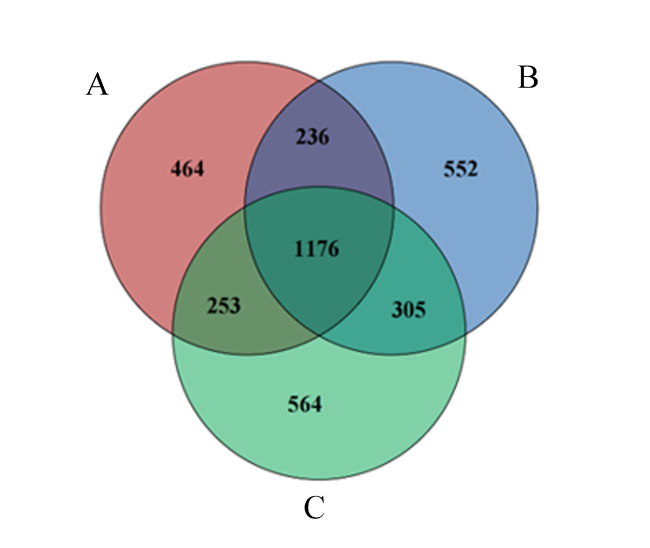
OTUs是基于有效序列进行聚类/去噪和物种分类分析的一种分类单元,由图1可知,Ⅰ组包含了1 640个OTUs,Ⅱ组包含1 728个OTUs,Ⅲ组包含1 740个OTUs。与Ⅰ组相比,Ⅱ、Ⅲ组肉鸡盲肠微生物的OTUs个数明显增加,这表明由腐殖酸钠、三丁酸甘油酯、苯甲酸和单宁酸组成的复合酸可影响肉鸡盲肠微生物物种组成。
图1 基于OTUs的Venn图

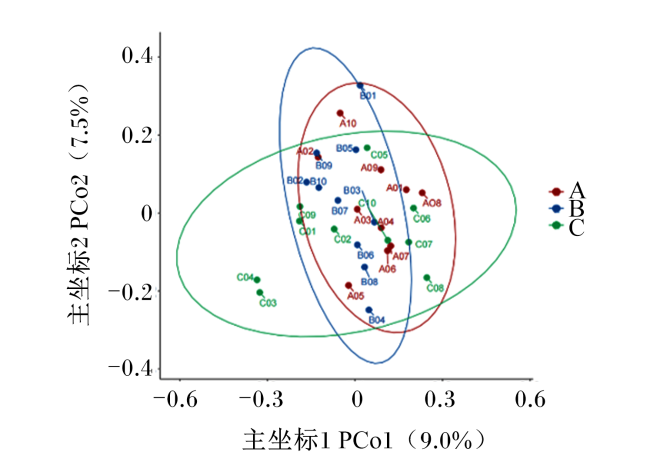
Venn图显示的是不同组间共有以及组内特有的OTUs数量,每个椭圆代表一个组。A表示Ⅰ组,B表示Ⅱ组,C表示Ⅲ组,图2同。

Fig.1 Venn diagram based on OTUs

The Venn diagram shows the number of common OTUs between different groups and the number of unique OTUs in each group, and each ellipse represents a group. A represents group Ⅰ, B represents group Ⅱ, and C represents group Ⅲ, the same as Fig.2.

2.4.2 复合酸对肉鸡盲肠微生物alpha多样性的影响

Chao1指数、Faith-pd指数、Observed_OTUs指数、Shannon指数和Simpson指数是衡量alpha多样性的主要指标。由表7可知,与Ⅰ组相比,Ⅱ、Ⅲ组的Chao1指数、Faith-pd指数、Observed_OTUs指数、Shannon指数和Simpson指数均无显著差异(P>0.05)。
表7 复合酸对肉鸡盲肠微生物alpha多样性的影响

Table 7 Effects of compound acid on alpha diversity of cecal microorganisms of broilers

项目
Items
Ⅰ组
Group Ⅰ
Ⅱ组
Group Ⅱ
Ⅲ组
Group Ⅲ
P
P-value
Chao1指数Chao1 index 633.08±25.70 624.59±19.08 655.54±29.17 0.668
Faith_pd指数Faith_pd index 44.20±1.48 43.01±0.95 44.47±1.67 0.738
Observed_OTUs指数Observed_OTUs index 631.00±25.48 622.30±18.99 652.70±29.31 0.678
Shannon指数Shannon index 7.69±0.11 7.57±0.07 7.55±0.13 0.641
Simpson指数Simpson index 0.99±0.00 0.99±0.00 0.98±0.00 0.267

2.4.3 复合酸对肉鸡盲肠微生物beta多样性的影响

主坐标分析(PCoA)是衡量微生物beta多样性的重要方法。图2中,根据PCoA结果可知,Ⅲ组与Ⅰ组有区系分离的趋势;相比于Ⅰ组,Ⅱ、Ⅲ组的节点之间的距离较长,这表明Ⅱ、Ⅲ组盲肠菌群结构发生了改变。
图2 主坐标分析图

Fig.2 PCoA diagram

2.4.4 复合酸对肉鸡盲肠微生物物种组成和相对丰度的影响

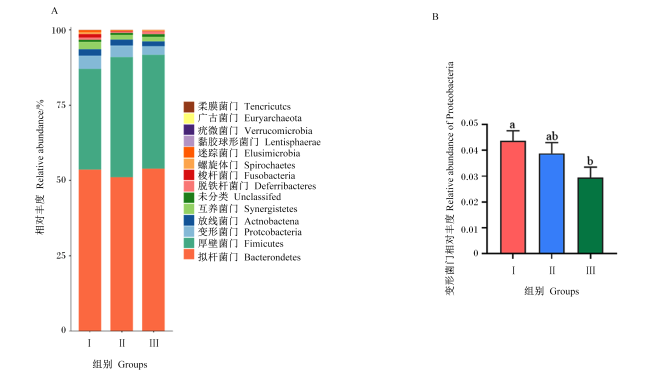
图3-A为盲肠微生物门水平上物种分布柱形图,拟杆菌门(Bacteroidetes)、厚壁菌门(Firmicutes)和变形菌门(Proteobacteria)是肉鸡盲肠中的三大优势菌群,其中拟杆菌门在Ⅰ、Ⅱ、Ⅲ组中的相对丰度分别为53.61%、51.12%、53.91%;厚壁菌门在Ⅰ、Ⅱ、Ⅲ组中的相对丰度分别为33.40%、39.85%、37.76%;变形菌门在Ⅰ、Ⅱ、Ⅲ组中的相对丰度分别为4.37%、3.88%、2.95%。与Ⅰ组相比,Ⅱ、Ⅲ组拟杆菌门和厚壁菌门的相对丰度以及它们的比值无显著差异(P>0.05),但Ⅲ组变形菌门的相对丰度显著降低(P<0.05,图3-B)。
图3 复合酸对肉鸡盲肠微生物门水平物种相对丰度的影响

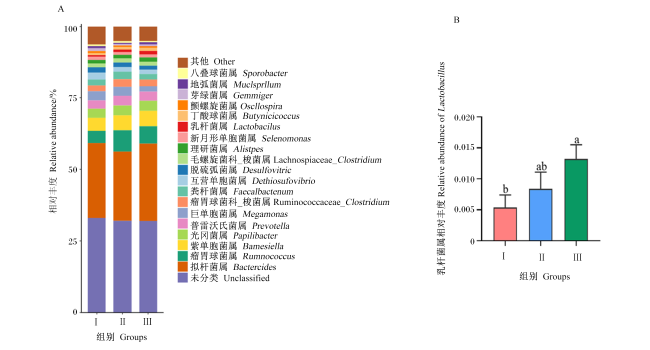
数据柱标注不同小写字母表示差异显著(P<0.05),相同小写字母表示差异不显著(P>0.05)。图4同。

Fig.3 Effects of compound acid on species relative abundances of cecal microorganisms at phylum level of broilers

Data columns with different small letters mean significant difference (P<0.05), while with the same small letters mean no significant difference (P>0.05). The same as below.

图4-A为盲肠微生物属水平上Top前20的优势菌群分布柱形图,图中拟杆菌属(Bacteroides)、瘤胃球菌属(Ruminococcus)、紫单胞菌属(Barnesiella)和光冈菌属(Papillibacter)在菌群结构中占比较大,是肉鸡盲肠中的优势菌属。与Ⅰ组相比,Ⅱ、Ⅲ组在拟杆菌属、瘤胃球菌属、紫单胞菌属和光冈菌属的相对丰度均有所提升,但无显著差异(P>0.05);在剩下的16个菌属中发现,Ⅲ组其他菌属的相对丰度与Ⅰ组无显著差异(P>0.05),但乳杆菌属(Lactobacillus)的相对丰度显著提高(P<0.05,图4-B)。
图4 复合菌对肉鸡盲肠微生物属水平物种相对丰度的影响

Fig.4 Effects of compound acid on species relative abundances of cecal microorganisms at genus level of broilers

3 讨论

3.1 复合酸对肉鸡生长性能的影响

肉鸡养殖中能直接反映肉鸡营养状态的指标是生长性能,而平均日增重、平均日采食量和耗料增重比是反映肉鸡生长性能的最直接指标。腐殖酸钠、三丁酸甘油酯、苯甲酸和单宁酸均属于有机酸化剂,能通过降低肉鸡胃部pH、刺激多种消化酶的分泌并提高消化酶的活性、促进机体对营养物质的消化吸收、抑制肠道有害菌的生长、促进益生菌的增殖来调节肠道菌群平衡,从而改善肉鸡的生长性能[16]。张世忠等[17]研究发现,饲粮中添加200 g/t单宁酸能显著提高白羽肉鸡的平均日采食量和降低耗料增重比。Kocabagli等[18]研究表明,饲粮中添加2.5 kg/t腐殖酸钠能显著改善肉仔鸡的增重和耗料增重比。有研究表明,多种酸化剂联合使用时,多种酸化剂之间可能存在协同增效作用,并发挥出比单一酸化剂更好的作用[19]。本试验结果显示,由不同添加量的腐殖酸钠、三丁酸甘油酯、苯甲酸和单宁酸配伍组成的复合酸对肉鸡生长性能均有积极影响,其中以由250 g/t腐殖酸钠、700 g/t三丁酸甘油酯、1 000 g/t苯甲酸和400 g/t单宁酸组成的复合酸的效果最好,能显著提高肉鸡的平均日采食量,对平均日增重和耗料增重比也有改善趋势,其改善了生长性能,促进了肉鸡生长。这可能与多种酸化剂之间协同增效作用有关[20-21]

3.2 复合酸对肉鸡屠宰性能的影响

屠宰性能是评价肉鸡胴体品质的重要参数,是衡量生产性能以及经济效益的综合性指标。张世忠等[17]研究表明,饲粮中添加150 g/t单宁酸能显著提高白羽肉鸡的腿肌率。袁小陵等[22]亦发现,苯甲酸能明显改善肉鸡的屠宰性能,提高全净膛率和半净膛率。本研究中,在文昌鸡饲粮中添加复合酸对肉鸡的屠宰率、全净膛率、腿肌率和胸肌率均有改善趋势,其中由250 g/t腐殖酸钠、700 g/t三丁酸甘油酯、1 000 g/t苯甲酸和400 g/t单宁酸组成的复合酸能显著提高肉鸡腿肌率,这与张世忠等[17]的研究结论一致,推测这可能与酸化剂能提高肉鸡胃肠道中的蛋白质消化吸收有关[23],该复合酸通过加强对蛋白质的利用来促进肌肉沉积,从而提高了屠宰性能[15,24]

3.3 复合酸对肉鸡血清免疫指标的影响

酸化剂具有提高动物机体免疫功能的作用[25]。IgA、IgM和IgG是动物血清中主要的免疫球蛋白,是机体体液免疫的重要组成部分,能调节免疫水平,保护机体不受各种病原微生物的侵害[26-27]。血清中免疫球蛋白含量的高低能反映机体免疫功能的强弱,其含量越高,则说明机体免疫水平越高[28]。有研究表明,饲粮中添加复合酸化剂能显著提高肉鸡血清中IgA和IgG含量[29]。童玉鑫等[30]研究结果显示,饲粮中添加五倍子单宁酸能显著提高1~21日龄黄羽肉鸡血清中IgM含量,且随着五倍子单宁酸添加剂量的提高,血清中IgM含量呈线性升高。黄灵杰等[31]也发现,在饲粮中添加高剂量的苯甲酸能显著提高肉鸡血清中IgM含量。本研究中,在饲粮中添加由250 g/t腐殖酸钠、700 g/t三丁酸甘油酯、1 000 g/t苯甲酸和400 g/t单宁酸组成的复合酸能极显著提高肉鸡血清中IgA和IgM含量;另外,添加由250 g/t腐殖酸钠、350 g/t三丁酸甘油酯、500 g/t苯甲酸和200 g/t单宁酸组成的复合酸在极显著提高血清中IgA和IgM含量的基础上,还极显著提高了血清中IgG含量。此结果与童玉鑫等[30]和黄灵杰等[31]的研究结果一致。这表明由腐殖酸钠、三丁酸甘油酯、苯甲酸和单宁酸组成的复合酸能促进肉鸡机体B细胞分泌免疫球蛋白,提高机体免疫水平,而不同配比复合酸之间的差异可能与4种酸化剂之间互作调节以及剂量配比有关。

3.4 复合酸对肉鸡盲肠微生物的影响

肠道菌群结构对肉鸡的生长性能和肠道健康起着关键作用,肠道菌群平衡有助于提高动物对营养物质的消化吸收能力[32],并有利于机体抵御病原微生物的入侵[33]。有益的微生物在维持正常生理动态平衡、调节宿主免疫系统、促进器官发育和调节宿主机体代谢方面具有重要作用[34]。一些研究表明,饲粮中添加有机酸能选择性的刺激益生菌生长,从而改善肉鸡盲肠菌群平衡[2,35]。本研究发现,在肉鸡盲肠微生物中以拟杆菌门、厚壁菌门和变形菌门为三大优势菌群。而拟杆菌门和厚壁菌门细菌可产生分解多糖的酶,能帮助机体分解多糖类物质,从而促进机体对营养物质的消化吸收[36-37]。有研究发现,厚壁菌门与拟杆菌门的比值与脂肪沉积有关,该比值越高,越有益于脂肪沉积[38]。而变形菌门主要由许多已知的病原菌组成,如大肠杆菌、志贺氏菌、沙门氏菌、螺杆菌、布鲁氏菌和立克次体等[39],当动物肠道中变形菌门的相对丰度上升时,往往会引起代谢紊乱和肠道炎症的发生[40-41]。本试验中,在微生物门水平上,饲粮中添加由250 g/t腐殖酸钠、700 g/t三丁酸甘油酯、1 000 g/t苯甲酸和400 g/t单宁酸组成的复合酸在一定程度上提高了盲肠微生物中拟杆菌门和厚壁菌门的相对丰度以及二者比值,并显著降低了变形菌门的相对丰度。这表明肉鸡饲粮中添加由250 g/t腐殖酸钠、700 g/t三丁酸甘油酯、1 000 g/t苯甲酸和400 g/t单宁酸组成的复合酸能提高机体糖代谢,促进肉鸡育肥,并能抑制病原微生物的增殖,预防疾病发生,从而促进生长。
在微生物属水平上,饲粮中添加由250 g/t腐殖酸钠、700 g/t三丁酸甘油酯、1 000 g/t苯甲酸和400 g/t单宁酸组成的复合酸还显著提高了肉鸡盲肠微生物中乳杆菌属的相对丰度,并在一定程度上提高了主要优势菌属如拟杆菌属和瘤胃球菌属的相对丰度。乳杆菌属的细菌对宿主的健康具有重要作用,它们不仅能够产生抗菌物质,也能与致病菌株竞争肠道的黏附位点来达到抑菌目的,还能阻止细胞凋亡来提升肠道的防御机制,为宿主提供更好的健康状态。Wang等[42]研究发现,饲粮中添加苯甲酸和苯甲酸+淀粉酶复合物均能提高肉鸡盲肠内容物中乳杆菌属的相对丰度,并降低大肠杆菌的相对丰度。这与本研究结论相符,这些结果表明,肠道中的有益菌大量增殖是抑制病原菌生长的重要因素,肉鸡饲粮中补充由腐殖酸钠、三丁酸甘油酯、苯甲酸和单宁酸组成的复合菌可能会通过提高有益菌数量来改善肠道菌群组成,促进肉鸡生长。

4 结论

在本试验条件下,饲粮中添加由250 g/t腐殖酸钠、700 g/t三丁酸甘油酯、1 000 g/t苯甲酸和400 g/t单宁酸组成的复合酸能改善56~91日龄文昌鸡的生长性能和屠宰性能,提高机体特异性免疫水平,并能改善盲肠菌群结构。
[1]
PALAMIDI I, PARASKEUAS V, THEODOROU G, et al. Effects of dietary acidifier supplementation on broiler growth performance, digestive and immune function indices[J]. Animal Production Science, 2016, 57(2):271-281.

DOI

[2]
WU Y, YIN X, WANG Y, et al. Effect of 2-hydroxy-4-(methylthio) butanoic acid and acidifier on the performance, chyme pH, and microbiota of broilers[J]. Animal Science Journal, 2020, 91(1):e13409.

DOI

[3]
JOZEFIAK D, KACZMAREK S, RUTKOWSKI A. The effects of benzoic acid supplementation on the performance of broiler chickens[J]. Journal of Animal Physiology and Animal Nutrition, 2010, 94(1):29-34.

DOI PMID

[4]
DEHGHANI-TAFTI N, JAHANIAN R. Effect of supplemental organic acids on performance, carcass characteristics, and serum biochemical metabolites in broilers fed diets containing different crude protein levels[J]. Animal Feed Science and Technology, 2016, 211:109-116.

DOI

[5]
夏学鹏, 詹云花. 腐植酸钠在畜牧兽医方面的应用概况[J]. 养殖与饲料, 2009(3):56-58.

XIA X P, ZHAN Y H. Application of sodium humate in animal husbandry and veterinary[J]. Culture and Feed, 2009(3):56-58. (in Chinese)

[6]
JENSEN M S, JENSEN S K, JAKOBSEN K. Development of digestive enzymes in pigs with emphasis on lipolytic activity in the stomach and pancreas[J]. Journal of Animal Science, 1997, 75(2):437-445.

PMID

[7]
LEONEL A J, ALVAREZ-LEITE J I. Butyrate:implications for intestinal function[J]. Current Opinion in Clinical Nutrition and Metabolic Care, 2012, 15(5):474-479.

DOI

[8]
CRESCI G, NAGY L E, GANAPATHY V. Lactobacillus GG and tributyrin supplementation reduce antibiotic-induced intestinal injury[J]. Journal of Parenteral and Enteral Nutrition. 2013, 37(6):763-774.

DOI

[9]
TSUYOSHI M, RYUSAKU K, AYA O, et al. Butyric acid attenuates intestinal inflammation in murine DSS-induced colitis model via milk fat globule-EGF factor 8[J]. Laboratory Investigation, 2013, 93(7):834-843.

DOI PMID

[10]
余东游, 孙健栋, 麻剑雄, 等. 三丁酸甘油酯的生物学功能及其在畜牧生产中的应用[J]. 中国畜牧杂志, 2014, 50(17):91-95.

YU D Y, SUN J D, MA J X, et al. Biological function of glycerol tributylate and its application in animal production[J]. Chinese Journal of Animal Science, 2014, 50(17):91-95. (in Chinese)

[11]
SOHAIL R, SAEED M, CHAO S, et al. Comparative effect of different organic acids (benzoic, acetic and formic) on growth performance, immune response and carcass traits of broilers[J]. Journal of Animal Production Advances, 2015, 5:757-764.

DOI

[12]
CHEN J L, ZHENG P, ZHANG C, et al. Benzoic acid beneficially affects growth performance of weaned pigs which was associated with changes in gut bacterial populations, morphology indices and growth factor gene expression[J]. Journal of Animal Physiology and Animal Nutrition, 2017, 101(6):1137-1146.

DOI PMID

[13]
YOUSAF M S, GOODARZI B F, VAHJEN W, et al. Encapsulated benzoic acid supplementation in broiler diets influences gut bacterial composition and activity[J]. British Poultry Science, 2017, 58(2):122-131.

DOI PMID

[14]
BONELLI F, TURINI L, SARRI G, et al. Oral administration of chestnut tannins to reduce the duration of neonatal calf diarrhea[J]. BMC Veterinary Research, 2018, 14(1):1-6.

DOI

[15]
BIONDI L, RANDAZZO C L, RUSSO N, et al. Dietary supplementation of tannin-extracts to lambs:effects on meat fatty acids composition and stability and on microbial characteristics[J]. Foods, 2019, 8(10):469.

DOI

[16]
朱晓萍, 张德福. 几种酸化剂对断奶仔猪胃酸分泌、胃肠道消化酶活性和微生物菌群的影响[J]. 黑龙江畜牧兽医, 2007, 302(3):31-33.

ZHU X P, ZHANG D F. Effects of several acidifiers on gastric acid secretion, gastrointestinal digestive enzyme activity and microflora in weaned piglets[J]. Heilongjiang Animal Science and Veterinary Medicine, 2007, 302(3):31-33. (in Chinese)

[17]
张世忠, 陈秀琴, 陈盛星, 等. 单宁酸对白羽肉鸡生长性能、屠宰性能及肠道微生物菌群的影响[J]. 福建农业学报, 2021, 36(10):1153-1159.

ZHANG S Z, CHEN X Q, CHEN S X, et al. Effects of tannic acid on growth performance, slaughtering performance and intestinal microflora of white-feathered broilers[J]. Fujian Journal of Agricultural Sciences, 2021, 36(10):1153-1159. (in Chinese)

[18]
KOCABAGLI N, ALP M, ACAR N, et al. The effects of dietary humate supplementation on broiler growth and carcass yield[J]. Poultry Science, 2002, 81(2):227-230.

PMID

[19]
POLYCARPO G V, ANDRETTA I, KIPPER M, et al. Meta-analytic study of organic acids as an alternative performance-enhancing feed additive to antibiotics for broiler chickens[J]. Poultry Science, 2017, 96(10):3645-3653.

DOI PMID

[20]
DIBNER J J, BUTTIN P. Use of organic acids as a model to study the impact of gut microflora on nutrition and metabolism[J]. Journal of Applied Poultry Research, 2002, 11(4):453-463.

DOI

[21]
KIL D Y, KWON W B, KIM B G. Dietary acidifiers in weanling pig diets:a review[J]. Revista Colombiana de Ciencias Pecuarias, 2011, 24(3):231-247.

[22]
袁小陵, 王亚超, 胡茂, 等. 不同种类酸化剂对白羽肉鸡生长性能、屠宰性能、器官指数及养分表观消化率的影响[J]. 中国畜牧杂志, 2023, 59(2):196-201.

YUAN X L, WANG Y C, HU M, et al. Effects of different acidifiers on growth performance, slaughtering performance, organ index and apparent digestibility of nutrients in white-feathered broilers[J]. Chinese Journal of Animal Science, 2023, 59(2):196-201. (in Chinese)

[23]
RAVINDRAN V, KORNEGAY E T. Acidification of weaner pig diets:a review[J]. Journal of the Science of Food and Agriculture, 1993, 62(4):313-322.

DOI

[24]
PARTANEN K H, MROZ Z. Organic acids for performance enhancement in pig diets[J]. Nutrition Research Reviews, 1999, 12(1):117-145.

DOI PMID

[25]
马嘉瑜, 朴香淑. 酸化剂改善畜禽生长和肠道健康的研究进展[J]. 中国畜牧杂志, 2021, 57(8):1-10.

MA J Y, PIAO X S. Research progress of acidifiers in improving growth and intestinal health of livestock and poultry[J]. Chinese Journal of Animal Science, 2021, 57(8):1-10. (in Chinese)

[26]
PORTER P, HILL I R. Serological changes in immunoglobulins IgG, IgA and IgM and Escherichia coli antibodies in the young pig[J]. Immunology, 1970, 18(4):565-573.

[27]
骆雪, 俞伟辉. 抗菌肽对免疫应激仔猪生长性能和血清生化指标的影响[J]. 饲料研究, 2022, 45(18):19-23.

LUO X, YU W H. Effects of antimicrobial peptides on growth performance and serum biochemical indexes of immune stressed piglets[J]. Feed Research, 2022, 45(18):19-23. (in Chinese)

[28]
SHENGHE L, ERHUI J, ENMEI Q, et al. Chitooligosaccharide promotes immune organ development in broiler chickens and reduces serum lipid levels[J]. Histology and Histopathology, 2017, 32(9):951-961.

DOI PMID

[29]
孙得发, 苏成文, 黄俊杰, 等. 复合酸化剂对白羽肉鸡肠道、免疫功能的影响[J]. 饲料研究, 2022, 45(5):48-52.

SUN D F, SU C W, HUANG J J, et al. Effects of compound acidifier on intestinal and immune function of white-feathered broilers[J]. Feed Research, 2022, 45(5):48-52. (in Chinese)

[30]
童玉鑫, 吴淑琴, 李顺路, 等. 五倍子单宁酸对1-21日龄黄羽肉鸡生长性能、免疫及抗氧化功能的影响[J]. 中国畜牧杂志, 2022, 58(5):251-255.

TONG Y X, WU S Q, LI S L, et al. Effects of gallnut tannic acid on growth performance, immunity and antioxidant function of yellow-feathered broilers from 1 to 21 d of age[J]. Chinese Journal of Animal Science, 2022, 58(5):251-255. (in Chinese)

[31]
黄灵杰, 彭焕伟, 张克英, 等. 苯甲酸对球虫攻毒肉鸡生长性能、免疫功能及血清抗氧化能力的影响[J]. 动物营养学报, 2021, 33(3):1396-1407.

DOI

HUANG L J, PENG H W, ZHANG K Y, et al. Effects of benzoic acid on growth performance, immune function and serum antioxidant capacity of coccidiosis-challenged broilers[J]. Chinese Journal of Animal Nutrition, 2021, 33(3):1396-1407. (in Chinese)

[32]
LEE K W, EVERTS H, KAPPERT H J, et al. Effects of dietary essential oil components on growth performance, digestive enzymes and lipid metabolism in female broiler chickens[J]. British Poultry Science, 2003, 44(3):450-457.

DOI PMID

[33]
PANDIT R J, HINSU A T, PATEL N V, et al. Microbial diversity and community composition of caecal microbiota in commercial and indigenous Indian chickens determined using 16S rDNA amplicon sequencing[J]. Microbiome, 2018, 6:1-13.

DOI

[34]
SOMMER F, BACKHED F. The gut microbiota-masters of host development and physiology[J]. Nature Reviews Microbiology, 2013, 11(4):227-238.

DOI

[35]
YAKHKESHI S, SHAWRANG P, RAHIMI S. Effect of some acidifiers on gastrointestinal tract characteristics and performance of broiler chickens[J]. Iranian Journal of Applied Animal Science, 2014, 4(1):143-149.

[36]
LEY R E, TURNBAUGH P J, KLEIN S, Klein S, et al. Human gut microbes associated with obesity[J]. Nature, 2006, 444(7122):1022-1023.

DOI

[37]
SALYERS A A, VERCELLOTTI J R, WEST S E, et al. Fermentation of mucin and plant polysaccharides by strains of Bacteroides from the human colon[J]. Applied and Environmental Microbiology, 1977, 33(2):319-322.

DOI PMID

[38]
COCKBURN D W, KOROPATKIN N M. Polysaccharide degradation by the intestinal microbiota and its influence on human health and disease[J]. Journal of Molecular Biology, 2016, 428(16):3230-3252.

DOI PMID

[39]
RIZZATTI G, LOPETUSO L R, GIBIINO G, et al. Proteobacteria:a common factor in human diseases[J]. BioMed Research International, 2017,2017.

[40]
SEN T, CAWTHON C R, IHDE B T, et al. Diet-driven microbiota dysbiosis is associated with vagal remodeling and obesity[J]. Physiology & Behavior, 2017, 173:305-317.

DOI

[41]
SELVANANTHAM T, LIN Q, GUO C X, et al. NKT cell-deficient mice harbor an altered microbiota that fuels intestinal inflammation during chemically induced colitis[J]. The Journal of Immunology, 2016, 197(11):4464-4472.

DOI

[42]
WANG Y, WANG Y, LIN X, et al. Potential effects of acidifier and amylase as substitutes for antibiotic on the growth performance, nutrient digestion and gut microbiota in yellow-feathered broilers[J]. Animals, 2020, 10(10):1858.

DOI

文章导航

/