综述

瘤胃微生物移植在反刍动物生产中的应用及作用机制

  • 冯肖然 ,
  • 刁其玉 ,
  • 屠焰 , *
展开
  • 中国农业科学院饲料研究所,奶牛营养学北京市重点实验室,北京 100081
* 屠 焰,教授,博士生导师,E-mail:

冯肖然(2001—),女,河北保定人,硕士,从事反刍动物瘤胃微生物调控。E-mail:

Copy editor: 武海龙

收稿日期: 2023-06-26

  网络出版日期: 2023-12-11

基金资助

家畜产业技术体系北京市创新团队(BAIC05)

中国农业科学院科技创新工程(CAAS-ASTIP-IFR-03)

Application and Mechanism of Rumen Microbiota Transplantation in Ruminant Production

  • FENG Xiaoran ,
  • DIAO Qiyu ,
  • TU Yan , *
Expand
  • Beijing Key Laboratory for Dairy Cow Nutrition, Feed Research Institute, Chinese Academy of Agricultural Sciences, Beijing 100081, China
* professor, E-mail:

Received date: 2023-06-26

  Online published: 2023-12-11

摘要

反刍动物消化道菌群对其生长发育起着至关重要的作用,高效稳定的瘤胃微生物区系可保障宿主机体的营养物质消化率、免疫功能等。人们对反刍动物瘤胃微生物调控做了大量研究。瘤胃微生物移植作为瘤胃微生物调控手段之一,是将健康动物的瘤胃微生物及其代谢物移植至受体动物,以达到提高受体动物生产性能和健康状况等目的。本文从瘤胃微生物移植的方式和应用效果及目前发展状况出发,综述了瘤胃微生物移植对反刍动物生长发育和生产性能的影响,并分析了其可能的作用机制和影响因素,旨在为进一步研究提供理论依据。

本文引用格式

冯肖然 , 刁其玉 , 屠焰 . 瘤胃微生物移植在反刍动物生产中的应用及作用机制[J]. 动物营养学报, 2023 , 35(12) : 7561 -7570 . DOI: 10.12418/CJAN2023.686

Abstract

The gastrointestinal microorganism of ruminants plays a vital role in its growth and development, and the efficient and stable rumen microflora can ensure the host body’s nutrient digestibility and immunity etc. A lot of studies have been done on rumen microbial regulation of ruminants. Rumen microbiota transplantation, as one of the means of rumen microorganism regulation, is to transplant the rumen microorganisms of healthy ruminants into the recipient animals, in order to improve the production performance and health of recipient animals. This paper reviews the effects of ruminal microbial transplantation on the growth and development and production performance of ruminants and the possible mechanism based on the methods and application effects of ruminal microbial transplantation, aiming to provide a theoretical basis for further research.

瘤胃微生物包括细菌、古菌、厌氧真菌、原虫和噬菌体等,它们的存在使得反刍动物能够更好地利用植物性饲料来满足自身的能量需求[1]。稳定的瘤胃微生物区系和内环境对宿主健康和营养物质消化具有显著的积极作用[2],但由于瘤胃内环境组成的复杂性,微生物的稳定性易受环境、饲养管理和饲粮等因素影响而发生变化,从而影响宿主的生理健康和生产性能[3-5]。因此,反刍动物瘤胃微生物调控逐渐成为人们研究的热点。
在先前的研究中,人们对微生物的调控主要集中在饲粮组成和饲料添加剂。在饲粮组成方面,适宜的精粗比对瘤胃微生物区系高效发挥作用有积极意义[6]。高精料条件下,瘤胃细菌香农指数和辛普森指数显著下降,进而影响瘤胃细菌数量和丰度[7];而添加适量的高质量粗饲料可加快瘤胃乳头发育,丰富瘤胃微生物区系[8]。在饲料添加剂方面,微生态制剂,也称活菌制剂或直接饲喂微生物(direct-feeding microbial,DFM),结合了微生物生态学原理,将不同来源的益生菌经特殊处理成制剂,参与饲料消化的肠道菌群的建立,促进肠道健康[9]。随着研究者对益生菌的不断开发与应用,微生态制剂的应用正逐步成为饲料添加剂的发展趋势,在生产应用中,饲粮中可添加的益生菌有乳酸菌、芽孢杆菌以及酵母等,其应用效果已由大量研究结果所证实,例如,酿酒酵母培养物中大量的活性物质提高了纤维分解菌和乳酸利用菌的数量,增强了奶牛对营养物质的利用率[10];在荷斯坦公犊饲粮中添加巨型芽孢杆菌BM1259可显著改善犊牛的生长性能,提高营养物质表观消化率,同时改善瘤胃发酵,减少排泄物中氨态氮和硫化氢的含量[11]。饲喂复合益生菌(酵母+乳酸菌)可调节新生犊牛的肠道微生物群落结构,并改善肠道健康[12]
瘤胃微生物移植(rumen microbiota transplantation,RMT)作为微生态制剂的一种特殊应用方式,是将供体瘤胃中的微生物通过一定方式移植到受体中,对瘤胃菌群结构起到一定的改善和优化作用。RMT可用于揭示瘤胃微生物特性或功能[13],从而实现对特定菌株的分离培养和运用。但目前对于RMT的研究并不完善,微生物组的培养与饲喂仍处于起步阶段。本文阐述了RMT在反刍动物生产应用中的效果和可能作用机制,为日后RMT的应用提供参考。

1 RMT方式

早在18世纪中期,研究人员就已经利用健康反刍动物的反刍食团来治疗受体动物消化不良的症状[14]。随着对瘤胃微生物研究内容的不断展开,RMT作为瘤胃微生物调控方式之一,逐渐应用到动物菌群结构调节、疾病预防及治疗等领域。目前,RMT的移植单位可以是瘤胃内容物整体,也可以是具有特定功能的微生物组或单一菌株。

1.1 瘤胃内容物移植

从瘘管动物瘤胃中直接获取瘤胃液是常用的瘤胃液获取方式,该种方法对动物刺激作用小,且简单易行[15-16];胃管法是通过胃管插管收集供体动物的瘤胃液[17],但应激作用明显,摄取量较少,从而在生产中利用较少。从屠宰的动物瘤胃中直接获取也是瘤胃液采集方式之一[18],此种方式可在短时间内获取大量瘤胃液及内容物,适用于对瘤胃需求较大的情况,但其瘤胃微生物可能由于屠宰后收集不及时等因素,导致瘤胃液质量下降,影响移植效果。因此,供体瘤胃液获取方式应根据动物状态和生产要求进行科学选择。
目前存在的瘤胃内容物移植方式可以总结为瘤胃液胃管灌服[19]、冷冻瘤胃液口服[20]、冻干瘤胃液饲喂[21-22]和瘘管内容物转移[23]等,对于特定情景还可以利用瘤胃穿刺和鼻饲等方式[24]。在以瘤胃液胃管灌服为方式的研究性试验中,研究者利用注射器连接硅胶管,将新鲜瘤胃液注射到受体瘤胃中[16]或与乳汁混合后口服[20]。Santos等[25]通过胃管向羊瘤胃中注射1.5 L奶牛瘤胃液,对照组在相同条件下注射1.5 L温生理盐水,发现瘤胃内容物移植改变了瘤胃中主要微生物类群(厚壁菌门、变形菌门和拟杆菌门等)的相对比例,但未改变其整体组成。冷冻瘤胃液是将过滤后的瘤胃液放入用二氧化碳冲洗的预热温瓶中(39 ℃),随即冷冻[26]。相较于新鲜瘤胃液,冷冻瘤胃液会因保存时间长而效果欠佳,在使用过程中应避免反复解冻。冻干瘤胃液是将新鲜瘤胃液经离心处理,再将混合物在真空下冷冻干燥制成[21],具有易于保存且微生物存活率较高的优势,有利于菌株快速进入休眠状态[22,27]。Yu等[21]通过食管从5只10月龄健康雄性湖羊身上收集200 mL瘤胃液,4 ℃下24 000×g离心20 min,弃去上层清液,剩余物在1 000 mL 10%脱脂牛奶中重新悬浮,得到的混合物经真空冷冻干燥制成冻干瘤胃液,口服1 g/d冻干瘤胃液22 d后提高了断奶前羔羊的粗蛋白质和非结构性碳水化合物的消化率。由于其效果较好,操作方便,冻干瘤胃液在瘤胃内容物移植领域逐渐受到重视。

1.2 功能性瘤胃微生物组挖掘

RMT中起关键作用的微生物组是挖掘微生物资源的重要目标,可根据宏基因组等高通量测序的检测结果,不断调整人工培养条件,通过培养组学筛选出潜在的功能益生菌。目前,功能性瘤胃微生物组移植大多数研究尚停留在功能性微生物组的动物模型构建,即对供体预先设置条件,形成带有一定特征或者功能的微生物组后再移植,例如给奶山羊饲喂高纤维饲粮,最大限度地富集纤维降解菌后对小鼠进行RMT,结果提高了小鼠的纤维降解能力[28]。此外,微生物分离新技术如培养组学、微流控[29]和原位培养技术[30]等的不断发展,扩大了人类可培养菌种库,为微生物组的构建奠定了基础。因此,功能性瘤胃微生物组的挖掘还可以通过预先构建核心菌群实现,如科学家构建了复杂且定义明确的合成微生物组,并将其成功移植到小鼠体内发挥功能,使得基于工程微生物组的治疗方法成为可能[31];以小鼠为试验单元,将临床培养的4种乳酸菌制备成联合菌进行阴道菌群移植,显著减少了阴道组织损伤,恢复了小鼠的阴道菌群紊乱[32];研究人员基于猪的粪便微生物移植,以猪和小鼠的模型验证了4种核心菌群在调节猪和小鼠肌肉中的脂肪沉积方面的重要作用[33]。这些研究初步证明了微生物组体外构建的可行性,为功能性瘤胃微生物组的构建和移植提供应用参考。但微生物间的相互作用、胃肠道菌群变化和微生物代谢对宿主代谢的影响、潜在益生菌效应以及可能的作用机制,还需在未来的研究中不断挖掘。

2 RMT的应用

2.1 对幼龄反刍动物的应用效果

幼龄反刍动物瘤胃微生物的定植可直接影响宿主表型,且对幼龄动物瘤胃微生物群的建立有着长久影响[34-35],早期实施RMT可提高反刍动物早期的生长性能,缓解断奶应激导致的能量负平衡,促进幼龄反刍动物的健康发育[36]。RMT在幼龄反刍动物上的应用见表1。新生反刍动物灌服成年新鲜瘤胃液可提高营养物质表观消化率[21],改善瘤胃发酵,提高受体干物质采食量和平均日增重[1]。固体采食量的提高促进了断奶前瘤胃挥发性脂肪酸(VFA)的产生(尤其是乙酸和丙酸)和吸收[18],刺激瘤胃运动,从而加快瘤胃肌肉发育和瘤胃上皮细胞及乳头形态发育[37]。此外,RMT使得细菌和纤毛虫等微生物迅速接种到受体动物上,改变瘤胃微生物区系,促进瘤胃菌群结构迅速建立[18,38],显著降低腹泻发生的频率[39]。因此,在今后的研究中,RMT有望作为促进瘤胃成熟、提高动物生长发育的策略之一,同时成为应对幼龄反刍动物由液体饲料过渡到固体饲料产生应激导致腹泻的手段之一。但应用前需充分注意受体的生理状态和供体瘤胃液成分,避免幼龄反刍动物因肠道微生物的快速变化对宿主造成不利影响[40],导致生长性能一定程度的下降或免疫性能的损害[17]
表1 RMT在幼龄反刍动物的应用

Table 1 Application of RMT in young ruminants

项目
Items
收集方法
Collection
method
受体
Recipient
移植方式
Transplantation
mode
移植剂量
Transplantation
dose
应用效果
Application
effect
参考文献
Reference
Tellicherry山羊
Tellicherry goats
屠宰后收集 Tellicherry
山羊羔羊
新鲜和冷冻瘤
胃液随乳饲喂
每3 d 1次,
每次100 mL
提高受体生长性能,饲喂新鲜
瘤胃液效果更佳
Tamilinban
[20]
经产母牛
Multiparity cows
瘤胃瘘管 6对双胞胎
犊牛
新鲜瘤胃液
胃管灌服
每周3次,第2、3周剂量为5 mL/d,
第4周剂量增加到10 mL/d
加速细菌、古菌群落和纤毛虫原生
动物的建立,刺激断奶前体重增加,
提高固体采食量
Huuki等[1]
5只雄性湖羊
Five male Hu sheep
胃管收集 48只湖羊
羔羊
冻干瘤胃液饲喂 口服1 g/d冻干
瘤胃液
提高断奶前羔羊的消化率,增加断
奶羔羊瘤胃中有益菌相对丰度,
提高丙酸产量,减轻断奶应激
Yu等[21]
4只乌珠穆沁羊
Four Wuzhumuqin sheep
胃管收集 30只乌珠
穆沁羔羊
新鲜瘤胃液饲喂
冻干瘤胃液饲喂
饲喂100 mL新鲜瘤液(共7 d)
饲喂1.8 g冻干瘤胃液(共7 d)
改善饲料转化率,提高平均日增重、
营养物质表观消化率
改善饲料转化率,提高粗脂肪表观消化率
Zhong等[22]
8只成年山羊
Eight adult goats
瘤胃瘘管 80只Murciano-
Granadina
山羊羔羊
新鲜和高压瘤
胃液胃管灌服
第1周2.5 mL/只,
之后5 mL/只
促进原虫早期定居,提高了瘤胃
挥发性脂肪酸的产生和吸收,有利于断奶
Belanche
[18]
4头荷斯坦奶牛
Four Holstein cows
瘤胃瘘管 20头新生
公犊牛
新鲜和高压瘤胃
液胃管灌服
出生后第3天、第7天、第21天、
第42天和第50天每头小牛灌服
100、200、300、400和500 mL
不影响平均日采食量、平均
日增重、胸围或饲料转化率,但
显著降低了腹泻发生率
Bu等[39]
8只3月龄母羊、8只1岁成年母羊
Eight 3-month-old
ewes and eight 1-year-
old adult ewes
胃管收集 38只断奶前
湖羊羔羊
新鲜瘤胃液胃
管灌服
分别接种3月龄、1岁母羊
瘤胃液25 mL
加速瘤胃微生物的成熟,但胃肠道
完整性和免疫力受到一定损害,导致采食量
降低,饲料消化率降低,生长性能下降
Yin等[17]

2.2 对成年反刍动物的应用效果

由于成年反刍动物瘤胃发育较为完全,瘤胃微生物区系较稳定,外源微生物在宿主内的定植存在一定的局限性[35]。RMT在成年反刍动物的应用见表2。通过移植高产牛和高乳脂肪含量的奶牛瘤胃内容物可在一段时间内提高受体荷斯坦奶牛的牛奶生产效率[19]和乳脂率[41],但7~10 d逐渐恢复到移植前状态;将纤维消化率较高的野牛瘤胃液移植到肉牛瘤胃中,没有起到显著改变纤维消化率的作用[42];Santos等[25]使用3头健康奶牛作为供体,接种到6只健康绵羊,发现瘤胃微生物群落发生变化,但不改变优势原生动物,表明新引入的生物体在瘤胃定植方面是有一定限度的。然而外源微生物的植入造成微生物区系的变化,对奶牛反刍有一定的刺激作用,可增加动物食欲[23],提高奶牛干物质采食量[43],一定程度上有利于奶牛的生长发育。
表2 RMT在成年反刍动物的应用

Table 2 Application of RMT in adult ruminants

项目
Items
收集方法
Collection
method
受体
Recipient
移植方式
Transplantation
mode
移植剂量
Transplantation
dose
应用效果
Application
effect
参考文献
Reference
高产奶效率荷斯坦奶牛
High yield milk efficiency
Holstein cows
瘤胃瘘管 低产奶效率
瘘管荷斯坦奶牛
瘘管内容物转移 瘤胃内容物约
95%交换
7 d内受体牛产奶效率增加,但相关
群落在10 d内恢复到交换前
Weimer等[19]
5头瘘管荷斯坦奶牛
Five fistula Holstein cows
瘤胃瘘管 10头肠道菌群
紊乱瘘管荷斯
坦奶牛
瘘管内容物转移 试验组转移10 L内容物,对照组
转移10 L蒸馏去离子水
促进前肠和后肠
微生物群紊乱的恢复
Ji等[23]
32头野牛
Thirty-two bison
屠宰后收集 16头瘘管安格
斯×海福特
杂交肉牛
瘘管内容物转移 替代肉牛70%
瘤胃内容物
由于补充外源纤维降解酶,饲料
消化率的改善不依赖接种源
Ribeiro等[42]
2头奶牛
Two cows
瘤胃瘘管 45只患病牛
(食欲下降等
不同潜在疾病)
胃管灌服 1组灌服1 L,2组灌服5 L,
对照组灌服38 ℃温水5 L
少量瘤胃液输注即可有效
改善瘤胃功能和采食量
Steiner等[16]
15头湖羊
Fifteen Hu sheep
瘤胃瘘管 10只瘤胃酸
中毒湖羊
瘘管内容物
转移
试验组瘘管转入5 L瘤胃液;
对照组瘘管转入5 L生理盐水
降低脂多糖水平,使其更迅速的
从生态失调状态恢复
Liu等[44]
此外,目前已有部分研究表明RMT对于反刍动物的生理健康和疾病具有改善和治疗作用。瘤胃酸中毒作为反刍动物容易出现的瘤胃疾病之一,严重制约了动物的生长发育和畜牧场经济增长。有研究将瘤胃液移植至酸中毒的绵羊瘤胃中,发现瘤胃液移植可引起瘤胃发酵的动态变化,促进瘤胃细菌稳态的快速重建,减轻急性瘤胃酸中毒引起的瘤胃上皮的损伤[44]。在奶牛上也有同样的验证[45],同时可使因抗生素导致的奶牛消化道紊乱菌群得以恢复,有效调控奶牛瘤胃和肠道菌群[46],对于日后的酸中毒治疗和恢复肠道微生物紊乱具有良好的借鉴意义。一些研究均显示了瘤胃液移植对疾病的改善作用,后续可关注对疾病改善过程的机制研究。

3 RMT的作用机制

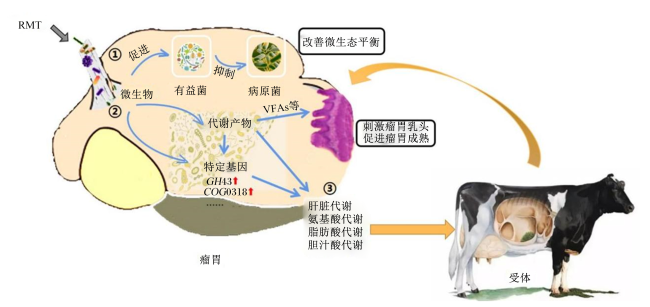
RMT可以加快微生物群落的建立,促进瘤胃成熟,恢复紊乱的微生物群落,缓解动物消化不良等症状。其作用机制可从以下几个方面进行阐述:1)微生物迅速抢占瘤胃内可用生态位,与病原体及有害菌形成竞争关系[47]。早期操纵微生物群落有利于加速瘤胃微生物的定植,此过程使得有益菌及其产生的抑菌物质通过生物夺氧、抑菌效应等方式与有害菌竞争养分或者吸附点[48-49],尤其是幼龄反刍动物瘤胃功能尚未发育完全,RMT有利于瘤胃微生物区系的快速建立[50],促进瘤胃成熟。2)微生物代谢终产物改变瘤胃发酵途径,促进瘤胃稳态。组成状态良好的微生物区系可以增加宿主可利用的VFA含量或减少产生甲烷的可利用底物,VFA的吸收和利用可刺激幼龄反刍动物瘤胃上皮代谢,促进瘤胃上皮和乳头的发育;其差异还与成年反刍动物的饲料效率和甲烷排放量相关[51],进而提高生产性能。此外,RMT还可上调某些微生物代谢途径中关键基因的表达,增强瘤胃内碳水化合物和脂质物质的代谢作用,影响乳脂肪前体物合成情况,最终提高乳脂肪的产量[41]。3)外源微生物的加入改变了宿主的代谢通路。血清代谢组学显示RMT后肝脏代谢、氨基酸代谢、脂肪酸代谢和胆汁酸代谢等均发生变化[52]。代谢组学的蓬勃发展可供人们更深入地了解瘤胃微生物和宿主的代谢途径,微生物代谢物的变化可能会影响宿主的活动,而宿主的生理和生物学变动也可能导致微生物组及其代谢物的波动[53]。3条作用途径相关机制见图1
图1 RMT作用机制

RMT:瘤胃微生物移植。VFAs:挥发性脂肪酸。GH43:糖苷水解酶家族43。①微生物抢占瘤胃内可用生态位途径;②微生物代谢产物对瘤胃的影响途径;③RMT对宿主代谢影响途径。红色箭头代表上调。

Fig.1 Mechanism of RMT

RMT: rumen microbial transplantation; VFAs: volatile fatty acid. GH43: glycoside hydrolase family 43. ① the way of microorganisms preempt the available niche in the rumen; ② the way of influence of microbial metabolites on rumen; ③ the way of influence of RMT on host metabolism. The red arrow means up.

微生物-宿主互作直观解释了微生物与机体不可分割的关系,即宿主为微生物提供了赖以生存的环境,微生物群一方面改善了营养物质的吸收利用,为宿主提供了新的代谢功能[54];另一方面刺激免疫系统,调节宿主生理,甚至影响宿主的社会行为[55-57]。微生物的功能和作用极其复杂,人们在微生物-宿主关联领域中对瘤胃微生物组、代谢组及其宿主的认识仍然有限,在未来的研究中依旧是热点与难点。

4 影响RMT的因素分析

由于瘤胃微生物的复杂性和易变性,受体瘤胃状态、移植剂量和方法均会对试验造成不同程度的干扰[13],最终导致瘤胃液移植后受体动物生产性能变化不同。试验周期较短且瘤胃液移植次数过少,导致瘤胃液移植后对奶牛生产性能暂未显现,也是造成差异的重要原因之一[58-59]。新鲜瘤胃液所携带的致病菌会对试验结果造成影响,或对受体动物的生理健康带来负面影响,因此供体瘤胃内容物的安全性应严格把控。此外,瘤胃微生物组和单一功能菌的饲喂剂量和定植状况需进一步探索。未来研究中,供体微生物的特异性需要相应的测序技术进行移植前和移植后的研究,通过对比进行核心微生物群的鉴定,以此保证接种效率。

5 小结与展望

反刍动物瘤胃微生物群的稳定及其结构和功能的变化均对宿主的健康和生产性能有重要影响。前人通过大量试验证明,瘤胃液移植改变或重塑受体瘤胃微生物群落或肠道菌群结构,对反刍动物的生产性能、消化疾病和幼龄动物生长发育等方面都有着积极的作用。随着多组学技术和高通量测序等生物技术手段的发展,以及对瘤胃液中具有特定功能的菌群进行选择及体外培养研究的逐渐深入,更多高效且特异性的单一或复合微生态制剂可被培养和开发,以对瘤胃微生物的定植发育起到更有效的特异性调控作用。RMT有望通过微生物间的相互作用及不同种属微生物瘤胃定植能力差异的研究,实现对微生物菌群的有效特异性移植,以减少现存RMT技术的不足之处,达到促进幼龄反刍动物生长发育、提高反刍动物生产性能的目的。
[1]
HUUKI H, AHVENJÄRVI S, LIDAUER P, et al. Fresh rumen liquid inoculant enhances the rumen microbial community establishment in pre-weaned dairy calves[J]. Frontiers in Microbiology, 2021, 12:758395.

DOI

[2]
马健, MUJTABA S A, 王之盛. 瘤胃微生物区系的影响因素及其调控措施[J]. 动物营养学报, 2020, 32(5):1957-1964.

DOI

MA J, MUJTABA S A, WANG Z S. Influencing factors and regulating measures of rumen microbial flora[J]. Chinese Journal of Animal Nutrition, 2020, 32(5):1957-1964. (in Chinese)

[3]
FIORE E, ARMATO L, MORGANTE M, et al. Methaphylactic effect of tulathromycin treatment on rumen fluid parameters in feedlot beef cattle[J]. Canadian Journal of Veterinary Research, 2016, 80(1):60-65.

[4]
庞凯悦, 戴东文, 杨英魁, 等. 不同饲养方式对牦牛瘤胃发酵参数及微生物菌群的影响[J]. 动物营养学报, 2022, 34(3):1667-1682.

DOI

PANG K Y, DAI D W, YANG Y K, et al. Effects of different feeding methods on rumen fermentation parameters and microbial flora of yaks[J]. Chinese Journal of Animal Nutrition, 2022, 34(3):1667-1682. (in Chinese)

[5]
NEWBOLD C J, RAMOS-MORALES E. Review:ruminal microbiome and microbial metabolome:effects of diet and ruminant host[J]. Animal, 2020,14 (Suppl.1):s78-s86.

[6]
PU X X, GUO X F, SHAHZAD K, et al. Effects of dietary non-fibrous carbohydrate (NFC) to neutral detergent fiber (NDF) ratio change on rumen bacteria in sheep based on three generations of full-length amplifiers sequencing[J]. Animals, 2020, 10(2):192.

DOI

[7]
LIU C, WU H, LIU S J, et al. Dynamic alterations in yak rumen bacteria community and metabolome characteristics in response to feed type[J]. Frontiers in Microbiology, 2019, 10:1116.

DOI PMID

[8]
HOSSEINI S H, MIRZAEI-ALAMOUTI H, VAZIRIGOHAR M, et al. Effects of whole milk feeding rate and straw level of starter feed on performance,rumen fermentation,blood metabolites,structural growth,and feeding behavior of Holstein calves[J]. Animal Feed Science and Technology, 2019, 255:114238.

DOI

[9]
MCALLISTER T A, BEAUCHEMIN K A, ALAZZEH A Y, et al. Review:the use of direct fed microbials to mitigate pathogens and enhance production in cattle[J]. Canadian Journal of Animal Science, 2011, 91(2):193-211.

DOI

[10]
DARABIGHANE B, SALEM A Z M, MIRZAEI AGHJEHGHESHLAGH F, et al. Environmental efficiency of Saccharomyces cerevisiae on methane production in dairy and beef cattle via a meta-analysis[J]. Environmental Science and Pollution Research International, 2019, 26(4):3651-3658.

DOI

[11]
DENG B B, CHEN Y Y, GONG X X, et al. Effects of Bacillus megatherium 1259 on growth performance,nutrient digestibility,rumen fermentation,and blood biochemical parameters in Holstein bull calves[J]. Animals, 2021, 11(8):2379.

DOI

[12]
LIU B, WANG C J, HUASAI S, et al. Compound probiotics improve the diarrhea rate and intestinal microbiota of newborn calves[J]. Animals, 2022, 12(3):322.

DOI

[13]
赵威, ABDELSATTAR M M, 柴建民, 等. 瘤胃微生物移植及应用研究进展[J]. 畜牧兽医学报, 2023, 54(5):1792-1803.

ZHAO W, ABDELSATTAR M M, CHAI J M, et al. Research progress of rumen microbiota transplantation and its application[J]. Acta Veterinaria et Zootechnica Sinica, 2023, 54(5):1792-1803. (in Chinese)

[14]
BRAG S, HANSEN H J. Treatment of ruminal indigestion according to popular belief in Sweden[J]. Revue Scientifique et Technique, 1994, 13(2):529-535.

[15]
COX M S, DEBLOIS C L, SUEN G. Assessing the response of ruminal bacterial and fungal microbiota to whole-rumen contents exchange in dairy cows[J]. Frontiers in Microbiology, 2021, 12:665776.

DOI

[16]
STEINER S, LINHART N, NEIDL A, et al. Evaluation of the therapeutic efficacy of rumen transfiguration[J]. Journal of Animal Physiology and Animal Nutrition, 2020, 104(1):56-63.

DOI

[17]
YIN X, JI S, DUAN C, et al. Rumen fluid transplantation affects growth performance of weaned lambs by altering gastrointestinal microbiota,immune function and feed digestibility[J]. Animal, 2021, 15(1):100076.

DOI

[18]
BELANCHE A, PALMA-HIDALGO J M, NEJJAM I, et al. Inoculation with rumen fluid in early life as a strategy to optimize the weaning process in intensive dairy goat systems[J]. Journal of Dairy Science, 2020, 103(6):5047-5060.

DOI PMID

[19]
WEIMER P J, COX M S, VIEIRA DE PAULA T, et al. Transient changes in milk production efficiency and bacterial community composition resulting from near-total exchange of ruminal contents between high- and low-efficiency Holstein cows[J]. Journal of Dairy Science, 2017, 100(9):7165-7182.

DOI PMID

[20]
TAMILINBAN R, VANAN T T, SIVAKUMAR T, et al. Effect of feeding fresh and frozen rumen fluid on the growth performance of goat kids[J]. Biological Rhythm Research, 2022, 53(4):559-568.

DOI

[21]
YU S B, SHI W B, YANG B, et al. Effects of repeated oral inoculation of artificially fed lambs with lyophilized rumen fluid on growth performance,rumen fermentation,microbial population and organ development[J]. Animal Feed Science and Technology, 2020, 264:114465.

DOI

[22]
ZHONG R Z, SUN H X, LI G D, et al. Effects of inoculation with rumen fluid on nutrient digestibility,growth performance and rumen fermentation of early weaned lambs[J]. Livestock Science, 2014, 162:154-158.

DOI

[23]
JI S K, JIANG T, YAN H, et al. Ecological restoration of antibiotic-disturbed gastrointestinal microbiota in foregut and hindgut of cows[J]. Frontiers in Cellular and Infection Microbiology, 2018, 8:79.

DOI PMID

[24]
DEPETERS E J, GEORGE L W. Rumen transfaunation[J]. Immunology Letters, 2014, 162(2Pt.A):69-76.

DOI PMID

[25]
SANTOS B P, BESSEGATTO J A, ALFIERI A A, et al. Transfaunation of the ruminal fluid from cows alters ruminal microbiota structure but not dominant protozoa in healthy sheep[J]. Small Ruminant Research, 2021, 194:106283.

DOI

[26]
SPANGHERO M, CHIARAVALLI M, COLOMBINI S, et al. Rumen inoculum collected from cows at slaughter or from a continuous fermenter and preserved in warm,refrigerated,chilled or freeze-dried environments for in vitro tests[J]. Animals, 2019, 9(10):815.

DOI

[27]
CHAUDHRY A S, MOHAMED R A I. Fresh or frozen rumen contents from slaughtered cattle to estimate in vitro degradation of two contrasting feeds[J]. Czech Journal of Animal Science, 2012, 57(6):265-273.

DOI

[28]
CHEN X D, YAN F, LIU T, et al. Ruminal microbiota determines the high-fiber utilization of ruminants:evidence from the ruminal microbiota transplant[J]. Microbiology Spectrum, 2022, 10(4):e0044622.

DOI

[29]
YIN J A, CHEN X Z, LI X B, et al. A droplet-based microfluidic approach to isolating functional bacteria from gut microbiota[J]. Frontiers in Cellular and Infection Microbiology, 2022, 12:920986.

DOI

[30]
LIU S J, YU Z T, ZHONG H Y, et al. Functional gene-guided enrichment plus in situ microsphere cultivation enables isolation of new crucial ureolytic bacteria from the rumen of cattle[J]. Microbiome, 2023, 11(1):76.

DOI

[31]
CHENG A G, HO P Y, ARANDA-DÍAZ A, et al. Design,construction,and in vivo augmentation of a complex gut microbiome[J]. Cell, 2022, 185(19):3617-3636.e19.

DOI

[32]
LI Y X, ZHU W, JIANG Y, et al. Synthetic bacterial consortia transplantation for the treatment of Gardnerella vaginalis-induced bacterial vaginosis in mice[J]. Microbiome, 2023, 11(1):54.

DOI

[33]
XIE C L, TENG J Y, WANG X K, et al. Multi-omics analysis reveals gut microbiota-induced intramuscular fat deposition via regulating expression of lipogenesis-associated genes[J]. Animal Nutrition, 2022, 9:84-99.

DOI PMID

[34]
FURMAN O, SHENHAV L, SASSON G, et al. Stochasticity constrained by deterministic effects of diet and age drive rumen microbiome assembly dynamics[J]. Nature Communications, 2020, 11(1):1904.

DOI PMID

[35]
GUO C Y, JI S K, YAN H, et al. Dynamic change of the gastrointestinal bacterial ecology in cows from birth to adulthood[J]. MicrobiologyOpen, 2020, 9(11):e1119.

DOI PMID

[36]
俞少博. 移植微生物改善断奶前后湖羊羔羊瘤胃微生物定植及功能[D]. 博士学位论文. 杭州: 浙江大学, 2020.

YU S B. Inoculation of microbes modified rumen microbial colonization and functions during weaning of Hu lambs[D]. Ph.D.Thesis. Hangzhou: Zhejiang University, 2020. (in Chinese)

[37]
KHAN M A, BACH A, WEARY D M, et al. Invited review:transitioning from milk to solid feed in dairy heifers[J]. Journal of Dairy Science, 2016, 99(2):885-902.

DOI

[38]
PALMA-HIDALGO J M, JIMÉNEZ E, POPOVA M, et al. Inoculation with rumen fluid in early life accelerates the rumen microbial development and favors the weaning process in goats[J]. Animal Microbiome, 2021, 3(1):11.

DOI

[39]
BU D P, ZHANG X, MA L, et al. Repeated inoculation of young calves with rumen microbiota does not significantly modulate the rumen prokaryotic microbiota consistently but decreases diarrhea[J]. Frontiers in Microbiology, 2020, 11:1403.

DOI PMID

[40]
MEALE S J, LI S C, AZEVEDO P, et al. Weaning age influences the severity of gastrointestinal microbiome shifts in dairy calves[J]. Scientific Reports, 2017, 7(1):198.

DOI PMID

[41]
吴建民. 调控奶牛乳脂率的瘤胃微生物和代谢表征物的筛选鉴定[D]. 硕士学位论文. 大庆: 黑龙江八一农垦大学, 2020.

WU J M. Screening and identification of rumen microbiome and metabolic markers regulating milk fat content in dairy cows[D]. Master’s Thesis. Daqing: Heilongjiang Bayi Agricultural University, 2020. (in Chinese)

[42]
RIBEIRO G O, OSS D B, HE Z X, et al. Repeated inoculation of cattle rumen with bison rumen contents alters the rumen microbiome and improves nitrogen digestibility in cattle[J]. Scientific Reports, 2017, 7(1):1276.

DOI PMID

[43]
蒋涛. 瘤胃微生物重塑对围产后期奶牛采食量和采食行为的影响[D]. 博士学位论文. 北京: 中国农业大学, 2018.

JIANG T. Influence of rumen microbial reshaping on feed intake and feeding behavior of Holstein cows during the late perinatal period[D]. Ph.D.Thesis. Beijing: China Agricultural University, 2018. (in Chinese)

[44]
LIU J H, LI H W, ZHU W Y, et al. Dynamic changes in rumen fermentation and bacterial community following rumen fluid transplantation in a sheep model of rumen acidosis: implications for rumen health in ruminants[J]. FASEB Journal, 2019, 33(7):8453-8467.

DOI PMID

[45]
MU Y Y, QI W P, ZHANG T, et al. Changes in rumen fermentation and bacterial community in lactating dairy cows with subacute rumen acidosis following rumen content transplantation[J]. Journal of Dairy Science, 2021, 104(10):10780-10795.

DOI PMID

[46]
纪守坤. 菌群移植调控奶牛瘤胃和肠道菌群及其生态学机理研究[D]. 博士学位论文. 北京: 中国农业大学, 2018.

JI S K. Reshaping gastrointestinal microbiota of cows with microbiota transplantation and it’s ecological mechanism[D]. Ph.D.Thesis. Beijing: China Agricultural University, 2018. (in Chinese)

[47]
BRUGMAN S, IKEDA-OHTSUBO W, BRABER S, et al. A comparative review on microbiota manipulation:lessons from fish,plants,livestock,and human research[J]. Frontiers in Nutrition, 2018, 5:80.

DOI

[48]
陈西风, 许瑞. 微生态制剂在奶牛生产中的作用[J]. 黑龙江畜牧兽医, 2018(21):69-71.

CHEN X F, XU R. The role of microecological preparations in dairy cow production[J]. Heilongjiang Animal Science and Veterinary Medicine, 2018(21):69-71. (in Chinese)

[49]
LI B B, ZHANG K, LI C, et al. Characterization and comparison of microbiota in the gastrointestinal tracts of the goat (Capra hircus) during preweaning development[J]. Frontiers in Microbiology, 2019, 10:2125.

DOI

[50]
YÁÑEZ-RUIZ D R, ABECIA L, NEWBOLD C J. Manipulating rumen microbiome and fermentation through interventions during early life:a review[J]. Frontiers in Microbiology, 2015, 6:1133.

[51]
SHABAT S K B, SASSON G, DORON-FAIGENBOIM A, et al. Specific microbiome-dependent mechanisms underlie the energy harvest efficiency of ruminants[J]. ISME Journal, 2016, 10(12):2958-2972.

DOI PMID

[52]
HUANG S, ZHENG G, MEN H K, et al. The response of fecal microbiota and host metabolome in dairy cows following rumen fluid transplantation[J]. Frontiers in Microbiology, 2022, 13:940158.

DOI

[53]
MALMUTHUGE N, GUAN L L. Understanding host-microbial interactions in rumen:searching the best opportunity for microbiota manipulation[J]. Journal of Animal Science and Biotechnology, 2017, 8(1):8.

DOI

[54]
MOELLER A H, SUZUKI T A, PHIFER-RIXEY M, et al. Transmission modes of the mammalian gut microbiota[J]. Science, 2018, 362(6413):453-457.

DOI PMID

[55]
FRAUNE S, BOSCH T C G. Why bacteria matter in animal development and evolution[J]. Bioessays, 2010, 32(7):571-580.

DOI PMID

[56]
ITOH H, TAGO K, HAYATSU M, et al. Detoxifying symbiosis:microbe-mediated detoxification of phytotoxins and pesticides in insects[J]. Natural Product Reports, 2018, 35(5):434-454.

DOI

[57]
OBENG N, BANSEPT F, SIEBER M, et al. Evolution of microbiota-host associations:the microbe’s perspective[J]. Trends in Microbiology, 2021, 29(9):779-787.

DOI

[58]
杨卓, 马勇, 张力莉, 等. 奶牛瘤胃微生物移植研究进展[J]. 动物营养学报, 2021, 33(3):1286-1291.

DOI

YANG Z, MA Y, ZHANG L L, et al. Research advances on rumen microbiota transplantation in dairy cattle[J]. Chinese Journal of Animal Nutrition, 2021, 33(3):1286-1291. (in Chinese)

[59]
YU S B, ZHANG G Y, LIU Z B, et al. Repeated inoculation with fresh rumen fluid before or during weaning modulates the microbiota composition and co-occurrence of the rumen and colon of lambs[J]. BMC Microbiology, 2020, 20(1):29.

DOI PMID

文章导航

/