综述

虾青素的生物学功能及其在畜禽生产中的应用

  • 石阳 ,
  • 井锶源 ,
  • 王晓萱 ,
  • 龙淼 , *
展开
  • 沈阳农业大学动物科学与医学学院,重要家畜疫病研究教育部重点实验室,农业农村部反刍动物重大疫病防控重点实验室(东部),沈阳 110161
* 龙 淼,教授,博士生导师,E-mail:

石 阳(2000—),女,河南南阳人,硕士研究生,从事畜禽临床疾病防治研究。E-mail:

Copy editor: 田艳明

收稿日期: 2023-06-07

  网络出版日期: 2023-12-11

基金资助

国家自然科学基金(32273074)

国家自然科学基金(31972746)

国家自然科学基金(31872538)

国家自然科学基金(31772809)

辽宁省教育厅重点项目(LJKZ0632)

Biological Functions of Astaxanthin and Its Application in Livestock and Poultry Production

  • SHI Yang ,
  • JING Siyuan ,
  • WANG Xiaoxuan ,
  • LONG Miao , *
Expand
  • Key Laboratory of Ruminant Infectious Disease Prevention and Control (East), Ministry of Agriculture and Rural Affairs, Key Laboratory of Livestock Infectious Diseases, Ministry of Education, College of Animal Science and Medicine, Shenyang Agricultural University, Shenyang 110161, China
* professor, E-mail:

Received date: 2023-06-07

  Online published: 2023-12-11

摘要

虾青素是一种广泛存在于海藻、真菌和甲壳类动物中的天然类胡萝卜素,具有广泛的生物学活性,如抗氧化、抗炎、抗肿瘤、免疫调节和神经保护等。虾青素是一种天然抗氧化剂,能够降低机体患病风险,在无抗、安全和绿色养殖中具有巨大潜力与应用前景。目前,对虾青素的研究已经表明其在畜禽生产上的应用潜力。本文主要综述了虾青素的主要生物学功能及其在畜禽生产中应用的研究进展,以期为虾青素作为功能性饲料添加剂在畜牧生产上的研究与应用提供参考。

本文引用格式

石阳 , 井锶源 , 王晓萱 , 龙淼 . 虾青素的生物学功能及其在畜禽生产中的应用[J]. 动物营养学报, 2023 , 35(12) : 7617 -7624 . DOI: 10.12418/CJAN2023.691

Abstract

Astaxanthin, a natural carotenoid widely found in seaweed, fungi and crustaceans, exhibits diverse biological activities including antioxidant, anti-inflammatory, anti-tumor, immune-regulatory and neuroprotective effects. As a natural antioxidant compound, astaxanthin can effectively mitigate disease risks within the body and holds significant potential for application in antibiotic-free, safe and environmentally friendly farming practices. Current research has demonstrated the promising utilization of astaxanthin in livestock and poultry production. This review aims to summarize the key biological functions of astaxanthin as well as its applications in livestock and poultry production to provide valuable insights for further exploration and implementation of astaxanthin as a functional feed additive.

虾青素(astaxanthin)是一种次生类胡萝卜素,不溶于水,可溶于丙酮、苯、二硫化碳、二氯甲烷和氯仿等有机溶剂[1],广泛存在于多种微生物和海洋动物中。其中,雨生血球菌目前被认为是最理想的天然虾青素来源,其在高盐、缺氮和高温等条件下可积累高含量的虾青素。虾青素是一种萜类不饱和化合物,化学名称为3,3’-二羟基-4,4’-二酮基-β,β’-胡萝卜素,分子式为C40H52O4,相对分子质量为596.86[2]。虾青素的化学结构是由4个异戊二烯单位以共轭双键形式连接,2端又有2个异戊二烯单位组成的六节环结构。其结构中的共轭双键链,及共轭双键链末端的不饱和酮基和羟基,能够吸引自由基未配对电子或向自由基提供电子[3]。这些独特的化学结构赋予虾青素一些与生物活性相关的优势,包括比其他类胡萝卜素具有更高的抗氧化作用。虾青素有顺式和反式2种异构体形式,由于全反式虾青素的结构比顺式虾青素更稳定,已经在一些研究中被用作试验材料。此外,由于结构中有2个立体碳原子,反式虾青素有3个立体异构体:(3S,3’S)、(3R,3’S)和(3R,3’R)(图1),其中(3S,3’S)-虾青素是比其他立体异构体具有更强抗氧化性的抗氧化剂[4]。研究表明,虾青素具有较强的抗氧化活性、抗炎、抗凋亡和神经保护等作用[5],此外,虾青素拮抗环境毒性物质也是其一个研究热点。虾青素生物学功能的研究揭示了其作为饲料添加剂防控动物疾病、缓解应激以及促进动物生长性能的潜能。已有研究显示,饲粮中添加虾青素能提高畜禽的生长性能和抗病能力,但其作用机制与在其他动物养殖生产中的应用还有待进一步研究。本文对虾青素的主要生物学功能及其在畜禽类生产中的应用进行了系统性综述,为其作为饲料添加剂开发和在动物生产上的应用提供参考。
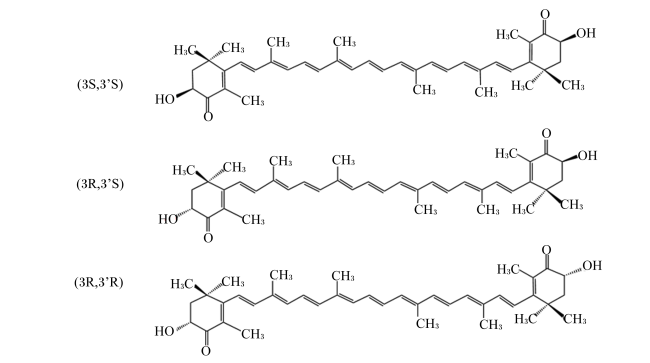
图1 虾青素的分子结构

Fig.1 Molecular structure of astaxanthin

1 虾青素的主要生物学功能

1.1 抗氧化作用

众多研究显示,虾青素具有较强的抗氧化作用。Hama等[6]首次报道了虾青素对羟基自由基的清除作用,在体外试验中,虾青素对水溶液中的羟自由基具有较强的清除能力,其清除能力强于α-生育酚。Dose等[7]的研究数据表明,合成的虾青素也是一种有效的自由基清除剂,除了清除自由基和单线态氧猝灭特性外,还能诱导抗氧化酶paroxoanase-1,提高肝细胞中谷胱甘肽的浓度,并防止脂质过氧化。核因子E2相关因子2(nuclear factor E2-related factor 2,Nrf2)是抗氧化基因的重要转录激活因子,是抗氧化保护的主要调节器[8]。Nrf2信号通路被激活后,会激活一系列下游抗氧化蛋白的表达[9]。虾青素是调节Nrf2/Kelch样ECH相关蛋白1(Kelch like ECH associated protein 1,Keap1)途径的天然化合物之一。大量研究表明,虾青素在体内的抗氧化作用机制涉及调控Nrf2/Keap1信号通路。如虾青素通过激活Nrf2/Keap1途径并抑制阻断核因子-κB(nuclear factor kappa B,NF-κB)途径,减轻D-半乳糖诱导的大鼠衰老中的氧化应激和免疫损伤[10]。虾青素还可通过激活Nrf2/Keap1通路及其下游Ⅱ期酶来保护人颗粒细胞免受氧化应激的损伤[11]。线粒体是活性氧簇(reactive oxygen species,ROS)的合成场所,也是其攻击的主要目标。当线粒体功能障碍会导致氧化应激,从而使细胞进入疾病状态[12]。越来越多的证据表明,虾青素可以通过维持线粒体的完整性抑制氧化应激。Baburina等[13]研究发现,虾青素能够通过抑制线粒体通透性过渡孔的开放,来减缓线粒体的肿胀,改善大鼠心脏线粒体对氧化应激的抵抗力。还有研究表明,虾青素能够保护线粒体结构免受酒精引起的退行性改变,主要通过维持线粒体氧化还原平衡来保护线粒体功能[14]。虾青素显著降低细胞发生的氧化应激,即使细胞在过氧化氢刺激后,它还可以防止基质金属蛋白酶(matrix metalloproteinase,MMP)的丢失,并增加线粒体的耗氧量[15]。此外,虾青素可以防止异丙肾上腺素引起的线粒体氧化损伤,并提高线粒体效率[16]。因此,虾青素可能是治疗与氧化损伤有关的线粒体功能障碍的潜在活性物质。

1.2 抗炎作用

目前,虾青素在抗炎反应中的各种机制已被证实。炎症性生物标志物,如许多急性期蛋白、诱导酶、趋化因子和细胞因子,都是虾青素调控的靶基因。除炎症分子外,虾青素还能激活磷脂酰肌醇-3激酶(phosphatidylinositide-3 kinase,PI3K)/蛋白激酶B(protein kinase B,Akt)/Nrf2、NF-κB、细胞外信号调节激酶(extracellular signal-regulated kinase,ERK)、c-Jun N末端激酶(c-Jun N-terminal kinase,JNK)、p38丝裂原活化蛋白激酶(p38 mitogen-activated protein kinase,p38 MAPK)和Janus激酶2(Janus kinase 2,JAK2)/信号转导与转录激活因子3(signal transducers and activators of transcription 3,STAT3)信号通路以减轻炎症[17]。Chan等[18]在糖尿病大鼠的饲粮中添加虾青素发现,虾青素可以减少血液和肾脏组织中ROS、白细胞介素-6(interleukin-6,IL-6)、肿瘤坏死因子-α(tumor necrosis factor-alpha,TNF-α)和单核细胞趋化蛋白1(monocyte chemoattractant protein 1,MCP1)的生成,还显著降低糖尿病大鼠血浆C反应蛋白和von Willebrand因子(von Willebrand factor,vWF)水平,减轻糖尿病相关的炎症应激。研究发现,虾青素还可通过抑制NF-κB的核转位和下调TNF-α来保护神经元免受炎症损伤,从而改善小鼠认知能力[19]。还有报道称,虾青素可以减弱幽门螺杆菌所引发的小鼠胃黏膜组织的炎症和致癌反应[20]。由此可见,虾青素在减轻炎症损害方面具有很强的潜力。

1.3 增强免疫功能

免疫系统细胞对自由基的损伤非常敏感。虾青素能防止自由基对免疫细胞的损伤,以保持免疫系统防御功能。人体补充虾青素后,血浆虾青素水平呈剂量依赖性升高,血浆C反应蛋白浓度降低,虾青素刺激有丝分裂原诱导的淋巴细胞增殖,增加自然杀伤(natural killer,NK)细胞的细胞毒活性,并增加T细胞和B细胞亚群,从而增强免疫应答[21]。研究发现,给犬饲喂添加虾青素的饲粮,可以提高犬免疫系统中B细胞的数量,提高血液免疫球蛋白G和免疫球蛋白M的浓度,进而增强犬的体液免疫反应[22]。Park等[23]在猫的饲粮中添加虾青素,发现虾青素也提高了猫血浆中免疫球蛋白G和免疫球蛋白M的浓度,且还可减少DNA损伤和炎症反应。Cheng等[24]的研究结果表明,在基础饲料中补充虾青素可以促进高温胁迫下河豚的生长,增强非特异性免疫反应和抗氧化防御系统,提高机体对高温胁迫的抵抗力。研究还表明,短期补充虾青素能够为参加剧烈运动的跑步者提供免疫支持,并抵抗血浆免疫球蛋白浓度的下降[25]。由此可见,虾青素在增强机体免疫功能上具有很大的应用潜力。

1.4 拮抗霉菌毒素

农作物在收获后的处理和储存过程中稍有不当就极有可能被真菌毒素污染,动物摄入受污染的饲料就会导致真菌毒素中毒,严重危害生命健康。据报道,真菌毒素可导致动物急性或慢性中毒,引发多种疾病,如黄曲霉毒素诱导氧化应激造成多个组织脏器损伤[26]。许多研究表明,虾青素可以减少真菌毒素对动物造成的损害。Cao等[27]研究发现,在饲粮中添加虾青素能逆转黄曲霉毒素B1(aflatoxin B1,AFB1)对抗氧化系统的损害,增强肉鸡肝组织的抗氧化活性,缓解肉鸡肝损伤。Monmeesil等[28]研究发现,AFB1可使大鼠肝脏中铜锌超氧化物歧化酶(Cu/Zn-superoxide dismutase,Cu/Zn-SOD)的表达降低,而虾青素可以可使Cu/Zn-SOD的表达显著升高,从而减轻AFB1诱导的大鼠肝损伤[27,29]。Tian等[30]通过体外试验发现,虾青素能激活猪小肠上皮细胞中的Nrf2信号通路,改善抗氧化能力,进而减弱AFB1引起的氧化应激和细胞凋亡。另一项研究也得到了相同的结果,虾青素通过调节Nrf2/Keap1信号通路,提高抗氧化酶的表达,进而减轻了赭曲霉毒素A(ochratoxin A,OTA)诱导的氧化应激,使小鼠肾小管上皮细胞恢复正常[31]。Cui等[32]试验发现,饲喂虾青素可上调小鼠心肌组织中总Nrf2和血红素氧合酶-1(heme oxygenase-1,HO-1)的蛋白表达,降低Keap1的蛋白表达,减轻了由OTA引起的氧化应激,从而防止心肌损伤。研究发现,与OTA处理相比,虾青素显著提高了Nrf2、HO-1和锰超氧化物歧化酶(Mn-superoxide dismutase,MnSOD)的表达,而其他蛋白[Keap1、Toll样受体4(Toll-like receptor 4,TLR4)和NF-κB]的表达显著降低,对OTA诱导的肺氧化损伤和炎症具有保护作用[33]。此外,有报道称,虾青素还可通过调节小鼠盲肠屏障功能和TLR4/髓样分化因子88(myeloid differentiation factor 88,MyD88)/NF-κB信号通路来减少OTA诱导的盲肠损伤[34]。综上所述,虾青素具有强大的抗氧化活性,能通过激活Nrf2/Keap1信号通路、清除自由基、抑制ROS生成以及防止脂质过氧化来减少真菌毒素对机体造成的氧化损伤,并通过抑制NF-κB通路缓解真菌毒素诱导的炎症反应。因此,在饲养过程中可以添加虾青素来减轻饲料中真菌毒素对动物健康的影响。

2 虾青素在畜禽生产中的应用

2.1 在禽类生产中的应用

虾青素能够提高禽类的生产性能。研究表明,饲粮中添加1.0%和1.5%的虾青素能够显著增加肉鸡平均日增重(average daily gain,ADG),并且显著降低料重比(feed to gain ratio,F/G),促进肉鸡生长[35],这可能与虾青素成分中含有优质蛋白质有关,也可能与虾青素能够激活消化酶的活性,促进营养物质的吸收有关[36]。饲粮中添加虾青素能够降低肉鸡和蛋鸡的热应激不良影响。研究发现,在热中性或高温下,在肉鸡饲粮中添加富含虾青素的干细胞粉可减轻热应激所带来的不良影响,如降低肉鸡肌肉中丙二醛(malondialdehyde,MDA)含量,增加肌肉中类胡萝卜素含量,提高鸡肉的红度和黄度值[37]。还有研究表明,在肉鸡和蛋鸡的热应激试验中,饲粮中添加0~80 mg/kg虾青素对于抗氧化、热应激、炎症反应以及肝脏脂类代谢相关的基因和蛋白表达都有影响,且与剂量相关[38]。但补充虾青素能够调节上述与氧化还原状态、热应激、炎症和脂质代谢相关的生物标志物基因表达的潜在机制尚不清楚。此外,饲粮中添加虾青素可以提高禽类产品的品质。有研究表明,在饲粮中添加低水平的虾青素即可显著减少鸡肉在烹饪、解冻过程中的水分丧失,提高鸡肉的保水能力,且虾青素处理的肉糜的肌红蛋白含量显著增高,鸡肉的口感和色泽得到改善[39]。蛋鸡饲粮中添加虾青素可以显著提高血浆、肝脏和蛋黄的抗氧化能力,调节脂质代谢,并显著提高蛋黄颜色[40]。Nugroho等[41]通过试验得到了类似的结果,蛋鸡摄入富含虾青素的玉米可降低血清中的MDA含量,提高血清的抗氧化指标,对蛋鸡的产蛋性能和鸡蛋品质的提高均有促进作用,使用富虾青素玉米可与添加虾青素饲粮发挥同等作用。此外,虾青素能通过提高蛋鸡的抗氧化能力,改善血清中生殖激素水平,从而防止卵巢衰老,改善蛋鸡产蛋后期繁殖性能下降的情况[42]

2.2 在猪生产中的应用

虾青素不仅可以改善猪精子和卵母细胞质量,提高生产性能,在养殖过程中起到辅助治疗作用,还可以降低机体氧化应激,提高抗病能力,改善猪肉的品质。研究表明,在冷冻延长剂中添加虾青素可抑制精子膜脂质过氧化,保护猪精子免受ROS损伤,改善解冻后精子质量[43]。Lee等[44]研究也发现,向冷冻缓冲液中加入不同浓度的虾青素,可以保护解冻后的小型猪精子DNA,提高精子活力和活动的精子数。此外,虾青素还可以提高玻璃化冷冻培养的猪受精卵的囊胚率,显著提高囊胚中线粒体的活性,可用于改善玻璃化冷冻胚胎的恢复培养条件[45]。卵母细胞体外成熟液中添加适量浓度的虾青素可有效促进卵母细胞的发育潜能,有效降低卵母细胞内ROS水平和MDA含量,提高卵母细胞质量及胚胎的发育能力[46]。另一项研究表明,虾青素通过提高猪卵母细胞的抗氧化能力,有效地恢复了卵母细胞的成熟率,减少了细胞凋亡,缓解了热应激造成的损伤[47]。虾青素能够提高断奶仔猪生产性能,降低仔猪对致病性微生物的易感性。研究发现,将虾青素添加到仔猪饲粮中能够抑制仔猪断奶应激带来的氧化应激反应,进而降低由于肠道氧化应激而引起的仔猪消化能力降低,并同时能够降低仔猪其他疾病的易感性[48]。此外,断奶仔猪的肠道对致病性病原微生物高度敏感,虾青素可以通过改变肠道微生物区系,提高断奶仔猪肠道益生菌的丰度和多样性来减轻应激造成的肠道炎性损伤[49]。虾青素还可作为抗氧化剂使肉类中的脂质氧化过程发生延迟。研究表明,富含虾青素的雨生红球藻提取物具有显著的自由基清除活性,该提取物对脂质氧化具有抗氧化作用,因此,可通过增强冷藏猪肉的抗氧化作用来延长保质期及保持肉色[50]

2.3 在反刍动物生产中的应用

饲粮添加虾青素不但能改善反刍动物生长性能、减少氧化应激和炎症损伤,提高机体抗病能力,还能调控生殖功能,以及改善肉的品质。Kumar等[51]研究发现,水母牛摄入含虾青素的饲粮后,血浆超氧化物歧化酶(superoxide dismutase,SOD)活性等抗氧化指标水平显著提高,机体抗氧化能力显著提升。虾青素还可以通过下调NF-κB信号通路,阻断促炎基因和半胱氨酸天冬氨酸蛋白酶-3(Caspase-3)的表达,以此来预防热应激诱导的母牛炎症反应和血浆中细胞凋亡[52]。虾青素对奶牛的生殖功能也具有调控作用。Jang等[53]通过体外试验发现,虾青素对牛的胚胎发育具有抗氧化作用,主要通过诱导抗氧化基因和抑制凋亡基因来提高牛输卵管上皮细胞活力,减少脂质过氧化。研究表明,虾青素有增强奶牛黄体功能的潜力,补充虾青素可能有助于维持妊娠[54]。另一项研究发现,虾青素能改善牛卵母细胞的质量,主要通过提高牛卵母细胞的抗氧化能力,抑制颗粒细胞的黄体化[55]。虾青素还可以通过提高卵母细胞SOD活性,降低高温诱导卵母细胞ROS的增加,进而恢复卵母细胞的发育能力[56]。此外,有报道称,生姜提取物和虾青素复配保鲜液能延缓脂质氧化,用其保存牛肉,能延长牛肉的贮藏期[57]。Carballo等[58]也发现,虾青素能减少羊肉中丁基化羟基甲苯的积累,增加冷冻肉的脂质稳定性,从而提升肉的品质和延长货架期。

3 小结与展望

虾青素作为一种安全、天然的抗氧化剂,不但可以提高畜禽的生产性能,改善畜禽的生殖功能,提高抗氧化能力和抗病力,还可提高肉、蛋等动物产品的品质。此外,虾青素拮抗真菌毒素的特性可用于预防和治疗畜禽各种霉菌毒素中毒。在动物饲粮中添加虾青素还可以拮抗饲料中真菌毒素带来的危害,这对人类和动物的健康和可持续发展具有重要意义。但是,虾青素在动物生产中的应用尚存在许多争议和挑战。例如,如何优化虾青素的添加方式,提高其稳定性,加入虾青素的饲粮配方和用量也需要进行精确控制。此外,虽然虾青素在动物体内的作用机制已初步阐明,如虾青素可通过激活PI3K/Akt/Nrf2、NF-κB、ERK、JNK、p38 MAPK和JAK2/STAT3信号通路以减轻氧化应激和炎症,但非编码RNA[微小RNA(miRNA)、长链非编码RNA(lncRNA)、环状RNA(circRNA)和与Piwi蛋白相作用的RNA(piRNA)]在调控虾青素抗氧化应激和炎症反应的具体作用机制尚需要进一步研究。此外,虾青素在动物肠道中的吸收和利用情况还需要进一步探讨。因此,还需要对虾青素作用于细胞和分子的具体机制进行深入研究。目前,对虾青素拮抗真菌毒素的研究也还不够多,虾青素的解毒功能是否可应用于生产实践,还需要进一步的试验研究。虽然已经证明,天然虾青素的毒理性很小,但合成虾青素对人和动物的安全性还需要在更广的范围内进行验证。解决这些问题的关键在于继续多方向展开虾青素在畜禽生产领域的研究,通过深入了解虾青素在动物机体内的作用机制,制定更加科学的添加剂配方和用量,深入评估虾青素的安全性,从而为虾青素在畜禽生产领域的应用提供保障。
[1]
黄文文, 洪碧红, 易瑞灶, 等. 虾青素生产方法及生物活性的研究进展[J]. 中国食品添加剂, 2012(6):214-218.

HUANG W W, HONG B H, YI R Z, et al. Progress of production method and biological activity about astaxanthin[J]. China Food Additives, 2012(6):214-218. (in Chinese)

[2]
STACHOWIAK B, SZULC P. Astaxanthin for the food industry[J]. Molecules, 2021, 26(9):2666.

DOI

[3]
肖素荣, 李京东. 虾青素的特性及应用前景[J]. 中国食物与营养, 2011, 17(5):33-35.

XIAO S R, LI J D. Features of astaxanthin and its application prospects[J]. Food and Nutrition in China, 2011, 17(5):33-35. (in Chinese)

[4]
LIU X J, XIE J T, ZHOU L S, et al. Recent advances in health benefits and bioavailability of dietary astaxanthin and its isomers[J]. Food Chemistry, 2023, 404(Part B):134605.

[5]
SI P, ZHU C K. Biological and neurological activities of astaxanthin (review)[J]. Molecular Medicine Reports, 2022, 26(4):300.

DOI

[6]
HAMA S S, UENISHI S, YAMADA A, et al. Scavenging of hydroxyl radicals in aqueous solution by astaxanthin encapsulated in liposomes[J]. Biological and Pharmaceutical Bulletin, 2012, 35(12):2238-2242.

DOI

[7]
DOSE J, MATSUGO S, YOKOKAWA H, et al. Free radical scavenging and cellular antioxidant properties of astaxanthin[J]. International Journal of Molecular Sciences, 2016, 17(1):103.

DOI

[8]
VOMUND S, SCHÄFER A, PARNHAM M J, et al. Nrf2,the master regulator of anti-oxidative responses[J]. International Journal of Molecular Sciences, 2017, 18(12):2772.

DOI

[9]
ASHRAFIZADEH M, AHMADI Z, SAMARGHANDIAN S, et al. MicroRNA-mediated regulation of Nrf2 signaling pathway:implications in disease therapy and protection against oxidative stress[J]. Life Sciences, 2020, 244:117329.

DOI

[10]
CHEN Z Q, XIAO J, LIU H, et al. Astaxanthin attenuates oxidative stress and immune impairment in D-galactose-induced aging in rats by activating the Nrf2/Keap1 pathway and suppressing the NF-κB pathway[J]. Food & Function, 2020, 11(9):8099-8111.

[11]
ESLAMI M, ESFANDYARI S, AGHAHOSSEINI M, et al. Astaxanthin protects human granulosa cells against oxidative stress through activation of NRF2/ARE pathway and its downstream phase Ⅱ enzymes[J]. Cell Journal, 2021, 23(3):319-328.

[12]
FANG P, LIANG J J, JIANG X J, et al. Quercetin attenuates D-GaLN-induced L02 cell damage by suppressing oxidative stress and mitochondrial apoptosis via inhibition of HMGB1[J]. Frontiers in Pharmacology, 2020, 11:608.

DOI

[13]
BABURINA Y, KRESTININ R, ODINOKOVA I, et al. Astaxanthin inhibits mitochondrial permeability transition pore opening in rat heart mitochondria[J]. Antioxidants, 2019, 8(12):576.

DOI

[14]
KRESTININA O, ODINOKOVA I, SOTNIKOVA L, et al. Astaxanthin is able to prevent alcohol-induced dysfunction of liver mitochondria[J]. Antioxidants, 2022, 11(10):2019.

DOI

[15]
KIM S H, KIM H. Inhibitory effect of astaxanthin on oxidative stress-induced mitochondrial dysfunction-a mini-review[J]. Nutrients, 2018, 10(9):1137.

DOI

[16]
KRESTININA O, BABURINA Y, KRESTININ R, et al. Astaxanthin prevents mitochondrial impairment induced by isoproterenol in isolated rat heart mitochondria[J]. Antioxidants, 2020, 9(3):262.

DOI

[17]
CHANG M X, XIONG F. Astaxanthin and its effects in inflammatory responses and inflammation-associated diseases:recent advances and future directions[J]. Molecules, 2020, 25(22):5342.

DOI

[18]
CHAN K C, PEN P J, YIN M C. Anticoagulatory and antiinflammatory effects of astaxanthin in diabetic rats[J]. Journal of Food Science, 2012, 77(2):H76-H80.

[19]
ZHOU X Y, ZHANG F, HU X T, et al. Inhibition of inflammation by astaxanthin alleviates cognition deficits in diabetic mice[J]. Physiology & Behavior, 2015, 151:412-420.

DOI

[20]
HAN H, LIM J W, KIM H. Astaxanthin inhibits helicobacter pylori-induced inflammatory and oncogenic responses in gastric mucosal tissues of mice[J]. Journal of Cancer Prevention, 2020, 25(4):244-251.

DOI

[21]
PARK J S, CHYUN J H, KIM Y K, et al. Astaxanthin decreased oxidative stress and inflammation and enhanced immune response in humans[J]. Nutrition & Metabolism, 2010, 7:18.

[22]
CHEW B P, MATHISON B D, HAYEK M G, et al. Dietary astaxanthin enhances immune response in dogs[J]. Veterinary Immunology and Immunopathology, 2011, 140(3/4):199-206.

DOI

[23]
PARK J S, MATHISON B D, HAYEK M G, et al. Astaxanthin stimulates cell-mediated and humoral immune responses in cats[J]. Veterinary Immunology and Immunopathology, 2011, 144(3/4):455-461.

DOI

[24]
CHENG C H, GUO Z X, YE C X, et al. Effect of dietary astaxanthin on the growth performance,non-specific immunity,and antioxidant capacity of pufferfish (Takifugu obscurus) under high temperature stress[J]. Fish Physiology and Biochemistry, 2018, 44(1):209-218.

DOI

[25]
NIEMAN D C, WOO J, SAKAGUCHI C A, et al. Astaxanthin supplementation counters exercise-induced decreases in immune-related plasma proteins[J]. Frontiers in Nutrition, 2023, 10:1143385.

DOI

[26]
ISMAIL A, GONÇALVES B L, DE NEEFF D V, et al. Aflatoxin in foodstuffs:occurrence and recent advances in decontamination[J]. Food Research International, 2018, 113:74-85.

DOI

[27]
CAO J G, WANG W J. Effects of astaxanthin and esterified glucomannan on hematological and serum parameters,and liver pathological changes in broilers fed aflatoxin-B1-contaminated feed[J]. Animal Science Journal, 2014, 85(2):150-157.

DOI

[28]
MONMEESIL P, FUNGFUANG W, TULAYAKUL P, et al. The effects of astaxanthin on liver histopathology and expression of superoxide dismutase in rat aflatoxicosis[J]. Journal of Veterinary Medical Science, 2019, 81(8):1162-1172.

DOI PMID

[29]
KANG J O, KIM S J, KIM H. Effect of astaxanthin on the hepatotoxicity,lipid peroxidation and antioxidative enzymes in the liver of CCl4-treated rats[J]. Methods and Findings in Experimental and Clinical Pharmacology, 2001, 23(2):79-84.

DOI

[30]
TIAN Y, CHE H Y, YANG J S, et al. Astaxanthin alleviates aflatoxin B1-induced oxidative stress and apoptosis in IPEC-J2 cells via the Nrf2 signaling pathway[J]. Toxins, 2023, 15(3):232.

DOI

[31]
LI L, CHEN Y L, JIAO D Y, et al. Protective effect of astaxanthin on ochratoxin A-induced kidney injury to mice by regulating oxidative stress-related NRF2/KEAP1 pathway[J]. Molecules, 2020, 25(6):1386.

DOI

[32]
CUI G Y, LI L, XU W X, et al. Astaxanthin protects ochratoxin A-induced oxidative stress and apoptosis in the heart via the Nrf2 pathway[J]. Oxidative Medicine and Cellular Longevity, 2020, 2020:7639109.

[33]
XU W X, WANG M Y, CUI G Y, et al. Astaxanthin protects OTA-induced lung injury in mice through the Nrf2/NF-κB pathway[J]. Toxins, 2019, 11(9):540.

DOI

[34]
CHEN Y L, ZHAO S W, JIAO D Y, et al. Astaxanthin alleviates ochratoxin A-induced cecum injury and inflammation in mice by regulating the diversity of cecal microbiota and TLR4/MyD88/NF-κB signaling pathway[J]. Oxidative Medicine and Cellular Longevity, 2021, 2021:8894491.

[35]
付兴周, 路志芳, 李东. 虾青素复合添加剂对肉鸡生长性能及肉质的影响[J]. 畜牧与兽医, 2017, 49(1):27-30.

FU X Z, LU Z F, LI D. Effects of astaxanthin composite additives on growth performance and meat quality in the broiler[J]. Animal Husbandry & Veterinary Medicine, 2017, 49(1):27-30. (in Chinese)

[36]
白建. 日粮添加虾青素对肉鸡饲喂效果的影响研究[J]. 饲料研究, 2022, 45(22):57-62.

BAI J. Study on effect of dietary astaxanthin on feeding efficiency of broilers[J]. Feed Research, 2022, 45(22):57-62. (in Chinese)

[37]
INOUE H, SHIMAMOTO S, TAKAHASHI H, et al. Effects of astaxanthin-rich dried cell powder from Paracoccus carotinifaciens on carotenoid composition and lipid peroxidation in skeletal muscle of broiler chickens under thermo-neutral or realistic high temperature conditions[J]. Animal Science Journal, 2019, 90(2):229-236.

DOI

[38]
TOLBA S A, MAGNUSON A D, SUN T, et al. Dietary supplemental microalgal astaxanthin modulates molecular profiles of stress,inflammation,and lipid metabolism in broiler chickens and laying hens under high ambient temperatures[J]. Poultry Science, 2020, 99(10):4853-4860.

DOI

[39]
AWADH I A J, ZANGANA B S R. Effect of adding astaxanthin to the diet on the physical and chemical traits of the broiler chickens[J]. IOP Conference Series:Earth and Environmental Science, 2021, 910:012074.

DOI

[40]
GAO S, LI R H, HENG N, et al. Effects of dietary supplementation of natural astaxanthin from Haematococcus pluvialis on antioxidant capacity,lipid metabolism,and accumulation in the egg yolk of laying hens[J]. Poultry Science, 2020, 99(11):5874-5882.

DOI

[41]
NUGROHO R D, DANSOU D M, 王浩, 等. 富虾青素玉米对蛋鸡生产性能、抗氧化能力、虾青素富集及蛋品质的影响[J]. 中国畜牧杂志, 2022, 58(9):214-219,227.

NUGROHO R D, DANSOU D M, WANG H, et al. Effects of astaxanthin-rich maize on performance,antioxidant activity,astaxanthin enrichment,and egg quality of laying hens[J]. Chinese Journal of Animal Science, 2022, 58(9):214-219,227. (in Chinese)

[42]
HE W Z, WANG H, TANG C H, et al. Dietary supplementation with astaxanthin alleviates ovarian aging in aged laying hens by enhancing antioxidant capacity and increasing reproductive hormones[J]. Poultry Science, 2023, 102(1):102258.

DOI

[43]
GUO H T, WANG J R, SUN L Z, et al. Effects of astaxanthin on plasma membrane function and fertility of boar sperm during cryopreservation[J]. Theriogenology, 2021, 164:58-64.

DOI

[44]
LEE E, KIM D. Effects of astaxanthin on miniature pig sperm cryopreservation[J]. BioMed Research International, 2018, 2018:6784591.

[45]
XIANG D C, JIA B Y, FU X W, et al. Role of astaxanthin as an efficient antioxidant on the in vitro maturation and vitrification of porcine oocytes[J]. Theriogenology, 2021, 167:13-23.

DOI

[46]
许建春, 汪浩鑫, 自永宏, 等. 虾青素对猪卵母细胞体外成熟的影响[J]. 中国兽医学报, 2022, 42(12):2549-2554.

XU J C, WANG H X, ZI Y H, et al. Effects of astaxanthin on maturation of porcine oocytes in vitro[J]. Chinese Journal of Veterinary Science, 2022, 42(12):2549-2554. (in Chinese)

[47]
DO L T K, LUU V V, MORITA Y, et al. Astaxanthin present in the maturation medium reduces negative effects of heat shock on the developmental competence of porcine oocytes[J]. Reproductive Biology, 2015, 15(2):86-93.

DOI PMID

[48]
SZCZEPANIK K, FURGAŁ-DIERZUK I, GALA Ł, et al. Effects of Hermetia illucens larvae meal and astaxanthin as feed additives on health and production indices in weaned pigs[J]. Animals, 2022, 13(1):163.

DOI

[49]
YASUDA R, KAMADA K, MURAKAMI T, et al. Astaxanthin attenuated the stress-induced intestinal motility disorder via altering the gut microbiota[J/OL]. International Journal for Vitamin and Nutrition Research:a000756[2023-05-11].https://doi.org/10.1024/0300-9831/a000756.

[50]
POGORZELSKA E, GODZISZEWSKA J, BRODOWSKA M, et al. Antioxidant potential of Haematococcus pluvialis extract rich in astaxanthin on colour and oxidative stability of raw ground pork meat during refrigerated storage[J]. Meat Science, 2018, 135:54-61.

DOI

[51]
KUMAR R, SAHU D S, CHANDRA G, et al. Effect of astaxanthin and copper supplementation on growth,immunity,antioxidant,and blood biochemical status of growing murrah buffalo heifers[J]. Biological Trace Element Research, 2022, 200(12):5052-5063.

DOI

[52]
KUMAR S, SINGH S V. Inhibition of NF-κB signaling pathway by astaxanthin supplementation for prevention of heat stress-induced inflammatory changes and apoptosis in Karan Fries heifers[J]. Tropical Animal Health and Production, 2019, 51(5):1125-1134.

DOI PMID

[53]
JANG H Y, JI S J, KIM Y H, et al. Antioxidative effects of astaxanthin against nitric oxide-induced oxidative stress on cell viability and gene expression in bovine oviduct epithelial cell and the developmental competence of bovine IVM/IVF embryos[J]. Reproduction in Domestic Animals, 2010, 45(6):967-974.

DOI PMID

[54]
KAMADA H, AKAGI S, WATANABE S. Astaxanthin increases progesterone production in cultured bovine luteal cells[J]. Journal of Veterinary Medical Science, 2017, 79(6):1103-1109.

DOI PMID

[55]
ABDEL-GHANI M A, YANAGAWA Y, BALBOULA A Z, et al. Astaxanthin improves the developmental competence of in vitro-grown oocytes and modifies the steroidogenesis of granulosa cells derived from bovine early antral follicles[J]. Reproduction,Fertility and Development, 2019, 31(2):272-281.

DOI

[56]
ISPADA J, RODRIGUES T A, RISOLIA P H B, et al. Astaxanthin counteracts the effects of heat shock on the maturation of bovine oocytes[J]. Reproduction,Fertility and Development, 2018, 30(9):1169-1179.

DOI

[57]
孟庆, 孙亚楠. 生姜提取物/虾青素复配液对冷鲜牛肉保鲜效果的影响[J]. 中国食品添加剂, 2022, 33(6):115-121.

MENG Q, SUN Y N. Effects of ginger extract/astaxanthin compound solution on the preservation effect of chilled beef[J]. China Food Additives, 2022, 33(6):115-121. (in Chinese)

[58]
CARBALLO D E, GIRÁLDEZ F J, ANDRÉS S, et al. Effects of dietary astaxanthin supplementation on the oxidative stability of meat from suckling lambs fed a commercial milk-replacer containing butylated hydroxytoluene[J]. Meat Science, 2019, 156:68-74.

DOI PMID

文章导航

/