研究论文

饲粮粗纤维水平对中新鸭生长性能、屠宰性能、肠道发育及盲肠菌群结构的影响

  • 来金良 , 1, 2, 3 ,
  • 吕尊周 1, 2, 3 ,
  • 姚玥州 1, 2 ,
  • 韩青海 1, 2, 3 ,
  • 刘振林 1, 2, 3 ,
  • 杨庆磊 1, 2, 3 ,
  • 吕孝国 1, 2, 3 ,
  • 李鑫 1, 2, 3 ,
  • 刘宗强 1, 2, 3 ,
  • 周桂莲 1, 2 ,
  • 李勇 , 1, 2, 3, 4, * ,
  • 燕磊 , 1, 2, 3, *
展开
  • 1 农业农村部饲料及畜禽产品质量安全控制重点实验室,成都 610023
  • 2 新希望六和股份有限公司,成都 610023
  • 3 山东新希望六和集团有限公司,青岛市动物饲料安全重点实验室,青岛 266061
  • 4 潍坊新希望六和饲料科技有限公司,潍坊 261000
* 李 勇,高级畜牧师,E-mail: ;
燕 磊,研究员,E-mail:

来金良(1979—),男,山东日照人,硕士,从事家禽营养研究。E-mail:

Copy editor: 武海龙

收稿日期: 2023-06-30

  网络出版日期: 2023-12-11

基金资助

山东省重点研发计划(TSCY20190108)

山东省重点研发计划(2021CXGC010805)

国家重点研发计划(2022YFD13006005)

鸢都产业领军人才项目(2022年度)

Effects of Dietary Crude Fiber Levels on Growth Performance, Slaughter Performance, Intestinal Development and Cecal Flora Structure of Zhongxin Ducks

  • LAI Jinliang , 1, 2, 3 ,
  • LYU Zunzhou 1, 2, 3 ,
  • YAO Yuezhou 1, 2 ,
  • HAN Qinghai 1, 2, 3 ,
  • LIU Zhenlin 1, 2, 3 ,
  • YANG Qinglei 1, 2, 3 ,
  • LYU Xiaoguo 1, 2, 3 ,
  • LI Xin 1, 2, 3 ,
  • LIU Zongqiang 1, 2, 3 ,
  • ZHOU Guilian 1, 2 ,
  • LI Yong , 1, 2, 3, 4, * ,
  • YAN Lei , 1, 2, 3, *
Expand
  • 1 Key Laboratory of Feed and Livestock and Poultry Products Quality & Safety Control, Ministry of Agriculture and Rural Affairs, Chengdu 610023, China
  • 2 New Hope Liuhe Co., Ltd., Chengdu 610023, China
  • 3 Qingdao Key Laboratory of Animal Feed Safety, Shandong New Hope Liuhe Co., Ltd., Qingdao 266061, China
  • 4 Weifang New Hope Liuhe Feed Technology Co., Ltd., Weifang 261000, China
* LI Yong, senior engineer, E-mail: ;
YAN Lei, professor, E-mail:

Received date: 2023-06-30

  Online published: 2023-12-11

摘要

本试验旨在研究饲粮粗纤维水平对中新鸭生长性能、屠宰性能、肠道发育及盲肠菌群结构的影响。选择1日龄商品代中新肉公鸭600只,随机分为3组,每组8个重复,每个重复25羽。饲粮粗纤维设为低(前期2.9%、后期3.6%)、中(前期4.2%、后期4.7%)、高(前期5.8%、后期5.5%)3个水平。试验期37 d。结果表明:1)饲粮粗纤维水平对各阶段中新鸭生长性能均无显著影响(P>0.05)。2)高粗纤维水平组腹脂率显著高于低粗纤维水平组(P<0.05)。3)高粗纤维水平组空肠和回肠相对重量及腺胃指数显著高于低、中粗纤维水平组(P<0.05),中、高粗纤维水平组空肠和回肠绝对重量显著高于低粗纤维水平组(P<0.05)。饲粮粗纤维水平对中新鸭肠道损伤评分无显著影响(P>0.05)。4)中粗纤维水平组Shannon指数显著高于高粗纤维水平组(P<0.05)。在门水平上,中粗纤维水平组厚壁菌门相对丰度最高,低粗纤维水平组拟杆菌门相对丰度最高。在属水平上,低粗纤维水平组拟杆菌属相对丰度最高。由此可见,饲喂中粗纤维水平(前期4.2%、后期4.7%)饲粮的中新鸭生长性能和盲肠菌群结构表现最佳;饲喂高粗纤维水平(前期5.8%、后期5.5%)饲粮有利于中新鸭胃肠道的发育,但可能对生长性能和屠宰性能有不利影响。

本文引用格式

来金良 , 吕尊周 , 姚玥州 , 韩青海 , 刘振林 , 杨庆磊 , 吕孝国 , 李鑫 , 刘宗强 , 周桂莲 , 李勇 , 燕磊 . 饲粮粗纤维水平对中新鸭生长性能、屠宰性能、肠道发育及盲肠菌群结构的影响[J]. 动物营养学报, 2023 , 35(12) : 7805 -7816 . DOI: 10.12418/CJAN2023.709

Abstract

The aim of this experiment was to study the effects of dietary crude fiber levels on growth performance, slaughter performance, intestinal development and cecal flora structure of Zhongxin ducks. A total of 600 one-day-old male commercial Zhongxin ducks were randomly divided into 3 groups with 8 replicates per group and 25 ducks per replicate. The dietary crude fiber levels were low (2.9% in the starter and 3.6% in the finisher), medium (4.2% in the starter and 4.7% in the finisher) and high (5.8% in the starter and 5.5% in the finisher), respectively. The experimental period was 37 days. The results showed as follows: 1) dietary crude fiber levels had no significant effect on the growth performance of Zhongxin ducks at all stages (P>0.05). 2) The abdominal fat percentage of high crude fiber level group was significantly higher than that of low crude fiber level group (P<0.05). 3) The relative weight of jejunum and ileum and proventriculus index of high crude fiber level group were significantly higher than those of low and medium crude fiber level groups (P<0.05), and the absolute weight of jejunum and ileum of medium and high crude fiber level groups were significantly higher than those of low crude fiber level group (P<0.05). Dietary crude fiber levels had no significant effect on the intestinal injury score of Zhongxin ducks (P>0.05). 4) The Shannon index of medium crude fiber level group was significantly higher than that of high crude fiber level group (P<0.05). At the phylum level, the relative abundance of Firmicutes was the highest in medium crude fiber level group, while the relative abundance of Bacteroidetes was the highest in low crude fiber level group. At the genus level, the relative abundance of Bacteroides was the highest in low crude fiber level group. In conclusion, Zhongxin ducks feeding medium crude fiber level (4.2% in the starter and 4.7% in the finisher) dites showed the best growth performance and cecal flora structure; feeding high crude fiber level (5.8% in the early stage and 5.5% in the late stage) diets are beneficial for the gastrointestinal tract development of Zhongxin ducks, but it may have adverse effects on growth performance and slaughter performance.

中国作为最大的鸭类生产国,占全球鸭类市场的75%以上,提高肉鸭的生产效率能产生巨大经济效益[1]。目前,我国饲养的肉鸭品种主要有北京鸭、樱桃谷鸭及地方麻鸭。结合我国肉鸭产业及消费现状,消费者对鸭肉品质的要求越来越高,优质鸭肉需求量逐年增大。中新鸭是近年来我国自主培育的肉鸭新品种,相比于樱桃谷鸭具有脂肪沉积低、肉质鲜美等优点,更符合中国消费市场需求[2]。为了确保家禽健康生长和消化器官正常发育,饲粮中需要适量的粗纤维,饲粮中粗纤维能够增强饲料在家禽肌胃中的挤压和摩擦性能,有助于刺激家禽分泌更多的胃酸和消化液,提高消化能力,不同来源和含量的纤维会对家禽的生长性能产生影响,补充粗纤维对肉禽和蛋禽的生长性能、消化功能都有积极的影响[3-4]。鸭的消化道容积较大,对粗纤维的各个组分有较强的消化能力,对半纤维素的消化能力比鸡要高19.05%[5]。还有研究表明,饲粮中额外添加粗纤维可显著提高肉鸭平均日增重和出栏体重,降低料重比,并且还可以提高盲肠绒毛高度[6]。饲粮粗纤维在肠道被微生物发酵,产生有益的短链脂肪酸,如丙酸、丁酸等,能够提供能量给肠道细胞,同时还可以促进肠道蠕动、维持肠黏膜完整性、调节肠道微生物组成、刺激免疫和促进肠道完整性,以达到保护家禽肠道免受病原体和毒素入侵的目的[7-8]。目前,关于饲粮粗纤维水平对中新鸭生长性能、胴体特性的影响鲜少有研究报道,且也无中新鸭饲粮适宜粗纤维水平的研究。因此,本试验旨在研究饲粮粗纤维水平对中新鸭生长性能、屠宰性能、肠道指数、肠道评分及盲肠菌群结构的影响,探讨粗纤维水平调控肉鸭生长发育的规律,为精准配制中新鸭饲料配方提供理论依据。

1 材料与方法

1.1 试验设计

试验选择1日龄商品代中新鸭肉公鸭600只,随机分为3组,每组8个重复,每个重复25羽。饲粮粗纤维设为低(前期2.9%、后期3.6%)、中(前期4.2%、后期4.7%)、高(前期5.8%、后期5.5%)3个水平。试验期37 d。试验饲粮组成及营养水平见表1,营养水平和阶段划分参照《鸭饲养标准》(T/CAAA053—2020)。饲粮常规营养成分测定按照国家标准进行,其中水分、粗灰分、粗蛋白质、粗脂肪、粗纤维、钙、总磷含量的测定方法分别按照GB/T 6435—2014、GB/T 6438—2007、GB/T 6432—2018、GB/T 6433—2006、GB/T 6434—2022、GB/T 6436—2018、GB/T 6437—2018进行。
表1 试验饲粮组成及营养水平(风干基础)

Table 1 Composition and nutrient levels of experimental diets (air-dry basis) %

项目
Items
粗纤维水平Crude fiber levels
1~17日龄1 to 17 days of age 18~37日龄18 to 37 days of age
低Low 中Medium 高High 低Low 中Medium 高High
原料Ingredients
玉米Corn 40.81 37.59 34.39 30.35 29.23 28.08
面粉Wheat flour 20.00 22.50 25.00 30.00 30.00 30.00
豆粕Soybean meal 10.38 10.08 9.78 6.02 6.32 6.63
玉米干酒糟及其可溶物Corn DDGS 8.00 7.69 7.37 10.00 10.00 10.00
花生粕Peanut meal 6.00 6.00 6.00 6.00 6.00 6.00
玉米胚芽粕Corn germ meal 4.78 2.39 0.00 6.33 3.17
玉米蛋白粉Corn gluten meal 2.99 3.35 3.70 2.44 2.71 2.99
大豆皮Soybean hull 3.91 7.82 3.99 7.98
石粉Limestone 1.70 1.56 1.43 1.56 1.40 1.25
膨润土Bentonite 1.37 0.69 0.00 0.89 0.45 0.00
磷酸氢钙CaHPO4 1.16 1.19 1.22 0.57 0.60 0.62
鸭油Duck oil 1.00 1.25 1.50 4.00 4.31 4.63
L-赖氨酸硫酸盐L-Lys·H2SO4 0.80 0.79 0.78 0.84 0.82 0.81
DL-蛋氨酸DL-Met 0.20 0.20 0.20 0.19 0.19 0.20
氯化钠NaCl 0.31 0.31 0.31 0.31 0.31 0.31
预混料Premix1) 0.50 0.50 0.50 0.50 0.50 0.50
合计Total 100.00 100.00 100.00 100.00 100.00 100.00
营养水平Nutrient levels2)
水分Moisture 13.2 12.6 13.7 13.4 13.4 13.5
粗蛋白质CP 18.93 18.89 18.76 17.39 17.48 17.35
粗灰分Ash 5.60 5.10 4.50 4.60 4.30 3.90
粗脂肪EE 3.70 3.70 3.90 6.70 7.00 7.20
粗纤维CF 2.90 4.20 5.80 3.60 4.70 5.50
钙Ca 0.87 0.87 0.80 0.74 0.70 0.63
总磷TP 0.58 0.60 0.61 0.47 0.47 0.46
赖氨酸Lys 1.14 1.15 1.15 1.09 1.10 1.10
蛋氨酸Met 0.51 0.51 0.51 0.49 0.49 0.49
代谢能ME/(MJ/kg) 11.72 11.72 11.72 12.55 12.55 12.55

1)预混料为每千克饲粮提供 The premix provided the following per kg of diets:Cu 8 mg,Fe 80 mg,Mn 80 mg,Zn 60 mg,I 3 mg,Se 0.25 mg,VA 9 000 IU,VD3 2 000 IU,VE 11 IU,VK 1.0 mg,VB1 1.2 mg,VB2 5.8 mg,烟酸 nicotinic acid 66 mg,泛酸 pantothenic acid 10 mg,VB6 2.6 mg,生物素 biotin 0.10 mg,叶酸 folic acid 0.7 mg,VB12 0.012 mg。

2)氨基酸和代谢能为计算值,其余为实测值。Amino acids and ME were calculated values, while the others were measured values.

1.2 饲养管理

试验鸭采用笼养,自由饮水和采食,人工光照,常规免疫。采用整舍育雏,暖风炉水暖控温,进雏时舍温为32 ℃,以后每周降低2 ℃直至常温。肉鸭饲养过程中,根据鸭群健康状况确定治疗用药。每天记录温湿度、采食量、健康状况和死淘情况,发现异常情况及时处理,并做好记录。在试验开始和结束进行全体称重并记录。

1.3 样品采集与指标测定

1.3.1 生长性能

分别于试验第1天和试验结束当天以重复为单位对空腹试验鸭称重,记为初始体重(IBW)和终末体重(FBW),以重复为单位准确记录喂料量和剩料量,计算试验鸭平均日增重(ADG)、平均日采食量(ADFI)和料重比(F/G)。

1.3.2 屠宰性能和器官指数

在肉鸭37日龄时,从每个重复中选择4只接近该组平均体重的试验鸭,称量活体重后,使用静脉放血的方法将其安乐死,并进行湿法拔毛。根据NY/T 823—2020的标准进行屠宰性能测定,计算屠宰率、全净膛率、胸肌率、腿肌率和腹脂率。同时,取出腺胃和肌胃,用剪刀剖开并冲洗掉胃内容物,称量肌胃和腺胃的重量,并计算器官指数。相关指标计算公式如下:
屠宰率(%)=(屠体重/宰前活重)×100;
全净膛率(%)=(全净膛重/宰前活重)×100;
胸肌率(%)=(胸肌重/全净膛重)×100;
腿肌率(%)=(腿肌重/全净膛重)×100;
腹脂率(%)=[腹脂重/(全净膛重+腹脂重)]×100;
器官指数(g/kg)=器官重量/宰前活重。

1.3.3 肠道指数

试验鸭屠宰后分离各肠段(十二指肠、空肠和回肠),分别用皮尺和电子天平测量各肠段绝对长度和绝对重量,计算各肠段的相对长度和相对重量。计算公式如下:
肠段相对长度(cm/kg)=肠段长度/宰前活重;
肠段相对重量(g/kg)=肠段重量/宰前活重。

1.3.4 肠道损伤评分

肠道损伤评分参考Dahiya等[9]和Liu等[10]的方法,检查整个肠道病变程度并对胀气、水分增多、肠壁变薄、弹性减弱、黏液增多、黏膜脱落、后肠段含料量增多、出血性肠炎和气泡增多等肠道损伤指标进行评分,分值为0~3分,分值越高则代表该现象越严重。

1.3.5 盲肠菌群结构测定

每个重复随机选取1只试验鸭,收集盲肠食糜0.5 g,置于PE管中,液氮速冻后保存于干冰中送至百迈客生物科技有限公司进行DNA提取、检测、PCR扩增、文库构建及生物信息学分析。按照E.Z.N.A. DNA Kit说明书提取盲肠食糜DNA,使用1%琼脂糖凝胶电泳检测DNA提取质量并使用Nano Drop 2000测定DNA浓度和纯度。采用16S rRNA基因通用型引物338F(5'-ACTCCTACGGGAGGCAGCAG-3')和806R(5'-GGACTACHVGGGTWTCTAAT-3')对V3~V4可变区进行PCR扩增。将同一样本的PCR产物混合后使用2%琼脂糖凝胶回收PCR产物并利用AxyPrep DNA Gel Extraction Kit进行回收产物纯化,2%琼脂糖凝胶电泳检测,并用QuantusTM Fluorometer对回收产物进行检测、定量。使用NEXTFLEX Rapid DNA-Seq Kit进行建库,并在MiSeq PE300平台进行测序。

1.4 数据处理及统计分析

试验数据先用Excel 2021进行整理和初步计算,再采用SPSS 25.0统计软件中ANOVA程序进行方差分析,对差异显著者进行Duncan氏法多重比较。各组试验结果均用“平均值±标准差”表示,以P<0.05为差异显著。菌群数据方面,微生物多样性(包括α多样性和β多样性)采用QIIME2软件进行分析,各菌群组间差异显著性分析采用F检验方法进行分析。

2 结果与分析

2.1 饲粮粗纤维水平对中新鸭生长性能的影响

表2可知,各组之间1~17日龄、18~37日龄及1~37日龄中新鸭生长性能无显著差异(P>0.05)。
表2 饲粮粗纤维水平对中新鸭生长性能的影响

Table 2 Effects of dietary crude fiber levels on growth performance of Zhongxin ducks

项目
Items
粗纤维水平Crude fiber levels P
P-value
低Low 中Medium 高High
初始体重IBW/g 52.00±0.00 52.00±0.00 52.00±0.00 1.000

1~17日龄
平均日采食量ADFI/g 70.13±2.04 69.94±2.66 71.21±2.37 0.292

1 to 17 days of age
平均日增重ADG/g 62.45±2.57 61.70±1.91 62.26±2.66 0.715
料重比F/G 1.12±0.02 1.13±0.04 1.15±0.05 0.314
终末体重FBW/g 1 113.94±43.56 1 101.25±32.31 1 110.75±44.99 0.716

18~37日龄
平均日采食量ADFI/g 225.21±14.12 225.56±19.50 221.96±15.00 0.795

18 to 37 days of age
平均日增重ADG/g 113.33±8.97 114.54±7.95 109.06±7.53 0.176
料重比F/G 2.00±0.16 1.97±0.13 2.04±0.16 0.471
终末体重FBW/g 3 380.44±164.71 3 391.67±155.90 3 291.69±179.10 0.215

1~37日龄
平均日采食量ADFI/g 153.65±7.46 153.30±9.72 152.33±8.41 0.901

1 to 37 days of age
平均日增重ADG/g 89.97±4.45 90.26±4.21 87.54±4.84 0.210
料重比F/G 1.71±0.10 1.70±0.08 1.74±0.11 0.460

同行数据肩标不同小写字母表示差异显著(P<0.05),相同或无字母表示差异不显著(P>0.05)。下表同。

In the same row, values with different small letter superscripts mean significant difference (P<0.05), while with the same or no letter superscripts mean no significant difference (P>0.05). The same as below.

2.2 饲粮粗纤维水平对中新鸭屠宰性能的影响

表3可知,各组之间中新鸭屠宰率、全净膛率、胸肌率和腿肌率无显著差异(P>0.05)。高粗纤维水平组腹脂率显著高于低粗纤维水平组(P<0.05),并且腹脂率随着粗纤维水平的升高而增加。
表3 饲粮粗纤维水平对中新鸭屠宰性能的影响

Table 3 Effects of dietary crude fiber levels on slaughter performance of Zhongxin ducks

项目
Items
粗纤维水平Crude fiber levels P
P-value
低Low 中Medium 高High
宰前活重Live weight before slaughter/g 3 343.80±173.05 3 463.70±254.61 3 311.20±122.90 0.070
屠宰率Dressed percentage/% 91.62±2.23 92.70±3.03 91.85±2.16 0.443
全净膛率Eviscerated percentage/% 72.61±2.42 72.39±3.31 73.05±3.88 0.845
腹脂率Abdominal fat percentage/% 0.90±0.16b 1.11±0.27ab 1.21±0.24a 0.036
胸肌率Breast muscle percentage/% 17.59±1.47 17.86±1.63 17.51±1.24 0.783
腿肌率Leg muscle percentage/% 12.78±1.16 13.36±1.46 12.85±1.15 0.674

2.3 饲粮粗纤维水平对中新鸭肠道指数和器官指数的影响

表4可知,高粗纤维水平组空肠和回肠相对重量及腺胃指数显著高于低、中粗纤维水平组(P<0.05),中、高粗纤维水平组空肠和回肠绝对重量显著高于低粗纤维水平组(P<0.05),并且空肠相对重量、绝对重量和回肠绝对重量均随着粗纤维水平的升高而增加。
表4 饲粮粗纤维水平对中新鸭肠道指数和器官指数的影响

Table 4 Effects of dietary crude fiber levels on intestinal index and organ index of Zhongxin ducks

项目
Items
粗纤维水平Crude fiber levels P
P-value
低Low 中Medium 高High
十二指肠 相对长度Relative length/(cm/kg) 10.89±0.95 10.63±1.10 10.89±1.20 0.749
Duodenum 相对重量Relative weight/(g/kg) 3.25±0.48 3.37±0.44 3.58±0.40 0.116
空肠 相对长度Relative length/(cm/kg) 28.65±1.29 29.65±2.33 29.14±2.21 0.388
Jejunum 相对重量Relative weight/(g/kg) 8.62±0.76b 9.05±0.64b 9.95±1.38a 0.002
回肠 相对长度Relative length/(cm/kg) 26.70±1.63 27.33±1.69 28.42±2.46 0.056
Ileum 相对重量Relative weight/(g/kg) 7.52±0.66b 7.45±0.86b 9.00±0.92a <0.001
器官指数 肌胃指数Gizzard index 20.57±4.31 20.94±2.99 21.75±4.50 0.698
Organ index 腺胃指数Proventriculus index 2.13±0.34b 2.08±0.37b 2.40±0.34a 0.025
十二指肠 绝对长度Absolute length/cm 36.33±2.51 36.30±2.57 36.01±3.69 0.948
Duodenum 绝对重量Absolute weight/g 10.83±1.47 11.54±1.45 11.84±1.32 0.129
空肠 绝对长度Absolute length/cm 95.81±6.51 101.43±6.61 96.49±7.96 0.066
Jejunum 绝对重量Absolute weight/g 28.80±2.70b 31.05±3.03a 32.95±4.62a 0.008
回肠 绝对长度Absolute length/cm 89.29±7.20 93.49±4.07 94.00±7.76 0.098
Ileum 绝对重量Absolute weight/g 25.09±2.04b 26.48±2.46a 29.78±2.92a <0.001
器官绝对重量 肌胃Gizzard/g 68.54±13.22 71.84±11.29 72.17±15.85 0.719
Absolute organ weight 腺胃Proventriculus/g 7.11±1.13 7.11±1.29 7.95±1.10 0.078

2.4 饲粮粗纤维水平对中新鸭肠道损伤评分的影响

表5可知,各组之间中新鸭肠道损伤评分无显著差异(P>0.05)。
表5 饲粮粗纤维水平对中新鸭肠道损伤评分的影响

Table 5 Effects of dietary crude fiber levels on intestinal injury score of Zhongxin ducks

项目
Items
粗纤维水平Crude fiber levels P
P-value
低Low 中Medium 高High
胀气Gut ballooning 1.36±0.10 1.00±0.63 1.07±0.80 0.478
水分增多Excessive moisture 0.00±0.00 0.00±0.00 0.06±0.25 0.653
肠壁变薄Thinning intestinal tract 1.19±0.40 1.40±0.51 1.31±0.48 0.128
弹性减弱Lack of tonus 1.19±0.40 1.40±0.51 1.31±0.48 0.174
黏液增多Excessive mucus 1.13±0.34 1.20±0.41 1.06±0.25 0.218
黏膜脱落Mucosa sloughing 1.19±0.40 1.40±0.51 1.38±0.50 0.170
出血性肠炎Bloody intestinal enteritis 0.06±0.25 0.07±0.26 0.00±0.00 0.332
气泡增多Excessive foam 0.13±0.34 0.20±0.56 0.13±0.34 0.863
平均值Average value 0.65±0.19 0.74±0.27 0.67±0.19 0.463

2.5 饲粮粗纤维水平对中新鸭盲肠菌群结构的影响

2.5.1 α多样性分析

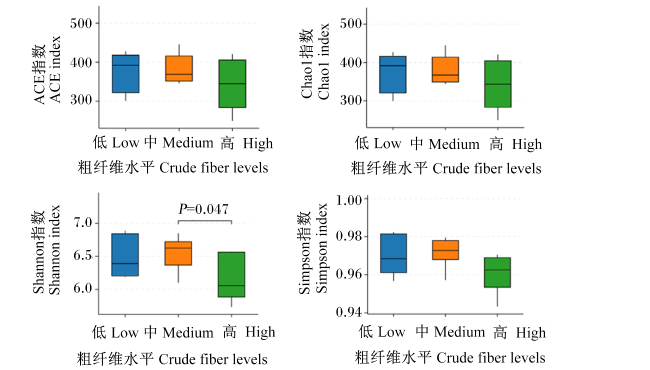
图1所示,中粗纤维水平组Shannon指数显著高于高粗纤维水平组(P<0.05),表明中粗纤维水平组中新鸭肠道菌群多样性高于高纤维水平组。各组之间其他α多样性指数均无显著差异(P>0.05)。
图1 中新鸭盲肠菌群α多样性分析

Fig.1 Cecal flora α diversity analysis of Zhongxin ducks

2.5.2 β多样性分析

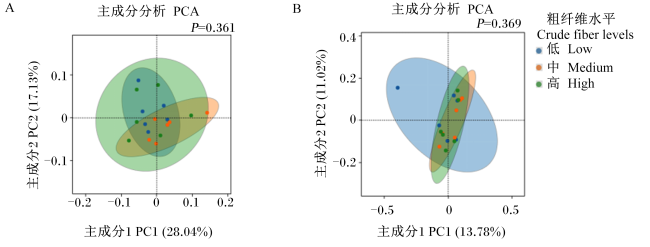
基于Unifrac的加权(图2-A)和非加权(图2-B)的主成分分析,不同粗纤维水平组样品间存在大面积交叠现象,表明3个粗纤维水平组样本的微生物群落结构具有较高的相似性。盲肠菌群结构β多样性差异不显著(加权P=0.361,非加权P=0.369)。
图2 中新鸭盲肠菌群β多样性分析

Fig.2 Cecal flora β diversity analysis of Zhongxin ducks

2.5.3 盲肠门和属水平菌群分析

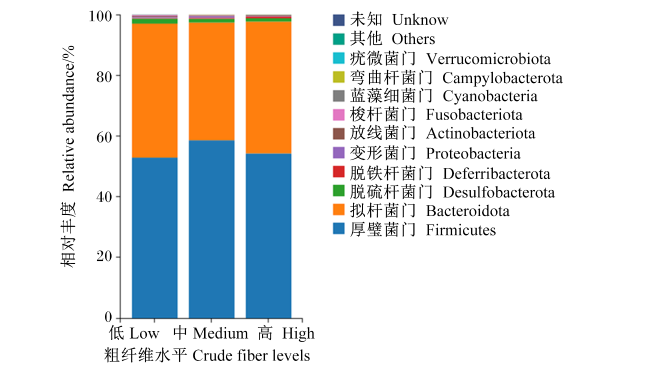
图3表6可知,盲肠菌群门水平相对丰度排名前6的菌门依次是厚壁菌门(Firmicutes)、拟杆菌门(Bacteroidota)、脱硫杆菌门(Desulfobacterota)、脱铁杆菌门(Deferribacterota)、变形菌门(Proteobacteria)和放线菌门(Actinobacteriota),且各组之间以上菌门相对丰度均无显著差异(P>0.05)。中粗纤维水平组厚壁菌门相对丰度最高,低粗纤维水平组拟杆菌门相对丰度最高。
图3 盲肠菌群门水平分布柱状图(前10)

Fig.3 Column diagram of distribution of cecal flora at phylum level (top 10)

表6 饲粮粗纤维水平对中新鸭盲肠菌群门水平相对丰度的影响

Table 6 Effects of dietary crude fiber levels on relative abundance of cecal flora at phylum level of Zhongxin ducks %

项目
Items
粗纤维水平Crude fiber levels P
P-value
低Low 中Medium 高High
厚壁菌门Firmicutes 52.91±4.52 58.56±2.75 54.33±6.16 0.128
拟杆菌门Bacteroidota 44.08±5.04 38.78±3.36 43.47±6.83 0.198
脱硫杆菌门Desulfobacterota 1.64±1.36 1.27±1.09 0.99±1.34 0.682
脱铁杆菌门Fusobacteriota 0.36±0.12 0.17±0.03 0.03±0.07 0.220
变形菌门Proteobacteria 0.32±0.01 0.53±0.05 0.15±0.01 0.124
放线菌门Actinobacteriota 0.34±0.02 0.24±0.01 0.24±0.01 0.472
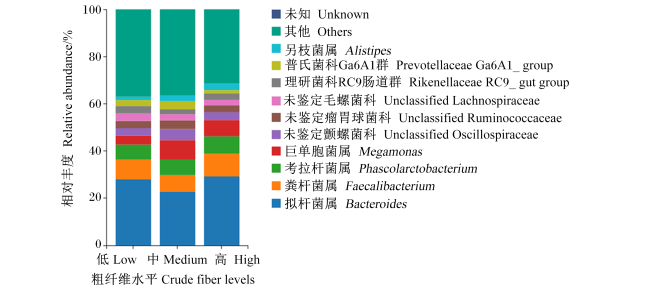
图4表7可知,盲肠菌群属水平相对丰度排名前6的菌属依次是拟杆菌属(Bacteroides)、粪杆菌属(Faecalibacterium)、巨单胞菌属(Megamonas)、考拉杆菌属(Phascolarctobacterium)、理研菌科RC9肠道群(Rikenellaceae_RC9_gut_group)和未鉴定颤螺菌科(unclassified_Oscillospiraceae),且各组之间以上菌属相对丰度均无显著差异(P>0.05)。低粗纤维水平组拟杆菌属相对丰度最高。
图4 盲肠菌群属水平分布柱状图(前10)

Fig.4 Column diagram of distribution of cecal flora at genus level (top 10)

表7 饲粮粗纤维水平对中新鸭盲肠菌群属水平相对丰度的影响

Table 7 Effects of dietary crude fiber levels on relative abundance of cecal flora at genus level of Zhongxin ducks %

项目
Items
粗纤维水平Crude fiber levels P
P-value
低Low 中Medium 高High
拟杆菌属Bacteroides 24.74±7.01 22.77±3.32 24.65±7.42 0.823
粪杆菌属Faecalibacterium 7.65±4.33 6.60±2.48 7.13±4.85 0.785
巨单胞菌属Megamonas 7.89±2.79 9.31±2.79 9.00±1.32 0.915
考拉杆菌属Phascolarctobacterium 6.44±2.31 6.36±6.77 6.04±6.49 0.928
理研菌科RC9肠道群Rikenellaceae_RC9_gut_group 4.72±0.09 2.77±1.89 3.84±1.39 0.460
未鉴定颤螺菌科Unclassified_Oscillospiraceae 4.38±1.32 3.98±0.82 3.79±0.62 0.794

3 讨论

3.1 饲粮粗纤维水平对中新鸭生长性能和屠宰性能的影响

生长性能是评定家禽经济效益的重要指标,品种是影响家禽生长性能的关键因素之一,而饲粮粗纤维对家禽生长性能的影响主要与纤维特性、使用量和使用阶段有关[11]。本试验中,饲粮粗纤维水平对中新鸭平均日采食量、平均日增重和料重比均无显著影响。由于不同日龄肉鸭对粗纤维需要量不同,幼龄动物对粗纤维需求量较低,饲粮中适量添加粗纤维可以改善肉鸭生长性能[12]。本试验中,各组之间生长性能指标虽均不显著,但从数值上可以看出,1~17日龄肉鸭在低粗纤维水平时体重有所提高,料重比有所降低,而18~37日龄和1~37日龄肉鸭在中粗纤维水平时出栏体重最高,高出高粗纤维水平时100 g,料重比也最低。以上结果表明,中新鸭生长中后期对粗纤维的需求水平可能比前期略微升高。相似地,El-Katcha等[13]研究发现,3.8%粗纤维水平组(饲粮粗纤维来源同样为大豆皮)肉鸭出栏体重和料重比最佳,显著优于2.4%和6.7%纤维水平组,另外众多研究同样进一步说明了不同阶段适宜的饲粮粗纤维水平对肉鸭生长性能至关重要[14-17],不同生长阶段中使用适宜的粗纤维水平可以提高家禽生长性能和营养物质利用率。
屠宰性能是评价肉鸭行业经济效益的重要指标之一。首先屠宰率、全净膛率、胸肌率和腿肌率反映动物产肉性能,同时腹脂率反映动物胴体组织中沉积脂肪的量,并会随着体重增加而增加,从而影响肉鸭产肉性能[18]。本研究发现,3种饲粮粗纤维水平对中新鸭屠宰性能(除腹脂率)均无显著影响,这可能表明当饲粮中蛋白质、能量水平适宜时,粗纤维水平对中新鸭屠宰性能影响较小。相似地,一些研究结果表明当饲粮粗纤维水平约低于3%时,屠宰性能才会降低,而当粗纤维水平不高于12%时,对大部分禽类的屠宰性能不会产生显著影响[19-20],正常范围内的粗纤维水平对家禽屠宰性能可能影响不大。本试验中,以高粗纤维水平饲粮饲喂中新鸭时,腹脂率显著提高,这与一些研究结果[21-22]不一致,可能与本试验中高粗纤维水平组饲料配方中油脂使用量较高有关。

3.2 饲粮粗纤维水平对中新鸭消化器官发育和肠道损伤评分的影响

消化器官是家禽机体消化吸收营养物质的重要场所,其生理特点和发育很大程度上决定营养物质的吸收利用,而消化器官生长和功能的发育可以通过改变遗传基因、饲粮及饲养管理而获得[23-24]。为了获得较高的生长速度和产肉性能,通常需要吸收更多的营养物质,因此肠道的生长、消化功能和饲粮的相互作用对家禽营养转化至关重要[25]。已有文献表明,饲粮成分对家禽胃的发育非常重要[26],在本研究中,随着饲粮粗纤维水平的提高,胃肠道重量随之增加,这很可能有助于提高营养物质的消化率。相似地,Wang等[27]研究发现,随着饲粮粗纤维水平的提高,肉鸭的肌胃和腺胃的相对重量也会增加。González-Alvarado等[28]研究发现,饲粮粗纤维的水合作用和黏性使食糜含水量增加,体积增大、流通速度减慢,从而刺激胃肠道的蠕动,促进肠道的发育,最终提高了家禽胃、盲肠和消化道的相对重量。由此可见,饲粮中适当的粗纤维水平具有促进家禽胃肠道发育的功能。
肠道不仅承担着机体消化和吸收的主要功能,同时还是抵御外部病原微生物的首要防线[29]。健康的肠道对肉鸭生长发育起到非常重要的作用,纤维在维持肠黏膜正常形态、保护肠黏膜屏障、防止细菌易位等方面有着积极的作用[23,30-31],肠道评分或肠道形态均可以在一定程度上反映肠道的健康程度[32]。有研究表明,饲粮中额外添加纤维源可提高肉鸭盲肠绒隐比、肌层厚度和绒毛杯状细胞数量,有利于肠道结构和屏障功能的完整[33]。同样,Rezaei等[34]也观察到不溶性纤维对肉鸡回肠绒毛高度与隐窝深度比的积极影响。但与前人研究结果不同的是,本试验中随着饲粮粗纤维水平的提高,各组肉鸭肠道评分均没有发生显著变化,且解剖时在胃肠道中也没有发现明显的临床或亚临床炎症反应的病变,饲养试验过程中也没有出现因肠道疾病而死亡或腹泻的现象。造成此结果的原因可能是本试验设置的粗纤维水平跨度较小,粗纤维水平未能对胃肠道发育情况造成显著影响,也可能是粗纤维来源和试验管理等因素造成的影响。以上研究结果表明,使用适宜水平的粗纤维不会对中新鸭肠道形态产生不良影响。

3.3 饲粮粗纤维水平对中新鸭盲肠菌群结构的影响

家禽肠道微生物菌群对肠道健康和生理起着重要作用。它影响宿主对体内平衡、器官发育、营养代谢和免疫反应的调节,是消除病原体和增强免疫系统来抵御疾病的屏障。本研究对菌群种类最为丰富的盲肠内容物菌群,采用Illumina NovaSeq、MiSeq高通量测序技术进行分析。α多样性分析结果表明,饲喂高粗纤维水平饲粮显著降低了中新鸭盲肠反映微生物菌群均一性的Shannon指数。同样地,陈珍珍[35]研究也表明,饲粮额外添加纤维源也降低了肠道菌群α多样性指标。多项研究表明,饲粮中纤维素成分可以影响家禽肠道中微生物组成,促进有益菌(双歧杆菌和乳酸杆菌)的生长并改善肠道形态,当肠道中的单一菌群数量增加时,整体的菌群多样性通常会降低,这也可能是粗纤维降低肠道菌群均一性的原因之一[36-37]
大量研究报道鸭盲肠内容物中优势菌门分别为拟杆菌门、厚壁菌门、梭杆菌门和变形菌门,这与本研究的结果一致。厚壁菌门和拟杆菌门是肉鸭肠道中的主要优势菌门,与机体健康有关,可以帮助消化营养物质,分解复杂的碳水化合物和纤维素,产生短链脂肪酸(如丙酸、丁酸)等益生物质,为肠道细胞提供能量和营养[38]。在本研究中,尽管饲喂了不同粗纤维水平的饲粮,厚壁菌门和拟杆菌门仍为优势菌门,且门水平各菌群之间变化不显著。盲肠菌群在属水平上的主要菌群变化也和门水平上的变化一致,粗纤维水平未对盲肠菌群属水平相对丰度造成影响。上述结果表明,适宜水平的粗纤维不会改变肉鸭肠道菌群组成,肉鸭的肠道菌群可能具有较高的稳定性,即使改变饲粮粗纤维水平,菌群的组成和相对丰度也能保持相对稳定,这可能是由于菌群之间的相互作用和调节机制,以及菌群对环境变化的适应能力。

4 结论

饲喂中粗纤维水平(前期4.2%、后期4.7%)饲粮的中新鸭生长性能和肠道菌群结构表现最佳;饲喂高粗纤维水平(前期5.8%、后期5.5%)饲粮有利于中新鸭胃肠道的发育,但可能对生长性能和屠宰性能产生不利影响。
[1]
ZENG Q F, HUANG X Q, LUO Y H, et al. Effects of a multi-enzyme complex on growth performance,nutrient utilization and bone mineralization of meat duck[J]. Journal of Animal Science and Biotechnology, 2015, 6(1):12.

DOI

[2]
侯水生, 周正奎. 肉鸭种业的昨天及今天和明天[J]. 中国畜牧业, 2021(18):23-26.

HOU S S, ZHOU Z K. The past,present,and future of the duck industry[J]. China Animal Industry, 2021(18):23-26. (in Chinese)

[3]
JIMÉNEZ-MORENO E, DE COCA-SINOVA A, GONZÁLEZ-ALVARADO J M, et al. Inclusion of insoluble fiber sources in mash or pellet diets for young broilers.1.Effects on growth performance and water intake[J]. Poultry Science, 2016, 95(1):41-52.

DOI

[4]
KHERAVII S K, SWICK R A, CHOCT M, et al. Coarse particle inclusion and lignocellulose-rich fiber addition in feed benefit performance and health of broiler chickens[J]. Poultry Science, 2017, 96(9):3272-3281.

DOI PMID

[5]
张克英. 鸭非常规饲料资源高效利用技术[J]. 饲料与畜牧, 2019(7):52-58.

ZHANG K Y. Efficient utilization of unconventional duck feed resources[J]. Feed and Husbandry, 2019(7):52-58. (in Chinese)

[6]
HAO Y S, JI Z Q, SHEN Z J, et al. Effects of total dietary fiber on cecal microbial community and intestinal morphology of growing white Pekin duck[J]. Frontiers in Microbiology, 2021, 12:727200.

DOI

[7]
SINGH A K, KIM W K. Effects of dietary fiber on nutrients utilization and gut health of poultry:a review of challenges and opportunities[J]. Animals, 2021, 11(1):181.

DOI

[8]
KHERAVII S K, MORGAN N K, SWICK R A, et al. Roles of dietary fibre and ingredient particle size in broiler nutrition[J]. World’s Poultry Science Journal, 2018, 74(2):301-316.

DOI

[9]
DAHIYA J P, HOEHLER D, WILKIE D C, et al. Dietary glycine concentration affects intestinal Clostridium perfringens and lactobacilli populations in broiler chickens[J]. Poultry Science, 2005, 84(12):1875-1885.

DOI

[10]
LIU D, GUO S S, GUO Y M. Xylanase supplementation to a wheat-based diet alleviated the intestinal mucosal barrier impairment of broiler chickens challenged by Clostridium perfringens[J]. Avian Pathology, 2012, 41(3):291-298.

DOI

[11]
FAN H P, XIE M, WANG W W, et al. Effects of dietary energy on growth performance and carcass quality of white growing pekin ducks from two to six weeks of age[J]. Poultry Science, 2008, 87(6):1162-1164.

DOI PMID

[12]
韩浩月. 日粮纤维对肉鸭生产性能、胃肠道生理及肝脏脂肪代谢的影响[D]. 硕士学位论文. 雅安: 四川农业大学, 2016.

HAN H Y. Effect of dietary fiber on growth performance,gastrointestinal physiology and hepatic lipid metabolism in meat duck[D]. Master’s Thesis. Ya’an: Sichuan Agricultural University, 2016. (in Chinese)

[13]
EL-KATCHA M I, SOLTAN M A, SHEWITA R, et al. Dietary fiber and lysolecithin supplementation in growing ducks:effect on performance,immune response,intestinal morphology and lipid metabolism-regulating genes[J]. Animals, 2021, 11(10):2873.

DOI

[14]
AMERAH A M, RAVINDRAN V, LENTLE R G. Influence of insoluble fibre and whole wheat inclusion on the performance,digestive tract development and ileal microbiota profile of broiler chickens[J]. British Poultry Science, 2009, 50(3):366-375.

DOI

[15]
KALMENDAL R, ELWINGER K, HOLM L, et al. High-fibre sunflower cake affects small intestinal digestion and health in broiler chickens[J]. British Poultry Science, 2011, 52(1):86-96.

DOI PMID

[16]
ROGEL A M, BALNAVE D, BRYDEN W L, et al. Improvement of raw potato starch digestion in chickens by feeding oat hulls and other fibrous feedstuffs[J]. Australian Journal of Agricultural Research, 1987, 38(3):629-637.

DOI

[17]
ROGEL A M, ANNISON E F, BRYDEN W L, et al. The digestion of wheat starch in broiler chickens[J]. Australian Journal of Agricultural Research, 1987, 38(3):639-649.

DOI

[18]
王继文, 王林全, 曾凡同, 等. 三个肉鸭新品系及其杂种的肉用性能测定[J]. 四川农业大学学报, 1996, 14(1):112-117.

WANG J W, WANG L Q, ZENG F T, et al. Meat performance of three meat duck strains and their hybrids[J]. Journal of Sichuan Agricultural University, 1996, 14(1):112-117. (in Chinese)

[19]
罗旭. 日粮纤维水平对不同生长阶段籽鹅生长性能和胃肠道菌群的影响[D]. 硕士学位论文. 大庆: 黑龙江八一农垦大学, 2017.

LUO X. Effects of dietary fiber levels on growth performance and gastrointestinal microflora of Zi geese in different growth stages[D]. Master’s Thesis. Daqing: Heilongjiang Bayi Agricultural University, 2017. (in Chinese)

[20]
李杰, 王安. 纤维来源对肉鸡消化道发育的影响[J]. 东北农学院学报, 1993, 24(1):98-100.

LI J, WANG A. Effect of fiber resources on gut size of broilers[J]. Journal of Northeast Agricultural College, 1993, 24(1):98-100. (in Chinese)

[21]
李璐, 刘春光. 不同水平的苜蓿草粉添加对肉鸭生长性能、屠宰性能及经济效益指标的影响[J]. 中国饲料, 2021(3):132-134.

LI L, LIU C G. Effects of different levels of alfalfa meal supplementation on growth performance,slaughter performance and economic benefits of meat ducks[J]. China Feed, 2021(3):132-134. (in Chinese)

[22]
谈婷. 饲粮中添加木质纤维素对肉鸭生长和屠宰性能以及免疫和抗氧化能力的影响[D]. 硕士学位论文. 扬州: 扬州大学, 2021.

TAN T. Effects of dietary lignocellulose on growth and slaughter performances and immune and antioxidative capacities of meat ducks[D]. Master’s Thesis. Yangzhou: Yangzhou University, 2021. (in Chinese)

[23]
胡永飞, 呙于明. 家禽肠道微生物组研究进展[J]. 中国家禽, 2022, 44(11):1-9.

HU Y F, GUO Y M. Research advances in poultry gut microbiome[J]. China Poultry, 2022, 44(11):1-9. (in Chinese)

[24]
LUMPKINS B S, BATAL A B, LEE M D. Evaluation of the bacterial community and intestinal development of different genetic lines of chickens[J]. Poultry Science, 2010, 89(8):1614-1621.

DOI PMID

[25]
UNI Z, NOY Y, SKLAN D. Posthatch development of small intestinal function in the poult[J]. Poultry Science, 1999, 78(2):215-222.

PMID

[26]
KHERAVII S K, MORGAN N K, SWICK R A, et al. Roles of dietary fibre and ingredient particle size in broiler nutrition[J]. World’s Poultry Science Journal, 2018, 74(2):301-316.

DOI

[27]
WANG S P, WANG W J, YANG D S, et al. Growth,carcass,and physiological traits of growing male China micro-ducks fed various levels of dietary crude fibre[J]. Czech Journal of Animal Science, 2017, 62(8):347-356.

DOI

[28]
GONZÁLEZ-ALVARADO J M, JIMÉNEZ-MORENO E, LÁZARO R, et al. Effect of type of cereal,heat processing of the cereal,and inclusion of fiber in the diet on productive performance and digestive traits of broilers[J]. Poultry Science, 2007, 86(8):1705-1715.

DOI

[29]
LI M, CHEN T, HE J J, et al. Plant MIR167e-5p inhibits enterocyte proliferation by targeting β-catenin[J]. Cells, 2019, 8(11):1385.

DOI

[30]
DE VERDAL H, MIGNON-GRASTEAU S, JEULIN C, et al. Digestive tract measurements and histological adaptation in broiler lines divergently selected for digestive efficiency[J]. Poultry Science, 2010, 89(9):1955-1961.

DOI PMID

[31]
刘俊, 夏强. 胃癌术后膳食纤维和早期肠内营养与消化道并发症的关系[J]. 中华胃肠外科杂志, 2005, 8(3):223-225.

LIU J, XIA Q. Relationship of dietary fiber and early enteral nutrition with digestive complications after surgical treatment of gastric cancer[J]. Chinese Journal of Gastrointestinal Surgery, 2005, 8(3):223-225. (in Chinese)

[32]
AMERAH A M, RAVINDRAN V. Effect of coccidia challenge and natural betaine supplementation on performance,nutrient utilization,and intestinal lesion scores of broiler chickens fed suboptimal level of dietary methionine[J]. Poultry Science, 2015, 94(4):673-680.

DOI

[33]
HAO Y S, JI Z Q, SHEN Z J, et al. Increase dietary fiber intake ameliorates cecal morphology and drives cecal species-specific of short-chain fatty acids in white Pekin ducks[J]. Frontiers in Microbiology, 2022, 13:853797.

DOI

[34]
REZAEI M, KARIMI TORSHIZI M A, ROUZBEHAN Y. The influence of different levels of micronized insoluble fiber on broiler performance and litter moisture[J]. Poultry Science, 2011, 90(9):2008-2012.

DOI PMID

[35]
陈珍珍. 饲料中添加木质纤维素对樱桃谷鸭肠道结构与功能、肠道微生物区系以及生长性能的影响[D]. 硕士学位论文. 扬州: 扬州大学, 2021.

CHEN Z Z. Effects of dietary supplementation with lignocellulose on intestinal structure and function,intestinal microflora and growth performance of Cherry Valley ducks[D]. Master’s Thesis. Yangzhou: Yangzhou University, 2021. (in Chinese)

[36]
BAURHOO B, PHILLIP L, RUIZ-FERIA C A. Effects of purified lignin and mannan oligosaccharides on intestinal integrity and microbial populations in the ceca and litter of broiler chickens[J]. Poultry Science, 2007, 86(6):1070-1078.

PMID

[37]
BAURHOO B, LETELLIER A, ZHAO X, et al. Cecal populations of lactobacilli and bifidobacteria and Escherichia coli populations after in vivo Escherichia coli challenge in birds fed diets with purified lignin or mannanoligosaccharides[J]. Poultry Science, 2007, 86(12):2509-2516.

DOI

[38]
BEST A A, PORTER A L, FRALEY S M, et al. Characterization of gut microbiome dynamics in developing Pekin ducks and impact of management system[J]. Frontiers in Microbiology, 2016, 7:2125.

DOI PMID

文章导航

/