研究论文

褪黑素对泌乳中期奶牛瘤胃发酵参数及微生物区系的影响

  • 李云梦 , 1 ,
  • 宋晨歌 1 ,
  • 张琦智 2 ,
  • 臧长江 , 1, * ,
  • 南冰禹 1 ,
  • 仇娅琪 1 ,
  • 刘拓 1 ,
  • 李晓斌 1 ,
  • 陈开旭 1 ,
  • 米热古丽·依马木 1 ,
  • 院东 3 ,
  • 王永力 4 ,
  • 杨开伦 1
展开
  • 1 新疆农业大学动物科学学院,新疆肉乳用草食动物营养实验室,乌鲁木齐 830052
  • 2 新疆生产建设兵团第十三师红山农场农业发展服务中心,哈密 839202
  • 3 新疆长荣饲料有限公司,昌吉 831100
  • 4 新疆佳和瑞鑫农牧科技有限公司,昌吉 831100
* 臧长江,副教授,博士生导师,E-mail:

李云梦(1996—),女,新疆昌吉人,硕士研究生,研究方向为动物营养与饲料科学。E-mail:

Copy editor: 菅景颖

收稿日期: 2023-06-09

  网络出版日期: 2023-12-11

基金资助

新疆维吾尔自治区重点实验室项目“添喂褪黑素对奶牛乳腺炎防治效果及作用机制的研究”(2020D04034)

Effects of Melatonin on Ruminal Fermentation Parameters and Microflora of Dairy Cows in Mid-Lactation Period

  • LI Yunmeng , 1 ,
  • SONG Chenge 1 ,
  • ZHANG Qizhi 2 ,
  • ZANG Changjiang , 1, * ,
  • NAN Bingyu 1 ,
  • QIU Yaqi 1 ,
  • LIU Tuo 1 ,
  • LI Xiaobin 1 ,
  • CHEN Kaixu 1 ,
  • MIREGULI Yimamu 1 ,
  • YUAN Dong 3 ,
  • WANG Yongli 4 ,
  • YANG Kailun 1
Expand
  • 1 Xinjiang Key Laboratory of Herbivore Nutrition for Meat & Milk, College of Animal Science, Xinjiang Agricultural University, Urumqi 830052, China
  • 2 Agricultural Development Service Center of Hongshan Farm, 13th Division of Xinjiang Production and Construction Corps, Hami 839202, China
  • 3 Xinjiang Changrong Feed Co., Ltd., Changji 831100, China
  • 4 Xinjiang Jiahe Ruixin Agricultural and Animal Husbandry Technology Co., Ltd., Changji 831100, China
* associate professor, E-mail:

Received date: 2023-06-09

  Online published: 2023-12-11

摘要

本试验旨在研究褪黑素对泌乳中期奶牛瘤胃发酵参数及微生物区系的影响。选择泌乳日龄[(143±43) d]、胎次[(2.75±1.23)胎]、产奶量[(36.80±4.18) kg]相近的荷斯坦奶牛48头,随机分为4组,每组12头,每头为1个重复。在饲喂基础饲粮的基础上,3个试验组分别补饲80(试验Ⅰ组)、120(试验Ⅱ组)、160 mg/d(试验Ⅲ组)的褪黑素,投喂时预先将褪黑素分装于可食用的糯米胶囊中,而对照组则补饲空的糯米胶囊。褪黑素于每日晨饲时进行投喂,试验期37 d,其中预试期7 d,正试期30 d。结果显示:1)与对照组相比,试验Ⅱ、Ⅲ组奶牛瘤胃液中氨态氮浓度显著升高(P<0.05),试验Ⅰ、Ⅱ、Ⅲ组奶牛瘤胃液中丙酸浓度均显著升高(P<0.05)。瘤胃液中总挥发性脂肪酸浓度随褪黑素补饲量的增加有所升高,但各试验组与对照组相比均无显著差异(P>0.05)。2)在门水平上,与对照组相比,试验Ⅱ组瘤胃菌群中厚壁菌门的相对丰度显著升高(P<0.05),试验Ⅰ、Ⅱ、Ⅲ组瘤胃菌群中螺旋菌门的相对丰度均显著降低(P<0.05)。3)在属水平上,与对照组相比,试验Ⅱ、Ⅲ组瘤胃菌群中普雷沃氏菌属和瘤胃球菌属的相对丰度显著升高(P<0.05)。综上所述,补饲褪黑素可以提高泌乳中期奶牛瘤胃液中氨态氮和丙酸的浓度,提高瘤胃菌群中厚壁菌门、普雷沃氏菌属和瘤胃球菌属的相对丰度,降低螺旋菌门的相对丰度,推荐补饲量为120 mg/d。

本文引用格式

李云梦 , 宋晨歌 , 张琦智 , 臧长江 , 南冰禹 , 仇娅琪 , 刘拓 , 李晓斌 , 陈开旭 , 米热古丽·依马木 , 院东 , 王永力 , 杨开伦 . 褪黑素对泌乳中期奶牛瘤胃发酵参数及微生物区系的影响[J]. 动物营养学报, 2023 , 35(12) : 7879 -7891 . DOI: 10.12418/CJAN2023.715

Abstract

The aim of this experiment was to investigate the effects of melatonin on rumen fermentation parameters and microflora of dairy cows in mid-lactation period. Forty-eight Holstein cows with similar lactation age [(143±43) d], parity [(2.75±1.23) parities ] and milk yield [(36.80±4.18) kg] were selected and randomly divided into four groups of 12 cows each, On the basis of feeding a basal diet, different doses [80 (trial group I), 120 (trial group Ⅱ) and 160 mg/d (trial group Ⅲ)] of melatonin were administered at the time of daily morning feeding in three groups, and the melatonin were pre-dispensed in edible glutinous rice capsules, while the control group was administered empty glutinous rice capsules. The experimental period was 37 d, including 7 d of pre-test period and 30 d of test period. The results showed as follows: 1) compared with the control group, the concentration of ammoniacal nitrogen in the rumen of dairy cows was significantly increased in the trial groups Ⅱ and Ⅲ (P<0.05), and the concentration of propionic acid in the rumen fluid of dairy cows was significantly increased in the trial groups Ⅰ, Ⅱ and Ⅲ (P<0.05). The concentration of total volatile fatty acids (TVFA) in the rumen fluid of dairy cows increased with melatonin feeding amount increasing, but there was no significant difference between the control group and the trial groups (P>0.05). 2) At phylum level, the relative abundance of Firmicutes in rumen bacteria in the trial group Ⅱ was significantly higher than that in the control group (P<0.05), and the relative abundance of Spirochaetes in rumen bacteria in the trial groups Ⅰ, Ⅱ and Ⅲ was significantly lower than that in the control group (P<0.05). 3) At genus level, relative abundances of Prevotella and Ruminococcus in rumen bacteria in the trial groups Ⅱ and Ⅲ were significantly higher than those in the control group (P<0.05). In summary, feeding melatonin can increase the concentrations of ammoniacal nitrogen and propionic acid in the rumen fluid of dairy cows in mid-lactation period, increase the relative abundances of Firmicutes, Prevotella and Ruminococcus in the rumen bacteria, and reduce the relative abundance of Spirochaetes. The recommended feeding amount is 120 mg/d.

褪黑素(melatonin,MLT)是一种胺类神经内激素,主要是由下丘脑视交叉上核的松果体合成的吲哚杂环类色氨酸衍生物。褪黑素不仅可以在松果体内合成,在视网膜、皮肤、胃肠道等器官内也可以合成,胃肠道褪黑素主要是由胃肠道黏膜的肠嗜铬细胞分泌,且松果体和胃肠道内的MLT都具有昼夜节律性[1]。胃肠道昼夜节律分泌的褪黑素可以通过核因子-κB(nuclear factor-kappa B,NF-κB)通路调控肠道微生物,进而影响动物肠道微生物群落结构[2]。肠道微生物能够刺激内分泌细胞释放肠肽和激素进入血液,肠肽和激素被吸收而介导中枢神经系统,有效调节宿主生物钟[3]。在反刍动物瘤胃中,胃泌素、胰岛素样生长因子-1(insulin-like growth factor-1,IGF-1)、皮质醇等可以作用于微生物,促进微生物的生长和代谢,说明激素可以双向介导宿主和肠道微生物[4]。褪黑素是参与调节宿主昼夜节律的最重要的激素之一[5]。Bubenik等[6]最早报道了奶牛瘤胃肌层和瘤胃液中褪黑素的存在,褪黑素可以提高奶牛的干物质采食量及饲料转化效率,增加泌乳期的产奶量,改善乳品质[7]。Ma等[8]和Paulose等[9]研究发现,褪黑素、肠道菌群和黏膜免疫细胞之间有关联,并且褪黑素以昼夜方式调节肠道微生物。此外,Zhu等[10]报道,褪黑素处理可使小鼠肠道中拟杆菌门的相对丰度从58.93%降低到41.63%,同时增加了厚壁菌门的相对丰度。欧阳佳良[11]开展的体外试验显示,褪黑素能提高普雷沃氏菌科和普雷沃氏菌属1的相对丰度。目前关于反刍动物外源褪黑素与肠道微生物之间关系的研究鲜有报道。因此,本试验以泌乳中期荷斯坦奶牛为研究对象,旨在探究褪黑素对泌乳中期奶牛瘤胃发酵参数及微生物区系的影响,为褪黑素调控奶牛瘤胃发酵提供理论参考。

1 材料与方法

1.1 试验设计

选择泌乳日龄[(143±43) d]、胎次[(2.75±1.23)胎]、产奶量[(36.80±4.18) kg]相近的荷斯坦奶牛48头,随机分为4组(对照组与试验Ⅰ、Ⅱ和Ⅲ组),每组12头,每头为1个重复。对照组饲喂基础饲粮,试验Ⅰ、Ⅱ、Ⅲ组在饲喂基础饲粮的基础上每头奶牛补饲80、120、160 mg/d的褪黑素(有效浓度为99%,购自安徽某科技有限公司)。试验期37 d,其中预试期7 d,正试期30 d。褪黑素于每日08:00进行投喂,预先将80、120、160 mg的褪黑素分装于可食用的糯米胶囊中进行投喂,对照组投喂空的糯米胶囊。

1.2 基础饲粮

泌乳中期奶牛基础饲粮参照NRC(2001)的营养标准进行配制,其组成及营养水平见表1
表1 基础饲粮组成及营养水平(干物质基础)

Table 1 Composition and nutrient levels of the basal diet (DM basis) %

项目Items 含量Content
原料Ingredients
苜蓿干草Alfalfa hay 15.20
玉米青贮Corn silage 24.17
蒸汽压片玉米Steam-flaked corn 6.47
玉米Corn 24.23
浓缩料Concentrated feed1) 17.95
脂肪粉Fat powder 0.75
棉籽粕Cottonseed meal 4.04
全棉籽Whole cottonseed 1.41
甜菜颗粒Beet granules 4.78
蛋氨酸Methionine 0.06
碳酸氢钠NaHCO3 0.56
氯化钠NaCl 0.38
合计Total 100.00
营养水平Nutrient levels2)
有机物OM 92.64
粗蛋白质CP 15.57
粗脂肪EE 3.96
中性洗涤纤维NDF 38.39
酸性洗涤纤维ADF 16.45
钙Ca 0.85
总磷TP 0.46
产奶净能NEL/(MJ/kg) 6.60

1)浓缩料为商品饲料,其营养水平如下Concentrated feed was a commercial feed, and its nutrient levels showed as follows:干物质 DM 86%,粗蛋白质 CP 29.5%,粗纤维 CF 12%,粗灰分 Ash 18%,钙 Ca 1.3%,总磷 TP 0.6%,氯化钠 NaCl 1.3%,赖氨酸 Lys 0.8%。每千克浓缩料中含有 One kilogram of concentrated feed contained the following:VA 12 000 IU,VD 3 300 IU,VE 87 IU,Cu (as copper sulfate) 42 mg,Zn (as zinc sulfate) 181 mg,Mn (as manganese sulfate) 53 mg,Fe (as ferrous sulfate) 56 mg,I (as potassium iodide) 1.9 mg,Co (as cobalt sulfate) 0.41 mg。

2)产奶净能为计算值,其余营养水平为实测值。NEL was a calculated value, while the other nutrient levels were measured values.

1.3 饲养管理

试验动物统一管理,饲喂全混合日粮(TMR),试验组试验动物除每日投喂含褪黑素胶囊之外,其他饲养管理条件与对照组完全相同。每日分别于08:00、15:30和23:00进行饲喂,试验期间牛群自由采食、饮水,保持圈舍光照、干燥通风。

1.4 样品采集

1.4.1 饲粮样品的采集

从正试期开始,每10 d采集1次TMR,并将3次采集的TMR混合在一起,然后采用四分法取样品600 g,于-20 ℃冰箱中保存,用于常规营养成分含量的测定。

1.4.2 瘤胃液样品的采集

在正试期第30天,每组抽取6头奶牛,在晨饲前使用胃管式采液器(武汉科立博有限公司生产)采集瘤胃液样品200 mL,为了避免污染,前50 mL舍弃。采集的瘤胃液通过4层纱布过滤到采样瓶中,立即测定pH(pH计型号:METTLERTOLEDO-FE2000)。将采集的瘤胃液分装至冻存管,其中一管置于液氮中保存,用于瘤胃微生物区系的测定;其余瘤胃液于-20 ℃保存,用于挥发性脂肪酸(volatile fatty acid,VFA)、氨态氮(ammoniacal nitrogen,NH3-N)、微生物蛋白(microbial protein,MCP)浓度等指标的测定。

1.5 测定指标及方法

1.5.1 饲粮营养成分含量的测定

饲粮中干物质(dry matter,DM)、有机物(organic matter,OM)、粗蛋白质(crude protein,CP)、粗脂肪(ether extract,EE)、总磷(total phosphorus,TP)、总能(gross energy,GE)参考《饲料分析及饲料质量检测技术》[12]中所述的国标方法测定;中性洗涤纤维(neutral detergent fiber,NDF)和酸性洗涤纤维(acid detergent fiber,ADF)含量参照Van Soest等[13]的方法测定;钙(calcium,Ca)含量采用邻甲酚酞比色法[14]测定。

1.5.2 瘤胃发酵参数的测定

冷冻的瘤胃液样品经过解冻,在4 ℃条件下离心10 min,吸取上清液用于测定NH3-N、MCP和VFA的浓度,其中NH3-N浓度使用靛酚蓝比色法[15]测定,VFA浓度参照Zhang等[16]的方法采用气相色谱仪(GC2010,岛津,日本)测定,MCP浓度参照李琛[17]的方法测定。
瘤胃发酵状况:一般利用VFA来分析瘤胃发酵状况,其相关指标计算公式[18]如下:
六碳糖发酵量(mmol/L)=0.5×乙酸浓度+0.5×丙酸浓度+丁酸浓度+戊酸浓度;
微生物细胞产量(mmol/L)=(乙酸浓度+丙酸浓度+丁酸浓度+戊酸浓度)×0.03;
瘤胃发酵效率(%)=[(0.62×乙酸浓度+1.09×丙酸浓度+0.78×丁酸浓度)/(乙酸浓度+丙酸浓度+丁酸浓度)]×100。

1.5.3 瘤胃微生物区系的测定

将-80 ℃保存的共24份(每组6份)瘤胃液样品送至南京派森诺基因科技有限公司进行细菌测序。先对样品进行DNA的提取,然后将瘤胃液细菌16S rDNA的V3~V4区用表2所示引物进行扩增,将PCR产物用1%琼脂糖凝胶电泳检测,再用Agencourt AMPure XP核酸纯化试剂盒进行分离纯化;利用Illumina MiSeq PE300高通量测序系统,对PCR产物进行双端(paired-end)测序,筛选出97%相似度以上的序列,用于微生物多样性和组成分析。
表2 16S rDNA引物序列

Table 2 16S rDNA primer sequences

引物名称
Primer names
引物序列
Primer sequences
338F 5'-ACTCCTACGGGAGGCAGCA-3'
806R 5'-GGACTACHVGGGTWTCTAAT-3'

1.6 数据处理与分析

采用Excel 2013对试验数据进行初步整理,SPSS 19.0统计软件进行单因素方差分析,Duncan氏法进行多重比较。试验结果用平均值表示,变异程度用均值标准误(SEM)表示。P<0.01表示差异极显著,P<0.05表示差异显著,P>0.05表示差异不显著。

2 结果与分析

2.1 褪黑素对泌乳中期奶牛瘤胃发酵参数的影响

表3可知,与对照组相比,试验Ⅱ、Ⅲ组奶牛瘤胃液中NH3-N浓度显著升高(P<0.05),各试验组瘤胃液中丙酸浓度均显著提高(P<0.05);各试验组之间瘤胃液中NH3-N和丙酸浓度无显著差异(P>0.05);瘤胃液pH与MCP、乙酸、异丁酸、丁酸、异戊酸、戊酸、总挥发性脂肪酸(TVFA)浓度以及乙酸/丙酸值各组之间均无显著差异(P>0.05)。
表3 褪黑素对泌乳中期奶牛瘤胃发酵参数的影响

Table 3 Effects of melatonin on rumen fermentation parameters of dairy cows in mid-lactation period (n=6)

项目
Items
对照组
Control
group
试验Ⅰ组
Trial
group Ⅰ
试验Ⅱ组
Trial
group Ⅱ
试验Ⅲ组
Trial
group Ⅲ
均值标准误
SEM
P
P-value
pH 6.60 6.55 6.43 6.53 0.050 0.725
氨态氮NH3-N/(mmol/L) 8.25b 9.67ab 10.70a 10.48a 0.330 0.024
微生物蛋白MCP/(μg/mL) 201.13 232.00 280.80 253.82 11.120 0.063
乙酸Acetic acid/(mmol/L) 57.46 63.75 67.10 65.78 3.427 0.786
丙酸Propionic acid/(mmol/L) 18.51b 25.28a 28.97a 26.83a 1.293 0.015
异丁酸Isobutyric acid/(mmol/L) 1.10 1.12 1.23 1.15 0.037 0.586
丁酸Butyric acid/(mmol/L) 16.68 14.65 15.25 15.58 0.671 0.777
异戊酸Isovaleric acid/(mmol/L) 1.46 1.27 1.30 1.40 0.059 0.671
戊酸Valeric acid/(mmol/L) 2.28 2.51 2.26 2.42 0.077 0.648
乙酸/丙酸Acetic acid/propionic acid 3.49 2.54 2.34 2.48 0.212 0.206
总挥发性脂肪酸TVFA/(mmol/L) 97.49 108.58 116.12 113.16 4.113 0.419

同行数据肩标不同大写字母表示差异极显著(P<0.01),不同小写字母表示差异显著(P<0.05),相同字母或无字母表示差异不显著(P>0.05)。下表同。

In the same row, values with different capital letter superscripts mean extremely significant difference (P<0.01), and with different small letter superscripts mean significant difference (P<0.05), while with the same or no letter superscripts mean no significant difference (P>0.05). The same as below.

2.2 褪黑素对泌乳中期奶牛瘤胃发酵状况的影响

表4可知,与对照组相比,各试验组瘤胃中六碳糖发酵量、微生物细胞产量及瘤胃发酵效率均无显著差异(P>0.05),3个试验组间也无显著差异(P>0.05)。
表4 褪黑素对泌乳中期奶牛瘤胃发酵状况的影响

Table 4 Effects of melatonin on rumen fermentation status of dairy cows in mid-lactation period (n=6)

项目
Items
对照组
Control
group
试验Ⅰ组
Trial
group Ⅰ
试验Ⅱ组
Trial
group Ⅱ
试验Ⅲ组
Trial
group Ⅲ
均值标准误
SEM
P
P-value
六碳糖发酵量
Fermentable amount of hexose/(mmol/L)
56.94 61.68 65.55 64.30 2.150 0.530
微生物细胞产量
Microbial cell yield/(mmol/L)
2.85 3.19 3.41 3.32 0.123 0.413
瘤胃发酵效率
Rumen fermentation efficiency/%
74.33 76.15 76.45 76.36 0.540 0.486

2.3 褪黑素对奶牛瘤胃微生物区系的影响

2.3.1 测序序列数据质控

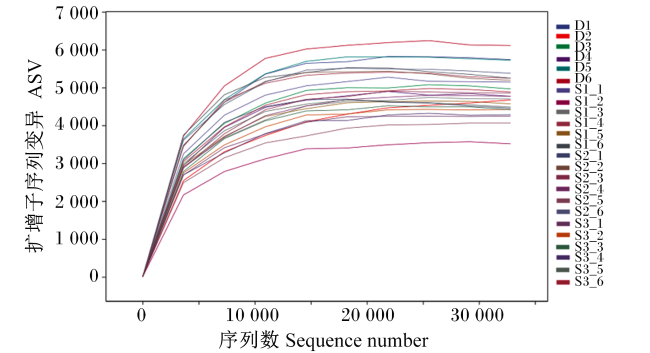
图1所示,各样本扩增子序列变异(ASV)数量在测序条数达到15 000条以上时,所有的样品曲线趋势都比较平稳,表明瘤胃微生物区系分析具有较好的测序深度,能够进行数据的多样性分析。
图1 稀释曲线

D1~D6:对照组的6个样本;S1_1~S1_6:试验Ⅰ组的6个样本;S2_1~S2_6:试验Ⅱ组的6个样本;S3_1~S3_6:试验Ⅲ组的6个样本。

Fig.1 Rarefaction curve

D1 to D6: six samples from the control group; S1_1 to S1_6: six samples from the trial group Ⅰ; S2_1 to S2_6: six samples from the trial group Ⅱ; S3_1 to S3_6: six samples from the trial group Ⅲ.

2.3.2 alpha多样性分析

瘤胃微生物alpha多样性分析结果(表5)显示,与对照组相比,试验Ⅰ、Ⅱ、Ⅲ组的Observed_species指数、Chao1指数、Shannon指数、Simpson指数均不同程度的升高,但各组间差异均不显著(P>0.05),表明补饲褪黑素不影响奶牛瘤胃微生物的丰富度和均匀度。
表5 褪黑素对泌乳中期奶牛瘤胃微生物alpha多样性指数的影响

Table 5 Effects of melatonin on rumen microbial alpha diversity indexes of dairy cows in mid-lactation period

项目
Items
对照组
Control
group
试验Ⅰ组
Trial
group Ⅰ
试验Ⅱ组
Trial
group Ⅱ
试验Ⅲ组
Trial
group Ⅲ
均值标准误
SEM
P
P-value
Observed_species指数
Observed_species index
3 924.45 4 024.70 4 180.14 4 077.92 75.287 0.718
Chao1指数Chao1 index 4 446.95 4 699.76 4 942.51 4 742.10 113.604 0.519
Shannon指数Shannon index 10.02 10.41 10.59 10.29 0.258 0.903
Simpson指数Simpson index 0.97 0.97 0.98 0.98 0.002 0.275

2.3.3 beta多样性分析

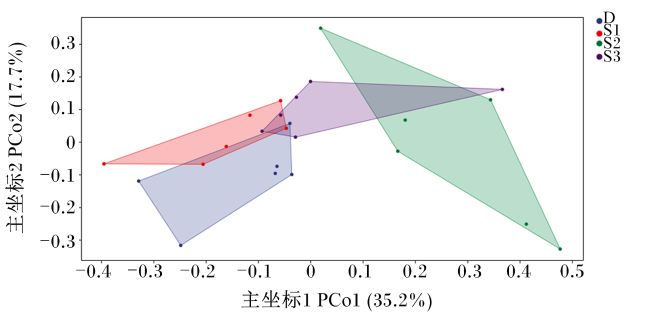
主坐标分析(PCoA,图2)结果显示,主坐标1(PC1)的贡献率为35.2%,主坐标2(PC2)的贡献率为17.7%,各组间瘤胃液样品相对分离,组内相似性较高,表明褪黑素对泌乳中期奶牛瘤胃微生物种群结构有一定的影响。
图2 瘤胃微生物PCoA

D:对照组;S1:试验Ⅰ组;S2:试验Ⅱ组;S3:试验Ⅲ组。图5同。

Fig.2 PCoA of rumen microbes

D: control group; S1: trial group Ⅰ; S2: trial group Ⅱ; S3: trial group Ⅲ. The same as Fig.5.

2.3.4 褪黑素对门水平瘤胃菌群结构的影响

将相对丰度>1%的菌群作为优势菌群,4组奶牛瘤胃菌群中的优势菌群均为厚壁菌门、拟杆菌门、变形菌门、软壁菌门、放线菌门、螺旋菌门。由表6可知,试验Ⅱ组厚壁菌门的相对丰度与对照组相比显著升高(P<0.05),而试验Ⅰ、Ⅲ组和对照组这3组间差异不显著(P>0.05);试验Ⅰ、Ⅱ、Ⅲ组螺旋菌门的相对丰度较对照组显著降低(P<0.05),各试验组间差异不显著(P>0.05);拟杆菌门、变形菌门、软壁菌门、放线菌门的相对丰度各组间均差异不显著(P>0.05)。
表6 褪黑素对泌乳中期奶牛瘤胃菌群中优势菌门相对丰度的影响

Table 6 Effects of melatonin on relative abundance of dominant bacterial phyla in rumen microflora of dairy cows in mid-lactation period %

项目
Items
对照组
Control
group
试验Ⅰ组
Trial
group Ⅰ
试验Ⅱ组
Trial
group Ⅱ
试验Ⅲ组
Trial
group Ⅲ
均值标准误
SEM
P
P-value
厚壁菌门Firmicutes 40.44b 45.94ab 55.61a 49.98ab 1.977 0.035
拟杆菌门Bacteroidetes 31.62 34.27 37.46 35.97 1.762 0.706
变形菌门Proteobacteria 2.92 2.89 1.77 2.55 0.214 0.202
软壁菌门Tenericutes 1.18 1.06 1.14 1.01 0.070 0.838
放线菌门Actinobacteria 1.11 1.03 1.52 1.09 0.163 0.730
螺旋菌门Spirochaetes 1.37a 0.85b 0.65b 0.77b 0.094 0.023

2.3.5 褪黑素对属水平瘤胃菌群结构的影响

在属水平上,4组奶牛瘤胃菌群中相对丰度排在前6的菌属均为普雷沃氏菌属、瘤胃球菌属、丁酸弧菌属、解琥珀酸菌属、夏普氏菌属、粪球菌属。由表7可知,试验Ⅱ、Ⅲ组普雷沃氏菌属、瘤胃球菌属的相对丰度与对照组相比显著升高(P<0.05),其他各组间均无显著差异(P>0.05);丁酸弧菌属、解琥珀酸菌属、夏普氏菌属、粪球菌属、YRC22、Shuttleworthia、CF231、月形单胞菌属的相对丰度各组间均无显著差异(P>0.05)。
表7 褪黑素对泌乳中期奶牛瘤胃菌群中优势菌属相对丰度的影响

Table 7 Effects of melatonin on relative abundance of dominant bacterial genera in rumen microflora of dairy cows in mid-lactation period %

项目
Items
对照组
Control
group
试验Ⅰ组
Trial
group Ⅰ
试验Ⅱ组
Trial
group Ⅱ
试验Ⅲ组
Trial
group Ⅲ
均值标准误
SEM
P
P-value
普雷沃氏菌属Prevotella 17.98b 25.60ab 31.91a 28.17a 1.640 0.011
瘤胃球菌属Ruminococcus 3.18b 4.15ab 5.84a 5.25a 0.338 0.015
丁酸弧菌属Butyrivibrio 2.77 3.55 5.43 4.43 0.379 0.064
解琥珀酸菌属Succiniclasticum 3.40 3.56 3.75 3.59 0.195 0.947
夏普氏菌属Sharpea 2.96 2.86 2.75 2.76 0.424 0.998
粪球菌属Coprococcus 1.08 1.07 1.09 1.14 0.062 0.979
YRC22 1.26 1.28 1.18 1.15 0.058 0.858
Shuttleworthia 0.83 1.17 0.87 0.76 0.139 0.754
CF231 0.73 0.56 0.86 0.79 0.072 0.518
月形单胞菌属Selenomonas 0.73 0.51 0.69 0.48 0.064 0.422

2.3.6 瘤胃发酵参数与瘤胃优势菌属的相关性分析

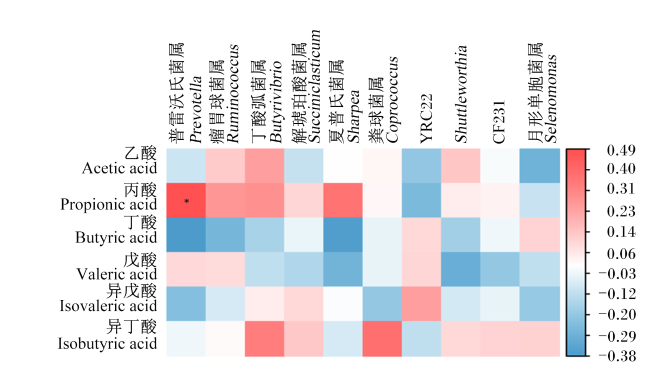
图3可知,瘤胃液中丙酸浓度与普雷沃氏菌属相对丰度呈显著正相关(R=0.48,P=0.02);乙酸、丁酸、戊酸等VFA浓度与瘤胃球菌属、丁酸弧菌属、解琥珀酸菌属等优势菌属相对丰度无显著相关性(P>0.05)。
图3 瘤胃发酵参数与瘤胃优势菌属的相关性分析

*表示相关性显著(P<0.05)。

Fig.3 Correlation analysis of rumen fermentation parameters with rumen dominant bacterial genera

* indicated significant correlation (P<0.05).

2.3.7 瘤胃微生物功能预测代谢通路差异分析

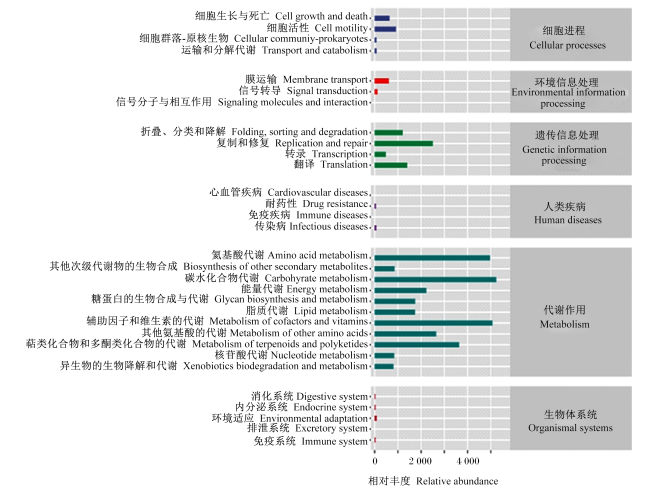
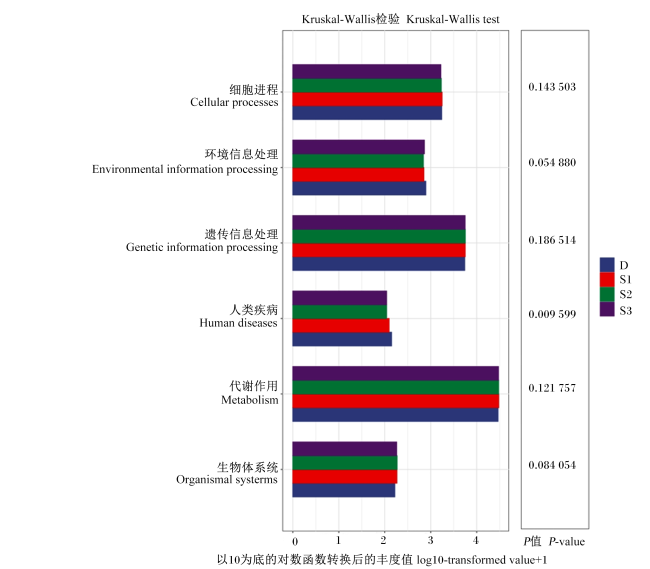
瘤胃微生物基于KEGG数据库进行功能预测的代谢通路注释见图4。对所获基因进行通路富集,泌乳奶牛瘤胃微生物在KEGG数据库中富集到6条初级代谢通路,包括细胞进程(cellular processes)、环境信息处理(environmental information processing)、遗传信息处理(genetic information processing)、人类疾病(human diseases)、代谢作用(metabolism)、生物体系统(organismal systems);富集到31条次级代谢通路,其中碳水化合物代谢(carbohydrate metabolism)、辅助因子和维生素的代谢(metabolism of cofactors and vitamins)、氨基酸代谢(amino acid metabolism)中瘤胃菌群的相对丰度位列前3。各组间在初级代谢通路上的差异性分析(图5)显示,瘤胃菌群在初级代谢通路人类疾病上存在极显著差异(P<0.01)。
图4 瘤胃菌群功能预测

Fig.4 Functional prediction of rumen microflora

图5 瘤胃菌群功能预测代谢通路差异分析

Fig.5 Differential analysis of metabolic pathways in functional prediction of rumen microflora

3 讨论

3.1 褪黑素对泌乳中期奶牛瘤胃发酵参数及发酵状况的影响

瘤胃液pH与NH3-N、VFA浓度等参数是研究瘤胃发酵状况的重要指标,其反映出饲粮在瘤胃内被微生物分解吸收的状况和瘤胃内环境的稳定性[19-20]。本研究发现,与对照组相比,各试验组瘤胃液中丙酸浓度均显著提高,TVFA浓度略有增加,产生此结果的主要原因可能是褪黑素使瘤胃内微生物多样性增加,尤其是淀粉分解菌的相对丰度增加,碳源和能量的充足供应为瘤胃提供了更加稳定的内环境[21]
欧阳佳良[11]的研究结果显示,褪黑素可以有效增加瘤胃菌群中普雷沃氏菌属和琥珀酸弧菌属等淀粉降解菌的相对丰度,提高碳水化合物的利用率,并为机体提供充足的VFA,本研究结果与此结论相类似。瘤胃液中丙酸浓度的增加还可能会引起产奶量升高,但乙酸/丙酸值过高时,会导致脂肪沉积,褪黑素促进瘤胃发酵及丙酸生成,进而对奶牛产奶量产生影响[22]。饲粮中蛋白质及非蛋白氮在瘤胃中的降解产物是NH3-N[23]。瘤胃微生物可以利用饲粮中的蛋白质或者NH3-N类物质合成自身的蛋白质MCP,而后在小肠被机体吸收[24]。本研究中,补饲120或160 mg/d褪黑素后,奶牛瘤胃液NH3-N浓度显著升高,MCP浓度有升高趋势。机体自身的褪黑素是由色氨酸先转化为5-羟色胺进而合成褪黑素,色氨酸是生长羔羊和牛在非蛋白氮利用过程中的限制性氨基酸,部分色氨酸通过5-羟色胺途径转化为5-羟色胺和褪黑素[25]。刘君等[26]研究表明,肉羊补饲瘤胃保护性色氨酸提高了血液中游离色氨酸浓度,尿氮的排出量显著下降,氮沉积量显著增加;Ouyang等[27]研究发现,光照条件下瘤胃液中NH3-N浓度显著低于黑暗条件下,推测机体褪黑素的含量与氮利用效率呈正相关。还有研究发现,饲粮中添加过瘤胃色氨酸不仅能提高羔羊的生长性能和绵羊的产毛量,还能提高山羊的氮利用率和绒山羊的平均日增重和氮利用率[28-29]。这也解释了本试验中补饲褪黑素后奶牛瘤胃液中NH3-N和MCP浓度有所提高的原因。Jaworek等[30]在对大鼠的体内、体外研究中发现,褪黑素或色氨酸对外分泌胰腺活性的刺激作用涉及胆囊收缩素的分泌,而胆囊收缩素是牛胰酶的调节剂,这种效果归因于α-淀粉酶的释放量增加,最终提高了牛的淀粉消化率。褪黑素对瘤胃发酵效率的影响是由于它的亲脂性,可以通过固有层和黏膜下层中的血管移动到更深层,作用于肌间神经系统,调节胃肠运动[31]。褪黑素或其前体物质色氨酸可以通过刺激胆囊收缩素释放肽和激活十二指肠-胰腺反射来刺激胆囊收缩素分泌[32],胆囊收缩素可能通过激活迷走神经元上的瘦素或内脏传入神经元向大脑摄食中枢传递抑制信号,使瘤胃收缩抑制,减少摄入量,提高瘤胃发酵效率[33]。六碳糖发酵量、微生物细胞产量和瘤胃发酵效率是衡量瘤胃发酵状况的主要指标,三者都与瘤胃液内乙酸、丙酸及丁酸浓度密切相关。六碳糖发酵量、微生物细胞产量及瘤胃发酵效率主要通过测定瘤胃液内乙酸、丙酸、丁酸等的浓度来进行评估,进而评估饲粮在瘤胃中的消化代谢情况。本研究中,与对照组相比,补饲褪黑素使奶牛瘤胃中六碳糖发酵量、微生物细胞产量及瘤胃发酵效率均呈不同程度的升高,这与补饲褪黑素提高了奶牛瘤胃液中乙酸、丙酸和MCP浓度相一致。

3.2 褪黑素对泌乳中期奶牛瘤胃微生物区系的影响

反刍动物将饲粮中的营养成分转化为微生物代谢能量和发酵最终产物主要依赖于不同的微生物在瘤胃复杂的生态系统中的共存和相互作用[34-35]。1958年,Lerner等从牛松果体中首次发现褪黑素具有消炎、促睡眠、改善情绪、调节繁殖、增强机体免疫力和抗氧化等功效[36]。抗氧化剂可以改变奶牛瘤胃微生物区系。Goiri等[37]的研究结果表明,饲喂废咖啡渣(spent coffee grounds,SCG)可引起绵羊瘤胃细菌群落的变化,改变细菌群落和细菌群落与瘤胃VFA之间的相关网络,这可能与SCG的抗氧化特性及其高含量的褪黑素有关;给绵羊饲喂高剂量的SCG时,瘤胃密螺旋体属、丁酸弧菌属、Anaeroplasma、布劳特氏菌属、纤维杆菌属等的相对丰度显著增加。褪黑素可以调节肠道微生物及其代谢物的活性,改善肠道生理功能,预防各种肠道疾病,同时褪黑素可改变肠道菌群代谢,进而影响肠道菌群结构[38-39]。在反刍动物瘤胃中,在门水平上,优势菌群为厚壁菌门和拟杆菌门[40-41]。厚壁菌门主要进行纤维和纤维素的降解[42],拟杆菌门主要参与复合碳水化合物和发酵有机物的消化[43]。本研究结果显示,泌乳奶牛瘤胃中优势菌群为厚壁菌门、拟杆菌门、变形菌门。这与Wang等[44]通过16S rRNA全长基因测序得出的奶牛瘤胃菌群在门水平上依次以厚壁菌门、拟杆菌门和变形菌门为主的结论相一致。还有研究结果显示,这3种优势菌群遵循昼夜规律,拟杆菌门和厚壁菌门在黑暗条件下相对丰度高于光照条件下[45]。本试验中,就门、属水平来看,补饲褪黑素后奶牛瘤胃菌群中厚壁菌门的相对丰度显著提高,螺旋菌门的相对丰度显著降低,普雷沃氏菌属、瘤胃球菌属的相对丰度显著升高。厚壁菌门在瘤胃微生物组成中的比例会随着pH的降低而增加[46]。补饲褪黑素对瘤胃微生物区系产生影响可能是由于褪黑素作为一种信号分子参与肠道微生物之间的通讯,通过释放细胞调节因子来影响微生物群落结构及其代谢产物。Ma等[47]研究表明,褪黑素可通过肠上皮产生的细胞因子[如γ-干扰素(interferon-γ,IFN-γ)]影响肠道微生物,肠道微生物通过褪黑素结合位点识别并响应来自肠道的褪黑素信号,进一步激活肠道免疫细胞的功能[48-49]。但目前褪黑素在肠道内进行信号转导的通路尚未明确。褪黑素可改变动物胃肠道微生物区系,且在不同动物胃肠道中的表现有所不同。Hashimoto等[50]研究发现,当小鼠体内血管紧张素转换酶2(angiotensin-converting enzyme 2,Ace2)缺乏导致肠道炎症易感性增高时,补饲色氨酸可以平衡肠道微生物区系。褪黑素处理可使小鼠肠道中厚壁菌门的相对丰度有所增加[10]。体外培养发现,褪黑素浓度与普雷沃氏菌门相对丰度呈正相关,而与琥珀弧菌属、变形杆菌属相对丰度呈负相关[51]。Fu等[52]通过体外、体内试验研究了褪黑素对瘤胃发酵的影响,结果表明,褪黑素处理可以提高球菌科瘤胃、毛螺旋菌科、双歧杆菌属等有益菌的相对丰度,降低罗姆布茨菌属、Lachnoclostridium、檬酸杆菌属等致病菌的相对丰度,同时降低了产甲烷菌的活性,减少了甲烷的产生;但与本试验结果存在不同的是,褪黑素降低了瘤胃内VFA的产量,这可能与饲喂剂量有关。在本试验中,补饲褪黑素后奶牛瘤胃菌群的Observed_species指数和Chao1指数略高于对照组,可能是补喂褪黑素可使瘤胃菌群的相对丰度升高,但具体的作用机制有待进一步深入研究。

3.3 褪黑素对泌乳中期奶牛瘤胃微生物功能的影响

普雷沃氏菌属在降解蛋白质、淀粉等营养物质的过程中起着至关重要的作用[53]。丙酸是反刍动物糖异生的主要前体,它参与了机体的多种代谢活动。在本研究中,瘤胃液中丙酸浓度与普雷沃氏菌属相对丰度呈显著正相关,普雷沃氏菌属发酵的产物主要是丙酸,这与补饲褪黑素提高了瘤胃菌群中普雷沃氏菌属相对丰度和丙酸浓度的结果相一致。已有研究报道,体外培养液中普雷沃氏菌科、普雷沃氏菌属1相对丰度与褪黑素浓度之间存在显著的正相关[26],但褪黑素对普雷沃氏菌科的具体调控机制仍待进一步研究。本试验中,奶牛瘤胃微生物功能预测次级代谢通路主要集中分布在碳水化合物代谢、辅助因子和维生素的代谢及氨基酸代谢上,其中瘤胃微生物对碳水化合物、氨基酸及维生素的转化利用率更高,瘤胃微生物参与碳水化合物的转运及代谢的相关基因是最多的,该结果与安雅静等[54]对牦牛瘤胃微生物的研究结果相似。本研究结果显示,补饲褪黑素的各试验组瘤胃微生物在初级代谢通路human diseases上与对照组存在极显著差异。最新研究发现,普雷沃氏菌属相对丰度的增加与局部和全身性疾病密切相关,普雷沃氏菌属可以刺激上皮细胞产生白细胞介素-8(interleukin-8,IL-8)和白细胞介素-6(interleukin-6,IL-6),增加肠道炎症反应,并导致全身自身免疫[55]。光暗周期可能通过影响褪黑素浓度,进而影响普雷沃氏菌属1和琥珀酸弧菌科调节瘤胃菌群细胞运动和分泌、磷酸酯和次磷酸酯代谢或蛋白质折叠及相关加工等功能,从而影响泌乳奶牛的生理代谢,最终影响生产性能,如产奶量等[11]。同时,褪黑素还可能会通过色氨酸代谢通路对肠道微生物进行调控,其中吲哚类化合物和色氨酸可以介导结肠细胞中芳香烃受体,影响肠道弹性和对炎症刺激的反应[56]。Gordeeva等[57]在小鼠上的研究显示,5-羟基色氨酸上调了参与5-羟色胺合成和代谢过程的氨基酸脱羧酶(amino acid decarboxylase,AADC)、单氨氧化酶A(monoamine oxidase,AMAOA)、转谷氨酰胺酶2(TGM2)等酶的基因表达。

4 结论

在本试验条件下,补饲褪黑素提高了泌乳中期奶牛瘤胃液中NH3-N、丙酸浓度,并提高了瘤胃菌群中厚壁菌门、普雷沃氏菌属和瘤胃球菌属的相对丰度,降低了螺旋菌门的相对丰度。泌乳中期奶牛的褪黑素推荐补饲量为120 mg/d。
[1]
李佳佳, 门海涛, 高丽美. 褪黑素的生理功能及应用研究进展[J]. 江苏农业科学, 2023, 51(8):17-26.

LI J J, MEN H T, GAO L M. Research progress on physiological function and application of melatonin[J]. Jiangsu Agricultural Sciences, 2023, 51(8):17-26. (in Chinese)

[2]
O’KEEFFE S M, BEYNON A L, DAVIES J S, et al. NF-κB signalling is involved in immune-modulation,but not basal functioning,of the mouse suprachiasmatic circadian clock[J]. The European Journal of Neuroscience, 2017, 45(8):1111-1123.

DOI

[3]
MARTIN A M, SUN E W, ROGERS G B, et al. The influence of the gut microbiome on host metabolism through the regulation of gut hormone release[J]. Frontiers in Physiology, 2019, 10:428.

DOI PMID

[4]
THACKRAY V G. Sex,microbes,and polycystic ovary syndrome[J]. Trends in Endocrinology & Metabolism, 2019, 30(1):54-65.

[5]
KIM S W, KIM S, SON M, et al. Melatonin controls microbiota in colitis by goblet cell differentiation and antimicrobial peptide production through Toll-like receptor 4 signalling[J]. Scientific Reports, 2020, 10(1):2232.

DOI PMID

[6]
BUBENIK G A, HACKER R R, BROWN G M, et al. Melatonin concentrations in the luminal fluid,mucosa,and muscularis of the bovine and porcine gastrointestinal tract[J]. Journal of Pineal Research, 1999, 26(1):56-63.

DOI

[7]
LACASSE P, LOLLIVIER V, BRUCKMAIER R M, et al. Effect of the prolactin-release inhibitor quinagolide on lactating dairy cows[J]. Journal of Dairy Science, 2011, 94(3):1302-1309.

DOI PMID

[8]
MA N, ZHANG J, REITER R J, et al. Melatonin mediates mucosal immune cells,microbial metabolism,and rhythm crosstalk:a therapeutic target to reduce intestinal inflammation[J]. Medicinal Research Reviews, 2020, 40(2):606-632.

DOI

[9]
PAULOSE J K, CASSONE V M. The melatonin-sensitive circadian clock of the enteric bacterium Enterobacter aerogenes[J]. Gut Microbes, 2016, 7(5):424-427.

DOI

[10]
ZHU D, MA Y, DING S J, et al. Effects of melatonin on intestinal microbiota and oxidative stress in colitis mice[J]. BioMed Research International, 2018, 2018:2607679.

[11]
欧阳佳良. 泌乳奶牛瘤胃内褪黑素的昼夜节律及其对瘤胃菌群结构的影响[D]. 硕士学位论文. 扬州: 扬州大学, 2020.

OUYANG J L. Diurnal variation of ruminal melatonin and the influence on rumen microorganisms in lactating cows[D]. Master’s Thesis. Yangzhou: Yangzhou University, 2020. (in Chinese)

[12]
张丽英. 饲料分析及饲料质量检测技术[M]. 3版. 北京: 中国农业大学出版社, 2007.

ZHANG L Y. Feed analysis and feed quality testing techniques[M]. 3rd ed. Beijing: China Agricultural University Press, 2007. (in Chinese)

[13]
VAN SOEST P J, ROBERTSON J B, LEWIS B A. Methods for dietary fiber,neutral detergent fiber,and nonstarch polysaccharides in relation to animal nutrition[J]. Journal of Dairy Science, 1991, 74(10):3583-3597.

DOI

[14]
傅启高, 雒秋江. 用邻-甲酚酞比色法测定饲料中钙含量的研究[J]. 动物营养学报, 1996, 8(3):25-30.

FU Q G, LUO Q J. Determination of feed calcium contents by o-cresolphthalein complexone colorimetry[J]. Chinese Journal of Animal Nutrition, 1996, 8(3):25-30. (in Chinese)

[15]
冯宗慈, 高民. 通过比色测定瘤胃液氨氮含量方法的改进[J]. 畜牧与饲料科学, 2010, 31(6/7):37.

FENG Z C, GAO M. Improvement of the method for determining the ammonia-nitrogen content of rumen liquor by colourimetry[J]. Animal Husbandry and Feed Science, 2010, 31(6/7):37. (in Chinese)

[16]
张俊瑜, 苏玲玲. 不同前处理对气相色谱法测定瘤胃中挥发性脂肪酸的影响[J]. 草食家畜, 2017(3):30-34.

ZHANG J Y, SU L L. Effects of different pretreatment methods on the determination of volatile fatty acids in rumen by gas chromatography[J]. Grass-Feeding Livestock, 2017(3):30-34. (in Chinese)

[17]
李琛. 饲喂酵母培养物对奶牛泌乳性能、血清和瘤胃发酵指标的影响[D]. 硕士学位论文. 乌鲁木齐: 新疆农业大学, 2021.

LI C. Effect of feeding yeast culture on milking performance,serum and rumen fermentation index of dairy cows[D]. Master’s Thesis. Urumqi: Xinjiang Agricultural University, 2021. (in Chinese)

[18]
卢德勋. 新版系统动物营养学导论[M]. 北京: 中国农业出版社, 2016.

LU D X. An introduction to systems-nutrition of animals (2016 edition)[M]. Beijing: China Agriculture Press, 2016. (in Chinese)

[19]
宋范成. 日粮磷水平对奶牛瘤胃发酵、产奶性能及磷消化代谢的影响[D]. 硕士学位论文. 呼和浩特: 内蒙古农业大学, 2010.

SONG F C. Effect of dietary phosphorus levels on ruminal fermentation,milk performance and digestion and metabolism of phosphorus of dairy cows[D]. Master’s Thesis. Hohhot: Inner Mongolia Agricultural University, 2010. (in Chinese)

[20]
魏小霜, 逯勇. 复合微生态制剂对犊牛生长性能、瘤胃发酵参数、血液生化指标和免疫指标的影响[J]. 中国饲料, 2021(17):46-51.

WEI X S, LU Y. Effects of compound probiotics on growth performance,rumen fermentation parameters,blood biochemical indexes and immune indexes of calves[J]. China Feed, 2021(17):46-51. (in Chinese)

[21]
XU P F, WANG J L, HONG F, et al. Melatonin prevents obesity through modulation of gut microbiota in mice[J]. Journal of Pineal Research, 2017, 62(4):1-13.

[22]
李胜利. 奶牛营养学[M]. 北京: 科学出版社, 2020.

LI S L. Nutriology of dairy cattle[M]. Beijing: Science Press, 2020. (in Chinese)

[23]
姜士凯. 不同类型日粮对泌乳奶牛体况、瘤胃发酵及生产性能的影响[D]. 硕士学位论文. 郑州: 河南农业大学, 2013.

JIANG S K. Effects of different types of diets on body condition score, rumen fermentation and performance of lactating dairy cow[D]. Master’s Thesis. Zhengzhou: Henan Agricultural University, 2013. (in Chinese)

[24]
SCHWAB C G, BRODERICK G A. A 100-year review:protein and amino acid nutrition in dairy cows[J]. Journal of Dairy Science, 2017, 100(12):10094-10112.

DOI

[25]
LEE S B, LEE K W, WANG T, et al. Intravenous administration of L-tryptophan stimulates gastrointestinal hormones and melatonin secretions:study on beef cattle[J]. Journal of Animal Science and Technology, 2019, 61(4):239-244.

DOI

[26]
刘君, 耿忠诚, 马慧, 等. 瘤胃保护性色氨酸对肉羊氮代谢及生长性能的影响[J]. 饲料与畜牧, 2010(1):18-21.

LIU J, GENG Z C, MA H, et al. Effect of rumen-protected tryptophan on nitrogen metabolism and production performance in lambs[J]. Feed and Husbandry, 2010(1):18-21. (in Chinese)

[27]
OUYANG J L, WANG M Z, BU D P, et al. Ruminal microbes exhibit a robust circadian rhythm and are sensitive to melatonin[J]. Frontiers in Nutrition, 2021, 8:760578.

DOI

[28]
VAN E NOLTE J, LÖEST C A, FERREIRA A V, et al. Limiting amino acids for growing lambs fed a diet low in ruminally undegradable protein[J]. Journal of Animal Science, 2008, 86(10):2627-2641.

DOI PMID

[29]
MA H, CHENG J, ZHU X, et al. Effects of rumen-protected tryptophan on performance,nutrient utilization and plasma tryptophan in cashmere goats[J]. African Journal of Biotechnology, 2011, 10(30):5806-5811.

[30]
JAWOREK J, NAWROT K, KONTUREK S J, et al. Melatonin and its precursor,L-tryptophan:influence on pancreatic amylase secretion in vivo and in vitro[J]. Journal of Pineal Research, 2004, 36(3):155-164.

DOI

[31]
ACUÑA-CASTROVIEJO D, ESCAMES G, VENEGAS C, et al. Extrapineal melatonin:sources,regulation,and potential functions[J]. Cellular and Molecular Life Sciences, 2014, 71(16):2997-3025.

DOI

[32]
LEJA-SZPAK A, JAWOREK J, NAWROT-PORABKA K, et al. Modulation of pancreatic enzyme secretion by melatonin and its precursor;L-tryptophan.Role of CCK and afferent nerves[J]. Journal of Physiology and Pharmacology, 2004, 55(Suppl 2):33-46.

[33]
BANG C S, YANG Y J, BAIK G H. Melatonin for the treatment of gastroesophageal reflux disease;protocol for a systematic review and meta-analysis[J]. Medicine, 2019, 98(4):e14241.

DOI

[34]
WANG Z, ELEKWACHI C, JIAO J Z, et al. Changes in metabolically active bacterial community during rumen development,and their alteration by rhubarb root powder revealed by 16S rRNA amplicon sequencing[J]. Frontiers in Microbiology, 2017, 8:159.

[35]
MURA M C, DAGA C, BODANO S, et al. Development of a RNA extraction method from milk for gene expression study in the mammary gland of sheep[J]. Molecular Biology Reports, 2013, 40(3):2169-2173.

DOI PMID

[36]
KONTUREK S J, KONTUREK P C, BRZOZOWSKA I, et al. Localization and biological activities of melatonin in intact and diseased gastrointestinal tract (GIT)[J]. Journal of Physiology and Pharmacology, 2007, 58(3):381-405.

PMID

[37]
GOIRI I, DÍAZ DE OTÁLORA X, RUIZ R, et al. Spent coffee grounds alter bacterial communities in Latxa dairy ewes[J]. Microorganisms, 2020, 8(12):1961.

DOI

[38]
SRINIVASAN V, MOHAMED M, KATO H. Melatonin in bacterial and viral infections with focus on sepsis:a review[J]. Recent Patents on Endocrine,Metabolic & Immune Drug Discovery, 2012, 6(1):30-39.

[39]
REN W K, WANG P, YAN J M, et al. Melatonin alleviates weanling stress in mice:involvement of intestinal microbiota[J]. Journal of Pineal Research, 2018, 64(2):e12448.

DOI

[40]
DE MENEZES A B, LEWIS E, O’DONOVAN M, et al. Microbiome analysis of dairy cows fed pasture or total mixed ration diets[J]. FEMS Microbiology Ecology, 2011, 78(2):256-265.

DOI PMID

[41]
MAO S Y, ZHANG M L, LIU J H, et al. Characterising the bacterial microbiota across the gastrointestinal tracts of dairy cattle:membership and potential function[J]. Scientific Reports, 2015, 5(1):16116.

DOI

[42]
LANGILLE M G I, ZANEVELD J, CAPORASO J G, et al. Predictive functional profiling of microbial communities using 16S rRNA marker gene sequences[J]. Nature Biotechnology, 2013, 31(9):814-821.

DOI PMID

[43]
REIGSTAD C S, KASHYAP P C. Beyond phylotyping:understanding the impact of gut microbiota on host biology[J]. Neurogastroenterology and Motility, 2013, 25(5):358-372.

DOI

[44]
WANG Z, YU Y N, LI X Y, et al. Fermented soybean meal replacement in the diet of lactating Holstein dairy cows:modulated rumen fermentation and ruminal microflora[J]. Frontiers in Microbiology, 2021, 12:625857.

DOI

[45]
YIN J, LI Y Y, HAN H, et al. Administration of exogenous melatonin improves the diurnal rhythms of the gut microbiota in mice fed a high-fat diet[J]. mSystems, 2020, 5(3):e00002-20.

[46]
BÄCKHED F, DING H, WANG T, et al. The gut microbiota as an environmental factor that regulates fat storage[J]. Proceedings of the National Academy of Sciences of the United States of America, 2004, 101(44):15718-15723.

DOI PMID

[47]
MA N, GUO P T, ZHANG J, et al. Nutrients mediate intestinal bacteria-mucosal immune crosstalk[J]. Frontiers in Immunology, 2018, 9:5.

DOI PMID

[48]
GUISSONI CAMPOS L M, HATAKA A, VIEIRA I Z, et al. Circadian clock proteins and melatonin receptors in neurons and glia of the Sapajus apella cerebellum[J]. Frontiers in Physiology, 2018, 9:5.

DOI

[49]
BYEON Y, BACK K. Melatonin production in Escherichia coli by dual expression of serotonin N-acetyltransferase and caffeic acid O-methyltransferase[J]. Applied Microbiology and Biotechnology, 2016, 100(15):6683-6691.

DOI

[50]
HASHIMOTO T, PERLOT T, REHMAN A, et al. ACE2 links amino acid malnutrition to microbial ecology and intestinal inflammation[J]. Nature, 2012, 487(7408):477-481.

DOI

[51]
YAO S Y, WU H, MA H, et al. Effects of rumen bypass melatonin feeding (RBMF) on milk quality and mastitis of Holstein cows[J]. PeerJ, 2020, 8:e9147.

DOI

[52]
FU Y, YAO S Y, WANG T K, et al. Effects of melatonin on rumen microorganisms and methane production in dairy cow:results from in vitro and in vivo studies[J]. Microbiome, 2023, 11(1):196.

DOI

[53]
THOETKIATTIKUL H, MHUANTONG W, LAOTHANACHAREON T, et al. Comparative analysis of microbial profiles in cow rumen fed with different dietary fiber by tagged 16S rRNA gene pyrosequencing[J]. Current Microbiology, 2013, 67(2):130-137.

DOI PMID

[54]
安雅静, 文勇立, 赵佳琦, 等. 宏基因组学揭示AFB1对牦牛瘤胃微生物多样性及CAZy谱影响[J]. 家畜生态学报, 2019, 40(2):13-20.

AN Y J, WEN Y L, ZHAO J Q, et al. Metagenomics reveals the effect of AFB1 on rumen microbial diversity and CAZy of yak[J]. Acta Ecologae Animalis Domastici, 2019, 40(2):13-20. (in Chinese)

[55]
LARSEN J M. The immune response to Prevotella bacteria in chronic inflammatory disease[J]. Immunology, 2017, 151(4):363-374.

DOI

[56]
WIKOFF W R, ANFORA A T, LIU J, et al. Metabolomics analysis reveals large effects of gut microflora on mammalian blood metabolites[J]. Proceedings of the National Academy of Sciences of the United States of America, 2009, 106(10):3698-3703.

DOI PMID

[57]
GORDEEVA O, SAFANDEEV V. 5-hydroxytryptophan (5-HTP)-induced intracellular syndrome in mouse non-neural embryonic cells is associated with inhibited proliferation and cell death[J]. Neuropharmacology, 2021, 195:107862.

DOI

文章导航

/