研究论文

饲料中添加L-肉碱对凡纳滨对虾生长性能、消化能力及非特异性免疫力的影响

  • 赵敏 , 1, 2 ,
  • 周良星 3, 4, * ,
  • 刘佳裕 2, 3 ,
  • 周桂莲 3, 5 ,
  • 李勇 2, 3 ,
  • 刘天骥 2, 3 ,
  • 刘匆 2, 3 ,
  • 席庆凯 3 ,
  • 朱站英 2, 3 ,
  • 顾夕章 2, 6 ,
  • 张文兵 , 1, ** ,
  • 李洪琴 , 2, **
展开
  • 1 中国海洋大学水产学院,青岛 266061
  • 2 新希望六和股份有限公司,农业农村部饲料及畜禽产品质量安全控制重点实验室,北京 100102
  • 3 山东新希望六和集团有限公司,青岛市动物饲料安全重点实验室,青岛 266061
  • 4 广州希望饲料有限公司,广州 510000
  • 5 四川新希望六和科技创新有限公司,成都 610101
  • 6 射阳六和饲料有限公司,江苏省水产生物环保饲料工程研究中心,盐城 224000
** 张文兵,教授,博士生导师,E-mail: ;
李洪琴,E-mail:

* 同等贡献作者

赵 敏(1989—),男,山东青岛人,硕士,研究方向为水产动物营养与饲料。E-mail:

Copy editor: 武海龙

收稿日期: 2023-06-16

  网络出版日期: 2023-12-11

基金资助

国家重点研发计划(2021YFD1301004)

Effects of L-carnitine Supplementation in Diets on Growth Performance, Digestive Ability and Non-Specific Immunity of Pacific White Shrimp (Litopenaeus vannamei)

  • ZHAO Min , 1, 2 ,
  • ZHOU Liangxing 3, 4, * ,
  • LIU Jiayu 2, 3 ,
  • ZHOU Guilian 3, 5 ,
  • LI Yong 2, 3 ,
  • LIU Tianji 2, 3 ,
  • LIU Cong 2, 3 ,
  • XI Qingkai 3 ,
  • ZHU Zhanying 2, 3 ,
  • GU Xizhang 2, 6 ,
  • ZHANG Wenbing , 1, ** ,
  • LI Hongqin , 2, **
Expand
  • 1 College of Fisheries, Ocean University of China, Qingdao 266061, China
  • 2 Key Laboratory for Quality and Safety Control of Feed and Livestock Products, Ministry of Agriculture and Rural Affairs, New Hope Liuhe Co., Ltd., Beijing 100102, China
  • 3 Qingdao Key Laboratory for Animal Feed Safety, Shandong New Hope Liuhe Group Co., Ltd., Qingdao 266061, China
  • 4 Guangzhou Hope Feed Co., Ltd., Guangzhou 510000, China
  • 5 Sichuan New Hope Liuhe Technology Innovation Co., Ltd., Chengdu 610101, China
  • 6 Jiangsu Province Aquatic Biology Environmental Protection Feed Engineering Research Center, Sheyang Liuhe Feed Co., Ltd., Yancheng 224000, China
** ZHANG Wenbing, professor, E-mail: ;
LI Hongqin, E-mail:

* Contributed equally

Received date: 2023-06-16

  Online published: 2023-12-11

摘要

本试验旨在探究饲料中添加L-肉碱对凡纳滨对虾生长性能、消化能力及非特异性免疫力的影响。选择初始体重为(0.40±0.02) g的凡纳滨对虾虾苗480尾,随机分为3组,每组4个重复,每个重复40尾虾。对照组饲喂基础饲料,试验组饲喂L-肉碱添加水平分别为0.02%和0.04%的试验饲料。试验期8周。结果表明:1)0.04% L-肉碱组增重率和特定生长率显著高于对照组(P<0.05),0.04% L-肉碱组饲料系数显著低于对照组(P<0.05)。各组之间凡纳滨对虾存活率无显著差异(P>0.05)。2)0.02% L-肉碱组和0.04% L-肉碱组虾体水分含量显著高于对照组(P<0.05)。各组之间凡纳滨对虾虾体粗蛋白质、粗脂肪和粗灰分含量无显著差异(P>0.05)。3)0.02% L-肉碱组肠道肌层厚度显著高于对照组(P<0.05)。各组之间凡纳滨对虾肠道绒毛高度无显著差异(P>0.05)。4)0.04% L-肉碱组肠道蛋白酶和脂肪酶活性显著高于对照组(P<0.05)。各组之间凡纳滨对虾肠道淀粉酶活性无显著差异(P>0.05)。5)0.04% L-肉碱组肝胰腺酸性磷酸酶和溶菌酶活性显著高于对照组(P<0.05),0.02% L-肉碱组和0.04% L-肉碱组肝胰腺碱性磷酸酶和过氧化氢酶活性显著高于对照组(P<0.05)。由此可见,饲料中添加适宜水平的L-肉碱可以改善凡纳滨对虾生长性能和饲料利用效率,提高对虾消化能力和非特异性免疫力。在本试验条件下,凡纳滨对虾饲料中L-肉碱的适宜添加水平为0.04%。

本文引用格式

赵敏 , 周良星 , 刘佳裕 , 周桂莲 , 李勇 , 刘天骥 , 刘匆 , 席庆凯 , 朱站英 , 顾夕章 , 张文兵 , 李洪琴 . 饲料中添加L-肉碱对凡纳滨对虾生长性能、消化能力及非特异性免疫力的影响[J]. 动物营养学报, 2023 , 35(12) : 7978 -7987 . DOI: 10.12418/CJAN2023.723

Abstract

This experiment was conducted to study the effects of L-carnitine supplementation in diets on growth performance, digestive ability and non-specific immunity of Pacific white shrimp (Litopenaeus vannamei). A total of 480 juvenile Pacific white shrimp with initial body weight of (0.40±0.02) g were randomly divided into 3 groups with 4 replicates per group and 40 shrimp per replicate. Shrimp in the control group were fed a basal diet, and others in experimental groups were fed experimental diets which L-carnitine supplemental levels were 0.02% and 0.04%, respectively. The experiment lasted for 8 weeks. The results showed as follows: 1) the weight gain rate and specific growth rate of 0.04% L-carnitine group were significantly higher than those of the control group (P<0.05), and the feed conversion ratio of 0.04% L-carnitine group was significantly lower than that of the control group (P<0.05). There was no significant difference in survival rate of Pacific white shrimp among all groups (P>0.05). 2) The whole shrimp moisture content of 0.02% L-carnitine group and 0.04% L-carnitine group was significantly higher than that of the control group (P<0.05). There were no significant differences in the contents of crude protein, ether extract and ash in whole shrimp of Pacific white shrimp among all groups (P>0.05). 3) The intestinal muscular layer thickness of 0.02% L-carnitine group was significantly higher than that of the control group (P<0.05). There was no significant difference in intestinal villus height of Pacific white shrimp among all groups (P>0.05). 4) The activities of protease and lipase in intestine of 0.04% L-carnitine group were significantly higher than those of the control group (P<0.05). There was no significant difference in intestinal amylase activity of Pacific white shrimp among all groups (P>0.05). 5) The activities of acid phosphatase and lysozyme in hepatopancreas of 0.04% L-carnitine group were significantly higher than those of the control group (P<0.05), and the activities of alkaline phosphatase and catalase in hepatopancreas of 0.02% L-carnitine group and 0.04% L-carnitine group were significantly higher than those of the control group (P<0.05). In conclusion, adding appropriate level of L-carnitine in diet can improve the growth performance, feed efficiency, digestive ability and non-specific immunity of Pacific white shrimp. Under the conditions of this experiment, the appropriate supplemental level of L-carnitine in diet of Pacific white shrimp is 0.04%.

蛋白质、脂肪和碳水化合物是动物的三大能量物质,其中蛋白质虽然可以被鱼类充分利用,但由于价格高,在饲料中主要被设计用于鱼类生长而不是能量代谢;而脂肪因单位质量所含的能量是蛋白质和碳水化合物的2倍多,且其饲料成本较蛋白质低,通常被用作水产饲料的主要能量来源,起到节约饲料蛋白质的作用[1]。因此,高脂肪低蛋白质饲料成为水产饲料的发展趋势之一[2]。然而水产动物代谢脂肪的能力有限,鱼体内脂肪过量堆积会引起如脂肪肝、腹腔脂肪堆积等疾病,使得生长受阻且免疫力下降[3]。所以寻找有效的降脂因子来提高水产动物利用脂肪的能力,减少脂肪的蓄积,对水产业快速健康发展具有重要意义。
L-肉碱(β-羟基-γ-三甲基铵丁酸)又称左旋肉碱,是一种多功能的有机营养物质,其典型功能为在β-氧化中作为长链脂肪酸的运输载体,从线粒体外部将长链脂肪酸跨膜运输到线粒体基质进行氧化分解[4]。除此之外,L-肉碱还有促进机体消化和蛋白质沉积、增强抗氧化能力和免疫力的作用[5-8]。动物普遍具有以蛋氨酸和赖氨酸为原料合成L-肉碱的能力,但动物特别是水产养殖动物往往自身合成能力不足,内源性L-肉碱仅占机体L-肉碱总量的1/3,需要在饲料中额外添加L-肉碱以维持正常的生长和代谢[9-10]
凡纳滨对虾(Litopenaeus vannamei)俗称南美白对虾,具有适应性强、生长周期短的养殖特点,适合高密度工厂化养殖,年产量连续多年超过百万吨,是我国目前养殖产量最大的对虾品种[11]。目前,已有研究报导L-肉碱在凡纳滨对虾饲料中的应用,Raghuvaran等[12]设计了L-肉碱添加水平为0.05%和0.10%的试验饲料,对初重约为4 g的凡纳滨对虾进行饲喂试验,发现2种添加水平的L-肉碱添加均可以显著提高凡纳滨对虾生长和饲料利用能力,其中L-肉碱添加水平为0.05%时效果更佳。然而鲜有关于凡纳滨对虾不同生长阶段L-肉碱需求量的报导。因此,本试验旨在进一步探究L-肉碱对凡纳滨对虾生长性能、消化能力及非特异性免疫力的影响,以期为L-肉碱在凡纳滨对虾苗种饲料中的应用提供理论依据。

1 材料与方法

1.1 试验饲料

以鱼粉、豆粕、花生麸等为主要蛋白质源,鱼油为脂肪源,高筋面粉为糖源,配制基础饲料,在基础饲料的基础上分别添加0.02%和0.04%的L-肉碱(购自北京某生物化学技术有限公司,主要成分为L-肉碱盐酸盐,纯度≥50%)配制成2种等氮等脂的试验饲料。试验饲料组成及营养水平加表1。饲料制作之前,所有原料粉碎后过120 μm筛。饲料配方中的干粉型成分精确称取后,微量成分采取逐级扩大法添加,与大宗原料混合均匀后,再与鱼油和纯净水充分混匀,制成硬的面团后用制粒机制成1.0和1.5 mm 2种粒径的颗粒料,熟化后于阴凉通风处风干24 h,待饲料干燥冷却后,用双层塑封袋包装并封口,存入-20 ℃冰箱中备用。
表1 试验饲料组成及营养水平(风干基础)

Table 1 Composition and nutrient levels of experimental diets (air-dry basis) %

项目
Items
L-肉碱添加水平L-canitine supplemental level/%
0 0.02 0.04
原料Ingredients
鱼粉Fish meal 3.00 3.00 3.00
鸡肉粉Chicken powder 6.00 6.00 6.00
虾壳粉Shrimp shell powder 4.00 4.00 4.00
鱿鱼膏Squid paste 6.00 6.00 6.00
豆粕Soybean meal 29.00 29.00 29.00
花生麸Peanut bran 24.00 24.00 24.00
高筋面粉Strong flour 21.00 21.00 21.00
鱼油Fish oil 3.00 3.00 3.00
磷酸二氢钙Ca(H2PO4)2 2.00 2.00 2.00
统糠Rice bran 0.90 0.88 0.86
矿物质预混料Mineral premix1) 0.10 0.10 0.10
维生素预混料Vitamin premix2) 0.05 0.05 0.05
氯化钠NaCl 0.50 0.50 0.50
氯化胆碱Choline chloride 0.15 0.15 0.15
赖氨酸Lysine 0.21 0.21 0.21
苏氨酸Threonine 0.03 0.03 0.03
蛋氨酸Methionine 0.06 0.06 0.06
L-肉碱L-canitine 0.02 0.04
合计Total 100.00 100.00 100.00
营养水平Nutrient levels3)
粗蛋白质Crude protein 37.92 37.89 37.87
粗脂肪Ether extract 6.91 6.97 6.91

1)矿物质预混料为每千克饲料提供 The mineral premix provided the following per kg of diets:高碘酸钾 KIO4 0.06 mg,六水氯化钴 CoCl2·6H2O 8.14 mg,五水硫酸铜 CuSO4·5H2O 39.68 mg,柠檬酸铁 ferric citrate 27.42 mg,七水硫酸锰 MnSO4·7H2O 0.24 mg,磷酸钙 Ca3(PO4)2 160.00 mg,一水硫酸镁 MgSO4·H2O 24.86 mg,氯化钾 KCl 30.66 mg,亚硒酸钠 NaSeO3 4.00 mg,沸石粉 zeolite powder 1 648.38 mg。

2)维生素预混料为每千克饲料提供 The vitamin premix provided the following per kg of diets:VB 125.5 mg,核黄素 riboflavin 25 mg,吡哆醇 pyridoxine 50 mg,氰钴胺素 cyanocobalamin 0.1 mg,叶酸 folic acid 6.25 mg,泛酸钙 calcium pantothenate 61 mg,烟酸 niacin 201 mg,生物素 biotin 2.5 mg,VA 10 mg,VD 120 mg,VE 99 mg,VK 10 mg,纤维素 cellulose 589.65 mg。

3)实测值 Measured values。

1.2 试验设计与饲养管理

购买凡纳滨对虾苗种1 500尾,在室内玻璃纤维桶0.47 m2(有效水体0.3 m3)中以商品饲料驯化饲养4周后,挑选体质健壮、规格整齐、初始体重为(0.40±0.02) g的虾苗480尾,随机分为3组,每组4个重复,每个重复40尾虾。对照组饲喂基础饲料,试验组饲喂L-肉碱添加水平分别为0.02%和0.04%的试验饲料。
每天饱食投喂4次,投喂时间分别为07:00、11:00、17:00和21:00。试验期8周。养殖试验期间水体温度为28~32 ℃,溶氧浓度为5~6 mg/L,盐度为29‰~31‰,氨氮浓度≤0.02 mg/L,亚硝酸盐浓度≤0.10 mg/L,pH为7.5~8.0。

1.3 样品采集

养殖试验结束后,凡纳滨对虾停食24 h,采用MS-222(0.01%)麻醉,然后计算每个重复试验对虾的数量并称取总重量,用于计算试验对虾增重率(WGR)、特定生长率(SGR)、饲料系数(FCR)和存活率(SR)。每重复随机选取15尾对虾进行取样,其中5尾对虾用于全虾体成分分析,即水分、粗蛋白质、粗脂肪和粗灰分含量测定;6尾对虾于冰盘中解剖,分离完整肠道用于肠道消化酶活性测定,分离肝胰腺用于肝胰腺抗氧化酶和非特异性免疫相关酶活性测定。此外,每重复随机取4尾对虾,取肠道和肝胰腺于4%多聚甲醛中固定备用,用于石蜡切片的制备。

1.4 指标测定

1.4.1 生长性能

生长性能相关指标计算公式如下:
增重率(%)=100×(W2-W1)/W1;
特定生长率(%)=100×(lnW2-lnW1)/t;
饲料系数=(W2-W1)/F;
存活率(%)=100×N2/N1
式中:t为试验天数;N2为试验结束时各组对虾的数量(尾);N1为试验开始时各组对虾的数量(尾);W2为试验结束时各组对虾的平均体重(g);W1为试验开始时各组对虾的平均体重(g);F为试验期间所用饲料总重(g)。

1.4.2 饲料营养成分和体成分

105 ℃烘箱干燥法(GB/T 6435—2006)测定水分含量,凯氏定氮法(GB/T 6432—1994)测定粗蛋白质含量,索氏抽提法(GB/T 6433—1994)测定粗脂肪含量,550 ℃灼烧法(GB/T 6438—1992)测定粗灰分含量。

1.4.3 肠道消化酶活性

每重复随机选取6尾对虾,取完整肠道,用滤纸吸干表面水分后称重(约0.1 g)。按照重量(g)∶体积(mL)=1∶9的比例加入9倍体积生理盐水,冰水浴下制备匀浆,然后4 ℃、3 000 r/min离心15 min,取上清液,分装后置于-80 ℃冰箱中冷冻保存,分别使用胰蛋白酶、脂肪酶和淀粉酶测定试剂盒(南京建成生物工程研究所)进行肠道蛋白酶、脂肪酶和淀粉酶活性的检测。

1.4.4 肝胰腺非特异性免疫相关酶活性

每重复随机选取6尾对虾,取完整肝胰腺,用滤纸吸干表面水分后称重(约0.1 g)。按照重量(g)∶体积(mL)=1∶9的比例加入9倍体积生理盐水,冰水浴下制备匀浆,然后4 ℃、3 000 r/min离心15 min,取上清液,分装后置于-80 ℃冰箱中冷冻保存,分别使用酸性磷酸酶(ACP)、碱性磷酸酶(AKP)、溶菌酶(LZM)和过氧化氢酶(CAT)测定试剂盒(南京建成生物工程研究所)进行肝胰腺ACP、AKP、LZM和CAT活性的检定。

1.4.5 肠道和肝胰腺组织结构

每个重复随机选取4尾对虾,取肠道和肝胰腺在4%多聚甲醛中固定超过24 h后,脱水,用二甲苯清洁,石蜡包埋,苏木精-伊红(HE)染色,切成5 μm薄片。观察肠道绒毛高度、肌层厚度以及肝胰腺细胞结构。使用DS-Ri2(Nikon,日本)对染色切片进行分析。

1.5 数据处理

试验结果采用SPSS 22.0软件进行方差齐性检验和单因素方差分析(one-way ANOVA),采用Duncan氏多重比较法分析组间差异显著性。P<0.05表示差异显著,数据以平均值±标准差(mean±SD)表示。

2 结果

2.1 饲料中添加L-肉碱对凡纳滨对虾生长性能的影响

表2可知,凡纳滨对虾增重率和特定生长率随饲料中L-肉碱添加水平的上升而提高,其中0.04% L-肉碱组增重率和特定生长率显著高于对照组(P<0.05)。凡纳滨对虾饲料系数随饲料中L-肉碱添加水平的上升而下降,其中0.04% L-肉碱组饲料系数显著低于对照组(P<0.05)。各组之间凡纳滨对虾存活率无显著差异(P>0.05)。
表2 饲料中添加L-肉碱对凡纳滨对虾生长性能的影响

Table 2 Effects of L-carnitine supplementation in diets on growth performance of Pacific white shrimp (Litopenaeus vannamei)

项目
Items
增重率
WGR/%
特定生长率
SGR/(%/d)
饲料系数
FCR
存活率
SR/%
对照组Control group 1 958.23±3.82a 5.04±0.00a 1.66±0.00b 96.25±3.75
0.02% L-肉碱组0.02% L-carnitine group 1 974.67±32.04a 5.05±0.03a 1.64±0.03b 98.13±2.39
0.04% L-肉碱组0.04% L-carnitine group 2 067.12±32.43b 5.12±0.03b 1.57±0.03a 97.50±2.04

同列数据肩标不同小写字母表示差异显著(P<0.05),相同或无字母表示差异不显著(P>0.05)。下表同。

In the same column, values with different small letter superscripts mean significant difference (P<0.05), while with the same or no letter superscripts mean no significant difference (P>0.05). The same as below.

表3可知,0.02% L-肉碱组和0.04% L-肉碱组凡纳滨对虾虾体水分含量显著高于对照组(P<0.05)。各组之间凡纳滨对虾虾体粗蛋白质、粗脂肪和粗灰分含量无显著差异(P>0.05)。
表3 饲料中添加L-肉碱对凡纳滨对虾体成分的影响

Table 3 Effects of L-carnitine supplementation in diets on body composition of Pacific white shrimp (Litopenaeus vannamei) %

项目
Items
水分
Moisture
粗蛋白质
CP
粗脂肪
EE
粗灰分
Ash
对照组Control group 78.27±0.15a 69.61±1.86 9.69±0.68 14.74±0.35
0.02% L-肉碱组0.02% L-carnitine group 79.69±0.35b 70.36±0.47 10.72±1.22 15.08±0.97
0.04% L-肉碱组0.04% L-carnitine group 79.56±0.48b 70.74±1.56 10.82±0.98 15.35±0.17

2.2 饲料中添加L-肉碱对凡纳滨对虾消化能力的影响

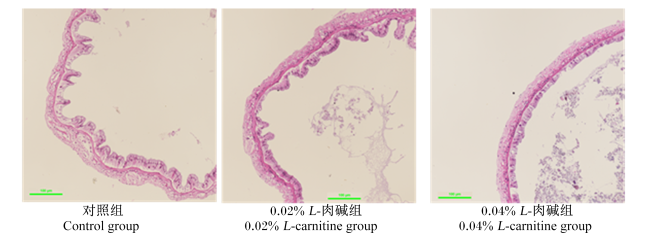
饲料中添加L-肉碱对凡纳滨对虾肠道黏膜形态的影响如图1所示,各组凡纳滨对虾肠道黏膜形态无明显差异。
图1 饲料中添加L-肉碱对凡纳滨对虾肠道黏膜形态的影响

Fig.1 Effects of L-carnitine supplementation in diets on intestinal mucosa morphology of Pacific white shrimp (Litopenaeus vannamei) (200×)

表4可知,各组之间凡纳滨对虾肠道绒毛高度无显著差异(P>0.05)。0.02% L-肉碱组肠道肌层厚度显著高于对照组(P<0.05),而0.04% L-肉碱组肌层厚度与对照组无显著差异(P>0.05)。
表4 饲料中添加L-肉碱对凡纳滨对虾肠道绒毛高度和肌层厚度的影响

Table 4 Effects of L-carnitine supplementation in diets on villus height and muscular layer thickness in intestine of Pacific white shrimp (Litopenaeus vannamei) μm

项目Items 绒毛高度Villus height 肌层厚度Muscular layer thickness
对照组Control group 29.92±0.73 8.05±0.33a
0.02% L-肉碱组0.02% L-carnitine group 30.13±2.46 10.32±1.04b
0.04% L-肉碱组0.04% L-carnitine group 27.68±1.10 7.23±0.78a
表5可知,凡纳滨对虾肠道蛋白酶、脂肪酶和淀粉酶活性随饲料中L-肉碱添加水平的上升而提高,其中0.04% L-肉碱组肠道蛋白酶和脂肪酶活性显著高于对照组(P<0.05),而0.02% L-肉碱组肠道蛋白酶和脂肪酶活性与对照组无显著差异(P>0.05)。各组之间凡纳滨对虾肠道淀粉酶活性无显著差异(P>0.05)。
表5 饲料中添加L-肉碱对凡纳滨对虾肠道消化酶活性的影响

Table 5 Effects of L-carnitine supplementation in diets on intestinal digestive enzyme activities of Pacific white shrimp (Litopenaeus vannamei)

项目
Items
蛋白酶
Protease/(U/mg prot)
脂肪酶
Lipase/(U/g prot)
淀粉酶
Amylase/(U/g prot)
对照组Control group 149.44±18.18a 1 481.69±61.74a 238.92±36.40
0.02% L-肉碱组0.02% L-carnitine group 191.44±13.32a 1 821.77±290.81ab 311.16±11.10
0.04% L-肉碱组0.04% L-carnitine group 250.12±42.74b 2 019.83±167.95b 337.00±91.63

2.3 饲料中添加L-肉碱对凡纳滨对虾非特异性免疫力的影响

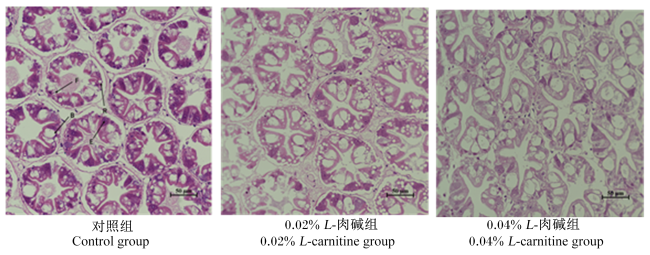
饲料中添加L-肉碱对凡纳滨对虾肝胰腺组织结构的影响如图2所示,各组凡纳滨对虾肝胰腺组织均具有完整的细胞结构,未出现肝胰腺坏死现象。
图2 饲料中添加L-肉碱对凡纳滨对虾肝胰腺组织结构的影响

Fig.2 Effects of L-carnitine supplementation in diets on hepatopancreas structure of Pacific white shrimp (Litopenaeus vannamei) (200×)

表6可知,凡纳滨对虾肝胰腺ACP、AKP和LZM活性随饲料中L-肉碱添加水平的上升而提高,其中0.04% L-肉碱组肝胰腺ACP活性显著高于对照组(P<0.05),0.02% L-肉碱组和0.04% L-肉碱组肝胰腺AKP活性显著高于对照组(P<0.05),0.04% L-肉碱组肝胰腺LZM活性显著高于对照组(P<0.05),0.02% L-肉碱组和0.04% L-肉碱组肝胰腺CAT活性显著高于对照组(P<0.05)。
表6 饲料中添加L-肉碱对凡纳滨对虾肝胰腺抗氧化及非特异免疫相关酶活性的影响

Table 6 Effects of L-carnitine supplementation in diets on activities of anti-oxidative and non-specific immune-related enzymes in hepatopancreas of Pacific white shrimp (Litopenaeus vannamei)

项目
Items
酸性磷酸酶
ACP/
(金氏单位/g prot)
碱性磷酸酶
AKP/
(金氏单位/g prot)
溶菌酶
LZM/(U/L)
过氧化氢酶
CAT/(U/mL)
对照组Control group 64.99±0.40a 19.21±0.97a 5.76±0.18a 40.02±5.56a
0.02% L-肉碱组0.02% L-carnitine group 77.35±7.48a 37.06±1.32b 5.83±0.04a 53.35±5.18b
0.04% L-肉碱组0.04% L-carnitine group 244.72±9.79b 64.49±1.15c 7.18±0.29b 51.05±1.84b

3 讨论

3.1 饲料中添加L-肉碱对凡纳滨对虾生长性能的影响

凡纳滨对虾是我国养殖产量最大的对虾养殖品种,养殖规模的扩张和工厂化高密度养殖模式的推广等行业发展新趋势的出现对凡纳滨对虾苗种的质量提出了更高的要求。苗种质量是水产养殖业的基石,凡纳滨对虾在苗种期生长发育迅速,对营养的需求较高且免疫力相对较差,生物饵料虽营养丰富但易携带致病微生物,导致虾苗成活率低,因此高品质的凡纳滨对虾苗种饲料已成为水产行业的研究焦点[13]L-肉碱作为脂肪β-氧化中长链脂肪酸的运输载体,不仅可以促进脂肪代谢[14-15],而且在猪[16]、肉鸡[17]、虹鳟(Oncorhynchus mykiss)[18]上的结果表明L-肉碱还有促进生长的功能。为探究L-肉碱对凡纳滨对虾生长性能的影响,本研究将0.02%和0.04% L-肉碱分别添加到基础饲料中,制作了3种等氮等脂的试验饲料,结果发现凡纳滨对虾增重率和特定生长率随饲料中L-肉碱添加水平的增加而升高,其中0.04% L-肉碱组的增重率和特定生长率显著提高,且饲料利用能力随L-肉碱添加水平的增加而增强,其中0.04% L-肉碱组的饲料系数显著降低。这与在凡纳滨对虾幼虾中的研究结果一致,Raghuvaran等[12]配制了粗蛋白质和粗脂肪不同的3种等能饲料(36%粗蛋白质和5%粗脂肪、33%粗蛋白质和8%粗脂肪、30%粗蛋白质和11%粗脂肪),并在此基础上分别添加了0.5%和1.0%的L-肉碱,对初始体重约为4 g的凡纳滨对虾幼虾进行为期60 d的饲喂试验,发现在3种营养状态下,凡纳滨对虾幼虾均在饲料中L-肉碱添加水平为0.5%时取得最佳生长状态,并获得最大饲料利用效率。蛋白质和脂肪均属于动物的主要能量来源,推测L-肉碱可能通过加强脂肪代谢为机体提供能量,并提高蛋白质合成能力,促进对虾生长增重,此结论已在草鱼(Ctenopharyngodon idella)和罗非鱼(Oreochromis mossambicus)上得到部分证实,代谢物同位素追踪试验结果表明L-肉碱可以通过增强脂肪源能量供应促进罗非鱼肌肉蛋白质沉积[7],且转录组学结果表明L-肉碱可以通过上调哺乳动物雷帕霉素靶蛋白(mTOR)表达促进草鱼蛋白质合成[19]。同时,本研究结果表明饲料中添加L-肉碱对凡纳滨对虾体成分中粗蛋白质和粗脂肪含量无显著影响,推测这可能与所处的快速生长阶段有关,更多的蛋白质被用于合成体蛋白,更多的脂肪被用于为生长代谢供能,维持高速生长状态。

3.2 饲料中添加L-肉碱对凡纳滨对虾消化能力的影响

消化道是对虾营养物质消化吸收的主要场所,消化道的形态结构是维持对虾生长状态的重要基础。肠道绒毛高度和肌层厚度是反映消化道生理功能和健康状态的2个基本指标[20],本研究中,各组之间凡纳滨对虾肠道绒毛高度无显著差异;与对照组相比,0.02% L-肉碱组肠道肌层厚度显著提高,而0.04% L-肉碱组肠道肌层厚度无显著差异。这说明L-肉碱对凡纳滨对虾消化道健康和吸收能力无不良影响。
蛋白质、脂肪酸等大分子营养物质进入对虾体内之后,需先在消化道经消化酶和乳化剂分解为小分子后才能被消化道吸收,之后运送到肝胰腺,分别在肝胰腺小管和肝胰腺细胞进行进一步消化释能[21]。作为获取营养的第一步,消化酶活性与营养物质利用效率紧密相关。本研究结果表明,凡纳滨对虾肠道蛋白酶、脂肪酶和淀粉酶活性随饲料中L-肉碱添加水平提高而上升,其中0.04% L-肉碱组肠道蛋白酶和脂肪酶活性分别较对照组提高了67.37%和36.32%。在凡纳滨对虾幼虾的研究中也有类似的发现,饲料中添加0.05% L-肉碱可以提高幼虾肝胰腺蛋白酶、脂肪酶以及脂肪代谢酶肉碱棕榈先转移酶-Ⅰ(CPT-Ⅰ)、葡萄糖-6-磷酸脱氢酶(G6PDH)活性,其中蛋白酶和脂肪酶活性较未添加L-肉碱的对照组分别提高了18.99%和8.16%[12]L-肉碱对肠道消化酶活性的作用在罗非鱼上也有相似报导[22]

3.3 饲料中添加L-肉碱对凡纳滨对虾非特异性免疫力的影响

肝胰腺不仅是对虾的主要消化器官,还具有重要的抗氧化和免疫功能[23]。ACP、AKP、CAT和LZM活性是评价肝胰腺抗氧化和免疫功能的重要指标[24-26]。本研究结果表明,饲料中添加L-肉碱对凡纳滨对虾肝胰腺结构没有明显影响,但肝胰腺ACP、AKP、LZM和CAT活性均随饲料中L-肉碱添加水平的提高而升高,其中0.04% L-肉碱组较对照组分别提高了276.55%、235.71%、27.56%和24.65%。Raghuvaran等[12]在凡纳滨对虾幼虾中的试验检测了饲料中添加L-肉碱对幼虾肝胰腺和鳃CAT和超氧化物歧化酶(SOD)活性的影响,结果表明0.05%和0.10% L-肉碱添加均明显抑制了2种抗氧化酶的活性,这与本试验结果不一致,可能与对虾生长阶段有关。相关研究发现氨氮胁迫会给对虾带来氧化压力,引起细胞凋亡[27],而对虾对氨氮的耐受力在不同生长阶段差异较大,一般幼虾氨氮耐受度较低[28-29]。基于此,我们推测在水体氨氮含量相同情况下,幼虾更易受到慢性氨氮胁迫从而产生氧化压力,在此情况下L-肉碱通过激活肝胰腺抗氧化酶活性提高抗氧化力,进而提高幼虾生存能力。

4 结论

饲料中添加L-肉碱对凡纳滨对虾生长性能、饲料利用、消化能力和非特异性免疫力等具有积极的影响。在本试验条件下,综合考虑生长性能和健康状况,凡纳滨对虾饲料中L-肉碱适宜添加水平为0.04%。
[1]
WANG L, ZHANG W R, GLADSTONE S, et al. Effects of isoenergetic diets with varying protein and lipid levels on the growth,feed utilization,metabolic enzymes activities,antioxidative status and serum biochemical parameters of black sea bream (Acanthopagrus schlegelii)[J]. Aquaculture, 2019, 513:734397.

DOI

[2]
BUREAU D P, HUA K. Towards effective nutritional management of waste outputs in aquaculture,with particular reference to salmonid aquaculture operations[J]. Aquaculture Research, 2010, 41(5):777-792.

DOI

[3]
YAN J, LIAO K, WANG T J, et al. Dietary lipid levels influence lipid deposition in the liver of large yellow croaker (Larimichthys crocea) by regulating lipoprotein receptors,fatty acid uptake and triacylglycerol synthesis and catabolism at the transcriptional level[J]. PloS One, 2015, 10(6):e0129937.

DOI

[4]
CARILLO M R, BERTAPELLE C, SCIALÒ F, et al. L-carnitine in drosophila:a review[J]. Antioxidants, 2020, 9(12):1310.

DOI

[5]
THANGASAMY T, SUBATHRA M, SITTADJODY S, et al. Role of L-carnitine in the modulation of immune response in aged rats[J]. Clinica Chimica Acta, 2008, 389(1/2):19-24.

DOI

[6]
LEE B J, LIN J S, LIN Y C, et al. Effects of L-carnitine supplementation on oxidative stress and antioxidant enzymes activities in patients with coronary artery disease:a randomized,placebo-controlled trial[J]. Nutrition Journal, 2014, 13:79.

DOI

[7]
LI L Y, LU D L, JIANG Z Y, et al. Dietary L-carnitine improves glycogen and protein accumulation in Nile tilapia via increasing lipid-sourced energy supply:an isotope-based metabolic tracking[J]. Aquaculture Reports, 2020, 17:100302.

DOI

[8]
LI J M, ZHANG Z, KONG A, et al. Dietary L-carnitine regulates liver lipid metabolism via simultaneously activating fatty acid β-oxidation and suppressing endoplasmic reticulum stress in large yellow croaker fed with high-fat diets[J]. British Journal of Nutrition, 2023, 129(1):29-40.

DOI

[9]
REBOUCHE C J. Kinetics,pharmacokinetics,and regulation of L-carnitine and acetyl-L-carnitine metabolism[J]. Annals of the New York Academy of Sciences, 2004, 1033(1):30-41.

DOI

[10]
PEKALA J, PATKOWSKA-SOKOŁA B, BODKOWSKI R, et al. L-carnitine--metabolic functions and meaning in humans life[J]. Current Drug Metabolism, 2011, 12(7):667-678.

PMID

[11]
农业农村部渔业渔政管理局,全国水产技术推广总站,中国水产学会. 2021中国渔业统计年鉴[M]. 北京: 中国农业出版社, 2021.

Bureau of fisheries,Ministry of agriculture and rural affairs,National Fisheries Technology Extension Center,China Society of Fisheries. China fishery statistical yearbook 2021[M]. Beijing: China Agriculture Press, 2021 (in Chinese)

[12]
RAGHUVARAN N, SARDAR P, SAHU N P, et al. Effect of L-carnitine supplemented diets with varying protein and lipid levels on growth,body composition,antioxidant status and physio-metabolic changes of white shrimp,Penaeus Vannamei juveniles reared in inland saline water[J]. Animal Feed Science and Technology, 2023, 296:115548.

DOI

[13]
骆大鹏, 何玉贵, 杨明秋, 等. 凡纳滨对虾室内生态育苗技术[J]. 现代农业科技, 2015(10):256-257,262.

LUO D P, HE Y G, YANG M Q, et al. Indoor ecological breeding technologies of Litopenaeus vannamei[J]. Modern Agricultural Science and Technology, 2015(10):256-257,262. (in Chinese)

[14]
ABBASNEZHAD A, HASANAVAND A, FALAHI E, et al. Effect of L-carnitine supplementation on lipid profiles of patients with liver disease:a systematic review and meta-analysis[J]. Preventive Nutrition and Food Science, 2020, 25(2):124-132.

DOI

[15]
FANG H H, NIU J. Dietary supplementation of L-carnitine relieved detrimental impacts of a high-fat diet in juvenile Trachinotus ovatus[J]. Aquaculture Reports, 2022, 24:101139.

DOI

[16]
RAMANAU A, KLUGE H, SPILKE J, et al. Supplementation of sows with L-carnitine during pregnancy and lactation improves growth of the piglets during the suckling period through increased milk production[J]. The Journal of Nutrition, 2004, 134(1):86-92.

DOI

[17]
AZIZI-CHEKOSARI Μ, BOUYE Μ, SEIDAVI A R. Effects of L-carnitine supplementation in diets of broiler chickens[J]. Journal of the Hellenic Veterinary Medical Society, 2021, 72(1):2611-2628.

DOI

[18]
DIKEL S, ÜNALAN B, EROLDOĞAN O T, et al. Effects of dietary L-carnitine supplementation on growth,muscle fatty acid composition and economic profit of rainbow trout (Oncorhynchus mykiss)[J]. Turkish Journal of Fisheries and Aquatic Sciences, 2010, 10:173-180.

[19]
LUO W, CHEN P Y, ZHANG X Y, et al. Effect of adding L-carnitine to high-fat/low-protein diets of common carp (Cyprinus carpio) and the mechanism of regulation of fat and protein metabolism[J]. Aquaculture Nutrition, 2022, 2022:3768368.

[20]
MANZANILLA E G, PEREZ J F, MARTIN M, et al. Effect of plant extracts and formic acid on the intestinal equilibrium of early-weaned pigs[J]. Journal of Animal Science, 2004, 82(11):3210-3218.

PMID

[21]
VOGT G. Synthesis of digestive enzymes,food processing,and nutrient absorption in decapod crustaceans:a comparison to the mammalian model of digestion[J]. Zoology, 2021, 147:125945.

DOI

[22]
PRADHAN C, SOHARWARDI U, DILEEP N, et al. Suitable ratio of dietary L-carnitine and α-ketoglutarate improves growth and health performance in Nile tilapia,Oreochromis niloticus[J]. Fish Physiology and Biochemistry, 2021, 47(6):1933-1950.

DOI

[23]
YU D A, ZHAI Y F, HE P M, et al. Comprehensive transcriptomic and metabolomic analysis of the Litopenaeus vannamei hepatopancreas after WSSV challenge[J]. Frontiers in Immunology, 2022, 13:826794.

DOI

[24]
XU D F, WU J X, SUN L J, et al. Combined stress of acute cold exposure and waterless duration at low temperature induces mortality of shrimp Litopenaeus vannamei through injuring antioxidative and immunological response in hepatopancreas tissue[J]. Journal of Thermal Biology, 2021, 100:103080.

DOI

[25]
WANG W N, LI B S, LIU J J, et al. The respiratory burst activity and expression of catalase in white shrimp,Litopenaeus vannamei,during long-term exposure to pH stress[J]. Ecotoxicology, 2012, 21(6):1609-1616.

DOI

[26]
HU F, WANG Y, HU J J, et al. A novel c-type lysozyme from Litopenaeus vannamei exhibits potent antimicrobial activity[J]. Fish & Shellfish Immunology, 2022, 131:729-735.

[27]
LI Y D, ZHOU F L, HUANG J H, et al. Transcriptome reveals involvement of immune defense,oxidative imbalance,and apoptosis in ammonia-stress response of the black tiger shrimp (Penaeus monodon)[J]. Fish & Shellfish Immunology, 2018, 83:162-170.

[28]
LIN Y C, CHEN J C. Acute toxicity of ammonia on Litopenaeus vannamei Boone juveniles at different salinity levels[J]. Journal of Experimental Marine Biology and Ecology, 2001, 259(1):109-119.

DOI

[29]
DE LOURDES COBO M, SONNENHOLZNER S, WILLE M, et al. Ammonia tolerance of Litopenaeus vannamei (Boone) larvae[J]. Aquaculture Research, 2014, 45(3):470-475.

DOI

文章导航

/