综述

畜禽呼吸测热装置的研究进展

  • 张建建 ,
  • 王丽 ,
  • 杨雪芬 ,
  • 李平 , *
展开
  • 广东省农业科学院动物科学研究所,猪禽种业全国重点实验室,农业农村部华南动物营养与饲料重点实验室,广东省畜禽育种与营养研究重点实验室,岭南现代农业科学与技术广东省实验室茂名分中心,广州 510640
* 李平,副研究员,硕士生导师,E-mail:

张建建(1995—),男,甘肃庆阳人,硕士,从事动物营养与饲料研究。E-mail:

Copy editor: 陈鑫

收稿日期: 2023-07-10

  网络出版日期: 2024-01-12

基金资助

十四五重点研发专项(2021YFD1300402)

广东省乡村振兴战略专项资金项目(2023TS-3)

农业农村部政府购买服务项目仔猪常用能量饲料原料营养价值评定与参数建立(16210078)

猪禽种业全国重点实验室、广东省农业科学院动物科学研究所畜禽呼吸测热装置项目(GZGK21P264A08O3Z)

Research Progress of Respiratory Calorimeter for Livestock and Poultry

  • ZHANG Jianjian ,
  • WANG Li ,
  • YANG Xuefen ,
  • LI Ping , *
Expand
  • Lingnan Modern Agricultural Science and Technology Guangdong Laboratory Maoming Branch, Guangdong Key Laboratory of Animal Breeding and Nutrition, State Key Laboratory of Swine and Poultry Breeding Industry, Key Laboratory of Animal Nutrition and Feed in South China, Ministry of Agriculture and Rural Affairs, Institute of Animal Science, Guangdong Academy of Agricultural Sciences, Guangzhou 510640, China
* associate professor, E-mail:

Received date: 2023-07-10

  Online published: 2024-01-12

摘要

近年来随着呼吸测热装置的不断发展,不仅可应用于畜禽能量代谢,也在反刍动物温室气体测定等方面得到广泛应用。本文综述了呼吸测热装置的研究概况、呼吸面罩及呼吸室等的设计原理、装置构造和使用注意事项等方面的进展及其应用情况,以期为畜禽能量代谢测定研究提供参考。

本文引用格式

张建建 , 王丽 , 杨雪芬 , 李平 . 畜禽呼吸测热装置的研究进展[J]. 动物营养学报, 2024 , 36(1) : 124 -140 . DOI: 10.12418/CJAN2024.013

Abstract

The respiratory calorimeter device has seen significant development and application in recent years. It has found extensive use in studying the energy metabolism of livestock and poultry, as well as in measuring greenhouse gas emissions from ruminants. This paper provides a review of the research status of respiratory calorimeters, including their design principles, device construction, and the application of respiratory masks and chambers. The aim is to offer a reference for energy metabolism measurement in livestock and poultry.

近年来,在养殖形式规模化、精准饲养的大趋势下,应用更为科学精准的能量体系来指导动物生产尤为重要,而准确评定饲料有效能值也成为动物营养学关注的焦点。与消化能和代谢能相比,净能不仅考虑了粪能、尿能与气体能损失,还考虑了体增热(heat increment,HI)等因素,可更准确地将饲料的有效能值与畜禽的能量需求统一起来,更大限度地反映了动物对能量的真实需要量,对降低饲料成本和减少环境污染等具有显著作用。净能的测定既可使用传统的比较屠宰法,也可使用测热法。比较屠宰法是通过计算动物在一定时间内代谢能摄入量(metabolizable energy intake,MEI)与能量沉积(retained energy,RE)差值得到动物产热量,其试验工作量大,一般适用于小动物[1-2]。测热法作为净能测定的主要方法,主要包括直接测热法和间接测热法。直接测热法是指将被测动物置于特定装置中,收集被测动物在一定时间内(通过辐射、传导、对流等)产生的总热量,但其操作繁琐且极易产生误差[3]。间接测热法是间接计算动物产热的一种方法,主要为呼吸测热法。呼吸测热法是测定动物在采食前后所消耗的氧气(O2)和产生的二氧化碳(CO2)与甲烷(CH4),通过计算得到动物的产热量,但此方法需要利用呼吸测热装置(respiratory calorimeter device,RCD)完成[4]。近年来,随着呼吸测热装置应用技术的不断成熟,国内外利用该装置做了一些突破性研究,本文综述了呼吸测热装置的研究概况、设计原理及其应用,以期为畜禽能量代谢及饲料能值评定等研究提供参考。

1 国内外研究概况

呼吸测热作为一种间接测热法,是研究畜禽能量代谢及评定饲料能值的重要手段[5]。200多年前,Lavoisier和Laplace以动物体内氧化还原理论为基础,首次成功研制出动物呼吸测热装置[6]。1849年,Regnault等创建了第1台密闭回流式呼吸测热装置,用于绵羊试验研究,标志着畜禽呼吸代谢试验的正式开始[7]。Regnault[8]介绍了Pettenkober和Voit研发的开放回流式呼吸测热装置,后经Gottingen改制用于牛的试验。1880年Kuhrs建造了大型动物呼吸测热装置,1892年Kellner建造了牛用呼吸试验装置[6]。1950年英国汉纳研究所建造了可容纳体重约500 kg的牛进行试验的大型闭路式呼吸测热室,开闭式呼吸测热室是该研究所在20世纪70年代发展起来的新型呼吸测热装置[9]。目前,国外主要有澳大利亚新南威尔士州阿米代尔(Armidale Livestock Industries Centre)建造的牛呼吸设施,可容纳10头牛的呼吸室;比利时Melle农业和渔业研究所(ILVO)建造的反刍动物呼吸设施,可容纳6个密闭牛呼吸室;新西兰2011年建成的反刍动物甲烷测量中心(Ruminant methane Measurement Center)可容纳24个羊呼吸室和4个牛呼吸室;丹麦奥胡斯大学(Aarhus University)1984年修建的牛呼吸设施有4个牛呼吸室;英国阿伯里斯特威斯大学(Aberystwyth University)的羊甲烷设施包括4个开路呼吸室;瑞士苏黎世大学(University of Zurich)和苏黎世联邦理工学院(Swiss Federal Institute of Technology in Zurich)的代谢中心建造的2个大型的牛呼吸室、2个中型的羊呼吸室和2个小型动物呼吸室;德国达默斯托夫莱布尼茨农场动物生物学研究所(FBN)修建的大型动物呼吸设施,包括4个牛或羊的呼吸室、4个猪的呼吸室和6个鼠的呼吸室[10]
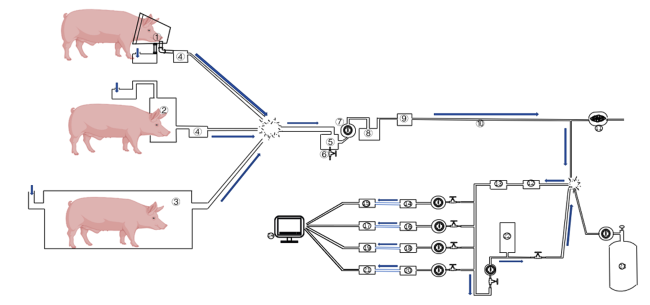
我国能量代谢研究起步较晚,20世纪60年代,只对猪的饲料能量价值、羊和马的呼吸面罩装置进行了研究,到70年代初80年代末,创建了多种类型的呼吸测热试验研究中心和基地,取得了很多研究成果。郭城[11]研制的“传统开路式面具”,当时主要用于军马的测热,后经过不断改造和完善用于牛、羊等方面的研究。1985年,冯仰廉等[12]与英国罗威特研究所合作研制了“闭路循环式呼吸测热面具”。1983至1987年,吉林省农业科学院杨嘉实等[13-14]研制了“猪用密闭回流式呼吸测热装置”、“禽用密闭回流式呼吸测热装置”,先后完成了对猪、羊、蛋鸡、肉鸡、貂、狐等动物的能量代谢研究。1989年,洪嵘等[15]研制出“自控大型开闭式呼吸测热室”,并对香猪的绝食代谢进行了研究。1998年,李玉芝等[16]研制出1套可供猪和鸡使用的“开路式呼吸测热系统”,并对猪进行试验。常用的呼吸测热装置主要有呼吸面罩法、呼吸室法和呼吸头箱法,其中开路式呼吸测热室应用较多[17-22]。此后,我国各个高校及科研单位不断对呼吸测热装置进行改造和完善,期间完成了猪、鸡、牛、羊以及特种动物等营养需要量、营养代谢规律、饲料原料营养价值评定等研究。目前,国内主要有农业农村部饲料工业中心建造的9台开放式呼吸测热装置[23];中国农业科学院北京畜牧兽医研究所建立的畜禽呼吸测热装置[24];四川农业大学动物营养研究所建立呼吸测热装置,包括4间猪呼吸测热室,2间牛呼吸测热室;黑龙江省农业科学院建造猪用呼吸代谢室2套,人工气候室6套;山东农业大学与青岛农业大学联合建立校外动物能量代谢试验基地,包含呼吸代谢测定装置共46套;辽宁农业职业技术学院建造8室联排羊用智能呼吸测热装置。此外,中国科学院亚热带农业生态研究所、中国农业科学院特产研究所、中国农业科学院饲料研究所、南京农业大学、山西农业大学等均建造畜禽呼吸测热装置。呼吸测热装置示意图如图1所示。
图1 呼吸测热装置示意图

①:呼吸面罩 breathing mask;②:呼吸头箱 breathing hood;③:呼吸室 breathing chamber;④:收集器 trap;⑤:冷阱 cold trap;⑥:气阀 valve;⑦:转子流量计 rotameter;⑧:温湿度、气压传感器 temperature and press sensor;⑨:抽气泵 sucking pump;⑩:导气管 air duct;⑪:排风扇 exhaust fan;⑫:干燥器 dryer;⑬:过滤器 air filter;⑭氧气收集系统 oxygen collection system;⑮:氧气分析系统 oxygen analysis system;⑯:二氧化碳收集系统 carbon dioxide collection system;⑰:二氧化碳分析系统 carbon dioxide analysis system;⑱:甲烷收集系统CH4 dioxide collection system;⑲:甲烷分析系统CH4 analysis system;⑳:其他气体收集系统 other air collection system;㉑:其他气体分析系统other air analysis system;㉒:气体储存系统 gas storage system;㉓:气体校正系统 gas correction system;㉔:输出及记录器 output and recorder。

Fig.1 Schematic diagram of respiratory calorimetric device[25]

2 呼吸头箱

呼吸头箱是将动物头部置于密闭的箱体中,通过箱体上用于气体进出的单向排气阀测定动物在一定周期内的呼吸熵(respiratory quotient,RQ),从而计算出动物的能量代谢。这种方法相对于呼吸室和呼吸面罩,造价低,可自由站立或躺下,也可以进食和饮水,但这种方法一般应用于牛和羊[26-28]

3 呼吸面罩

3.1 原理与设计

呼吸面罩测定装置主要包括呼吸面罩、气体阀、硅胶管和气囊等。试验时将呼吸面罩套在动物口鼻处,动物呼出气体通过硅胶管进入气囊,当气囊装满气体后,利用气体分析仪测定气体浓度,即利用呼吸试验采气装置准确收集测试动物呼出的气体,对气体容积和化学成分进行分析,依此求出测试动物机体内的产热量以及能量物质代谢等结果[29-32]。呼吸面罩法简单易行,不受条件限制,可在多种环境下测定气体浓度,但限制了动物的饮水和采食行为[33]

3.2 呼吸面罩的构造

3.2.1 面罩

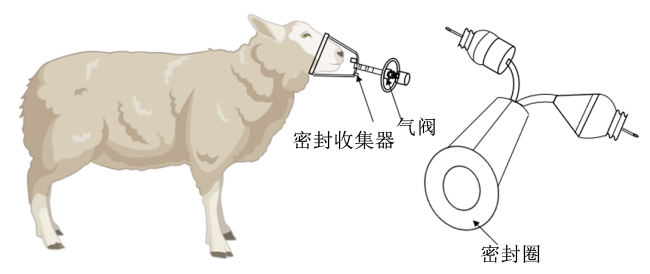
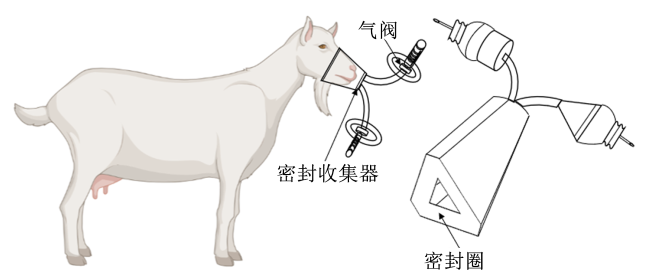
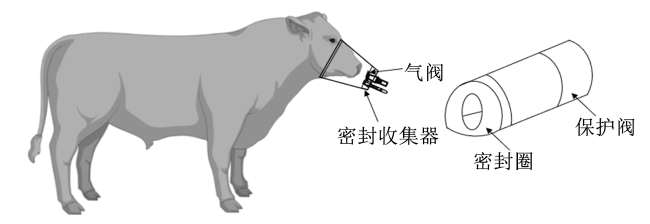
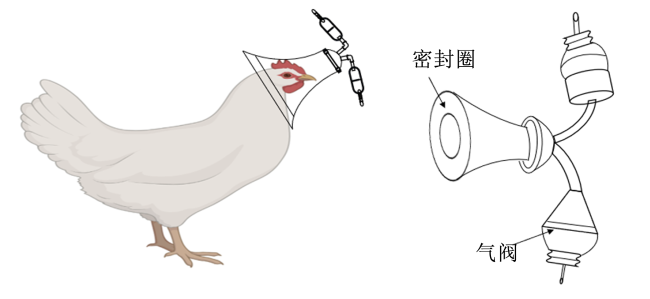
面罩一般使用薄橡胶类材质根据不同动物设计而得,通过面罩上的呼吸瓣膜对吸入和呼出的气体进行调节。据Maia等[34]研究发现,绵羊的理想面罩为圆柱形(图2),面罩的前部包含2个阀门,一个置于吸入空气的入口,另一个置于排出气体处,由于羊在戴面膜的时候会产生大量的唾液,因此,必要时会将注射器连接到口罩上收集唾液;山羊面罩的最佳几何形状为三棱柱形(图3),面罩的瓣膜及其位置与绵羊面罩相同,山羊分泌的唾液比绵羊少,但也需要安装唾液收集装置[34-35];牛面罩的最佳几何形状是椭球形(图4)[34];对于家禽而言,头罩可以覆盖家禽的头部和颈部,因此一般选择由透明材料制成的头罩(图5),但在颈部周围需要用橡胶片等进行密封[34]。反刍动物经常使用开路式面罩或头罩[36]。面罩和头罩均可在较短时间内测量,但面罩长时间使用会引起不适和痛苦,从而影响气体测量,因此对于长期测量时经常使用头罩[26,37-38]
图2 绵羊呼吸面罩示意图

Fig.2 Schematic diagram of breathing mask for sheep[34]

图3 山羊呼吸面罩示意图

Fig.3 Schematic diagram of breathing mask for goat[34]

图4 牛呼吸面罩示意图

Fig.4 Schematic diagram of breathing mask for cattle[34]

图5 鸡呼吸面罩示意图

Fig.5 Schematic diagram of breathing mask for chicken[34]

3.2.2 呼吸阀门

呼吸阀门具有连接面罩与通气管的作用,分为出气孔和进气孔,两孔相通。出气孔与呼出导管相连,气体通往气囊。在2个阀门的内部装有定向活动的瓣膜,动物在呼吸时可以依靠气体自动开闭,保证将气体收集到气囊之中。

3.2.3 通气管

通气管一般选择优质胶皮或质量较好的塑料软管,可以自由弯曲与伸展,一端与进气孔相连一端与气囊相连[39]

4 呼吸室

呼吸测热室目前是许多国家研究动物机体能量代谢的主要设备,适用范围广泛,不仅适用于牛、马、驴、羊、猪等大中型动物,而且对家禽、小鼠等小型动物同样适用,相对于移动式的呼吸面罩而言其检测结果更加准确,但是呼吸测热室成本相对较高,使用也较为复杂[40-41]。根据气体回流方式可分为密闭式、开路式和开闭式3种,目前较为普遍采用的是监测稳定的开路式,三者的基本原理是将动物置于呼吸室内,通过测定设定时间内动物产生的气体浓度变化来计算气体进气量和排放量[11,31,42-43]

4.1 原理与设计

4.1.1 密闭式

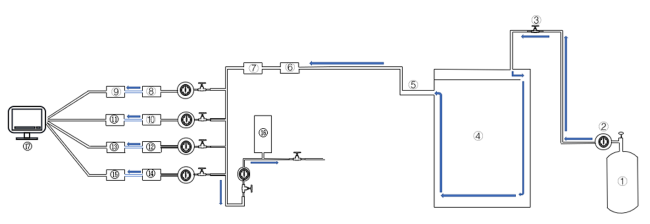
密闭式间接测热法具有相对较高的准确性,该装置中的气体在装置内循环流动,与外界空气呈隔绝状态(图6)。动物在呼吸室内消耗氧气(O2)和产生二氧化碳(CO2),O2通过流量计进入呼吸室,在呼吸室的另一端收集排出气的体,CO2排出使得呼吸室压力下降,激活电磁阀,补充呼吸室O2,通过检测CO2的生成量或者O2的消耗量来计算动物能量代谢等结果[44]。每个关闭测定阶段的气体交换与畜禽产热量计算公式如下:

V O 2(L)= V C 1×O1- V C 2×O2;

V C O 2(L)= V C 2×C2- V C 1×C1;

V C H 4(L)= V C 2×H2- V C 1×H1;

HP(KJ)=16.175× V O 2+5.021× V C O 2+2.167× V C H 4

图6 密闭式示意图

①:输氧系统 oxygen delivery system;②:气体流量计 gas flow meter;③:气阀 valve;④:呼吸室 breathing chamber;⑤:导气管 air duct;⑥:干燥器 dryer;⑦:过滤器 air filter;⑧:氧气收集系统 oxygen collection system;⑨:氧气分析系统 oxygen analysis system;⑩:二氧化碳收集系统 carbon dioxide collection system;⑪:二氧化碳分析系统 carbon dioxide analysis system;⑫:甲烷收集系统CH4 collection system;⑬:甲烷分析系统CH4 analysis system;⑭:其他气体收集系统other air collection system;⑮:其他气体分析系统other air analysis system;⑯:气体储存系统 gas storage system;⑰:输出及记录器 output and recorder。

Fig.6 Schematic diagram of closed-circuit circulation[13-14,47]

式中: V O 2 V C O 2 V C H 4分别为被测畜禽消耗的O2、产生的CO2和CH4的体积; V C 1×O1 V C 1×C1 V C 1×H1分别为气体收集开始时小室和管道内的O2、CO2和CH4的体积; V C 2×O2 V C 2×C2 V C 2×H2分别为气体收集结束时小室和管道内的O2、CO2和CH4的体积;HP为被测畜禽在试验期间的产热量。
将测试动物置于呼吸室内,内部湿度会升高,使测试动物体表变湿,如果呼吸室内没有除湿装置,不但对测试动物造成不良影响,同时也会影响气体分析仪的测定值,因此需要在呼吸室内装置除湿机,使呼吸室内的湿度始终保持在70%以下,为了不受室温影响,可用加热器对气体分析仪的检测部分进行加温[44-45]。需要注意的是,在循环系统中通入的是O2并非空气且O2并不是单纯代替排出的CO2,还补充了试验动物消耗的O2[46]

4.1.2 开路式

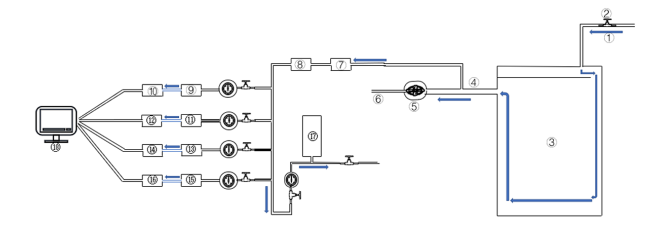
开路式系统中,呼吸室的大小取决于试验动物,可根据测量O2消耗量和CO2产生量计算产热,不影响动物的正常行为[48]。该装置的呼吸室与外界互通,主要设计原理是:外界空气不断输入,与呼吸室内气体混合后被动物利用,同时呼吸室内气体在抽气机的作用下不断被排出室外,通过气体采集及分析装置检测CO2、O2、CH4等含量,按照吸入与排出之间各气体含量的变化和气体流速即可计算出CO2、CH4的产生量以及耗氧量,从而计算得到动物能量代谢等结果(图7),气体交换与畜禽产热量由进出气体浓度差等进行计算[49-50]。所有开路呼吸室的共同点是需要将气体浓度和流量的测量值校正到标准温度和压力条件下,并考虑湿度,因为湿度会对气体体积产生影响,在测量开始和结束时,也必须考虑呼吸室内CH4含量[44]。Arch等[51]发现流量计1%的误差会导致耗氧量产生21%的误差。在开放系统中,进入呼吸室内的是空气而不是O2,耗氧量只能通过O2含量和离开呼吸室的空气体积来计算。
图7 开路式示意图

①:进气口 air inlet;②:气阀 valve;③:呼吸室 breathing chamber;④:导气管 air duct;⑤:排气扇 exhaust fan;⑥:出气口 air outlet;⑦:干燥器 dryer;⑧:过滤器 air filter;⑨:氧气收集系统 oxygen collection system;⑩:氧气分析系统 oxygen analysis system;⑪:二氧化碳收集系统 carbon dioxide collection system;⑫:二氧化碳分析系统 carbon dioxide analysis system;⑬:甲烷收集系统 CH4 collection system;⑭:甲烷分析系统 CH4 analysis system;⑮:其他气体收集系统 other air collection system;⑯:其他气体分析系统 other air analysis system;⑰:气体储存系统 gas storage system;⑱:输出及记录器 output and recorder。

Fig.7 Schematic diagram of open-circuit circulation[52-54]

4.1.3 开闭式

该装置呼吸室与开路式主要区别在于该装置进气门不是一直处于开放状态,测定时通过定时打开进气门向呼吸室内通入空气,再关闭进气门,经过一定的时间后再次打开进气门通入空气,再关闭进气门,如此反复。根据每次打开和关闭进气门气体分析仪所测定的呼吸室内CO2、CH4以及O2的含量,计算出动物的CO2、CH4等产生量和O2的消耗量,进而计算得到动物能量代谢等结果,其余与开路式相同。畜禽能量估算方式也与密闭式相同。

4.2 呼吸室的构造(腔室结构描述)

呼吸室的设计主要是保证装置的气密性以及气体分析的准确性,除此之外,每个研究课题根据研究目的的不同,应专门针对反刍、猪、家禽或者其他动物设计不同大小规格的装置,但基本都包括呼吸小室、气体吸收系统、通气或供氧系统、动物饲喂及粪污处理系统、空调(温湿度控制)系统、气体分析系统和其他化学成分分析系统。

4.2.1 呼吸小室

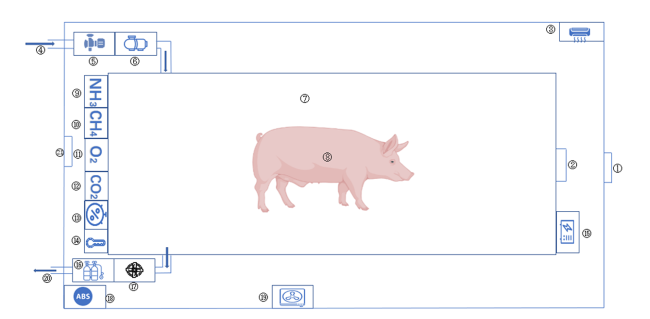
呼吸小室为呼吸室的主体,该部分是测试动物活动的场所,室壁由隔热夹层板制成,内部和外部的制作材料也不尽相同。例如,主框架可用不锈钢材料,四周采用双层透明玻璃、有机塑料板或聚偏二氟乙烯(PVDF)线圈涂层镀锌板等制成[10,55-57]。为了保证与外部温湿度隔绝,基本都会在夹层中间加上珍珠岩、聚氨酯泡沫或其他隔绝材料[13]。在小室的密封门上装有双层透明钢化玻璃用以观察小室内动物的状况,密封门开关处和观察窗处,均用密封胶圈进行密封,保证小室绝对的密封状态。每个呼吸室都是1个独立的单元,包括气体取样器、空调装置和数据采集等。空气通过呼吸室顶部管道和粉尘过滤器,在气泵的作用下进入各个腔室,每个腔室都配有多个传感器,以监测相对湿度、温度和气体等的变化,多个腔室组合共用气体分析仪、数据采集和分析系统。呼吸小室结构如图8所示。
图8 呼吸室示意图

①:门 door;②:进食窗口 feeding window;③:空调系统 air conditioner;④:进气口 air inlet;⑤:抽气泵 sucking pump;⑥:过滤器 air filter;⑦:小室 chamber;⑧:试验动物 experimental animal;⑨:氨气及有害气体传感器 ammonia and harmful gas sensor;⑩:甲烷传感器 CH4 sensor;⑪:氧气传感器 O2 sensor;⑫:二氧化碳传感器 CO2 sensor;⑬:湿度传感器 humidness sensor;⑭:温度传感器 temperature sensor;⑮:电控箱 electric control box;⑯:气体取样器 air sample line;⑰:风机 sucking pump;⑱:电磁锁electromagnetic lock;⑲:排风扇 exhaust fan;⑳:出气口 air outlet;㉑:侧门 side entrance。

Fig.8 Schematic diagram of breathing chamber[52]

4.2.1.1 气密性检验

呼吸小室作为呼吸测热装置的核心部位,准确性至关重要,影响准确性的因素主要有呼吸室的密闭性、气体分析仪器的准确性和呼吸室容积的准确性[27,40,44,58-63]。呼吸室通常在负压下操作,流量计以300~1 000 L/min(大室)和40~250 L/min(中室)的速度连续抽气,这种“拉式系统”与呼吸室入口处的阀门一起,始终确保小室内的轻微负压受到严密控制,从而防止小室内气体泄漏;但也有使用正压系统的情况[64-65]。在小室内容易产生误差,误差主要来源于呼吸室的气流速度、小室内气体混合程度、分析仪器和气体导入效率[25,66]。因此,试验开始前必须对装置的气密性进行检验,检验密闭性和气体分析仪准确性的通用方法是燃烧法和CO2回收法[67]。将不同剂量燃烧剂(一般使用甲醇或乙醇)在不同温度下进行燃烧,得到的CO2产生量和O2消耗量的实际测定值与理论值相比较,计算出二者的相关系数及每一剂量在不同温度下的呼吸熵,从而检验呼吸室的准确性。在标准状况下,1 g无水乙醇燃烧消耗O2 1.459 6 L,产生CO2 0.973 1 L,CO2回收率和O2的消耗率计算公式如下:

CO2回收率(%)=CO2测定量(L)×100/乙醇消耗量(g)×0.973 1(L/g);

O2消耗率(%)=O2测定量(L)×100/乙醇消耗量(g)×1.459 6(L/g)。

一般要求呼吸熵为0.667(2CO2/3O2)。若CO2回收率和O2消耗率不准确,呼吸熵准确,表明进气和排气管道可能出现泄漏,而气体分析仪可能是良好的[68]
CO2回收法一般是指向小室内注入高纯度的液体CO2,通过比较理论值与实际检测值确定气密性的准确程度[69]。标准状态(0 ℃,101.3 kPa)下,1 g液态CO2产生0.505 8 L气态CO2,释放到小室的CO2量可以根据小室容积、气体流量和测试时间估算,所需CO2准备量及CO2回收率计算公式如下:

CO2准备量(g)=[小室容积(L)×试验CO2浓度(%)+气体流量(L/min)×试验CO2浓度(%)×测试时间(min)]/0.5058;

CO2回收率(%)=CO2测定量(L)×100/液态CO2消耗量(L)。

一般要求气密性检验准确度≥99%,CO2回收率在99%~101%,此种方法进行气密性检验时需要根据小室体积确定需要准备的CO2最少量,检测时间在15~20 h。为了接近试验条件,一般向小室内注入CO2浓度介于0.5%~0.9%[23]。Gardiner等[63]的研究表明,呼吸室在未经过校准且校准后气体回收率不在100%左右的前提下其准确性和精密度并非“金标准”。
进入分析系统的气体中残留的水分和任何颗粒物质,需要分别通过含有氯化钙(CaCl2)和玻璃棉的吸附柱除去,如果进入分析仪的气体中存在水蒸气,可能会导致高至25%的误差[70]

4.2.1.2 小室参数的设置

无论选择何种方法,仪器的校准和回收率试验都必不可少[49]。小室参数一般包括气体循环时间、气体流量、温湿度及气体分析仪缓冲时间等。
1)气体循环时间。确定试验动物后,所用的小室的体积基本确定。由于气体分析仪对小室内气体的分析有一定的延迟,O2的消耗和CO2产生速率的变化不会立即反映在排出空气中O2和CO2浓度的变化上,因此需要设置缓冲时间,缓冲时间与气体循环时间呈正相关[51,71-72]。气体循环时间为小室体积与通气速率的比值,小室体积越大气体缓冲时间相对越长。气体缓冲时间应根据小室具体体积而确定,如果缓冲时间太短,小室内气体浓度不均匀,导致检测到的数据不准;如果缓冲时间过长,则会导致气体分析仪无法检测到一些气体变化,产生试验误差。因此,对于缓冲时间的调试至关重要,该参数的设置一般以小室内CO2浓度进行调试。小室内的CO2浓度必须保持在不影响动物代谢水平的1%以下,如果超过1%,会增加呼吸和能量消耗,小于0.5%的浓度会由于相关误差敏感因子的幅度越来越大变得难以准确测量,因此大多数情况下大约0.6%的值较为合适[49,73]。生长育肥猪小室内CO2浓度应维持在0.4%~0.7%[49]
2)温湿度。小室内温湿度绝大部分会根据试验目的及试验设计进行设置。例如,生长育肥猪净能测定试验中,温度通常为(22±2) ℃,相对湿度为(70±5)%,温度传感器精确度要求≤0.1 ℃,湿度传感器精确度要求为≤2%[68];牛小室内温度通常为(20±2) ℃,相对湿度为60%~75%[64,74-75];鸡小室内温度通常为(20±2) ℃,相对湿度为60%~70%[76-77];羊小室内温度通常为20~25 ℃,相对湿度为60%~75%[34,63]
3)气体流量。气体流量使用气体流量控制仪进行控制,因此对气体流量控制仪的准确性必须进行校准。气体流量计精确度通常要求小于0.5%,通过使用标准气体流量计对呼吸测热装置所涉及的所有气体流量计进行校准,可保证气体流量计的准确性;另外,气体流量控制仪通入一定的气体,与气体流量计所显示的数据进行对比,可用来校准气体流量控制仪。
4)气体分析仪。每次试验前均需对气体分析仪进行校准,每种气体的校准时间须在20 min以上,在气体校准时,除气体变化外,其余条件均与正式试验保持一致[78]。牛呼吸室的气流可设置为0~30 m3/h,猪呼吸室的气流可设置为0~24 m3/h,在所有情况下,气流都是在通过腔室后测量的。常见动物呼气量如表1所示。
表1 常见动物呼气量

Table 1 Common animal expiratory volume[31]L/min

动物种类
Animal species
呼气量
Expiratory volume
范围Range 平均Average
猪Swine 7.6~14.3 10.9
牛Cattle 38.5~47.1 42.8
羊Ram 4.9~12.4 8.7
马Horse 20.5~42.2 31.4

4.2.2 气体吸收系统

气体吸收系统是该装置的主要组成部分,一般选择耐酸耐碱且无毒无害的材料制成,包括气体收集罐、气体导管等部件,确定呼吸室气体回收率是评估气体排放量准确性的核心条件,对试验结果具有决定性作用[41,79-80]。气体收集罐有进气口和出气口,分别与导管连接,导管另一口与呼吸小室相连,连接处均以密封胶圈密封,防止气体外溢。由小室排出的气体经过收集罐后通过导管再次进入小室内,收集罐中放置KOH用以吸收CO2、CH4等气体,在放置试剂罐前后各装置2~3个收集罐,其中放置硅酸凝胶用以吸收气体中的水分,在吸收罐上安装温度计和水压计,便于随时观察吸收状况。每次气体测量试验前至少进行1次CO2回收试验,如果连续使用则每月进行1次测试[81]

4.2.3 供氧系统

呼吸小室中需要不断地通入空气或O2以补充测试动物所消耗的O2,通过导管与呼吸小室相接,导管的另一端与O2罐或外界连接。小室内补充O2依靠动物消耗的O2以及吸收系统吸收CO2后所产生的负压而实现,在进气端安装气量记录仪对通入气体量进行记录。梁浩等[80]报道,猪和羊用呼吸室容积为4~5 m3,禽用呼吸室容积为0.4~0.5 m3,牛用呼吸室容积为30~40 m3,猪和羊通气量一般为30~300 L/min,禽通气量为3~30 L/min,牛通气量为300~3 000 L/min。

4.2.4 动物饲喂及粪污处理系统

料槽和自动饮水器一般位于代谢笼的前方,为了减少饲喂期间漏气的几率,一般在试验开始前将饲料移入呼吸小室内,期间饮水通过外部水阀控制,自动饮水器也可选用自动控温类型。受测动物固定在代谢笼中,代谢笼(包括料槽和饮水器)一般由不锈钢材料制成,耐腐蚀并便于清洁。代谢笼下方放置可移动漏斗收集尿液,该漏斗通向尿盘(桶),后方放置粪盘用以收粪。为了防止动物从代谢笼后方及上部逃出,可置后方及顶部屏障,为缩小排便面积,还可以移动侧壁调整代谢笼的宽度。

4.2.5 空调(温湿度控制)系统

温度由空调制冷制热系统进行控制,根据试验设计要求进行温度调节。湿度由呼吸室内除湿机和加湿器进行控制。空调机组可完全集成到呼吸室外部,减少因空调装置而产生的噪音和振动,尽量减少动物因噪音而产生的应激。我国北方冬天较为寒冷,应做好防寒保暖措施,南方夏季炎热潮湿,需做好降温除湿措施。

4.2.6 气体成分分析系统

在试验开始和结束时,均需对收集的气体样品进行分析,其分析方法主要包括重量分析法、容量分析法、化学分析法和气谱分析法等。重量分析法是使用精密天平对试验前后气体吸收罐的重量进行测定,可用于CO2等气体测定;容量分析法是通过气体分析仪对动物产生的CO2、CH4等气体进行检测;气谱分析法主要是用于较多种类气体样品情况下,使用气相色谱仪进行检测[83]。目前CO2和CH4一般使用红外吸收分析仪测定,O2通过顺磁分析仪测定。

4.2.7 数据收集与处理

收集数据并进行精确计算的系统必不可少。应建立1个自动化系统,以便24 h收集数据。该系统的基本组成包括电子设备(即流量计,气体分析仪)、气体采样点即A/D转换器,用于将各种电子设备的模拟信号输出转换为发送到计算机并记录的数字信号,具有数据记录和计算的功能[10]

4.2.8 动物行为监测

可在系统中安装各种组件来监测动物的行为,这将对数据处理和试验结果给出合理解释提供很大的帮助。监测组件包括监控动物进食活动的装置以及监控摄像头。监测装置一般置于小室前方,用于记录受测动物的活动情况[10]

4.3 动物福利、动物和人员的安全

动物福利和动物安全对呼吸室的设计有很大的影响。在试验期间应采取所有可能措施,以避免因呼吸室故障或气体积聚有关的伤害或死亡。为了确保试验动物尽可能舒适,在测量期间,可以通过视频监控定期检查动物,而不会干扰动物。控制监视器还应提供有关呼吸小室和建筑物状态的信息。对新鲜空气的供应和呼吸室内气体浓度进行密切监测,以避免动物窒息。为了安全起见,在呼吸室的门或窗口处应设置紧急开口,可由电磁铁或其他控制其开关,当电源、设备通讯故障或温湿度、气压、气流(空调和数据采集系统测量)、CO2、CH4或氨气(NH3)(数据采集系统测得)超过设定的阈值时,应急口自动打开,以保证新鲜空气的良好循环。在初次使用或第1次测试中,应将动物的福利和安全以及操作人员的安全作为主要考虑因素。

5 应用

呼吸测热装置不但可以用于畜禽能量代谢的测定,而且也适于反刍动物甲烷排放等的测定,其对舍饲动物测定结果较准确和全面,但缺点是测定空间限制了动物的正常活动,不能真实模拟动物的活动环境,难以消除动物个体差异和应激性。此外,其建造成本较高并且运行维护需要专业人员,致使该技术在国内未得到广泛应用。但是,随着饲料成本的增加、精准饲养的发展、养殖过程中产生的温室气体急剧增加,准确评定饲料能值、降低生产成本、加强温室气体的监测和减排尤为重要。目前,国内外多家高等院校和科研机构利用呼吸测热装置对猪、鸡、羊、牛等多种动物的营养代谢和碳氮减排等进行了研究,表2列举了近10余年的部分研究与应用情况。
表2 呼吸测热装置的应用

Table 2 Application of respiratory calorimeter device

装置类型
Type of device
动物种类
Animal species
研究内容
Research contents
参考文献
Reference
呼吸头箱Breathing hood 呼吸头箱与呼吸室对甲烷检测的对比 [82]
呼吸头箱Breathing hood 干橘和大豆皮替代玉米饲喂哺乳山羊对甲烷产量的影响 [83]
呼吸面罩Breathing mask 内蒙古荒漠草原放牧季绵羊甲烷的研究 [84]
开路式Open-circuit 饲粮粗蛋白质含量对草原红牛呼吸代谢等的影响 [85]
开路式Open-circuit 不同饲粮能量水平对草原红牛能量代谢的影响 [86]
开路式Open-circuit 气体回收率试验和草原红牛呼吸测热试验 [87]
开路式Open-circuit 不同体质量、月龄和是否饲喂添加剂的舍饲红牛的
呼吸代谢气体变化规律的研究
[88]
开路式Open-circuit 能量利用效率对奶牛甲烷代谢的影响 [89]
开路式Open-circuit 基因型对奶牛甲烷代谢的影响 [90]
开路式Open-circuit 饲草型青贮对奶牛甲烷代谢的影响 [91]
开路式Open-circuit 杜寒杂交母羊营养物质代谢及能量需要参数 [92]
开路式Open-circuit 研究不同净能水平的饲粮对不同体重阶段猪的生长性能和
能量摄入量的影响
[93]
开路式Open-circuit 生长猪维持能量代谢 [94]
开路式Open-circuit 研究饲粮中不同可溶性和不可溶性纤维对生长猪
营养物质消化率和能量利用的影响
[95]
开路式Open-circuit 测定4种蛋白质类饲料和2种能量类饲料的净能值 [96]
开路式Open-circuit 研究膨化豆粕的能量含量及热处理对生长猪能量利用的影响 [97]
开路式Open-circuit 测定燕麦的能量及其颗粒大小对生长猪营养和能量平衡的影响 [98]
开路式Open-circuit 挤压玉米饲粮对生长猪能量利用的影响 [99]
开路式Open-circuit 测定高蛋白质葵花籽粕的能量值 [100]
开路式Open-circuit 测定饲粮中燕麦麸、小麦麸和棕榈仁膨化物的净能 [101]
开路式Open-circuit 母猪常用高纤维饲料原料净能值测定 [102]
开路式Open-circuit 测定饲粮中纤维含量增加对产热量的影响 [103]
开路式Open-circuit 测定油菜粕的消化能、代谢能和净能 [104]
开路式Open-circuit 测定生长猪饲粮大豆油的净能 [105]
开路式Open-circuit 研究初生体重相同的慢生长和快生长仔猪分别饲喂慢消化淀粉
饲粮的维持能量需求和用于生长的能量效率
[106]
开路式Open-circuit 间接测热法对生长猪油脂净能的研究 [107]
开路式Open-circuit 低温环境对生长猪气体能量代谢的影响 [108]
开路式Open-circuit 生长猪维持能量需要量研究 [109]
开路式Open-circuit 生长猪谷物类饲料原料净能值测定 [110]
开路式Open-circuit 测定生长猪饲用大麻壳、挤压大麻壳和豌豆混合大麻壳的净能值 [111]
开路式Open-circuit 测定5种不同含油水平可溶性玉米的玉米蒸馏干谷物的净能 [112]
开路式Open-circuit 研究粗粮纤维组成对生长猪能量利用等的影响 [113]
开路式Open-circuit 生长猪蛋白质类饲料原料净能值测定 [9]
开路式Open-circuit 研究在高纤维饲粮中添加多酶混合物对生长猪门静脉净葡萄糖和
乳酸通量、胰岛素产量和全动物门
静脉排出脏器消耗的影响
[114]
开路式Open-circuit 研究在玉米-豆粕型饲粮中添加15%或30%麦麸对生长猪
消化能、代谢能和净能的影响
[115]
开路式Open-circuit 研究饲粮设计对生长猪净能值的影响 [116]
开路式Open-circuit 研究生长肥育猪的维持净能需要量 [117]
开路式Open-circuit 维持能量需要量及豆粕净能预测方程的构建 [118]
开路式Open-circuit 肥育猪玉米豆粕净能值测定 [119]

6 小结

呼吸测热装置作为测定畜禽能量代谢的核心设备,具有很大的灵活性,允许在各种环境和试验情况下对畜禽(牛、羊、猪、禽和马等)进行测量。尽管装置建造繁琐、投入较大、需要专业人员运行和维护,但其检测结果准确,接近测试动物的正常活动环境,具有很高的参考价值,是国内外畜禽能量代谢及饲料能值评定等常用的设备,其中开路式呼吸室应用最为广泛,对精准营养的发展、净能值的测定以及碳氮平衡的研究具有极大的推动作用。
[1]
刘伟, 廖瑞波, 闫海洁, 等. 家禽净能的测定方法、影响其测定的因素及研究现状[J]. 动物营养学报, 2015, 27(12):3655-3662.

DOI

LIU W, LIAO R B, YAN H J, et al. Net energy determination for poultry:methods,influential factors and current research situation[J]. Chinese Journal of Animal Nutrition, 2015, 27(12):3655-3662. (in Chinese)

[2]
BAREKATAIN M R, NOBLET J, WU S B, et al. Effect of sorghum distillers dried grains with solubles and microbial enzymes on metabolizable and net energy values of broiler diets[J]. Poultry Science, 2014, 93(11):2793-2801.

DOI PMID

[3]
杨亭, 贾刚, 赵华, 等. 家禽净能体系的构建与应用研究进展[C]// 中国畜牧兽医学会动物营养学分会第十届全国代表大会暨十二届学术研讨会论文集. 武汉: 中国农业大学出版社, 2016:91-98.

YANG T, JIA G, ZHAO H, et al. Research progress on the construction and application of poultry net energy system[C]// Proceedings of the 10th National Congress and 12th Academic Seminar of the Animal Nutrition Branch of the Chinese Society of Animal Husbandry and Veterinary Medicine. Wuhan: China Agricultural University Press, 2016:91-98. (in Chinese)

[4]
刘伟, 刘增民, 解庆柱. 应用呼吸测热法测定肉鸡和蛋鸡饲料原料净能值的研究进展[J]. 动物营养学报, 2023, 35(7):4102-4107.

DOI

LIU W, LIU Z M, XIE Q Z, et al. Research progress on net energy values of feed ingredients determined by respiration calorimetry method for broilers and laying hens[J]. Chinese Journal of Animal Nutrition, 2023, 35(7):4102-4107. (in Chinese)

DOI

[5]
周怿, 刁其玉. 反刍动物瘤胃甲烷气体生成的调控[J]. 草食家畜, 2008(4):21-24.

ZHOU Y, DIAO Q Y. Manipulation for the methane production in rumen[J]. Grass Feeding Livestock, 2008(4):21-24. (in Chinese)

[6]
李坤, 孙国强, 宋恩亮, 等. 牛能量需要量测定方法研究进展[J]. 家畜生态学报, 2011, 32(1):5-8.

LI K, SUN G Q, SONG E L, et al. The research progress in energy requirement of cattle[J]. Journal of Domestic Animal Ecology, 2011, 32(1):5-8. (in Chinese)

[7]
杨嘉实. 畜禽能量代谢研究的简要历史回顾和今后发展建议[J]. 中国家禽, 2008, 30(4):1-4.

YANG J S. A brief historical review of energy metabolism research in livestock and poultry and suggestions for future development[J]. China Poultry, 2008, 30(4):1-4. (in Chinese)

[8]
REGNAULT L. Multifunction cell with a variable volume chamber and a fluid supply circuit for an ink jet printing head:4910529[P].1990-03-20.

[9]
李忠超. 生长猪植物蛋白原料净能推测方程的构建[D]. 博士学位论文. 北京: 中国农业大学, 2017.

LI Z C. Net energy prediction of plant protein ingredients to growing pigs[D]. Ph.D.Thesis. Beijing: China Agricultural University, 2017. (in Chinese)

[10]
HART K J, MARTIN-GARCIA I, YAEZ-RUIZ D R, et al. Technical manual on respiration chamber designs[M]. New Zealand: Ministry of Agriculture and Forestry, 2012.

[11]
郭城. 家畜能量代谢呼吸试验装置的研究[J]. 中国畜牧杂志, 1983(5):10-13.

GUO C. Research on energy metabolism respiratory test device of livestock[J]. Chinese Journal of Animal Science, 1983(5):10-13. (in Chinese)

[12]
冯仰廉, MOLLISON G S, SMITH J S, 等. 新闭路循环式面具呼吸测热法的研究[J]. 北京农业大学学报, 1985(1):71-79.

FENG Y L, MOLLISON G S, SMITH J S, et al. Research on a new closed-loop mask calorimetry[J]. Journal of China Agricultural University, 1985(1):71-79. (in Chinese)

[13]
杨嘉实. 猪用回流密闭式呼吸装置[J]. 畜牧兽医学报, 1983(4):26-31.

YANG J S. Reflux closed respiratory apparatus for pigs[J]. Acta Veterinaria et Zootechnica Sinica, 1983(4):26-31. (in Chinese)

[14]
杨嘉实, 苏秀霞, 黄礼光, 等. 禽用密闭式呼吸测热器简介[J]. 东北农业科学, 1987(4):60-63.

YANG J S, SU X X, HUANG L G, et al. A brief introduction to the closed-circuit respiration apparatus for poultry[J]. Journal of Northeast Agricultural Sciences, 1987(4):60-63. (in Chinese)

[15]
洪嵘, 冯仰廉, 张晓明, 等. 自控大型双呼吸测热室的研制[J]. 中国畜牧杂志, 1989(1):4-8.

HONG R, FENG Y L, ZHANG X M, et al. Development of large self-controlled double breath calorimeter chamber[J]. Chinese Journal of Animal Science, 1989(1):4-8. (in Chinese)

[16]
李玉芝, 李茫雪, 孙黎, 等. 开放式呼吸测热系统的研制[J]. 动物营养学报, 1998(3):29-34.

LI Y Z, LI M X, SUN L, et al. Study on an open circuit respiratory calorimetry system[J]. Chinese Journal of Animal Nutrition, 1998(3):29-34. (in Chinese)

[17]
AGUERRE M J, WATTIAUX M A, POWELL J M, et al. Effect of forage-to-concentrate ratio in dairy cow diets on emission of methane,carbon dioxide,and ammonia,lactation performance,and manure excretion[J]. Journal of Dairy Science, 2011, 94(6):3081-3093.

DOI

[18]
AMON T, AMON B, KRYVORUCHKO V, et al. Biogas production from maize and dairy cattle manure-influence of biomass composition on the methane yield[J]. Agriculture,Ecosystems & Environment, 2007, 118(1/2/3/4):173-182.

DOI

[19]
ANDERSON R C, CARSTENS G E, MILLER R K, et al. Effect of oral nitroethane and 2-nitropropanol administration on methane-producing activity and volatile fatty acid production in the ovine rumen[J]. Bioresource Technology, 2006, 97(18):2421-2426.

PMID

[20]
ANDERSON R C, HUWE J K, SMITH D J, et al. Effect of nitroethane,dimethyl-2-nitroglutarate and 2-nitro-methyl-propionate on ruminal methane production and hydrogen balance in vitro[J]. Bioresource Technology, 2010, 101(14):5345-5349.

DOI

[21]
ANIMUT G, PUCHALA R, GOETSCH A L, et al. Methane emission by goats consuming diets with different levels of condensed tannins from lespedeza[J]. Animal Feed Science and Technology, 2008, 144(3/4):212-227.

DOI

[22]
王成杰, 汪诗平, 周禾. 放牧家畜甲烷气体排放量测定方法研究进展[J]. 草业学报, 2006, 15(1):113-116.

WANG C J, WANG S P, ZHOU H. Review on advancements in measurement methods of methane emissions from grazing animals[J]. Acta Prataculturae Sinica, 2006, 15(1):113-116. (in Chinese)

[23]
吕知谦. 生长猪常用高纤维饲料原料净能预测方程的构建[D]. 博士学位论文. 北京: 中国农业大学, 2021.

LYU Z Q. Net energy prediction of common high-fiber ingredients in growing pigs[D]. Ph.D.Thesis. Beijing: China Agricultural University, 2021. (in Chinese)

[24]
姜雨轩. 不同氨化条件对肉羊能量代谢、氮沉积及甲烷排放的影响[D]. 硕士学位论文. 哈尔滨: 东北农业大学, 2018.

JIANG Y X. Effect of different ammoniating conditions on energy metabolism,nitrogen deposition and methane emission of sheep[D]. Master’s Thesis. Harbin: Northeast Agricultural University, 2018. (in Chinese)

[25]
YOUNG B A, KERRIGANN B, CHRISTOPHERSON R J. A versatile respiratory pattern analyzer for studies of energy metabolism of livestock[J]. Canadian Journal of Animal Science, 1975, 55(1):17-22.

DOI

[26]
TAKAHASHI J, CHAUDHRY A S, BENEKE R G, et al. An open-circuit hood system for gaseous exchange measurements in small ruminants[J]. Small Ruminant Research, 1999, 32(1):31-36.

DOI

[27]
FERNÁNDEZ C, LÓPEZ M C, LACHICA M. Low-cost mobile open-circuit hood system for measuring gas exchange in small ruminants:from manual to automatic recording[J]. The Journal of Agricultural Science, 2015, 153(7):1310-1311.

DOI

[28]
SUZUKI T, PHAOWPHAISAL I, PHOLSEN P, et al. In vivo nutritive value of pangola grass (Digitaria eriantha) hay by a novel indirect calorimeter with a ventilated hood in Thailand[J]. Japan Agricultural Research Quarterly:JARQ, 2008, 42(2):123-129.

DOI

[29]
CABEZAS-GARCIA E H. Methane production in dairy cows.Individual cow variability in methane production[D].Ph.D.Thesis. Uppsala: Swedish University of Agricultural Sciences, 2017.

[30]
郭城. 家畜能量代谢试验采气装置的研制[J]. 兽医大学学报, 1982(3):192-198.

GUO C. Development of gas production device for energy metabolism test of livestock[J]. Journal of Veterinary University, 1982(3):192-198. (in Chinese)

[31]
孙雨坤, 赵玉民, 闫晓刚, 等. 反刍动物甲烷代谢测定方法及其调控技术的研究进展[J]. 黑龙江畜牧兽医, 2016(15):41-44.

SUN Y K, ZHAO Y M, YAN X G, et al. Research progress of the determination method of methane metabolism in ruminants and the regulation technology of methane emission[J]. Heilongjiang Animal Science and Veterinary Medicine, 2016(15):41-44. (in Chinese)

[32]
ODONGO N E, AL-ZAHAL O, LAS J E, et al. Data capture:development of a mobile open-circuit ventilated hood system for measuring real-time gaseous emissions in cattle[M]//FRANCE J,KEBREAB E.Mathematical modelling in animal nutrition.Cambridge,MA:CABI, 2008:225.

[33]
FERNÁNDEZ C, GOMIS-TENA J, HERNÁNDEZ A, et al. An open-circuit indirect calorimetry head hood system for measuring methane emission and energy metabolism in small ruminants[J]. Animals, 2019, 9(6):380.

DOI

[34]
MAIA A S C, GEBREMEDHIN K G, NASCIMENTO S T, et al. Development of facial masks for indirect calorimetric studies for livestock[C]// American Society of Agricultural and Biological Engineers Annual International Meeting 2014.Montreal, Canada: American Society of Agricultural & Biological Engineers, 2014:1790-1793.

[35]
FERNANDES M H M D R, LIMA A R C, ALMEIDA A K, et al. Fasting heat production of Saanen and Anglo Nubian goats measured using open-circuit facemask respirometry[J]. Journal of Animal Physiology and Animal Nutrition, 2017, 101(1):15-21.

DOI PMID

[36]
BROSH A. Heart rate measurements as an index of energy expenditure and energy balance in ruminants:a review[J]. Journal of Animal Science, 2007, 85(5):1213-1227.

DOI

[37]
LÓPEZ LUJÁN M D C. Development of a mobile open-circuit system based on indirect calorimetry for energetic metabolism studies in small ruminants[D]. Ph.D.Thesis.València:Universitat Politècnica de València,2016.

[38]
LACHICA M, AGUILERA J F. Energy expenditure of walk in grassland for small ruminants[J]. Small Ruminant Research, 2005, 59(2/3):105-121.

DOI

[39]
李伍杰, 杨膺白, 李丽莉, 等. 传统呼吸面具的改装自制及使用[J]. 中国奶牛, 2012(5):11-13.

LI W J, YANG Y B, LI L L, et al. Modification and use of traditional breathing masks[J]. China Dairy Cattle, 2012(5):11-13. (in Chinese)

[40]
江运志, 朱一轨, 梅建德. 闭路循环式呼吸室计算机控制系统的设计[J]. 中国农业大学学报, 1996, 1(2):52-56.

JIANG Y Z, ZHU Y G, MEI J D, et al. Research and design of a computer control system for closed circuit respiration apparatus[J]. Journal of China Agricultural University, 1996, 1(2):52-56. (in Chinese)

[41]
HAMMOND K J, CROMPTON L A, BANNINK A, et al. Review of current in vivo measurement techniques for quantifying enteric methane emission from ruminants[J]. Animal Feed Science and Technology, 2016, 219:13-30.

DOI

[42]
叶岩, 祝天宇, 吴泽全, 等. 反刍动物甲烷排量监测技术应用研究进展[J]. 农业机械学报, 2022, 53(S1):277-292.

YE Y, ZHU T Y, WU Z Q, et al. Research progress on application of methane emission monitoring technology in ruminants[J]. Transactions of the Chinese Society of Agricultural Machinery, 2022, 53(S1):277-292. (in Chinese)

[43]
王贝, 许贵善, 董利锋, 等. 反刍动物甲烷排放测定和营养调控减排方法[J]. 饲料工业, 2018, 39(19):49-55.

WANG B, XU G S, DONG L F, et al. Research status about methane emission determination from ruminant and techniques of nutritional control and emission reduction[J]. Feed Industry, 2018, 39(19):49-55. (in Chinese)

[44]
CHOCT M. 家禽饲料能量营养价值的评定系统[J]. 中国家禽, 2013, 35(12):38-39.

CHOCT M. Evaluation system of energy nutritional value of poultry feed[J]. China Poultry, 2013, 35(12):38-39. (in Chinese)

[45]
KATSUKI K, YUJI O, KURUMI T, et al. An indirect,open-circuit calorimeter system for studies on the energy metabolism of chickens[J]. Journal of the Faculty of Agriculture,Shinshu University, 2006, 42(1/2):9-16.

[46]
SUZUKI T, MCCRABB G J, NISHIDA T, et al. Construction and operation of ventilated hood-type respiration calorimeters for in vivo measurement of methane production and energy partition in ruminants[M]//Makkar H P S,Vercoe P E.Measuring methane production from ruminants. Dordrecht:Springer, 2007:125-135.

[47]
VERSTEGEN M W A, VAN DER HEL W, KOPPE R, et al. An indirect calorimeter for the measurement of the heat production of large groups of animals kept together[M]. Wageningen: Veenman, 1971.

[48]
VAN MILGEN J, NOBLET J, DUBOIS S, et al. Dynamic aspects of oxygen consumption and carbon dioxide production in swine[J]. British Journal of Nutrition, 1997, 78(3):397-410.

PMID

[49]
MCLEAN J A, TOBIN G. Animal and human calorimetry[M]. Cambridge: Cambridge University Press, 2007.

[50]
JOHNSON K A, JOHNSON D E. Methane emissions from cattle[J]. Journal of Animal Science, 1995, 73(8):2483-2492.

DOI PMID

[51]
ARCH J R S, HISLOP D, WANG S J Y, et al. Some mathematical and technical issues in the measurement and interpretation of open-circuit indirect calorimetry in small animals[J]. International Journal of Obesity, 2006, 30(9):1322-1331.

DOI PMID

[52]
CELLIER P, DECUQ C, GENERMONT S, et al. Measuring emissions from livestock farming:greenhouse gases,ammonia and nitrogen oxides[M]. Measuring emissions from livestock farming: Greenhouse Gases, 2016.

[53]
MACHADO F S, TOMICH T R, FERREIRA A L, et al. Technical note:a facility for respiration measurements in cattle[J]. Journal of Dairy Science, 2016, 99(6):4899-4906.

DOI

[54]
JORGEN M, IDA M L D, NICOLAJ I N, et al. Methods for measuring and estimating methane emission from ruminants[J]. Animals, 2012, 2(2):160-183.

DOI PMID

[55]
杨华明, 马训骏, 郭常禹, 等. 一种多联排呼吸代谢舱:CN202121391544.7[P].2022-01-04.

YANG H M, MA X J, GUO C Y, et al. A multi-exhaust respiratory metabolic chamber:CN202121391544.7[P].2022-01-04. (in Chinese).

[56]
冯泽猛, 杨华明, 王敏, 等. 智能动物呼吸代谢测定系统:CN201720703518.0[P].2018-09-18.

FENG Z M, YANG H M, WANG M, et al. Respiratory metabolism measurement system for intelligent animals:CN201720703518.0[P].2018-09-18. (in Chinese)

[57]
赵峰, 解竞静, 刘汉锁, 等. 小型动物密闭回流式呼吸代谢测热系统及方法:CN202210227152.X[P].2022-06-07.

ZHAO F, XIE J J, LIU H S, et al. Closed reflux respiratory and metabolic calorimetry system and method for small animals:CN202210227152.X[P].2022-06-07. (in Chinese)

[58]
LACHICA M, AGUILERA J F. Methods to estimate the energy expenditure of goats:from the lab to the field[J]. Small Ruminant Research, 2008, 79(2/3):179-182.

DOI

[59]
BROCKWAY J M. Escape from the chamber:alternative methods for large animal calorimetry[J]. Proceedings of the Nutrition Society, 1978, 37(1):13-19.

DOI

[60]
SCHOELLER D A, RACETTE S B. A review of field techniques for the assessment of energy expenditure[J]. The Journal of Nutrition, 1990, 120(Suppl.11):1492-1495.

DOI

[61]
KU-VERA J K, MACLEOD N A, ØRSKOV E R. Construction and operation of an open-circuit ventilated hood system for cattle nourished wholly by intragastric infusion of nutrients[J]. Animal Feed Science and Technology, 1990, 28(1/2):109-114.

DOI

[62]
JOHNSON D E. Fundamentals of whole animal calorimetry:use in monitoring body tissue deposition[J]. Journal of Animal Science, 1986, 63(Suppl.2):111-114.

[63]
GARDINER T D, COLEMAN M D, INNOCENTI F, et al. Determination of the absolute accuracy of UK chamber facilities used in measuring methane emissions from livestock[J]. Measurement, 2015, 66:272-279.

DOI

[64]
VAN GASTELEN S, ANTUNES-FERNANDES E C, HETTINGA K A, et al. Enteric methane production,rumen volatile fatty acid concentrations,and milk fatty acid composition in lactating Holstein-Friesian cows fed grass silage- or corn silage-based diets[J]. Journal of Dairy Science, 2015, 98(3):1915-1927.

DOI

[65]
李振兴. 反刍动物甲烷无干扰测定技术及预测模型的研究[D]. 硕士学位论文. 泰安: 山东农业大学, 2008.

LI Z X. The studies on the measurement of production of the ruminant with the non-interference technology and the forecasting model of methane[D]. Master’s Thesis. Tai’an: Shandong Agricultural University, 2008. (in Chinese)

[66]
HRISTOV A N, KEBREAB E, NIU M, et al. Symposium review:uncertainties in enteric methane inventories,measurement techniques,and prediction models[J]. Journal of Dairy Science, 2018, 101(7):6655-6674.

DOI

[67]
刘德稳. 生长猪常用七种饲料原料净能预测方程[D]. 博士学位论文. 北京: 中国农业大学, 2014.

LIU D W. Determination and prediction equations for the net energy content of seven common ingredients in growing pigs[D]. Ph.D.Thesis. Beijing: China Agricultural University, 2014. (in Chinese)

[68]
HEETKAMP M J W, ALFERINK S J J, ZANDSTRA T, et al. Design of climate respiration chambers,adjustable to the metabolic mass of subjects[M]//GERRITS W,LABUSSIÈRE E.Indirect calorimetry:techniques,computations and applications.Wageningen:Wageningen Academic Publishers, 2015:35-56.

[69]
BEAVER W L. Water vapor corrections in oxygen consumption calculations[J]. Journal of Applied Physiology, 1973, 35(6):928-931.

PMID

[70]
BLAXTER K L. Energy metabolism;proceedings of the 3d symposium held at Troon,Scotland,May 1964[M]. Troon, Scotland: Academic Press, 1965.

[71]
VAN KLINKEN J B, VAN DEN BERG S A A, VAN DIJK K W. Practical aspects of estimating energy components in rodents[J]. Frontiers in Physiology, 2013, 4:94.

DOI PMID

[72]
AGUILERA J F, PRIETO C. Description and function of an open-circuit respiration plant for pigs and small ruminants and the techniques used to measure energy metabolism[J]. Archiv Fur Tierernahrung, 1986, 36(11):1009-1018.

DOI

[73]
崔志浩. 温热环境与皖东牛体温调节生理反应的研究[D]. 硕士学位论文. 南京: 南京农业大学, 2018.

CUI Z H. Study on thermoregulatory responses in Wandong cattle[D]. Master’s Thesis. Nanjing: Nanjing Agricultural University, 2018. (in Chinese)

[74]
VAN GASTELEN S, VISKER M H P W, EDWARDS J E, et al. Linseed oil and DGAT1 K232A polymorphism:effects on methane emission,energy and nitrogen metabolism,lactation performance,ruminal fermentation,and rumen microbial composition of Holstein-Friesian cows[J]. Journal of Dairy Science, 2017, 100(11):8939-8957.

DOI

[75]
付蹇洋, 班志彬, 徐惠萍, 等. 海兰褐产蛋鸡维持净能需要量研究[J]. 中国畜牧杂志, 2023, 59(2):186-190,195.

FU J Y, BAN Z B, XU H P, et al. Study on net energy requirement of hy-line brown laying hens[J]. Chinese Journal of Animal Science, 2023, 59(2):186-190,195. (in Chinese)

[76]
BROWN D, COLE T J, DAUNCEY M J, et al. Analysis of gaseous exchange in open-circuit indirect calorimetry[J]. Medical and Biological Engineering and Computing, 1984, 22(4):333-338.

DOI

[77]
GERRITS W J J, LABUSSIÈRE E, REYNOLDS C K, et al. Letter to the editor: recovery test results as a prerequisite for publication of gaseous exchange measurements[J]. Journal of Dairy Science, 2018, 101(6):4703-4704.

DOI PMID

[78]
DHUMEZ O, TESSIER J, EUGÈNE M, et al. Dynamic data for determining the accuracy of four open-circuit respiration chambers designed to quantify methane emissions from goats[J]. Animal-Open Space, 2022, 1(1):100006.

DOI

[79]
HRISTOV A N, OH J, GIALLONGO F, et al. The use of an automated system (GreenFeed) to monitor enteric methane and carbon dioxide emissions from ruminant animals[J]. Journal of Visualized Experiments, 2015, 103:52904.

[80]
梁浩, 班志彬, 李柏浩, 等. 开路式动物呼吸测热装置:CN201910472927.8[P].2019-10-11.

LIANG H, BAN Z B, LI B H, et al. Open-circuit animal respiration calorimeter:CN201910472927.8[P].2019-10-11. (in Chinese)

[81]
杨嘉实, 冯仰廉. 畜禽能量代谢[M]. 北京: 中国农业出版社, 2004.

YANG J S, FENG Y L. Energy metabolism of livestock and poultry[M]. Beijing: China Agriculture Press, 2004. (in Chinese)

[82]
TROY S M, DUTHIE C A, ROSS D W, et al. A comparison of methane emissions from beef cattle measured using methane hoods with those measured using respiration chambers[J]. Animal Feed Science and Technology, 2016, 211:227-240.

DOI

[83]
LÓPEZ M C, ESTELLÉS F, MOYA V J, et al. Use of dry citrus pulp or soybean hulls as a replacement for corn grain in energy and nitrogen partitioning,methane emissions,and milk performance in lactating Murciano-Granadina goats[J]. Journal of Dairy Science, 2014, 97(12):7821-7832.

DOI

[84]
翟夏杰. 内蒙古荒漠草原放牧季绵羊呼吸及羊圈CH4排放研究[D]. 硕士学位论文. 呼和浩特: 内蒙古农业大学, 2014.

ZHAI X J. Research on CH4 emission from sheep respiration and sheepfolds during the grazing season in desert grassland of Inner Mongolia[D]. Master’s Thesis. Hohhot: Inner Mongolia Agricultural University, 2014. (in Chinese)

[85]
张相伦, 刘基伟, 赵红波, 等. 饲粮粗蛋白质水平对草原红牛呼吸代谢、养分表观消化率和血清生化指标的影响[J]. 动物营养学报, 2021, 33(12):6833-6842.

DOI

ZHANG X L, LIU J W, ZHAO H B, et al. Effects of dietary crude protein levels on respiration metabolism,nutrient apparent digestibility and serum biochemical indices of steppe red cattle[J]. Chinese Journal of Animal Nutrition, 2021, 33(12):6833-6842. (in Chinese)

[86]
刘基伟, 张相伦, 李旭, 等. 饲粮能量水平对草原红牛代谢及血清指标的影响[J]. 中国农业科学, 2020, 53(12):2502-2511.

DOI

LIU J W, ZHANG X L, LI X, et al. Effects of dietary energy levels on metabolism and serum parameters of steppe red cattle[J]. Scientia Agricultura Sinica, 2020, 53(12):2502-2511. (in Chinese)

DOI

[87]
班志彬, 梁浩, 杨华明. 大型动物“开放回流式呼吸测热装置”的研制及应用试验[J]. 中国畜牧兽医文摘, 2014, 30(2):185-187.

BAN Z B, LIANG H, YANG H M, et al. Development and application of “open return flow respiratory calorimeter” for large animals[J]. Chinese Abstracts of Animal Husbandry and Veterinary Medicine, 2014, 30(2):185-187. (in Chinese)

[88]
香艳, 赵玉民, 张国梁, 等. 非实时监测法测定肉牛呼吸代谢试验的采气时间点的确定[C]//中国畜牧兽医学会2013年学术年会论文集. 北京: 中国畜牧兽医学会, 2013:165.

XIANGY, ZHAOY M, ZHANGG L, et al. Determination of gas production time point of beef cattle respiratory metabolism test by non-real-time monitoring method[C]//Proceedings of the 2013 Annual Conference of Chinese Society of Animal Husbandry and Veterinary Medicine. Beijing: Chinese Association of Animal Science and Veterinary Medicine, 2013:165. (in Chinese)

[89]
XUE B, YAN T, FERRIS C F, et al. Milk production and energy efficiency of Holstein and Jersey-Holstein crossbred dairy cows offered diets containing grass silage[J]. Journal of Dairy Science, 2011, 94(3):1455-1464.

DOI PMID

[90]
YAN T, MAYNE C S, GORDON F G, et al. Mitigation of enteric methane emissions through improving efficiency of energy utilization and productivity in lactating dairy cows[J]. Journal of Dairy Science, 2010, 93(6):2630-2638.

DOI PMID

[91]
MC COURT A, YAN T, MAYNE C S, et al. Prediction of methane output in beef cattle from indirect respiration calorimetry data[J]. International Congress Series, 2006, 1293:46-49.

DOI

[92]
魏炳栋, 刁其玉, 陈群, 等. 饲喂水平对杂交肉羊 (母) 营养物质代谢及能量需要参数的影响[J]. 东北农业大学学报, 2017, 48(7):55-62.

WEI B D, DIAO Q Y, CHEN Q, et al. Effect of different feeding levels on substance and energy metabolism of crossbred ewes[J]. Journal of Northeast Agricultural University, 2017, 48(7):55-62. (in Chinese)

[93]
吕知谦, 王力, 赵小刚, 等. 不同净能水平日粮对不同体重阶段猪生长性能和能量摄入量的影响[J]. 中国畜牧杂志, 2023, 59(7):173-177.

LV Z Q, WANG L, ZHAO X G, et al. Effects of diets with different net energy levels on growth performance and energy intake of pigs at different weight stages[J]. Chinese Journal of Animal Science, 2023, 59(7):173-177. (in Chinese)

[94]
LIU H, LIU D W, WANG W H, et al. UPLC-MS-based plasma metabolomics for identifying energy metabolism biomarkers of maintenance in growing pigs[J]. Journal of Animal Physiology and Animal Nutrition, 2023, 107(3):850-858.

DOI

[95]
LEE G I, HEDEMANN M S, JØRGENSEN H, et al. Influence of dietary fibre on nutrient digestibility and energy utilisation in growing pigs fed diets varying in soluble and insoluble fibres from co-products[J]. Animal, 2022, 16(5):100511.

DOI

[96]
WOYENGO T A, ZIJLSTRA R T. Net energy value of canola meal,field pea,and wheat millrun fed to growing-finishing pigs[J]. Journal of Animal Science, 2021, 99(9):skab229.

DOI

[97]
KOO B, ADESHAKIN O, NYACHOTI C M. Energy content of intact and heat-treated dry extruded-expelled soybean meal fed to growing pigs[J]. Journal of Animal Science, 2021, 99(7):skab131.

DOI

[98]
KOO B, NYACHOTI C M. Effect of oat particle size on energy and nutrient utilization in growing pigs[J]. Journal of Animal Science, 2021, 99(5):skab134.

DOI

[99]
朱浩然. 挤压的谷物类淀粉葡萄糖释放模式对生长猪能量利用的影响[D]. 硕士学位论文. 长春: 吉林农业大学, 2021.

ZHU H R. Effects of glucose modes of extruded grain starches on energy utilization in growing pigs[D]. Master’s Thesis. Changchun: Jilin Agricultural University, 2021. (in Chinese)

[100]
KIM J W, LEE J, NYACHOTI C M. Net energy of high-protein sunflower meal fed to growing pigs and effect of dietary phosphorus on measured values of NE[J]. Journal of Animal Science, 2020, 98(1):skz387.

DOI

[101]
LYU Z, HUANG B B, LI Z C, et al. Net energy of oat bran,wheat bran,and palm kernel expellers fed to growing pigs using indirect calorimetry[J]. Animal Science Journal, 2019, 90(1):98-107.

DOI

[102]
王振宇. 妊娠母猪常用五种纤维原料净能值的测定[D]. 博士学位论文. 北京: 中国农业大学, 2019.

WANG Z Y. Determination of net energy value of five fiber raw materials commonly used in pregnant sows[D]. Ph.D.Thesis. Beijing: China Agricultural University, 2019. (in Chinese)

[103]
LYU Z, LI Y K, LIU H, et al. Net energy content of rice bran,defatted rice bran,corn gluten feed,and corn germ meal fed to growing pigs using indirect calorimetry[J]. Journal of Animal Science, 2018, 96(5):1877-1888.

DOI

[104]
KIM J W, KOO B, NYACHOTI C M. Net energy content of canola meal fed to growing pigs and effect of experimental methodology on energy values[J]. Journal of Animal Science, 2018, 96(4):1441-1452.

DOI PMID

[105]
LI E K, LV Z Q, LIU H, et al. Determination of net energy content of soybean oil fed to growing pigs using indirect calorimetry[J]. Animal Science Journal, 2018, 89(1):149-157.

DOI PMID

[106]
VAN ERP R J J, VAN HEES H M J, ZIJLSTRA R T, et al. Reduced feed intake,rather than increased energy losses,explains variation in growth rates of normal-birth-weight piglets[J]. Journal of Nutrition, 2018, 148(11):1794-1803.

DOI

[107]
李恩凯. 间接测热法测定生长猪油脂净能的研究[D]. 博士学位论文. 北京: 中国农业大学, 2018.

LI E K. Study on the determination of net energy of growing pig fat by indirect calorimetry[D]. Ph.D. Thesis. Beijing: China Agricultural University, 2018. (in Chinese)

[108]
相冬, 秦贵信, 姜海龙, 等. 低温环境对生长猪气体能量代谢的影响[J]. 中国畜牧杂志, 2018, 54(3):104-107.

XIANG D, QIN G X, JIANG H L, et al. Effect of low temperature on the gas energy metabolism of growing pigs[J]. Chinese Journal of Animal Science, 2018, 54(3):104-107. (in Chinese)

[109]
刘虎. 基于维持状态的生长猪能量需要和代谢组研究[D]. 博士学位论文. 北京: 中国农业大学, 2018.

LIU H. Energy requirement and metabolomics for growing pigs during maintenance status[D]. Ph.D.Thesis. Beijing: China Agricultural University, 2018. (in Chinese)

[110]
李亚奎. 生长猪谷物类原料净能预测方程的构建[D]. 博士学位论文. 北京: 中国农业大学, 2018.

LI Y K. Net energy prediction equations for cereal ingredients in growing pigs[D]. Ph.D.Thesis. Beijing: China Agricultural University, 2018. (in Chinese)

[111]
KIM J W, NYACHOTI C M. Net energy of hemp hulls and processed hemp hull products fed to growing pigs and the comparison of net energy determined via indirect calorimetry and calculated from prediction equations[J]. Journal of Animal Science, 2017, 95(6):2649-2657.

DOI PMID

[112]
LI Z C, LI P, LIU D W, et al. Determination of the energy value of corn distillers dried grains with solubles containing different oil levels when fed to growing pigs[J]. Journal of Animal Physiology and Animal Nutrition, 2017, 101(2):339-348.

DOI PMID

[113]
FOUHSE J M, GAO J, VASANTHAN T, et al. Whole-grain fiber composition influences site of nutrient digestion,standardized ileal digestibility of amino acids,and whole-body energy utilization in grower pigs[J]. The Journal of Nutrition, 2017, 147(1):29-36.

DOI

[114]
AGYEKUM A K, KIARIE E, WALSH M C, et al. Postprandial portal glucose and lactate fluxes,insulin production,and portal vein-drained viscera oxygen consumption in growing pigs fed a high-fiber diet supplemented with a multi-enzyme cocktail[J]. Journal of Animal Science, 2016, 94(9):3760-3770.

DOI

[115]
JAWORSKI N W, LIU D W, LI D F, et al. Wheat bran reduces concentrations of digestible,metabolizable,and net energy in diets fed to pigs,but energy values in wheat bran determined by the difference procedure are not different from values estimated from a linear regression procedure[J]. Journal of Animal Science, 2016, 94(7):3012-3021.

DOI

[116]
VELAYUDHAN D E, HEO J M, NYACHOTI C M. Net energy content of dry extruded-expelled soybean meal fed with or without enzyme supplementation to growing pigs as determined by indirect calorimetry[J]. Journal of Animal Science, 2015, 93(7):3402-3409.

DOI PMID

[117]
ZHANG G F, LIU D W, WANG F L, et al. Estimation of the net energy requirements for maintenance in growing and finishing pigs[J]. Journal of Animal Science, 2014, 92(7):2987-2995.

DOI PMID

[118]
张桂凤. 生长猪豆粕净能推测方程的构建[D]. 博士学位论文. 北京: 中国农业大学, 2014.

ZHANG G F. Prediction equations for the net energy content of soybean meal in growing pigs[D]. Ph.D.Thesis. Beijing: China Agricultural University, 2014. (in Chinese)

[119]
胡琴. 生长肥育猪玉米和豆粕净能值测定[D]. 博士学位论文. 北京: 中国农业大学, 2011.

HU Q. Measurement of the net energy value of corn and soybean meal in growing and finishing pigs[D]. Ph.D.Thesis. Beijing: China Agricultural University, 2011. (in Chinese)

文章导航

/