综述

菜籽粕的营养价值及其在猪生产中的应用研究进展

  • 陶安 ,
  • 谌俊 ,
  • 林锦山 ,
  • 游金明 , *
展开
  • 江西农业大学,江西省动物营养重点实验室,江西省优质安全畜禽生产产教融合重点创新中心,南昌 330045
* 游金明,教授,博士生导师,E-mail:

陶安(1999—),男,江西九江人,硕士研究生,从事猪的营养与饲料科学研究。E-mail:

Copy editor: 陈鑫

收稿日期: 2023-07-10

  网络出版日期: 2024-01-12

基金资助

江西省重点研发计划项目(20223BBF61018)

Research Progress on Nutritional Value of Rapeseed Meal and Its Application in Swine Production

  • TAO An ,
  • CHEN Jun ,
  • LIN Jinshan ,
  • YOU Jinming , *
Expand
  • Jiangxi Province Key Innovation Center for Industry-Education Integration of High Quality and Safety Livestock Production, Jiangxi Province Key Laboratory of Animal Nutrition, Jiangxi Agricultural University, Nanchang 330045, China
* professor, E-mail:

Received date: 2023-07-10

  Online published: 2024-01-12

摘要

开发与利用非常规蛋白质饲料资源用于减量替代生猪饲粮中的豆粕是当下生猪产业中的重点和难点。菜籽粕是油菜籽榨油后的副产品,是世界上第二大类植物性蛋白质饲料资源,具有粗蛋白质含量高、氨基酸均衡、产量高和成本低等优点,其作为蛋白质原料替代猪饲粮中的豆粕具有广阔的应用前景。但是,因菜籽粕抗营养因子的存在限制了其在猪饲粮中的应用。本文介绍了菜籽粕的营养价值,并阐述了提高菜籽粕饲用价值的生物学方法及其在猪生产中的应用研究进展,以期为生猪饲粮中豆粕减量替代提供参考。

本文引用格式

陶安 , 谌俊 , 林锦山 , 游金明 . 菜籽粕的营养价值及其在猪生产中的应用研究进展[J]. 动物营养学报, 2024 , 36(1) : 86 -97 . DOI: 10.12418/CJAN2024.009

Abstract

The replacement or partial reduction of soybean meal using unconventional protein resources is the current focus and difficulty of swine industry. Rapeseed meal, a by-product of rapeseed oil extraction, is the second largest plant protein feed resource in the world, and has the advantages of high crude protein content, balanced amino acid profile, high yield and low cost. It has broad application prospects as a protein raw material to replace soybean meal in pig diets. However, its application in swine feed is limited by its presence of anti-nutritional factors. This review firstly introduced the nutritional value of rapeseed meal and the biological methods of improving the feeding value of rapeseed meal, and then we summarized the research and application progress of rapeseed meal in swine production. This review can provide reference for the substitution or partial reduction of soybean meal usage in swine feed.

豆粕是生猪养殖中主要的蛋白质饲料来源,但人畜争粮问题日益突出[1]。我国大豆对外依存度超过80%,是对外依存度最高的粮食作物。为减少对国外进口的依赖性、保障我国粮食安全和畜牧业可持续发展,迫切需要寻求新的蛋白质原料替代豆粕。据国家统计局数据,自2018年以来,我国油菜籽产量逐年增加,2022年油菜籽产量高达15 531 400 t,而菜籽粕作为油菜籽榨油后的副产品可占油菜籽的58%,若能充分利用菜籽粕可一定程度上缓解豆粕资源紧缺和进口依赖性高的现状[2]。目前,诸多国家围绕畜禽菜籽粕减量替代豆粕开展了大量的研究工作,在缓解蛋白质饲料资源紧缺和降低养殖成本方面已取得一定成效[3-4]。本文主要就菜籽粕的营养价值、抗营养因子、生物学处理及其在猪营养中的应用研究进行综述,以期为菜籽粕在猪饲粮中的应用提供参考,同时为我国生猪饲粮豆粕减量替代提供理论依据和实践参考。

1 菜籽粕的营养价值

1.1 粗蛋白质和氨基酸

菜籽粕是一种蛋白质原料,其粗蛋白质含量受品种、产地、生长环境和纤维含量等因素影响。菜籽粕中粗蛋白质含量占35%~39%,氨基酸组成合理且均衡。菜籽粕蛋白值主要是由12S球蛋白(约占60%)和2S白蛋白(约占20%)组成,此外,还有一些小蛋白,如硫堇、胰岛素抑制剂和脂质转移蛋白[5]。Li等[6]测得压榨菜籽粕的粗蛋白质含量为39.2%,而溶剂萃取之后的粗蛋白质含量为42.4%。Li等[7]测得2种压榨菜籽粕的粗蛋白质含量为37.70%~39.75%,3种溶剂萃取后的菜籽粕粗蛋白质含量为39.92%~41.83%。Li等[8]测得13种双低菜籽粕的粗蛋白质含量平均值为42.20%,波动范围在40.29%~43.64%,且氨基酸的组成也有差异。与豆粕相比,菜籽粕的蛋白质不易被动物消化,但菜籽粕中氨基酸平衡,这与豆粕相似。与豆粕相比,菜籽粕中赖氨酸含量较低,而含硫氨基酸含量较高[9]。因此,针对菜籽粕与豆粕在畜禽饲粮中的氨基酸含量具有互补性这一特点,在畜禽饲粮中应合理配伍。菜籽粕的粗蛋白质和氨基酸含量及猪对菜籽粕表观回肠消化率(apparent ileal digestibility,AID)和标准回肠消化率(standard ileal digestibility,SID)见表1。由表1可知,不同品种、工艺和产地等生产的菜籽粕的粗蛋白质和氨基酸的含量差异较大。
表1 菜籽粕的粗蛋白质与氨基酸含量及猪对菜籽粕氨基酸的表观回肠消化率和标准回肠消化率

Table 1 Contents of crude protein and amino acids of rapeseed meal and AID and SID of amino acids of rapeseed meal for pigs%

项目
Items
菜籽粕
Rapeseed meal[10]
双低菜籽粕
Double-low rapeseed meal[8]*
菜籽粕
Rapeseed meal[11]*
黑曲霉发酵菜籽粕
Aspergillus niger fermented
rapeseed meal[12]
菜籽粕
Rapeseed meal[12]
含量
Content
表观
回肠
消化率
AID
标准
回肠
消化率
SID
含量
Content
表观
回肠
消化率
AID
标准
回肠
消化率
SID
含量
Content
表观
回肠
消化率
AID
标准
回肠
消化率
SID
含量
Content
表观
回肠
消化率
AID
标准
回肠
消化率
SID
含量
Content
表观
回肠
消化率
AID
标准
回肠
消化率
SID
粗蛋白质CP 33.39 64.3 78.0 42.40 63.85 72.81 40.07 65.39 71.04 35.81 64.78 74.87 30.99 61.61 71.56
必需氨基酸Essential amino acids
精氨酸Arg 1.99 81.3 89.1 2.23 79.88 86.58 2.52 74.14 79.92 1.81 80.48 87.81 1.74 82.35 87.54
组氨酸His 0.84 81.2 86.3 1.10 79.95 83.56 1.13 69.97 75.38 0.69 72.59 83.25 0.76 73.28 81.08
异亮氨酸Ile 1.33 75.0 80.6 1.48 74.56 77.94 1.72 66.95 72.21 1.26 68.58 78.23 1.02 67.41 77.41
亮氨酸Leu 2.29 78.0 83.3 2.63 74.71 79.25 3.20 73.61 78.83 2.39 71.91 79.91 1.97 71.19 79.19
赖氨酸Lys 1.79 76.5 80.0 2.09 66.75 70.52 2.21 57.49 63.37 1.64 68.14 76.29 1.55 64.79 73.38
蛋氨酸Met 0.67 84.8 88.0 0.90 79.86 82.41 0.43 74.72 79.18 0.58 72.16 78.24 0.46 67.11 74.50
苯丙氨酸Phe 1.31 76.5 81.9 1.31 75.10 79.31 1.85 75.63 80.63 1.45 73.30 80.76 1.17 69.97 77.93
苏氨酸Thr 1.48 67.5 78.1 1.82 63.10 69.76 1.98 58.35 64.70 1.49 61.68 74.07 1.23 60.26 73.07
色氨酸Trp 0.45 69.2 77.3 0.51 70.30 75.76 0.48 62.33 67.23 - - - - - -
缬氨酸Val 1.72 73.5 79.6 2.26 70.15 74.53 1.92 66.32 72.82 1.55 70.14 78.21 1.35 66.17 76.15
非必需氨基酸Non-essential amino acids
丙氨酸Ala 1.43 70.9 80.9 1.89 69.14 76.95 2.23 71.77 81.10 1.52 65.53 77.63 1.17 63.85 76.35
天冬氨酸Asp 2.43 69.6 77.1 2.79 64.52 69.88 3.17 69.02 74.28 2.67 68.82 77.93 1.93 63.58 74.39
半胱氨酸Cys 0.77 69.4 77.5 1.17 64.49 71.06 0.51 60.78 66.81 0.66 71.68 79.18 0.59 69.48 77.45
谷氨酸Glu 5.42 81.8 85.9 7.02 79.91 82.44 8.17 79.18 82.63 5.97 78.99 83.92 5.48 81.01 85.54
甘氨酸Gly 1.69 56.5 82.3 2.32 58.88 78.84 2.31 64.25 77.33 1.68 53.41 75.54 1.39 45.62 69.37
脯氨酸Pro 1.91 53.5 134.7 2.27 51.33 97.26 6.23 52.72 98.07 1.98 23.61 76.29 1.68 25.66 77.36
丝氨酸Ser 1.43 67.7 78.2 1.68 65.28 72.14 1.95 64.82 71.11 1.52 67.42 78.55 1.27 64.54 76.48
酪氨酸Tyr - - - 0.75 81.33 87.05 1.44 70.04 82.49 1.19 71.38 83.26 0.97 62.01 74.14

“-”表示此指标的数值在文献中暂未公开报道。“*”表示平均值。表2同。

“-” mean the value of this index has not been publicly reported in the literature. “*” mean average value. The same as Table 2.

1.2 有效能值

猪对菜籽粕的有效能值见表2。Li等[6]研究发现,在生长猪饲粮中添加20%压榨菜籽粕或溶剂萃取菜籽粕替代玉米和豆粕,通过全收粪法、套算法测得生长猪对压榨菜籽粕和溶剂萃取菜籽粕的消化能(DE)和代谢能(ME)分别为16.55、12.82 MJ/kg和15.71、11.61 MJ/kg,并采用间接测热法测得净能(NE)分别为11.71和8.83 MJ/kg。Li等[7]采用间接测热法测得生长猪对压榨菜籽粕和溶剂萃取菜籽粕的NE分别为10.80和8.45 MJ/kg。Li等[8]在13种试验饲粮中添加19.2%的双低菜籽粕,替代基础饲粮(玉米-豆粕饲粮)供能部分的20%,通过全收粪法、套算法测得生长猪对13个产地的双低菜籽粕DE和ME变异范围分别为10.95~12.97 MJ/kg和10.53~12.41 MJ/kg。李波[11]评价了5种不同产地的菜籽粕在生长猪上的有效能值,通过全收粪法、套算法测得生长猪5种菜籽粕的ME、DE和NE平均值分别为11.62、12.75和8.26 MJ/kg。Li等[13]评价了10种不同产地的双低菜籽粕的DE和ME值,通过全收粪法、套算法测得在干物质基础上其变异范围分别为12.64~15.77 MJ/kg和11.93~14.41 MJ/kg。由表2可知,目前对于菜籽粕能值的评定主要集中在生长猪上,且因菜籽粕产地和品种的原因,菜籽粕的能值是有差异的。后续应对国内外常见的菜籽粕品种进行准确的营养价值评定,从中筛选抗营养因子较低、能值较大的品种,并将其替代猪饲粮中部分豆粕,这不失为降低饲料生产成本、减少对国外进口豆粕依赖性的措施。
表2 菜籽粕的有效能值(干物质基础)

Table 2 Available energy values of rapeseed meal (DM basis)MJ/kg

原料种类
Types of materials
动物
Animals
总能
GE
消化能
DE
代谢能
ME
净能
NE
参考文献
References
菜籽粕
Rapeseed meal
生长猪 18.62 12.75 11.62 8.26 李波[11]*
压榨菜籽粕
Expeller-press rapeseed meal
生长猪 21.33 16.55 12.82 11.71 Li等[6]
溶剂萃取菜籽粕
Solvent-extracted rapeseed meal
19.54 15.71 11.61 8.83
压榨菜籽粕
Expeller-press rapeseed meal
生长猪 20.96 15.72 14.17 10.80 Li等[7]*
溶剂萃取菜籽粕
Solvent-extracted rapeseed meal
19.48 13.05 11.90 8.45
双低菜籽粕
Double-low rapeseed meal
生长猪 19.21 11.98 11.40 - Li等[8]*
双低菜籽粕
Double-low rapeseed meal
生长猪 21.10 14.51 13.08 - Li等[13]*

1.3 其他营养成分

菜籽粕含有丰富的矿物质,包括钙、磷、钾、铁、锌和硒,这些都是猪的重要矿物质。与豆粕相比,菜籽粕中钙和磷含量高,但其中高达65%的磷与植酸盐有关,这意味着磷在菜籽粕中的消化率相对较低。此外,有研究表明,菜籽粕的钠含量比豆粕低。因此,菜籽粕的饲粮中应添加钠,以保持动物体内最佳的膳食电解质平衡[14-15]。菜籽粕硒含量在植物蛋白质饲料中是最高的,而硒缺乏是一个全球性的问题,这无疑提高了菜籽粕在豆粕替代中的重要性[14]。在维生素组成方面,菜籽粕含有丰富的B族维生素(如硫胺素、核黄素、生物素、叶酸、烟酸)和维生素E,但泛酸的含量较豆粕低[15]。此外,菜籽粕还含有丰富的酚类化合物、生育酚和胆碱等[16],菜籽粕中的多酚类化合物含量约为豆粕的5倍,且具有较高的抗氧化和自由基清除能力。综上所述,菜籽粕有潜力成为一种优良的蛋白质饲料原料。

2 主要抗营养因子

2.1 硫代葡萄糖苷(glucosinolates,GLS)

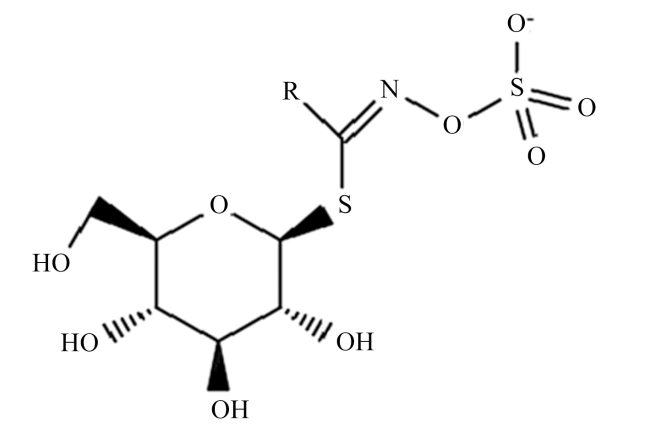
GLS是一种含硫的次生植物代谢物,主要存在于十字花科植物中,在双低菜籽品种引进种植前GLS是制约菜籽粕用作畜禽饲料原料的主要原因之一。到目前为止,由于GLS可变侧链的不同,已经确定了200多种不同的GLS,可将其分为3类:脂肪、吲哚和芳香族GLS[9],图1为GLS的通用化学结构。GLS是一种化学稳定性较高的化合物,其本身是无毒的,且在植物抗病防御机制中发挥着重要作用,并已被用作抗氧化剂应用[17-18]。然而,GLS在水分存在和种子破裂后,很容易被芥子酶水解。GLS的水解过程也会发生在单胃动物的消化道中,外源的芥子酶催化GLS水解为葡萄糖和不稳定的中间体β-苷元,β-苷元会根据环境变化自发转化为异硫氰酸酯、噁唑烷硫酮、硫氰酸盐和腈[19]。但其分解产物无论是通过芥子酶,还是非酶促因素,如微生物、温度、pH、消化道的生理结构和食糜运输时间,都会对动物产生有害影响[20]。此外,GLS的分解产物具有苦味,会影响饲料的适口性和降低动物的采食量,特别是在仔猪和育肥初期的猪中[21]。Velayudhan等[22]报道,在生长猪饲粮中用压榨菜籽粕(1.90~2.78 μmol/g GLs)替代33%~66%的豆粕,降低了平均日采食量,线性增加了甲状腺重量和血清中三碘甲状腺原氨酸含量,而血清中四碘甲状腺原氨酸含量减少,对猪的生产性能有不利影响。为了推动菜籽粕在畜禽饲粮中的广泛应用,研究者采用多种降解GLS的方法,如热处理[23]和化学处理[24]。热处理可有效降低菜籽粕中GLS含量。但该方法对热敏因子的特异性较高,因此受到限制。此外,热处理可能会引起赖氨酸和淀粉之间的美拉德反应,降低其他物质的营养特性[17]。这些方法由于降解率低、造成蛋白质和其他营养物质流失或成本过高而未能得到广泛推广。相对于理化法,菜籽粕通过生物学预处理是更有前景的方法。微生物发酵降低了GLS及其降解产物异硫氰酸酯、噁唑烷硫酮、硫氰酸盐和腈的水平的同时也提高了菜籽粕的营养价值。此外,其具有成本低、无剩余溶剂残留、反应条件温和等优点,但发酵过程较难控制及产生的次级代谢产物的安全性有待进一步考证。酶法降解GLS具有高效性、专一性等优点,但缺点是成本较高[25]
图1 GLS化学结构

Fig.1 Chemical structure of glucosinolates[26]

2.2 植酸

植酸是菜籽粕中一种含量较高的抗营养因子,其在菜籽粕中的含量为2%~5%。虽然,植酸在动物营养中的作用尚不明确,但其被认为是一种抗营养因子[27]。植酸可与带正电的二价或多价金属离子(如锌、钙、铜、镁、锰和铁离子)螯合后形成不溶性植酸盐,从而降低某些必需矿物质元素的生物利用率。且由于这种螯合性,植酸被认为是动物营养中矿物质离子缺乏的主要原因[28]。植酸通过影响消化酶活性而降低动物对养分的消化和吸收,如蛋白酶、淀粉酶和脂肪酶。此外,它可与蛋白质结合形成不溶性复合物,极大降低了蛋白质的生物利用率和消化率[29]。但是,植酸的化学性质相对稳定,不能通过加热等物理方法来降解,动物体内也没有相应的酶来消化降解。目前,外源植酸酶被广泛用于分解植酸[17]。菜籽粕中植酸产生的不良影响可通过在饲粮中添加外源植酸酶来缓解,并通过“超磷”效应提高氨基酸和磷等营养物质的消化率,这也是目前猪生产研究的一个主要方向[30]

2.3 单宁

单宁,又名单宁酸,主要存在于油菜籽壳中,其在菜籽粕中的含量约为3.65%,是油菜籽口感苦涩、适口性差的主要原因,根据结构组成可将其分为缩合型和水解型2种[31]。单宁可与消化道中的酶结合形成钝化化合物,与蛋白质结合形成不溶性化合物,从而影响蛋白质和其他养分的消化。此外,单宁可通过促进钙、铁和锌等各种金属离子的沉淀,干扰矿物质元素的生物利用度,从而降低其利用率,进而影响动物生长性能和饲料转化率[32]。单宁一般通过微生物降解。其本质为微生物分泌的单宁降解酶,如单宁酶、脱羧酶和多酚氧化酶等,催化植物单宁降解的酶促反应。

2.4 芥子碱

芥子碱是芥子酸的胆碱酯,是油菜籽中含量最丰富的酚类酯。芥子碱是一种苦味的酚类化合物,广泛存在于十字花科类植物中,因此它会使不含GLS的油菜籽产品产生苦味,影响饲料适口性,并可能降低动物的采食量[15]。德国正在进行一项研究发现,通过开发黄籽低纤维低芥子碱的油菜品种来降低油菜籽或油菜中芥子碱的含量,并可使芥子碱的含量降低至2.4 mg/g,降解率达到71%[33]

3 提高菜籽粕营养价值的生物学方法

3.1 酶法

与传统的物理和化学方法相比,酶法去除抗营养因子因为具有高效性、可持续性和生态性,而受到了广泛的关注。Zhang等[34]研究发现,从甘蓝型油菜中提取的腈化酶BnNIT2可将GLS的降解产物腈转化为羧酸和氨。此外,在pH 5.0、铁离子存在的条件下,该腈化酶可降解GLS中高达80%的腈。Rodrigues等[35]采用植酸酶预处理菜籽粕后提高了蛋白质的质量,并使植酸含量降低了25%。在菜籽粕饲粮中添加外源酶是提高食糜消化和养分吸收效率、提高生长性能的重要措施[36-37],猪饲粮中最常用的酶制剂是植酸酶、蛋白酶和碳水化合物酶。Maison等[38]研究表明,在菜籽粕饲粮中添加微生物植酸酶可提高生长猪对磷的消化率。Kasprowicz-Potocka等[39]也发现,在菜籽粕饲粮中添加植酸酶可提高生长育肥猪对钙和磷的消化率。Velayudhan等[40]报道,饲粮中添加纤维素酶、果胶酶、淀粉酶、蛋白酶和植酸酶复合酶提高了妊娠和哺乳期母猪氨基酸的SID。Sanjayan等[41]研究发现,在甘蓝型和芥菜黄型菜籽粕饲粮中添加碳水化合物酶对断奶仔猪的生长性能并无显著影响,且提高了仔猪对干物质、粗蛋白质和总能的全肠道表观消化率。Fang等[42]在以玉米、豆粕和双低菜籽粕基础的饲粮中添加木聚糖酶,提高了平均日增重、平均采食量和干物质、总能、粗蛋白质、中性洗涤纤维、酸性洗涤纤维和总磷的表观全肠道消化率,并对提高饲粮的饲喂价值具有积极作用。

3.2 微生物发酵法

微生物发酵法是指利用自然繁殖的微生物或人工添加的微生物制剂,分泌相关酶,通过发酵分解抗营养因子等大分子物质。此外,可提高发酵底物营养价值,并抑制致病微生物的生长和繁殖[43]。微生物发酵可分为固态发酵和液态发酵2种,固态发酵在畜禽生产上应用较多[44]。通过发酵预处理菜籽粕可改善其理化特性,提高粗蛋白质含量,降低GLS、粗纤维和植酸含量[45]。目前,许多微生物已被用于菜籽粕的发酵,主要包括乳酸菌、芽孢杆菌和酵母菌等,这些微生物单独或联合发酵可促进蛋白质水解,从而获得更高的产肽率和解毒效果,且多菌种发酵的效果比单一菌种更好,但要考虑各菌种间的协同或拮抗作用[46-47]。Vlassa等[48]研究发现,用酵母菌固态发酵菜籽粕24 h后,总GLS含量降低51.60%~66.04%,总多酚含量降低21.58%~23.55%,但粗蛋白质含量提高10%~13%。Konkol等[49]用枯草芽孢杆菌对菜籽粕进行固态发酵,菜籽粕发酵后的干物质、粗灰分、粗脂肪和代谢能均显著提高,粗纤维和GLS含量显著降低。Zhang等[50]研究发现,当脱脂乳杆菌和枯草芽孢杆菌混合发酵菜籽粕后,菜籽粕中GLS含量由64.6 μmol/g降至3.5 μmol/g,降解率高达94.62%。Wang等[45]研究表明,用乳酸菌、地衣芽胞杆菌和产朊假丝酵母组合发酵菜籽粕3 d,菜籽粕蛋白经发酵降解为分子质量小于9.5 ku的小肽;且在饲粮中添加发酵菜籽粕显著提高了黄羽肉鸡生产性能,提高了干物质和粗蛋白质的体外消化率。Wang等[51]利用枯草芽孢杆菌和酵母菌发酵和挤压预处理菜籽粕48 h,结果表明,发酵后菜籽粕的小肽(分子质量小于3 ku)、总酚含量均达到最高水平,2S白蛋白和12S球蛋白亚基条带几乎完全消失;在大鼠饲粮中添加发酵后的菜籽粕后,提高了血清和肝脏中的总超氧化物歧化酶活性,而丙二醛含量显著降低,且在大鼠饲粮中添加发酵后的菜籽粕可减轻由应激引起的氧化损伤。此外,还有一些研究采用菌酶协同发酵,有效地降解了菜籽粕中的抗营养因子,从而进一步提高了其营养价值和适口性。Tie等[52]研究表明,采用菌酶协同方法发酵菜籽粕后,GLS和植酸的水平显著降低,粗蛋白质、总氨基酸和总酚含量显著提高。Zhu等[18]研究发现,利用复合酶酶解和乳酸杆菌发酵相结合,显著提高了菜籽粕中纤维和蛋白质的营养价值和利用率。综上所述,利用生物学方法可以降解菜籽粕中的抗营养因子,提升营养价值,从而提高菜籽粕的利用率。

4 菜籽粕在猪生产中的应用研究进展

4.1 生长性能

研究表明,在猪饲粮中添加适量菜籽粕不会对猪的生长性能产生不利影响(表3)。Do等[3]研究发现,饲粮中添加8%菜籽粕未对断奶仔猪生产性能产生负面影响。Choi等[53]研究也发现,当菜籽粕添加量为9%时,对生长肥育猪的生产性能也无不良影响。Grabez等[54]研究表明,在生长育肥阶段饲粮中添加18%菜籽粕对猪的生长速度和采食量没有显著影响。Torres-Pitarch等[55]研究表明,在育肥猪饲粮中添加20%菜籽粕替代豆粕是可行的,且对生长性能无不良影响,但在育肥猪饲粮中添加72%的菜籽粕替代豆粕显著降低了育肥期末的体重和生长速度。此外,菜籽粕经过发酵后有一种酸味,可以改善其风味及品质而具有刺激猪的食欲的潜力,可能会提高猪的采食量,进而改善生产性能。孙佩佩[56]研究发现,在生长育肥猪饲粮中添加发酵菜籽粕(菜籽粕与麦麸比例7∶3)可一定程度改善生长猪的生产性能,并使在生长猪饲粮中发酵菜籽粕的添加量达到16%,即实际的菜籽粕添加量达到11.2%;在育肥猪饲粮中发酵菜籽粕的添加量达到20%,即实际的菜籽粕添加量达到14%。Czech等[57]研究表明,在断奶仔猪饲粮中添加8%发酵菜籽粕对生长性能无不良影响。Grela等[4]研究发现,在妊娠母猪饲粮中添加4%~9%的发酵菜籽粕显著改善了生产性能(尤其是在初产母猪中),提高了窝产仔数和窝重,并降低了仔猪的腹泻率和死亡率。Shi等[58]也发现,在生长猪饲粮中添加10%发酵菜籽粕,显著提高了生长猪的平均日增重和饲料转化率。综上所述,菜籽粕在生长和育肥猪阶段饲粮中的应用较多,添加量最高可达20%,且对猪的生长性能无不良影响,而菜籽粕发酵后在不影响猪生产性能的情况下提高了其在猪饲粮中的添加量,表4为各阶段猪只饲粮中菜籽粕的参考添加量。
表3 菜籽粕对猪生长性能的影响

Table 3 Effects of rapeseed meal on growth performance of pigs

原料种类
Types of materials
动物
Animals
饲粮处理
Diet treatments
结果
Results
参考文献
References
菜籽粕
Rapeseed meal
断奶仔猪 添加量8% 对生长性能无不良影响 Do等[3]
菜籽粕
Rapeseed meal
生长育肥猪 添加量18% 生长速度、采食量没有显著差异 Grabež等[54]
菜籽粕
Rapeseed meal
育肥猪 添加量20% 对生长性能无不良影响 Torres-Pitarch等[55]
菜籽粕
Rapeseed meal
生长育肥猪 添加量9% 对生长性能无不良影响 Choi等[53]
发酵菜籽粕
Fermented rapeseed meal
断奶仔猪 添加量8% 对生长性能无不良影响 Wlazło等[59]
发酵菜籽粕
Fermented rapeseed meal
断奶仔猪 添加量8% 改善了仔猪的生长性能 Czech等[57]
发酵菜籽粕
Fermented rapeseed meal
生长猪 添加量10% 改善了生长猪的生长性能 Shi等[58]
发酵菜籽粕
Fermented rapeseed meal
妊娠母猪 添加量4%~9% 改善了母猪和后代仔猪的生长性能 Grela等[4]
表4 猪饲粮中菜籽粕的参考添加量

Table 4 Reference supplemental amount of rapeseed meal in pig diet[9]%

项目
Items
菜籽粕在猪饲粮中的添加量
Supplemental amount of rapeseed meal in pig diet
仔猪Piglets 3~5
保育猪Nursery piglets 6~8
育肥猪(30~60 kg) Finishing pigs (30 to 60 kg) 12~15
育肥猪(61~111 kg) Finishing pigs (61 to 111 kg) 15~20
断奶后和早期妊娠母猪Post-weaning and early gestation sows 10~15
妊娠晚期和哺乳期母猪Late gestation and lactating sows 5

4.2 肠道微生物

动物的肠道微生物区系是保护宿主免受由胃肠道中的病原体定殖引起的免疫力下降和疾病的第1道屏障[60]。Hui等[61]在断奶仔猪饲粮中添加2.5%发酵菜籽粕海藻混合物,增加了结肠微生物多样性,提高了斯特科普雷沃菌(Prevotella stercore)和光冈菌属(Mitsuokella)的丰度。Wlazło等[59]研究报道,在断奶仔猪饲粮中使用8%发酵菜籽粕替代豆粕,结果表明,饲喂发酵菜籽粕的猪粪便中乳酸菌的数量显著增加,大肠菌群和产气荚膜梭菌总数显著减少。孙佩佩[56]研究发现,在生长育肥猪饲粮中添加发酵菜籽粕显著提高了厚壁菌门和瘤胃球菌科(属)的数量,并丰富了盲肠微生物区系。Shuai等[62]在生长猪饲粮中添加12.24%发酵菜籽粕,显著降低了盲肠和结肠中大肠杆菌的丰度,提高了乳杆菌的丰度和丁酸盐含量。此外,上调了闭合蛋白(Occludin)在小肠上皮中的mRNA表达水平、十二指肠中紧密连接蛋白封闭蛋白-1(Claudin-1)、黏蛋白1(MUC1)和寡肽转运蛋白1(PepT1)基因的mRNA表达水平和空肠中钠-葡萄糖共转运蛋白1(SGLT1)和过氧化氢酶1(CAT1)基因的mRNA表达水平。Grela等[4]研究发现,在母猪饲粮中添加4%~9%发酵菜籽粕对(特别是妊娠后期的母猪)肠道菌群有积极影响,减少了妊娠后期初产母猪粪便中所含的总细菌和真菌数,尤其是大肠杆菌和厌氧产气荚膜梭菌的数量显著减少,并提高了乳酸水平。以上研究结果提示,发酵菜籽粕可能通过减少有害菌的数量和增加有益菌的数量来改善动物胃肠道生态和健康的方式而具有成为抗生素替代品的潜力。

4.3 肉品质

Grabež等[54]研究发现,饲粮中添加菜籽粕提高生长育肥猪饲料转化率,提高了游离氨基酸和甜味代谢产物浓度,并改善肉色和肉的风味属性,但对总饱和脂肪酸、单不饱和脂肪酸和多不饱和脂肪酸无显著影响。Gilbert等[63]在生长育肥猪饲粮种添加2种不同品种的菜籽粕(传统和高蛋白菜籽粕)替代33%、66%和100%的豆粕,结果表明,各组间的终末活重、胴体重、眼肌面积、第10肋骨背膘厚和胴体瘦肉量均无显著差异,但与传统菜籽粕组相比高蛋白菜籽粕组的去骨瘦肉产量和去骨胴体重显著提高。有研究发现,在育肥猪饲粮中添加菜籽粕和豆类植物对猪肉的品质无不良影响,且能使脂肪含量显著降低[64-65]。Torres-Pitarch等[55]在育肥猪饲粮中添加20%菜籽粕替代豆粕,对脂肪厚度、肉pH、胴体和肉质性状没有负面影响。王荷香等[66]研究发现,在生长育肥猪饲粮中添加8%发酵菜籽粕等量替代基础饲粮中的豆粕能够改善猪肉品质。顾方等[67]在低蛋白质饲粮的基础上使用发酵菜籽粕替代部分豆粕,对60~110 kg阶段育肥猪的生长性能和胴体性状无不良影响,显著提高了猪肉的肌苷酸含量和感官评分,并具有改善猪肉脂肪酸组成的作用。综上所述,在生长育肥猪饲粮中添加菜籽粕替代部分豆粕对猪肉品质无不良影响,但必须合理控制添加量。

4.4 养分消化率

养分消化率反映的是动物对营养物质消化吸收的能力。Czech等[57]研究发现,在断奶仔猪饲粮中添加8%发酵菜籽粕提高了断奶仔猪粗蛋白质、粗脂肪和粗纤维回肠消化率(分别提高了约4%、6%和14%),并显著提高了微量元素和常量元素的消化率,且仔猪粪便中氨释放水平显著降低。朱青青等[68]研究发现,与玉米-豆粕型饲粮相比,玉米-豆粕-菜籽粕型饲粮降低了生长猪对有机物、粗纤维和粗蛋白质消化率,但在饲粮中添加300 mg/kg蛋白酶后显著提高了生长猪的有机物、粗脂肪、干物质、粗蛋白质、粗纤维以及总能的消化率,且在添加蛋白酶的条件下,生长猪饲粮中菜籽粕可以部分替代豆粕,从而降低生产成本。Shim等[69]在生长猪菜籽粕饲粮中添加植酸酶和碳水化合物酶,显著提高了生长猪对干物质、总能、粗蛋白质、粗脂肪、钙和磷的消化率。而Torres-Pitarch等[55]研究表明,在育肥猪饲粮中添加72%菜籽粕替代豆粕降低了育肥猪对干物质、有机物和粗蛋白质的消化率,这可能是菜籽粕添加量和品种不同的原因所造成的,但是饲喂菜籽粕的猪排出的可降解粪便和每克有机物产生的甲烷较少。Grela等[4]在生长猪饲粮中添加4%~9%的发酵菜籽粕显著提高了母猪妊娠后期和泌乳期脂肪和粗纤维的全肠道表观消化率。

5 小结与展望

菜籽粕在减量替代生猪饲粮中的豆粕中具有巨大的潜力和前景,而通过微生物发酵、酶法预处理后可降低其抗营养因子含量,提高饲用价值,进而扩大其在猪饲粮中的应用,这对非常规植物蛋白质原料的开发与利用、豆粕减量替代计划和养猪企业降本增效具有重大意义。此外,下一步应开展对菜籽粕进行生物学预处理后的营养价值评定工作并对饲喂的猪的有效能值及氨基酸消化率做动态预测,进而精准饲喂和制作饲料配方,并在各阶段猪只中进行大规模群体试验中探究其替代豆粕的适宜比例。
[1]
MOTTET A, DE HAAN C, FALCUCCI A, et al. Livestock:on our plates or eating at our table?A new analysis of the feed/food debate[J]. Global Food Security, 2017, 14:1-8.

DOI

[2]
崔海军. 粕类季节性规律:菜籽粕篇[J]. 湖南饲料, 2021(5):5-6,14.

CUI H J. Seasonal law of rapeseed meal:rapeseed meal[J]. Hunan Feed, 2021(5):5-6,14. (in Chinese)

[3]
DO S H, KIM B O, FANG L H, et al. Various levels of rapeseed meal in weaning pig diets from weaning to finishing periods[J]. Asian-Australasian Journal of Animal Sciences, 2017, 30(9):1292-1302.

DOI PMID

[4]
EUGENIUSZ R G, CZECH A, KIESZ M, et al. A fermented rapeseed meal additive:effects on production performance,nutrient digestibility,colostrum immunoglobulin content and microbial flora in sows[J]. Animal Nutrition, 2019, 5(4):373-379.

DOI

[5]
BÉROT S, COMPOINT J P, LARRÉ C, et al. Large scale purification of rapeseed proteins (Brassica napus L.)[J]. Journal of Chromatography B, 2005, 818(1):35-42.

DOI

[6]
LI Z C, LI Y K, LV Z Q, et al. Net energy of corn,soybean meal and rapeseed meal in growing pigs[J]. Journal of Animal Science and Biotechnology, 2017, 8:44.

DOI

[7]
LI Z C, LYU Z Q, LIU H, et al. Prediction of net energy values in expeller-pressed and solvent-extracted rapeseed meal for growing pigs[J]. Animal Bioscience, 2021, 34(1):109-118.

DOI

[8]
LI P L, WANG F L, WU F, et al. Chemical composition,energy and amino acid digestibility in double-low rapeseed meal fed to growing pigs[J]. Journal of Animal Science and Biotechnology, 2015, 6(1):37.

DOI

[9]
GOŁEBIEWSKA K, FRAŚ A, GOŁEBIEWSKI D. Rapeseed meal as a feed component in monogastric animal nutrition-a review[J]. Annals of Animal Science, 2022, 22(4):1163-1183.

DOI

[10]
CASAS G A, JAWORSKI N W, HTOO J K, et al. Ileal digestibility of amino acids in selected feed ingredients fed to young growing pigs[J]. Journal of Animal Science, 2018, 96(6):2361-2370.

DOI PMID

[11]
李波. 不同来源菜籽饼粕对生长猪的消化能值及氨基酸回肠消化率的测定[D]. 硕士学位论文. 雅安: 四川农业大学, 2011.

LI B. Determination of digestive energy and amino acid ileal digestibility of different sources rapeseed cakes/meals in growing pig[D]. Master’s Thesis. Ya’an: Sichuan Agricultural University, 2011. (in Chinese)

[12]
SHI C, HE J, YU J, et al. Amino acid,phosphorus,and energy digestibility of Aspergillus niger fermented rapeseed meal fed to growing pigs[J]. Journal of Animal Science, 2015, 93(6):2916-2925.

DOI

[13]
LI P L, WU F, CHEN Y F, et al. Determination of the energy content and amino acid digestibility of double-low rapeseed cakes fed to growing pigs[J]. Animal Feed Science and Technology, 2015, 210:243-253.

DOI

[14]
KISSIL G W, LUPATSCH I, HIGGS D A, et al. Dietary substitution of soy and rapeseed protein concentrates for fish meal,and their effects on growth and nutrient utilization in gilthead seabream Sparus aurata L.[J]. Aquaculture Research, 2000, 31(7):595-601.

DOI

[15]
MEJICANOS G, SANJAYAN N, KIM I H, et al. Recent advances in canola meal utilization in swine nutrition[J]. Journal of Animal Science and Technology, 2016, 58:7.

DOI PMID

[16]
SZYDŁOWSKA-CZERNIAK A. Rapeseed and its products-sources of bioactive compounds:a review of their characteristics and analysis[J]. Critical Reviews in Food Science and Nutrition, 2013, 53(4):307-330.

DOI

[17]
YANG Z F, HUANG Z X, CAO L J. Biotransformation technology and high-value application of rapeseed meal:a review[J]. Bioresources and Bioprocessing, 2022, 9(1):103.

DOI

[18]
ZHU X F, WANG L Y, ZHANG Z, et al. Combination of fiber-degrading enzymatic hydrolysis and lactobacilli fermentation enhances utilization of fiber and protein in rapeseed meal as revealed in simulated pig digestion and fermentation in vitro[J]. Animal Feed Science and Technology, 2021, 278:115001.

DOI

[19]
SØNDERBY I E, GEU-FLORES F, HALKIER B A. Biosynthesis of glucosinolates-gene discovery and beyond[J]. Trends in Plant Science, 2010, 15(5):283-290.

DOI

[20]
XIE C, LI W M, GAO R G, et al. Determination of glucosinolates in rapeseed meal and their degradation by myrosinase from rapeseed sprouts[J]. Food Chemistry, 2022, 382:132316.

DOI

[21]
WANG L F, BELTRANENA E, ZIJLSTRA R T. Diet nutrient digestibility and growth performance of weaned pigs fed Brassica napus canola meal varying in nutritive quality[J]. Animal Feed Science and Technology, 2017, 223:90-98.

DOI

[22]
VELAYUDHAN D E, SCHUH K, WOYENGO T A, et al. Effect of expeller extracted canola meal on growth performance,organ weights,and blood parameters of growing pigs[J]. Journal of Animal Science, 2017, 95(1):302-307.

[23]
JING B Y, GUO R, WANG M Z, et al. Influence of seed roasting on the quality of glucosinolate content and flavor in virgin rapeseed oil[J]. LWT, 2020, 126:109301.

DOI

[24]
DAS PURKAYASTHA M, GOGOI J, KALITA D, et al. Physicochemical and functional properties of rapeseed protein isolate:influence of antinutrient removal with acidified organic solvents from rapeseed meal[J]. Journal of Agricultural and Food Chemistry, 2014, 62(31):7903-7914.

DOI

[25]
HAO Y N, WANG Z G, ZOU Y C, et al. Effect of static-state fermentation on volatile composition in rapeseed meal[J]. Journal of the Science of Food and Agriculture, 2020, 100(5):2145-2152.

DOI PMID

[26]
KONKOL D, SZMIGIEL I, DOMŻAŁ-KEDZIA M, et al. Biotransformation of rapeseed meal leading to production of polymers,biosurfactants,and fodder[J]. Bioorganic Chemistry, 2019, 93:102865.

DOI

[27]
KHAJALI F, SLOMINSKI B A. Factors that affect the nutritive value of canola meal for poultry[J]. Poultry Science, 2012, 91(10):2564-2575.

PMID

[28]
SAMTIYA M, ALUKO R E, DHEWA T. Plant food anti-nutritional factors and their reduction strategies:an overview[J]. Food Production,Processing and Nutrition, 2020, 2(1):6.

DOI

[29]
RAVINDRAN V, CABAHUG S, RAVINDRA G, et al. Response of broiler chickens to microbial phytase supplementation as influenced by dietary phytic acid and non-phytate phosphorous levels.Ⅱ.Effects on apparent metabolisable energy,nutrient digestibility and nutrient retention[J]. British Poultry Science, 2000, 41(2):193-200.

DOI

[30]
DERSJANT-LI Y, DUSEL G. Increasing the dosing of a Buttiauxella phytase improves phytate degradation,mineral,energy,and amino acid digestibility in weaned pigs fed a complex diet based on wheat,corn,soybean meal,barley,and rapeseed meal[J]. Journal of Animal Science, 2019, 97(6):2524-2533.

DOI

[31]
BUTLER L G, RIEDL D J, LEBRYK D G, et al. Interaction of proteins with sorghum tannin:mechanism,specificity and significance[J]. Journal of the American Oil Chemists’ Society, 1984, 61(5):916-920.

DOI

[32]
REDDY N R, PIERSON M D, SATHE S K, et al. Dry bean tannins:a review of nutritional implications[J]. Journal of the American Oil Chemists’ Society, 1985, 62(3):541-549.

DOI

[33]
EMRANI N, HARLOFF H J, GUDI O, et al. Reduction in sinapine content in rapeseed (Brassica napus L.) by induced mutations in sinapine biosynthesis genes[J]. Molecular Breeding, 2015, 35(1):37.

DOI

[34]
ZHANG H, ZHANG H H, QIN X, et al. Biodegradation of nitriles derived from glucosinolates in rapeseed meal by BnNIT2:a nitrilase from Brassica napus with wide substrate specificity[J]. Applied Microbiology and Biotechnology, 2022, 106(7):2445-2454.

DOI

[35]
RODRIGUES I M, CARVALHO M G V, ROCHA J M. Increase of protein extraction yield from rapeseed meal through a pretreatment with phytase[J]. Journal of the Science of Food and Agriculture, 2017, 97(8):2641-2646.

DOI PMID

[36]
ZIJISTR R T, LI S, OWUSU-ASIEDU A, et al. Effect of carbohydrase supplementation of wheat- and canola-meal-based diets on growth performance and nutrient digestibility in group-housed weaned pigs[J]. Canadian Journal of Animal Science, 2004, 84(4):689-695.

DOI

[37]
ZHANG G G, YANG Z B, WANG Y, et al. Effects of dietary supplementation of multi-enzyme on growth performance,nutrient digestibility,small intestinal digestive enzyme activities,and large intestinal selected microbiota in weanling pigs[J]. Journal of Animal Science, 2014, 92(5):2063-2069.

DOI

[38]
MAISON T, LIU Y, STEIN H H. Apparent and standardized total tract digestibility by growing pigs of phosphorus in canola meal from North America and 00-rapeseed meal and 00-rapeseed expellers from Europe without and with microbial phytase[J]. Journal of Animal Science, 2015, 93(7):3494-3502.

DOI PMID

[39]
KASPROWICZ-POTOCKA M, ZAWORSKA-ZAKRZEWSKA A, RUTKOWSKI A. Effect of phytase on digestibility and performance of growing and finishing pigs fed diets with lupins and rapeseed meal[J]. Journal of Agricultural Science and Technology A, 2020, 10:216-227.

[40]
VELAYUDHAN D E, HOSSAIN M M, STEIN H H, et al. Standardized ileal digestibility of amino acids in canola meal fed to gestating and lactating sows[J]. Journal of Animal Science, 2019, 97(10):4219-4226.

DOI

[41]
SANJAYAN N, HEO J M, NYACHOTI C M. Nutrient digestibility and growth performance of pigs fed diets with different levels of canola meal from Brassica napus black and Brassica juncea yellow[J]. Journal of Animal Science, 2014, 92(9):3895-3905.

DOI

[42]
FANG Z F, PENG J, LIU Z L, et al. Responses of non-starch polysaccharide-degrading enzymes on digestibility and performance of growing pigs fed a diet based on corn,soya bean meal and Chinese double-low rapeseed meal[J]. Journal of Animal Physiology and Animal Nutrition, 2007, 91(7/8):361-368.

DOI

[43]
GARRIDO-GALAND S, ASENSIO-GRAU A, CALVO-LERMA J, et al. The potential of fermentation on nutritional and technological improvement of cereal and legume flours:a review[J]. Food Research International, 2021, 145:110398.

DOI

[44]
YANG L J, ZENG X F, QIAO S Y. Advances in research on solid-state fermented feed and its utilization:the pioneer of private customization for intestinal microorganisms[J]. Animal Nutrition, 2021, 7(4):905-916.

DOI

[45]
WANG Y, LIU J, WEI F H, et al. Improvement of the nutritional value,sensory properties and bioavailability of rapeseed meal fermented with mixed microorganisms[J]. LWT, 2019, 112:108238.

DOI

[46]
WANG X S, JIN Q Z, WANG T, et al. Screening of glucosinolate-degrading strains and its application in improving the quality of rapeseed meal[J]. Annals of Microbiology, 2012, 62(3):1013-1020.

DOI

[47]
COUTO S R, SANROMÁN M Á. Application of solid-state fermentation to food industry-a review[J]. Journal of Food Engineering, 2006, 76(3):291-302.

DOI

[48]
VLASSA M, FILIP M, TǍRANU I, et al. The yeast fermentation effect on content of bioactive,nutritional and anti-nutritional factors in rapeseed meal[J]. Foods, 2022, 11(19):2972.

DOI

[49]
KONKOL D, JONUZI E, POPIELA E, et al. Influence of solid state fermentation with Bacillus subtilis 67 strain on the nutritional value of rapeseed meal and its effects on performance and meat quality of broiler chickens[J]. Poultry Science, 2023, 102(7):102742.

DOI

[50]
ZHANG Z Y, WEN M, CHANG Y Q. Degradation of glucosinolates in rapeseed meal by Lactobacillus delbrueckii and Bacillus subtilis[J]. Grain & Oil Science and Technology, 2020, 3(2):70-76.

[51]
WANG Y, SUN H, HAN B, et al. Improvement of nutritional value,molecular weight patterns (soluble peptides),free amino acid patterns,total phenolics and antioxidant activity of fermented extrusion pretreatment rapeseed meal with Bacillus subtilis YY-1 and Saccharomyces cerevisiae YY-2[J]. LWT, 2022, 160:113280.

DOI

[52]
TIE Y, LI L, LIU J, et al. Two-step biological approach for treatment of rapeseed meal[J]. Journal of Food Science, 2020, 85(2):340-348.

DOI PMID

[53]
CHOI H B, JEONG J H, KIM D H, et al. Influence of rapeseed meal on growth performance,blood profiles,nutrient digestibility and economic benefit of growing-finishing pigs[J]. Asian-Australasian Journal of Animal Sciences, 2015, 28(9):1345-1353.

DOI

[54]
GRABEŽ V, EGELANDSDAL B, KJOS N P, et al. Replacing soybean meal with rapeseed meal and faba beans in a growing-finishing pig diet:effect on growth performance,meat quality and metabolite changes[J]. Meat Science, 2020, 166:108134.

DOI

[55]
TORRES-PITARCH A, MOSET V, FERRER P, et al. The inclusion of rapeseed meal in fattening pig diets,as a partial replacer of soybean meal,alters nutrient digestion,faecal composition and biochemical methane potential from faeces[J]. Animal Feed Science and Technology, 2014, 198:215-223.

DOI

[56]
孙佩佩. 发酵菜籽粕的营养价值评定及其在生长育肥猪上的应用研究[D]. 硕士学位论文. 重庆: 西南大学, 2019.

SUN P P. Evaluation of nutritional value of fermented rapeseed meal and its application in growing and finishing pigs[D]. Master’s Thesis. Chongqing: Southwest University, 2019. (in Chinese)

[57]
CZECH A, WLAZŁO Ł, ŁUKASZEWICZ M, et al. Fermented rapeseed meal enhances the digestibility of protein and macro- and microminerals and improves the performance of weaner pigs[J]. Animal Feed Science and Technology, 2023, 300:115656.

DOI

[58]
SHI C Y, HE J, WANG J P, et al. Effects of Aspergillus niger fermented rapeseed meal on nutrient digestibility,growth performance and serum parameters in growing pigs[J]. Animal Science Journal, 2016, 87(4):557-563.

DOI

[59]
WLAZŁO Ł, NOWAKOWICZ-DEBEK B, OSSOWSKI M, et al. Effect of fermented rapeseed meal in diets for piglets on blood biochemical parameters and the microbial composition of the feed and faeces[J]. Animals, 2022, 12(21):2972.

DOI

[60]
OLUKOMAIYA O, FERNANDO C, MEREDDY R, et al. Solid-state fermented plant protein sources in the diets of broiler chickens:a review[J]. Animal Nutrition, 2019, 5(4):319-330.

DOI

[61]
HUI Y, TAMEZ-HIDALGO P, CIEPLAK T, et al. Supplementation of a lacto-fermented rapeseed-seaweed blend promotes gut microbial- and gut immune-modulation in weaner piglets[J]. Journal of Animal Science and Biotechnology, 2021, 12(1):85.

DOI PMID

[62]
SHUAI C Y, CHEN D W, YU B, et al. Effect of fermented rapeseed meal on growth performance,nutrient digestibility,and intestinal health in growing pigs[J]. Animal Nutrition, 2023[2023-07-01].https://doi.org/10.1016/j.aninu.2023.06.011.

[63]
GILBERT M S, IJSSENNAGGER N, KIES A K, et al. Protein fermentation in the gut;implications for intestinal dysfunction in humans,pigs,and poultry[J]. American Journal of Physiology-Gastrointestinal and Liver Physiology, 2018, 315(2):G159-G170.

DOI

[64]
LITTLE K L, BOHRER B M, MAISON T, et al. Effects of feeding canola meal from high-protein or conventional varieties of canola seeds on growth performance,carcass characteristics,and cutability of pigs[J]. Journal of Animal Science, 2015, 93(3):1284-1297.

DOI

[65]
ZMUDZIŃSKA A, BIGOROWSKI B, BANASZAK M, et al. The effect of diet based on legume seeds and rapeseed meal on pig performance and meat quality[J]. Animals, 2020, 10(6):1084.

DOI

[66]
王荷香, 卢慧芳, 王东方. 发酵菜籽粕对育肥猪生长性能、肉品质、血清生化指标的影响[J]. 饲料研究, 2022, 45(24):32-36.

WANG H X, LU H F, WANG D F. Effect of fermented rapeseed meal on growth performance,meat quality and serum biochemical indexes of finishing pigs[J]. Feed Research, 2022, 45(24):32-36. (in Chinese)

[67]
顾方, 刘世龙, 李红胜, 等. 低蛋白质饲粮中添加发酵菜籽粕对育肥猪生长性能和肉品质的影响[J]. 动物营养学报, 2023, 35(3):1489-1500.

DOI

GU F, LIU S L, LI H S, et al. Effects of low protein diet supplemented with-fermented canola meal on growth performance and meat quality of finishing pigs[J]. Chinese Journal of Animal Nutrition, 2023, 35(3):1489-1500. (in Chinese)

DOI

[68]
朱青青, 余冰, 何军, 等. 豆粕和菜籽粕饲粮中添加新型蛋白酶对生长猪生长性能、养分消化率和血清生化指标的影响[J]. 动物营养学报, 2023, 35(6):3563-3573.

DOI

ZHU Q Q, YU B, HE J, et al. Effects of novel protease supplementation in soybean meal and rapeseed meal diets on growth performance,nutrient digestibility and serum biochemical indices of growing pigs[J]. Chinese Journal of Animal Nutrition, 2023, 35(6):3563-3573. (in Chinese)

[69]
SHIM Y H, CHAE B J, LEE J H. Effects of phytase and carbohydrases supplementation to diet with a partial replacement of soybean meal with rapeseed meal and cottonseed meal on growth performance and nutrient digestibility of growing pigs[J]. Asian-Australasian Journal of Animal Sciences, 2003, 16(9):1339-1347.

DOI

文章导航

/