研究论文

β-酪蛋白不同基因型荷斯坦奶牛瘤胃微生物群落特征和功能分析

  • 赵金燕 , 1, 2 ,
  • 王川川 1, 2 ,
  • 禹保军 1, 2 ,
  • 马若霜 1, 2 ,
  • 胡佳欢 1, 2 ,
  • 张娟 1, 2 ,
  • 顾亚玲 , 1, 2, *
展开
  • 1 宁夏大学动物科技学院,银川 750021
  • 2 宁夏回族自治区反刍动物分子细胞育种重点实验室,银川 750021
* 顾亚玲,教授,博士生导师,E-mail:

赵金燕(2000—),女,河南安阳人,硕士研究生,研究方向为动物遗传育种。E-mail:

Copy editor: 田艳明

收稿日期: 2023-07-13

  网络出版日期: 2024-01-12

基金资助

宁夏回族自治区重点研发项目(2022BBF02017)

Characteristic and Functional Analysis of Rumen Microbial Communities in Holstein Cows with Different β-Casein Genotypes

  • ZHAO Jinyan , 1, 2 ,
  • WANG Chuanchuan 1, 2 ,
  • YU Baojun 1, 2 ,
  • MA Ruoshuang 1, 2 ,
  • HU Jiahuan 1, 2 ,
  • ZHANG Juan 1, 2 ,
  • GU Yaling , 1, 2, *
Expand
  • 1 College of Animal Science and Technology, Ningxia University, Yinchuan 750021, China
  • 2 Ningxia Hui Autonomous Region Key Laboratory of Ruminant Molecular Cell Breeding, Yinchuan 750021, China
* professor, E-mail:

Received date: 2023-07-13

  Online published: 2024-01-12

摘要

β-酪蛋白是乳汁中最重要的蛋白质之一,在荷斯坦奶牛中存在A1和A2这2种主要基因型。为探究β-酪蛋白不同基因型荷斯坦奶牛瘤胃微生物群落的差异,试验选取体况良好、第1胎次的A1A1、A1A2和A2A2基因型荷斯坦奶牛各15头(各基因型奶牛乳脂率和乳蛋白率相近),采集瘤胃液后通过Illumina HiSeq 2000平台进行宏基因组测序,并利用Diamond 0.9.7软件进行分类和功能注释,分析3种基因型奶牛瘤胃微生物群落的组成和功能。结果表明:1)A1A1基因型奶牛瘤胃中特征微生物有Intestinibaculum、戴阿利斯特杆菌属(Dialister)、克雷伯氏菌属(Klebsiella)和不动杆菌属(Acinetobacter)等;A1A2基因型奶牛瘤胃中特征微生物有普雷沃氏菌科(Prevotellaceae)的帕拉普雷沃氏菌属(Paraprevotella)和Paraprevotella xylaniphila;A2A2基因型奶牛瘤胃中特征微生物包括醋杆菌属(Acetobacter)和黄单胞菌属(Xanthomonas)等。2)A1A2和A2A2基因型奶牛瘤胃中富含与木质纤维素和纤维素降解相关的酶;A1A2基因型奶牛瘤胃参与淀粉和蔗糖代谢、脂肪酸生物合成、蛋白质消化与吸收、精氨酸和脯氨酸代谢以及RNA降解通路的基因数量更多;A2A2基因型奶牛瘤胃参与炎症介质调节通路的基因数量更多。由此可知,A1A1基因型荷斯坦奶牛的瘤胃标志物微生物是Intestinibaculum和戴阿利斯特杆菌属,可能与减少甲烷排放和A1型β-酪蛋白以及部分疾病存在潜在关联;A1A2基因型奶牛的瘤胃标志微生物是普雷沃氏菌科,可能对饲粮消化有促进作用;A2A2基因型奶牛的瘤胃标志微生物是醋杆菌属,其相对丰度对乳脂含量有调节作用。

本文引用格式

赵金燕 , 王川川 , 禹保军 , 马若霜 , 胡佳欢 , 张娟 , 顾亚玲 . β-酪蛋白不同基因型荷斯坦奶牛瘤胃微生物群落特征和功能分析[J]. 动物营养学报, 2024 , 36(1) : 537 -550 . DOI: 10.12418/CJAN2024.049

Abstract

β-casein is one of the most important proteins in milk, and there are two major genotypes, A1 and A2, in Holstein cows. In order to investigate the differences of rumen microbial communities of Holstein cows with different β-casein genotypes, 15 Holstein cows with genotypes A1A1, A1A2 and A2A2 in good condition and the first parity were selected in the experiment (milk fat percentage and milk protein percentage of all genotypes were similar). After rumen fluid collection, metagomic sequencing was performed by Illumina HiSeq 2000 platform, Diamond 0.9.7 software was used for classification and functional annotation, and the composition and function of rumen microbial communities of three genotypes of dairy cows were analyzed. The results showed as follows: 1) the characteristic microorganisms in rumen of cows with genotype A1A1 were Intestinibaculum, Dialister, Klebsiella and Acinetobacter, and so on; the characteristic microorganisms in rumen of cows with genotype A1A2 were Paraprevotella and Paraprevotella xylaniphila of Prevotellaceae; and the characteristic microorganisms in rumen of cows with genotype A2A2 were Acetobacter and Xanthomonas, and so on. 2) The rumen of cows with genotypes A1A2 and A2A2 was rich in enzymes related to lignocellulose and cellulose degradation; the number of genes involved in starch and sucrose metabolism, fatty acid biosynthesis, protein digestion and absorption, arginine and proline metabolism and RNA degradation pathways were more in rumen of cows with genotype A1A2, and the rumen of cows with genotype A2A2 had more genes involved in the regulatory pathway of inflammatory mediators. It can be concluded that the rumen marker microorganisms of Holstein cows with genotype A1A1 are Intestinibaculum and Dealisteria, which may be potentially associated with reduced methane emissions and β-casein type A1, as well as some diseases; the rumen marker microorganism of cows with genotype A1A2 is Prevotellaceae, which may promote dietary digestion; and the rumen marker microorganism of cows with genotype A2A2 is Acetobacter, and its relative abundance has a regulating effect on milk fat content.

牛奶中富含乳糖、甘油三酯、蛋白质、矿物质和维生素等营养成分[1-2],对人体健康有利。牛奶中的乳蛋白根据其可溶性分为酪蛋白(约80%)、乳清蛋白(约14%)和脂肪球膜蛋白(约6%)[3],其中酪蛋白又可分为α1-酪蛋白、α2-酪蛋白、β-酪蛋白和κ-酪蛋白[4]。研究发现,β-酪蛋白是一种主要的牛奶蛋白质,参与调控免疫、心血管、胃肠道和中枢神经系统等机体活动[5]。β-酪蛋白的结构与奶牛的品种和基因型有关,共存在12~15种β-酪蛋白表型,其中最常见的2种是A1型β-酪蛋白和A2型β-酪蛋白,而这2种β-酪蛋白的主要特征是,A1型β-酪蛋白多肽链第67位是组氨酸,A2型β-酪蛋白多肽链第67位是脯氨酸[6]。目前市场上流行的“A2奶”即是由β-酪蛋白A2A2基因型奶牛所生产的牛奶[7]。研究发现,与β-酪蛋白A1A1和A1A2基因型奶牛相比,A2A2基因型奶牛所产牛奶的乳脂率更高[8];A1A2和A2A2基因型奶牛产奶量无显著差异,且都显著高于A1A1基因型奶牛[9]。据报道,A1型β-酪蛋白在人体内消化代谢过程中会产生β酪啡肽-7,其与人乳糖不耐受性的胃肠病相关[10-13]。研究显示,A1型β-酪蛋白具有促炎症效应,可联合胃肠、内分泌、神经和心血管等系统产生负面影响[14-15]。此外,A1型β-酪蛋白可增加儿童患Ⅰ型糖尿病(DM-Ⅰ)、自闭症和冠心病(CHD)的风险[16-17],而不含A1型β-酪蛋白的“A2奶”对于人体健康有益,并且在乳糖不耐受个体中更容易消化[18]。因此,“A2奶”已成为缓解上述疾病的一种替代方案[19]
反刍动物的瘤胃内存在大量微生物,这些微生物能够将饲料转化为机体可以消化利用的营养物质。菌群之间相互协作,在养分的利用、代谢、生长以及宿主的健康等方面发挥着重要作用[20-23]。已有研究表明,品种、年龄、遗传和饲养环境等因素都会对瘤胃中的微生物产生直接或间接的作用[24-25]。Bickhart等[26]发现,菌群的类型与生产性能密切相关,瘤胃中微生物的多样性和丰度会影响奶牛的产奶量、乳脂率和乳蛋白率[27-28]。此外,利用传统方法培养瘤胃微生物难度较大,并限制了对微生物群的研究进度和深度。近年来,随着宏基因组学的发展,科研工作者可以进一步了解瘤胃微生物的分类、结构、组成和功能。迄今为止,国内外学者对A2型β-酪蛋白奶牛的鉴定方法进行了较多的探讨,但大多采用乳汁或遗传学检验的方法[29-31]。目前尚无研究报道A2型β-酪蛋白奶牛瘤胃中的特征微生物。
因此,本试验以宁夏农垦贺兰山奶业有限公司的荷斯坦奶牛为研究对象,利用宏基因组学技术,对3种不同β-酪蛋白基因型(A1A1、A1A2和A2A2)荷斯坦奶牛瘤胃微生物群的结构和功能进行分析,旨在鉴定A2纯合基因型荷斯坦奶牛的瘤胃微生物组成,为深入揭示A2纯合基因型荷斯坦奶牛特性的分子遗传机制提供重要参考。

1 材料与方法

1.1 试验动物和样本采集

荷斯坦奶牛瘤胃液采自宁夏农垦贺兰山奶业有限公司奶牛场,试验牛饲喂相同的平衡全混合日粮,其组成及营养水平见表1。前期研究采用竞争性等位基因特异性PCR(KASP)方法对奶牛进行分型,共获得3种基因型,分别为A1A1、A1A2和A2A2基因型[32]。然后选取体况良好、第1胎次的A1A1、A1A2和A2A2基因型荷斯坦奶牛各15头(表2),其中各基因型奶牛乳脂率和乳蛋白率相近。在晨饲2 h后使用负压口腔胃管提取瘤胃内容物。为了保持瘤胃内容物的纯度,尽量减少唾液污染,丢弃最初收集的150 mL瘤胃内容物[33];然后用4层无菌纱布过滤,分装后于液氮速冻,置于-80 ℃冰箱保存备用。
表1 饲粮组成及营养水平(干物质基础)

Table 1 Composition and nutrient levels of the diet (DM basis)%

原料
Ingredients
含量
Content
营养水平
Nutritient levels2)
含量
Content
苜蓿Alfalfa 16.23 产奶净能NEL/(MJ/kg) 7.769
玉米青贮Corn silage 51.32 粗蛋白质CP 18.314
压片玉米Flaked corn 10.82 中性洗涤纤维NDF 35.841
豆粕Soybean meal 10.82 酸性洗涤纤维ADF 21.853
棉籽粕Cottonseed meal 5.40 粗脂肪EE 2.592
10%预混料10% Premix1) 5.41 钙Ca 0.525
合计Total 100.00 磷P 0.355

1)每千克预混料含有 One kilogram of the premix contained the following:VA 800 000 IU,VD 200 000 IU,VE 4 000 mg,Cu 1 200 mg,Fe 6 000 mg,Mn 4 000 mg,Zn 4 000 mg,I 40 mg,Co 40 mg,Se 32 mg。

2)产奶净能为计算值,其余为实测值。NEL was a calculated value, while the others were measured values.

表2 试验牛只基本信息

Table 2 Basic information of trial cows

基因型
Genotypes
胎次
Parity/胎
产奶量
Milk yield/(kg/d)
乳蛋白率
Milk protein percentage/%
乳脂率
Milk fat content/%
A1A1 1 38.79±8.59 3.27±0.37 3.86±0.46
A1A2 1 40.76±9.26 3.32±0.18 3.87±0.37
A2A2 1 42.19±26.51 3.36±0.16 4.92±0.22

1.2 DNA提取

使用DNA提取试剂盒(TruSeq Nano DNA LT Sample Preparation Kit,Illumina,美国)从瘤胃液中提取总DNA并纯化,具体操作严格按照DNA Kit的标准规范进行,使用1.0%的琼脂糖凝胶电泳和Nano Drop 分光光度计评估DNA的浓度和质量。

1.3 宏基因组测序及分析

纯化后检测合格的DNA样品使用Covaris S220超声破碎仪进行打断和末端修复,在末端连接Y字形接头,进行PCR扩增回收目标片段并制成文库;随后提交至Illumina HiSeq 2000平台进行测序,测序由上海欧易生物医学科技有限公司完成。
测序结束获得raw reads后,首先使用Trimmomatic 0.36软件[34]和bowtie2 2.2.9软件[35]对宿主基因进行过滤和质控得到clean reads,随后利用MEGAHIT 1.1.2软件[36]对序列进行拼接,然后使用Prodigal 2.6.3软件[37]预测已拼接contig的开放阅读框(ORF),最后通过CD-HIT 4.5.7软件[38]构建已预测基因的非冗余基因集。

1.4 瘤胃宏基因组的分类和功能注释

通过Diamond 0.9.7软件[39]将得到的非冗余基因集与GenBank的非冗余蛋白序列数据库(non-redundant protein sequence database,NR)进行比对(https://www.ncbi.nlm.nih.gov/guide/taxonomy/),将evalue≤1×10-5的序列作为有意义的序列,并获得物种注释信息。采用ACE和Chao1指数对瘤胃微生物群落物种多样性的中位数、分散性、最大值、最小值以及异常值进行检测,分析α多样性的差异;通过主坐标分析(PCoA)及相似性分析(ANOSIM)对瘤胃微生物群落的多样性进行分析。将预测基因与京都基因与基因组百科全书(KEGG)数据库(http://www.genome.jp/kegg/pathway.html)、蛋白质直系同源簇(COG)数据库(ftp://ftp.ncbi.nih.gov/research/cog/)和综合抗生素耐药性数据库(CARD)(http://card.macmaster.ca/browse)进行比对,获得基因功能注释信息。将基因集与碳水化合物活性酶(CAZy)数据库(http://www.cazy.org)的hmmscan 3.1工具比对,获得基因对应的碳水化合物活性酶注释信息。使用碳水化合物活性酶对应的基因丰度总和计算该碳水化合物活性酶的丰度。最后通过线性判别分析效应大小(LEfSe)分析,以线性判别分析(LDA)得分>2、P<0.05为阈值,筛选出3种基因型奶牛瘤胃液特征微生物和特征功能富集。

2 结果与分析

2.1 测序数据概述

本研究对45头荷斯坦奶牛瘤胃液样本进行宏基因组测序,结果显示样本的clean reads分布在10.01~16.63 Gb,contig的N50统计分布在299~475 bp,去冗余后构建gene catalogue(非冗余基因集)中ORF数目为15 361 808(表3)。
表3 组装结果统计表

Table 3 Statistics table of assembly results

项目Items 数量Count
总长度Total length/bp 6 467 923 563
总数Total number/个 15 361 808
平均长度Mean length/bp 421.039 213 8
最长长度Max length/bp 23 691
最短长度Min length/bp 201
GC含量GC content/% 43.36

2.2 不同基因型奶牛瘤胃微生物群落α和β多样性分析

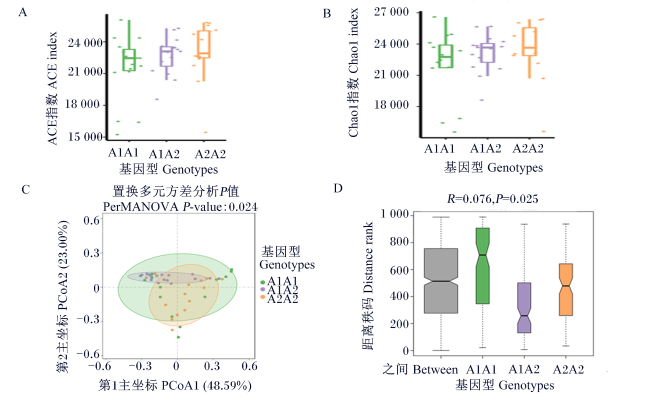
对比A1A1、A1A2和A2A2基因型奶牛之间瘤胃微生物群落α多样性指数的差异发现,A1A1基因型奶牛瘤胃微生物群落ACE指数和Chao1最低,但3者之间差异不显著(P>0.05)(图1-A图1-B)。β多样性分析结果显示,第1主坐标(PCoA1)和第2主坐标(PCoA2)的变化是71.59%(图1-C),表明了3种基因型奶牛瘤胃微生物群落物种基因的趋向特征;ANOSIM结果显示,3种基因型奶牛瘤胃微生物群间之间差异显著(R=0.076,P<0.05,图3-D)。
图1 瘤胃微生物群落的α和β多样性

A:α多样性ACE指数箱式图 ACE index box diagram of α diversity;B:α多样性Chao1指数箱形图 Chao1 index box diagram of α diversity;C:微生物群落组成PCoA图 PCoA map of microbial community composition;D:微生物群落ANSOIM图 ANSOIM map of microbial community。

Fig.1 α and β diversity of rumen microbial communities

2.3 不同基因型奶牛瘤胃微生物群落组成分析

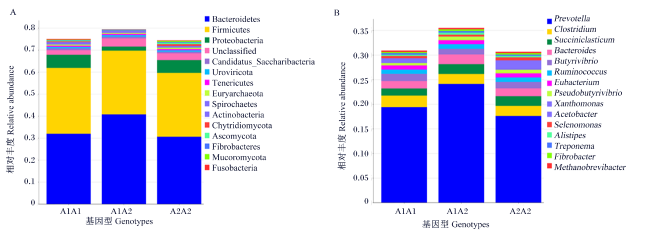
将代表序列与NCBI的NR进行比对和注释,共得到了4个届、200个门、355个纲、637个目、1 295个科和4 825个属。选取A1A1、A1A2和A2A2基因型奶牛的前15个丰富门和属绘制物种相对丰度柱形图(图2-A图2-B)发现,优势门水平微生物是拟杆菌门(Bacteroidetes)和厚壁菌门(Firmicutes),优势属水平微生物是普雷沃氏菌属(Prevotella)和梭菌属(Clostridium)。
图2 不同基因型奶牛瘤胃微生物群落组成差异

A:前15个门水平 top 15 at phylum level;B:前15个属水平 top 15 at genus level。

Bacteroidetes:拟杆菌门;Firmicutes:厚壁菌门;Proteobacteria:变形菌门;Tenericutes:软壁菌门;Euryarchaeota:广古菌门;Spirochaetes:螺旋体门;Actinobacteria:放线菌门;Chytridiomycota:壶菌门;Ascomycota:子囊菌门;Fibrobacteres:纤维杆菌门;Mucoromycota:毛霉门;Fusobacteria:梭杆菌门;Basidiomycota:担子菌门;Prevotella:普雷沃氏菌属;Clostridium:梭菌属;Succiniclasticum:解琥珀酸菌属;Bacteroides:拟杆菌属;Butyrivibrio:丁酸弧菌属;Ruminococcus:瘤胃球菌属;Eubacterium:真杆菌属;Pseudobutyrivibrio:假丁酸弧菌属;Xanthomonas:黄单胞菌属;Acetobacter:醋杆菌属;Selenomonas:月形单胞菌属;Alistipes:另枝菌属;Treponema:密螺旋体属;Fibrobacter:纤维杆菌属;Methanobrevibacter:甲烷短杆菌属。

Fig.2 Differences in rumen microbial community composition of cows with different genotypes

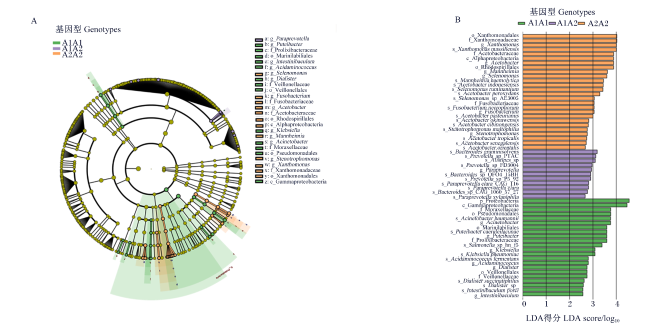
进一步通过LEfSe分析筛选与A2A2基因型奶牛相关的潜在生物标志物和基因组特征,根据LDA及进化分析(图3)可知,变形菌门(Proteobacteria)、Intestinibaculum、戴阿利斯特杆菌属(Dialister)、氨基酸球菌属(Acidaminococcus)、克雷伯氏菌属(Klebsiella)、井杆菌属(Puteibacter)和不动杆菌属(Acinetobacter)等菌群在A1A1基因型奶牛中显著富集(P<0.05);普雷沃氏菌科(Prevotellaceae)的帕拉普雷沃氏菌属(Paraprevotella)、Paraprevotella xylaniphila等菌群在A1A2基因型奶牛中显著富集(P<0.05);窄食单胞菌属(Stenotrophomonas)、梭杆菌属(Fusobacterium)、月形单胞菌属(Selenomonas)、曼海姆氏菌属(Mannheimia)、醋杆菌属(Acetobacter)和黄单胞菌属(Xanthomonas)等菌群在A2A2基因型奶牛中显著富集(P<0.05)。
图3 不同基因型奶牛瘤胃微生物群落组成LDA

A:进化分支图。奶牛瘤胃微生物在3组中显示出不同的相对丰度(以小圆圈和阴影突出表示)。从内到外有7层,分别对应7个分类学级别(界、门、纲、目、科、属和种)。与其他2个基因型相比,具有不同颜色的节点(小圆圈)代表相应基因型的微生物相对丰度更高,而黄色节点表示3个基因型之间统计和生物学差异不显著的微生物,通过LEfSe分析判别差异差异。B:LDA柱状图。

Paraprevotella:帕拉普雷沃氏菌属;Puteibacter:井杆菌属;Acidaminococcus:氨基酸球菌属;Selenomonas:月形单胞菌属;Dialister:戴阿利斯特杆菌属;Veillonellaceae:韦荣球菌科;Veillonellales:韦荣球菌目;Fusobacterium:梭杆菌属;Fusobacteriaceae:梭杆菌科;Acetobacter:醋杆菌属;Acetobacteraceae:醋杆菌科;Rhodospirillales:红螺菌目;Alphaproteobacteria:α变形杆菌纲;Klebsiella:克雷伯氏菌属;Mannheimia:曼海姆氏菌属;Acinetobacter:不动杆菌属;Moraxellaceae:莫拉氏菌科;Pseudomonadales:假单胞菌目;Stenotrophomonas:窄食单胞菌属;Xanthomonas:黄单胞菌属;Xanthomonadaceae:黄单胞菌科;Xanthomonadales:黄单胞菌目;Gammaproteobacteria:γ变形杆菌纲;Mannheimia haemolytica:溶血性曼氏杆菌;Acetobacter indonesiensis:印度尼西亚醋杆菌;Selenomonas ruminantium:反刍兽月形单胞菌;Acetobacter peroxydans:过氧化醋杆菌;Fusobacterium necrophorum:坏死梭杆菌;Acetobacter pasteurianus:巴氏醋杆菌;Acetobacter okinawensis:冲绳醋杆菌;Acetobacter cibinongensis:西比隆醋杆菌;Stenotrophomonas maltophilia:嗜麦芽窄食单胞菌;Acetobacter tropicalis:热带醋杆菌;Acetobacter orientalis:东方醋杆菌;Prevotella:普雷沃氏菌属;Alistipes:另枝菌属;Bacteroides:拟杆菌属;Proteobacteria:变形菌门;Acinetobacter baumannii:鲍曼不动杆菌;Salmonella:沙门氏菌属;Klebsiella pneumoniae:肺炎克雷伯菌;Acidaminococcus fermentans:发酵氨基酸球菌。

Fig.3 LDA in rumen microbial community composition of cows with different genotypes

A: evolutionary branching map. Dairy rumen microbes showed different relative abundances (highlighted by small circles and shadows) in the three groups. There were seven layers from the inside to the outside, corresponding to seven taxonomic levels (kingdom, phylum, class, order, family, genus and species). Compared with the other two genotypes, nodes with different colors (small circles) represented higher relative abundances of microorganisms of the corresponding genotypes, while yellow nodes represented microorganisms with no significant statistical and biological differences between the three genotypes, and the difference was identified by LEfSe analysis. B: LDA bar graph.

2.4 不同基因型奶牛瘤胃微生物群落基因功能注释

基于NCBI数据库对非冗余基因进行功能注释,结果显示:34.40%的基因被注释到KEGG数据库中,1.54%的基因被注释到CAZy数据库中,53.84%的基因被注释到基因的进化谱系:无监督的同源群(eggNOG)数据库中,0.10%的基因被注释到CARD中(表4)。
表4 组装和非冗余基因预测结果

Table 4 Assembly and nonredundant gene prediction results

数据库Databases 注释数量Annotated number/个 注释率Annotated ratio/%
NR 11 472 460 74.68
GO 4 795 894 31.22
eggNOG 8 270 685 53.84
KEGG 5 284 760 34.40
CAZy 236 725 1.54
CARD 15 153 0.10
PHI 761 795 4.96
VFDB 702 770 4.57

NR:非冗余蛋白序列数据库 non-redundant protein sequence database;GO:基因本体 gene ontology;eggNOG:基因的进化谱系:无监督的同源群 evolutionary genealogy of genes: non-supervised orthologous groups;KEGG:京都基因与基因组百科全书 Kyoto encyclopedia of genes and genomes;CAZy:碳水化合物活性酶 carbohydrate-active enzymes;CARD:综合抗生素耐药性数据库 comprehensive antibiotic resistance database;PHI:病原与宿主互作数据库 pathogen and host interaction database;VFBD:毒力因子数据库 virulence factor database。

2.4.1 不同基因型奶牛瘤胃微生物群落基因KEGG注释

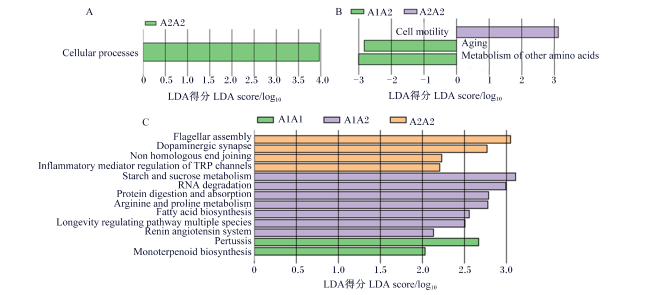
通过KEGG对瘤胃微生物组的基因进行功能注释,LEfSe分析显示,在1级水平上(图4-A),细胞过程显著富集在A2A2基因型奶牛中(P<0.05)。在2级水平上(图4-B),细胞运动显著富集在A2A2基因型奶牛中(P<0.05),老化和其他氨基酸代谢显著富集在A1A2基因型奶牛中(P<0.05)。在3级水平上共鉴定出310条KEGG通路(图4-C),其中单萜类化合物生物合成和百日咳通路在A1A1基因型奶牛中显著富集(P<0.05);淀粉和蔗糖代谢、脂肪酸生物合成、多物种长寿调节途径、蛋白质消化与吸收、肾素血管紧张素系统、精氨酸和脯氨酸代谢和RNA降解通路显著富集在A1A2基因型奶牛中(P<0.05);鞭毛组装、非同源末端连接、多巴胺能突触和瞬时受体电位通道的炎症介质调节通路显著富集在A2A2基因型奶牛中(P<0.05)。
图4 差异KEGG信号通路的LefSe分析图

A、B和C分别表示1级、2级和3级水平。

Cellular processes:细胞过程;Cell motility:细胞运动;Aging:老化;Metabolism of other amino acids:其他氨基酸代谢;Flagellar assembly:鞭毛组装;Dopaminergic synapse:多巴胺能突触;Non homologous end joining:非同源末端连接;Inflammatory mediator regulation of TRP channels:瞬时受体电位通道的炎症介质调节;Starch and sucrose metabolism:淀粉和蔗糖代谢;RNA degradation:RNA降解;Protein digestion and absorption:蛋白质消化与吸收;Arginine and proline metabolism:精氨酸和脯氨酸代谢;Fatty acid biosynthesis:脂肪酸生物合成;Longevity regulating pathway multiple species:多物种长寿调节途径;Renin angiotensin system:肾素血管紧张素系统;Pertussis:百日咳;Monoterpenoid biosynthesis:单萜类化合物生物合成。

Fig.4 LefSe analysis diagram of differential KEGG signaling pathways

A, B and C represented levels 1, 2 and 3, respectively.

2.4.2 不同基因型奶牛瘤胃微生物群落基因eggNOG注释

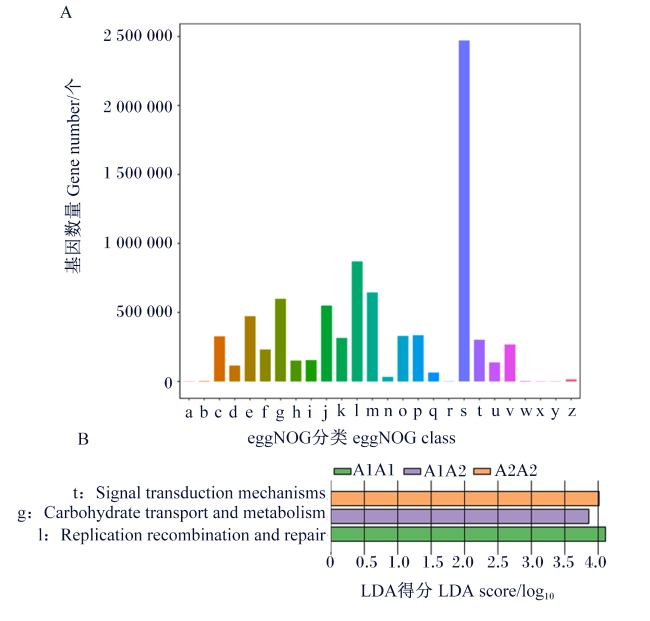
对宏基因组中的预测基因进行eggNOG功能分类预测发现,除功能未知的基因外,注释基因数目最多的是复制、重组和修复,其次是细胞壁/膜/包膜生物合成以及碳水化合物转运与代谢,富集到的基因数量分别为868 265、644 504和597 792个(图5)。通过LEfSe分析发现,A1A1基因型显著富集在复制、重组和修复;A1A2基因型显著富集在碳水化合物运输与代谢等生物学过程;A2A2基因型显著富集在信号转导机制中。
图5 COG分类(A)和基于eggNOG1级水平差异功能LDA(B)

a:RNA加工和修改 RNA processing and modification;b:染色质结构与动力学 chromatin structure and dynamics;c:能量产生和转换 energy production and conversion;d:细胞周期控制、细胞分裂、染色体分区 cell cycle control, cell division, chromosome partitioning;e:氨基酸转运与代谢 amino acid transport and metabolism;f:核苷酸转运与代谢 nucleotide transport and metabolism;g:碳水化合物转运与代谢 carbohydrate transport and metabolism;h:辅酶转运与代谢 coenzyme transport and metabolism;i:脂质转运与代谢 lipid transport and metabolism;j:翻译,核糖体结构和生物转化 translation, ribosomal structure and biogenesis;k:转录 transcription;l:复制、重组和修复 replication, recombination and repair;m:细胞壁/膜/包膜生物合成 cell wall/membrane/envelope biogenesis;n:细胞运动 cell motility;o:转译后修饰,蛋白质转换,分子伴侣 posttranslational modification, protein turnover, chaperones;p:无机离子转运和代谢 inorganic ion transport and metabolism;q:次生代谢产物生物合成、转运和分解代谢 secondary metabolites biosynthesis, transport and catabolism;r:通用功能预测 general function prediction only;s:未知功能 function unknown;t:信号转导机制 signal transduction mechanisms;u:胞内运输、分泌和囊泡运输 intracellular trafficking, secretion, and vesicular transport;v:防御机制 defense mechanisms;w:细胞外结构 extracellular structures;x:移动基因组(噬菌体原、转座子) mobilome (prophages, transposons);y:核结构 nuclear structure;z:细胞骨架 cytoskeleton。

Fig.5 COG classification (A) and LDA of differential functions based eggNOG level 1

2.4.3 不同基因型奶牛瘤胃微生物群落基因CARD注释

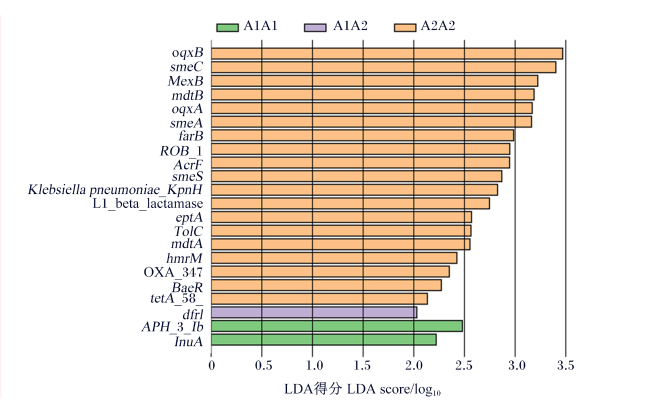
基于LEfSe分析的差异抗性基因(图6)可以看出,A2A2基因型奶牛的抗性基因主要富集于ROB_1、smeCsmeAsmeSOXA_347、L1_beta_lactamase、TolCbaeRmdtBmdtAtetA_58_、hmrMAcrFeptAKlebsiella pneumoniae_KpnHoqxAoqxBfarBMexB,A1A2基因型奶牛的抗性基因主要富集于dfrl,A1A1基因型奶牛的抗性基因主要富集于lnuAAPH_3_Ib。其中,A2A2基因型奶牛的抗性基因富集最多。
图6 基于LEfSe分析的差异抗性基因LDA

Fig.6 LDA of differential resistance genes based on LEfSe analysis

2.4.4 不同基因型奶牛瘤胃微生物群落基因CAZy注释

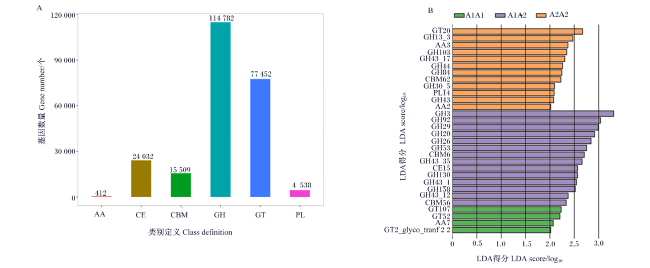
为进一步探究CAZy的活性,将预测基因与CAZy数据库进行比对注释,发现有236 725个基因比对到CAZy数据库中(图7-A);宏基因组中的葡萄糖苷水解酶(GH)、糖基转移酶(GT)、碳水化合物酯酶(CE)、碳水化合物结合模块(CBM)、多糖裂解酶(PL)和辅助活性(AA)基因数量分别为114 782、77 452、24 032、15 509、4 538和412个。在鉴定出的475种CAZy中,有246种GH、58种PL、60种CBM、16种CE、84种GT和11种AA。为了筛选组间具有显著差异的生物标志物,通过LEfSe分析得到LDA得分,发现有30种CAZy在3种基因型奶牛之间存在显著差异(P<0.05),其中GT52、GT107、AA7和GT2_glyco_tranf_2_2在A1A1基因型奶牛中显著富集(P<0.05);12种CAZy在A1A2基因型奶牛中显著富集(P<0.05),分别是CBM56、GH43_35、GH43_12、GH29、GH20、GH26、GH3、GH43_1、GH53、GH158、CBM6、GH92、CE15和GH130;12种CAZy在A2A2基因型奶牛中显著富集(P<0.05),分别是GH84、GH43、GH103、GH43_17、PL14、GH13_3、AA3、AA2、GH30_5、GH44、CBM62和GT20(图7-B)。
图7 基于LEfSe分析的差异碳水化合物基因LDA

A:CAZy数据库比对结果 comparison results of CAZy database;B:差异CAZy的LEfSe分析图 Linear LEfSe analysis diagram of differential CAZy。

AA:辅助活性 auxiliary activity;CE:碳水化合物酯酶 carbohydrate esterases;CBM:碳水化合物结合模块 carbohydrate binding modules;GH:葡萄糖苷水解酶 glucoside hydrolase;GT:糖基转移酶 glycosyl transferases;PL:多糖裂合酶 polysaccharide lyases。

Fig.7 LDA of differential carbohydrate gene based on LEfSe analysis

3 讨论

在瘤胃中,微生物将饲粮中的多糖消化成短链脂肪酸(SCFA),如乙酸、丁酸和丙酸,对动物能量摄入总量的贡献高达70%[40]。瘤胃内环境是由菌群、代谢产物与机体免疫三者共同调控的,对奶牛个体健康及生产性能有重要影响[41-44]。研究表明,β-酪蛋白对奶牛个体健康和泌乳性能至关重要[45-46]。然而,关于β-酪蛋白对奶牛瘤胃菌群的影响还没有相关研究。因此,本研究利用宏基因组技术对β-酪蛋白不同基因型奶牛瘤胃菌群结构及功能进行系统研究,探究3种基因型奶牛瘤胃微生物群落差异。研究结果表明,细菌是荷斯坦奶牛瘤胃微生物组成中最具代表性的群体,细菌中优势门水平微生物是拟杆菌门,优势属水平微生物是普雷沃氏菌属,这与Wu等[21]和Xue等[27]报道的荷斯坦奶牛瘤胃优势微生物一致。
本研究中,在饲养条件一致且胎次相同的荷斯坦奶牛中,A1A1基因型奶牛瘤胃Intestinibaculum、戴阿利斯特杆菌属、不动杆菌属和克雷伯氏菌属的相对丰度显著高于A1A2和A2A2基因型奶牛,其中戴阿利斯特杆菌属与抑郁症[47]、自闭症[47]、肥胖[48]和强直性脊柱炎疾病[49]等相关。研究表明,戴阿利斯特杆菌属可能通过释放脂多糖来诱导宿主炎症反应[49],高水平脂多糖会增加肠道通透性和促进慢性炎症反应[50]。克雷伯氏菌属是在肺炎的患者体内发现的一种著名的人类病原体,主要感染患有严重基础疾病(包括糖尿病或慢性肺梗阻)的免疫缺陷个体[51-52],并在炎症个体中富集[53]。同时,Yadav等[54]研究发现,A1牛奶对肺部具有促炎作用,据报道,A1型β-酪蛋白具有促炎症效应,可对胃肠、内分泌、神经和心血管等多系统产生消极影响,从而增加儿童患DM-Ⅰ、自闭症的风险[14-17]。因此,A1型β-酪蛋白对疾病的影响可能与戴阿利斯特杆菌属和克雷伯氏菌属有关。此外,值得一提的是,Takizawa等[55]发现Intestinibaculum和戴阿利斯特杆菌属可以产乳酸,与产甲烷的甲烷杆菌竞争,从而减少奶牛的肠道甲烷排放。基于上述研究结果,本研究推测β-酪蛋白的基因型可能影响甲烷排放。在功能水平上,基于KEGG注释显示,A1A1基因型奶牛瘤胃单萜类化合物的生物合成基因相对丰度显著高于A1A2型和A2A2基因型奶牛,而单萜类化合物对微生物具有毒性[56],这可能是导致A1A1基因型奶牛瘤胃微生物群落α多样性较低的原因。因此,本研究发现,A1A1基因型奶牛瘤胃标志菌群的Intestinibaculum、戴阿利斯特杆菌属、不动杆菌和克雷伯氏菌属可能与甲烷排放减少和部分疾病发病率升高有关,同时A1A1基因型奶牛瘤胃微生物群落α多样性较低,可能是由于单萜类化合物生物合成较多所引起的。
A1A2基因型奶牛中瘤胃显著富集的微生物大多数都属于普雷沃氏菌科。据报道,普雷沃氏菌科是瘤胃中占主导地位的糖酵解家族之一,且含有能够结合和消化多种碳水化合物底物的蛋白质[57]。KEGG富集显示,A1A2基因型奶牛富集到的淀粉和蔗糖代谢、脂肪酸生物合成、蛋白质消化和吸收以及精氨酸和脯氨酸代谢通路的基因数量较多;在eggNOG数据库中,碳水化合物转运与代谢通路也显著富集在A1A2基因型奶牛中,该基因型奶牛可能含有大量的木质纤维素降解酶基因。因此,在一定范围内,我们推测A1A2基因型奶牛的饲料消化能力相较于A1A1和A2A2基因型奶牛更强,可供奶牛稳定的消化营养物质,从而维持高产奶牛产奶量的相对稳定。
研究发现,A1和A2型β-酪蛋白对奶牛乳脂率有重要影响[9,58]。Marko等[8]研究发现,A2A2基因型奶牛的乳脂含量极显著高于A1A1和A1A2基因型奶牛,与本研究结果一致。本研究中,A2A2基因型奶牛瘤胃醋杆菌属的相对丰度显著高于A1A1和A1A2基因型奶牛,醋杆菌属是通过氧化糖来产生醋酸盐的主要细菌[59],醋酸盐是乳脂合成的前体之一,可直接参与乳腺中乳脂的合成[60]。此外,Gu等[61]研究发现,醋杆菌属可以促进牛奶中乳脂的合成。因此,推测A2A2基因型奶牛乳脂的合成可能与醋杆菌属有关。在CARD注释中发现,A2A2基因型奶牛有较多的抗性基因,且多数基因属于多重耐药基因。因此,本研究推断A2特色奶相较与普通奶不会导致肠道炎症[62-63]可能与耐药病原菌的出现有关。
GH是水解复合碳水化合物的糖苷键,大多数GH属于低聚糖降解酶,可降解植物细胞壁产生低聚糖[57,64-65]。Tyson等[66]研究发现,低聚糖降解酶的比例与反刍动物单糖和挥发性脂肪酸(VFA)的生成率成正比,可以促进营养物质的吸收和利用。本研究中,A1A2和A2A2基因型奶牛中GH家族富集较多,其最具代表性的是GH43,属于半纤维素酶,有利于营养吸收利用,促进奶牛乳的合成。Kumar等[9]研究发现,A1A1基因型奶牛的总产奶量、300 d产奶量及峰值产奶量都显著低于A1A2和A2A2基因型奶牛,这可能与GH家族的富集有关。但是,目前尚不清楚β-酪蛋白不同基因型奶牛对产奶量的具体调控机制。

4 结论

通过高通量测序发现,在饲养条件一致且胎次相同的荷斯坦奶牛中,A1A1基因型奶牛的瘤胃标志物微生物是Intestinibaculum和戴阿利斯特杆菌属,可能与减少甲烷排放和A1型β-酪蛋白以及部分疾病存在潜在关联;A1A2基因型奶牛的瘤胃标志微生物是普雷沃氏菌科,可能对饲粮消化有促进作用;A2A2基因型奶牛的瘤胃标志微生物是醋杆菌属,其相对丰度对乳脂含量有一定调节作用。
[1]
LIAO J, LIU Y F. Purification procedures meaningfully influence DNA quantification in milk[J]. LWT, 2018, 94:8-12.

DOI

[2]
JAISWAL L, WORKU M. Recent perspective on cow’s milk allergy and dairy nutrition[J]. Critical Reviews in Food Science and Nutrition, 2022, 62(27):7503-7517.

DOI

[3]
FERNÁNDEZ-RICO S, MONDRAGÓN A D C, LÓPEZ-SANTAMARINA A, et al. A2 milk:new perspectives for food technology and human health[J]. Foods, 2022, 11(16):2387.

DOI

[4]
FERRETTI L, LEONE P, SGARAMELLA V. Long range restriction analysis of the bovine casein genes[J]. Nucleic Acids Research, 1990, 18(23):6829-6833.

PMID

[5]
UL HAQ M R, KAPILA R, SHANDILYA U K, et al. Impact of milk derived β-casomorphins on physiological functions and trends in research:a review[J]. International Journal of Food Properties, 2014, 17(8):1726-1741.

DOI

[6]
DANILOSKI D, CUNHA N M D, MCCARTHY N A, et al. Health-related outcomes of genetic polymorphism of bovine β-casein variants:a systematic review of randomised controlled trials[J]. Trends in Food Science&Technology, 2021, 111:233-248.

[7]
DE POI R, DE DOMINICIS E, GRITTI E, et al. Development of an LC-MS method for the identification of β-casein genetic variants in bovine milk[J]. Food Analytical Methods, 2020, 13(12):2177-2187.

DOI

[8]
MARKO R, UROS G, BRANISLAV V, et al. Beta-casein gene polymorphism in serbian Holstein-Friesian cows and its relationship with milk production traits[J]. Acta Veterinaria, 2020, 70(4):497-510.

DOI

[9]
KUMAR A, SINGH R V, CHAUHAN A, et al. Genetic association analysis reveals significant effect of β-casein A1/A2 loci on production & reproduction traits in Frieswal crossbred cows[J]. Biological Rhythm Research, 2020, 51(8):1259-1272.

DOI

[10]
WADA Y, LÖNNERDAL B. Bioactive peptides released from in vitro digestion of human milk with or without pasteurization[J]. Pediatric Research, 2015, 77(4):546-553.

DOI

[11]
CIEŚLIŃSKA A, KOSTYRA E, KOSTYRA H, et al. Milk from cows of different β-casein genotypes as a source of β-casomorphin-7[J]. International Journal of Food Sciences and Nutrition, 2012, 63(4):426-430.

DOI PMID

[12]
NONI I D. Release of β-casomorphins 5 and 7 during simulated gastro-intestinal digestion of bovine β-casein variants and milk-based infant formulas[J]. Food Chemistry, 2008, 110(4):897-903.

DOI PMID

[13]
BOUTROU R, GAUDICHON C, DUPONT D, et al. Sequential release of milk protein-derived bioactive peptides in the jejunum in healthy humans[J]. The American Journal of Clinical Nutrition, 2013, 97(6):1314-1323.

DOI

[14]
CHIN-DUSTING J, SHENNAN J, JONES E, et al. Effect of dietary supplementation with β-casein A1 or A2 on markers of disease development in individuals at high risk of cardiovascular disease[J]. British Journal of Nutrition, 2006, 95(1):136-144.

DOI

[15]
SHENG X Y, LI Z L, NI J Y, et al. Effects of conventional milk versus milk containing only A2 β-casein on digestion in Chinese children:a randomized study[J]. Journal of Pediatric Gastroenterology and Nutrition, 2019, 69(3):375-382.

DOI

[16]
CHIA J S J, MCRAE J L, KUKULJAN S, et al. A1 beta-casein milk protein and other environmental pre-disposing factors for type 1 diabetes[J]. Nutrition & Diabetes, 2017, 7(5):e274.

[17]
MCLACHLAN C N S. β-casein A1,ischaemic heart disease mortality,and other illnesses[J]. Medical Hypotheses, 2001, 56(2):262-272.

DOI

[18]
KAY S I S, DELGADO S, MITTAL J, et al. Beneficial effects of milk having A2 β-casein protein:myth or reality?[J]. The Journal of Nutrition, 2021, 151(5):1061-1072.

DOI

[19]
JIANQIN S, LEIMING X, LU X, et al. Effects of milk containing only A2 beta casein versus milk containing both A1 and A2 beta casein proteins on gastrointestinal physiology,symptoms of discomfort,and cognitive behavior of people with self-reported intolerance to traditional cows’ milk[J]. Nutrition Journal, 2016, 15:35.

DOI

[20]
WANG Z, YU Y A, LI X Y, et al. Fermented soybean meal replacement in the diet of lactating Holstein dairy cows:modulated rumen fermentation and ruminal microflora[J]. Frontiers in Microbiology, 2021, 12:625857.

DOI

[21]
WU X, HUANG S, HUANG J F, et al. Identification of the potential role of the rumen microbiome in milk protein and fat synthesis in dairy cows using metagenomic sequencing[J]. Animals, 2021, 11(5):1247.

DOI

[22]
BUITENHUIS B, LASSEN J, NOEL S J, et al. Impact of the rumen microbiome on milk fatty acid composition of Holstein cattle[J]. Genetics Selection Evolution, 2019, 51(1):23.

DOI PMID

[23]
XUE M Y, SUN H Z, WU X H, et al. Multi-omics reveals that the rumen microbiome and its metabolome together with the host metabolome contribute to individualized dairy cow performance[J]. Microbiome, 2020, 8(1):64.

DOI

[24]
GUO C Y, JI S K, YAN H, et al. Dynamic change of the gastrointestinal bacterial ecology in cows from birth to adulthood[J]. MicrobiologyOpen, 2020, 9(11):e1119.

DOI PMID

[25]
FURMAN O, SHENHAV L, SASSON G, et al. Stochasticity constrained by deterministic effects of diet and age drive rumen microbiome assembly dynamics[J]. Nature Communications, 2020, 11(1):1904.

DOI PMID

[26]
BICKHART D M, WEIMER P J. Symposium review:host-rumen microbe interactions may be leveraged to improve the productivity of dairy cows[J]. Journal of Dairy Science, 2018, 101(8):7680-7689.

DOI

[27]
XUE M Y, SUN H Z, WU X H, et al. Assessment of rumen bacteria in dairy cows with varied milk protein yield[J]. Journal of Dairy Science, 2019, 102(6):5031-5041.

DOI PMID

[28]
TONG J J, ZHANG H, YANG D L, et al. Illumina sequencing analysis of the ruminal microbiota in high-yield and low-yield lactating dairy cows[J]. PLoS One, 2018, 13(11):e0198225.

[29]
XIAO S J, WANG Q H, LI C F, et al. Rapid identification of A1 and A2 milk based on the combination of mid-infrared spectroscopy and chemometrics[J]. Food Control, 2022, 134:108659.

DOI

[30]
NGUYEN D D, SOLAH V A, BUSETTI F, et al. Application of ultra-high performance liquid chromatography coupled to high-resolution mass spectrometry (OrbitrapTM) for the determination of beta-casein phenotypes in cow milk[J]. Food Chemistry, 2020, 307:125532.

DOI

[31]
DE POI R, DE DOMINICIS E, GRITTI E, et al. Correction to:development of an LC-MS method for the identification of β-casein genetic variants in bovine milk[J]. Food Analytical Methods, 2020, 13(12):2188-2191.

DOI

[32]
李艳艳, 卜建华, 韩丽云, 等. 奶牛A2型β-酪蛋白基因多态性及其与产奶性状、乳房性状育种值的关联分析[J]. 黑龙江畜牧兽医, 2022(17):65-69.

LI Y Y, BU J H, HAN L Y, et al. Polymorphism of β-casein A2 type gene and its association analysis with breeding values of milk production traits and udder traits in dairy cows[J]. Heilongjiang Animal Science and Veterinary Medicine, 2022(17):65-69. (in Chinese)

[33]
AMIN A B, ZHANG L, ZHANG J Y, et al. Metagenomic and metabolomic insights into the mechanism underlying the disparity in milk yield of Holstein cows[J]. Frontiers in Microbiology, 2022, 13:844968.

DOI

[34]
BOLGER A M, LOHSE M, USADEL B. Trimmomatic:a flexible trimmer for Illumina sequence data[J]. Bioinformatics, 2014, 30(15):2114-2120.

DOI

[35]
LANGMEAD B, SALZBERG S L. Fast gapped-read alignment with bowtie 2[J]. Nature Methods, 2012, 9(4):357-359.

DOI PMID

[36]
LI D H, LIU C M, LUO R B, et al. MEGAHIT:an ultra-fast single-node solution for large and complex metagenomics assembly via succinct de Bruijn graph[J]. Bioinformatics, 2015, 31(10):1674-1676.

DOI

[37]
HYATT D, CHEN G L, LOCASCIO P F, et al. Prodigal:prokaryotic gene recognition and translation initiation site identification[J]. BMC Bioinformatics, 2010, 11:119.

DOI

[38]
LI W, JAROSZEWSKI L, GODZIK A. Clustering of highly homologous sequences to reduce the size of large protein databases[J]. Bioinformatics, 2001, 17(3):282-283.

DOI PMID

[39]
BUCHFINK B, XIE C, HUSON D H. Fast and sensitive protein alignment using DIAMOND[J]. Nature Methods, 2015, 12(1):59-60.

DOI PMID

[40]
FLINT H J, BAYER E A, RINCON M T, et al. Polysaccharide utilization by gut bacteria:potential for new insights from genomic analysis[J]. Nature Reviews. Microbiology, 2008, 6(2):121-131.

DOI

[41]
CLEMMONS B A, VOY B H, MYER P R. Altering the gut microbiome of cattle:considerations of host-microbiome interactions for persistent microbiome manipulation[J]. Microbial Ecology, 2019, 77(2):523-536.

DOI

[42]
PETRI R M, SCHWAIGER T, PENNER G B, et al. Characterization of the core rumen microbiome in cattle during transition from forage to concentrate as well as during and after an acidotic challenge[J]. PloS One, 2013, 8(12):e83424.

DOI

[43]
BAINBRIDGE M L, CERSOSIMO L M, WRIGHT A D G, et al. Rumen bacterial communities shift across a lactation in Holstein,Jersey and Holstein×Jersey dairy cows and correlate to rumen function,bacterial fatty acid composition and production parameters[J]. FEMS Microbiology Ecology, 2016, 92(5):fiw059.

[44]
MYER P R, SMITH T P L, WELLS J E, et al. Rumen microbiome from steers differing in feed efficiency[J]. PloS One, 2015, 10(6):e0129174.

[45]
COSTA E SILVA R, DE MOURA J F P, DE SOUZA B B, et al. Polymorphism of the beta-casein gene and adaptability of Sindhi cows to semiarid conditions[J]. Tropical Animal Health and Production, 2021, 53(6):534.

DOI PMID

[46]
PERNA A, INTAGLIETTA I, GAMBACORTA E, et al. The influence of casein haplotype on quality,coagulation,and yield traits of milk from Italian Holstein cows[J]. Journal of Dairy Science, 2016, 99(5):3288-3294.

DOI

[47]
ANDREO-MARTÍNEZ P, GARCÍA-MARTÍNEZ N, SÁNCHEZ-SAMPER E P, et al. An approach to gut microbiota profile in children with autism spectrum disorder[J]. Environmental Microbiology Reports, 2020, 12(2):115-135.

DOI

[48]
ZHANG Q, ZOU R, GUO M, et al. Comparison of gut microbiota between adults with autism spectrum disorder and obese adults[J]. PeerJ, 2021, 9:e10946.

DOI

[49]
MENA-VÁZQUEZ N, RUIZ-LIMÓN P, MORENO-INDIAS I, et al. Adiposity is associated with expansion of the genus Dialister in rheumatoid arthritis patients[J]. Biomedicine&Pharmacotherapy, 2023, 160:114388.

[50]
CORNEJO-PAREJA I, MUÑOZ-GARACH A, CLEMENTE-POSTIGO M, et al. Importance of gut microbiota in obesity[J]. European Journal of Clinical Nutrition, 2019, 72(1):26-37.

DOI

[51]
PAPAJK J, MEZEROVÁ K, UVÍZL R, et al. Clonal diversity of Klebsiella spp. and Escherichia spp. strains isolated from patients with ventilator-associated pneumonia[J]. Antibiotics, 2021, 10(6):674.

DOI

[52]
CATOZZI C, SANCHEZ BONASTRE A, FRANCINO O, et al. The microbiota of water buffalo milk during mastitis[J]. PLoS One, 2017, 12(9):e0184710.

[53]
DELPLANQUE M, BENECH N, ROLHION N, et al. Gut microbiota alterations are associated with phenotype and genotype in familial Mediterranean fever[J/OL]. Rheumatology:kead322[2023-05-02].https://doi.org/10.1093/rheumatology/kead322.

[54]
YADAV S, YADAV N D S, GHEWARE A, et al. Oral feeding of cow milk containing A1 variant of β casein induces pulmonary inflammation in male Balb/c mice[J]. Scientific Reports, 2020, 10(1):8053.

DOI PMID

[55]
TAKIZAWA S, SHINKAI T, KOBAYASHI Y, et al. Rumen microbial composition associated with the non-glucogenic to glucogenic short-chain fatty acids ratio in Holstein cows[J]. Animal Science Journal, 2023, 94(1):e13829.

DOI

[56]
张帆, 王颖, 李春. 单萜类化合物的微生物合成[J]. 生物工程学报, 2022, 38(2):427-442.

ZHANG F, WANG Y, LI C. Microbial synthesis of monoterpenoids:a review[J]. Chinese Journal of Biotechnology, 2022, 38(2):427-442. (in Chinese)

[57]
STEWART R D, AUFFRET M D, WARR A, et al. Assembly of 913 microbial genomes from metagenomic sequencing of the cow rumen[J]. Nature Communications, 2018, 9(1):870.

DOI PMID

[58]
DE VITTE K, KERZIENE S, KLEMENTAVIČIŪTĒ J, et al. Relationship between β-casein genotypes (A1A1,A1A2,and A2A2) and coagulation properties of milk and the fatty acid composition and sensory characteristics of dairy products (soft cheese,sour cream,and butter)[J]. Acta Agriculturae Scandinavica,Section A:Animal Science, 2022, 71(1/4):21-32.

[58]
MARKO R, UROS G, BRANISLAV V, et al. Beta-casein gene polymorphism in serbian Holstein-Friesian cows and its relationship with milk production traits[J]. Acta Veterinaria, 2020, 70(4):497-510.

DOI

[59]
LYONS T, BIELAK A, DOYLE E, et al. Variations in methane yield and microbial community profiles in the rumen of dairy cows as they pass through stages of first lactation[J]. Journal of Dairy Science, 2018, 101(6):5102-5114.

DOI PMID

[60]
URRUTIA N L, HARVATINE K J. Acetate dose-dependently stimulates milk fat synthesis in lactating dairy cows[J]. The Journal of Nutrition, 2017, 147(5):763-769.

DOI

[61]
GU F F, LIANG S L, ZHU S L, et al. Multi-omics revealed the effects of rumen-protected methionine on the nutrient profile of milk in dairy cows[J]. Food Research International, 2021, 149:110682.

DOI

[62]
UL HAQ M R, KAPILA R, SHARMA R, et al. Comparative evaluation of cow β-casein variants (A1/A2) consumption on Th2-mediated inflammatory response in mouse gut[J]. European Journal of Nutrition, 2014, 53(4):1039-1049.

DOI PMID

[63]
LIU B, QIAO W C, ZHANG M H, et al. Bovine milk with variant β-casein types on immunological mediated intestinal changes and gut health of mice[J]. Frontiers in Nutrition, 2022, 9:970685.

DOI

[64]
SINGH K M, REDDY B, PATEL D, et al. High potential source for biomass degradation enzyme discovery and environmental aspects revealed through metagenomics of Indian buffalo rumen[J]. BioMed Research International, 2014, 2014:267189.

[65]
WILKE A, HARRISON T, WILKENING J, et al. The M5nr:a novel non-redundant database containing protein sequences and annotations from multiple sources and associated tools[J]. BMC Bioinformatics, 2012, 13:141.

DOI

[66]
TYSON G W, CHAPMAN J, HUGENHOLTZ P, et al. Community structure and metabolism through reconstruction of microbial genomes from the environment[J]. Nature, 2004, 428(6978):37-43.

DOI

文章导航

/