研究论文

不同纤维源对断奶仔猪生长性能、血清生化指标、肠道通透性和粪便微生物的影响

  • 刘宁 , 1 ,
  • 刘攀 1 ,
  • 郎育杰 1 ,
  • 卢小斌 1 ,
  • 褚瑰燕 1 ,
  • 曾祥芳 2 ,
  • 谯仕彦 2 ,
  • 蔡传江 , 1, *
展开
  • 1 西北农林科技大学动物科技学院,杨凌 712100
  • 2 中国农业大学动物科技学院,北京 100193
* 蔡传江,副教授,博士生导师,E-mail:

刘宁(1998—),女,山东泰安人,硕士研究生,从事动物营养与饲料科学研究。E-mail:

Copy editor: 田艳明

收稿日期: 2023-08-11

  网络出版日期: 2024-02-01

基金资助

国家重点研发计划项目(2022YFD1300501)

Effects of Different Fiber Sources on Growth Performance, Serum Biochemical Indices, Intestinal Permeability and Fecal Microorganisms of Weaned Piglets

  • LIU Ning , 1 ,
  • LIU Pan 1 ,
  • LANG Yujie 1 ,
  • LU Xiaobin 1 ,
  • CHU Guiyan 1 ,
  • ZENG Xiangfang 2 ,
  • QIAO Shiyan 2 ,
  • CAI Chuanjiang , 1, *
Expand
  • 1 College of Animal Science and Technology, Northwest A&F University, Yangling 712100, China
  • 2 College of Animal Science and Technology, China Agricultural University, Beijing 100193, China
* associate professor, E-mail:

Received date: 2023-08-11

  Online published: 2024-02-01

摘要

本试验旨在研究麦麸(WB)和甜菜粕(SBP)对断奶仔猪生长性能、血清生化指标、肠道通透性和粪便微生物的影响。选取75头28日龄平均体重为(8.25±0.83) kg、健康的三元(杜×长×大)杂交断奶仔猪,随机分为5个组,每组5个重复,每个重复3头猪。5个组分别饲喂基础饲粮(CON组)、4%和8%WB替代基础饲粮的饲粮(WB4组和WB8组)以及4%和8%SBP替代基础饲粮的饲粮(SBP4组和SBP8组)。试验期28 d,分为第1~14天和第15~28天2个阶段。测定每头猪初始体重、第14天和第28天体重及试验期间耗料量,在试验结束时采集血液样本进行血清指标的测定,试验第14天和28天采集直肠粪便样品进行16S rRNA测序。结果表明:1)试验第1~14天,与WB4组相比,SBP8组断奶仔猪平均日增重显著提高(P<0.05),料重比显著降低(P<0.05)。2)SBP8组血清总胆固醇含量显著低于WB8组(P<0.05)。3)SBP4组血清二胺氧化酶活性极显著低于WB4组和WB8组(P<0.01);与CON组和WB8组相比,SBP4组和SBP8组血清内毒素含量极显著降低(P<0.01);与CON组和SBP4组相比,SBP8组血清D-乳酸含量显著降低(P<0.05)。4)SBP4组和SBP8组血清白细胞介素-1β(IL-1β)含量极显著低于CON组(P<0.01);SBP8组血清白细胞介素-10含量极显著高于CON组和WB4组(P<0.01);SBP8组血清肿瘤坏死因子-α含量极显著低于WB4组、WB8组和SBP4组(P<0.01);与CON组和WB4组相比,SBP4和SBP8组血清免疫球蛋白G含量极显著提高(P<0.01)。5)试验第14天,SBP4组和SBP8组粪便微生物群落Simpson指数显著低于CON组(P<0.05)。线性判别分析效应大小(LEfSe)分析结果发现,试验第14天,粪球菌属(Coprococcus)在SBP8组中显著富集(P<0.05);试验第28天,毛螺菌科NK4A136群(Lachnospiraceae_NK4A136_group)在SBP8组中显著富集(P<0.05)。相关性分析表明,粪便未分类毛螺菌科(unclassified_f_Lachnospiraceae)相对丰度与血清IL-1β含量呈显著负相关(P<0.05)。综上所述,8%SBP替代基础饲粮可以提高断奶仔猪生长性能,增强机体免疫功能和肠道屏障功能,并通过调节肠道菌群结构,提高有益菌丰度,促进肠道健康。

本文引用格式

刘宁 , 刘攀 , 郎育杰 , 卢小斌 , 褚瑰燕 , 曾祥芳 , 谯仕彦 , 蔡传江 . 不同纤维源对断奶仔猪生长性能、血清生化指标、肠道通透性和粪便微生物的影响[J]. 动物营养学报, 2024 , 36(2) : 833 -846 . DOI: 10.12418/CJAN2024.077

Abstract

This experiment was conducted to investigate the effects of wheat bran (WB) and sugar beet pulp (SBP) on growth performance, serum biochemical indices, intestinal permeability and fecal microorganisms of weaned piglets. A total of 75 healthy Duroc×Landrace×Yorkshire crossbred weaned piglets with an average body weight of (8.25±0.83) kg at the age of 28 days were randomly divided into 5 groups with 5 replicates per group and 3 pigs per replicate. Pigs in the five groups were fed a basal diet (CON group), diets in which 4% and 8% WB replaced with the basal diet (WB4 and WB8 groups), and diets in which 4% and 8% SBP replaced with the basal diet (SBP4 and SBP8 groups), respectively. The experiment lasted for 28 days, which was divided into two stages as days 1 to 14 and days 15 to 28. The initial body weight of each pig, body weight on days 14 and 28 and feed consumption during the experiment were determined, the blood samples were collected at the end of the experiment for the determination of serum indices, and the rectal fecal samples were collected on days 14 and 28 for 16S rRNA sequencing. The results showed as follows: 1) from days 1 to 14 of the experiment, compared with WB4 group, the average daily gain of weaned piglets in SBP8 group was significantly increased (P<0.05), and the ratio of feed to gain was significantly decreased (P<0.05). 2) The serum total cholesterol content in SBP8 group was significantly lower than that in WB8 group (P<0.05). 3) The serum diamine oxidase activity in SBP4 group was extremely significantly lower than that in WB4 and WB8 groups (P<0.01); compared with CON group and WB8 group, the serum endotoxin content in SBP4 and SBP8 groups was extremely significantly decreased (P<0.01); compared with CON group and SBP4 group, the serum D-lactic acid content in SBP8 group was significantly decreased (P<0.05). 4) The serum interleukin-1β (IL-1β) content in SBP4 and SBP8 groups was extremely significantly lower than that in CON group (P<0.01); the serum interleukin-10 content in SBP8 group was extremely significantly higher than that in CON group and WB4 group (P<0.01); the serum tumor necrosis factor-α content in SBP8 group was extremely significantly lower than that in WB4, WB8 and SBP4 groups (P<0.01); compared with CON group and WB4 group, the serum immunoglobulin G content in SBP4 and SBP8 groups was extremely significantly increased (P<0.01). 5) On day 14, the Simpson index of fecal microbial community in SBP4 and SBP8 groups was significantly lower than that in CON group (P<0.05). Linear discriminant analysis effect size (LEfSe) analysis showed that on day 14, Coprococcus was significantly enriched in SBP8 group (P<0.05); on day 28, Lachnospiraceae_NK4A136_group was significantly enriched in SBP8 group (P<0.05). Correlation analysis showed that the unclassified_f_Lachnospiraceae relative abundance of in feces was significantly negatively correlated with the serum IL-1β content (P<0.05). In conclusion, 8% SBP replacement of the basal diet can improve the growth performance of weaned piglets, enhance the immune function and intestinal barrier function, and improve the abundance of beneficial bacteria by regulating the structure of intestinal flora, and promote intestinal health.

断奶仔猪的消化系统和免疫系统尚在发育之中,其消化机能和调节能力均处于较弱的阶段。仔猪在断奶前后的时期通常表现为肠道菌群紊乱以及肠道形态和肠道屏障受损,从而导致仔猪生长受阻并伴有腹泻,严重时可引起死亡[1]。因此,制定有效的饲粮配方来维持断奶仔猪肠道健康和改善生产性能是至关重要的。在传统营养学研究中,纤维被认为是一种抗营养因子,因为其不能被内源性消化酶分解,会降低营养物质的消化率,从而影响动物的生产性能[2]。而今,越来越多的研究已经揭示纤维对动物健康的积极作用。纤维可提高动物机体的免疫防御功能,并对动物的肠道健康起着重要作用,因为它不仅改善了肠道上皮屏障功能,而且可以通过调节肠道微生物组成来维持宿主肠道菌群环境的稳态[3-4]。麦麸(wheat bran,WB)是面粉加工过程中产生的副产品,主要由阿拉伯木聚糖、纤维素和β-葡聚糖组成[5]。甜菜粕(sugar beet pulp,SBP)是甜菜在制糖过程产生的副产品,主要由纤维素、半纤维素、果胶和葡聚糖组成,且含有丰富的甜菜碱[6-7]。研究发现,WB可使断奶仔猪的平均日增重(average daily gain,ADG)增加,腹泻率降低,肠道屏障增强;SBP可使肠道乳酸菌相对丰度提高但对生长性能无积极作用[8]。也有报道称,SBP可使断奶仔猪后肠中乙酸含量产生增加[9],且SBP的量不同,对生长性能的影响亦不同[10]。目前,WB和SBP对断奶仔猪的影响差异研究较少且尚不明确。因此,本试验旨在研究WB和SBP这2种纤维来源对断奶猪生长性能、血清生化指标、肠道通透性和粪便微生物的影响,以期为WB和SBP在断奶仔猪中的应用提供依据。

1 材料与方法

1.1 试验设计和试验饲粮

试验选取75头28日龄平均体重为(8.25±0.83) kg、健康的三元(杜×长×大)杂交断奶仔猪,随机分为5个组,每组5个重复(栏),每个重复3头猪。5个组分别饲喂基础饲粮(CON组)、4%和8%WB替代基础饲粮的饲粮(WB4组和WB8组)以及4%和8%SBP替代基础饲粮的饲粮(SBP4组和SBP8组)。试验饲粮参照NRC(2012)猪营养需要标准进行配制,其组成及营养水平见表1。试验期28 d,分为第1~14天和第15~28天2个阶段。
表1 试验饲粮组成及营养水平(风干基础)

Table 1 Composition and nutrient levels of experimental diets (air-dry basis)%

项目
Items
第1~14天 Days 1 to 14 第15~28天 Days 15 to 28
CON WB4 WB8 SBP4 SBP8 CON WB4 WB8 SBP4 SBP8
原料 Ingredient
玉米 Corn 54.65 39.37 24.14 34.48 14.33 57.68 42.33 26.98 38.32 18.98
玉米淀粉 Corn starch 3.00 13.10 23.19 16.64 30.27 10.40 20.60 30.80 23.45 36.49
豆粕 Soybean meal 6.69 7.80 8.90 9.14 11.59 10.80 11.90 13.00 13.10 15.40
发酵豆粕 Fermented soybean meal 7.99 8.00 8.00 7.99 7.99 6.00 6.00 6.00 6.00 6.00
乳清粉 Whey powder 9.99 10.00 10.00 9.99 9.99
鱼粉 Fish meal 3.00 3.00 3.00 3.00 3.00 2.00 2.00 2.00 2.00 2.00
麦麸 Wheat bran 4.00 8.00 4.00 8.00
甜菜粕 Sugar beet pupl 4.00 8.00 4.00 8.00
蔗糖 Sucrose 2.00 2.00 2.00 2.00 2.00 2.00 2.00 2.00 2.00 2.00
葡萄糖 Glucose 2.00 2.00 2.00 2.00 2.00
大豆浓缩蛋白
Soybean protein concentrate
6.00 6.00 6.00 6.00 6.00 6.00 6.00 6.00 6.00 6.00
大豆磷脂油粉
Soybean phospholipid oil powder
1.00 1.00 1.00 1.00 1.00 1.00 1.00 1.00 1.00 1.00
磷酸氢钙 CaHPO4 0.62 0.58 0.54 0.78 0.94 0.79 0.77 0.75 0.81 0.82
石粉 Limestone 0.65 0.74 0.82 0.57 0.48 1.13 1.20 1.27 1.12 1.11
氧化锌 ZnO 0.21 0.21 0.21 0.21 0.21
预混料 Premix1) 2.20 2.20 2.20 2.20 2.20 2.20 2.20 2.20 2.20 2.20
合计 Total 100.00 100.00 100.00 100.00 100.00 100.00 100.00 100.00 100.00 100.00
营养水平 Nutrient level2)
消化能 DE/(MJ/kg) 14.59 14.59 14.59 14.59 14.59 14.63 14.63 14.63 14.63 14.63
粗蛋白质 CP 18.12 18.27 18.00 18.05 18.11 18.48 18.13 18.03 18.75 18.48
粗脂肪 EE 3.91 3.24 3.20 3.87 3.12 3.74 3.17 3.13 3.06 2.35
粗灰分 Ash 5.38 5.51 5.76 5.61 5.79 4.94 5.09 5.31 5.01 5.32
中性洗涤纤维 NDF 7.10 7.70 7.90 7.10 6.90 7.80 7.80 7.80 6.90 7.00
酸性洗涤纤维 ADF 2.90 3.10 3.20 3.50 4.10 3.50 3.20 3.20 3.10 3.90
钙 Ca 0.60 0.69 0.73 0.66 0.79 0.84 0.94 0.94 0.94 0.99
总磷 TP 0.51 0.54 0.57 0.55 0.58 0.50 0.54 0.52 0.52 0.49

1)预混料为每千克饲粮提供 The premix provided the following per kg of diets:VA 20 000 IU,VB1 2.5 mg,VB2 8 mg,VB6 5 mg,VB12 0.05 mg,VD3 3 000 IU,VE 40 IU,VK3 2.5 mg,生物素 biotin 0.3 mg,叶酸 folic acid 5 mg,D-泛酸 D-pantothenic acid 20 mg,烟酸 nicotinic acid 40 mg,Cu 150 mg,Fe 100 mg,Mn 47.5 mg,Zn 100 mg,I 0.75 mg,Se 0.40 mg。

2)消化能为计算值,其余为实测值。DE was a calculated value, while the others were measured values.

1.2 饲养管理

试验在西北农林科技大学畜禽生态养殖场进行,采用全进全出制饲养管理模式,全漏缝地面饲养。每个圈舍均配有1个乳头式饮水器和1个3孔不锈钢可调节自动料槽,保证试验猪自由采食和饮水。每天打扫圈舍,保持猪舍干燥、通风,记录猪只健康状况。

1.3 测定指标及方法

1.3.1 营养物质含量测定

饲粮中粗蛋白质、粗脂肪、粗灰分、中性洗涤纤维、酸性洗涤纤维、钙和总磷含量分别参考GB/T 6432—2018、GB/T 6433—2006、GB/T 6438—2007、GB/T 20806—2022、NY/T 1459—2022、GB/T 6436—2018和GB/T 6437—2018的方法进行测定。饲粮和粪便总能参照国际标准ISO 9831:1998方法,采用氧弹式热量仪(IKA C200,德国)进行测定,饲粮消化能=饲粮总能-粪便总能。

1.3.2 生长性能

分别于试验期第1、14和28天早晨,以个体为单位对全部的试验猪进行空腹称重,试验过程中每天记录投放饲粮量,计算试验第1阶段(第1~14天)、试验第2阶段(第15~28天)和试验全期(第1~28天)仔猪的ADG、平均日采食量(average daily feed intake,ADFI)和料重比(feed to gain raito,F/G)。在试验期间,每天定时进行粪便评分,依据粪便形状评为1~5分[11]。观察并记录每个圈舍仔猪的腹泻及健康状况,统计腹泻仔猪头数,粪便连续2 d评分在4~5分则为腹泻,计算腹泻率,公式如下:
腹泻率(%)=100×Σ[(腹泻头数×腹泻天数)/(每栏仔猪头数×试验天数)]。

1.3.3 血清生化指标

于试验期第28天早晨,经过12 h空腹后,从每个重复中选取1头中等体重的猪,经前腔静脉采集血液样本到10 mL的真空采血管中,3 000 r/min离心10 min后得到血清。将血清样品在-80 ℃冰箱中冷冻保存,直到分析。使用迈瑞BC-30S全自动生化分析仪测定血清中葡萄糖(glucose,GLU)、甘油三酯(triglyceride,TG)、总胆固醇(total cholesterol,TC)、尿素氮(urea nitrogen,UN)、总蛋白(total protein,TP)、白蛋白(serum albumin,ALB)、高密度脂蛋白(high density lipoprotein,HDL)和低密度脂蛋白(low density lipoprotein,LDL)含量。

1.3.4 血清中肠道通透性标志物含量

采用酶联免疫吸附测定(ELISA)试剂盒(上海恒远生物科技有限公司)测定血清中二胺氧化酶(diamine oxidase,DAO)活性以及内毒素和D-乳酸含量,具体操作步骤根据试剂盒说明书进行。

1.3.5 血清免疫指标

采用ELISA试剂盒(上海恒远生物科技有限公司)测定血清炎症因子和免疫球蛋白含量,炎症因子包括白细胞介素-1β(interleukin-1β,IL-1β)、白细胞介素-10(interleukin-10,IL-10)、肿瘤坏死因子-α(tumor necrosis factor-α,TNF-α),免疫球蛋白包括免疫球蛋白A(immunoglobulin A,IgA)、免疫球蛋白G(immunoglobulin G,IgG)和免疫球蛋白M(immunoglobulin M,IgM),具体操作步骤根据试剂盒说明书进行。

1.3.6 粪便微生物群落

分别于试验期第14天和第28天,从每个重复中选择1头试验猪收集其直肠新鲜粪便样本,装入2 mL的无菌冻存管中,并立即用液氮快速冷冻,储存在-80 ℃用于测定微生物群落结构。采用Omega Soil DNA提取试剂盒提取粪便的DNA样品并进行PCR扩增,并送至上海美吉生物医药科技有限公司进行16S rRNA测序,测序流程包括DNA质检、Illumina文库构建和Illumina测序。通过对所得原始测序序列进行质控、过滤和双端拼接获得优化数据,使用序列降噪方法处理优化数据,获得扩增子序列变异(amplicon sequence variant,ASV)代表序列和丰度信息。利用美吉生物云平台进行菌群的多样性分析、组成分析、物种差异分析和相关性分析。

1.4 数据统计与分析

采用Excel 2021对试验数据进行初步整理,并采用SAS 9.4软件对数据进行完全随机设计的方差分析,通过正交多项式对比评估随着WB和SBP替代量增加的线性和二次效应,当线性和二次效应都显著时,只讨论二次效应。数据结果以平均值和均值标准误(SEM)表示,P<0.01表示差异极显著,P<0.05表示差异显著。

2 结果与分析

2.1 不同纤维源对断奶仔猪生长性能和腹泻率的影响

表2可知,试验第1阶段(第1~14天),与WB4组相比,SBP8组断奶仔猪ADG显著提高(P<0.05),F/G显著降低(P<0.05);ADG随饲粮中SBP替代量的增加呈线性升高(P<0.05)。试验全期(第1~28天),ADG随饲粮中SBP替代量的增加呈线性升高(P<0.05)。各组间腹泻率均无显著差异(P>0.05)。
表2 不同纤维源对断奶仔猪生长性能和腹泻率的影响

Table 2 Effects of different fiber sources on growth performance and diarrhea rate of weaned piglets

项目
Items
组别 Groups 均值
标准误
SEM
PP-value
CON WB4 WB8 SBP4 SBP8 处理
Treatment
WB线性
Linear of
WB
WB二次
Quadratic
of WB
SBP线性
Linear of
SBP
SBP二次
Quadratic
of SBP
第1~14天 Days 1 to 14
平均日采食量
ADFI/g
457 461 492 519 495 20.033 0.112 0.295 0.636 0.169 0.235
平均日增重
ADG/g
264ab 239b 271ab 290ab 313a 16.279 0.036 0.806 0.270 0.008 0.368
料重比 F/G 1.74ab 1.96a 1.83ab 1.81ab 1.58b 0.076 0.037 0.536 0.183 0.050 0.089
腹泻率
Diarrhea rate/%
3.33 1.90 2.38 1.43 2.86 0.018 0.947 0.848 0.513 0.690 0.678
第15~28天 Days 15 to 28
平均日采食量
ADFI/g
742 828 845 915 878 41.595 0.083 0.126 0.372 0.115 0.121
平均日增重
ADG/g
429 458 457 497 487 33.382 0.622 0.585 0.593 0.269 0.359
料重比 F/G 1.78 1.81 1.88 1.84 1.80 0.069 0.862 0.324 0.792 0.869 0.651
腹泻率
Diarrhea rate/%
11.90 3.81 5.71 4.76 4.29 0.025 0.197 0.431 0.083 0.526 0.517
第1~28天 Days 1 to 28
平均日采食量
ADFI/g
599 645 668 712 686 27.211 0.067 0.139 0.634 0.117 0.115
平均日增重
ADG/g
347 348 364 395 400 19.415 0.175 0.589 0.911 0.041 0.175
料重比 F/G 1.75 1.86 1.84 1.80 1.71 0.044 0.137 0.193 0.259 0.607 0.301
腹泻率
Diarrhea rate/%
7.62 2.86 4.05 3.10 3.57 0.017 0.294 0.476 0.096 0.494 0.567

同行数据肩标无字母或相同小写字母表示差异不显著(P>0.05),不同小写字母表示差异显著(P<0.05),不同大写字母表示差异极显著(P<0.01)。下表同。

In the same row, values with no letter or the same small letter superscripts mean no significant difference (P>0.05), while with different small letter superscripts mean significant difference (P<0.05), and with different capital letter superscripts mean significant difference (P<0.01). The same as below.

2.2 不同纤维源对断奶仔猪血清生化指标的影响

表3可知,SBP8组断奶仔猪血清TC含量显著低于WB8组(P<0.05)。各组间其他血清生化指标均无显著差异(P>0.05)。
表3 不同纤维源对断奶仔猪血清生化指标的影响

Table 3 Effects of different fiber sources on serum biochemical indices of weaned piglets

项目
Items
组别 Groups 均值
标准误
SEM
PP-value
CON WB4 WB8 SBP4 SBP8 处理
Treatment
WB线性
Linear of
WB
WB二次
Quadratic
of WB
SBP线性
Linear of
SBP
SBP二次
Quadratic
of SBP
葡萄糖
GLU/(mg/mL)
0.67 0.68 0.64 0.69 0.65 0.022 0.493 0.299 0.403 0.522 0.354
甘油三酯
TG/(μg/mL)
645.28 664.80 618.25 636.64 606.17 26.397 0.569 0.484 0.331 0.361 0.763
总胆固醇
TC/(μg/mL)
275.07ab 262.46ab 294.24a 268.79ab 251.55b 8.920 0.042 0.199 0.098 0.072 0.592
尿素氮
UN/(mg/mL)
0.07 0.07 0.09 0.08 0.11 0.014 0.260 0.284 0.860 0.061 0.748
总蛋白
TP/(mg/mL)
76.58 80.23 77.64 69.67 71.82 3.535 0.248 0.816 0.439 0.479 0.438
白蛋白
ALB/(g/L)
31.20 31.10 29.96 29.07 26.82 1.627 0.341 0.652 0.828 0.092 0.977
高密度脂蛋白
HDL/(mmol/L)
0.77 0.83 0.76 0.80 0.77 0.032 0.556 0.922 0.197 0.972 0.416
低密度脂蛋白
LDL/(mmol/L)
2.52 2.51 2.41 2.40 2.36 0.132 0.879 0.538 0.742 0.526 0.869

2.3 不同纤维源对断奶仔猪血清中肠道通透性标志物含量的影响

表4可知,SBP4组断奶仔猪血清DAO活性极显著低于WB4组和WB8组(P<0.01);与CON组和WB8组相比,SBP4组、SBP8组和WB4组血清内毒素含量极显著降低(P<0.01);与CON组和SBP4组相比,SBP8组血清D-乳酸含量显著降低(P<0.05)。此外,血清内毒素含量随饲粮中WB替代量的增加呈先降低后提高的二次变化(P<0.05),血清D-乳酸含量随饲粮中SBP替代量的增加呈先提高后降低的二次变化(P<0.05)。
表4 不同纤维源对断奶仔猪血清中肠道通透性标志物含量的影响

Table 4 Effects of different fiber sources on serum marker contents of intestinal permeability of weaned piglets

项目
Items
组别 Groups 均值
标准误
SEM
PP-value
CON WB4 WB8 SBP4 SBP8 处理
Treatment
WB线性
Linear
of WB
WB二次
Quadratic
of WB
SBP线性
Linear
of SBP
SBP二次
Quadratic
of SBP
二胺氧化酶
DAO/(U/L)
390.26ABab 417.55Aa 416.16Aa 392.97Bb 407.47ABab 5.533 0.007 0.122 0.118 0.112 0.500
内毒素
Endotoxin/
(pg/mL)
537.36Aa 459.63Bb 514.44Aa 441.94Bb 468.16Bb 10.499 <0.001 0.258 0.004 0.100 0.102
D-乳酸
D-lactate/
(μg/L)
2 208.18a 2 143.47ab 2 182.97ab 2 213.84a 2 084.61b 27.660 0.025 0.609 0.239 0.001 0.007

2.4 不同纤维源对断奶仔猪血清免疫指标的影响

表5可知,WB8组、SBP4组和SBP8组断奶仔猪血清IL-1β含量极显著低于CON组(P<0.01);SBP8组血清IL-10含量极显著高于CON组和WB4组(P<0.01);SBP8组血清TNF-α含量极显著低于WB4组、WB8组和SBP4组(P<0.01);与CON组和WB4组相比,SBP4组和SBP8组血清IgG含量极显著提高(P<0.01);与WB4组相比,WB8组和CON组血清IgG含量极显著提高(P<0.01)。此外,血清IL-10含量随饲粮中SBP替代量的增加呈线性升高(P<0.05),血清TNF-α含量随饲粮中WB和SBP替代量的增加呈先提高后降低的二次变化(P<0.05),血清IgG含量随饲粮中WB替代量的增加呈先降低后增加的二次变化(P<0.05),血清IgG含量随饲粮中SBP替代量的增加呈线性升高(P<0.05)。
表5 不同纤维源对断奶仔猪血清免疫指标的影响

Table 5 Effects of different fiber sources on serum immune indices of weaned piglets

项目
Items
组别 Groups 均值
标准误
SEM
PP-value
CON WB4 WB8 SBP4 SBP8 处理
Treatment
WB线性
Linear
of WB
WB二次
Quadratic
of WB
SBP线性
Linear
of SBP
SBP二次
Quadratic
of SBP
白细胞介素-1β
IL-1β/(ng/L)
56.10Aa 54.92ABab 43.86Bb 47.39Bb 52.51Bb 0.656 <0.001 0.075 0.060 0.126 0.219
白细胞介素-10
IL-10/(ng/L)
225.43Bb 233.98Bb 237.85ABab 236.11ABab 248.73Aa 3.591 0.006 0.226 0.571 0.004 0.851
肿瘤坏死因子-α
TNF-α/(pg/mL)
469.33ABab 542.27Aa 538.61Aa 544.15Aa 457.21Bb 10.527 <0.001 0.003 0.028 0.414 <0.001
免疫球蛋白A
IgA/(μg/mL)
27.47 28.97 29.98 27.85 28.01 0.563 0.112 0.235 0.778 0.518 0.125
免疫球蛋白G
IgG/(μg/mL)
423.95Bb 394.01Cc 452.74ABab 465.04Aa 475.11Aa 7.575 <0.001 0.054 0.004 0.001 0.108
免疫球蛋白M
IgM/(μg/mL)
43.86 43.27 43.67 43.16 44.69 0.651 0.180 0.796 0.460 0.429 0.107

2.5 不同纤维源对断奶仔猪粪便微生物群落的影响

2.5.1 不同纤维源对断奶仔猪粪便微生物群落多样性的影响
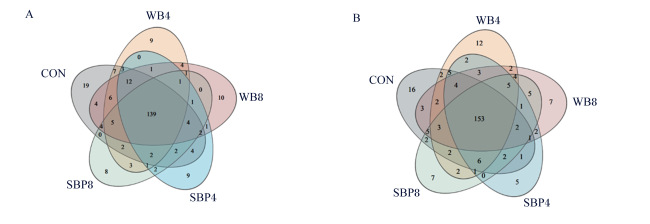
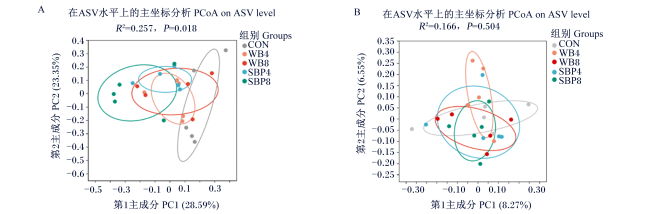
图1-A所示,试验第14天,CON组、WB4组、WB8组、SBP4组和SBP8组断奶仔猪粪便微生物群落分别具有19、9、10、9和8个独特的属,5个组共有的属为139个。如图1-B所示,试验第28天,CON组、WB4组、WB8组、SBP4组和SBP8组粪便微生物群落分别具有16、12、7、5和7个独特的属,5个组共有的属为153个。不同纤维源对断奶仔猪粪便微生物群落α多样性的影响如表6所示,试验第14天,WB4组、WB8组、SBP4组和SBP8组粪便微生物群落的Simpson指数显著低于CON组(P<0.05),这表明WB4组、WB8组、SBP4组和SBP8组粪便微生物群落的α多样性高于CON组。不同纤维源对断奶仔猪粪便微生物群落β多样性的影响如图2所示,由图2-A可知,试验第14天,各组粪便微生物群落明显分离,具有显著差异(P<0.05);由图2-B可知,试验第28天,各组粪便微生物群落聚在一起,差异不显著(P>0.05)。
图1 断奶仔猪第14天(A)和第28天(B)粪便微生物群落韦恩图(属水平)

Fig.1 Venn diagram of fecal microbial community of weaned piglets on days 14 (A) and 28 (B) (genus level)

表6 不同纤维源对断奶仔猪粪便微生物群落α多样性的影响

Table 6 Effects of different fiber sources on α diversity of fecal microbial community of weaned piglets

项目
Items
组别 Groups 均值标准误
SEM
P
P-value
CON WB4 WB8 SBP4 SBP8
第14天 Day 14
Shannon指数 Shannon index 4.52 5.08 5.24 4.82 4.82 0.123 0.109
Simpson指数 Simpson index 0.05a 0.02b 0.02b 0.02b 0.03b 0.006 0.014
Chao指数 Chao index 609.10 658.10 762.40 549.90 593.70 36.320 0.130
第28天 Day 28
Shannon指数 Shannon index 4.89 4.60 4.50 4.62 4.87 0.079 0.557
Simpson指数 Simpson index 0.03 0.05 0.05 0.05 0.03 0.006 0.730
Chao指数 Chao index 679.40 697.90 599.70 626.20 675.40 18.353 0.423
图2 断奶仔猪第14天(A)和第28天(B)粪便微生物群落β多样性

Fig.2 β-diversity of fecal microbial community of weaned piglet on days 14 (A) and 28 (B)

2.5.2 不同纤维源对断奶仔猪粪便微生物群落组成的影响

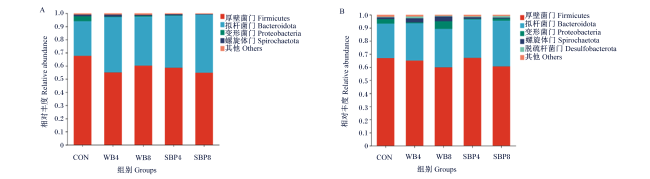
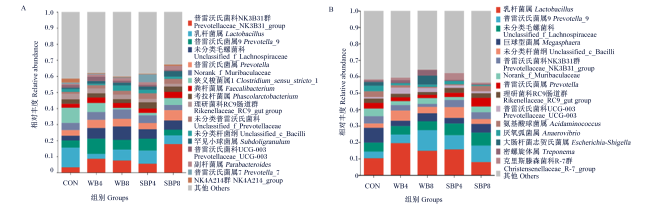
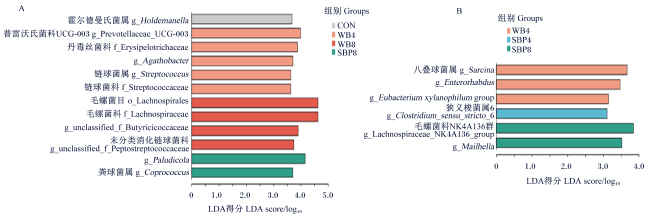
图3为试验第14天和第28天断奶仔猪粪便微生物群落在门水平上的相对丰度,其中优势菌门为厚壁菌门(Firmicutes)、拟杆菌门(Bacteroidota)和变形菌门(Proteobacteria),第14天和第28天上述菌门在总序列中的占比分别为97.8%和96.7%。图4-A为试验第14天断奶仔猪粪便微生物群落在属水平上的相对丰度,其中优势菌属为普雷沃氏菌科NK3B31群(Prevotellaceae_NK3B31_group)、乳杆菌属(Lactobacillus)、普雷沃氏菌属9(Prevotella_9)、未分类毛螺菌科(unclassified_f_Lachnospiraceae)和普雷沃氏菌属(Prevotella)。图4-B为试验第28天断奶仔猪粪便微生物群落在属水平上的相对丰度,其中优势菌属为乳杆菌属、普雷沃氏菌属9、未分类毛螺菌科、巨球型菌属(Megasphaera)和未分类杆菌纲(unclassified_c_Bacilli)。为明确各组间的差异微生物,对试验第14天和第28天断奶仔猪粪便微生物群落进行线性判别分析效应大小(LEfSe)分析,结果如图5所示,试验第14天,普雷沃氏菌科UCG-003(Prevotellaceae_UCG-003)在WB4组中显著富集[线性判别分析(LDA)得分>2,P<0.05],粪球菌属(Coprococcus)在SBP8组中显著富集(LDA得分>2,P<0.05);试验第28天,毛螺菌科NK4A136群(Lachnospiraceae_NK4A136_group)在SBP8组中显著富集(LDA得分>2,P<0.05)。
图3 断奶仔猪第14天(A) 和第28天(B) 粪便微生物群落在门水平上的分布

Fig.3 Distribution of fecal microbial community at phylum level of weaned piglets on days 14 (A) and 28 (B)

图4 断奶仔猪第14天(A) 和第28天(B) 粪便微生物群落在属水平上的分布

Fig.4 Distribution of fecal microbial community at genus level of weaned piglets on days 14 (A) and 28 (B)

图5 LEfSe分析断奶仔猪第14天(A) 和第28天(B) 在属水平上显著富集的粪便微生物

Fig.5 Significantly enriched fecal microorganisms of weaned piglets at genus level on days 14 (A) and 28 (B) analyzed by LEfSe

2.5.3 断奶仔猪粪便微生物群落与血清免疫指标的相关性分析

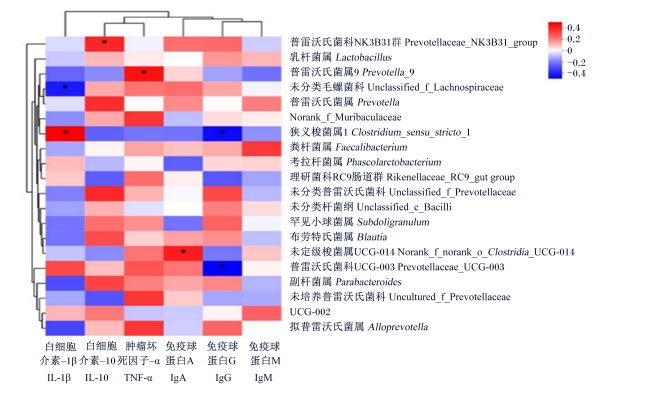
断奶仔猪粪便微生物群落与血清免疫指标的相关性分析如图6所示,粪便未分类毛螺菌科相对丰度与血清IL-1β含量呈显著负相关(P<0.05),粪便狭义梭菌属1(Clostridium_sensu_stricto_1)相对丰度与血清IL-1β含量呈显著正相关(P<0.05);粪便普雷沃氏菌科NK3B31群相对丰度与血清IL-10含量呈显著正相关(P<0.05);粪便普雷沃氏菌属9相对丰度与血清TNF-α含量呈显著正相关(P<0.05);分别未定级梭菌属UCG-014(norank_f_norank_o_Clostridia_UCG-014)相对丰度与血清IgA含量呈显著正相关(P<0.05);粪便狭义梭菌属1和普雷沃氏菌科UCG-003相对丰度与血清IgG含量呈显著负相关(P<0.05)。
图6 断奶仔猪粪便微生物群落与血清免疫指标的相关性热图

*表示差异显著(P<0.05)。

Fig.6 Correlation heat map between fecal microbial community and serum immune indices of weaned piglets

* indicated significant difference (P<0.05).

3 讨论

3.1 不同纤维源对断奶仔猪生长性能和腹泻率的影响

在本研究中,与WB4组相比,SBP8组断奶仔猪在试验第1阶段的ADG显著提高,F/G显著降低。结果表明,纤维对断奶仔猪生长性能的影响取决其来源,SBP对于提高断奶仔猪的生长性能更加有效。Wang等[10]研究表明,饲喂60 g/kg的SBP可提高断奶仔猪的生长性能,而饲喂240 g/kg的SBP时则会降低生长性能,这是因为240 g/kg的SBP降低了总能和粗蛋白质的全肠道表观消化率,由此说明纤维对断奶仔猪的影响也取决于其添加量。本研究结果表明,SBP对断奶仔猪的腹泻率无显著影响。Yan等[12]研究表明,饲粮中的SBP可预防仔猪断奶后腹泻,并对生长性能无不利影响,有一定的替抗作用。Berrocoso等[13]研究发现,在最佳的环境卫生条件下饲养仔猪时,纤维(燕麦壳、SBP、小麦中粮和秸秆)使仔猪断奶后腹泻增加;然而,当断奶仔猪在较差的卫生条件下饲养时,纤维对其生长性能无负面影响。试验结果的差异可能归因于纤维的来源、水平以及试验条件的不同。

3.2 不同纤维源对断奶仔猪血清生化指标的影响

血清生化指标在很大程度上可以反映动物体内营养物质的代谢情况和动物机体的健康状况[14]。本研究中,与WB8组相比,SBP8组断奶仔猪血清TC含量显著降低,这与之前的研究结果[15]一致。研究发现,可溶性纤维在后肠中发酵产生短链脂肪酸,而短链脂肪酸可以降低猪体内胆固醇的内源性合成[16-17]。SBP作为一种可溶性纤维可能通过增加消化液黏度来降低胆固醇和胆汁酸的吸收,并进一步改变肝脏胆固醇代谢,从而降低血清中的胆固醇含量[18]。血清TC含量的升高会导致炎症介质如IL-1β、IL-6和TNF-α等含量的升高,导致蛋白质功能障碍以及氧化还原反应和免疫失调[19]

3.3 不同纤维源对断奶仔猪肠道通透性的影响

DAO是由肠上皮细胞合成的胞内酶,主要分布于细胞质[20]。肠道屏障的破坏通常会导致DAO释放到血液中[21]。肠道的主要功能之一是阻止肠腔内细菌和内毒素移位至其他组织,当肠道屏障功能下降时,会导致肠腔内大量细菌和内毒素向肠外组织迁移。肠黏膜对D-乳酸具有屏障作用,机体产生的大量D-乳酸通过粪便被排出体外,而当肠道屏障功能下降时,肠道通透性增加,D-乳酸会进入到血液中。因此,血清DAO活性以及内毒素和D-乳酸含量可以作为监测肠道屏障完整性的标志,是代表肠道通透性的标志物[22]。本研究中,与WB4组和WB8组相比,SBP4组断奶仔猪血清DAO活性极显著降低;与CON组和WB8组相比,SBP4组、SBP8组和WB4组血清内毒素含量极显著降低;与CON组和SBP4组相比,SBP8组血清D-乳酸含量显著降低,这说明SBP可使肠道通透性降低,增强肠道屏障功能。肠道屏障功能增强可以防止致病菌和抗原的入侵,从而促进断奶仔猪的生长。

3.4 不同纤维源对断奶仔猪血清免疫指标的影响

研究表明,纤维具有免疫调节特性[23]。IL-1β和TNF-α是2种重要的促炎细胞因子,在调节免疫中起着关键作用[24-25],促炎细胞因子过度产生可能通过降低紧密连接蛋白的表达从而导致肠道屏障功能的破坏[26]。本研究发现,与CON组相比,WB8组、SBP4组和SBP8组断奶仔猪血清IL-1β含量极显著降低;与WB4组、WB8组和SBP4组相比,SBP8组血清TNF-α含量极显著降低。饲喂SBP的仔猪血清促炎因子含量降低可能是改善肠道屏障功能的原因之一。IL-10可以促进B细胞的分化和增殖以及抗体的分泌[27],抑制多种细胞因子的合成从而起到抗炎作用,是重要的抗炎因子[28]。本研究中,与CON组和WB4组相比,SBP8组血清IL-10含量极显著提高。此外,本研究结果表明,与CON组和WB4组相比,SBP4组和SBP8组血清IgG含量极显著提高。血清免疫球蛋白是体液免疫的主要组成部分,是反映机体免疫功能的重要指标[29]。免疫球蛋白分泌增加,进而可以增强肠道黏膜屏障,这可能是SBP增强肠道屏障功能的原因之一[30]。由此可见,SBP可以通过调节炎症细胞因子和免疫球蛋白来增强仔猪的免疫能力。

3.5 不同纤维源对断奶仔猪粪便微生物群落的影响

饲粮中的纤维成分是影响肠道菌群的重要因素[31],肠道菌群对肠道形态、肠道屏障、免疫功能和宿主健康都有重要的影响[32]。本试验使用16S rRNA测序测定了各组断奶仔猪直肠粪便的微生物群落组成,结果表明,通过降低Simpson指数,WB4组、WB8组、SPB4组和SBP8组断奶仔猪粪便微生物群落α多样性均有所提高,这与之前的研究结果[33-34]一致。通过LEfSE分析可知,试验第14天,普雷沃氏菌科UCG-003在WB4组中显著富集,普雷沃氏菌科UCG-003可引起炎症反应,增加肠道通透性[35-36];粪球菌属在SBP8组中显著富集,粪球菌属能够积极发酵碳水化合物产生丁酸,可能通过产生IgG来调节免疫反应[37],SBP8组血清IgG含量较高可能与粪球菌属的相对丰度提高有关。试验第28天,毛螺菌科NK4A136群在SBP8组中显著富集,毛螺菌科NK4A136群广泛存在于胃肠道中,可以利用果胶等纤维,是产丁酸和丙酸的有益微生物[38],在宿主的能量调节和肠道屏障功能方面发挥着重要作用[39-40]。通过粪便微生物群落与血清免疫指标的相关性分析发现,粪便未分类毛螺菌科相对丰度与血清IL-1β含量呈负相关,粪便普雷沃氏菌属9相对丰度与血清TNF-α含量呈正相关,粪便普雷沃氏菌科UCG-003相对丰度与血清IgG含量呈负相关。结果表明,断奶仔猪粪便微生物群落组成的改善可能是SBP8组机体免疫反应改善和肠道屏障功能增强的原因之一。

4 结论

8%SBP替代基础饲粮可以提高断奶仔猪生长性能,增强机体免疫功能和肠道屏障功能,并通过调节肠道菌群结构,提高有益菌丰度,促进肠道健康。
[1]
MONTAGNE L, BOUDRY G, FAVIER C, et al. Main intestinal markers associated with the changes in gut architecture and function in piglets after weaning[J]. British Journal of Nutrition, 2007, 97(1):45-57.

DOI PMID

[2]
JHA R, BERROCOSO J D. Review:dietary fiber utilization and its effects on physiological functions and gut health of swine[J]. Animal, 2015, 9(9):1441-1452.

DOI

[3]
DAÏEN C I, PINGET G V, TAN J K, et al. Detrimental impact of microbiota-accessible carbohydrate-deprived diet on gut and immune homeostasis:an overview[J]. Frontiers in Immunology, 2017, 8:548.

DOI

[4]
MA N, GUO P T, ZHANG J, et al. Nutrients mediate intestinal bacteria-mucosal immune crosstalk[J]. Frontiers in Immunology, 2018, 9:5.

DOI PMID

[5]
CHEN H, CHEN D W, QIN W, et al. Wheat bran components modulate intestinal bacteria and gene expression of barrier function relevant proteins in a piglet model[J]. International Journal of Food Sciences and Nutrition, 2017, 68(1):65-72.

DOI PMID

[6]
FADEL J G, DEPETERS E J, AROSEMENA A. Composition and digestibility of beet pulp with and without molasses and dried using three methods[J]. Animal Feed Science and Technology, 2000, 85(1/2):121-129.

DOI

[7]
贾曾浩, 陈宝江. 甜菜粕在动物生产中的饲用价值和研究进展[J]. 饲料研究, 2021, 44(3):114-117.

JIA Z H, CHEN B J. Development and feeding value of sugar beet meal in animal production[J]. Feed Research, 2021, 44(3):114-117. (in Chinese)

[8]
SHANG Q H, LIU H S, WU D, et al. Source of fiber influences growth,immune responses,gut barrier function and microbiota in weaned piglets fed antibiotic-free diets[J]. Animal Nutrition, 2021, 7(2):315-325.

DOI

[9]
SHANG Q H, MA X K, LIU H S, et al. Effect of fibre sources on performance,serum parameters,intestinal morphology,digestive enzyme activities and microbiota in weaned pigs[J]. Archives of Animal Nutrition, 2020, 74(2):121-137.

DOI

[10]
WANG L F, BELTRANENA E, ZIJLSTRA R T. Diet nutrient digestibility and growth performance of weaned pigs fed sugar beet pulp[J]. Animal Feed Science and Technology, 2016, 211:145-152.

DOI

[11]
GAHAN D A, LYNCH M B, CALLAN J J, et al. Performance of weanling piglets offered low-,medium- or high-lactose diets supplemented with a seaweed extract from Laminaria spp[J]. Animal, 2009, 3(1):24-31.

DOI

[12]
YAN C L, KIM H S, HONG J S, et al. Effect of dietary sugar beet pulp supplementation on growth performance,nutrient digestibility,fecal microflora,blood profiles and diarrhea incidence in weaning pigs[J]. Journal of Animal Science and Technology, 2017, 59:18.

DOI

[13]
BERROCOSO J D, MENOYO D, GUZMÁN P, et al. Effects of fiber inclusion on growth performance and nutrient digestibility of piglets reared under optimal or poor hygienic conditions[J]. Journal of Animal Science, 2015, 93(8):3919-3931.

DOI PMID

[14]
WANG J P, YOO J S, KIM H J, et al. Nutrient digestibility,blood profiles and fecal microbiota are influenced by chitooligosaccharide supplementation of growing pigs[J]. Livestock Science, 2009, 125(2/3):298-303.

DOI

[15]
NDOU S P, KIARIE E, THANDAPILLY S J, et al. Flaxseed meal and oat hulls supplementation modulates growth performance,blood lipids,intestinal fermentation,bile acids,and neutral sterols in growing pigs fed corn-soybean meal-based diets[J]. Journal of Animal Science, 2017, 95(7):3068-3078.

[16]
VELÁZQUEZ M, DAVIES C, MARETT R, et al. Effect of oligosaccharides and fibre substitutes on short-chain fatty acid production by human faecal microflora[J]. Anaerobe, 2000, 6(2):87-92.

DOI

[17]
YOON S J, CHU D C, JUNEJA L R. Physiological functions of partially hydrolyzed guar gum[J]. Journal of Clinical Biochemistry and Nutrition, 2006, 39(3):134-144.

DOI

[18]
SANTAS J, ESPADALER J, CUÑÉ J, et al. Partially hydrolyzed guar gums reduce dietary fatty acid and sterol absorption in Guinea pigs independent of viscosity[J]. Lipids, 2012, 47(7):697-705.

DOI PMID

[19]
ŠKARA L, HUDEK TURKOVIĆ A, PEZELJ I, et al. Prostate cancer-focus on cholesterol[J]. Cancers, 2021, 13(18):4696.

DOI

[20]
THOMPSON J S, VAUGHAN W P, FORST C F, et al. The effect of the route of nutrient delivery on gut structure and diamine oxidase levels[J]. Journal of Parenteral and Enteral Nutrition, 1987, 11(1):28-32.

PMID

[21]
NIETO N, TORRES M I, FERNÁNDEZ M I, et al. Experimental ulcerative colitis impairs antioxidant defense system in rat intestine[J]. Digestive Diseases and Sciences, 2000, 45(9):1820-1827.

PMID

[22]
CHEN J L, ZHENG P, ZHANG C, et al. Benzoic acid beneficially affects growth performance of weaned pigs which was associated with changes in gut bacterial populations,morphology indices and growth factor gene expression[J]. Journal of Animal Physiology and Animal Nutrition, 2017, 101(6):1137-1146.

DOI

[23]
TRACHSEL J, BRIGGS C, GABLER N K, et al. Dietary resistant potato starch alters intestinal microbial communities and their metabolites,and markers of immune regulation and barrier function in swine[J]. Frontiers in Immunology, 2019, 10:1381.

DOI

[24]
AL-SADI R, BOIVIN M, MA T. Mechanism of cytokine modulation of epithelial tight junction barrier[J]. Frontiers in Bioscience-Landmark, 2009, 14:2765-2778.

[25]
LIU Y L, CHEN F, ODLE J, et al. Fish oil enhances intestinal integrity and inhibits TLR4 and NOD2 signaling pathways in weaned pigs after LPS challenge[J]. The Journal of Nutrition, 2012, 142(11):2017-2024.

DOI

[26]
TLASKALOVÁ-HOGENOVÁ H, STĚPÁNKOVÁ R, KOZÁKOVÁ H, et al. The role of gut microbiota (commensal bacteria) and the mucosal barrier in the pathogenesis of inflammatory and autoimmune diseases and cancer:contribution of germ-free and gnotobiotic animal models of human diseases[J]. Cellular & Molecular Immunology, 2011, 8(2):110-120.

[27]
ANTOSZ H, WOJCIECHOWSKA K, SAJEWICZ J, et al. IL-6,IL-10,c-Jun and STAT3 expression in B-CLL[J]. Blood Cells,Molecules & Diseases, 2015, 54(3):258-265.

DOI

[28]
DE ALMEIDA RIBEIRO C R, BEGHINI D G, LEMOS A S, et al. Cytokines profile in patients with acute and chronic hepatitis B infection[J]. Microbiology and Immunology, 2022, 66(1):31-39.

DOI

[29]
PAN S L, MANABE N, YAMAGUCHI Y. 3D structures of IgA,IgM,and components[J]. International Journal of Molecular Sciences, 2021, 22(23):12776.

DOI

[30]
DE MEDINA F S, ROMERO-CALVO I, MASCARAQUE C, et al. Intestinal inflammation and mucosal barrier function[J]. Inflammatory Bowel Diseases, 2014, 20(12):2394-2404.

DOI PMID

[31]
KOH A, DE VADDER F, KOVATCHEVA-DATCHARY P, et al. From dietary fiber to host physiology:short-chain fatty acids as key bacterial metabolites[J]. Cell, 2016, 165(6):1332-1345.

DOI

[32]
HE J, XIE H M, CHEN D W, et al. Synergetic responses of intestinal microbiota and epithelium to dietary inulin supplementation in pigs[J]. European Journal of Nutrition, 2021, 60(2):715-727.

DOI

[33]
刘攀, 李瑞琦, 谭占坤, 等. 高纤维日粮对生长育肥猪生长性能、肉品质及肠道微生物的影响[J/OL]. 畜牧兽医学报:1-14[2023-05-26]. http://kns.cnki.net/kcms/detail/11.1985.S.20230425.1007.002.html.

LIU P, LI R Q, TAN Z K, et al. Effects of high fiber diet on growth performance,meat quality and intestinal microbiome of growing-finishing pigs[J/OL]. Acta Veterinaria et Zootechnica Sinica:1-14[2023-05-26]. http://kns.cnki.net/kcms/detail/11.1985.S.20230425.1007.002.html. (in Chinese)

[34]
ZHAO J B, BAI Y, TAO S Y, et al. Fiber-rich foods affected gut bacterial community and short-chain fatty acids production in pig model[J]. Journal of Functional Foods, 2019, 57:266-274.

DOI

[35]
LEY R E. Prevotella in the gut:choose carefully[J]. Nature Reviews Gastroenterology & Hepatology, 2016, 13(2):69-70.

[36]
ILJAZOVIC A, ROY U, GÁLVEZ E J C, et al. Perturbation of the gut microbiome by Prevotella spp. enhances host susceptibility to mucosal inflammation[J]. Mucosal Immunology, 2021, 14(1):113-124.

DOI

[37]
VAN DE MERWE J P, STEGEMAN J H. Binding of Coprococcus comes to the Fc portion of IgG.A possible role in the pathogenesis of Crohn’s disease?[J]. European Journal of Immunology, 1985, 15(8):860-863.

DOI

[38]
DUSKOVÁ D, MAROUNEK M. Fermentation of pectin and glucose,and activity of pectin-degrading enzymes in the rumen bacterium Lachnospira multiparus[J]. Letters in Applied Microbiology, 2001, 33(2):159-163.

DOI

[39]
LIN Z, YE W, ZU X P, et al. Integrative metabolic and microbial profiling on patients with spleen-yang-deficiency syndrome[J]. Scientific Reports, 2018, 8(1):6619.

DOI PMID

[40]
BRON P A, KLEEREBEZEM M, BRUMMER R J, et al. Can probiotics modulate human disease by impacting intestinal barrier function?[J]. The British Journal of Nutrition, 2017, 117(1):93-107.

DOI PMID

文章导航

/