研究论文

不同饲粮粗蛋白质水平对槟榔江水牛泌乳性能的影响

  • 李安润 , 1 ,
  • 陈艳美 2, * ,
  • 文泽芳 1 ,
  • 张丽娟 1 ,
  • 姜丰 1 ,
  • 黄琴 1 ,
  • 张瑞云 1 ,
  • 史建伟 2 ,
  • 金贞 3 ,
  • 张敏 4 ,
  • 余四娜 5 ,
  • 毛华明 , 1, ** ,
  • 李清 , 1, **
展开
  • 1 云南农业大学动物科学技术学院,云南省动物营养与饲料重点实验室,昆明 650201
  • 2 云南省草地动物科学研究院,昆明 650212
  • 3 陇川县科学技术协会,德宏 678700
  • 4 个旧市畜牧技术推广站,个旧 661000
  • 5 福贡县农业农村局,怒江 673400
**毛华明,教授,博士生导师,E-mail: ;
李 清,正高级实验师,硕士生导师,E-mail:

*同等贡献作者

李安润(1998—),女,傈僳族,云南梁河人,硕士研究生,从事反刍动物营养研究。E-mail:

Copy editor: 田艳明

收稿日期: 2023-10-31

  网络出版日期: 2024-04-15

基金资助

乡村振兴科技专项-科技特派团(202204BI090005)

Effects of Different Dietary Crude Protein Levels on Lactation Performance of Binglangjiang Buffalo

  • LI Anrun , 1 ,
  • CHEN Yanmei 2 ,
  • WEN Zefang 1 ,
  • ZHANG Lijuan 1 ,
  • JIANG Feng 1 ,
  • HUANG Qin 1 ,
  • ZHANG Ruiyun 1 ,
  • SHI Jianwei 2 ,
  • JIN Zhen 3 ,
  • ZHANG Min 4 ,
  • YU Sina 5 ,
  • MAO Huaming , 1 ,
  • LI Qing , 1
Expand
  • 1 Yunnan Key Laboratory of Animal Nutrition and Feed, College of Animal Science and Technology, Yunnan Agricultural University, Kunming 650201, China
  • 2 Yunnan Academy of Grassland Animal Science, Kunming 650212, China
  • 3 Longchuan County Science and Technology Association, Dehong 678700, China
  • 4 Gejiu Animal Husbandry Technology Promotion Station, Gejiu 661000, China
  • 5 Agriculture and Rural Bureau of Fugong County, Nujiang 673400, China
**MAO Huaming, professor, E-mail: ;
LI Qing, senior experimentalist, E-mail:

*Contributed equally

Received date: 2023-10-31

  Online published: 2024-04-15

摘要

本试验旨在探究不同饲粮粗蛋白质水平对槟榔江水牛泌乳性能的影响。试验采用单因素完全随机区组设计,将21头健康、年龄[(6.33±2.75)岁]和胎次[(3.14±1.56)胎]相近,且上胎产奶量相近的槟榔江水牛随机分为3个组(每组7头),分别饲喂低粗蛋白质水平(9.5%)、中粗蛋白质水平(12.5%)和高粗蛋白质水平(14.8%)的全混合日粮。预试期7 d,正试期273 d。结果表明:随着饲粮粗蛋白质水平的升高,槟榔江水牛泌乳性能相关指标均有一定变化,其中14.8%粗蛋白质组泌乳期日均产奶量、平均产奶量以及乳蛋白、乳非脂固形物和乳尿素氮含量均显著高于9.5%粗蛋白质组(P<0.05),而9.5%和12.5%粗蛋白质组间上述指标差异不显著(P>0.05);随着泌乳时间的增加,12.5%和14.8%粗蛋白质组乳脂含量基本都呈现为先降低后升高的变化趋势,9.5%粗蛋白质变化规律不明显,但3组泌乳末期乳脂含量都比泌乳初期高,且12.5%粗蛋白质组乳脂含量最高,为7.84%;3组平均泌乳天数、乳脂蛋比以及乳脂、乳糖和乳总固形物含量差异均不显著(P>0.05),且乳脂蛋比、乳糖和乳总固形物含量变化不大;12.5%粗蛋白质组乳体细胞数显著高于9.5%和14.8%粗蛋白质组(P<0.05)。由此可知,饲粮粗蛋白质水平从9.5%提高至14.8%可显著提高槟榔江水牛产奶量以及乳蛋白、乳非脂固形物和乳尿素氮含量,但对泌乳天数和乳脂、乳糖、乳总固形物含量以及乳脂蛋比无显著影响。

本文引用格式

李安润 , 陈艳美 , 文泽芳 , 张丽娟 , 姜丰 , 黄琴 , 张瑞云 , 史建伟 , 金贞 , 张敏 , 余四娜 , 毛华明 , 李清 . 不同饲粮粗蛋白质水平对槟榔江水牛泌乳性能的影响[J]. 动物营养学报, 2024 , 36(4) : 2457 -2474 . DOI: 10.12418/CJAN2024.212

Abstract

This experiment was conducted to investigate the effects of different dietary crude protein levels on lactation performance of Bingangjiang buffalo. A single factor completely randomized block design was used in the experiment, and 21 healthy Bingangjiang buffalo with similar age [(6.33±2.75) years], parity [(3.14±1.56) parities] and milk yield in upper parity were randomly divided into 3 groups (7 heads per group). They were fed total mixed rations with low crude protein level (9.5%), medium crude protein level (12.5%) and high crude protein level (14.8%), respectively. The pre-trial period lasted for 7 days and the experimental period lasted for 273 days. The results show that with the increase of dietary crude protein level, the relevant indices of lactation performance of Bingangjiang buffalo had certain changes, among which the average daily milk yield, average milk yield and contents of milk protein, milk non-fat solids and milk urea nitrogen in 14.8% crude protein group were significantly higher than those in 9.5% crude protein group (P<0.05), and the above indices were not significantly different between 9.5% and 12.5% crude protein groups (P>0.05). With the increase of lactation time, the milk fat content in 12.5% and 14.8% crude protein groups basically showed a trend of first decreasing and then increasing, and the change in 9.5% crude protein group was not obvious, but the milk fat content in all three groups was higher at the end of lactation than at the beginning of lactation, and the milk fat content in 12.5% crude protein group was the highest (7.84%). There were no significant differences in average lactation days, milk fat to protein ratio and contents of milk fat, milk lactose and milk total solids among the three groups (P>0.05), and little changes in milk fat to protein ratio and contents of milk lactose and total solids were observed. The milk somatic cell count in 12.5% crude protein group was significantly higher than that in 9.5% and 14.8% crude protein groups (P<0.05). In conclusion, increasing dietary crude protein level from 9.5% to 14.8% can significantly increase the milk yield and contents of milk protein, milk non-fat solids and milk urea nitrogen, but has no significant effects on lactation days and contents of milk fat, milk lactose and milk total solids as well as milk fat to protein ratio of Bingangjiang buffalo.

槟榔江水牛是我国唯一的河流型水牛品种。调查发现,槟榔江水牛个体参差不齐,无论是产奶量、乳成分还是繁殖性能均存在很大差异[1-4],其日产奶量(4.04 kg/d)虽然高于在我国饲养的部分河流型乳用摩拉水牛及尼里-拉菲水牛,但与其他国家相比,仍处于较低水平,无论是个体还是群体产奶量都存在较大发展空间[5-10]。奶牛泌乳性能除了受品种、个体等遗传因素影响外,还受饲养管理、营养水平、产犊季节、泌乳季节、年龄及胎次等非遗传因素影响[11-12],其中饲粮营养水平是影响奶牛泌乳性能的关键因素[13-14],而饲粮粗蛋白质(CP)水平是造成奶牛个体及群体泌乳性能差异的主要原因[15-16]。研究表明,荷斯坦奶牛饲粮粗蛋白质水平从10%提高到12%以上,可显著提高产奶量;当荷斯坦奶牛的日产奶量在30 kg/d以下时,适宜的饲粮粗蛋白质水平为12%~14%,当日产奶量在30 kg/d以上时,适宜的饲粮粗蛋白质水平为14%~17%[11-29]。而奶水牛对饲粮中粗蛋白质的利用率比荷斯坦奶牛要高[30-39]。Lakhani等[36]和Pasha[37]研究认为,泌乳水牛的适宜饲粮粗蛋白质水平可能等于或低于12%;绝大多数人研究认为,泌乳水牛的饲粮粗蛋白质水平为9.26%~14.40%[38-41];Santillo等[7]和Gaafar等[42]研究表明,泌乳水牛饲粮粗蛋白质水平从12%提高到16%时,能显著提高奶水牛日产奶量以及乳蛋白和乳总固形物含量,乳脂和乳糖含量略有升高,但差异不明显;而Bartocci等[43]调查表明,对于日产奶量为7~12 kg/d的水牛,所需饲粮粗蛋白质水平为10.2%~15.2%;Bovera等[44]研究认为,饲粮粗蛋白质水平为13.65%可维持泌乳晚期(日产奶量为8.20~9.85 kg/d)奶水牛营养需要,较高的粗蛋白质摄入没有导致产奶量提高。目前,国内关于奶水牛饲粮粗蛋白质水平的研究较少。总得来说,国外奶水牛的日产奶量为7~15 kg/d,饲粮粗蛋白质水平为10%~16%[6-7];日产奶量为10 kg/d的奶水牛,饲粮粗蛋白质水平为9%不能满足其需求[9-10];日产奶量为8.20~9.85 kg/d时,饲粮粗蛋白质水平为13.65%可维持泌乳晚期奶水牛营养需要;日产奶量为7~12 kg/d时,所需饲粮蛋白质水平为10.2%~15.2%;若日产奶量继续提高,可能需要更高的饲粮粗蛋白质水平[36-50]。由此可见,无论是荷斯坦奶牛,还是奶水牛,其适宜的饲粮粗蛋白质水平范围较广,这与试验动物、环境和饲养管理有关。
目前,关于槟榔江水牛的研究主要集中在种质资源的调查研究与评价[3]、群体遗传特征[4]、选育及保种[51]、个体体尺及生长发育规律[52-53]以及基因多态性[54-55]等方面,而关于饲粮营养水平的研究鲜见报道。因此,为获得槟榔江水牛泌乳期适宜的蛋白质需要,提高其泌乳性能,充分发挥其生产潜力,本试验将探究不同饲粮粗蛋白质水平对其泌乳性能的影响,初步确定槟榔江水牛泌乳期适宜的饲粮粗蛋白质水平,为奶水牛的科学饲养提供参考。

1 材料与方法

1.1 试验时间与地点

试验时间:2017年7月25日—2018年4月31日。
试验地点:云南省腾冲市巴福乐槟榔江水牛良种繁育有限公司。
试验期:参试槟榔江水牛的整个泌乳期。

1.2 试验设计及分组

试验采用单因素完全随机区组设计,将21头健康、年龄[(6.33±2.75)岁]和胎次[(3.14±1.56)胎]相近,且上胎产奶量相近的槟榔江水牛随机分为3个组(每组7头),分别饲喂低粗蛋白质水平(9.5%)、中粗蛋白质水平(12.5%)和高粗蛋白质水平(14.8%)的全混合日粮。饲料种类、来源及主要原料和营养水平见表1,饲粮组成及营养水平见表2。预试期7 d,正试期273 d(9个月)。
表1 饲料种类、来源及主要原料和营养水平

Table 1 Feed types, sources, main raw materials and nutrient levels

项目 Items 奶牛精料补充料2881
Dairy concentrate
supplement 2881
奶牛浓缩料880
Dairy concentrate 880
玉米蛋白粉
Corn protein meal
全株玉米青贮
Whole corn
silage
主要原料
Main raw materials
豆粕、菜籽粕、玉米、氯化钠、
磷酸氢钙、矿物元素、多种
维生素及抗氧化剂等
豆粕、菜籽粕、氯化钠、磷酸
氢钙、矿物元素、多种维生
素及抗氧化剂等
玉米 全株玉米
来源 Source 昆明田园饲料
有限公司
昆明田园饲料
有限公司
宁夏伊品生物科技
股份有限公司
当地收购
营养水平 Nutrient levels
干物质 DM/% 89.4 91.4 91.7 33.7
粗蛋白质 CP/(% DM) 20.4 40.2 67.2 6.8
粗脂肪 EE/(% DM) 3.6 4.1 1.2 1.2
中性洗涤纤维
NDF/(% DM)
23.2 20.6 20.7 64.4
非纤维碳水化合物
NFC/(% DM)
42.5 13.7 7.2 21.2
产奶净能 NEL/(MJ/kg) 9.6 9.2 9.2 5.0

产奶净能为计算值,其他为实测值。表2同。

NEL was a calculated value, while the others were measured values. The same as Table 2.

表2 饲粮组成及营养水平

Table 2 Composition and nutrient levels of diets

项目
Items
14.8%粗蛋白质组
14.8% CP group
12.5%粗蛋白质组
12.5% CP group
9.5%粗蛋白质组
9.5% CP group
原料 Ingredients/%
全株玉米青贮 Whole corn silage 80 80 80
玉米蛋白粉 Corn protein meal 5
奶牛浓缩饲料880 Dairy concentrate 880 15 15
奶牛精料补充料2881 Dairy concentrate supplement 2881 5 20
合计 Total 100 100 100
营养水平 Nutrient levels
干物质 DM/% 45.3 45.2 44.9
粗蛋白质 CP/(% DM) 14.8 12.5 9.5
粗脂肪 EE/(% DM) 1.6 1.7 1.6
中性洗涤纤维 NDF/(% DM) 55.6 55.7 56.1
非纤维碳水化合物 NFC/(% DM) 19.4 21.2 25.5
产奶净能 NEL/(MJ/kg) 5.8 5.8 5.8

1.3 饲养管理

3组试验牛在相同的饲养管理条件下,分别饲养在同一牛舍的3个圈中,每天07:00和16:00各饲喂1次;试验牛自由采食和饮水,并在每天06:00和17:00各挤奶1次;其他的管理按照牛场常规进行。

1.4 测定指标及方法

1.4.1 产奶量

每天实际记录每头牛的产奶量,并根据公式计算7%乳脂校正乳(FCM)产量[56],计算公式为:
7% FCM产量=0.265×a+10.5×b
式中:a表示实际产奶量(kg/d),b表示乳脂产量(kg/d)。

1.4.2 泌乳天数

当奶水牛日产奶量低于2 kg/d时停止挤奶,从产犊开始到停止挤奶的天数即为每头牛的泌乳天数。

1.4.3 乳成分分析

每月月初采集1次奶样,每头牛每次采集50 mL奶样放入加有防腐剂(重铬酸钾)的取样瓶中摇匀,根据早晚产奶量按6∶4比例混合,送至昆明市奶牛生产性能测定中心进行测定。乳成分分析包括乳蛋白、乳脂、乳糖、乳总固形物、乳非脂固形物和乳尿素氮含量以及乳体细胞数,测定仪器为MilkoScanFT-120乳成分分析仪和MilkoScanFT+FC乳成分体细胞联用仪。

1.4.4 饲料营养成分分析

饲料干物质(DM)含量参照GB/T 6435—2014测定,粗蛋白质含量参照GB/T 6432—2018测定,粗脂肪(EE)含量参照GB/T 6433—2006测定,粗灰分(Ash)含量参照GB/T 6438—2007测定,钙(Ca)含量参照GB/T 6436—2018测定,磷(P)含量参照GB/T 6437—2018测定,中性洗涤纤维(NDF)含量参照GB/T 20806—2006测定,酸性洗涤纤维(ADF)含量参照NY/T 1459—2007测定,酸性洗涤木质素(ADL)含量参照GB/T 20805—2006测定;中性洗涤不溶氮(NDIN)、酸性洗涤不溶性氮(ADIN)和酸性不溶灰分(AIA)含量参照Mustafa等[6]、郑会玲[57]和王加启等[58]的方法进行测定。

1.4.5 产奶净能估测

产奶净能以饲料常规营养成分及范氏纤维成分分析的结果,根据NRC(2021)的估测公式进行计算。

1.5 拟合曲线

应用Wood数学模型不完全伽玛函数模型对日产奶量、采食量和体重的变化进行拟合。拟合基本模型为:
y=axbe-cx
式中:y为日产奶量(kg/d),x为泌乳天数,a为规模因子,b为日产奶量上升率参数,c为日产奶量下降因子。
当参数b为正值,c为负值时,该模型可用于日产奶量拟合分析,此时a是泌乳潜力,c是达到泌乳高峰的速度,b是从泌乳高峰下降的速度;当参数b为负值,c为正值时,该模型适合于乳脂率和乳蛋白率拟合分析,即模型为y=ax-becx,此时a是泌乳潜力,c是达到指标最低点的速度,b是从指标最低点上升的速度。
采用SPSS 27.0软件对3个组日产奶量进行曲线拟合,通过曲线拟合所得的a、b、c 3个参数可以进一步估计以下二级参数:
泌乳持久力(P)=-(b+1)lnc;
高峰泌乳日(Tmax)=b/c;
高峰日产奶量(PY)=a(b/c)be-b

1.6 数据处理

采用Excel 2021和SPSS 27.0软件对试验数据进行分析及作图,差异显著性检验采用单因素方差分析(one-way ANOVA)和Duncan氏法多重比较,结果用“平均值±标准误”表示,P<0.05表示差异显著

2 结果与分析

2.1 不同饲粮粗蛋白质水平对槟榔江水牛产奶量和泌乳天数的影响
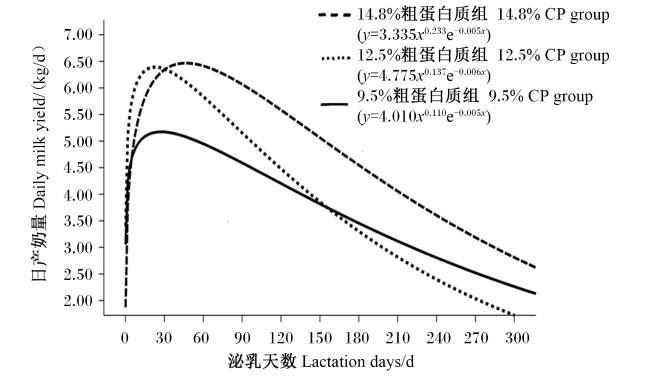
图1所示,14.8%、12.5%和9.5%粗蛋白质组槟榔江水牛泌乳高峰期均出现在第2泌乳月,高峰期日产奶量分别为6.71、6.31和5.40 kg/d,其中14.8%粗蛋白质组和12.5%粗蛋白质组高峰期日产奶量相差不大,且都明显高于9.5%粗蛋白质组,但差异均不显著(P>0.05)。
图1 不同饲粮粗蛋白质水平槟榔江水牛日产奶量和泌乳天数曲线图

Fig.1 Curve graph of daily milk yield and lactation days of Binglangjiang buffalo with different dietary CP levels

按照奶水牛产奶量低于2 kg/d为停奶标准计算,由表3可知,14.8%、12.5%和9.5%粗蛋白质组平均泌乳天数分别为254、234和221 d,但3组间无显著差异(P>0.05)。由此可见,随着饲粮粗蛋白质水平从9.5%升高到14.8%,槟榔江水牛平均泌乳天数有提高的趋势,且14.8%粗蛋白质组泌乳期平均产奶量和日均产奶量均显著高于12.5%和9.5%粗蛋白质组(P<0.05)。
表3 不同饲粮粗蛋白质水平对槟榔江水牛产奶量和泌乳天数的影响

Table 3 Effects of different dietary CP levels on milk yield and lactation days of Binglangjiang buffalo

项目
Items
14.8%粗蛋白质组
14.8% CP group
12.5%粗蛋白质组
12.5% CP group
9.5%粗蛋白质组
9.5% CP group
日产奶量 Daily milk yield/(kg/d)
第1泌乳月 First lactation month 5.44±0.22b 6.18±0.10a 5.09±0.10b
第2泌乳月 Second lactation month 6.71±0.18a 6.31±0.16a 5.4±0.15b
第3泌乳月 Third lactation month 6.01±0.15a 5.21±0.15b 4.28±0.13c
第4泌乳月 Fourth lactation month 5.70±0.13a 4.52±0.17b 3.95±0.09c
第5泌乳月 Fifth lactation month 5.22±0.15a 3.91±0.16b 3.82±0.12b
第6泌乳月 Sixth lactation month 4.43±0.16a 3.77±0.13b 3.63±0.12b
第7泌乳月 Seventh lactation month 4.23±0.15a 3.28±0.16b 3.44±0.14b
第8泌乳月 Eighth lactation month 3.53±0.14a 2.48±0.1b 2.71±0.13b
泌乳期平均产奶量
Average milk yield in lactation/(kg/头)
1 178.35±195.52a 995.40±133.37b 856.56±176.79b
平均泌乳天数 Average lactation days/d 254±15 234±21 221±27
泌乳期日均产奶量
Average daily milk yield in lactation/(kg/d)
5.11±0.26a 4.53±0.21b 4.25±0.10b

同行数据肩标无字母或相同字母表示差异不显著(P>0.05),不同字母表示差异显著(P<0.05)。下表同。

In the same row, values with no letter or the same letter superscripts mean no significant difference (P>0.05), while with different letter superscripts mean significant difference (P<0.05). The same as below.

2.2 不同饲粮粗蛋白质水平对槟榔江水牛乳成分的影响

2.2.1 不同饲粮粗蛋白质水平对槟榔江水牛乳脂含量的影响

表4可知,14.8%、12.5%和9.5%粗蛋白质组槟榔江水牛整个泌乳期内乳脂含量平均值分别为7.65%、7.84%和7.30%,且各组间差异不显著(P>0.05)。3组各泌乳月乳脂含量变化分别为6.76%~8.93%、6.48%~8.88%和5.99%~8.74%,除第7泌乳月12.5%粗蛋白质组乳脂含量含量显著高于9.5%乳脂含量组(P<0.05)外,其余各泌乳月各组间乳脂含量差异均不显著(P>0.05)。此外,随着泌乳时间的增加,14.8%粗蛋白质组和12.5%粗蛋白质组乳脂含量基本都呈现出先降低后升高的变化趋势,9.5%粗蛋白质组变化规律不明显,但3组泌乳末期乳脂含量都比泌乳初期高。
表4 不同饲粮粗蛋白质水平对槟榔江水牛乳脂含量的影响

Table 4 Effects of different dietary CP levels on milk fat content of Binglangjiang buffalo%

项目
Items
14.8%粗蛋白质组
14.8% CP group
12.5%粗蛋白质组
12.5% CP group
9.5%粗蛋白质组
9.5% CP group
第1泌乳月 First lactation month 7.11±0.98 8.43±0.88 6.37±0.39
第2泌乳月 Second lactation month 6.76±0.51 6.48±1.02 7.33±0.37
第3泌乳月 Third lactation month 7.46±0.20 7.22±0.77 5.99±0.76
第4泌乳月 Fourth lactation month 7.50±0.35 7.46±0.90 7.82±0.26
第5泌乳月 Fifth lactation month 7.65±0.64 7.50±0.39 7.14±0.54
第6泌乳月 Sixth lactation month 8.93±0.66 8.76±0.76 8.74±0.54
第7泌乳月 Seventh lactation month 8.39±0.29ab 8.87±0.48a 7.55±0.39b
第8泌乳月 Eighth lactation month 7.75±0.98 8.88±1.02 8.73±0.45
平均值 Mean 7.65±0.23 7.84±0.30 7.30±0.21

2.2.2 不同饲粮粗蛋白质水平对槟榔江水牛乳蛋白含量的影响

表5可知,14.8%粗蛋白质组槟榔江水牛整个泌乳期内乳蛋白含量平均值显著高于9.5%粗蛋白质组(P<0.05),14.8%、12.5%和9.5%粗蛋白质组各泌乳月乳蛋白含量变化分别为4.52%~5.65%、4.43%~5.73%和4.43%~5.11%,且各组间不同泌乳月差异均不显著(P>0.05)。从不同泌乳月分析,各组的乳蛋白含量都是在第1泌乳月最高,之后呈先降低后有所升高的变化趋势,但出现最低含量的时间不同:14.8%粗蛋白质组在第2泌乳月最低,12.5%粗蛋白质组在第4泌乳月最低,9.5%粗蛋白质组在第3泌乳月最低,大致变化规律与产奶量变化趋势相反。
表5 不同饲粮粗蛋白质水平对槟榔江水牛乳蛋白含量的影响

Table 5 Effects of different dietary CP levels on milk protein content of Binglangjiang buffalo%

项目
Items
14.8%粗蛋白质组
14.8% CP group
12.5%粗蛋白质组
12.5% CP group
9.5%粗蛋白质组
9.5% CP group
第1泌乳月 First lactation month 5.65±0.79 5.73±0.49 5.11±0.26
第2泌乳月 Second lactation month 4.52±0.18 4.59±0.13 4.47±0.06
第3泌乳月 Third lactation month 4.67±0.13 4.50±0.15 4.43±0.08
第4泌乳月 Fourth lactation month 4.75±0.14 4.43±0.33 4.44±0.09
第5泌乳月 Fifth lactation month 4.85±0.17 4.74±0.29 4.53±0.16
第6泌乳月 Sixth lactation month 4.73±0.17 4.82±0.22 4.49±0.16
第7泌乳月 Seventh lactation month 4.96±0.10 4.87±0.22 4.63±0.19
第8泌乳月 Eighth lactation month 4.95±0.24 4.82±0.29 4.60±0.29
平均值 Mean 4.89±0.13a 4.81±0.12ab 4.59±0.06b

2.2.3 不同饲粮粗蛋白质水平对槟榔江水牛乳糖含量影响

表6可知,14.8%、12.5%和9.5%粗蛋白质组槟榔江水牛整个泌乳期内乳糖含量平均值分别为5.15%、4.82%和5.02%,但各组间差异不显著(P>0.05)。3组各泌乳月乳糖含量变化分别为4.83%~5.48%、4.26%~5.20%和4.56%~5.38%,且各组间不同泌乳月差异均不显著(P>0.05)。从不同泌乳月分析,3组乳糖含量都表现为第2泌乳月最高,其余泌乳月间含量相近,变化幅度较小。
表6 不同饲粮粗蛋白质水平对槟榔江水牛乳糖含量的影响

Table 6 Effects of different dietary CP levels on milk lactose content of Binglangjiang buffalo%

项目
Items
14.8%粗蛋白质组
14.8% CP group
12.5%粗蛋白质组
12.5% CP group
9.5%粗蛋白质组
9.5% CP group
第1泌乳月 First lactation month 4.83±0.31 4.70±0.24 4.97±0.20
第2泌乳月 Second lactation month 5.48±0.03 5.20±0.26 5.38±0.11
第3泌乳月 Third lactation month 5.40±0.05 4.93±0.25 5.32±0.07
第4泌乳月 Fourth lactation month 5.23±0.11 4.26±0.63 4.89±0.33
第5泌乳月 Fifth lactation month 5.08±0.15 4.79±0.36 4.92±0.22
第6泌乳月 Sixth lactation month 5.00±0.04 5.00±0.11 4.93±0.09
第7泌乳月 Seventh lactation month 5.06±0.03 4.92±0.17 4.90±0.08
第8泌乳月 Eighth lactation month 5.12±0.05 4.99±0.07 4.56±0.38
平均值 Mean 5.15±0.06 4.82±0.12 5.02±0.08

2.2.4 不同饲粮粗蛋白质水平的槟榔江水牛乳总固形物含量比较

表7可知,14.8%、12.5%和9.5%粗蛋白质组槟榔江水牛整个泌乳期内乳总固形物含量平均值分别为19.41%、19.29%和18.57%,但各组间差异不显著(P>0.05)。3组各泌乳月乳总固形物含量变化分别为18.20%~20.54%、17.78%~21.60%和17.36%~20.20%,且各组间不同泌乳月差异均不显著(P>0.05)。各组不同泌乳月间乳总固形物含量变化幅度较小,没有明显的升降趋势。
表7 不同饲粮粗蛋白质水平对槟榔江水牛乳总固形物含量的影响

Table 7 Effects of different dietary CP levels on milk total solid content of Binglangjiang buffalo%

项目
Items
14.8%粗蛋白质组
14.8% CP group
12.5%粗蛋白质组
12.5% CP group
9.5%粗蛋白质组
9.5% CP group
第1泌乳月 First lactation month 20.07±1.63 21.60±1.23 18.40±0.90
第2泌乳月 Second lactation month 19.68±1.15 18.85±1.50 20.20±0.60
第3泌乳月 Third lactation month 20.54±0.49 18.94±1.20 17.90±1.23
第4泌乳月 Fourth lactation month 19.62±0.10 18.43±2.06 19.55±0.86
第5泌乳月 Fifth lactation month 18.20±0.55 17.78±0.59 17.36±0.51
第6泌乳月 Sixth lactation month 19.32±0.79 19.25±0.76 18.83±0.55
第7泌乳月 Seventh lactation month 19.05±0.29 19.54±0.49 17.81±0.50
第8泌乳月 Eighth lactation month 18.40±1.20 20.10±0.76 18.64±0.52
平均值 Mean 19.41±0.35 19.29±0.48 18.57±0.31

2.2.5 不同饲粮粗蛋白质水平的槟榔江水牛乳非脂固形物含量比较

表8可知,14.8%、12.5%和9.5%粗蛋白质组槟榔江水牛整个泌乳期内乳非脂固形物含量平均值分别为11.26%、10.84%和10.77%,其中14.8%粗蛋白质组乳非脂固形物含量显著高于9.5%粗蛋白质(P<0.05)。3组各泌乳月乳非脂固形物含量变化分别为10.66%~11.92%、9.92%~12.02%和10.05%~11.42%,且各组间不同泌乳月差异均不显著(P>0.05)。各组乳非脂固形物含量在不同泌乳月间变化趋势都表现为第1泌乳月最高,之后呈现先降低后又略有升高的变化趋势。
表8 不同饲粮粗蛋白质水平对槟榔江水牛乳非脂固形物含量的影响

Table 8 Effects of different dietary CP levels on milk non-fat solid content of Binglangjiang buffalo%

项目
Items
14.8%粗蛋白质组
14.8% CP group
12.5%粗蛋白质组
12.5% CP group
9.5%粗蛋白质组
9.5% CP group
第1泌乳月 First lactation month 11.92±0.50 12.02±0.56 11.42±0.29
第2泌乳月 Second lactation month 11.53±0.28 11.27±0.31 11.37±0.21
第3泌乳月 Third lactation month 11.68±0.23 10.69±0.36 11.04±0.22
第4泌乳月 Fourth lactation month 11.32±0.34 9.92±1.03 10.67±0.51
第5泌乳月 Fifth lactation month 10.83±0.19 10.40±0.55 10.32±0.31
第6泌乳月 Sixth lactation month 10.66±0.17 10.37±0.15 10.30±0.17
第7泌乳月 Seventh lactation month 10.96±0.09 10.78±0.24 10.43±0.20
第8泌乳月 Eighth lactation month 10.94±0.29 10.88±0.22 10.05±0.40
平均值 Mean 11.26±0.12a 10.84±0.21ab 10.77±0.13b

2.2.6 不同饲粮粗蛋白质水平对槟榔江水牛乳体细胞数的影响

表9可知,14.8%、12.5%和9.5%粗蛋白质组槟榔江水牛整个泌乳期内乳体细胞数平均值分别为20.88×10⁴、146.72×10⁴和56.91×10⁴个/mL,其中12.5%粗蛋白质组乳体细胞数显著高于14.8%和9.5%粗蛋白质组(P<0.05)。3组各泌乳月乳体细胞数变化分别为4.05×104~40.68×104个/mL、24.90×104~238.78×104个/mL和8.16×104~100.67×104个/mL,且各组间不同泌乳月差异均不显著(P>0.05),其中14.8%粗蛋白质组各泌乳月乳体细胞数平均值变化幅度不大,均不超过50×104个/mL;而12.5%和9.5%粗蛋白质组变化幅度较大,个体差异也大,且2组分别在泌乳初期和泌乳末期出现连续2个泌乳月乳体细胞数较高的情况。
表9 Effects of different dietary CP levels on milk somatic cell count of Binglangjiang buffalo×104个/mL

Table 9

项目
Items
14.8%粗蛋白质组
14.8% CP group
12.5%粗蛋白质组
12.5% CP group
9.5%粗蛋白质组
9.5% CP group
第1泌乳月 First lactation month 36.00±4.35 200.41±132.79 86.94±41.46
第2泌乳月 Second lactation month 26.24±10.32 238.78±215.33 28.55±20.19
第3泌乳月 Third lactation month 4.05±0.83 37.10±32.60 9.57±3.01
第4泌乳月 Fourth lactation month 18.17±14.97 88.21±42.15 32.53±14.67
第5泌乳月 Fifth lactation month 5.47±2.88 234.68±153.25 80.31±47.27
第6泌乳月 Sixth lactation month 21.20±15.99 24.90±179.31 8.16±2.21
第7泌乳月 Seventh lactation month 40.68±22.27 136.40±54.17 139.00±62.88
第8泌乳月 Eighth lactation month 23.75±6.52 35.93±17.97 100.67±62.19
平均值 Mean 20.88±4.00b 146.72±43.53a 56.91±13.26b

2.2.7 不同饲粮粗蛋白质水平对槟榔江水牛乳尿素氮含量的影响

表10可知,14.8%、12.5%和9.5%粗蛋白质组槟榔江水牛整个泌乳期内乳尿素氮含量平均值分别为34.78、29.71和27.14 mg/dL,其中14.8%粗蛋白质组乳尿素氮含量显著高于其他2组(P<0.05)。3组各泌乳月乳尿素氮含量变化分别为27.37~39.63 mg/dL、24.76~42.28 mg/dL和20.20~32.64 mg/dL。第3泌乳月,各组乳尿素氮含量与整个泌乳期内乳尿素氮含量平均值情况一致;第8泌乳月,14.8%和12.5%粗蛋白质组乳尿素氮含量显著高于9.5%粗蛋白质组(P<0.05);各组间其他泌乳月乳尿素氮含量则差异不显著(P>0.05)。除第8泌乳月外,前7个泌乳月14.8%粗蛋白质组乳尿素氮含量始终高于其余2组。从不同泌乳月分析,乳尿素氮含量表现为泌乳后期比泌乳前期高,且各组都表现为产后第1泌乳月较低,之后随着泌乳月的增加而逐渐增加,且12.5%粗蛋白质增加幅度最大。
表10 不同饲粮粗蛋白质水平对槟榔江水牛乳尿素氮含量的影响

Table 10 Effects of different dietary CP levels on milk urea nitrogen content of Binglangjiang buffalomg/dL

项目
Items
14.8%粗蛋白质组
14.8% CP group
12.5%粗蛋白质组
12.5% CP group
9.5%粗蛋白质组
9.5% CP group
第1泌乳月 First lactation month 27.37±4.86 24.76±2.85 20.20±4.11
第2泌乳月 Second lactation month 31.20±6.86 27.78±3.27 28.93±1.87
第3泌乳月 Third lactation month 37.60±6.88a 27.33±1.77b 23.81±2.59b
第4泌乳月 Fourth lactation month 36.85±4.99 27.57±3.25 29.80±3.11
第5泌乳月 Fifth lactation month 37.37±5.79 31.08±1.83 27.80±3.94
第6泌乳月 Sixth lactation month 38.36±6.22 33.32±1.77 32.64±3.73
第7泌乳月 Seventh lactation month 39.63±6.75 34.50±3.10 30.30±4.18
第8泌乳月 Eighth lactation month 29.80±2.34a 42.28±6.08a 25.27±1.90b
平均值 Mean 34.78±2.01a 29.71±1.23b 27.14±1.27b

2.2.8 不同饲粮粗蛋白质水平对槟榔江水牛乳脂蛋比的影响

表11可知,14.8%、12.5%和9.5%粗蛋白质组槟榔江水牛整个泌乳期内乳脂蛋比平均值分别为1.59、1.64和1.60,但各组间差异不显著(P>0.05)。随着泌乳月的增加,各组乳脂蛋比有逐渐增长的趋势,但各组间不同泌乳月差异均不显著(P>0.05)。
表11 不同饲粮粗蛋白质水平对槟榔江水牛乳脂蛋比的影响

Table 11 Effects of different dietary CP levels on milk fat to protein ratio of Binglangjiang buffalo

项目
Items
14.8%粗蛋白质组
14.8% CP group
12.5%粗蛋白质组
12.5% CP group
9.5%粗蛋白质组
9.5% CP group
第1泌乳月 First lactation month 1.38±0.24 1.50±0.12 1.26±0.09
第2泌乳月 Second lactation month 1.51±0.12 1.41±0.22 1.65±0.09
第3泌乳月 Third lactation month 1.60±0.06 1.60±0.16 1.37±0.18
第4泌乳月 Fourth lactation month 1.58±0.06 1.66±0.14 1.76±0.05
第5泌乳月 Fifth lactation month 1.59±0.15 1.61±0.13 1.58±0.12
第6泌乳月 Sixth lactation month 1.88±0.08 1.84±0.18 1.95±0.13
第7泌乳月 Seventh lactation month 1.70±0.08 1.83±0.08 1.63±0.06
第8泌乳月 Eighth lactation month 1.55±0.12 1.83±0.14 1.91±0.07
平均值 Mean 1.59±0.05 1.64±0.06 1.60±0.05

3 讨论

3.1 不同饲粮粗蛋白质水平对槟榔江水牛产奶量和泌乳天数的影响

3.1.1 不同饲粮粗蛋白质水平对槟榔江水牛产奶量的影响

为了比较不同状态下的乳的质量和计算不同条件下产乳的营养需要,通常将不同乳脂含量的乳矫正到含乳脂7%的标准状态下进行分析[59],因本试验依据3组牛整个泌乳期内乳脂含量基本都高于7%,所以用乳脂含量为7%作为标准计算7% FCM来进行分析。试验结果表明,14.8%、12.5%和9.5%粗蛋白质组水牛泌乳期日均产奶量分别为5.11、4.53和4.25 kg/d,这与谢红等[56]、白文顺等[60]和毛华明等[61]报道的结果相近,但低于屈在久等[4]报道的结果,这可能与调查方法有关,从而高估了日产奶量,马畅[62]调查也发现这一问题。由于产奶量有所差异而导致3组试验牛的泌乳曲线走势也不相同,并由此可以看出9.5%粗蛋白质不能满足槟榔江水牛营养需要,这与Lakhani等[36]和Akhtar等[38]的研究结果相似;14.8%粗蛋白质组产奶量起点最低,但产奶量上升速率较大,高峰泌乳日较迟,但高峰日产奶量最高,说明此粗蛋白质水平能够满足水牛营养需要,这与Santillo等[7]、邹彩霞等[41]和Bovera等[44]的研究结果相似;而12.5%粗蛋白质组产奶量起点最高,达到泌乳高峰的时间也最短,但日产奶量下降速率也最大,这可能是各组之间饲粮组成及营养水平不同所致,其中12.5%粗蛋白质组添加了5%的奶牛精料补充料,14.8%粗蛋白质组添加了5%的玉米蛋白粉,2组所添加的饲料营养成分存在一定差异,特别是粗蛋白质水平差异较大,虽然12.5%粗蛋白质组营养水平能够满足水牛前期营养需要,但其蛋白质除了用于产奶还需用于体组织的蛋白质沉积,因此到了泌乳中、后期饲粮粗蛋白质水平无法满足水牛营养需要,故中、后期产奶量下降迅速[44]
影响奶牛产奶量的因素很多,包括遗传因素、生理因素、管理因素及营养因素等,因此可通过选育、加强饲养管理和提供合理的营养水平等措施以提高产奶量。其中,饲粮蛋白质和能量水平是衡量饲粮营养水平的重要指标之一,本试验结果证实了将饲粮粗蛋白质水平提高到14.8%能显著提高槟榔江水牛产奶量,这与Costa等[9]、Zang等[30]、Akhtar等[38]和Bartocci等[49]的研究结果一致;但也与Santillo等[7]、Zang等[30]、Yang等[31]、Lakhani等[36]和邹彩霞等[41]所获得的提高饲粮粗蛋白质水平对奶牛产奶量无显著影响的结果有差异,这可能与试验设置的饲粮能量与粗蛋白质水平、饲养管理水平、试验动物品种及泌乳期等不同有关。

3.1.2 不同饲粮粗蛋白质水平对槟榔江水牛泌乳天数的影响

牛泌乳天数的长短会影响产奶量的高低。唐小飞[63]研究表明,摩拉水牛和尼里-拉菲水牛的平均泌乳天数分别为311.26和286.59 d,其中泌乳天数在240 d以下所占的比例分别为17.36%和30.45%,在240~360 d的比例分别为57.68%和52.92%,360 d以上的比例分别为24.93%和16.62%,可见摩拉和尼里-拉菲水牛的泌乳期多在240~360 d。本研究结果显示,槟榔江水牛饲粮粗蛋白质水平为9.5%、12.5%和14.8%时,相对应的平均泌乳天数分别为221、234和254 d,除9.5%粗蛋白质组泌乳天数偏低外,其余2组牛的泌乳天数均符合上述分布范围;而余选富等[64]报道,槟榔江水牛的平均泌乳天数为290 d,最高泌乳天数为356 d,最低泌乳天数为140 d;屈在久等[4]报道,槟榔江水牛的平均泌乳天数为269.53 d,最高泌乳天数为330 d,最低泌乳天数为239 d,这与本研究结果存在一定差异,这可能与槟榔江水牛个体差异大及饲养管理水平不一致,以及日产奶量计算是否大于3 kg/d有关。除此之外,本研究结果还表明,随着饲粮粗蛋白质水平从9.5%升高至14.8%,槟榔江水牛泌乳天数有提高的趋势,但影响效果不显著。

3.2 不同饲粮粗蛋白质水平对槟榔江水牛乳成分的影响

3.2.1 不同饲粮粗蛋白质水平对槟榔江水牛乳脂和乳蛋白含量的影响

乳脂和乳蛋白是牛奶中最主要的营养物质,乳制品的好坏受其含量多少的影响;牛奶中乳脂和乳蛋白含量高,乳制品口感、风味更佳,产品的质构和保型性也更好[65]。本试验结果表明,饲粮粗蛋白质水平为9.5%、12.5%和14.8%的3组水牛整个泌乳期内乳脂含量变化分别为5.99%~8.74%、6.48%~8.88%和6.76%~8.93%,与谢红等[56]、白文顺等[60]、毛华明等[61]、马畅[62]、唐小飞[63]、李清等[66]、邓慧芳等[67]、章纯熙等[68]、晋丽娜等[69]和罗福丽[70]所报道的结果相近;3组乳蛋白含量变化分别为4.43%~5.11%、4.43%~5.73%和4.52%~5.65%,与谢红等[56]、白文顺等[60]、李清等[66]、章纯熙等[68]和罗福丽[70]的研究结果相近,略高于唐小飞[63]、晋丽娜等[69]和符俊[71]的研究结果,可能是由试验牛的品种、饲粮营养水平及环境等因素不同造成。随着泌乳时间的增加,槟榔江水牛的乳脂和乳蛋白含量变化趋势基本为先降低后升高,这与罗福丽[70]、童雄等[72]、周玲[73]、Yilmaz等[74]、Sahin等[75]和Ghavi Hossein-Zadeh[76]的研究结果一致;曾令湖等[77]和梁靓等[78]研究也发现,随着泌乳月龄的增加牛乳中的乳脂率和乳蛋白率存在着协同关系。本试验中,提高饲粮粗蛋白质水平对槟榔江水牛的整个泌乳期乳脂含量平均值和各泌乳月乳蛋白含量无显著影响,这与Santillo等[7]、Costa等[9]、刘怡帆等[18]、Lakhani等[36]、Akhtar等[38]、邹彩霞等[41]和Terramoccia等[47]的研究结果一致。

3.2.2 不同饲粮粗蛋白质水平对槟榔江水牛乳脂蛋比的影响

乳脂蛋比是指测定日奶样乳脂含量与乳蛋白含量的比值,可以用来分析奶牛的营养和代谢情况,反映饲粮营养供应量是否合适,进而指导饲粮配方调整,以达到改善奶牛体况,降低饲养成本的目的[79]。本试验结果表明,饲粮粗蛋白质水平为9.5%、12.5%和14.8%的3组试验水牛整个泌乳期内乳脂蛋比变化分别为1.26~1.95、1.41~1.83和1.38~1.88,与Mustafa等[6]、Santillo等[7]、Eldawy等[10]、Bartocci等[48-49]和El-Moghazy等[80]的研究结果相近;随着泌乳时间的增加,乳脂蛋比有逐渐升高的趋势,与Bartocci等[48]的研究结果一致。当饲粮产奶净能一致时,提高饲粮粗蛋白质水平对平均乳脂蛋比无显著影响,与Bartocci等[48-49]的研究结果一致。乳脂蛋比过低表明奶牛精料比例过高,而粗饲料质量差,在瘤胃中的发酵率降低,奶牛反刍减少,酸中毒病症增多;乳脂蛋比过高则表明奶牛饲粮中蛋白质不平衡,品质差,瘤胃微生物蛋白合成不足,奶牛干物质采食量不足,夏天会出现热应激。谢红等[56]研究发现,云南奶水牛乳脂蛋比在1.2~1.4,因此在养殖过程中要注意奶水牛的饲粮营养搭配及精粗饲料的比例,饲粮粗蛋白质水平可为9.5%~12.0%。

3.2.3 不同饲粮粗蛋白质水平对槟榔江水牛乳糖含量的影响

乳糖由饲粮中的淀粉和糖类在瘤胃降解产生的丙酸合成,是乳中最稳定的成分,乳糖的合成受到饲粮中淀粉等能量物质的影响[81]。本试验结果表明,饲粮粗蛋白质水平为9.5%、12.5%和14.8%的3组试验水牛整个泌乳期内乳糖含量变化分别为4.56%~5.38%、4.26%~5.20%和4.83%~5.48%,与Mustafa等[6]、Bartocci等[49]、谢红等[56]、白文顺等[60]、毛华明等[61]、马畅[62]、余选富等[64]、李清等[66]、邓慧芳等[67]和El-Moghazy等[80]的研究结果相近。当饲粮产奶净能一致时,提高饲粮粗蛋白质水平对乳糖含量无显著影响,与Santillo等[7]、Costa等[9]、Zang等[30]、Yang等[31]、Naveed-Ul-Haque等[39]和邹彩霞等[41]的研究结果一致;且各泌乳月间的变化幅度小,在4.26%~5.48%变化,与Wang等[8]、晋丽娜等[69]、罗福丽[70]、符俊[71]和Sahin等[75]报道的结果相似,说明饲粮营养成分组成合理。

3.2.4 不同饲粮粗蛋白质水平对槟榔江水牛乳总固形物含量的影响

总固形物含量是指牛乳中除水分以外的所有成分的含量,包括乳蛋白、乳糖、乳脂肪和乳矿物质等,是评价牛奶品质的重要指标之一,能够反映牛奶的浓缩程度和口感[82]。本试验结果表明,饲粮粗蛋白质水平为9.5%、12.5%和14.8%的3组试验水牛整个泌乳期内乳总固形物含量变化分别为17.36%~20.20%、17.78%~21.60%和18.20%~20.54%,与Costa等[9]、毛华明等[61]、李清等[66]、El-Moghazy等[80]和Singh等[83]的研究结果相近;不同泌乳月间乳总固形物含量变化幅度小,说明槟榔江水牛乳总固形物在不同泌乳月具有一定稳定性,与Wang等[8]和Sahin等[75]的研究结果一致。提高饲粮粗蛋白质水平对乳总固形物含量无显著影响,与Mustafa等[6]、Santillo等[7]、Wang等[8]和Reid等[84]的研究结果一致;而Costa等[9]研究则表明将饲粮粗蛋白质水平从12%提高到16%,能显著提高总固形物含量,这可能与本试验饲粮能显著提高奶水牛产奶量有关。

3.2.5 不同饲粮粗蛋白质水平对槟榔江水牛乳非脂固形物含量的影响

非脂固形物是指牛奶中除了脂肪和水以外的物质总称,主要包括蛋白质、碳水化合物、矿物质和维生素等,可作为判断牛奶中营养价值的指标,其含量越高,说明该牛奶中蛋白质、乳糖、矿物质和维生素等营养物质含量高,牛奶质量越好[85]。饲粮粗蛋白质水平为9.5%、12.5%和14.8%的3组试验水牛整个泌乳期内乳非脂固形物含量变化分别为10.05%~11.42%、9.92%~12.02%和10.66%~11.92%,与Mustafa等[6]、Costa等[9]、Zang等[30]和邓慧芳等[67]的研究结果相近;随着泌乳时间的增加,泌乳后期乳非脂固形物含量低于泌乳前期,但变幅不大,Mustafa等[6]研究表明泌乳第46~120天的摩拉水牛乳非脂固形物含量比泌乳第1~45天的含量略低;Sahin等[75]研究表明,泌乳中期安纳托利亚水牛的乳非脂固形物含量略低于泌乳初期和末期,说明乳非脂固形物的含量会受奶牛泌乳时间的影响。
当饲粮产奶净能一致时,饲粮粗蛋白质水平从9.5%升高到14.8%可显著提高槟榔江水牛乳非脂固形物的含量;Costa等[9]研究表明,将饲粮粗蛋白质水平从12%提高到16%,可提高奶水牛乳非脂固形物含量,但差异不显著;Mustafa等[6]和Zang等[30]研究表明,提高饲粮粗蛋白水平对奶牛乳非脂固形物含量无显著影响,这与本试验结果不一致,这可能与奶牛品种、泌乳期和饲粮营养水平不同有关。

3.2.6 不同饲粮粗蛋白质水平对槟榔江水牛乳体细胞数的影响

乳体细胞数是指每毫升牛乳中所含体细胞的总数,可以用来衡量奶牛生理健康状况,同时可以用来评判奶牛的泌乳性能及乳品质[85]。由本试验结果可知,槟榔江水牛各泌乳月的乳体细胞数变化幅度较大,9.5%、12.5%和14.8%粗蛋白质组试验水牛整个泌乳期内乳体细胞数变化分别为8.16×10⁴~100.67×10⁴个/mL、24.90×104~238.78×104个/mL和4.05×104~40.68×104个/mL,说明试验牛个体间乳体细胞数差异较大。白文顺等[60]研究表明,云南省水牛乳体细胞数平均值为(24.90±94.89)×104个/mL,其中低于5×104个/mL的占43%,低于20×104个/mL的占80%,高于100×104个/mL的占4%;谢红等[56]对云南省的5个奶水牛场2009—2010年2年间2 882个水牛奶分析发现,其平均乳体细胞数为43×104个/mL,说明云南省奶水牛个体间乳体细胞数存在很大差异,这与本研究结果一致。

3.2.7 不同饲粮粗蛋白质水平对槟榔江水牛乳尿素氮含量的影响

乳尿素氮含量是指尿素在牛奶中的含量,过高或过低都反映了奶牛的代谢紊乱,可能引发繁殖障碍问题,进而影响奶牛生产性能[86]。本试验结果表明,饲粮粗蛋白质水平为9.5%、12.5%和14.8%的3组试验水牛整个泌乳期内乳尿素氮含量变化分别为20.20~32.64 mg/dL、24.76~42.28 mg/dL和27.37~39.63 mg/dL,与Eldawy等[10]和Campanile等[46]的研究结果相近,略高于谢红等[56]、白文顺等[61]和李清等[66]的研究结果。可能与本研究所设计的饲粮粗蛋白质水平高于一般奶水牛的饲粮粗蛋白水平有关,但由于前者报告中并未详细介绍所检测各奶牛场奶水牛的饲粮营养水平,所以具体原因有待研究。
从不同泌乳月分析,乳尿素氮含量表现为泌乳后期比泌乳前期高,与李胜利[81]的研究结果一致。Campanile等[46]研究表明,从泌乳第132天至泌乳第214天的地中海奶水牛,其乳尿素氮含量呈先上升后下降的趋势;Eldawy等[10]研究表明,从泌乳第23天到泌乳第136天,奶水牛乳尿素氮含量呈先升高后降低的趋势;Santillo等[7]研究表明,泌乳第91~146天乳尿素氮含量显著低于泌乳第33~90天,说明泌乳期会影响奶水牛乳尿素氮含量。
将饲粮粗蛋白质水平从9.5%升高到12.5%不影响槟榔江水牛乳尿素氮含量,但升高到14.8%可显著提高其含量,说明在一定范围内提高饲粮粗蛋白质水平可显著提高乳尿素氮含量,与Zang等[30]、Campanile等[46]和Bartocci等[48]的研究结果一致,且Bartocci等[48-49]研究表明乳尿素氮含量的最高值与粗蛋白质水平最高的饲粮有关。

4 结论

饲粮粗蛋白质水平从9.5%提高至14.8%可显著提高槟榔江水牛产奶量以及乳蛋白、乳非脂固形物和乳尿素氮含量,但对泌乳天数和乳脂、乳糖、乳总固形物含量以及乳脂蛋比无显著影响。
[1]
李清, 毛华明. 槟榔江水牛[M]. 北京: 中国农业出版社, 2020.

LI Q, MAO H M. Binglangjiang buffalo[M]. Beijing: China Agriculture Press, 2020. (in Chinese)

[2]
国家畜禽遗传资源委员会. 中国畜禽遗传资源志-牛志[M]. 北京: 中国农业出版社, 2011.

National Livestock and Poultry Genetic Resources Committee. Animal genetic resources in China-bovines[M]. Beijing: China Agriculture Press, 2011. (in Chinese)

[3]
王金梅, 杨远, 苗永旺. 槟榔江水牛养殖系统动态保护调查[J]. 中国农学通报, 2021, 37(11):137-142.

DOI

WANG J M, YANG Y, MIAO Y W. Dynamic protection of Binglangjiang buffalo breeding system[J]. Chinese Agricultural Science Bulletin, 2021, 37(11):137-142. (in Chinese)

[4]
屈在久, 李大林, 苗永旺, 等. 槟榔江水牛种质资源调查与评价[J]. 云南农业大学学报, 2008, 23(2):265-269.

QU Z J, LI D L, MIAO Y W, et al. A survey on the genetic resource of Binglangjiang water buffalo[J]. Journal of Yunnan Agricultural Unversity, 2008, 23(2):265-269. (in Chinese)

[5]
余选富, 毛华明, 白文顺. 槟榔江水牛泌乳性能统计分析[J]. 中国奶牛, 2012(19):25-27.

YU X F, MAO H M, BAI W S. Statistical analysis of lactation performance of Binglangjiang buffalo[J]. China Dairy Cattle, 2012(19):25-27. (in Chinese)

[6]
MUSTAFA A A, TYAGI N, GAUTAM M, et al. Assessment of feeding varying levels of metabolizable energy and protein on performance of transition Murrah buffaloes[J]. Tropical Animal Health and Production, 2017, 49(8):1637-1644.

DOI PMID

[7]
SANTILLO A, CAROPRESE M, MARINO R, et al. Quality of buffalo milk as affected by dietary protein level and flaxseed supplementation[J]. Journal of Dairy Science, 2016, 99(10):7725-7732.

DOI PMID

[8]
WANG J X, HE Y T, PANG K, et al. Changes in milk yield and composition of colostrum and regular milk from four buffalo breeds in China during lactation[J]. Journal of the Science of Food and Agriculture, 2019, 99(13):5799-5807.

DOI PMID

[9]
COSTA A, NEGRINI R, DE MARCHI M, et al. Phenotypic characterization of milk yield and quality traits in a large population of water buffaloes[J]. Animals, 2020, 10(2):327.

DOI

[10]
ELDAWY M H, LASHEN M E S, BADR H M, et al. Milk production potential and reproductive performance of Egyptian buffalo cows[J]. Tropical Animal Health and Production, 2021, 53(2):282.

DOI PMID

[11]
林小觉, 刘德武, 邓铭, 等. 影响华南华北地区奶牛泌乳性能的非遗传因素研究[J]. 中国畜牧杂志, 2023, 59(5):143-149.

LIN X J, LIU D W, DENG M, et al. Study on non-genetic factors affecting milk performance of dairy cows in North and South China[J]. Chinese Journal of Animal Science, 2023, 59(5):143-149. (in Chinese)

[12]
方晨辉, 朱梦婷, 南颖, 等. 非遗传因素对奶牛生产性能的影响[J]. 石河子大学学报(自然科学版), 2022, 40(6):729-734.

DOI

FANG C H, ZHU M T, NAN Y, et al. Effect of non-genetic factors on the performance of dairy cows[J]. Journal of Shihezi University(Natural Science), 2022, 40(6):729-734. (in Chinese)

DOI

[13]
张婷. 不同加工方式玉米及能量水平饲粮对奶牛泌乳性能的影响[D].硕士学位论文. 长沙: 湖南农业大学, 2015.

ZHANG T. Effects of different corn processing and energy level on lactation performance in cows[D].Master’s Thesis. Changsha: Hunan Agricultural University, 2015. (in Chinese)

[14]
DELABY L, FAVERDIN P, MICHEL G, et al. Effect of different feeding strategies on lactation performance of Holstein and Normande dairy cows[J]. Animal, 2009, 3(6):891-905.

DOI PMID

[15]
王星凌, 刘春林, 赵红波, 等. 饲粮粗蛋白质水平对中国荷斯坦奶牛产奶性能、氮利用及血液激素的影响[J]. 动物营养学报, 2012, 24(4):669-680.

DOI

WANG X L, LIU C L, ZHAO H B, et al. Dietary crude protein levels affect milk production,nitrogen utilization and blood hormones of Chinese Holstein dairy cows[J]. Chinese Journal of Animal Nutrition, 2012, 24(4):669-680. (in Chinese)

[16]
郭庆河, 赵永旭. 浓缩料粗蛋白质水平对泌乳早期奶牛生产性能、氮代谢及瘤胃发酵性能的影响[J]. 中国饲料, 2021(18):57-60.

GUO Q H, ZHAO Y X. Effects of concentrate crude protein levels on lactation performance,nitrogen metabolism and rumen fermentation performance of early lactation dairy cows[J]. China Feed, 2021(18):57-60. (in Chinese)

[17]
Subcommittee on Dairy Cattle Nutrition,Committee on Animal Nutrition, Board on Agriculture and Natural Resources,National Research Council. Nutrient requirements of dairy cattle[M].7th ed. Washington,D.C.: National Academy Press, 2021.

[18]
刘怡帆, 张传凯, 何刘宽, 等. 饲粮粗蛋白质水平周期性波动对奶牛生产性能、养分表观消化率和瘤胃发酵参数的影响[J]. 动物营养学报, 2023, 35(7):4420-4431.

DOI

LIU Y F, ZHANG C K, HE L K, et al. Effects of periodic fluctuation of dietary crude protein level on performance,nutrient apparent digestibility and rumen fermentation parameters in dairy cows[J]. Chinese Journal of Animal Nutrition, 2023, 35(7):4420-4431. (in Chinese)

[19]
郝健, 韩吉雨, 刘凯玉, 等. 日粮中淀粉及蛋白质水平对青年母牛产后产奶量的影响[J]. 中国奶牛, 2022(5):48-52.

HAO J, HAN J Y, LIU K Y, et al. Effects of starch and protein levels in young cows’ diets on postpartum milk yield[J]. China Dairy Cattle, 2022(5):48-52. (in Chinese)

[20]
刘探照. 日粮对泌乳奶牛代谢蛋白转化效率和产奶量影响的荟萃分析[D].硕士学位论文. 泰安: 山东农业大学, 2020.

LIU T Z. Meta analysis of diets on metabolic protein conversion efficiency and milk yield of lactating dairy cows[D]. Tai’an: Shandong Agricultural University, 2020. (in Chinese)

[21]
杨海涛, 曲永利, 苗树君. 日粮蛋白水平和过瘤胃蛋氨酸对奶牛泌乳性能及采食量的影响[J]. 黑龙江畜牧兽医, 2016(10):83-84.

YANG H T, QU Y L, MIAO S J. Effects of dietary protein level and rumen methionine on lactation performance and feed intake of dairy cows[J]. Heilongjiang Animal Science and Veterinary Medicine, 2016(10):83-84. (in Chinese)

[22]
程光民, 陈凤梅, 伏桂华, 等. 不同蛋白质水平日粮对中国荷斯坦奶牛生产性能、氮消化和血液生化指标的影响[J]. 畜牧与兽医, 2019, 51(1):35-39.

CHENG G M, CHEN F M, FU G H, et al. Effects of different crude protein levels in diet on milk production performance,nitrogen digestion and biochemical indexes of blood in Holstein cows[J]. Animal Husbandry & Veterinary Medicine, 2019, 51(1):35-39. (in Chinese)

[23]
刘薇, 李妍, 高艳霞, 等. 围产前期饲粮粗蛋白质水平对荷斯坦经产奶牛产后生产性能和血液指标的影响[J]. 动物营养学报, 2016, 28(2):598-608.

DOI

LIU W, LI Y, GAO Y X, et al. Impact of prepartal dietary crude protein level on postpartal production performance and blood indexes of multiparous Holstein dairy cows[J]. Chinese Journal of Animal Nutrition, 2016, 28(2):598-608. (in Chinese)

[24]
全英凯. 日粮蛋白水平周期性波动对奶牛泌乳性能、瘤胃发酵及氮利用的影响[D].硕士学位论文. 郑州: 河南农业大学, 2022.

QUAN Y K. Effects of periodic fluctuation of dietary protein levelon lactation performance,rumen fermentation and nitrogen utilization of dairy cows[D].Master’s Thesis. Zhengzhou: Henan Agricultural University, 2022. (in Chinese)

[25]
赵若含, 李莲, 韩兆玉, 等. 不同饲粮组成对泌乳荷斯坦奶牛产奶性能、血液生化指标及氮磷排放量的影响[J]. 动物营养学报, 2018, 30(6):2155-2163.

ZHAO R H, LI L, HAN Z Y, et al. Effects of different dietary compositions on performance,blood biochemical parameters,nitrogen and phosphorus emissions of lactating Holstein cows[J]. Chinese Journal of Animal Nutrition, 2018, 30(6):2155-2163. (in Chinese)

[26]
张峰, 吴占军, 马书林, 等. 低蛋白精料补充料对奶牛生产性能和繁殖性能的影响[J]. 河北农业科学, 2021, 25(3):86-90.

ZHANG F, WU Z J, MA S L, et al. Effects of low protein concentrate supplenment on productive and reproductive performance in dairy cows[J]. Journal of Hebei Agricultural Sciences, 2021, 25(3):86-90. (in Chinese)

[27]
BARROS T, QUAASSDORFF M A, AGUERRE M J, et al. Effects of dietary crude protein concentration on late-lactation dairy cow performance and indicators of nitrogen utilization[J]. Journal of Dairy Science, 2017, 100(7):5434-5448.

DOI PMID

[28]
KAND D, DICKHOEFER U. The effects of rumen nitrogen balance on nutrient intake,nitrogen partitioning,and microbial protein synthesis in lactating dairy cows offered different dietary protein sources[J]. Journal of Dairy Science, 2021, 104(4):4223-4235.

DOI

[29]
LIU E, VANDEHAAR M J. Relationship of residual feed intake and protein efficiency in lactating cows fed high- or low-protein diets[J]. Journal of Dairy Science, 2020, 103(4):3177-3190.

DOI PMID

[30]
ZANG Y, JI P, MORRISON S Y, et al. Reducing metabolizable protein supply:effects on milk production,blood metabolites,and health in early-lactation dairy cows[J]. Journal of Dairy Science, 2021, 104(12):12443-12458.

DOI

[31]
YANG C T, FERRIS C P, YAN T. Effects of dietary crude protein concentration on animal performance and nitrogen utilisation efficiency at different stages of lactation in Holstein-Friesian dairy cows[J]. Animal, 2022, 16(7):100562.

DOI

[32]
KAND D, CASTRO-MONTOYA J, SELJE-ASSMANN N, et al. The effects of rumen nitrogen balance on intake,nutrient digestibility,chewing activity,and milk yield and composition in dairy cows vary with dietary protein sources[J]. Journal of Dairy Science, 2021, 104(4):4236-4250.

DOI

[33]
RAUBA J, HEINS B J, CHESTER-JONES H, et al. Relationships between protein and energy consumed from milk replacer and starter and calf growth and first-lactation production of Holstein dairy cows[J]. Journal of Dairy Science, 2019, 102(1):301-310.

DOI PMID

[34]
LAROCHE J P, GERVAIS R, LAPIERRE H, et al. Milk production and efficiency of utilization of nitrogen,metabolizable protein,and amino acids are affected by protein and energy supplies in dairy cows fed alfalfa-based diets[J]. Journal of Dairy Science, 2022, 105(1):329-346.

DOI

[35]
LETELIER P, ZANTON G I, WATTIAUX M A. Production performance of Holstein cows at 4 stages of lactation fed 4 dietary crude protein concentrations[J]. Journal of Dairy Science, 2022, 105(12):9581-9596.

DOI

[36]
LAKHANI N, TYAGI N, AGARWAL A, et al. Optimizing fiber and protein levels in diet of lactating Murrah buffaloes to ameliorate heat stress:effect on physiological status and production performance[J]. Journal of Thermal Biology, 2021, 96:102838.

DOI

[37]
PASHA T N. Prospect of nutrition and feeding for sustainable buffalo production[J]. Buffalo Bulletin, 2013, 32(1):91-110.

[38]
AKHTAR M U, HIFZULRAHMAN, IMRAN M, et al. Nitrogen balance,production performance,and plasma metabolites of lactating buffaloes in response to varying dietary protein levels[J]. Tropical Animal Health and Production, 2021, 53(4):443.

DOI

[39]
NAVEED-UL-HAQUE M, AKHTAR M U, MUNNAWAR R, et al. Effects of increasing dietary protein supplies on milk yield,milk composition,and nitrogen use efficiency in lactating buffalo[J]. Tropical Animal Health and Production, 2018, 50(5):1125-1130.

DOI

[40]
孙维庭, 唐恩应, 杨雨梅, 等. 不同蛋白水平日粮对德宏奶水牛体重及产奶量的影响[J]. 养殖与饲料, 2017(1):53-55.

SUN W T, TANG E Y, YANG Y M, et al. Effects of different protein levels on body weight and milk yield of Dehong milk buffalo[J]. Animals Breeding and Feed, 2017(1):53-55. (in Chinese)

[41]
邹彩霞, 韦升菊, 梁贤威, 等. 饲粮粗蛋白质水平对泌乳水牛产奶量及氮代谢的影响[J]. 动物营养学报, 2012, 24(5):946-952.

DOI

ZOU C X, WEI S J, LIANG X W, et al. Dietary crude protein level affects milk yield and nitrogen metabolism of lactating water buffalo[J]. Chinese Journal of Animal Nutrition, 2012, 24(5):946-952. (in Chinese)

DOI

[42]
GAAFAR H M A, ABDELRAOUF E M, BENDARY M M, et al. Effects of dietary protein and energy levels on productive and reproductive performance of lactating buffaloes[J]. Iranian Journal of Applied Animal Science, 2011, 1:57-63.

[43]
BARTOCCI S, TRIPALDI C, TERRAMOCCIA S. Characteristics of foodstuffs and diets,and the quanti-qualitative milk parameters of Mediterranean buffaloes bred in Italy using the intensive system:an estimate of the nutritional requirements of buffalo herds lactating or dry[J]. Livestock Production Science, 2002, 77(1):45-58.

DOI

[44]
BOVERA F, CALABRO S, CUTRIGNELLI M I, et al. Effect of dietary energy and protein contents on buffalo milk yield and quality during advanced lactation period[J]. Asian-Australasian Journal of Animal Sciences, 2002, 15(5):675-681.

DOI

[45]
HUHTANEN P, HRISTOV A N. A meta-analysis of the effects of dietary protein concentration and degradability on milk protein yield and milk N efficiency in dairy cows[J]. Journal of Dairy Science, 2009, 92(7):3222-3232.

DOI PMID

[46]
CAMPANILE G, DE FILIPPO C, DI PALO R, et al. Influence of dietary protein on urea levels in blood and milk of buffalo cows[J]. Livestock Production Science, 1998, 55(2):135-143.

DOI

[47]
TERRAMOCCIA S, BARTOCCI A, DI GIOVANNI S, et al. The influence of dietary characteristics on the milk quantity and quality of riverine buffaloes:estimate of the energy/protein requirements,for a medium-high production,in the first ninety days of lactation[J]. Asian-Australasian Journal of Animal Sciences, 2012, 25(3):335-340.

DOI

[48]
BARTOCCI S, TERRAMOCCIA S. Variations in the production,qualitative characteristics and coagulation parameters of the milk of the riverine buffalo determined by the energy/protein content of the diet[J]. Asian-Australasian Journal of Animal Sciences, 2010, 23(9):1166-1173.

DOI

[49]
BARTOCCI S, TERRAMOCCIA S, TRIPALDI C. The utilisation of a high level energy/protein diet for lactating Mediterranean buffaloes:intake capacity and effects on quanti-qualitative milk parameters[J]. Livestock Science, 2006, 99(2/3):211-219.

DOI

[50]
WILLIAMS K T, WEIGEL K A, COBLENTZ W K, et al. Effect of diet energy level and genomic residual feed intake on bred Holstein dairy heifer growth and feed efficiency[J]. Journal of Dairy Science, 2022, 105(3):2201-2214.

DOI PMID

[51]
鲁琼芬, 毛华明, 李清, 等. 3种培育方式对槟榔江水牛犊牛生长发育的影响[J]. 云南农业大学学报(自然科学), 2020, 35(6):968-976.

LU Q F, MAO H M, LI Q, et al. Effects of three rearing methods on the growth and development of Binglangjiang buffalo calves[J]. Journal of Yunnan Agricultural University, 2020, 35(6):968-976. (in Chinese)

[52]
戴思凡, 王梓蓓, 郭太情, 等. 槟榔江水牛机体养分的沉积规律[J]. 贵州农业科学, 2022, 50(8):40-46.

DAI S F, WANG Z B, GUO T Q, et al. The nutrient deposition rule of Binglangjiang buffalo[J]. Guizhou Agricultural Sciences, 2022, 50(8):40-46. (in Chinese)

[53]
鲁琼芬, 毛华明, 李清, 等. 不同培育方式对槟榔江水牛犊牛瘤胃发酵及血液指标的影响[J]. 动物营养学报, 2019, 31(10):4572-4581.

DOI

LU Q F, MAO H M, LI Q, et al. Effects of different rearing methods on rumen fermentation and blood parameters of Binglangjiang buffalo calves[J]. Chinese Journal of Animal Nutrition, 2019, 31(10):4572-4581. (in Chinese)

[54]
李素霞, 张秀, 李杨, 等. FST基因多态性与槟榔江水牛和德宏水牛繁殖性能的相关性研究[J]. 中国牛业科学, 2015, 41(2):17-22.

LI S X, ZHANG X, LI Y, et al. Associations of FST gene polymorphism with reproduction traits in Binglangjiang and Dehong water buffalo[J]. China Cattle Science, 2015, 41(2):17-22. (in Chinese)

[55]
陈亮, 史宪伟, 张秀, 等. 槟榔江水牛及德宏水牛GDF9基因多态性与繁殖性状的关联性研究[J]. 黑龙江畜牧兽医(上半月), 2016(5):225-229.

CHEN L, SHI X W, ZHANG X, et al. Study on the relationship between GDF9 gene polymorphism and reproductive traits of Binglangjiang buffalo and Dehong buffalo[J]. Heilongjiang Animal Science and Veterinary Medicine, 2016(5):225-229. (in Chinese)

[56]
谢红, 刘琴, 周亚平, 等. 云南省奶水牛乳成分与产奶量之间的关系[J]. 中国奶牛, 2011(20):54-57.

XIE H, LIU Q, ZHOU Y P, et al. Relationship between milk composition and milk yield of dairy cattle in Yunnan Province[J]. China Dairy Cattle, 2011(20):54-57. (in Chinese)

[57]
郑会玲. 干燥和分析方法对富含单宁植物纤维原料测定的影响[J]. 中国饲料, 2019(6):75-79.

ZHENG H L. Drying and assay methods affect the detergent fiber analysis in plants rich in tannins[J]. China Feed, 2019(6):75-79. (in Chinese)

[58]
王加启, 于建国. 饲料分析与检验[M]. 北京: 中国计量出版社, 2004.

WANG J Q, YU J G. Feed analysis and inspection[M]. Beijing: China Metrology Publishing House, 2004. (in Chinese)

[59]
张宸. 添喂多库酯和聚丙烯酰胺对乳牛消化和泌乳性能的影响[D].硕士学位论文. 乌鲁木齐: 新疆农业大学, 2022.

ZHANG C. Effect of supplementation of docusate and polyacrylamide on digestion and milking performances of dairy cattle[D].Master’s Thesis. Urumqi: Xinjiang Agricultural University, 2022. (in Chinese)

[60]
白文顺, 朱尤帅, 杨仕标, 等. 云南省水牛奶体细胞数及其与DHI其他指标的相关性分析[J]. 中国奶牛, 2013(4):24-25.

BAI W S, ZHU Y S, YANG S B, et al. Analysis of somatic cell count and its correlation with other DHI indexes in buffalo milk of Yunnan Province[J]. China Dairy Cattle, 2013(4):24-25. (in Chinese)

[61]
毛华明, 李永强, 王鹏武. 云南奶水牛业发展概况[J]. 中国奶牛, 2012(13):58-61.

MAO H M, LI Y Q, WANG P W. Overview of the development of Yunnan milk and water cattle industry[J]. China Dairy Cattle, 2012(13):58-61. (in Chinese)

[62]
马畅. 杂交水牛体型外貌与高峰日产奶量的相关性[D].硕士学位论文. 昆明: 云南农业大学, 2017.

MA C. Correlation between body shape and peak daily milk yield of hybrid buffalo[D].Master’s Thesis. Kunming: Yunnan Agricultural University, 2017. (in Chinese)

[63]
唐小飞. 摩拉和尼里/拉菲水牛泌乳特性观察[J]. 广西畜牧兽医, 1998,(3):18-20.

TANG X F. Observation of lactation characteristics of Mora and Neary/Rafi buffalo[J]. Guangxi Journal of Animal Husbandry & Veterinary Medicine, 1998(3):18-20. (in Chinese)

[64]
余选富, 王友文, 邵思远, 等. 槟榔江水牛生产性能测定及其种质评价[J]. 中国奶牛, 2018(3):27-31.

YU X F, WANG Y W, SHAO S Y, et al. Study on production performance and resource evaluation of Binglangjiang buffalo[J]. China Dairy Cattle, 2018(3):27-31. (in Chinese)

[65]
罗林. 奶牛乳脂性状候选基因SNP及Indel位点筛选及其与产奶性状关联分析[D].硕士学位论文. 大庆: 黑龙江八一农垦大学, 2021.

LUO L. Screening of SNP and Indel loci of milk fat traits candidate genes in dairy cows and analysis of their association with milk production traits[D].Master’s Thesis. Daqing: Heilongjiang Bayi Agricultural University, 2021. (in Chinese)

[66]
李清, 毛华明, 李文, 等. 云南水牛乳成分分析及乳能量预测模型的建立[J]. 动物营养学报, 2017, 29(8):2875-2883.

LI Q, MAO H M, LI W, et al. Establishment of prediction model of milk energy and milk composition analysis of Yunnan buffalo[J]. Chinese Journal of Animal Nutrition, 2017, 29(8):2875-2883. (in Chinese)

[67]
邓慧芳, 韦昱, 杜玉兰, 等. 奶水牛乳中体细胞数与乳成分的相关分析[J]. 中国畜牧兽医, 2013, 40(6):241-244.

DENG H F, WEI Y, DU Y L, et al. Correlation analysis between somatic cell count and some milk components in milk of dairy buffalo cows[J]. China Animal Husbandry & Veterinary Medicine, 2013, 40(6):241-244. (in Chinese)

[68]
章纯熙, 苗永旺, 李大林. 我国首例本土河流型水牛-槟榔江水牛的种质特征[J]. 家畜生态学报, 2011, 32(6):39-45.

ZHANG C X, MIAO Y W, LI D L. Gnemplasm characteristics of Binglangjiang buffalo-first indigenous river type buffalo in China[J]. Journal of Domestic Animal Ecology, 2011, 32(6):39-45. (in Chinese)

[69]
晋丽娜, 黄艾祥. 云南省水牛乳常规营养成分的研究[J]. 中国奶牛, 2011(18):31-33.

JIN L N, HUANG A X. Study on general nutrients of buffalo milk in Yunnan Province[J]. China Dairy Cattle, 2011(18):31-33. (in Chinese)

[70]
罗福丽. 奶水牛泌乳性能分析[J]. 农民致富之友, 2017(18):210.

LUO F L. Analysis of lactation performance of milk buffalo[J]. Friends of Farmers Getting Rich, 2017(18):210. (in Chinese)

[71]
符俊. 乳用水牛泌乳特性和产奶性能观察[J]. 四川畜牧兽医, 2009, 36(8):28-29.

FU J. Observation on lactation characteristics and milk production performance of milk buffalo[J]. Sichuan Animal & Veterinary Sciences, 2009, 36(8):28-29. (in Chinese)

[72]
童雄, 王秀娟, 李大刚, 等. 华南地区荷斯坦牛泌乳性能在季节、胎次、泌乳时期影响下的变化规律[J]. 华南农业大学学报, 2018, 39(2):16-22.

TONG X, WANG X J, LI D G, et al. Variation in milk performance of Holstein dairy cows under the effects of season,parity and lactation stage in South China[J]. Journal of South China Agricultural University, 2018, 39(2):16-22. (in Chinese)

[73]
周玲. 广西地区奶水牛及娟姗奶牛生产性能、乳中氨基酸和脂肪酸的比较研究[D].硕士学位论文. 南宁: 广西大学, 2017.

ZHOU L. Compared the milk of conventional composition,amino acid,fatty acid in buffalo cows and Jersey cows of Guangxi[D].Master’s Thesis. Nanning: Guangxi University, 2017. (in Chinese)

[74]
YILMAZ A, OCA E, KOSE S, et al. A research on milk yield,milk composition and body weights of Anatolian buffaloes[J]. Indian Journal of Animal Research, 2017, 51(3):564-569.

[75]
SAHIN A, YILDIRIM A, ULUTAS Z. Changes in some physico-chemical content of Anatolian buffalo milk according to the some environmental factors[J]. Buffalo Bulletin, 2016, 35(4):573-585.

[76]
GHAVI HOSSEIN-ZADEH N. Comparison of non-linear models to describe the lactation curves for milk yield and composition in buffaloes (Bubalus bubalis)[J]. Animal, 2016, 10(2):248-261.

DOI

[77]
曾令湖, 莫乃国, 李辉, 等. 不同品种河流型水牛乳成分分析及季节对乳成分的影响[J]. 黑龙江畜牧兽医, 2021(10):135-138.

ZENG L H, MO N G, LI H, et al. Analysis of milk composition of different breeds of river buffalo and the influence of season on milk composition[J]. Heilongjiang Animal Science and Veterinary Medicine, 2021(10):135-138. (in Chinese)

[78]
梁靓, 陈奎蓉, 程锋, 等. 不同乳蛋白水平中国荷斯坦奶牛DHI指标及其与月份间的相关性分析[J]. 黑龙江畜牧兽医, 2021(6):63-68,152.

LIANG L, CHEN K R, CHENG F, et al. Correlation analysis between DHI indexes of Chinese Holstein dairy cows under different milk protein levels and between DHI indexes and months[J]. Heilongjiang Animal Science and Veterinary Medicine, 2021(6):63-68,152. (in Chinese)

[79]
宋佳璇. 利用DHI数据分析不同因素对牛奶质量的影响[D].硕士学位论文. 呼和浩特: 内蒙古农业大学, 2020.

SONG J X. Using DHI data to analyze the influence of different factors on milk quality[D].Master’s Thesis. Hohhot: Inner Mongolia Agricultural University, 2020. (in Chinese)

[80]
El-MOGHAZY M M, HAMAD M N F, EL-RAGHI A A, et al. The relation between milk yield and composition of individual buffaloes[J]. Egyptian Journal of Dairy Science, 2015, 43(2):141-145.

[81]
李胜利. 黄梅县中国荷斯坦奶牛产奶量和乳成分的相关性及其影响因素研究[D].硕士学位论文. 武汉: 华中农业大学, 2017.

LI S L. Correlation between milk yield and composition in Chinese Holstein and their effects in Huangmei county[D].Master’s Thesis. Wuhan: Huazhong Agricultural University, 2017. (in Chinese)

[82]
鱼喆喆. 羊乳的冷冻贮藏及其干燥产品的品质分析[D].硕士学位论文. 西安: 陕西师范大学, 2022.

YU Z Z. Frozen storage of goat milk and quality analysis for its dried products[D].Master’s Thesis. Xi’an: Shaanxi Normal University, 2022. (in Chinese)

[83]
SINGH S, NAG S K, MAITY S B, et al. Nutritional evaluation of organically grown fodders in lactating Murrah buffaloes (Bubalus bubalis)[J]. Tropical Animal Health and Production, 2013, 45(1):251-257.

DOI PMID

[84]
REID M, O’DONOVAN M, ELLIOTT C T, et al. The effect of dietary crude protein and phosphorus on grass-fed dairy cow production,nutrient status,and milk heat stability[J]. Journal of Dairy Science, 2015, 98(1):517-531.

DOI

[85]
张靖. 基于DHI数据的奶牛泌乳性能影响因素分析[D].硕士学位论文. 杨凌: 西北农林科技大学, 2022.

ZHANG J. Influencing factors of lactation performance of dairy cows based on DHI[D].Master’s Thesis. Yangling: Northwest A and F University, 2022. (in Chinese)

[86]
岳远西. 日粮能量水平对泌乳驴产奶性能的影响及机制研究[D].博士学位论文. 呼和浩特: 内蒙古农业大学, 2022.

YUE Y X. Effect and mechanism of dietary energy level on milk performance of lactating donkeys[D].Ph.D. Thesis. Hohhot: Inner Mongolia Agricultural University, 2022. (in Chinese)

文章导航

/