研究论文

工厂化循环水养殖模式对大口黑鲈肌肉营养成分和挥发性风味物质的影响

  • 孙丽慧 , 1 ,
  • 包成荣 2 ,
  • 李倩 1 ,
  • 姜建湖 1 ,
  • 陈建明 1 ,
  • 高令梅 1 ,
  • 郭建林 , 1, *
展开
  • 1 浙江省淡水水产研究所,农业农村部淡水渔业健康养殖实验室,浙江省鱼类健康与营养重点实验室,湖州市水产品品质提升与加工技术重点实验室,湖州 313001
  • 2 杭州市萧山区瓜沥镇农业农村办公室,杭州 311241
* 郭建林,高级工程师,E-mail:

孙丽慧(1984—),女,山东鄄城人,工程师,硕士,研究方向为水产动物营养与饲料。E-mail:

Office editor: 菅景颖

收稿日期: 2023-11-15

  网络出版日期: 2024-05-15

基金资助

浙江省农业重大技术协同推广项目(2022XTTGSC01)

浙江省科研院所扶持专项(2023YSZX005)

Effects of Industrialized Circulating Aquaculture Mode on Muscle Nutritional Components and Volatile Flavor Compounds of Largemouth Bass (Micropterus salmoides)

  • SUN Lihui , 1 ,
  • BAO Chengrong 2 ,
  • LI Qian 1 ,
  • JIANG Jianhu 1 ,
  • CHEN Jianming 1 ,
  • GAO Lingmei 1 ,
  • GUO Jianlin , 1, *
Expand
  • 1 Huzhou Key Laboratory of Aquatic Product Quality Improvement and Processing Technology, Key Laboratory of Fish Health and Nutrition of Zhejiang Province, Key Laboratory of Healthy Freshwater Aquaculture, Ministry of Agriculture and Rural Affairs, Zhejiang Institute of Freshwater Fisheries, Huzhou 313001, China
  • 2 Agricultural and Rural Office of Guali Town, Xiaoshan District of Hangzhou, Hangzhou 311241, China
* senior engineer, E-mail:

Received date: 2023-11-15

  Online published: 2024-05-15

摘要

为探究工厂化循环水养殖模式对池塘养殖的大口黑鲈肌肉营养成分和挥发性风味物质的影响,将池塘养殖的大口黑鲈成鱼移入到工厂化循环水养殖系统中进行暂养,分别于暂养第1天、第10天、第20天和第30天进行取样,测定分析大口黑鲈的肌肉营养成分和挥发性风味物质。结果显示:在工厂化循环水系统中暂养不同时间对大口黑鲈肌肉中粗蛋白质和粗脂肪含量无显著影响(P>0.05),但对肌肉中氨基酸总量以及二十碳五烯酸(EPA)和二十二碳六烯酸(DHA)的含量有显著影响(P<0.05),均在暂养第30天时含量最高,且显著高于暂养第1天、第10天和第20天时(P<0.05);采用氨基酸评分(AAS)和化学评分(CS)对大口黑鲈肌肉必需氨基酸进行营养评价,AAS模式下不同暂养时间的大口黑鲈第一限制性氨基酸均为缬氨酸,CS模式下第一限制性氨基酸均为甲硫氨酸+胱氨酸。通过构建工厂化循环水系统暂养不同时间的大口黑鲈肌肉中挥发性风味物质的指纹图谱,发现肌肉中2-庚酮、2-戊酮、2-丁酮、环戊酮、1-辛烯-3-醇、1-己醇等愉悦气味物质含量随着工厂化循环水暂养时间的延长而增加。综上可知,将池塘养殖的大口黑鲈成鱼移入到工厂化循环水系统中暂养可提高大口黑鲈肌肉营养品质及风味,是一种有效提高大口黑鲈成鱼品质的技术措施,建议在池塘养殖大口黑鲈成鱼的品质提升上推广应用。

本文引用格式

孙丽慧 , 包成荣 , 李倩 , 姜建湖 , 陈建明 , 高令梅 , 郭建林 . 工厂化循环水养殖模式对大口黑鲈肌肉营养成分和挥发性风味物质的影响[J]. 动物营养学报, 2024 , 36(5) : 3192 -3208 . DOI: 10.12418/CJAN2024.274

Abstract

This experiment was conducted to investigate the effects of industrialized circulating aquaculture mode on the muscle nutritional components and volatile flavor compounds of largemouth bass (Micropterus salmoides). The largemouth bass from pond was temporarily raised in an industrialized circulating aquaculture system, samples were collected and the muscle nutritional components and volatile flavor compounds were identified and analyzed on the 1st, 10th, 20th and 30th day, respectively. The results showed that different temporary culturing time in industrialized circulating aquaculture system had no significant effects on the contents of crude protein and ether extract in muscle of largemouth bass (P>0.05), but had significant effects on the contents of total amino acid, C20∶5n-3 (EPA) and C22∶6n-3 (DHA) in muscle of largemouth bass (P<0.05), and they highest contents of them were found on the 30th day of temporary culturing, which were significantly higher than those on the 1st, 20th and 30th day of temporary culturing (P<0.05). Amino acid score (AAS) and chemical score (CS) were used to evaluate the essential amino acids of largemouth bass muscle. The first limiting amino acid of largemouth bass in AAS mode was valine, and the first limiting amino acid in CS mode was methionine+cystine. By constructing the fingerprint of volatile flavor substances in the muscle of largemouth bass cultured in industrialized circulating aquaculture system for different time, it was found that the contents of pleasant odor substances such as 2-heptanone, 2-pentanone, 2-butanone, cyclopentanone, 1-octene-3-ol, 1-hexanol and other substances in the muscle were increased with the extension of temporary culturing time in industrialized circulating aquaculture system. Above all, we can conclude that, adult largemouth bass cultured in ponds are transferred to an industrialized circulating aquaculture system for temporary culturing can improve the muscle nutritional quality and flavor of largemouth bass, which is an effective technical measure to improve the quality of adult largemouth bass, and it is suggested to promote the application in improving the quality of adult largemouth bass cultured in ponds.

大口黑鲈(largemouth bass,Micropterus salmoides),俗称加州鲈,隶属于鲈形目(Perciformes)太阳鱼科(Ceutrarchidae)黑鲈属(Micropterus),原产于美国加利福尼亚州[1]。国内最早由台湾地区引进,并于1983年成功实现人工繁育,随后养殖范围延伸至大陆地区,并在广东、浙江以及江苏等地形成大规模养殖[2-3],由于其生长快、肉多刺少、味道鲜美、富含蛋白质和维生素[4],深受广大养殖户和消费者喜爱[5],市场前景广阔[6]。工厂化循环水养殖是通过增氧、过滤、消毒、温度控制、氨氮、亚硝酸盐调控等多项技术集成,实现水产养殖过程的集成化、智能化控制,从而使养殖动物在优质稳定的水环境中达到高密度、快速生长[7]。工厂化循环水养殖作为现代渔业的一种新型养殖模式,因其具有环境友好、资源节约和产品质量可追溯等特点,是公认的现代水产养殖业的重要发展方向[8-9]
目前,有关养殖模式或暂养方式对大口黑鲈肌肉品质方面的研究主要集中在池塘内循环流水养殖(IPRA)对其肌肉营养成分的影响[10-11],而有关工厂化循环水养殖模式对大口黑鲈肌肉营养成分和挥发性风味物质影响的研究鲜见报道。因此,本试验以池塘养殖大口黑鲈成鱼为研究对象,分别对在工厂化循环水系统中暂养不同时间的大口黑鲈的肌肉营养成分和挥发性风味物质进行分析,以期科学评价工厂化循环水养殖模式对大口黑鲈肌肉营养及风味的影响,为大口黑鲈成鱼品质提升推广提供理论依据。

1 材料与方法

1.1 试验样本采集

本试验中所采用的大口黑鲈来自浙江省淡水水产研究所综合试验基地,将池塘养殖(养殖密度约为3 000尾/亩,1亩≈667 m2)的同一批大口黑鲈[3 600尾,平均体重(452.18±58.61) g]随机平均放入3个室内圆形循环水养殖缸(直径6.0 m,高1.5 m,保持水深1.2 m;养殖密度为1 200尾/缸)内进行暂养,期间保持流量为45 t/h,进水口水流速度保持在0.4 m/s左右,工厂化循环水养殖系统及运行图释见图1。每天用哈希便携式水质检测仪(HQ30D)测定水温、溶解氧浓度及pH,每2 d用国标法测定氨氮和亚硝酸氮浓度,养殖期间水温在23.6~25.3 ℃,溶解氧浓度在7.97~10.12 mg/L,pH在6.83~7.61,氨氮浓度在0.11~0.39 mg/L,亚硝酸氮浓度在0.023~0.260 mg/L,采用自动补水装置补充固液分离器等消耗用水,日补水量约为2 t/缸。早(08:00)、晚(17:00)各投喂1次,投喂率为鱼体重的0.4%~0.6%,试验饲料为大口黑鲈专用膨化配合饲料,其组成及营养水平见表1。分别于暂养第1天(LY1)、第10天(LY2)、第20天(LY3)和第30天(LY4)进行采样(体重数据见表2)。在采样前,所有试验鱼均停饲24 h以上。每次采样每个养殖缸随机取20尾鱼,对每尾鱼用MS-222进行麻醉,之后测量并记录鱼体长、体重以及内脏质量,测量后进行样品采集,每个养殖缸取6尾全鱼、6尾鱼的胴体(全鱼去除内脏及性腺)及8尾鱼的两侧背肌,用干冰速冻后转入-80 ℃冰箱保存待测。全鱼、胴体以及一部分肌肉用于水分、粗蛋白质、粗脂肪和粗灰分含量的测定,剩余肌肉用于氨基酸、脂肪酸以及挥发性风味物质含量的测定。
图1 工厂化循环水养殖系统及运行图释

Fig.1 Industrialized circulating aquaculture system and breeding operation illustrated explanation

表1 试验饲料组成及营养水平(风干基础)

Table 1 Composition and nutrient levels of the experimental diet (air-dry basis) %

项目Items 含量Content
原料Ingredients
鱼粉Fish meal 40.00
鸡肉粉Chicken meal 6.00
菌体蛋白Bacterial protein 9.00
血球蛋白粉Spray-dried blood cells 3.00
玉米蛋白粉Corn gluten meal 3.00
豆粕Soybean meal 5.00
发酵豆粕Fermented soybean meal 8.00
棉籽粕Cottonseed meal 6.00
高筋面粉Strong flour 12.00
鱼油Fish oil 2.00
豆油Soybean oil 2.00
磷酸二氢钙Ca(H2PO4)2 2.00
维生素预混料Vitamin premix1) 1.00
矿物质预混料Mineral premix2) 1.00
合计Total 100.00
营养水平Nutrient levels3)
水分Moisture 7.62
粗蛋白质CP 50.13
粗脂肪EE 9.15
粗灰分Ash 8.56

1)每千克维生素预混料含有 Contains the following per kg of vitamin premix:视黄醇醋酸酯 retinol acetate 1.60 g,胆钙化醇 cholecalciferol 0.12 g,α-生育酚醋酸酯 α-tocopherol acetate 8.00 g,甲萘醌 menadione 16.00 g,硫胺素 thiamin 4.00 g,核黄素 riboflavin 4.00 g,泛酸 pantothenic acid 12.00 g,吡哆醇 pyridoxine 4.00 g,叶酸 folic acid 1.00 g,尼克酸 niacin 30 g,氰钴胺 cyanocobalamin 0.04 g,肌醇 inositol 80.00 g,包膜维生素C coated vitamin C 40 g,玉米淀粉 corn starch 799.24 g。

2)每千克矿物质预混料含有 Contains the following per kg of mineral premix:FeSO4·7H2O 75 g,CuSO4·H2O 1.5 g,ZnSO4·7H2O 50 g,MnSO4·H2O 2.5 g,NaCl 150 g,MgSO4 200 g,KI 0.25 g,Na2SeO3 0.025 g,CoCl3·6H2O 2.5 g,沸石粉 zeolite powder 518.225 g。

3)营养水平均为测定值。Nutrient levels are measured values.

表2 工厂化循环水养殖系统中暂养不同时间的大口黑鲈的体重

Table 2 Body weight of Micropterus salmoides under different temporary culturing time in industrialized circulating aquaculture system g

项目
Item
暂养时间Temporary culturing time
LY1 LY2 LY3 LY4
体重Body weight 458.17±34.89 479.34±39.52 501.41±43.72 523.74±45.28

1.2 指标测定

1.2.1 形体指标

形体指标的测量和计算参考文献[12]。

1.2.2 常规营养成分测定

试验饲料、全鱼、胴体及肌肉常规营养成分测定:水分含量测定参考GB 6435—2014中的常压干燥法,即烘箱内105 ℃烘干至恒重;粗蛋白质含量参考GB 5009.5—2016中的凯氏定氮法测定;粗脂肪含量参考GB 5009.6—2016中的索氏抽提法测定;粗灰分含量参照GB 5009.4—2016中的马福炉550 ℃灰化法测定。

1.2.3 氨基酸分析及评价

肌肉氨基酸组成测定采用盐酸水解法,使用氨基酸自动分析仪(L-8900,日立)测定。准确称取适量肌肉样品加入到水解管中,随后加入10~15 mL 6 mol/L的盐酸溶液,充氮气后盖紧瓶盖并密封,放置在(110±1) ℃烘箱中水解22~24 h,水解后取出冷却至室温;将水解液定容至50 mL容量瓶中,准确吸取1 mL水解液移入15 mL试管中,在氮吹仪上蒸发至干燥,最后用1.0 mL pH 2.2的柠檬酸钠缓冲溶液溶解混匀,用0.22 μm滤膜过滤后上机测定。氨基酸含量测定结果用占湿重的百分比表示。将已测得的大口黑鲈肌肉氨基酸含量换算为占干重的百分比,除以16后再乘以1 000即换算成每克氮中含氨基酸毫克数(mg/g N)[13],与1973年联合国粮农组织和世界卫生组织(FAO/WHO)提出的必需氨基酸评分标准[14]和中国预防医学科学院、营养与食品卫生研究所提出的鸡蛋蛋白质模式[15]进行比较,氨基酸评分(AAS)、化学评分(CS)和必需氨基酸指数(EAAI)分别按以下公式[16]求得:
AAS=试验蛋白质氨基酸含量(mg/g N)/
FAO/WHO评分标准模式
氨基酸含量(mg/g N);
CS=试验蛋白质氨基酸含量(mg/g N)/鸡蛋
蛋白质中同氨基酸含量(mg/g N);
EAAI=[(赖氨酸t/赖氨酸s)×100×
(亮氨酸t/亮氨酸s)×100…×
(缬氨酸t/缬氨酸s)×100]1/n
式中:n为比较的氨基酸数;t为试验蛋白质中氨基酸含量;s为鸡蛋蛋白质中氨基酸含量。

1.2.4 脂肪酸组成测定

肌肉脂肪酸组成采用岛津气相色谱仪(2010plus)测定。准确称取肌肉样品100 mg至带塞刻度试管中,加入1 mol/L氢氧化钾甲醇溶液3 mL,于75~80 ℃水浴加热20 min,冷却至室温,加入2 mol/L盐酸甲醇溶液3 mL,再次于75~80 ℃水浴加热20 min,冷却至室温,加正己烷1.5 mL,旋涡振荡混匀,摇床振荡萃取30 min,分层后吸取上清液1 mL,用0.45 μm滤膜过滤后上机测定。根据所得图谱采用面积归一法计算各脂肪酸的含量。

1.2.5 挥发性风味物质定性与定量测定

肌肉挥发性风味物质采用气相色谱-离子迁移谱(GC-IMS)联用技术进行分离鉴定。准确称量2 g肌肉样品,置于20 mL顶空进样瓶中,于80 ℃振荡孵育20 min后上机测定。进样体积为50 μL,进样针温度为85 ℃,载气为高纯度(99.999%)氮气,采用自动进样器不分流进样;色谱类型为MXT-5(15 m×0.53 mm,1 μm),色谱柱温度为60 ℃。初始流速为2 mL/min,保持2 min,随后线性上升至100 mL/min,分析时间为20 min;离子迁移谱条件:迁移管长98 mm,电压550 V/cm,漂移气为高纯度(99.999%)氮气,流速为150 mL/min,离子迁移谱(IMS)探测器温度为45 ℃。

1.3 数据分析

所有试验数据均采用SPSS 16.0软件进行单因子方差分析(one-way ANOVA),如有显著差异(P<0.05),则做Duncan氏多重比较分析。试验结果以平均值±标准差表示。采用主成分分析(principal component analysis,PCA)对大口黑鲈肌肉中挥发性物质的概况进行分析,分析过程在SIMCA14.1软件中完成。指纹图谱分析及物质定性分析采用GC-IMS仪内置的Laboratory Analytical Viewer(LAV)和Library Search软件进行。

2 结果

2.1 形体指标

在工厂化循环水系统中暂养不同时间的大口黑鲈的形体指标见表3。不同暂养时间的大口黑鲈的肥满度、脏体比和肝体比均无显著差异(P>0.05)。
表3 工厂化循环水养殖系统中暂养不同时间的大口黑鲈的形体指标

Table 3 Morphological indexes of Micropterus salmoides under different temporary culturing time in industrialized circulating aquaculture system %

项目
Items
暂养时间Temporary culturing time
LY1 LY2 LY3 LY4
肥满度Condition factor 2.73±0.42 2.61±0.17 2.57±0.23 2.86±0.21
脏体比Viscreral-somatic index 7.96±0.77 9.11±0.98 8.79±0.49 9.02±1.21
肝体比Hepato-somatic index 2.26±0.54 2.79±0.87 2.63±0.51 3.09±0.62

同行数据肩标无字母或相同字母表示差异不显著(P>0.05),不同字母表示差异显著(P<0.05)。表4表7同。

Values in the same row with no letter or the same letter superscripts are not significantly different (P>0.05), while with different letter superscripts are significantly different (P<0.05). The same as Table 4 to Table 7.

2.2 常规营养成分

在工厂化循环水系统中暂养不同时间的大口黑鲈的全鱼、胴体及肌肉常规营养成分见表4。全鱼粗蛋白质含量以LY4最高,显著高于LY3(P<0.05);胴体水分含量LY3显著高于LY2(P<0.05),粗蛋白质含量LY2显著高于LY1和LY4(P<0.05),粗脂肪含量LY3和LY4显著低于LY1和LY2(P<0.05);肌肉水分含量以LY3最低,显著低于LY1、LY2和LY4(P<0.05),粗灰分含量LY3显著低于LY1(P<0.05)。不同暂养时间的大口黑鲈的全鱼水分、粗脂肪、粗灰分含量,胴体粗灰分含量以及肌肉粗蛋白质、粗脂肪含量无显著差异(P>0.05)。
表4 工厂化循环水养殖系统中暂养不同时间的大口黑鲈的全鱼、胴体和肌肉常规营养成分(湿重基础)

Table 4 Proximate nutritional components of whole body, carcass and muscle of Micropterus salmoides under different temporary culturing time in industrialized circulating aquaculture system (wet weight basis) %

项目
Items
暂养时间Temporary culturing time
LY1 LY2 LY3 LY4
全鱼Whole body
水分Moisture 67.55±0.07 68.16±0.23 68.43±0.61 68.03±0.05
粗蛋白质CP 17.68±0.06ab 17.27±0.26ab 16.89±0.88a 18.26±0.03b
粗脂肪EE 9.81±0.21 10.06±0.36 9.65±1.26 8.33±0.37
粗灰分Ash 3.81±0.17 3.83±0.19 4.09±0.05 3.88±0.26
胴体Carcass
水分Moisture 68.13±0.19ab 67.32±0.45a 68.97±0.05b 68.46±0.65ab
粗蛋白质CP 17.59±0.23a 18.13±0.03b 17.91±0.24ab 17.63±0.09a
粗脂肪EE 9.33±0.33b 9.69±0.00b 7.67±0.13a 7.87±0.81a
粗灰分Ash 4.10±0.06 4.25±0.03 4.38±0.53 4.67±0.63
肌肉Muscle
水分Moisture 76.57±0.15b 76.48±0.20b 75.71±0.12a 76.36±0.17b
粗蛋白质CP 20.06±0.26 19.84±0.05 20.30±0.08 19.86±0.18
粗脂肪EE 1.34±0.07 1.61±0.21 1.53±0.06 1.60±0.27
粗灰分Ash 1.32±0.01b 1.28±0.03ab 1.26±0.02a 1.27±0.02ab

2.3 肌肉氨基酸组成及评价

在大口黑鲈肌肉中共鉴定出17种常见氨基酸和1种特殊氨基酸——牛磺酸(表5),17种常见氨基酸中包括7种人体必需氨基酸,2种半必需氨基酸和8种非必需氨基酸,必需氨基酸中以赖氨酸含量最高,占肌肉湿重的1.97%~2.00%;氨基酸总量以LY4最高,显著高于LY1和LY3(P<0.05);必需氨基酸总量LY3显著低于LY1、LY2和LY4(P<0.05)。
表5 工厂化循环水养殖系统中暂养不同时间的大口黑鲈的肌肉氨基酸组成(湿重基础)

Table 5 Muscle amino acid composition of Micropterus salmoides under different temporary culturing time in industrialized circulating aquaculture system (wet weight basis) %

氨基酸
Amino acids
暂养时间Temporary culturing time
LY1 LY2 LY3 LY4
牛磺酸Tau 0.36±0.01 0.34±0.04 0.31±0.00 0.32±0.05
天冬氨酸Asp* 2.17±0.00b 2.17±0.00b 2.15±0.00a 2.19±0.01c
苏氨酸Thr 0.94±0.01 0.93±0.01 0.90±0.01 0.94±0.01
丝氨酸Ser 0.85±0.01 0.86±0.01 0.84±0.01 0.85±0.02
谷氨酸Glu* 3.03±0.00 3.06±0.02 3.06±0.04 3.05±0.00
甘氨酸Gly* 0.96±0.02a 0.96±0.00a 1.01±0.01b 0.99±0.02ab
丙氨酸Ala* 1.29±0.01 1.28±0.01 1.26±0.01 1.28±0.02
胱氨酸Cys 0.22±0.01 0.23±0.00 0.22±0.00 0.23±0.01
缬氨酸Val 0.99±0.00b 0.99±0.01b 0.96±0.01a 1.01±0.02b
甲硫氨酸Met 0.64±0.00b 0.65±0.00b 0.63±0.00a 0.64±0.00b
异亮氨酸Ile 0.88±0.01ab 0.86±0.04ab 0.83±0.00a 0.90±0.02b
亮氨酸Leu 1.64±0.02 1.63±0.01 1.62±0.00 1.66±0.02
酪氨酸Tyr* 0.69±0.00 0.68±0.10 0.68±0.00 0.68±0.01
苯丙氨酸Phe* 0.88±0.01 0.89±0.00 0.89±0.01 0.89±0.01
组氨酸His 0.52±0.02 0.53±0.02 0.53±0.00 0.54±0.01
赖氨酸Lys 1.97±0.00 1.98±0.02 2.00±0.01 1.99±0.02
精氨酸Arg 1.18±0.01 1.18±0.00 1.18±0.01 1.18±0.01
脯氨酸Pro 0.69±0.02 0.69±0.02 0.72±0.00 0.70±0.01
∑AA 19.89±0.03ab 19.92±0.05bc 19.77±0.06a 20.06±0.05c
∑EAA 8.30±0.01b 8.28±0.07b 8.13±0.01a 8.35±0.02b
∑NEAA 9.89±0.03 9.93±0.01 9.93±0.04 9.98±0.03
∑DAA 9.01±0.01 9.03±0.03 9.04±0.05 9.09±0.01
∑EAA/∑AA 41.71±0.09 41.55±0.25 41.12±0.07 41.64±0.01
∑EAA/∑NEAA 83.87±0.28 83.40±0.69 81.85±0.24 83.66±0.01
∑DAA/∑AA 45.28±0.09 45.34±0.04 45.71±0.10 45.32±0.15

标注“*”的氨基酸为鲜味氨基酸。∑AA表示氨基酸总量,∑EAA表示必需氨基酸总量,∑NEAA表示非必需氨基酸总量,∑DAA表示鲜味氨基酸总量。

The amino acids marked with “*” are delicious amino acids. ∑AA represents total amino acids, ∑EAA represents total essential amino acids, ∑NEAA represents total nonessential amino acids, and ∑DAA represents total delicious amino acids.

采用AAS和CS对大口黑鲈肌肉必需氨基酸进行营养评价,其结果见表6。AAS模式下各暂养时间的大口黑鲈肌肉的第一限制性氨基酸均为缬氨酸,CS模式下第一限制性氨基酸均为甲硫氨酸+胱氨酸;EAAI表现为LY3最低,显著低于LY1、LY2和LY4(P<0.05)。
表6 工厂化循环水养殖系统中暂养不同时间的大口黑鲈的肌肉必需氨基酸组成评价

Table 6 Muscle essential amino acid composition evaluation of Micropterus salmoides under different temporary culturing time in industrialized circulating aquaculture system mg/g N

必需氨基酸
Essential
amino acids
FAO/WHO
评分模式
FAO/WHO
evaluation
mode
鸡蛋蛋白质
Egg
protein
LY1 LY2 LY3 LY4
氨基酸评分
AAS
化学评分
CS
氨基酸评分
AAS
化学评分
CS
氨基酸评分
AAS
化学评分
CS
氨基酸评分
AAS
化学评分
CS
异亮氨酸Ile 250 331 0.94±0.01b** 0.71±0.01B 0.92±0.04ab** 0.69±0.03AB 0.86±0.00a** 0.65±0.00A 0.95±0.02b** 0.72±0.02B
亮氨酸Leu 440 534 1.00±0.01b 0.82±0.01B 0.99±0.00b 0.81±0.00B 0.95±0.00a 0.78±0.00A 1.00±0.01b 0.82±0.01B
赖氨酸Lys 340 441 1.54±0.00ab 1.19±0.00AB 1.55±0.01b 1.19±0.01B 1.51±0.01a 1.17±0.01A 1.55±0.02b 1.20±0.01B
甲硫氨酸+胱氨酸
Met+Cys
220 386 1.05±0.01b 0.60±0.01B* 1.06±0.00b 0.60±0.00B* 0.99±0.00a 0.57±0.00A* 1.04±0.01b 0.59±0.01B*
苯丙氨酸+酪氨酸
Phe+Tyr
380 565 1.10±0.01b 0.74±0.01B 1.10±0.01b 0.74±0.01B 1.06±0.01a 0.71±0.00A 1.09±0.00b 0.74±0.00B
苏氨酸Thr 250 292 1.00±0.01b 0.86±0.01B 0.99±0.01b 0.85±0.01B 0.93±0.01a 0.79±0.01A 0.99±0.01b 0.85±0.01B
缬氨酸Val 310 410 0.86±0.00b* 0.65±0.00B** 0.85±0.01b* 0.64±0.01B** 0.80±0.01a* 0.60±0.00A** 0.86±0.01b* 0.65±0.01B**
必需氨基酸指数
EAAI
77.55±0.17b 77.20±0.53b 73.24±0.17a 77.66±0.33b

标注“*”的氨基酸为第一限制性氨基酸;标注“**”的氨基酸为第二限制性氨基酸。在同一行中,AAS或EAAI有显著差异用不同小写字母肩标表示,CS有显著差异用不同大小字母肩标表示。

Amino acid marked with “*” is the first limited amino acid, and marked with “**” is the second limited amino acid. In a row, the significant difference of AAS or EAAI is represented by different small letter superscripts, and the significant difference of CS is represented by different capital letter superscripts.

2.4 肌肉脂肪酸组成

在大口黑鲈肌肉中共检测出30种脂肪酸,其中饱和脂肪酸13种,单不饱和脂肪酸8种,高不饱和脂肪酸9种(表7),其中二十碳五烯酸(C20∶5n-3,EPA)、二十二碳六烯酸(C22∶6n-3,DHA)以及EPA+DHA含量均以LY4最高,显著高于LY1、LY2和LY3(P<0.05)。
表7 工厂化循环水养殖系统中暂养不同时间的大口黑鲈的肌肉脂肪酸组成(占总脂肪酸的百分比)

Table 7 Muscle fatty acid composition of Micropterus salmoides under different temporary culturing time in industrialized circulating aquaculture system (percentage of the total fatty acid) %

脂肪酸
Fatty acids
暂养时间Temporary culturing time
LY1 LY2 LY3 LY4
辛酸C8∶0 0.01±0.00 0.01±0.00 0.01±0.00
月桂酸C12∶0 0.02±0.00 0.02±0.00 0.02±0.00 0.02±0.00
十三烷酸C13∶0 0.01±0.00 0.01±0.00 0.01±0.00
肉豆蔻酸C14∶0* 1.57±0.01a 2.02±0.02c 1.76±0.01b 2.17±0.02d
十五烷酸C15∶0 0.21±0.00a 0.25±0.00c 0.23±0.00b 0.25±0.00c
棕榈酸C16∶0* 19.79±0.03b 21.24±0.02d 21.05±0.05c 19.35±0.03a
十七烷酸C17∶0 0.18±0.00a 0.22±0.00d 0.20±0.00b 0.20±0.00b
硬脂酸C18∶0* 4.45±0.02c 4.36±0.01b 4.88±0.03d 3.81±0.04a
花生酸C20∶0 0.13±0.00b 0.12±0.00a 0.12±0.00a 0.12±0.00ab
二十一烷酸C21∶0 0.03±0.00b 0.02±0.00a 0.02±0.00a 0.02±0.00a
山嵛酸C22∶0 0.10±0.00c 0.09±0.00b 0.11±0.00c 0.08±0.00a
二十三烷酸C23∶0* 1.07±0.01b 1.05±0.01a 1.10±0.01c 1.14±0.01d
木蜡酸C24∶0 0.08±0.00c 0.07±0.00b 0.07±0.00b 0.04±0.00a
∑SFA 27.64±0.02b 29.48±0.03c 29.57±0.01d 27.21±0.05a
肉豆蔻脑酸C14∶1n-5 0.03±0.00a 0.03±0.00a 0.03±0.00a 0.04±0.00b
棕榈油酸C16∶1n-7* 4.03±0.01a 4.69±0.02c 4.36±0.01b 5.87±0.01d
十七碳烯酸C17∶1n-7 0.13±0.00a 0.16±0.00c 0.14±0.00b 0.20±0.00d
反油酸C18∶1n-9t 0.17±0.00a 0.20±0.00b 0.22±0.00c 0.22±0.00c
油酸C18∶1n-9c* 24.03±0.02a 26.01±0.01c 25.81±0.03b 28.33±0.02d
二十碳烯酸C20∶1n-9 0.85±0.00a 0.86±0.00b 0.86±0.00b 0.99±0.00d
芥酸C22∶1n-9 0.10±0.00b 0.10±0.00b 0.09±0.00a 0.11±0.00d
神经酸C24∶1n-9 0.40±0.00b 0.34±0.00a 0.45±0.00c 0.34±0.00a
∑MUFA 29.74±0.05a 32.39±0.02c 31.96±0.06b 36.10±0.01d
亚麻酸C18∶3n-3* 2.12±0.02d 1.88±0.02c 1.72±0.03b 1.44±0.01a
二十碳三烯酸C20∶3n-3 0.19±0.00d 0.18±0.00c 0.16±0.00b 0.12±0.00a
二十碳五烯酸C20∶5n-3 (EPA)* 1.39±0.00a 1.82±0.01c 1.72±0.03b 2.60±0.03d
二十二碳六烯C22∶6n-3 (DHA)* 13.39±0.01c 12.89±0.01b 12.34±0.01a 15.16±0.01d
∑n-3 PUFA 17.09±0.02c 16.77±0.04b 15.94±0.02a 19.32±0.03d
亚油酸C18∶2n-6c* 24.45±0.02d 20.51±0.03b 21.53±0.03c 16.61±0.02a
γ-亚麻酸C18∶3n-6 0.15±0.00b 0.14±0.00a 0.14±0.00ab 0.14±0.00a
二十碳二烯酸C20∶2n-6 0.55±0.00a 0.38±0.00b 0.48±0.00c 0.31±0.00a
二十碳三烯酸C20∶3n-6 0.31±0.00d 0.28±0.00b 0.30±0.00c 0.25±0.00a
二十二碳二烯酸C22∶2n-6 0.07±0.00a 0.05±0.00b 0.04±0.00a 0.05±0.00b
∑n-6 PUFA 25.53±0.02d 21.36±0.01b 22.50±0.01c 17.36±0.01a
∑PUFA 42.62±0.05d 38.13±0.03b 38.44±0.11c 36.68±0.02a
EPA+DHA 14.78±0.02c 14.71±0.01b 14.06±0.02a 17.76±0.02d
∑n-3∶∑n-6 66.94±0.03a 78.50±0.23c 70.87±0.14b 111.27±0.24d

“—”表示未检出。标注“*”的脂肪酸为含量大于1%的脂肪酸。∑SFA代表饱和氨基酸总量;∑MUFA代表单不饱和脂肪酸总量;∑n-3 PUFA代表n-3多不饱和脂肪酸总量;∑n-6 PUFA代表n-6多不饱和脂肪酸总量;∑PUFA代表多不饱和脂肪酸总量;∑n-3∶∑n-6代表n-3多不饱和脂肪酸与n-6多不饱和脂肪酸的比值。

“—” indicates not detected out. The fatty acids marked with “*” are fatty acids with a content greater than 1%. ∑SFA represents total saturated fatty acids; ∑MUFA represents total monounsaturated fatty acids; ∑n-3 PUFA represents total n-3 polyunsaturated fatty acids; ∑n-6 PUFA represents total n-6 polyunsaturated fatty acids; ∑PUFA represents total polyunsaturated fatty acids; ∑n-3∶∑n-6 represents the ratio of total n-3 polyunsaturated fatty acids to total n-6 polyunsaturated fatty acids.

2.5 肌肉挥发性风味物质概况

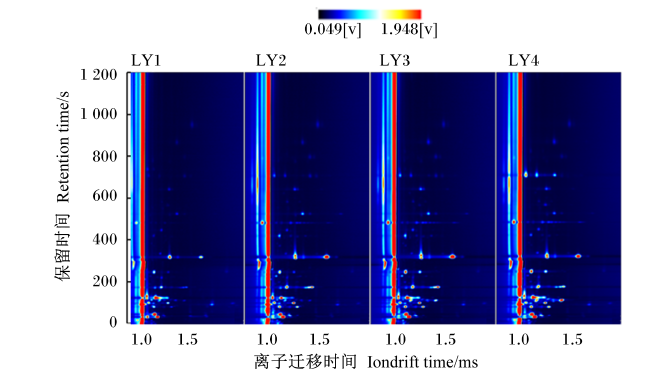
在工厂化循环水系统中暂养不同时间的大口黑鲈肌肉中挥发性化合物GC-IMS测定结果见图2,图中纵坐标代表气相色谱的保留时间(s),横坐标代表离子迁移时间(ms),横坐标1.0处的红线为经归一化处理的反应离子峰(reactiveionpeak,RIP),RIP两侧的每个亮斑代表一种挥发性化合物,白色表示较低含量,红色表示较高含量,颜色越深表示含量越高。由图2可知,随着在工厂化循环水系统中暂养时间的延长,大口黑鲈肌肉中挥发性风味物质的种类和含量均增加。
图2 工厂化循环水养殖系统中暂养不同时间的大口黑鲈肌肉的GC-IMS谱图(俯视图)

Fig.2 Muscle GC-IMS spectrogram of Micropterus salmoides under different temporary culturing time in industrialized circulating aquaculture system (vertical view)

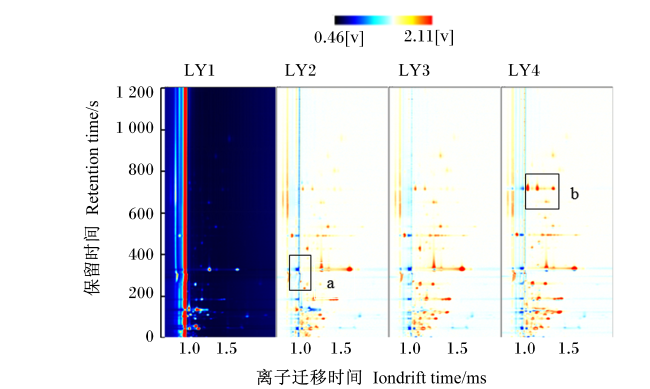
以LY1为参比,其余谱图扣除LY1中的信号峰,得到二者的差异谱图,如图3所示,蓝色区域说明该物质在此样品中较LY1少,如图中a区域,红色区域说明该物质在此样品中较LY1多,如图中b区域,同样的,颜色越深,说明差异越大。
图3 工厂化循环水养殖系统中暂养不同时间的大口黑鲈肌肉的GC-IMS谱图(差异图)

Fig.3 Muscle GC-IMS spectrogram of Micropterus salmoides under different temporary culturing time in industrialized circulating aquaculture system (difference diagram)

在大口黑鲈肌肉中共鉴定出56种挥发性风味物质,包括醛类24种、酮类12种、醇类13种、酯类1种和其他化合物6种(表8)。由此可见,醛类为大口黑鲈肌肉中最丰富的挥发性化合物,包括乙醛、丙烯醛、丙醛、丁醛、2-甲基戊醛、2-甲基丁醛、3-甲基丁醛、戊醛、反-2-戊烯醛、2-戊醛、己醛、反-2-己烯醛、乙缩醛、顺式-4-庚烯醛、正庚醛、反-2-庚烯醛、辛醛、反-2-辛烯醛和壬醛,其次为醇类和酮类。
表8 大口黑鲈肌肉中挥发性风味物质定性结果

Table 8 Qualitative results of volatile flavor compounds in muscle of Micropterus salmoides

化合物
Compounds
CAS号
CAS number
分子式
Molecule
formula
相对分子质量
Relative
molecule mass
保留指数
Retention index
保留时间
Retention time/s
迁移时间
Drift time/ms
醛类Aldehydes
乙醛Acetaldehyde C75070 C2H4O 44.1 773.4 215.527 0.975 76
丙烯醛Acrolein C107028 C3H4O 56.1 860.6 262.334 1.049 47
丙醛Propanal C123386 C3H6O 58.1 827.5 243.504 1.141 59
丁醛(单体) Butanal (monomer) C123728 C4H8O 72.1 897.8 285.251 1.110 80
丁醛(二聚体) Butanal (dimer) C123728 C4H8O 72.1 898.7 285.849 1.283 15
2-甲基戊醛2-methylpropanal C78842 C4H8O 72.1 839.1 249.960 1.281 32
2-甲基丁醛2-methylbutanal C96173 C5H10O 86.1 937.8 312.137 1.166 32
3-甲基丁醛3-methylbutanal C590863 C5H10O 86.1 936.9 311.540 1.403 45
戊醛(单体) Pentanal (monomer) C110623 C5H10O 86.1 1 006.1 366.681 1.180 86
戊醛(二聚体) Pentanal (dimer) C110623 C5H10O 86.1 1 007.5 368.242 1.421 31
反-2-戊烯醛(单体) (E)-2-pentenal (monomer) C1576870 C5H8O 84.1 1 154.6 581.269 1.109 01
反-2-戊烯醛(二聚体) (E)-2-pentenal (dimer) C1576870 C5H8O 84.1 1 154.6 581.269 1.362 66
2-戊醛2-pentenal C764396 C5H8O 84.1 1 137.5 549.276 1.087 02
己醛(单体) Hexanal (monomer) C66251 C6H12O 100.2 1 103.6 490.752 1.261 50
己醛(二聚体) Hexanal (dimer) C66251 C6H12O 100.2 1 104.0 491.532 1.565 00
反-2-己烯醛(E)-2-hexenal C6728263 C6H10O 98.1 1 236.3 721.304 1.186 02
乙缩醛Diethyl acetal C105577 C6H14O2 118.2 912.4 294.811 1.028 67
顺式-4-庚烯醛Cis-4-heptenal C6728310 C7H12O 112.2 1 257.7 754.003 1.151 29
正庚醛(单体) Heptanal (monomer) C111717 C7H14O 114.2 1 201.3 670.894 1.331 90
正庚醛(二聚体) Heptanal (dimer) C111717 C7H14O 114.2 1 201.4 671.006 1.699 89
反-2-庚烯醛(E)-2-heptenal C18829555 C7H12O 112.2 1 333.8 886.160 1.262 43
辛醛Octanal C124130 C8H16O 128.2 1 299.2 822.125 1.403 10
反-2-辛烯醛(E)-2-octenal C2548870 C8H14O 126.2 1 439.7 1 115.050 1.337 11
壬醛Nonanal C124196 C9H18O 142.2 1 404.6 1 033.304 1.470 83
酮类Ketones
丙酮Acetone C67641 C3H6O 58.1 847.6 254.781 1.114 27
2-丁酮(单体) 2-butanone (monomer) C78933 C4H8O 72.1 923.1 301.981 1.061 06
2-丁酮(二聚体) 2-butanone (dimer) C78933 C4H8O 72.1 923.1 301.981 1.246 14
2-戊酮(单体) 2-pentanone (monomer) C107879 C5H10O 86.1 1 002.4 362.779 1.114 88
2-戊酮(二聚体) 2-pentanone (dimer) C107879 C5H10O 86.1 1 003.9 364.340 1.356 80
3-戊酮3-pentanone C96220 C5H10O 86.1 1 024.9 387.750 1.106 08
1-戊烯-3-酮(单体) 1-penten-3-one (monomer) C1629589 C5H8O 84.1 1 045.3 411.939 1.076 76
1-戊烯-3-酮(二聚体) 1-penten-3-one (dimer) C1629589 C5H8O 84.1 1 045.3 411.939 1.309 88
环戊酮Cyclopentanone C120923 C5H8O 84.1 1 129.7 535.230 1.111 94
环己酮Cyclohexanone C108941 C6H10O 98.1 1 301.5 826.212 1.166 92
4-甲基-2-戊酮4-methyl-2-pentanone C108101 C6H12O 100.2 1 039.5 404.917 1.183 79
2-庚酮2-heptanone C110430 C7H14O 114.2 1 195.0 662.174 1.263 68
醇类Alcohols
乙醇(单体) Ethanol (monomer) C64175 C2H6O 46.1 952.9 322.983 1.043 03
乙醇(二聚体) Ethanol (dimer) C64175 C2H6O 46.1 954.0 323.763 1.125 14
2-丙醇2-propanol C67630 C3H8O 60.1 940.3 313.930 1.086 51
1-丙醇(单体) 1-propanol (monomer) C71238 C3H8O 60.1 1 059.1 429.106 1.113 41
1-丙醇(二聚体) 1-propanol (dimer) C71238 C3H8O 60.1 1 059.7 429.887 1.248 30
2-甲基-1-丙醇2-methyl-1-propanol C78831 C4H10O 74.1 1 112.5 505.578 1.172 06
1-丁醇1-butanol C71363 C4H10O 74.1 1 166.5 604.678 1.183 79
3-甲基-1-丁醇3-methyl-1-butanol C123513 C5H12O 88.1 1 225.2 704.955 1.246 80
1-戊醇(单体) 1-pentanol (monomer) C71410 C5H12O 88.1 1 268.0 770.352 1.257 22
1-戊醇(二聚体) 1-pentanol (dimer) C71410 C5H12O 88.1 1 268.9 771.715 1.510 77
1-戊烯-3-醇1-penten-3-ol C616251 C5H10O 86.1 1 180.9 634.331 0.943 33
1-己醇1-hexanol C111273 C6H14O 102.2 1 371.9 962.457 1.330 16
1-辛烯-3-醇1-octen-3-ol C3391864 C8H16O 128.2 1 485.2 1 230.858 1.172 13
酯类Lipids
庚酸乙酯Ethyl heptanoate C106309 C9H18O2 158.2 1 342.9 903.872 1.406 57
其他Others
二甲硫醚Dimethyl sulfide C75183 C2H6S 62.1 802.3 230.054 0.955 80
乙偶姻(单体) Acetoin (monomer) C513860 C4H8O2 88.1 1 302.3 827.575 1.060 98
乙偶姻(二聚体) Acetoin (dimer) C513860 C4H8O2 88.1 1 302.3 827.575 1.333 63
2,3-二甲基哌嗪2,3-dimethylpyrazine C5910894 C6H8N2 108.1 1 354.6 927.033 1.104 40
氨(单体) Ammonia (monomer) C7664417 NH3 17.0 1 263.7 763.540 0.847 37
氨(二聚体) Ammonia (dimer) C7664417 NH3 17.0 1 263.7 763.540 0.899 47
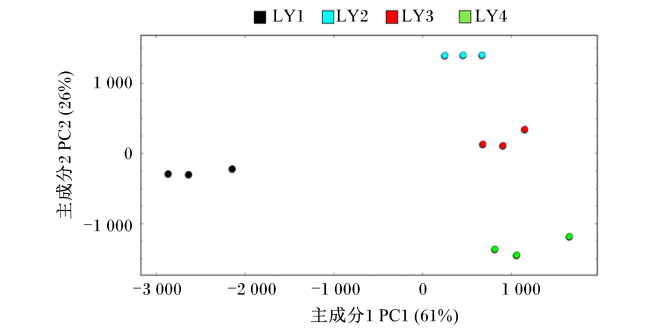
选取IMS特征峰的峰强度作为特征变量,对不同暂养时间的大口黑鲈肌肉挥发性风味物质进行主成分分析,筛选出2个变量主成分1(PC1)和主成分2(PC2)的贡献率分别为61%和26%,二者累计贡献率为87%(图4),并且4个暂养时间的大口黑鲈无重叠区域,可明显区分开。
图4 工厂化循环水养殖系统中暂养不同时间的大口黑鲈肌肉中挥发性风味物质的主成分分析图

Fig.4 Principal component analysis diagram of volatile flavor compounds in muscle of Micropterus salmoides under different temporary culturing time in industrialized circulating aquaculture system

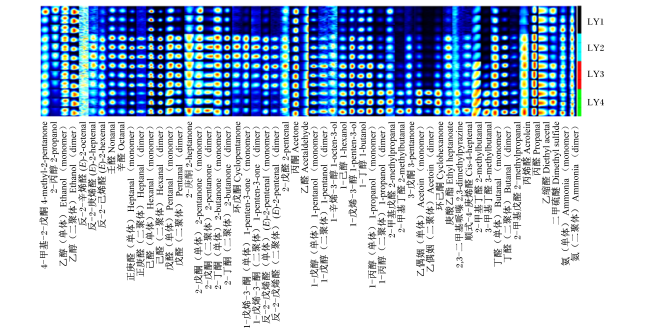
图5为根据各挥发性风味物质的含量,运用GC-IMS仪内置的FlavourSpec®系统(GAS)自带的LAV软件中的Gallery Plot插件所形成的指纹图谱。图中每行代表单个样本中全部挥发性风味物质的信号峰,每列代表同一挥发性风味物质在不同样本间的信号峰,每个亮斑代表一种挥发性风味物质,亮斑颜色越深代表含量越高。由图中可见,LY1中4-甲基-2-戊酮、2-丙醇、乙醇等物质的含量较高;LY2中E-2-辛烯醛、E-2-庚烯醛、E-2-己烯醛、壬醛、辛醛、庚醛、己醛、戊醛、2-庚酮、2-戊酮、2-丁酮、环戊酮、1-戊烯-3-酮等物质的含量较高;LY3中E-2-戊烯醛、2-戊烯醛、丙酮、乙醛、1-戊醇等物质的含量较高;LY4中1-辛烯-3-醇、1-己醇、1-戊烯-3-醇、1-丁醇、1-丙醇、2-甲基-1-丙醇、3-甲基-1-丁醇、3-戊酮、乙偶姻、环己酮、庚酸乙酯、2,3-二甲基吡嗪、Z-4-庚烯醛、2-甲基丁醛、3-甲基丁醛、丁醛、2-甲基丙醛、丙烯醛、丙醛、乙缩醛、二甲基硫醚、氨等物质的含量较高。
图5 工厂化循环水养殖系统中暂养不同时间的大口黑鲈肌肉中挥发性风味物质的指纹图谱

Fig.5 Fingerprint of volatile flavor compounds in muscle of Micropterus salmoides under different temporary culturing time in industrialized circulating aquaculture system

3 讨论

3.1 工厂化循环水养殖模式对大口黑鲈形体指标的影响

运动对鱼体形体指标的影响主要与脂肪沉积有关,相关研究表明,当运动速度在一定强度范围内时可以增加鱼体脂肪沉积,从而导致肥满度、脏体指数和肝体指数上升[17],但强度超过一定范围的运动会促使脂肪分解供能,从而造成肥满度等指标降低[18]。原居林等[10]研究发现,“跑道”养殖90 d的大口黑鲈,其肥满度、脏体指数和肝体指数均显著低于传统池塘养殖的大口黑鲈;李敏等[19]的研究结果则显示,“跑道”养殖梭鱼肥满度、脏体指数与网箱养殖差异不显著。本研究发现,工厂化循环水暂养30 d对大口黑鲈肥满度、脏体指数和肝体指数无显著影响。造成这种差异的原因可能与试验鱼的种类、循环水流速以及养殖周期有关。

3.2 工厂化循环水养殖模式对大口黑鲈肌肉常规营养成分的影响

肌肉组织是鱼类主要食用部分,肌肉中粗蛋白质和粗脂肪含量是评价肌肉营养价值的重要参照[20],其含量受养殖模式、饲料营养和投喂方式等诸多因素影响。工厂化循环水养殖系统相对于传统池塘而言,其最大差别在于流速增加。关于流速对鱼类肌肉营养组成影响的研究较多,但结论不一[10]。宋立民等[11]研究表明,不同群体大口黑鲈肌肉粗蛋白质和粗脂肪含量受循环水养殖模式的影响不同。本研究中,在工厂化循环水系统中暂养不同时间的大口黑鲈肌肉粗蛋白质和粗脂肪含量无显著差异,这一结果与管崇武等[21]的研究结果相一致。分析其原因,可能与本试验养殖周期较短和暂养期间投喂饲料有关。

3.3 工厂化循环水养殖模式对大口黑鲈肌肉氨基酸组成及评价的影响

水产品的氨基酸组成,特别是必需氨基酸组成和含量决定了蛋白质营养水平,是衡量其营养价值的重要指标[22]。本试验条件下,在工厂化循环水系统中暂养不同时间的大口黑鲈肌肉氨基酸组成较一致,含量变化较小,表明大口黑鲈肌肉氨基酸组成相对保守,受工厂化循环水养殖系统的影响较小,这一研究结果在韩晓磊等[23]开展的不同养殖模式下加州鲈营养成分差异分析中得到了证实。本研究中,在工厂化循环水系统中暂养时间达30 d时,大口黑鲈肌肉氨基酸总量显著升高,可见,在工厂化循环水养殖系统中暂养达到一定的周期可显著影响大口黑鲈肌肉氨基酸总量。根据FAO/WHO的氨基酸理想模式,质量较好的蛋白质其氨基酸组成中必需氨基酸/总氨基酸(EAA/TAA)为40%左右,必需氨基酸/非必需氨基酸(EAA/NEAA)在60%以上[21]。本研究中,在工厂化循环水系统中暂养不同时间的大口黑鲈肌肉氨基酸组成中的EAA/TAA为41.12%~41.71%,EAA/NEAA为81.85%~83.87%,表明大口黑鲈肌肉属于优质蛋白质。AAS、CS和EAAI是评定必需氨基酸营养价值的3个重要指标,AAS和CS数值越接近1,EAAI数值越接近100,就代表蛋白质价值越高,营养越均衡[14]。本研究中,在工厂化循环水系统中暂养不同时间的大口黑鲈肌肉AAS大于1或接近1,EAAI范围为73.24~77.66,进一步说明了大口黑鲈肌肉蛋白质营养均衡。

3.4 工厂化循环水养殖模式对大口黑鲈肌肉脂肪酸组成的影响

除氨基酸外,脂肪酸是影响肌肉品质和风味的又一重要因素[24],其主要可分为饱和脂肪酸和不饱和脂肪酸,其中饱和脂肪酸作为重要的能量来源之一,可为机体提供充足的能量,而不饱和脂肪酸在维持细胞因子功能稳定、调控脂蛋白平衡、降低胆固醇、抗心血管疾病等方面起着重要作用,特别是其中的亚油酸、EPA和DHA还可以抑制癌细胞生长[25]。本研究中,大口黑鲈肌肉中EPA、DHA以及EPA+DHA含量随着放入循环水养殖系统中暂养时间的延长而出现波动,其中EPA含量在放入循环水养殖系统暂养后均显著高于初始样,DHA含量在放入循环水养殖系统暂养10和20 d时略微降低,但到暂养30 d时显著升高,大口黑鲈肌肉EPA、DHA以及EPA+DHA含量均以暂养30 d时最高,这与付运银等[26]的研究结果相类似。究其原因可能为,池塘养殖模式下的大口黑鲈放入循环水养殖系统后,新环境对鱼体产生应激,而应激状态往往伴随鱼体高度不饱和脂肪酸的脂质过氧化,因此前期鱼体肌肉中高不饱和脂肪酸含量会出现略有下降的趋势;但在一定周期内,随着大口黑鲈适应循环水养殖条件后,应激反应消除,使EPA及DHA累积存在可能;加之循环水养殖模式下的大口黑鲈需要长时间进行游泳行为以应对循环水流,不间断地运动激活了线粒体代谢来满足鱼体能量需求,而线粒体代谢的能量多来自于相对中短链的脂肪酸而非高不饱和长链脂肪酸如DHA、EPA等的分解代谢,所以在一定周期(暂养30 d)后鱼体肌肉脂肪酸中的DHA和EPA占比就提高了。韩晓磊等[23]研究认为,鱼体运动强度加大会加速能量补充需要,进而消耗大量的饱和脂肪酸,还会维持并加强鱼体正常的神经和视觉功能,从而选择性地在体内沉积EPA和DHA。本研究中,循环水暂养30 d与初始样相比,肌肉脂肪酸中降幅较大的除了饱和脂肪酸中的硬脂酸,还有相对短链脂肪酸亚麻酸和亚油酸,其中以亚油酸降幅最大,这与蔡丽等[27]对翘嘴鲌的研究结果相一致。故初步推测大口黑鲈在工厂化循环水系统暂养30 d后肌肉中EPA、DHA以及EPA+DHA组成比例升高不但是通过鱼体加大运动消耗硬脂酸等饱和脂肪酸所致,而且还消耗了亚麻酸和亚油酸,其机制有待于进一步研究。

3.5 工厂化循环水养殖模式对大口黑鲈肌肉挥发性风味物质的影响

本研究采用GC-IMS联用技术对大口黑鲈肌肉中挥发性风味物质进行了鉴定。按照化合物结构对鉴定出的所有化合物进行分类,主要有醛类、酮类、酯类、醇类等,其中以醛类含量最多。为探究在工厂化循环水养殖系统中暂养不同时间对大口黑鲈肌肉中挥发性风味物质含量的影响,对鉴定出的56种挥发性风味物质的离子强度进行主成分分析。主成分分析是一种重要的数据降维处理方法,通过将一组可能存在相关性的变量通过归一化处理后减少该组变量的维数,同时保留少数特征物质,以达到筛选代表性变化的目的[28]。通常认为累计贡献率大于80%时,该主成分分析模型包含了样本的主要信息[28]。本研究中建立的主成分分析模型的2个主成分累计贡献率为87%,说明该模型中筛选的2个主成分可以反映在工厂化循环水养殖系统中暂养不同时间的大口黑鲈肌肉中挥发性风味化合物的主要信息。在主成分分析得分图中,4个暂养时间的大口黑鲈可以很好地分开,表明随着工厂化循环水暂养时间的延长,大口黑鲈肌肉中挥发性风味出现了明显差异。
醛类物质有较低的气味阈值[29],在水产动物肌肉中作为特征性风味物质已经得到了广泛报道。本研究中所鉴定出的醛类化合物都曾在不同水产动物中有报道,如舌齿鲈[30]、大黄鱼[31]和翘嘴鲌[27]。根据指纹图谱,大口黑鲈肌肉中鉴定出的醛类物质在LY2和LY4中种类较多,含量较高。相关研究表明,醛类物质在分子质量较低(<150 u)时会产生令人不愉快的气味,而分子质量较大时,则会产生甜味和水果味[32]。正戊醛是n-6多不饱和脂肪酸的氧化产物,具有杏仁味、水果味和麦芽味[31],正庚醛、正辛醛和壬醛都是油酸和亚油酸的氧化产物,正庚醛和正辛醛通常具有脂肪味、干鱼味、青草味、柑橘水果味和辛辣味,壬醛则具有生鱼味、塑料味和脂肪味[31]。这4种醛类在LY2中含量较高。其中,正庚醛和壬醛在含量较低时散发出较为清新的气味,含量较高时则呈现令人不愉悦的酸败味和鱼腥味[33]。这说明工厂化循环水暂养周期达10 d时即对大口黑鲈肌肉中挥发性风味物质产生显著影响。2-甲基-丁醛和3-甲基-丁醛分别是异亮氨酸和亮氨酸Strecker降解反应的产物,前者呈现出坚果味,或者呈现出刺激性气味、杏仁味和坚果味[31]。这2种醛类在LY4中含量较高。
水产品中的酮类物质通常是热降解、氨基酸降解、脂质氧化、微生物氧化和美拉德反应的产物[31]。大多数酮类物质具有水果和奶油的香味,阈值高于醛类物质[34],对肉的腥味具有消减作用[35]。本研究中,在大口黑鲈肌肉中共鉴定出12种酮类物质,其中含量较高的酮类以LY2大口黑鲈肌肉中最多。2-庚酮被报道存在于中华绒螯蟹[36]和大黄鱼[31]体内,并认为其具有类似果香、花香和青草香,2-丁酮在草鱼[37]和中华绒螯蟹[38]中被认为具有黄油味,是由微生物的乳酸或柠檬酸代谢生成[39]。本研究中,工厂化循环水暂养大口黑鲈10 d后,其肌肉中2-庚酮、2-丁酮、2-戊酮和环戊酮含量升高,这将对丰富肌肉愉悦气味具有一定作用。
醇类物质具有较高的阈值,通常被认为对食品风味贡献较小,除非大量存在或以不饱和状态存在[40]。本研究中,在大口黑鲈肌肉中共鉴定出醇类13种,以LY4大口黑鲈肌肉中含量较高。正己醇的来源与脂氧合酶和过氧化氢裂解酶的活动有关,被认为具有一种青草味,曾在许多水产品中被鉴定出[41]。1-辛烯-3-醇是一种不饱和醇类,其作为水产动物中一种重要的气味活性醇,在国内外已经得到了广泛研究[42]。1-辛烯-3-醇通常来源于不饱和脂肪酸,并被认为带有一种类似蘑菇的气味[43]。含量较高的醇类种类以LY4大口黑鲈肌肉中较多,这表明工厂化循环水暂养周期增加至30 d时大口黑鲈肌肉将富集较多醇类物质,可能对大口黑鲈肌肉风味有改善作用。

4 结论

综上所述,与初始放入工厂化循环水暂养的池塘养殖大口黑鲈成鱼相比,在工厂化循环水系统中暂养30 d后,其肌肉中氨基酸总量以及EPA、DHA和EPA+DHA含量提高,暂养10 d后,其肌肉中挥发性风味物质的种类及含量均显著增加,如2-庚酮、2-戊酮、2-丁酮、环戊酮等。因此,将池塘养殖大口黑鲈成鱼移入到工厂化循环水系统中暂养可提高大口黑鲈肌肉的营养品质及风味,建议将其在池塘养殖大口黑鲈成鱼的品质提升上推广应用。
[1]
BAI J J, LUTZ-CARRILLO D J, QUAN Y C, et al. Taxonomic status and genetic diversity of cultured largemouth bass Micropterus salmoides in China[J]. Aquaculture, 2008, 278(1/4):27-30.

[2]
农业农村部渔业渔政管理局, 全国水产技术推广总站,中国水产学会.中国渔业统计年鉴-2020[M]. 北京: 中国农业出版社, 2020:33.

Fisheries and Fisheries Administration Bureau of the Ministry of Agriculture and Rural Affairs,National Fisheries Technology Extension Center, China Society of Fisheries.China fishery statistical yearbook of 2020[M]. Beijing: China Agriculture Press, 2020:33. (in Chinese)

[3]
农业农村部渔业渔政管理局. 全国水产技术推广总站,中国水产学会.中国渔业统计年鉴-2021[M]. 北京: 中国农业出版社, 2021:25.

Fisheries and Fisheries Administration Bureau of the Ministry of Agriculture and Rural Affairs,National Fisheries Technology Extension Center, China Society of Fisheries.China fishery statistical yearbook of 2021[M]. Beijing: China Agriculture Press, 2021:25. (in Chinese)

[4]
WAN J L, CAO A L, CAI L Y. Effects of vacuum or sous-vide cooking methods on the quality of largemouth bass (Micropterus salmoides)[J]. International Journal of Gastronomy and Food Science, 2019, 18:100181.

[5]
廖静. 加州鲈种苗的“两次升级”[J]. 海洋与渔业, 2019(12):60-61.

LIAO J. “Two upgrades” of largemouth bass seedlings[J]. Ocean and Fishery, 2019(12):60-61. (in Chinese)

[6]
胥钦, 乔宇, 汪莹, 等. 超高压结合真空低温烹调处理对鲈鱼品质的影响[J]. 食品工业, 2021, 42(6):174-178.

XU Q, QIAO Y, WANG Y, et al. Effect of high hydrostatic pressure combined with sous-vide treatment on quality of perches[J]. The Food Industry, 2021, 42(6):174-178. (in Chinese)

[7]
胡金城, 于学权, 辛乃宏, 等. 工厂化循环水养殖研究现状及应用前景[J]. 中国水产, 2017(6):94-97.

HU J C, YU X Q, XIN N H, et al. Research status and application prospects of industrialized recirculating aquaculture[J]. China Fisheries, 2017(6):94-97. (in Chinese)

[8]
刘克明, 马林, 尤宏争, 等. 3种养殖模式下北极红点鲑肌肉营养成分分析与评价[J]. 大连海洋大学学报, 2019, 34(3):387-392.

LIU K M, MA L, YOU H Z, et al. Comparative analysis of muscular nutrients in Arctic char Salvelinus alpines cultured under three different modes[J]. Journal of Dalian Fisheries University, 2019, 34(3):387-392. (in Chinese)

[9]
仇登高, 温凭, 林琪, 等. 投喂频率对工厂化循环水养殖珍珠龙胆石斑鱼生长和血浆抗应激酶活力的影响[J]. 渔业研究, 2018, 40(6):441-448.

QIU D G, WEN P, LIN Q, et al. The effect of feeding frequency on the growth and plasma anti-stress enzyme activities of hybrid grouper (Epinephelus fuscoguttatus ♀×E. lanceolatus♂) in industrial recirculating aquaculture systems[J]. Journal of Fisheries Research, 2018, 40(6):441-448. (in Chinese)

[10]
原居林, 刘梅, 倪蒙, 等. 不同养殖模式对大口黑鲈生长性能、形体指标和肌肉营养成分影响研究[J]. 江西农业大学学报, 2018, 40(6):1276-1285.

YUAN J L, LIU M, NI M, et al. Effects of different culture models on growth performances,morphological traits and nutritional quality in muscles of Micropterus salmoides[J]. Acta Agriculturae Universitatis Jiangxiensis, 2018, 40(6):1276-1285. (in Chinese)

[11]
宋立民, 姜巨峰, 王宇, 等. 不同养殖模式下2个群体大口黑鲈肌肉营养成分比较[J]. 中国农学通报, 2022, 38(14):118-123.

DOI

SONG L M, JIANG J F, WANG Y, et al. Comparison of muscle nutritional components of Micropterus salmoides from 2 populations under different culture modes[J]. Chinese Agricultural Science Bulletin, 2022, 38(14):118-123. (in Chinese)

[12]
KIM H S, JUNG W G, MYUNG S H, et al. Substitution effects of fishmeal with tuna byproduct meal in the diet on growth,body composition,plasma chemistry and amino acid profiles of juvenile oliver flounder (Paralichthys olivaceus)[J]. Aquaculture, 2014, 431:92-98.

[13]
黄峰, 严安生, 熊传喜, 等. 黄颡鱼的含肉率及鱼肉营养评价[J]. 淡水渔业, 1999, 29(10):3-6.

HUANG F, YAN A S, XIONG C X, et al. Evaluation of the nutrition and the rate or flesh in the whole body of Pelteobagraus fulvidraco rich[J]. Freshwater Fisheries, 1999, 29(10):3-6. (in Chinese)

[14]
Joint FAO/WHO Ad Hoc Expert Committee on Energy and Protein Requirements,World Health Organization & Food and Agriculture Organization of the United Nations. Energy and protein requirements:report of a Joint FAO/WHO ad hoc expert committee: World Health Organization technical report series No. 522[R]. Geneva: World Health Organization, 1973:40-73.

[15]
中国预防医学科学院营养与食品卫生研究所. 食物成分表(全国代表值)[M]. 北京: 人民卫生出版社, 1991:30-82,92-104.

Institute of Nutrition and Food Hygiene,Chinese Academy of Preventive Medicine. Food composition (national representative value)[M]. Beijing: People's Medical Publishing House, 1991:30-82,92-104. (in Chinese)

[16]
PELLETT P L, YONG V R. Nutritional evaluation of protein foods[M]. Tokyo: United Nations University Press, 1980:26-29.

[17]
MERINO G E, PIEDRAHITA R H, CONKLIN D E. Effect of water velocity on the growth of California halibut (Paralichthys californicus) juveniles[J]. Aquaculture, 2007, 271(1/4):206-215.

[18]
LIU G Y, WU Y J, QIN X H, et al. The effect of aerobic exercise training on growth performance,innate immune response and disease resistance in juvenile Schizothorax prenanti[J]. Aquaculture, 2018, 486:18-25.

[19]
李敏, 蔡景波, 张翔, 等. 2种模式梭鱼肌肉营养组成及挥发性风味成分比较[J]. 浙江海洋大学学报(自然科学版), 2022, 41(2):119-127.

LI M, CAI J B, ZHANG X, et al. Comparison of nutritional composition and main volatile substances in muscle of Liza haematocheila in two culture models[J]. Journal of Zhejiang Ocean University (Natural Science), 2022, 41(2):119-127. (in Chinese)

[20]
周胜杰, 杨蕊, 于刚, 等. 美济礁附近海域3种金枪鱼肌肉成分检测与营养评价[J]. 南方水产科学, 2021, 17(2):51-59.

ZHOU S J, YANG R, YU G, et al. Muscle composition determination and nutrition evaluation of three tuna species near Meiji reef[J]. South China Fisheries Science, 2021, 17(2):51-59. (in Chinese)

[21]
管崇武, 杨菁, 单建军, 等. 不同养殖模式下俄罗斯鲟肌肉营养成分的比较与分析[J]. 中国农学通报, 2020, 36(8):145-150.

DOI

GUAN C W, YANG J, SHAN J J, et al. Muscle nutrient composition of Russian sturgeon (Acipenser gueldenstaedtii) under different culture modes:comparison and analysis[J]. Chinese Agricultural Science Bulletin, 2020, 36(8):145-150. (in Chinese)

[22]
李凤林, 张忠, 李凤玉. 食品营养学[M]. 北京: 化学工业出版社, 2009:24-49.

LI F L, ZHANG Z, LI F Y. Food nutrition[M]. Beijing: Chemical Industry Press, 2009:24-49. (in Chinese)

[23]
韩晓磊, 王浩, 冯一凡, 等. 不同养殖模式下加州鲈营养成分差异分析[J]. 淡水渔业, 2020, 50(3):87-93.

HAN X L, WANG H, FENG Y F, et al. Comparative study on nutritional components of Micropterus salmoides under different aquaculture modes[J]. Freshwater Fisheries, 2020, 50(3):87-93. (in Chinese)

[24]
薛山. 动物源肌内磷脂及其脂肪酸含量、组成与生理功效研究进展[J]. 肉类研究, 2016, 30(9):40-44.

XUE S. A review of the current knowledge of fatty acid contents,composition and physiological functions of animal-derived intramuscular phospholipids[J]. Meat Research, 2016, 30(9):40-44. (in Chinese)

[25]
冯德品, 董舰峰, 张金平, 等. 网箱与微流水养殖的齐口裂腹鱼肌肉营养成分的比较与分析[J]. 水产学杂志, 2017, 30(4):17-22.

FENG D P, DONG J F, ZHANG J P, et al. Comparison and quality evaluation of nutritive composition in muscle of Schizothorax prenanti reared in cages and flowing water[J]. Chinese Journal of Fisheries, 2017, 30(4):17-22. (in Chinese)

[26]
付运银, 郑维友, 张恒, 等. 开放流水养殖模式下暂养时间对黄颡鱼肌肉品质和营养价值的影响[J]. 水生生物学报, 2023, 47(8):1342-1352.

FU Y Y, ZHENG W Y, ZHANG H, et al. Purging time on muscle quality and nutritional value of yellow catfish (Pelteobagrus fulvidraco) under open flowing water mode[J]. Acta Hydrobiologica Sinica, 2023, 47(8):1342-1352. (in Chinese)

[27]
蔡丽, 魏泽宏, 唐涛, 等. 池塘内循环水“跑道”养殖与池塘传统养殖翘嘴鲌肌肉营养成分和挥发性风味物质的比较[J]. 水产学报, 2021, 45(10):1621-1633.

CAI L, WEI Z H, TANG T, et al. Comparison of nutritional quality and volatile flavor compounds in muscle of Culter alburnus cultivated in in-pond “raceway” aquaculture system and traditional pond[J]. Journal of Fisheries of China, 2021, 45(10):1621-1633. (in Chinese)

[28]
邵悦春, 付晓婷, 许加超, 等. 基于气相离子迁移谱的发酵海带风味分析[J]. 食品工业科技, 2021, 42(12):300-306.

SHAO Y C, FU X T, XU J C, et al. Flavor analysis of fermented Laminaria japonica based on gas chromatograph-ion mobility spectrometer (GC-IMS)[J]. Science and Technology of Food Industry, 2021, 42(12):300-306. (in Chinese)

[29]
GIRI A, OSAKO K, OHSHIMA T. Identification and characterisation of headspace volatiles of fish miso,a Japanese fish meat based fermented paste,with special emphasis on effect of fish species and meat washing[J]. Food Chemistry, 2010, 120(2):621-631.

[30]
VIDAL N P, MANZANOS M J, GOICOECHEA E, et al. Farmed and wild sea bass (Dicentrarchus labrax) volatile metabolites:a comparative study by SPME-GC/MS[J]. Journal of the Science of Food and Agriculture, 2016, 96(4):1181-1193.

[31]
MU H, WEI Z H, YI L N, et al. Dietary fishmeal levels affect the volatile compounds in cooked muscle of farmed large yellow croaker Larimichthys crocea[J]. Aquaculture Research, 2017, 48(12):5821-5834.

[32]
WU G Y. Amino acids:metabolism,functions,and nutrition[J]. Amino Acids, 2009, 37(1):1-17.

[33]
薛永霞, 卫赛超, 张菊, 等. 尼罗罗非鱼制作传统上海熏鱼过程中的风味变化[J]. 水产学报, 2019, 43(7):1661-1677.

XUE Y X, WEI S C, ZHANG J, et al. Changes of flavor components of Oreochromis niloticus during the processing of traditional Shanghai smoked fish[J]. Journal of Fisheries of China, 2019, 43(7):1661-1677. (in Chinese)

[34]
HUANG Q, DONG K, WANG Q, et al. Changes in volatile flavor of yak meat during oxidation based on multi-omics[J]. Food Chemistry, 2022, 371:131103.

[35]
顾赛麒, 唐锦晶, 周绪霞, 等. 腌腊鱼传统日晒干制过程中品质变化与香气形成[J]. 食品科学, 2019, 40(17):36-44.

DOI

GU S Q, TANG J J, ZHOU X X, et al. Quality change and aroma formation in cured fish during traditional sun drying processing[J]. Food Science, 2019, 40(17):36-44. (in Chinese)

DOI

[36]
GU S Q, WANG X C, TAO N P, et al. Characterization of volatile compounds in different edible parts of steamed Chinese mitten crab (Eriocheir sinensis)[J]. Food Research International, 2013, 54(1):81-92.

[37]
WANG H L, ZHANG J J, ZHU Y Z, et al. Volatile components present in different parts of grass carp[J]. Journal of Food Biochemistry, 2018, 42(6):e12668.

[38]
WU N, GU S Q, TAO N P, et al. Characterization of important odorants in steamed male Chinese mitten crab (Eriocheir sinensis) using gas chromatography-mass spectrometry-olfactometry[J]. Journal of Food Science, 2014, 79(7):C1250-C1259.

[39]
HAYALOGLU A A, YASAR K, TOLU C, et al. Characterizing volatile compounds and proteolysis in Gokceada artisanal goat cheese[J]. Small Ruminant Research, 2013, 113(1):187-194.

[40]
MU H, WEI Z H, YI L N, et al. Effects of low dietary fish meal on the volatile compounds in muscle of large yellow croaker Larimichthys crocea[J]. Aquaculture Research, 2017, 48(9):5179-5191.

[41]
MA R, LIU X H, TIAN H N, et al. Odor-active volatile compounds profile of triploid rainbow trout with different marketable sizes[J]. Aquaculture Reports, 2020, 17:100312.

[42]
ZHUANG K J, WU N, WANG X C, et al. Effects of 3 feeding modes on the volatile and nonvolatile compounds in the edible tissues of female Chinese mitten crab (Eriocheir sinensis)[J]. Journal of Food Science, 2016, 81(4):S968-S981.

[43]
MOREIRA N, ARAÚJO A M, ROGERSON F, et al. Development and optimization of a HS-SPME-GC-MS methodology to quantify volatile carbonyl compounds in Port wines[J]. Food Chemistry, 2019, 270:518-526.

DOI PMID

文章导航

/