综述

母源传递调控仔猪肠道黏膜发育的研究进展

  • 郑吉昌 , 1, 2 ,
  • 沈海波 1, 2 ,
  • 印遇龙 1, 2 ,
  • 王婧 , 1, 2, *
展开
  • 1 湖南农业大学动物科学技术学院,动物营养基因组与种质创新中心,长沙 410128
  • 2 岳麓山实验室,长沙 410128
*王 婧,教授,硕士生导师,E-mail:

郑吉昌(2000—),男,河南焦作人,硕士研究生,动物营养与饲料科学专业。E-mail:

Copy editor: 田艳明

收稿日期: 2023-12-29

  网络出版日期: 2024-06-07

基金资助

国家重点研发计划(2021YFD1300401)

国家自然科学基金(U20A2054)

国家自然科学基金(U22A20510)

国家自然科学基金(32072745)

国家自然科学基金(32102571)

国家自然科学基金(32130099)

湖南省优秀青年基金(2022JJ20027)

Research Progress on Regulation of Intestinal Mucosal Development in Piglets by Maternal Transmission

  • ZHENG Jichang , 1, 2 ,
  • SHEN Haibo 1, 2 ,
  • YIN Yulong 1, 2 ,
  • WANG Jing , 1, 2, *
Expand
  • 1 Animal Nutrition Genomics and Germplasm Innovation Center, College of Animal Science and Technology, Hunan Agricultural University, Changsha 410128, China
  • 2 Yuelushan Laboratory, Changsha 410128, China
*professor, E-mail:

Received date: 2023-12-29

  Online published: 2024-06-07

摘要

肠道健康是仔猪快速生长的核心基础。肠道的形成始于胚胎期,在哺乳期肠道组织重量及形态快速发育,并在断奶后逐渐发育成熟。在胚胎及哺乳期,母源营养物质和微生物通过胎盘、阴道、母乳和粪便等途径传递给子代,在其肠道形成和发育过程中发挥重要作用。本文以母源营养及微生物传递为切入点,围绕仔猪肠道黏膜形态和功能发育,阐明了母仔传递的主要途径,揭示了母源营养和微生物对子代肠道黏膜形态结构和功能的调控机制,旨在为优化母源营养干预措施提供参考,对改善仔猪肠道健康、提高仔猪活力具有重要的科学意义。

本文引用格式

郑吉昌 , 沈海波 , 印遇龙 , 王婧 . 母源传递调控仔猪肠道黏膜发育的研究进展[J]. 动物营养学报, 2024 , 36(6) : 3438 -3449 . DOI: 10.12418/CJAN2024.294

Abstract

Intestinal health is the core foundation for the rapid growth of piglets. The formation of the intestine begins in the embryonic period, the weight and shape of the intestinal tissue develop rapidly during lactation, and gradually mature after weaning. During the embryonic and lactation periods, maternal nutrients and microorganisms are transmitted to the offspring through the placenta, vagina, breast milk and feces, which play an important role in the formation and development of the intestine. Taking maternal nutrition and microbial transmission as the breakthrough point, this paper focused on the development of intestinal mucosa morphology and function of piglets, elucidated the main pathways of maternal nutrition and microbial transmission, and revealed the regulatory mechanism of maternal nutrition and microorganisms on intestinal mucosa morphology and structure and function of offspring, so as to provide a reference for optimizing maternal nutrition intervention measures. It is of great scientific significance to improve the intestinal health and vitality of piglets.

肠道是动物机体主要的消化器官和最大的免疫器官。肠道黏膜不仅承载了机体对营养物质的消化和吸收的过程,还组成了机体抵抗外源病原菌的重要屏障。仔猪肠道黏膜的发育状态会持续影响仔猪的生长和健康。仔猪出生后会遭受多种应激刺激,易引起未发育成熟的肠道屏障损伤,并极易导致继发性感染,从而降低仔猪生长速度。母源传递的营养物质和微生物是影响仔猪肠道黏膜发育的重要因素之一,这部分营养物质和微生物在仔猪肠道黏膜结构、黏液层微生物组成等方面均有长期的影响,或优或劣取决于母源传递的模式和物质的组成。通过改善母体营养和微生物的传递,促进子代肠道发育、加强肠道黏膜屏障功能,已成为现代营养学研究的热点之一。

1 母仔营养物质传递及其对子代肠道发育的影响

母源传递泛指从母体到子体的营养物质和微生物的传递过程,存在于母猪的妊娠期和哺乳期。仔猪出生前,肠道发育所需的营养物质和能量依赖于母仔间的胎盘传递;仔猪出生后,肠道发育由宫内发育转为宫外发育,营养物质摄入方式也随之改变,母乳成为哺乳仔猪的主要营养物质来源。母源营养物质在仔猪肠道消化吸收和屏障防御功能方面发挥了重要作用。

1.1 母仔间营养物质的传递

仔猪在出生前,肠道发育所需的营养物质依赖脐带血液循环和羊水吞咽[1]。母猪和胎猪的血液在母猪胎盘独有的滑膜结构中相融,经微血管过滤后实现营养物质的传递。一氧化氮作为孕期母猪精氨酸的代谢物可调节血管内皮生长因子,干预胎盘发育和微血管生成[2]。胎盘膜的交换通过扩散、转运蛋白介导的机制以及内吞和胞吐3个主要过程发生:如葡萄糖作为胎盘和胎猪代谢的底物,经ATP依赖型葡萄糖转运载体穿过胎盘发挥作用[3];铁作为血蛋白和氢化酶等的重要组成部分,经转铁蛋白介导传递到胎儿体内[4]。羊水作为第一种进入胎儿肠道的液体,胎儿在吞咽时可获得少部分营养物质支持肠道发育,占自身所需营养物质的10%~14%[5-6]。随着妊娠的进展,羊水中的葡萄糖、胰岛素和肝细胞生长因子等含量下降[7]。在胎儿食管结扎试验中发现,缺少羊水作用的肠道发育变得减缓[8]
母乳喂养是胎儿在宫内营养物质供给的一个延续。出生后,仔猪的肠道进入快速发育阶段,这一时期是仔猪体内营养物质转化的高峰期,此时,吮吸母乳成为仔猪在哺乳期获得营养物质的唯一途径,充足的母乳摄入成为仔猪肠道和整个机体的生理功能得以健康发育的重要因素[9-10]。初乳含有大量营养物质,例如由乳糖组成的碳水化合物,由三酰甘油和小部分可作为稳态调节剂的脂肪酸组成的脂质,以及由酪蛋白和富含免疫球蛋白的乳清蛋白组成的蛋白质,这些营养物质是仔猪生长发育所必需的,也可为仔猪提供调节体温所需的能量[11]。新生仔猪在24 h内若不能摄取至少200 g初乳,断奶前死亡率将达到43.4%[12]。Hu等[13]研究发现,哺乳仔猪限制营养(与母乳成分相同的配方奶)摄入后骨骼肌发育缓慢且代谢紊乱。此外,母乳中含有许多生物活性因子,如可促进仔猪肠道黏膜生长发育的功能性糖唾液酸[14]和表皮生长因子、胰岛素样生长因子;可帮助仔猪抵抗氧化应激的抗氧化剂谷胱甘肽、维生素A和维生素C[15];可抑制炎症反应,减轻仔猪炎症症状的抗炎因子白细胞介素-10(IL-10)、转化生长因子-β(TGF-β)。

1.2 母源物质对肠道黏膜消化吸收功能的影响

妊娠期母源营养物质的传递对仔猪肠道黏膜消化吸收功能的影响意义重大。生命早期,胎儿肠道在胎盘营养物质的持续支持下快速发育[16],从最初的简单管道发育成由单层柱状细胞构成的复杂消化器。妊娠后期,胎儿从羊水中摄取的生长调节素等可促进肠道黏膜的表面积进一步增大,肠道管径加宽,肠道皱襞和绒毛数量增多,肠上皮细胞和固有层细胞沿隐窝-绒毛轴不断增殖分化和更新,从而促进肠道黏膜与食糜接触面积,提高营养物质的转运吸收效率[5,17]。另外,羊水中高浓度的褪黑素可以进入胎儿机体循环,使胎儿的肠道持续暴露较高浓度的褪黑素中,促进肠道蠕动,但其对肠道消化吸收功能的积极影响需要进一步验证[18-19]。宫内生长受限影响仔猪肠道的营养物质吸收[20]。有研究表明,妊娠期营养供应不足的仔猪出生当天的肠道中动力蛋白1(dynamin 1,F1RRW8)和突触融合蛋白4(syntaxin 4,F1RIR2)等4种与转运相关的蛋白表达均表现异常[21]
出生时仔猪的肠道已经初步成型,出生后仔猪肠道内营养物质的供给从母体营养转变为自主吸收。肠道的完整性可为营养物质的消化吸收提供保障。初乳首先对新生仔猪的肠道产生良性刺激,与未哺乳的新生儿相比,哺乳1 d后仔猪肠道的重量增加86%,肠道长度增加29%,肠道表面积增加108%[22]。母乳中的肝素结合性表皮生长因子(HB-EGF)和血管内皮生长因子(VEGF)等可维持肠道微绒毛的完整,促进肠上皮细胞增殖[23];同时,母乳中乳糖可促使哺乳仔猪肠道内的乳糖酶活性水平在出生时达到峰值[24];乳铁蛋白则可促进仔猪肠道细胞增殖分化,加速肠道生长和成熟,减轻消化不良和腹泻等问题[25]

1.3 母源营养物质对肠道黏膜屏障功能的影响

肠道黏膜是维持肠道内环境稳态和抵御致病菌及毒素入侵的先天性屏障,包括机械屏障、化学屏障、微生物屏障和免疫屏障。妊娠期和哺乳期是仔猪肠道屏障系统发育和建立的关键期,肠道屏障在此时的发育深受母源营养物质的影响。
肠道机械屏障主要由肠道上皮细胞以及细胞间连接复合物组成,作为肠道抵御外来污染的第一道防线,发挥着重要的作用。肠道黏膜机械屏障的早期形成与发育需要母源营养物质的支持。在肠道干细胞衍生的类器官模型研究中发现,母乳中的碳水化合物经婴儿肠道微生物发酵产生丁酸盐,丁酸盐不仅能增加封闭蛋白(claudin)和闭合蛋白(occludin)蛋白表达,也可恢复紧密连接蛋白在白细胞介素-1β(IL-1β)和干扰素-γ(IFN-γ)攻击下所引起的损失,降低上皮细胞通透性,增强肠道机械屏障[26]。此外,相较于足月生产的仔猪,获得宫内母体营养物质较少的早产仔猪肠道黏膜通透性更高,机械屏障受损严重[27]
肠道化学屏障主要由黏蛋白、消化液以及抗菌活性物质组成,其中杯状细胞分泌的黏蛋白和潘氏细胞分泌的抗菌肽是主要的功能性成分(仔猪肠道是否存在潘氏细胞仍存在争议)。母乳中乳铁蛋白可促进子代回肠和结肠黏膜中黏蛋白2(MUC2)的分泌,并上调回肠中抗菌肽防御素β1(Defb1)的表达[28]。另外,来源于母乳中外泌体的微小RNA(microRNA)可促进杯状细胞活性,提高黏蛋白产量以及杯状细胞表达标志物三叶因子3(TFF3)和MUC2的相对表达水平[29]
肠道微生物屏障主要由宿主肠道内共生的微生物菌群发挥作用。母乳中的2'-岩藻糖基乳糖、6'-唾液酸乳糖和乳铁蛋白可抑制大肠杆菌在人结直肠腺癌细胞(Caco-2)细胞上的黏附[30];乳铁蛋白在乳酸菌的协助下也能有效地减少新生大鼠小肠中大肠杆菌的浮游和上皮黏附生长[31]。此外,有研究表明,碳水化合物中葡萄糖、D-半乳糖等可以通过调节微生物群体感应减轻致病性革兰氏阳性和革兰氏阴性病原体的毒力表达[32],而母乳向仔猪传递了大量的碳水化合物,是否经此机制影响仔猪肠道中病原体的致病性,仍具有研究意义。
肠道免疫屏障主要由肠道相关淋巴组织以及免疫蛋白组成。在胚胎发育期,胎盘不仅承载母源免疫球蛋白的传递,还可传递维生素,其中维生素A的代谢物视黄酸参与了特别是在肠道边界处的多种与免疫功能相关基因的表达,且能调控T细胞分化等[33-34]。分娩后,初乳中乳铁蛋白、抗炎细胞因子和免疫球蛋白等不仅直接参与新生仔猪的先天性免疫,还对仔猪的肠道免疫屏障产生良性刺激作用[35];此外,母乳中富含ω-3多不饱和脂肪酸(PUFA),有研究表明,PUFA可促进辅助性T细胞1(Th1)分化为效应T细胞、诱导辅助性T细胞2(Th2)凋亡,母乳中PUFA传递到仔猪体内后可帮助仔猪肠道黏膜的免疫细胞发挥作用[36]

2 母仔微生物垂直传递及其对子代肠道发育的影响

据统计,肠道内的微生物数量高达1014,是存活于动物体内最大的微生物群体[37]。随着肠道的发育,仔猪肠道黏膜微生物区系逐渐建立,并参与宿主的营养物质消化吸收和免疫防御,驱动肠道发育成熟。研究显示,子代肠道中约58.5%的微生物群落来源于母体,并呈现出与母体相似的肠道微生物结构[38-39]

2.1 母仔间微生物的垂直传递

母源传递微生物主要有4种途径:胎盘、阴道、母乳以及粪便。传统意义上认为仔猪在母体子宫内处于无菌环境,但Aagaard等[40]采用高通量测序法研究了无菌方法获得的胎盘切片,发现厚壁菌门、拟杆菌门等细菌的存在,并证实胎盘中存在低丰度但代谢丰富的微生物组,表明母源微生物在妊娠期间可能经胎盘和羊水定植在胎儿体内。在母体分娩过程中,母源阴道微生物与经过阴道的胎儿直接接触,自然分娩的婴儿较剖宫产出生的婴儿的肠道微生物载量高约31%[41],且经剖宫产的子代的拟杆菌门相对丰度和多样性都较低[42]
在哺乳期,子代从母乳和母猪粪便中可获取丰富的微生物。Murphy等[43]对母乳和相应婴儿粪便的微生物进行基因测序分析,发现具有相同特征的短芽孢杆菌和植物乳杆菌,并证明是属于同一菌株,为母源微生物通过母乳传递并在婴儿肠道中定植的能力提供了强有力的证据。在哺乳后期,母猪粪便中的核心微生物,如不动杆菌、假细胞菌、拟杆菌和变形菌等,被仔猪摄入并定植在其肠道内[44]。仔猪肠道内与母乳微生物相似的部分主要存在于仔猪小肠部位,而与母猪粪便中微生物类似的微生物则多活跃于盲肠、结肠等后肠部位[45]。因此,不同部位来源的母体微生物在子代肠道的定植能力存在差异,这可能与不同部位母源微生物组成差异相关;然而,母源微生物在子代中定植的机制和规律仍需进一步研究。

2.2 母源微生物对肠道黏膜消化吸收功能的影响

肠道微生物可协助宿主的营养消化,并调节代谢产物的吸收[46]。研究表明,用无菌法获得的母乳可分离出2种鼠李糖乳酪杆菌菌株LHL6和LHL7,在体外评估发现这2种菌株与发酵乳杆菌CECT5716的抗菌、耐酸性等特征相似,具有促进消化、缓解腹泻的潜力[47]。在母乳喂养的婴儿肠道微生物群中,双歧杆菌占主导地位,母乳中第三大固体成分低聚糖由于能抵抗胃酸、宿主肠道消化酶的水解和胃肠道吸收等特性可极大程度地到达宿主远端小肠和结肠处,最终被双歧杆菌代谢发酵[48-49]。子代在自然分娩和吮吸母乳的过程中获得了大量乳酸杆菌,这些母源乳酸杆菌定植在子代肠道后可产生乳糖酶、蛋白酶等消化酶以促进宿主的消化作用[50]。这部分乳糖酶作用产生的乳糖与母乳传递的乳糖在发酵过程中衍生的乳酸又可以被母乳微生物代谢,Jost等[51]提出韦荣氏球菌属和丙酸杆菌属将乳糖发酵衍生的乳酸代谢为丙酸盐和乙酸盐,防止乳酸积累。此外,母源粪便微生物在仔猪哺乳后期饮食教槽料时也发挥了作用,可以帮助仔猪消化分解纤维、蛋白质等复杂物质,转化为更易于吸收的小分子营养物质。有研究表明,给无菌仔猪移植健康母猪粪便微生物提高了新生仔猪脂肪酶、胰蛋白酶等消化酶的活性以及小肠的绒隐比,提高了新生仔猪的营养物质消化率[52]

2.3 母源微生物对肠道黏膜屏障功能的影响

母源微生物主要通过代谢物调控仔猪肠道黏膜形态的发育[53]。例如,微生物代谢产物丁酸盐可上调紧密连接(特别是claudin和occludin)和黏蛋白的表达,降低肠道通透性,减轻肠道炎症,增强肠道机械屏障[26]
母源微生物同样经代谢产物调控肠道黏膜化学屏障。例如,齿双歧杆菌可以分泌γ-谷氨酰半胱氨酸刺激杯状细胞,增加MUC2,从而降低活性氧(ROS),抑制核因子-κB(NF-κB)信号通路激活[54];分节丝状芽孢杆菌可诱导辅助性T细胞17(Th17)分化,增加白细胞介素-17(IL-17)、白细胞介素-22(IL-22)表达,刺激潘氏细胞分泌抗菌肽,维持肠道化学屏障[55-56]
母源微生物是影响子代肠道微生物菌群结构和多样性早期建立的主要决定因素。其中,母乳微生物在调控仔猪肠道微生物定植中扮演重要角色[57],子代出生后的前30 d经母乳传递并定植到子代肠道的微生物占仔猪肠道微生物的27.7%[58]。与其他母源传递微生物相比,母猪的粪便微生物可与仔猪肠道中的微生物发生共生效应,促进其在仔猪肠道中的定植,并且母猪粪便微生物对仔猪肠道微生物的贡献也是随着出生时间慢慢增长的,从仔猪出生时开始直到35日龄内贡献了约90%的细菌[45]
母源微生物也影响子代肠道黏膜免疫屏障的发育。有研究指出,胎儿与母体共生细菌是在妊娠期间垂直传递给胎儿以启动免疫系统发育的信使,由于子宫内胎儿暴露于垂直传播的微生物抗原而发生的“主动获得免疫耐受”[59]。此外,母源微生物能助力肠道免疫功能基因的局部表达,如抗炎症和抗病菌的相关基因表达[45],或者与先天性免疫相互作用助力肠道免疫屏障的发育过程[60]

3 母源干预对仔猪肠道发育的调控作用及机制

3.1 母源营养干预

妊娠期和哺乳期的母猪机体营养代谢旺盛,易受采食量、饲粮营养成分[61]以及疾病等因素的影响,因此可从母仔血液循环和乳汁传递的角度出发,利用营养手段干预母源传递,进一步改善仔猪肠道生命早期的发育与健康[62]。由于妊娠母猪和哺乳母猪自身营养需求与向子代传递营养物质方式的不同,生产中对母猪在不同时期的营养调控也存在差异。
妊娠母猪的营养状况深刻影响仔猪的初生重[63],母猪需要摄入稳定的能量和蛋白质供给胎盘的发育及营养物质传递。研究发现,给母猪补充核苷酸类添加剂可调节氨基酸代谢:如在妊娠中后期给母猪补充尿苷可经哺乳动物雷帕霉素靶蛋白复合物1(mTORC1)-过氧化物酶体增殖物激活受体(PPAR)途径调节胎盘的氨基酸及脂肪酸的代谢和转运,提高新生仔猪回肠的绒隐比,促进空肠和回肠白细胞介素-6(IL-6)、IL-10等细胞因子的表达[64];在妊娠中后期给母猪补充酵母核苷酸可提高母猪血清总蛋白和白蛋白含量,降低死胎率和仔猪宫内生长受限率,提高子代肠道免疫球蛋白的含量[65-66];在妊娠后期给母猪补充嘧啶核苷酸可调节母猪血清中谷氨酸等代谢,上调仔猪空肠中葡萄糖和氨基酸转运相关基因mRNA的表达[67];在妊娠中后期给母猪直接补充精氨酸可增加母猪精氨酸及其代谢物的循环水平,增强仔猪蛋白质合成以及出生窝重[68-69]。此外,妊娠母猪需要着重注意便秘问题,膳食纤维作为有效营养素,适量补充便可得到缓解,同时可增强母猪的繁殖性能[70-71]。膳食纤维添加剂的益处也能延伸至子代:如在妊娠期给母猪补充预胶化糯玉米淀粉、瓜尔胶类可提高母猪胰岛素敏感性,降低全身炎症,增加仔猪抗炎介质IL-10和免疫耐受介质TGF-β的表达,减轻肠道炎症[72];在妊娠后期开始给母猪补充低聚半乳糖可提高母猪血清免疫球蛋白含量,上调仔猪肠道紧密连接蛋白[occludin、claudin-1和闭锁小带蛋白-1(ZO-1)]和MUC2表达,增强肠道屏障[73]
哺乳母猪通过母乳传递营养物质,因此需要摄入更高的能量、优质蛋白以及脂肪进行分泌母乳。在妊娠后期和哺乳期给母猪补充麦麸和甜菜浆可减少母乳中的促炎因子,增加仔猪结肠中的醋酸盐和丁酸盐等短链脂肪酸含量,加强肠道屏障[74];在妊娠晚期和哺乳期给母猪补充酵母培养物可提高母猪产奶量并改善母乳质量,提高仔猪平均日增重[75];在妊娠后期和哺乳期给母猪补充酶制剂添加剂中的过氧化氢酶补充剂可提高母猪肠道中抗氧化酶相关基因的表达,减轻氧化应激,增强子代的脂代谢[76-77]。此外,在妊娠期和哺乳期优化母猪饲粮结构[78]或给母猪补充植物提取物(如黄芩和金银花[79]、水飞蓟素[80])也可提高乳糖、乳蛋白和免疫球蛋白含量,改善母乳,促进仔猪肠道健康发育。部分有关母猪饲粮中添加功能性活性物质的研究总结于表1
表1 干预母猪营养对母猪和仔猪的影响

Table 1 Effects of intervention in sow nutrition on sows and piglets

功能性添加剂
Functional additives
对母猪的影响
Impact on sows
对仔猪的作用
Effects on piglets
参考文献
References
尿苷
Uridine
改善妊娠母猪血清中半胱氨酸和
蛋氨酸的相对含量
降低死胎率,提高小肠绒毛高度、
绒隐比以及IL-6、IL-10等细胞
因子mRNA表达量
[64]
酵母核苷酸
Yeast-based nucleotide
增加妊娠母猪血清总蛋白、
白蛋白和总胆固醇含量
降低死胎率、宫内生长受限率,促进肠
绒毛的生长,提高肠道免疫球蛋白含量
[65-66]
嘧啶核苷
Pyrimidine nucleoside
降低妊娠母猪血清中谷丙转氨酶、
谷草转氨酶活性,提高氨基酸利用率
降低死胎率,上调空肠中葡萄糖和
氨基酸转运蛋白的基因表达
[67]
L-精氨酸
L-arginine
增加妊娠母猪血清白蛋白、精氨酸
含量,提高氨基酸利用率
提高仔猪窝重和肠道的消化能力 [68-69]
预胶化糯玉米淀粉、瓜尔胶
Pregelatinized waxy maize
starch and guar gum
增加妊娠母猪肠道丙酸盐、血浆
奇链脂肪酸含量,提高胰岛素敏感
性,减轻全身炎症
降低肠道通透性,减少肠道炎症 [72]
低聚半乳糖
Galactooligosaccharides
增加妊娠母猪血清免疫球
蛋白含量
上调肠道occludin、claudin-1、ZO-1表达,
增加MUC2含量,增强肠道屏障
[73]
麦麸、甜菜浆
Wheat bran and sugar beet pulp
减少哺乳母猪母乳中的
促炎因子
增加结肠中的醋酸盐、丁酸盐含量,
增强肠道屏障功能
[74]
过氧化氢酶
Catalase
提高哺乳母猪产奶量,调节脂肪酸
代谢,降低母猪氧化应激
降低宫内生长受限率,上调仔猪
回肠谷胱甘肽过氧化物酶基因表达
[76-77]

3.2 母源微生物干预

母猪饲粮中添加益生菌是目前最为便捷的调控母源微生物的方法:如在妊娠后期和哺乳期饲粮中添加丁酸梭菌可提高母猪肠道普雷沃氏菌的相对丰度,降低仔猪血清内大肠杆菌的相对丰度,同时经母源粪便微生物传递可增加仔猪肠道中益生菌的相对丰度[81];母猪妊娠期后4周饲粮中添加罗伊氏乳杆菌可降低母猪肠道变形杆菌门的相对丰度,提高双歧杆菌的相对丰度,提高仔猪胎粪中微生物的丰富度,同时提高初乳中微生物菌群的相对丰度,帮助仔猪肠道免受病原菌感染[82]。母猪妊娠后期和哺乳期补充枯草芽孢杆菌PB6可提高母猪繁殖性能,缩短产程,提高母猪肠道芽单胞菌门和酸杆菌门相对丰度,降低仔猪血清皮质醇含量,减缓应激腹泻[83]
母猪饲粮中添加益生元对母乳品质具有较好的改善作用:如在妊娠后期和哺乳期饲粮中添加酵母培养物可提高母猪采食量,增加产乳量,提高仔猪肠道有益菌普雷沃氏菌的相对丰度,增加子代肠道琥珀酸盐和乙酸盐的含量,进而增强仔猪肠道屏障和抗炎作用[75,84];白藜芦醇作为植物多酚,于妊娠后期和哺乳期在母猪饲粮中添加可有效提高母乳中乳酸杆菌等有益菌的相对丰度和免疫球蛋白的含量,增加仔猪肠道中普雷沃氏菌的相对丰度,减少食源性流行病原体志贺氏菌对仔猪肠道的侵染[85-86];于妊娠期和哺乳期在母猪饲粮中添加连翘提取物一方面可增强乳酸杆菌属的母源传递,提高母体和子代肠道中乳酸杆菌的相对丰度,另一方面可激活核因子E2相关因子2(Nrf2)/血红素氧合酶-1(HO-1)信号通路,提高母猪及其子代血清中超氧化物歧化酶(SOD)和谷胱甘肽过氧化物酶1(GPX1)含量[87-88]
此外,提高母猪膳食纤维的摄入也大有裨益[71]。于妊娠中后期在母猪饲粮中添加苜蓿可提高母猪和仔猪抗炎细菌的相对丰度,减轻炎症反应[89-90];于妊娠后期和哺乳期在母猪饲粮中添加发酵竹纤维可提高母猪肠道中普雷沃氏菌等产酸菌的相对丰度,提高仔猪肠道中益生菌另枝杆菌等相对丰度,抑制有害菌化脓隐秘杆菌等[91]。母猪饲粮中添加益生菌和益生元改善母猪微生菌群结构的部分相关研究总结见表2
表2 干预母猪微生物对母猪和仔猪的影响

Table 2 Effects of intervention in sow microorganism on sows and piglets

益生菌/益生元
Probiotics/prebiotics
对母猪的影响
Impact on sows
对仔猪的作用
Effects on piglets
参考文献
References
丁酸梭菌
Clostridium butyricum
缩短母猪产程,提高哺乳母猪血清
总超氧化物歧化酶活性和普雷沃
氏菌相对丰度
提高拟杆菌相对丰度,降低链
球菌、放线菌等相对丰度
[81]
罗伊氏乳杆菌
Lactobacillus reuteri
降低哺乳母猪变形杆菌门相对丰
度,提高双歧杆菌相对丰度
提高有益菌罗姆布茨菌属、
乳杆菌属、布劳特氏菌属、
Butyricicoccus和瘤胃球菌属相对丰度
[82]
枯草芽孢杆菌PB6
Bacillus subtilis PB6
缩短母猪产程,降低哺乳母猪血清
内毒素含量,提高肠道中瘤胃球菌科
UCG-013相对丰度
降低仔猪血清皮质醇含量,
减少腹泻
[83]
酵母培养物
Yeast culture
增加哺乳母猪肠道中厚壁菌,
减少拟杆菌
提高异乳杆菌相对丰度,降低
结肠食糜乳酸菌相对丰度
[75,84]
白藜芦醇
Resveratrol
提高哺乳母猪母乳中乳酸杆菌
相对丰度以及免疫球蛋白含量
提高仔猪粪便中乳酸杆菌相对丰度,
降低志贺氏菌相对丰度
[85-86]
连翘提取物
Forsythia suspensa extract
提高母猪妊娠期和哺乳
期乳酸杆菌相对丰度
提高结肠内乳杆菌属相对丰度 [87-88]
苜蓿粉
Alfalfa meal
提高哺乳母猪肠道中纤维蛋白溶解细菌
的相对丰度以及肠道抗炎菌群数量
提高抗炎细菌的相对丰度 [89-90]
发酵竹纤维
Fermented bamboo fiber
促进哺乳母猪肠道内有益菌毛螺菌
属和罗氏菌属等的富集,降低有害细菌
梭杆菌、萨特氏菌科和萨特氏
菌属相对丰度
提高有益菌另枝菌属和
Lachnoclostridium相对丰度,
降低结肠微生物中致病菌特吕
佩尔氏菌属相对丰度
[91]

4 小结

母源传递主要通过胎盘、阴道、母乳和母猪粪便等媒介输送母源营养物质和母源微生物以支持仔猪肠道的生长发育(图1)。本文从“母猪-仔猪-肠道”出发,查阅了母源营养物质和母源微生物对子代肠道发育和黏膜屏障功能调控作用的文章,综述了干预母源营养物质或微生物的主要手段及其对子代的影响。然而,母仔营养传递的具体机制以及母源干预对子代的持续效应仍需进一步研究。
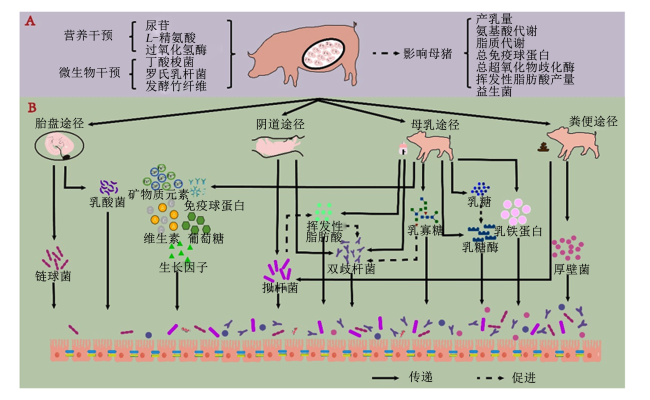
图1 母源营养物质和微生物的传递

A:营养和微生物干预对母猪的影响 effects of nutritional and microbial interventions on sows;B:母源传递经4种途径(胎盘、阴道、母乳、粪便)向仔猪传递营养物质和微生物,并对子代肠道产生影响 maternal transmission transmits nutrients and microorganisms to piglets through four pathways (placenta, vagina, breast milk and feces) and affects the gut of the offspring。

Fig.1 Transfer of maternal nutrients and microorganisms

[1]
BUDDINGTON R K, SANGILD P T. Companion animals symposium:development of the mammalian gastrointestinal tract,the resident microbiota,and the role of diet in early life[J]. Journal of Animal Science, 2011, 89(5):1506-1519.

[2]
TAN C Q, HUANG Z H, XIONG W Y, et al. A review of the amino acid metabolism in placental function response to fetal loss and low birth weight in pigs[J]. Journal of Animal Science and Biotechnology, 2022, 13(4):987-998.

[3]
BURTON G J, FOWDEN A L. The placenta:a multifaceted,transient organ[J]. Philosophical Transactions of the Royal Society of London.Series B:Biological Sciences, 2015, 370(1663):20140066.

[4]
CAO C, FLEMING M D. The placenta:the forgotten essential organ of iron transport[J]. Nutrition Reviews, 2016, 74(7):421-431.

[5]
DASGUPTA S, ARYA S, CHOUDHARY S, et al. Amniotic fluid:source of trophic factors for the developing intestine[J]. World Journal of Gastrointestinal Pathophysiology, 2016, 7(1):38-47.

[6]
MULVIHILL S J, STONE M M, DEBAS H T, et al. The role of amniotic fluid in fetal nutrition[J]. Journal of Pediatric Surgery, 1985, 20(6):668-672.

PMID

[7]
ZHANG L M, TAN C Q, XIN Z Q, et al. UPLC-Orbitrap-MS/MS combined with biochemical analysis to determine the growth and development of mothers and fetuses in different gestation periods on Tibetan sow model[J]. Frontiers in Nutrition, 2022,9:836938.

[8]
SANGILD P T, SCHMIDT M, ELNIF J, et al. Prenatal development of gastrointestinal function in the pig and the effects of fetal esophageal obstruction[J]. Pediatric Research, 2002, 52(3):416-424.

PMID

[9]
ZHANG S H, CHEN F, ZHANG Y Z, et al. Recent progress of porcine milk components and mammary gland function[J]. Journal of Animal Science and Biotechnology, 2018,9:77.

[10]
AVERETTE L A, ODLE J, MONACO M H, et al. Dietary fat during pregnancy and lactation increases milk fat and insulin-like growth factor Ⅰ concentrations and improves neonatal growth rates in swine[J]. Journal of Nutrition, 1999, 129(12):2123-2129.

[11]
INOUE R, TSUKAHARA T. Composition and physiological functions of the porcine colostrum[J]. Animal Science Journal, 2021, 92(1):e13618.

[12]
汪振有, 李防修. 初乳管理在养猪生产上的应用[J]. 北方牧业, 2022(2):22-23.

WANG Z Y, LI F X. The application of colostrum management in pig production[J]. Northern Animal Husbandry, 2022(2):22-23. (in Chinese)

[13]
HU L, PENG X, HAN F, et al. Effects of birth weight and postnatal nutritional restriction on skeletal muscle development,myofiber maturation,and metabolic status of early-weaned piglets[J]. Animals, 2020, 10(1):156.

[14]
JAHAN M, FRANCIS N, WYNN P, et al. The potential for sialic acid and sialylated glycoconjugates as feed additives to enhance pig health and production[J]. Animals, 2021, 11(8):2318.

[15]
LIPKO-PRZYBYLSKA J, KANKOFER M. Antioxidant defence of colostrum and milk in consecutive lactations in sows[J]. Irish Veterinary Journal, 2012, 65(1):4.

[16]
AVAGLIANO L, GARÒ C, MARCONI A M. Placental amino acids transport in intrauterine growth restriction[J]. Journal of Pregnancy, 2012,2012:972562.

[17]
TRAHAIR J F, HARDING R. Ultrastructural anomalies in the fetal small intestine indicate that fetal swallowing is important for normal development:an experimental study[J]. Virchows Archiv.A,Pathological Anatomy and Histopathology, 1992, 420(4):305-312.

[18]
CHEN C Q, FICHNA J, BASHASHATI M, et al. Distribution,function and physiological role of melatonin in the lower gut[J]. World Journal of Gastroenterology, 2011, 17(34):3888-3898.

[19]
BAGCI S, KATZER D, ALTUNTAS Ö, et al. The fetal gastrointestinal tract is exposed to melatonin and superoxide dismutase rich amniotic fluid throughout prenatal development[J]. Journal of Clinical Biochemistry and Nutrition, 2022, 71(1):64-68.

DOI PMID

[20]
LI T T, HUANG S M, LEI L, et al. Intrauterine growth restriction alters nutrient metabolism in the intestine of porcine offspring[J]. Journal of Animal Science and Biotechnology, 2021, 12(1):15.

DOI PMID

[21]
HUANG S M, LIU C, LI N, et al. Membrane proteomic analysis reveals the intestinal development is deteriorated by intrauterine growth restriction in piglets[J]. Functional & Integrative Genomics, 2020, 20(2):277-291.

[22]
BUDDINGTON R K, ELNIF J, PUCHAL-GARDINER A A, et al. Intestinal apical amino acid absorption during development of the pig[J]. American Journal of Physiology:Regulatory,Integrative and Comparative Physiology, 2001, 280(1):R241-R247.

[23]
YORK D J, SMAZAL A L, ROBINSON D T, et al. Human milk growth factors and their role in NEC prevention: a narrative review[J]. Nutrients, 2021, 13(11):3751.

[24]
BAILEY C B, KITTS W D, WOOD A J. The development of the digestive enzyme system of the pig during its pre-weaning phase of growth:B.Intestinal lactase,sucrase and maltase[J]. Canadian Journal of Agricultural Science, 1956, 36(1):51-58.

[25]
CONESA C, BELLÉS A, GRASA L, et al. The role of lactoferrin in intestinal health[J]. Pharmaceutics, 2023, 15(6):1569.

[26]
GAO Y N, DAVIS B, ZHU W S, et al. Short-chain fatty acid butyrate,a breast milk metabolite,enhances immature intestinal barrier function genes in response to inflammation in vitro and in vivo[J]. American Journal of Physiology.Gastrointestinal and Liver Physiology, 2021, 320(4):G521-G530.

[27]
HANSEN C F, THYMANN T, ANDERSEN A D, et al. Rapid gut growth but persistent delay in digestive function in the postnatal period of preterm pigs[J]. American Journal of Physiology:Gastrointestinal and Liver Physiology, 2016, 310(8):G550-G560.

[28]
BLAIS A, LAN A, BOLUKTAS A, et al. Lactoferrin supplementation during gestation and lactation is efficient for boosting rat pup development[J]. Nutrients, 2022, 14(14):2814.

[29]
LI B, HOCK A, WU R Y, et al. Bovine milk-derived exosomes enhance goblet cell activity and prevent the development of experimental necrotizing enterocolitis[J]. PLoS One, 2019, 14(1):e0211431.

[30]
FACINELLI B, MARINI E, MAGI G, et al. Breast milk oligosaccharides:effects of 2’-fucosyllactose and 6’-sialyllactose on the adhesion of Escherichia coli and Salmonella fyris to Caco-2 cells[J]. The Journal of Maternal-Fetal & Neonatal Medicine, 2019, 32(17):2950-2952.

[31]
SHERMAN M P, BENNETT S H, HWANG F F Y, et al. Neonatal small bowel epithelia:enhancing anti-bacterial defense with lactoferrin and Lactobacillus GG[J]. BioMetals, 2004, 17(3):285-289.

[32]
SURESH S, ALVA P P, PREMANATH R. Modulation of quorum sensing-associated virulence in bacteria:carbohydrate as a key factor[J]. Archives of Microbiology, 2021, 203(5):1881-1890.

[33]
LARANGE A, CHEROUTRE H. Retinoic acid and retinoic acid receptors as pleiotropic modulators of the immune system[J]. Annual Review of Immunology, 2016,34:369-394.

[34]
BONO M R, TEJON G, FLORES-SANTIBAÑEZ F, et al. Retinoic acid as a modulator of T cell immunity[J]. Nutrients, 2016, 8(6):349.

[35]
MACIAG S S, BELLAVER F V, BOMBASSARO G, et al. On the influence of the source of porcine colostrum in the development of early immune ontogeny in piglets[J]. Scientific Reports, 2022, 12(1):15630.

DOI PMID

[36]
KIM W, KHAN N A, MCMURRAY D N, et al. Regulatory activity of polyunsaturated fatty acids in T-cell signaling[J]. Progress in Lipid Research, 2010, 49(3):250-261.

DOI PMID

[37]
SAVAGE D C. Microbial ecology of the gastrointestinal tract[J]. Annual Review of Microbiology, 1977,31:107-133.

[38]
BOGAERT D, VAN BEVEREN G J, DE KOFF E M, et al. Mother-to-infant microbiota transmission and infant microbiota development across multiple body sites[J]. Cell Host & Microbe, 2023, 31(3):447-460.

[39]
VAN DAELE E, KNOL J, BELZER C. Microbial transmission from mother to child: improving infant intestinal microbiota development by identifying the obstacles[J]. Critical Reviews in Microbiology, 2019, 45(5/6):613-648.

[40]
AAGAARD K, MA J, ANTONY K M, et al. The placenta harbors a unique microbiome[J]. Science Translational Medicine, 2014, 6(237):237ra65.

[41]
BÄCKHED F, ROSWALL J, PENG Y Q, et al. Dynamics and stabilization of the human gut microbiome during the first year of life[J]. Cell Host & Microbe, 2015, 17(5):690-703.

[42]
JAKOBSSON H E, ABRAHAMSSON T R, JENMALM M C, et al. Decreased gut microbiota diversity,delayed Bacteroidetes colonisation and reduced Th1 responses in infants delivered by caesarean section[J]. Gut, 2014, 63(4):559-566.

[43]
MURPHY K, CURLEY D, O’CALLAGHAN T F, et al. The composition of human milk and infant faecal microbiota over the first three months of life:a pilot study[J]. Scientific Reports, 2017,7:40597.

[44]
CHEN X, XU J M, REN E D, et al. Co-occurrence of early gut colonization in neonatal piglets with microbiota in the maternal and surrounding delivery environments[J]. Anaerobe, 2018,49:30-40.

[45]
LIU H B, ZENG X F, ZHANG G L, et al. Maternal milk and fecal microbes guide the spatiotemporal development of mucosa-associated microbiota and barrier function in the porcine neonatal gut[J]. BMC Biology, 2019, 17(1):106.

DOI PMID

[46]
ABDALLAH A, ELEMBA E, ZHONG Q Z, et al. Gastrointestinal interaction between dietary amino acids and gut microbiota:with special emphasis on host nutrition[J]. Current Protein & Peptide Science, 2020, 21(8):785-798.

[47]
KANG W L, PAN L N, PENG C, et al. Isolation and characterization of lactic acid bacteria from human milk[J]. Journal of Dairy Science, 2020, 103(11):9980-9991.

DOI PMID

[48]
BODE L. Human milk oligosaccharides:every baby needs a sugar mama[J]. Glycobiology, 2012, 22(9):1147-1162.

[49]
WICINSKI M, SAWICKA E, GEBALSKI J, et al. Human milk oligosaccharides:health benefits,potential applications in infant formulas,and pharmacology[J]. Nutrients, 2020, 12(1):266.

[50]
MASKE B L, DE MELO PEREIRA G V, DA S VALE A, et al. A review on enzyme-producing lactobacilli associated with the human digestive process:from metabolism to application[J]. Enzyme and Microbial Technology, 2021,149:109836.

[51]
JOST T, LACROIX C, BRAEGGER C, et al. Impact of human milk bacteria and oligosaccharides on neonatal gut microbiota establishment and gut health[J]. Nutrition Reviews, 2015, 73(7):426-437.

DOI PMID

[52]
ZHOU H, SUN J, YU B, et al. Gut microbiota absence and transplantation affect growth and intestinal functions:an investigation in a germ-free pig model[J]. Animal Nutrition, 2021, 7(2):295-304.

[53]
KOH A, DE VADDER F, KOVATCHEVA-DATCHARY P, et al. From dietary fiber to host physiology:short-chain fatty acids as key bacterial metabolites[J]. Cell, 2016, 165(6):1332-1345.

[54]
ENGEVIK M A, HERRMANN B, RUAN W, et al. Bifidobacterium dentium-derived y-glutamylcysteine suppresses ER-mediated goblet cell stress and reduces TNBS-driven colonic inflammation[J]. Gut Microbes, 2021, 13(1):1-21.

[55]
SHI N, LI N, DUAN X W, et al. Interaction between the gut microbiome and mucosal immune system[J]. Military Medical Research, 2017,4:14.

[56]
WANG Y L, YIN Y S, CHEN X, et al. Induction of intestinal Th17 cells by flagellins from segmented filamentous bacteria[J]. Frontiers in Immunology, 2019,10:2750.

[57]
MOOSSAVI S, SEPEHRI S, ROBERTSON B, et al. Composition and variation of the human milk microbiota are influenced by maternal and early-life factors[J]. Cell Host & Microbe, 2019, 25(2):324-335.

[58]
PANNARAJ P S, LI F, CERINI C, et al. Association between breast milk bacterial communities and establishment and development of the infant gut microbiome[J]. JAMA Pediatrics, 2017, 171(7):647-654.

DOI PMID

[59]
LI Y J, TOOTHAKER J M, BEN-SIMON S, et al. In utero human intestine harbors unique metabolome,including bacterial metabolites[J]. JCI Insight, 2020, 5(21):138751.

[60]
WORTHINGTON J J. The intestinal immunoendocrine axis:novel cross-talk between enteroendocrine cells and the immune system during infection and inflammatory disease[J]. Biochemical Society Transactions, 2015, 43(4):727-733.

[61]
吴德, 方正锋, 车炼强, 等. 妊娠母猪营养研究进展[J]. 饲料工业, 2019, 40(10):60-64.

WU D, FANG Z F, CHE L Q, et al. Advances in nutrient-dependent regulation of reproduction in gestation sows[J]. Feed Industry, 2019, 40(10):60-64. (in Chinese)

[62]
ZHANG S H, HENG J H, SONG H Q, et al. Role of maternal dietary protein and amino acids on fetal programming,early neonatal development,and lactation in swine[J]. Animals, 2019, 9(1):19.

[63]
YUAN T L, ZHU Y H, SHI M, et al. Within-litter variation in birth weight:impact of nutritional status in the sow[J]. Journal of Zhejiang University:Science B, 2015, 16(6):417-435.

[64]
GAO L M, LIU Y L, ZHOU X H, et al. Maternal supplementation with uridine influences fatty acid and amino acid constituents of offspring in a sow-piglet model[J]. British Journal of Nutrition, 2021, 125(7):743-756.

[65]
GAO L, XIE C, LIANG X, et al. Yeast-based nucleotide supplementation in mother sows modifies the intestinal barrier function and immune response of neonatal pigs[J]. Animal Nutrition, 2021, 7(1):84-93.

DOI PMID

[66]
GAO L M, ZHOU T T, CHEN Z P, et al. Maternal yeast-based nucleotide supplementation decreased stillbirth by regulating nutrient metabolism[J]. Journal of the Science of Food and Agriculture, 2021, 101(10):4018-4032.

[67]
GAO L M, LIU G Y, WANG H L, et al. Maternal pyrimidine nucleoside supplementation regulates fatty acid,amino acid and glucose metabolism of neonatal piglets[J]. Animal Nutrition, 2022,11:309-321.

[68]
HONG J S, FANG L H, JEONG J H, et al. Effects of L-arginine supplementation during late gestation on reproductive performance,piglet uniformity,blood profiles,and milk composition in high prolific sows[J]. Animals, 2020, 10(8):1313.

[69]
DA SILVA FONSECA L, LANFERDINI E, MOREIRA R H R, et al. Arginine supplementation in the feed of gestating sows[J]. Livestock Science, 2022,263:104999.

[70]
LU D D, PI Y, YE H, et al. Consumption of dietary fiber with different physicochemical properties during late pregnancy alters the gut microbiota and relieves constipation in sow model[J]. Nutrients, 2022, 14(12):2511.

[71]
QIN F, WEI W Y, GAO J J, et al. Effect of dietary fiber on reproductive performance,intestinal microorganisms and immunity of the sow:a review[J]. Microorganisms, 2023, 11(9):2292.

[72]
XU C H, CHENG C S, ZHANG X, et al. Inclusion of soluble fiber in the gestation diet changes the gut microbiota,affects plasma propionate and odd-chain fatty acids levels,and improves insulin sensitivity in sows[J]. International Journal of Molecular Sciences, 2020, 21(2):635.

[73]
WU Y J, ZHANG X Y, PI Y, et al. Maternal galactooligosaccharides supplementation programmed immune defense,microbial colonization and intestinal development in piglets[J]. Food & Function, 2021, 12(16):7260-7270.

[74]
SHANG Q H, LIU S J, LIU H, et al. Maternal supplementation with a combination of wheat bran and sugar beet pulp during late gestation and lactation improves growth and intestinal functions in piglets[J]. Food & Function, 2021, 12(16):7329-7342.

[75]
ZHAO Y, WANG Q B, ZHOU P, et al. Effects of yeast culture supplementation from late gestation to weaning on performance of lactating sows and growth of nursing piglets[J]. Animal, 2022, 16(5):100526.

[76]
GUO G L, ZHOU T T, REN F Y, et al. Effect of maternal catalase supplementation on reproductive performance,antioxidant activity and mineral transport in sows and piglets[J]. Animals, 2022, 12(7):828.

[77]
ZHOU T T, CHENG B, GAO L M, et al. Maternal catalase supplementation regulates fatty acid metabolism and antioxidant ability of lactating sows and their offspring[J]. Frontiers in Veterinary Science, 2022,9:1014313.

[78]
ZHE L, ZHOU R, THEIL P K, et al. The impact of enhancing diet quality or dietary supplementation of flavor and multi-enzymes on primiparous lactating sows[J]. Animals, 2022, 12(12):1493.

[79]
WANG L, HUO B, HUANG L J, et al. Dietary supplementation with a mixture of herbal extracts during late gestation and lactation improves performance of sows and nursing piglets through regulation of maternal metabolism and transmission of antibodies[J]. Frontiers in Veterinary Science, 2022,9:1026088.

[80]
JIANG X J, LIN S, LIN Y, et al. Effects of silymarin supplementation during transition and lactation on reproductive performance,milk composition and haematological parameters in sows[J]. Journal of Animal Physiology and Animal Nutrition, 2020, 104(6):1896-1903.

[81]
CAO M, LI Y, WU Q J, et al. Effects of dietary Clostridium butyricum addition to sows in late gestation and lactation on reproductive performance and intestinal microbiota1[J]. Journal of Animal Science, 2019, 97(8):3426-3439.

[82]
WANG G, WANG X Y, MA Y H, et al. Lactobacillus reuteri improves the development and maturation of fecal microbiota in piglets through mother-to-infant microbe and metabolite vertical transmission[J]. Microbiome, 2022, 10(1):211.

[83]
ZHANG Q Q, LI J, CAO M, et al. Dietary supplementation of Bacillus subtilis PB6 improves sow reproductive performance and reduces piglet birth intervals[J]. Animal Nutrition, 2020, 6(3):278-287.

[84]
LIU Y L, JIA X L, CHANG J L, et al. Effect of yeast culture supplementation in sows during late gestation and lactation on growth performance, antioxidant properties,and intestinal microorganisms of offspring weaned piglets[J]. Frontiers in Microbiology, 2022,13:1105888.

[85]
MENG Q W, SUN S S, LUO Z, et al. Maternal dietary resveratrol alleviates weaning-associated diarrhea and intestinal inflammation in pig offspring by changing intestinal gene expression and microbiota[J]. Food & Function, 2019, 10(9):5626-5643.

[86]
ZHAO Y, HUANG Y J, GAO K G, et al. Maternal resveratrol regulates the growth performance,antioxidant capacity,and intestinal health of suckling piglets through intestinal microorganisms at high summer temperatures[J]. Frontiers in Nutrition, 2022,9:971496.

[87]
LONG S F, PIAO X S. Effects of dietary Forsythia suspensa extract supplementation to lactating sows and nursery pigs on post-weaning performance,antioxidant capacity,nutrient digestibility,immunoglobulins,and intestinal health[J]. Journal of Animal Science, 2021, 99(8):skab142.

[88]
LONG S F, WANG Q Q, HE T F, et al. Maternal dietary Forsythia suspensa extract supplementation induces changes in offspring antioxidant status,inflammatory responses,intestinal development,and microbial community of sows[J]. Frontiers in Veterinary Science, 2022,9:926822.

[89]
LIU B S, ZHU X Y, CUI Y L, et al. Consumption of dietary fiber from different sources during pregnancy alters sow gut microbiota and improves performance and reduces inflammation in sows and piglets[J]. mSystems, 2021, 6(1):e00591-20.

[90]
MA J X, HUANGFU W K, YANG X, et al. “King of the forage”-alfalfa supplementation improves growth,reproductive performance,health condition and meat quality of pigs[J]. Frontiers in Veterinary Science, 2022,9:1025942.

[91]
SUN C S, SONG R, ZHOU J Y, et al. Fermented bamboo fiber improves productive performance by regulating gut microbiota and inhibiting chronic inflammation of sows and piglets during late gestation and lactation[J]. Microbiology Spectrum, 2023, 11(3):e0408422.

文章导航

/