研究论文

饲粮中性洗涤纤维水平对晋汾白猪生长性能、消化能力、肠道微生物以及代谢产物的影响

  • 牛瑾 , 1 ,
  • 赵晓磊 1 ,
  • 王士斌 1 ,
  • 李一飞 1 ,
  • 杨冠青 2 ,
  • 赵燕 1 ,
  • 杨光 3 ,
  • 杨阳 1 ,
  • 郭晓红 1 ,
  • 李步高 , 1, * ,
  • 曹果清 , 1, *
展开
  • 1 山西农业大学动物科学学院,太谷 030801
  • 2 晋中市太谷区现代农业产业发展中心,太谷 030801
  • 3 山西维能达生物科技有限公司,临汾 031600
*李步高,教授,博士生导师,E-mail: ;
曹果清,教授,博士生导师,E-mail:

牛 瑾(1999—),女,山西交城人,硕士研究生,从事动物营养与饲料科学研究。E-mail:

Copy editor: 菅景颖

收稿日期: 2023-12-28

  网络出版日期: 2024-06-07

基金资助

山西省重点研发计划项目(202102140601005)

三晋学者支持计划专项经费资助(2016)

三晋学者支持计划专项经费资助(2017)

山西省现代农业产业技术体系建设专项

山西农业大学生物育种工程项目(YZGC128)

Effects of Dietary Neutral Detergent Fiber Level on Growth Performance, Digestive Capacity, Intestinal Microbiota and Metabolic Products of Jinfen White Pigs

  • NIU Jin , 1 ,
  • ZHAO Xiaolei 1 ,
  • WANG Shibin 1 ,
  • LI Yifei 1 ,
  • YANG Guanqing 2 ,
  • ZHAO Yan 1 ,
  • YANG Guang 3 ,
  • YANG Yang 1 ,
  • GUO Xiaohong 1 ,
  • LI Bugao , 1, * ,
  • CAO Guoqing , 1, *
Expand
  • 1 College of Animal Science, Shanxi Agricultural University, Taigu 030801, China
  • 2 Jinzhong City Taigu District Modern Agricultural Industry Development Center, Taigu 030801, China
  • 3 Shanxi Vinanda Biotechnology Co., Ltd., Linfen 031600, China
*professor, E-mail: ;
professor, E-mail:

Received date: 2023-12-28

  Online published: 2024-06-07

摘要

本试验旨在探究不同中性洗涤纤维(NDF)水平饲粮对晋汾白猪生长性能、抗氧化能力、消化能力、肠道微生物以及代谢产物的影响,为纤维的合理利用提供理论依据。选用体重为(19.72±0.37) kg的晋汾白猪80头,随机分成4组,每组5个重复,每个重复4头(公母各占1/2)。4组试验猪分别饲喂NDF水平为9.0%(不添加大豆皮,9N组)、13.5%、(添加9.35%大豆皮,13.5N组)、18.0%(添加18.64%大豆皮,18N组)和22.5%(添加28.03%大豆皮,22.5N组)的饲粮,以9N组为对照组。预试期7 d,正试期30 d。结果显示:1)与13.5N组相比,9N组、18N组和22.5N组的料重比显著降低(P<0.05)。2)22.5N组的血清总抗氧化能力显著高于9N组和18N组(P<0.05)。3)在结肠前段,13.5N组和22.5N组的纤维素酶含量显著高于18N组和9N组(P<0.05)。4)18N组和22.5N组的粗蛋白质表观消化率显著低于9N组和13.5N组(P<0.05)。5)结肠内容物中丙酸和异丁酸浓度以9N组的最高,丁酸和戊酸浓度以13.5N组最高。6)13.5N组、18N组和22.5N组的肠道微生物Alpha多样性指数均显著高于9N组(P<0.05);18N组结肠内容物中普雷沃氏菌属_9的相对丰度显著高于9N组和22.5N组(P<0.05),13.5N组结肠内容物中毛螺菌属的相对丰度高于9N组(P<0.05);同时,丙酸、异丁酸和异戊酸均与普雷沃氏菌属9存在显著或极显著正相关(P<0.05或P<0.01),丁酸与毛螺菌属存在极显著正相关(P<0.01)。7)13.5N组结肠内容物中γ-L-谷氨酰基-L-谷氨酸表达量高于其他3组。综上可知,饲粮NDF水平的适当提高降低了晋汾白猪的料重比,提高了机体的抗氧化能力,改善了机体的消化能力,增加了肠道微生物的多样性,改善了肠道健康,影响了机体的代谢产物,进而促进了机体健康发育。在本试验条件下,晋汾白猪饲粮中适宜的NDF水平为13.5%~18.0%。

本文引用格式

牛瑾 , 赵晓磊 , 王士斌 , 李一飞 , 杨冠青 , 赵燕 , 杨光 , 杨阳 , 郭晓红 , 李步高 , 曹果清 . 饲粮中性洗涤纤维水平对晋汾白猪生长性能、消化能力、肠道微生物以及代谢产物的影响[J]. 动物营养学报, 2024 , 36(6) : 3601 -3618 . DOI: 10.12418/CJAN2024.310

Abstract

This study aimed to assess the effects of different neutral detergent fiber (NDF) level diets on the growth performance, antioxidant capacity, digestive capacity, intestinal microbiota and metabolic products of Jinfen white pigs. A total of 80 Jinfen white pigs, averaging (19.72±0.37) kg in weight, were randomly allocated to four groups, each comprising five replicates with four pigs (half male and half female) per replicate. Pigs in the four groups were fed diets with NDF level of 9.0% (without soybean husk, 9N group), 13.5% (with 9.35% soybean husk, 13.5N group), 18.0% (with 18.64% soybean husk, 18N group) and 22.5% (with 28.03% soybean husk, 22.5N group), respectively, and the 9N group served as control group. The pre-trial period lasted for 7 days, and the experimental period lasted for 30 days. The results showed as follows: 1) the feed-to-gain ratio significantly decreased in the 9N, 18N and 22.5N groups compared with the 13.5N group (P<0.05). 2) 22.5N group exhibited significantly higher serum total antioxidant capacity than that in 9N and 18N groups (P<0.05). 3) The cellulase content in the anterior segment of the colon in the 13.5N and 22.5N groups was significantly higher than that in the 18N and 9N groups (P<0.05). 4) The apparent digestibility of crude protein in the 18N and 22.5N groups was significantly lower than that in the 9N and 13.5N groups (P<0.05). 5) 9N group exhibited the highest propionic acid and isobutyric acid concentrations, while 13.5N group showed the highest butyric acid and valeric acid concentrations (P<0.05). The alpha diversity indexes of intestinal microbiota in the 13.5N, 18N, and 22.5N groups were significantly higher than those in the 9N group (P<0.05); the relative abundance of Prevotella_9 in colon contents in the 18N group was significantly higher than that in the 9N and 22.5N groups (P<0.05), and the relative abundance of Lachnospira in colon contents in the 13.5N group was significantly higher than that in the 9N group (P<0.05); propionic acid, isobutyric acid and isovaleric acid all showed significant or extremely significant positive correlation with Prevotella_9 (P<0.05 or P<0.01), and butyric acid showed a extremely significant positive correlation with Lachnospira (P<0.01). 7)The expression level of γ-L-glutamyl-L-glutamate in the colon contents in the 13.5N group was significantly higher than that in the other three groups (P<0.05). Based on these findings, the appropriate improvement of the dietary NDF level reduces the feed-to-gain ratio, improves the antioxidant capacity of the body, improves the digestive capacity of the body, increases the diversity of intestinal microbiota, improves the intestinal health, affects the metabolic products of the body, and then promotes the healthy development of the body.of Jinfen white pigs. Under the condition of this experiment, the optimal dietary NDF level for Jinfen white pigs is within the range of 13.5% to 18.0%.

近年来,饲料原料短缺的问题越来越严重,为了降低饲料成本,越来越多的纤维原料被应用于猪饲粮生产中[1-2]。纤维是单胃动物饲粮中不可或缺的重要成分[3],它主要被猪后肠内的微生物发酵利用[4]。研究发现,断奶仔猪饲粮中添加适量的纤维饲料可以刺激仔猪采食量进而提高生长性能[5]。在猪饲粮中添加适宜的纤维原料能够降低肝脏中的胆固醇含量[6],改善猪的体质,调节胃肠道微生态平衡[7],对猪的肉质也有积极影响[8]。由于中性洗涤纤维(NDF)含有全部的半纤维素、纤维素和木质素等成分,因此它比粗纤维更能全面、准确、敏感地反映饲料的纤维属性和有效能属性。
晋汾白猪是以马身猪、二花脸猪、长白猪、大白猪为亲本,多品种复杂杂交组建基础群,采用群体继代选育法结合分子标记辅助选择,经20年持续选育而成的品种,2014年通过国家畜禽遗传资源委员会审定,具有产仔多、生长发育快、胴体和肉质品质好等特点[9-10]。晋汾白猪是新近育成的品种,有关晋汾白猪的营养需要还未见报道。鉴于此,本研究以晋汾白猪为研究对象,探究不同饲粮中性洗涤纤维水平对晋汾白猪生长性能、抗氧化能力、消化能力、肠道微生物和及代谢产物的影响,深入分析最适合晋汾白猪的饲粮中性洗涤纤维水平,为饲粮中纤维的合理利用提供理论依据。

1 材料与方法

1.1 试验动物与饲养管理

选用80头初始体重为(19.72±0.37) kg的晋汾白猪,随机分为4个组,每组5个重复,每个重复4头猪(公母各占1/2)。在玉米-豆粕基础饲粮配方的基础上,分别添加0、9.35%、18.64%和28.03%的大豆皮(大豆皮来源于北美),得到中性洗涤纤维水平分别为9.0%、13.5%、18.0%和22.5%的4种试验饲粮,分别命名为9N组、13.5N组、18N组和22.5N组,其中9N组为对照组。预试期7 d,正试期30 d。试验猪分栏饲养于2.0 m×2.0 m的栏舍,每日饲喂3次,自由采食和饮水,试验饲粮组成及营养水平见表1。所有试验程序和动物保护方案经过山西农业大学动物保护与利用委员会的批准(批准号:SXAU-EAW-2020P011012)。试验结束后,每个重复随机挑选1头猪进行屠宰,屠宰后采集各肠段组织、结肠内容物以及胰脏组织样品,于-80 ℃保存备用。
表1 试验饲粮组成及营养水平(风干基础)

Table 1 Composition and nutrient levels of experimental diets (air-dry basis)[11]%

项目
Items
组别 Groups
9N 13.5N 18N 22.5N
原料 Ingredients
玉米 Corn 75.09 67.19 59.30 52.75
大豆皮 Soybean husk 9.35 18.64 28.03
豆粕 Soybean meal 20.43 19.19 17.97 15.24
赖氨酸 L-Lys·HCl 0.29 0.23 0.17 0.15
蛋氨酸 L-Met 0.11 0.09 0.08 0.07
苏氨酸 L-Thr 0.13 0.10 0.08 0.07
色氨酸 L-Trp 0.02 0.01
石粉 Limestone 0.85 0.71 0.58 0.44
磷酸氢钙 CaHPO4 0.83 0.88 0.92 0.99
氯化钠 NaCl 0.25 0.25 0.26 0.26
预混料 Premix1) 2.00 2.00 2.00 2.00
合计 Total 100.00 100.00 100.00 100.00
营养水平 Nutrient levels
计算值 Calculated values2)
干物质 DM 87.12 87.44 87.77 88.08
消化能 ME/(MJ/kg) 14.40 13.85 13.31 12.75
净能 NE/(MJ/kg) 10.61 10.02 9.44 8.85
粗蛋白质 CP 15.50 15.50 15.50 15.00
粗纤维 CF 2.00 5.00 8.00 11.00
中性洗涤纤维 NDF 9.00 13.50 18.00 22.50
酸性洗涤纤维 ADF 5.30 8.10 11.67 14.79
钙 Ca 0.58 0.58 0.58 0.58
磷 P 0.46 0.46 0.46 0.46
实测值 Measured values
粗蛋白质 CP 15.86 15.57 13.82 14.75
粗脂肪 EE 17.31 17.26 15.63 17.12
粗灰分 Ash 5.03 5.15 7.78 4.90
钙 Ca 0.72 0.55 0.92 0.60
磷 P 0.46 0.51 0.58 0.37

1)预混料为每千克饲粮提供 The premix provided the following per kg of diets:VA 9 000 IU,VB1 5 mg,VB2 9 mg,VB6 32 mg,VB12 0.030 mg,VD3 1 900 IU,VE 22 IU,VK 35 mg,生物素 biotin 0.09 mg,泛酸钙 calcium pantothenate 15 mg,烟酸 niacin 29 mg,Cu (as copper sulfate) 21 mg,Fe (as ferrous sulfate) 65 mg,Mn (as manganese sulfate) 45 mg,Zn (as zinc sulfate) 65 mg,I (as potassium iodide) 0.55 mg,Se (as sodium selenite) 0.32 mg。

2)计算值是根据配方中各原料所占比例与各原料在《中国饲料成分及营养价值表(2021年第32版)》中的对应营养成分含量计算得出。The calculated values were calculated according to the proportion of each raw material in the formula and the corresponding nutrient contents of each raw material in the Tables of Feed Composition and Nutritional Values in China (32nd ed, 2021).

1.2 指标检测与方法

1.2.1 生长性能测定

试验第1天和第30天对猪只进行称重,记录试验初重和试验末重。每天09:30记录每栏的喂料量和余料量,计算平均日增重(ADFI)、平均日采食量(ADG)和料重比(F/G)。

1.2.2 血清生化指标测定

试验结束后,试验猪空腹12 h后,每个重复选取2头与平均体重接近的猪只进行前腔静脉采血10 mL,4 ℃下1 971×g离心15 min,分装血清,-80 ℃保存,用于血清生化指标的测定。
采用酶联免疫吸附测定(ELISA)试剂盒测定血清中总抗氧化能力(T-AOC)及蛋白质羰基(PCO)、丙二醛(MDA)、8-羟基脱氧鸟苷(8-OHdG)含量。利用猪谷丙转氨酶(ALT)、谷草转氨酶(AST)、三碘甲腺原氨酸(T3)、四碘甲状腺原氨酸(T4)、生长激素(GH)和胰岛素(INS)ELISA试剂盒测定血清中相应酶和激素的含量。所用试剂盒均购自上海酶联生物技术有限公司,按试剂盒说明书进行操作。

1.2.3 养分表观消化率测定

采用4×4拉丁方设计进行代谢试验,试验分为4期,每期包括5 d的预试期和5 d的采样期。以三氧化铬为标记物,采样期内准确地收集并记录每头猪每日的粪便排出量,并与适量的10%稀硫酸混合,然后在-20 ℃下保存。粪便样品与饲粮样品在65 ℃下干燥后粉碎,分别根据GB/T 6432—2018、GB/T 6433—2006、GB/T 6438—2007、GB/T 6436—2018和GB/T 6437—2018测定粗蛋白质(CP)、粗脂肪(EE)、粗灰分(Ash)、钙(Ca)和磷(P)含量,参照文献[12]的方法计算养分表观消化率。

1.2.4 消化酶含量测定

解冻胰脏、十二指肠、空肠、回肠、结肠、盲肠样品后匀浆,4 ℃下1 642×g离心10 min,取上清液,利用猪淀粉酶、纤维素酶、胰蛋白酶、脂肪酶ELISA试剂盒测定相应酶的含量。

1.2.5 结肠内容物中挥发性脂肪酸浓度测定

取结肠内容物0.25 g和1 mL的灭菌水至2 mL的离心管中,漩涡混匀后,17 925×g离心5 min;取500 μL上清液与100 μL偏八酸混匀,通过0.22 μm水相过滤膜,在4 ℃冰箱中静置过滤后,利用德国赛默飞气相色谱仪测定结肠内容物中各挥发性脂肪酸浓度,以巴豆酸为内标。

某挥发性脂肪酸浓度=(样品某酸峰面积×巴豆酸标准峰面积×某酸标准浓度)/(样品中巴豆酸峰面积×标样中某酸峰面积)。

1.2.6 结肠内容物微生物组分析

每组随机选取3个结肠内容物样品,用于微生物组分析。使用Hipure粪便DNA试剂盒提取微生物DNA,进行PCR扩增。使用AMPure XP Beads试剂盒对PCR扩增产物回收并纯化,在Illumina HiSeq 2500平台上进行16S扩增子测序。使用FASTP(version 0.18.0)对微生物组原始数据进行质量过滤,使用UPARSE(version 9.2.64)在97%水平下进行操作分类单元(OTU)聚类,使用UCHIME算法去除所有嵌合标签。基于UNITE数据库(version 8.0),使用RDP classifier(version 2.2)进行物种注释,置信阈值为0.8。结肠微生物组使用R语言的Vegan软件包(2.5.3版)进行多元统计分析,包括Alpha和Beta多样性。在unifrac、jaccard和bray-curtis距离上进行主坐标分析(PCoA)和非度量多维尺度(NMDS)分析。利用R语言包(psych,version1.8.4)计算微生物与挥发性脂肪酸之间的Pearson相关系数,使用Omicsmart在线平台(http://www.omicsmart.com)生成相关性热图。

1.2.7 结肠内容物代谢组分析

使用Vanquish UHPLC系统和Orbitrap QExactiveTM HF-X质谱仪对结肠内容物进行UHPLC-MS/MS分析。使用Compound Discoverer 3.1处理原始数据文件,整合目标离子。正离子模式和负离子模式下的代谢产物根据目标代谢物筛选后组合成一组新模式代谢集,然后进行下一步分析。在差异分析中,2组比较采用Wilcoxon秩检验,多组比较采用Kruskal-Wallis H检验。差异代谢物的筛选涉及使用正交偏最小二乘判别分析(OPLS-DA)中的变量重要性投影度(VIP)和t检验中的P值。利用R语言包(psych,version 1.8.4)计算微生物与代谢产物之间的Pearson相关系数,并绘制相关性热图。

1.3 数据统计分析

所有数据经Excel 2021初步处理后,用SPSS 23.0软件进行单因素方差分析(one-way ANOVA),差异显著时采用LSD法进行组间多重比较,并采用曲线回归模型确定饲粮中性洗涤纤维水平增加的线性(linear)和二次(quadratic)效应。P<0.05表示差异显著,P>0.05表示差异不显著。

2 结果

2.1 饲粮中性洗涤纤维水平对晋汾白猪生长性能的影响

表2可知,各组之间初重、末重、平均日增重和平均日采食量均无显著差异(P>0.05)。与13.5N组相比,9N组、18N组和22.5N组的料重比显著降低(P<0.05)。
表2 饲粮中性洗涤纤维水平对晋汾白猪生长性能的影响

Table 2 Effects of dietary NDF level on growth performance of Jinfen white pigs

项目
Items
组别 Groups 均值
标准误
SEM
PP-value
9N 13.5N 18N 22.5N 方差分析
ANOVA
线性
Linear
二次
Quadratic
初重 Initial weight/kg 20.13 19.63 19.60 19.88 1.27 0.998 0.939 0.980
末重 Final weight/kg 41.63 39.88 43.55 42.25 2.07 0.975 0.821 0.950
平均日增重 ADG/(g/d) 645.16 653.23 758.06 721.77 29.07 0.579 0.234 0.501
平均日采食量 ADFI/(kg/d) 1.34 1.50 1.50 1.44 0.07 0.846 0.711 0.656
料重比 F/G 2.05b 2.30a 1.98b 1.99b 0.48 0.020 0.212 0.109

同行数据肩标相同字母或无字母表示差异不显著(P>0.05),不同字母表示差异显著(P<0.05)。下表同。

Values in the same row with the same letter or no letter superscripts mean no significant difference (P>0.05), while with different small letter superscripts mean significant difference (P<0.05). The same as below.

2.2 饲粮中性洗涤纤维水平对晋汾白猪血清生化指标的影响

表3可知,饲粮中性洗涤纤维水平对血清中谷丙转氨酶、谷草转氨酶的活性以及三碘甲腺原氨酸、四碘甲状腺原氨酸、胰岛素、生长激素、丙二醛和8-羟基脱氧鸟苷含量均没有显著影响(P>0.05)。22.5N组血清总抗氧化能力显著高于9N组和18N组(P<0.05),与13.5N组差异不显著(P>0.05)。
表3 饲粮中性洗涤纤维水平对晋汾白猪血清生化指标的影响

Table 3 Effects of dietary NDF level on serum biochemical indexes of Jinfen white pigs

项目
Items
组别 Groups 均值
标准误
SEM
PP-value
9N 13.5N 18N 22.5N 方差分析
ANOVA
线性
Linear
二次
Quadratic
谷丙转氨酶 ALT/(ng/L) 38.63 41.24 40.49 41.54 0.87 0.643 0.286 0.492
谷草转氨酶 AST/(ng/L) 220.63 248.63 230.08 232.88 4.78 0.109 0.610 0.184
三碘甲腺原氨酸 T3/(ng/L) 229.82 224.45 229.35 221.76 5.26 0.952 0.647 0.905
四碘甲状腺原氨酸 T4/(ng/L) 1 595.00 1 414.05 1 715.63 1 584.15 40.51 0.083 0.590 0.616
胰岛素 INS/(ng/L) 99.32 94.58 94.41 98.03 1.67 0.711 0.847 0.486
生长激素 GH/(ng/L) 23.46 24.44 23.60 23.96 0.51 0.923 0.856 0.902
总抗氧化能力 T-AOC/(U/mL) 7.51bc 8.02ab 7.20c 8.51a 0.17 0.006 0.163 0.191
蛋白质羰基 PCO/(pg/mL) 256.37 270.17 248.40 255.13 5.65 0.646 0.637 0.864
丙二醛 MDA/(nmol/L) 8.92 10.04 9.57 9.04 0.19 0.127 0.957 0.087
8-羟基脱氧鸟苷 8-OHdG/(ng/L) 166.78 163.01 168.03 168.35 3.26 0.954 0.756 0.917

2.3 饲粮中性洗涤纤维水平对晋汾白猪养分表观消化率的影响

表4可知,饲粮中性洗涤纤维水平对粗灰分和钙的表观消化率无显著影响(P>0.05)。随着饲粮中性洗涤纤维水平的提高,粗蛋白质和粗脂肪的表观消化率呈现显著的线性和二次效应(P<0.05)。18N组磷的表观消化率显著低于其他3组(P<0.05),其他3组间差异不显著(P>0.05)。
表4 饲粮中性洗涤纤维水平对晋汾白猪养分表观消化率的影响

Table 4 Effects of dietary NDF level on nutrient apparent digestibility of Jinfen white pigs%

项目
Items
组别 Groups 均值
标准误
SEM
PP-value
9N 13.5N 18N 22.5N 方差分析
ANOVA
线性
Linear
二次
Quadratic
粗蛋白质 CP 90.35a 88.89a 84.39b 84.91b 0.74 0.003 0.001 0.003
粗脂肪 EE 92.42a 90.32a 87.41b 90.05a 0.51 0.002 0.024 0.003
粗灰分 Ash 71.96 68.40 69.28 71.70 1.03 0.552 0.992 0.361
钙 Ca 76.02 65.73 70.34 71.63 1.52 0.116 0.539 0.134
磷 P 68.29a 70.92a 55.31b 67.25a 1.93 0.014 0.286 0.278

2.4 饲粮中性洗涤纤维水平对晋汾白猪消化酶含量的影响

表5可知,在纤维素酶方面,饲粮中性洗涤纤维水平对结肠前段和盲肠中纤维素酶含量有显著影响(P<0.05);在结肠前段,13.5N组和22.5N组纤维素酶含量显著高于18N组和9N组(P<0.05),18N组显著高于9N组(P<0.05);在盲肠中,13.5N组纤维素酶含量显著低于其他3组(P<0.05),其他3组间差异不显著(P>0.05)。
表5 饲粮中性洗涤纤维水平对晋汾白猪消化酶含量的影响

Table 5 Effects of dietary NDF level on digestive enzyme contents of Jinfen white pigsng/L

项目
Items
组别 Groups 均值
标准误
SEM
PP-value
9N 13.5N 18N 22.5N 方差分析
ANOVA
线性
Linear
二次
Quadratic
纤维素酶 Cellulase
结肠前段
The anterior segment of the colon
280.64c 341.90a 319.39b 339.68a 9.33 <0.001 0.053 0.066
结肠后段
The posterior segment of the colon
291.34 344.48 335.62 285.44 12.14 0.190 0.828 0.070
盲肠 Cecum 313.85a 299.83b 321.23a 316.80a 3.23 0.026 0.331 0.511
淀粉酶 Amylase
胰脏 Pancreas 3 693.66b 4 311.86a 3 778.73b 3 489.47c 115.52 <0.001 0.301 0.039
十二指肠 Duodenum 3 999.92a 4 408.28a 3 398.73 3 994.25a 148.06 0.022 0.453 0.755
空肠 Jejunum 3 841.11 4 141.71 4 141.71 3 523.50 132.66 0.341 0.465 0.159
回肠 Ileum 3 517.84b 3 475.20b 3 489.47b 4 317.53a 139.47 0.008 0.039 0.005
脂肪酶Lipase
胰脏 Pancreas 360.21bc 366.97ab 351.64c 373.74a 3.33 0.034 0.439 0.422
十二指肠 Duodenum 335.40b 414.33a 403.96a 343.07b 13.95 0.001 0.787 <0.001
空肠 Jejunum 386.82 365.62 400.80 358.86 11.19 0.636 0.663 0.846
回肠 Ileum 412.08a 351.64c 372.74b 410.23a 9.77 0.001 0.874 0.003
胰蛋白酶Trypsin
胰脏 Pancreas 12.33c 13.90a 11.82d 13.39b 0.31 0.001 0.722 0.944
十二指肠 Duodenum 11.63 12.47 12.85 12.64 0.26 0.431 0.529 0.580
空肠 Jejunum 13.54a 13.54a 12.32b 11.21c 0.37 <0.001 <0.001 <0.001
回肠 Ileum 11.08b 14.60a 14.16a 14.22a 0.54 <0.001 0.621 0.837
在淀粉酶方面,在胰脏中,13.5N组淀粉酶含量显著高于9N组、18N组和22.5N组(P<0.05);在十二指肠中,13.5N组淀粉酶含量显著高于18N组(P<0.05),与9N组和22.5N组差异不显著(P>0.05);在回肠中,22.5N组淀粉酶含量显著高于其他3组(P<0.05)。
在脂肪酶方面,在胰脏中,22.5N组脂肪酶含量最高,显著高于9N组和18N组(P<0.05);在十二指肠中,与9N相比,13.5N组和18N组脂肪酶含量均有显著提高(P<0.05),且随着饲粮中性洗涤纤维水平的提高呈现显著二次效应(P<0.05);在回肠中,9N组脂肪酶含量最高,显著高于13.5N组和18N组(P<0.05)。
在蛋白酶方面,在胰脏中,与9N组相比,13.5N组和22.5N组胰蛋白酶含量均显著提高(P<0.05);在空肠中,9N组和13.5N组胰蛋白酶含量显著高于18N组和22.5N组(P<0.05),且随着饲粮纤维水平的提高呈现显著的二次效应(P<0.05);在回肠中,13.5N组、18N组和22.5N组胰蛋白酶含量显著高于9N组(P<0.05)。

2.5 饲粮中性洗涤纤维水平对晋汾白猪结肠内容物中挥发性脂肪酸浓度的影响

表6可知,饲粮中性洗涤纤维水平对结肠内容物中总挥发性脂肪酸和乙酸的浓度均无显著影响(P>0.05)。随着饲粮中性洗涤纤维水平的提高,结肠内容物中丙酸的浓度呈现显著的二次效应(P<0.05),异戊酸的浓度呈现显著的线性效应(P<0.05),均以18N组最低。与9N组相比,13.5N组和22.5N组结肠内容物中丁酸的浓度显著提高(P<0.05)。13.5N组结肠内容物中戊酸的浓度显著高于9N和18N组(P<0.05)。随着饲粮中性洗涤纤维水平的提高,结肠内容物中异丁酸的浓度呈现显著的线性和二次效应(P<0.05)。18N组结肠内容物中乙酸/丙酸的比值显著高于9N组和13.5N组(P<0.05)。
表6 饲粮中性洗涤纤维水平对晋汾白猪结肠内容物中挥发性脂肪酸浓度的影响

Table 6 Effects of dietary NDF level on volatile fatty acid concentrations in colon contents of Jinfen white pigs

项目
Items
组别 Groups 均值
标准误
SEM
PP-value
9N 13.5N 18N 22.5N 方差分析
ANOVA
线性
Linear
二次
Quadratic
总挥发性脂肪酸 TVFA/(mmol/L) 46.46 44.69 41.35 46.22 1.70 0.757 0.804 0.644
乙酸 Acetic acid/(mmol/L) 23.37 24.08 26.49 27.73 1.37 0.708 0.221 0.491
丙酸 Propionic acid/(mmol/L) 12.92a 11.12ab 8.85b 11.09ab 0.56 0.046 0.123 0.036
丁酸 Butyric acid/(mmol/L) 0.25b 0.61a 0.44ab 0.53a 0.05 0.019 0.136 0.112
异丁酸 Isobutyric acid/(mmol/L) 7.74a 6.31ab 4.24c 5.25bc 0.47 0.017 0.014 0.012
戊酸 Valeric acid/(mmol/L) 0.34b 0.94a 0.58b 0.67ab 0.08 0.022 0.392 0.179
异戊酸 Isovaleric acid/(mmol/L) 1.84 1.62 0.75 0.95 0.20 0.131 0.035 0.102
乙酸/丙酸
Acetic acid/propionic acid
1.83b 2.19b 2.99a 2.44ab 0.15 0.021 0.051 0.034

2.6 饲粮中性洗涤纤维水平对晋汾白猪结肠内容物微生物的影响

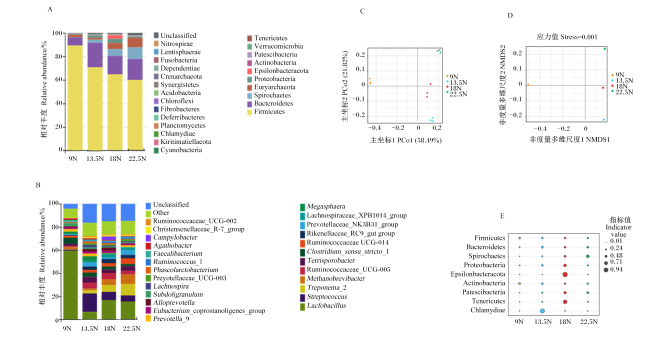
对晋汾白猪结肠内容物进行了16S rRNA测序,并在门和属水平上评估了细菌的相对丰度(图1-A图1-B)。
图1 饲粮中性洗涤纤维水平对晋汾白猪结肠内容物微生物的影响

A:结肠内容物微生物在门水平上的组成 composition of microorganisms in colon contents at phylum level;B:结肠内容物微生物在属水平上的组成 composition of microorganisms in colon contents at genus level;C:主坐标分析图 principal coordinates analysis (PCoA) diagram;D:非度量多维尺度分析图 nonmetric multidimensional scaling (NMDS) analysis diagram;E:指示物种分析图 indicator species analysis diagram。

Firmicutes:厚壁菌门;Bacteroidetes:拟杆菌门;Spirochaetes:螺旋体门;Euryarchaeota:广古菌门;Proteobacteria:变形菌门;Epsilonbacteraeota:弯曲菌门;Actinobacteria:放线菌门;Patescibacteria:髌骨细菌门;Verrucomicrobia:疣微菌门;Tenericutes:软壁菌门;Kiritimatiellaeota:圣诞岛盐菌门;Cyanobacteria:蓝藻门;Chlamydiae:衣原体门;Planctomycetes:浮霉菌门;Deferribacteres:脱铁杆菌门;Fibrobacteres:脱铁杆菌门;Nitrospirae:硝化螺旋菌门:Lentisphaerae:黏胶球形菌门;Fusobacteria:梭杆菌门;Dependentiae:依赖菌门;Crenarchaeota:泉古菌门;Synergistetes:互养菌门;Acidobacteria:酸杆菌门;Chloroflexi:绿弯菌门;Unclassified:未分类。

Lactobacillus:乳杆菌属;Streptococcus:链球菌属;Treponema_2:螺旋体属_2;Methanobrevibacter:甲烷短杆菌属;Ruminococcaceae_UCG-005:瘤胃球菌科UCG-005;Terrisporobacter:风孢杆菌属;Clostridium_sensu_stricto_1:狭义梭菌属1;Ruminococcaceae_UCG-014:瘤胃球菌科UCG-014;Rikenellaceae_RC9_gut_group:理研菌科RC9肠道群;Prevotellaceae_NK3B31_group:普雷沃氏菌科NK3B31群;Lachnospiraceae_XPB1014_group:毛螺菌科XPB1014群;Megasphaera:巨球型菌属;Prevotella_9:普雷沃氏菌属9;Eubacterium_coprostanoligenes_group:产粪甾醇真细菌群;Alloprevotella:拟普雷沃氏菌属;Subdoligranulum:罕见小球菌属;Lachnospira:毛螺菌属;Prevotellaceae_UCG-003:普雷沃氏菌科UCG-003;Phascolarctobacterium:考拉杆菌属;Ruminococcus_1:瘤胃球菌属1;Faecalibacterium:粪杆菌属;Agathobacter:阿加索杆菌属;Campylobacter:弯曲菌属;Christensenellaceae_R-7_group:克里斯滕森菌科R-7群;Other:其他;Unclassified:未分类。

Fig.1 Effects of dietary NDF level on microorganisms in colon contents of Jinfen white pigs

图1-A为门水平上的物种分布,结肠内容物中的优势菌门主要是厚壁菌门(Firmicutes)和拟杆菌门(Bacteroidetes)和螺旋体门(Spirochaetes)。13.5N组、18N组和22.5N组厚壁菌门的相对丰度显著低于9N组(P<0.05),13.5N组拟杆菌门的相对丰度显著高于9N组和18N组(P<0.05),13.5N组、18N组和22.5N组螺旋体门的相对丰度显著高于9N组(P<0.05)(表7)。
表7 饲粮中性洗涤纤维水平对结肠内容物微生物在门水平上相对丰度的影响(前15)

Table 7 Effects of dietary NDF level on relative abundances of microorganisms in colon contents at phylum level (top 15)%

项目
Items
组别 Groups 均值
标准误
SEM
PP-value
9N 13.5N 18N 22.5N 方差分析
ANOVA
线性
Linear
二次
Quadratic
厚壁菌门 Firmicutes 89.31a 70.76b 64.91c 60.07d 3.40 <0.001 <0.001 <0.001
拟杆菌门 Bacteroidetes 6.67c 20.80a 15.44b 17.66ab 1.65 <0.001 0.055 0.013
螺旋体门 Spirochaetes 0.29d 2.78c 5.57b 10.04a 1.12 <0.001 <0.001 <0.001
广古菌门 Euryarchaeota 2.04 1.52 5.06 8.10 1.13 0.121 0.022 0.530
变形菌门 Proteobacteria 0.77d 2.05b 3.53a 1.12c 0.32 <0.001 0.408 0.001
弯曲菌门 Epsilonbacteraeota 0.04b 0.08b 3.04a 0.07b 0.39 <0.001 0.412 0.099
放线菌门 Actinobacteria 0.35a 0.29ab 0.21b 0.20b 0.02 0.019 0.002 0.006
髌骨细菌门 Patescibacteria 0.03d 0.15c 0.33a 0.25b 0.04 <0.001 0.001 <0.001
疣微菌门 Verrucomicrobia 0.13b 0.24a 0.20ab 0.12b 0.02 0.040 0.625 0.017
软壁菌门 Tenericutes 0.00c 0.05b 0.28a 0.04b 0.03 <0.001 0.270 0.030
蓝藻门 Cyanobacteria 0.05b 0.10a 0.09a 0.08ab 0.01 0.018 0.362 0.013
圣诞岛盐菌门 Kiritimatiellaeota 0.01c 0.08ab 0.10a 0.05b 0.01 0.001 0.131 <0.001
衣原体门 Chlamydiae 0.00b 0.093a 0.01b 0.00b 0.01 <0.001 0.489 0.115
浮霉菌门 Planctomycetes 0.11 0.02 0.01 0.04 0.00 0.175 0.090 0.120
脱铁杆菌门 Deferribacteres 0.00b 0.01b 0.03a 0.01b 0.00 0.001 0.298 0.072
纤维杆菌门 Fibrobacteres 0.00 0.00 0.00 0.02 0.00 0.090 0.069 0.057
图1-B为属水平上的物种分布,乳杆菌属(Lactobacillus)、链球菌属(Streptococcus)、密螺旋体属2(Treponema_2)、甲烷短杆菌属(Methanobrevibacter)、瘤胃球菌科UCG-005(Ruminococcaceae_UCG-005)、土孢杆菌属(Terrisporobacter)、狭义梭菌属1(Clostridium_sensu_stricto_1)等为结肠内容物中的主要菌属。18N组普雷沃氏菌属9(Prevotella_9)的相对丰度显著高于9N组和22.5N组(P<0.05),13.5N组毛螺菌属(Lachnospira)和瘤胃球菌科UCG-014(Ruminococcaceae_UCG-014)的相对丰度显著高于9N组(P<0.05),9N组和13.5N组毛螺菌科XPB1014群(Lachnospiraceae_XPB1014_group)的相对丰度显著高于18N组和22.5N组(P<0.05),13.5N组、18N组和22.5N组克里斯滕森菌科R-7群(Christensenellaceae_R-7_group)的相对丰度显著高于9N组(P<0.05)(表8)。
表8 饲粮中性洗涤纤维水平对结肠内容物微生物在属水平上相对丰度的影响

Table 8 Effects of dietary NDF level on the relative abundance at the genus level of bacteria%

项目
Items
组别 Groups 均值
标准误
SEM
PP-value
9N 13.5N 18N 22.5N 方差分析
ANOVA
线性
Linear
二次
Quadratic
乳杆菌属 Lactobacillus 59.49a 6.69c 16.82b 15.63b 6.19 <0.001 0.019 <0.001
链球菌属 Streptococcus 0.85d 15.83a 7.05b 5.14c 1.66 <0.001 0.797 0.017
螺旋体属2 Treponema_2 0.29d 2.77c 5.96b 10.03a 1.11 <0.001 <0.001 <0.001
甲烷短杆菌属 Methanobrevibacter 2.02ab 1.50b 4.98ab 8.07a 1.12 0.121 0.220 0.520
瘤胃球菌科UCG-005
Ruminococcaceae_UCG-005
0.86 4.98 5.44 3.23 0.55 <0.001 0.131 <0.001
风孢杆菌属Terrisporobacter 5.24a 3.82b 2.61c 1.83c 0.40 <0.001 <0.001 <0.001
狭义梭菌属1
Clostridium_sensu_stricto_1
1.74c 2.44b 2.97b 5.02a 0.38 <0.001 <0.001 <0.001
瘤胃球菌科UCG-014
Ruminococcaceae_UCG-014
0.62c 2.79b 3.57a 2.86b 0.34 <0.001 0.005 <0.001
理研菌科RC9肠道群
Rikenellaceae_RC9_gut_group
0.77b 3.15a 1.02b 3.63a 0.44 0.007 0.098 0.271
普雷沃氏菌科NK3B31群
Prevotellaceae_NK3B31_group
0.21c 1.73b 2.80a 2.79a 0.32 <0.001 <0.001 <0.001
毛螺菌科XPB1014群
Lachnospiraceae_XPB1014_group
1.90ab 3.95a 1.02c 0.28c 0.52 0.034 0.091 0.084
巨球型菌属Megasphaera 2.28a 2.47b 0.28a 1.70a 0.30 0.011 0.149 0.214
普雷沃氏菌属9
Prevotella_9
1.59b 1.75ab 1.89a 1.20c 0.09 0.030 0.186 0.003
产粪甾醇真细菌群
Eubacterium_coprostanoligenes_
group
0.78b 2.11a 2.78a 0.46b 0.30 <0.001 0.918 <0.001
拟普雷沃氏菌属Alloprevotella 2.40a 1.46b 0.97c 0.65d 0.20 <0.001 <0.001 <0.001
罕见小球菌属Subdoligranulum 0.27c 2.13a 0.88b 1.00b 0.21 <0.001 0.636 0.980
毛螺菌属 Lachnospira 0.52b 1.36a 0.75b 1.58a 0.13 <0.001 0.230 0.880
普雷沃氏菌科UCG-003
Prevotellaceae_UCG-003
0.50b 1.63a 1.37a 0.44b 0.16 <0.001 0.793 <0.001
考拉杆菌属
Phascolarctobacterium
0.22c 0.79b 1.35a 1.48a 0.15 <0.001 <0.001 <0.001
瘤胃球菌属1
Ruminococcus_1
1.68a 0.89b 0.65bc 0.60c 0.14 <0.001 <0.001 <0.001
粪杆菌属Faecalibacterium 1.23a 1.02a 0.63b 0.52b 0.09 <0.001 <0.001 <0.001
阿加索杆菌属 Agathobacter 0.04b 0.07b 3.01a 0.07b 0.39 <0.001 0.411 0.101
弯曲菌属 Campylobacter 0.20c 0.81b 1.11a 0.94b 0.10 <0.001 0.001 <0.001
克里斯滕森菌科R-7群
Christensenellaceae_R-7_group
0.22c 1.01a 0.70b 0.68b 0.09 <0.001 0.184 0.060
Alpha多样性结果表明,随着饲粮中性洗涤纤维水平的提高,Ace、Chao1、PD、Pielou、Shannon、Simpson指数呈现显著的一次和二次效应(P<0.05),且13.5N组、18N组和22.5N组显著高于9N组(表9)。PCoA和NMDS分析结果显示,4个组分离明显,说明4个组结肠内容物中微生物组成存在差异(图1-C图1-D)。基于物种在样本中的相对丰度和出现频率得到指示物种分析图(图1-E),从图中可看出13.5N组的指示物种是衣原体门(Chlamydiae),18N组出现频率较高的物种是弯曲菌门(Epsilonbacteraeota)和软壁菌门(Tenericutes),22.5N组的指示物种是螺旋体门。
表9 Alpha多样性指数分析结果

Table 9 Results of Alpha diversity indexes analysis

项目
Items
组别 Groups 均值
标准误
SEM
PP-value
9N 13.5N 18N 22.5N 方差分析
ANOVA
线性
Linear
二次
Quadratic
Ace指数 Ace index 1 432.50b 1 767.64a 1 755.53a 1 697.71a 50.05 0.001 0.002 0.001
Chao1指数 Chao1 index 1 346.90b 1 650.45a 1 649.27a 1 725.30a 46.43 0.001 0.001 0.001
PD指数 PD index 151.29b 194.18a 196.09a 194.28a 5.95 0.001 0.006 <0.001
Pielou指数 Pielou index 0.43b 0.66a 0.66a 0.67a 0.03 0.001 0.002 <0.001
Shannon指数 Shannon index 4.39b 6.95a 6.97a 7.07a 0.34 0.001 0.002 <0.001
Simpson指数 Simpson index 0.76b 0.96a 0.97a 0.97a 0.03 0.001 0.002 <0.001

2.7 饲粮中性洗涤纤维水平对晋汾白猪结肠代谢产物和代谢通路的影响

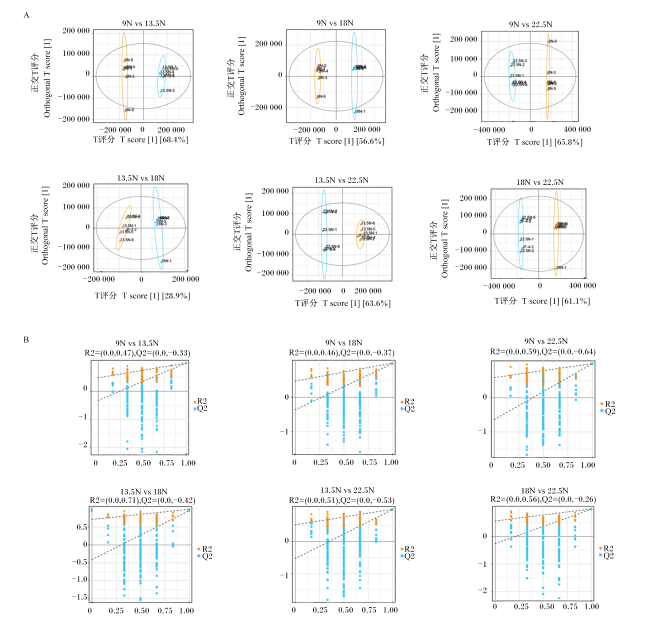
OPLS-DA模型分析结果显示,各组样本均被明显区分开,表明随着饲粮中性洗涤纤维水平的增加,结肠代谢产物谱发生了显著的变化(图2-A);图2-B结果显示,该模型预测结果可靠,不存在拟合问题。
图2 组间OPLS-DA模型的得分图(A)和验证图(B)

Fig.2 Score plot (A) and verification graph (B) of OPLS-DA model between groups

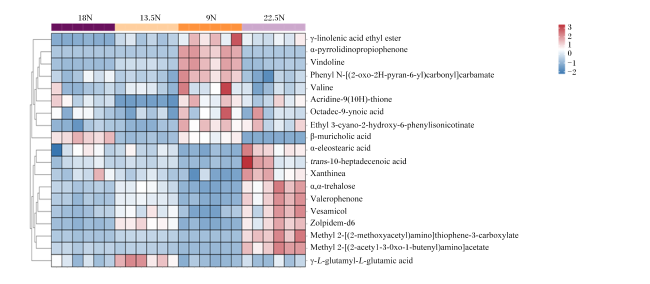
以OPLS-DA模型中P<0.05和VIP>11为标准筛选出了各比较组间的差异代谢物(图3),结果显示,13.5N组γ-L-谷氨酰基-L-谷氨酸(γ-L-glutamyl-L-glutamic acid)表达量最高,其他3组较低;18N组β-鼠胆酸(β-muricholic acid)表达量最高,其他3组较低;在9N组,γ-亚麻酸乙酯(γ-linolenic acid ethyl ester)、缬氨酸(valine)、十八烯-十二炔酸(octadec-9-ynoic acide)等8个代谢物的表达量较高;在22.5N组,α-桐酸(α-eleostearic acid)、十七碳烯酸(trans-10-heptadecenoic acid)、黄嘌呤(xanthine)等9个代谢物的表达量较高。
图3 结肠内容物中差异代谢物热图

红色表示正相关;蓝色表示负相关。下图同。Red indicated positive correlation; blue indicated negative correlation. The same as below.

γ-linolenic acid ethyl ester:γ-亚麻酸乙酯;α-pyrrolidinopropiophenone:α-吡咯烷酮;Vindoline:文多林;Phenyl N-[(2-oxo-2H-pyran-6-yl)carbonyl]carbamate:苯基N-[(2-oxo-2H-吡喃-6-基)羰基]氨基甲酸酯;Valine:缬氨酸;Acridine-9(10H)-thione:吖啶-9(10H )-硫酮;Octadec-9-ynoic acid:十八碳-9-炔酸;Ethyl 3-cyano-2-hydroxy-6-phenylisonicotinate:3-氰基-2-羟基-6-苯基异烟酸乙酯;β-muricholic acid:β-鼠胆酸;α-eleostearic acid:α-桐酸;trans-10-heptadecenoic acid:十七碳烯酸;Xanthinea:黄嘌呤;α,α-trehalose:α,α-海藻糖;Valerophenone:苯戊酮;Vesamicol:囊状乙酰胆碱转运抑制剂;Zolpidem-d6:唑吡坦-d6;Methyl 2-[(2-methoxyacetyl)amino]thiophene-3-carboxylate:2-[(2-甲氧基乙酰基)氨基]噻吩-3-羧酸甲酯;Methyl 2-[(2-acety1-3-0xo-1-butenyl)amino]acetate:2-[(2-乙酰-3-氧代-1-丁烯基)氨基]乙酸甲酯;γ-L-glutamyl-L-glutamic acid:γ-L-谷氨酰基-L-谷氨酸。

Fig.3 Heat map of differential metabolites in colon contents

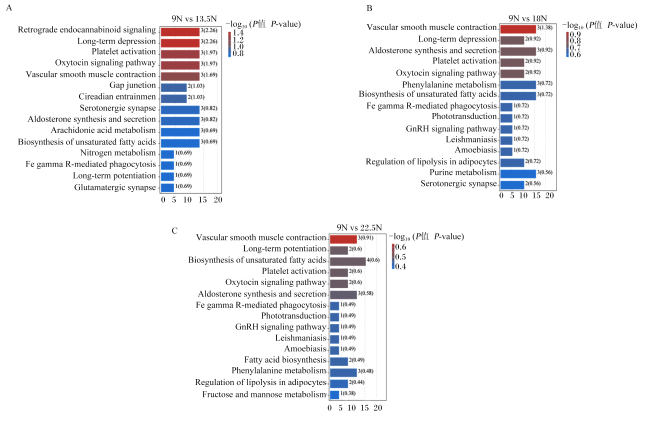
图4展示了各比较组间差异显著的代谢通路。9N组 vs 13.5N组,差异代谢物显著富集在逆行内源性大麻素信号(retrograde endocannabinoid signaling)、血小板激活(platelet activation)、催产素信号通路(oxytocin signaling pathway)、血管平滑肌收缩(vascular smooth muscle contraction)等通路上;9N组 vs 18N组,差异代谢物在血管平滑肌收缩(vascular smooth muscle contraction)、醛固酮的合成和分泌(aldosterone synthesis and secretion)、血小板激活、催产素信号通路等通路上显著富集;9N组vs 22.5N组,差异代谢物在血管平滑肌收缩、不饱和脂肪酸的生物合成(biosynthesis of un-saturated fatty acids)、血小板激活、催产素信号通路、醛固酮的合成和分泌等通路上显著富集。
图4 KEGG富集通路分析

Retrograde endocannabinoid signaling:逆行内源性大麻素信号;Long-term depression:长期抑制作用;Platelet activation:血小板激活;Oxytocin signaling pathway:催产素信号通路;Vascular smooth muscle contraction:血管平滑肌收缩;Gap junetion:间隙连接;Cireadian entrainmen:昼夜夹带;Serotonergie synapse:5-羟色胺突触;Aldosterone synthesis and secretion:醛固酮的合成和分泌;Arachidonie acid metabolism:花生四烯酸代谢;Biosynthesis of unsaturated fatty acids:不饱和脂肪酸的生物合成;Nitrogen metabolism:氮代谢;Fe gamma R-mediated phagocytosis:铁γ-R介导的吞噬作用;Long-term potentiation:长期增强作用;Glutamatergic synapse:谷氨酸能突触;Phenylalanine metabolism:苯丙氨酸代谢;Phototransduction:光传导;GnRH signaling pathway:促性腺激素释放激素信号通路;Leishmaniasis:利什曼病;Amoebiasis:阿米巴病;Regulation of lipolysis in adipocytes:脂肪细胞中脂肪分解的调节;Purine metabolism:嘌呤代谢;Serotonergic synapse:含血清素的神经突触;Fatty acid biosynthesis:脂肪酸生物合成;Fructose and mannose metabolism:果糖和甘露糖代谢。

Fig.4 KEGG enrichment pathway analysis

2.8 晋汾白猪结肠内容物微生物与挥发性脂肪酸、代谢产物的相关性分析

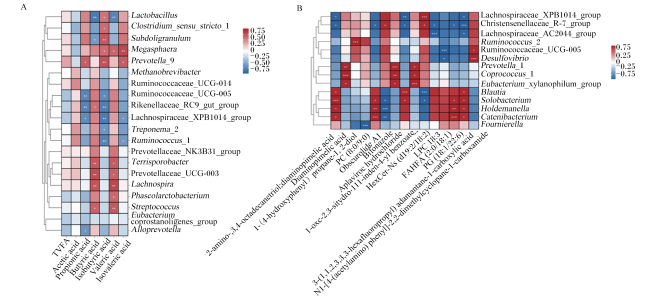
图5-A为晋汾白猪结肠微生物和挥发性脂肪酸之间的相关性分析,普雷沃氏菌属9与丙酸、异丁酸和异戊酸呈显著或极显著正相关(P<0.05、P<0.01),毛螺菌属与丁酸和戊酸呈极显著正相关(P<0.01),拟普雷沃氏菌属(Alloprevotella)、毛螺菌科XPB1014群与丙酸呈显著负相关(P<0.05),理研菌科RC9肠道群、瘤胃球菌科UCG-005与丙酸呈极显著负相关(P<0.01)。
图5 结肠内容物微生物与挥发性脂肪酸(A)、代谢产物(B)相关性热图

*:显著相关 significant correlation (P<0.05);**:极显著相关 extremely significant correlation (P<0.01);***:极显著相关 extremely significant correlation (P<0.001)。

Lactobacillus:乳杆菌属;Clostridium_sensu_stricto_1:狭义梭菌属1;Subdoligranulum:罕见小球菌属;Megasphaera:巨球型菌属;Prevotella_9:普雷沃氏菌属9;Methanobrevibacter:甲烷短杆菌属;Ruminococcaceae_UCG-014:瘤胃球菌科UCG-014;Ruminococcaceae_UCG-005:瘤胃球菌科UCG-005;Rikenellaceae_RC9_gut_group:理研菌科RC9肠道群;Lachnospiraceae_XPB1014_group:毛螺菌科XPB1014群;Treponema_2:螺旋体属_2;Ruminococcus_1:瘤胃球菌属1;Prevotellaceae_NK3B31_group:普雷沃氏菌科NK3B31群;Terrisporobacter:风孢杆菌;Prevotellaceae_UCG-003:普雷沃氏菌科UC-G003;Lachnospira:毛螺菌属;Phascolarctobacterium:考拉杆菌属;Streptococcus:链球菌属;Eubacterium_coprostanoligenes_group:产粪甾醇真细菌群;Alloprevotella:拟普雷沃氏菌属;Lachnospiraceae_AC2044_group:毛螺菌科AC2044群;Ruminococcus_2:瘤胃球菌属2;Desulfovibrio:脱硫弧菌属;Prevotella_1:普雷沃氏菌属1;Coprococcus_1:粪球菌属1;Blautia:布劳特氏菌属;Solobacterium:索拉杆菌属;Holdemanella:霍尔德曼氏菌属;Catenibacterium:链型杆菌属;Fournierella:福涅雷拉菌属;TVFA:总挥发性脂肪酸;Acetic acid:乙酸;Propionic acid:丙酸;Isobutyric acid:异丁酸;Valeric acid:戊酸;Isovaleric acid:异戊酸;2-amino-,3,4-octadecanetriol;diaminopimelic acid:二氨基庚二酸;1-(4-hydroxyphenyl) propane-1,2-diol:1-(4-羟苯基)丙烷-1,2-二醇;Bifonazole:联苯苄唑;Aplaviroc hydrochloride:盐酸阿普拉韦洛;1-oxc-2.3-sitydro-111-inden-4-yl benzoate:苯酸盐;(1,1,2,3,3,3,3-hexafluoropropyl)adamantance-1-carboxylic acid:3-(1,1,2,3,3,3-六氟丙基)金刚烷-1-羧酸。

Fig.5 Correlation heat map between microorganisms and volatile fatty acid (A), metabolites (B) in colon contents

图5-B为晋汾白猪结肠微生物与代谢产物之间的相关性分析,布劳特氏菌属(Blautia)、索拉杆菌属(Solobacterium)、霍尔德曼氏菌属(Holdemanella)、链型杆菌属(Catenibacterium)与3-(1,1,2,3,3,3-六氟丙基)金刚烷-1-羧酸等代谢产物呈显著正相关(P<0.05)。

3 讨论

3.1 饲粮中性洗涤纤维水平对晋汾白猪生长性能的影响

有研究发现,饲喂苜蓿粉水平分别为5%、10%、15%的饲粮时,猪的日采食量和日增重没有显著变化[13];适当提高饲粮中的纤维水平提高了肠道微生物的相对丰度,但没有影响猪的生长性能[14]。也有研究发现,饲喂生长育肥猪不同米糠水平的饲粮,料重比呈线性降低[15]。本研究发现,饲粮中性洗涤纤维水平没有显著影响晋汾白猪的平均日增重和平均日采食量,但对料重比有显著影响,饲粮中性洗涤纤维水平为18.0%和22.5%时料重比较低,这与前人研究结果[13,15]一致。本研究中,18N组和22.5N组晋汾白猪试验期内平均日增重和平均日采食量没有显著变化,料重比得到显著改善,其原因可能与肠道微生物以及肠道代谢产物有关。
晋汾白猪生长性能受到了结肠内微生物的影响,饲粮中的纤维对大肠微生物来说具有营养价值[16],它在大肠内发酵,能够改善肠道微生物结构[17],促进猪的健康发育[18]。在门水平上,拟杆菌门是一种常见的微生物,主要作用是降解多糖。前人研究发现,拟杆菌门的细菌主要是一些有益菌属,能够修复肠道屏障,消化吸收碳水化合物[19]。本研究中,13.5N组结肠内容物中拟杆菌门的相对丰度显著高于9N组,表明随着饲粮中性洗涤纤维水平的提高,降解纤维的拟杆菌门所属细菌的数量开始增加,有利于晋汾白猪的健康发育。在属水平上,克里斯滕森菌科R-7群可以调节脂质代谢,减少脂肪的增加[20]。本研究发现,13.5N组、18N组和22.5N组结肠内容物中克里斯滕森菌科R-7群的相对丰度高于9N组,说明饲粮中性洗涤纤维水平的提高可以降低晋汾白猪的脂肪沉积,促进晋汾白猪的健康发育。
代谢组学能够进一步揭示肠道菌群对晋汾白猪生长性能的影响。谷氨酸能够改善仔猪肠道屏障功能和生长性能,影响肠道微生物组成,降低动物炎症[21-22]。谷氨酸在肠道菌群的氮代谢通路中发挥着重要作用,且细菌种类的增加也与谷氨酸的含量相关[23]。本研究发现,13.5N组的γ-L-谷氨酰基-L-谷氨酸表达量最高,在其他3组表达量则较低,说明饲粮中性洗涤纤维水平在13.5%时改变了晋汾白猪结肠中谷氨酸的代谢。饲粮中的中性洗涤纤维可能通过影响谷氨酸的代谢来增强肠道功能,进而改善晋汾白猪的生长性能。

3.2 饲粮中性洗涤纤维水平对晋汾白猪抗氧化能力的影响

研究发现,饲粮纤维具有抗氧化的生理功能[24],纤维水平高的饲粮,不仅可以促进体内的热量降低,减少线粒体自由基的产生,提高抗氧化能力,还能够使机体脂肪排出,进而起到缓解脂质过氧化过程[25]。Jin等[26]研究发现,饲粮粗纤维水平为13.5%,育肥猪的抗氧化能力大于粗纤维水平为9%的抗氧化能力,与本试验结果一致。本研究发现,13.5N组和22.5N组的血清总抗氧化能力高于9N组和18N组。

3.3 饲粮中性洗涤纤维水平对晋汾白猪消化能力的影响

晋汾白猪消化能力受到养分消化率的影响,随着饲粮纤维水平的增加,肠道蠕动速度加快,同时由于可溶性纤维包裹食糜等原因,都会导致内容物与肠壁接触时间不足,使养分的消化率降低[27]。Hu等[28]研究发现,饲喂肥育猪粗纤维水平为2.52%和7.00%的饲粮时,纤维水平为7.00%的饲粮显著降低了肥育猪的粗蛋白质、粗纤维、中性洗涤纤维、酸性洗涤纤维和粗脂肪的表观消化率,说明饲粮粗纤维水平到7.00%时超过了肥育猪的耐受性。Chen等[29]饲喂生长猪添加5%菊粉的饲粮时发现,粗蛋白质、干物质、中性洗涤纤维和酸性洗涤纤维的表观消化率显著降低。本研究中,随着饲粮中性洗涤纤维水平的增加,粗脂肪和粗蛋白质的表观消化率呈现先增加后降低的趋势,综合分析,饲粮中性洗涤纤维水平为13.5%时能够提高晋汾白猪对饲粮中粗蛋白质、粗脂肪和磷的表观消化率,表现出较好的消化能力。
消化酶是动物肠道内重要的活性物质,不仅能影响动物对养分的吸收,还对机体的生长发育有重要影响。机体主要通过淀粉酶、脂肪酶、胰蛋白酶等消化酶完成对碳水化合物和蛋白质等养分的消化。从本研究结果综合来看,13.5N组的肠道内胰蛋白酶和脂肪酶含量较高,进而使得粗蛋白质和粗脂肪的表观消化率得到提高。
饲粮纤维的可发酵性可以促进肠道挥发性脂肪酸的产生,改善肠道内环境,提高肠道对养分的消化吸收能力[30-31]。挥发性脂肪酸是肠道内微生物代谢的产物,这些代谢产物可以促进碳水化合物和蛋白质的生成,并被结肠快速吸收,为机体提供养分;此外,有些代谢产物还能发挥抗炎作用,维持肠道稳态[32-33],还有些代谢产物能抑制病原体的产生,为有益菌提供能量[34]。有研究发现,丁酸、丙酸可以通过影响黏膜炎症使肠上皮T细胞数量增加,激活肠上皮细胞的G蛋白耦合受体,参与肠道炎症调节[35];丙酸还参与糖异生,抑制脂肪形成[36]。还有研究发现肠道微生物组和短链脂肪酸在调节动物生长发育中发挥重要作用[37]。本研究中,饲粮中性洗涤纤维水平为13.5%时,结肠内容物中丁酸和戊酸的浓度均显著提高,肠道内环境得到改善,提高了晋汾白猪的消化能力。
肠道微生物的多样性和丰度也会影响动物的消化能力。饲粮纤维可以维持肠道微生物的多样性[38]。与前人研究一致,本试验中,饲粮中性洗涤纤维水平从9.0%提高到13.5%,结肠内容物中微生物α多样性显著增加。有研究发现,变形菌门中的细菌主要是致病菌,它们的增加与代谢紊乱和炎症性肠病有关[39]。本研究发现,在门水平上,各组结肠内容物中变形菌门的相对丰度均较低,表明肠道健康。
毛螺菌科可以产生降解碳水化合物的酶[40],与益生元功能相似[41]。有研究发现,在犬粮中添加纤维物质能提高狗粪便中毛螺菌科的相对丰度,肠道健康得到改善[42]。Pu等[14]研究发现,瘤胃球菌科和螺旋菌科与纤维摄入量呈正相关。肠道内与纤维降解相关的微生物类群数量的增加,有利于有益菌群的定植与生长,同时也有利于肠道健康[43]。与前人研究一致,本研究发现,13.5N组、18N组和22.5N组晋汾白猪结肠内容物中瘤胃球菌科UCG-014相对丰度显著高于9N组,表明随着饲粮中性洗涤纤维水平的提高,结肠中与纤维降解相关的微生物类群得到丰富,提高降解碳水化合物的酶的活性,使得肠道消化吸收能力得到提高。
本研究还发现,13.5N组结肠内容物中毛螺菌属和普雷沃氏菌属9相对丰度较高,丁酸的浓度也较高。这与相关性分析结果一致,即丙酸、异丁酸和异戊酸均与普雷沃氏菌属9具有显著或极显著正相关,丁酸与毛螺菌属呈极显著正相关。综上可知,饲粮中性洗涤纤维水平为13.5%时,肠道内与纤维降解相关的微生物的相对丰度增加,提高了肠道的消化吸收能力,促进了挥发性脂肪酸的生成。

4 结论

① 饲粮中性洗涤纤维水平为13.5%时,晋汾白猪血清总抗氧化能力增强,粗蛋白质、粗脂肪和磷的表观消化率提高,结肠中纤维素酶与胰脏和十二指肠中淀粉酶以及胰脏、空肠和回肠中胰蛋白酶的含量增加,结肠内容物中丁酸的浓度增加,毛螺菌属和普雷沃氏菌属9相对丰度增加,肠道消化吸收能力提高。
② 饲粮中性洗涤纤维水平为18.0%时,晋汾白猪的料重比降低,盲肠纤维素酶含量和结肠内容物微生物多样性提高,对纤维的消化能力增强,促进了机体的健康生长。
③ 综合考虑生长性能、抗氧化能力、消化能力、肠道微生物等指标,晋汾白猪饲粮中适宜的中性洗涤纤维水平在13.5%~18.0%。

致谢

感谢美国北卡罗莱纳州立大学动科院动物营养系教授Dr.Kim对文稿所提的宝贵意见。
[1]
CHASSÉ É, GUAY F, BACH KNUDSEN K E, et al. Toward precise nutrient value of feed in growing pigs:effect of meal size,frequency and dietary fibre on nutrient utilisation[J]. Animals, 2021, 11(9):2598.

[2]
LI H, YIN J, TAN B, et al. Physiological function and application of dietary fiber in pig nutrition:a review[J]. Animal Nutrition, 2021, 7(2):259-267.

[3]
RIVA A, KUZYK O, FORSBERG E, et al. A fiber-deprived diet disturbs the fine-scale spatial architecture of the murine colon microbiome[J]. Nature Communications, 2019, 10(1):4366.

DOI PMID

[4]
ZHANG Z Y, ZHANG S, LAI C H, et al. Effects of adaptation time and inclusion level of sugar beet pulp on nutrient digestibility and evaluation of ileal amino acid digestibility in pigs[J]. Asian-Australasian Journal of Animal Sciences, 2019, 32(9):1414-1422.

DOI PMID

[5]
GERRITSEN R, VAN DER AAR P, MOLIST F. Insoluble nonstarch polysaccharides in diets for weaned piglets[J]. Journal of Animal Science, 2012, 90(Suppl 4):318-320.

[6]
LAMPE J W, SLAVIN J L, BAGLIEN K S, et al. Serum lipid and fecal bile acid changes with cereal,vegetable,and sugar-beet fiber feeding[J]. American Journal of Clinical Nutrition, 1991, 53(5):1235-1241.

[7]
ZHAO J B, LIU P, WU Y, et al. Dietary fiber increases butyrate-producing bacteria and improves the growth performance of weaned piglets[J]. Journal of Agricultural and Food Chemistry, 2018, 66(30):7995-8004.

DOI PMID

[8]
HAN P P, LI P H, ZHOU W D, et al. Effects of various levels of dietary fiber on carcass traits,meat quality and myosin heavy chain Ⅰ,Ⅱa,Ⅱx and Ⅱb expression in muscles in Erhualian and Large White pigs[J]. Meat Science, 2020,169:108160.

[9]
LU C, LIU Y D, MA Y J, et al. Comparative evaluation of the ileum microbiota composition in piglets at different growth stages[J]. Frontiers in Microbiology, 2021,12:765691.

[10]
GUO Y B, LIU T, LI W X, et al. Effects of low-ambient-temperature stimulation on modifying the intestinal structure and function of different pig breeds[J]. Animals, 2022, 12(20):2740.

[11]
ZHAO Y, LIU C, NIU J, et al. Impacts of dietary fiber level on growth performance,apparent digestibility,intestinal development,and colonic microbiota and metabolome of pigs[J]. Journal of Animal Science, 2023,101:skad174.

[12]
SAURA-CALIXTO F. Dietary fiber as a carrier of dietary antioxidants:an essential physiological function[J]. Journal of Agricultural and Food Chemistry, 2011, 59(1):43-49.

[13]
WANG J W, QIN C F, HE T, et al. Alfalfa-containing diets alter luminal microbiota structure and short chain fatty acid sensing in the caecal mucosa of pigs[J]. Journal of Animal Science and Biotechnology, 2018,9:11.

[14]
PU G, LI P H, DU T R, et al. Adding appropriate fiber in diet increases diversity and metabolic capacity of distal gut microbiota without altering fiber digestibility and growth rate of finishing pig[J]. Frontiers in Microbiology, 2020,11:533.

[15]
CASAS G A, OVERHOLT M F, DILGER A C, et al. Effects of full fat rice bran and defatted rice bran on growth performance and carcass characteristics of growing-finishing pigs[J]. Journal of Animal Science, 2018, 96(6):2293-2309.

DOI PMID

[16]
CAPPAI M G, ALESSO G A, NIEDDU G, et al. Electron microscopy and composition of raw acorn starch in relation to in vivo starch digestibility[J]. Food & Function, 2013, 4(6):917-922.

[17]
JHA R, FOUHSE J M, TIWARI U P, et al. Dietary fiber and intestinal health of monogastric animals[J]. Frontiers in Veterinary Science, 2019,6:48.

[18]
KUMAR A, HENDERSON A, FORSTER G M, et al. Dietary rice bran promotes resistance to Salmonella enterica serovar Typhimurium colonization in mice[J]. BMC Microbiology, 2012,12:71.

[19]
LEY R E, HAMADY M, LOZUPONE C, et al. Evolution of mammals and their gut microbes[J]. Science, 2008, 320(5883):1647-1651.

DOI PMID

[20]
YU M, GAO T, LIU Z, et al. Effects of dietary supplementation with high fiber (stevia residue) on the fecal flora of pregnant Sows[J]. Animals, 2020, 10(12):2247.

[21]
JIANG J, YIN L, LI J Y, et al. Glutamate attenuates lipopolysaccharide-induced oxidative damage and mRNA expression changes of tight junction and defensin proteins,inflammatory and apoptosis response signaling molecules in the intestine of fish[J]. Fish & Shellfish Immunology, 2017,70:473-484.

[22]
PALOMO-BUITRAGO M E, SABATER-MASDEU M, MORENO-NAVARRETE J M, et al. Glutamate interactions with obesity,insulin resistance,cognition and gut microbiota composition[J]. Acta Diabetologica, 2019, 56(5):569-579.

[23]
CHANG C H, LIN C H, LANE H Y. D-glutamate and gut microbiota in Alzheimer's disease[J]. International Journal of Molecular Sciences, 2020, 21(8):2676.

[24]
LIU J B, LIU Z Q, CHEN L, et al. Effects of feed intake and dietary nutrient density on apparent ileal and total tract digestibility of nutrients and gross energy for growing pigs[J]. Journal of Animal Science, 2016, 94(10):4251-4258.

DOI PMID

[25]
郎芯蕊. 不同蛋白和纤维水平荞麦日粮对肥育猪生长、免疫、抗氧化、胆固醇代谢及肠道健康的影响[D]. 硕士学位论文. 杭州: 浙江大学, 2020.

LANG X R. Effects of buckwheat diets with different protein and fiber levels on growth,immunity,antioxidant,cholesterol metabolism and intestinal health on finishing pigs[D]. Master’s Thesis. Hangzhou: Zhejiang University, 2020. (in Chinese)

[26]
JIN S S, WIJERATHNE C U B, AU-YEUNG K K W, et al. Effects of high- and low-fiber diets on intestinal oxidative stress in growing-finishing pigs[J]. Journal of Animal Science, 2022, 100(11):skac306.

[27]
ADEDOKUN S A, ADEOLA O. Regression-derived ileal endogenous amino acid losses in broiler chickens and cannulated pigs fed corn fiber,wheat bran,and pectin[J]. Animals, 2020, 10(11):2145.

[28]
HU P, WANG L G, HU Z J, et al. Effects of multi-bacteria solid-state fermented diets with different crude fiber levels on growth performance,nutrient digestibility,and microbial flora of finishing pigs[J]. Animals, 2021, 11(11):3079.

[29]
CHEN L, GAO L X, HUANG Q H, et al. Viscous and fermentable nonstarch polysaccharides affect intestinal nutrient and energy flow and hindgut fermentation in growing pigs[J]. Journal of Animal Science, 2017, 95(11):5054-5063.

DOI PMID

[30]
WEITKUNAT K, SCHUMANN S, PETZKE K J, et al. Effects of dietary inulin on bacterial growth, short-chain fatty acid production and hepatic lipid metabolism in gnotobiotic mice[J]. Journal of Nutritional Biochemistry, 2015, 26(9):929-937.

DOI PMID

[31]
JARRETT S, ASHWORTH C J. The role of dietary fibre in pig production,with a particular emphasis on reproduction[J]. Journal of Animal Science and Biotechnology, 2018,9:59.

[32]
JHA R, BERROCOSO J D. Review:dietary fiber utilization and its effects on physiological functions and gut health of swine[J]. Animal, 2015, 9(9):1441-1452.

[33]
NIU Q, LI P H, HAO S S, et al. Dynamic distribution of the gut microbiota and the relationship with apparent crude fiber digestibility and growth stages in pigs[J]. Scientific Reports, 2015,5:9938.

[34]
TIWARI U P, SINGH A K, JHA R. Fermentation characteristics of resistant starch,arabinoxylan,and β-glucan and their effects on the gut microbial ecology of pigs:a review[J]. Animal Nutrition, 2019, 5(3):217-226.

[35]
MALTZ R M, KEIRSEY J, KIM S C, et al. Social stress affects colonic inflammation,the gut microbiome,and short-chain fatty acid levels and receptors[J]. Journal of Pediatric Gastroenterology and Nutrition, 2019, 68(4):533-540.

[36]
FUNG K Y C, COSGROVE L, LOCKETT T, et al. A review of the potential mechanisms for the lowering of colorectal oncogenesis by butyrate[J]. British Journal of Nutrition, 2012, 108(5):820-831.

[37]
WILLEMSEN L E M, KOETSIER M A, VAN DEVENTER S J H, et al. Short chain fatty acids stimulate epithelial mucin 2 expression through differential effects on prostaglandin E(1) and E(2) production by intestinal myofibroblasts[J]. Gut, 2003, 52(10):1442-1447.

DOI PMID

[38]
JHA R, ROSSNAGEL B, PIEPER R, et al. Barley and oat cultivars with diverse carbohydrate composition alter ileal and total tract nutrient digestibility and fermentation metabolites in weaned piglets[J]. Animal, 2010, 4(5):724-731.

DOI PMID

[39]
HUMPHREY B, ZHAO J, FARIS R. Review:link between intestinal immunity and practical approaches to swine nutrition[J]. Animal, 2019, 13(11):2736-2744.

[40]
EL KAOUTARI A, ARMOUGOM F, GORDON J I, et al. The abundance and variety of carbohydrate-active enzymes in the human gut microbiota[J]. Nature Reviews. Microbiology, 2013, 11(7):497-504.

DOI PMID

[41]
VALCHEVA R, KOLEVA P, MARTÍNEZ I, et al. Inulin-type fructans improve active ulcerative colitis associated with microbiota changes and increased short-chain fatty acids levels[J]. Gut Microbes, 2019, 10(3):334-357.

DOI PMID

[42]
JACKSON M I, JEWELL D E. Balance of saccharolysis and proteolysis underpins improvements in stool quality induced by adding a fiber bundle containing bound polyphenols to either hydrolyzed meat or grain-rich foods[J]. Gut Microbes, 2019, 10(3):298-320.

DOI PMID

[43]
WILLIAMS B A, VERSTEGEN M W, TAMMINGA S. Fermentation in the large intestine of single-stomached animals and its relationship to animal health[J]. Nutrition Research Reviews, 2001, 14(2):207-228.

DOI PMID

文章导航

/