研究论文

不同添加水平木薯对白羽肉鸡生长性能、屠宰性能及肠道菌群的影响

  • 燕磊 , 1, 2, 3, 4 ,
  • 安沙 1, 2, 3, * ,
  • 高佳 1, 2, 3 ,
  • 吕尊周 1, 2, 3 ,
  • 来金良 1, 2, 3 ,
  • 陈亮 5 ,
  • 周桂莲 , 1, 2, ** ,
  • 李勇 , 1, 2, 3, **
展开
  • 1 新希望六和股份有限公司,畜禽饲料与畜禽产品质量安全控制四川省重点实验室,成都 610023
  • 2 新希望六和股份有限公司,农业农村部饲料及畜禽产品质量安全控制重点实验室,成都 610023
  • 3 山东新希望六和集团有限公司,青岛市动物饲料安全重点实验室,青岛 266061
  • 4 莱阳六和饲料有限公司,莱阳 265200
  • 5 中国农业科学院北京畜牧兽医研究所,北京 100193
**周桂莲,研究员,E-mail: ;
李 勇,高级畜牧师,E-mail:

*同等贡献作者

燕 磊(1979—),男,山东曲阜人,博士,研究员,从事家禽营养与饲料科学研究。E-mail:

Copy editor: 陈鑫

收稿日期: 2023-09-14

  网络出版日期: 2024-06-07

基金资助

烟台市“双百计划”人才项目(烟办发[2019]16号)

国家重点研发计划“替代玉米新型能量饲料资源开发与产品创制”(2022YFD1300600)

Effects of Different Addition Levels of Cassava on Growth Performance, Slaughter Performance and Intestinal Microflora of White Feather Broilers

  • YAN Lei , 1, 2, 3, 4 ,
  • AN Sha 1, 2, 3 ,
  • GAO Jia 1, 2, 3 ,
  • LYU Zunzhou 1, 2, 3 ,
  • LAI Jinliang 1, 2, 3 ,
  • CHEN Liang 5 ,
  • ZHOU Guilian , 1, 2, ** ,
  • LI Yong , 1, 2, 3, **
Expand
  • 1 Sichuan Provincial Key Laboratory for Quality and Safety Control of Livestock and Poultry Feed and Products, New Hope Liuhe Co.,Ltd., Chengdu 610023, China
  • 2 Key Laboratory for Quality and Safety Control of Feed and Livestock and Poultry Products of the Ministry of Agriculture and Rural Affairs, New Hope Liuhe Co.,Ltd., Chengdu 610023, China
  • 3 Qingdao Key Laboratory of Animal Feed Safety, Shandong New Hope Liuhe Group Co., Ltd., Qingdao 266061, China
  • 4 Laiyang Liuhe Feed Co., Ltd., Laiyang 265200, China
  • 5 Beijing Institute of Animal Science, Chinese Academy of Agricultural Sciences, Beijing 100193, China
**professor, E-mail: ;
senior engineer, E-mail:

*Contributed equally

Received date: 2023-09-14

  Online published: 2024-06-07

摘要

本试验旨在评估饲粮中不同添加水平木薯对白羽肉鸡生长性能、屠宰性能及肠道菌群的影响。选取1日龄罗斯308商品肉仔鸡母雏960只,随机分为4组,木薯添加水平分别为0(对照)、10%、20%和30%,每组8个重复,每个重复30只。试验期为37 d。结果表明:1) 1~15日龄,对照与10%木薯组肉鸡平均日增重(ADG)、15日龄体重(BW)显著高于其他2组(P<0.05);对照与10%木薯组肉鸡育肥指数显著高于30%木薯组(P<0.05);对照组肉鸡料重比(F/G)显著低于20%和30%木薯组(P<0.05)。16~24日龄,对照与10%木薯组肉鸡ADG、育肥指数显著高于30%木薯组(P<0.05);对照与10%木薯组肉鸡24日龄BW显著高于其他2组(P<0.05)。25~37日龄和1~37日龄,不同木薯添加水平对肉鸡各生长性能指标均无显著影响(P>0.05)。2) 对照组肌胃指数显著高于其他组(P<0.05)。3) 各木薯添加水平组肉鸡弹性减弱评分存在显著差异(P<0.05),表现为30%木薯组肉鸡弹性最差。随着木薯添加水平的增加,肉鸡肠道微生物Chao1指数、Simpson指数、Shannon指数和Observed species指数呈现先增高后降低趋势,20%木薯组肠道微生物α多样性丰富度最高;其中,各组间Chao1指数和Observed species指数达到显著水平(P<0.05)。随着木薯添加水平提高,肉鸡回肠乳杆菌属相对丰度有线性降低趋势,主要表现在木薯添加水平为30%时,乳杆菌属相对丰度较对照组降低7.35%。在本试验条件下,饲粮中添加木薯对肉鸡前、中期生长性能影响较大,建议肉鸡饲养前、中期木薯添加水平不超过20%,后期不超过30%;肉鸡饲粮中添加木薯可提高肠道微生物多样性,在一定程度上改善肠道评分与肠道菌群结构。

本文引用格式

燕磊 , 安沙 , 高佳 , 吕尊周 , 来金良 , 陈亮 , 周桂莲 , 李勇 . 不同添加水平木薯对白羽肉鸡生长性能、屠宰性能及肠道菌群的影响[J]. 动物营养学报, 2024 , 36(6) : 3619 -3630 . DOI: 10.12418/CJAN2024.311

Abstract

This experiment aimed to evaluate the effects of different addition levels of cassava in the diet on the growth performance, slaughter performance, and intestinal microflora of white feather broilers. A total of 960 one-day-old Ross 308 broilers were divided into 4 groups with addition levels of cassava of 0 (control), 10%, 20% and 30%, with 8 replicates per group and 30 broilers per replicate. The experimental period was 37 days. The results showed as follows: 1) at the age of 1 to 15 days, the averge daily gain (ADG) and 15 day-old body weight (BW) of broilers in the control and 10% cassava groups were significantly higher than those in the other two groups (P<0.05); the fattening index of broilers in the control and 10% cassava groups was significantly higher than that in the 30% cassava group (P<0.05); the feed to gain ratio (F/G) of broilers in the control group was significantly lower than that in the 20% and 30% cassava groups (P<0.05). At the age of 16 to 24 days, the ADG and fattening index of broilers in the control and 10% cassava groups were significantly higher than those in the 30% cassava group (P<0.05); the 24 day-old BW of broilers in the control and 10% cassava groups was significantly higher than that in the other two groups (P<0.05). At the ages of 25 to 37 days and 1 to 37 days, different addition levels of cassava had no significant effect on various growth performance indicators of broilers (P>0.05). 2) The gizzard index in the control group was significantly higher than that in the other groups (P<0.05). 3) There was a significant difference in the score of decreased elasticity addition among broilers at different levels of cassava (P<0.05), with the 30% cassava group having the worst elasticity. As the amount of cassava added increased, the Chao1 index, Simpson index, Shannon index, and Observed species index of intestinal microflora in broilers showed a trend of first increasing and then decreasing. The intestinal microflora in the 20% cassava group showed the highest α diversity richness; among them, the Chao1 index and Observed species index among the groups reached a significant level (P<0.05). With the addition level of cassava increasing, the relative abundance of Lactobacillus in the ileum of broilers showed a linear decrease trend, mainly manifested in a 7.35% decrease in the relative abundance of Lactobacillus compared with the control group when the cassava addition was 30%. Under the conditions of this experiment, adding cassava to the diet has a significant impact on the growth performance of broilers in the early and middle stages. It is recommended that the amount of cassava added to broilers in the early and middle stage of feeding should not exceed 20%, and in the later stage should not exceed 30%; adding cassava to the diet of broilers can increase intestinal microbial diversity, improve intestinal scores and intestinal microflora structure to a certain extent.

近几年,由于新冠疫情的暴发和生猪生产的持续恢复,玉米市场价格持续上升,尤其是2020年之后玉米价格快速、大幅上涨,饲料成本急剧增加。开发能量饲料替代原料逐渐成为我国饲料研发的热点之一[1]。木薯素有“淀粉之王”的美誉,产量高,对种植土壤肥力要求低,是谷物等能量饲料的最佳替代品[2]。在我国木薯主要种植于广西、广东、云南、福建、海南等地[3]。据联合国粮农组织(FAO)统计,2020年我国木薯种植面积高达302 136 hm2,产量约5 041 409 t[4]。木薯中无氮浸出物含量高达70%以上,其营养价值等同甚至优于甘薯和马铃薯。但木薯粗蛋白质含量低,且木薯根茎中含有亚麻苦苷,在酶或弱酸作用下被分解成氢氰酸抑制细胞内酶活性,致使细胞不能利用血氧而造成窒息,从而影响畜禽生长甚至导致动物中毒[5]。另外,家禽消化道较短,木薯中含有的非淀粉多糖物质会影响其生产性能[6]。但是,众多研究表明,在适当的饲料替代比例条件下,木薯部分替代玉米供能是完全可行的[7-8]。我国农业农村部于2021年颁布了《猪鸡饲料玉米豆粕减量替代技术方案》,建议肉鸡饲粮中木薯粉或者木薯粒添加水平不超过10%。目前,关于饲粮中添加木薯对肉鸡的影响研究主要集中在黄羽肉鸡的生长性能与肉色方面,对白羽肉鸡肠道健康和肠道菌群的影响鲜少有报道。因此,有必要对其进行基于肠道菌群的营养评估,以扩充木薯资源利用,减少我国对进口玉米的依赖。本试验旨在评估饲粮中添加不同水平木薯对肉鸡生长性能、屠宰性能及肠道菌群的影响,为其在生产实践中的应用提供科学依据。

1 材料与方法

1.1 试验设计及饲粮

选取1日龄罗斯308商品肉仔鸡母雏960只,随机分为4组,木薯添加水平分别为0(基础饲粮,对照)、10%、20%和30%,每组8个重复,每个重复30只。试验期为37 d。饲养周期分为3个阶段,1~15日龄为前期,16~24日龄为中期,25~37日龄为后期,试验饲粮组成及营养水平见表1。饲料常规营养成分测定按照国家标准进行,其中,粗蛋白质、钙、总磷含量测定分别按照GB/T 6432—2018、GB/T 6436—2018、GB/T 6437—2018测定。
表1 试验饲粮组成及营养水平(风干基础)

Table 1 Composition and nutrient levels of experimental diets (air-dry basis)%

项目
Items
木薯添加水平 Cassava addition level/%
1~15日龄 1 to 15 days of age 16~24日龄 16 to 24 days of age 25~37日龄 25 to 37 days of age
0(对照
Control)
10% 20% 30% 0(对照
Control)
10% 20% 30% 0(对照
Control)
10% 20% 30%
原料 Ingredients
玉米 Corn 53.55 41.27 29.00 16.75 55.96 43.83 31.71 19.58 52.94 40.82 28.69 16.56
木薯 Cassava 10.00 20.00 30.00 10.00 20.00 30.00 10.00 20.00 30.00
豆粕 Soybean meal 26.22 27.89 29.55 31.20 20.34 21.95 23.57 25.18 16.53 18.15 19.76 21.37
面粉 Flour 5.00 5.00 5.00 5.00 6.00 6.00 6.00 6.00 8.00 8.00 8.00 8.00
玉米蛋白粉
Corn gluten meal
3.00 3.00 3.00 3.00 4.00 4.00 4.00 4.00 5.00 5.00 5.00 5.00
棉籽粕
Cottonseed meal
3.00 3.00 3.00 3.00 4.00 4.00 4.00 4.00 4.00 4.00 4.00 4.00
花生粕 Peanut meal 3.00 3.00 3.00 3.00 3.00 3.00 3.00 3.00 4.00 4.00 4.00 4.00
豆油 Soybean oil 0.90 1.56 2.22 2.87 1.79 2.36 2.92 3.48 4.91 5.47 6.04 6.60
石粉 Limestone 1.36 1.35 1.33 1.32 1.25 1.23 1.21 1.19 1.26 1.24 1.22 1.20
磷酸氢钙 CaHPO4 1.18 1.17 1.16 1.15 0.89 0.88 0.88 0.88 0.62 0.61 0.61 0.61
L-赖氨酸盐酸盐
L-Lys·HCl
0.74 0.70 0.66 0.62 0.76 0.72 0.67 0.63 0.79 0.74 0.70 0.66
DL-蛋氨酸
DL-Met
0.27 0.28 0.30 0.31 0.23 0.25 0.26 0.28 0.20 0.22 0.23 0.25
氯化钠 NaCl 0.28 0.28 0.28 0.28 0.28 0.28 0.28 0.28 0.25 0.25 0.25 0.25
预混料 Premix1) 1.50 1.50 1.50 1.50 1.50 1.50 1.50 1.50 1.50 1.50 1.50 1.50
合计 Total 100.00 100.00 100.00 100.00 100.00 100.00 100.00 100.00 100.00 100.00 100.00 100.00
营养水平 Nutrient levels2)
粗蛋白质 CP 22.60 22.40 22.30 22.40 20.80 21.10 20.70 21.00 20.30 20.50 20.50 20.60
钙 Ca 0.77 0.77 0.77 0.80 0.65 0.67 0.68 0.70 0.63 0.63 0.65 0.65
总磷 TP 0.64 0.61 0.61 0.60 0.55 0.55 0.54 0.54 0.49 0.48 0.48 0.46
代谢能
ME/(MJ/kg)
11.70 11.70 11.70 11.70 12.14 12.14 12.14 12.14 13.10 13.10 13.10 13.10

1)预混料为每千克饲粮提供The premix provided the following per kg of diets:Mg 100 mg,Zn 75 mg,Fe 80 mg,I 0.65 mg,Cu 8 mg,Se 0.35 mg,VA 9 000 IU,VD3 2 000 IU,VE 11 IU,VK 1.0 mg,VB1 1.2 mg,VB2 5.8 mg,烟酸 niacin 66 mg,泛酸 pantothenic acid 10 mg,VB6 2.6 mg,生物素 biotin 0.10 mg,叶酸 folic acid 0.7 mg,VB12 0.012 mg。

2)代谢能参考《中国饲料成分及营养价值表(2022年第33版)》计算,其余均为实测值。ME was calculated by reference to the Table of Feed Composition and Nutritional Value in China (33rd edition 2022), while the others were measured values.

试验鸡自由采食和饮水。采用天然气直燃机控温,最初入雏时舍温为32 ℃,以后每周降低2 ℃,直到26 ℃。试验期间按常规免疫程序进行免疫。

1.2 主要能量饲料粉碎特性检测

粉碎机装Φ2.5 mm孔径筛片,分别对主要能量饲料原料玉米和木薯进行粉碎粒径测定。粉碎后的样品采用《饲料粒度测定几何平均粒度法》(GB/T 40944—2021)标准中的14层筛法进行粉碎粒径及均匀度的测定,结果见表2
表2 Φ2.5 mm孔径筛片下玉米和木薯粉碎特性

Table 2 Crushing characteristics of corn and cassava under a Φ2.5mm aperture sieveμm

项目
Items
质量几何平均粒度
Geometric mean particle of mass
质量几何标准差
Geometric standard deviation of mass
玉米 Corn 375.96±3.76 2.58±0.01
木薯 Cassava 85.20±2.91 1.93±0.02

1.3 检测指标

1.3.1 生长指标

分别在肉鸡15、24和37日龄,对整笼试验鸡进行空腹称重并统计采食量,根据《家禽生产性能名词术语和度量计算方法》(NY/T 823—2020)计算平均日增重(ADG)、平均日采食量(ADFI)、料重比(F/G)和体重(BW)等指标。育肥指数按Butcher等[9]方法进行计算。

成活率(%)=(末存活只数/初始只数)×100。

1.3.2 胴体指标及消化器官发育

38日龄时,每个重复随机取1只母鸡,称重后屠宰,剥离腹脂、双侧胸肌、腿、翅并称重,根据《家禽生产性能名词术语和度量计算方法》(NY/T 823—2020)进行分割,计算全净膛率、胸肌率、腿肌率、翅重率和腹脂率。摘取肌胃、腺胃、脾脏、法氏囊进行称重并计算肌胃指数、腺胃指数、法氏囊指数与脾脏指数。

器官指数(%)=100×器官鲜重(g)/宰前体重(g)。

1.3.3 肠道评分

38日龄时,每个重复随机取1只母鸡,参考贾友刚等[10]方法对屠宰鸡只肠道水分增多、肠壁变薄、弹性减弱、黏液增多、黏膜脱落、后肠段含料量增多、出血性肠炎和气泡增多等指标进行评分。分值为0~4分,分值越低代表肠道越健康。具体评分标准为:0分,正常状态,无肉眼可见的损伤;1分,肠壁有零散的小出血点;2分,肠壁有大量出血点;3分,肠道胀气、肠壁增厚,肠黏膜广泛出血,肠道食糜中有小血块;4分,肠壁明显增厚、肠道严重胀气,肠道食糜中有大量血凝块,并散发恶臭气息。

1.3.4 肠道菌群

38日龄时,每个重复随机取1只母鸡,处死后迅速采集肉鸡回肠中段食糜于无菌冻存管中,用于分析肠道菌群多样性,检测方法参考燕磊等[11]报道的方法。

1.4 数据统计与分析

生长性能、屠宰性能与肠道微生物丰富度指标采用SPSS 25.0统计软件中one-way ANOVA程序进行方差分析,并进行线性和二次回归分析,肠道评分数据采用卡方检验,所有指标以每个重复为试验单位。以0.05<P≤0.10表示差异趋于显著,P≤0.05表示差异显著。结果用平均值及均值标准误(SEM)表示。

2 结果

2.1 不同添加水平木薯对肉鸡生长性能的影响

表3可知,1~15日龄,不同木薯添加水平对肉鸡ADFI、成活率均无显著影响(P>0.05);对照与10%木薯组肉鸡ADG、15日龄BW显著高于其他2组(P<0.05);对照与10%木薯组肉鸡育肥指数显著高于30%木薯组(P<0.05);对照组肉鸡F/G显著低于20%和30%木薯组(P<0.05);10%木薯组肉鸡F/G与其他组无显著差异(P>0.05)。随着木薯添加水平升高,肉鸡F/G呈现线性和二次效应(P<0.05),育肥指数与15日龄BW有线性降低效应(P<0.05)。16~24日龄,不同木薯添加水平对肉鸡F/G、ADFI、成活率均无显著影响(P>0.05);对照与10%木薯组肉鸡ADG、育肥指数显著高于30%木薯组(P<0.05);对照与10%木薯组肉鸡24日龄BW显著高于其他2组(P<0.05);随着木薯添加水平升高,F/G有线性增加的趋势(P=0.06),ADG、育肥指数与24日龄BW呈现线性降低的效应(P<0.05)。25~37日龄和1~37日龄,不同木薯添加水平对肉鸡各生长性能指标均无显著影响(P>0.05)。
表3 不同添加水平木薯对肉鸡生长性能的影响

Table 3 Effects of different addition levels of cassava on growth performance of broilers

项目
Items
平均日增重
ADG/g
料重比
F/G
平均日采食量
ADFI/g
成活率
Survival
rate/%
育肥指数
Fattening
index
体重
BW/g
1~15日龄 1 to 15 days of age
木薯添加水平 Cassava addition level/%
0(对照 Control) 33.5a 1.127b 37.7 99.3 295.1a 479.8a
10 33.5a 1.138ab 38.1 100.0 294.4ab 480.0a
20 32.9b 1.145a 37.7 100.0 287.7bc 472.5b
30 32.9b 1.150a 37.8 100.0 286.1c 471.7b
SEM 0.10 0.003 0 0.12 0.13 1.36 1.31
PP-value 0.01 0.04 0.66 0.10 0.03 0.03
线性 Linear 0.11 0.02 0.93 0.23 0.05 0.09
二次 Quadratic 0.45 0.03 0.89 0.26 0.31 0.41
16~24日龄 16 to 24 days of age
木薯添加水平 Cassava addition level/%
0(对照 Control) 88.8a 1.315 116.7 100.0 675.5a 1 367.3a
10 88.5ab 1.323 117.0 100.0 669.2ab 1 364.7a
20 87.2bc 1.343 117.1 100.0 649.6bc 1 345.0b
30 86.6c 1.343 116.3 100.0 645.3c 1 338.0b
SEM 0.28 0.005 0 0.39 0.00 4.15 3.68
PP-value 0.01 0.12 0.90 1.00 0.02 <0.01
线性 Linear 0.03 0.06 0.61 1.00 0.03 0.04
二次 Quadratic 0.21 0.29 0.25 1.00 0.25 0.27
25~37日龄 25 to 37 days of age
木薯添加水平 Cassava addition level/%
0(对照 Control) 90.0 1.748 157.4 99.6 513.2 2 448.0
10 90.0 1.776 159.7 99.2 503.7 2 444.0
20 90.1 1.764 158.9 99.2 506.9 2 426.0
30 90.2 1.755 161.8 99.6 524.1 2 445.0
SEM 0.48 0.006 0 0.60 0.25 4.29 6.30
PP-value 0.28 0.43 0.06 0.91 0.36 0.63
线性 Linear 0.06 0.90 0.12 1.00 0.49 0.65
二次 Quadratic 0.14 0.46 0.48 1.00 0.02 0.66
1~37日龄 1 to 37 days of age
木薯添加水平 Cassava addition level/%
0(对照 Control) 68.7 1.475 101.3 98.9 460.4
10 68.6 1.492 102.3 99.2 456.3
20 68.0 1.498 101.9 99.2 450.7
30 68.6 1.498 102.7 99.6 456.2
SEM 0.18 0.003 0 0.25 0.28 2.35
PP-value 0.61 0.06 0.22 0.83 0.56
线性 Linear 0.64 0.11 0.18 0.06 0.41
二次 Quadratic 0.69 0.06 0.56 0.32 0.41

同列数据肩无字母或相同字母表示差异不显著(P>0.05),不同小写字母表示差异显著(P<0.05)。表4表5同。

In the same column, values with no letter or the same letter superscripts mean no significant difference (P>0.05), while with different small letter superscripts mean significant difference (P<0.05). The same as Table 4 and Table 5.

2.2 不同添加水平木薯对肉鸡屠宰性能、器官指数的影响

表4表5可知,各组间肉鸡屠宰率、全净膛率、胸肌率、腿肌率、翅重率、脾脏指数、法氏囊指数、腺胃指数均无显著差异(P>0.05);对照组肌胃指数显著高于其他组(P<0.05);随着木薯添加水平升高,肉鸡肌胃指数有线性降低的趋势(P=0.07)。
表4 不同添加水平木薯对肉鸡屠宰性能的影响

Table 4 Effects of different addition levels of cassava on slaughtering performance of broilers%

项目
Items
屠宰率
Dressing
percentage
全净膛率
Eviscerating
percentage
胸肌率
Percentage of
breast muscle
腿肌率
Percentage of
leg muscle
翅重率
Percentage
of wing weight
腹脂率
Percentage of
abdominal fat
木薯添加水平 Cassava addition level/%
0(对照 Control) 92.44 72.25 29.10 31.35 10.07 2.04
10 91.52 71.72 28.95 31.13 10.25 1.91
20 92.40 72.64 30.07 30.87 9.62 1.83
30 91.57 71.91 30.15 31.01 9.63 1.87
SEM 0.25 0.29 0.22 0.20 0.10 0.06
PP-value 0.40 0.72 0.09 0.86 0.06 0.69
线性 Linear 0.56 0.97 0.13 0.19 0.21 0.16
二次 Quadratic 0.90 0.99 0.47 0.28 0.59 0.10
表5 不同添加水平木薯对肉鸡器官指数的影响

Table 5 Effects of different addition levels of cassava on organ indexes of broilers%

项目
Items
脾脏指数
Spleen index
法氏囊指数
Bursa of Fabricius index
肌胃指数
Gizzard index
腺胃指数
Proventriculus index
木薯添加水平 Cassava addition level/%
0(对照 Control) 0.14 0.05 0.97a 0.32
10 0.14 0.06 0.82b 0.35
20 0.14 0.05 0.82b 0.32
30 0.15 0.05 0.73b 0.29
SEM 0.01 0.01 0.02 0.01
PP-value 0.81 0.19 <0.01 0.30
线性 Linear 0.23 0.74 0.07 0.37
二次 Quadratic 0.26 0.78 0.31 0.32

2.3 不同添加水平木薯对肉鸡肠道评分的影响

表6可知,不同添加水平木薯组间肠道弹性减弱均存在显著差异(P<0.05);30%木薯组弹性减弱情况较好;不同添加水平木薯组间肠道水分增多、肠壁变薄、黏液增多、黏膜脱落、后肠段含料增多、出血性肠炎、气泡增多等情况均无显著差异(P>0.05)。
表6 不同添加水平木薯对肉鸡肠道评分的影响

Table 6 Effects of different addition levels of cassava on intestinal score of broilers

序号
No.
项目
Items
木薯添加水平 Cassava addition level/% P
P-value
0 (对照 Control) 10 20 30
0 1 2 0 1 2 0 1 2 0 1 2
1 水分增多 10 0 0 7 1 2 9 1 0 7 0 3 0.22
2 肠壁变薄 0 1 9 0 0 10 0 2 8 0 2 8 0.47
3 弹性减弱 0 1 9 0 0 10 0 2 8 0 6 4 0.01
4 黏液增多 0 8 2 0 6 4 0 7 3 0 7 3 0.81
5 黏膜脱落 0 1 9 0 0 10 0 2 8 0 2 8 0.47
6 后肠段含料量增多 10 0 0 10 0 0 9 1 0 10 0 0 0.38
7 出血性肠炎 8 2 0 10 0 0 8 2 1 8 2 0 0.52
8 气泡增多 9 1 0 9 1 0 10 0 0 10 0 0 0.55

表中列出的数据是每组各个评分所出现的次数。

The times of each score occurred for each group was listed in the table.

2.4 不同添加水平木薯对肉鸡肠道菌群的影响

2.4.1 测序深度

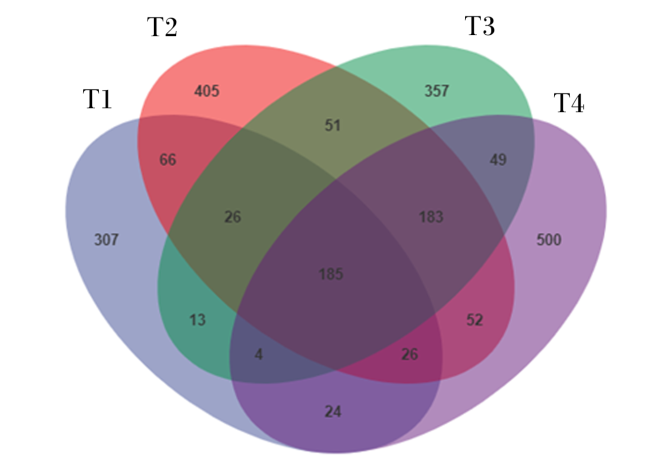
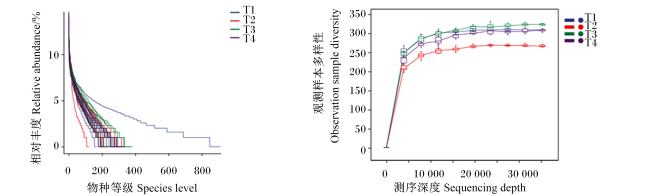
图1所示,本试验共得到2 248个操作分类单元(OTUs),对照组、10%木薯组、20%木薯组、30%木薯组所共有的OTUs为185个,所独有的OTUs分别为307、405、357、500个。如图2所示,稀释曲线和等级聚类曲线已趋于平缓,新物种随着持续抽样几乎不再出现,说明测序深度足够,测序的数据量合理。
图1 肉鸡肠道菌群韦恩图

T1:对照组 control group; T2:10%木薯组 10% cassava group; T3:20%木薯组 20% cassava group; T4:30%木薯组 30% cassava group。下图同 the same as below。

Fig.1 Venn diagram of intestinal microbiota of chickens

图2 等级聚类曲线(左)和稀释曲线(右)

Fig.2 Hierarchical clustering curve (left) and dilution curve (right)

2.4.2 α多样性分析

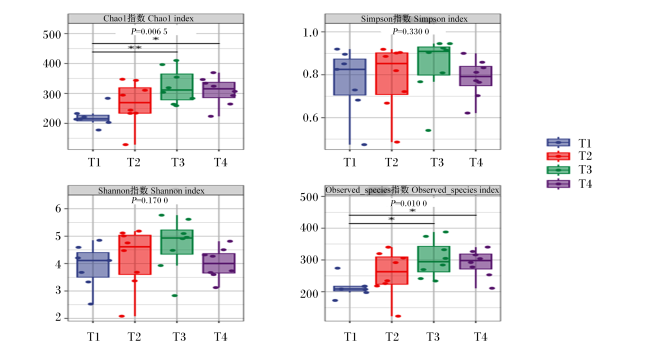
图3可知,随着木薯添加水平的增加,肉鸡肠道微生物Chao1指数、Simpson指数、Shannon指数和Observed species指数呈现先增高后降低的趋势,20%木薯组肠道微生物α多样性丰富度最高;其中,各组间Chao1指数和Observed species指数达到显著水平(P<0.05)。
图3 回肠菌群α多样性分析

*代表与T1相比差异显著(P<0.05)。

Fig.3 Ileal microbiota α diversity analysis

* represents significant difference compared with T1 (P<0.05).

2.4.3 β多样性分析

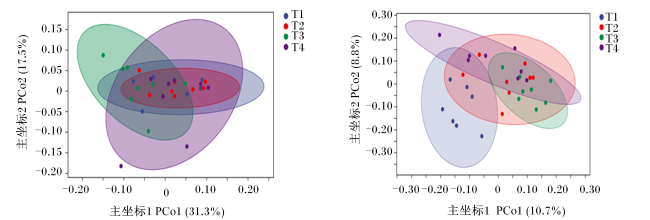
基于Unifrac的加权和非加权的主坐标分析,不同木薯添加水平组样品间存在大面积交叠现象(图4),这表明4个组样本的微生物群落结构具有较高的相似性。
图4 回肠菌群β多样性分析

左:基于系统发生树-加权;右:基于系统发生树-非加权。

Fig.4 Ileal microbiota β diversity analysis

Left: based on phylogenetic tree-weighted; Right: based on phylogenetic tree-unweighted.

2.4.4 门和属水平菌群分析

表7可知,各组肉鸡肠道微生物门水平相对丰度最高的是厚壁菌门(Firmicutes)和变形菌门(Proteobacteria),各组肉鸡肠道微生物属水平相对丰度最高的是乳杆菌属(Lactobacillus)、分节丝状菌(Candidatus Arthromitus)和肠球菌属(Enterococcus),不同木薯添加水平对肉鸡回肠微生物在门水平和属水平相对丰度没有显著影响(P>0.05)。随着木薯添加水平提高,肉鸡回肠乳杆菌属相对丰度有线性降低趋势(P=0.10),主要表现在木薯添加水平为30%时,乳杆菌属相对丰度较对照组降低7.35%,木薯添加水平为20%时,乳杆菌属相对丰度较对照组降低0.99%。
表7 不同添加水平木薯对肉鸡肠道微生物相对丰度的影响

Table 7 Effects of different addition levels of cassava on relative abundance of intestinal microbes of broilers%

项目
Items
木薯添加水平 Cassava addition level/% P
P-value
线性
Linear
二次
Quadratic
0(对照 Control) 10 20 30 SEM
门水平 Phylum level
厚壁菌门 Firmicutes 99.38 99.55 99.71 99.05 0.11 0.21 0.42 0.14
变形菌门 Proteobacteria 0.45 0.35 0.22 0.82 0.11 0.26 0.34 0.18
属水平 Genera level
乳杆菌属 Lactobacillus 97.32 97.28 96.36 91.07 1.31 0.30 0.10 0.16
分节丝状菌
Candidatus Arthromitus
0.95 0.61 2.79 3.86 0.95 0.61 0.21 0.44
肠球菌属 Enterococcus 0.29 0.46 0.03 1.28 0.21 0.20 0.22 0.21

同行数据肩无字母表示差异不显著(P>0.05)。

In the same row, values with no letter superscripts mean no significant difference (P>0.05).

3 讨论

3.1 不同添加水平木薯对肉鸡生长性能的影响

淀粉是畜禽所需的重要能量来源,木薯被称为“淀粉之王”,木薯富含钾、铁、锌等微量元素,其有效能值约为玉米的90%。研究结果表明,在适当的饲料替代比例条件下,木薯部分替代玉米供能完全可行[4,11]。欧肇林等[12]研究发现,用50%木薯替代玉米可显著提高22~42日龄新兴黄鸡的ADFI。Ojewola等[13]用不同比例木薯干(10%~100%)替代玉米(58.6%添加量),结果显示,对照组和10%替代组肉鸡生长性能优于其他替代组。Tang等[14]研究结果显示,用木薯粒和木薯干完全替代玉米会抑制肉鸡生长,降低非淀粉多糖、粗蛋白质消化率和代谢能利用。Souza等[15]研究结果显示,随饲粮中木薯粉添加量(0、20%、40%和60%)的增加,裸颈鸡体重和增重呈线性增加。本试验研究结果表明,肉鸡生长前期和生长中期,饲粮木薯添加水平越高,肉鸡ADG、育肥指数、15日龄BW降低,F/G升高,肉鸡饲喂后期及全程,饲粮木薯添加水平对肉鸡生长性能无显著影响,但饲粮添加木薯有升高肉鸡全程F/G趋势。这可能是由于家禽消化道短,木薯中含有的非淀粉多糖含量高而影响肉鸡生长性能[6]。唐德富等[16]检测结果显示,木薯干、木薯粒、玉米中非淀粉多糖含量分别为8.28%、8.73%、3.39%,可溶性淀粉多糖含量分别为42.19%、53.30%、65.70%。从本试验生长性能结果来看,肉鸡生长前期和中期,饲粮中木薯添加水平不建议超过20%,肉鸡生长后期和整体阶段,饲粮中添加木薯对肉鸡生长性能无显著影响。

3.2 不同添加水平木薯对肉鸡屠宰性能、器官指数的影响

本研究结果显示,各组屠宰性能指标无显著差异。Bhuiyan等[17]研究结果表明,木薯对科宝500肉鸡脾脏指数、法氏囊指数没有显著影响,以上结果与本试验结果相同。本试验结果显示,随着木薯添加水平升高,肉鸡肌胃指数降低,可能是由于木薯粉碎粒度低于玉米导致肌胃指数下降。饲粮经过胃进入十二指肠、空肠和回肠的速度快,饲喂粉碎较细的饲粮会导致肌胃萎缩,小肠肥大,导致细菌发酵加强,增加挥发性脂肪酸(VFA)的生成,降低肠道食糜pH,进而影响动物的食欲,影响其生产性能[18-19]。本试验测定了玉米和木薯粉碎粒度,结果显示,木薯粉碎粒度远低于玉米。

3.3 不同添加水平木薯对肉鸡肠道评分与肠道菌群结构的影响

肠道黏膜形态的完整性对于动物机体消化、吸收营养物质起关键作用,肠道黏膜表面黏液、上皮细胞及肠道黏膜的免疫系统是黏膜屏障的主要构成部分,直接影响着肠道对营养物质的吸收效率[20-21]。本试验从多维度对试验肉鸡肠道健康状况进行眼观评分,分值越高,代表肠道损伤越严重。本试验条件下,不同添加水平木薯组间肠道弹性减弱均存在显著差异,30%木薯组弹性减弱情况较好。Yadav等[22]研究结果表明,饲粮中使用25%和37.5%木薯根有利于肉鸡肠道发育。
机体的正常生理、新陈代谢等均受到体内微生物的调节。厚壁菌门的代谢产物主要是丁酸,与物质的运输有关,参与机体的能量代谢,而变形菌门相对丰度的增加会导致肠道菌群失调,引起肠道炎症[23-24]。Fouhse等[25]和Yang等[26]研究发现抗性淀粉或直链淀粉可抑制肠道有害菌增殖,促进有益菌生长,促进肠道发育。Zhang等[27]研究结果表明,木薯能增加动物机体肠道微生物多样性,具有较高的Shannon指数和Simpson指数。以上研究结果与本研究结果基本吻合。由于木薯中的抗性淀粉是细菌发酵的主要底物,特别是在家禽肠道中,发酵主要产物是VFA,包括醋酸、丙酸和丁酸,促进了肠道部分有益菌的增殖,降低了大肠杆菌等潜在致病菌的数量[13,28]。因此,饲粮中添加木薯可增加肉鸡肠道菌群的丰富度。丁酸盐是结肠上皮细胞的首选能量来源,可调节细胞增殖和维持肠黏膜完整性,减少细胞凋亡,有益于肉鸡肠道健康。本试验研究结果显示,不同木薯添加水平对肉鸡回肠微生物在门水平和属水平相对丰度没有显著影响,但随着木薯添加水平提高,肉鸡回肠乳酸菌属相对丰度有线性降低趋势,在木薯添加水平为30%时,乳酸菌属相对丰度较对照组降低7.35%。综上所述,肉鸡饲粮中添加木薯可提高肉鸡肠道微生物多样性,在一定程度上改善肠道评分与肠道菌群结构。

4 结论

在本试验条件下,建议肉鸡饲养前、中期饲粮中木薯添加水平不超过20%,后期饲粮中不超过30%。
[1]
刘婧怡, 李先德. 我国饲料粮价格的非线性关系研究—以玉米、大麦为例[J/OL]. 中国畜牧杂志:1-11[2023-07-04].https://doi.org/10.19556/j.0258-7033.20220708-01.

LIU J Y, LI X D. A study on the nonlinear relationship of feed grain prices in china: taking corn and barley as examples[J]. Chinese Journal of Animal Science,1-11[2023-07-04].https://doi.org/10.19556/j.0258-7033.20220708-01. in Chinese)

[2]
张芬芬, 杨海明, 江栋材, 等. 木薯的营养价值及其在家禽生产中的应用[J]. 饲料研究, 2013(9):38-42.

ZHANG F F, YANG H M, JIANG D C, et al. The nutritional value of cassava and its application in poultry production[J]. Feed Research, 2013(9):38-42. (in Chinese)

[3]
苟钟勇, 崔小燕, 李龙. 黄羽肉鸡非常规饲料资源利用研究进展[J]. 中国畜牧兽医, 2019, 46(6):1685-1694.

DOI

GOU Z Y, CUI X Y, LI Y, et al. Research progress on non-conventional feeds in yellow-feathered broilers[J]. China Animal Husbandry & Veterinary Medicine, 2019, 46(6):1685-1694. (in Chinese)

[4]
冯淦熠, 杨刚, 李瑞, 等. 木薯的营养价值及其在猪与禽生产中的应用研究进展[J]. 动物营养学报, 2023, 35(2):687-698.

DOI

FEN G Y, YANG G, LI R, et al. Research progress in nutritional value of cassava and its application in pig and poultry production[J]. Chinese Journal of Animal Nutrition, 2023, 35(2):687-698. (in Chinese)

DOI

[5]
吴家林. 木薯粒营养价值评定及其在家禽日粮中的应用[D]. 硕士学位论文. 长沙: 湖南农业大学, 2016.

WU J Z. Evaluation of nutritive value of cassava and its application in poultry[D]. Master’s Thesis. Changsha: Hunan Agricultural University, 2016. (in Chinese)

[6]
吕武兴, 贺建华, 李俊波, 等. 日粮中添加木薯对肉鸭生长性能和养分利用率的影响[J]. 湖南农业大学学报(自然科学版), 2012, 38(1):78-82.

LV W X, HE J H, LI J B, et al. Effects of different supplemental levels of cassava on growth performance and nutrient utilization of meat ducks[J]. Journal of Hunan Agricultural University (Natural Sciences), 2012, 38(1):78-82. (in Chinese)

[7]
唐兴, 支锐. 木薯型日粮添加复合酶对肉鸡生长性能、组织器官重量及养分消化的影响[J]. 中国饲料, 2021(8):33-36.

TANG X, ZHI R. Effects of adding complex enzyme to cassava based diet on growth performance,tissue weight and nutrient digestion of broilers[J]. China Feed, 2021(8):33-36. (in Chinese)

[8]
BRUM P A R D, GUIDONI A L, ALBINO L F T, et al. Whole cassava meal in diest for broiler chickens[J]. Pesquisa Agropecuaria Brasileira, 1990,25:1367-1373.

[9]
BUTCHER G D, NILIPOUR A H. Numbers for successful poultry production[EB/OL].(2015-07-07)[2022-11-11]. http://edis.ifas.ufl.edu/VM098.

[10]
贾友刚, 孔凡科, 吕孝国, 等. 玉米蛋白粉替代豆粕对黄脚麻鸡生长性能、屠宰性能、肉品质、抗氧化能力和肠道评分的影响[J]. 动物营养学报, 2023, 35(6):3734-3744.

DOI

JIA Y G, KONG F K, LYU X G, et al. Effects of corn gluten meal replacing soybean meal on growth performance,slaughter performance,meat quality,antioxidant capacity and intestinal score of yellow feet broilers[J]. Chinese Journal of Animal Nutrition, 2023, 35(6):3734-3744. (in Chinese)

[11]
燕磊, 吕孝国, 房伟安, 等. 商业鸡场日粮中添加屎肠球菌对肉鸡生长性能、肠道菌群和经济效益的影响[J]. 中国畜牧杂志, 2023, 59(1):266-273.

YAN L, LV X G, FANG W A, et al. Effects of enterococcus supplementation in the diet of commercial chicken farms on growth performance,gut microbiota and economic benefits of broilers[J]. Chinese Journal of Animal Husbandry, 2023, 59(1):266-273. (in Chinese)

[12]
欧肇林, 翁小芳, 黄国京, 等. 低蛋白日粮添加木薯替代玉米对肉鸡生长性能、回肠蛋白质消化率和氮排泄的影响[J]. 中国饲料, 2018(2):69-75.

OU Z L, WENG X F, HUANG G J, et al. Effects of low protein level diets and substitution of cassava for corn in broiler diets on growth performance,ileal protein digestibility and nitrogen excretion[J]. China Feed, 2018(2):69-75. (in Chinese)

[13]
OJEWOLA G S, EBELE E A, OLOJEDE A O. Biologic and economic performance of broiler chickens fed cassava root meal “garri” as a substitute for maize[J]. Journal of Agriculture and Veterinary Science, 2016, 9(10):10-15.

[14]
TANG D, FRU Y J, SONG S Y, et al. The effect of cassava chips,pellets,pulp and maize based diets on performance,digestion and metabolism of nutrients for broilers[J]. Journal of Animal and Veterinary Advances, 2012, 11(9):1332-1337.

[15]
SOUZA K M R, CARRIJO A S, KIEFER C, et al. Cassava root meal in diets of free-range broiler chickens[J]. Archivos de Zootecnia, 2011, 60(231):489-499.

[16]
唐德富, IJI P, CHOCT M, 等. 木薯产品营养成分的分析与比较研究[J]. 中国畜牧兽医, 2014, 41(9):74-80.

TANG D F, IJI P, CHOCT M, et al. Comparative study and analysis on nutrients of cassava products[J]. China Animal Husbandry & Veterinary Medicine, 2014, 41(9):74-80. (in Chinese)

[17]
BHUIYAN M M, IJI P A. Energy value of cassava products in broiler chicken diets with or without enzyme supplementation[J]. Asian-Australasian journal of animal sciences, 2015, 9(28):1317-1326.

[18]
史艳华, 杨玉双. 饲料不同粉碎粒度对畜禽生产性能影响的研究进展[J]. 中国饲料, 2023(12):5-8.

SHI Y H, YANG Y S. Research progress on the impact of different crushing particle sizes of feed on livestock and poultry production performance[J]. China Feed, 2023(12):5-8. (in Chinese)

[19]
石湛粤, 邓红成, 王鸣, 等. 玉米粉碎粒度对肉鸡生产性能和消化道指标的影响[J]. 中国畜牧杂志, 2017, 53(11):70-74.

SHI Z Y, DENG H C, WANG M, et al. Effect of corn particle size on performance and gastrointestinal indices of broilers[J]. Chinese Journal of Animal Science, 2017, 53(11):70-74. (in Chinese)

[20]
FORTE C, ACUTI G, MANUALI E, et al. Effects of two different probiotics on microflora, morphology, and morphometry of gut in organic laying hens[J]. Poultry Science, 2016, 95(11):2528-2535.

PMID

[21]
WINZELL M S, SVENSSON H, ARNER P, et al. The expression of hormone-sensitive lipase in clonal β-ells and rat islets is induced by long-term exposure to high glucose[J]. Diabetes, 2011, 50(10): 2225-2230.

[22]
YADAV S, MISHRA B, JHA R. Cassava (Manihot esculenta)root chips inclusion in the diets of broiler chickens:effects on growth performance,ileal histomorphology, and cecal volatile fatty acid production[J]. Poultry Science, 2019, 98(9):4008-4015.

[23]
MORRISON D J, PRESTON T. Formation of short chain fatty acids by the gut microbiota and their impact on human metabolism[J]. Gut Microbes, 2016, 7(3):189-200.

DOI PMID

[24]
LITVAK Y, BYNDLOSS M X, TSOLIS R M, et al. Dysbiotic proteobacteria expansion:a microbial signature of epithelial dysfunction[J]. Current Opinion in Microbiology, 2017,39:1-6.

[25]
FOUHSE J M, GANZLE M G, REGMI P R, et al. High amylose starch with low in vitro digestibility stimulates hindgut fermentation and has a bifidogenic effect in weaned pigs[J]. The Journal of Nutrition, 2015, 145(11):2464-2470.

[26]
YANG X, DARKO K O, HUANG Y, et al. Resistant starch regulates gut microbiota:structure,biochemistry and cell signalling[J]. Cellular Physiology and Biochemistry, 2017, 42(1):306-318

[27]
ZHANG S, HUANG Y Q, WANG Y C, et al. Effects of five carbohydrate sources on cat diet digestibility,postprandial glucose,insulin response,and gut microbiomes[J]. Journal of animal science, 2023,101:1-10.

[28]
JHA R, BERROCOSO J D. Review:Dietary fiber utilization and its effects on physiological functions and gut health of swine[J]. Animal, 2015,9:1441-1452.

文章导航

/