研究论文

茶褐素和白藜芦醇对不同产蛋期蛋鸡生产性能、蛋品质及卵巢功能的影响

  • 李孟雨 ,
  • 许雯雯 ,
  • 丁雪梅 ,
  • 白世平 ,
  • 曾秋凤 ,
  • 张克英 ,
  • 王建萍 , *
展开
  • 四川农业大学动物营养研究所,动物抗病营养教育部重点实验室,动物抗病营养与饲料农业农村部重点实验室,动物抗病营养四川省重点实验室,成都 611130
*王建萍,教授,博士生导师,E-mail:

李孟雨(2001—),女,河南许昌人,硕士研究生,研究方向为禽的营养。E-mail:

Copy editor: 菅景颖

收稿日期: 2023-12-29

  网络出版日期: 2024-06-07

基金资助

国家自然科学基金面上项目(31872992)

国家重点研发计划(2021YFD300204)

四川省科技计划(2022YFH0070)

Effects of Theabrownin and Resveratrol on Production Performance, Egg Quality and Ovarian Function of Laying Hens in Different Laying Periods

  • LI Mengyu ,
  • XU Wenwen ,
  • DING Xuemei ,
  • BAI Shiping ,
  • ZENG Qiufeng ,
  • ZHANG Keying ,
  • WANG Jianping , *
Expand
  • Key Laboratory of Animal Disease-Resistance Nutrition of Sichuan Province, Key Laboratory of Animal Disease-Resistance Nutrition and Feed of Ministry of Agriculture and Rural Affairs, Key Laboratory of Animal Disease-Resistance Nutrition of Ministry of Education, Animal Nutrition Institute, Sichuan Agricultural University, Chengdu 611130, China
*professor, E-mail:

Received date: 2023-12-29

  Online published: 2024-06-07

摘要

本试验旨在通过研究茶褐素(TB)和白藜芦醇(RES)对不同产蛋期蛋鸡生产性能、蛋品质和卵巢功能的影响,探究TB和RES对蛋鸡的影响机制,为缓解产蛋后期蛋鸡卵巢功能衰退,提高产蛋率和蛋品质,实现蛋鸡延养提供依据。选取360只健康罗曼灰蛋鸡(47和67周龄各180只),试验共设置6个处理,包含2个产蛋期[产蛋中期(试验初始蛋鸡为47周龄)、产蛋后期(试验初始蛋鸡为67周龄)]、3种试验饲粮[基础饲粮、基础饲粮+TB(100 mg/kg)、基础饲粮+RES(400 mg/kg)]。试验期为12周。结果显示:1)整个试验期内,产蛋后期蛋鸡的产蛋率显著低于产蛋中期蛋鸡(P<0.05),料蛋比、平均蛋重、不合格蛋率显著高于产蛋中期蛋鸡(P<0.05);饲粮中添加TB和RES显著增加了产蛋率(P<0.05),并显著降低了料蛋比(P<0.05);产蛋期和饲粮在蛋鸡整个试验期间的脏蛋率上存在互作效应(P=0.02),表现为TB和RES在产蛋后期蛋鸡上降低脏蛋率的效果更好。2)产蛋后期蛋鸡的蛋壳强度和蛋壳厚度显著低于产蛋中期蛋鸡(P<0.05);饲粮中添加RES显著增加了蛋壳强度和蛋壳厚度(P<0.05),添加TB显著增加了蛋壳强度(P<0.05);产蛋期和饲粮对蛋鸡的蛋壳强度和蛋壳厚度存在互作效应(P=0.02),主要表现为TB和RES在产蛋后期蛋鸡上增加蛋壳质量的效果更好。3)产蛋后期蛋鸡血浆中孕酮(PROG)、褪黑素(MT)、促卵泡激素(FSH)、雌二醇(E2)、促黄体生成素(LH)的水平均显著低于产蛋中期蛋鸡(P<0.05);饲粮中添加TB显著提高了蛋鸡血浆中PROG、MT、FSH、E2和LH的水平(P<0.05),添加RES显著提高了蛋鸡血浆中FSH的水平(P<0.05);产蛋期和饲粮在蛋鸡血浆中PROG、MT和抗缪勒管激素(AMH)的水平上存在互作效应(P≤0.02),表现为TB和RES在产蛋后期蛋鸡上增加血浆中PROG、MT及AMH水平的效果更好。4)产蛋后期蛋鸡卵巢中谷胱甘肽-S-转移酶(GST)的活性和丙二醛(MDA)的含量显著高于产蛋中期蛋鸡(P<0.05);饲粮中添加TB和RES显著提高了蛋鸡卵巢中GST、谷胱甘肽过氧化物酶(GSH-Px)的活性(P<0.05),且显著降低了卵巢中MDA的含量(P<0.05);产蛋期和饲粮在蛋鸡卵巢中还原型谷胱甘肽(GSH)的含量、GST和GSH-Px的活性上存在互作效应(P≤0.03),表现为TB和RES在产蛋后期蛋鸡上增加卵巢抗氧化能力的效果更好。5)产蛋后期蛋鸡卵巢中血红素氧合酶-1(HO-1)mRNA的相对表达量较产蛋中期蛋鸡显著下调(P<0.05),核因子E2相关因子2(Nrf2)mRNA的相对表达量较产蛋中期蛋鸡显著上调(P<0.05);饲粮中添加TB和RES显著上调了蛋鸡卵巢中HO-1、Nrf2和醌氧化还原酶1(NQO1)mRNA的相对表达量(P<0.05)。6)产蛋后期蛋鸡卵巢中类固醇激素合成急性调节蛋白(StAR)mRNA的相对表达量较产蛋中期蛋鸡显著下调(P<0.05);饲粮中添加TB可显著上调卵巢中雌激素受体1(ESR1)和StAR mRNA的相对表达量(P<0.05)。综上所述,饲粮中添加100 mg/kg TB或400 mg/kg RES均可通过促进生殖相关激素分泌、增强机体抗氧化能力、改善卵巢功能,进而提高蛋鸡的生产性能和蛋品质,且在产蛋后期蛋鸡上的应用效果更好。

本文引用格式

李孟雨 , 许雯雯 , 丁雪梅 , 白世平 , 曾秋凤 , 张克英 , 王建萍 . 茶褐素和白藜芦醇对不同产蛋期蛋鸡生产性能、蛋品质及卵巢功能的影响[J]. 动物营养学报, 2024 , 36(6) : 3657 -3668 . DOI: 10.12418/CJAN2024.314

Abstract

The purpose of this experiment was to study the effects of theabrownin (TB) and resveratrol (RES) on production performance, egg quality and ovarian function of laying hens in different laying periods, and to explore the mechanism of TB and RES on laying hens, so as to alleviate the decline of ovarian function of laying hens in late laying period, improve egg production rate and egg quality, and provide basis for the realization of laying hens’ extended feeding. In the experiment, a total of 360 healthy Lohmann gray laying hens (180 hens at 47 weeks of age and 180 hens at 67 weeks of age) were selected, and 6 treatments were designed including 2 laying periods [medium laying period (the laying hens were 47 weeks of age at the beginning of the experiment) and late laying period (the laying hens were 67 weeks of age at the beginning of the experiment)] and three diets [basal diet, basal diet+TB (100 mg/kg) and basal diet+RES (400 mg/kg)]. The experimental period was 12 weeks. The results show as follows: 1) during the entire experimental period, the egg production rate of laying hens in the late laying period was significantly lower and the feed:egg ratio, average egg weight and unqualified egg rate of laying hens in the late laying period were significantly higher than those of laying hens in the medium laying period (P<0.05); adding TB or RES to the diet significantly increased the egg production rate (P<0.05), and significantly decreased the feed:egg ratio (P<0.05); there was an interaction effect between laying period and diet on dirty egg percentage of laying hens during the whole experiment (P=0.02), which showed that TB and RES had a better effect on reducing dirty egg percentage of laying hens in the late laying period. 2) The eggshell strength and eggshell thickness of laying hens in late laying period were significantly lower than those of laying hens in the medium laying period (P<0.05); adding RES to the diet significantly increased the eggshell strength and eggshell thickness, and adding TB to the diet significantly increased the eggshell strength (P<0.05); there were interaction effects between laying period and diet on eggshell strength and eggshell thickness of laying hens (P=0.02), which showed that TB and RES had better effects on improving eggshell strength and eggshell thickness of laying hens in late laying period. 3) The plasma levels of progesterone (PROG,) melatonin (MT), follicle-stimulating hormone (FSH), estradiol (E2) and luteinizing hormone (LH) of laying hens in late laying period were significantly lower than those of laying hens in the medium laying period (P<0.05); adding TB to the diet significantly increased the plasma levels of PROG, MT, FSH, E2 and LH (P<0.05), and adding RES to the diet significantly increased the plasma FSH level (P<0.05); there were interaction effects between laying period and diet on plasma levels of PROG, MT and anti-mullerian hormone (AMH) of laying hens (P≤0.02), which showed that TB and RES had better effects on increasing plasma PROG, MT and AMH levels of laying hens in the late laying period. 4) The activity of glutathione S-transferase (GST) activity and the content of malondialdehyde (MDA) in ovary of laying hens in the late laying period were significantly higher than those of laying hens in the medium laying period (P<0.05); adding TB and RES to the diet significantly increased the activities of GST and glutathion peroxidase (GSH-Px) in ovary (P<0.05), and significantly decreased the MDA content in ovary of laying hens (P<0.05); there were interaction effects between laying period and diet on reduced glutathione (GSH) content, GST and GSH-Px activities in ovary of laying hens (P≤0.03), which showed that TB and RES had a better effect on increasing ovarian antioxidant capacity of laying hens in the late laying period. 5) The relative expression levels of heme oxygenase-1 (HO-1) mRNA in ovary of laying hens in the late laying period were significantly lower than those of laying hens in the medium laying period (P<0.05), and the relative expression level of nuclear factor E2 related factor 2 (Nrf2) mRNA in ovary was significantly higher than that of laying hens in the medium laying period (P<0.05); adding TB and RES to the diet significantly upregulated the relative expression levels of HO-1, Nrf2 and quinone oxidoreductase 1 (NQO1) in ovary of laying hens (P<0.05). 6) The relative expression levels of steroidogenic acute regulatory protein (StAR) mRNA in ovary of laying hens in the late laying period were significantly lower than that of laying hens in the medium laying period (P<0.05); adding TB to the diet significantly upregulated the relative expression levels of estrogen receptor 1 (ESR1) and StAR in ovary of laying hens (P<0.05). In conclusion, adding 100 mg/kg TB or 400 mg/kg RES to the diet can improve the production performance and egg quality of laying hens by promoting the secretion of reproductive hormones, enhancing the body’s antioxidant capacity and improving the ovarian function, and the application effect on laying hens in the late laying period is better.

衰老是导致蛋鸡产蛋后期生产性能和蛋品质下降的主要因素,其特征是机体内自由基堆积引起氧化应激,抗氧化功能下降[1-4]。研究发现,蛋鸡卵巢更易产生氧化应激而引起衰老,且卵巢的衰老在启动或加速一系列衰老变化中起着重要作用[5]。延缓衰老可延长蛋鸡的产蛋周期,大量减少蛋鸡饲养量,降低养殖成本,同时还能缓解蛋鸡养殖对环境的压力,对促进蛋鸡产业发展具有重要意义。
茶褐素(theabrownin,TB)是一种水溶性茶色素,是普洱茶渥堆发酵过程中多酚类物质经氧化聚合而形成的复杂产物[6-7]。白藜芦醇(resveratrol,RES)是一种天然的植物提取物。TB和RES均属于多酚类物质,具有调节机体抗氧化能力等多种生物活性。研究发现,TB可以缓解小鼠肝脏氧化应激,通过靶向调控肠道微生物预防和延缓衰老[8];RES可以提高大鼠卵巢中抗氧化酶的活性,缓解卵巢的氧化损伤[9]
TB和RES在缓解动物机体氧化应激、提高卵巢功能等方面具有积极意义,然而这2种物质在家禽卵巢功能上的研究较少,在不同周龄蛋鸡上的应用效果也不清楚。鉴于此,本试验将TB和RES添加到不同周龄蛋鸡饲粮中,探究TB和RES对不同产蛋期蛋鸡生产性能和卵巢功能的影响,确定通过营养调控延缓蛋鸡衰老,延长产蛋周期,提高蛋鸡生产潜力的可能性,为实现蛋鸡延养提供科学依据。

1 材料与方法

1.1 试验材料

试验所用TB纯度为83%,RES纯度为98%。

1.2 试验设计

根据本课题组前期研究结果,确定TB的添加量为100 mg/kg[10],RES的添加量为400 mg/kg[11-12]。选取360只健康罗曼灰蛋鸡(47和67周龄各180只)作为试验动物,试验开始前4周,产蛋中期(42~46周龄)蛋鸡平均产蛋率为94.37%,产蛋后期(62~66周龄)蛋鸡平均产蛋率为68.20%。采用2×3双因素试验设计,即2个产蛋期[产蛋中期(试验初始蛋鸡为47周龄)、产蛋后期(试验初始蛋鸡为67周龄)]、3种试验饲粮[基础饲粮、基础饲粮+TB(100 mg/kg)、基础饲粮+RES(400 mg/kg)],将试验蛋鸡分为6个处理,每个处理10个重复,每个重复6只鸡。基础饲粮参考NRC(1994)和《鸡饲养标准》(NY/T 33—2004)配制,其组成及营养水平见表1。试验所用饲粮形态为粉料,TB和RES均采用逐级混匀的方式添加到基础饲粮中。正式试验周期为12周。
表1 基础饲粮组成及营养水平(饲喂基础)

Table 1 Composition and nutrient levels of the basal diet (as-fed basis)%

项目 Items 含量 Content
原料 Ingredients
玉米 Corn 56.40
豆粕 Soybean meal (43%) 25.50
小麦麸 Wheat bran 4.80
大豆油 Soybean oil 2.34
碳酸钙 CaCO3 8.30
磷酸氢钙 CaHPO4 1.50
L-赖氨酸盐酸盐 L-Lys·HCl 0.04
DL-蛋氨酸 DL-Met 0.14
苏氨酸 Thr 0.04
色氨酸 Try 0.01
氯化钠 NaCl 0.30
氯化胆碱 Choline chloride (50%) 0.10
维生素和矿物质预混料
Vitamin and mineral premix1)
0.53
合计 Total 100.00
营养水平 Nutrient levels2)
代谢能 ME/(MJ/kg) 11.31
粗蛋白质 CP 16.58
钙 Ca 3.55
有效磷 AP 0.38
可消化赖氨酸 DLys 0.79
可消化蛋氨酸 DMet 0.36
可消化苏氨酸 DThr 0.58
可消化色氨酸 DTrp 0.18

1)预混料为每千克饲粮提供The premix provides the following per kg of the diet:VA 8 000 IU,VD3 1 600 IU,VE 5 IU,VK3 4.0 mg,VB1 0.80 mg,VB2 2.50 mg,VB6 1.50 mg,VB12 0.004 mg,叶酸 folic acid 0.25 mg,烟酸 nicotinic acid 20.0 mg,泛酸 pantothenic acid 2.20 mg,生物素 biotin 0.10 mg,Fe (FeSO4·H2O) 60.0 mg,Cu (CuSO4·5H2O) 8.0 mg,Mn (MnSO4·H2O) 60.0 mg,Zn (ZnSO4·H2O) 80.0 mg,Se (Na2SeO3) 0.30 mg,I (KI) 0.35 mg。

2)代谢能、有效磷和可消化氨基酸为参考《中国饲料成分及营养价值表(2020年第31版)》所得计算值,粗蛋白质(GB/T 6432—2018)和钙(GB/T 6436—2018)为实测值。ME, AP and digestible amino acids are calculated with reference to the Tables of Feed Composition and Nutritional Values in China (31st edition, 2020), while CP (GB/T 6432—2018) and Ca (GB/T 6436—2018) are measured values.

1.3 饲养管理

本试验在四川农业大学动物营养研究所试验基地进行。试验期间每天饲喂2次(09:00、15:00),于每天16:00记录蛋鸡产蛋情况。饲养管理按常规饲养管理程序进行,每周进行严格消毒,定期打扫圈舍卫生,室温保持在20~22 ℃。

1.4 检测指标

1.4.1 生产性能

试验期间每天准确记录每个重复产蛋的数量、蛋重、不合格蛋(脏蛋、畸形蛋、破蛋)数量以及蛋鸡的死淘情况等。按周计算产蛋率、平均蛋重、不合格蛋率等。每周结算耗料量,计算平均日采食量。根据采食量和蛋重计算料蛋比。

1.4.2 蛋品质

于试验第12周末,每个处理随机选取30枚鸡蛋(3枚/重复),进行蛋品质测定,测定指标包括蛋壳品质(蛋壳强度、蛋壳厚度)、蛋清品质(蛋白高度、哈氏单位)、蛋黄颜色。其中,蛋壳强度的测定采用蛋壳强度测定仪(ETG-1601A,日本Robotmation公司);蛋白高度、蛋黄颜色和哈氏单位的测定采用蛋品质自动分析仪(EMT-5200型,日本Robotmation公司);蛋壳厚度采用千分尺对蛋壳尖端、钝端以及中部进行厚度测定,然后取平均值;蛋壳重量采用电子秤(精确至0.01 g)测定。

1.4.3 血液指标

于试验第12周末,每个重复随机选取1只蛋鸡,颈静脉取血10 mL,置于3个含肝素抗凝剂的绿色真空管内,4 ℃下1 300×g离心分离血浆后分装至5个1.5 mL EP管中,-20 ℃保存。
生殖激素测定:使用酶联免疫吸附测定(ELISA)试剂盒(南京建成生物工程研究所)测定血浆中孕酮(PROG)、褪黑素(MT)、促卵泡激素(FSH)、雌二醇(E2)、促黄体生成素(LH)和抗缪勒管激素(AMH)的水平。

1.4.4 卵巢指标

卵巢抗氧化相关指标:于试验第12周末,每个重复随机选取1只蛋鸡处死,将卵巢完整取出,用无菌磷酸盐缓冲液(PBS)进行冲洗并用滤纸拭干水分。将各级卵泡以及结缔组织去除后,采集部分卵巢组织于样品袋中,于-20 ℃保存。采用相关试剂盒(南京建成生物工程研究所)测定卵巢抗氧化相关指标,主要包括还原型谷胱甘肽(GSH)、谷胱甘肽-S-转移酶(GST)、谷胱甘肽过氧化物酶(GSH-Px)、丙二醛(MDA)的含量或活性。
卵巢基因:采集卵巢组织样品于无菌EP管中,于-80 ℃保存,用于测定卵巢生殖相关基因[类固醇激素合成急性调节蛋白(StAR)、雄激素受体(AR)、雌激素受体1(ESR1)]和抗氧化相关基因[核因子E2相关因子2(Nrf2)、血红素氧合酶-1(HO-1)、醌氧化还原酶1(NQO1)]的表达情况。以β-肌动蛋白(β-actin)为参比基因,相关基因的引物信息见表2
表2 相关基因的引物信息

Table 2 Primer information of related genes

基因名称
Gene names
方向
Orientation
引物序列
Primer sequence (5'—3')
登录号
Accession number
产物大小
Product size/bp


β-肌动蛋白β-actin
正向 Forward GCTACAGCTTCACCACCACA

NM_205518.1


90
反向 Reverse TCTCCTGCTCGAAATCCAGT


核因子E2相关因子2 Nrf2
正向 Forward TGTGTGTGATTCAACCCGACT

NM_205117.1


143
反向 Reverse TTAATGGAAGCCGCACCACT


血红素氧合酶-1 HO-1
正向 Forward TTGGCAAGAAGCATCCAGA

NM_205344.1


129
反向 Reverse TCCATCTCAAGGGCATTCA

醌氧化还原酶1 NQO1
正向 Forward GTTCAATGCCGTGCTCTCAC
NM_001277619.1

146
反向 Reverse CCGCTTCAATCTTCTTCTGC

类固醇激素合成急性调节蛋白
StAR
正向 Forward AGAGGAAGCCCTGCAGAAAT
NM_204686.2

92
反向 Reverse TCAGCACTTTGTCTCCGTTG

雄激素受体 AR
正向 Forward CCTGAATGAACTTGGGGAGA
NM_001040090.1

93
反向 Reverse ATCTGGTCATCCACATGCAA

雌激素受体1 ESR1
正向 Forward TTCAAGGGGAGGAATTTGTG
NM_205138.2

123
反向 Reverse TGTCCAGAACACGGTGGATA

1.5 数据统计分析

试验数据用Excel 2019进行初步整理后,利用SPSS 27.0软件对试验结果进行双因素方差分析,模型主效应包括产蛋期和饲粮的效应以及两者间的互作效应。结果数据用平均值和均值标准误(SEM)表示,P<0.05表示差异显著。

2 结果与分析

2.1 TB和RES对不同产蛋期蛋鸡生产性能的影响

表3可知,产蛋期对蛋鸡整个试验期间的产蛋率、平均蛋重、料蛋比和不合格蛋率均有显著影响(Pperiod<0.01,以Pperiod表示产蛋期作为主效应的P值,下同);产蛋后期蛋鸡的产蛋率显著低于产蛋中期蛋鸡(P<0.05),料蛋比、平均蛋重、不合格蛋率显著高于产蛋中期蛋鸡(P<0.05)。饲粮对蛋鸡整个试验期间的产蛋率和料蛋比有显著影响(Pdiet≤0.03,以Pdiet表示饲粮作为主效应的P值,下同);饲粮中添加TB和RES显著增加了产蛋率(P<0.05),并显著降低了料蛋比(P<0.05)。产蛋期和饲粮在蛋鸡整个试验期间的脏蛋率上存在互作效应(Pinteraction=0.02,以Pinteraction表示产蛋期和饲粮的互作作为主效应的P值,下同),表现为TB和RES在产蛋后期蛋鸡上降低脏蛋率的效果更好。
表3 TB和RES对不同产蛋期蛋鸡生产性能的影响

Table 3 Effects of TB and RES on production performance of laying hens in different laying periods (n=10)

项目
Items
产蛋率
Egg
production
rate/%
平均蛋重
Average egg
weight/g
平均日
采食量
ADFI/g
料蛋比
Feed∶egg
ratio
脏蛋率
Percentage of
dirty eggs/%
不合格蛋率
Percentage of
unqualified
eggs/%
产蛋期 Laying periods 饲粮 Diets


产蛋中期
Medium laying period
CON 88.10 61.28 104.49 1.94 0.14b 1.02
TB 92.68 61.20 105.97 1.87 0.31b 0.83
RES 91.25 61.19 105.60 1.89 0.46b 1.16


产蛋后期
Late laying period
CON 66.88 63.81 106.45 2.50 1.28a 13.08
TB 72.95 62.59 104.80 2.32 0.22b 10.25
RES 71.93 63.65 105.10 2.31 0.29b 8.94
均值标准误 SEM 1.67 0.44 0.99 0.05 0.25 1.18
产蛋期 Laying periods
产蛋中期 Medium laying period 90.68a 61.22b 105.35 1.90b 0.30 1.00b
产蛋后期 Late laying period 70.58b 63.35a 105.45 2.38a 0.60 10.76a
饲粮 Diets
CON 77.49b 62.54 105.47 2.22a 0.71 7.05
TB 82.81a 61.90 105.38 2.10b 0.26 5.54
RES 81.59a 62.42 105.35 2.10b 0.37 5.05
主效应PP-value of main effects
产蛋期 Laying period <0.01 <0.01 0.90 <0.01 0.16 <0.01
饲粮 Diet <0.01 0.30 0.99 0.03 0.20 0.22
产蛋期×饲粮 Laying period×diet 0.84 0.36 0.26 0.37 0.02 0.20

CON表示基础饲粮,TB表示添加TB饲粮,RES表示添加RES饲粮。同列数据肩标不同字母表示差异显著(P<0.05)。下表同。

CON represents basal diet, TB represents adding TB diet, and RES represents adding RES diet. Values in the same column with different small letter superscripts mean significant difference (P<0.05). The same as below.

2.2 TB和RES对不同产蛋期蛋鸡蛋品质的影响

表4可知,产蛋期对蛋鸡的蛋壳强度和蛋壳厚度有显著影响(Pperiod<0.01);产蛋后期蛋鸡的蛋壳强度和蛋壳厚度显著低于产蛋中期蛋鸡(P<0.05)。饲粮对蛋鸡的蛋壳强度和蛋壳厚度有显著影响(Pdiet≤0.03);饲粮中添加RES显著增加了蛋壳强度和蛋壳厚度(P<0.05),添加TB显著增加了蛋壳强度(P<0.05)。产蛋期和饲粮对蛋鸡的蛋壳强度和蛋壳厚度存在互作效应(Pinteraction=0.02),主要表现为TB和RES在产蛋后期蛋鸡上增加蛋壳质量的效果更好。
表4 TB和RES对不同产蛋期蛋鸡蛋品质的影响

Table 4 Effects of TB and RES on egg quality of laying hens in different laying periods (n=30)

项目
Items
蛋白高度
Albumen
height/mm
蛋黄颜色
Yolk color
哈氏单位
Haugh units
蛋壳强度
Eggshell
strength/(kg/cm2)
蛋壳厚度
Eggshell
thickness/mm
产蛋期 Laying periods 饲粮 Diets


产蛋中期
Medium laying period
CON 7.76 5.71 86.67 4.20a 0.366a
TB 7.90 5.67 88.58 4.49a 0.356a
RES 7.80 5.71 87.13 4.45a 0.370a


产蛋后期
Late laying period
CON 7.18 5.56 82.70 3.45c 0.336b
TB 7.78 5.65 86.18 3.81b 0.356a
RES 7.92 5.68 87.78 4.29a 0.359a
均值标准误 SEM 0.26 0.21 1.57 0.11 0.005
产蛋期 Laying periods
产蛋中期 Medium laying period 7.82 5.69 87.46 4.38a 0.364a
产蛋后期 Late laying period 7.62 5.63 85.55 3.85b 0.350b
饲粮 Diets
CON 7.47 5.63 84.69 3.82c 0.351b
TB 7.84 5.66 87.38 4.15b 0.356ab
RES 7.86 5.70 87.45 4.37a 0.364a
主效应PP-value of main effects
产蛋期 Laying period 0.37 0.71 0.14 <0.01 <0.01
饲粮 Diet 0.26 0.95 0.14 <0.01 0.03
产蛋期×饲粮 Laying period×diet 0.41 0.94 0.33 0.02 0.02

2.3 TB和RES对不同产蛋期蛋鸡卵巢功能的影响

2.3.1 血浆生殖激素

表5可知,产蛋期对蛋鸡血浆中PROG、MT、FSH、E2和LH的水平均有显著影响(Pperiod≤0.01);产蛋后期蛋鸡血浆中PROG、MT、FSH、E2和LH的水平均显著低于产蛋中期蛋鸡(P<0.05)。饲粮对蛋鸡血浆中PROG、MT、FSH、E2和LH的水平均有显著影响(Pdiet≤0.04);饲粮中添加TB显著提高了蛋鸡血浆中PROG、MT、FSH、E2和LH的水平(P<0.05),添加RES显著提高了蛋鸡血浆中FSH的水平(P<0.05)。产蛋期和饲粮在蛋鸡血浆中PROG、MT和AMH的水平上存在互作效应(Pinteraction≤0.02),表现为TB和RES在产蛋后期蛋鸡上增加血浆中PROG、MT及AMH水平的效果更好。
表5 TB和RES对不同产蛋期蛋鸡血浆生殖激素水平的影响

Table 5 Effects of TB and RES on plasma reproductive hormone levels of laying hens in different laying periods (n=8)

项目
Items
孕酮
PROG/
(ng/mL)
褪黑素
MT/
(ng/L)
卵泡刺激素
FSH/
(mIU/mL)
雌二醇
E2/(ng/L)
促黄体
生成素
LH/
(mIU/mL)
抗缪勒
管激素
AMH/
(ng/L)
产蛋期 Laying periods 饲粮 Diets


产蛋中期
Medium laying period
CON 54.34b 4 514.71a 60.38 244.54 48.35 2 242.44a
TB 64.15a 4 503.19a 73.34 255.63 59.60 2 185.40ab
RES 61.38a 4 050.24c 71.45 245.51 58.40 2 181.53b


产蛋后期
Late laying period
CON 31.87c 3 582.21d 53.00 203.09 43.01 2 163.56b
TB 57.52a 4 189.11b 57.14 253.01 57.66 2 210.02ab
RES 36.43c 4 097.97c 59.82 234.24 44.58 2 207.33ab
均值标准误 SEM 2.97 23.27 3.87 8.42 3.35 20.82
产蛋期 Laying periods
产蛋中期 Medium laying period 59.96a 4 356.05a 68.39a 248.56a 55.45a 2 203.12
产蛋后期 Late laying period 41.94b 3 956.43b 56.65b 230.12b 48.42b 2 193.14
饲粮 Diets
CON 43.10b 4 048.46b 56.69b 223.82b 45.68b 2 203.00
TB 60.84a 4 346.15a 65.24a 254.32a 58.63a 2 197.71
RES 48.60b 4 074.11b 65.64a 239.87ab 51.50b 2 194.43
主效应PP-value of main effects
产蛋期 Laying period <0.01 <0.01 <0.01 0.01 0.01 0.58
饲粮 Diet <0.01 <0.01 0.04 <0.01 <0.01 0.92
产蛋期×饲粮 Laying period×diet <0.01 <0.01 0.53 0.07 0.20 0.02

2.3.2 卵巢抗氧化相关指标

表6可知,产蛋期对蛋鸡卵巢中GST的活性和MDA的含量均有显著影响(Pperiod<0.01);产蛋后期蛋鸡卵巢中GST的活性和MDA的含量显著高于产蛋中期蛋鸡(P<0.05)。饲粮对蛋鸡卵巢中GSH、MDA的含量与GST、GSH-Px的活性均有显著影响(Pdiet<0.01);饲粮中添加TB和RES显著提高了蛋鸡卵巢中GST、GSH-Px的活性(P<0.05),且显著降低了卵巢中MDA的含量(P<0.05)。产蛋期和饲粮在蛋鸡卵巢中GSH的含量、GST和GSH-Px的活性上存在互作效应(Pinteraction≤0.03),表现为TB和RES在产蛋后期蛋鸡上增加卵巢抗氧化能力的效果更好。
表6 TB和RES对不同产蛋期蛋鸡卵巢抗氧化相关指标的影响

Table 6 Effects of TB and RES on ovarian antioxidant-related indexes of laying hens in different laying periods (n=8)

项目
Items
还原型谷胱甘肽
GSH/
(μmol/g prot)
谷胱甘肽-S-转移酶
GST/
(U/mg prot)
谷胱甘肽过氧化物酶
GSH-Px/
(U/mg prot)
丙二醛
MDA/
(nmol/mg prot)
产蛋期 Laying periods 饲粮 Diets


产蛋中期
Medium laying period
CON 20.28a 3.20b 34.36c 4.66
TB 13.44b 2.88c 55.85b 3.19
RES 13.21b 6.48b 69.94a 4.01


产蛋后期
Late laying period
CON 15.75b 2.17a 25.06c 5.73
TB 21.41a 7.05b 67.43ab 4.36
RES 14.00b 5.96b 63.72ab 4.30
均值标准误 SEM 1.46 0.35 4.20 0.28
产蛋期 Laying periods
产蛋中期 Medium laying period 15.31 4.19b 53.38 3.96b
产蛋后期 Late laying period 17.05 5.06a 52.07 4.80a
饲粮 Diets
CON 18.02a 2.68c 29.71b 5.19a
TB 17.43a 4.96b 61.64a 3.78b
RES 13.10b 6.22a 66.83a 4.16b
主效应PP-value of main effects
产蛋期 Laying period 0.15 <0.01 0.70 <0.01
饲粮 Diet <0.01 <0.01 <0.01 <0.01
产蛋期×饲粮 Laying period×diet <0.01 <0.01 0.03 0.24

2.3.3 卵巢抗氧化相关基因

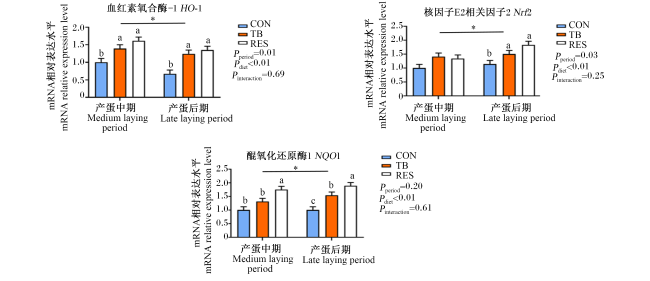
图1所示,产蛋期对蛋鸡卵巢中HO-1和Nrf2 mRNA的相对表达量有显著影响(Pperiod≤0.03);产蛋后期蛋鸡卵巢中HO-1 mRNA的相对表达量较产蛋中期蛋鸡显著下调(P<0.05),Nrf2 mRNA的相对表达量较产蛋中期蛋鸡显著上调(P<0.05)。饲粮对蛋鸡卵巢中HO-1、Nrf2和NQO1 mRNA的相对表达量均有显著影响(Pdiet<0.01);饲粮中添加TB和RES显著上调了蛋鸡卵巢中HO-1、Nrf2和NQO1 mRNA的相对表达量(P<0.05)。产蛋期和饲粮在蛋鸡卵巢抗氧化相关基因的表达上不存在互作效应(Pinteraction>0.05)。
图1 TB和RES对不同产蛋期蛋鸡卵巢抗氧化相关基因表达的影响

CON表示基础饲粮,TB表示添加TB饲粮,RES表示添加RES饲粮。不同饲粮数据柱形标注不同小写字母表示差异显著(P<0.05),“*”表示不同产蛋期之间差异显著(P<0.05)。图2同。

Fig.1 Effects of TB and RES on expression of antioxidant-related genes in ovary of laying hens in different laying periods (n=8)

CON represents basal diet, TB represents adding TB diet, and RES represents adding RES diet. Data columns with different small letters mean significant difference in different diets (P<0.05), “*” mean significant difference in different laying periods (P<0.05). The same as Fig.2.

2.3.4 卵巢生殖相关基因

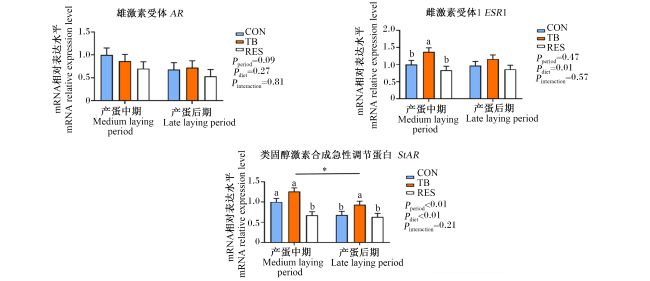
图2所示,产蛋期对蛋鸡卵巢中StAR mRNA的相对表达量有显著影响(Pperiod<0.01);产蛋后期蛋鸡卵巢中StAR mRNA的相对表达量较产蛋中期蛋鸡显著下调(P<0.05)。饲粮对蛋鸡卵巢中ESR1和StAR mRNA的相对表达量有显著影响(Pdiet≤0.01);饲粮中添加TB可显著上调卵巢中ESR1和StAR mRNA的相对表达量(P<0.05)。产蛋期和饲粮在蛋鸡卵巢生殖相关基因的表达上不存在互作效应(Pinteraction>0.05)。
图2 TB和RES对不同产蛋期蛋鸡卵巢生殖相关基因表达的影响

Fig.2 Effects of TB and RES on expression of reproductive-related genes in ovary of laying hens in different laying periods (n=8)

3 讨论

3.1 衰老对蛋鸡的影响

3.1.1 衰老对蛋鸡生产性能和蛋品质的影响

已有大量研究表明,蛋鸡衰老会导致产蛋率下降、蛋品质变差,而卵巢衰老是蛋鸡繁殖性能下降的主要原因[13-14]。在本研究中,我们观察到蛋鸡的产蛋率随着周龄的增加而下降。
本试验中,产蛋期对常规蛋品质的影响主要体现在蛋清质量和蛋壳质量上,在年龄较大的蛋鸡中,鸡蛋的蛋白高度和哈氏单位降低[15-16],这可能与蛋鸡卵磷脂含量随着年龄的增加而降低有关[17]。蛋鸡体内钙离子水平的降低会直接影响蛋壳质量[18-19],产蛋后期蛋鸡的蛋壳强度和蛋壳厚度较低,这可能是由于产蛋后期蛋鸡对钙的吸收和利用降低,抑制了钙离子的转移以及子宫内壳膜的形成,最终导致蛋壳结构和性能下降[2,20]

3.1.2 衰老对蛋鸡卵巢功能的影响

卵巢作为蛋鸡的主要生殖器官,衰老和频繁排卵加速了活性氧(ROS)在蛋鸡卵巢组织中的积累,加剧了蛋白质氧化,减少了游离巯基的数量,并导致氧化损伤[21-22]。本研究发现,随着周龄的增长,蛋鸡卵巢中抗氧化酶(GST)活性和脂质过氧化产物(MDA)含量增加。Nrf2、HO-1和NQO1是与组织抗氧化能力密切相关的基因。Liu等[23]报道,Nrf2/HO-1通路的活性随着蛋鸡年龄的增加而降低。这与本试验结果一致,本试验中产蛋后期蛋鸡卵巢中HO-1 mRNA的相对表达量较产蛋中期蛋鸡显著降低。除了抗氧化能力下降外,卵巢衰老还伴随着生殖激素分泌的变化。这些激素主要通过下丘脑-垂体-卵巢轴调节卵泡的生长、发育和成熟[24]。Ciccone等[25]研究发现,60周龄蛋鸡血浆中LH和FSH的水平低于30周龄蛋鸡。这与本研究结果一致,本研究中蛋鸡血浆中生殖激素(PROG、MT、FSH、E2和LH)的水平随年龄增长而显著降低,这可能与卵巢中生殖雌激素受体基因StAR mRNA的相对表达量发生增龄性下调有关。

3.2 TB和RES对不同产蛋期蛋鸡生产性能和蛋品质的影响

前人的研究发现,饲粮中添加茶叶及其提取物可以有效改善蛋鸡的生产性能和蛋品质[26-27]。与TB相比,RES在蛋鸡上的应用较多,并对蛋鸡生产性能和蛋品质具有积极影响[28-29]。本研究发现,饲粮中添加TB和RES可以提高蛋鸡的产蛋率和饲料利用效率,TB和RES对于常规蛋品质的改善主要体现在对蛋壳质量的加强(蛋壳强度和蛋壳厚度)上。TB的生产应用效果与Zhang等[30]的研究结果一致。在本试验中,我们发现TB和RES对产蛋后期蛋鸡蛋品质的改善效果比对产蛋中期蛋鸡更好,这可能是因为产蛋后期蛋鸡身体机能处于快速衰退阶段,TB和RES对产蛋后期蛋鸡机体的改善空间远大于产蛋中期蛋鸡。

3.3 TB和RES对不同产蛋期蛋鸡卵巢功能的影响

TB和RES均具有多酚化合物的抗氧化活性。本研究发现,饲粮中添加100 mg/kg TB和400 mg/kg RES均能提高蛋鸡卵巢中GSH-Px和GST的活性,降低MDA的含量,表明TB和RES能提高蛋鸡卵巢的抗氧化能力,减轻卵巢氧化应激。Nrf2是多种植物多酚发挥抗氧化作用的关键靶点。Kim等[31]发现,RES可以通过激活Nrf2和沉默信息调节因子1(SIRT1)信号转导来防止氧化应激。绿茶多酚能有效缓解D-半乳糖诱导的小鼠肝脏Nrf2及其下游靶基因表达的失调[32]。同样,作为植物多酚的TB和RES的显著上调了蛋鸡卵巢中HO-1、Nrf2和NQO1 mRNA的相对表达量。因此,我们推测TB和RES可能通过Nrf2/HO-1信号通路改善蛋鸡卵巢的抗氧化状态,从而改善卵巢功能。此外,饲粮中添加100 mg/kg TB还能显著提高蛋鸡血浆中PROG、MT、FSH、E2和LH的水平。MT可以作为延缓细胞氧化损伤的抗衰老药物,根据Tamura等[33]的研究发现,MT的长期治疗可以显著延缓小鼠卵巢的衰老过程。同时,一些学者在体外培养的人体卵细胞中发现,E2的水平与卵泡质量和胚胎评分呈正相关[34]。TB具体通过什么途径提高卵巢中MT和E2的水平来促进衰老蛋鸡的卵泡发育,这还有待进一步研究。
在目前的研究中,我们发现饲粮中添加TB显著上调了蛋鸡卵巢中ESR1和StAR的表达。StAR在类固醇的合成过程中起着关键作用。一些研究发现,过度表达StAR可以改善肥胖小鼠的胰岛素抵抗和全身炎症反应[35]。因此,我们推测TB可能通过上调StAR在蛋鸡卵巢中的表达,减轻卵巢衰老引起的炎症反应,促进卵巢类固醇激素的分泌,从而保证卵泡的正常发育。

4 结论

① 饲粮中添加TB(100 mg/kg)或RES(400 mg/kg)对蛋鸡机体健康、生产性能和蛋品质有改善作用,RES对蛋品质的改善效果较TB更明显。
② 产蛋后期(67~79周龄)蛋鸡卵巢功能下降,而在饲粮中添加100 mg/kg TB或400 mg/kg RES均可通过提高卵巢功能(增强生殖相关激素分泌、提高抗氧化能力)缓解由衰老引起的生产性能和蛋品质下降,该结果为蛋鸡延养提供了可行的营养策略。
[1]
MIAO L P, ZHOU M Y, ZHANG X Y, et al. Effect of excess dietary fluoride on laying performance and antioxidant capacity of laying hens[J]. Poultry Science, 2017, 96(7):2200-2205.

DOI PMID

[2]
GU Y F, CHEN Y P, JIN R, et al. A comparison of intestinal integrity,digestive function,and egg quality in laying hens with different ages[J]. Poultry Science, 2021, 100(3):100949.

[3]
LIU X T, LIN X, MI Y L, et al. Age-related changes of yolk precursor formation in the liver of laying hens[J]. Journal of Zhejiang University:Science B, 2018, 19(5):390-399.

[4]
MARZEC A, DAMAZIAK K, KOWALSKA H, et al. Effect of hens age and storage time on functional and physiochemical properties of eggs[J]. Journal of Applied Poultry Research, 2019, 28(2):290-300.

[5]
JOYNER C J, PEDDIE M J, TAYLOR T G. The effect of age on egg production in the domestic hen[J]. General and Comparative Endocrinology, 1987, 65(3):331-336.

PMID

[6]
GONG J S, PENG C X, CHEN T, et al. Effects of theabrownin from pu-erh tea on the metabolism of serum lipids in rats:mechanism of action[J]. Journal of Food Science, 2010, 75(6):H182-H189.

[7]
LIANG Y R, ZHANG L Y, LU J A. A study on chemical estimation of pu-erh tea quality[J]. Journal of the Science of Food and Agriculture, 2005, 85(3):381-390.

[8]
LEI S W, ZHANG Z F, XIE G H, et al. Theabrownin modulates the gut microbiome and serum metabolome in aging mice induced by D-galactose[J]. Journal of Functional Foods, 2022,89:104941.

[9]
BANU S K, STANLEY J A, SIVAKUMAR K K, et al. Resveratrol protects the ovary against chromium-toxicity by enhancing endogenous antioxidant enzymes and inhibiting metabolic clearance of estradiol[J]. Toxicology and Applied Pharmacology, 2016,303:65-78.

[10]
ZHANG T, BAI S P, DING X M, et al. Dietary theabrownin supplementation improves production performance and egg quality by promoting intestinal health and antioxidant capacity in laying hens[J]. Animals (Basel), 2022, 12(20):2856.

[11]
ZHANG C Y, KANG X T, ZHANG T Y, et al. Positive effects of resveratrol on egg-laying ability, egg quality,and antioxidant activity in hens[J]. Journal of Applied Poultry Research, 2019, 28(4):1099-1105.

[12]
DING X M, CAI C Y, JIA R, et al. Dietary resveratrol improved production performance,egg quality,and intestinal health of laying hens under oxidative stress[J]. Poultry Science, 2022, 101(6):101886.

[13]
IQBAL Z, DRAKE K, SWICK R A, et al. Effect of pecking stones and age on feather cover,hen mortality,and performance in free-range laying hens[J]. Poultry Science, 2020, 99(5):2307-2314.

[14]
WANG Y P, JIN T H, ZHANG N B, et al. Effect of stocking density and age on physiological performance and dynamic gut bacterial and fungal communities in Langya hens[J]. Microbial Cell Factories, 2021, 20(1):218.

[15]
SILVERSIDES F G, SCOTT T A. Effect of storage and layer age on quality of eggs from two lines of hens[J]. Poultry Science, 2001, 80(8):1240-1245.

PMID

[16]
SILVERSIDES F G, BUDGELL K. The relationships among measures of egg albumen height,pH,and whipping volume[J]. Poultry Science, 2004, 83(10):1619-1623.

[17]
TUMOVÁ E, GOUS R M. Interaction of hen production type,age,and temperature on laying pattern and egg quality[J]. Poultry Science, 2012, 91(5):1269-1275.

[18]
PONGMANEE K, KÜHN I, KORVER D R. Effects of phytase supplementation on eggshell and bone quality,and phosphorus and calcium digestibility in laying hens from 25 to 37 wk of age[J]. Poultry Science, 2020, 99(5):2595-2607.

[19]
WANG J, WANG W W, QI G H, et al. Effects of dietary Bacillus subtilis supplementation and calcium levels on performance and eggshell quality of laying hens in the late phase of production[J]. Poultry Science, 2021, 100(3):100970.

[20]
RODRIGUEZ-NAVARRO A, KALIN O, NYS Y, et al. Influence of the microstructure on the shell strength of eggs laid by hens of different ages[J]. British Poultry Science, 2002, 43(3):395-403.

[21]
SENA L A, CHANDEL N S. Physiological roles of mitochondrial reactive oxygen species[J]. Molecular Cell, 2012, 48(2):158-167.

DOI PMID

[22]
LIM J, NAKAMURA B N, MOHAR I, et al. Glutamate cysteine ligase modifier subunit (Gclm) null mice have increased ovarian oxidative stress and accelerated age-related ovarian failure[J]. Endocrinology, 2015, 156(9):3329-3343.

DOI PMID

[23]
LIU X T, LIN X, ZHANG S Y, et al. Lycopene ameliorates oxidative stress in the aging chicken ovary via activation of Nrf2/HO-1 pathway[J]. Aging, 2018, 10(8):2016-2036.

[24]
PROUDMAN J A, SIOPES T D. Potential role of thyroid hormones and prolactin in the programming of photorefractoriness in Turkey hens[J]. Poultry Science, 2006, 85(8):1457-1461.

PMID

[25]
CICCONE N A, SHARP P J, WILSON P W, et al. Changes in reproductive neuroendocrine mRNAs with decreasing ovarian function in ageing hens[J]. General and Comparative Endocrinology, 2005, 144(1):20-27.

PMID

[26]
XIA B, LIU Y L, SUN D, et al. Effects of green tea powder supplementation on egg production and egg quality in laying hens[J]. Journal of Applied Animal Research, 2018, 46(1):927-931.

[27]
ZHU Y F, WANG J P, DING X M, et al. Effect of different tea polyphenol products on egg production performance,egg quality and antioxidative status of laying hens[J]. Animal Feed Science and Technology, 2020,267:114544.

[28]
ZHANG C Y, KANG X T, ZHANG T Y, et al. Positive effects of resveratrol on egg-laying ability,egg quality,and antioxidant activity in hens[J]. Journal of Applied Poultry Research, 2019, 28(4):1099-1105.

[29]
FENG Z H, GONG J G, ZHAO G X, et al. Effects of dietary supplementation of resveratrol on performance,egg quality,yolk cholesterol and antioxidant enzyme activity of laying hens[J]. British Poultry Science, 2017, 58(5):544-549.

[30]
ZHANG T, BAI S P, DING X M, et al. Dietary theabrownin supplementation improves production performance and egg quality by promoting intestinal health and antioxidant capacity in laying hens[J]. Animals, 2022, 12(20):2856.

[31]
KIM E N, LIM J H, KIM M Y, et al. Resveratrol,an Nrf2 activator,ameliorates aging-related progressive renal injury[J]. Aging, 2018, 10(1):83-99.

[32]
WANG D X, WANG T T, LI Z M, et al. Green tea polyphenols upregulate the Nrf2 signaling pathway and suppress oxidative stress and inflammation markers in D-galactose-induced liver aging in mice[J]. Frontiers in Nutrition, 2022,9:836112.

[33]
TAMURA H, KAWAMOTO M, SATO S, et al. Long-term melatonin treatment delays ovarian aging[J]. Journal of Pineal Research, 2017, 62(2):e12381.

[34]
VON WOLFF M, MITTER V R, JAMIR N, et al. The endocrine milieu in naturally matured follicles is different in women with high serum anti-Müllerian hormone concentrations[J]. Reproductive BioMedicine Online, 2021, 43(2):329-337.

DOI PMID

[35]
QIU Y Y, SUI X X, CAO S X, et al. Steroidogenic acute regulatory protein (StAR) overexpression reduces inflammation and insulin resistance in obese mice[J]. Journal of Cellular Biochemistry, 2017, 118(11):3932-3942.

DOI PMID

文章导航

/