研究论文

粪菌移植对蛋鸡生产性能、脂质代谢、血清抗氧化指标以及肠道免疫的影响

  • 王鹏飞 , 1 ,
  • 李晓丽 1 ,
  • 何万领 , 1, * ,
  • 任振东 2 ,
  • 丁小伟 2 ,
  • 贾寒方 1 ,
  • 杨龙帮 2
展开
  • 1 河南科技大学动物科技学院,洛阳 471023
  • 2 河南省岐伯实业有限公司,鹤壁 456250
*何万领,教授,硕士生导师,E-mail:

王鹏飞(1995—),男,河南信阳人,硕士研究生,从事动物营养与饲料科学研究。E-mail:

Copy editor: 田艳明

收稿日期: 2023-12-29

  网络出版日期: 2024-06-07

基金资助

河南省青年科学基金项目(212300410136)

河南岐伯实业有限公司重点研发项目(4025-22010074)

Effects of Fecal Microbial Transplantation on Performance, Lipid Metabolism, Serum Antioxidant Indices and Intestinal Immunity of Laying Hens

  • WANG Pengfei , 1 ,
  • LI Xiaoli 1 ,
  • HE Wanling , 1, * ,
  • REN Zhendong 2 ,
  • DING Xiaowei 2 ,
  • JIA Hanfang 1 ,
  • YANG Longbang 2
Expand
  • 1 College of Animal Science and Technology, Henan University of Science and Technology, Luoyang 471023, China
  • 2 Henan Qibo Industrial Co., Ltd., Hebi 456250, China
*professor, E-mail:

Received date: 2023-12-29

  Online published: 2024-06-07

摘要

本试验旨在研究粪菌移植(FMT)对蛋鸡生产性能、脂质代谢、血清抗氧化指标以及肠道免疫的影响。试验选取390日龄京红蛋鸡780只,随机分为3组,每组5个重复,每个重复52只。对照组正常饮水,试验Ⅰ组在每日正常饮水中添加100 mL 1号添加剂菌液(厌氧发酵),试验Ⅱ组在每日正常饮水中添加100 mL 2号添加剂菌液(好氧发酵)。各组均饲喂相同的基础饲粮。预试期7 d,正试期28 d。结果表明:1)与对照组相比,FMT对蛋鸡生产性能无显著影响(P>0.05)。在蛋品质方面,试验第28天,与对照组相比,试验Ⅱ组蛋黄颜色显著降低(P<0.05)。2)与对照组相比,试验Ⅰ组和试验Ⅱ组蛋鸡血清谷草转氨酶(AST)活性显著降低(P<0.05)。肝脏组织病理学检测结果表明,FMT改善了蛋鸡肝脏脂质沉积,且试验Ⅰ组改善效果优于试验Ⅱ组。3)与对照组相比,试验Ⅰ组蛋鸡血清总抗氧化能力(T-AOC)以及过氧化氢酶(CAT)和谷胱甘肽过氧化物酶(GSH-Px)活性均显著提高(P<0.05),血清丙二醛(MDA)含量显著降低(P<0.05);试验Ⅱ组血清T-AOC及GSH-Px活性显著提高(P<0.05),血清MDA含量显著降低(P<0.05)。4)与对照组相比,试验Ⅰ组蛋鸡空肠免疫球蛋白M(IgM)和分泌型免疫球蛋白A(sIgA)含量显著提高(P<0.05),十二指肠肿瘤坏死因子-α(TNF-α)含量显著降低(P<0.05);试验Ⅱ组十二指肠和空肠sIgA含量显著提高(P<0.05),回肠TNF-α含量显著降低(P<0.05)。综上所述,FMT能够降低蛋黄颜色及血清AST活性,提高血清抗氧化能力,对肝脏脂肪沉积及肠道免疫具有改善作用,且厌氧发酵制备的粪菌液效果要优于好氧发酵制备的粪菌液。

本文引用格式

王鹏飞 , 李晓丽 , 何万领 , 任振东 , 丁小伟 , 贾寒方 , 杨龙帮 . 粪菌移植对蛋鸡生产性能、脂质代谢、血清抗氧化指标以及肠道免疫的影响[J]. 动物营养学报, 2024 , 36(6) : 3669 -3679 . DOI: 10.12418/CJAN2024.315

Abstract

The aim of this study was to investigate the effects of fecal microbial transplantation (FMT) on performance, lipid metabolism, serum antioxidant indices and intestinal immunity of laying hens. A total of 780 Jinghong laying hens of 390-day-old were randomly divided into 3 groups with 5 replicates per group and 52 hens per replicate. The hens in the control group drank normal water, those in experimental group Ⅰ drank normal water supplemented with 100 mL additive No.1 bacterial solution (anaerobic fermentation) every day, and those in experimental group Ⅱ drank normal water supplemented with 100 mL additive No.2 bacterial solution (aerobic fermentation) every day. The pre-trial period lasted for 7 days and the experimental period lasted for 28 days. The results showed as follows: 1) compared with the control group, FMT had no significant effects on performance of laying hens (P>0.05). In terms of egg quality, on day 28 of the experiment, the yolk color in experimental group Ⅱ was significantly decreased compared with the control group (P<0.05). 2) Compared with the control group, the serum aspartate aminotransferase (AST) activity of laying hens in experimental groups Ⅰ and Ⅱ was significantly decreased (P<0.05). The results of liver histopathology showed that FMT improved the lipid deposition in liver of laying hens, and the improvement effect in experimental group Ⅰ was better than that in experimental group Ⅱ. 3) Compared with the control group, the serum total antioxidant capacity (T-AOC), the activities of catalase (CAT) and glutathione peroxidase (GSH-Px) of laying hens in experimental group Ⅰ were significantly increased (P<0.05), and the serum malondialdehyde (MDA) content was significantly decreased (P<0.05); the T-AOC and GSH-Px activity in serum in experimental group Ⅱ were significantly increased (P<0.05), and the MDA content in serum was significantly decreased (P<0.05). 4) Compared with the control group, the contents of immunoglobulin M (IgM) and secretory immunoglobulin A (sIgA) in jejunum of laying hens in experimental group Ⅰ were significantly increased (P<0.05), and the tumor necrosis factor-α (TNF-α) content in duodenum was significantly decreased (P<0.05); the sIgA content in duodenum and jejunum in experimental group Ⅱ was significantly increased (P<0.05), and the TNF-α content in ileum was significantly decreased (P<0.05). In conclusion, FMT can reduce the yolk color and serum AST activity, increase the serum antioxidant capacity, improve liver fat deposition and intestinal immunity, and the effects of fecal bacteria solution prepared by anaerobic fermentation is better than that prepared by aerobic fermentation.

动物和人类的肠道中均定植有大量微生物,这些微生物被称为肠道菌群,其数量约为机体细胞的10倍。并参与机体代谢、免疫等生命活动[1]。近年来,粪菌移植(FMT)在维持动物健康和生产性能方面发挥着重要作用,受到人们的广泛重视。通过将健康动物的肠道菌群移植到患有肠道疾病、生产性能差等不健康的动物体内,可以有效地调控肠道微生物以进一步提高畜禽健康状况和生产水平[2-4]。研究表明,通过FMT能够加速仔猪的生长和代谢,同时降低仔猪腹泻率[5];FMT能够改善断奶前小牛肠道微生物区系发生变化导致的腹泻[6];吉林黄鸡粪菌联合丁酸梭菌能够促进海兰褐蛋雏鸡生长,提高免疫功能[7];高产蛋鸡和低产蛋鸡互相FMT后,高产蛋鸡产蛋率下降后很快恢复,低产蛋鸡产蛋率明显提高,高产蛋鸡肠道菌群结构明显高于低产蛋鸡[8];饮用酵母菌液能够在肉鸡盲肠形成更丰富的菌群结构,有效提高肉鸡十二指肠胰蛋白酶活性,降低料重比[9];奶牛饮水中添加每毫升含有益总菌数≥2×10¹¹ CFU的微生物菌液能够促进胃动力,并提高免疫机能和产奶量,从而提高经济效益[10]。乳杆菌属、双歧杆菌属和芽孢杆菌属等益生菌,它们能调节宿主微生物区系,发挥抗菌、抗氧化和免疫作用,并影响肠道形态,对宿主动物的健康和生产产生有益影响[11-13]。目前,FMT在蛋鸡上研究较少,且存在一些亟待解决的问题。比如,之前的研究中FMT需要大量的粪便去制备粪菌液,费时费力难以大量使用;并且制备的粪菌液批次不一,造成菌液活菌数不稳定;以及移植过程中操作不规范等问题。因此,本研究采用发酵粪菌的方法制备菌液,并使用菌液饮水的方式进行饲喂,以节省人力物力,为FMT在蛋鸡上的应用提供参考。

1 材料与方法

1.1 试验材料

本试验所用1号添加剂为厌氧发酵粪菌液,2号添加剂为好氧发酵粪菌液,粪菌液材料取自160日龄京红蛋鸡,所有添加剂均由河南科技大学动物科技学院动物营养与饲料实验室制备,并对添加剂活菌数进行测定,结果见表1
表1 厌氧和好氧发酵粪菌液在各选择性培养基中的活菌数

Table 1 Viable bacteria count in each selective culture medium for fecal bacteria solution prepared by anaerobic and aerobic fermentation

项目
Items
培养基
Culture medium
活菌数
Viable bacteria count/[lg(CFU/mL)]


1号添加剂 Additive No.1
哥伦比亚血琼脂 8.02±0.04
MRS 7.93±0.03
BBL琼脂 7.99±0.01
拟杆菌胆汁七叶苷琼脂 5.80±0.02


2号添加剂 Additive No.2
大肠菌群显色 9.15±0.06
伊红美蓝 8.01±0.03
粪肠球菌琼脂 7.02±0.05

1.2 试验设计及饲养管理

试验选取390日龄京红蛋鸡780只,随机分为3组,每组5个重复,每个重复52只。对照组正常饮水,试验Ⅰ组在每日正常饮水中添加100 mL 1号添加剂菌液,试验Ⅱ组在每日正常饮水中添加100 mL 2号添加剂菌液。预试期7 d,正试期28 d。
试验期间,蛋鸡限饲,充足饮水,按正常免疫程序进行免疫接种。试验蛋鸡采用3层全阶梯式笼养,每笼3只鸡。采用人工补充灯光和自然光照结合,使光照时间为每日18 h,每日07:30和17:30各饲喂1次,每天17:00开始收取鸡蛋并做好记录。基础饲粮依据NRC(1994)及京红蛋鸡饲养手册配制,其组成及营养水平见表2
表2 基础饲粮组成及营养水平(风干基础)

Table 2 Composition and nutrient levels of the basal diet (air-dry basis)%

原料 Ingredients 含量 Content 营养水平 Nutrient levels2) 含量 Content
玉米 Corn 63.5 粗蛋白质 CP 16.02
豆粕 Soybean meal 23.0 代谢能 ME/(MJ/kg) 11.16
油脂 Grease 0.5 钙 Ca 3.54
石粉 Limestone 8.0 有效磷 AP 0.43
预混料 Premix1) 5.0 赖氨酸 Lys 0.78
合计 Total 100.0 蛋氨酸 Met 0.39
胱氨酸 Cys 0.28

1) 预混料为每千克饲粮提供 The premix provided the following per kg of the diet:VA 8 500 IU,VD3 500 IU,VE 35 mg,VK3 1 mg,VB1 1.5 mg,VB2 4 mg,VB6 2 mg,VB12 0.02 mg,烟酸 nicotinic acid 30 mg,叶酸 folic acid 0.55 mg,泛酸 pantothenic acid 10 mg,生物素 biotin 0.16 mg,氯化胆碱 choline chloride 420 mg,Cu 10 mg,Fe 200 mg,Mn 100 mg,Zn 100 mg。

2)粗蛋白质和钙为实测值,其他营养水平根据NY/T 33—2004计算所得。CP and Ca were measured values, while the other nutrient levels were calculated according to NY/T 33—2004.

1.3 样品采集及处理

于正试期第14天和第28天,分别采集鸡蛋样品,每组采集10枚蛋用于测定蛋品质。试验结束后,每组随机抽取3只鸡使用促凝真空采血管采集5 mL血样,通过静置20 min、593×g离心10 min的处理后将得到的上层血清置于-20 ℃冰箱中保存。每组随机抽取3只鸡进行屠宰,去除整个肝脏,并用生理盐水进行冲洗,将取出的肝脏分解成块状置于4%的多聚甲醛溶液中固定,以便后期进行肝脏病理学检验;分别取十二指肠、空肠和回肠黏膜分装后于-20 ℃冰箱中保存,以便后期进行肠道免疫指标的测定。

1.4 指标测定及方法

1.4.1 生产性能和蛋品质的测定

试验全期以重复为单位,记录每天产蛋数、蛋重及破软蛋数,计算试验全期各组料蛋比、产蛋率和平均蛋重等生产性能指标。
蛋品质测定指标包括蛋壳强度、蛋形指数(径纵/横后)、蛋壳厚度(人工去除蛋壳内壳膜)、蛋壳颜色、平均蛋重、蛋黄颜色、蛋白高度和哈氏单位。使用仪器为游标卡尺(得力,中国)、螺旋测微器(得力,中国)、蛋品质分析仪(QCH,英国)、强度测定仪(In-Spec 2200,美国)和蛋壳颜色测定仪(QCR-SC,英国)。

1.4.2 血清脂质代谢和抗氧化指标的测定

脂质代谢指标:采用分光光度计测定血清总胆固醇(T-CHO)、甘油三酯(TG)、低密度脂蛋白胆固醇(LDL-C)、高密度脂蛋白胆固醇(HDL-C)含量以及谷丙转氨酶(ALT)和谷草转氨酶(AST)活性。血清抗氧化指标:采用分光光度计测定血清总抗氧化能力(T-AOC)和总超氧化物歧化酶(T-SOD)、谷胱甘肽过氧化物酶(GSH-Px)、过氧化氢酶(CAT)活性以及丙二醛(MDA)含量。所用试剂盒均购于南京建成生物工程研究所。

1.4.3 肠道免疫指标的测定

采用酶标仪使用酶联免疫吸附测定(ELISA)试剂盒分别测定十二指肠、空肠和回肠黏膜免疫球蛋白G(IgG)、免疫球蛋白M(IgM)、分泌型免疫球蛋白A(sIgA)、干扰素-γ(IFN-γ)和肿瘤坏死因子-α(TNF-α)含量。所用试剂盒均购于南京建成生物工程研究所。

1.4.4 饲粮营养成分的测定

在完成饲粮配制后,在出料过程中取3个重复样品,粉碎后过40目筛,用于营养成分的测定。其中,粗蛋白质含量的测定采用凯氏定氮法(GB/T 6432—2018),钙含量的测定采用乙二胺四乙酸二钠络合滴定法(GB/T 6436—2018)。

1.5 数据处理与分析

采用Case Viewer软件对染色的切片进行观察并分析;采用SPSS 22.0统计软件进行单因素方差分析(one-way ANOVA),并采用Duncan氏法和最小显著差异(LSD)法进行多重比较,当P<0.05表示差异显著,结果数据以“平均值±标准差”以及均值标准误(SEM)表示。

2 结果与分析

2.1 FMT对蛋鸡生产性能的影响

表3可知,各组间蛋鸡平均蛋重、料蛋比、产蛋率和软破蛋率均无显著差异(P>0.05)。
表3 FMT对蛋鸡生产性能的影响

Table 3 Effects of FMT on performance of laying hens

项目
Items
对照组
Control group
试验Ⅰ组
Experimental
group Ⅰ
试验Ⅱ组
Experimental
group Ⅱ
均值标准误
SEM
P
P-value
平均蛋重 Average egg weight/g 60.91±0.72 60.53±0.47 60.63±0.65 0.17 0.68
料蛋比 F/E 2.12±0.03 2.12±0.02 2.14±0.04 0.01 0.68
产蛋率 Laying rate/% 92.27±1.35 93.46±0.79 92.07±1.40 0.38 0.27
破软蛋率 Broken egg rate/% 0.61±0.05 0.67±0.38 0.74±0.36 0.08 0.85

同行数据肩标不同字母表示差异显著(P<0.05),相同字母或无字母表示差异不显著(P>0.05)。下表同。

In the same row, values with different letter superscripts mean significant difference (P<0.05), while with the same letter or no letter superscripts mean no significant difference (P>0.05). The same as below.

2.2 FMT对蛋鸡蛋品质的影响

表4可知,第14天,与对照组相比,试验Ⅰ组和试验Ⅱ组蛋品质指标差异均不显著(P>0.05)。第28天,与对照组相比,试验Ⅱ组蛋黄颜色显著降低(P<0.05)。
表4 FMT对蛋鸡蛋品质的影响

Table 4 Effects of FMT on egg quality of laying hens

项目
Items
对照组
Control group
试验Ⅰ组
Experimental
group Ⅰ
试验Ⅱ组
Experimental
group Ⅱ
均值标准误
SEM
P
P-value
第14 天
Day 14
蛋形指数 Egg shape index 1.29±0.02 1.28±0.06 1.30±0.04 <0.01 0.48
蛋壳强度 Eggshell strength/(kg/cm2) 9.13±1.45 9.34±1.71 9.71±2.61 0.32 0.76
蛋壳厚度 Eggshell thickness/mm 0.37±0.02 0.37±0.02 0.38±0.03 <0.01 0.34
蛋壳颜色 Eggshell color 16.98±3.06 17.81±2.10 15.44±1.46 0.43 0.10
蛋白高度 Albumen height/mm 5.84±0.88 5.69±1.34 5.70±1.05 0.18 0.94
蛋黄颜色 Yolk color 6.85±0.95 7.00±0.87 6.70±0.95 0.16 0.78
哈氏单位 Haugh unit 75.41±5.03 74.34±8.47 74.02±6.26 1.29 0.91
平均蛋重 Average egg weight/g 59.26±2.86 60.21±2.82 60.93±3.81 0.60 0.50
第28 天
Day 28
蛋形指数 Egg shape index 1.30±0.04 1.30±0.05 1.29±0.04 <0.01 0.77
蛋壳强度 Eggshell strength/(kg/cm2) 9.02±1.49 9.05±1.49 9.18±1.64 0.30 0.97
蛋壳厚度 Eggshell thickness/mm 0.39±0.02 0.39±0.02 0.40±0.02 <0.01 0.22
蛋壳颜色 Eggshell color 17.78±1.92 18.97±1.91 17.60±2.24 0.34 0.25
蛋白高度 Albumen height/mm 6.12±1.05 6.77±1.05 6.57±0.52 0.18 0.31
蛋黄颜色 Yolk color 6.80±1.01a 6.22±1.20ab 5.60±0.97b 0.20 0.03
哈氏单位 Haugh unit 75.24±12.26 76.49±10.24 80.74±3.57 1.78 0.44
平均蛋重 Average egg weight/g 60.91±4.60 61.06±4.01 59.69±4.65 0.73 0.74

2.3 FMT对蛋鸡血清脂质代谢指标的影响

表5可知,与对照组相比,试验Ⅰ组和试验Ⅱ组蛋鸡血清AST活性显著降低(P<0.05),血清T-CHO、TG、HDL-C、LDL-C含量以及ALT活性差异均不显著(P>0.05)。
表5 FMT对蛋鸡血清脂质代谢指标的影响

Table 5 Effects of FMT on serum lipid metabolism indices of laying hens

项目
Items
对照组
Control group
试验Ⅰ组
Experimental
group Ⅰ
试验Ⅱ组
Experimental
group Ⅱ
均值标准误
SEM
P
P-value
总胆固醇 T-CHO/(mmol/L) 4.15±1.35 4.16±0.73 4.76±1.03 0.26 0.56
甘油三酯 TG/(mmol/L) 20.83±2.29 20.65±4.90 22.48±1.41 0.82 0.63
高密度脂蛋白胆固醇 HDL-C/(mmol/L) 0.15±0.06 0.22±0.02 0.22±0.02 0.02 0.15
低密度脂蛋白胆固醇 LDL-C/(mmol/L) 0.70±0.25 0.66±0.13 0.83±0.08 0.05 0.47
谷草转氨酶 AST/(U/L) 78.22±11.29a 43.62±10.20b 50.01±9.23b 5.27 <0.01
谷丙转氨酶 ALT/(U/L) 3.85±0.76 2.63±0.51 3.77±0.56 0.25 0.08

2.4 FMT对蛋鸡肝脏组织病理的影响

2.4.1 肝脏组织苏木精-伊红(HE)染色
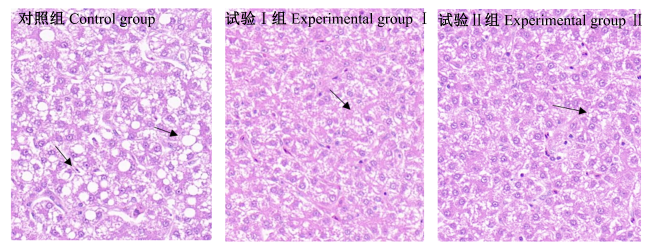
图1可知,对照组蛋鸡肝脏出现了明显的肝细胞肿胀、界限不清楚以及炎症细胞浸润,同时出现了较大的脂滴空泡变性以及高密度的脂滴;与对照组相比,试验Ⅰ组和试验Ⅱ组蛋鸡肝脏组织脂肪空泡数量减少,脂肪空泡变性得到缓解。
图1 蛋鸡肝脏组织HE染色

箭头所指为空泡样变性

Fig.1 HE staining of liver tissue of laying hens (40×)

Arrow referred to vacuolar degeneration。

2.4.2 肝脏组织油红O染色

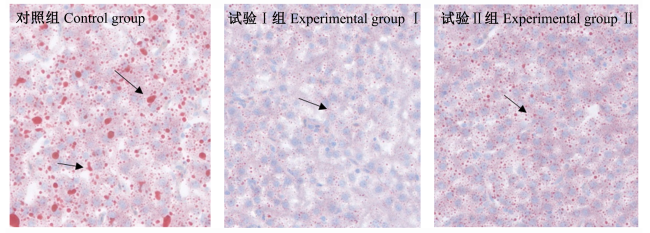
图2可知,对照组蛋鸡肝脏呈现明显脂性病变,脂质沉积明显,大量脂滴堆积,密度较大;与对照组相比,试验Ⅰ组和试验Ⅱ组蛋鸡肝脏组织脂肪变性减轻,脂滴密度和体积更小,且试验Ⅰ组对脂肪沉积的改善程度要优于试验Ⅱ组。
图2 蛋鸡肝脏组织油红O染色

箭头所指为脂滴

Fig.2 Oil red O staining of liver tissue of laying hens (40×)

Arrow referred to lipid droplets。

2.5 FMT对蛋鸡血清抗氧化指标的影响

表6可知,与对照组相比,试验Ⅰ组蛋鸡血清T-AOC以及CAT和GSH-Px活性均显著提高(P<0.05),血清MDA含量显著降低(P<0.05);试验Ⅱ组血清T-AOC及GSH-Px活性显著提高(P<0.05),血清MDA含量显著降低(P<0.05)。
表6 FMT对蛋鸡血清抗氧化指标的影响

Table 6 Effects of FMT on serum antioxidant indices of laying hens

项目
Items
对照组
Control group
试验Ⅰ组
Experimental
group Ⅰ
试验Ⅱ组
Experimental
group Ⅱ
均值标准误
SEM
P
P-value
过氧化氢酶 CAT/(U/mL) 0.53±0.08b 2.72±0.87a 0.98±0.10b 0.36 <0.01
丙二醛 MDA/(nmol/mL) 7.23±1.11a 4.46±0.71b 4.71±0.72b 0.51 0.01
总抗氧化能力 T-AOC/(U/mL) 9.10±0.36c 10.94±0.38b 12.74±0.70a 0.55 <0.01
总超氧化物歧化酶 T-SOD/(U/mL) 84.18±8.90 99.70±2.51 87.44±12.82 3.12 0.08
谷胱甘肽过氧化物酶 GSH-Px/(U/mL) 1 072.22±16.20b 1 298.61±112.25a 1 219.44±103.89a 35.00 <0.01

2.6 FMT对蛋鸡肠道免疫指标的影响

表7可知,与对照组相比,试验Ⅰ组蛋鸡空肠IgM和sIgA含量显著提高(P<0.05),十二指肠TNF-α和空肠IgG含量显著降低(P<0.05);试验Ⅱ组十二指肠和空肠sIgA含量显著提高(P<0.05),回肠TNF-α含量显著降低(P<0.05)。
表7 FMT对蛋鸡肠道免疫指标的影响

Table 7 Effects of FMT on intestinal immune indices of laying hens

项目
Items
对照组
Control group
试验Ⅰ组
Experimental
group Ⅰ
试验Ⅱ组
Experimental
group Ⅱ
均值标准误
SEM
P
P-value
十二指肠 Duodenum
免疫球蛋白G IgG/(μg/mL) 316.11±25.64 281.65±25.10 285.16±17.86 8.64 0.21
免疫球蛋白M IgM/(μg/mL) 180.84±13.47 207.77±11.31 169.44±19.10 7.20 0.05
分泌型免疫球蛋白A sIgA/(μg/mL) 6.41±0.60b 7.45±0.45b 9.45±0.90a 0.49 <0.01
干扰素-γ IFN-γ/(ng/L) 70.81±1.65 63.26±4.30 66.57±5.61 1.63 0.17
肿瘤坏死因子-α TNF-α/(ng/L) 56.96±3.22a 27.75±5.97b 47.64±4.51a 4.52 <0.01
空肠 Jejunum
免疫球蛋白G IgG/(μg/mL) 303.30±18.75a 262.27±22.56b 330.03±16.94a 11.36 0.02
免疫球蛋白M IgM/(μg/mL) 185.94±1.59b 202.80±5.66a 177.50±5.62b 3.96 <0.01
分泌型免疫球蛋白A sIgA/(μg/mL) 5.55±0.44c 10.62±0.46a 7.78±0.92b 0.76 <0.01
干扰素-γ IFN-γ/(ng/L) 89.21±3.37 99.77±6.05 91.81±8.69 2.44 0.19
肿瘤坏死因子-α TNF-α/(ng/L) 36.94±2.52 33.33±2.52 34.05±4.53 1.11 0.43
回肠 Ileum
免疫球蛋白G IgG/(μg/mL) 265.76±10.49 302.86±18.98 284.76±14.29 6.89 0.06
免疫球蛋白M IgM/(μg/mL) 181.20±6.60 182.55±10.26 178.31±0.76 2.13 0.76
分泌型免疫球蛋白A sIgA/(μg/mL) 6.87±0.85 7.34±0.49 6.84±0.90 2.73 0.69
干扰素-γ IFN-γ/(ng/L) 81.84±4.73 86.84±3.99 83.81±7.98 1.83 0.60
肿瘤坏死因子-α TNF-α/(ng/L) 49.38±6.72a 41.46±5.00ab 31.75±5.05b 3.03 0.02

3 讨论

3.1 FMT对蛋鸡生产性能和蛋品质的影响

本试验结果表明,通过菌液饮水的方式进行FMT对蛋鸡生产性能无显著影响。有研究表明,高产蛋鸡FMT给低产蛋鸡后,产蛋率有上升的趋势,但差异不显著[14]
在蛋品质方面,FMT能够显著降低蛋黄颜色,而对其他蛋品质指标无显著影响。研究表明,通过将高产蛋鸡粪菌悬液移植给低产蛋鸡后发现,与饮用生理盐水相比,FMT降低了蛋黄颜色[15],这与本研究结果一致。FMT引起蛋黄颜色降低可能与脂质代谢有关[16],其通过调节肝脏脂质代谢降低了脂溶性色素在蛋黄中的沉积。此外,另一些研究表明,在饲粮中添加益生菌对蛋鸡蛋品质有显著影响,如丁酸梭菌和短芽孢杆菌在蛋鸡高峰期作为益生菌补充,可提高蛋鸡蛋壳品质、哈氏单位和蛋白高度[17];复合益生菌A(枯草杆菌2×10⁹ CFU/g,乳酸杆菌3×109 CFU/g,酵母菌5×108 CFU/g)和复合益生菌B(丁酸梭菌2×108 CFU/g和唾液乳杆菌1×108 CFU/g)发酵饲料能显著提高蛋白高度、哈氏单位,但对蛋形指数、蛋壳厚度等未产生显著影响[18]。饲粮中添加主要成分为枯草芽孢杆菌和丁酸梭菌的复合益生菌显著提高鸭蛋的哈氏单位、蛋白高度和蛋形指数,改善了鸭蛋的质量[19]。也有研究表明,添加益生菌对蛋鸡的蛋品质没有影响,饲粮中添加嗜酸乳杆菌CGMCC1.18778和枯草芽孢杆菌ACCC11088组成的复合益生菌对产蛋后期蛋鸡鸡蛋的蛋壳强度、蛋白高度等指数均无显著影响[20]。由此可见,无论是单一菌株或者不同菌株组合在家禽饲粮中进行补充对家禽的蛋品质有显著影响或无影响,本文的研究结果与前人研究结果一致。

3.2 FMT对蛋鸡血清脂质代谢指标的影响

肠道微生物在调控宿主脂质代谢方面发挥着重要作用,微生物代谢产物包括短链脂肪酸、胆碱代谢物和胆汁酸等对脂质代谢产生影响[21]。有研究表明,益生菌干酪乳杆菌Zhang具有改善高脂膳食大鼠脂质代谢的功能,而且在剂量为2×10⁸ CFU/d时就有很明显的改善作用[22]。在肉鸡饲粮中,酿酒酵母和多菌株益生菌(嗜酸乳杆菌、枯草芽孢杆菌和黑曲霉)单独或联合使用可降低肉鸡血清中的脂质和胆固醇含量[23]。基础饲粮中添加1.2%植物乳杆菌+0.24%丁酸梭菌,能够显著降低塔里木鸽血清中TG和胆固醇含量[24]。本试验中,与对照组相比,试验Ⅰ组和试验Ⅱ组蛋鸡血清AST活性均显著性降低,血清ALT活性有降低趋势,但不显著。

3.3 FMT对蛋鸡肝脏组织病理的影响

家禽脂质代谢的主要器官是肝脏[25-26]。鸡肝脏中的脂肪生成水平和肌肉中的脂肪沉积是决定鸡肉质量和机体健康的最重要因素之一[27]。有研究表明,益生菌、益生元和药品均是通过调节肠道环境和免疫力来改善脂肪肝,且它们的效率基于肠-肝轴[28]。在青脚麻鸡生长早期饮水中添加双歧杆菌、乳酸杆菌、粪链球菌和酵母菌组成的复合活菌制剂可以预防肉鸡脂肪肝的发生,主要通过2个方面起作用:一是通过抑制肝脏内脂肪合成途径从而抑制肝脏脂肪的生成;二是通过增加肉鸡肠道菌群的多样性以及增加有益菌的定植[29]。在肉鸡饲粮中添加0.05%的益生菌Primalac 454,肝脏组织学分级、脂肪变性和细胞空泡评分显著降低,且限制了肉鸡因饮食蛋白质限制而引起的肝脂肪病的强度[30]。本试验中,试验Ⅰ组和试验Ⅱ组蛋鸡肝脏的脂肪沉积均不同程度地得到缓解,可能是FMT有助于提高肠道微生物的多样性,增加了有益菌的定植。

3.4 FMT对蛋鸡血清抗氧化指标的影响

益生菌通过不同的机制直接影响宿主的抗氧化能力,肠道菌群在肠道免疫系统的发育和成熟中起着至关重要的作用。益生菌和益生元通过调控抗氧化途径和提高抗氧化能力来直接和间接抑制氧化应激。直接途径包括补充剂诱导的宿主抗氧化酶活性提高和抗氧化剂相关代谢物(特别是短链脂肪酸)增加;间接途径涉及补充剂诱导的共生细菌物种丰度的变化,这些细菌物种与微生物代谢物的产生和抗氧化酶的活性有关[31]
有研究表明,粪菌联合益生菌移植显著提高了断奶仔猪血浆CAT、GSH-Px、T-SOD活性和及T-AOC,显著降低了血浆MDA含量;早期FMT干预可增强仔猪断奶后的抗氧化能力[32]。FMT干预通过提高厚壁菌门的相对丰度,降低拟杆菌门和变形菌门的相对丰度,使肠道菌群恢复,可有效改善小鼠溃疡性结肠炎[33]。通过FMT,大鼠肝脏、肾脏组织中的超氧化物歧化酶活性显著升高,MDA含量显著降低,表明FMT提高了清除自由基的能力,减缓了细胞受氧化应激损伤的程度,从而起到抗氧化作用[34]。本试验中,FMT后蛋鸡的血清抗氧化酶活性得到显著提高,血清MDA含量显著降低。

3.5 FMT对蛋鸡肠道免疫指标的影响

肠道微生物的组成和产物对免疫应答有很大影响,动物肠道定植着大量的微生物,这些肠道本土微生物以共生的关系与宿主共同进化,除了代谢益处外,共生细菌还为宿主提供了多种功能,可促进免疫稳态、免疫反应和防止病原体定植[35-36]。益生菌能够改善肠道黏膜屏障功能和免疫系统功能,促进抗炎因子的分泌,从而抑制肠道有害细菌的生长;FMT可以通过增加短链脂肪酸(尤其是丁酸盐)的产生来降低肠道通透性,从而降低疾病的严重程度,这有助于维持上皮屏障的完整性[37]
有研究表明,FMT联合丁酸梭菌能显著提高7和21日龄雏鸡血清IgM含量[38]。FMT对改善被动免疫失败犊牛肠道免疫健康、提高犊牛抗病力具有积极作用[39]。从耗牛肠道分离的益生菌补充给小鼠,显著提高了小鼠血清中IgG、IgM和免疫球蛋白A(IgA)含量,同时降低了主要促炎因子TNF-α、白细胞介素-6(IL-6)和白细胞介素-8(IL-8)的表达[40]。蛋鸡饲粮中分别添加由丁酸梭菌、枯草杆菌和唾液乳杆菌等不同益生菌组合发酵的饲料均显著提高空肠黏膜sIgA含量[18]。饲喂由乳酸菌、枯草芽孢杆菌和酵母菌制成的复合益生菌制剂,28和42日龄肉鸡血清免疫球蛋白(IgA、IgG和IgM)含量提高[41]。本试验中,FMT对蛋鸡肠道IgG、IgM和sIgA和TNF-α含量有显著影响,可能是FMT影响了蛋鸡肠道菌群的多样性。

4 结论

FMT显著降低了蛋黄颜色,并且降低了蛋鸡血清AST活性,提高了血清抗氧化能力,对肝脏脂肪沉积及肠道免疫具有改善作用,但FMT对蛋鸡生产性能无显著影响。同时,厌氧发酵制备的粪菌液效果要优于好氧发酵制备的粪菌液。
[1]
KUZIEL G A, RAKOFF-NAHOUM S. The gut microbiome[J]. Current Biology, 2022, 32(6):R257-R264.

[2]
ZHONG Y F, CAO J H, MA Y F, et al. Fecal microbiota transplantation donor and dietary fiber intervention collectively contribute to gut health in a mouse model[J]. Frontiers in Immunology, 2022,13:842669.

[3]
HINCHLIFFE T, PAULINE M L, WIZZARD P R, et al. The effect of fecal microbial transplant on intestinal microbial composition in short-bowel neonatal piglets[J]. JPEN. Journal of Parenteral and Enteral Nutrition, 2022, 46(6):1393-1403.

[4]
SONG Y, CUI Y B, WANG Y M, et al. Donor selection for fecal bacterial transplantation and its combined effects with inulin on early growth and ileal development in chicks[J]. Journal of Applied Microbiology, 2023, 134(5):lxad099.

[5]
张卓. 粪菌移植和结肠菌移植对新生仔猪生长、代谢及肠道健康的差异影响[D]. 硕士学位论文. 重庆: 西南大学, 2021.

ZHANG Z. Differential effects of fecal microbiota transplantation and colonic microbiota transplantation on growth,metabolism and intestinal health of neonatal piglets[D]. Master’s Thesis. Chongqing: Southwest University, 2021. (in Chinese)

[6]
KIM H S, WHON T W, SUNG H, et al. Longitudinal evaluation of fecal microbiota transplantation for ameliorating calf diarrhea and improving growth performance[J]. Nature Communications, 2021, 12(1):161.

DOI PMID

[7]
温琼毅, 于静, 王宝林, 等. 吉林黄鸡源菌群移植联合丁酸梭菌对海兰褐蛋雏鸡早期生长发育的影响[J]. 中国畜牧杂志, 2023, 59(1):285-291.

WEN Q Y, YU J, WANG B L, et al. Effects of transplantation of Jilin yellow chicken bacteria and Clostridium butyricum on early growth and development of Hy-Line brown egg chicks[J]. Chinese Journal of Animal Science, 2023, 59(1):285-291. (in Chinese)

[8]
WANG Y B, XU L P, SUN X L, et al. Characteristics of the fecal microbiota of high- and low-yield hens and effects of fecal microbiota transplantation on egg production performance[J]. Research in Veterinary Science, 2020,129:164-173.

[9]
李璐琳, 曹珍, 钟珊, 等. 饮用酵母发酵菌液对矮脚黄肉鸡生长性能、消化酶活性和盲肠菌落结构的影响[J]. 动物营养学报, 2018, 30(9):3781-3790.

LI L L, CAO Z, ZHONG S, et al. Effects of drinking Saccharomycetes fermented inoculants on growth performance,digestive enzyme activities and cecal microbiota structure of dwarf yellow broilers[J]. Chinese Journal Of Animal Nutrition, 2020, 129(9):164-173. (in Chinese)

[10]
杨成文. 奶牛饮水中添加微生物菌液对产奶性能的影响[J]. 中国牛业科学, 2017, 43(4):37-39.

YANG C W. Effect of addition of microorganisms in drinking water on the lactating performance of dairy cows[J]. China Cattle Science, 2017, 43(4):37-39. (in Chinese)

[11]
CUNNINGHAM M, AZCARATE-PERIL M A, BARNARD A, et al. Shaping the future of probiotics and prebiotics[J]. Trends in Microbiology, 2021, 29(8):667-685.

DOI PMID

[12]
MELARA E G, AVELLANEDA M C, VALDIVIÉ M, et al. Probiotics:symbiotic relationship with the animal host[J]. Animals, 2022, 12(6):719.

[13]
高铎, 李欣南, 韩镌竹, 等. 益生菌在家禽生产中的作用机制及应用研究进展[J]. 动物营养学报, 2023, 35(11):6840-6847.

DOI

GAO D, LI X N, HAN J Z, et al. Research progress on mechanism and application of probiotics in poultry production[J]. Chinese Journal of Animal Nutrition, 2023, 35(11):6840-6847. (in Chinese)

DOI

[14]
张亚楠. 蛋鸡肠道微生物菌群结构特征与产蛋水平关联性研究[D]. 硕士学位论文. 郑州: 河南农业大学, 2016.

ZHANG Y N. Differential effects of fecal microbiota transplantation and colonic microbiota transplantation on growth,metabolism and intestinal health of neonatal piglets[D]. Master’s Thesis. Zhengzhou: Henan Agricultural University, 2016. (in Chinese)

[15]
刘继泽. 肠道微生物组成与蛋鸡生产性能及健康的关联性探究[D]. 硕士学位论文. 泰安: 山东农业大学, 2022.

LIU J Z. Association study of gut microbial composition with production performance and health in laying hens[D]. Master’s Thesis. Tai’an: Shandong Agricultural University, 2022. (in Chinese)

[16]
DEL BARRIO M, LAVÍN L, SANTOS-LASO Á, et al. Faecal microbiota transplantation,paving the way to treat non-alcoholic fatty liver disease[J]. International Journal of Molecular Sciences, 2023, 24(7):6123.

[17]
OBIANWUNA U E, QIU K, CHANG X Y, et al. Enhancing egg production and quality by the supplementation of probiotic strains (Clostridium and Brevibacillus) via improved amino acid digestibility,intestinal health,immune response,and antioxidant activity[J]. Frontiers in Microbiology, 2022,13:987241.

[18]
郭丽娟. 复合益生菌发酵饲料对蛋鸡生产性能和肠道健康的影响[D]. 硕士学位论文. 杨凌: 西北农林科技大学, 2022.

GUO L J. Effects of mixed probiotic fermented feed on performance and intestinal health of laying hens[D]. Master’s Thesis. Yangling: Northwest A and F University, 2022. (in Chinese)

[19]
CAO Y, XUN M Y, REN S M, et al. Effects of dietary organic acids and probiotics on laying performance,egg quality,serum antioxidants and expressions of reproductive genes of laying ducks in the late phase of production[J]. Poultry Science, 2022, 101(12):102189.

[20]
陈欣. 饲粮添加复合益生菌对产蛋后期蛋鸡生产性能和肠道健康的影响[D]. 硕士学位论文. 无锡: 江南大学, 2022.

CHEN X. Effects of dietary supplementation with compound probiotics on production and intestinal health in aged laying hens[D]. Master’s Thesis. Wuxi: Jiangnan University, 2022. (in Chinese)

[21]
马燕飞, 刘建新, 汪海峰. 猪肠道微生物与机体脂质代谢研究进展[J]. 中国科学(生命科学), 2023, 53(5):616-625.

MA Y F, LIU J X, WANG H F. Porcine gut microbiota lipid metabolism recent advances and future directions[J]. Science China (Life Sciences), 2023, 53(5):616-625. (in Chinese)

[22]
张勇, 杜瑞亭, 何秋雯, 等. 饲喂益生菌Lactobacillus casei Zhang对高脂日粮大鼠肝脏脂质代谢的作用[J]. 中国农业科学, 2012, 45(5):943-950.

DOI

ZHANG Y, DU R T, HE Q W, et al. Effect of Lactobacillus casei Zhang administration on liver lipids metabolism of high-fat diet induced hypercholesterolemia rats[J]. Scientia Agricultura Sinica, 2012, 45(5):943-950. (in Chinese)

DOI

[23]
HUSSEIN E, SELIM S. Efficacy of yeast and multi-strain probiotic alone or in combination on growth performance,carcass traits,blood biochemical constituents,and meat quality of broiler chickens[J]. Livestock Science, 2018,216:153-159.

[24]
马嘉月, 张云生, 秦荣艳, 等. 复合益生菌对塔里木鸽生长性能、血清生化指标和屠宰性能的影响[J]. 饲料研究, 2023, 46(19):26-29.

MA J Y, ZHANG Y S, QIN R Y, et al. Effect of complex probiotics on growth performance,serum biochemical indexes and slaughter performance of Tarim pigeon[J]. Feed Research, 2023(19):26-29. (in Chinese)

[25]
HUANG J B, ZHANG Y, ZHOU Y B, et al. Green tea polyphenols alleviate obesity in broiler chickens through the regulation of lipid-metabolism-related genes and transcription factor expression[J]. Journal of Agricultural and Food Chemistry, 2013, 61(36):8565-8572.

DOI PMID

[26]
ZHOU M J, ZENG D, NI X Q, et al. Effects of Bacillus licheniformis on the growth performance and expression of lipid metabolism-related genes in broiler chickens challenged with clostridium perfringens-induced necrotic enteritis[J]. Lipids in Health and Disease, 2016,15:48.

[27]
ZHANG M, LI D H, LI F, et al. Integrated analysis of miRNA and genes associated with meat quality reveals that Gga-miR-140-5p affects intramuscular fat deposition in chickens[J]. Cellular Physiology and Biochemistry, 2018, 46(6):2421-2433.

DOI PMID

[28]
NAGASHIMADA M Y I, HONDA M. Effect of microbiome on non-alcoholic fatty liver disease and the role of probiotics,prebiotics,and biogenics[J]. International Journal of Molecular Sciences, 2021, 22(15):8008.

[29]
梅文晴. 复合益生菌对肉鸡肠道结构、微生物组成和应激引起的脂肪肝的缓解作用研究[D]. 硕士学位论文. 南京: 南京农业大学, 2020.

MEI W Q. Effects of compound probiotics on intestinal structure,microbial composition and stress-induced fatty liver in broilers[D]. Master’s Thesis. Nanjing: Nanjing Agricultural University, 2020. (in Chinese)

[30]
YALCIN S S, GUCER S, YALCIN S, et al. Effects of probiotic (Primalac 454) on non-alcoholic fatty liver disease in broilers[J]. Revue de Medecine Veterinaire, 2011, 162(7):371-376.

[31]
TSAO S P, NURRAHMA B A, KUMAR R, et al. Probiotic enhancement of antioxidant capacity and alterations of gut microbiota composition in 6-hydroxydopamin-induced Parkinson’s disease rats[J]. Antioxidants, 2021, 10(11):1823.

[32]
XIANG Q H, WU X Y, PAN Y, et al. Early-life intervention using fecal microbiota combined with probiotics promotes gut microbiota maturation,regulates immune system development, and alleviates weaning stress in piglets[J]. International Journal of Molecular Sciences, 2020, 21(2):503.

[33]
ZHANG W Y, ZOU G L, LI B, et al. Fecal microbiota transplantation (FMT) alleviates experimental colitis in mice by gut microbiota regulation[J]. Journal of Microbiology and Biotechnology, 2020, 30(8):1132-1141.

DOI PMID

[34]
游婷. 粪菌移植对D-半乳糖诱导的衰老大鼠模型抗氧化功能及肠道菌群影响的研究[D]. 硕士学位论文. 泸州: 西南医科大学, 2022.

YOU T. Effects of Fecal Microbiota transplantation on antioxidant function and intestinal flora in D-galactose-induced aging rats model[D]. Master’s Thesis. Luzhou: Southwest Medical University, 2022. (in Chinese)

[35]
MASLOWSKI K M, MACKAY C R. Diet,gut microbiota and immune responses[J]. Nature Immunology, 2011, 12(1):5-9.

[36]
PICKARD J M, ZENG M Y, CARUSO R, et al. Gut microbiota:role in pathogen colonization,immune responses,and inflammatory disease[J]. Immunological Reviews, 2017, 279(1):70-89.

[37]
SHEN Z H, ZHU C X, QUAN Y S, et al. Relationship between intestinal microbiota and ulcerative colitis: Mechanisms and clinical application of probiotics and fecal microbiota transplantation[J]. World Journal of Gastroenterology, 2018, 24(1):5-14.

[38]
崔一博. 粪菌移植联合益生菌 (元) 对雏鸡生长、免疫和肠道菌群的影响[D]. 硕士学位论文. 长春: 吉林农业大学, 2023.

CUI Y B. Effects of fecal microbiota transplantation combined with probiotics (prebiotics) on growth,immune and intestinal microbiota of chicks[D]. Master’s Thesis. Changchun: Jilin Agricultural University, 2023. (in Chinese)

[39]
吴兆海. 粪菌移植对被动免疫失败犊牛肠道屏障功能及肠道菌群构建的影响[D]. 博士学位论文. 北京: 中国农业大学, 2018.

WU Z H. Effects of fecal microbiota transplantation on intestinal barrier function and microbiota establishment in calves with failure of passive immune transfer[D]. Ph.D. Thesis. Beijing: China Agricultural University, 2018. (in Chinese)

[40]
LI A Y, WANG Y P, LI Z X, et al. Probiotics isolated from yaks improves the growth performance,antioxidant activity,and cytokines related to immunity and inflammation in mice[J]. Microbial Cell Factories, 2019, 18(1):112.

[41]
龙宪荣. 复合益生菌制剂及其对肉鸡益生效果的检验[D]. 硕士学位论文. 泰安: 山东农业大学, 2021.

LONG X R. Compound probiotic preparation and its probiotic effect on broilers[D]. Master’s Thesis. Tai’an: Shandong Agricultural University, 2021. (in Chinese)

文章导航

/