研究论文

菜籽粕替代鱼粉对青鱼生长、抗氧化能力和肠道健康的影响

  • 魏正玲 , 1 ,
  • 罗凯 1, * ,
  • 邵仙萍 2 ,
  • 郜卫华 , 1, ** ,
  • 吴成龙 , 2, ** ,
  • 赵成民 3
展开
  • 1 长江大学动物科学技术学院,荆州 434024
  • 2 湖州师范学院,湖州 313000
  • 3 湖北沙洋小笨鱼农业发展有限公司,荆门 448200
**郜卫华,副教授,硕士生导师,E-mail: ;
吴成龙,教授,硕士生导师,E-mail:

*同等贡献作者

魏正玲(1998—),女,湖北十堰人,硕士研究生,从事水产动物营养与饲料研究。E-mail:

Copy editor: 菅景颖

收稿日期: 2023-12-27

  网络出版日期: 2024-06-07

基金资助

国家现代农业产业技术体系项目(CARS-45)

广东省重点领域研发计划资助项目(2021B0202050002)

Effects of Rapeseed Meal Replacing Fish Meal on Growth, Antioxidant Capacity and Intestinal Health of Black Carp (Mylopharyngodon piceus)

  • WEI Zhengling , 1 ,
  • LUO Kai 1 ,
  • SHAO Xianping 2 ,
  • GAO Weihua , 1, ** ,
  • WU Chenglong , 2, ** ,
  • ZHAO Chengmin 3
Expand
  • 1 College of Animal Science and Technology, Yangtze University, Jingzhou 434024, China
  • 2 Huzhou University, Huzhou 313000, China
  • 3 Hubei Shayang Xiaobenyu Agricultural Development Co., Ltd., Jingmen 448200, China
**associate professor, E-mail: ;
professor, E-mail:

*Contributed equally

Received date: 2023-12-27

  Online published: 2024-06-07

摘要

本试验旨在研究菜籽粕替代鱼粉对青鱼(Mylopharyngodon piceus)生长、抗氧化能力和肠道健康的影响。用菜籽粕分别替代基础饲料中0(对照组)、10%(10%组)、20%(20%组)、30%(30%组)、40%(40%组)和50%(50%组)的鱼粉,配制6种等氮等脂的试验饲料,饲喂初始体重为(6.73±0.70) g的青鱼8周。每种试验饲料投喂4个养殖桶,每桶放养35尾鱼。结果显示:1)对照组、10%组和20%组增重率和特定生长率无显著差异(P>0.05),30%、40%和50%组的增重率和特定生长率显著低于对照组和10%组(P<0.05)。随着菜籽粕替代鱼粉比例的增加,肥满度、肝体比和肠体比呈现下降的趋势,饲料系数呈现先下降后上升的趋势,50%组的饲料系数显著高于对照组、10%组和20%组(P<0.05)。2)各组全鱼的水分和粗灰分含量无显著差异(P>0.05);随着菜籽粕替代鱼粉比例的增加,全鱼的粗蛋白质和粗脂肪含量呈现下降的趋势,40%和50%组全鱼的粗蛋白质和粗脂肪含量显著低于对照组(P<0.05)。各组肌肉的水分、粗脂肪和粗灰分含量无显著差异(P>0.05);30%组、40%组和50%组肌肉的粗蛋白质含量显著低于对照组(P<0.05)。3)各组干物质和粗脂肪表观消化率无显著差异(P>0.05),20%组、30%组、40%组和50%组粗蛋白质表观消化率显著低于对照组(P<0.05)。当饲料中菜籽粕替代鱼粉比例超过10%时,肠道胰蛋白酶、脂肪酶和淀粉酶活性均显著下降(P<0.05)。4)血清总抗氧化能力和超氧化物歧化酶活性随着菜籽粕替代鱼粉比例的增加呈下降趋势,但各组间无显著差异(P>0.05)。当菜籽粕替代鱼粉比例高于20%时,血清过氧化氢酶活性显著降低(P<0.05),血清丙二醛含量显著升高(P<0.05)。5)当菜籽粕替代鱼粉比例超过10%时,肠绒毛长度、宽度和肌层厚度显著下降(P<0.05)。在门水平上,青鱼肠道菌群中的优势菌门为变形菌门、拟杆菌门和放线菌门;在属水平上,青鱼肠道菌群中的优势菌属为金黄杆菌属、无色杆菌属和气单胞菌属。菜籽粕替代20%和50%的鱼粉提高了青鱼肠道菌群中变形菌门和气单胞菌属的相对丰度。综上所述,青鱼饲料中菜籽粕替代鱼粉的比例以不超过20%为宜,此时不会对青鱼的生长和抗氧化能力产生明显的负面影响。

本文引用格式

魏正玲 , 罗凯 , 邵仙萍 , 郜卫华 , 吴成龙 , 赵成民 . 菜籽粕替代鱼粉对青鱼生长、抗氧化能力和肠道健康的影响[J]. 动物营养学报, 2024 , 36(6) : 3876 -3891 . DOI: 10.12418/CJAN2024.332

Abstract

This experiment aimed to investigate the effects of rapeseed meal replacing fish meal on the growth, antioxidant capacity and intestinal health of black carp (Mylopharyngodon piceus). Six isonitrogen and isolipid diets were designed and prepared by replacing 0 (control group), 10% (10% group), 20% (20% group), 30% (30% group), 40% (40% group) and 50% (50% group) of fish meal with rapeseed meal based on a basal diet, respectively. The black carp with an initial body weight of (6.73±0.70) g were fed the experimental diets for 8 weeks. Each experimental diet was fed to 4 breeding buckets with 35 fish per bucket. The results showed as follows: 1) there were no significant differences in weight gain rate (WGR) and specific growth rate (SGR) among the control group, 10% group and 20% group (P>0.05), while the WGR and SGR in the 30% group, 40% group and 50% group were significantly lower than those in the control group and 10% group (P<0.05). With the rapeseed meal replacement level increasing, the condition factor (CF), hepatosmatic index (HSI) and intestinosomatic index (ISI) were decreased, and the feed conversion ratio (FCR) firstly decreased and then increased. The FCR in the 50% group was significantly higher than that in the control group and 10% group (P<0.05). 2) There were no significant differences in the moisture and ash content of whole fish among groups (P>0.05); the crude protein and crude lipid contents of 30% group, 40% group and 50% group were decreased with the rapeseed meal replacement level increasing, and those in the 40% group and 50% group were significantly lower than those in the control group (P<0.05). There were no significant differences in moisture, ash and crude lipid of muscle among groups (P>0.05), while the crude protein content of muscle in the 30% group, 40% group and 50% group was significantly decreased compared with the control group (P<0.05). 3) There were no significant differences in the apparent digestibility coefficients of dry matter and crude lipid among groups (P>0.05). The apparent digestibility coefficient of crude protein in the 30% group, 40% group and 50% group was significantly lower than that in the control group (P<0.05). When the fish meal replaced by rapeseed meal exceeded 10%, the activities of intestinal trypsin, lipase and amylase in intestine were significantly decreased compared with control group (P<0.05). 4) The total antioxidant capacity (T-AOC) and superoxide dismutase (SOD) activity in serum showed a decreasing trend among the experimental groups, but there were no significant differences among groups (P>0.05). When the fish meal replaced by rapeseed meal exceeded 20%, serum catalase (CAT) activity was significantly decreased (P<0.05), and serum malondialdehyde (MDA) content was significantly increased (P<0.05). 5) The intestinal villi length, villi width and muscle thickness decreased significantly when the fish meal replaced by rapeseed meal exceeded 10% (P<0.05). At phylum level, the dominant microbial phyla in intestinal flora of black carp were Proteobacteria, Bacteroidetes and Actinobacteria. At genus level, the dominant microbial genera in intestinal flora of black carp were Chrysobacillus, Achromobacillus and Aeromonas. The relative abundances of Proteobacteria and Aeromonas were when 20% and 50% fish meal replaced by rapeseed meal. In summary, an appropriate proportion of rapeseed meal instead of fish meal in the diet of black carp should not exceed 20%, which will not have noticeable adverse effects on the growth and antioxidant capacity of black carp.

鱼粉是水产饲料中最重要的蛋白质原料。近年来,随着水产养殖业的快速发展,鱼粉的需求量持续增加,加之过度捕捞导致海洋鱼类资源越来越匮乏,从而造成鱼粉产量下降、供应短缺和价格上涨,饲料成本逐年提高[1-2]。为缓解这一现状并促进水产养殖业稳定发展,应用部分植物蛋白质源替代鱼粉已成为近年来研究的热点之一。植物蛋白质源来源广泛、供应稳定、价格低廉且蛋白质含量较高,备受研究者的关注[3-4]
菜籽粕是畜禽饲粮中常用的饲料原料,其来源广泛,蛋白质含量高,富含较为平衡的氨基酸且价格较为低廉。已有研究表明,饲料中菜籽粕替代鱼粉的比例在5%~15%时不会影响虹鳟(Oncorhynchus mykiss)的生长性能[5];饲料中菜籽粕替代鱼粉的比例达到15%及以上会导致莫桑比克罗非鱼(Oreochromis mossambicus)生长和饲料利用率下降[6];膨化饲料中以菜籽粕替代75%的鱼粉对在银鲫(Carassius auratus)的生长和饲料系数无显著影响,而硬颗粒饲料中以菜籽粕替代50%和75%的鱼粉后,银鲫的生长受到明显的抑制,饲料系数显著升高[7];饲料中菜籽粕替代鱼粉的比例达到50%及以上时六须鲶(Silurus glanis)的生长性能和摄食量显著降低[8]。以上研究结果表明,菜籽粕替代鱼粉的最适水平在不同的饲料类型和鱼类之间存在较大差异。
青鱼隶属于脊索动物门(Chordata),硬骨鱼纲(Osteichthyes),鲤形目(Cypriniformes),鲤科(Cyprinidae),青鱼属(Mylopharyngodon),是我国主要的经济养殖鱼类,也是我国四大家鱼中唯一的肉食性鱼类。青鱼具有个体大、肌肉蛋白质含量高、脂肪含量低和肉味鲜美等优点,深受广大消费者的喜爱[9-10]。近几年我国青鱼养殖产量不断增加,2022年其产量达74.80万t[11]。为满足青鱼养殖发展的需求,研发低成本、经济效益高的配合饲料迫在眉睫。因此,研究青鱼饲料中鱼粉的替代品,对降低饲养成本、提高青鱼的综合养殖性能具有重要意义。研究显示,饲料中小肽豆粕替代鱼粉的比例为25%时,对青鱼幼鱼的生长无显著影响[12];用豆粕、菜籽粕按蛋白质含量1∶1的比例混合后分别替代25%、50%、75%、100%的鱼粉,通过测定青鱼的生长性能、体成分、血清抗氧化指标、肠道消化酶活性、营养物质表观消化率及肠道菌群,得到青鱼专用配合饲料中用豆粕和菜籽粕混合植物蛋白质源替代鱼粉的适宜比例为25%~50%[13-14]。本研究以青鱼为试验对象,研究菜籽粕替代不同比例鱼粉对青鱼生长、抗氧化能力和肠道健康的影响,为水产动物营养研究和菜籽粕在水产配合饲料生产中的合理应用提供理论基础和科学指导。

1 材料与方法

1.1 试验饲料

本试验首先以鱼粉、鸡肉粉、谷朊粉、玉米蛋白粉、豆粕为蛋白质源,以鱼油和菜籽油为主要脂肪源,以三氧化二钇(Y2O3)为外源指示剂,配制青鱼基础饲料,然后在基础饲料配方的基础上,以菜籽粕分别替代0(对照组)、10%(10%组)、20%(20%组)、30%(30%组)、40%(40%组)和50%(50%组)的鱼粉,配制出6种等氮等脂的试验饲料,其组成及营养水平见表1。各饲料原料经粉碎机(30B,常州荣振干燥设备有限公司)粉碎后过80目筛,按照表1中配比由少到多逐级混合,添加鱼油和菜籽油后再经混合机(SYH-100L,常州万达干燥设备有限公司)混合均匀,最终经TSE65膨化机(北京现代洋工机机械科技发展有限公司)制成粒径为1 mm的膨化饲料,于-20 ℃保存待用。试验饲料中抗营养因子含量见表2
表1 试验饲料组成及营养水平(干物质基础)

Table 1 Composition and nutrient levels of test diets (DM basis)%

项目
Items
菜籽粕替代鱼粉比例 Proportion of rapeseed meal replacing fish meal/%
0 10 20 30 40 50
原料 Ingredients
鱼粉 Fish meal 20.00 18.00 16.00 14.00 12.00 10.00
菜籽粕 Rapeseed meal 3.60 7.20 11.00 14.50 18.20
豆粕 Soybean meal 25.00 25.00 25.00 25.00 25.00 25.00
鸡肉粉 Chicken meal 4.00 4.00 4.00 4.00 4.00 4.00
谷朊粉 Wheat gluten 3.00 3.00 3.00 3.00 3.00 3.00
玉米蛋白粉 Corn protein meal 5.00 5.00 5.00 5.00 5.00 5.00
鱼油 Fish oil 1.00 1.22 1.44 1.66 1.88 2.10
菜籽油 Rapeseed oil 1.80 1.44 1.09 0.71 0.37 2.90
微晶纤维素 Microcrystalline cellulose 11.00 9.54 8.07 6.43 5.05 0.60
高筋面粉 Bread flour 26.00 26.00 26.00 26.00 26.00 26.00
磷酸二氢钙 Ca(H2PO4)2 1.80 1.80 1.80 1.80 1.80 1.80
氯化胆碱 Choline chloride 0.25 0.25 0.25 0.25 0.25 0.25
三氧化二钇 Y2O3 0.10 0.10 0.10 0.10 0.10 0.10
预混料 Premix1) 1.00 1.00 1.00 1.00 1.00 1.00
抗氧化剂 Antioxidant 0.05 0.05 0.05 0.05 0.05 0.05
合计 Total 100.00 100.00 100.00 100.00 100.00 100.00
营养水平 Nutrient levels2)
粗蛋白质 Crude protein 39.19 39.11 39.40 39.72 39.67 39.24
粗脂肪 Crude lipid 7.51 7.73 7.54 7.40 7.54 8.08
粗灰分 Ash 8.60 8.42 8.64 8.40 8.23 8.24

1)每千克预混料含有 Contained the following per kg of the premix:VA 250 000 IU,VD3 62 500 IU,VE 2.3 g,VK3 0.25 g,VC 5 g,VB1 0.48 g,VB2 0.75 g,VB6 0.75 g,VB12 3 mg,烟酰胺 nicotinamide 2 g,D-泛酸钙 D-pantothenic acid 2 g,叶酸 folic acid 0.1 g,D-生物素 D-biotin 5 mg,肌醇 inositol 4.75 g,氯化胆碱 choline chloride 200 g,MgSO4 6.5 g,FeSO4 17.5 g,ZnSO4 7.5 g,CuSO4 1.25 g,MnSO4 2.5 g,CoSO4 65 mg,Na2SeO3 15.5 mg,Ca(IO3)2 222 mg。

2)营养水平均为实测值。Nutrient levels were measured values.

表2 饲料中抗营养因子含量

Table 2 Antinutritional factor contents of test diets

项目
Items
菜籽粕替代鱼粉比例 Proportion of rapeseed meal replacing fish meal/%
0 10 20 30 40 50
硫代葡萄糖苷 GLS/(μmol/g) 4.95 8.53 9.03 10.51 10.97 11.74
异硫氰酸酯 Isothiocyanate/(mg/g) 0.47 1.21 1.38 1.54 1.71 1.86
噁唑烷硫酮 OZT/(mg/g) 0.26 0.44 0.60 0.75 0.90 1.09
单宁 Tannin/(mg/g) 0.43 0.86 1.27 1.61 2.04 2.56
植酸 Phytic acid/(mg/g) 8.97 15.67 16.46 17.28 18.17 18.98

1.2 试验设计及饲养管理

青鱼鱼苗购于荆州市观音垱镇,于循环水养殖系统中进行为期14 d的暂养,暂养期间投喂基础饲料,使其适应养殖环境和饲料。青鱼在正式试验开始前禁食24 h,禁食结束后挑选体质健康、规格均匀的青鱼840尾,初始体重为(6.73±0.70) g,随机分为6个组,每组4个重复,每桶35尾鱼,以重复为单位养殖在24个圆柱形养殖桶(300 L/桶)中,分别饲喂相应的试验饲料,进行为期8周的养殖试验。试验期间采用表观饱食法进行投喂,每天09:00和17:00各投喂1次并收集残饵。每天换水1次,每次换水量为1/3。饲养期间的水温为(24.0±1.0) ℃,溶解氧含量>5.0 mg/L,pH为7.2~7.6。

1.3 样品采集

正式试验开始前取20尾青鱼于-20 ℃保存。养殖试验开始1周后,每天收集粪便,烘干后于-20 ℃保存,用于营养物质表观消化率测定。养殖试验结束后,青鱼禁食24 h,使用MS-222(Sigma,美国)麻醉,统计青鱼数量,并测量体重和体长,用于计算生长性能和形体指标。每个养殖桶随机取5尾青鱼,用于全鱼常规营养成分分析。每个养殖桶再随机选取20尾青鱼尾静脉取血,4 ℃静止24 h后4 ℃离心(3 000×g)10 min,取上清液于-80 ℃保存,用于血清抗氧化指标测定。对取血后的青鱼进行解剖,并分别称量内脏团、肝脏和肠道重量,用于形体指标计算;取青鱼的肠道于-80 ℃保存,用于肠道消化酶活性和菌群检测;取青鱼前肠,使用4%多聚甲醛固定液固定,用于肠道组织切片观察;取青鱼肌肉于-20 ℃保存,用于肌肉常规营养成分分析。

1.4 指标检测及方法

1.4.1 常规营养成分

饲料原料、饲料、全鱼、肌肉和粪便的水分含量采用105 ℃烘箱干燥法(GB/T 6435—2014)测定,粗蛋白质含量采用凯氏定氮法(GB/T 6432—2018)测定,粗脂肪含量使用索氏抽提法(GB/T 6433—2006)测定,粗灰分含量采用马弗炉550 ℃灼烧法(GB/T 6438—2007)测定;饲料和粪便中Y2O3含量用电感耦合等离子体质谱法(PE Avio 500电感耦合等离子体发射光谱仪)测定;饲料中硫代葡萄糖苷含量采用氯化钯法测定,噁唑烷硫酮含量参照GB/T 13089—2020方法测定,异硫氰酸酯含量参照NY/T 1596—2008方法测定,单宁含量参照GB/T 27985—2011方法测定,植酸含量参照GB/T 5009.153—2003方法测定。

1.4.2 血清抗氧化指标和肠道消化酶活性

血清抗氧化指标以及肠道消化酶活性采用商业试剂盒(南京建成生物工程研究所)测定。血清总抗氧化能力(T-AOC)采用ABTS法测定,过氧化氢酶(CAT)活性采用钼酸铵法测定,超氧化物歧化酶(SOD)活性采用WST-1法测定,丙二醛(MDA)含量采用硫代巴比妥酸(TBA)法。肠道胰蛋白酶活性采用紫外-可见分光光度法测定,α-淀粉酶活性采用淀粉-碘比色法测定,脂肪酶活性采用甲基试卤灵底物法测定。

1.4.3 肠道组织切片

取固定后的青鱼前肠样本进行常规石蜡包埋切片,厚度约为5 μm,使用苏木精-伊红(HE)染色后在光学显微镜下观察并拍照,使用Image Pro Plus 6.0软件测量肠道绒毛长度、绒毛宽度和肌层厚度。

1.4.4 肠道菌群

根据E.Z.N.A.® Soil DNA Kit(Omega,美国)说明书进行微生物群落总DNA抽提,使用1%琼脂糖凝胶电泳检测DNA的提取质量,Nano-Drop 2000测定DNA浓度和纯度。使用338F(5'-ACTCCTACGGGAGGCAGCAG-3')和806R(5'-GGACTACHVGGGTWTCTAAT-3')对16S rRNA基因V3~V4区进行PCR扩增。将同一样本的PCR产物混合后使用2%琼脂糖凝胶回收PCR产物,利用AxyPrepDNAGel Extraction Kit(Axygen Biosciences,美国)进行回收产物纯化,2%琼脂糖凝胶电泳检测,并用QuantusTM Fluoro-meter(Promega,美国)对回收产物进行检测和定量。使用NEXT-FLEX Rapid DNA-Seq Kit(Bioo Scientific,美国)进行建库,利用Illumina公司的MiSeq PE300平台进行测序。使用Fasstp软件对原始测序序列进行质控,使用Flash软件进行拼接。使用Uparse软件对样品的全部有效数据进行操作分类单位(OTUs)聚类和物种分类分析,以97%的一致性将序列聚类成为OTUs,并通过R语言工具和构建Venn图。使用Mothur软件计算微生物Alpha多样性指数,包括Sobs、Shannon、Simpson、Chao、Ace指数和覆盖率。通过Qiime软件分析门和属分类级别的物种组成和相对丰度。

1.5 计算公式

存活率(SR,%)=(终末尾数/初始尾数)×100;

增重率(WGR,%)=[(试验鱼终末体重-试验鱼初始体重)/试验鱼初始体重]×100;

特定生长率(SGR,%/d)=[(ln试验鱼终末体重-ln试验鱼初始体重)/试验天数]×100;

饲料系数(FCR)=摄入饲料干重/(试验鱼终末体重-试验鱼初始体重);

肥满度(CF,g/cm3)=(体重/体长3)×100;

肝体比(HSI,%)=(肝脏重/体重)×100;

脏体比(VSI,%)=(内脏重/体重)×100;

肠体比(ISI,%)=(肠道重/体重)×100;

干物质表观消化率(%)=(1-饲料中Y2O3含量/粪便中Y2O3含量)×100;

粗蛋白质表观消化率(%)=[1-(饲料中Y2O3含量×粪便中粗蛋白质含量)/(粪便中Y2O3含量×饲料中粗蛋白质含量)]×100;

粗脂肪表观消化率(%)=[1-(饲料中Y2O3含量×粪便中粗脂肪含量)/(粪便中Y2O3含量×饲料中粗脂肪含量)]×100。

1.6 数据处理及分析

采用SPSS 26.0软件对数据进行统计和分析,先对数据进行单因素方差分析(one-way ANOVA),在用Tukey法对组间差异显著性进行多重比较,所有分析结果均表示为平均值±标准差,P<0.05被认为具有显著差异。

2 结果

2.1 菜籽粕替代鱼粉对青鱼生长性能和体成分的影响

表3可知,菜籽粕替代饲料中不同比例鱼粉对青鱼的存活率、脏体比均无显著影响(P>0.05),但随菜籽粕替代鱼粉比例的增加,青鱼的增重率、特定生长率、肥满度、肝体比和肠体比均呈现下降的趋势,饲料系数呈现先下降后上升的趋势。当菜籽粕替代鱼粉比例超过20%时,青鱼的增重率、特定生长率显著低于对照组(P<0.05)。当菜籽粕替代鱼粉比例达到50%时,饲料系数显著高于对照组(P<0.05)。
表3 菜籽粕替代鱼粉对青鱼生长性能的影响

Table 3 Effects of replacing fish meal with rapeseed meal on growth performance of black carp

项目
Items
菜籽粕替代鱼粉比例 Proportion of rapeseed meal replacing fish meal/% P
P-value
0 10 20 30 40 50
初始体重 IBW/g 6.66±0.06 6.66±0.04 6.67±0.03 6.67±0.06 6.67±0.02 6.67±0.02 0.073
终末体重 FBW/g 12.14±0.31a 12.05±0.27a 11.77±0.50ab 10.52±0.58bc 10.41±0.56c 9.59±0.35c <0.001
存活率 SR/% 99.29±1.43 100.00±0.00 99.29±1.43 100.00±0.00 100.00±0.00 98.57±1.65 0.588
增重率 WGR/% 83.14±3.96a 80.81±4.29a 76.88±7.81ab 58.19±7.53bc 56.14±8.02c 44.14±5.52c <0.001
特定生长率
SGR/(%/d)
0.87±0.03a 0.84±0.04a 0.81±0.07ab 0.65±0.07bc 0.63±0.07c 0.52±0.06c <0.001
饲料系数 FCR 2.50±0.03b 2.46±0.27b 2.35±0.39b 2.65±0.27ab 3.52±0.48ab 3.81±0.55a <0.001
肥满度 CF/(g/cm3) 1.82±0.02a 1.77±0.02ab 1.75±0.04bc 1.72±0.02bc 1.71±0.01c 1.71±0.02c <0.001
脏体比 VSI/% 7.25±0.14 7.11±0.27 7.09±0.14 7.07±0.25 6.85±0.13 6.77±0.05 0.061
肝体比 HSI/% 1.38±0.09a 1.36±0.06a 1.27±0.05ab 1.16±0.07bc 1.14±0.02bc 1.07±0.05c <0.001
肠体比 ISI/% 1.75±0.03a 1.68±0.07a 1.64±0.06a 1.44±0.03b 1.23±0.10c 1.21±0.09c <0.001

同行数据肩标不同小写字母表示差异显著(P<0.05)。下表同。

Values in the same row with different letter superscripts represent significant difference (P<0.05). The same as below.

表4可知,随着菜籽粕替代鱼粉比例的增加,全鱼的粗蛋白质和粗脂肪含量呈现下降的趋势,40%组和50%组全鱼的粗蛋白质和粗脂肪含量显著低于对照组(P<0.05);全鱼的水分和粗灰分含量各组之间无显著差异(P>0.05)。肌肉的水分、粗脂肪和粗灰分含量随菜籽粕替代鱼粉比例的增加无显著变化(P>0.05),但30%组、40%组和50%组肌肉的粗蛋白质含量显著低于对照组(P<0.05)。
表4 菜籽粕替代鱼粉对青鱼体成分的影响

Table 4 Effects of replacing fish meal with rapeseed meal on body composition of black carp%

项目
Items
菜籽粕替代鱼粉比例 Proportion of rapeseed meal replacing fish meal/% P
P-value
0 10 20 30 40 50
全鱼 Whole body
水分 Moisture 72.74±0.51 72.18±0.69 72.89±0.55 72.17±0.69 72.00±0.39 70.60±0.94 0.007
粗蛋白质 Crude protein 12.62±0.53a 12.39±0.22a 12.15±0.16ab 11.94±0.22ab 11.65±0.37bc 11.13±0.13c <0.001
粗脂肪 Crude lipid 9.86±0.38a 9.54±0.33ab 9.49±0.10ab 9.13±0.43abc 8.89±0.33bc 8.71±0.29c 0.003
粗灰分 Ash 2.57±0.15 2.48±0.09 2.47±0.19 2.44±0.17 2.43±0.13 2.37±0.37 0.856
肌肉 Muscle
水分 Moisture 78.18±0.53 78.09±0.14 78.30±0.29 77.99±0.10 78.43±0.27 78.07±0.52 0.517
粗蛋白质 Crude protein 18.56±0.12a 18.44±0.14a 18.23±0.16ab 17.95±0.21b 17.56±0.12c 17.40±0.15c <0.001
粗脂肪 Crude lipid 1.87±0.06 1.81±0.21 1.78±0.10 1.74±0.11 1.71±0.09 1.70±0.03 0.346
粗灰分 Ash 1.03±0.17 1.01±0.12 0.98±0.09 0.95±0.14 0.91±0.11 0.89±0.13 0.624

2.2 菜籽粕替代鱼粉对青鱼营养物质表观消化率和肠道消化酶活性的影响

表5可知,随着菜籽粕替代鱼粉比例的增加,干物质和粗脂肪表观消化率无显著变化(P>0.05)。当菜籽粕替代鱼粉比例超过10%时,粗蛋白质表观消化率显著低于对照组(P<0.05)。
表5 菜籽粕替代鱼粉对青鱼营养物质表观消化率的影响

Table 5 Effects of replacing fish meal with rapeseed meal on nutrient apparent digestibility coefficients of black carp

项目
Items
菜籽粕替代鱼粉比例 Proportion of rapeseed meal replacing fish meal/% P
P-value
0 10 20 30 40 50
干物质表观消化率
ADC of dry matter
74.77±1.39 72.78±0.01 74.46±0.95 72.60±0.53 73.29±1.51 72.95±1.03 0.303
粗蛋白质表观消化率
ADC of crude protein
92.36±0.47a 91.44±0.57ab 90.02±0.48bc 88.33±0.53cd 89.31±0.01c 86.96±0.56d <0.001
粗脂肪表观消化率
ADC of crude lipid
82.02±1.96 83.03±0.94 82.56±1.90 79.82±0.30 82.84±0.47 79.55±1.82 0.157
表6可知,随着菜籽粕替代鱼粉比例的增加,青鱼肠道胰蛋白酶、脂肪酶和α-淀粉酶活性均呈现下降趋势,当菜籽粕替代鱼粉比例超过10%时,胰蛋白酶、脂肪酶和α-淀粉酶活性均显著低于对照组(P<0.05)。
表6 菜籽粕替代鱼粉对青鱼肠道消化酶活性的影响

Table 6 Effects of replacing fish meal with rapeseed meal on activities of digestive enzymes in intestine of black carp

项目
Items
菜籽粕替代鱼粉比例 Proportion of rapeseed meal replacing fish meal/% P
P-value
0 10 20 30 40 50
胰蛋白酶
TPS/(U/g prot)
80.20±3.88a 74.14±3.79ab 64.11±4.57bc 60.57±1.73c 57.92±2.41c 56.73±1.29c <0.001
脂肪酶
LPS/(U/g prot)
26.04±2.43a 25.19±1.29a 17.66±1.92b 15.03±1.85bc 14.79±0.76bc 12.57±2.06c <0.001
α-淀粉酶
AMS/(U/mg prot)
0.38±0.01a 0.31±0.06ab 0.32±0.01b 0.30±0.02b 0.29±0.05b 0.19±0.03c <0.001

2.3 菜籽粕替代鱼粉对青鱼血清抗氧化指标的影响

表7可知,各组青鱼的血清总抗氧化能力和超氧化物歧化酶活性无显著差异(P>0.05)。菜籽粕替代饲料中不同比例的鱼粉能够显著影响青鱼的血清过氧化氢酶活性和丙二醛的含量(P<0.05),其中过氧化氢酶活性随着菜籽粕替代鱼粉比例的增加而降低,而丙二醛含量则随着菜籽粕替代鱼粉比例的增加而增加;当菜籽粕替代鱼粉比例超过20%时,血清过氧化氢酶活性显著低于对照组(P<0.05),血清丙二醛含量显著高于对照组(P<0.05)。
表7 菜籽粕替代鱼粉对青鱼血清抗氧化指标的影响

Table 7 Effects of replacing fish meal with rapeseed meal on serum antioxidant indices of black carp

项目
Items
菜籽粕替代鱼粉比例 Proportion of rapeseed meal replacing fish meal/% P
P-value
0 10 20 30 40 50
总抗氧化能力
T-AOC/(mmol/L)
0.95±0.00 0.94±0.01 0.93±0.02 0.85±0.01 0.85±0.10 0.84±0.01 0.108
过氧化氢酶
CAT/(U/mL)
6.32±0.10a 5.37±0.67ab 4.81±0.77abc 3.62±0.44bc 3.50±0.59bc 2.91±0.84c <0.001
超氧化物歧化酶
SOD/(U/mL)
119.55±1.03 118.99±0.48 118.20±1.03 117.64±0.48 117.53±1.03 116.97±1.43 0.090
丙二醛
MDA/(nmol/mL)
6.37±0.37c 6.84±0.65c 7.09±0.71bc 8.68±0.42ab 9.78±0.31d 9.93±0.52a <0.001

2.4 菜籽粕替代鱼粉对青鱼肠道组织形态的影响

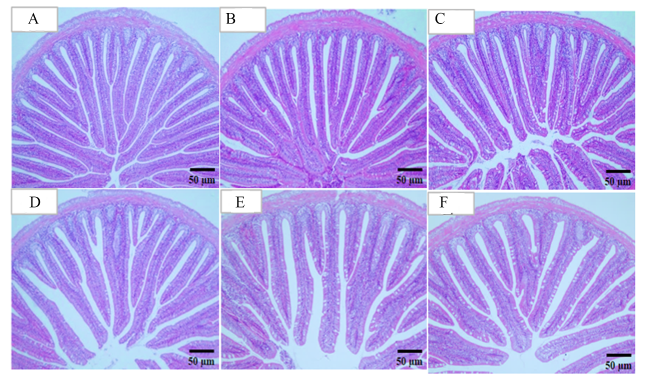
青鱼肠道组织形态如图1所示,对照组、10%组、20%组青鱼肠道绒毛结构完整,发育良好。由表8可知,菜籽粕替代饲料中不同比例的鱼粉能够显著影响青鱼肠道绒毛长度、绒毛宽度和肌层厚度(P<0.05)。当菜籽粕替代鱼粉比例超过10%时,肠道绒毛长度、绒毛宽度和肌层厚度均显著低于对照组(P<0.05)。
图1 青鱼肠道(前肠)组织切片

A:对照组;B:10%组;C:20%组;D:30%组;E:40%组;F:50%组。

Fig.1 Intestinal (foregut) tissue section of black carp

A: control group; B:10% group; C:20% group; D:30% group; E:40% group; F:50% group.

表8 菜籽粕替代鱼粉对青鱼肠道形态指标的影响

Table 8 Effects of replacing fish meal with rapeseed meal on intestinal morphology indices of black carpμm

项目
Items
菜籽粕替代鱼粉比例 Proportion of rapeseed meal replacing fish meal/% P
P-value
0 10 20 30 40 50
绒毛长度 Villus length 482.43±41.23a 455.92±69.45ab 401.45±9.23bc 391.71±44.86bc 385.04±27.51bc 328.97±15.54c <0.001
绒毛宽度 Villus width 122.95±7.90a 110.22±6.88a 85.51±11.37b 73.85±5.83b 52.72±5.65c 44.18±8.69c <0.001
肌层厚度
Muscular thickness
89.87±6.40a 79.10±6.83a 74.19±6.60b 38.63±4.45c 34.48±4.25c 30.25±2.59c <0.001

2.5 菜籽粕替代鱼粉对青鱼肠道菌群的影响

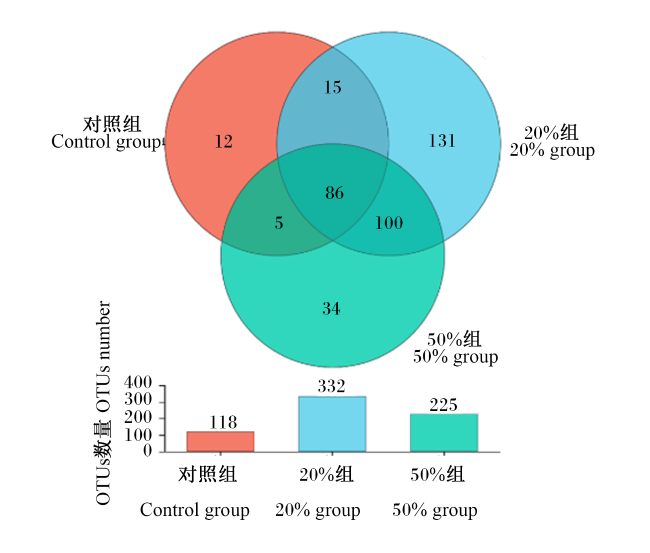
根据生长结果,选取了对照组、20%组和50%组这3个组青鱼的肠道样品进行肠道菌群分析。由图2可知,肠道菌群特有的OTUs对照组为118个,20%组为332个,50%组为225个OTUs;3组共有OTUs为86个。3组肠道菌群的Alpha多样性分析结果显示,各组的覆盖率均达到99%以上,Simpson和Shannon指数无显著差异(P>0.05),Sobs、Chao和Ace指数在3组间有显著差异(P<0.05),20%组和50%组的Chao指数显著高于对照组(P<0.05),表明20%组和50%组的肠道菌群丰度高于对照组(表9)。
图2 青鱼肠道菌群基于OTUs的Venn图

Fig.2 Venn diagram of intestinal microflora of black carp based on OTUs

表9 菜籽粕替代鱼粉对青鱼肠道菌群Alpha多样性指数的影响

Table 9 Effects of replacing fish meal with rapeseed meal on Alpha diversity indices of intestinal microflora of black carp

项目 Items 对照组 Control group 20%组 20% group 50%组 50% group PP-value
Sobs指数 Sobs index 117.00±42.43c 427.50±10.61a 253.00±9.90b 0.003
Shannon指数 Shannon index 1.35±0.67 3.19±0.67 2.87±0.12 0.083
Simpson指数 Simpson index 0.49±0.28 0.14±0.09 0.11±0.03 0.184
Chao指数 Chao index 121.13±48.26c 450.09±4.72a 271.13±24.34b 0.004
Ace指数 Ace index 119.46±45.92c 457.23±0.69a 267.12±17.96b 0.003
覆盖率 Coverage/% 99.99±0.00 99.87±0.00 99.93±0.01 0.057
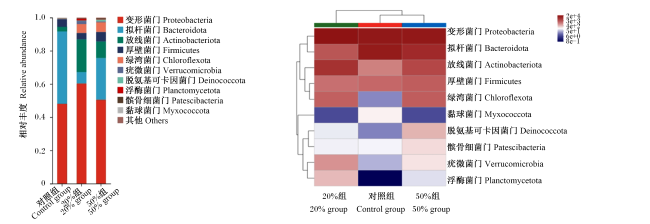
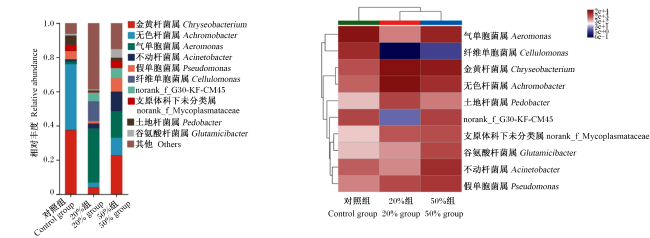
在门分类水平上,对照组肠道菌群中变形菌门(Proteobacteria)为优势菌门,其次为拟杆菌门(Bacteroidota)、厚壁菌门(Firmicutes)和放线菌门(Actinobacteriota);20%组肠道菌群中变形菌门为优势菌门,其次为放线菌门、拟杆菌门和疣微菌门(Verrucomicrobiota);50%组肠道菌群中变形菌门为优势菌门,其次为拟杆菌门、放线菌门和厚壁菌门(图3)。在属分类水平上,对照组肠道菌群中金黄杆菌属(Chryseobacterium)和无色杆菌属(Achromobacter)相对丰度较高;20%组肠道菌群中气单胞菌属(Aeromonas)和纤维单胞菌属(Cellulomonas)相对丰度较高;50%组肠道菌群中金黄杆菌属(Chryseobacterium)和气单胞菌属(Aeromonas)相对丰度较高(图4)。
图3 青鱼肠道菌群在门水平上的组成

Fig.3 Composition of intestinal microflora of black carp at phylum level

图4 青鱼肠道菌群在属水平上的组成

Fig.4 Composition of intestinal microflora of black carp at genus level

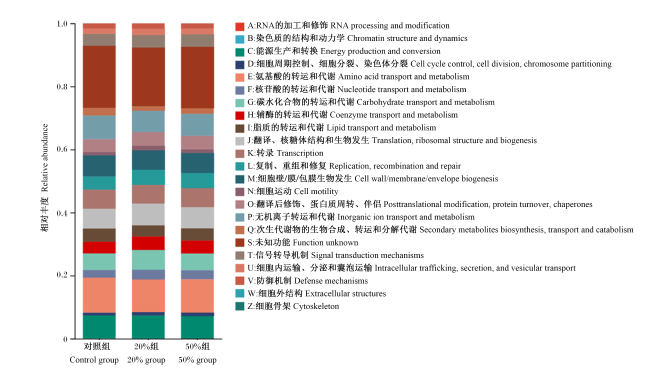
基于肠道微生物测序结果和COG数据库对青鱼肠道微生物群落功能进行PICRUSt预测分析,结果显示,青鱼肠道微生物中能源生产和转化、氨基酸转运和代谢、转录、碳水化合物运输和代谢、翻译、核糖体结构和生物发生、细胞壁/膜/包膜生物发生以及无机离子的运输和代谢等功能占比较高(图5)。
图5 青鱼肠道微生物功能预测

Fig.5 Prediction of intestinal microbial function of black carp

3 讨论

3.1 菜籽粕替代鱼粉对青鱼生长性能的影响

本研究结果表明,随着菜籽粕替代鱼粉比例的增加,青鱼的终末体重、增重率和特定生长率呈现下降趋势,饲料系数则呈上升趋势,这与在青鱼[15]、日本真鲈(Lateolabrax japonicus)[16]、大黄鱼(Pseudosciaena crocea)[17]、莫桑比克罗非鱼(Oreochromis mossambicus)[18]以及墨西哥笛鲷(Lutjanus guttatus)[19]等鱼类上的研究结果一致。有研究表明,当饲料中硫代葡萄糖苷、单宁含量分别达到7 μmol/g[20]、1.75%[21]时,草鱼的生长性能显著下降;植酸含量达到10 g/kg时,大菱鲆的生长性能下降[22]。硫代葡萄糖苷及其分解产物异硫氰酸酯、噁唑烷硫酮等会刺激消化道黏膜而影响饲料利用,导致动物的生长性能不佳[23-26]。本试验中对饲料抗营养因子含量的检测结果显示,随着菜籽粕替代鱼粉比例的增加,硫代葡萄糖苷、单宁和植酸等抗营养因子含量也增加了,这些抗营养因子的摄入会降低青鱼对饲料的利用,从而抑制其生长性能。脏体比、肝体比和肥满度可作为评价鱼类状况的重要指标[27]。在本研究中,
随着菜籽粕替代鱼粉比例的增加,青鱼的肝体比、脏体比及肥满度呈现降低的趋势,表明菜籽粕替代鱼粉过量时,可能导致青鱼肝脏受到损伤,降低了代谢能力以致生长性能降低。根据生长性能结果可知,青鱼饲料中菜籽粕替代鱼粉的比例不超过20%时,不会对其生长性能造成显著影响。
鱼体的营养组成作为重要的生长指标反映了鱼类的生长水平和生理状况。张明明等[28]在吉富罗非鱼的研究中发现,饲料中添加60%的双低菜籽粕可显著降低鱼体的脂肪含量。饲料中菜籽粕添加比例达到32%时,显著降低了虹鳟的全鱼粗蛋白质含量[29]。在凡纳滨对虾(Litopenaeus vannamei)的研究中发现,菜籽粕替代鱼粉后全虾粗脂肪含量呈现下降的趋势[30]。菜籽粕和棉籽粕复合替代鱼粉比例达到20%及以上时,黄颡鱼(Peletobagrus fulvidraco)肌肉中粗蛋白质和粗脂肪含量显著降低[31]。在本试验中,当菜籽粕替代鱼粉的比例超过20%时全鱼粗蛋白质含量显著降低,替代比例超过30%时肌肉粗蛋白质含量显著降低,替代比例超过40%时全鱼粗脂肪含量显著降低,表明饲料中菜籽粕替代鱼粉比例过高会降低青鱼全鱼和肌肉营养成分含量。单宁和植酸等影响了饲料的适口性并且会抑制动物对营养物质的吸收,造成鱼体摄食量降低,使得摄入的蛋白质和脂肪不能满足生长需求,以致在鱼体和肌肉中的沉积减少[32]。因此,饲料中菜籽粕替代鱼粉的比例过高可能会降低青鱼的消化吸收能力和饲料的利用率,从而影响其生长。
消化率是评价饲料品质的重要指标。在大黄鱼[33]、青鱼[34]、花鲈[35]的研究中发现,它们对菜籽粕的粗蛋白质消化率均低于鱼粉。本试验结果显示,随着菜籽粕替代鱼粉比例的增加,青鱼对饲料中粗蛋白质的表观消化率呈现下降的趋势,在日本真鲈[16]和大菱鲆(Psetta maxima)[36]的研究中也有相似的结果。这可能与菜籽粕中含有多种抗营养因子有关,如植酸和单宁在消化道中与蛋白质结合时,生成难消化的分子复合物,降低鱼类对蛋白质的消化利用率和饲料养分的消化率;此外,菜籽粕与鱼粉相比缺乏赖氨酸、蛋氨酸等必需氨基酸,氨基酸组成的不平衡可能会降低鱼类对菜籽粕中蛋白质的转化率[37]。消化酶活性会影响水生动物对营养素的消化和利用,而消化酶活性受到外源和内源因素的影响,饲料是主要的外源因素之一[38]。Qian等[39]在红鳌螯虾(Cherax quadricarinatus)的研究中发现,当饲料中菜籽粕替代50%的鱼粉时显著降低了肝胰腺脂肪酶和胰蛋白酶的活性。孙盛明等[14]研究显示,随着菜籽粕替代鱼粉比例的增加,青鱼的肠道和肝脏消化酶活性降低。Cheng等[16]报道,日本真鲈的肠道蛋白酶、脂肪酶和淀粉酶活性随着饲料中菜籽粕替代比例的增加而显著降低。在本试验中,青鱼的肠道胰蛋白酶、脂肪酶和α-淀粉酶活性随菜籽粕替代鱼粉比例的增加呈现降低趋势;当菜籽粕替代鱼粉比例高于20%时,上述消化酶活性显著降低,这可能是饲料中抗营养因子含量的增加降低了营养物质的消化吸收能力。综上所述,饲料中菜籽粕替代鱼粉比例不超过20%对青鱼的生长性能无显著的负面影响,而过高的替代比例(30%~50%)则会降低青鱼的生长性能和饲料利用率。

3.2 菜籽粕替代鱼粉对青鱼抗氧化能力的影响

总抗氧化能力是衡量机体抗氧化能力的综合指标,总抗氧化能力的提高可以提高机体抗氧化性能[40-41]。超氧化物歧化酶和过氧化氢酶具有清除自由基的作用,超氧化物歧化酶可以清除超氧阴离子( O 2 -),过氧化氢酶可以清除生物体内的过氧化氢(H2O2),从而避免自由基对机体的氧化损伤[42-43]。丙二醛是脂质过氧化的产物,其含量反映脂质过氧化程度和细胞损伤程度,含量降低表示机体有较高的抗氧化能力[44]。Bu等[45]研究发现,乌苏里拟鲿(Pseudobagrus ussuriensis)血清中超氧化物歧化酶和过氧化氢酶活性随着饲料中菜籽粕替代鱼粉比例的增加而降低,丙二醛含量则随着菜籽粕替代鱼粉比例的增加而升高。Sallam等[46]以尼罗罗非鱼(Oreochromis niloticus)和伽利略罗非鱼(Sarotherodon galilaeus)为研究对象的研究发现,菜籽粕替代20%和30%的鱼粉显著降低了肝脏超氧化物歧化酶活性,显著增加了丙二醛含量。黄莹等[47]研究发现,随着饲料中菜籽粕水平的升高,克氏原螯虾(Procambarusclarkii)肝胰腺中过氧化氢酶、超氧化物歧化酶活性呈下降趋势,丙二醛含量呈上升趋势。本试验结果与上述研究结果相同,随着菜籽粕替代鱼粉比例的增加,青鱼血清中总抗氧化能力、超氧化物歧化酶及过氧化氢酶活性随之降低,丙二醛含量随之提高。由此可见,菜籽粕替代高比例(>20%)的鱼粉对青鱼的抗氧化系统产生损伤,从而降低其抗氧化能力。

3.3 菜籽粕替代鱼粉对青鱼肠道健康的影响

肠道是水产动物重要的消化场所,肠道组织的完整性是行使消化功能的前提。肠道绒毛长度、绒毛宽度、绒毛密度以及肌层厚度等组织形态学指标可以反映鱼类肠道的发育和健康程度,并且肌肉层与水产动物肠道节律性蠕动相关,其肌肉层完整度可反映肠道机械消化能力[48]。本试验中,菜籽粕替代鱼粉比例超过10%时,青鱼肠道绒毛长度、绒毛宽度和肌层厚度显著降低。相关研究表明。菜籽粕替代饲料中37.5%的鱼粉后显著降低了翘嘴鳜肠道绒毛长度、绒毛宽度和绒毛密度[49];菜籽粕替代鱼粉和豆粕对尼罗罗非鱼的肠道形态有显著影响,75%替代组肠绒毛黏膜皱襞严重空泡化,100%替代组肠道出现死亡细胞数量增多、组织壁和绒毛完全变性等现象[50]。本试验结果与上述研究结果相一致。由此表明,饲料中菜籽粕过量替代鱼粉会对青鱼的肠道绒毛结构造成破坏,降低肠道肌层厚度,使青鱼消化吸收营养物质的能力受到抑制,进而对其生长发育造成负面影响。肠道组织学的变化可能与菜籽粕中所含抗营养因子的水解产物(如异硫氰酸酯、植酸-蛋白质复合物)和不可利用的碳水化合物(包括非淀粉多糖等)有关,如非淀粉多糖使食靡在肠道中停留时间过长,有害微生物大量繁殖损害肠道[51],菜籽粕替代鱼粉过量时则导致肠道绒毛长度和绒毛宽度降低。
鱼体肠道微生物影响鱼类的摄食、生长、代谢以及免疫;此外,肠道菌群对营养吸收和代谢机制也有着重要影响,肠道菌群的动态平衡以及正常分布是鱼类健康生长的重要基础[52]。因此,研究菜籽粕替代鱼粉对青鱼肠道菌群结构的影响有重要意义。本研究中,变形菌门是青鱼肠道菌群中的优势菌门,其次为拟杆菌门和放线菌门,这与陈倪慧等[53]的研究结果相似。与对照组相比,菜籽粕替代20%和50%的鱼粉提高了青鱼肠道菌群中变形菌门和放线菌门的相对丰度,而降低了拟杆菌门的相对丰度,表明菜籽粕替代鱼粉后影响了青鱼的肠道菌群结构。变形菌门是肠道炎症的特征微生物,其相对丰度增加标志着菌群失调及潜在的疾病风险出现。拟杆菌门与蛋白质和碳水化合物的降解有关。放线菌门在参与宿主的代谢以及维持肠道稳态方面发挥着关键作用[54-55]。拟杆菌门相对丰度的下降可能会导致肠道菌群对相关营养物质的利用率降低。在属水平上,菜籽粕替代20%和50%的鱼粉提高了隶属于变形菌门的气单胞菌属和不动杆菌属的相对丰度,气单胞菌属和不动杆菌属大多数为致病菌,说明菜籽粕替代鱼粉后增加了青鱼肠道中致病菌的比例。综上所述,菜籽粕过量替代鱼粉会对青鱼肠道健康产生负面影响,从而降低其生长性能,其具体作用机理有待进一步研究。

4 结论

综上所述,菜籽粕替代饲料中适宜比例的鱼粉不会对青鱼的生长性能、抗氧化能力和肠道健康产生不利影响。菜籽粕过量替代(替代比例≥30%)鱼粉时,显著降低了青鱼的生长性能、抗氧化能力,破坏了肠道组织结构。综合考虑,菜籽粕可作为青鱼饲料中鱼粉的替代蛋白质源,替代比例以不超过20%为宜。
[1]
HARDY R W. Utilization of plant proteins in fish diets:effects of global demand and supplies of fishmeal[J]. Aquaculture Research, 2010, 41(5):770-776.

[2]
TACON A G J, METIAN M. Global overview on the use of fish meal and fish oil in industrially compounded aquafeeds:trends and future prospects[J]. Aquaculture, 2008, 285(1/4):146-158.

[3]
华凯瑟琳. 水生蛋白的未来:对水产养殖日粮中蛋白质来源的启示[J]. 同一个地球, 2019, 1(3):316-329.

HUA K S L. The future of aquatic proteins:implications for protein sources in aquaculture diets[J]. One Earth, 2019, 1(3):316-329. (in Chinese)

[4]
彭凯, 罗锦伟, 黄文. 植物蛋白原料替代鱼粉在水产饲料中的研究进展[J]. 饲料研究, 2022, 45(15):136-140.

PENG K, LUO J W, HUANG W. Research progress of plant protein ingredients replacing fish meal in aquatic feed[J]. Feed Research, 2022, 45(15):136-140. (in Chinese)

[5]
GOMES E F, CORRAZE G, KAUSHIK S. Effects of dietary incorporation of a co-extruded plant protein (rapeseed and peas) on growth,nutrient utilization and muscle fatty acid composition of rainbow trout (Oncorhynchus mykiss)[J]. Aquaculture, 1993, 113(4):339-353.

[6]
DAVIES S J, MCCONNELL S, BATESON R I. Potential of rapeseed meal as an alternative protein source in complete diets for tilapia (Oreochromis mossambicus Peters)[J]. Aquaculture, 1990, 87(2):145-154.

[7]
张杰, 王四维, 陈泽涛, 等. 菜籽粕替代鱼粉对银鲫生长性能及饲料利用率的影响[J]. 中国粮油学报, 2013, 28(9):91-96.

ZHANG J, WANG S W, CHEN Z T, et al. Effect of substituting fish meal with rapeseed meal on the growth and feed utilization of Carassius auratus[J]. Journal of the Chinese Cereals and Oils Association, 2013, 28(9):91-96. (in Chinese)

[8]
SLAWSKI H, ADEM H, TRESSEL R P, et al. Replacement of fish meal with rapeseed protein concentrate in diets fed to wels catfish (Silurus glanis L.)[J]. Aquaculture Nutrition, 2011, 17(6):605-612.

[9]
冷向军. 青鱼的营养需求与配合饲料研究[J]. 饲料工业, 2016, 37(6):1-7.

LENG X J. Nutrients requirement and formula feed of black carp[J]. Feed Industry, 2016, 37(6):1-7. (in Chinese)

[10]
HUANG H Y, WANG Y X, SHI W Z. Effects of different drying methods on the quality and nonvolatile taste compounds of black carp[J]. Journal of Food Processing and Preservation, 2021, 45(6):e15507.

[11]
农业农村部渔业渔政管理局, 全国水产技术推广总站, 中国水产学会. 中国渔业统计年鉴-2023[M]. 北京: 中国农业出版社, 2023.

Fisheries and Fisheries Administration Bureau of the Ministry of Agriculture and Rural Affairs, National Fisheries Technology Extension Center, China Society of Fisheries. 2023 China fishery statistical yearbook[M]. Beijing: China Agriculture Press, 2023. (in Chinese)

[12]
刘沛, 叶金云, 邵仙萍, 等. 饲料中小肽豆粕替代鱼粉对青鱼幼鱼生长及其体组成的影响[J]. 浙江海洋学院学报(自然科学版), 2014, 33(1):72-78.

LIU P, YE J Y, SHAO X P, et al. Effects of dietary replacement of fish meal by fermented soybean meal on growth performance and body composition of juvenile black carp (Mylopharyngodon piceus)[J]. Journal of Zhejiang Ocean University(Natural Science), 2014, 33(1):72-78. (in Chinese)

[13]
孙盛明, 叶金云, 陈建明, 等. 配合饲料中豆粕、菜粕替代鱼粉对青鱼鱼种生长、体组成的影响[J]. 浙江海洋学院学报(自然科学版), 2009, 28(1):25-31.

SUN S M, YE J Y, CHEN J M, et al. Effects of fishmeal replacement by mixture of soybean meal and rapeseed meal on growth performance and body composition of fingerling black carp (Mylopharyngodon piceus)[J]. Journal of Zhejiang Ocean University(Natural Science), 2009, 28(1):25-31. (in Chinese)

[14]
孙盛明, 叶金云, 陈建明, 等. 配合饲料中豆粕、菜粕替代鱼粉对青鱼消化酶活力和表观消化率的影响[J]. 浙江海洋学院学报(自然科学版), 2008, 27(4):395-400.

SUN S M, YE J Y, CHEN J M, et al. Effects of fishmeal replacement by mixture of soybean meal and rapeseed meal on digestive enzyme activities and apparent digestibility of the black carp (Mylopharyngodon piceus)[J]. Journal of Zhejiang Ocean University (Natural Science), 2008, 27(4):395-400. (in Chinese)

[15]
黄云, 胡毅, 肖调义, 等. 双低菜粕替代豆粕对青鱼幼鱼生长及生理生化指标的影响[J]. 水生生物学报, 2012, 36(1):41-48.

HUANG Y, HU Y, XIAO T Y, et al. Influence of dietary canola meal levels on growth and biochemical indices in juvenile Mylopharvngodon piceus[J]. Acta Hydrobiologica Sinica, 2012, 36(1):41-48. (in Chinese)

[16]
CHENG Z Y, AI Q H, MAI K S, et al. Effects of dietary canola meal on growth performance,digestion and metabolism of Japanese seabass,Lateolabrax japonicus[J]. Aquaculture, 2010, 305(1/2/3/4):102-108.

[17]
MENG Y Q, MIAO X, SUN R J, et al. Potential risks of high level replacement of dietary fish meal by canola meal on large yellow croaker Larimichthys crocea (Richardson,1846):growth,health and nutritional values as a food fish[J]. Acta Hydrobiologica Sinica, 2017, 41(1):127-138.

[18]
WU F, TIAN J, YU L J, et al. Effects of dietary rapeseed meal levels on growth performance,biochemical indices and flesh quality of juvenile genetically improved farmed tilapia[J]. Aquaculture Reports, 2021,20:100679.

[19]
HERNÁNDEZ C, OLMEDA-GUERRERO L, CHÁVEZ-SÁNCHEZ M C, et al. Nutritional evaluation of canola meal as fish meal replacement for juvenile spotted rose snapper (Lutjanus guttatus):effects on growth performance,hematological parameters,body composition,and nutrient digestibility[J]. Animal Feed Science and Technology, 2020,269:114683.

[20]
TAN Q S, LIU Q, CHEN X X, et al. Growth performance,biochemical indices and hepatopancreatic function of grass carp,Ctenopharyngodon idellus,would be impaired by dietary rapeseed meal[J]. Aquaculture, 2013,414/415:119-126.

[21]
YAO J T, CHEN P, APRAKU A, et al. Hydrolysable tannin supplementation alters digestibility and utilization of dietary protein,lipid,and carbohydrate in grass carp (Ctenopharyngodon idellus)[J]. Frontiers in Nutrition, 2019,6:183.

[22]
VON DANWITZ A, SCHULZ C. Effects of dietary rapeseed glucosinolates,sinapic acid and phytic acid on feed intake,growth performance and fish health in turbot (Psetta maxima L.)[J]. Aquaculture, 2020,516:734624.

[23]
ZHOU Q L, HABTE-TSION H M, GE X, et al. Graded replacing fishmeal with canola meal in diets affects growth and target of rapamycin pathway gene expression of juvenile blunt snout bream,Megalobrama amblycephala[J]. Aquaculture Nutrition, 2018, 24(1):300-309.

[24]
SHAFAEIPOUR A, YAVARI V, FALAHATKAR B, et al. Effects of canola meal on physiological and biochemical parameters in rainbow trout (Oncorhynchus mykiss)[J]. Aquaculture Nutrition, 2008, 14(2):110-119.

[25]
ZHANG X D, WANG H Z, ZHANG J W, et al. Assessment of rapeseed meal as fish meal alternative in diets for juvenile Asian red-tailed catfish (Hemibagrus wyckioides)[J]. Aquaculture Reports, 2020,18:100497.

[26]
YANG Z F, HUANG Z X, CAO L J. Biotransformation technology and high-value application of rapeseed meal:a review[J]. Bioresources and Bioprocessing, 2022, 9(1):103.

[27]
曾文繁. 发酵豆粕替代鱼粉对黄姑鱼幼鱼的影响及血清代谢组学初步研究[D]. 硕士学位论文. 舟山: 浙江海洋大学, 2018.

ZENG W F. Effect of fermented soybean meal substitute of fish meal an of juvenile yellow drum (Nibea albiflora) and preliminary study on metabonomics[D]. Master’s Thesis. Zhoushan: Zhejiang Ocean University, 2018. (in Chinese)

[28]
张明明, 文华, 蒋明, 等. 饲料菜粕水平对吉富罗非鱼幼鱼生长、肝脏组织结构和部分非特异性免疫指标的影响[J]. 水产学报, 2011, 35(5):748-755.

ZHANG M M, WEN H, JIANG M, et al. Effects of dietary rapeseed meal levels on growth,liver tissue structure and some nonspecific immunity indices of juvenile GIFT tilapia (Oreochromis niloticus)[J]. Journal of Fisheries of China, 2011, 35(5):748-755. (in Chinese)

[29]
YĪĞĪT N Ö, BAHADIR KOCA S, BAYRAK H, et al. Effects of canola meal on growth and digestion of rainbow trout (Oncorhynchus mykiss) fry[J]. Turkish Journal of Veterinary & Animal Sciences, 2012, 36(5):533-538.

[30]
王托. 凡纳滨对虾对棉粕及菜粕的利用研究[D]. 硕士学位论文. 湛江: 广东海洋大学, 2011.

WANG T. Study on utilization of cottonseed meal and canola meal for the pacific white shrimp, Litopenaeus vannamei[D]. Master’s Thesis. Zhenjiang: Guangdong Ocean University, 2011. (in Chinese)

[31]
邹峰余, 韩亚康, 罗智, 等. 棉籽粕和菜籽粕替代部分鱼粉对黄颡鱼肉质及肌肉发育相关基因表达的影响[J]. 水生生物学报, 2023, 47(2):227-234.

ZOU F Y, HAN Y K, LUO Z, et al. Replacement of dietary fish meal by rapeseed meal and cottonseed meal on muscle texture,health and expression of muscle-related genes in yellow catfish (Pelteobagrus fulvidraco)[J]. Acta Hydrobiologica Sinica, 2023, 47(2):227-234. (in Chinese)

[32]
CHUNG K T, WEI C I, JOHNSON M G. Are tannins a double-edged sword in biology and health?[J]. Trends in Food Science & Technology, 1998, 9(4):168-175.

[33]
李会涛, 麦康森, 艾庆辉, 等. 大黄鱼对几种饲料蛋白原料消化率的研究[J]. 水生生物学报, 2007, 31(3):370-376.

LI H T, MAI K S, AI Q H, et al. Apparent digestibility of selected protein ingredients for larger yellow croaker Pseudosciaena crocea[J]. Acta Hydrobiologica Sinica, 2007, 31(3):370-376. (in Chinese)

[34]
陈建明, 沈斌乾, 郭建林, 等. 青鱼对8种常用蛋白源的表观消化率[J]. 饲料工业, 2011, 32(24):15-17.

CHEN J M, SHEN B Q, GUO J L, et al. Apparent digestibility of black carp to 8 common protein sources[J]. Feed Industry, 2011, 32(24):15-17. (in Chinese)

[35]
付晶晶, 黄燕华, 曹俊明, 等. 花鲈对6种饲料原料的表观消化率[J]. 饲料研究, 2014, 37(3):48-54.

FU J J, HUANG Y H, CAO J M, et al. Apparent digestibility of 6 feed ingredients for sea bass[J]. Feed Research, 2014, 37(3):48-54. (in Chinese)

[36]
BUREL C, BOUJARD T, KAUSHIK S J, et al. Potential of plant-protein sources as fish meal substitutes in diets for turbot (Psetta maxima):growth,nutrient utilisation and thyroid status[J]. Aquaculture, 2000, 188(3/4):363-382.

[37]
KOU H Y, XU S Y, WANG A L. Effect of replacing canola meal for fish meal on the growth,digestive enzyme activity,and amino acids,of ovate pompano,Trachinotus ovatus[J]. Israeli Journal of Aquaculture-Bamidgeh, 2015,67:1-10.

[38]
WAN J J, XI Q K, TANG J Q, et al. Effects of pelleted and extruded feed on growth performance,intestinal histology and microbiota of juvenile red swamp crayfish (Procambarus clarkii)[J]. Animals, 2022, 12(17):2252.

[39]
QIAN D W, YANG X L, XU C, et al. Growth and health status of the red claw crayfish,Cherax quadricarinatus,fed diets with four typical plant protein sources as a replacement for fish meal[J]. Aquaculture Nutrition, 2021, 27(3):795-806.

[40]
ZHANG J F, SHEN H, WANG X R, et al. Effects of chronic exposure of 2,4-dichlorophenol on the antioxidant system in liver of freshwater fish Carassius auratus[J]. Chemosphere, 2004, 55(2):167-174.

[41]
ABHIJITH B D, RAMESH M, POOPAL R K. Responses of metabolic and antioxidant enzymatic activities in gill,liver and plasma of Catla catla during methyl parathion exposure[J]. The Journal of Basic & Applied Zoology, 2016,77:31-40.

[42]
孙立梅, 陈立侨, 李二超, 等. 高比例棉粕饲料中补充蛋氨酸对中华绒螯蟹幼蟹摄食、生长及抗氧化酶活性的影响[J]. 水生生物学报, 2013, 37(2):336-343.

SUN L M, CHEN L Q, LI E C, et al. Effects of dietary methionine supplementation on feeding,growth and antioxidant ability of juvenile Chinese mitten crab,Eriocheir sinensis[J]. Acta Hydrobiologica Sinica, 2013, 37(2):336-343. (in Chinese)

[43]
高春生, 王春秀, 张书松. 水体铜对黄河鲤肝胰脏抗氧化酶活性和总抗氧化能力的影响[J]. 农业环境科学学报, 2008, 27(3):1157-1162.

GAO C S, WANG C X, ZHANG S S. Effects of copper on activities of antioxidant enzymes and total antioxidative competence in hepatopan-creas of Cyprinus carpio[J]. Journal of Agro-Environment Science, 2008, 27(3):1157-1162. (in Chinese)

[44]
LIU Y L, ZHONG L, CHEN T, et al. Dietary sanguinarine supplementation on the growth performance,immunity and intestinal health of grass carp (Ctenopharyngodon idellus) fed cottonseed and rapeseed meal diets[J]. Aquaculture, 2020,528:735521.

[45]
BU X Y, WANG Y Y, CHEN F Y, et al. An evaluation of replacing fishmeal with rapeseed meal in the diet of Pseudobagrus ussuriensis:growth,feed utilization,nonspecific immunity,and growth-related gene expression[J]. Journal of the World Aquaculture Society, 2018, 49(6):1068-1080.

[46]
SALLAM E A, MATTER A F, MOHAMMED L S, et al. Replacing fish meal with rapeseed meal:potential impact on the growth performance,profitability measures,serum biomarkers,antioxidant status,intestinal morphometric analysis,and water quality of Oreochromis niloticus and Sarotherodon galilaeus fingerlings[J]. Veterinary Research Communications, 2021, 45(4):223-241.

[47]
黄莹, 娄格格, 刘轩宇, 等. 双低菜粕替代鱼粉对克氏原螯虾幼虾生长性能、抗氧化能力和消化系统组织形态的影响[J]. 水生生物学报, 2023, 47(12):1918-1931.

HUANG Y, LOU G G, LIU X Y, et al. Replacing fish meal with rapeseed meal on growth performance,antioxidant capacity and digestive system morphology of juvenile Procambarus clarkii[J]. Acta Hydrobiologica Sinica, 2023, 47(12):1918-1931. (in Chinese)

[48]
徐茜, 杨正, 朱文娟, 等. 发酵豆粕替代鱼粉对鲫鱼生长、血清生化指标及肠道结构的影响[J]. 饲料工业, 2021, 42(10):31-37.

XU Q, YANG Z, ZHU W J, et al. Effects of fermented soybean meal instead of fish meal on growth,serum biochemical indexes and intestinal structure of Carassius auratus[J]. Feed Industry, 2021, 42(10):31-37. (in Chinese)

[49]
王杰, 梁旭方, 李姣, 等. 菜粕替代鱼粉对翘嘴鳜肠道吸收和氨基酸代谢的影响[J]. 华中农业大学学报, 2018, 37(4):93-101.

WANG J, LIANG X F, LI J, et al. Effect of substituting fish meal with rapeseed meal on intestinal absorption and amino acids metabolism in Chinese perch (Siniperca chuatsi)[J]. Journal of Huazhong Agricultural University, 2018, 37(4):93-101. (in Chinese)

[50]
IQBAL M, YAQUB A, AYUB M. Partial and full substitution of fish meal and soybean meal by canola meal in diets for genetically improved farmed tilapia (O. niloticus):growth performance,carcass composition,serum biochemistry,immune response,and intestine histology[J]. Journal of Applied Aquaculture, 2022, 34(4):829-854.

[51]
CAI C F, SONG L, WANG Y L, et al. Assessment of the feasibility of including high levels of rapeseed meal and peanut meal in diets of juvenile crucian carp (Carassius auratus gibelio ♀×Cyprinus carpio ♂):growth,immunity,intestinal morphology,and microflora[J]. Aquaculture, 2013,410/411:203-215.

[52]
PÉREZ T, BALCÁZAR J L, RUIZ-ZARZUELA I, et al. Host-microbiota interactions within the fish intestinal ecosystem[J]. Mucosal Immunology, 2010, 3(4):355-360.

DOI PMID

[53]
陈倪慧, 杨霞, 孙珊珊, 等. 发酵植物蛋白复配替代豆粕对青鱼生长、免疫、抗氧化及肠道菌群结构的影响[J]. 动物营养学报, 2023, 35(4):2478-2489.

DOI

CHEN N H, YANG X, SUN S S, et al. Effects of soybean meal replaced by fermented plant protein compound on growth,immune,antioxidant and intestinal microflora structure of black carp (Mylopharyngodon piceus)[J]. Chinese Journal of Animal Nutrition, 2023, 35(4):2478-2489. (in Chinese)

[54]
SHIN N R, WHON T W, BAE J W. Proteobacteria:microbial signature of dysbiosis in gut microbiota[J]. Trends in Biotechnology, 2015, 33(9):496-503.

[55]
ZHANG Y, SUN K, LI Z Y, et al. Effescts of acute diclofenac exposure on intestinal histology,antioxidant defense,and microbiota in freshwater crayfish (Procambarus clarkii)[J]. Chemosphere, 2021,263:128130.

文章导航

/