研究论文

饲粮不同比例番茄秸秆替代花生秧对肉兔生长性能、营养物质表观消化率和盲肠微生物结构的影响

  • 徐建 , 1 ,
  • 季荣梅 1 ,
  • 张莉蕊 1 ,
  • 刘永需 2 ,
  • 赵红 2 ,
  • 刘磊 1 ,
  • 李福昌 , 1, *
展开
  • 1 山东农业大学动物科技学院,农业农村部非粮食饲料资源高效利用重点实验室(部省共建),山东省动物生物技术与疾病预防控制重点实验室,泰安 271018
  • 2 青岛康大佳惠饲料有限公司,青岛 266499
*李福昌,教授,博士生导师,E-mail:

徐 建(1998—),女,山东临沂人,硕士研究生,从事家兔营养与代谢研究。E-mail:

Copy editor: 陈 鑫

收稿日期: 2023-10-23

  网络出版日期: 2024-06-07

基金资助

山东省重点研发计划(乡村振兴科技创新提振行动计划)(2023TZXD044)

现代农业产业技术体系(CARS-43-B-1)

山东省自然科学基金(ZR2021MC043)

山东省自然科学基金(ZR2021QC108)

山东省特种经济动物产业技术体系(SDAIT-21-16)

山东省农业良种工程(2021LZGC002)

青岛西海岸新区2021年度科技项目(科技攻关“揭榜制”专项)(2021-17)

Effects of Different Ratios of Tomato Straw Substituted for Peanut Straw in Diets on Growth Performance, Apparent Digestibility of Nutrients and Cecal Microbial Structure of Meet Rabbits

  • XU Jian , 1 ,
  • JI Rongmei 1 ,
  • ZHANG Lirui 1 ,
  • LIU Yongxu 2 ,
  • ZHAO Hong 2 ,
  • LIU Lei 1 ,
  • LI Fuchang , 1, *
Expand
  • 1 Shandong Provincial Key Laboratory of Animal Biotechnology and Disease Control and Prevention, Key Laboratory of Efficient Utilization of Non-Grain Feed Resources (Co-Construction by Ministry and Province), Ministry of Agriculture and Rural Affairs, Department of Animal Science, Shandong Agricultural University, Tai’an 271018, China
  • 2 Qingdao Kangda Jiahui Feed Co., Ltd., Qingdao 266499, China
*professor, E-mail:

Received date: 2023-10-23

  Online published: 2024-06-07

摘要

本试验旨在研究饲粮不同比例番茄秸秆替代花生秧对肉兔生长性能、营养物质表观消化率和盲肠微生物结构的影响。选取体重相近的140只60日龄肉兔(公母各占1/2),按照平均体重分为4组(每组17或18只公兔,每组35个重复,每个重复1只兔),分别饲喂不同比例番茄秸秆替代花生秧的全价配合饲料,替代比例分别为0(对照组)、5%(TS5组)、10%(TS10组)和20%(TS20组)。预试期3 d,正试期31 d。结果显示:饲粮中添加番茄秸秆对肉兔平均日采食量、脏器指数和盲肠微生物结构均无显著影响(P>0.05)。饲粮中番茄秸秆的添加降低肉兔死亡率和腹泻率。与对照组相比,TS5组和TS10组肉兔的平均日增重和料重比没有显著改变(P>0.05),但是TS20组平均日增重显著降低(P<0.05),TS20组料重比显著升高(P<0.05)。随着番茄秸秆替代比例的增加,背最长肌黄度值呈现先升高后降低的趋势,TS10组黄度值最高。与对照组相比,TS5组和TS10组的小肠长度显著增加(P<0.05),TS20组没有显著变化(P>0.05)。与对照组相比,番茄秸秆的添加显著提高粗脂肪、中性洗涤纤维和粗灰分表观消化率(P<0.05),TS5组粗蛋白质表观消化率显著提高(P<0.05)。饲粮中添加番茄秸秆并未对肉兔盲肠微生物结构产生显著影响(P>0.05)。综上所述,饲粮中用5%~10%的番茄秸秆替代花生秧能够降低肉兔腹泻率和死亡率,调节小肠发育,提高饲粮中部分营养物质的消化率,建议饲粮中番茄秸秆替代比例不超过10%。

本文引用格式

徐建 , 季荣梅 , 张莉蕊 , 刘永需 , 赵红 , 刘磊 , 李福昌 . 饲粮不同比例番茄秸秆替代花生秧对肉兔生长性能、营养物质表观消化率和盲肠微生物结构的影响[J]. 动物营养学报, 2024 , 36(6) : 3920 -3930 . DOI: 10.12418/CJAN2024.335

Abstract

This experiment aimed to study the effects of different ratios of tomato straw substituted for peanut straw in diets on growth performance, apparent digestibility of nutrients and cecal microbial structure in meet rabbits. In the present experiment, a total of 140 rabbits (60-day-old, half male and half female) with similar weight were selected and divided into 4 groups (17 or 18 male rabbits in each group, 35 replicates per group, 1 rabbit per replicate): rabbits in 4 groups were fed the full-valued compound feed (tomato straw instead of peanut straw) supplemented with 0 (control group), 5% (TS5 group), 10% (TS10 group) and 20% (TS20 group), respectively. The pretest period lasted for 3 days, and the test period lasted for 31 days. The results showed that dietary addition of tomato straw had no significant effects on the average daily feed intake, organ indexes and cecal microbial structure (P>0.05). Compared with the control group, the application of tomato straw in diets reduced the mortality rate and diarrhea rate of meat rabbits. Compared with the control group, the average daily gain and feed/gain of meat rabbits in TS5 and TS10 groups did not change significantly (P>0.05), but the average daily gain of meat rabbits in TS20 group was significantly decreased (P<0.05), and the feed/gain of meat rabbits in TS20 group was significantly increased (P<0.05).With the increase of tomato straw replacement ratio, the yellowness value of longissimus dorsi showed a trend of first increasing and then decreasing, and the yellowness value in TS10 group was the highest. Compared with the control group, the length of the small intestine in the TS5 and TS10 groups increased significantly (P<0.05), and there was no significant change in the TS20 group (P>0.05). Compared with the control group, the application of tomato straw significantly increased the apparent digestibility of crude fat, neutral detergent fiber and crude ash (P<0.05), and the apparent digestibility of crude protein in TS5 group significantly increased (P<0.05). Dietary tomato straw had no significant effect on cecal microbial structure of meat rabbits (P>0.05). In conclusion, tomato straw substitution of 5% and 10% peanut straw in diets can reduce the diarrhea rate and mortality rate in meat rabbits, regulate the development of small intestine, and improve the digestibility of some nutrients in diets. It is recommended that the proportion of tomato straw substitution in diet should not exceed 10%.

近年来肉兔饲养规模由小规模向中等规模转变,饲粮需要量日益增加。我国牧草资源短缺,优质粗饲料原料匮乏,严重制约着养兔行业发展。为满足行业发展、降低生产成本,开发新型优质粗饲料是一条有效途径。目前,我国是全球最大的番茄生产国[1],番茄秸秆资源丰富。但是目前大部分番茄秸秆通过田间堆肥或焚烧等方式处理,这会造成环境污染,如何合理利用番茄秸秆成为一个新议题。番茄秸秆中纤维素含量为43.77%,木质素含量为13.75%,半纤维素含量为4.36%[2]。合理的配伍与利用能够满足肉兔对饲粮纤维的需求,但番茄秸秆在肉兔饲粮中的应用效果鲜见报道。肉兔由野兔进化而来,是单胃草食动物且盲肠发达,盲肠内含有大量能够水解纤维素的内源微生物。盲肠微生物对纤维进行消化,消化产物通过家兔的食粪行为回到胃和小肠进行吸收[3]。这些生物学特性使得肉兔区别于猪、鸡等其他单胃动物,对饲粮纤维具有较高的消化利用率。因此,本试验旨在研究不同比例番茄秸秆替代花生秧对肉兔生长性能、脏器指数、营养物质表观消化率、肠道形态和盲肠微生物结构的影响,为在肉兔生产上合理利用番茄秸秆资源提供科学参考。

1 材料与方法

1.1 试验设计及饲粮

试验用兔为新西兰肉兔与泰山大白兔杂交品种,选取体重相近的140只60日龄肉兔(公母各占1/2),按照平均体重分为4组(每组17或18只公兔,每组35个重复,每个重复1只兔),分别饲喂不同比例番茄秸秆替代花生秧的全价配合饲料,替代比例分别为0(对照组)、5%(TS5组)、10%(TS10组)和20%(TS20组)。预试期3 d,正试期31 d。试验期间采取正常免疫程序,限制采食,自由饮水。
试验采用的番茄秸秆营养水平见表1。参考《肉兔营养需要量》(NY/T 4049—2021)[4]并结合实际生产配制基础饲粮,各组饲粮组成及营养水平见表2
表1 番茄秸秆营养水平(风干基础)

Table 1 Nutrient levels of tomato straw (air-dry basis)%

项目
Item
干物质
DM
粗蛋
白质
CP
粗脂肪
EE
中性洗
涤纤维
NDF
酸性洗
涤纤维
ADF
酸性洗涤
木质素
ADL
粗纤维
CF
粗灰分
Ash

Ca
总磷
TP
番茄秸秆
Tomato straw
89.23 13.09 1.69 39.21 33.49 6.87 28.25 19.77 3.06 0.18
表2 各组饲粮组成及营养水平(风干基础)

Table 2 Composition and nutrient levels of diets of each group (air-dry basis)%

项目
Items
组别 Groups
CON TS5 TS10 TS20
原料 Ingredients
玉米 Corn 17.0 17.0 17.0 17.0
小麦麸 Wheat bran 14.0 14.0 14.0 14.0
大豆油 Soybean oil 0.6 0.6 0.6 0.6
大豆粕 Soybean meal 20.0 19.0 18.4 17.0
花生秧 Peanut straw 44.4 40.4 36.0 27.4
番茄秸秆 Tomato straw 5.0 10.0 20.0
预混料 Premix1) 4.0 4.0 4.0 4.0
合计 Total 100.0 100.0 100.0 100.0
营养水平 Nutrient levels2)
消化能 DE/(MJ/kg) 9.94 9.86 9.81 9.70
粗蛋白质 CP 15.86 17.63 16.62 16.66
中性洗涤纤维 NDF 30.72 34.27 31.64 32.92
酸性洗涤纤维 ADF 22.44 22.19 22.94 21.08
酸性洗涤木质素 ADL 6.93 6.74 6.99 6.11
赖氨酸 Lys 0.74 0.74 0.73 0.73
蛋氨酸+胱氨酸 Cys+Met 0.46 0.45 0.45 0.45
粗纤维 CF 17.23 17.08 18.01 16.83
粗灰分 Ash 10.39 10.46 11.06 11.79
钙 Ca 1.08 1.27 1.33 1.49
总磷 TP 0.41 0.47 0.46 0.47

1)预混料为每千克饲粮提供 The premix provided the following per kg of diets:VA 8 000 IU,VD3 1 000 IU,VE 50 mg,VK3 2.3 mg,VB1 1.75 mg,VB2 6.9 mg,VB3 28.45 mg,VB5 6.7 mg,VB9 0.6 mg,VB12 0.15 mg,胆碱 choline 420 mg,赖氨酸 Lys 1 500 mg,蛋氨酸Met 1 500 mg,Cu 30 mg,Fe 100 mg,Mn 30 mg,Mg 150 mg,I 0.1 mg。

2)氨基酸与消化能参照《中国饲料成分及营养价值表(2022年第33版)》计算,其他为实测值。 Amino acids and DE were calculated with reference to the Table of Feed Composition and Nutritional Value in China (33rd edition 2022), while the others were measured values.

1.2 测定指标与方法

1.2.1 生长性能

正式试验开始前禁食12 h,自由饮水,记录试验初、末肉兔体重及每日采食量。计算试验期间肉兔平均日增重(ADG)、平均日采食量(ADFI)、料重比(F/G)、腹泻率以及死亡率。

ADG=(末体重-初体重)/试验天数;

ADFI=正试期总采食量/试验天数;

F/G=ADFI/ADG;

死亡率(%)=(死亡只数/总只数)×100;

腹泻率(%)=(腹泻兔只数/试验兔总只数)×100。

1.2.2 屠宰性能

试验结束时每组根据平均体重选取8只试验兔屠宰,记录其宰前活重、全净膛重、半净膛重和脏器重量,并计算全净膛屠宰率、半净膛屠宰率和脏器指数。计算公式如下:

全净膛屠宰率(%)=(全净膛重/宰前活重)×100;

半净膛屠宰率(%)=(半净膛重/宰前活重)×100;

胸腺指数(g/kg)=胸腺重/宰前活重;

脾脏指数(g/kg)=脾脏重/宰前活重;

肝脏指数(g/kg)=肝脏重/宰前活重;

圆小囊指数(g/kg)=圆小囊重/宰前活重。

小肠长度:屠宰后将小肠从腹腔中取出,去除其肠系膜后,平铺在桌子上用软尺测量小肠长度。
pH:屠宰后用酸碱度计测背腰最长肌的pH,连续测量3次取平均值。
肉色:屠宰后从背腰最长肌处切开3个切面,用CR-10型号色度仪,分别记录亮度(L*)、红度(a*)和黄度(b*)值。

1.2.3 营养物质表观消化率

试验结束后进行7 d消化试验,每组选取8只试验兔单笼饲养,每日记录其采食量和排粪量并采集粪便冷冻保存待测。
饲粮及粪便中的粗蛋白质(CP)含量参照GB/T 6432—2018方法[5]测定,粗脂肪(EE)含量参照GB/T 6433—2006方法[6]测定,粗纤维(CF)含量参照GB/T 6434—2022方法[7]测定,粗灰分(Ash)含量参照GB/T 6438—2007方法[8]测定,钙(Ca)含量参照GB/T 6436—2018方法[9]测定,总磷(TP)含量参照GB/T 6437—2018方法[10]测定,中性洗涤纤维(NDF)、酸性洗涤纤维(ADF)和酸性洗涤木质素(ADL)含量采用Van Soest等[11]方法测定。

某营养物质表观消化率(%)=[(该营养物质摄入量-该营养物质排出量)/该营养物质摄入量]×100。

1.2.4 小肠组织形态测定

试验兔屠宰后分别取十二指肠、空肠、回肠中段2 cm,固定于4%多聚甲醛中,24 h后更换多聚甲醛。待样品形态固定完成后进行修剪、脱水、包埋、切片、染色、封片,并使用白光正置显微镜观察和拍照。成像完成后以微米(μm)为单位测量各肠段绒毛高度和隐窝深度,并计算绒毛高度/隐窝深度。

1.2.5 盲肠微生物结构测定

盲肠内容物样品保存于干冰中,送至南京派诺森基因科技有限公司提取DNA,进行目标片段PCR扩增采用Illumina公司的TruSeq Nano DNA LT Library Prep Kit制备测序文库,进行高通量测序,检测微生物多样性。

1.3 数据处理与分析

试验数据用SAS 9.4统计软件进行单因素方差分析,Duncan氏法进行多重比较。数据用平均值±标准误表示,P<0.05表示差异显著。

2 结果

2.1 饲粮不同比例番茄秸秆替代花生秧对肉兔生长性能的影响

表3所示,饲粮不同比例番茄秸秆替代花生秧对肉兔的末体重和ADFI没有显著影响(P>0.05)。与对照组相比,TS20组ADG显著降低(P<0.05),F/G显著升高(P<0.05)。此外,与对照组相比,番茄秸秆的添加降低了肉兔的死亡率和腹泻率。
表3 饲粮不同比例番茄秸秆替代花生秧对肉兔生长性能的影响

Table 3 Effects of different ratios of tomato straw substituted for peanut straw in diets on growth performance of meat rabbits

项目
Items
组别 Groups P
P-value
CON TS5 TS10 TS20
初体重 Initial weight/kg 1.820±0.038 1.755±0.045 1.768±0.055 1.747±0.062 0.714 7
末体重 Final weight/kg 2.886±0.046 2.890±0.054 2.931±0.033 2.789±0.043 0.107 8
平均日采食量 ADFI/(g/d) 174.93±0.96 174.38±1.10 176.35±0.29 174.62±0.72 0.273 3
平均日增重 ADG/(g/d) 36.14±0.89a 36.98±1.18a 35.93±0.57a 33.43±0.65b 0.013 2
料重比 F/G 4.89±0.10b 4.80±0.14b 4.94±0.07b 5.27±0.10a 0.006 2
死亡率 Mortality rate/% 19.23 16.67 13.79 6.90
腹泻率 Diarrhea rate/% 26.92 25.00 10.34 6.90

同行数据肩标无字母或相同字母表示差异不显著(P>0.05),不同小写字母表示差异显著(P<0.05)。下表同。

In the same row, values with no letter or the same letter superscripts mean no significant difference (P>0.05), while with different small letter superscripts mean significant difference (P<0.05). The same as below.

2.2 饲粮不同比例番茄秸秆替代花生秧对肉兔屠宰性能的影响

表4所示,番茄秸秆替代花生秧对肉兔的全净膛重、全净膛屠宰率、半净膛重、半净膛屠宰率、肌肉pH45 min以及肌肉L*、a*值没有显著影响(P>0.05)。饲粮不同比例番茄秸秆替代花生秧显著影响肉兔的宰前活重(P<0.05),宰前活重随着番茄秸秆替代比例的增加,呈现先增加后降低的趋势,在替代比例达到10%时肉兔宰前活重最重,替代比例达到20%时肉兔宰前活重最轻。饲粮不同比例番茄秸秆替代花生秧对肉兔背最长肌的b*值影响显著(P<0.05),随着番茄秸秆替代比例的增加,肉兔背最长肌的b*值呈现先升高后降低的趋势,在番茄秸秆替代比例为10%时达到最大值。番茄秸秆替代花生秧能够显著影响生长肉兔小肠长度(P<0.05),与对照组相比,TS5组和TS10组肉兔小肠长度显著增加(P<0.05),TS20组差异不显著(P>0.05)。番秸秆替代花生秧对肉兔肝脏指数、脾脏指数、胸腺指数和圆小囊指数没有显著影响(P>0.05)。
表4 饲粮不同比例番茄秸秆替代花生秧对肉兔屠宰性能的影响

Table 4 Effects of different ratios of tomato straw substituted for peanut straw in diets on slaughtering performance of meat rabbits

项目
Items
组别 Groups P
P-value
CON TS5 TS10 TS20
宰前活重
Live weight before slaughter/kg
2.80±0.02bc 2.83±0.03b 2.93±0.02a 2.73±0.02c <0.000 1
全净膛重
Full clean bore weight/kg
1.27±0.03 1.31±0.03 1.34±0.02 1.27±0.01 0.149 3
全净膛屠宰率
Total chamber slaughter rate/%
45.40±0.81 46.18±0.82 45.78±0.53 46.67±0.51 0.599 0
半净膛重
Semi-clean bore weight/kg
1.37±0.03 1.40±0.02 1.45±0.02 1.38±0.01 0.108 4
半净膛屠宰率
Semi-clean chamber
slaughter rate/%
48.93±0.83 49.41±0.46 49.34±0.60 50.47±0.46 0.343 2
pH45 min 7.06±0.04 7.14±0.06 7.01±0.11 7.01±0.09 0.606 5
亮度 L* 36.94±0.65 37.56±0.69 39.19±0.75 36.67±0.54 0.050 5
红度 a* 25.24±0.54 26.22±0.32 26.56±0.60 25.38±0.44 0.182 3
黄度 b* -1.71±0.22b -0.52±0.37a 0.08±0.27a -1.73±0.31b 0.000 2
肝脏指数 Liver index 26.35±0.86 26.68±0.71 25.60±0.94 27.89±1.22 0.407 5
脾脏指数 Spleen index 0.56±0.06 0.44±0.02 0.46±0.06 0.47±0.02 0.274 7
胸腺指数 Thymus index 2.20±0.13 2.51±0.25 2.56±0.15 2.02±0.09 0.089 6
圆小囊指数 Round sac index 0.88±0.05 0.85±0.04 0.78±0.02 0.85±0.03 0.274 9
小肠长度
Small intestine length/cm
204.13±2.71b 239.25±10.86a 224.88±6.78a 201.56±6.52b 0.002 8

2.3 饲粮不同比例番茄秸秆替代花生秧对肉兔营养物质表观消化率的影响

表5所示,饲粮不同比例番茄秸秆替代花生秧对酸性洗涤纤维、钙和磷表观消化率没有显著影响(P>0.05)。饲粮不同比例番茄秸秆替代花生秧对肉兔粗蛋白质表观消化率有显著影响(P<0.05),TS5组表观消化率最高,TS20组表观消化率最低。与对照组相比,番茄秸秆的添加显著提高粗脂肪、中性洗涤纤维和粗灰分表观消化率(P<0.05)。
表5 饲粮不同比例番茄秸秆替代花生秧对肉兔营养物质表观消化率的影响

Table 5 Effects of different ratios of tomato straw substituted for peanut straw in diets on nutrient apparent digestibility of meat rabbits%

项目
Items
组别 Groups P
P-value
CON TS5 TS10 TS20
粗蛋白质 CP 66.32±1.75b 73.30±2.67a 68.46±2.56ab 59.44±2.59c 0.003 2
粗脂肪 EE 80.90±4.13b 94.24±1.44a 91.54±2.66a 92.66±1.50a 0.012 8
酸性洗涤纤维 ADF 12.49±2.47 20.97±4.00 21.03±2.93 16.49±3.21 0.237 4
中性洗涤纤维 NDF 15.85±2.65b 27.56±3.34a 25.38±2.83a 28.24±2.16a 0.011 5
粗灰分 Ash 25.47±2.19b 33.46±3.40a 35.15±1.71a 36.54±1.56a 0.011 4
钙 Ca 46.02±2.93 51.16±2.81 49.13±1.94 49.69±2.33 0.545 1
磷 P 5.41±2.40 17.98±4.84 17.15±4.56 10.91±2.21 0.167 7

2.4 饲粮不同比例番茄秸秆替代花生秧对肉兔小肠组织形态的影响

表6所示,饲粮不同比例番茄秸秆替代花生秧对肉兔十二指肠绒毛高度、隐窝深度及绒毛高度/隐窝深度没有显著影响(P>0.05),对空肠隐窝深度和绒毛高度/隐窝深度没有显著影响(P>0.05);与对照组相比,TS10组和TS20组空肠绒毛高度显著增加(P<0.05)。
表6 饲粮不同比例番茄秸秆替代花生秧对肉兔十二指肠和空肠组织形态的影响

Table 6 Effects of different ratios of tomato straw substituted for peanut straw in diets on duodenal and jejunal tissue morphology of meat rabbits

项目
Items
组别 Groups P
P-value
CON TS5 TS10 TS20
十二指肠 Duodenum
绒毛高度 Villus height/μm 1 486.25±44.29 1 441.33±24.97 1 529.60±79.52 1 470.33±81.63 0.878 3
隐窝深度 Crypt depth/μm 151.00±24.25 103.5±33.50 131.80±13.89 177.00±19.70 0.195 7
绒毛高度/隐窝深度 V/C 10.80±1.98 15.80±5.50 12.37±1.94 8.86±1.11 0.231 1
空肠 Jejunum
绒毛高度 Villus height/μm 1 328.40±62.95b 1 365.00±81.94b 1 630.25±50.10a 1 672.00±81.73a 0.008 3
隐窝深度 Crypt depth/μm 123.30±13.54 121.00±12.41 137.50±9.28 165.60±37.32 0.384 4
绒毛高度/隐窝深度 V/C 11.41±0.70 12.42±1.72 12.00±0.83 11.61±1.90 0.940 7

2.5 饲粮不同比例番茄秸秆替代花生秧对肉兔盲肠微生物结构的影响

2.5.1 物种注释分析
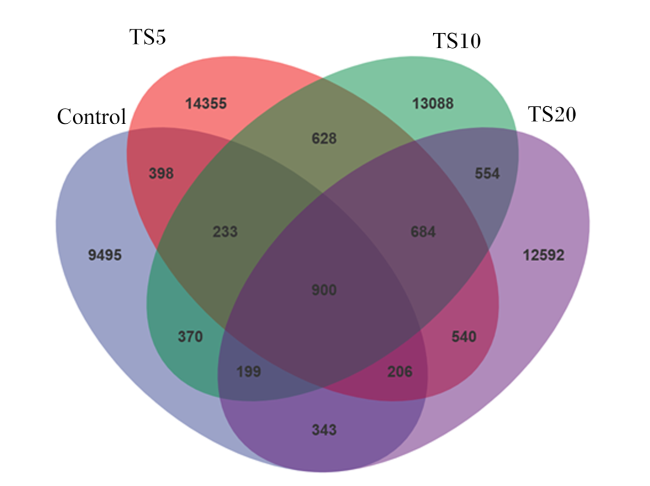
图1所示,对照组特有的物种操作分类单元(OTUs)为9 477个,占总OTUs数量的80.70%;TS5组特有OTUs数量为14 343个,占总OTUs数量的79.93%;TS10组特有OTUs数量为13 067个,占总OTUs数量的78.45%;TS20组特有OTUs数量为13 135个,占总OTUs数量的78.74%。
图1 OTUs个数统计图

Control、TS5、TS10、TS20分别代表对照组、TS5组、TS10组、TS20组。下图同。

Fig.1 Statistical graph of OTUs count

Control, TS5, TS10 and TS20 represented control group, TS5 group, TS10 group and TS20 group, respectively. The same as below.

2.5.2 饲粮不同比例番茄秸秆替代花生秧对肉兔盲肠微生物alpha多样性的影响
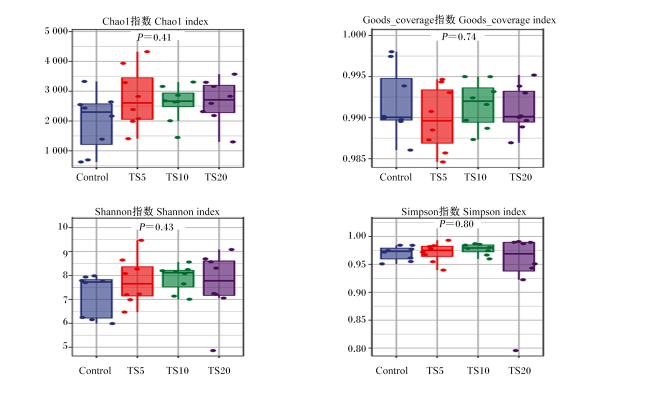
图2所示,与对照组相比,饲粮中番茄秸秆的添加对肉兔盲肠微生物的Chao1、Shannon、Simpson、Goods_coverage指数没有显著影响(P>0.05)。
图2 Alpha多样性分析

Fig.2 Alpha diversity analysis

2.5.3 饲粮不同比例番茄秸秆替代花生秧对肉兔盲肠微生物bate多样性的影响
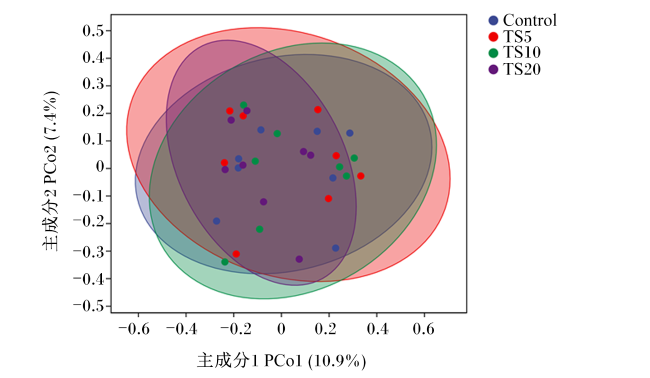
图3中每个点代表1个样本,不同颜色的点指示不同的分组,椭圆范围内置信率为95%。对照组与3个试验组之间样本距离差距不大,表明番茄秸秆的应用对肉兔盲肠微生物bate多样性的影响不明显。
图3 主成分分析

Fig.3 Principal component analysis

2.5.4 饲粮不同比例番茄秸秆替代花生秧对肉兔盲肠微生物结构的影响

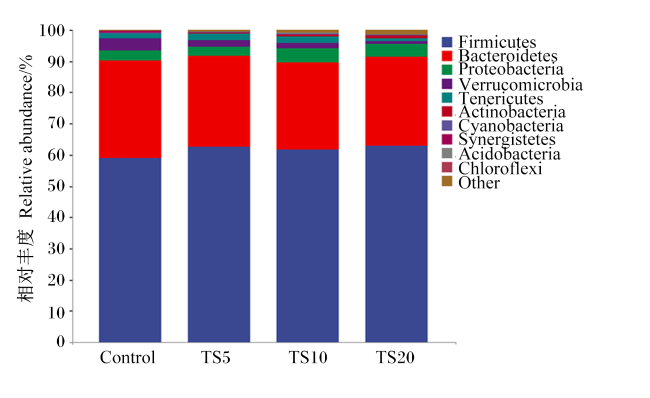
盲肠微生物结构在门水平上如图4所示,其中相对丰度前10位的有:厚壁菌门(Firmicutes)、拟杆菌门(Bacteroidetes)、变形菌门(Proteobacteria)、疣微菌门(Verrucomicrobia)、柔膜菌门(Tenericutes)、放线菌门(Actinobacteria)、蓝细菌(Cyanobacteria)、互养菌门(Synergistetes)、酸杆菌门(Acidobacteria)和绿弯菌门(Chloroflexi)。
图4 门水平组间群落差异分析

Firmicutes:厚壁菌门;Bacteroidetes:拟杆菌门;Proteobacteria:变形菌门;Verrucomicrobia:疣微菌门;Tenericutes:柔膜菌门;Actinobacteria:放线菌门;Cyanobacteria:蓝细菌;Synergistetes:互养菌门;Acidobacteria:酸杆菌门;Chloroflexi:绿弯菌门;Other:其他。

Fig.4 Analysis of community composition among groups at phylum level

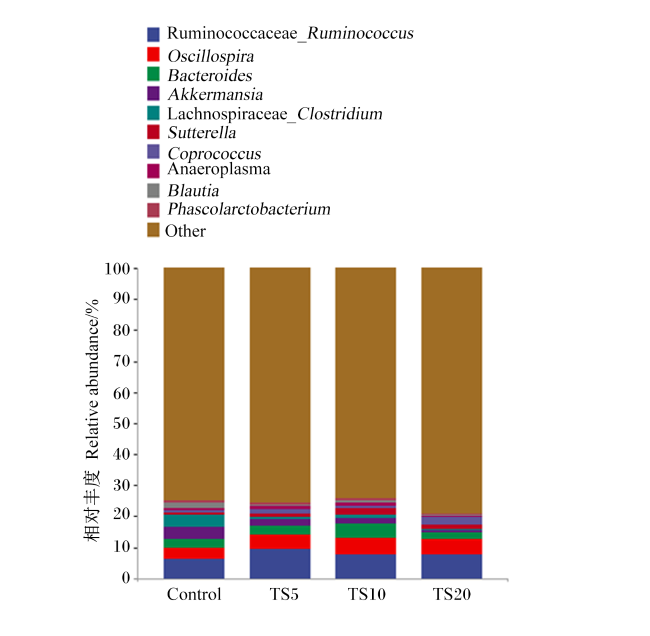
盲肠微生物结构在属水平上如图5所示,其中相对丰度前10位的有瘤胃球菌科瘤胃球菌属(Ruminococcaceae_Ruminococcus)、颤螺菌属(Oscillospira)、拟杆菌属(Bacteroides)、阿克曼菌属(Akkermansia)、毛螺菌科梭菌属(Lachnospiraceae_Clostridium)、萨特氏菌属(Sutterella)、粪球菌属(Coprococcus)、厌氧原体属(Anaeroplasma)、布劳特氏菌属(Blautia)和考拉杆菌属(Phascolarctobacterium)。
图5 属水平组间群落差异分析

Ruminococcaceae_Ruminococcus:瘤胃球菌科瘤胃球菌属;Oscillospira:颤螺菌属;Bacteroides:拟杆菌属;Akkermansia:阿克曼菌属;Lachnospiraceae_Clostridium:毛螺菌科梭菌属;Sutterella:萨特氏菌属;Coprococcus:粪球菌属;Anaeroplasma:厌氧原体属;Blautia:布劳特氏菌属;Phascolarctobacterium:考拉杆菌属;Other:其他。

Fig.5 Analysis of community composition among groups at genus level

3 讨论

3.1 饲粮不同比例番茄秸秆替代花生秧对肉兔生长性能的影响

饲粮的营养成分和适口性等因素是影响动物生长发育的重要原因[12]。蛋白质是机体功能性物质的重要组分也是组织生长和更新必不可缺的原料。当犊牛摄入的蛋白质水平不足时生长发育受到抑制,生产性能下降[13]。ADG和F/G是衡量肉兔生长性能的重要指标。本试验中不同比例番茄秸秆替代花生秧对肉兔ADFI影响不显著,但当替代比例为20%时,粗蛋白质表观消化率显著降低,伴随着ADG降低和F/G显著增加,这与前人的研究结果一致。番茄秸秆的应用使得肉兔死亡率和腹泻率产生一定程度的降低。这说明肉兔饲粮应用5%和10%的番茄秸秆没有对肉兔生长性能产生不利影响。

3.2 饲粮不同比例番茄秸秆替代花生秧对肉兔屠宰性能的影响

屠宰性能反映出畜禽身体组成和可食用部分的占比,是评价畜禽生产性能的重要指标[14]。本试验结果显示,饲粮不同比例番茄秸秆替代花生秧并未对肉兔屠宰率产生不利影响。兔肉具有高蛋白质、低脂肪、低热量的优点[15]。肉色和pH是兔肉评定的重要方式。一般认为,肉色中a*值越高,b*、L*值越低,则肉品质越好[16]。本试验研究结果显示,番茄秸秆添加对兔肉pH影响不显著但是显著影响肌肉b*值,替代水平为5%和10%时b*值明显增加,这提示番茄秸秆的添加有降低兔肉品质的风险。脏器指数是器官重量与宰前活重之比,能够在一定程度上反映该器官功能的强弱。胸腺和脾脏等免疫器官的脏器指数能够反映机体免疫机能[17]。本试验结果显示,饲粮不同比例番茄秸秆替代花生秧对肉兔肝脏、脾脏、胸腺和圆小囊指数没有显著影响,说明番茄秸秆的添加并未削弱以上器官的机能。

3.3 饲粮不同比例番茄秸秆替代花生秧对肉兔营养物质表观消化率及小肠组织形态的影响

小肠是消化吸收的主要场所,小肠长度能够在一定程度上反映肉兔的消化吸收能力[18]。与对照组相比,TS5组和TS10组小肠长度显著提高,同时中性洗涤纤维、粗脂肪和粗蛋白质表观消化率得到提升,这说明饲粮添加适量番茄秸秆能够促进肉兔小肠发育,增强其消化吸收能力。
Duan等[19]的研究表明,小肠的正常组织结构是维持其功能的基础,其中小肠绒毛高度增加能够增大与食糜接触面积,促进营养物质的吸收[20]。此外,绒毛高度/隐窝深度也对小肠吸收能力有明显影响,比值越大吸收能力越强[21]。本试验结果显示,与对照组相比,TS10组和TS20组肉兔空肠绒毛高度显著增加,中性洗涤纤维和粗脂肪表观消化率显著提高,这与前人的研究结果[22]一致。

3.4 饲粮不同比例番茄秸秆替代花生秧对肉兔盲肠微生物结构的影响

盲肠内微生物在增加营养成分的消化利用方面发挥重要作用,能够维持肠道健康提高生产性能。盲肠内微生物结构并非恒定不变,有研究证明,饲粮能够显著影响其组成比例[23]。本试验结果表明,在门水平上生长肉兔盲肠中优势菌群为厚壁菌门,其次为拟杆菌门,这与许多家兔盲肠微生物研究结果[24-25]一致。厚壁菌门有利于促进碳水化合物和蛋白质的吸收,帮助宿主获取能量,拟杆菌门能够促进木质素等难消化物质的降解[26],因此,厚壁菌门和拟杆菌门的相对稳定对维持肉兔肠道健康具有重要意义。本试验中,不同比例番茄秸秆替代饲粮花生秧在属水平上对肉兔盲肠微生物结构没有明显影响。

4 结论

本试验结果表明,饲粮中用5%~10%的番茄秸秆替代花生秧能够降低肉兔腹泻率和死亡率,对肉兔生长性能未产生不利影响,并且能够调节小肠发育和肠道绒毛形态,建议饲粮中番茄秸秆替代比例不超过10%。
[1]
孙永珍, 贺靖, 魏芳, 等. “十三五”我国番茄产业发展及其国际竞争力评价[J]. 中国瓜菜, 2023, 36(1):112-116.

SUN Y Z, HE J, WEI F, et al. Evaluation on the development and international competitiveness of China’s tomato industry during the 13th Five-Year Plan period[J]. China Cucurbits and Vegetables, 2023, 36(1):112-116. (in Chinese)

[2]
杨冬艳, 冯海萍, 谢华, 等. 不同有机肥添加对番茄秸秆堆肥腐熟品质质量的影响[J]. 内蒙古农业大学学报(自然科学版), 2020, 41(5):19-24.

YANG D Y, FENG H P, XIE H, et al. Effect of different organic fertilizers on the maturity quality of tomato straw compost[J]. Journal of Inner Mongolia Agricultural University(Natural Science Edition), 2020, 41(5):19-24. (in Chinese)

[3]
韩舒舒. 食粪行为对獭兔肠道菌群和生长发育的影响[D]. 硕士学位论文. 雅安: 四川农业大学, 2015.

HAN S S. Effects of caecolrophy on the gut microbiome and growth of rex rabbit[D]. Master’s Thesis. Ya’an: Sichuan Agricultural University, 2015. (in Chinese)

[4]
中华人民共和国农业农村部. 肉兔营养需要量:NY/T 4049—2021[S]. 北京: 中国农业出版社, 2021.

Ministry of Agriculture and Rural Affairs of the People’s Republic of China. Nutrient requirements of meat rabbit:NY/T 4049—2021[S]. Beijing: China Agriculture Press, 2021. (in Chinese)

[5]
国家市场监督管理总局, 中国国家标准化管理委员会. 饲料中粗蛋白的测定凯氏定氮法:GB/T 6432—2018[S]. 北京: 中国标准出版社, 2018.

State Administration for Market Regulation, Standardization Administration of the People’s Republic of China. Determination of crude protein in feeds-Kjeldahl method:GB/T 6432—2018[S]. Beijing: Standards Press of China, 2018. (in Chinese)

[6]
中华人民共和国国家质量监督检验检疫总局, 中国国家标准化管理委员会. 饲料中粗脂肪的测定:GB/T 6433—2006[S]. 北京: 中国标准出版社, 2006.

General Administration of Quality Supervision,Inspection and Quarantine of the People’s Republic of China, Standardization Administration of the People’s Republic of China. Determination of crude fat in feeds:GB/T 6433—2006[S]. Beijing: Standards Press of China, 2006. (in Chinese)

[7]
国家市场监督管理总局, 中国国家标准化管理委员会. 饲料中粗纤维的含量测定:GB/T 6434—2022[S]. 北京: 中国标准出版社, 2022.

State Administration for Market Regulation, Standardization Administration of the People’s Republic of China. Determination of crude fiber content in feeds:GB/T 6434—2022[S]. Beijing: Standards Press of China, 2022. (in Chinese)

[8]
中华人民共和国国家质量监督检验检疫总局, 中国国家标准化管理委员会. 饲料中粗灰分的测定:GB/T 6438—2007[S]. 北京: 中国标准出版社, 2007.

General Administration of Quality Supervision,Inspection and Quarantine of the People’s Republic of China, Standardization Administration of the People’s Republic of China. Animal feeding stuffs-determination of crude ash:GB/T 6438—2007[S]. Beijing: Standards Press of China, 2007. (in Chinese)

[9]
国家市场监督管理总局, 中国国家标准化管理委员会. 饲料中钙的测定:GB/T 6436—2018[S]. 北京: 中国标准出版社, 2018.

State Administration for Market Regulation, Standardization Administration of the People’s Republic of China. Determination of calcium in feeds:GB/T 6436—2018[S]. Beijing: Standards Press of China, 2018. (in Chinese)

[10]
国家市场监督管理总局, 中国国家标准化管理委员会. 饲料中总磷的测定分光光度法:GB/T 6437—2018[S]. 北京: 中国标准出版社, 2018.

State Administration for Market Regulation, Standardization Administration of the People’s Republic of China. Determination of phosphorus in feeds-spectrophotometry:GB/T 6437—2018[S]. Beijing: Standards Press of China, 2018. (in Chinese)

[11]
VAN SOEST P J, ROBERTSON J B, LEWIS B A. Methods for dietary fiber,neutral detergent fiber,and non-starch polysaccharides in relation to animal nutrition[J]. Journal of Dairy Science, 1991, 74(10):3583-3597.

[12]
齐大胜. 四种非常规粗饲料在家兔上的营养价值评定[D]. 硕士学位论文. 保定: 河北农业大学, 2014.

QI D S. Study on nutritional value in four kinds of unconventional roughage feed for rabbits[D]. Master’s Thesis. Baoding: Hebei Agricultural University, 2014. (in Chinese)

[13]
韩璐璐, 胡文昊, 孙玉伟, 等. 日粮粗蛋白质对反刍动物微生物区系及生产性能的影响[J]. 吉林畜牧兽医, 2023, 44(10):1-2.

HAN L L, HU W H, SUN Y W, et al. Effect of dietary crude protein on microflora and production performance of ruminants[J]. Jilin Animal Husbandry and Veterinary Medicine, 2023, 44(10):1-2. (in Chinese)

[14]
王惠影, 刘毅, 龚绍明, 等. 日粮能蛋水平对罗曼鹅生产、屠宰性能和养分消化率的影响[J]. 上海农业学报, 2017, 33(4):107-111.

WANG H Y, LIU Y, GONG S M, et al. Effects of energy and protein levels on the growth performance,slaughter performance and nutrient digestibility of Roman goose[J]. Acta Agriculturae Shanghai, 2017, 33(4):107-111. (in Chinese)

[15]
HALLIWELL B, WHITEMAN M. Measuring reactive species and oxidative damage in vivo and in cell culture:how should you do it and what do the results mean?[J]. British Journal of Pharmacology, 2004, 142(2):231-255.

[16]
陈旭东, 唐茂妍, 计成. 肉鸡肌肉品质的研究现状与趋势[J]. 中国家禽, 2008, 30(1):2-6.

CHEN X D, TANG M Y, JI C. Current situation and trend of meat quality research in broilers[J]. China Poultry, 2008, 30(1):2-6. (in Chinese)

[17]
唐丽, 郭志强, 雷岷, 等. 酵母培养物对肉兔生产性能、脏器指数和血液生化指标的影响[J]. 中国饲料, 2019(13):38-41.

TANG L, GUO Z Q, LEI M, et al. Effects of yeast culture on productive performance,slaughter performance,viscera indices and blood biochemistry of meat rabbit[J]. China Feed, 2019(13):38-41. (in Chinese)

[18]
YAMAUCHI K, TARACHAI P. Changes in intestinal villi,cell area and intracellular autophagic vacuoles related to intestinal function in chickens[J]. British Poultry Science, 2000, 41(4):416-423.

[19]
DUAN Q M, CHEN D W, YU B, et al. Effect of sialyllactose on growth performance and intestinal epithelium functions in weaned pigs challenged by enterotoxigenic Escherichia coli[J]. Journal of Animal Science and Biotechnology, 2022, 13(1):30.

[20]
CUMMINGS J H, MACFARLANE G T. Collaborative JPEN-clinical nutrition scientific publications role of intestinal bacteria in nutrient metabolism[J]. Journal of Parenteral and Enteral Nutrition, 1997, 21(6):357-365.

PMID

[21]
XU Q, JITKAEW S, CHOKSI S, et al. The cytoplasmic nuclear receptor RARγ controls RIP1 initiated cell death when cIAP activity is inhibited[J]. Nature Communications, 2017, 8(1):425.

DOI PMID

[22]
HEO J M, OPAPEJU F O, PLUSKE J R, et al. Gastrointestinal health and function in weaned pigs:a review of feeding strategies to control post-weaning diarrhoea without using in-feed antimicrobial compounds[J]. Journal of Animal Physiology and Animal Nutrition, 2013, 97(2):207-237.

[23]
ABECIA L, RODRÍGUEZ-ROMERO N, YAÑEZ-RUIZ D R, et al. Biodiversity and fermentative activity of caecal microbial communities in wild and farm rabbits from Spain[J]. Anaerobe, 2012, 18(3):344-349.

DOI PMID

[24]
刘静华, 吴峰洋, 周思源. 发酵精料对肉兔饲粮养分消化率、肠道发育及盲肠微生物多样性的影响[J]. 动物营养学报, 2023, 35(5):3237-3248.

DOI

LIU J H, WU F Y, ZHOU S Y, et al. Effects of fermented concentrate on dietary nutrient digestibility,lntestinal development and cecalmicrobial diversity of meat rabbits[J]. Chinese Journal of Animal Nutrition, 2023, 35(5):3237-3248. (in Chinese)

[25]
刘公言, 闫先峰, 吴志强, 等. 丁酸梭菌、葡萄糖氧化酶和迷迭香提取物组方对肉兔生长性能、屠宰性能、免疫功能和盲肠微生物区系的影响[J]. 动物营养学报, 2023, 35(9):5942-5953.

DOI

LIU G Y, YAN X F, WU Z Q, et al. Effects of clostridium butyricum,glucose oxidase and rosemary extract formulas on growthperformance,slaughter performance,lmmune function and cecal microflora of meat rabbits[J]. Chinese journal of animal nutrition, 2023, 35(9):5942-5953. (in Chinese)

[26]
THOMAS F, HEHEMANN J H, REBUFFET E, et al. Environmental and gut Bacteroidetes:the food connection[J]. Frontiers in Microbiology, 2011,2:93.

文章导航

/